

The future of digital health with federated learning
Open accessThe DOI matches its Crossref record; 75 of the 76 references it cites were found in a registry or an index, and 1 are not checked yet; 31 of the 51 sources its claims cite were checked for support.
Abstract
Data-driven machine learning (ML) has emerged as a promising approach for building accurate and robust statistical models from medical data, which is collected in huge volumes by modern healthcare systems. Existing medical data is not fully exploited by ML primarily because it sits in data silos and privacy concerns restrict access to this data. However, without access to sufficient data, ML will be prevented from reaching its full potential and, ultimately, from making the transition from research to clinical practice. This paper considers key factors contributing to this issue, explores how federated learning (FL) may provide a solution for the future of digital health and highlights the challenges and considerations that need to be addressed.
Verified 2026-11-25 · 1 reference not checked yet
Overview
CoChat Summary
TL;DR
This perspective paper argues that federated learning (FL) is a promising way to train medical AI across institutions without centralizing sensitive data, potentially improving accuracy, robustness, and privacy in digital health. It also emphasizes that FL does not remove core challenges such as data heterogeneity, privacy leakage, and the need for standardization and governance.
Key findings
- FL is presented as a learning paradigm that lets multiple parties train collaboratively without exchanging or centralizing datasets, by moving the model to the data rather than the data to the model.
- The paper states that recent research has shown FL models can achieve performance comparable to centrally hosted data sets and superior to models trained on isolated single-institution data.
- Reported application areas already include EHR tasks such as finding clinically similar patients and predicting hospitalizations due to cardiac events, mortality, and ICU stay time, as well as medical imaging tasks such as whole-brain segmentation, brain tumor segmentation, and fMRI classification.
- Concrete initiatives mentioned include a collaboration across 4 hospitals in France (HealthChain), an international federation of 30 healthcare institutions (FeTS), and a project across 10 pharmaceutical companies (Melloddy).
Methods
- Not stated in the paper.
- The article is a perspective/consensus paper rather than an empirical study; it synthesizes prior work and examples to discuss FL’s promise, current uses, and technical considerations.
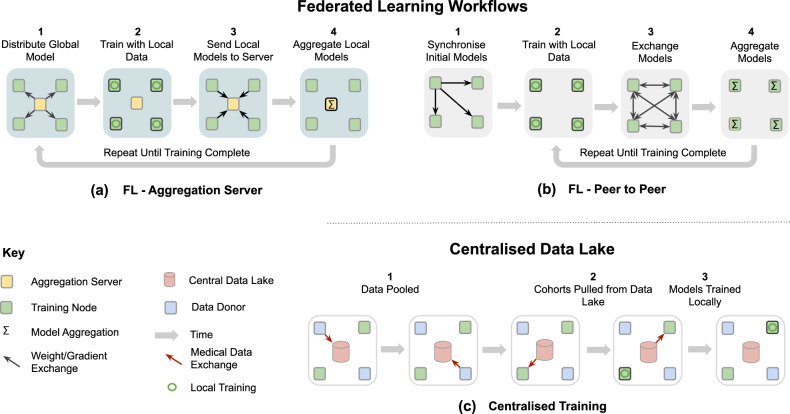
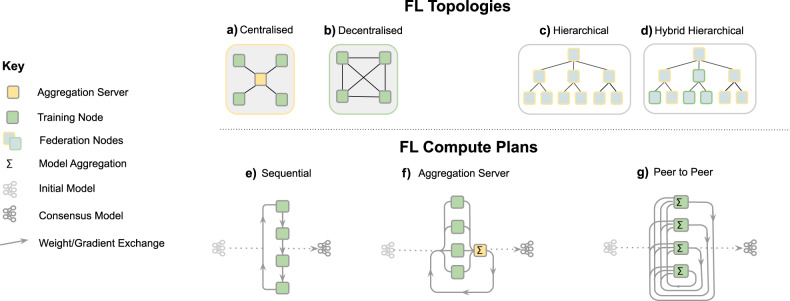
- The text describes FL workflows, including aggregation-server and peer-to-peer topologies, and discusses mechanisms such as FedAvg, FedProx, domain adaptation, and differential privacy at a conceptual level.
Limitations
- The paper explicitly states that FL does not solve all issues inherent to learning on medical data; success still depends on data quality, bias, and standardization.
- It states that FL does not eliminate privacy risks: models can still memorize information, and gradients/model updates may leak private data through inversion or adversarial attacks.
- Evident from the text: this is a perspective article, so it does not report original experimental results, sample sizes, or statistical testing.
Model-written summary. Check it against the paper before relying on it.
Integrity signals
Registry
Cites
Statistics
Figures
Verification
Claims the paper makes
16 Valid · 0 Not valid · 4 Not checked · 19 Own results and interpretations
The cited sources support only part of this claim — read each source’s verdict below.
In the paper
“Modern DL models feature millions of parameters that need to be learned from sufficiently large curated data sets in order to achieve clinical-grade accuracy, while being safe, fair, equitable and generalising well to unseen data2–5.”
§ The future of digital health with federated learning > Introduction
What the sources say
- Not checked — no full text of the sourcecites [2] Wang F Casalino LP Khullar D Deep learning in medicine—promise, progress, and challenges JAMA Intern. Med. 2019 179 293 294 10.1001/jamainternmed.2018.7117 30556825 source
- Not checked — no full text of the sourcecites [3] Chartrand G Deep learning: a primer for radiologists Radiographics 2017 37 2113 2131 10.1148/rg.2017170077 29131760 source
- Partly supportedcites [4] De Fauw J Clinically applicable deep learning for diagnosis and referral in retinal disease Nat. Med. 2018 24 1342 10.1038/s41591-018-0107-6 30104768 sourceExperimental — accuracy not yet measured
Split into 2 atoms — 0 confirmed, 2 partially supported, 0 disputed, 0 misattributed, 0 unverifiable. Expand the claim to see per-atom verdicts.
- Partly supportedcites [5] Sun, C., Shrivastava, A., Singh, S. & Gupta, A. Revisiting unreasonable effectiveness of data in deep learning era. In Proceedings of the IEEE international conference on computer vision, 843–852 (IEEE, 2017). sourceExperimental — accuracy not yet measured
Split into 2 atoms — 0 confirmed, 2 partially supported, 0 disputed, 0 misattributed, 0 unverifiable. Expand the claim to see per-atom verdicts.
plainstates a cause- Asserted: passes — The authors put it forward as true.
- Checkable: passes — It can be checked against evidence.
- Load-bearing: passes — The paper’s conclusions depend on it.
- Based: passes — The paper gives a reason why it holds.
The cited sources support only part of this claim — read each source’s verdict below.
In the paper
“Existing medical data is not fully exploited by ML primarily because it sits in data silos and privacy concerns restrict access to this data.”
§ The future of digital health with federated learning > Abstract
What the sources say
- Partly supportedcites [6] Van Panhuis WG A systematic review of barriers to data sharing in public health BMC Public Health 2014 14 1144 10.1186/1471-2458-14-1144 25377061 PMC4239377 sourceExperimental — accuracy not yet measured
The Background describes routinely collected public-health data as underused, and Results > Legal barriers says privacy concerns can lead to restrictive data-access policies. Results > Technical barriers describes difficulties integrating datasets. The paper does not establish that machine learning is the affected use or that data silos and privacy are the primary reasons medical data is underexploited. (LLM, conf=0.87)
- Partly supportedcites [7] Rocher L Hendrickx JM De Montjoye Y-A Estimating the success of re-identifications in incomplete datasets using generative models Nat. Commun. 2019 10 1 9 10.1038/s41467-019-10933-3 31337762 PMC6650473 sourceExperimental — accuracy not yet measured
The Introduction (page not provided) says medical and other personal data can advance AI, while privacy concerns affect its collection, use, and sharing. It does not say that medical data sits in silos or that silos and privacy restrictions are the primary reasons ML underuses it. (LLM, conf=0.85)
plainstates a cause- Asserted: passes — The authors put it forward as true.
- Checkable: passes — It can be checked against evidence.
- Load-bearing: passes — The paper’s conclusions depend on it.
- Based: passes — The paper gives a reason why it holds.
- Partly supported
The cited sources support only part of this claim — read each source’s verdict below.
In the paper
“The more rounds of local training are performed, the less it is guaranteed that the overall procedure is minimising (Eq. 1)9,12.”
§ The future of digital health with federated learning > Technical considerations > Federated learning definition
What the sources say
- Partly supportedcites [9] McMahan, B., Moore, E., Ramage, D., Hampson, S. & y Arcas, B. A. Communication-efficient learning of deep networks from decentralized data. In Artificial Intelligence and Statistics, 1273–1282. https://scholar.google.de/scholar?hl=de&as_sdt=0%2C5&q=Communicationefficient+learning+of+deep+networks+from+decentralized+data&btnG= (2017). sourceExperimental — accuracy not yet measured
The Experimental Results (p. 7) report that with very many local epochs, FedAvg can plateau or diverge on the Shakespeare LSTM task. But they also report no significant convergence degradation for large numbers of local epochs on the MNIST CNN, so the paper does not establish a general rule that more local training makes minimisation of the global loss less assured. (LLM, conf=0.86)
- Supportedcites [12] Kairouz, P. et al. Advances and open problems in federated learning. arXiv preprint arXiv:1912.04977 (2019). source
Section 3.2.1 states that more local updates increase divergence between client models and slow convergence of the training loss. Section 3.2.2 also reports more restrictive convergence bounds for local updates with non-IID data. Together, these support the claim that increasing local training weakens convergence assurances for the global loss. (LLM, conf=0.86)
plainstates a cause- Asserted: passes — The authors put it forward as true.
- Checkable: passes — It can be checked against evidence.
- Load-bearing: unclear — It is unclear whether the paper’s conclusions depend on it.
- Based: passes — The paper gives a reason why it holds.
- Partly supported
A conclusion the paper draws from its own results — it cites no other source for it, so there is none to check. The quote shows it is in the paper.
In the paper
“By linking healthcare institutions, not restricted to research centres, FL can have direct clinical impact.”
§ The future of digital health with federated learning > Data-driven medicine requires federated efforts > Current FL efforts for digital health
plainstates a possible cause- Asserted: passes — The authors put it forward as true.
- Checkable: passes — It can be checked against evidence.
- Load-bearing: passes — The paper’s conclusions depend on it.
- Based: passes — The paper gives a reason why it holds.
A conclusion the paper draws from its own results — it cites no other source for it, so there is none to check. The quote shows it is in the paper.
In the paper
“FL enables collaborative research for, even competing, companies.”
§ The future of digital health with federated learning > Data-driven medicine requires federated efforts > Current FL efforts for digital health
plainstates a cause- Asserted: passes — The authors put it forward as true.
- Checkable: passes — It can be checked against evidence.
- Load-bearing: unclear — It is unclear whether the paper’s conclusions depend on it.
- Based: passes — The paper gives a reason why it holds.
14 references still to check
A free account verifies the references that are still open.
- Probably not a substantial claim. 19
- It may state two separate claims as one. 32
- The quote only partly states this claim. 1
Claims other papers make about this one
Each is checked against this paper’s own text: does it say what the citing paper says it does?
The source backs part of the claim, not all of it — or backs it for a different population, condition or comparison.
In the citing paper
“This is currently addressed by sharing multi-site data, but such centralization is challenging/infeasible to scale due to various limitations.”
From Federated learning enables big data for rare cancer boundary detection (2022) · cites this paper as [10]
Experimental — accuracy not yet measuredThe source backs part of the claim, not all of it — or backs it for a different population, condition or comparison.
In the citing paper
“However, these methods often come with trade-offs in accuracy and computational efficiency.”
From The role of multimodality in clinical disease diagnosis: advances, challenges, and opportunities (2026) · cites this paper as [34]
Experimental — accuracy not yet measuredThe source backs part of the claim, not all of it — or backs it for a different population, condition or comparison.
In the citing paper
“The experts in healthcare and life sciences can use FL to solve the unique problem of data governance by training algorithms behind the hospital's firewall and only sharing models so that data remain secure [31].”
From A comprehensive survey on federated learning techniques for healthcare informatics (2023) · cites this paper as [31]
Experimental — accuracy not yet measuredThe source backs part of the claim, not all of it — or backs it for a different population, condition or comparison.
In the citing paper
“It also improves patient privacy and reduces low latency during the collaboration of multiple hospitals/entities [7].”
From Handling privacy-sensitive medical data with federated learning: Challenges and future directions (2023) · cites this paper as [7]
Experimental — accuracy not yet measuredThe source backs part of the claim, not all of it — or backs it for a different population, condition or comparison.
In the citing paper
“Enabling privacy protected data sharing across clinical centers is advocated as an essential pathway to promote collaborations internationally yet underexplored so far6,7.”
From Federated deep learning for detecting COVID-19 lung abnormalities in CT: a privacy-preserving multinational validation study (2021) · cites this paper as [7]
Experimental — accuracy not yet measured
27 more claims about this paper
Create a free account to see every claim other papers make about this one.
Citations
Cites
LeCun, Y., Bengio, Y., & Hinton, G. (2015) · Nature · doi:10.1038/nature14539 · Cited by 84,126
Communication-Efficient Learning of Deep Networks from Decentralized Data
McMahan, H. B., Moore, E., Ramage, D., Hampson, S., & Arcas, B. A. Y. (2016) · arXiv · doi:10.48550/arxiv.1602.05629 · Cited by 14,215
Sudlow, C., Gallacher, J., Allen, N., Beral, V., Burton, P., Danesh, J., Downey, P., Elliott, P., Green, J., Landray, M., et al. (2015) · PLOS Medicine · doi:10.1371/journal.pmed.1001779 · Cited by 12,728 · cited 2×
“Substantial, albeit smaller, initiatives include the Human Connectome25, the UK Biobank26, the Cancer Imaging Archive (TCIA)27, NIH CXR828, NIH DeepLesion29, the Cancer Genome Atlas (TCGA)30, the Alzheimer’s Disease Neuroimaging Initiative (ADNI)31, as well as medical grand challenges32 such as the CAMELYON challenge3…”
BackgroundAdvances and Open Problems in Federated Learning
Kairouz, P., McMahan, H. B., Avent, B., Bellet, A., Bennis, M., Bhagoji, A. N., Bonawitz, K., Charles, Z., Cormode, G., Cummings, R., et al. (2019) · arXiv · doi:10.48550/arxiv.1912.04977 · Cited by 7,857
Advances and Open Problems in Federated Learning
Kairouz, P., & McMahan, H. B. (2021) · Foundations and Trends in Machine Learning · doi:10.1561/2200000083 · Cited by 7,772
The multimodal brain tumor image segmentation benchmark (BRATS)
Menze, B. H., Jakab, A., Bauer, S., Kalpathy-Cramer, J., Farahani, K., Kirby, J., Burren, Y., Porz, N., Slotboom, J., Wiest, R., et al. (2015) · IEEE Transactions on Medical Imaging · doi:10.1109/tmi.2014.2377694 · Cited by 6,781
Deep Learning with Differential Privacy
Abadi, M., Chu, A., Goodfellow, I., McMahan, H. B., Mironov, I., Talwar, K., & Zhang, L. (2016) · Proceedings of the 2016 ACM SIGSAC Conference on Computer and Communications Security · doi:10.1145/2976749.2978318 · Cited by 6,578 · cited 2×
“Countermeasures, such as limiting the granularity of the shared model updates and to add specific noise to ensure differential privacy [34, 12, 57] may be needed and is still an active area of research [14].”
BackgroundMethodFederated Machine Learning: Concept and Applications
Yang, Q., Liu, Y., Chen, T., & Tong, Y. (2019) · ACM Transactions on Intelligent Systems and Technology · doi:10.1145/3298981 · Cited by 6,322 · cited 4×
“d FL approaches are still under development. 3 Technical Considerations FL is perhaps best-known from the work of Konecnˇ y` et al. [36], but various other definitions have been proposed in literature [14, 11, 15, 9]. These approaches can be realised via different communication architectures (see Figure 1) and respecti…”
BackgroundInfluentialFederated learning: Challenges, methods, and future directions
Li, T., Sahu, A. K., Talwalkar, A., & Smith, V. (2020) · IEEE Signal Processing Magazine · doi:10.1109/msp.2020.2975749 · Cited by 6,210 · cited 3×
“However, there is a trade-off in terms of performance and these techniques may affect for example the accuracy of the final model [10].”
BackgroundMethodShin, H.-C., Roth, H. R., Gao, M., Lu, L., Xu, Z., Nogues, I., Yao, J., Mollura, D., & Summers, R. M. (2016) · IEEE Transactions on Medical Imaging · doi:10.1109/tmi.2016.2528162 · Cited by 5,759
Self-citation
Cited by
Items 2,701–2,800 of 3,132
Curtis, J. R., Holladay, E. E., Mehta, T. S., & Osborne, J. D. (2026) · Rheumatic Disease Clinics of North America · doi:10.1016/j.rdc.2026.05.001
107Chapter 6 AI in Biomedical Imaging: A New Era of Precision and Insight
Sharma, N., Mukhopadhyay, G., Kumar, V. D., Sharma, V., Sheikh, I., Sharma, A. V., Sharma, A. V., Bansal, P., Sharma, V., & Joshi, A. (2026) · De Gruyter eBooks · doi:10.1515/9783112214275-006
57Chapter 4 AI-Enhanced Drug Discovery and Development
Verma, P., Duhan, P., Bansal, P., Verma, K. S., Mohan, N., & Kumar, P. (2026) · De Gruyter eBooks · doi:10.1515/9783112214275-004
Saini, S., Saini, M., Tuli, H. S., Saini, J., Nagpal, S., Duhan, P., & Bansal, P. (2026) · De Gruyter eBooks · doi:10.1515/9783112214275-015
Manikandan, M., Mithaguru, Lakshmanan, M., Sriramkumar, R., Dhanraj, J. A., & Godhandaraman, T. (2026) · International conference Computer Networks and Inventive Communication Technologies · doi:10.1109/iccnct68477.2026.11590090
Sirdar, A., Habis, H. A., & Brahimi, T. (2026) · Learning and Technology Conference (L&T) · doi:10.1109/lt68265.2026.11592550
Fundamentals of Artificial Intelligence in Drug Discovery and Healthcare
Fakhoury, N. (2026) · Springer eBooks · doi:10.1007/978-3-032-19536-4_2
Federated Brain Tumour MRI Classification via Performance-Weighted Model Aggregation
Haripriya, R., Soni, A., Khare, N., & Pandey, M. (2026) · Procedia Computer Science · doi:10.1016/j.procs.2026.06.386
Daly, A., Fotouhi, A., & Metral, T. (2026) · International Convention on Information and Communication Technology, Electronics and Microelectronics · doi:10.1109/mipro70003.2026.11591794
Singh, S. K., Kumari, S., Kumar, S., & Sharma, S. K. (2026) · IEEE International Conference on Computing, Power and Communication Technologies (IC2PCT) · doi:10.1109/ic2pct68894.2026.11584385
Bibliometrics Analysis for Exploring Scientific Evaluation of Federated Learning in Medical Images
Salaria, A., Khullar, V., Panda, S. N., & Chawla, M. (2026) · Procedia Computer Science · doi:10.1016/j.procs.2026.05.068
Perillo, G., Tramontano, A., Tamburis, O., et al. (2026) · Lecture notes on data engineering and communications technologies · doi:10.1007/978-3-032-30573-2_16
Synthetic Model Aggregation Strategies in Federated Learning: Cloning and Crossover-Based Approaches
Fusco, P., Amato, A., Venticinque, S., et al. (2026) · Lecture notes on data engineering and communications technologies · doi:10.1007/978-3-032-30573-2_10
Efficient Backdoor Mitigation in Federated Learning With Contrastive Loss
Ferguson, H. C., Ning, R., Wu, H., Zhu, L., Xin, C., Uddin, M. S., & Li, J. (2026) · IEEE Internet of Things Journal · doi:10.1109/jiot.2026.3711587
AI agents in drug discovery: A review of evolution, applications, and future directions
Das, S., Ferdaus, M. M., & Dam, T. (2026) · Computer Methods and Programs in Biomedicine · doi:10.1016/j.cmpb.2026.109539 · Cited by 2
Yeo, J., So, E. S., & Youm, S. (2026) · International Journal of Medical Informatics · doi:10.1016/j.ijmedinf.2026.106597 · Cited by 1
Sаpаyev, V., Aarthi, S., Sevara, T., Ravikumar, R. N., Urozboev, K., & Avazbek, R. (2026) · Advances in computational intelligence and robotics book series · doi:10.4018/979-8-3373-4962-6.ch013
Federated Computing in Orthopaedic Surgery: A Paradigm Shift in Collaborative Multicenter Research
Hill, B. G., Nyul, T. E., Moschetti, W. E., & Schilling, P. L. (2026) · Journal of Bone and Joint Surgery · doi:10.2106/jbjs.25.01034 · Cited by 1
A Distributed Deep Learning Architecture for Cloud Continuum Deployment in a E-health Scenario
Sarcina, F., Martino, B. D., Guarrasi, V., & Soda, P. (2026) · Lecture notes on data engineering and communications technologies · doi:10.1007/978-3-032-30573-2_18 · Cited by 2
Federated Learning for Brain Tumor Classification in Distributed Healthcare Systems
Yayavaram, N., Gera, J., Inturi, G., et al. (2026) · IEEE International Conference on Computational Intelligence and Communication Networks (CICN) · doi:10.1109/cicn70047.2026.11594183
Privacy Preserving using Decentralized Federated Learning with Partial Dense-layer Weight Sharing
Nabha, R. A., Laouiti, A., & Samhat, A. E. (2026) · International Journal of Information Security · doi:10.1007/s10207-026-01288-0
Federated learning from molecules to processes: A perspective
Rittig, J. G., & Kortmann, C. (2026) · Chemical Engineering Research and Design · doi:10.1016/j.cherd.2026.07.011 · Cited by 4
Zhou, H., Kong, J., & Li, Y. (2026) · Research Square · doi:10.21203/rs.3.rs-10229272/v1
Yan, M., Wang, Z., Ning, L., Xuan, J., Zhang, Z., Li, H., Wang, Y., Li, M., Niu, G., Bermejo, I. H., et al. (2026) · International Journal of Radiation Oncology*Biology*Physics · doi:10.1016/j.ijrobp.2026.06.3083
Coupland, S. E., Rao, A., Jonigk, D., Bülow, R. D., Chetty, R., Rane, S. U., Dave, S., & Naresh, K. N. (2026) · Journal of Clinical Pathology · doi:10.1136/jcp-2026-210720
Biobank-scale genotype similarity search and dynamic patient-matched cohort creation with GenoSiSPreprint
Schneider, K., Chowdhury, M., Tepper, M., Khan, J. B., Shortt, J., Gignoux, C. R., & Layer, R. M. (2026) · Genome Research · doi:10.1101/gr.280278.124
Reproducibility and Validation Challenges in AI-Driven Scaffold Design for Bone Regeneration
Damsaz, M., Laybidi, F. H., Moradipour, Z., Sobhani, H., Shavali, N., Nayeh, M. M. R., Gholami, E., Dolatabadi, A., Raee, A., & Hooshiar, M. H. (2026) · Tissue Engineering Part B Reviews · doi:10.1177/19373368261467436
Liu, H., Tian, H., Cheng, X., Shi, F., Nikolić, S. V., & Zhang, J. (2026) · Optoelectronics Letters · doi:10.1007/s11801-026-3227-0 · Cited by 1
Xu, J., Jin, L., & Su, C. (2026) · Lecture notes in computer science · doi:10.1007/978-3-032-16168-0_3
Yu, Y., & Zhang, J. (2026) · Korean Journal of Radiology · doi:10.3348/kjr.2025.1963
Building Patient Digital Twins: Data Foundations and Integration Pathways
Patra, A., Dutta, P. K., Bhattacharya, P., & Moezzi, R. (2026) · Springer tracts in additive manufacturing · doi:10.1007/978-3-032-21869-8_19
Smart Healthcare Systems Using Autonomous Diagnostic Agents
Kaur, K., Arya, P. K., Garg, R., Chaudhary, A., Rajpurohit, J., & Kumar, A. (2026) · Lecture notes in networks and systems · doi:10.1007/978-3-032-26376-6_17
Deng, H., Yan, Y., & Tong, L. (2026) · IEEE International Conference on Communications workshops · doi:10.1109/iccworkshops63917.2026.11586578
FedNLC: Personalized Federated Learning via Inverse-Norm Weighted Aggregation with Local Calibration
Cao, Y., Yan, Q., Lin, H., et al. (2026) · Lecture notes in computer science · doi:10.1007/978-981-92-3485-1_14
Nordic AI-Health: a unique opportunity for discovery and clinical impact
Andreassen, O. A., Heimer, H., Brunak, S., et al. (2026) · The Lancet Regional Health - Europe · doi:10.1016/j.lanepe.2026.101769
FedBIBD: Balanced Incomplete Block Design for Fair Practical Federated Learning
Ramesh, D., Upadhyay, A. K., & Dutta, V. (2026) · IFIP advances in information and communication technology · doi:10.1007/978-3-032-30805-4_16
LEO-DPSL: An Efficient Split Learning Framework for AI Tasks over LEO Satellite Networks
Yang, R., Zhang, S., & Yan, S. (2026) · IEEE International Conference on Communications workshops · doi:10.1109/iccworkshops63917.2026.11586538
Gowtham, M., & P, L. M. (2026) · International Conference on Emerging Research in Smart Electronics and Machine Informatics (ECMI) · doi:10.1109/ecmi68341.2026.11603213
Ahmed, S., & Vacchani, D. (2026) · International Conference on Secure Cyber Computing and Communications (ICSCCC) · doi:10.1109/icsccc69031.2026.11600033
Privacy-Preserving Intrusion Detection Using Federated Learning Architecture
Patel, H. S., Gautam, C. S., & Waoo, A. A. (2026) · International Conference on Secure Cyber Computing and Communications (ICSCCC) · doi:10.1109/icsccc69031.2026.11600054 · Cited by 1
Genetic Programming in Federated Aggregation: A Comparison of FedGP with State of the Art Methods
Pacioni, E., Muller, C., de Vega, F. F., & Calvaresi, D. (2026) · Lecture notes in computer science · doi:10.1007/978-3-032-25035-3_26 · Cited by 1
Federated Learning in Smart Healthcare: Enhancing Privacy and Efficiency in Medical Data Analysis
K.Anitha, & Parthasarathy, R. (2026) · Advances in computational intelligence and robotics book series · doi:10.4018/979-8-2600-3070-7.ch004
Ushanandhini, M. (2026) · IGI Global eBooks · doi:10.4018/979-8-3373-7976-0.ch007
Differentially Private and Explainable Federated Learning for ICU Mortality Prediction
Shaik, S., Nageswararao, M., & Krishnaiah, K. R. (2026) · International Conference on Secure Cyber Computing and Communications (ICSCCC) · doi:10.1109/icsccc69031.2026.11600079
Any, T. S., Manna, A., ISLAM, M. S., Yaduvanshi, A. P., Neogi, S., Dash, A. R., & Saha, T. (2026) · International Journal of Latest Technology in Engineering Management & Applied Science · doi:10.51583/ijltemas.2026.150600149
Asynchronous proximal federated aggregation for heterogeneous healthcare networks
Sreelakshmi, M., & Delhibabu, R. (2026) · Frontiers in Digital Health · doi:10.3389/fdgth.2026.1879670
Application of deep learning in prognostic prediction of non-small cell lung cancer
Lun, X. (2026) · Frontiers in Cell and Developmental Biology · doi:10.3389/fcell.2026.1878798
Aryeetey, E. O., & Garg, L. (2026) · Lecture notes in computer science · doi:10.1007/978-3-032-19981-2_11
Jere, N. R., Aruleba, K., Komolafe, K. H., et al. (2026) · Springer proceedings in complexity · doi:10.1007/978-3-032-21524-6_28
Comprehensive Review on Federated Learning for Real-Time Cardiac Monitoring in IoMT Systems
Mohammed, A. H. F., Nagamalla, V., Rao, K. R., Reddy, P. V., Yenna, G. R., & Mali, M. (2026) · International Conference on Innovations in Cybersecurity and Data Science (ICICDS) · doi:10.1109/icicds70526.2026.11604633
Thompson, D., Mitchell, S., Adams, R., & Brown, J. (2026) · International Journal of Pharmaceutical and Phytopharmacological Research · doi:10.51847/chwxtuymdo
Song, D., Guo, J., Rao, X., Hu, X., Gu, X., & Chen, J. (2026) · Journal of Intelligence · doi:10.3390/jintelligence14070150
Kovács, Z., Szabo, K., & Nagy, G. (2026) · International Journal of Pharmaceutical and Phytopharmacological Research · doi:10.51847/y0yunxq0gg
Çifçi, M. A., & Canatalay, P. J. (2026) · Machine Learning and Knowledge Extraction · doi:10.3390/make8070213
Buzea, C. G., & Agop, M. (2026) · Artificial intelligence · doi:10.5772/intechopen.1014563
Desai, S. P., Hori, Y. S., Lam, F. C., Zagzoog, N., Kalra, N., Tayag, A. T., Ustrzynski, L., Emrich, S. C., Gu, X., Park, D. J., et al. (2026) · Journal of Clinical Neuroscience · doi:10.1016/j.jocn.2026.112210
Liu, X., Garg, M., Jeon, E., Jia, H., Crowson, C. S., Sauver, J. L. S., Pagali, S. R., & Sohn, S. (2026) · JAMIA Open · doi:10.1093/jamiaopen/ooag139 · Cited by 1
Decentralized Machine Learning in Healthcare: Federated Learning for IoMT and Beyond
MUGIGAYI, F., Karacan, H., Alli, A. A., Ali, A. B., & Mwondi, L. A. (2026) · International Symposium on AI-Driven Engineering Systems (ISADES) · doi:10.1109/isades69945.2026.11608204
Jizani, M. K. S. A., & Stâmâtescu, G. (2026) · IEEE Access · doi:10.1109/access.2026.3715515
Deligiannis, P., Kouidis, I.-A., Theofanous, A., Anifanti, M., Deligiannis, A. P., & Kouidi, E. J. (2026) · Healthcare · doi:10.3390/healthcare14142219
The use of artificial intelligence in advancing molecular biology in Africa: a narrative review
Awuah, D., Hounkpe, A., Anane-Asamoah, J., Dakubo, W. K., Adu, I. K., Barnie, P. A., Ansah, E. O., Fosu, K., Aidoo, C. O., Essien, V., et al. (2026) · Molecular Genetics and Genomics · doi:10.1007/s00438-026-02492-2
Suwito, M. H., Gunardi, Y., Santoso, H., et al. (2026) · doi:10.1109/icoeins69996.2026.11605862
Fang, S.-S., & Chen, S.-H. (2026) · The Egyptian Journal of Radiology and Nuclear Medicine · doi:10.1186/s43055-026-01820-1
Zhang, H., Xu, Y., Zhang, W., Choudhary, S., Alam, M. Z., Nguyen, L. D., Klein, M., Vangala, S., Miller, J. K., Johnson, E. G., et al. (2026) · Light Science & Applications · doi:10.1038/s41377-026-02375-6
The Digital Pulse: The AI Transformation of Disease Prediction and Preventive Care
Khirwadkar, P., Mehata, D., Sharma, A., Singh, S., & Bhonsale, K. (2026) · IEEE International Conference on Intelligent Technologies for a Sustainable and Inclusive Future (ICITSIF) · doi:10.1109/icitsif69060.2026.11608479
Omar, A. M., Omisade, A., Gallivan, J. P., & Winston, G. P. (2026) · Journal of Neural Engineering · doi:10.1088/1741-2552/ae8eb1
Mahapatra, C. (2026) · Artificial intelligence · doi:10.5772/intechopen.1015689
Xu, T., & Leung, H. (2026) · Conference proceedings - Canadian Conference on Electrical and Computer Engineering · doi:10.1109/ccece68150.2026.11610166
Lessons from federated networks for implementing the European health data space. Empirical study
Kogut-Czarkowska, M., & Shabani, M. (2026) · Digital Health · doi:10.1177/20552076261466806 · Cited by 1
State of the art artificial intelligence assisted disease detection tools
Das, S. K., Mishra, R., Samanta, A., Roy, S. D., & Sahoo, U. (2026) · Elsevier eBooks · doi:10.1016/b978-0-443-43934-6.00021-3
Li, J., An, X., Jing, Z., & Li, Y. (2026) · Transfusion Medicine · doi:10.1111/tme.70105
Ethical issues of artificial intelligence in biomedical applications
Chakraborty, S. (2026) · Elsevier eBooks · doi:10.1016/b978-0-443-43934-6.00037-7
Quantum artificial intelligence for human health: A statistical framework
Hassani, H., Mashhad, L. M., & MacFeely, S. (2026) · Elsevier eBooks · doi:10.1016/b978-0-443-43934-6.00039-0
Artificial Intelligence in Public Health: Opportunities, Challenges, and the Path Forward
Kulkarni, H. (2026) · Journal of GMC Nagpur · doi:10.5005/jgmc-11030-0028
Song, J., Tao, W., Zhou, D., 李轩宾, Peng, S., Li, C., & Yuan, J. (2026) · Medicine · doi:10.1097/md.0000000000049815 · Cited by 1
Mapping the Intellectual Landscape of Personalized Federated Learning: A Bibliometric Analysis
Sabah, F., Chen, Y., Yang, Z. L., Azam, M., Ahmad, N., & Sarwar, R. (2026) · SN Computer Science · doi:10.1007/s42979-026-05201-3
Artificial intelligence in assisted reproduction: Navigating the next frontier in fertility care
Chakraborty, P., Nandi, P., & Rahman, S. M. (2026) · Elsevier eBooks · doi:10.1016/b978-0-443-43934-6.00002-x
Attallah, S. B., Atta, R. A., Abduljabbar, Z. A., Naseef, R. S., Abdulmohsin, A. S., Mukhtar, A. M., Kadhim, M. N., Rasheed, B. S., & Nyangaresi, V. O. (2026) · International Conference on Electronics, Computers and Artificial Intelligence (ECAI) · doi:10.1109/ecai69016.2026.11613720 · Cited by 1
Periyasamy, T. S., Sekar, N., & Lakshmanan, H. (2026) · Journal of Alzheimer s Disease · doi:10.1177/13872877261471812
Nkansah, E., Oladosu, M. A., Abah, M. A., & Oladosu, O. A. (2026) · International Journal of Preventive Medicine and Health · doi:10.54105/ijpmh.e1162.06050726
Palermi, S., Saglietto, A., D’Ascenzo, F., Ferrari, G. M. D., Bruno, F., Tse, G., Kizilkilic, S. E., Tjong, F. V. Y., Ruipérez-Campillo, S., Keser, N., et al. (2026) · Progress in Cardiovascular Diseases · doi:10.1016/j.pcad.2026.07.005 · Cited by 2
Kinzhebay, A., Zhanymbetova, A., & Salybekov, A. A. (2026) · IntechOpen eBooks · doi:10.5772/intechopen.1016046
Manikandaraja, G., S., H. R., & Anwar, N. B. (2026) · Journal of Artificial Intelligence and Capsule Networks · doi:10.36548/jaicn.2026.3.005
Dipto, S. M., Banerjee, S., Roy, S., Musawi, A. F. A., Ghosh, P., Shetty, S. S., & Rana, P. (2026) · ACM International Conference on Bioinformatics, Computational Biology, and Health Informatics (ACM-BCB) · doi:10.1145/3807503.3819489
Longo, U. G., Merone, M., Schena, E., Bandini, B., Nicodemi, G., Zsidai, B., Hilkert, A., Senorski, E. H., Grassi, A., Ley, C., et al. (2026) · Journal of Experimental Orthopaedics · doi:10.1002/jeo2.70863
Ethics and AI in Healthcare: Balancing Innovation with Patient Rights and Organizational Culture
Vashistha, R., Bhushan, P., & Jewandah, S. (2026) · BENTHAM SCIENCE PUBLISHERS eBooks · doi:10.2174/9798898816452126010012
FSM: Privacy-Preserving Federated Learning for On-Device Child Screen Content Monitoring
Mehta, M., Kothari, H., Mathukia, N., et al. (2026) · International Conference on Intelligent Technologies (CONIT) · doi:10.1109/conit69683.2026.11621631
Beyond model reporting: data-layer opacity in multi-modal biomedical AI (Preprint)Preprint
Ponnusamy, K., Lenin, R. R., & Amrith Ramakrishnan, D. (2026) · doi:10.2196/preprints.108091
Xie, S., & Jing, F. S. (2026) · International Conference on Bioinformatics and Computational Biology (ICBCB) · doi:10.1109/icbcb69424.2026.11621420
Vallée, A. (2026) · PLOS Digital Health · doi:10.1371/journal.pdig.0001610 · Cited by 1
AS-FL: Accumulator and Signature-Based Federated Learning with Weight Aggregation
Xu, R. (2026) · International Conference on Computer and Communication Systems (ICCCS) · doi:10.1109/icccs69761.2026.11613274
Eigenstructure-Based Traceability Mechanisms for Federated Machine Learned Operators and Triggers
Tinsley, K. R., Crocker, D. R., & Sun, W. (2026) · International Conference on Federated Learning and Intelligent Computing Systems (FLICS) · doi:10.1109/flics70075.2026.11621956
Embedding-Based Federated Learning with Runtime Governance for Iron Deficiency Prediction
Zhang, F., Deltadahl, S., Delouee, M. L., Kreuter, D., Taylor, J., Visser, A., BloodCounts consortium, Rudd, J. H. F., Gleadall, N., Sivapalaratnam, S., et al. (2026) · International Conference on Federated Learning and Intelligent Computing Systems (FLICS) · doi:10.1109/flics70075.2026.11621932 · Cited by 2
Liberti, F. (2026) · International Conference on Federated Learning and Intelligent Computing Systems (FLICS) · doi:10.1109/flics70075.2026.11621929 · Cited by 1
Self-Optimizing Edge Intelligence for Autonomous Healthcare Networks Using Federated Learning
Manikandan, M., Mithaguru, Lakshmanan, M., Sriramkumar, R., Dhanraj, J. A., & Godhandaraman, T. (2026) · International Conference on Computing Methodologies and Communication (ICCMC) · doi:10.1109/iccmc69250.2026.11624874
Zhu, X., Gao, H., Ren, S., Zhang, Y., Zhao, J., Zhang, J., & Han, F. (2026) · Digital Health · doi:10.1177/20552076261473790
Thorsteinsson, T., Remen, K. S., Opedal, A. R., Linga, B. H. S., Lønning, T. S., Veeraragavan, N., Islam, S., Feng, B.-N., & Nygård, J. (2026) · 2026 2nd International Conference on Federated Learning and Intelligent Computing Systems (FLICS) · doi:10.1109/flics70075.2026.11621937
Ethical and Privacy Concerns in Intelligent Digital Systems
Thoker, Z. A., & Marwaha, L. (2026) · Advances in computational intelligence and robotics book series · doi:10.4018/979-8-3373-8755-0.ch005
Leveraging Federated Learning for Predicting Kidney Graft Survival Using OPTN Dataset
Wakade, A., Makkar, A., Hutchings, B., et al. (2026) · doi:10.1109/flics70075.2026.11621961
Metadata
- Authors
- Rieke, N., Hancox, J., Li, W., Milletarì, F., Roth, H. R., Albarqouni, S., Bakas, S., Galtier, M. N., Landman, B. A., Maier-Hein, K., Ourselin, S., Sheller, M., Summers, R. M., Trask, A., Xu, D., Baust, M., & Cardoso, M. J.
- Affiliations
- Technical University of Munich (DE)
- Nvidia (United Kingdom) (GB)
- Nvidia (United States) (US)
- Imperial College London (GB)
- University of Pennsylvania (US)
- Vanderbilt University (US)
- German Cancer Research Center (DE)
- Intel (United States) (US)
- National Institutes of Health (US)
- University of Oxford (GB)
- King's College London (GB)
- Corresponding author
- Rieke, Nicola
- ORCID
- Venue
- npj Digital Medicine
- Published
- 2020-09-14
- Volume
- 3
- Issue
- 1
- Pages
- 119-119
- ISSN
- 2398-6352 (ISSN-L)
- PMC
- PMC7490367
- OpenAlex
- W3012501605
- Semantic Scholar
- b245c5d36702eaae0ff374fad92848024bc99534
- Cited by
- 4,015
- References
- 38
- Citations by year
- 2026: 1453 · 2025: 921 · 2024: 618 · 2023: 473 · 2022: 353 · 2021: 175 · 2020: 18
- FWCI
- 13.36
- Type
- journal article
- Language
- en
- Open access
- gold
- doi.org
- Licence
- cc-by
- creativecommons.org/licenses/by/4.0 (tdm)
- creativecommons.org/licenses/by/4.0 (vor)
- Locations
- npj Digital Medicine (publishedVersion, cc-by)
- PubMed (publishedVersion)
- arXiv (Cornell University) (submittedVersion, other-oa)
- Informationszentrum Lebenswissenschaften (ZB MED) (submittedVersion, cc-by)
- DOAJ (DOAJ: Directory of Open Access Journals) (submittedVersion, cc-by-sa)
- Research Portal (King's College London) (submittedVersion, other-oa)
- mediaTUM – the media and publications repository of the Technical University Munich (Technical University Munich) (submittedVersion, other-oa)
- arXiv (Cornell University)
- Funders
- U.S. Department of Health and Human Services (R01NS042645, U01CA242871)
- Nvidia
- Wellcome Trust
- UK Research and Innovation
- Bpifrance
- Deutscher Akademischer Austauschdienst
- Bundesministerium für Bildung und Forschung
- National Institutes of Health (1s10od023495-01)
- Engineering and Physical Sciences Research Council ([WT203148/Z/16/Z], WT213038/Z/18/Z)
- Centre For Medical Engineering, King’s College London (WT 203148/Z/16/Z)
- National Cancer Institute (U24CA189523, U01CA242871)
- National Institute of Neurological Disorders and Stroke (R01NS042645)
- NIH Clinical Center
- Topics
- Physical Sciences › Computer Science › Artificial Intelligence › Privacy-Preserving Technologies in Data
- Health Sciences › Medicine › Health Informatics › Artificial Intelligence in Healthcare and Education
- Physical Sciences › Computer Science › Artificial Intelligence › Machine Learning in Healthcare
- Keywords
- federated learning, digital health, medical data privacy, data silos, data-driven machine learning, health information access
About these checks
Registry, retraction, Cites and statistics results are computed, not judged, with one exception: a printed reference that no index lists is read once by a model before it counts as a citation error. Claims are extracted by a model and kept only when their quote appears verbatim in the text; each cited source is then checked, with a model’s help, for whether it says what the claim relies on. Those verdicts can be wrong — read the claim’s quote and the cited source before relying on one.
The claim verdicts this report counts are experimental: their accuracy is not yet measured.
A language model drew the claims from the paper on 2026-10-10, under version 3 of the claim definition (model deepseek-v4.1-flash, prompt extract-v3).
A second model labelled each claim on 2026-10-10 (model jev-1.13-20260917, definition revision gold-guideline-v0.2).
Cited sources are checked with a language model’s help (gpt-6-sol and qwen3.8-omni-flash).
Statistics and arithmetic are recomputed, not judged.
Confidence bands are shown only for fields calibrated on our annotated test set. None is calibrated yet, so no band is shown.
What counts as a claim ›How we measure confidence ›How we check this ›
Are you an author, or do you see a problem with this page? Request a review
Data sources
Bibliographic data: Semantic Scholar, OpenAlex, Crossref.
Contains information from the Semantic Scholar Academic Graph Datasets, made available under the ODC Attribution License (ODC-BY 1.0).
Semantic Scholar’s data is described in: Kinney, R., et al. (2023). The Semantic Scholar Open Data Platform. arXiv:2301.10140.
