

The future of digital health with federated learning
Open accessThe DOI matches its Crossref record; 75 of the 76 references it cites were found in a registry or an index, and 1 are not checked yet; 31 of the 51 sources its claims cite were checked for support.
Abstract
Data-driven machine learning (ML) has emerged as a promising approach for building accurate and robust statistical models from medical data, which is collected in huge volumes by modern healthcare systems. Existing medical data is not fully exploited by ML primarily because it sits in data silos and privacy concerns restrict access to this data. However, without access to sufficient data, ML will be prevented from reaching its full potential and, ultimately, from making the transition from research to clinical practice. This paper considers key factors contributing to this issue, explores how federated learning (FL) may provide a solution for the future of digital health and highlights the challenges and considerations that need to be addressed.
Verified 2026-11-25 · 1 reference not checked yet
Overview
CoChat Summary
TL;DR
This perspective paper argues that federated learning (FL) is a promising way to train medical AI across institutions without centralizing sensitive data, potentially improving accuracy, robustness, and privacy in digital health. It also emphasizes that FL does not remove core challenges such as data heterogeneity, privacy leakage, and the need for standardization and governance.
Key findings
- FL is presented as a learning paradigm that lets multiple parties train collaboratively without exchanging or centralizing datasets, by moving the model to the data rather than the data to the model.
- The paper states that recent research has shown FL models can achieve performance comparable to centrally hosted data sets and superior to models trained on isolated single-institution data.
- Reported application areas already include EHR tasks such as finding clinically similar patients and predicting hospitalizations due to cardiac events, mortality, and ICU stay time, as well as medical imaging tasks such as whole-brain segmentation, brain tumor segmentation, and fMRI classification.
- Concrete initiatives mentioned include a collaboration across 4 hospitals in France (HealthChain), an international federation of 30 healthcare institutions (FeTS), and a project across 10 pharmaceutical companies (Melloddy).
Methods
- Not stated in the paper.
- The article is a perspective/consensus paper rather than an empirical study; it synthesizes prior work and examples to discuss FL’s promise, current uses, and technical considerations.
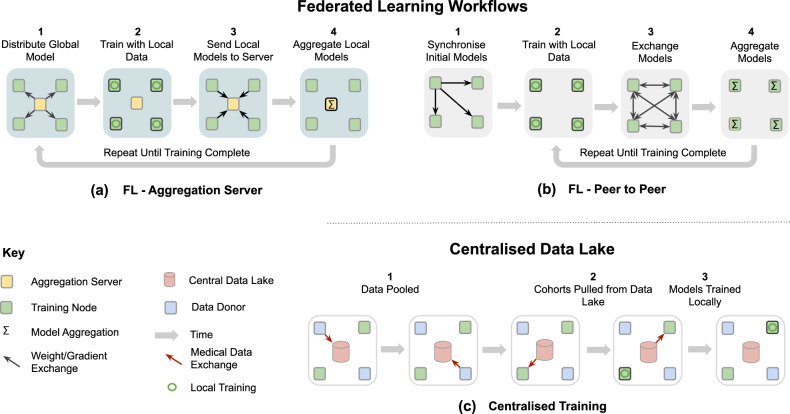
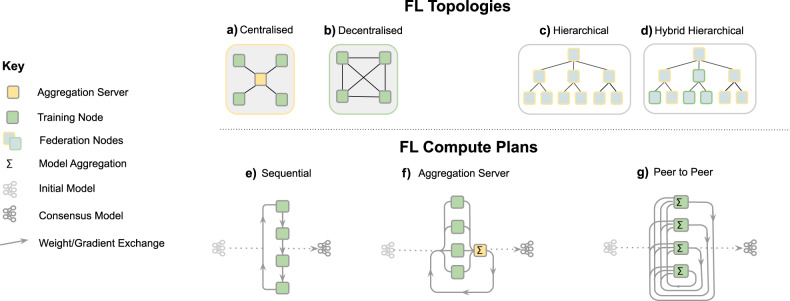
- The text describes FL workflows, including aggregation-server and peer-to-peer topologies, and discusses mechanisms such as FedAvg, FedProx, domain adaptation, and differential privacy at a conceptual level.
Limitations
- The paper explicitly states that FL does not solve all issues inherent to learning on medical data; success still depends on data quality, bias, and standardization.
- It states that FL does not eliminate privacy risks: models can still memorize information, and gradients/model updates may leak private data through inversion or adversarial attacks.
- Evident from the text: this is a perspective article, so it does not report original experimental results, sample sizes, or statistical testing.
Model-written summary. Check it against the paper before relying on it.
Integrity signals
Registry
Cites
Statistics
Figures
Verification
Claims the paper makes
16 Valid · 0 Not valid · 4 Not checked · 19 Own results and interpretations
The cited sources support only part of this claim — read each source’s verdict below.
In the paper
“Modern DL models feature millions of parameters that need to be learned from sufficiently large curated data sets in order to achieve clinical-grade accuracy, while being safe, fair, equitable and generalising well to unseen data2–5.”
§ The future of digital health with federated learning > Introduction
What the sources say
- Not checked — no full text of the sourcecites [2] Wang F Casalino LP Khullar D Deep learning in medicine—promise, progress, and challenges JAMA Intern. Med. 2019 179 293 294 10.1001/jamainternmed.2018.7117 30556825 source
- Not checked — no full text of the sourcecites [3] Chartrand G Deep learning: a primer for radiologists Radiographics 2017 37 2113 2131 10.1148/rg.2017170077 29131760 source
- Partly supportedcites [4] De Fauw J Clinically applicable deep learning for diagnosis and referral in retinal disease Nat. Med. 2018 24 1342 10.1038/s41591-018-0107-6 30104768 sourceExperimental — accuracy not yet measured
Split into 2 atoms — 0 confirmed, 2 partially supported, 0 disputed, 0 misattributed, 0 unverifiable. Expand the claim to see per-atom verdicts.
- Partly supportedcites [5] Sun, C., Shrivastava, A., Singh, S. & Gupta, A. Revisiting unreasonable effectiveness of data in deep learning era. In Proceedings of the IEEE international conference on computer vision, 843–852 (IEEE, 2017). sourceExperimental — accuracy not yet measured
Split into 2 atoms — 0 confirmed, 2 partially supported, 0 disputed, 0 misattributed, 0 unverifiable. Expand the claim to see per-atom verdicts.
plainstates a cause- Asserted: passes — The authors put it forward as true.
- Checkable: passes — It can be checked against evidence.
- Load-bearing: passes — The paper’s conclusions depend on it.
- Based: passes — The paper gives a reason why it holds.
The cited sources support only part of this claim — read each source’s verdict below.
In the paper
“Existing medical data is not fully exploited by ML primarily because it sits in data silos and privacy concerns restrict access to this data.”
§ The future of digital health with federated learning > Abstract
What the sources say
- Partly supportedcites [6] Van Panhuis WG A systematic review of barriers to data sharing in public health BMC Public Health 2014 14 1144 10.1186/1471-2458-14-1144 25377061 PMC4239377 sourceExperimental — accuracy not yet measured
The Background describes routinely collected public-health data as underused, and Results > Legal barriers says privacy concerns can lead to restrictive data-access policies. Results > Technical barriers describes difficulties integrating datasets. The paper does not establish that machine learning is the affected use or that data silos and privacy are the primary reasons medical data is underexploited. (LLM, conf=0.87)
- Partly supportedcites [7] Rocher L Hendrickx JM De Montjoye Y-A Estimating the success of re-identifications in incomplete datasets using generative models Nat. Commun. 2019 10 1 9 10.1038/s41467-019-10933-3 31337762 PMC6650473 sourceExperimental — accuracy not yet measured
The Introduction (page not provided) says medical and other personal data can advance AI, while privacy concerns affect its collection, use, and sharing. It does not say that medical data sits in silos or that silos and privacy restrictions are the primary reasons ML underuses it. (LLM, conf=0.85)
plainstates a cause- Asserted: passes — The authors put it forward as true.
- Checkable: passes — It can be checked against evidence.
- Load-bearing: passes — The paper’s conclusions depend on it.
- Based: passes — The paper gives a reason why it holds.
- Partly supported
The cited sources support only part of this claim — read each source’s verdict below.
In the paper
“The more rounds of local training are performed, the less it is guaranteed that the overall procedure is minimising (Eq. 1)9,12.”
§ The future of digital health with federated learning > Technical considerations > Federated learning definition
What the sources say
- Partly supportedcites [9] McMahan, B., Moore, E., Ramage, D., Hampson, S. & y Arcas, B. A. Communication-efficient learning of deep networks from decentralized data. In Artificial Intelligence and Statistics, 1273–1282. https://scholar.google.de/scholar?hl=de&as_sdt=0%2C5&q=Communicationefficient+learning+of+deep+networks+from+decentralized+data&btnG= (2017). sourceExperimental — accuracy not yet measured
The Experimental Results (p. 7) report that with very many local epochs, FedAvg can plateau or diverge on the Shakespeare LSTM task. But they also report no significant convergence degradation for large numbers of local epochs on the MNIST CNN, so the paper does not establish a general rule that more local training makes minimisation of the global loss less assured. (LLM, conf=0.86)
- Supportedcites [12] Kairouz, P. et al. Advances and open problems in federated learning. arXiv preprint arXiv:1912.04977 (2019). source
Section 3.2.1 states that more local updates increase divergence between client models and slow convergence of the training loss. Section 3.2.2 also reports more restrictive convergence bounds for local updates with non-IID data. Together, these support the claim that increasing local training weakens convergence assurances for the global loss. (LLM, conf=0.86)
plainstates a cause- Asserted: passes — The authors put it forward as true.
- Checkable: passes — It can be checked against evidence.
- Load-bearing: unclear — It is unclear whether the paper’s conclusions depend on it.
- Based: passes — The paper gives a reason why it holds.
- Partly supported
A conclusion the paper draws from its own results — it cites no other source for it, so there is none to check. The quote shows it is in the paper.
In the paper
“By linking healthcare institutions, not restricted to research centres, FL can have direct clinical impact.”
§ The future of digital health with federated learning > Data-driven medicine requires federated efforts > Current FL efforts for digital health
plainstates a possible cause- Asserted: passes — The authors put it forward as true.
- Checkable: passes — It can be checked against evidence.
- Load-bearing: passes — The paper’s conclusions depend on it.
- Based: passes — The paper gives a reason why it holds.
A conclusion the paper draws from its own results — it cites no other source for it, so there is none to check. The quote shows it is in the paper.
In the paper
“FL enables collaborative research for, even competing, companies.”
§ The future of digital health with federated learning > Data-driven medicine requires federated efforts > Current FL efforts for digital health
plainstates a cause- Asserted: passes — The authors put it forward as true.
- Checkable: passes — It can be checked against evidence.
- Load-bearing: unclear — It is unclear whether the paper’s conclusions depend on it.
- Based: passes — The paper gives a reason why it holds.
14 references still to check
A free account verifies the references that are still open.
- Probably not a substantial claim. 19
- It may state two separate claims as one. 32
- The quote only partly states this claim. 1
Claims other papers make about this one
Each is checked against this paper’s own text: does it say what the citing paper says it does?
The source backs part of the claim, not all of it — or backs it for a different population, condition or comparison.
In the citing paper
“This is currently addressed by sharing multi-site data, but such centralization is challenging/infeasible to scale due to various limitations.”
From Federated learning enables big data for rare cancer boundary detection (2022) · cites this paper as [10]
Experimental — accuracy not yet measuredThe source backs part of the claim, not all of it — or backs it for a different population, condition or comparison.
In the citing paper
“However, these methods often come with trade-offs in accuracy and computational efficiency.”
From The role of multimodality in clinical disease diagnosis: advances, challenges, and opportunities (2026) · cites this paper as [34]
Experimental — accuracy not yet measuredThe source backs part of the claim, not all of it — or backs it for a different population, condition or comparison.
In the citing paper
“The experts in healthcare and life sciences can use FL to solve the unique problem of data governance by training algorithms behind the hospital's firewall and only sharing models so that data remain secure [31].”
From A comprehensive survey on federated learning techniques for healthcare informatics (2023) · cites this paper as [31]
Experimental — accuracy not yet measuredThe source backs part of the claim, not all of it — or backs it for a different population, condition or comparison.
In the citing paper
“It also improves patient privacy and reduces low latency during the collaboration of multiple hospitals/entities [7].”
From Handling privacy-sensitive medical data with federated learning: Challenges and future directions (2023) · cites this paper as [7]
Experimental — accuracy not yet measuredThe source backs part of the claim, not all of it — or backs it for a different population, condition or comparison.
In the citing paper
“Enabling privacy protected data sharing across clinical centers is advocated as an essential pathway to promote collaborations internationally yet underexplored so far6,7.”
From Federated deep learning for detecting COVID-19 lung abnormalities in CT: a privacy-preserving multinational validation study (2021) · cites this paper as [7]
Experimental — accuracy not yet measured
27 more claims about this paper
Create a free account to see every claim other papers make about this one.
Citations
Cites
LeCun, Y., Bengio, Y., & Hinton, G. (2015) · Nature · doi:10.1038/nature14539 · Cited by 84,126
Communication-Efficient Learning of Deep Networks from Decentralized Data
McMahan, H. B., Moore, E., Ramage, D., Hampson, S., & Arcas, B. A. Y. (2016) · arXiv · doi:10.48550/arxiv.1602.05629 · Cited by 14,215
Sudlow, C., Gallacher, J., Allen, N., Beral, V., Burton, P., Danesh, J., Downey, P., Elliott, P., Green, J., Landray, M., et al. (2015) · PLOS Medicine · doi:10.1371/journal.pmed.1001779 · Cited by 12,728 · cited 2×
“Substantial, albeit smaller, initiatives include the Human Connectome25, the UK Biobank26, the Cancer Imaging Archive (TCIA)27, NIH CXR828, NIH DeepLesion29, the Cancer Genome Atlas (TCGA)30, the Alzheimer’s Disease Neuroimaging Initiative (ADNI)31, as well as medical grand challenges32 such as the CAMELYON challenge3…”
BackgroundAdvances and Open Problems in Federated Learning
Kairouz, P., McMahan, H. B., Avent, B., Bellet, A., Bennis, M., Bhagoji, A. N., Bonawitz, K., Charles, Z., Cormode, G., Cummings, R., et al. (2019) · arXiv · doi:10.48550/arxiv.1912.04977 · Cited by 7,857
Advances and Open Problems in Federated Learning
Kairouz, P., & McMahan, H. B. (2021) · Foundations and Trends in Machine Learning · doi:10.1561/2200000083 · Cited by 7,772
The multimodal brain tumor image segmentation benchmark (BRATS)
Menze, B. H., Jakab, A., Bauer, S., Kalpathy-Cramer, J., Farahani, K., Kirby, J., Burren, Y., Porz, N., Slotboom, J., Wiest, R., et al. (2015) · IEEE Transactions on Medical Imaging · doi:10.1109/tmi.2014.2377694 · Cited by 6,781
Deep Learning with Differential Privacy
Abadi, M., Chu, A., Goodfellow, I., McMahan, H. B., Mironov, I., Talwar, K., & Zhang, L. (2016) · Proceedings of the 2016 ACM SIGSAC Conference on Computer and Communications Security · doi:10.1145/2976749.2978318 · Cited by 6,578 · cited 2×
“Countermeasures, such as limiting the granularity of the shared model updates and to add specific noise to ensure differential privacy [34, 12, 57] may be needed and is still an active area of research [14].”
BackgroundMethodFederated Machine Learning: Concept and Applications
Yang, Q., Liu, Y., Chen, T., & Tong, Y. (2019) · ACM Transactions on Intelligent Systems and Technology · doi:10.1145/3298981 · Cited by 6,322 · cited 4×
“d FL approaches are still under development. 3 Technical Considerations FL is perhaps best-known from the work of Konecnˇ y` et al. [36], but various other definitions have been proposed in literature [14, 11, 15, 9]. These approaches can be realised via different communication architectures (see Figure 1) and respecti…”
BackgroundInfluentialFederated learning: Challenges, methods, and future directions
Li, T., Sahu, A. K., Talwalkar, A., & Smith, V. (2020) · IEEE Signal Processing Magazine · doi:10.1109/msp.2020.2975749 · Cited by 6,210 · cited 3×
“However, there is a trade-off in terms of performance and these techniques may affect for example the accuracy of the final model [10].”
BackgroundMethodShin, H.-C., Roth, H. R., Gao, M., Lu, L., Xu, Z., Nogues, I., Yao, J., Mollura, D., & Summers, R. M. (2016) · IEEE Transactions on Medical Imaging · doi:10.1109/tmi.2016.2528162 · Cited by 5,759
Self-citation
Cited by
Items 2,901–3,000 of 3,132
Alshammari, N., Hassan, R., Patel, M. B., & Adnan, M. (2026) · Pharmaceuticals · doi:10.3390/ph19091326
Ma, G., Yu, D., Zhang, E., & Sun, H. (2026) · IEEE International Conference on Big Data and Artificial Intelligence (BDAI) · doi:10.1109/bdai70753.2026.11655101
Haq, S. R., & Lakshmanna, K. (2026) · Frontiers in Digital Health · doi:10.3389/fdgth.2026.1902226
Noori, G. H., Bibi, S., & Lee, S. W. (2026) · INQUIRY The Journal of Health Care Organization Provision and Financing · doi:10.1177/00469580261478793 · Cited by 3
Li, N., 战星辰, Li, Y., Li, M., & Zhu, D. (2026) · IEEE International Conference on Joint Cloud Computing (JCC) · doi:10.1109/jcc72984.2026.00044
Niny, S., Kissi, C., & Srifi, M. N. (2026) · International Conference on Circuit, Systems and Communication (ICCSC) · doi:10.1109/iccsc71566.2026.11650260
Simon, B. F., Dénes-Fazakas, L., Eigner, G., Kovács, L., & Szilágyi, L. (2026) · IEEE International Conference on Intelligent Engineering Systems (INES) · doi:10.1109/ines69513.2026.11661038
Starfish-FL: Harnessing Agentic Federated Analytics
Bao, Y., Saad, Z., Abbas, F., Duarte, K. T. N., Sajobi, T. T., Menon, B. K., Zhou, J., & Drew, S. (2026) · ACM Transactions on Computing for Healthcare · doi:10.1145/3843774 · Cited by 1
Global RETFound: A Protocol for the World’s First Global Medical Foundation Model
Nderitu, P., Zhou, Y., Ran, A. R., Goh, J. H. L., Jiang, H., Srinivasan, S., Kitema, G. F., Rawlinson, P., Arnold, L. V. R., Yuen, K. W., et al. (2026) · Ophthalmology Science · doi:10.1016/j.xops.2026.101384
Artificial intelligence in medicine: An ethical and legal review
Schleidgen, S., & Friedrich, O. (2026) · European Journal of Internal Medicine · doi:10.1016/j.ejim.2026.107172
Baali, F. A., Lhasnaoui, C., Ait‐Mlouk, A., & Agouti, T. (2026) · Machine Learning · doi:10.1007/s10994-026-07142-7
Progress in the Diagnosis and Treatment of Urosepsis: A Review
罗, 楠. (2026) · Advances in Clinical Medicine · doi:10.12677/acm.2026.1683012
Federated Contrastive Learning for Privacy-Preserving Personalization in Healthcare
Naxine, P. K., Dandekar, A., DALKE, P. A., et al. (2026) · National Academy Science Letters · doi:10.1007/s40009-026-02427-w
FPMAN: A Framework for Stable and Privacy-Preserving Federated Learning under Non-IID Data
Esha, I. T., Tasnim, T., & Das, D. (2026) · International Conference on Power, Electronics, Communications, Computing, and Intelligent Infrastructure (PECCII) · doi:10.1109/peccii70991.2026.11662022
FALCON: An agentic probe-and-switch attack on Byzantine-robust federated learning
Mazroa, A. A., Malwi, W. A., Awaji, B. H., Asiri, F., & Manzoor, H. U. (2026) · Neurocomputing · doi:10.1016/j.neucom.2026.134923
Distributed Collective Learning on Mobile Devices: A Real-Hardware FedAvg Evaluation
Tudor, G.-A., Ciobanu, R., & Dobre, C. (2026) · International Conference on Distributed Computing in Smart Systems and the Internet of Things (DCOSS-IoT) · doi:10.1109/dcoss-iot69657.2026.00127
Machine Learning Models for Predicting Orthopaedic Surgical Complications
Kamal, H. (2026) · Journal of Bone and Joint Surgery · doi:10.2106/jbjs.26.00770
Refined Exclusion in Medical AI: Data Justice and Patient Safety Governance
Lee, J. H., Choi, B., Jeong, K., Suh, S. W., Kim, J. H., & Son, D. (2026) · Journal of Medical Internet Research · doi:10.2196/102359
A federated learning–driven data fusion strategy for the hardenability prediction of gear steel
Shang, C., Jiang, T., Zhang, L., Wu, H., Wang, B., Wang, S., Gao, J., Zhao, H., Zhang, C., & Mao, X. (2026) · Journal of Materials Informatics · doi:10.20517/jmi.2026.26
Saqib, M., Korotkova, E. I., Li, K., Firoz, N., Vashisth, M., Hui, A. L., Lipskikh, O. I., & Kar, P. K. (2026) · Biosensors · doi:10.3390/bios16090470 · Cited by 2
Fed-LoRA: Cross-Domain Generative Knowledge Feedback for Few-Shot Medical Anomaly Detection
Wang, Z., Ning, Z., & Liu, H. (2026) · International Conference on Computer Communications and Networks (ICCCN) · doi:10.1109/icccn69946.2026.11662972
Core AI and Machine Learning Architectures for Biological Sequence and Structure Modelling
Yada, D., Ramya, K. S. S. L., Samidala, N. R., Vemla, C., & Pindiprolu, S. K. S. S. (2026) · Advances in computational intelligence and robotics book series · doi:10.4018/979-8-2600-0161-5.ch002
UniFLM: United Segmentation and Measurement on Fetal Limb Ultrasonic Image
Ze’en, Z., Chen, Q., Cao, X., Chen, C., Sun, C., & Du, B. (2026) · Pattern Recognition · doi:10.1016/j.patcog.2026.114787
Machine Learning in Mitochondrial Mutation Detection and Pathogenicity Assessment
Kesavardhini, K., Saranraj, P., Dayana, S., Indhu, S., & Gayathri, K. V. (2026) · Advances in computational intelligence and robotics book series · doi:10.4018/979-8-2600-0161-5.ch007
From promise to practice: digital health through the lens of neonatal care
Variane, G. F. T., Leandro, D. M. K., Mimiça, M. J., Austin, T., Chock, V. Y., Craig, A. K., Mohammad, K., & Meurs, K. P. V. (2026) · The Lancet Regional Health - Americas · doi:10.1016/j.lana.2026.101600
Alajaji, A. S., Alablani, M. J., & Hassan, M. M. (2026) · IEEE Access · doi:10.1109/access.2026.3728130
Phiri, J., Zimba, A., Njovu, C., & Lumpa, M. (2026) · Discover Artificial Intelligence · doi:10.1007/s44163-026-01958-x
PryML: Privacy-Preserving Federated Learning under Data Heterogeneity using CKKS Encryption
Thabit, A. M. M. M., Huay, H. S., & Sen, A. (2026) · doi:10.1109/icoict71118.2026.11664829
Data Foundations Multi-Omics, Imaging, and Clinical Data in AI-Driven Editing
Ramya, K. S. S. L., Divya, Y., Kiranmayi, G. V. N., Vemla, C., & Ramesh, A. (2026) · Advances in computational intelligence and robotics book series · doi:10.4018/979-8-2600-0161-5.ch003
Future Directions Toward Integrated, Autonomous, and Equitable Intelligent Therapeutic Ecosystems
Latif, W. B., Amin, M. B., & Islam, M. A. (2026) · Advances in computational intelligence and robotics book series · doi:10.4018/979-8-2600-0161-5.ch016
Mahankali, S. (2026) · Indian journal of radiology and imaging - new series/Indian journal of radiology and imaging/Indian Journal of Radiology & Imaging · doi:10.1055/s-0046-1827801 · Cited by 1
Al-Nussairi, A. K. J., Rahma, M. K., Al‐Hiti, A. S., Bakhritdinov, F., Rakhimov, B. B., Mammadova, K., Qasim, M. T., & Khishe, M. (2026) · Intelligence-Based Medicine · doi:10.1016/j.ibmed.2026.100465
Federated acquisition-robust representation learning for cross-protocol ECG biometric authentication
Xu, J., Zhou, D., Xu, J., et al. (2026) · Pattern Recognition Letters · doi:10.1016/j.patrec.2026.08.029
Integration of artificial intelligence and multi-omics for precision medicine
Marei, H. E. S., Cenciarelli, C., & Vagni, D. (2026) · Functional & Integrative Genomics · doi:10.1007/s10142-026-02024-6
Perur, S. D., Kenchannavar, H. H., Hegde, R., Kenchannavar, A., Deshpande, A. M., & Hariharan, S. (2026) · Neurocomputing · doi:10.1016/j.neucom.2026.134880
Rethinking Federated Learning for Mobile Health Therapeutic Research: A Principled Framework
Zhao, R., Hu, Y., Chinchilli, V. M., & Chen, C. (2026) · IEEE/ACM Conference on Connected Health: Applications, Systems and Engineering Technologies · doi:10.1109/chase69719.2026.00075
Ferrantelli, S., Cuore, A. D., Cassataro, G., Dell’Ajra, L., Norrito, R. L., Geraci, G., Carmina, G., Minà, C., Polizzi, V., Ciancio, N., et al. (2026) · International Journal of Molecular Sciences · doi:10.3390/ijms27177763
EcoFair: Energy-efficient inference routing for edge AI under data degradation
Anoosha, M., Thakker, D., Paxton, K., Aslansefat, K., Mishra, B. K., Ahmad, B., & Kureshi, R. R. (2026) · Ad Hoc Networks · doi:10.1016/j.adhoc.2026.104403
Wijaya, D. R., Setiawan, B., & Anuar, K. (2025) · Aintelia Science Notes · doi:10.68099/asnj.2025.83
Zhang, T.-F., Huo, Z., & Wang, T. (2026) · Information Sciences · doi:10.1016/j.ins.2026.124089
Brecher, V., Androutsopoulou, V. A., Sicouri, S., Ramlawi, B., Avgerinos, D. V., Athanasiou, T., & Magouliotis, D. E. (2026) · Frontiers in Systems Biology · doi:10.3389/fsysb.2026.1897299 · Cited by 1
Joshi, A., Sandhya, P., & Goyal, M. (2026) · International Journal of Community Pharmacy · doi:10.65301/ijcp.2026.8.2.3
Ashraf, K., Hosen, M. H., Farah, N. T., Morol, M. K., Liew, T. H., Nandi, D., Rahman, M., & Jubair, A. A. (2026) · Frontiers in Digital Health · doi:10.3389/fdgth.2026.1862236
Federated learning for multi-institutional AI in healthcare via digital pathology
Soleimani, R., Azimi, M., & Talebi, N. (2026) · Biomedizinische Technik/Biomedical Engineering · doi:10.1515/bmt-2025-0489 · Cited by 2
Tiwari, D., Sharma, M., & Singh, A. (2026) · IEEE Access · doi:10.1109/access.2026.3729715
Liang, T., Du, L., & Lan, G. (2026) · Ad Hoc Networks · doi:10.1016/j.adhoc.2026.104406
Posta, M., Figler, A., Dobolyi, Z., & Győrffy, B. (2026) · Journal of Medical Internet Research · doi:10.2196/95780 · Cited by 1
Digital Twins in Oncology: From Multimodal Data Integration to Precision Clinical Practice
Vairavan, A., Bhattacharjee, R., & Raghavan, B. (2026) · Indian journal of radiology and imaging - new series/Indian journal of radiology and imaging/Indian Journal of Radiology & Imaging · doi:10.1055/s-0046-1827804
Ghosal, S., PANDA, N., Jena, B. R., Maity, M., Bose, S., & Parhi, R. (2026) · ADMET & DMPK · doi:10.5599/admet.3565
Khan, I. I., Shah, S. A. H., Tsipourakis, A., Malavolta, M., Aleesha, A., Shah, S. B. H., Hajiani, M., Buccoliero, A., Panagiotopoulos, K., Shah, S. T. H., et al. (2026) · Frontiers in Imaging · doi:10.3389/fimag.2026.1910013
Chen, C. (2026) · Frontiers in Cardiovascular Medicine · doi:10.3389/fcvm.2026.1831993
Academic Anesthesiology Chapter 7. Beyond 2025: Creating the Future
Mathew, J. P., Wilson, S. H., & Reves, J. G. (2026) · International Anesthesiology Clinics · doi:10.1097/aia.0000000000000533
Cell-based therapies of autoimmune diseases in the context of artificial intelligence development
Dinesh, D., Das, S. S., Bhattacharya, B., & Pai, K. S. R. (2026) · Clinical and Experimental Medicine · doi:10.1007/s10238-026-02302-4
Varma, D., Parmar, R., Bhat, S., & Dutta, P. (2026) · Future Generation Computer Systems · doi:10.1016/j.future.2026.108807
From Invisible to Enrolled: How Artificial Intelligence Is Reshaping Clinical Trial Recruitment
Ahn, S. (2026) · Pharmaceutical Medicine · doi:10.1007/s40290-026-00635-9 · Cited by 1
al-madah, R. (2026) · Annals of dental specialty · doi:10.51847/11oq5ahwfy · Cited by 1
Kirubakaran, M., & Vijayarajan, V. (2026) · Frontiers in Digital Health · doi:10.3389/fdgth.2026.1933562
Federated Learning Ecosystems in Healthcare: Architectural Models and Privacy Trade-Offs
Brooks, D., Grant, O., & Hernandez, M. (2023) · Journal of Artificial Intelligence for Healthcare Systems · doi:10.68159/b928118102
Albalawi, H. A. (2026) · American Journal of Clinical Oncology · doi:10.1097/coc.0000000000001370
Kulkarni, S., Joshi, M., Patil, R., & Deshmukh, A. (2022) · Journal of Health Informatics and Digital Systems · doi:10.68159/j927130731
Deep Multimodal Diagnostic Fusion of Medical Imaging and Structured Clinical Data
Minh, P. Q., Bich, L. T., & Huy, N. T. (2024) · Journal of Artificial Intelligence for Healthcare Systems · doi:10.68159/i254334718
A Multi-Source Public Health Surveillance Intelligence Mesh for Outbreak-Aware Systems
Al-Qahtani, Y., Al-Salem, F., & Al-Harbi, A. (2026) · Journal of Artificial Intelligence for Healthcare Systems · doi:10.68159/v978476617
Nakamura, H., & Kato, Y. (2022) · Journal of Health Informatics and Digital Systems · doi:10.68159/n552358828
Opioid overdose detection and reversal with closed-loop systems
Angelone, L. M., & Koustova, E. (2026) · Nature Reviews Bioengineering · doi:10.1038/s44222-026-00492-w · Cited by 1
Hjazi, A. M. (2026) · Hematology · doi:10.1080/16078454.2026.2729588
Boateng, S., Mensah, K., & Asante, K. (2026) · Journal of Health Informatics and Digital Systems · doi:10.68159/q985088265
Privacy-Preserving Machine Learning on Sensitive Health Data Using Federated Learning
Karthik, S., Anandaram, H., Bhaskar, S., -, M. A. H., Mahajan, P., & Singh, N. (2026) · Lecture notes in networks and systems · doi:10.1007/978-3-032-27691-9_40
Dupont, C., & Martin, J. (2022) · Journal of Health Informatics and Digital Systems · doi:10.68159/b452442230
Population Health Analytics Infrastructures: AI System Architectures and Governance Models
Meyer, L., Schmid, A., & Kumar, R. (2024) · Journal of Artificial Intelligence for Healthcare Systems · doi:10.68159/g777760419
Nieroda, M., Fenoglio, E., & Treleaven, P. C. (2026) · doi:10.2196/preprints.111355
A Conceptual Framework for Federated Learning in Acute Kidney Injury Prediction
Hernandez, M., & Vega, C. (2022) · Journal of Artificial Intelligence for Healthcare Systems · doi:10.68159/t935635935
Conti, M., Greco, A., & Ferri, L. (2026) · Journal of Artificial Intelligence for Healthcare Systems · doi:10.68159/h352855186
Pardo, À., Gómez, J., Berrueta, J., García-Martínez, A., Orts, P., Manrique, S., Rodríguez, A. H., & Bodí, M. A. (2026) · Journal of Clinical Medicine · doi:10.3390/jcm15186957 · Cited by 1
Petrov, I., & Smirnov, A. (2026) · Journal of Artificial Intelligence for Healthcare Systems · doi:10.68159/s417811021
Perrella, A., Pecoraro, S., Maffettone, A., Salvatore, P., D'Amore, A., Morfino, V., & Bisogno, M. (2026) · Information · doi:10.3390/info17090869
A Federated Autoencoder Framework for Cross-Payer Healthcare Billing Fraud Detection
Al-Mahdi, R., Al-Suwaidi, K., & Al-Kuwari, M. (2025) · Journal of Artificial Intelligence for Healthcare Systems · doi:10.68159/f467680042
Alnemari, M. H., & Al-Omair, O. M. (2026) · IEEE Access · doi:10.1109/access.2026.3731730
Bianchi, L., Rossi, M., & Romano, G. (2026) · Journal of Artificial Intelligence for Healthcare Systems · doi:10.68159/b293037132
Feng, J., Yao, M., Feng, X., Wang, C., Chen, H., Li, D., & Niu, Q. (2026) · Frontiers in Public Health · doi:10.3389/fpubh.2026.1835590
Mahfouz, K., Abdelaziz, R. A., Adel, S., Mostafa, D., Nabil, T., & Saad, R. (2025) · Journal of Artificial Intelligence for Healthcare Systems · doi:10.68159/i028497975
O’Brien, K., Murphy, L., & Doyle, S. (2026) · Journal of Artificial Intelligence for Healthcare Systems · doi:10.68159/m372713091
Thakur, N., Chouksey, P., Sadotra, P., Chopra, M., Thakur, G., & Kumar, S. (2026) · Discover Artificial Intelligence · doi:10.1007/s44163-026-02069-3
Friend-Safe Adversarial Attack for selective evasion in personalized federated learning
Kwon, H., & Kim, D.-J. (2026) · Discover Computing · doi:10.1007/s10791-026-10547-6
Artificial intelligence and scientific methodology: continuity, disruption, and the next revolution
Hounkonnou, M. N., & Warin, T. (2026) · Ethics Medicine and Public Health · doi:10.1016/j.jemep.2026.101323
Beyond the Algorithm: A Stewardship Framework for the Hand Surgeon Adopting Artificial Intelligence
Cievet‐Bonfils, M., Burnier, M., & Locquet, V. (2026) · The Journal Of Hand Surgery · doi:10.1016/j.jhsa.2026.08.006
van Genderen, P. J. J., & van Sprang, E. N. M. (2026) · Journal of Travel Medicine · doi:10.1093/jtm/taag082
Grech, L., & Pace, N. P. (2026) · Frontiers in Genetics · doi:10.3389/fgene.2026.1932078
Multimodal EEG–MRI signal processing approaches for stroke and rehabilitation: a narrative review
Das, H., Bhatia, D., Kumar, V., & Paul, S. (2026) · Scientific Reviews · doi:10.1038/s44573-026-00011-3
Lazrak, Z., Bouayad, A., & Boumaiz, M. (2026) · Discover Artificial Intelligence · doi:10.1007/s44163-026-02157-4
Mathematical Oncology: Models, Methods, and Clinical Applications
Zigman, P. (2026) · Tatra Mountains Mathematical Publications · doi:10.2478/tmmp-2026-0011
Fu, C., Su, D., Zhang, J., Pei, S., & Ma, S. (2026) · Asian Journal of Psychiatry · doi:10.1016/j.ajp.2026.105143
Tan, H. K., Froese, L., Wilhelms, D., Fagerström, J., & Chew, M. S. (2026) · Scientific Reports · doi:10.1038/s41598-026-63350-0
Komenda, M., Klimeš, D., Tichopád, A., Jarkovský, J., Májek, O., Mužík, J., Táborský, M., Těšitelová, V., Habetinek, J., & Dušek, L. (2026) · JMIR Medical Informatics · doi:10.2196/80683
Layer-wise FCFL: Federated learning with scaling-factor-based layer-wise fuzzy clustering
Zhao, M., Xu, G., Lu, J., et al. (2026) · Electronic Research Archive · doi:10.3934/era.2026335
Singhera, F. U., Overhulse, J. M., Lee, T. M., Katz, J. G., Lee, J. S. H., & McKenna, C. E. (2026) · Cancers · doi:10.3390/cancers18182939
Contrast-enhanced ultrasound in assessing organ quality of brain-dead donors: A comprehensive review
Xu, Y., 楊應礎, 郑志文, Yang, K., Zhou, G., Yao, Y., 孙常廉, Chen, Y., & Liu, X. (2026) · WFUMB Ultrasound Open · doi:10.1016/j.wfumbo.2026.100122
Peng, S., Qin, M., Song, G., 毛庆龙, Liu, Z., & Nie, W. (2026) · Frontiers in Immunology · doi:10.3389/fimmu.2026.1859601
Manohar, P., Singh, S. K., & Misra, R. (2026) · Lecture notes in networks and systems · doi:10.1007/978-3-032-31998-2_32
Zhang, W., Feng, Z., Liu, Y., Zhong, R., Chen, S., Li, Z., 李冰燕, Liu, D., Gao, L., & Hu, K. (2026) · Frontiers in Oncology · doi:10.3389/fonc.2026.1915669
State-of-the-art artificial intelligence frameworks and models for diagnostic veterinary anatomy
Sahu, S. K., & Mishra, U. K. (2026) · Annals of Anatomy - Anatomischer Anzeiger · doi:10.1016/j.aanat.2026.153377
Metadata
- Authors
- Rieke, N., Hancox, J., Li, W., Milletarì, F., Roth, H. R., Albarqouni, S., Bakas, S., Galtier, M. N., Landman, B. A., Maier-Hein, K., Ourselin, S., Sheller, M., Summers, R. M., Trask, A., Xu, D., Baust, M., & Cardoso, M. J.
- Affiliations
- Technical University of Munich (DE)
- Nvidia (United Kingdom) (GB)
- Nvidia (United States) (US)
- Imperial College London (GB)
- University of Pennsylvania (US)
- Vanderbilt University (US)
- German Cancer Research Center (DE)
- Intel (United States) (US)
- National Institutes of Health (US)
- University of Oxford (GB)
- King's College London (GB)
- Corresponding author
- Rieke, Nicola
- ORCID
- Venue
- npj Digital Medicine
- Published
- 2020-09-14
- Volume
- 3
- Issue
- 1
- Pages
- 119-119
- ISSN
- 2398-6352 (ISSN-L)
- PMC
- PMC7490367
- OpenAlex
- W3012501605
- Semantic Scholar
- b245c5d36702eaae0ff374fad92848024bc99534
- Cited by
- 4,015
- References
- 38
- Citations by year
- 2026: 1453 · 2025: 921 · 2024: 618 · 2023: 473 · 2022: 353 · 2021: 175 · 2020: 18
- FWCI
- 13.36
- Type
- journal article
- Language
- en
- Open access
- gold
- doi.org
- Licence
- cc-by
- creativecommons.org/licenses/by/4.0 (tdm)
- creativecommons.org/licenses/by/4.0 (vor)
- Locations
- npj Digital Medicine (publishedVersion, cc-by)
- PubMed (publishedVersion)
- arXiv (Cornell University) (submittedVersion, other-oa)
- Informationszentrum Lebenswissenschaften (ZB MED) (submittedVersion, cc-by)
- DOAJ (DOAJ: Directory of Open Access Journals) (submittedVersion, cc-by-sa)
- Research Portal (King's College London) (submittedVersion, other-oa)
- mediaTUM – the media and publications repository of the Technical University Munich (Technical University Munich) (submittedVersion, other-oa)
- arXiv (Cornell University)
- Funders
- U.S. Department of Health and Human Services (R01NS042645, U01CA242871)
- Nvidia
- Wellcome Trust
- UK Research and Innovation
- Bpifrance
- Deutscher Akademischer Austauschdienst
- Bundesministerium für Bildung und Forschung
- National Institutes of Health (1s10od023495-01)
- Engineering and Physical Sciences Research Council ([WT203148/Z/16/Z], WT213038/Z/18/Z)
- Centre For Medical Engineering, King’s College London (WT 203148/Z/16/Z)
- National Cancer Institute (U24CA189523, U01CA242871)
- National Institute of Neurological Disorders and Stroke (R01NS042645)
- NIH Clinical Center
- Topics
- Physical Sciences › Computer Science › Artificial Intelligence › Privacy-Preserving Technologies in Data
- Health Sciences › Medicine › Health Informatics › Artificial Intelligence in Healthcare and Education
- Physical Sciences › Computer Science › Artificial Intelligence › Machine Learning in Healthcare
- Keywords
- federated learning, digital health, medical data privacy, data silos, data-driven machine learning, health information access
About these checks
Registry, retraction, Cites and statistics results are computed, not judged, with one exception: a printed reference that no index lists is read once by a model before it counts as a citation error. Claims are extracted by a model and kept only when their quote appears verbatim in the text; each cited source is then checked, with a model’s help, for whether it says what the claim relies on. Those verdicts can be wrong — read the claim’s quote and the cited source before relying on one.
The claim verdicts this report counts are experimental: their accuracy is not yet measured.
A language model drew the claims from the paper on 2026-10-10, under version 3 of the claim definition (model deepseek-v4.1-flash, prompt extract-v3).
A second model labelled each claim on 2026-10-10 (model jev-1.13-20260917, definition revision gold-guideline-v0.2).
Cited sources are checked with a language model’s help (gpt-6-sol and qwen3.8-omni-flash).
Statistics and arithmetic are recomputed, not judged.
Confidence bands are shown only for fields calibrated on our annotated test set. None is calibrated yet, so no band is shown.
What counts as a claim ›How we measure confidence ›How we check this ›
Are you an author, or do you see a problem with this page? Request a review
Data sources
Bibliographic data: Semantic Scholar, OpenAlex, Crossref.
Contains information from the Semantic Scholar Academic Graph Datasets, made available under the ODC Attribution License (ODC-BY 1.0).
Semantic Scholar’s data is described in: Kinney, R., et al. (2023). The Semantic Scholar Open Data Platform. arXiv:2301.10140.
