

Do as AI say: susceptibility in deployment of clinical decision-aids
Open accessThe DOI matches its Crossref record; 42 of the 42 references it cites were found in a registry or an index; 9 of the 31 sources its claims cite were checked for support.
Abstract
Artificial intelligence (AI) models for decision support have been developed for clinical settings such as radiology, but little work evaluates the potential impact of such systems. In this study, physicians received chest X-rays and diagnostic advice, some of which was inaccurate, and were asked to evaluate advice quality and make diagnoses. All advice was generated by human experts, but some was labeled as coming from an AI system. As a group, radiologists rated advice as lower quality when it appeared to come from an AI system; physicians with less task-expertise did not. Diagnostic accuracy was significantly worse when participants received inaccurate advice, regardless of the purported source. This work raises important considerations for how advice, AI and non-AI, should be deployed in clinical environments.
Overview
CoChat Summary
TL;DR
In a pre-registered web experiment, physicians reviewing chest X-rays received diagnostic advice that was always generated by human experts but sometimes labeled as coming from an AI system. Inaccurate advice reduced diagnostic accuracy regardless of purported source, while radiologists rated purported AI advice as lower quality than purported human advice.
Key findings
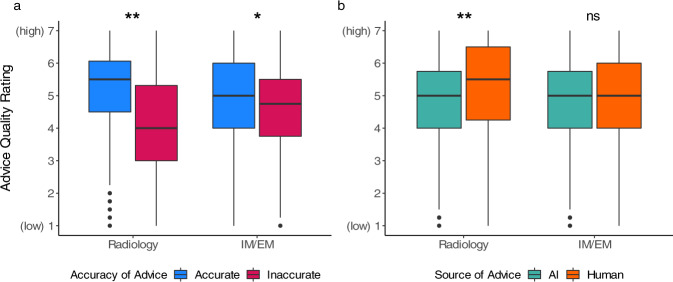
- Radiologists showed algorithmic aversion in advice-quality ratings: they rated advice significantly lower when it was labeled AI versus human (γ = 0.53, p = 0.001), whereas IM/EM physicians did not (γ = 0.22, p = 0.165).
- Inaccurate advice was rated lower in quality by both groups, more strongly by radiologists (γ = −1.00, p < 0.001) than by IM/EM physicians (γ = −0.40, p = 0.002).
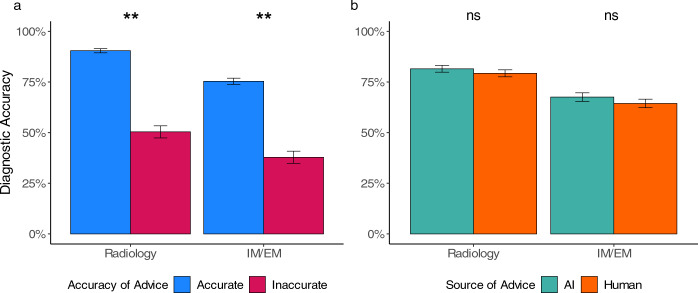
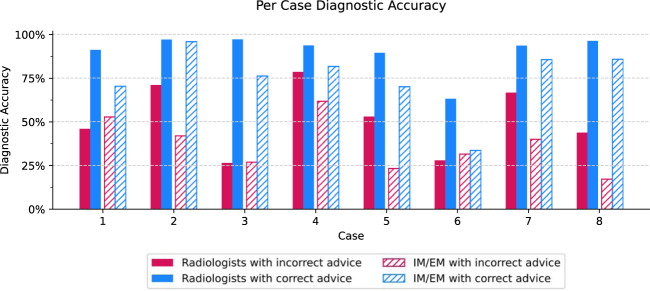
- Diagnostic accuracy was significantly worse with inaccurate advice for radiologists (β = 2.39, p < 0.001) and IM/EM physicians (β = 1.91, p < 0.001); task experts performed 40.10% better and non-experts 37.53% better with accurate versus inaccurate advice.
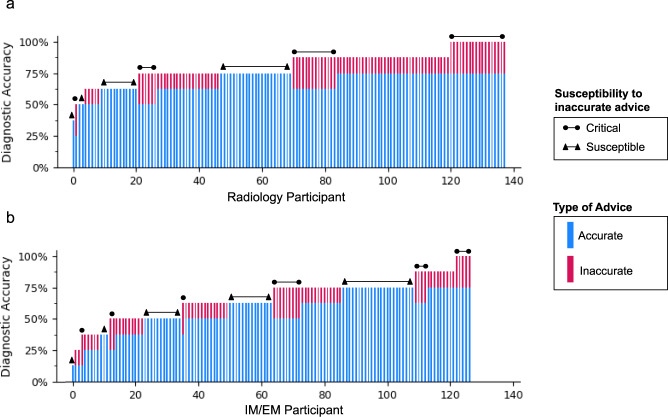
- Purported source did not significantly affect diagnostic accuracy (radiologists p = 0.183; IM/EM p = 0.081). Susceptibility varied: 41.73% of IM/EM physicians always gave the wrong diagnosis with inaccurate advice versus 27.54% of radiologists; 28.26% of radiologists and 17.32% of IM/EM physicians refuted all incorrect advice.
Methods
- Pre-registered web-based experiment (Qualtrics) with physicians recruited in the US and Canada: 138 radiologists (high task expertise) and 127 internal/emergency medicine physicians (lower task expertise).
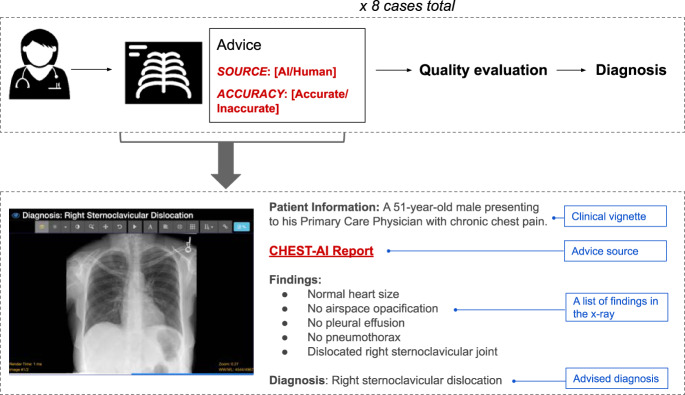
- Participants reviewed eight chest X-ray cases from the MIMIC Chest X-ray database, each with a clinical vignette and diagnostic advice; advice was human-generated but labeled as either from an AI system (CHEST-AI) or an experienced radiologist (Dr. S. Johnson).
- The design was a 2 × 2 mixed factorial: advice source (AI vs. human) between subjects and advice accuracy (accurate vs. inaccurate) within subjects, with participants randomly assigned six accurate and two inaccurate cases. Separate linear mixed models for advice-quality ratings and logistic mixed models for diagnostic accuracy regressed outcomes on advice accuracy, source, their interaction, and individual-related covariates, with a random effect by participant.
Limitations
- The paper states that only eight cases were tested to keep the study short enough for physician completion, that the web-based tool may not capture real deployment risk or behavior, that physician conversations are difficult to recreate, and that the sample is skewed toward less experienced physicians.
- The paper notes that advice was always generated by human experts and only the purported source was manipulated, so the study does not test actual AI-generated advice.
- Evident from the text: quality ratings may not reflect actual attitudes or behavior, as radiologists’ expressed aversion to AI advice did not affect their reliance on it; the online format may also have led to less careful case review or greater reliance on advice.
Model-written summary. Check it against the paper before relying on it.
Integrity signals
Registry
Cites
Statistics
Figures
Verification
Claims the paper makes
4 Valid · 1 Not valid · 10 Not checked · 48 Own results and interpretations
The sources with a verdict support this claim; the rest weren’t checked yet, have no full text we could read, or their verdicts aren’t rated yet.
In the paper
“However, it is not clear how to effectively integrate AI tools with human decision-makers; indeed, the few cases where systems have been implemented and studied showed no improved clinical outcomes6,7.”
§ Do as AI say: susceptibility in deployment of clinical decision-aids > Introduction
What the sources say
- Supportedcites [6] Brocklehurst P Computerised interpretation of fetal heart rate during labour (INFANT): a randomised controlled trial Lancet 2017 389 1719 1729 10.1016/S0140-6736(17)30568-8 28341515 PMC5413601 source
The Results report no significant difference in poor neonatal outcomes between the decision-support and control groups, and no evidence of differences in secondary outcomes for babies. The Discussion likewise concludes that the software did not reduce poor neonatal outcomes. This trial supports the cited sentence as an example, not as evidence about every AI system. (LLM, conf=0.92)
- Not checked — no full text of the sourcecites [7] Nunes I Central fetal monitoring with and without computer analysis: a randomized controlled trial Obstet. Gynecol. 2017 129 83 90 10.1097/AOG.0000000000001799 27926647 source
plain- Asserted: passes — The authors put it forward as true.
- Checkable: passes — It can be checked against evidence.
- Load-bearing: passes — The paper’s conclusions depend on it.
- Based: passes — The paper gives a reason why it holds.
- Supported
A result the paper reports from its own data — it cites no other source for it, so there is none to check. The quote shows it is in the paper.
In the paper
“As shown in Fig. 5, all cases were impacted by incorrect advice to varying degrees.”
§ Do as AI say: susceptibility in deployment of clinical decision-aids > Results > Incorrect advice impacts some clinical cases more than others
plainstates a causen = 8- Asserted: passes — The authors put it forward as true.
- Checkable: passes — It can be checked against evidence.
- Load-bearing: passes — The paper’s conclusions depend on it.
- Based: passes — The paper gives a reason why it holds.
A result the paper reports from its own data — it cites no other source for it, so there is none to check. The quote shows it is in the paper.
In the paper
“None of the measured covariates significantly predicted susceptibility, for either radiologists or IM/EM physicians.”
§ Do as AI say: susceptibility in deployment of clinical decision-aids > Discussion
plain- Asserted: passes — The authors put it forward as true.
- Checkable: passes — It can be checked against evidence.
- Load-bearing: passes — The paper’s conclusions depend on it.
- Based: passes — The paper gives a reason why it holds.
A result the paper reports from its own data — it cites no other source for it, so there is none to check. The quote shows it is in the paper.
In the paper
“Physicians across expertise levels often failed to dismiss inaccurate advice regardless of its source.”
§ Do as AI say: susceptibility in deployment of clinical decision-aids > Discussion
plain- Asserted: passes — The authors put it forward as true.
- Checkable: passes — It can be checked against evidence.
- Load-bearing: passes — The paper’s conclusions depend on it.
- Based: passes — The paper gives a reason why it holds.
A result the paper reports from its own data — it cites no other source for it, so there is none to check. The quote shows it is in the paper.
In the paper
“Further, inaccurate advice was more convincing for certain cases that involved additional interaction or analyses to recognize the error.”
§ Do as AI say: susceptibility in deployment of clinical decision-aids > Discussion
plainstates an association- Asserted: passes — The authors put it forward as true.
- Checkable: passes — It can be checked against evidence.
- Load-bearing: passes — The paper’s conclusions depend on it.
- Based: passes — The paper gives a reason why it holds.
22 more claims
Create a free account to see all 63 claims and every source verdict.
- It may state two separate claims as one. 20
- Probably not a substantial claim. 19
Claims other papers make about this one
Each is checked against this paper’s own text: does it say what the citing paper says it does?
The source backs part of the claim, not all of it — or backs it for a different population, condition or comparison.
In the citing paper
“it has been shown that people with high task expertise are more inclined to dismiss or devalue task-related advice from an AI system than are people with low task expertise7,18.”
From Non-task expert physicians benefit from correct explainable AI advice when reviewing X-rays (2023) · cites this paper as [7]
Experimental — accuracy not yet measuredThe source backs part of the claim, not all of it — or backs it for a different population, condition or comparison.
In the citing paper
“The presentation format of an explanation, its integration into electronic health record (EHR) systems, the cognitive load it imposes, and its alignment with existing clinical reasoning patterns all shape whether a technically sound explanation translates into genuine clinical utility [31,32].”
From Explainability of decoder-only clinical large language models: A scoping review (2026) · cites this paper as [32]
Experimental — accuracy not yet measuredThe source backs part of the claim, not all of it — or backs it for a different population, condition or comparison.
In the citing paper
“A growing body of work examines how healthcare professionals interact with and respond to AI-generated explanations, a dimension distinct from the technical methods used to produce them.”
From Explainability of decoder-only clinical large language models: A scoping review (2026) · cites this paper as [32]
Experimental — accuracy not yet measuredThe source backs part of the claim, not all of it — or backs it for a different population, condition or comparison.
In the citing paper
“Acceptance of clinical AI is shaped by integration into existing workflows, performance under time pressure, alignment with clinical reasoning patterns, and the cognitive load explanations impose [20,31,32].”
From Explainability of decoder-only clinical large language models: A scoping review (2026) · cites this paper as [32]
Experimental — accuracy not yet measuredThe source backs part of the claim, not all of it — or backs it for a different population, condition or comparison.
In the citing paper
“studies suggest that convincing explanations may paradoxically increase over-reliance on incorrect AI outputs, particularly among less experienced clinicians [31,32].”
From Explainability of decoder-only clinical large language models: A scoping review (2026) · cites this paper as [32]
Experimental — accuracy not yet measured
13 more claims about this paper
Create a free account to see every claim other papers make about this one.
Statistics recomputed
Every reported test result, recomputed from its test statistic and degrees of freedom. A result shows as not adding up only once an independent check has confirmed it.
- Consistentr(1102) = 0.43reported p < .001 · recomputed p < .001
“r(1102) = 0.43, p < .001”
Self-check
Percentages, sums and reported differences re-computed from the paper’s own numbers.
Self-check results appear here once an independent check has confirmed them.
Citations
Cites
Dermatologist-level classification of skin cancer with deep neural networks
Esteva, A., Kuprel, B., Novoa, R. A., Ko, J., Swetter, S. M., Blau, H. M., & Thrun, S. (2017) · Nature · doi:10.1038/nature21056 · Cited by 14,362
High-performance medicine: the convergence of human and artificial intelligence
Topol, E. J. (2019) · Nature Medicine · doi:10.1038/s41591-018-0300-7 · Cited by 10,450
Gulshan, V., Peng, L., Coram, M., Stumpe, M. C., Wu, D., Narayanaswamy, A., Venugopalan, S., Widner, K., Madams, T., Cuadros, J., et al. (2016) · JAMA · doi:10.1001/jama.2016.17216 · Cited by 7,697
The Association of American Medical Colleges
Zapffe, F. C. (1938) · Academic Medicine · doi:10.1097/00001888-193801000-00007 · Cited by 5,533
Rajkomar, A., Dean, J., & Kohane, I. (2019) · New England Journal of Medicine · doi:10.1056/nejmra1814259 · Cited by 4,579
Algorithm aversion: People erroneously avoid algorithms after seeing them err.
Dietvorst, B. J., Simmons, J. P., & Massey, C. (2015) · Journal of Experimental Psychology: General · doi:10.1037/xge0000033 · Cited by 3,232
Artificial intelligence in healthcare
Yu, K.-H., Beam, A. L., & Kohane, I. S. (2018) · Nature Biomedical Engineering · doi:10.1038/s41551-018-0305-z · Cited by 2,817
Algorithm appreciation: People prefer algorithmic to human judgment
Logg, J. M., Minson, J. A., & Moore, D. A. (2019) · Organizational Behavior and Human Decision Processes · doi:10.1016/j.obhdp.2018.12.005 · Cited by 2,061
Resistance to Medical Artificial Intelligence
Longoni, C., Bonezzi, A., & Morewedge, C. K. (2019) · Journal of Consumer Research · doi:10.1093/jcr/ucz013 · Cited by 2,015
Lakhani, P., & Sundaram, B. (2017) · Radiology · doi:10.1148/radiol.2017162326 · Cited by 1,775
Cited by
Items 401–500 of 527
(2025) · Zeitschrift für Gemeinwirtschaft und Gemeinwohl · doi:10.5771/2701-4193-2025-2-105
Rahman, J. S., Delaforce, A., Bradford, D., Li, J., Magrabi, F., Cook, D., & Brankovic, A. (2025) · doi:10.2196/preprints.81460
Artificial Intelligence in Visual Programming with Scratch
Valeva, P. I., Dimitrov, I. M., & Shopova, V. (2025) · International Scientific Conference on Information, Communication and Energy Systems and Technologies (ICEST) · doi:10.1109/icest66328.2025.11098349
“Educators need to develop media literacy in learners [5] so that technology can be used wisely and purposefully [6].”
Medical Artificial Intelligence
Grote, T. (2025) · Oxford University Press eBooks · doi:10.1093/oxfordhb/9780197625835.013.0033
Einsatzszenarien und Potenziale von KI im Bereich der prähospitalen Telenotfallmedizin
Rehbock, C., Durdova, N., Beckers, S. K., Borgs, C., & Schröder, H. (2025) · Springer eBooks · doi:10.1007/978-3-658-48573-3_17 · Cited by 1
Explainability of decoder-only clinical large language models: A scoping review
Mishra, N., Abu-Hanna, A., & Calixto, I. (2026) · Artificial Intelligence in Medicine · doi:10.1016/j.artmed.2026.103501
Liebherr, M., Babiker, A., Alshakhsi, S. A. A., Al‐Thani, D., Montag, C., & Ali, R. (2025) · Advances in Human-Computer Interaction · doi:10.1155/ahci/5590506
“In the realm of domain-specifc knowledge, previous results indicate that individuals with lower knowledge are generally more predisposed toward relying on AI, compared to those with a higher level of understanding [35–37].”
Poslon, L., & Čartolovni, A. (2025) · Springer eBooks · doi:10.1007/978-3-031-91379-2_3
Weerheijm, B., Giest, S. N., & Klievink, B. (2025) · Government Information Quarterly · doi:10.1016/j.giq.2025.102088 · Cited by 2
Multimorbidity measurement strategies for predicting hospital visits
Neves, B. D., Moreira, J. M., Gonçalves, S., Cerejo, J., Mota, I., Silva, N. A., Leite, F., & Silva, M. J. (2025) · BMC Health Services Research · doi:10.1186/s12913-025-13817-z
Machine Learning in Public Health and the Prediction-Intervention Gap
Grote, T., & Buchholz, O. (2025) · Synthese Library/Synthese library · doi:10.1007/978-3-032-03083-2_22 · Cited by 2
Yoon, J., Kim, T., Han, J. J., Hwang, J. S., Han, J. M., Park, J. I., Song, H., & Hwang, D. D.-J. (2025) · International Journal of Human-Computer Interaction · doi:10.1080/10447318.2025.2603628
“Moreover, they may compare the AI’s performance to their own expertise, leading to a more critical evaluation and a lower perceived usefulness of the system (Gaube et al., 2021).”
Risks Related to Artificial Intelligence and Their Mitigation Techniques: Review on Recent Advances
Kapoor, D., & Bhatia, A. (2026) · Lecture notes in electrical engineering · doi:10.1007/978-981-96-9370-2_14
Clinician perspectives on trust and adoption of AI in breast cancer diagnosis
Rezaeian, O., Ghorbanichemazkati, E., Bayrak, A. E., & Asan, O. (2026) · IISE Transactions on Healthcare Systems Engineering · doi:10.1080/24725579.2025.2611435 · Cited by 2
“These AI-driven systems hold significant promise for addressing rising clinical demands, reducing diagnostic errors, and ultimately improving patient outcomes (Aljarboa et al., 2024; C � artolovni et al., 2022; Gaube et al., 2021; Topol, 2019).”
ARICI, E. Y., Yiğit, N. B., & Kalogiannakis, M. (2026) · Advances in computational intelligence and robotics book series · doi:10.4018/979-8-3373-9074-1.ch004
Big Data and the “Small X”. Patient Autonomy in the Age of AI
Marazia, C., Rolfes, V., & Sio, F. D. (2026) · Integrated science · doi:10.1007/978-3-032-14537-6_12
Devi, G. U., & Maram, B. (2025) · International Conference on Internet of Everything, Microwave Engineering, Communication and Networks (IEMECON) · doi:10.1109/iemecon69302.2025.11365821 · Cited by 1
When Better Performance Feels the Same: Performance Underestimation in Human-AI CollaborationPreprint
Voigt, J., & Berger, S. (2026) · SSRN Electronic Journal · doi:10.2139/ssrn.6164246
Arslan, J., Benke, K. K., Cajas, S. A., Castro, R., Celi, L. A., Cruz-Suarez, G. A., Reyes, R. D., Engelmann, J., Ercole, A., Hilel, A., et al. (2026) · medRxiv · doi:10.64898/2026.02.06.26345664
Dabaliz, A.-B., Dabaliz, A.-A. M., & Hawarey, M. (2026) · doi:10.65737/airlsm2026232
Neal, J. T., Hoffmann, R. M., Chiang, E. L., & Gravel, C. A. (2026) · Current Opinion in Pediatrics · doi:10.1097/mop.0000000000001555 · Cited by 1
Consensus Building in AI Risk Management: Approaches to Global Cooperation
Qu, S., Zhou, Q., Lin, J., Cao, Y., Song, Y., Ben, Y., Lei, L., Zhang, F., & Huang, Q. G. H. (2026) · Frontiers of artificial intelligence, ethics and multidisciplinary applications. · doi:10.1007/978-3-032-05588-0_8
Zhang, J.-J., Yao, Z., Kang, D.-J., Rasiah, R., & Gao, N. (2026) · BMC Psychology · doi:10.1186/s40359-026-04246-6 · Cited by 1
“AI overreliance occurs when individuals uncritically accept AI recommendations despite contra-dictory information or available personal expertise [9, 24].”
Reconfiguring Empathy: Affective Outcomes of AI-Mediated Decision-Making
Schmidt, E. (2026) · CHI Conference Extended Abstracts on Human Factors in Computing Systems (CHI EA) · doi:10.1145/3772363.3799185
“Prior work documents heterogeneous patterns of algorithm aversion, appreciation, reliance, and even internalization of AI advice [1, 19, 24, 37] and in some cases even internalization of AI advice [20, 60].”
Recent Breakthroughs in Artificial Intelligence for Dermatology
Tavangari, S., Mankidy, A., & Janfaza, S. (2026) · Studies in computational intelligence · doi:10.1007/978-3-032-17975-3_4
Heslin, S. M. (2026) · Advances in Medical Education and Practice · doi:10.2147/amep.s592114 · Cited by 1
“34–36 This principle is becoming increasingly relevant in the clinical use of AI, which requires that clinicians interpret, contextualize, and critically evaluate the recommendations of AI algorithms.”
From Detection to Calibration: Reframing Radiology Training in the Artificial Intelligence Era
Desalvo, M. N. (2026) · Journal of the American College of Radiology · doi:10.1016/j.jacr.2026.05.005
Drogt, J., Jongsma, K. R., & Milota, M. (2026) · Synthese Library/Synthese library · doi:10.1007/978-3-032-10073-3_6
Jeong, Y., Ryu, W.-S., Kim, B., Choi, B. S., Kim, J. H., & Sunwoo, L. (2026) · Frontiers in Neurology · doi:10.3389/fneur.2026.1766199 · Cited by 1
“However, in clinical practice, most AI solutions currently serve as an adjunct rather than a stand-alone diagnostic tool, aiding human experts in making the final decisions (18).”
Croon, P. M., Dhingra, L. S., Pedroso, A. F., & Khera, R. (2026) · Current Heart Failure Reports · doi:10.1007/s11897-026-00764-x · Cited by 4
“These dynamics may result in automation bias, over-reliance on incorrect AI recommendations, or algorithm aversion, in which correct AI outputs are dismissed due to insufficient trust, potentially undermining clinical judgment [118, 119].”
Jeong, M.-A., & Kim, S.-D. (2026) · Applied Sciences · doi:10.3390/app16105146 · Cited by 5
AI as an Epistemic Technology: Navigating Ethics in Practice in Cases of Distributed Decision Making
Maslen, S., & Hayes, J. (2026) · Springer eBooks · doi:10.1007/978-3-032-20002-0_12
Hua, Z., Liu, X., Wang, M., Yu, M., Luo, Y., Zhang, K., & Han, Y. (2026) · Communications in computer and information science · doi:10.1007/978-981-95-7299-1_17
AI Error Difficulty Modulates the Effectiveness of Explainability in Decision Support Systems
Rieger, T., Schindler, H., Koch, K., & Onnasch, L. (2026) · ACM Transactions on Computer-Human Interaction · doi:10.1145/3817603 · Cited by 1
“The factors underlying underreliance include the systematic underestimation of system reliability [96, 102, 113, 118, 149], the tendency to discount AI compared to human advice [37, 65, 112], and role-related concerns that discourage full dependence on automated support [31, 114, 117].”
Kim, J. W. (2026) · Korean Intraoperative Neuromonitoring Society · doi:10.54441/jnn.2026.6.1.8
Andreadakis, Z. (2026) · Sustainable development goals series · doi:10.1007/978-3-032-22167-4_17
Fantastic AI Text Generations and Where to Trust Them: It’s Not Magic, It’s Science!
Straub, L., Schaschek, M., Tomitza, C., & Winkelmann, A. (2026) · Lecture notes in information systems and organisation · doi:10.1007/978-3-032-08486-6_6
Evaluating Physician-AI Interaction for Cancer Management: Paving the Path toward Precision Oncology
Hussain, Z., Lam, B., Acosta-Perez, F. A., Riaz, I. B., Jacobs, M. L., Yee, A. J., & Sontag, D. A. (2026) · ACM Transactions on Computing for Healthcare · doi:10.1145/3816148 · Cited by 4
Cai, L., Meng, B., Huang, J., Ding, G., Ju, M., Wang, W.-W., Shi-jie, D., Lai, L., Wang, J., Yang, C.-X., et al. (2026) · LabMed discovery. · doi:10.1016/j.lmd.2026.100130 · Cited by 1
Generative AI and Organizational Decision-Making: A Systematic Review of Performance Effects
Nassiri, E. M., & Mzabi, A. E. (2026) · Procedia Computer Science · doi:10.1016/j.procs.2026.04.182 · Cited by 7
Fu, X., Bao, J., Qiao, X., Shen, J., Zhang, Y., Jin, P., Ji, Y., Zhang, J., Su, Y., Ji, L., et al. (2026) · Journal of Magnetic Resonance Imaging · doi:10.1002/jmri.70393
Sun, P., Wang, J., Yuan, Y., Chen, Z., Liu, J., Xia, L., Zhang, J., & Xu, N. (2026) · iScience · doi:10.1016/j.isci.2026.116414
“27,28 However, this does not diminish the clinical utility of the human-AI collaboration framework.”
Caparatta, T., Tsoi, A., Byramji, D. K., Farooq, S., Ruiz, K., Frank, C., Gartner, G., Schwarz, N., Fenn, A., Nazarian, J. P., et al. (2026) · Research Square · doi:10.21203/rs.3.rs-9899999/v1
When Explanations Deceive: Understanding Unintentional and Intentional Deception in XAI
Tekkesinoglu, S. (2026) · ACM Conference on Fairness, Accountability, and Transparency (FAccT) · doi:10.1145/3805689.3812351
“…[4, 41, 42, 55, 93, 100, 105] False Causality: [15, 18, 30, 42, 72, 108] Inconsistencies: [9, 15, 15, 17, 26, 39] Over-confidence: [23, 48, 81, 85, 88] Human Factors Misinterpretation: [8, 18, 24, 30, 35, 51, 73, 91, 102, 107] False Sense of Security: [12, 25, 40, 52, 61, 64, 71, 87, 89, 90] Fig.”
Lee, A., Lee, S., & You, S. C. (2026) · doi:10.2196/preprints.105215
Jiang, T., Li, X., Shen, J., Yan, Y. J., Sui, L., Zhou, L., Jin, Z., Ou, D., Wang, L., Chuan, Z., et al. (2026) · Academic Radiology · doi:10.1016/j.acra.2026.06.010 · Cited by 1
Understanding Automation Bias in Imaging AI: An Early Career Perspective
Abbasi, N., & Giess, C. S. (2026) · Radiology · doi:10.1148/radiol.261864
Miyake, K., Ozaki, K., Maehigashi, A., & Yamada, S. (2026) · Lecture notes in computer science · doi:10.1007/978-3-032-25032-2_28
Noyori, S., Shibuya, K., Nozaki, Y., Takamune, S., Sugeta, R., 橋本, 美., Kuriyama, A., Higashi, K., Sassa, T., Tanaka, H., et al. (2026) · doi:10.2196/preprints.98325
Do people rely on ChatGPT more than their peers to detect deepfake news?
Fu, Y., & Hanaki, N. (2026) · Journal of Economic Interaction and Coordination · doi:10.1007/s11403-026-00490-6 · Cited by 1
From Code to Clinic: Bridging the Implementation Gap in AI-Based Clinical Decision Support
Savadkoohi, E. G., Asadi, F., & Emami, H. (2026) · International Interdisciplinary Conference on Artificial Intelligence: Engineering, Health, Finance and Humanities (IICAI) · doi:10.1109/iicai70155.2026.11620638 · Cited by 1
“Ensure clinicians know when the model is likely to err [21].”
Deobhakta, A. A., Rosen, R. B., Chadha, N., Tsai, J. C., Harris, A., & Pasquale, L. R. (2026) · Current Ophthalmology Reports · doi:10.1007/s40135-026-00355-y
“[ 22 ] Diagnostic accuracy declined significantly when participants received inaccurate advice, regardless of the purported source.”
Angioni, D., & Bello, F. D. (2026) · AboutOpen · doi:10.33393/ao.2026.3940 · Cited by 1
Lozada, R., Sarhan, A., Hoffman, M., & Binkley, C. E. (2026) · The American Journal of Bioethics · doi:10.1080/15265161.2026.2690951
“Novice learners may also be more susceptible to the anchoring effect of AI output and subsequent cognitive and confirmatory biases that lead them to identify features that support the output (Gaube et al. 2021).”
Uzoechina, G., & Osajiuba, T. (2026) · BMC Artificial Intelligence · doi:10.1186/s44398-026-00035-8
Ma, Y., Zhao, X., Li, G., Liu, S., Liu, T., Zhao, Q., Xiao, M., & Wang, J. (2026) · International Journal of Nursing Studies · doi:10.1016/j.ijnurstu.2026.105659 · Cited by 1
Esteron, J. V., Agustin, R. M. S., Basilio, S. R. Y., Padolina, N. G. D., Fernandez, Z. S., & Ramirez, D. Q. (2026) · Patient Education and Counseling · doi:10.1016/j.pec.2026.109808 · Cited by 1
An interpretable machine learning framework for pediatric appendicitis and peritonitis diagnosis
Dyuthishree, A., Shenoy, B., Sampathila, N., Ujwal, P., Prabhu, O., & Chadaga, K. (2026) · Healthcare Analytics · doi:10.1016/j.health.2026.100483
Rosbach, E., Ammeling, J., Bertram, C., Riener, A., & Aubreville, M. (2026) · Veterinary Pathology · doi:10.1177/03009858261472493
Fosset, M., Pensier, J., Jung, B., Siddiqi, A., Mamdani, M. M., & Celi, L. A. (2026) · PLOS Digital Health · doi:10.1371/journal.pdig.0001621 · Cited by 2
Cao, F., Bu, L., Huang, Y., Chi, Y., & Fu, H. (2026) · The Journal of Academic Librarianship · doi:10.1016/j.acalib.2026.103320 · Cited by 2
Gestalt-GNN: Multimodal ROI Reasoning for Uncertainty-Aware Chest X-Ray Multi-Label Classification
Vemula, S., & Sinko, A. (2026) · IEEE International Conference on Healthcare Informatics (ICHI) · doi:10.1109/ichi69079.2026.00140
“Gaube et al. conducted a large-scale study with 220 physicians evaluating chest radiographs with AI assistance, finding that different explanation types and confidence levels significantly affected both diagnostic performance and physician trust [3].”
Masood, H., Bajwa, M. N., Shafait, S., Fraz, M. M., Shafait, F., & Khan, H. A. (2026) · Lecture notes in computer science · doi:10.1007/978-3-032-35390-0_6
Tanaka, K., Kobayashi, Y., & Nakamura, T. (2025) · Archives of Pharmacy Practice · doi:10.51847/93lgpx91jn
Al-Fahd, S., Al-Khalifa, N., & Al-Turki, O. (2025) · Archives of Pharmacy Practice · doi:10.51847/rot7tcfrhd
Reimagining the Pharmacy Workbench as a Human–AI Coordination Space for Medication Decisions
Anderson, J., Rossi, M., & Clark, W. (2025) · Archives of Pharmacy Practice · doi:10.51847/ng72yn5h2b
Building an Explainability Contract between Clinical Algorithms and Practicing Pharmacists
Anderson, M., Wong, L., & Lee, S. (2025) · Archives of Pharmacy Practice · doi:10.51847/rgnlce8u0w
Governing Artificial Intelligence after Deployment in the Medication-Use System
Osei, D., Afriyie, A., & Adu, K. (2025) · Archives of Pharmacy Practice · doi:10.51847/hpznblgkmc
Pharmacy Practice in the Age of Agentic Systems That Can Plan, Act, and Escalate
Gonzales, M., Santos, J., Cruz, A., & Reyes, C. (2026) · Archives of Pharmacy Practice · doi:10.51847/bdjsmwffzu
When the Medication Record Disagrees with Itself: A Multi-Agent Reconciliation Architecture
Botha, P., Wyk, A. V., & Marais, J. (2026) · Archives of Pharmacy Practice · doi:10.51847/zrzlpexlrl
Translating Algorithmic Uncertainty into Actionable Medication Advice
Zayed, O., Ibrahim, L., & Mansour, A. (2025) · Archives of Pharmacy Practice · doi:10.51847/a5cyik22em
Continual Learning without Silent Change in Medication-Support Systems
Kim, D., Park, J., Kang, M.-S., & Jung, H.-W. (2026) · Archives of Pharmacy Practice · doi:10.51847/65q1pxmaoe
Dividing Responsibility When a Pharmacist and an Algorithm Co-Produce the Medication Decision
Zhang, W., Hui, C., & Tan, M. (2025) · Archives of Pharmacy Practice · doi:10.51847/bgargcnmwk
Measuring Pharmacy Artificial Intelligence by Avoided Harm, Recovered Time, and Better Decisions
Rodrigues, A., Martins, T., & Lopes, B. (2025) · Archives of Pharmacy Practice · doi:10.51847/zwjuagnerk
A Pharmacy Gatekeeping System for Admitting, Restricting, and Withdrawing Clinical Algorithms
Schneider, N., Frank, T., Müller, A., & Meier, C. (2026) · Archives of Pharmacy Practice · doi:10.51847/u7rohuc21i
Trust Is Not a Single Outcome in Pharmacy AI: A Realist Review of Acceptance, Reliance, and Refusal
Nilsson, P., Johansson, E., & Andersson, L. (2025) · Archives of Pharmacy Practice · doi:10.51847/rzro3hilbk
What Counts as Meaningful Human Oversight in AI-Assisted Medication Management?
Smet, W. D., Dam, L. V., & Janssens, P. (2025) · Archives of Pharmacy Practice · doi:10.51847/w3ex398rcg
Why Pharmacy AI Evaluation Must Begin with Plausible Harm Scenarios
Popescu, A., Ionescu, M., Stan, E., & Radu, C. (2026) · Archives of Pharmacy Practice · doi:10.51847/7eukyieyrz
Keller, L., Lehmann, T., Brunner, S., Meier, C., & Thompson, D. (2026) · Archives of Pharmacy Practice · doi:10.51847/cviybd7v1l
Communicating Calibrated Uncertainty at the Point of Dispensing
Hassan, L., Khalaf, O., Jaber, R., & Mostafa, R. H. (2026) · Archives of Pharmacy Practice · doi:10.51847/vz1sqyhtmd
Keeping Algorithmic Medication Advice Open to Challenge in Routine Pharmacy Care
Kovács, Z., Szabo, K., Nagy, G., & Toth, E. (2026) · Archives of Pharmacy Practice · doi:10.51847/5ojs70ftj2
Wilson, G., Bennett, C., Wright, E., & Turner, J. (2026) · Archives of Pharmacy Practice · doi:10.51847/hvkjbm7bs8
Competence before Confidence in Pharmacist Use of Generative Artificial Intelligence
Lahtinen, M., Salo, E., & Virtanen, J. (2025) · Archives of Pharmacy Practice · doi:10.51847/tpz4jouox9
Artificial intelligence and the phantom pneumothorax: Clinical reasoning still matters
Cacciapuoti, F., Ruocco, A., Crispo, S., Abbate, M., Orabona, G. D., Cuomo, O., & Mauro, C. (2026) · Emergency Radiology · doi:10.1007/s10140-026-02533-8
Meyer, L., Schmid, A., Braun, S., & Keller, L. (2026) · International Journal Of Pharmaceutical Research And Allied Sciences · doi:10.51847/ugyerdbsld
Boyacı, T., Canyakmaz, C., & de Véricourt, F. (2026) · Management Sciences · doi:10.1287/mnsc.2024.07450
How Algorithmic Certainty Weakens Dissent, Experimentation, and Organizational Learning
Petrova, E., Georgiev, I., Stoyanov, N., & Kolev, P. (2024) · Journal of Applied Organizational Systems and Behavior · doi:10.51847/iojmh6xn7n
Schaffernak, I., Cecil, J., Kokje, E., Kleine, A., Saad, A., Zemo, F., & Lermer, E. (2026) · Journal of Medical Internet Research · doi:10.2196/93172 · Cited by 1
“These systems may reduce the physician’s cognitive burden but are also associated with some risk of overreliance on AI outputs [46-49].”
Self-citationPahr-Hosbach, S., Roddewig, M., & Benner-Wickner, M. (2026) · HeilberufeScience · doi:10.1007/s16024-026-00456-5
“Die KI übernimmt dabei keine moralische Verantwortung, wirkt je-doch unterstützend auf Entscheidungsprozesse ein (Gaube et al. 2021).”
Xu, Z., Huang, Q., Tian, G., Liu, Q., & Wu, K. (2026) · Techniques and Innovations in Gastrointestinal Endoscopy · doi:10.1016/j.tige.2026.250988
Pohlkamp, C., & Haferlach, T. (2026) · EClinicalMedicine · doi:10.1016/j.eclinm.2026.104184 · Cited by 1
“29 This highlights that perception and handling of AI-based decision support are critical for safe implementation.”
Caspers, J., & Heinrichs, B. (2026) · European Radiology · doi:10.1007/s00330-026-12812-0
Cheng, R., Sun, R., & Tang, W. (2026) · Systems · doi:10.3390/systems14091081
A five-phase evaluation framework for diagnostic and predictive medical artificial intelligence
Ye, Z., Chen, Y., Huang, X., Chen, M., Wang, W., Zhu, H., Han, K., Wang, J., Lu, Q., Zhao, Y., et al. (2026) · npj Digital Medicine · doi:10.1038/s41746-026-03155-7 · Cited by 4
“While the inclusion of trap cases (intentionally incorrect AI predictions) is helpful for probing over-reliance 78 , it is not suf fi cient on its own.”
Toward a Socratic Scaffolding design paradigm for diagnostic AI: A conceptual middleware framework
Chatzichristofis, S. A., Hatzimichael, E. C., Kakoulli, E., & Amanatiadis, A. A. (2026) · Journal of Responsible Technology · doi:10.1016/j.jrt.2026.100185
Koshmanova, E., Kirkove, D., Voz, B., Gillain, N., Matagne, A., Bruwier, L., Waltregny, D., & Pétré, B. (2026) · Journal of Medical Internet Research · doi:10.2196/101751
“This aligns with existing literature showing that clinicians tend to support AI for well-defined or repetitive tasks while remaining cautious in areas requiring contextual judgment and relational care [52, 53].”
Desjardins, G., Jain, V., Simonson, M. G., & McQuade, C. N. (2026) · Journal of General Internal Medicine · doi:10.1007/s11606-026-10777-w
Khalid, F., & Ahmed, S. (2026) · Canadian Association of Radiologists Journal · doi:10.1177/08465371261483533
Metadata
- Authors
- Gaube, S., Suresh, H., Raue, M., Merritt, A., Berkowitz, S. J., Lermer, E., Coughlin, J. F., Guttag, J. V., Colak, E., & Ghassemi, M.
- Affiliations
- University of Regensburg (DE)
- MIT Computer Science and Artificial Intelligence Laboratory (US)
- Massachusetts Institute of Technology (US)
- Boston Medical Center (US)
- Beth Israel Deaconess Medical Center (US)
- FOM University of Applied Sciences for Economics and Management (DE)
- St. Michael's Hospital (CA)
- University of Toronto (CA)
- Corresponding author
- Gaube, Susanne
- Suresh, Harini
- ORCID
- Venue
- npj Digital Medicine
- Published
- 2021-02-19
- Volume
- 4
- Issue
- 1
- Pages
- 31-31
- ISSN
- 2398-6352 (ISSN-L)
- PMC
- PMC7896064
- OpenAlex
- W3130937151
- Cited by
- 543
- References
- 42
- Citations by year
- 2026: 174 · 2025: 109 · 2024: 81 · 2023: 94 · 2022: 62 · 2021: 23
- FWCI
- 18.71
- Type
- journal article
- Language
- en
- Open access
- gold
- doi.org
- Licence
- cc-by
- creativecommons.org/licenses/by/4.0 (tdm)
- creativecommons.org/licenses/by/4.0 (vor)
- Locations
- npj Digital Medicine (publishedVersion, cc-by)
- PubMed Central (publishedVersion, cc-by)
- PubMed (publishedVersion)
- DOAJ (DOAJ: Directory of Open Access Journals) (submittedVersion, cc-by-sa)
- DSpace@MIT (Massachusetts Institute of Technology) (submittedVersion, cc-by-nc)
- University of Regensburg Publication Server (University of Regensburg) (submittedVersion)
- Funders
- Gouvernement du Canada | Natural Sciences and Engineering Research Council of Canada
- Microsoft Research
- Topics
- Health Sciences › Medicine › Health Informatics › Artificial Intelligence in Healthcare and Education
- Health Sciences › Medicine › Family Practice › Clinical Reasoning and Diagnostic Skills
- Physical Sciences › Computer Science › Artificial Intelligence › Explainable Artificial Intelligence (XAI)
- Keywords
- artificial intelligence, clinical decision support, radiologists, chest X-ray diagnosis, diagnostic accuracy
About these checks
Registry, retraction, Cites and statistics results are computed, not judged, with one exception: a printed reference that no index lists is read once by a model before it counts as a citation error. Claims are extracted by a model and kept only when their quote appears verbatim in the text; each cited source is then checked, with a model’s help, for whether it says what the claim relies on. Those verdicts can be wrong — read the claim’s quote and the cited source before relying on one.
The claim verdicts this report counts are experimental: their accuracy is not yet measured.
A language model drew the claims from the paper on 2026-10-10, under version 3 of the claim definition (model deepseek-v4.1-flash, prompt extract-v3).
A second model labelled each claim on 2026-10-10 (model jev-1.13-20260917, definition revision gold-guideline-v0.2).
Cited sources are checked with a language model’s help (gpt-6-sol).
Statistics and arithmetic are recomputed, not judged.
Confidence bands are shown only for fields calibrated on our annotated test set. None is calibrated yet, so no band is shown.
What counts as a claim ›How we measure confidence ›How we check this ›
Are you an author, or do you see a problem with this page? Request a review
Data sources
Bibliographic data: Semantic Scholar, OpenAlex, Crossref.
Contains information from the Semantic Scholar Academic Graph Datasets, made available under the ODC Attribution License (ODC-BY 1.0).
Semantic Scholar’s data is described in: Kinney, R., et al. (2023). The Semantic Scholar Open Data Platform. arXiv:2301.10140.
