

Do as AI say: susceptibility in deployment of clinical decision-aids
Open accessThe DOI matches its Crossref record; 42 of the 42 references it cites were found in a registry or an index; 9 of the 31 sources its claims cite were checked for support.
Abstract
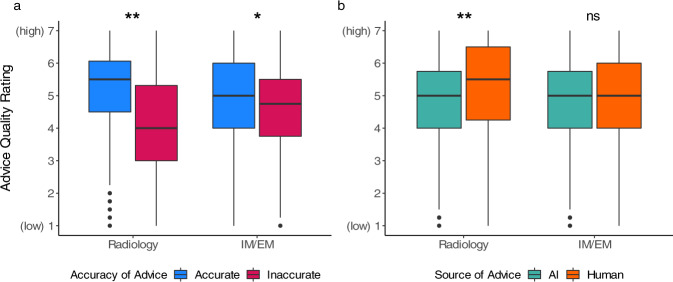
Artificial intelligence (AI) models for decision support have been developed for clinical settings such as radiology, but little work evaluates the potential impact of such systems. In this study, physicians received chest X-rays and diagnostic advice, some of which was inaccurate, and were asked to evaluate advice quality and make diagnoses. All advice was generated by human experts, but some was labeled as coming from an AI system. As a group, radiologists rated advice as lower quality when it appeared to come from an AI system; physicians with less task-expertise did not. Diagnostic accuracy was significantly worse when participants received inaccurate advice, regardless of the purported source. This work raises important considerations for how advice, AI and non-AI, should be deployed in clinical environments.
Overview
CoChat Summary
TL;DR
In a pre-registered web experiment, physicians reviewing chest X-rays received diagnostic advice that was always generated by human experts but sometimes labeled as coming from an AI system. Inaccurate advice reduced diagnostic accuracy regardless of purported source, while radiologists rated purported AI advice as lower quality than purported human advice.
Key findings
- Radiologists showed algorithmic aversion in advice-quality ratings: they rated advice significantly lower when it was labeled AI versus human (γ = 0.53, p = 0.001), whereas IM/EM physicians did not (γ = 0.22, p = 0.165).
- Inaccurate advice was rated lower in quality by both groups, more strongly by radiologists (γ = −1.00, p < 0.001) than by IM/EM physicians (γ = −0.40, p = 0.002).
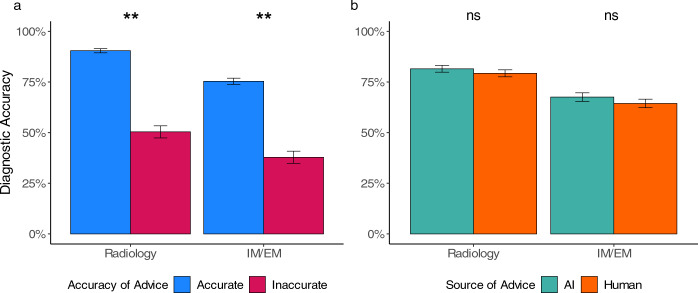
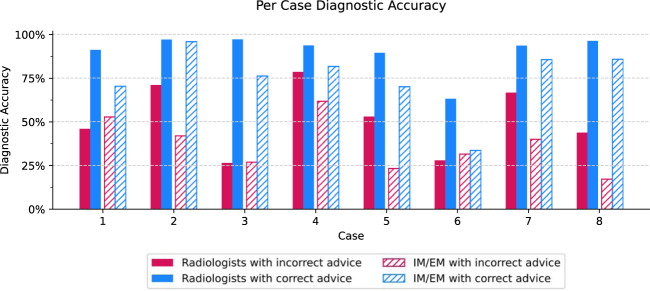
- Diagnostic accuracy was significantly worse with inaccurate advice for radiologists (β = 2.39, p < 0.001) and IM/EM physicians (β = 1.91, p < 0.001); task experts performed 40.10% better and non-experts 37.53% better with accurate versus inaccurate advice.
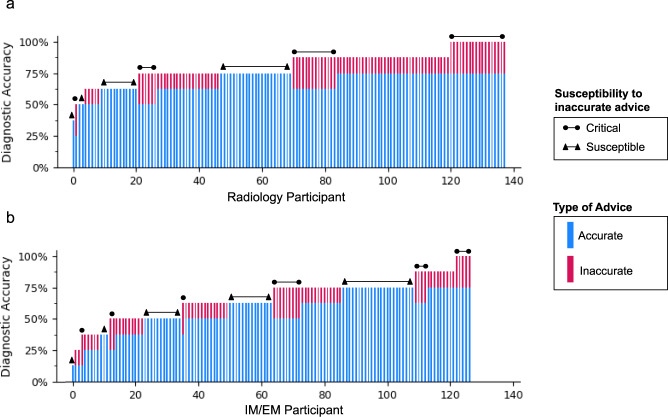
- Purported source did not significantly affect diagnostic accuracy (radiologists p = 0.183; IM/EM p = 0.081). Susceptibility varied: 41.73% of IM/EM physicians always gave the wrong diagnosis with inaccurate advice versus 27.54% of radiologists; 28.26% of radiologists and 17.32% of IM/EM physicians refuted all incorrect advice.
Methods
- Pre-registered web-based experiment (Qualtrics) with physicians recruited in the US and Canada: 138 radiologists (high task expertise) and 127 internal/emergency medicine physicians (lower task expertise).
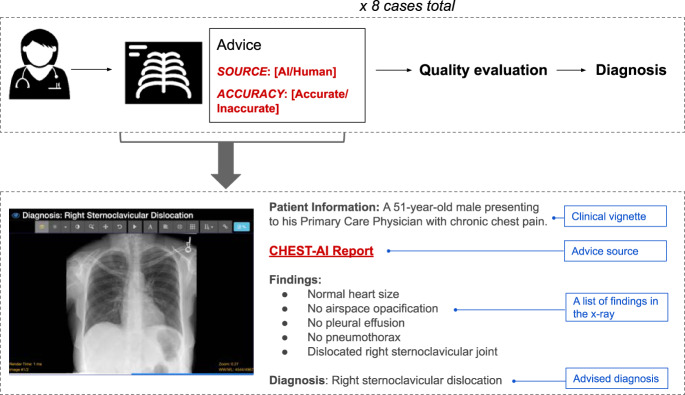
- Participants reviewed eight chest X-ray cases from the MIMIC Chest X-ray database, each with a clinical vignette and diagnostic advice; advice was human-generated but labeled as either from an AI system (CHEST-AI) or an experienced radiologist (Dr. S. Johnson).
- The design was a 2 × 2 mixed factorial: advice source (AI vs. human) between subjects and advice accuracy (accurate vs. inaccurate) within subjects, with participants randomly assigned six accurate and two inaccurate cases. Separate linear mixed models for advice-quality ratings and logistic mixed models for diagnostic accuracy regressed outcomes on advice accuracy, source, their interaction, and individual-related covariates, with a random effect by participant.
Limitations
- The paper states that only eight cases were tested to keep the study short enough for physician completion, that the web-based tool may not capture real deployment risk or behavior, that physician conversations are difficult to recreate, and that the sample is skewed toward less experienced physicians.
- The paper notes that advice was always generated by human experts and only the purported source was manipulated, so the study does not test actual AI-generated advice.
- Evident from the text: quality ratings may not reflect actual attitudes or behavior, as radiologists’ expressed aversion to AI advice did not affect their reliance on it; the online format may also have led to less careful case review or greater reliance on advice.
Model-written summary. Check it against the paper before relying on it.
Integrity signals
Registry
Cites
Statistics
Figures
Verification
Claims the paper makes
4 Valid · 1 Not valid · 10 Not checked · 48 Own results and interpretations
The sources with a verdict support this claim; the rest weren’t checked yet, have no full text we could read, or their verdicts aren’t rated yet.
In the paper
“However, it is not clear how to effectively integrate AI tools with human decision-makers; indeed, the few cases where systems have been implemented and studied showed no improved clinical outcomes6,7.”
§ Do as AI say: susceptibility in deployment of clinical decision-aids > Introduction
What the sources say
- Supportedcites [6] Brocklehurst P Computerised interpretation of fetal heart rate during labour (INFANT): a randomised controlled trial Lancet 2017 389 1719 1729 10.1016/S0140-6736(17)30568-8 28341515 PMC5413601 source
The Results report no significant difference in poor neonatal outcomes between the decision-support and control groups, and no evidence of differences in secondary outcomes for babies. The Discussion likewise concludes that the software did not reduce poor neonatal outcomes. This trial supports the cited sentence as an example, not as evidence about every AI system. (LLM, conf=0.92)
- Not checked — no full text of the sourcecites [7] Nunes I Central fetal monitoring with and without computer analysis: a randomized controlled trial Obstet. Gynecol. 2017 129 83 90 10.1097/AOG.0000000000001799 27926647 source
plain- Asserted: passes — The authors put it forward as true.
- Checkable: passes — It can be checked against evidence.
- Load-bearing: passes — The paper’s conclusions depend on it.
- Based: passes — The paper gives a reason why it holds.
- Supported
A result the paper reports from its own data — it cites no other source for it, so there is none to check. The quote shows it is in the paper.
In the paper
“As shown in Fig. 5, all cases were impacted by incorrect advice to varying degrees.”
§ Do as AI say: susceptibility in deployment of clinical decision-aids > Results > Incorrect advice impacts some clinical cases more than others
plainstates a causen = 8- Asserted: passes — The authors put it forward as true.
- Checkable: passes — It can be checked against evidence.
- Load-bearing: passes — The paper’s conclusions depend on it.
- Based: passes — The paper gives a reason why it holds.
A result the paper reports from its own data — it cites no other source for it, so there is none to check. The quote shows it is in the paper.
In the paper
“None of the measured covariates significantly predicted susceptibility, for either radiologists or IM/EM physicians.”
§ Do as AI say: susceptibility in deployment of clinical decision-aids > Discussion
plain- Asserted: passes — The authors put it forward as true.
- Checkable: passes — It can be checked against evidence.
- Load-bearing: passes — The paper’s conclusions depend on it.
- Based: passes — The paper gives a reason why it holds.
A result the paper reports from its own data — it cites no other source for it, so there is none to check. The quote shows it is in the paper.
In the paper
“Physicians across expertise levels often failed to dismiss inaccurate advice regardless of its source.”
§ Do as AI say: susceptibility in deployment of clinical decision-aids > Discussion
plain- Asserted: passes — The authors put it forward as true.
- Checkable: passes — It can be checked against evidence.
- Load-bearing: passes — The paper’s conclusions depend on it.
- Based: passes — The paper gives a reason why it holds.
A result the paper reports from its own data — it cites no other source for it, so there is none to check. The quote shows it is in the paper.
In the paper
“Further, inaccurate advice was more convincing for certain cases that involved additional interaction or analyses to recognize the error.”
§ Do as AI say: susceptibility in deployment of clinical decision-aids > Discussion
plainstates an association- Asserted: passes — The authors put it forward as true.
- Checkable: passes — It can be checked against evidence.
- Load-bearing: passes — The paper’s conclusions depend on it.
- Based: passes — The paper gives a reason why it holds.
22 more claims
Create a free account to see all 63 claims and every source verdict.
- It may state two separate claims as one. 20
- Probably not a substantial claim. 19
Claims other papers make about this one
Each is checked against this paper’s own text: does it say what the citing paper says it does?
The source backs part of the claim, not all of it — or backs it for a different population, condition or comparison.
In the citing paper
“it has been shown that people with high task expertise are more inclined to dismiss or devalue task-related advice from an AI system than are people with low task expertise7,18.”
From Non-task expert physicians benefit from correct explainable AI advice when reviewing X-rays (2023) · cites this paper as [7]
Experimental — accuracy not yet measuredThe source backs part of the claim, not all of it — or backs it for a different population, condition or comparison.
In the citing paper
“The presentation format of an explanation, its integration into electronic health record (EHR) systems, the cognitive load it imposes, and its alignment with existing clinical reasoning patterns all shape whether a technically sound explanation translates into genuine clinical utility [31,32].”
From Explainability of decoder-only clinical large language models: A scoping review (2026) · cites this paper as [32]
Experimental — accuracy not yet measuredThe source backs part of the claim, not all of it — or backs it for a different population, condition or comparison.
In the citing paper
“A growing body of work examines how healthcare professionals interact with and respond to AI-generated explanations, a dimension distinct from the technical methods used to produce them.”
From Explainability of decoder-only clinical large language models: A scoping review (2026) · cites this paper as [32]
Experimental — accuracy not yet measuredThe source backs part of the claim, not all of it — or backs it for a different population, condition or comparison.
In the citing paper
“Acceptance of clinical AI is shaped by integration into existing workflows, performance under time pressure, alignment with clinical reasoning patterns, and the cognitive load explanations impose [20,31,32].”
From Explainability of decoder-only clinical large language models: A scoping review (2026) · cites this paper as [32]
Experimental — accuracy not yet measuredThe source backs part of the claim, not all of it — or backs it for a different population, condition or comparison.
In the citing paper
“studies suggest that convincing explanations may paradoxically increase over-reliance on incorrect AI outputs, particularly among less experienced clinicians [31,32].”
From Explainability of decoder-only clinical large language models: A scoping review (2026) · cites this paper as [32]
Experimental — accuracy not yet measured
13 more claims about this paper
Create a free account to see every claim other papers make about this one.
Statistics recomputed
Every reported test result, recomputed from its test statistic and degrees of freedom. A result shows as not adding up only once an independent check has confirmed it.
- Consistentr(1102) = 0.43reported p < .001 · recomputed p < .001
“r(1102) = 0.43, p < .001”
Self-check
Percentages, sums and reported differences re-computed from the paper’s own numbers.
Self-check results appear here once an independent check has confirmed them.
Citations
Cites
Dermatologist-level classification of skin cancer with deep neural networks
Esteva, A., Kuprel, B., Novoa, R. A., Ko, J., Swetter, S. M., Blau, H. M., & Thrun, S. (2017) · Nature · doi:10.1038/nature21056 · Cited by 14,362
High-performance medicine: the convergence of human and artificial intelligence
Topol, E. J. (2019) · Nature Medicine · doi:10.1038/s41591-018-0300-7 · Cited by 10,450
Gulshan, V., Peng, L., Coram, M., Stumpe, M. C., Wu, D., Narayanaswamy, A., Venugopalan, S., Widner, K., Madams, T., Cuadros, J., et al. (2016) · JAMA · doi:10.1001/jama.2016.17216 · Cited by 7,697
The Association of American Medical Colleges
Zapffe, F. C. (1938) · Academic Medicine · doi:10.1097/00001888-193801000-00007 · Cited by 5,533
Rajkomar, A., Dean, J., & Kohane, I. (2019) · New England Journal of Medicine · doi:10.1056/nejmra1814259 · Cited by 4,579
Algorithm aversion: People erroneously avoid algorithms after seeing them err.
Dietvorst, B. J., Simmons, J. P., & Massey, C. (2015) · Journal of Experimental Psychology: General · doi:10.1037/xge0000033 · Cited by 3,232
Artificial intelligence in healthcare
Yu, K.-H., Beam, A. L., & Kohane, I. S. (2018) · Nature Biomedical Engineering · doi:10.1038/s41551-018-0305-z · Cited by 2,817
Algorithm appreciation: People prefer algorithmic to human judgment
Logg, J. M., Minson, J. A., & Moore, D. A. (2019) · Organizational Behavior and Human Decision Processes · doi:10.1016/j.obhdp.2018.12.005 · Cited by 2,061
Resistance to Medical Artificial Intelligence
Longoni, C., Bonezzi, A., & Morewedge, C. K. (2019) · Journal of Consumer Research · doi:10.1093/jcr/ucz013 · Cited by 2,015
Lakhani, P., & Sundaram, B. (2017) · Radiology · doi:10.1148/radiol.2017162326 · Cited by 1,775
Cited by
Items 301–400 of 527
When Do Undergraduate Students Prefer AI? Insights into AI Scoring and Feedback
Yildirim‐Erbasli, S. N., Dibek, M. İ., Thomas, M. L., & Lesoway, N. (2026) · Behavioral Sciences · doi:10.3390/bs16071196 · Cited by 3
“…evidence from adjacent domains consistently shows that individuals may reject algorithmically derived judgments even when algorithms outperform human decision makers, a phenomenon documented in medical decision-making, hiring, and financial advising (Dietvorst et al., 2015; Gaube et al., 2021).”
Improving Social Bot Detection Through Aid and Training
Kenny, R., Fischhoff, B., Davis, A. L., & Canfield, C. (2023) · Human Factors The Journal of the Human Factors and Ergonomics Society · doi:10.1177/00187208231210145 · Cited by 5
“Although algorithms can help detect diseases, their adoption has been slow due to preferences for human advice (Dietvorst et al., 2015; Buck et al., 2022; Gaube et al., 2021).”
BackgroundJoo, H., Mathis, M. R., Tam, M., James, C. A., Han, P., Mangrulkar, R. S., Friedman, C. P., & Vydiswaran, V. G. V. (2023) · JMIR Research Protocols · doi:10.2196/49842 · Cited by 2
Longo, L. (2023) · Communications in computer and information science · doi:10.1007/978-3-031-44070-0 · Cited by 7
Applications and potential of machine, learning augmented chest X-ray interpretation in cardiology
Milne, M., Ahmad, H. K., Buchlak, Q. D., Esmaili, N., Tang, C. H. M., Seah, J. C. Y., Ektas, N., Brotchie, P., Marwick, T. H., & Jones, C. M. (2024) · Minerva Cardiology and Angiology · doi:10.23736/s2724-5683.24.06288-4 · Cited by 2
Detecting Uncertainty of Mortality Prediction Using Confident Learning
Abad, Z. S. H., & Lee, J. (2021) · Annual International Conference of the IEEE Engineering in Medicine and Biology Society (EMBC) · doi:10.1109/embc46164.2021.9629505 · Cited by 7
“Second, research that argues trust in human-AI collaboration and investigates the role of human clinicians in interpreting the decisions made by medical ML models [6]–[9].”
BackgroundWho should do as AI say? Only non-task expert physicians benefit from correct explainable AI advice
Gaube, S., Suresh, H., Raue, M., Lermer, E., Koch, T., Hudecek, M., Ackery, A. D., Grover, S. C., Coughlin, J. F., Frey, D., et al. (2022) · doi:10.21203/rs.3.rs-1687219/v1 · Cited by 3
Self-citationChatGPT in Medical Education: A Precursor for Automation Bias? (Preprint)
Nguyen, T. (2023) · doi:10.2196/preprints.50174 · Cited by 2
Kohan, A., Xu, J., Xiao, L., Wu, X., Kukkar, A., Hussain, S., Roshanzamir, M., Alizadehsani, R., & Acharya, U. R. (2026) · Research Square · doi:10.21203/rs.3.rs-8976235/v1 · Cited by 5
Schlicker, N., Langer, M., & Hirsch, M. C. (2023) · Die Innere Medizin · doi:10.1007/s00108-023-01602-1 · Cited by 6
Leveraging Actionable Explanations to Improve People’s Reactions to AI-Based Decisions
Langer, M., & Valera, I. (2024) · Lecture notes in computer science · doi:10.1007/978-3-031-73741-1_18 · Cited by 3
“This is true in high-stakes contexts such as medical diagnosis and treatment [1], hiring [2], and loan contexts [3].”
Wang, Y., Zhao, J. L., Ba, Y., Mancenido, M. V., Chiou, E. K., & Maciejewski, R. (2025) · International Journal of Human-Computer Interaction · doi:10.1080/10447318.2025.2564272 · Cited by 3
“Experts, due to extensive training and professional experience, may exhibit higher skepticism toward AI recommendations (Gaube et al., 2021; Nourani et al., 2020a), have established mental models of what constitutes meaningful explanations, and react differently to error types, particularly missed…”
Rahman, J. S., Delaforce, A., Bradford, D., Li, J., Magrabi, F., Cook, D., & Brankovic, A. (2026) · JMIR Human Factors · doi:10.2196/81460 · Cited by 5
“Without adequate transparency, there is also a risk that clinicians may overrely on these tools, potentially leading to harmful outcomes [24-27].”
Pal, O., Duddu, V., Goyal, A., Goel, D., & Saha, K. (2026) · CHI Extended Abstracts · doi:10.1145/3772363.3799386 · Cited by 7
Zhang, Q., Liu, L., Li, J., Xing, B., Liu, Z. H., Liu, J., Li, X., Wang, J., Wang, J., & Wang, J. (2026) · BMC Medical Education · doi:10.1186/s12909-026-09358-6 · Cited by 4
“The automation bias literature documents the tendency of frequent users of automated systems to develop over-reliance on system outputs accompanied by diminished independent verification behavior [14, 15].”
Unlocking AI Chatbot Potential in Healthcare: Trust-Enhanced DeLone & McLean IS Success Model
Sarhan, M. Y., Alarify, M., & Khojah, M. (2026) · Healthcare · doi:10.3390/healthcare14101324 · Cited by 2
Positive psychology 4.0: a science of consequence for a world that can no longer wait
van Zyl, L. E. (2026) · Frontiers in Psychology · doi:10.3389/fpsyg.2026.1726065 · Cited by 3
“Research demonstrates that hybrid human-AI systems consistently outperform either humans or AI alone across diverse clinical prediction tasks, with improvements in diagnostic accuracy ranging from 12 to 37% compared to unaided clinical judgment (Gaube et al., 2021; Rajpurkar et al., 2022).”
Taib, A. G., Partridge, G. J. W., Phillips, P. W., Maxwell-Armstrong, C., Chen, X., Hofvind, S. S. H., James, J. J., & Chen, Y. (2026) · Radiology · doi:10.1148/radiol.252590 · Cited by 11
Toward Behavioral AI: Cognitive Factors Underlying the Public Psychology of Artificial Intelligence
Mukherjee, S., Senapati, D., & Mahajan, I. (2023) · Springer eBooks · doi:10.1007/978-981-99-3966-4_1 · Cited by 3
Who Does What? Archetypes of Roles Assigned to LLMs During Human-AI Decision-Making
Chappidi, S., Singh, J., & Krauze, A. V. (2026) · CHI Conference on Human Factors in Computing Systems · doi:10.1145/3772318.3791428 · Cited by 8
“Previous work has shown differences in output style and quality depending on the syntactic features of the prompt (e.g., quality of writing [82]) as well as varying deference to AI suggestions based on expertise level [76, 106, 154, 191].”
Ip, W.-Y., Yeung, F.-K., Yung, S. P. F., Yu, H.-C. J., So, T., & Vardhanabhuti, V. (2021) · Artificial Intelligence in Medical Imaging · doi:10.35711/aimi.v2.i2.37 · Cited by 2
Gerendas, B. S., Bogunović, H., & Schmidt-Erfurth, U. M. (2021) · JAMA Ophthalmology · doi:10.1001/jamaophthalmol.2021.2309 · Cited by 2
Howland, H., Keyser, V., & Mahootian, F. (2022) · Future of business and finance · doi:10.1007/978-3-030-99838-7_10 · Cited by 2
Confidence in AI in general practice
Painter, A., Nix, M. G., & Verma, J. (2023) · Future Medicine AI · doi:10.2217/fmai-2023-0017 · Cited by 2
Mitigating Knowledge Imbalance in Ai-Advised Decision-Making Through Collaborative User InvolvementPreprint
Gómez, C., Unberath, M., & Huang, C.-M. (2022) · Social Science Research Network · doi:10.2139/ssrn.4183219 · Cited by 50
Empathy Cuts Both Ways in Clinical AI (Preprint)Preprint
Sorin, V., & Klang, E. (2026) · doi:10.2196/preprints.108778 · Cited by 2
“Role of Human-AI interaction in selective prediction,”
Bondi, E., Koster, R., Sheahan, H., Chadwick, M., Bachrach, Y., Cemgil, T., Paquet, U., & Dvijotham, K. (2022) · Proceedings of the AAAI Conference on Artificial Intelligence · doi:10.1609/aaai.v36i5.20465 · Cited by 30
“Gaube et al. (2021) conduct experiments to measure the interaction between medical AI systems and clinicians.”
BackgroundProviding Care: Intrinsic Human–Machine Teams and Data
Russell, S., & Kumar, A. (2022) · Entropy · doi:10.3390/e24101369 · Cited by 2
Les enjeux de l’intelligence artificielle en odontologie
Dot, G., Gajny, L., & Ducret, M. (2024) · médecine/sciences · doi:10.1051/medsci/2023199 · Cited by 1
Future Trends in AI and Academic Research Writing
Roy, R., Ashmika, R., Chakraborty, A., & Sharafat, I. (2024) · Advances in educational technologies and instructional design book series · doi:10.4018/979-8-3693-1798-3.ch015 · Cited by 5
Raposo, D. R. A., Júnior, J. S. A., da Silva, D. T. O., Alves, R. D. A., dos Santos, D. C. M., Alves, T. M., da Silva, J. K. S., Aragão, S. F., & Farias, C. M. S. (2024) · Contribuciones a las Ciencias Sociales · doi:10.55905/revconv.17n.7-417 · Cited by 4
Alrashdi, A. A. A., Alrasheedi, A. M. E., Alazmi, N., Algharbi, A. A. B., Alanazi, K., Alshammari, H. O. S., Alshammari, D., Alshammari, H., Aldubl, I. S. S., & Alharbi, A. H. (2024) · Journal of Ecohumanism · doi:10.62754/joe.v3i8.5252 · Cited by 3
“Source: (Koh et al., 2022) Source: (Gaube et al., 2021) These bars illustrate the diagnostic performances of the developed AI models against human radiologists for different cancers, including lung, breast, and prostate cancer.”
Psychological impact of ai in the automation of clinical decision-making
Hernández, D. C. V., Contreras-Vásquez, L. F., Espinoza, G. F. S., Tufiño, A., Teneda, A. C. C., Rosero, E. A. R., Velasteguí, V. G. S., Hernández, R. E. V., Cabezas, F. A. V. D. L. B., & Salazar-Garcés, L. F. (2025) · Salud Ciencia y Tecnología · doi:10.56294/saludcyt20251586 · Cited by 1
Leveraging artificial intelligence for the management of preschool wheeze: A narrative review
Dent, A., Khan, M. U., & Subbarao, P. (2025) · Pediatric Allergy and Immunology · doi:10.1111/pai.70207 · Cited by 2
“96 In the context of algorithms for wheezing, predictions must align with available clinical workflows and standards of care.”
Khoobi, M., von der Stück, M. S., Ordonez, F. B., Iancu, A.-M., Corban, E., Nowak, J., Kargaliev, A. V., Perelygina, V., Schott, A.-S., dos Santos, D. P., et al. (2026) · Radiology · doi:10.1148/radiol.251348 · Cited by 2
Human at the Center: A Framework for Human-Driven AI Development
Hu, D., Acosta-Navas, D., Gaube, S., Mozannar, H., Taylor, M. E., Dvijotham, K., & Bondi-Kelly, E. (2025) · The AI Magazine · doi:10.1002/aaai.70043 · Cited by 3
Self-citationEngineering framework for curiosity-driven and humble AI in clinical decision support
Arslan, J., Benke, K. K., Cajas, S. A., Castro, R., Celi, L. A., Cruz-Suarez, G. A., Reyes, R. D., Engelmann, J., Ercole, A., Hilel, A., et al. (2026) · BMJ Health & Care Informatics · doi:10.1136/bmjhci-2025-101877 · Cited by 2
Bold, B., Tokuda, B., Kashif, M. S., Fadzli, F., Wee, N. K., Kanwal, U., Nguyen, T. N., & Wah, N. P. S. (2026) · Japanese Journal of Radiology · doi:10.1007/s11604-026-01971-1 · Cited by 2
“Increasingly, implemen - tation studies have emphasized that clinical impact depends on sociotechnical factors, including workflow integration, governance, clinician engagement, and trust in the technol - ogy [ 6 ].”
Guberina, N., Khouya, A., Hoffmann, C., Fischedick, G., Alberti, Y., Hlouschek, J., Freisleben, F., Herz, A., Ton, T. T. M., Kiwitt, L. O., et al. (2026) · Technical Innovations & Patient Support in Radiation Oncology · doi:10.1016/j.tipsro.2026.100401 · Cited by 1
“This phenomenon has been observed not only in medical contexts among physicians [13,14], but also in various other important decision-making situations [15].”
Four Aspirations for Evaluating AI-Infused Technologies: A Narrative Review
Morey, D. A., Jalaeian, M., Reynolds, M. E., McGeorge, N., Oldham, H. K., & Rayo, M. F. (2026) · Journal of Cognitive Engineering and Decision Making · doi:10.1177/15553434261443032 · Cited by 1
“Alternatively, evaluations which couple and corroborate measures of trust with more direct measures of performance may derive richer and more comprehensive insights from these complementary analyses (Chavaillaz et al., 2019; Gaube et al., 2021; Salehi et al., 2024).”
Efficiency Pitfalls of Explainable AI in Clinical Diagnostic and Treatment Human-AI Workflows
Hunsicker, T., Schulz, A., Leist, R. A., Kiefer, S., Boden, K., Rothaus, K., König, C. J., & Langer, M. (2026) · Human Factors The Journal of the Human Factors and Ergonomics Society · doi:10.1177/00187208261443764 · Cited by 3
Zhu, Z., Hu, G., Tan, W., Gao, K., Sun, C. F., Zhou, Z. ‐., Xu, K., Han, W., Shang, M., Qiu, X., et al. (2026) · Nature Cancer · doi:10.1038/s43018-026-01147-w · Cited by 2
“Moreover, key factors influencing the effectiveness of AIassisted reading—such as AI accuracy, radiologist experience, susceptibility to AI output and personality traits—are not fully understood 31–33 .”
From Algorithms to Adaptive Clinical Intelligence in Diabetes Care
Corrao, S. (2026) · Endocrine Practice · doi:10.1016/j.eprac.2026.05.006 · Cited by 1
Kim, M., Yun, S., Kim, H., Matsushita, E., Yeom, J. W., Kim, S., Pack, S. P., Lee, H., Cheong, T., & Cho, C. (2026) · Digital Health · doi:10.1177/20552076261458929 · Cited by 3
A Safety-Constrained Architecture for Adaptive Clinical Decision Support
Wendakoon, K., & Tripathi, N. (2026) · Communications in computer and information science · doi:10.1007/978-3-032-28819-6_21 · Cited by 1
Ostrovsky, D. A., Haran, U., & Novack, V. (2026) · European Journal of Internal Medicine · doi:10.1016/j.ejim.2026.107032 · Cited by 2
Mariotti, F., Cacioppa, L. M., Rossini, N., Bruno, A., Francavilla, G., Felicioli, A., Macchini, M., Coppola, A., Cellina, M. I., & Floridi, C. (2026) · Journal of Imaging · doi:10.3390/jimaging12060274 · Cited by 1
Trust and Reliance on AI in Education: AI Literacy and Need for Cognition as Moderators
Pitts, G., Rani, N., & Mildort, W. (2026) · Lecture notes in computer science · doi:10.1007/978-3-032-29763-1_28 · Cited by 7
de Grauw, M., Westphal, M., Smit, E. J., et al. (2026) · Radiology Advances · doi:10.1093/radadv/umag028 · Cited by 1
“28 In a nonblinded setting, readers might place greater trust in expert-derived measurements, potentially widening the observed difference in reading time between AI-assisted and expert-assisted conditions.”
Divergent impacts of explainable AI for dermatological diagnosis on clinicians versus lay people
Xu, X., Hu, H.-Y., Zhang, H., Wang, W., Wang, R., Soenksen, L., Badri, O., Jafry, S., Burger, E., Nwandu, L., et al. (2026) · Nature Medicine · doi:10.1038/s41591-026-04553-w · Cited by 3
“We inspected the relationship between participants ʼ deference toward AI suggestions and initial performance 30 .”
InfluentialSelf-citationValue-Centric AI – Designing Sociotechnical Systems Before Legitimacy Fails
Richter, A., Pfeiffer, J., Hinz, O., & Reijers, H. A. (2026) · Business & Information Systems Engineering · doi:10.1007/s12599-026-01017-w · Cited by 1
“In clinical decision support, AI advice can improve performance while also creating susceptibility to erroneous recommendations and automation bias (Goddard et al. 2014; Gaube et al. 2021), particularly for novice physicians (Jussupow et al. 2021).”
Work Redesign after Digital Augmentation of Human Expertise and Agency
Larsson, S., Johansson, E., Nilsson, A., & Andersson, L. (2025) · Journal of Applied Organizational Systems and Behavior · doi:10.51847/f9ejhcqn5d · Cited by 1
Kim, J. Y., Rowell, B. E., Whitaker, M., Chen, Q., Kontar, R. A., Lester, C. A., & Yang, X. J. (2026) · JMIR Human Factors · doi:10.2196/92822 · Cited by 1
“While this approach can preserve human decision autonomy and reduce the anchoring effect, it may exacerbate confirmation bias [37-39], contribute to algorithm aversion [35,40,41], and introduce workflow interruptions when AI intervenes unnecessarily [42].”
AI in Healthcare: Malignant or Benign?
Lloyd, N., & Khuman, A. S. (2022) · Brain informatics and health · doi:10.1007/978-981-19-5272-2_1 · Cited by 3
Alarcón, Á. S., Madrid, N. M., Seepold, R., & Ramirez, J. A. O. (2022) · Procedia Computer Science · doi:10.1016/j.procs.2022.09.532 · Cited by 1
Elbow trauma in children: development and evaluation of radiological artificial intelligence models
Rozwag, C., Valentini, F., Cotten, A., Demondion, X., PREUX, P., & Jacques, T. (2023) · Research in Diagnostic and Interventional Imaging · doi:10.1016/j.redii.2023.100029 · Cited by 4
“In addition, recent work on this topic tends to show the potentially deleterious impact of a model, though effective in silico, on the diagnoses made by doctors [20,21].”
BackgroundAI-Based Extraction of Radiologists Gaze Patterns Corresponding to Lung Regions
Pershin, I., Maksudov, B., Mustafaev, T., & Ibragimov, B. (2023) · Lecture notes in networks and systems · doi:10.1007/978-3-031-35501-1_39 · Cited by 1
Ammeling, J., Manger, C., Kwaka, E., Krügel, S., Uhl, M., Kießig, A., Fritz, A., Ganz, J., Riener, A., Bertram, C., et al. (2023) · Mensch und Computer (MuC) · doi:10.1145/3603555.3608561 · Cited by 1
“Recent studies show, that providing explanations on a case-by-case basis can increase trust and reliance on the advice, even when the advice is incorrect [2, 9, 10, 15].”
BackgroundLópez, M. J. C., Castillo, A. L., Casados, J. C., Rosales, D. A. M., & Casados, L. N. C. (2023) · South Florida Publishing eBooks · doi:10.47172/sfp2020.ed.00081 · Cited by 1
Artificial Intelligence in Cutaneous Lesions: Where do we Stand and What is Next?
(2024) · Frontiers research topics · doi:10.3389/978-2-8325-4911-7 · Cited by 2
Ooko, P. A., Aloka, P. J. O., & Koweru, R. A. (2023) · South Florida Publishing eBooks · doi:10.47172/sfp2020.ed.00082 · Cited by 1
An Interpretable Algorithm for Uveal Melanoma Subtyping from Whole Slide Cytology ImagesPreprint
Chen, H., Liu, T. Y. A., Gómez, C., Corrêa, Z. M., & Unberath, M. (2021) · arXiv (Cornell University) · doi:10.48550/arxiv.2108.06246 · Cited by 4
“However, as “black box” models that perform a super-human task, these algorithms do not offer insights beyond the final recommendation to the human decision makers, which has been linked to automation bias and over-trust or dis-trust in such systems (Nourani et al., 2020; Gaube et al., 2021).”
Demonstrating Clinical Impact for AI Interventions
Sachdeva, G. S., Han, J. E., Keane, P. A., Denniston, A. K., & Liu, X. (2023) · Wiley eBooks · doi:10.1002/9781119790686.ch42 · Cited by 1
Impact of a machine learning-powered algorithm on pathologist HER2 IHC scoring in breast cancerPreprint
Shamshoian, J., Shanis, Z., Cabeen, R. P., Yu, L., Chakraborty, S., Thibault, M., Martin, B., Padigela, H., Juyal, D., Javed, S. A., et al. (2025) · medRxiv · doi:10.1101/2025.02.04.25321335 · Cited by 5
Grundgeiger, T., Maurer, L., Hölzing, C. R., & Happel, O. (2026) · CHI Conference on Human Factors in Computing Systems · doi:10.1145/3772318.3790619 · Cited by 1
“Depending on the research question, additional measures included trust in the AI system and confidence in the diagnosis decision (e.g., [13, 26, 38, 54, 56]).”
Adams, L. C., Marx, L., Orberg, E. T., Bressem, K. K., Ziegelmayer, S., Bernhardt, D., Graf, M., Makowski, M. R., Combs, S. E., Matthes, F., et al. (2026) · Research Square · doi:10.21203/rs.3.rs-9227402/v1 · Cited by 1
Training Radiologists for an AI-Augmented Future
Wu, K., Gaube, S., Colak, E., et al. (2026) · Canadian Association of Radiologists Journal · doi:10.1177/08465371261449694 · Cited by 1
Self-citationDighe, M. (2026) · WFUMB Ultrasound Open · doi:10.1016/j.wfumbo.2026.100115 · Cited by 3
Jung, W., Jeon, K., & Babon-Ayeng, P. (2026) · Proceedings of the 2026 ACM Sustainability Week · doi:10.1145/3765611.3815499
“Across multiple decision-support contexts, users with domain knowledge have been shown to be more discerning – rejecting incorrect AI recommendations that non-experts accept [7] and reducing their reliance when AI quality is low [4].”
Can deep learning classify stroke subtypes from chest X-rays?
Raghu, V. K., & Lu, M. T. (2021) · EBioMedicine · doi:10.1016/j.ebiom.2021.103517
Cuocolo, R. (2021) · American Journal of Roentgenology · doi:10.2214/ajr.21.27221
Hummel, T. R., & Rimmele, M. (2021) · Springer eBooks · doi:10.1007/978-3-658-35779-5_34 · Cited by 1
Hahn, L. D. (2022) · American Journal of Roentgenology · doi:10.2214/ajr.22.28768
Lorenz, M. (2022) · eDiss (Georg-August-Universität Göttingen) · doi:10.53846/goediss-9591
Weber, S., Godefroid, M., Knop, M., Plattfaut, R., & Niehaves, B. (2022) · doi:10.2196/preprints.44090
Algorithmic Decision-Making, Economic Behavior and Predictability in Financial Markets
Judek, J. R. (2023) · eDiss (Georg-August-Universität Göttingen) · doi:10.53846/goediss-9868
Hummel, T. R., & Rimmele, M. (2023) · Springer eBooks · doi:10.1007/978-3-658-40232-7_34
9 KI-gestützte Entscheidungsunterstützungssysteme im Gesundheitswesen
Gaube, S., & Lermer, E. (2023) · De Gruyter eBooks · doi:10.1515/9783111034706-009 · Cited by 4
Self-citationSidiropoulos, T. A., & Chaidemenos, G. C. (2023) · South Florida Publishing eBooks · doi:10.47172/sfp2020.ed.00079
CDC6 AND GEMININ EXPRESSION IN CERVICAL CANCER CELLS
Mora, W. A. C., Hernández, O. D. M., Illades‐Aguiar, B., & Alarcón‐Romero, L. D. C. (2023) · South Florida Publishing eBooks · doi:10.47172/sfp2020.ed.00083
Technologies aimed at the health area
Ooko, P. A. (2023) · South Florida Publishing eBooks · doi:10.47172/sfp2020.ed.00078
ESTUDIANTE DE MEDICINA: SUS IDEAS Y ESCRITURA
Estrada, J. R. O., Torres, C. M., & Nava, B. R. (2023) · South Florida Publishing eBooks · doi:10.47172/sfp2020.ed.00080
Can overzealous reliance on evidence-based medicine overshadow good clinical judgement?
Sykes, L., Grobler, G. P., & Bradfield, C. (2024) · Journal of the Colleges of Medicine of South Africa · doi:10.4102/jcmsa.v2i1.30
“10 In this scenario, such blind adherence to the pre-determined plan prevented the clinicians from altering their strategy when they encountered the clinical difficulties.”
Dorigheto, P. S., Barros, P. G., Garcia, E. H. C., Lens, L. N., & Murgia, M. F. Z. (2023) · South Florida Publishing eBooks · doi:10.47172/sfp2020.ed.00110
ADENOCARCINOMA DE COLON CON CÉLULAS EN ANILLO DE SELLO EN UN ADOLESCENTE: REPORTE DE UN CASO
Ortiz, R. A. C., Montiel, M. D., Gallego, A. M., Izaguirre, R. A. R., & Rodriguez, E. J. B. (2023) · South Florida Publishing eBooks · doi:10.47172/sfp2020.ed.00103
dfg sdh sfdghfg hfgsh fgs hsfgh sfg hfsg hsfgh
fgh, G. F. H., fghfgh, F. F. F. F. H., fghfh, F. F. H. H. H., & sgfhfghsfgh, S. H. H. H. H. (2024) · South Florida Publishing eBooks · doi:10.47172/sfp2020.ed.00112
Tomaz, H. B. M., Solidade, C. H. R., da Silva, T. L., & Lens, L. N. (2024) · South Florida Publishing eBooks · doi:10.47172/sfp2020.ed.00111
Schlicker, N., Langer, M., & Hirsch, M. C. (2024) · Forum · doi:10.1007/s12312-024-01338-5 · Cited by 1
Xie, H., Zhang, J. S., Zhu, Y., Chen, D., Yang, K., Hu, X., Bai, Z., & Zuo, Y. (2024) · doi:10.2196/preprints.64168
Ausgewählte wissenschaftliche Beiträge des Center for Leadership and People Management
Kuonath, A., Frey, D., Vilser, M., & Lermer, E. (2024) · Springer eBooks · doi:10.1007/978-3-662-67652-3_19
Self-citationLeveraging Actionable Explanations to Improve People’s Reactions to AI-based DecisionsPreprint
Langer, M., & Valera, I. (2024) · doi:10.31219/osf.io/53v4x
Impact of Using an AI-CAD Tool in Radiology Training
Leite, B. R., Rossi, S., & Andersen, T. O. (2024) · Nordic Conference on Human-Computer Interaction · doi:10.1145/3677045.3685437
“• Bias: [6] also highlighted the presence of biases when AI advice was provided, affirming that the use of AI before a preliminary diagnosis may lead professionals to look for information that confirms the diagnostic presented by the technology.”
InfluentialArtificial intelligence in healthcare
Canelas‐Pais, M., Coutinho‐Almeida, J., Araujo, S. M., Rafael, F. M., Cruz-Correia, R. J., & Rodrigues, P. P. (2024) · Elsevier eBooks · doi:10.1016/b978-0-323-91819-0.00009-9 · Cited by 1
When AI Is Not Enough: Reducing Diagnostic Errors with Radiologist OversightPreprint
Cai, J., & Zychlinski, N. (2024) · SSRN Electronic Journal · doi:10.2139/ssrn.5037549
Analisi dei fattori determinanti l'adozione dell'Intelligenza Artificiale in sanità
Domenico, F. D., Noto, G., & Vermiglio, C. (2024) · MECOSAN · doi:10.3280/mesa2023-128oa18595
Designing Human-Automation Redundancy: Overreliance, Automation Shirking, and the Operator’s Dilemma
Cohen, D., Roth, Y., Rieskamp, J., & Schöbel, M. (2025) · doi:10.2139/ssrn.5098488
Recognizing Selected Features in the News Text
Kaczmarek, A., Tobolewski, F., Ganzha, M., Paprzycki, M., & Wróblewska, A. (2025) · Lecture notes in computer science · doi:10.1007/978-3-031-86193-2_17
Shank, D. B. (2025) · Springer eBooks · doi:10.1007/978-3-031-86061-4_7
Improving AI-Assisted Decision-Making Through Calibrated CoarseningPreprint
Hoong, R., & Dreyfuss, B. (2025) · SSRN Electronic Journal · doi:10.2139/ssrn.5286198 · Cited by 5
Metadata
- Authors
- Gaube, S., Suresh, H., Raue, M., Merritt, A., Berkowitz, S. J., Lermer, E., Coughlin, J. F., Guttag, J. V., Colak, E., & Ghassemi, M.
- Affiliations
- University of Regensburg (DE)
- MIT Computer Science and Artificial Intelligence Laboratory (US)
- Massachusetts Institute of Technology (US)
- Boston Medical Center (US)
- Beth Israel Deaconess Medical Center (US)
- FOM University of Applied Sciences for Economics and Management (DE)
- St. Michael's Hospital (CA)
- University of Toronto (CA)
- Corresponding author
- Gaube, Susanne
- Suresh, Harini
- ORCID
- Venue
- npj Digital Medicine
- Published
- 2021-02-19
- Volume
- 4
- Issue
- 1
- Pages
- 31-31
- ISSN
- 2398-6352 (ISSN-L)
- PMC
- PMC7896064
- OpenAlex
- W3130937151
- Cited by
- 543
- References
- 42
- Citations by year
- 2026: 174 · 2025: 109 · 2024: 81 · 2023: 94 · 2022: 62 · 2021: 23
- FWCI
- 18.71
- Type
- journal article
- Language
- en
- Open access
- gold
- doi.org
- Licence
- cc-by
- creativecommons.org/licenses/by/4.0 (tdm)
- creativecommons.org/licenses/by/4.0 (vor)
- Locations
- npj Digital Medicine (publishedVersion, cc-by)
- PubMed Central (publishedVersion, cc-by)
- PubMed (publishedVersion)
- DOAJ (DOAJ: Directory of Open Access Journals) (submittedVersion, cc-by-sa)
- DSpace@MIT (Massachusetts Institute of Technology) (submittedVersion, cc-by-nc)
- University of Regensburg Publication Server (University of Regensburg) (submittedVersion)
- Funders
- Gouvernement du Canada | Natural Sciences and Engineering Research Council of Canada
- Microsoft Research
- Topics
- Health Sciences › Medicine › Health Informatics › Artificial Intelligence in Healthcare and Education
- Health Sciences › Medicine › Family Practice › Clinical Reasoning and Diagnostic Skills
- Physical Sciences › Computer Science › Artificial Intelligence › Explainable Artificial Intelligence (XAI)
- Keywords
- artificial intelligence, clinical decision support, radiologists, chest X-ray diagnosis, diagnostic accuracy
About these checks
Registry, retraction, Cites and statistics results are computed, not judged, with one exception: a printed reference that no index lists is read once by a model before it counts as a citation error. Claims are extracted by a model and kept only when their quote appears verbatim in the text; each cited source is then checked, with a model’s help, for whether it says what the claim relies on. Those verdicts can be wrong — read the claim’s quote and the cited source before relying on one.
The claim verdicts this report counts are experimental: their accuracy is not yet measured.
A language model drew the claims from the paper on 2026-10-10, under version 3 of the claim definition (model deepseek-v4.1-flash, prompt extract-v3).
A second model labelled each claim on 2026-10-10 (model jev-1.13-20260917, definition revision gold-guideline-v0.2).
Cited sources are checked with a language model’s help (gpt-6-sol).
Statistics and arithmetic are recomputed, not judged.
Confidence bands are shown only for fields calibrated on our annotated test set. None is calibrated yet, so no band is shown.
What counts as a claim ›How we measure confidence ›How we check this ›
Are you an author, or do you see a problem with this page? Request a review
Data sources
Bibliographic data: Semantic Scholar, OpenAlex, Crossref.
Contains information from the Semantic Scholar Academic Graph Datasets, made available under the ODC Attribution License (ODC-BY 1.0).
Semantic Scholar’s data is described in: Kinney, R., et al. (2023). The Semantic Scholar Open Data Platform. arXiv:2301.10140.
