

Do as AI say: susceptibility in deployment of clinical decision-aids
Open accessThe DOI matches its Crossref record; 42 of the 42 references it cites were found in a registry or an index; 9 of the 31 sources its claims cite were checked for support.
Abstract
Artificial intelligence (AI) models for decision support have been developed for clinical settings such as radiology, but little work evaluates the potential impact of such systems. In this study, physicians received chest X-rays and diagnostic advice, some of which was inaccurate, and were asked to evaluate advice quality and make diagnoses. All advice was generated by human experts, but some was labeled as coming from an AI system. As a group, radiologists rated advice as lower quality when it appeared to come from an AI system; physicians with less task-expertise did not. Diagnostic accuracy was significantly worse when participants received inaccurate advice, regardless of the purported source. This work raises important considerations for how advice, AI and non-AI, should be deployed in clinical environments.
Overview
CoChat Summary
TL;DR
In a pre-registered web experiment, physicians reviewing chest X-rays received diagnostic advice that was always generated by human experts but sometimes labeled as coming from an AI system. Inaccurate advice reduced diagnostic accuracy regardless of purported source, while radiologists rated purported AI advice as lower quality than purported human advice.
Key findings
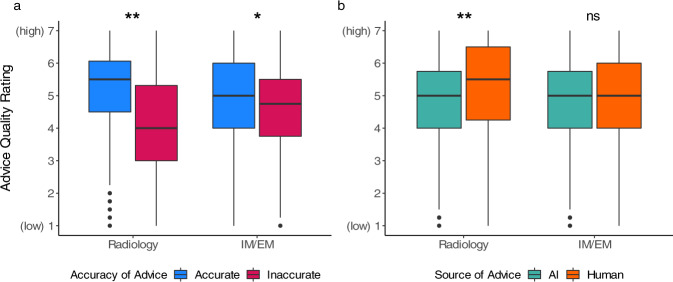
- Radiologists showed algorithmic aversion in advice-quality ratings: they rated advice significantly lower when it was labeled AI versus human (γ = 0.53, p = 0.001), whereas IM/EM physicians did not (γ = 0.22, p = 0.165).
- Inaccurate advice was rated lower in quality by both groups, more strongly by radiologists (γ = −1.00, p < 0.001) than by IM/EM physicians (γ = −0.40, p = 0.002).
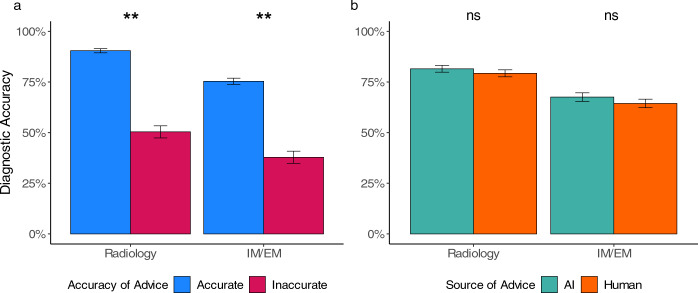
- Diagnostic accuracy was significantly worse with inaccurate advice for radiologists (β = 2.39, p < 0.001) and IM/EM physicians (β = 1.91, p < 0.001); task experts performed 40.10% better and non-experts 37.53% better with accurate versus inaccurate advice.
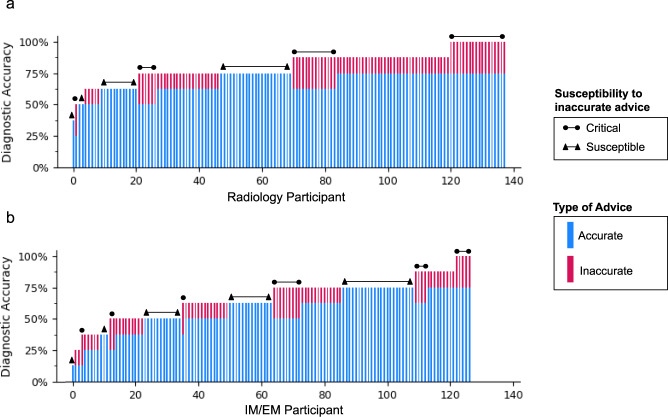
- Purported source did not significantly affect diagnostic accuracy (radiologists p = 0.183; IM/EM p = 0.081). Susceptibility varied: 41.73% of IM/EM physicians always gave the wrong diagnosis with inaccurate advice versus 27.54% of radiologists; 28.26% of radiologists and 17.32% of IM/EM physicians refuted all incorrect advice.
Methods
- Pre-registered web-based experiment (Qualtrics) with physicians recruited in the US and Canada: 138 radiologists (high task expertise) and 127 internal/emergency medicine physicians (lower task expertise).
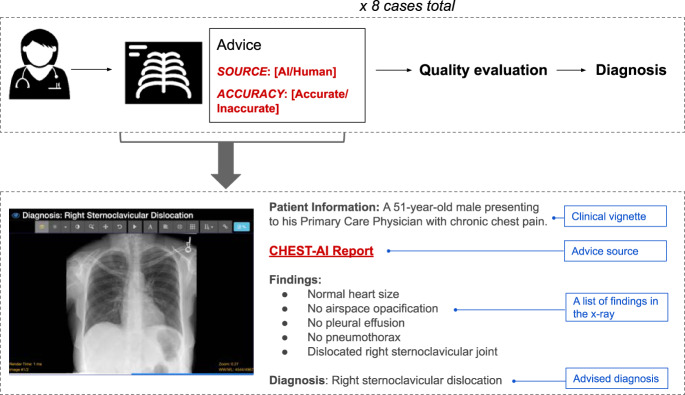
- Participants reviewed eight chest X-ray cases from the MIMIC Chest X-ray database, each with a clinical vignette and diagnostic advice; advice was human-generated but labeled as either from an AI system (CHEST-AI) or an experienced radiologist (Dr. S. Johnson).
- The design was a 2 × 2 mixed factorial: advice source (AI vs. human) between subjects and advice accuracy (accurate vs. inaccurate) within subjects, with participants randomly assigned six accurate and two inaccurate cases. Separate linear mixed models for advice-quality ratings and logistic mixed models for diagnostic accuracy regressed outcomes on advice accuracy, source, their interaction, and individual-related covariates, with a random effect by participant.
Limitations
- The paper states that only eight cases were tested to keep the study short enough for physician completion, that the web-based tool may not capture real deployment risk or behavior, that physician conversations are difficult to recreate, and that the sample is skewed toward less experienced physicians.
- The paper notes that advice was always generated by human experts and only the purported source was manipulated, so the study does not test actual AI-generated advice.
- Evident from the text: quality ratings may not reflect actual attitudes or behavior, as radiologists’ expressed aversion to AI advice did not affect their reliance on it; the online format may also have led to less careful case review or greater reliance on advice.
Model-written summary. Check it against the paper before relying on it.
Integrity signals
Registry
Cites
Statistics
Figures
Verification
Claims the paper makes
4 Valid · 1 Not valid · 10 Not checked · 48 Own results and interpretations
The sources with a verdict support this claim; the rest weren’t checked yet, have no full text we could read, or their verdicts aren’t rated yet.
In the paper
“However, it is not clear how to effectively integrate AI tools with human decision-makers; indeed, the few cases where systems have been implemented and studied showed no improved clinical outcomes6,7.”
§ Do as AI say: susceptibility in deployment of clinical decision-aids > Introduction
What the sources say
- Supportedcites [6] Brocklehurst P Computerised interpretation of fetal heart rate during labour (INFANT): a randomised controlled trial Lancet 2017 389 1719 1729 10.1016/S0140-6736(17)30568-8 28341515 PMC5413601 source
The Results report no significant difference in poor neonatal outcomes between the decision-support and control groups, and no evidence of differences in secondary outcomes for babies. The Discussion likewise concludes that the software did not reduce poor neonatal outcomes. This trial supports the cited sentence as an example, not as evidence about every AI system. (LLM, conf=0.92)
- Not checked — no full text of the sourcecites [7] Nunes I Central fetal monitoring with and without computer analysis: a randomized controlled trial Obstet. Gynecol. 2017 129 83 90 10.1097/AOG.0000000000001799 27926647 source
plain- Asserted: passes — The authors put it forward as true.
- Checkable: passes — It can be checked against evidence.
- Load-bearing: passes — The paper’s conclusions depend on it.
- Based: passes — The paper gives a reason why it holds.
- Supported
A result the paper reports from its own data — it cites no other source for it, so there is none to check. The quote shows it is in the paper.
In the paper
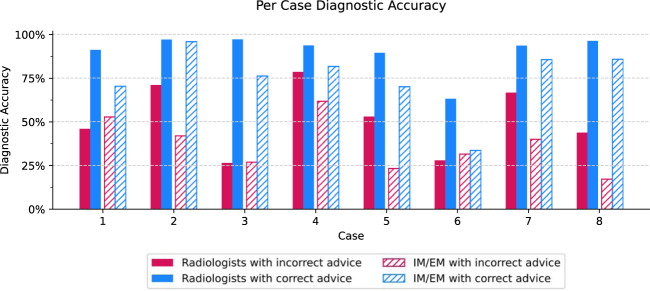
“As shown in Fig. 5, all cases were impacted by incorrect advice to varying degrees.”
§ Do as AI say: susceptibility in deployment of clinical decision-aids > Results > Incorrect advice impacts some clinical cases more than others
plainstates a causen = 8- Asserted: passes — The authors put it forward as true.
- Checkable: passes — It can be checked against evidence.
- Load-bearing: passes — The paper’s conclusions depend on it.
- Based: passes — The paper gives a reason why it holds.
A result the paper reports from its own data — it cites no other source for it, so there is none to check. The quote shows it is in the paper.
In the paper
“None of the measured covariates significantly predicted susceptibility, for either radiologists or IM/EM physicians.”
§ Do as AI say: susceptibility in deployment of clinical decision-aids > Discussion
plain- Asserted: passes — The authors put it forward as true.
- Checkable: passes — It can be checked against evidence.
- Load-bearing: passes — The paper’s conclusions depend on it.
- Based: passes — The paper gives a reason why it holds.
A result the paper reports from its own data — it cites no other source for it, so there is none to check. The quote shows it is in the paper.
In the paper
“Physicians across expertise levels often failed to dismiss inaccurate advice regardless of its source.”
§ Do as AI say: susceptibility in deployment of clinical decision-aids > Discussion
plain- Asserted: passes — The authors put it forward as true.
- Checkable: passes — It can be checked against evidence.
- Load-bearing: passes — The paper’s conclusions depend on it.
- Based: passes — The paper gives a reason why it holds.
A result the paper reports from its own data — it cites no other source for it, so there is none to check. The quote shows it is in the paper.
In the paper
“Further, inaccurate advice was more convincing for certain cases that involved additional interaction or analyses to recognize the error.”
§ Do as AI say: susceptibility in deployment of clinical decision-aids > Discussion
plainstates an association- Asserted: passes — The authors put it forward as true.
- Checkable: passes — It can be checked against evidence.
- Load-bearing: passes — The paper’s conclusions depend on it.
- Based: passes — The paper gives a reason why it holds.
22 more claims
Create a free account to see all 63 claims and every source verdict.
- It may state two separate claims as one. 20
- Probably not a substantial claim. 19
Claims other papers make about this one
Each is checked against this paper’s own text: does it say what the citing paper says it does?
The source backs part of the claim, not all of it — or backs it for a different population, condition or comparison.
In the citing paper
“it has been shown that people with high task expertise are more inclined to dismiss or devalue task-related advice from an AI system than are people with low task expertise7,18.”
From Non-task expert physicians benefit from correct explainable AI advice when reviewing X-rays (2023) · cites this paper as [7]
Experimental — accuracy not yet measuredThe source backs part of the claim, not all of it — or backs it for a different population, condition or comparison.
In the citing paper
“The presentation format of an explanation, its integration into electronic health record (EHR) systems, the cognitive load it imposes, and its alignment with existing clinical reasoning patterns all shape whether a technically sound explanation translates into genuine clinical utility [31,32].”
From Explainability of decoder-only clinical large language models: A scoping review (2026) · cites this paper as [32]
Experimental — accuracy not yet measuredThe source backs part of the claim, not all of it — or backs it for a different population, condition or comparison.
In the citing paper
“A growing body of work examines how healthcare professionals interact with and respond to AI-generated explanations, a dimension distinct from the technical methods used to produce them.”
From Explainability of decoder-only clinical large language models: A scoping review (2026) · cites this paper as [32]
Experimental — accuracy not yet measuredThe source backs part of the claim, not all of it — or backs it for a different population, condition or comparison.
In the citing paper
“Acceptance of clinical AI is shaped by integration into existing workflows, performance under time pressure, alignment with clinical reasoning patterns, and the cognitive load explanations impose [20,31,32].”
From Explainability of decoder-only clinical large language models: A scoping review (2026) · cites this paper as [32]
Experimental — accuracy not yet measuredThe source backs part of the claim, not all of it — or backs it for a different population, condition or comparison.
In the citing paper
“studies suggest that convincing explanations may paradoxically increase over-reliance on incorrect AI outputs, particularly among less experienced clinicians [31,32].”
From Explainability of decoder-only clinical large language models: A scoping review (2026) · cites this paper as [32]
Experimental — accuracy not yet measured
13 more claims about this paper
Create a free account to see every claim other papers make about this one.
Statistics recomputed
Every reported test result, recomputed from its test statistic and degrees of freedom. A result shows as not adding up only once an independent check has confirmed it.
- Consistentr(1102) = 0.43reported p < .001 · recomputed p < .001
“r(1102) = 0.43, p < .001”
Self-check
Percentages, sums and reported differences re-computed from the paper’s own numbers.
Self-check results appear here once an independent check has confirmed them.
Citations
Cites
Dermatologist-level classification of skin cancer with deep neural networks
Esteva, A., Kuprel, B., Novoa, R. A., Ko, J., Swetter, S. M., Blau, H. M., & Thrun, S. (2017) · Nature · doi:10.1038/nature21056 · Cited by 14,362
High-performance medicine: the convergence of human and artificial intelligence
Topol, E. J. (2019) · Nature Medicine · doi:10.1038/s41591-018-0300-7 · Cited by 10,450
Gulshan, V., Peng, L., Coram, M., Stumpe, M. C., Wu, D., Narayanaswamy, A., Venugopalan, S., Widner, K., Madams, T., Cuadros, J., et al. (2016) · JAMA · doi:10.1001/jama.2016.17216 · Cited by 7,697
The Association of American Medical Colleges
Zapffe, F. C. (1938) · Academic Medicine · doi:10.1097/00001888-193801000-00007 · Cited by 5,533
Rajkomar, A., Dean, J., & Kohane, I. (2019) · New England Journal of Medicine · doi:10.1056/nejmra1814259 · Cited by 4,579
Algorithm aversion: People erroneously avoid algorithms after seeing them err.
Dietvorst, B. J., Simmons, J. P., & Massey, C. (2015) · Journal of Experimental Psychology: General · doi:10.1037/xge0000033 · Cited by 3,232
Artificial intelligence in healthcare
Yu, K.-H., Beam, A. L., & Kohane, I. S. (2018) · Nature Biomedical Engineering · doi:10.1038/s41551-018-0305-z · Cited by 2,817
Algorithm appreciation: People prefer algorithmic to human judgment
Logg, J. M., Minson, J. A., & Moore, D. A. (2019) · Organizational Behavior and Human Decision Processes · doi:10.1016/j.obhdp.2018.12.005 · Cited by 2,061
Resistance to Medical Artificial Intelligence
Longoni, C., Bonezzi, A., & Morewedge, C. K. (2019) · Journal of Consumer Research · doi:10.1093/jcr/ucz013 · Cited by 2,015
Lakhani, P., & Sundaram, B. (2017) · Radiology · doi:10.1148/radiol.2017162326 · Cited by 1,775
Cited by
Algorithmic fairness in artificial intelligence for medicine and healthcare
Chen, R. J., Wang, J. J., Williamson, D. F. K., Chen, T. Y., Lipkova, J., Lu, M. Y., Sahai, S., & Mahmood, F. (2023) · Nature Biomedical Engineering · doi:10.1038/s41551-023-01056-8 · Cited by 750
Abulibdeh, A., Zaidan, E., & Abulibdeh, R. (2024) · Journal of Cleaner Production · doi:10.1016/j.jclepro.2023.140527 · Cited by 641
Towards a standard for identifying and managing bias in artificial intelligence
Schwartz, R., Vassilev, A., Greene, K., Perine, L., Burt, A., & Hall, P. (2022) · doi:10.6028/nist.sp.1270 · Cited by 548
“When system designers do not take these perceptual differences into consideration it can lead to misinterpretation of output, which is especially problematic in high-risk settings [247, 248].”
BackgroundArtificial Intelligence (AI) Literacy in Early Childhood Education: The Challenges and Opportunities
Su, J., Ng, D. T. K., & Chu, S. K. W. (2023) · Computers and Education: Artificial Intelligence · doi:10.1016/j.caeai.2023.100124 · Cited by 489
Health system-scale language models are all-purpose prediction engines
Jiang, L. Y., Liu, X. C., Nejatian, N. P., Nasir-Moin, M., Wang, D., Abidin, A., Eaton, K., Riina, H. A., Laufer, I., Punjabi, P., et al. (2023) · Nature · doi:10.1038/s41586-023-06160-y · Cited by 460
Dratsch, T., Chen, X., Rezazade Mehrizi, M., Kloeckner, R., Mähringer-Kunz, A., Püsken, M., Baeßler, B., Sauer, S., Maintz, D., & Pinto dos Santos, D. (2023) · Radiology · doi:10.1148/radiol.222176 · Cited by 369
Bias recognition and mitigation strategies in artificial intelligence healthcare applications
Hasanzadeh, F., Josephson, C. B., Waters, G., Adedinsewo, D., Azizi, Z., & White, J. A. (2025) · npj Digital Medicine · doi:10.1038/s41746-025-01503-7 · Cited by 320
“For example, convolutional neural networks (CNNs) trained from large chest X-ray datasets sourced from academic healthcare facilities have been shown to underdetect disease in speci fi c patient populations, inclusive of females, Black, Hispanic, and patients of low socioeconomic status 38 .”
Towards accurate differential diagnosis with large language models
McDuff, D., Schaekermann, M., Tu, T., Palepu, A., Wang, A., Garrison, J., Singhal, K., Sharma, Y., Azizi, S., Kulkarni, K., et al. (2025) · Nature · doi:10.1038/s41586-025-08869-4 · Cited by 311
“Furthermore, observations of standalone diagnostic accuracy often do not guarantee that an AI tool will improve performance in real-world settings as an assistive tool, and it remains unclear how AI and human decision-making should be optimally integrated in medicine 29 .”
Towards Accurate Differential Diagnosis with Large Language Models
McDuff, D., Schaekermann, M., Tu, T., Palepu, A., Wang, A., Garrison, J., Singhal, K., Sharma, Y., Azizi, S., Kulkarni, K., et al. (2023) · arXiv · doi:10.48550/arxiv.2312.00164 · Cited by 311
Chen, H., Gomez, C., Huang, C.-M., & Unberath, M. (2022) · npj Digital Medicine · doi:10.1038/s41746-022-00699-2 · Cited by 300
Čartolovni, A., Tomičić, A., & Lazić Mosler, E. (2022) · International Journal of Medical Informatics · doi:10.1016/j.ijmedinf.2022.104738 · Cited by 267
Deepfake detection by human crowds, machines, and machine-informed crowds
Groh, M., Epstein, Z., Firestone, C., & Picard, R. (2022) · Proceedings of the National Academy of Sciences · doi:10.1073/pnas.2110013119 · Cited by 248
Jabbour, S., Fouhey, D., Shepard, S., Valley, T. S., Kazerooni, E. A., Banovic, N., Wiens, J., & Sjoding, M. W. (2023) · JAMA · doi:10.1001/jama.2023.22295 · Cited by 236
Henry, K. E., Kornfield, R., Sridharan, A., Linton, R. C., Groh, C., Wang, T., Wu, A., Mutlu, B., & Saria, S. (2022) · npj Digital Medicine · doi:10.1038/s41746-022-00597-7 · Cited by 207
A generalist medical language model for disease diagnosis assistance
Liu, X., Liu, H., Yang, G., Jiang, Z., Cui, S., Zhang, Z., Wang, H., Tao, L., Sun, Y., Song, Z., et al. (2025) · Nature Medicine · doi:10.1038/s41591-024-03416-6 · Cited by 183
“A substantial gap remains between the development of major medical predictive algorithms and their actual clinical deployment in diverse healthcare settings 6 .”
McIntosh, C., Conroy, L., Tjong, M. C., Craig, T., Bayley, A., Catton, C., Gospodarowicz, M., Helou, J., Isfahanian, N., Kong, V., et al. (2021) · Nature Medicine · doi:10.1038/s41591-021-01359-w · Cited by 183
Exploring automation bias in human–AI collaboration: a review and implications for explainable AI
Romeo, G., & Conti, D. (2026) · AI & SOCIETY · doi:10.1007/s00146-025-02422-7 · Cited by 209
“Transparency mechanisms, such as uncertainty estimates, have been proposed to counteract overreliance by highlighting system limitations (Bond et al. 2018; Gaube et al. 2021; Dratsch et al. 2023).”
InfluentialDeep learning-aided decision support for diagnosis of skin disease across skin tones
Groh, M., Badri, O., Daneshjou, R., Koochek, A., Harris, C., Soenksen, L. R., Doraiswamy, P. M., & Picard, R. (2024) · Nature Medicine · doi:10.1038/s41591-023-02728-3 · Cited by 160
Humans inherit artificial intelligence biases
Vicente, L., & Matute, H. (2023) · Scientific Reports · doi:10.1038/s41598-023-42384-8 · Cited by 158
An Instrument for Measuring Teachers’ Trust in AI-Based Educational Technology
Nazaretsky, T., Cukurova, M., & Alexandron, G. (2022) · LAK22: 12th International Learning Analytics and Knowledge Conference · doi:10.1145/3506860.3506866 · Cited by 158
Sivaraman, V., Bukowski, L. A., Levin, J., Kahn, J. M., & Perer, A. (2023) · Proceedings of the 2023 CHI Conference on Human Factors in Computing Systems · doi:10.1145/3544548.3581075 · Cited by 141
“that acceptance of AI recommendations is often more strongly determined by the clinician’s expertise than by the quality of the recommendation [31, 80].”
BackgroundResultInfluentialThe fundamentals of Artificial Intelligence in medical education research: AMEE Guide No. 156.
Tolsgaard, M. G., Pusic, M. V., Sebok-Syer, S. S., Gin, B., Svendsen, M. B., Syer, M. D., Brydges, R., Cuddy, M. M., & Boscardin, C. K. (2023) · Medical Teacher · doi:10.1080/0142159x.2023.2180340 · Cited by 137
“For example, while novice learners may gain the most from good AI feedback (Tschandl et al. 2020), they may be more susceptible than experts to incorrect advice provided by AI systems (Gaube et al. 2021).”
BackgroundGenerative AI in Computing Education: Perspectives of Students and Instructors
Zastudil, C., Rogalska, M., Kapp, C., Vaughn, J., & MacNeil, S. (2023) · 2023 IEEE Frontiers in Education Conference (FIE) · doi:10.1109/fie58773.2023.10343467 · Cited by 136
“Finally, there can be a tendency to develop an over-reliance on AI systems which is, unfortunately, most common for low-expertise users [30].”
BackgroundThe explainability paradox: Challenges for xAI in digital pathology
Evans, T., Retzlaff, C. O., Geißler, C., Kargl, M., Plass, M., Müller, H., Kiehl, T.-R., Zerbe, N., & Holzinger, A. (2022) · Future Generation Computer Systems · doi:10.1016/j.future.2022.03.009 · Cited by 135
Inkpen, K., Chappidi, S., Mallari, K., Nushi, B., Ramesh, D., Michelucci, P., Mandava, V., Vepřek, L. H., & Quinn, G. (2023) · ACM Transactions on Computer-Human Interaction · doi:10.1145/3534561 · Cited by 132
“ran a studywhere physicians and radiologists were given chest X-rays and diagnostic advice [23].”
MethodHenry, K. E., Adams, R., Parent, C., Soleimani, H., Sridharan, A., Johnson, L., Hager, D. N., Cosgrove, S. E., Markowski, A., Klein, E. Y., et al. (2022) · Nature Medicine · doi:10.1038/s41591-022-01895-z · Cited by 144
“…where providers are shown simulated CDS recommendations for exemplar patients, studies have found that interface design 28 , provider expertise 29 and clinical time constraints 30 all play a role in adoption of the tool; Factors driving provider adoption of the TREWS machine learning-based…”
BackgroundDemographic bias in misdiagnosis by computational pathology models
Vaidya, A. J., Chen, R. J., Williamson, D. F. K., Song, A. H., Jaume, G., Yang, Y., Hartvigsen, T., Dyer, E. C., Lu, M. Y., Lipková, J., et al. (2024) · Nature Medicine · doi:10.1038/s41591-024-02885-z · Cited by 180
Dvijotham, K., Winkens, J., Barsbey, M., Ghaisas, S., Stanforth, R., Pawlowski, N., Strachan, P., Ahmed, Z., Azizi, S., Bachrach, Y., et al. (2023) · Nature Medicine · doi:10.1038/s41591-023-02437-x · Cited by 120
An Integrative Perspective on Algorithm Aversion and Appreciation in Decision-Making
Jussupow, E., Benbasat, I., & Heinzl, A. (2024) · MIS Quarterly · doi:10.25300/misq/2024/18512 · Cited by 121
Rams, hounds and white boxes: investigating human–AI collaboration protocols in medical diagnosis
Cabitza, F., Campagner, A., Ronzio, L., Cameli, M., Mandoli, G. E., Pastore, M. C., Sconfienza, L. M., Folgado, D., Barandas, M., & Gamboa, H. (2023) · Artificial Intelligence in Medicine · doi:10.1016/j.artmed.2023.102506 · Cited by 117
Dikmen, M., & Burns, C. (2022) · International Journal of Human-Computer Studies · doi:10.1016/j.ijhcs.2022.102792 · Cited by 116
Influence of believed AI involvement on the perception of digital medical advice
Reis, M., Reis, F., & Kunde, W. (2024) · Nature Medicine · doi:10.1038/s41591-024-03180-7 · Cited by 118
“9,10) or focused solely on the physician’s perspective 11 .”
Ethics of AI in Radiology: A Review of Ethical and Societal Implications
Goisauf, M., & Cano Abadía, M. (2022) · Frontiers in Big Data · doi:10.3389/fdata.2022.850383 · Cited by 108
“Other authors (Gaube et al., 2021) noted that, in the few cases where systems have been”
BackgroundAI for Decision Support: Balancing Accuracy, Transparency, and Trust Across Sectors
Kővári, A. (2024) · Information · doi:10.3390/info15110725 · Cited by 222
AI in the hands of imperfect users
Kostick-Quenet, K. M., & Gerke, S. (2022) · npj Digital Medicine · doi:10.1038/s41746-022-00737-z · Cited by 101
“Other studies have found that participants are averse to following algorithmic advice when making fi nal decisions (algorithmic bias) 49 – 51 , but this result is inconsistent with other studies, which show people sometimes prefer algorithmic to human judgment 46,47,52 .”
ResultEvidence, ethics and the promise of artificial intelligence in psychiatry
McCradden, M., Hui, K., & Buchman, D. Z. (2023) · Journal of Medical Ethics · doi:10.1136/jme-2022-108447 · Cited by 97
Foundational Considerations for Artificial Intelligence Using Ophthalmic Images
Abràmoff, M. D., Cunningham, B., Patel, B., Eydelman, M. B., Leng, T., Sakamoto, T., Blodi, B., Grenon, S. M., Wolf, R. M., Manrai, A. K., et al. (2022) · Ophthalmology · doi:10.1016/j.ophtha.2021.08.023 · Cited by 96
Nazaretsky, T., Mejia-Domenzain, P., Swamy, V., Frej, J., & Käser, T. (2025) · Computers and Education: Artificial Intelligence · doi:10.1016/j.caeai.2025.100368 · Cited by 96
Non-task expert physicians benefit from correct explainable AI advice when reviewing X-rays
Gaube, S., Suresh, H., Raue, M., Lermer, E., Koch, T. K., Hudecek, M. F. C., Ackery, A. D., Grover, S. C., Coughlin, J. F., Frey, D., et al. (2023) · Scientific Reports · doi:10.1038/s41598-023-28633-w · Cited by 92
Self-citationBrady, A. P., Allen, B., Chong, J., Kotter, E., Kottler, N. E., Mongan, J., Oakden‐Rayner, L., dos Santos, D. P., Tang, A., Wald, C., et al. (2024) · Insights into Imaging · doi:10.1186/s13244-023-01541-3 · Cited by 119
“73 These issues are further complicated by the fact that human-AI interaction may be in fl uenced by details of the user interface ’ s (UI) design.”
BackgroundThe emotional impact of generative AI: negative emotions and perception of threat
Gabbiadini, A., Ognibene, D., Baldissarri, C., & Anna, M. (2024) · Behaviour and Information Technology · doi:10.1080/0144929x.2024.2333933 · Cited by 119
“However, this explanation would not fi t the aversion toward AI agents able to clarify (Gaube et al. 2021) and discuss their suggestions, such as generative algorithms and natural language-based systems.”
Dingel, J., Kleine, A., Cecil, J., Sigl, A., Lermer, E., & Gaube, S. (2024) · Journal of Medical Internet Research · doi:10.2196/57224 · Cited by 139
“However, the consistently positive link between performance expectancy and use intention also suggests that health care institutions need to take measures to deter the perception of low-performing systems as high performing, which could potentially cause more harm than benefit [126].”
Self-citationDesigning AI‐augmented healthcare delivery systems for physician buy‐in and patient acceptance
Dai, T., & TAYUR, S. R. (2022) · Production and Operations Management · doi:10.1111/poms.13850 · Cited by 112
“However, significant anchoring effects have been reported in the literature (Gaube et al., 2021; Jussupow et al., 2021)— when AI provides an incorrect diagnosis, the physician is more likely to misdiagnose as well.”
BackgroundHasani, A. M., Singh, S. M., Zahergivar, A., Ryan, B., Nethala, D., Bravomontenegro, G., Mendhiratta, N., Ball, M. W., Farhadi, F., & Malayeri, A. A. (2023) · European Radiology · doi:10.1007/s00330-023-10384-x · Cited by 96
“…into easily understandable text [4], classify reports based on the presence or absence of specific diseases, aid in diagnostic decision-making [5, 6], provide patients with information about their examinations, outcomes, and follow-up recommendations [7], and potentially identify patterns in…”
Mitigating the impact of biased artificial intelligence in emergency decision-making
Adam, H., Balagopalan, A., Alsentzer, E., Christia, F., & Ghassemi, M. (2022) · Communications Medicine · doi:10.1038/s43856-022-00214-4 · Cited by 81
“While we focus on the impact of model bias, our fi ndings also have important implications for model inaccuracy, where blind adherence to inaccurate recommendations will also have dis-astrous consequences 3,5 .”
BackgroundSelf-citationAI or Human? Evaluating Student Feedback Perceptions in Higher Education
Nazaretsky, T., Mejia-Domenzain, P., Swamy, V., Frej, J., & Käser, T. (2024) · Lecture Notes in Computer Science · doi:10.1007/978-3-031-72315-5_20 · Cited by 76
Conceptualising fairness: three pillars for medical algorithms and health equity
Sikstrom, L., Maslej, M. M., Hui, K., Findlay, Z., Buchman, D. Z., & Hill, S. L. (2022) · BMJ Health & Care Informatics · doi:10.1136/bmjhci-2021-100459 · Cited by 76
“77 This effect is more pronounced when ML-based advice is paired with explanations of features contributing to prediction, 78 suggesting that explain-ability can adversely impact clinical decision making.”
Petersen, E., Potdevin, Y., Mohammadi, E., Zidowitz, S., Breyer, S., Nowotka, D., Henn, S., Pechmann, L., Leucker, M., Rostalski, P., et al. (2022) · IEEE Access · doi:10.1109/access.2022.3178382 · Cited by 113
“In the medical domain, Gaube et al. [257] have recently found that physicians with little task expertise tend to trust advice they receive on a diagnostic task, regardless of whether it is from an AI system or a colleague.”
BackgroundMezrich, J. L. (2022) · American Journal of Roentgenology · doi:10.2214/ajr.21.27224 · Cited by 91
Brady, A. P., Allen, B., Chong, J., Kotter, E., Kottler, N. E., Mongan, J., Oakden‐Rayner, L., dos Santos, D. P., Tang, A., Wald, C., et al. (2024) · Radiology Artificial Intelligence · doi:10.1148/ryai.230513 · Cited by 101
“A recent study showed that radiologists and other physicians rated the same information about a chest X-ray as being less reliable when it appeared to come from an AI system than when it appeared to come from a human expert (73).”
BackgroundOncologic Imaging and Radiomics: A Walkthrough Review of Methodological Challenges
Stanzione, A., Cuocolo, R., Ugga, L., Verde, F., Romeo, V., Brunetti, A., & Maurea, S. (2022) · Cancers · doi:10.3390/cancers14194871 · Cited by 64
Saban, M., & Dubovi, I. (2025) · Journal of Advanced Nursing · doi:10.1111/jan.16101 · Cited by 87
“Artificial intelligence (AI) technologies have been developing rapidly and may be able to enhance certain aspects of healthcare (Gaube et al., 2021 ; Huh, 2023 ; Kao et al., 2023 ).”
Artificial intelligence and skin cancer
Wei, M. L., Tada, M., So, A., & Torres, R. (2024) · Frontiers in Medicine · doi:10.3389/fmed.2024.1331895 · Cited by 91
Trust criteria for artificial intelligence in health: normative and epistemic considerations
Kostick, K. M., Lang, B. H., Smith, J. N., Hurley, M. E., & Blumenthal‐Barby, J. (2023) · Journal of Medical Ethics · doi:10.1136/jme-2023-109338 · Cited by 88
“Furthermore, psychosocial factors like situational awareness, 8 self-confidence of the operator and level of task expertise 9 can impact users’ reliance on machines.”
BackgroundChatGPT in Medical Education: A Precursor for Automation Bias?
Nguyen, T. (2024) · JMIR Medical Education · doi:10.2196/50174 · Cited by 59
“Multiple studies have found that algorithmic appreciation—a user’s valuing of an algorithm’s outputs—is lower for users who have more experience in a task than for those who are considered nonexperts in that task [12,13].”
BackgroundRethinking clinical trials for medical AI with dynamic deployments of adaptive systems
Rosenthal, J. T., Beecy, A., & Sabuncu, M. R. (2025) · npj Digital Medicine · doi:10.1038/s41746-025-01674-3 · Cited by 59
Learning to Prompt in the Classroom to Understand AI Limits: A Pilot Study
Theophilou, E., Koyutürk, C., Yavari, M., Bursic, S., Donabauer, G., Telari, A., Testa, A., Boiano, R., Hernandez-Leo, D., Ruskov, M., et al. (2023) · Lecture Notes in Computer Science · doi:10.1007/978-3-031-47546-7_33 · Cited by 58
Visser, R., Peters, T. M., Scharlau, I., & Hammer, B. (2025) · Cognitive Systems Research · doi:10.1016/j.cogsys.2025.101357 · Cited by 58
Quantifying the impact of AI recommendations with explanations on prescription decision making
Nagendran, M., Festor, P., Komorowski, M., Gordon, A. C., & Faisal, A. A. (2023) · npj Digital Medicine · doi:10.1038/s41746-023-00955-z · Cited by 82
Wildman‐Tobriner, B., Taghi-Zadeh, E., & Mazurowski, M. A. (2022) · American Journal of Roentgenology · doi:10.2214/ajr.22.27430 · Cited by 56
Robustness, Stability, and Fidelity of Explanations for a Deep Skin Cancer Classification Model
Saarela, M., & Geogieva, L. (2022) · Applied Sciences · doi:10.3390/app12199545 · Cited by 66
“As pointed out by Gaube et al. [14], AI systems will only be able to provide real clinical benefit if the physicians using them can balance trust and skepticism.”
BackgroundTrusting under risk – comparing human to AI decision support agents
Fahnenstich, H., Rieger, T., & Roesler, E. (2023) · Computers in Human Behavior · doi:10.1016/j.chb.2023.108107 · Cited by 73
Brady, A. P., Allen, B., Chong, J., Kotter, E., Kottler, N. E., Mongan, J., Oakden‐Rayner, L., dos Santos, D. P., Tang, A., Wald, C., et al. (2024) · Canadian Association of Radiologists Journal · doi:10.1177/08465371231222229 · Cited by 70
“73 These issues are further complicated by the fact that human‑AI interaction may be influenced by details of the user interface’s (UI) design.”
BackgroundArtificial Intelligence in Reproductive Medicine – An Ethical Perspective
Rolfes, V., Bittner, U., Gerhards, H., Krüssel, J.-S., Fehm, T., Ranisch, R., & Fangerau, H. (2023) · Geburtshilfe und Frauenheilkunde · doi:10.1055/a-1866-2792 · Cited by 53
Systematic AI Support for Decision-Making in the Healthcare Sector: Obstacles and Success Factors
Bertl, M., Ross, P., & Draheim, D. (2023) · Health Policy and Technology · doi:10.1016/j.hlpt.2023.100748 · Cited by 72
Tong, W.-J., Wu, S.-H., Cheng, M.-Q., Huang, H., Liang, J.-Y., Li, C.-Q., Guo, H.-L., He, D.-N., Liu, Y.-H., Xiao, H., et al. (2023) · JAMA Network Open · doi:10.1001/jamanetworkopen.2023.13674 · Cited by 52
Effect of Human-AI Interaction on Detection of Malignant Lung Nodules on Chest Radiographs
Lee, J. H., Hong, H., Nam, G., Hwang, E. J., & Park, C. M. (2023) · Radiology · doi:10.1148/radiol.222976 · Cited by 53
Large Language Models and Large Multimodal Models in Medical Imaging: A Primer for Physicians
Bradshaw, T., Tie, X., Warner, J., Hu, J., Li, Q., & Li, X. (2025) · Journal of Nuclear Medicine · doi:10.2967/jnumed.124.268072 · Cited by 65
“Research has shown that incorrect AI predictions can adversely impact clinical decisions, particularly for less experienced physicians ( 36 ).”
Appropriate Reliance on Artificial Intelligence in Radiology Education
Li, M. D., & Little, B. P. (2023) · Journal of the American College of Radiology · doi:10.1016/j.jacr.2023.04.019 · Cited by 52
The extent of algorithm aversion in decision-making situations with varying gravity
Filiz, I., Judek, J. R., Lorenz, M., & Spiwoks, M. (2023) · PLoS ONE · doi:10.1371/journal.pone.0278751 · Cited by 76
Clinical AI tools must convey predictive uncertainty for each individual patient
Banerji, C. R. S., Chakraborti, T., Harbron, C. G., & MacArthur, B. D. (2023) · Nature Medicine · doi:10.1038/s41591-023-02562-7 · Cited by 97
“Artificial intelligence tools usually aim to maximize predictive accuracy, but personalized measures of uncertainty, using new techniques such as conformal prediction, are needed for clinical artificial intelligence to realize its potential and improve human health.”
Prinster, D., Mahmood, A., Saria, S., Jeudy, J. J., Lin, C. T., Yi, P. H., & Huang, C. (2024) · Radiology · doi:10.1148/radiol.233261 · Cited by 81
Mortlock, R., & Lucas, C. (2024) · Exploratory Research in Clinical and Social Pharmacy · doi:10.1016/j.rcsop.2024.100481 · Cited by 51
“26,27 Conversely, some academics believe that embracing the use of Gen-AIwithin pharmacy education may enhance students ’ critical thinking by engaging students to address the flaws in the parser outputs (the output from the AI tool generated by the human prompt)of some AI bots as well as…”
BackgroundLanger, M., Baum, K. L., & Schlicker, N. (2024) · Minds and Machines · doi:10.1007/s11023-024-09701-0 · Cited by 117
“…cars who need to detect when to take over (Kraus et al., 2020 ), for doctors who need to detect erroneous diagnoses before correcting them (Gaube et al., 2021 ), and for human resource managers or judges who need to detect whether AI-based decisions were unfair in order to overwrite such…”
Mitigating knowledge imbalance in AI-advised decision-making through collaborative user involvement
Gomez, C., Unberath, M., & Huang, C.-M. (2023) · International Journal of Human-Computer Studies · doi:10.1016/j.ijhcs.2022.102977 · Cited by 50
Pal, A., Wangmo, T., Bharadia, T., Ahmed-Richards, M., Bhanderi, M., Kachhadiya, R., Allemann, S. S., & Elger, B. S. (2025) · Patient Preference and Adherence · doi:10.2147/ppa.s527922 · Cited by 63
“84,90 Issues surrounding data quality, potential biases, the opaque nature of the algorithm-generated information and the involvement of multiple stakeholders in their development and implementation complicate the assignment of accountability.”
Kahr, P. K., Rooks, G., Willemsen, M. C., & Snijders, C. C. P. (2024) · ACM Transactions on Interactive Intelligent Systems · doi:10.1145/3686164 · Cited by 49
“In many (though not all) prediction tasks, AI tools can match or outperform their human counterparts [36, 40].”
Accuracy-Time Tradeoffs in AI-Assisted Decision Making under Time Pressure
Swaroop, S., Buçinca, Z., Gajos, K. Z., & Doshi-Velez, F. (2024) · Proceedings of the 29th International Conference on Intelligent User Interfaces · doi:10.1145/3640543.3645206 · Cited by 49
Weber, S., Wyszynski, M., Godefroid, M., Plattfaut, R., & Niehaves, B. (2024) · Computational and Structural Biotechnology Journal · doi:10.1016/j.csbj.2024.02.009 · Cited by 61
“…both that highly experienced medical professionals rate advice from AI as being worse than advice from humans, independent of the quality of the advice, and that less-experienced medical professionals sometimes favor an incorrect AI decision, even if their own initial diagnosis was correct [34,44].”
BackgroundAlgorithm Aversion: Evidence from Ridesharing Drivers
Liu, M., Tang, X., Xia, S., Zhang, S., Zhu, Y., & Meng, Q. (2023) · Management Science · doi:10.1287/mnsc.2022.02475 · Cited by 95
Enabling Fairness in Healthcare Through Machine Learning
Grote, T., & Keeling, G. (2022) · Ethics and Information Technology · doi:10.1007/s10676-022-09658-7 · Cited by 62
“…in isolation (McKinney et al., 2020; Tschandl et al., 2020), the peer model is to some degree unattractive as it has been shown that clinicians are prone to over-rely on algorithmic advice, thus being led astray when the algorithm decides incorrectly (Tschandl et al., 2020; Gaube et al., 2021).”
BackgroundBrady, A. P., Allen, B., Chong, J., Kotter, E., Kottler, N., Mongan, J., Oakden‐Rayner, L., Pinto dos Santos, D., Tang, A., Wald, C., et al. (2024) · Journal of Medical Imaging and Radiation Oncology · doi:10.1111/1754-9485.13612 · Cited by 44
Visualizing the knowledge mapping of artificial intelligence in education: A systematic review
Qin, Q., & Zhang, S. (2024) · Education and Information Technologies · doi:10.1007/s10639-024-13076-1 · Cited by 71
“…of science (Cooper, 2023), mathematics (Tamborg et al., 2022), medicine (e.g. Krishnan, 2022; Ejaz et al., 2022), health care sciences (e.g. Allam & Jones, 2020; Gaube et al., 2021), environmental sciences (e.g. Liu et al., 2022), and psychology (e.g. Bittencourt et al., 2023; Li et al., 2022).”
Optimizing human-centered AI for healthcare in the Global South
Okolo, C. T. (2022) · Patterns · doi:10.1016/j.patter.2021.100421 · Cited by 62
Preserving clinical skills in the age of AI assistance
Berzin, T. M., & Topol, E. J. (2025) · The Lancet · doi:10.1016/s0140-6736(25)02075-6 · Cited by 46
Objective Task-Based Evaluation of Artificial Intelligence-Based Medical Imaging Methods
Jha, A. K., Myers, K. J., Obuchowski, N. A., Liu, Z., Rahman, M. A., Saboury, B., Rahmim, A., & Siegel, B. A. (2021) · PET Clinics · doi:10.1016/j.cpet.2021.06.013 · Cited by 60
Van Cauwenberge, D., Van Biesen, W., Decruyenaere, J., Leune, T., & Sterckx, S. (2022) · BMC Medical Ethics · doi:10.1186/s12910-022-00787-8 · Cited by 43
“However, next to these engineering and technical issues, a substantial human factor remains, as the human operator’s interaction with the system is the necessary step for enacting the recommendation of the device [13].”
BackgroundGasmi, I., Calinghen, A., Parienti, J., Belloy, F., Fohlen, A., & Pelage, J. (2023) · Pediatric Radiology · doi:10.1007/s00247-023-05621-w · Cited by 47
“Diagnostic performance, reduction in medical errors and time efficiency should be investigated [26, 27].”
BackgroundCognitive Biases and Artificial Intelligence
Wang, J., & Redelmeier, D. A. (2024) · NEJM AI · doi:10.1056/aics2400639 · Cited by 56
Yeter, I. H., Yang, W., & Sturgess, J. B. (2024) · Future in Educational Research · doi:10.1002/fer3.59 · Cited by 67
Algorithmic individual fairness and healthcare: a scoping review
Anderson, J. W., & Visweswaran, S. (2024) · JAMIA Open · doi:10.1093/jamiaopen/ooae149 · Cited by 60
Intricacies of human–AI interaction in dynamic decision-making for precision oncology
Niraula, D., Cuneo, K. C., Dinov, I. D., Gonzalez, B. D., Jamaluddin, J., Jin, J. J., Luo, Y., Matuszak, M. M., Haken, R. K. T., Bryant, A. K., et al. (2025) · Nature Communications · doi:10.1038/s41467-024-55259-x · Cited by 61
AI-Assisted vs Unassisted Identification of Prostate Cancer in Magnetic Resonance Images
Twilt, J. J., Saha, A., Bosma, J. S., Padhani, A. R., Bonekamp, D., Giannarini, G., van den Bergh, R. C. N., Kasivisvanathan, V., Obuchowski, N. A., Yakar, D., et al. (2025) · JAMA Network Open · doi:10.1001/jamanetworkopen.2025.15672 · Cited by 53
Micocci, M., Borsci, S., Thakerar, V., Walne, S., Manshadi, Y., Edridge, F., Mullarkey, D., Buckle, P., & Hanna, G. B. (2021) · Journal of Clinical Medicine · doi:10.3390/jcm10143101 · Cited by 39
“These findings are in alignment with previous studies [28] suggesting that over-reliance on automated systems may be triggered by confirmatory bias when participants direct their attention towards features consistent with the (inaccurate) advice.”
ResultRezaeian, O., Bayrak, A. E., & Asan, O. (2026) · International Journal of Human–Computer Interaction · doi:10.1080/10447318.2025.2539458 · Cited by 39
“AI systems have shown promise in improving diagnosis [1, 2, 3, 4], treatment planning [5, 6], and workflow efficiency, and also reducing human errors[7, 8, 9].”
Rezaeian, O., Bayrak, A. E., & Asan, O. (2025) · arXiv · doi:10.48550/arxiv.2501.16693 · Cited by 39
“AI systems have shown promise in improving diagnosis [1, 2, 3, 4], treatment planning [5, 6], and workflow efficiency, and also reducing human errors[7, 8, 9].”
Galsgaard, A., Doorschodt, T., Holten, A.-L., Müller, F. C., Ploug Boesen, M., & Maas, M. (2022) · European Journal of Radiology · doi:10.1016/j.ejrad.2022.110231 · Cited by 38
Glick, A., Clayton, M., Angelov, N., & Chang, J. T. (2022) · JAMIA Open · doi:10.1093/jamiaopen/ooac031 · Cited by 51
Is Your Machine Better Than You? You May Never Know
de Véricourt, F., & Gürkan, H. (2023) · Management Science · doi:10.1287/mnsc.2023.4791 · Cited by 78
Putting explainable AI in context: institutional explanations for medical AI
Theunissen, M., & Browning, J. (2022) · Ethics and Information Technology · doi:10.1007/s10676-022-09649-8 · Cited by 37
“There is thus a justifiable worry about relying on the algorithm since it might well lead to misdiagnosis (Gaube et al., 2021).”
Background
Metadata
- Authors
- Gaube, S., Suresh, H., Raue, M., Merritt, A., Berkowitz, S. J., Lermer, E., Coughlin, J. F., Guttag, J. V., Colak, E., & Ghassemi, M.
- Affiliations
- University of Regensburg (DE)
- MIT Computer Science and Artificial Intelligence Laboratory (US)
- Massachusetts Institute of Technology (US)
- Boston Medical Center (US)
- Beth Israel Deaconess Medical Center (US)
- FOM University of Applied Sciences for Economics and Management (DE)
- St. Michael's Hospital (CA)
- University of Toronto (CA)
- Corresponding author
- Gaube, Susanne
- Suresh, Harini
- ORCID
- Venue
- npj Digital Medicine
- Published
- 2021-02-19
- Volume
- 4
- Issue
- 1
- Pages
- 31-31
- ISSN
- 2398-6352 (ISSN-L)
- PMC
- PMC7896064
- OpenAlex
- W3130937151
- Cited by
- 543
- References
- 42
- Citations by year
- 2026: 174 · 2025: 109 · 2024: 81 · 2023: 94 · 2022: 62 · 2021: 23
- FWCI
- 18.71
- Type
- journal article
- Language
- en
- Open access
- gold
- doi.org
- Licence
- cc-by
- creativecommons.org/licenses/by/4.0 (tdm)
- creativecommons.org/licenses/by/4.0 (vor)
- Locations
- npj Digital Medicine (publishedVersion, cc-by)
- PubMed Central (publishedVersion, cc-by)
- PubMed (publishedVersion)
- DOAJ (DOAJ: Directory of Open Access Journals) (submittedVersion, cc-by-sa)
- DSpace@MIT (Massachusetts Institute of Technology) (submittedVersion, cc-by-nc)
- University of Regensburg Publication Server (University of Regensburg) (submittedVersion)
- Funders
- Gouvernement du Canada | Natural Sciences and Engineering Research Council of Canada
- Microsoft Research
- Topics
- Health Sciences › Medicine › Health Informatics › Artificial Intelligence in Healthcare and Education
- Health Sciences › Medicine › Family Practice › Clinical Reasoning and Diagnostic Skills
- Physical Sciences › Computer Science › Artificial Intelligence › Explainable Artificial Intelligence (XAI)
- Keywords
- artificial intelligence, clinical decision support, radiologists, chest X-ray diagnosis, diagnostic accuracy
About these checks
Registry, retraction, Cites and statistics results are computed, not judged, with one exception: a printed reference that no index lists is read once by a model before it counts as a citation error. Claims are extracted by a model and kept only when their quote appears verbatim in the text; each cited source is then checked, with a model’s help, for whether it says what the claim relies on. Those verdicts can be wrong — read the claim’s quote and the cited source before relying on one.
The claim verdicts this report counts are experimental: their accuracy is not yet measured.
A language model drew the claims from the paper on 2026-10-10, under version 3 of the claim definition (model deepseek-v4.1-flash, prompt extract-v3).
A second model labelled each claim on 2026-10-10 (model jev-1.13-20260917, definition revision gold-guideline-v0.2).
Cited sources are checked with a language model’s help (gpt-6-sol).
Statistics and arithmetic are recomputed, not judged.
Confidence bands are shown only for fields calibrated on our annotated test set. None is calibrated yet, so no band is shown.
What counts as a claim ›How we measure confidence ›How we check this ›
Are you an author, or do you see a problem with this page? Request a review
Data sources
Bibliographic data: Semantic Scholar, OpenAlex, Crossref.
Contains information from the Semantic Scholar Academic Graph Datasets, made available under the ODC Attribution License (ODC-BY 1.0).
Semantic Scholar’s data is described in: Kinney, R., et al. (2023). The Semantic Scholar Open Data Platform. arXiv:2301.10140.
