

Do as AI say: susceptibility in deployment of clinical decision-aids
Open accessThe DOI matches its Crossref record; 42 of the 42 references it cites were found in a registry or an index; 9 of the 31 sources its claims cite were checked for support.
Abstract
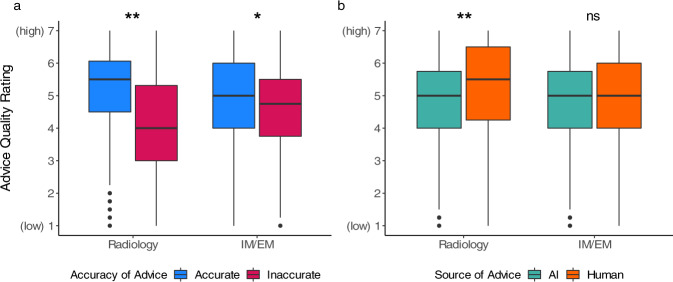
Artificial intelligence (AI) models for decision support have been developed for clinical settings such as radiology, but little work evaluates the potential impact of such systems. In this study, physicians received chest X-rays and diagnostic advice, some of which was inaccurate, and were asked to evaluate advice quality and make diagnoses. All advice was generated by human experts, but some was labeled as coming from an AI system. As a group, radiologists rated advice as lower quality when it appeared to come from an AI system; physicians with less task-expertise did not. Diagnostic accuracy was significantly worse when participants received inaccurate advice, regardless of the purported source. This work raises important considerations for how advice, AI and non-AI, should be deployed in clinical environments.
Overview
CoChat Summary
TL;DR
In a pre-registered web experiment, physicians reviewing chest X-rays received diagnostic advice that was always generated by human experts but sometimes labeled as coming from an AI system. Inaccurate advice reduced diagnostic accuracy regardless of purported source, while radiologists rated purported AI advice as lower quality than purported human advice.
Key findings
- Radiologists showed algorithmic aversion in advice-quality ratings: they rated advice significantly lower when it was labeled AI versus human (γ = 0.53, p = 0.001), whereas IM/EM physicians did not (γ = 0.22, p = 0.165).
- Inaccurate advice was rated lower in quality by both groups, more strongly by radiologists (γ = −1.00, p < 0.001) than by IM/EM physicians (γ = −0.40, p = 0.002).
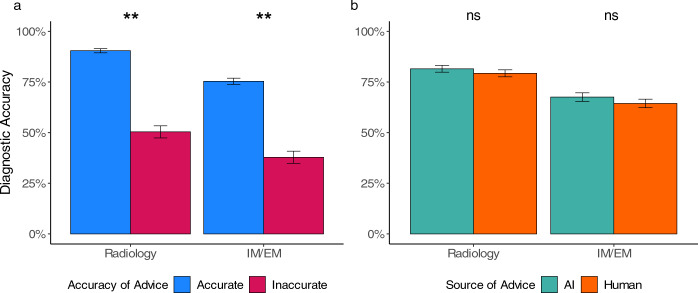
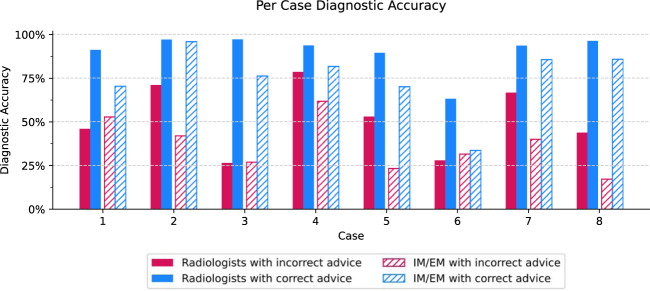
- Diagnostic accuracy was significantly worse with inaccurate advice for radiologists (β = 2.39, p < 0.001) and IM/EM physicians (β = 1.91, p < 0.001); task experts performed 40.10% better and non-experts 37.53% better with accurate versus inaccurate advice.
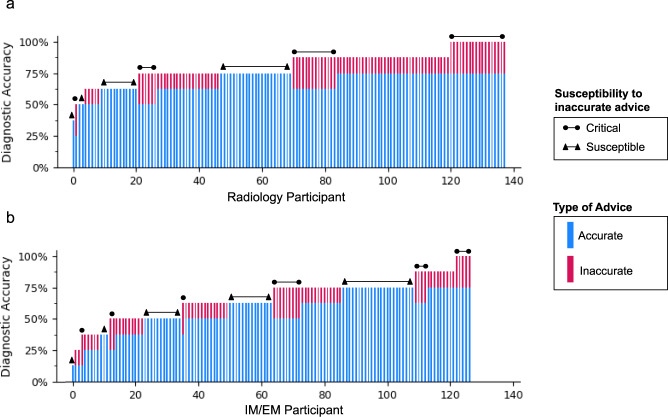
- Purported source did not significantly affect diagnostic accuracy (radiologists p = 0.183; IM/EM p = 0.081). Susceptibility varied: 41.73% of IM/EM physicians always gave the wrong diagnosis with inaccurate advice versus 27.54% of radiologists; 28.26% of radiologists and 17.32% of IM/EM physicians refuted all incorrect advice.
Methods
- Pre-registered web-based experiment (Qualtrics) with physicians recruited in the US and Canada: 138 radiologists (high task expertise) and 127 internal/emergency medicine physicians (lower task expertise).
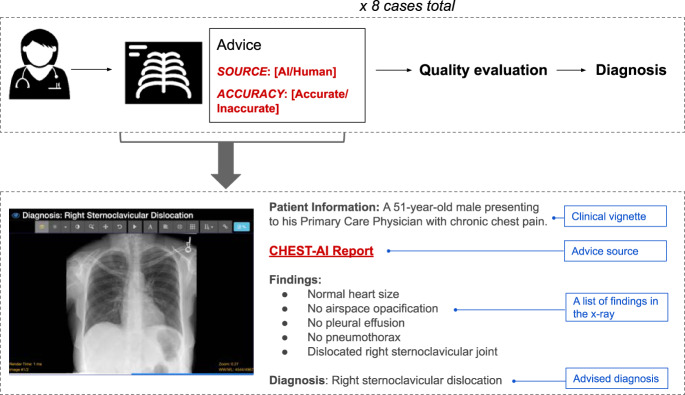
- Participants reviewed eight chest X-ray cases from the MIMIC Chest X-ray database, each with a clinical vignette and diagnostic advice; advice was human-generated but labeled as either from an AI system (CHEST-AI) or an experienced radiologist (Dr. S. Johnson).
- The design was a 2 × 2 mixed factorial: advice source (AI vs. human) between subjects and advice accuracy (accurate vs. inaccurate) within subjects, with participants randomly assigned six accurate and two inaccurate cases. Separate linear mixed models for advice-quality ratings and logistic mixed models for diagnostic accuracy regressed outcomes on advice accuracy, source, their interaction, and individual-related covariates, with a random effect by participant.
Limitations
- The paper states that only eight cases were tested to keep the study short enough for physician completion, that the web-based tool may not capture real deployment risk or behavior, that physician conversations are difficult to recreate, and that the sample is skewed toward less experienced physicians.
- The paper notes that advice was always generated by human experts and only the purported source was manipulated, so the study does not test actual AI-generated advice.
- Evident from the text: quality ratings may not reflect actual attitudes or behavior, as radiologists’ expressed aversion to AI advice did not affect their reliance on it; the online format may also have led to less careful case review or greater reliance on advice.
Model-written summary. Check it against the paper before relying on it.
Integrity signals
Registry
Cites
Statistics
Figures
Verification
Claims the paper makes
4 Valid · 1 Not valid · 10 Not checked · 48 Own results and interpretations
The sources with a verdict support this claim; the rest weren’t checked yet, have no full text we could read, or their verdicts aren’t rated yet.
In the paper
“However, it is not clear how to effectively integrate AI tools with human decision-makers; indeed, the few cases where systems have been implemented and studied showed no improved clinical outcomes6,7.”
§ Do as AI say: susceptibility in deployment of clinical decision-aids > Introduction
What the sources say
- Supportedcites [6] Brocklehurst P Computerised interpretation of fetal heart rate during labour (INFANT): a randomised controlled trial Lancet 2017 389 1719 1729 10.1016/S0140-6736(17)30568-8 28341515 PMC5413601 source
The Results report no significant difference in poor neonatal outcomes between the decision-support and control groups, and no evidence of differences in secondary outcomes for babies. The Discussion likewise concludes that the software did not reduce poor neonatal outcomes. This trial supports the cited sentence as an example, not as evidence about every AI system. (LLM, conf=0.92)
- Not checked — no full text of the sourcecites [7] Nunes I Central fetal monitoring with and without computer analysis: a randomized controlled trial Obstet. Gynecol. 2017 129 83 90 10.1097/AOG.0000000000001799 27926647 source
plain- Asserted: passes — The authors put it forward as true.
- Checkable: passes — It can be checked against evidence.
- Load-bearing: passes — The paper’s conclusions depend on it.
- Based: passes — The paper gives a reason why it holds.
- Supported
A result the paper reports from its own data — it cites no other source for it, so there is none to check. The quote shows it is in the paper.
In the paper
“As shown in Fig. 5, all cases were impacted by incorrect advice to varying degrees.”
§ Do as AI say: susceptibility in deployment of clinical decision-aids > Results > Incorrect advice impacts some clinical cases more than others
plainstates a causen = 8- Asserted: passes — The authors put it forward as true.
- Checkable: passes — It can be checked against evidence.
- Load-bearing: passes — The paper’s conclusions depend on it.
- Based: passes — The paper gives a reason why it holds.
A result the paper reports from its own data — it cites no other source for it, so there is none to check. The quote shows it is in the paper.
In the paper
“None of the measured covariates significantly predicted susceptibility, for either radiologists or IM/EM physicians.”
§ Do as AI say: susceptibility in deployment of clinical decision-aids > Discussion
plain- Asserted: passes — The authors put it forward as true.
- Checkable: passes — It can be checked against evidence.
- Load-bearing: passes — The paper’s conclusions depend on it.
- Based: passes — The paper gives a reason why it holds.
A result the paper reports from its own data — it cites no other source for it, so there is none to check. The quote shows it is in the paper.
In the paper
“Physicians across expertise levels often failed to dismiss inaccurate advice regardless of its source.”
§ Do as AI say: susceptibility in deployment of clinical decision-aids > Discussion
plain- Asserted: passes — The authors put it forward as true.
- Checkable: passes — It can be checked against evidence.
- Load-bearing: passes — The paper’s conclusions depend on it.
- Based: passes — The paper gives a reason why it holds.
A result the paper reports from its own data — it cites no other source for it, so there is none to check. The quote shows it is in the paper.
In the paper
“Further, inaccurate advice was more convincing for certain cases that involved additional interaction or analyses to recognize the error.”
§ Do as AI say: susceptibility in deployment of clinical decision-aids > Discussion
plainstates an association- Asserted: passes — The authors put it forward as true.
- Checkable: passes — It can be checked against evidence.
- Load-bearing: passes — The paper’s conclusions depend on it.
- Based: passes — The paper gives a reason why it holds.
22 more claims
Create a free account to see all 63 claims and every source verdict.
- It may state two separate claims as one. 20
- Probably not a substantial claim. 19
Claims other papers make about this one
Each is checked against this paper’s own text: does it say what the citing paper says it does?
The source backs part of the claim, not all of it — or backs it for a different population, condition or comparison.
In the citing paper
“it has been shown that people with high task expertise are more inclined to dismiss or devalue task-related advice from an AI system than are people with low task expertise7,18.”
From Non-task expert physicians benefit from correct explainable AI advice when reviewing X-rays (2023) · cites this paper as [7]
Experimental — accuracy not yet measuredThe source backs part of the claim, not all of it — or backs it for a different population, condition or comparison.
In the citing paper
“The presentation format of an explanation, its integration into electronic health record (EHR) systems, the cognitive load it imposes, and its alignment with existing clinical reasoning patterns all shape whether a technically sound explanation translates into genuine clinical utility [31,32].”
From Explainability of decoder-only clinical large language models: A scoping review (2026) · cites this paper as [32]
Experimental — accuracy not yet measuredThe source backs part of the claim, not all of it — or backs it for a different population, condition or comparison.
In the citing paper
“A growing body of work examines how healthcare professionals interact with and respond to AI-generated explanations, a dimension distinct from the technical methods used to produce them.”
From Explainability of decoder-only clinical large language models: A scoping review (2026) · cites this paper as [32]
Experimental — accuracy not yet measuredThe source backs part of the claim, not all of it — or backs it for a different population, condition or comparison.
In the citing paper
“Acceptance of clinical AI is shaped by integration into existing workflows, performance under time pressure, alignment with clinical reasoning patterns, and the cognitive load explanations impose [20,31,32].”
From Explainability of decoder-only clinical large language models: A scoping review (2026) · cites this paper as [32]
Experimental — accuracy not yet measuredThe source backs part of the claim, not all of it — or backs it for a different population, condition or comparison.
In the citing paper
“studies suggest that convincing explanations may paradoxically increase over-reliance on incorrect AI outputs, particularly among less experienced clinicians [31,32].”
From Explainability of decoder-only clinical large language models: A scoping review (2026) · cites this paper as [32]
Experimental — accuracy not yet measured
13 more claims about this paper
Create a free account to see every claim other papers make about this one.
Statistics recomputed
Every reported test result, recomputed from its test statistic and degrees of freedom. A result shows as not adding up only once an independent check has confirmed it.
- Consistentr(1102) = 0.43reported p < .001 · recomputed p < .001
“r(1102) = 0.43, p < .001”
Self-check
Percentages, sums and reported differences re-computed from the paper’s own numbers.
Self-check results appear here once an independent check has confirmed them.
Citations
Cites
Dermatologist-level classification of skin cancer with deep neural networks
Esteva, A., Kuprel, B., Novoa, R. A., Ko, J., Swetter, S. M., Blau, H. M., & Thrun, S. (2017) · Nature · doi:10.1038/nature21056 · Cited by 14,362
High-performance medicine: the convergence of human and artificial intelligence
Topol, E. J. (2019) · Nature Medicine · doi:10.1038/s41591-018-0300-7 · Cited by 10,450
Gulshan, V., Peng, L., Coram, M., Stumpe, M. C., Wu, D., Narayanaswamy, A., Venugopalan, S., Widner, K., Madams, T., Cuadros, J., et al. (2016) · JAMA · doi:10.1001/jama.2016.17216 · Cited by 7,697
The Association of American Medical Colleges
Zapffe, F. C. (1938) · Academic Medicine · doi:10.1097/00001888-193801000-00007 · Cited by 5,533
Rajkomar, A., Dean, J., & Kohane, I. (2019) · New England Journal of Medicine · doi:10.1056/nejmra1814259 · Cited by 4,579
Algorithm aversion: People erroneously avoid algorithms after seeing them err.
Dietvorst, B. J., Simmons, J. P., & Massey, C. (2015) · Journal of Experimental Psychology: General · doi:10.1037/xge0000033 · Cited by 3,232
Artificial intelligence in healthcare
Yu, K.-H., Beam, A. L., & Kohane, I. S. (2018) · Nature Biomedical Engineering · doi:10.1038/s41551-018-0305-z · Cited by 2,817
Algorithm appreciation: People prefer algorithmic to human judgment
Logg, J. M., Minson, J. A., & Moore, D. A. (2019) · Organizational Behavior and Human Decision Processes · doi:10.1016/j.obhdp.2018.12.005 · Cited by 2,061
Resistance to Medical Artificial Intelligence
Longoni, C., Bonezzi, A., & Morewedge, C. K. (2019) · Journal of Consumer Research · doi:10.1093/jcr/ucz013 · Cited by 2,015
Lakhani, P., & Sundaram, B. (2017) · Radiology · doi:10.1148/radiol.2017162326 · Cited by 1,775
Cited by
Items 101–200 of 527
van Berkel, N., Bellio, M., Skov, M. B., & Blandford, A. (2023) · ACM Transactions on Computer-Human Interaction · doi:10.1145/3571815 · Cited by 40
“compare clinicians’ behaviour in radiological tasks when presented with advice claimed to originate from either an AI-based support system or experienced radiologists [34].”
BackgroundAlgor-ethics: charting the ethical path for AI in critical care
Montomoli, J., Bitondo, M. M., Cascella, M., Rezoagli, E., Romeo, L., Bellini, V., Semeraro, F., Gamberini, E., Frontoni, E., Agnoletti, V., et al. (2024) · Journal of Clinical Monitoring and Computing · doi:10.1007/s10877-024-01157-y · Cited by 36
“Recog - nizing, evaluating, and addressing these cognitive dynamics is crucial when considering the use of IA-based CDSS. Gaube et al. highlight a critical concern where physicians might unconsciously adopt biases present in AI systems [36 ].”
BackgroundMcCrindle, B. W., Zukotynski, K., Doyle, T. E., & Noseworthy, M. D. (2021) · Radiology Artificial Intelligence · doi:10.1148/ryai.2021210031 · Cited by 56
Cecil, J., Lermer, E., Hudecek, M. F. C., Sauer, J., & Gaube, S. (2024) · Scientific Reports · doi:10.1038/s41598-024-60220-5 · Cited by 37
“Receiving correct advice leads to higher trust in the advice and improved performance compared to incorrect advice 17–20 .”
InfluentialSelf-citationFuner, F., Liedtke, W., Tinnemeyer, S., Klausen, A. D., Schneider, D., Zacharias, H. U., Langanke, M., & Salloch, S. (2024) · Journal of Medical Ethics · doi:10.1136/jme-2022-108814 · Cited by 36
“The ML-CDSSs pursue the goal of supporting professionals in their decision-making by making medical recommendations 14–16 and covering their existing information needs as human experts, 12 17 18 ‘for example, by providing evidence that would have otherwise not been available within a reasonable…”
BackgroundLi, D., Pehrson, L. M., Lauridsen, C. A., Tøttrup, L., Fraccaro, M., Elliott, D., Zając, H. D., Darkner, S., Carlsen, J. F., & Nielsen, M. B. (2021) · Diagnostics · doi:10.3390/diagnostics11122206 · Cited by 35
“[51] suggested that physicians with less experience were more likely to accept and deploy the suggested advice given to them by AI.”
BackgroundHow future work self salience shapes the effects of interacting with artificial intelligence
Voigt, J., & Strauss, K. (2024) · Journal of Vocational Behavior · doi:10.1016/j.jvb.2024.104054 · Cited by 48
Biases in AI: acknowledging and addressing the inevitable ethical issues
Hofmann, B. (2025) · Frontiers in Digital Health · doi:10.3389/fdgth.2025.1614105 · Cited by 63
“For example, overreliance on advice has been demonstrated amongst radiologists assessing chest x-rays and making diagnostic decisions (58).”
Vijayakumar, S., Lee, V. V., Leong, Q. Y., Hong, S. J., Blasiak, A., & Ho, D. (2023) · JMIR Human Factors · doi:10.2196/48476 · Cited by 34
“The understanding and reaction of physicians to new clinical tools are therefore crucial factors to enable clinical integration and ensure downstream adoption [30,32,34].”
Patient wisdom should be incorporated into health AI to avoid algorithmic paternalism
McCradden, M. D., & Kirsch, R. E. (2023) · Nature Medicine · doi:10.1038/s41591-023-02224-8 · Cited by 36
The unintended consequences of artificial intelligence in paediatric radiology
Ciet, P., Eade, C., Ho, M., Laborie, L. B., Mahomed, N., Naidoo, J., Pace, E., Segal, B., Toso, S., Tschauner, S., et al. (2023) · Pediatric Radiology · doi:10.1007/s00247-023-05746-y · Cited by 35
“Recently, Gaube et al. [37] assessed the behaviour of radiologists with respect to outputs from clinical decision aids.”
Applications of interpretability in deep learning models for ophthalmology
Hanif, A. M., Beqiri, S., Keane, P. A., & Campbell, J. P. (2021) · Current Opinion in Ophthalmology · doi:10.1097/icu.0000000000000780 · Cited by 40
Rosen, S. R., & Saban, M. (2023) · European Radiology · doi:10.1007/s00330-023-10230-0 · Cited by 46
“Additionally, large data sets can also be used to develop predictive models that can help identify patients who are at high risk for certain conditions and who may benefit from earlier or more aggressive intervention [24].”
Alarcón, Á. S., Madrid, N. M., Seepold, R., & Ortega, J. A. (2023) · Frontiers in Neuroscience · doi:10.3389/fnins.2023.1155900 · Cited by 44
“Only some of the publications focus on an essential aspect when trying to develop a medical device that is used in a real medical environment: the explainability of the model (Gaube et al., 2021).”
BackgroundHarmful biases in artificial intelligence
King, M. (2022) · The Lancet Psychiatry · doi:10.1016/s2215-0366(22)00312-1 · Cited by 46
Buçinca, Z., Swaroop, S., Paluch, A. E., Doshi‐Velez, F., & Gajos, K. Z. (2025) · CHI Conference on Human Factors in Computing Systems · doi:10.1145/3706598.3713229 · Cited by 76
“Intuitive designs that rely on simple XAI approaches, such as providing AI recommendations alongside (unilateral) explanations, have been shown to lead to overreliance — where users follow incorrect AI advice — across diverse tasks, settings, and explanation styles [5, 11, 34, 47, 82].”
Kim, Y., Park, J. Y., Hwang, E. J., Lee, S. M., & Park, C. M. (2021) · Journal of Thoracic Disease · doi:10.21037/jtd-21-1342 · Cited by 31
“However, the interaction between AI systems and physicians is still poorly understood (58), and further research is needed to maximize the synergistic effects of AI.”
BackgroundCarboni, C., Wehrens, R., van der Veen, R., & de Bont, A. (2023) · Social Studies of Science · doi:10.1177/03063127231167589 · Cited by 39
“Not unrelated, questions of responsibility are often foregrounded in discussions of how professionals should incorporate algorithmic analyses in their decision-making, and who or what is to be held accountable when these decisions result in poor health outcomes (Gaube et al., 2021; Grote & Berens, 2020).”
BackgroundBankuoru Egala, S., & Liang, D. (2024) · European Journal of Information Systems · doi:10.1080/0960085x.2023.2251927 · Cited by 30
“Despite these, extant research shows clinicians’ growing aversion to algorithms (Gaube et al., 2021; Mahmud et al., 2022).”
InfluentialDesigning AI-Based Work Processes: How the Timing of AI Advice Affects Diagnostic Decision Making
Yin, J., Ngiam, K. Y., Tan, S. S.-L., & Teo, H. (2025) · Management Science · doi:10.1287/mnsc.2022.01454 · Cited by 63
Recognising errors in AI implementation in radiology: A narrative review
Stogiannos, N., Cuocolo, R., D’Antonoli, T. A., dos Santos, D. P., Harvey, H., Huisman, M., Koçak, B., Kotter, E., Lekadir, K., Shelmerdine, S. C., et al. (2025) · European Journal of Radiology · doi:10.1016/j.ejrad.2025.112311 · Cited by 43
Winter, P., & Carusi, A. (2022) · Science & Technology Studies · doi:10.23987/sts.102198 · Cited by 49
“…for comparison are the ones who are able to interrogate the outputs of validation, whereas a clinician who has not been involved in that process may not comprehend or interpret the outputs in the same way and may open up the potential for “blind trust” in the technology (Gaube et al., 2021: 1).”
BackgroundSavardi, M., Signoroni, A., Benini, S., Vaccher, F., Alberti, M., Ciolli, P., Di Meo, N., Falcone, T., Ramanzin, M., Romano, B., et al. (2025) · Insights into Imaging · doi:10.1186/s13244-024-01893-4 · Cited by 30
Painting the Black Box White: Experimental Findings from Applying XAI to an ECG Reading Setting
Cabitza, F., Campagner, A., Natali, C., Parimbelli, E., Ronzio, L., & Cameli, M. (2023) · Machine Learning and Knowledge Extraction · doi:10.3390/make5010017 · Cited by 41
Artificial intelligence uncertainty quantification in radiotherapy applications − A scoping review
Wahid, K. A., Kaffey, Z. Y., Farris, D. P., Humbert‐Vidan, L., Moreno, A. C., Rasmussen, M. E., Ren, J., Naser, M. A., Netherton, T., Korreman, S., et al. (2024) · Radiotherapy and Oncology · doi:10.1016/j.radonc.2024.110542 · Cited by 54
A survey on AI and decision support systems in psychiatry – Uncovering a dilemma
Bertl, M., Ross, P., & Draheim, D. (2022) · Expert Systems with Applications · doi:10.1016/j.eswa.2022.117464 · Cited by 39
Reliable and Safe Use of Machine Translation in Medical Settings
Mehandru, N., Robertson, S., & Salehi, N. (2022) · ACM Conference on Fairness, Accountability, and Transparency (FAccT) · doi:10.1145/3531146.3533244 · Cited by 76
“There is an assumption that the end-user has some domain knowledge or expertise that they can rely on, possibly assisted by some explainability intervention, to assess the quality of predictions and come up with an alternative when necessary [19, 51].”
BackgroundMachine learning for healthcare that matters: Reorienting from technical novelty to equitable impact
Balagopalan, A., Baldini, I., Celi, L. A., Gichoya, J. W., McCoy, L. G., Naumann, T., Shalit, U., van der Schaar, M., & Wagstaff, K. L. (2024) · PLOS Digital Health · doi:10.1371/journal.pdig.0000474 · Cited by 44
How do judges use large language models? Evidence from Shenzhen
Liu, J. Z., & Li, X. (2024) · The Journal of Legal Analysis · doi:10.1093/jla/laae009 · Cited by 55
Regulating Government AI and the Challenge of Sociotechnical Design
Engstrom, D. F., & Haim, A. (2023) · Annual Review of Law and Social Science · doi:10.1146/annurev-lawsocsci-120522-091626 · Cited by 48
Human-artificial intelligence interaction in gastrointestinal endoscopy
Campion, J. R., O’Connor, D. B., & Lahiff, C. J. (2024) · World Journal of Gastrointestinal Endoscopy · doi:10.4253/wjge.v16.i3.126 · Cited by 37
Adomavičius, G., & Yang, M. (2019) · ACM Transactions on Management Information Systems · doi:10.1145/3519420 · Cited by 37
“In clinical decisionmaking, physicians tend to rate advice from AI systems as having lower quality than advice from human experts [79].”
BackgroundWill AI Replace Physicians in the Near Future? AI Adoption Barriers in Medicine
Obuchowicz, R., Piórkowski, A., Nurzynska, K., Obuchowicz, B., Strzelecki, M., & Bielecka, M. (2026) · Diagnostics · doi:10.3390/diagnostics16030396 · Cited by 28
Human, Do You Think This Painting is the Work of a Real Artist?
Park, J., Kang, H., & Kim, H. Y. (2023) · International Journal of Human-Computer Interaction · doi:10.1080/10447318.2023.2232978 · Cited by 39
“…AI and humans is in the same vein as that discussed in previous studies, and as AI judgment results do not always lead to more accurate results, a higher-perform-ance AI model is required for the combined effect of humans and AI (Gaube et al., 2021; Jacobs et al., 2021; Vaccaro & Waldo, 2019).”
Mapping the Landscape of Care Providers’ Quality Assurance Approaches for AI in Diagnostic Imaging
Lundström, C. F., & Lindvall, M. (2022) · Journal of Imaging Informatics in Medicine · doi:10.1007/s10278-022-00731-7 · Cited by 29
“The objective should be balanced trust, as both over-reliance and under-reliance of AI results would hamper their usefulness [29, 30].”
BackgroundDay, T. G., Matthew, J., Budd, S., Venturini, L., Wright, R., Farruggia, A., Vigneswaran, T. V., Zidere, V., Hajnal, J. V., Razavi, R., et al. (2024) · Ultrasound in Obstetrics and Gynecology · doi:10.1002/uog.27577 · Cited by 31
“We have also shown that giving incorrect AI model outputs worsened clinician performance, in keeping with work in other imaging modalities 14 .”
ResultLevin, C., Suliman, M., Naimi, E., & Saban, M. (2024) · Journal of Clinical Nursing · doi:10.1111/jocn.17384 · Cited by 33
“Concurrently, generative artificial intelligence (GenAI) models powered by large language models (LLMs) have advanced rapidly and demonstrate human-level capacities for natural language generation (Gaube et al., 2021 ; Huh, 2023 ; Kao et al., 2023 ; Saban & Dubovi, 2024 ).”
Biesen, W. V., Cauwenberge, D. V., Decruyenaere, J. M. A., Leune, T., & Sterckx, S. (2022) · BMC Medical Informatics and Decision Making · doi:10.1186/s12911-022-01933-3 · Cited by 26
“On the other hand, overconfidence in the computerized CDSS might also occur even when the advice is misleading [20, 21].”
BackgroundHwang, E. J., Goo, J. M., Nam, J. G., Park, C. M., Hong, K. J., & Kim, K. H. (2023) · Korean Journal of Radiology · doi:10.3348/kjr.2022.0651 · Cited by 28
“[27].”
The quality and utility of artificial intelligence in patient care
Wehkamp, K., Krawczak, M., & Schreiber, S. (2023) · Deutsches Ärzteblatt international · doi:10.3238/arztebl.m2023.0124 · Cited by 38
Maslej, M. M., Kloiber, S. M., Ghassemi, M., Yu, J., & Hill, S. (2023) · Translational Psychiatry · doi:10.1038/s41398-023-02509-z · Cited by 35
Self-citationBrady, A. P., Allen, B., Chong, J., Kotter, E., Kottler, N. E., Mongan, J., Oakden‐Rayner, L., dos Santos, D. P., Tang, A., Wald, C., et al. (2024) · Journal of the American College of Radiology · doi:10.1016/j.jacr.2023.12.005 · Cited by 41
Deployment of Artificial Intelligence in Radiology: Strategies for Success
Jiang, S., Bukhari, S. M. A., Krishnan, A., Bera, K., Sharma, A., Caovan, D., Rosipko, B., & Gupta, A. B. (2024) · American Journal of Roentgenology · doi:10.2214/ajr.24.31898 · Cited by 27
AI ethics and its pitfalls: not living up to its own standards?
Hagendorff, T. (2022) · AI and Ethics · doi:10.1007/s43681-022-00173-5 · Cited by 36
“The other side is AI skepticism [77].”
Toward a science of human–AI teaming for decision making: a complementarity framework
Gonzalez, C., Donahue, K., Goldstein, D. G., Heidari, H., Jalali, M. S., Schelble, B., Singh, A., & Woolley, A. W. (2026) · PNAS Nexus · doi:10.1093/pnasnexus/pgag030 · Cited by 33
“Effectiveness varies across individuals with task/AI expertise (97, 98), mental models of AI (91, 99, 100), and prior experiences with automation.”
Teneggi, J., Yi, P. H., & Sulam, J. (2023) · Radiology Artificial Intelligence · doi:10.1148/ryai.230159 · Cited by 29
Durrani, R., Iqbal, A., & Akram, H. (2024) · Qlantic journal of social sciences. · doi:10.55737/qjss.135537445 · Cited by 41
A Human–AI interaction paradigm and its application to rhinocytology
Desolda, G., Dimauro, G., Esposito, A., Lanzilotti, R., Matera, M., & Zancanaro, M. (2024) · Artificial Intelligence in Medicine · doi:10.1016/j.artmed.2024.102933 · Cited by 28
Prospective Human Validation of Artificial Intelligence Interventions in Cardiology
Moosavi, A., Huang, S., Vahabi, M., Motamedivafa, B., Tian, N., Mahmood, R., Liu, P. X., & Sun, C. L. F. (2024) · JACC Advances · doi:10.1016/j.jacadv.2024.101202 · Cited by 40
“78 87-89 These practices will accelerate AI research and adoption for improving cardiovascular care.”
BackgroundMichelson, K. N., Klugman, C. M., Kho, A. N., & Gerke, S. (2022) · The Journal of Pediatrics · doi:10.1016/j.jpeds.2021.12.069 · Cited by 23
Towards interpretable, medically grounded, EMR-based risk prediction models
Twick, I., Zahavi, G., Benvenisti, H., Rubinstein, R., Woods, M. S., Berkenstadt, H., Nissan, A., Hosgor, E., & Assaf, D. (2022) · Scientific Reports · doi:10.1038/s41598-022-13504-7 · Cited by 31
Morey, D. A., Rayo, M. F., & Woods, D. D. (2025) · npj Digital Medicine · doi:10.1038/s41746-025-01784-y · Cited by 36
“These risks are not unique to AI algorithms but rather fundamentalrisksofmisleadinginformation 51 .”
Suresh, H., Lewis, K. M., Guttag, J., & Satyanarayan, A. (2022) · 27th International Conference on Intelligent User Interfaces · doi:10.1145/3490099.3511160 · Cited by 20
“Drawing from prior work in cognitive and social psychology [24, 51, 60, 61], case-based reasoning [1], sociology [35], and HCI [7, 14, 30, 32, 44, 45, 56, 72], we identify several design sub-goals to this end:”
MethodResultSelf-citationLee, J. H., Hwang, E. J., Kim, H., & Park, C. M. (2022) · Translational Lung Cancer Research · doi:10.21037/tlcr-21-1012 · Cited by 26
“…bring an added value thanks to their higher diagnostic or predictive performance (103,104), human-DL collaboration to achieve certain goals remains poorly understood (105,106), and further research is warranted to investigate this interaction to maximize the usefulness of the DL algorithms.”
Artificial Intelligence Algorithms Need to Be Explainable—or Do They?
Bradshaw, T., McCradden, M. D., Jha, A. K., Dutta, J., Saboury, B., Siegel, E. L., & Rahmim, A. (2023) · Journal of Nuclear Medicine · doi:10.2967/jnumed.122.264949 · Cited by 19
“The presence of explanations alongside predictions may further persuade users to follow incorrect outputs by appearing to corroborate erroneous AI predictions ( 6 ).”
BackgroundThe Importance of Distrust in AI
Peters, T. M., & Visser, R. W. (2023) · Communications in computer and information science · doi:10.1007/978-3-031-44070-0_15 · Cited by 44
A paradigm shift?—On the ethics of medical large language models
Grote, T., & Berens, P. (2024) · Bioethics · doi:10.1111/bioe.13283 · Cited by 25
Trustworthy medical AI systems need to know when they don’t know
Grote, T. (2021) · Journal of Medical Ethics · doi:10.1136/medethics-2021-107463 · Cited by 20
RetroLens: A Human-AI Collaborative System for Multi-step Retrosynthetic Route Planning
Shi, C., Hu, Y., Wang, S., Ma, S., Zheng, C., Ma, X., & Luo, Q. (2023) · Proceedings of the 2023 CHI Conference on Human Factors in Computing Systems · doi:10.1145/3544548.3581469 · Cited by 19
“be delegated to AI only upon users’ request even if the molecules are within the scope of AI’s capability [27].”
BackgroundWang, D., & Chen, G. (2024) · IEEE Transactions on Education · doi:10.1109/te.2024.3421606 · Cited by 20
“Interestingly, even if the AI advice is of the same quality as human advice, experts tend to give it a lower rating [44], indicating a phenomenon known as algorithmic aversion.”
Generative Artificial Intelligence in Medicine
Shanmugam, D., Agrawal, M., Movva, R., Chen, I. Y., Ghassemi, M., Jacobs, M. L., & Pierson, E. (2025) · Annual Review of Biomedical Data Science · doi:10.1146/annurev-biodatasci-103123-095332 · Cited by 42
Self-citationEverett, S., Bunning, B., Jain, P., López, I., Agarwal, A., Desai, M., Gallo, R. J., Goh, E., Kadiyala, V., Kanjee, Z., et al. (2026) · npj Digital Medicine · doi:10.1038/s41746-026-02545-1 · Cited by 80
Brummelen, J. V., Kelleher, M., Tian, M. C., & Nguyen, N. H. (2023) · ACM International Conference on Interaction Design and Children (IDC) · doi:10.1145/3585088.3589353 · Cited by 29
“However, if they are too appreciative, users may make ill-informed decisions when technology presents incorrect information [20].”
BackgroundTavakoli, N., Abad, Z. S. H., Gowda, V., Samsel, K., Bedayat, A., Ghasemiesfe, A., Bağcı, U., Hsiao, A., Leiner, T., Carr, J., et al. (2025) · Radiology · doi:10.1148/radiol.242961 · Cited by 38
Students’ Reliance on AI in Higher Education: Identifying Contributing Factors
Pitts, G., Rani, N., Mildort, W., & Cook, E.-M. (2026) · Communications in computer and information science · doi:10.1007/978-3-032-12773-0_9 · Cited by 80
Perceptions of AI engaging in human expression
Bower, A. H., & Steyvers, M. (2021) · Scientific Reports · doi:10.1038/s41598-021-00426-z · Cited by 24
Should artificial intelligence have lower acceptable error rates than humans?
Lenskjold, A., Nybing, J. U., Trampedach, C. R., Galsgaard, A., Brejnebøl, M. W., Raaschou, H., Rose, M. H., & Boesen, M. (2023) · BJR|Open · doi:10.1259/bjro.20220053 · Cited by 28
An overview of clinical machine learning applications in neurology
Smith, C. M., Weathers, A. L., & Lewis, S. L. (2023) · Journal of the Neurological Sciences · doi:10.1016/j.jns.2023.122799 · Cited by 23
Algorithm Aversion: Evidence from Ridesharing DriversPreprint
Liu, M., Tang, X., Xia, S., et al. (2022) · SSRN Electronic Journal · doi:10.2139/ssrn.4194660 · Cited by 18
Rosbach, E., Ammeling, J., Krügel, S., Kießig, A., Fritz, A., Ganz, J., Puget, C., Donovan, T., Klang, A., Köller, M. C., et al. (2025) · Proceedings of the 2025 CHI Conference on Human Factors in Computing Systems · doi:10.1145/3706598.3713319 · Cited by 18
Rademakers, F. E., Biasin, E., Bruining, N., Caiani, E. G., Davies, R. H., Gilbert, S., Kamenjašević, E., McGauran, G., O’Connor, G., Rouffet, J.-B., et al. (2025) · npj Digital Medicine · doi:10.1038/s41746-025-01459-8 · Cited by 25
Safety of human-AI cooperative decision-making within intensive care: A physical simulation study
Festor, P., Nagendran, M., Gordon, A. C., Faisal, A. A., & Komorowski, M. (2025) · PLOS Digital Health · doi:10.1371/journal.pdig.0000726 · Cited by 32
“In this context, explainability did not help physicians identify biased models [46,47].”
The impact of AI explanations on clinicians’ trust and diagnostic accuracy in breast cancer
Rezaeian, O., Asan, O., & Bayrak, A. E. (2025) · Applied Ergonomics · doi:10.1016/j.apergo.2025.104577 · Cited by 30
Best Practices for the Safe Use of Large Language Models and Other Generative AI in Radiology
Yi, P. H., Haver, H. L., Jeudy, J. J., Kim, W., Kitamura, F., Oluyemi, E. T., Smith, A. D., Moy, L. P., & Parekh, V. S. (2025) · Radiology · doi:10.1148/radiol.241516 · Cited by 25
Trust in Machine Learning Driven Clinical Decision Support Tools Among Otolaryngologists
Chen, H. Y., Ma, X., Rives, H., Serpedin, A., Yao, P., & Rameau, A. (2024) · The Laryngoscope · doi:10.1002/lary.31260 · Cited by 21
“11,12 To our knowledge, no investigation into how ML advice is perceived among otolaryngolo-gists has been performed.”
BackgroundTopff, L., Steltenpool, S., Ranschaert, E. R., Ramanauskas, N., de Menezes, R. X., Visser, J. J., Beets‐Tan, R. G. H., & Hartkamp, N. S. (2024) · European Radiology · doi:10.1007/s00330-024-10676-w · Cited by 27
“Moreover, it reduces the risk of inaccurate AI suggestions to negatively influence the radiologist’s decision-making [35].”
BackgroundAn Instrument for Measuring Teachers’ Trust in AI-Based Educational TechnologyPreprint
Nazaretsky, T., Cukurova, M., & Alexandron, G. (2021) · doi:10.35542/osf.io/bcjme · Cited by 17
A scoping review of silent trials for medical artificial intelligence
Tikhomirov, L., Semmler, C., Prizant, N., Bhasin, S., Kenyon, G., van der Vegt, A., Erdman, L., Kurian, N. C., Thompson, H., Palmer, L. J., et al. (2026) · Nature Health · doi:10.1038/s44360-025-00048-z · Cited by 17
Assessing the impact of AI on physician decision-making for mental health treatment in primary care
Ryan, K., Yang, H., Kim, B., & Kim, J. P. (2025) · npj Mental Health Research · doi:10.1038/s44184-025-00124-y · Cited by 19
“While earlier studies found that clinicians often fail to adopt AI recommendations, more recent experiments found the opposite tendency, especiallyamongstphysicianswithlesstaskexpertise 15,19 .”
InfluentialHaugg, F., Lee, G. C., He, J., Johnson, J., Zapaishchykova, A., Bitterman, D. S., Kann, B. H., Aerts, H. J. W. L., & Mak, R. H. (2025) · The Lancet Healthy Longevity · doi:10.1016/j.lanhl.2025.100728 · Cited by 33
Cheung, J. L. S., Ali, A. A. A., Abdalla, M., & Fine, B. (2022) · Canadian Association of Radiologists Journal · doi:10.1177/08465371221131200 · Cited by 24
“Although radiologists tend to rate AI advice as lower quality compared to physicians with less medical imaging expertise, Gaube et al. 9 showed that radiologists are still susceptible to automation bias and experience a decreased in diagnostic accuracy when given inaccurate advice.”
BackgroundDogru, E. Ö., & Krämer, N. C. (2025) · Journal of Decision Systems · doi:10.1080/12460125.2025.2593251 · Cited by 15
“Gaube et al. (2021) found that more experienced physicians rated AI-labelled advice as lower quality, reflecting a trust gap among experts.”
Zhang, Z., Wang, T., Hu, Z., Yang, L.-Z., & Li, H. (2025) · IEEE Journal of Biomedical and Health Informatics · doi:10.1109/jbhi.2024.3509620 · Cited by 17
“Addressing the explainability and clinicians’ trust in AI decisions is an es-sentialprerequisiteforthesuccessfulapplicationofAIinclinicalpractice[2],[21].”
Towards Hormone Health: An Autoethnography of Long-Term Holistic Tracking to Manage PCOS
Kang, D., Li, J., Leshed, G., Rzeszotarski, J. M., & Lu, X. (2025) · CHI Conference on Human Factors in Computing Systems · doi:10.1145/3706598.3713619 · Cited by 24
“Assessing reliability is important, as research has shown that users tend to over-rely on AI assistance [12, 48].”
Cooper, J. M., Haroon, S. M., Crowe, F. L., Nirantharakumar, K., Jackson, T., Fitzsimmons, L., Hathaway, E., Flanagan, S., Marshall, T. P., Jackson, L., et al. (2025) · Journal of Medical Internet Research · doi:10.2196/71980 · Cited by 21
“This correlates with the findings of a study on AI-facilitated decision aids for radiology, which found that less experienced clinicians were more likely to trust AI advice than clinical experts [36].”
Explaining decisions without explainability? Artificial intelligence and medicolegal accountability
McCradden, M. D., & Stedman, I. (2024) · Future Healthcare Journal · doi:10.1016/j.fhj.2024.100171 · Cited by 19
Hein, I., Cecil, J., & Lermer, E. (2024) · Frontiers in Organizational Psychology · doi:10.3389/forgp.2024.1468907 · Cited by 28
Self-citationKwong, J. C. C., Nguyen, D.-D., Khondker, A., Kim, J. K., Johnson, A. E. W., McCradden, M. M., Kulkarni, G. S., Lorenzo, A., Erdman, L., & Rickard, M. (2024) · NEJM AI · doi:10.1056/aics2300004 · Cited by 15
Clinicians must participate in the development of multimodal AI
Banerji, C. R. S., Shah, A. B., Dabson, B., Chakraborti, T., Hellon, V., Harbron, C. G., & MacArthur, B. D. (2025) · EClinicalMedicine · doi:10.1016/j.eclinm.2025.103252 · Cited by 24
“13 This lack of inclusion is important, because clinician trust in AI is vital to its successful deployment 14 and studies have shown that detachment of clinicians from the development process is a driver of mistrust.”
Balagopalan, A., Madras, D., Yang, D., Hadfield-Menell, D., Hadfield, G. K., & Ghassemi, M. (2023) · Science Advances · doi:10.1126/sciadv.abq0701 · Cited by 33
Self-citationSimmons, C. S., DeGrasse, J., Polakovic, S. V., Aibinder, W. R., Throckmorton, T. W., Noerdlinger, M. A., Papandrea, R. F., Trenhaile, S. W., Schoch, B. S., Gobbato, B. B., et al. (2023) · European Journal of Orthopaedic Surgery & Traumatology · doi:10.1007/s00590-023-03796-4 · Cited by 14
“New techniques to evaluate fairness and bias may be required [51–54].”
Hudecek, M. F. C., Lermer, E., Gaube, S., Cecil, J., Heiss, S. F., & Batz, F. (2024) · Computers in Human Behavior Artificial Humans · doi:10.1016/j.chbah.2024.100046 · Cited by 23
“This reflects previous research that has shown that algorithm aversion (Dietvorst et al., 2015) not only applies to medical professionals (Gaube et al., 2021) but is also common among patients (Wu et al., 2021).”
Self-citationMcCradden, M. D., Thai, K., Assadi, A., Tonekaboni, S., Stedman, I., Joshi, S. D., Zhang, M., Chevalier, F., & Goldenberg, A. (2025) · BMJ Evidence-Based Medicine · doi:10.1136/bmjebm-2024-112919 · Cited by 21
“33 Consistent with Gaube et al , 11 we did not observe clear associations between years of experience or technical knowledge of ML in terms of response patterns.”
AI and work design: A positive psychology approach to employee well-being
Watermann, L., Kubowitsch, S., & Lermer, E. (2025) · Gruppe Interaktion Organisation Zeitschrift für Angewandte Organisationspsychologie (GIO) · doi:10.1007/s11612-025-00806-3 · Cited by 26
“…learning platforms (Wang et al. 2022) Supports continuous growth and career development Accomplishment AI-assisted decision-support tools (Gaube et al. 2021) Balances AI precision with human expertise AI-powered learning systems (LinkedIn 2024) Reinforces motivation through progress…”
Self-citationŠuster, S., Baldwin, T., & Verspoor, K. M. (2023) · Journal of Clinical Epidemiology · doi:10.1016/j.jclinepi.2023.04.006 · Cited by 17
Brummelen, J. V., Tian, M. C., Kelleher, M., & Nguyen, N. H. (2023) · Proceedings of the AAAI Conference on Artificial Intelligence · doi:10.1609/aaai.v37i13.26883 · Cited by 23
Informing the ethical review of human subjects research utilizing artificial intelligence
Makridis, C. A., Boese, A., Fricks, R., Workman, D. E., Klote, M., Mueller, J. M., Hildebrandt, I. J., Kim, M. P., & Alterovitz, G. (2023) · Frontiers in Computer Science · doi:10.3389/fcomp.2023.1235226 · Cited by 16
Machine learning in healthcare and the methodological priority of epistemology over ethics
Grote, T. (2024) · Inquiry · doi:10.1080/0020174x.2024.2312207 · Cited by 19
“A growing body of empirical studies investigates how physicians are willing to defer their judgment to ML models in clinical decision-making (Gaube et al. 2021; Tschandl et al. 2020).”
Evolving and Novel Applications of Artificial Intelligence in Thoracic Imaging
Chang, J. Y., & Makary, M. S. (2024) · Diagnostics · doi:10.3390/diagnostics14131456 · Cited by 15
Is Your Machine Better Than You? You May Never KnowPreprint
de Véricourt, F., & Gürkan, H. (2022) · SSRN Electronic Journal · doi:10.2139/ssrn.4117641 · Cited by 13
Metadata
- Authors
- Gaube, S., Suresh, H., Raue, M., Merritt, A., Berkowitz, S. J., Lermer, E., Coughlin, J. F., Guttag, J. V., Colak, E., & Ghassemi, M.
- Affiliations
- University of Regensburg (DE)
- MIT Computer Science and Artificial Intelligence Laboratory (US)
- Massachusetts Institute of Technology (US)
- Boston Medical Center (US)
- Beth Israel Deaconess Medical Center (US)
- FOM University of Applied Sciences for Economics and Management (DE)
- St. Michael's Hospital (CA)
- University of Toronto (CA)
- Corresponding author
- Gaube, Susanne
- Suresh, Harini
- ORCID
- Venue
- npj Digital Medicine
- Published
- 2021-02-19
- Volume
- 4
- Issue
- 1
- Pages
- 31-31
- ISSN
- 2398-6352 (ISSN-L)
- PMC
- PMC7896064
- OpenAlex
- W3130937151
- Cited by
- 543
- References
- 42
- Citations by year
- 2026: 174 · 2025: 109 · 2024: 81 · 2023: 94 · 2022: 62 · 2021: 23
- FWCI
- 18.71
- Type
- journal article
- Language
- en
- Open access
- gold
- doi.org
- Licence
- cc-by
- creativecommons.org/licenses/by/4.0 (tdm)
- creativecommons.org/licenses/by/4.0 (vor)
- Locations
- npj Digital Medicine (publishedVersion, cc-by)
- PubMed Central (publishedVersion, cc-by)
- PubMed (publishedVersion)
- DOAJ (DOAJ: Directory of Open Access Journals) (submittedVersion, cc-by-sa)
- DSpace@MIT (Massachusetts Institute of Technology) (submittedVersion, cc-by-nc)
- University of Regensburg Publication Server (University of Regensburg) (submittedVersion)
- Funders
- Gouvernement du Canada | Natural Sciences and Engineering Research Council of Canada
- Microsoft Research
- Topics
- Health Sciences › Medicine › Health Informatics › Artificial Intelligence in Healthcare and Education
- Health Sciences › Medicine › Family Practice › Clinical Reasoning and Diagnostic Skills
- Physical Sciences › Computer Science › Artificial Intelligence › Explainable Artificial Intelligence (XAI)
- Keywords
- artificial intelligence, clinical decision support, radiologists, chest X-ray diagnosis, diagnostic accuracy
About these checks
Registry, retraction, Cites and statistics results are computed, not judged, with one exception: a printed reference that no index lists is read once by a model before it counts as a citation error. Claims are extracted by a model and kept only when their quote appears verbatim in the text; each cited source is then checked, with a model’s help, for whether it says what the claim relies on. Those verdicts can be wrong — read the claim’s quote and the cited source before relying on one.
The claim verdicts this report counts are experimental: their accuracy is not yet measured.
A language model drew the claims from the paper on 2026-10-10, under version 3 of the claim definition (model deepseek-v4.1-flash, prompt extract-v3).
A second model labelled each claim on 2026-10-10 (model jev-1.13-20260917, definition revision gold-guideline-v0.2).
Cited sources are checked with a language model’s help (gpt-6-sol).
Statistics and arithmetic are recomputed, not judged.
Confidence bands are shown only for fields calibrated on our annotated test set. None is calibrated yet, so no band is shown.
What counts as a claim ›How we measure confidence ›How we check this ›
Are you an author, or do you see a problem with this page? Request a review
Data sources
Bibliographic data: Semantic Scholar, OpenAlex, Crossref.
Contains information from the Semantic Scholar Academic Graph Datasets, made available under the ODC Attribution License (ODC-BY 1.0).
Semantic Scholar’s data is described in: Kinney, R., et al. (2023). The Semantic Scholar Open Data Platform. arXiv:2301.10140.
