

Do as AI say: susceptibility in deployment of clinical decision-aids
Open accessThe DOI matches its Crossref record; 42 of the 42 references it cites were found in a registry or an index; 9 of the 31 sources its claims cite were checked for support.
Abstract
Artificial intelligence (AI) models for decision support have been developed for clinical settings such as radiology, but little work evaluates the potential impact of such systems. In this study, physicians received chest X-rays and diagnostic advice, some of which was inaccurate, and were asked to evaluate advice quality and make diagnoses. All advice was generated by human experts, but some was labeled as coming from an AI system. As a group, radiologists rated advice as lower quality when it appeared to come from an AI system; physicians with less task-expertise did not. Diagnostic accuracy was significantly worse when participants received inaccurate advice, regardless of the purported source. This work raises important considerations for how advice, AI and non-AI, should be deployed in clinical environments.
Overview
CoChat Summary
TL;DR
In a pre-registered web experiment, physicians reviewing chest X-rays received diagnostic advice that was always generated by human experts but sometimes labeled as coming from an AI system. Inaccurate advice reduced diagnostic accuracy regardless of purported source, while radiologists rated purported AI advice as lower quality than purported human advice.
Key findings
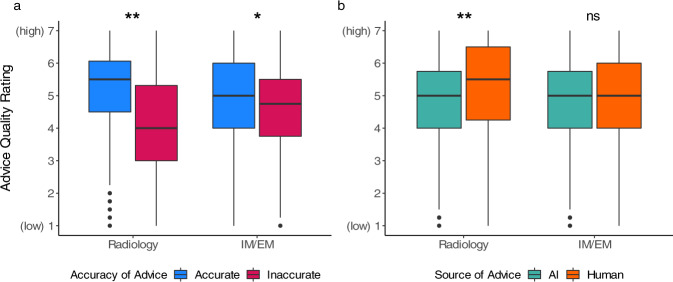
- Radiologists showed algorithmic aversion in advice-quality ratings: they rated advice significantly lower when it was labeled AI versus human (γ = 0.53, p = 0.001), whereas IM/EM physicians did not (γ = 0.22, p = 0.165).
- Inaccurate advice was rated lower in quality by both groups, more strongly by radiologists (γ = −1.00, p < 0.001) than by IM/EM physicians (γ = −0.40, p = 0.002).
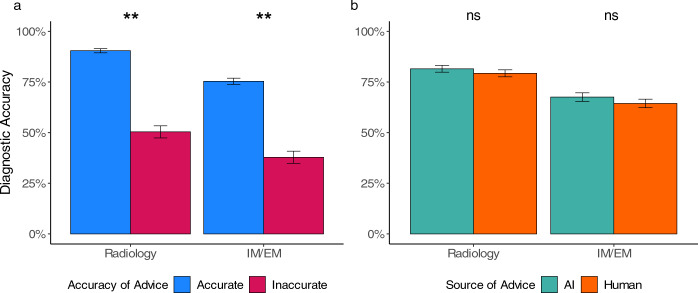
- Diagnostic accuracy was significantly worse with inaccurate advice for radiologists (β = 2.39, p < 0.001) and IM/EM physicians (β = 1.91, p < 0.001); task experts performed 40.10% better and non-experts 37.53% better with accurate versus inaccurate advice.
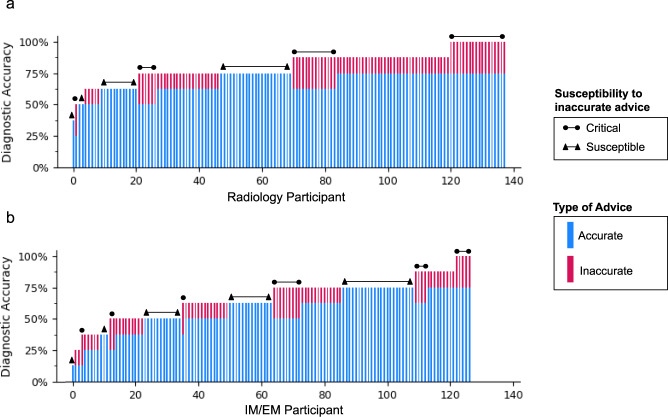
- Purported source did not significantly affect diagnostic accuracy (radiologists p = 0.183; IM/EM p = 0.081). Susceptibility varied: 41.73% of IM/EM physicians always gave the wrong diagnosis with inaccurate advice versus 27.54% of radiologists; 28.26% of radiologists and 17.32% of IM/EM physicians refuted all incorrect advice.
Methods
- Pre-registered web-based experiment (Qualtrics) with physicians recruited in the US and Canada: 138 radiologists (high task expertise) and 127 internal/emergency medicine physicians (lower task expertise).
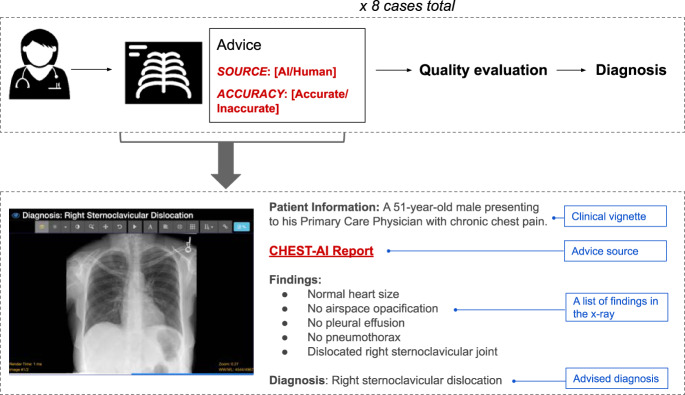
- Participants reviewed eight chest X-ray cases from the MIMIC Chest X-ray database, each with a clinical vignette and diagnostic advice; advice was human-generated but labeled as either from an AI system (CHEST-AI) or an experienced radiologist (Dr. S. Johnson).
- The design was a 2 × 2 mixed factorial: advice source (AI vs. human) between subjects and advice accuracy (accurate vs. inaccurate) within subjects, with participants randomly assigned six accurate and two inaccurate cases. Separate linear mixed models for advice-quality ratings and logistic mixed models for diagnostic accuracy regressed outcomes on advice accuracy, source, their interaction, and individual-related covariates, with a random effect by participant.
Limitations
- The paper states that only eight cases were tested to keep the study short enough for physician completion, that the web-based tool may not capture real deployment risk or behavior, that physician conversations are difficult to recreate, and that the sample is skewed toward less experienced physicians.
- The paper notes that advice was always generated by human experts and only the purported source was manipulated, so the study does not test actual AI-generated advice.
- Evident from the text: quality ratings may not reflect actual attitudes or behavior, as radiologists’ expressed aversion to AI advice did not affect their reliance on it; the online format may also have led to less careful case review or greater reliance on advice.
Model-written summary. Check it against the paper before relying on it.
Integrity signals
Registry
Cites
Statistics
Figures
Verification
Claims the paper makes
4 Valid · 1 Not valid · 10 Not checked · 48 Own results and interpretations
The sources with a verdict support this claim; the rest weren’t checked yet, have no full text we could read, or their verdicts aren’t rated yet.
In the paper
“However, it is not clear how to effectively integrate AI tools with human decision-makers; indeed, the few cases where systems have been implemented and studied showed no improved clinical outcomes6,7.”
§ Do as AI say: susceptibility in deployment of clinical decision-aids > Introduction
What the sources say
- Supportedcites [6] Brocklehurst P Computerised interpretation of fetal heart rate during labour (INFANT): a randomised controlled trial Lancet 2017 389 1719 1729 10.1016/S0140-6736(17)30568-8 28341515 PMC5413601 source
The Results report no significant difference in poor neonatal outcomes between the decision-support and control groups, and no evidence of differences in secondary outcomes for babies. The Discussion likewise concludes that the software did not reduce poor neonatal outcomes. This trial supports the cited sentence as an example, not as evidence about every AI system. (LLM, conf=0.92)
- Not checked — no full text of the sourcecites [7] Nunes I Central fetal monitoring with and without computer analysis: a randomized controlled trial Obstet. Gynecol. 2017 129 83 90 10.1097/AOG.0000000000001799 27926647 source
plain- Asserted: passes — The authors put it forward as true.
- Checkable: passes — It can be checked against evidence.
- Load-bearing: passes — The paper’s conclusions depend on it.
- Based: passes — The paper gives a reason why it holds.
- Supported
A result the paper reports from its own data — it cites no other source for it, so there is none to check. The quote shows it is in the paper.
In the paper
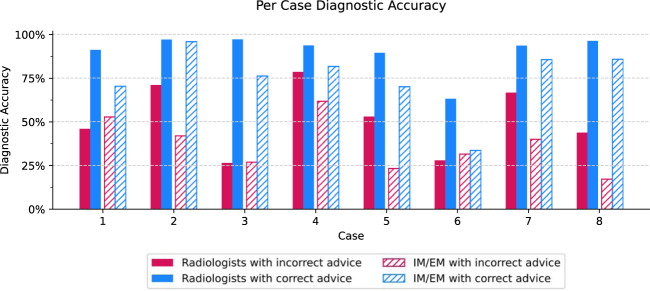
“As shown in Fig. 5, all cases were impacted by incorrect advice to varying degrees.”
§ Do as AI say: susceptibility in deployment of clinical decision-aids > Results > Incorrect advice impacts some clinical cases more than others
plainstates a causen = 8- Asserted: passes — The authors put it forward as true.
- Checkable: passes — It can be checked against evidence.
- Load-bearing: passes — The paper’s conclusions depend on it.
- Based: passes — The paper gives a reason why it holds.
A result the paper reports from its own data — it cites no other source for it, so there is none to check. The quote shows it is in the paper.
In the paper
“None of the measured covariates significantly predicted susceptibility, for either radiologists or IM/EM physicians.”
§ Do as AI say: susceptibility in deployment of clinical decision-aids > Discussion
plain- Asserted: passes — The authors put it forward as true.
- Checkable: passes — It can be checked against evidence.
- Load-bearing: passes — The paper’s conclusions depend on it.
- Based: passes — The paper gives a reason why it holds.
A result the paper reports from its own data — it cites no other source for it, so there is none to check. The quote shows it is in the paper.
In the paper
“Physicians across expertise levels often failed to dismiss inaccurate advice regardless of its source.”
§ Do as AI say: susceptibility in deployment of clinical decision-aids > Discussion
plain- Asserted: passes — The authors put it forward as true.
- Checkable: passes — It can be checked against evidence.
- Load-bearing: passes — The paper’s conclusions depend on it.
- Based: passes — The paper gives a reason why it holds.
A result the paper reports from its own data — it cites no other source for it, so there is none to check. The quote shows it is in the paper.
In the paper
“Further, inaccurate advice was more convincing for certain cases that involved additional interaction or analyses to recognize the error.”
§ Do as AI say: susceptibility in deployment of clinical decision-aids > Discussion
plainstates an association- Asserted: passes — The authors put it forward as true.
- Checkable: passes — It can be checked against evidence.
- Load-bearing: passes — The paper’s conclusions depend on it.
- Based: passes — The paper gives a reason why it holds.
22 more claims
Create a free account to see all 63 claims and every source verdict.
- It may state two separate claims as one. 20
- Probably not a substantial claim. 19
Claims other papers make about this one
Each is checked against this paper’s own text: does it say what the citing paper says it does?
The source backs part of the claim, not all of it — or backs it for a different population, condition or comparison.
In the citing paper
“it has been shown that people with high task expertise are more inclined to dismiss or devalue task-related advice from an AI system than are people with low task expertise7,18.”
From Non-task expert physicians benefit from correct explainable AI advice when reviewing X-rays (2023) · cites this paper as [7]
Experimental — accuracy not yet measuredThe source backs part of the claim, not all of it — or backs it for a different population, condition or comparison.
In the citing paper
“The presentation format of an explanation, its integration into electronic health record (EHR) systems, the cognitive load it imposes, and its alignment with existing clinical reasoning patterns all shape whether a technically sound explanation translates into genuine clinical utility [31,32].”
From Explainability of decoder-only clinical large language models: A scoping review (2026) · cites this paper as [32]
Experimental — accuracy not yet measuredThe source backs part of the claim, not all of it — or backs it for a different population, condition or comparison.
In the citing paper
“A growing body of work examines how healthcare professionals interact with and respond to AI-generated explanations, a dimension distinct from the technical methods used to produce them.”
From Explainability of decoder-only clinical large language models: A scoping review (2026) · cites this paper as [32]
Experimental — accuracy not yet measuredThe source backs part of the claim, not all of it — or backs it for a different population, condition or comparison.
In the citing paper
“Acceptance of clinical AI is shaped by integration into existing workflows, performance under time pressure, alignment with clinical reasoning patterns, and the cognitive load explanations impose [20,31,32].”
From Explainability of decoder-only clinical large language models: A scoping review (2026) · cites this paper as [32]
Experimental — accuracy not yet measuredThe source backs part of the claim, not all of it — or backs it for a different population, condition or comparison.
In the citing paper
“studies suggest that convincing explanations may paradoxically increase over-reliance on incorrect AI outputs, particularly among less experienced clinicians [31,32].”
From Explainability of decoder-only clinical large language models: A scoping review (2026) · cites this paper as [32]
Experimental — accuracy not yet measured
13 more claims about this paper
Create a free account to see every claim other papers make about this one.
Statistics recomputed
Every reported test result, recomputed from its test statistic and degrees of freedom. A result shows as not adding up only once an independent check has confirmed it.
- Consistentr(1102) = 0.43reported p < .001 · recomputed p < .001
“r(1102) = 0.43, p < .001”
Self-check
Percentages, sums and reported differences re-computed from the paper’s own numbers.
Self-check results appear here once an independent check has confirmed them.
Citations
Cites
Dermatologist-level classification of skin cancer with deep neural networks
Esteva, A., Kuprel, B., Novoa, R. A., Ko, J., Swetter, S. M., Blau, H. M., & Thrun, S. (2017) · Nature · doi:10.1038/nature21056 · Cited by 14,362
High-performance medicine: the convergence of human and artificial intelligence
Topol, E. J. (2019) · Nature Medicine · doi:10.1038/s41591-018-0300-7 · Cited by 10,450
Gulshan, V., Peng, L., Coram, M., Stumpe, M. C., Wu, D., Narayanaswamy, A., Venugopalan, S., Widner, K., Madams, T., Cuadros, J., et al. (2016) · JAMA · doi:10.1001/jama.2016.17216 · Cited by 7,697
The Association of American Medical Colleges
Zapffe, F. C. (1938) · Academic Medicine · doi:10.1097/00001888-193801000-00007 · Cited by 5,533
Rajkomar, A., Dean, J., & Kohane, I. (2019) · New England Journal of Medicine · doi:10.1056/nejmra1814259 · Cited by 4,579
Algorithm aversion: People erroneously avoid algorithms after seeing them err.
Dietvorst, B. J., Simmons, J. P., & Massey, C. (2015) · Journal of Experimental Psychology: General · doi:10.1037/xge0000033 · Cited by 3,232
Artificial intelligence in healthcare
Yu, K.-H., Beam, A. L., & Kohane, I. S. (2018) · Nature Biomedical Engineering · doi:10.1038/s41551-018-0305-z · Cited by 2,817
Algorithm appreciation: People prefer algorithmic to human judgment
Logg, J. M., Minson, J. A., & Moore, D. A. (2019) · Organizational Behavior and Human Decision Processes · doi:10.1016/j.obhdp.2018.12.005 · Cited by 2,061
Resistance to Medical Artificial Intelligence
Longoni, C., Bonezzi, A., & Morewedge, C. K. (2019) · Journal of Consumer Research · doi:10.1093/jcr/ucz013 · Cited by 2,015
Lakhani, P., & Sundaram, B. (2017) · Radiology · doi:10.1148/radiol.2017162326 · Cited by 1,775
Cited by
Items 201–300 of 527
Allure of Simplicity: On Interpretable Machine Learning Models in Healthcare
Grote, T. (2023) · Philosophy of Medicine · doi:10.5195/pom.2023.139 · Cited by 18
Jiang, T., Chen, C., Zhou, Y., Cai, S., Yan, Y., Sui, L., Lai, M., Song, M. L., Zhu, X., Pan, Q., et al. (2024) · BMC Cancer · doi:10.1186/s12885-024-12277-8 · Cited by 15
“Previous studies [38] have compared the performance of multiple human experts assisted by artificial intelligence and concluded that highly skilled human experts are more prone to algorithm aversion, meaning they are less likely to accept suggestions from artificial intelligence.”
ResultSemi-supervised skin cancer diagnosis based on self-feedback threshold focal learning
Yuan, W., Du, Z., & Han, S. (2024) · Discover Oncology · doi:10.1007/s12672-024-01043-8 · Cited by 16
Rainey, C., Bond, R., McConnell, J., Hughes, C., Kumar, D., & McFadden, S. L. (2024) · PLOS Digital Health · doi:10.1371/journal.pdig.0000560 · Cited by 19
Do Humans Trust Advice More if it Comes from AI? An Analysis of Human-AI Interactions
Vodrahalli, K., Daneshjou, R., Gerstenberg, T., & Zou, J. (2021) · arXiv · doi:10.48550/arxiv.2107.07015 · Cited by 16
“Some studies show people utilize automated or AI advice more than advice from peers [5, 17, 18, 27], while others have mixed results where AI advice has less or similar utilization [8, 21].”
BackgroundResultInfluentialPereira, S. C. D. A., Ferreira, R. A., Silva, J. M. A. V., Santos, E. J. F., Fassarella, C. S., & Ribeiro, O. M. P. L. (2025) · Journal of Clinical Nursing · doi:10.1111/jocn.70127 · Cited by 17
“By automating repetitive tasks, optimising clinical decision-making, and improving team communication, AI allows nurses to dedicate more time to tasks that require human interaction and critical thinking (Gaube et al. 2021; Kao et al. 2023; Li, Du, et al. 2024).”
AI Ethics beyond Principles: Strengthening the Life-world Perspective
Heuser, S., Steil, J. J., & Salloch, S. (2025) · Science and Engineering Ethics · doi:10.1007/s11948-025-00530-7 · Cited by 18
“…AI-based decision support systems seems particularly promising in data-heavy fields of healthcare (Rajkomar et al., 2019 ) and has invoked a discus-1 sion on questions of trust and distrust, medical errors, clinical outcomes, deskilling and the role of professional experience (Gaube et al., 2021 ).”
Bolton, W. J., Wilson, R. C., Gilchrist, M. J., Georgiou, P., Holmes, A. H., & Rawson, T. M. (2025) · The Lancet Digital Health · doi:10.1016/j.landig.2025.100912 · Cited by 21
Meaningful oversight of medical AI beyond human in the loop
van de Sande, D., Economou-Zavlanos, N., & van Genderen, M. E. (2026) · npj Digital Medicine · doi:10.1038/s41746-026-02971-1 · Cited by 37
Feedback, Control, or Explanations? Supporting Teachers With Steerable Distractor-Generating AI
Szymanski, M., Ooge, J., Croon, R. D., Abeele, V. V., & Verbert, K. (2024) · International Conference on Learning Analytics and Knowledge (LAK) · doi:10.1145/3636555.3636933 · Cited by 14
“This is, however, not uncommon amongst domain experts other than teachers, as similar results within the health context also indicate that domain experts tend to steer away from a poorly performing system and prefer to fall back on their expertise[17].”
BackgroundResultIf Machines Exceed Us: Health Care at an Inflection Point
Klang, E., Tessler, I., Freeman, R., Sorin, V., & Nadkarni, G. N. (2024) · NEJM AI · doi:10.1056/aip2400559 · Cited by 12
Artificial Intelligence user interface preferences in radiology: A scoping review
Gill, A., Rainey, C., McLaughlin, L., Hughes, C., Bond, R., McConnell, J., & McFadden, S. L. (2025) · Journal of medical imaging and radiation sciences · doi:10.1016/j.jmir.2025.101866 · Cited by 13
Braun, T. (2025) · Corporate Governance · doi:10.1108/cg-09-2024-0471 · Cited by 28
Rieger, T., Onnasch, L., Roesler, E., & Manzey, D. (2025) · IEEE Transactions on Human-Machine Systems · doi:10.1109/thms.2025.3584662 · Cited by 16
“That is, Gaube et al. [63] have shown that the very same advice is discounted by radiologists if told that the advice comes from an AI rather than a human colleague.”
Exploring trust factors in AI-healthcare integration: a rapid review
Mertz, M., Toskovich, K., Shields, G., Attema, G., Dumond, J., & Cameron, E. (2025) · Frontiers in Artificial Intelligence · doi:10.3389/frai.2025.1658510 · Cited by 16
How Displaying AI Confidence Affects Reliance and Hybrid Human-AI Performance
Tejeda, H., Kumar, A., & Mark Steyvers, B. (2023) · Frontiers in artificial intelligence and applications · doi:10.3233/faia230087 · Cited by 14
A Quantum Probability Approach to Improving Human–AI Decision Making
Humr, S. A., Canan, M., & Demir, M. (2025) · Entropy · doi:10.3390/e27020152 · Cited by 12
“Research suggests that experts and novices can perceive AI outputs differently, which can result in different judgments and decision outcomes [99,111,112].”
Lee, J., Jung, K., Newman, E., Chow, E., & Chen, Y. (2025) · CHI Conference on Human Factors in Computing Systems · doi:10.1145/3706598.3713244 · Cited by 18
“On the other hand, explanations could increase trust too much, leading to overreliance from novice clinicians [73].”
Human factors in digital healthcare systems: a critical literature review
Ogbeyemi, A., Lin, W., Odeyemi, J., Bradford, L., Yu, H., & Zhang, W. (2025) · Enterprise Information Systems · doi:10.1080/17517575.2025.2524847 · Cited by 12
“Indeed, some medical and healthcare practitioners are reluctant to adapt to new information systems due to technical know-how (Al-Hadban, Yusof, and Hashim 2016; Gaube et al. 2021; Salahuddin et al. 2020).”
Artificial intelligence and human expertise in hand trauma diagnosis: A collaborative approach
Klein, C., Fondu, P., Ghazali, D. A., Rotari, V., Arab, O. A., & David, E. (2025) · Orthopaedics & Traumatology Surgery & Research · doi:10.1016/j.otsr.2025.104338 · Cited by 10
Sonographer interaction with artificial intelligence: collaboration or conflict?
Day, T. G., Matthew, J., Budd, S., Hajnal, J. V., Simpson, J. M., Razavi, R., & Kainz, B. (2023) · Ultrasound in Obstetrics and Gynecology · doi:10.1002/uog.26238 · Cited by 12
The effect of medical explanations from large language models on diagnostic accuracy in radiology
Spitzer, P., Hendriks, D., Rudolph, J., Schlaeger, S., Ricke, J., Kühl, N., Hoppe, B. F., & Feuerriegel, S. (2026) · npj Digital Medicine · doi:10.1038/s41746-026-02619-0 · Cited by 21
Hong, S., Hwang, E. J., Kim, S., Song, J., Lee, T., Jo, G. D., Choi, Y., Park, C. M., & Goo, J. M. (2023) · Diagnostics · doi:10.3390/diagnostics13061089 · Cited by 9
McCradden, M. D. (2021) · Translational Psychiatry · doi:10.1038/s41398-021-01479-4 · Cited by 8
Choo, H., Yoo, S. Y., Moon, S., Park, M., Lee, J., Sung, K. W., Cha, W. C., Shin, S.-Y., & Son, M. H. (2022) · Journal of Biomedical Informatics · doi:10.1016/j.jbi.2022.104268 · Cited by 8
Teikari, P., & Pietrusz, A. (2021) · SportRxiv (OSF Preprints) · doi:10.31236/osf.io/w734a · Cited by 17
Majority voting of doctors improves appropriateness of AI reliance in pathology
Gu, H., Yang, C., Magaki, S., Zarrin‐Khameh, N., Lakis, N. S., Cobos, I., Khanlou, N., Zhang, X. R., Assi, J. S., Byers, J. T., et al. (2024) · International Journal of Human-Computer Studies · doi:10.1016/j.ijhcs.2024.103315 · Cited by 8
Development and Validation of a Sham-AI Model for Intracranial Aneurysm Detection at CT Angiography
Shi, Z., Hu, B., Lu, M., Zhang, M., Yang, H., He, B., Ma, J., Hu, C., Lu, L., Li, S., et al. (2025) · Radiology Artificial Intelligence · doi:10.1148/ryai.240140 · Cited by 8
The impact of AI feedback on the accuracy of diagnosis, decision switching and trust in radiography
Rainey, C., Bond, R., McConnell, J., Gill, A., Hughes, C., Kumar, D., & McFadden, S. L. (2025) · PLoS ONE · doi:10.1371/journal.pone.0322051 · Cited by 11
“…indicating that they were able to detect that the AI, or some aspects of the AI were inaccurate, however, this is at odds with the increased accuracy reported above and with other studies indicating that even experienced clinicians are unable to detect inaccuracies in decision support systems [36].”
InfluentialVoigt, J., & Strauss, K. (2025) · Journal of Vocational Behavior · doi:10.1016/j.jvb.2025.104154 · Cited by 13
Comparative analysis of AI support levels in clinical interpretation of traumatic pelvic radiographs
Tee, Y., Huang, J., Huang, Y., Hsu, C.-P., Chen, H.-W., Hsieh, C., Fu, C., Cheng, C., & Liao, C. (2025) · npj Digital Medicine · doi:10.1038/s41746-025-01923-5 · Cited by 9
“Priorstudieshavedescribedsaliency-inducedbias, aphenomenonwhereusersdevelopmisplacedcon fi denceinAIpredictions simply because they are accompanied by visually persuasive but potentially misleading saliency maps 47 .”
Jackson, N. J., Brown, K. E., Rn, M., Murrow, M., Cauley, M. R., Collins, B. X., Novak, L. L., Benda, N. C., & Ancker, J. S. (2026) · Journal of the American Medical Informatics Association · doi:10.1093/jamia/ocag002 · Cited by 19
“11,31,32,34,35,63,66,68,69 However, participants showed some resilience to this as incorrect advice decreased users’ trust 53 in the AI-CDS and decreased their confidence in their decisions 63,69 (with 1 exception 66 ).”
Influentialvan Leeuwen, K. G., Becks, M. J., Grob, D., de Lange, F., Rutten, J. H. W., Schalekamp, S., Rutten, M. J. C. M., van Ginneken, B., de Rooij, M., & Meijer, F. J. A. (2023) · Heliyon · doi:10.1016/j.heliyon.2023.e19065 · Cited by 11
“Interaction with existing systems and human-AI interactions may provide different results than retrospective validation [11,12].”
Presentation matters for AI-generated clinical advice
Ghassemi, M. (2023) · Nature Human Behaviour · doi:10.1038/s41562-023-01721-7 · Cited by 11
Self-citationEntropy removal of medical diagnostics
He, S., Chong, P., Yoon, B.-J., Chung, P.-H., Chen, D. J., Marzouk, S., Black, K. C., Sharp, W., Safari, P., Goldstein, J. N., et al. (2024) · Scientific Reports · doi:10.1038/s41598-024-51268-4 · Cited by 19
Ethik und künstliche Intelligenz
Kotter, E., & dos Santos, D. P. (2024) · Die Radiologie · doi:10.1007/s00117-024-01286-0 · Cited by 7
Anand, E., Devi, J., Antoniou, A., Joshi, S., Stoker, J., Lung, P. F. C., Hart, A. L., Tozer, P. J., Ballard, D. H., & Deepak, P. (2025) · Crohn s & Colitis 360 · doi:10.1093/crocol/otaf015 · Cited by 11
“33,34”
Artificial Intelligence‐Powered Acoustic Analysis System for Dysarthria Severity Assessment
Zhang, Z., Shang, X., Yang, L., Ai, W., Wang, J., Wang, H., Wong, S. T. C., Wang, X., & Li, H. (2023) · Advanced Intelligent Systems · doi:10.1002/aisy.202300097 · Cited by 12
Psychotraumatology and Artificial Intelligence: A Public Health Approach
Cogan, N. A. (2024) · Public Health Open Access · doi:10.23880/phoa-16000284 · Cited by 7
Diefenbach, S., Ullrich, D., Lindermayer, T., & Isaksen, K. R. (2024) · Information · doi:10.3390/info15080460 · Cited by 8
Pham, T.-T., Brecheisen, J., Wu, C. C., Nguyen, H. V., Deng, Z., Adjeroh, D., Doretto, G., Choudhary, A. K., & Le, N. (2024) · Artificial Intelligence in Medicine · doi:10.1016/j.artmed.2024.103054 · Cited by 8
Vicente, L., Matute, H., Fregosi, C., & Cabitza, F. (2025) · International Journal of Human-Computer Studies · doi:10.1016/j.ijhcs.2025.103474 · Cited by 18
When AI Is Not Enough: Reducing Diagnostic Errors with Radiologist Oversight
Cai, J., & Zychlinski, N. (2025) · Service Science · doi:10.1287/serv.2024.0234 · Cited by 7
Robles‐Medranda, C., Verpalen, I. M., Schulz, D., & Spadaccini, M. (2025) · Gastroenterology · doi:10.1053/j.gastro.2025.04.011 · Cited by 7
König, C., Copado, P., Vellido, A., Nebot, À., Ángulo, C., Lamarca, M., Vanessa Acuña, P., Berna, F. S., Moritz, S., Gawęda, Ł., et al. (2025) · Computational and Structural Biotechnology Journal · doi:10.1016/j.csbj.2025.07.051 · Cited by 10
Kadian, A., Merhi, M. I., Gupta, M., Ghafoori, A., & Dennehy, D. (2025) · IEEE Transactions on Engineering Management · doi:10.1109/tem.2025.3606352 · Cited by 9
“Research on individual-level responses to GAIH is needed because individuals tend to over-rely on information provided by AI [59], [60].”
Clinical pathway-aware large language models for reliable and transparent medical dialogue
Wu, J., Wu, X., Zheng, Y., & Yang, J. (2025) · Journal of Biomedical Informatics · doi:10.1016/j.jbi.2025.104942 · Cited by 14
Passi, S., Dhanorkar, S., & Vorvoreanu, M. (2025) · Springer eBooks · doi:10.1007/978-981-95-3658-0_98 · Cited by 16
Verhulsdonck, G., & Jiang, J. (2026) · Journal of Technical Writing and Communication · doi:10.1177/00472816251405787 · Cited by 8
“For example, studies of medical decision making show both high-and low-expertise professionals deferring excessively to AI recommendations (Gaube et al., 2021), while other research demonstrates users even revising self-reports to match arbitrary AI “ evaluations ” (Springer et al., 2017).”
Raees, M., Khan, V.-J., Lykourentzou, I., & Papangelis, K. (2026) · Proceedings of the 2026 CHI Conference on Human Factors in Computing Systems · doi:10.1145/3772318.3791467 · Cited by 5
“Even when the given task itself is high-stakes (e.g., recidivism [32]) or resembles real-world, if the users involved bear no responsibility or accountability or lack expertise [53, 152], the task may still fail to extract user reliance appropriately.”
Ignorance Isn't Bliss: We Must Close the Machine Learning Knowledge Gap in Pediatric Critical Care
Ehrmann, D. E., Harish, V., Morgado, F., Rosella, L. C., Johnson, A. E. W., Mema, B., & Mazwi, M. (2022) · Frontiers in Pediatrics · doi:10.3389/fped.2022.864755 · Cited by 7
“Automation bias has been reported in the ML literature, especially among inexperienced end-users (25).”
BackgroundUnsettled Liability Issues for “Prediagnostic” Wearables and Health-Related Products
Simon, D. A., Shachar, C., & Cohen, I. G. (2022) · JAMA · doi:10.1001/jama.2022.16317 · Cited by 6
Bélisle‐Pipon, J., & David, P. (2023) · Pharmaceutical Medicine · doi:10.1007/s40290-022-00459-3 · Cited by 11
When Do Humans Heed AI Agents’ Advice? When Should They?
Dunning, R. E., Fischhoff, B., & Davis, A. L. (2023) · Human Factors The Journal of the Human Factors and Ergonomics Society · doi:10.1177/00187208231190459 · Cited by 17
“Studies have found that humans value receiving numerical probabilities and can often use them effectively, when they are associated with well-de fi ned events (Erev & Cohen, 1990; Gaube et al., 2021; Lipkus, 2007; Zhang et al., 2020).”
BackgroundDetection of Osteosarcoma on Bone Radiographs Using Convolutional Neural Networks
Asito, L., Pereira, H. M., Nogueira‐Barbosa, M. H., et al. (2021) · Congresso Brasileiro de Inteligência Computacional (CBIC) · doi:10.21528/cbic2021-16 · Cited by 6
“In several tasks, classification of medical images based on Artificial Intelligence (AI) presents excellent performance, sometimes with similar or superior quality to that of human experts (in [4], clinical task performance with and without AI aid systems are compared and discussed).”
BackgroundThe Effect of AI-generated Advice on Decision-Making in Personnel SelectionPreprint
Cecil, J., Lermer, E., Hudecek, M. F. C., Sauer, J., & Gaube, S. (2023) · doi:10.31219/osf.io/349xe · Cited by 6
Self-citationLanger, M., Baum, K. L., & Schlicker, N. (2023) · doi:10.31234/osf.io/ke256 · Cited by 6
Influence of believed AI involvement on the perception of digital medical advicePreprint
Reis, M., Reis, F., & Kunde, W. (2024) · doi:10.31234/osf.io/35hn8 · Cited by 6
Mastrianni, A., Kim, M. S., Sullivan, T. M., Sippel, G. J., Burd, R. S., Gajos, K. Z., & Sarcevic, A. (2025) · Proceedings of the ACM on Human-Computer Interaction · doi:10.1145/3757512 · Cited by 6
Teaching Humans When to Defer to a Classifier via Exemplars
Mozannar, H., Satyanarayan, A., & Sontag, D. (2022) · Proceedings of the AAAI Conference on Artificial Intelligence · doi:10.1609/aaai.v36i5.20469 · Cited by 5
“Automated agents powered by machine learning are augmenting the capabilities of human decision makers in settings such as healthcare (Gaube et al. 2021), content moderation (Link, Hellingrath, and Ling 2016) and more routine decisions such as asking AI-enabled virtual assistants for recommendations…”
BackgroundGaze Assistance for Efficient Segmentation Correction of Medical Images
Khaertdinova, L., Shmykova, T., Pershin, I., Laryukov, A. V., Khanov, A., Ильшатович, З. Д., & Ibragimov, B. (2025) · IEEE Access · doi:10.1109/access.2025.3530701 · Cited by 11
“Concerns regarding the explainability of AI models [5], [8], [40], [54] and potential biases that radiologists may have towards AI tools [15], [19], [35] complicate the adoption of automated systems in radiology.”
Appropriating Empowerment: Precision Medicine’s Proclivity to Epistemic Injustice
Kenis, D. (2025) · Hypatia · doi:10.1017/hyp.2025.17 · Cited by 5
The Right to Explanation in AI: In a Lonely Place
Noë, A., Bouhouita-Guermech, S., & Zawati, M. H. (2025) · Journal of Medical Internet Research · doi:10.2196/64482 · Cited by 8
Marwaha, J. S., Yuan, W., Poddar, M., Elsamadisi, P., & Brat, G. A. (2025) · npj Digital Medicine · doi:10.1038/s41746-025-01960-0 · Cited by 12
“…consultant addresses many of the known contributors to this problem by selecting the best tool, helping physicians accurately update their clinical reasoning 5,10 , adjusting for the model ’ s limitations and biases 11 , and possibly even recognizing the physician ’ s cognitive biases 12 .”
Xin, Y., Yan, D., Shuren, L., Minyang, L., & Liuheng, L. (2026) · npj Digital Medicine · doi:10.1038/s41746-026-02521-9 · Cited by 21
“Unliketraditionalpassive learning tools, these systems function as advanced probabilistic support tools,offeringdiagnosticprobabilitiesandreasoningpathwaysthatstudents must actively evaluate 5,6 .”
InfluentialArtificial Truth: Algorithmic Power, Epistemic Authority, and the Crisis of Democratic Knowledge
Palese, R. (2026) · Societies · doi:10.3390/soc16030102 · Cited by 9
Empowering photodynamic therapy with artificial intelligence: current trends and future directions
Paul, A., Xavierselvan, M., Aebisher, D., Kubrak, T. P., Bartusik‐Aebisher, D., & Mallidi, S. (2026) · Frontiers in Oncology · doi:10.3389/fonc.2026.1771804 · Cited by 8
Qadir, J., & Mumtaz, M. (2026) · IEEE Global Engineering Education Conference (EDUCON) · doi:10.1109/educon67543.2026.11574165 · Cited by 10
“But... they aren’t insulting each other or anything...” [30,488 likes] This comment connects the AI debate format to personal expectations about discourse, implicitly critiquing human debate culture.”
Contrastive Learning Approach to Predict Radiologist's Error Based on Gaze Data
Pershin, I., Mustafaev, T., & Ibragimov, B. (2023) · IEEE Congress on Evolutionary Computation (CEC) · doi:10.1109/cec53210.2023.10254056 · Cited by 6
Alzaabi, A. A., & Padela, A. I. (2024) · Elsevier eBooks · doi:10.1016/b978-0-443-23637-2.00022-9 · Cited by 9
What Else Do I Need to Know? The Effect of Background Information on Users’ Reliance on QA Systems
Goyal, N., Briakou, E., Liu, A., Baumler, C., Bonial, C., Micher, J. C., Voss, C. R., Carpuat, M. J., & Daumé, H. (2023) · Conference on Empirical Methods in Natural Language Processing (EMNLP) · doi:10.18653/v1/2023.emnlp-main.201 · Cited by 20
“…increase trust in AI models, exacerbating over-reliance (Bansal et al., 2021; Buçinca et al., 2020; Papenmeier et al., 2019; Schemmer et al., 2022; Jacobs et al., 2021; Zhang et al., 2020; Buçinca et al., 2021), particularly among non-expert users (Gaube et al., 2022; Schaffer et al., 2019).”
BackgroundAn Architecture to Support Graduated Levels of Trust for Cancer Diagnosis with AI
Rezaeian, O., Bayrak, A. E., & Asan, O. (2024) · Communications in computer and information science · doi:10.1007/978-3-031-61966-3_37 · Cited by 11
The effect of medical explanations from large language models on diagnostic decisions in radiologyPreprint
Spitzer, P., Hendriks, D., Rudolph, J., Schlaeger, S., Ricke, J., Kühl, N., Hoppe, B. F., & Feuerriegel, S. (2025) · medRxiv · doi:10.1101/2025.03.04.25323357 · Cited by 10
From Trust to Appropriate Reliance: Measurement Constructs in Human-AI Decision-Making
Raees, M., & Papangelis, K. (2026) · arXiv · doi:10.48550/arxiv.2604.23896 · Cited by 5
“• Experiments with non-realistic tasks and a lack of users’ expertise on those tasks may fail to assess users’ reliance appropriately [27, 87].”
Bendella, Z., Wichtmann, B. D., Clauberg, R., Keil, V. C., Lehnen, N. C., Haase, R., Sáez, L. C., Wiest, I. C., Kather, J. N., Endler, C., et al. (2025) · European Journal of Radiology · doi:10.1016/j.ejrad.2025.112416 · Cited by 6
Ouyang, X., & Wei, J. (2025) · Annals of Biomedical Engineering · doi:10.1007/s10439-025-03865-1 · Cited by 19
“…be cautious or even skeptical of AI recommendations and tend to retain independent judgment; Junior providers, on the other hand, may rely too much on system outputs and suffer from “automation bias,” which is to blindly trust technology over clinical intuition and comprehensive assessment [184].”
Gomez, C., Wang, R., Breininger, K., Casey, C., Bradley, C., Pavlak, M., Pham, A. T., Yohannan, J., & Unberath, M. (2025) · npj Digital Medicine · doi:10.1038/s41746-025-02069-0 · Cited by 5
“Unlike previous human-AI teaming studies where both AI and humans can solve the task similarly well 19,27,28 , this study examines whether and how XAI may enable providers to integrate correct AI recommendations into their decisions while retaining their ability to interpret context to identify AI…”
Bian, X., Chen, Y., & Yang, A. (2026) · International Journal of Information Management · doi:10.1016/j.ijinfomgt.2026.103039 · Cited by 5
Mersal, F. A., Mersal, N. A., Ibrahim, N. M., Elgazzar, S. E., Alanazi, A. M., Alzughaibi, S., Alanazi, E. M., & Elsayed, E. A. H. (2026) · Digital Health · doi:10.1177/20552076261429671 · Cited by 9
“19 This contradicts the traditional de fi cit model of risk communication, which posits that emphasizing hazards diminishes trust.”
Zheng, S., Ma, W., Mu, L., He, K., Cao, J., So, T. Y., Zhang, L., Li, M., Yanan, Z., Liu, F., et al. (2025) · iScience · doi:10.1016/j.isci.2025.112224 · Cited by 8
“14,15 More-over, under which conditions it is reliable to solely rely on AI tools is unclear.”
Equity, autonomy, and the ethical risks and opportunities of generalist medical AI
Sass, R. (2023) · AI and Ethics · doi:10.1007/s43681-023-00380-8 · Cited by 5
“First, patients might feel pressured to use decision aids even if they do not wish to do so [26, 27].”
Trust Junk and Evil Knobs: Calibrating Trust in AI Visualization
Wall, E., Matzen, L. E., El‐Assady, M., Masters, P., Hosseinpour, H., Endert, A., Borgo, R., Chau, P., Perer, A., Schupp, H. T., et al. (2024) · IEEE Pacific Visualization Conference (PacificVis) · doi:10.1109/pacificvis60374.2024.00012 · Cited by 19
“Novice users may over-rely on incorrect advice while experienced users dismiss recommendations regardless of their quality [3,32,64].”
BackgroundDeLuca, N. J., Wertheimer, B., & Ansari, Z. (2025) · Current Ophthalmology Reports · doi:10.1007/s40135-025-00333-w · Cited by 7
“Overreliance may lead to automation bias, where clinicians defer excessively to algorthimic outputs, potentially compromising clinical judgement and diagnostic accuracy [21, 22].”
Huang, E. S. (2022) · Med · doi:10.1016/j.medj.2022.03.005 · Cited by 5
Hong, J. C., Patel, P., Eclov, N. C. W., Stephens, S. J., Mowery, Y. M., Tenenbaum, J. D., & Palta, M. (2023) · BMJ Health & Care Informatics · doi:10.1136/bmjhci-2022-100674 · Cited by 4
Langer, M. (2023) · Psychologische Rundschau · doi:10.1026/0033-3042/a000626 · Cited by 5
Comparing Human and Machine Deepfake Detection with Affective and Holistic Processing.Preprint
Groh, M., Epstein, Z., Firestone, C., & Picard, R. W. (2021) · arXiv (Cornell University) · Cited by 5
Kahr, P. K., Rooks, G., Willemsen, M. C., et al. (2023) · doi:10.31234/osf.io/9zr3u · Cited by 4
Zhu, Y., Sui, D., Wang, Z., Hu, X., Gu, L., Qi, Y., Wu, T., Wang, L., Wei, Y., Tang, W., et al. (2026) · Proceedings of the 2026 CHI Conference on Human Factors in Computing Systems · doi:10.1145/3772318.3791458 · Cited by 3
“…frameworks warn of de-skilling for junior clinicians or algorithmic aversion from experts, there is limited empirical evidence demonstrating how interactive features might mitigate these risks by supporting distinct cognitive strategies for novices versus experts within the same system [7, 21, 72].”
Narechania, A. A., Endert, A., & Sinha, A. R. (2025) · ACM International Conference on Intelligent User Interfaces (IUI) · doi:10.1145/3708359.3712166 · Cited by 7
Promises and pitfalls of large language models in psychiatric diagnosis and knowledge tasks
Bang, C., Jung, Y., You, S. C., Kim, K., & Kim, B.-H. (2025) · The British Journal of Psychiatry · doi:10.1192/bjp.2024.207 · Cited by 5
“9 There is more to consider in psychiatry than the DSM, and uncritical acceptance of these tools may potentially affect patient outcomes.”
Ma, Z., Mei, Y., Bruderlein, C., Gajos, K. Z., & Pan, W. (2025) · Annual Symposium on Human-Computer Interaction for Work (CHIWORK) · doi:10.1145/3729176.3729194 · Cited by 28
“However, subsequent empirical studies consistently showed that people assisted by XAI made less accurate decisions than the AI systems alone [8, 39, 52], possibly because users do not engage cognitively with AI-generated explanations in XAI settings [20, 38].”
Folgado, D., Famiglini, L., Campagner, A., Dores, H., Barandas, M., Gamboa, H. F. S., & Cabitza, F. (2025) · Lecture notes in computer science · doi:10.1007/978-3-031-95838-0_14 · Cited by 6
Chen, S., Gao, L., Tan, M., Zhang, K., & Lv, F. (2025) · Diagnostics · doi:10.3390/diagnostics15131623 · Cited by 5
“Despite the trust issues of radiologists regarding DL-CAD systems being expected to be relieved with the substantial advancement of AI in medicine, there are also challenges related to human–AI interaction [37,38].”
Prado, Á. M., Guerrero-López, A., Arias-Londoño, J. D., & Godino-Llorente, J. I. (2025) · IEEE Access · doi:10.1109/access.2025.3607282 · Cited by 3
Chen, H., Gómez, C., Corrêa, Z. M., Liu, A., Milman, T., Eiger‐Moscovich, M., Chévez‐Barrios, P., Salomão, D. R., & Unberath, M. (2025) · Medical Image Analysis · doi:10.1016/j.media.2025.103856 · Cited by 5
KUŞCU, F. N. (2026) · International Journal of Public Health · doi:10.3389/ijph.2026.1609194 · Cited by 4
Tang, F., Yao, F., & Zhou, M. (2026) · Computers & Education · doi:10.1016/j.compedu.2026.105619 · Cited by 9
AI literacy among basic school teachers in Ghana: A structural equation modelling analysis
Arkorful, V., Arthur, F., Opoku, E., Ameen, A., Salifu, I., Nortey, S. A., & Tetteh, S. A. (2026) · PLoS ONE · doi:10.1371/journal.pone.0347117 · Cited by 7
“Without these competencies, the integration of AI into teaching may be ineffective or even problematic, particularly in relation to issues such as mis-information and ethical misuse [10,11].”
When AI Disagrees: The Effect of Second Opinion on Patients' Trust in Doctors
Chen, C., Sun, Y., Liao, M., & Sundar, S. S. (2026) · International Journal of Human-Computer Studies · doi:10.1016/j.ijhcs.2026.103824 · Cited by 6
Metadata
- Authors
- Gaube, S., Suresh, H., Raue, M., Merritt, A., Berkowitz, S. J., Lermer, E., Coughlin, J. F., Guttag, J. V., Colak, E., & Ghassemi, M.
- Affiliations
- University of Regensburg (DE)
- MIT Computer Science and Artificial Intelligence Laboratory (US)
- Massachusetts Institute of Technology (US)
- Boston Medical Center (US)
- Beth Israel Deaconess Medical Center (US)
- FOM University of Applied Sciences for Economics and Management (DE)
- St. Michael's Hospital (CA)
- University of Toronto (CA)
- Corresponding author
- Gaube, Susanne
- Suresh, Harini
- ORCID
- Venue
- npj Digital Medicine
- Published
- 2021-02-19
- Volume
- 4
- Issue
- 1
- Pages
- 31-31
- ISSN
- 2398-6352 (ISSN-L)
- PMC
- PMC7896064
- OpenAlex
- W3130937151
- Cited by
- 543
- References
- 42
- Citations by year
- 2026: 174 · 2025: 109 · 2024: 81 · 2023: 94 · 2022: 62 · 2021: 23
- FWCI
- 18.71
- Type
- journal article
- Language
- en
- Open access
- gold
- doi.org
- Licence
- cc-by
- creativecommons.org/licenses/by/4.0 (tdm)
- creativecommons.org/licenses/by/4.0 (vor)
- Locations
- npj Digital Medicine (publishedVersion, cc-by)
- PubMed Central (publishedVersion, cc-by)
- PubMed (publishedVersion)
- DOAJ (DOAJ: Directory of Open Access Journals) (submittedVersion, cc-by-sa)
- DSpace@MIT (Massachusetts Institute of Technology) (submittedVersion, cc-by-nc)
- University of Regensburg Publication Server (University of Regensburg) (submittedVersion)
- Funders
- Gouvernement du Canada | Natural Sciences and Engineering Research Council of Canada
- Microsoft Research
- Topics
- Health Sciences › Medicine › Health Informatics › Artificial Intelligence in Healthcare and Education
- Health Sciences › Medicine › Family Practice › Clinical Reasoning and Diagnostic Skills
- Physical Sciences › Computer Science › Artificial Intelligence › Explainable Artificial Intelligence (XAI)
- Keywords
- artificial intelligence, clinical decision support, radiologists, chest X-ray diagnosis, diagnostic accuracy
About these checks
Registry, retraction, Cites and statistics results are computed, not judged, with one exception: a printed reference that no index lists is read once by a model before it counts as a citation error. Claims are extracted by a model and kept only when their quote appears verbatim in the text; each cited source is then checked, with a model’s help, for whether it says what the claim relies on. Those verdicts can be wrong — read the claim’s quote and the cited source before relying on one.
The claim verdicts this report counts are experimental: their accuracy is not yet measured.
A language model drew the claims from the paper on 2026-10-10, under version 3 of the claim definition (model deepseek-v4.1-flash, prompt extract-v3).
A second model labelled each claim on 2026-10-10 (model jev-1.13-20260917, definition revision gold-guideline-v0.2).
Cited sources are checked with a language model’s help (gpt-6-sol).
Statistics and arithmetic are recomputed, not judged.
Confidence bands are shown only for fields calibrated on our annotated test set. None is calibrated yet, so no band is shown.
What counts as a claim ›How we measure confidence ›How we check this ›
Are you an author, or do you see a problem with this page? Request a review
Data sources
Bibliographic data: Semantic Scholar, OpenAlex, Crossref.
Contains information from the Semantic Scholar Academic Graph Datasets, made available under the ODC Attribution License (ODC-BY 1.0).
Semantic Scholar’s data is described in: Kinney, R., et al. (2023). The Semantic Scholar Open Data Platform. arXiv:2301.10140.
