

Clinical artificial intelligence quality improvement: towards continual monitoring and updating of AI algorithms in healthcare
Open accessThe DOI matches its Crossref record; 89 of the 89 references it cites were found in a registry or an index.
Abstract
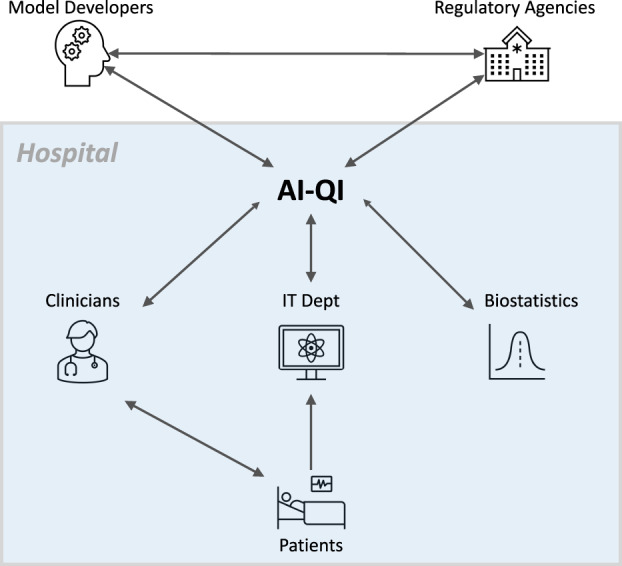
Machine learning (ML) and artificial intelligence (AI) algorithms have the potential to derive insights from clinical data and improve patient outcomes. However, these highly complex systems are sensitive to changes in the environment and liable to performance decay. Even after their successful integration into clinical practice, ML/AI algorithms should be continuously monitored and updated to ensure their long-term safety and effectiveness. To bring AI into maturity in clinical care, we advocate for the creation of hospital units responsible for quality assurance and improvement of these algorithms, which we refer to as “AI-QI” units. We discuss how tools that have long been used in hospital quality assurance and quality improvement can be adapted to monitor static ML algorithms. On the other hand, procedures for continual model updating are still nascent. We highlight key considerations when choosing between existing methods and opportunities for methodological innovation.
Overview
The claims and statistics of this paper haven’t been checked yet.
Free: it reads the open-access text and checks the first 5 claims that cite a source we can check. Create a free account to check every claim.
Integrity signals
Registry
Cites
Statistics
Figures
Verification
Claims the paper makes
The claims and statistics of this paper haven’t been checked yet.
Free: it reads the open-access text and checks the first 5 claims that cite a source we can check. Create a free account to check every claim.
Claims other papers make about this one
Each is checked against this paper’s own text: does it say what the citing paper says it does?
In the citing paper
“The establishment of a dedicated department within hospitals for algorithm quality control has been advocated [90].”
From Fairness of artificial intelligence in healthcare: review and recommendations (2024) · cites this paper as [90]
Self-check
Percentages, sums and reported differences re-computed from the paper’s own numbers.
The self-check needs the paper’s full text.
Citations
Cites
The Elements of Statistical Learning
Hastie, T., Tibshirani, R., & Friedman, J. (2009) · Springer Series in Statistics · doi:10.1007/978-0-387-84858-7 · Cited by 25,970
MIMIC-III, a freely accessible critical care database
Johnson, A. E. W., Pollard, T. J., Shen, L., Lehman, L.-W. H., Feng, M., Ghassemi, M., Moody, B., Szolovits, P., Anthony Celi, L., & Mark, R. G. (2016) · Scientific Data · doi:10.1038/sdata.2016.35 · Cited by 8,141 · cited 1×
“Although large publicly available datasets such as the Medical Information Mart for Intensive Care (MIMIC) database 102 are moving in the direction of releasing more accurate timestamps, random date shifts used for data de-identi fi cation have the unfortunate side effect of dampening temporal…”
MethodPAGE, E. S. (1954) · Biometrika · doi:10.1093/biomet/41.1-2.100 · Cited by 5,739 · cited 2×
“Commonly used control charts that fall in this category include Shewhart control charts, cumulative sum (CUSUM) control charts 35 , and exponentially weighted moving average (EWMA) control charts 31 .”
BackgroundMethodA guide to deep learning in healthcare
Esteva, A., Robicquet, A., Ramsundar, B., Kuleshov, V., DePristo, M., Chou, K., Cui, C., Corrado, G., Thrun, S., & Dean, J. (2019) · Nature Medicine · doi:10.1038/s41591-018-0316-z · Cited by 5,312
Causal Inference for Statistics, Social, and Biomedical Sciences: An Introduction
Imbens, G. W., & Rubin, D. B. (2015) · doi:10.1017/cbo9781139025751 · Cited by 4,210
Causal Diagrams for Epidemiologic Research
Greenland, S., Pearl, J., & Robins, J. M. (1999) · Epidemiology · doi:10.1097/00001648-199901000-00008 · Cited by 3,728
Hannun, A. Y., Rajpurkar, P., Haghpanahi, M., Tison, G. H., Bourn, C., Turakhia, M. P., & Ng, A. Y. (2019) · Nature Medicine · doi:10.1038/s41591-018-0268-3 · Cited by 3,148 · cited 1×
“The use of arti fi cial intelligence (AI) and machine learning (ML) in the clinical arena has developed tremendously over the past decades, with numerous examples in medical imaging, cardiology, and acute care 1 – 6 .”
BackgroundAir Pollution and Hospital Admissions for Heart Disease in Eight U.S. Counties
Schwartz, J. (1999) · Epidemiology · doi:10.1097/00001648-199901000-00005 · Cited by 3,038
A Kernel Method for the Two-Sample-Problem
Gretton, A., Borgwardt, K. M., Rasch, M., Schölkopf, B., & Smola, A. J. (2007) · Advances in Neural Information Processing Systems 19 · doi:10.7551/mitpress/7503.003.0069 · Cited by 2,167
Predicting good probabilities with supervised learning
Niculescu-Mizil, A., & Caruana, R. (2005) · Proceedings of the 22nd international conference on Machine learning - ICML '05 · doi:10.1145/1102351.1102430 · Cited by 1,884
Research works printed but not linked: 17
- Subbaswamy, A., Schulam, P. & Saria, S. Preventing failures due to dataset shift: Learning predictive models that transport. In: Proc. Machine Learning Research Vol. 89 (eds. Chaudhuri, K. & Sugiyama, M.) 3118–3127 (PMLR, 2019).
- Schölkopf, B. et al. On causal and anticausal learning. In: Proc. 29th International Coference on International Conference on Machine Learning, ICML’12 459–466 (Omnipress, 2012).
- Montgomery, D. Introduction to Statistical Quality Control (Wiley, 2020).
- Boracchi, G., Carrera, D., Cervellera, C. & Macciò, D. QuantTree: Histograms for change detection in multivariate data streams. In: Proc. 35th International Conference on Machine Learning Vol. 80 (eds. Dy, J. & Krause, A.) 639–648 (PMLR, 2018).
- Rabanser, S., Günnemann, S. & Lipton, Z. Failing Loudly: An Empirical Study of Methods for Detecting Dataset Shift. In: Advances in Neural Information Processing Systems Vol. 32 (eds. Wallach, H., Larochelle, H., Beygelzimer, A., d’Alché-Buc, F., Fox, E. & Garnett, R.) 1396–1408 https://proceedings.neurips.cc/paper/2019/file/846c260d715e5b854ffad5f70a516c88-Paper.pdf (Curran Associates, Inc., 2019).
- Harchaoui, Z., Moulines, E. & Bach, F. Kernel change-point analysis. In Advances in Neural Information Processing Systems Vol. 21 (eds. Koller, D., Schuurmans, D., Bengio, Y. & Bottou, L.) (Curran Associates, Inc., 2009).
- Perdomo, J., Zrnic, T., Mendler-Dünner, C. & Hardt, M. Performative prediction. In Proc. of the 37th International Conference on Machine Learning Vol. 119 (eds. Daumé. H. III & Singh, A.) 7599–7609 http://proceedings.mlr.press/v119/perdomo20a/perdomo20a.pdf (PMLR, 2020).
- Ensign, D., Friedler, S. A., Neville, S., Scheidegger, C. & Venkatasubramanian, S. Runaway feedback loops in predictive policing. In: Accountability and Transparency Vol. 81 (eds. Friedler, S. A. & Wilson, C.) 160–171 (PMLR, 2018).
- Hashimoto, T., Srivastava, M., Namkoong, H. & Liang, P. Fairness without demographics in repeated loss minimization. In Proc. 35th International Conference on Machine Learning Vol. 80 (eds. Dy, J. & Krause, A.) 1929–1938 (PMLR, 2018).
- Platt J Probabilistic outputs for support vector machines and comparisons to regularized likelihood methods Adv. Large Margin Classifiers 1999 10 61 74
- Guo C Pleiss G Sun Y Weinberger KQ On calibration of modern neural networks Int. Conf. Mach. Learning 2017 70 1321 1330
- Steyerberg, E. W. Clinical Prediction Models: A Practical Approach to Development, Validation, and Updating (Springer, 2009)..
- Vokinger KN Feuerriegel S Kesselheim AS Continual learning in medical devices: FDA’s action plan and beyond Lancet Digit Health 2021 3 e337 e338 10.1016/S2589-7500(21)00076-5 33933404 · DOI · Paper page
- Harvey, H. & Cabitza, F. Algorithms are the new drugs? Reflections for a culture of impact assessment and vigilance. In: IADIS International Conference ICT, Society and Human Beings 2018 (eds. Macedo, M. & Kommers, P.) (part of MCCSIS 2018) (2018).
- Zeileis A Leisch F Hornik K Kleiber C strucchange: an r package for testing for structural change in linear regression models J. Statistical Softw. Articles 2002 7 1 38
- Bifet A Holmes G Kirkby R Pfahringer B MOA: massive online analysis J. Mach. Learn. Res. 2010 11 1601 1604
- Montiel J Read J Bifet A Abdessalem T Scikit-multiflow: a multi-output streaming framework J. Mach. Learn. Res. 2018 19 1 5
Cited by
Items 401–500 of 503
AI in Healthcare: Promise, Pitfalls, and Future Directions
Nguyen, N. P., Le, T. D. V., Nguyen, N. G. U. Y. E. N., Truong, T. N., Chau, N. C., Nguyen, J., Nguyen, N. G. U. Y. E. N., Nguyen, T. U. O. N. G., Vu, L. T., & Nguyen, T. N. (2026) · TTU Journal of Science · doi:10.53901/tjs.2026.v01.issue02.art02
Särestöniemi, M., Singh, D., Jarva, E., & Reponen, J. (2026) · Communications in computer and information science · doi:10.1007/978-3-032-28819-6
Χαλλουμής, C. C. Κ. (2026) · Advances in computational intelligence and robotics book series · doi:10.4018/979-8-3373-8944-8.ch002
Ansari, S., Baur, B. A., & Admon, A. J. (2026) · Research Square · doi:10.21203/rs.3.rs-9918108/v1
“These confounding medical interventions (CMIs) cause models to appear ‘incorrect’ upon later validation, preventing effective degradation detection [3].”
Large reasoning models as thinking machines for medicine
Zhou, H.-Y., Rodman, A. M., Liu, P., Rajpurkar, P., Hu, Y., Wong, T. Y., & Topol, E. J. (2026) · Nature Biomedical Engineering · doi:10.1038/s41551-026-01701-y · Cited by 1
“While traditional AI systems allow clinicians to confirm simple outputs within seconds or minutes 82 , such as flagging a suspicious lung nodule for radiologist review, MRAI systems require clinicians to evaluate complex reasoning chains before clinical decisions, as correct conclusions may still…”
Artificial Intelligence in Surgical Quality Improvement
Bryan, D. S. (2026) · Thoracic surgery clinics/Thorac. surg. clin. · doi:10.1016/j.thorsurg.2026.05.006
Singh, P., Saifi, N., Thayanithi, C. A., Elipe, A., & Peacock, R. (2026) · Elsevier eBooks · doi:10.1016/b978-0-443-44344-2.00023-6
Wu, S. S., Shanmugam, M. V., Lee, Y., & Ayoub, N. (2026) · World Journal of Otorhinolaryngology - Head and Neck Surgery · doi:10.1002/wjo2.70130
Ahmed, M. M., Adebayo, U. O., Othman, Z. K., Oweidat, M. H., Okesanya, O. J., Kasimieh, O., Musa, S. S., Ong, C. J. N., Branda, F., & Lucero‐Prisno, D. E. (2026) · Intelligent Oncology · doi:10.1016/j.intonc.2026.100071
A quality improvement roadmap for scalable AI implementation in healthcare
Arnaout, A., Abrahams, B., Hinada, P., & McKenzie, M. (2026) · Discover Artificial Intelligence · doi:10.1007/s44163-026-01447-1
“On the issue of bias detection, where disparities are identified, corrective actions may include retraining models with more representative data, adjusting decision thresholds, or modifying downstream workflows to ensure AI outputs support equitable care delivery [30–32].”
Maw, A., Lupi, A. L., Johnson-Koenke, R. A., Coats, H., Zhou, L., Li, B. H., Mitchell, J., Kotz, A., Plasek, J. M., & Goss, F. R. (2026) · JMIR Formative Research · doi:10.2196/89837
“Our iterative, continuous evaluation-driven development approach aligns with emerging calls for continuous monitoring and adaptation of health care AI systems rather than static, one-time validation [36].”
ChatGPT-5.4 in health education: inter-generation stability and persistent readability challenges
Han, X., Li, D., Xing, R., & Song, X. (2026) · Frontiers in Public Health · doi:10.3389/fpubh.2026.1864894
Malalha, S. A., Burhanuddin, M., Duhair, H. T. M., Alsayaydeh, J. A. J., & Farid, M. (2026) · International Journal of Advanced Computer Science and Applications · doi:10.14569/ijacsa.2026.0170666
“…clinically important decisions; therefore, threshold www.ijacsa.thesai.org selection should be viewed as part of the design of a deployment, and thus should be subject to clearly defined escalation processes and audit trails for change control, rather than being treated as post-hoc tuning [38].”
Standardised evaluation and monitoring of site-specific AI performance with physical CT phantomsPreprint
Genske, U., Laudani, A., Yan, L., Peng, Y., Böning, G., Ulas, S. T., Wagner, M. P., Diekhoff, T., Hamm, B., & Jahnke, P. (2026) · medRxiv · doi:10.64898/2026.07.01.26357033
Wei, Q., Cui, M., Qi, Y., Zhang, Q., Liu, Z., Yu, C., Hobbs, F. D. R., Christiani, D. C., Li, Y., Zhang, R., et al. (2026) · The Innovation Medicine · doi:10.59717/j.xinn-med.2026.100229
尚伯义, Gan, H.-S., Xue, D., Yu, B., Zhou, M., & Mukhtar, H. (2026) · International Conference on Computer Supported Cooperative Work in Design (CSCWD) · doi:10.1109/cscwd68734.2026.11581587
“This architectural limitation is compounded by the issue of static knowledge, as the frozen parameters of pre-trained models cannot incorporate new clinical findings, leading to a risk of outdated or incorrect responses over time [8, 9].”
Mueller, M. R. (2026) · SSRN Electronic Journal · doi:10.2139/ssrn.7072638
Obuchowicz, R., MINKOWSKI, J. M., Kamiński, P., & Glinkowski, W. (2026) · doi:10.2196/preprints.106040
Detecting Performance Drift in AI Models for Medical Image Analysis Using CUSUM Chart
Prathapan, S., Samala, R. K., Hadjiyski, N., Petrick, N., Zamzmi, G., Nelson, B., Delfino, J. G., D’Haese, P.-F., Maldonado, F., Nguyen, P., et al. (2026) · Journal of Imaging Informatics in Medicine · doi:10.1007/s10278-026-02113-9
Autonomous Agents for Auditable Cardiovascular Artificial Intelligence DevelopmentPreprint
Dhingra, L. S., Batinica, B., Choi, R. B., Croon, P. M., Oikonomou, E. K., & Khera, R. (2026) · medRxiv · doi:10.64898/2026.07.10.26357656 · Cited by 1
Zhou, J., & Zhang, J. (2026) · Journal of Biosciences and Medicines · doi:10.4236/jbm.2026.147015
Hakim, S. A. D. A., Chatziantoniou, A., Ibrahim, N., & Momany, S. M. (2026) · IJQHC Communications · doi:10.1093/ijcoms/lyag030
Elayan, H., Sperrin, M., Martin, G. P., Braunschweig, F., Faxén, J., Alfredsson, J., & Jenkins, D. A. (2026) · Biometrical Journal · doi:10.1002/bimj.70166
“Such shifts can negatively impact model performance, leading to inaccurate predictions when applied to the target population (Davis et al. 2019 ; Lekadir et al. 2025 ; Moreno-Torres et al. 2012 ; Efthimiou et al. 2024 ; Guo et al. 2021 ; Feng et al. 2022 ).”
Tamanna, F. F., Arefin, K. M. M., & Masud, M. A. (2026) · arXiv (Cornell University) · doi:10.48550/arxiv.2607.19020
“To ensure patient safety, deployed models must be monitored and periodically updated [5, 11].”
Schmiegel, S., Marchi, H., Röchter, M. H., Rudwaleit, M., & Fuchs, C. (2026) · medRxiv · doi:10.64898/2026.07.22.26358665 · Cited by 1
On AI Safety and Security Technical Debt in Engineering AI-Enabled SystemsPreprint
Tukur, M., Adeyemo, H. B., Chen, T., Ali, N., Zarrad, A., Kazman, R., Agus, M., & Bahsoon, R. (2026) · arXiv (Cornell University) · doi:10.48550/arxiv.2607.23365 · Cited by 1
From Code to Clinic: Bridging the Implementation Gap in AI-Based Clinical Decision Support
Savadkoohi, E. G., Asadi, F., & Emami, H. (2026) · International Interdisciplinary Conference on Artificial Intelligence: Engineering, Health, Finance and Humanities (IICAI) · doi:10.1109/iicai70155.2026.11620638 · Cited by 1
“This leads to silent performance decay [6], [7].”
Güneştepe, K. (2026) · Journal of Health Organization and Management · doi:10.1108/jhom-09-2025-0574
Shein, G. S., Tudosie, S. C., Jensen, S. M., Brodie, R., Lecler, S., Diana, M., & Mintz, Y. (2026) · Minimally Invasive Therapy & Allied Technologies · doi:10.1080/13645706.2026.2703160
Sun, Z., Ye, L., Xu, Y., & Li, Y. (2026) · Frontiers in Neurology · doi:10.3389/fneur.2026.1895626
“This failure to generalize between centers is an ongoing obstacle to the extensive clinical use of automated segmentation methods, even for pre-trained models that are disseminated as open-source resources designed for wide deployment (4, 5).”
Modern Continual Learning with Foundation Models, Evaluation Challenges, and Future Directions
Ullah, Z., Hong, M., & Kim, J. (2026) · Mathematics · doi:10.3390/math14152774 · Cited by 1
Ramirez, C., Torres, E., Ortega, P., & Mendes, S. (2026) · Pharmacophore · doi:10.51847/2pdevvb1uu
Governing Artificial Intelligence after Deployment in the Medication-Use System
Osei, D., Afriyie, A., & Adu, K. (2025) · Archives of Pharmacy Practice · doi:10.51847/hpznblgkmc
Kowlgi, G. N., Jiang, Y., Huang, Y.-L., Schaeferle, G. M., Kuster, L., Jensen, M. A., & Madhavan, M. (2026) · BMC Medical Informatics and Decision Making · doi:10.1186/s12911-026-03765-x
A Pharmacy Gatekeeping System for Admitting, Restricting, and Withdrawing Clinical Algorithms
Schneider, N., Frank, T., Müller, A., & Meier, C. (2026) · Archives of Pharmacy Practice · doi:10.51847/u7rohuc21i
Detecting Workflow Drift before Pharmacy Algorithms Learn the Wrong Practice
Dupuis, C., Perrin, H., Morel, E., & Martin, T. (2026) · Archives of Pharmacy Practice · doi:10.51847/78i64l2m3e
Russu, E.-A., Ilinca, R., Popa, L. G., Dumitriu, A. S., Păunica, S., Giurcăneanu, C., & Albu, C.-C. (2026) · Pharmaceuticals · doi:10.3390/ph19081292
“…and prediction horizons, comparative model development, internal validation and calibration assessment, external validation, evaluation of clinical utility, and prospective assessment of potential imple-https mentation under appropriate ethical and data-governance procedures [14,15,58–60].”
Soomro, G. M., Amur, Z. H., Krayem, S., Chramcov, B., Jašek, R., & Allahwerdi, I. (2026) · Information · doi:10.3390/info17080786
“Continuous monitoring is therefore necessary for maintaining clinical analytics [21].”
Jouvet, P. A., Albert, K., Wiedemann, A., & Sauthier, M. (2026) · Bulletin de l Académie Nationale de Médecine · doi:10.1016/j.banm.2026.04.019
Fetal brain MRI analysis: Towards clinical translation and impact
Luis, A., Uus, A. U., Story, L., & Rutherford, M. (2026) · Developmental Medicine & Child Neurology · doi:10.1111/dmcn.70460
Hu, H., Ran, L. I., Yin, Y., Liu, Y., & Wang, X. (2026) · Frontiers in Industrial Engineering · doi:10.3389/fieng.2026.1854270
Lei, Q.-K., Wu, T.-X., Zhang, C.-L., & Zheng, Y. (2026) · Liver Research · doi:10.1016/j.livres.2026.08.001
“144,205,214 Multidisciplinary tumor boards may increasingly review AI-generated imaging, pathology, and risk-stratification reports as structured inputs, creating workflow checkpoints for human validation, auditability, and accountability.”
Vasilev, Y., Андреевич, Р. Д., Vladzymyrskyy, A. V., Omelyanskaya, O. V., Arzamasov, K. M., Bazhin, A. V., Дмитриевич, П. Л., Григорьевна, Р. Л., Naletov, I., Varlamova, A., et al. (2026) · Quantitative Imaging in Medicine and Surgery · doi:10.21037/qims-2026-0864
Swetha, M., Thirumurugan, E., & Devi, V. K. (2026) · Journal of the Practice of Cardiovascular Sciences · doi:10.4103/jpcs.jpcs_7_26
Wang, M., Li, J., Cheng, A. S. K., Lo, H. K. Y., & Ng, P. H. F. (2026) · doi:10.2196/preprints.108436
In silico methodologies in computational medicine: From complex disease modeling to virtual clinics
Italia, M., Otero, J. G., Azzimonti, L., García‐Aznar, J. M., Dercole, F., & Belmonte-Beitia, J. (2026) · Biophysics Reviews · doi:10.1063/5.0285118 · Cited by 1
VFR-Audit: Verdict-Level Reliability for Fairness Audits in Hospital Length-of-Stay Prediction
Joy, M. J. R., Vo, V., & Chua, C. (2026) · ACM International Conference on Information and Knowledge Management (CIKM) · doi:10.1145/3799682.3840827
Johnson, E., Smith, R. P., & Brown, L. (2024) · Journal of Health Informatics and Digital Systems · doi:10.68159/j563691456
A Causal Inference–Driven Treatment Effect Governance Model for Observational Clinical Systems
Larsson, S., Johansson, E., & Nilsson, A. (2026) · Journal of Artificial Intelligence for Healthcare Systems · doi:10.68159/a120078888
Huy, N. T., Minh, P. Q., & Bich, L. T. (2022) · Journal of Health Informatics and Digital Systems · doi:10.68159/h117919361
Nakamura, H., & Kato, Y. (2022) · Journal of Health Informatics and Digital Systems · doi:10.68159/n552358828
Post-Deployment Update Triggers for Clinical AI: An Error-Taxonomy Framework for Safe Model Revision
Herrera, L., Rojas, D., & Castro, A. (2024) · Journal of Health Informatics and Digital Systems · doi:10.68159/b329996013
Nkosi, T., & Molefe, L. (2024) · Journal of Health Informatics and Digital Systems · doi:10.68159/k913322666
Agrawal, R. K., Husain, A., Tambe, W. M. A., Yadav, P. K., & Chatterjee, A. (2026) · Informatics · doi:10.3390/informatics13110186
Big Problems, Big Data, Big Answers
Rider, N. L. (2026) · Immunology and Allergy Clinics of North America · doi:10.1016/j.iac.2026.08.010
İncir, S., Palaoğlu, K. E., & Oğuz, O. (2026) · Clinical Chemistry and Laboratory Medicine (CCLM) · doi:10.1515/cclm-2026-1371
“Monitoring of input distributions has an established analogue in patient-based real-time QC, and the same logic extends to model outputs [22, 59, 60].”
Sugimori, H., & Yoshimura, T. (2026) · Applied Sciences · doi:10.3390/app16189320
Bharadwaj, S., & Chaudhary, A. (2025) · Street Art & Urban Creativity · doi:10.66838/sauc.6484
Laurent, S., Dubois, P., Lefevre, M. A., & Moreau, C. (2026) · Journal of Health Informatics and Digital Systems · doi:10.68159/g088779265
van Noort, N., Lantman, M. V. S., Leers, M. P. G., Martens, R. J. H., Scharnhorst, V., Thelen, M., & Boer, A. (2026) · Clinical Chemistry and Laboratory Medicine (CCLM) · doi:10.1515/cclm-2026-1156
Angioni, D., Bello, F. D., Novizio, R., Paoletta, A., Frasoldati, A., Papini, E., & Durante, C. (2026) · SSRN Electronic Journal · doi:10.2139/ssrn.7540227
Inteligencia Artificial y toma de decisiones clínicas basadas en evidencia
del Rio, M. P., Auza-Santiváñez, J. C., & Apaza-Huanca, B. (2026) · doi:10.62486/978-9915-9928-3-9.ch20
Federated artificial intelligence monitoring service (FAMOS): an in silico feasibility study.
Luis, A., Scarsbrook, A. F., Grzeda, M. T., Perdomo-Lampignano, J. A., Clark, M., Wheller, B., Baldwin, J., Cairns, J., Dhesi, S. S., Hall, M., et al. (2026) · PubMed · doi:10.1093/bjrai/ubag016
AI-enabled portable healthcare devices: From signal measurement to user-side digital doctors
Ren, H., & Shen, Y. (2026) · Biomedical Instrumentation · doi:10.1016/j.bmi.2026.100072
A Framework to Monitor Editing of Artificial Intelligence-Generated Medical DocumentationPreprint
García-Agúndez, A., Zhou, S., Pourian, J., Blebea, C., Daneshpajouhnejad, P., Dente, E., Shi, K. X., Pollet, S., Xia, F., Shi, X., et al. (2026) · medRxiv · doi:10.64898/2026.09.30.26364427
Self-citationConway, A., Hada, A., Schluter, J., Xu, H. G., Lowden, D., Miller, T., Donald, K., & Teodorczuk, A. (2026) · JMIR Nursing · doi:10.2196/106133
“In practice, any such learning cycle should be treated as a controlled quality-improvement process, with monitoring and re-evaluation before revised prompts or models are released into clinical use [40].”
SQC-Guard: A Statistical Quality Control Based Monitoring Framework for NLP Pipelines
Kawatra, J. S., Rajamani, S., Sabu, S., Sheldon, E. J., James, N., Booth, J., Eze, A., Key, D. A., Patel, S., Zenonos, A., et al. (2026) · Lecture notes in computer science · doi:10.1007/978-3-032-37682-4_15
Investing in the Workforce Is the Solution for Building High-Performing Organizations
Mercado, S. (2026) · Emerald Group Publishing Limited eBooks · doi:10.1108/978-1-83742-662-120261007
Health Information Technology, Data, and Algorithms
El‐Azab, S., Moura, I., & Nong, P. (2026) · Wiley eBooks · doi:10.1002/9781394311446.ch13
When Risk Scores Become Trajectories: Interpreting Change After Model Updating
Bair, H. (2026) · Journal of Evaluation in Clinical Practice · doi:10.1111/jep.70654
Ismukhamedova, A. M., Bakanova, A. P., & Belginova, S. A. (2026) · ICSP «NEW SCIENCE» eBooks · doi:10.46916/12102026-3-978-5-00276-219-4
Provider Experiences with AI Clinical Decision Support in eSanjeevaniPreprint
Bhagat, P., Rana, S., Kaur, K. N., Sivasubramanian, S., Garg, V., Khalikar, S., Dutta, T., Chander, A., Sood, S., & Singh, H. (2026) · medRxiv · doi:10.64898/2026.10.12.26365316
Parchmann, N., Orzechowski, M., Braun, D. A., & Steger, F. (2026) · PLOS Digital Health · doi:10.1371/journal.pdig.0001781
Healthcare That Learns: Value-Based Care and the AI-Enabled Learning Health System
Ko, D., Tachinardi, U., & Kissela, B. M. (2026) · Productivity Press eBooks · doi:10.4324/9781003747628
Omigbodun, F. T. (2026) · Journal of Medicine Surgery and Public Health · doi:10.1016/j.glmedi.2026.100258
Medrano, D. J. A., Campos, L. E. L., Robles, N. M. H., & Alfaro, E. F. R. (2026) · International Research Journal of Multidisciplinary Scope · doi:10.47857/irjms.2026.v07i04.011813
Lin, Y., Ye, S., Wu, J., Hu, Y., Wu, H., He, H., 杨继龙, 王, 亚., Ni, B., Zhu, L., et al. (2026) · Frontiers in Oncology · doi:10.3389/fonc.2026.1971840
Yuji, K., & Yuji, W. (2026) · Expert Review of Medical Devices · doi:10.1080/17434440.2026.2753843
Amiel, R. (2026) · doi:10.37819/jaike.26.0002
“…literature provides substantial guidance on model development and validation, but comparatively less on implementation, governance, software deployment, impact assessment, and organizational execution in routine care (Bedoya et al., 2022; Feng et al., 2022; Kelly et al., 2019; Roski et al., 2021).”
Artificial intelligence: Role in advancing public health
Meo, S. A. (2026) · Elsevier eBooks · doi:10.1016/b978-0-443-45973-3.00011-7
Artificial intelligence: Physicians and patients’ communication
Meo, S. A. (2026) · Elsevier eBooks · doi:10.1016/b978-0-443-45973-3.00016-6
Risks and Ethical Concerns of Artificial Intelligence in Plastic Surgery
Özmen, B. B., & Schwarz, G. S. (2026) · Clinics in Plastic Surgery · doi:10.1016/j.cps.2026.09.004
ClinGuard: a governance framework for reliable, transparent, and auditable clinical coordinationPreprint
Wu, K., Nagori, A., Economou, N. J., Califf, R. M., & Kamaleswaran, R. (2026) · arXiv (Cornell University) · doi:10.48550/arxiv.2610.31354
REGULATORY-EFFICIENT SOFTWARE DEVELOPMENT AND RISK MANAGEMENT FOR AI-ENABLED IN VITRO DIAGNOSTICS
Bhatt, S. I. (2025) · Manuscripts on the Artificial Intelligence and Digital Research
Uncover This Tech Term: Model Calibration in the Artificial Intelligence Era
Myong, Y., Jeon, S., & Sim, Y. (2026) · Korean Journal of Radiology · doi:10.3348/kjr.2026.1648
Zhang, J. M. F., Patel, P., Junior, M. M., See, K. B., Mançano, A. D., Gaultier, T., & Hochhegger, B. (2026) · Journal of Imaging Informatics in Medicine · doi:10.1007/s10278-026-02423-y
Li, R., Ma, T., Tang, L., Li, S., Wu, Y., & Xia, H. (2026) · medRxiv · doi:10.64898/2026.10.23.26366103
Househ, M. S., Khalifa, M., Albadawy, M., Carvalho‐e‐Silva, A. P., Sood, V., Saedisomeolia, A., & Tariq, Z. U. A. (2026) · doi:10.2196/preprints.115507
Maintaining EHR-based Predictive Clinical Decision Support in Mental Health against Temporal ShiftsPreprint
Xiong, X., Shi, E., Qian, Z., Zhu, H., Hong, C., Guo, Z., Smoller, J. W., Liu, M., & Cai, T. (2026) · medRxiv · doi:10.64898/2026.10.28.26366683
Ocuin, L. M., Hwang, R. F., Park, K. U., Farr, D., Hashimoto, D. A., Thiels, C. A., Cho, C. S., Gholami, S., Koerkamp, B. G., Mayo, S. C., et al. (2026) · Annals of Surgical Oncology · doi:10.1245/s10434-026-20767-1
Zhang, M., Lv, N., Cao, Y., Lou, L., Cai, T., Zhu, J., Xu, Y., Zhao, X., Ma, Z., & Liu, X. (2026) · Frontiers in Cellular and Infection Microbiology · doi:10.3389/fcimb.2026.1999727
Kaysı, B. (2026) · International Conference on Computer Science and Engineering (UBMK) · doi:10.1109/ubmk71847.2026.11745256
“Their performance may change when they are applied to later cohorts, and predicted risks may become less reliable when calibration is not assessed [2], [3].”
Precision Social Medicine: Bridging the Gap Between Social Care and Health Systems Integration
Gabbay, J. M., Garg, A., Cabana, M. D., & Fiori, K. P. (2026) · Hospital Pediatrics · doi:10.1542/hpeds.2026-009715
Chow, J. C. L., & Li, K. (2026) · Information · doi:10.3390/info17111082
Du, M., & Zhan, N. (2026) · Philosophy Ethics and Humanities in Medicine · doi:10.1186/s13010-026-00237-y
“Drawing on the Sentinel Initiative in drug safety regulation, a dedicated technovigilance system (analogous to pharmacovigilance and focused on monitoring hallucination-related adverse events in medical AI) can be developed [60].”
Kanıta Dayalı Hemşirelik ve Yapay Zeka: Kanıtın Klinik Uygulamaya Aktarılması ve Kullanımı
Çağlar, O. (2026) · Özgür Yayınları eBooks · doi:10.58830/ozgur.pub1577.c6490
Yapay Zekâ Çağında Hemşirelik: Dijital Dönüşüm ve Bakım Uygulamaları
Altınbaş, Y. (2026) · Özgür Yayınları eBooks · doi:10.58830/ozgur.pub1577
Pautina, A. R., Sahin, A., Mubarak, M. A., & Pautina, M. R. (2026) · Journal of Primary Care & Community Health · doi:10.1177/21501319261505779
Wang, Z., Yang, G., Zhu, Z., Xu, R., & Peng, Y. (2026) · Frontiers in Psychiatry · doi:10.3389/fpsyt.2026.1952829
Elayan, H., Broomfield, J., Rutherford, M. J., Sperrin, M., Martin, G. P., Jenkins, D., & Booth, S. (2026) · Diagnostic and Prognostic Research · doi:10.1186/s41512-026-00245-8
Metadata
- Authors
- Feng, J., Phillips, R. V., Malenica, I., Bishara, A., Hubbard, A. E., Celi, L. A., & Pirracchio, R.
- Affiliations
- University of California, San Francisco (US)
- University of California, Berkeley (US)
- Beth Israel Deaconess Medical Center (US)
- Corresponding author
- Feng, Jean
- ORCID
- Venue
- npj Digital Medicine
- Published
- 2022-05-31
- Volume
- 5
- Issue
- 1
- Pages
- 66-66
- ISSN
- 2398-6352 (ISSN-L)
- PMC
- PMC9156743
- OpenAlex
- W4281681378
- Cited by
- 423
- References
- 88
- Citations by year
- 2026: 128 · 2025: 131 · 2024: 110 · 2023: 41 · 2022: 13
- FWCI
- 5.06
- Type
- journal article
- Language
- en
- Open access
- gold
- doi.org
- Licence
- cc-by
- creativecommons.org/licenses/by/4.0 (tdm)
- creativecommons.org/licenses/by/4.0 (vor)
- Locations
- npj Digital Medicine (publishedVersion, cc-by)
- PubMed Central (publishedVersion, cc-by)
- PubMed (publishedVersion)
- DOAJ (DOAJ: Directory of Open Access Journals) (submittedVersion, cc-by-sa)
- eScholarship (California Digital Library) (submittedVersion, cc-by)
- Funders
- Foundation for Anesthesia Education and Research
- U.S. Department of Health & Human Services | NIH | National Institute of Biomedical Imaging and Bioengineering (R01EB017205)
- Topics
- Health Sciences › Medicine › Health Informatics › Artificial Intelligence in Healthcare and Education
- Physical Sciences › Computer Science › Artificial Intelligence › Machine Learning in Healthcare
- Physical Sciences › Computer Science › Artificial Intelligence › Ethics and Social Impacts of AI
- Keywords
- artificial intelligence in healthcare, machine learning algorithms, performance degradation, hospital quality improvement
About these checks
Registry, retraction, Cites and statistics results are computed, not judged, with one exception: a printed reference that no index lists is read once by a model before it counts as a citation error. Claims are extracted by a model and kept only when their quote appears verbatim in the text; each cited source is then checked, with a model’s help, for whether it says what the claim relies on. Those verdicts can be wrong — read the claim’s quote and the cited source before relying on one.
Statistics and arithmetic are recomputed, not judged.
Confidence bands are shown only for fields calibrated on our annotated test set. None is calibrated yet, so no band is shown.
What counts as a claim ›How we measure confidence ›How we check this ›
Are you an author, or do you see a problem with this page? Request a review
Data sources
Bibliographic data: Semantic Scholar, OpenAlex, Crossref.
Contains information from the Semantic Scholar Academic Graph Datasets, made available under the ODC Attribution License (ODC-BY 1.0).
Semantic Scholar’s data is described in: Kinney, R., et al. (2023). The Semantic Scholar Open Data Platform. arXiv:2301.10140.
