

Qubits made by advanced semiconductor manufacturing
Open accessThe DOI matches its Crossref record; 68 of the 68 references it cites were found in a registry or an index.
Abstract
Full-scale quantum computers require the integration of millions of qubits, and the potential of using industrial semiconductor manufacturing to meet this need has driven the development of quantum computing in silicon quantum dots. However, fabrication has so far relied on electron-beam lithography and, with a few exceptions, conventional lift-off processes that suffer from low yield and poor uniformity. Here we report quantum dots that are hosted at a 28 Si/ 28 SiO 2 interface and fabricated in a 300 mm semiconductor manufacturing facility using all-optical lithography and fully industrial processing. With this approach, we achieve nanoscale gate patterns with excellent yield. In the multi-electron regime, the quantum dots allow good tunnel barrier control—a crucial feature for fault-tolerant two-qubit gates. Single-spin qubit operation using magnetic resonance in the few-electron regime reveals relaxation times of over 1 s at 1 T and coherence times of over 3 ms.
Overview
The claims and statistics of this paper haven’t been checked yet.
Free: it reads the open-access text and checks the first 5 claims that cite a source we can check. Create a free account to check every claim.
Integrity signals
Registry
Cites
Statistics
Figures

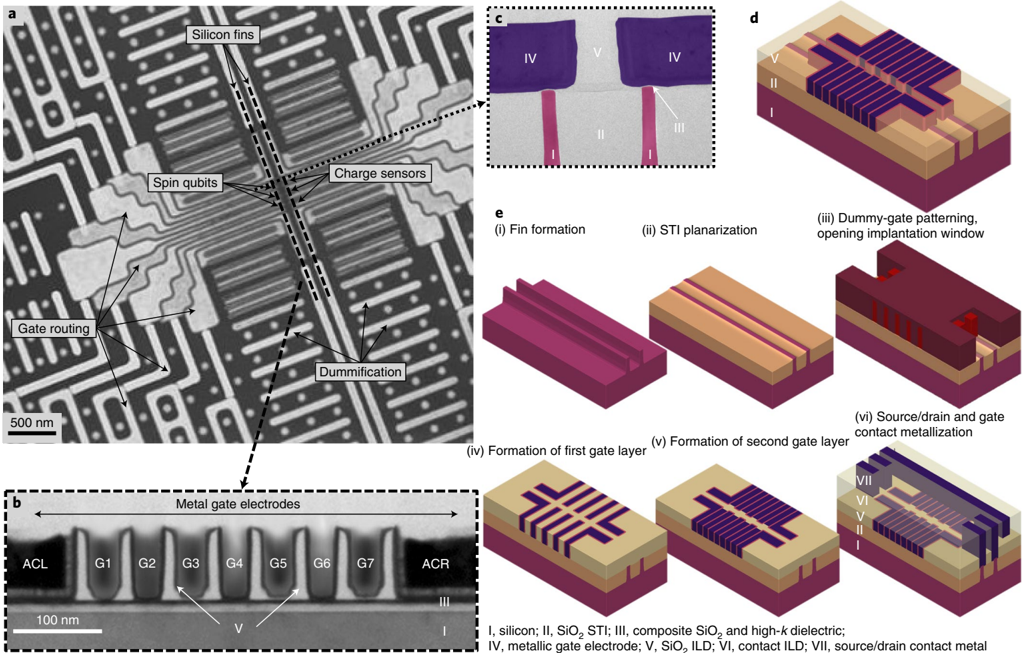
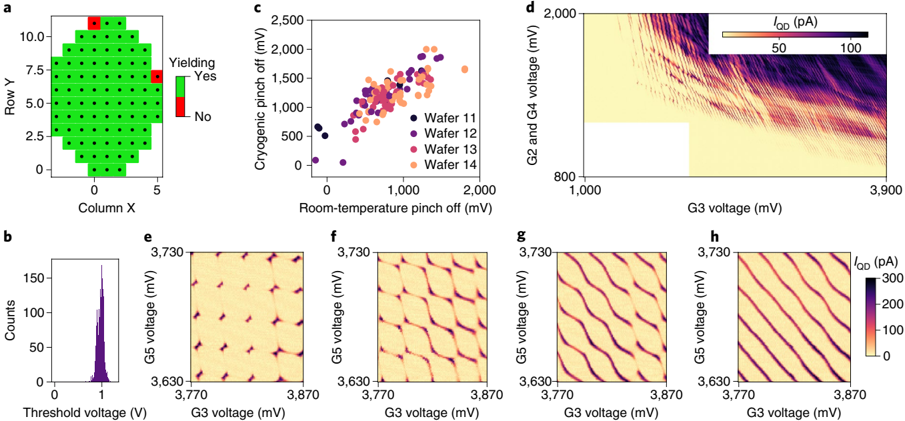
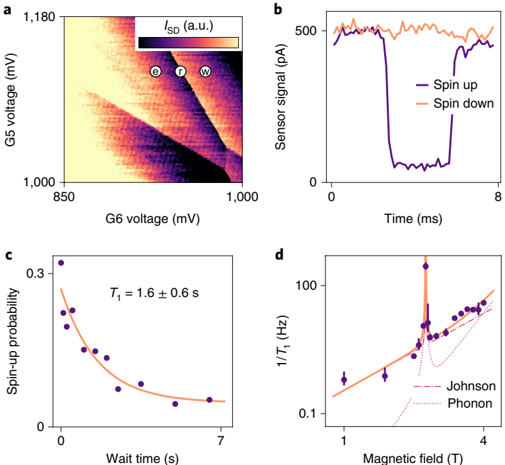
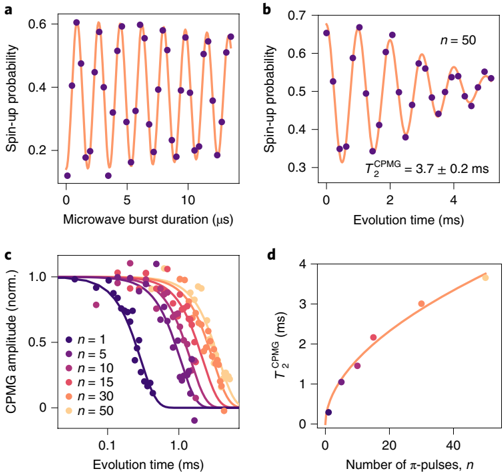
Verification
Claims the paper makes
The claims and statistics of this paper haven’t been checked yet.
Free: it reads the open-access text and checks the first 5 claims that cite a source we can check. Create a free account to check every claim.
Claims other papers make about this one
Each is checked against this paper’s own text: does it say what the citing paper says it does?
The source backs part of the claim, not all of it — or backs it for a different population, condition or comparison.
In the citing paper
“More fully industry-compatible devices in Si-MOS have also been demonstrated25,26 but are at present limited by high levels of disorder owing to the qubits being formed directly at the Si/SiO2 interface.”
From Probing single electrons across 300-mm spin qubit wafers (2024) · cites this paper as [26]
Experimental — accuracy not yet measured
Self-check
Percentages, sums and reported differences re-computed from the paper’s own numbers.
The self-check needs the paper’s full text.
Citations
Cites
Simulating physics with computers
Feynman, R. P. (1982) · International Journal of Theoretical Physics · doi:10.1007/bf02650179 · Cited by 7,691
Quantum computation with quantum dots
Loss, D., & DiVincenzo, D. P. (1998) · Physical Review A · doi:10.1103/physreva.57.120 · Cited by 6,840
Surface codes: Towards practical large-scale quantum computation
Fowler, A. G., Mariantoni, M., Martinis, J. M., & Cleland, A. N. (2012) · Physical Review A · doi:10.1103/physreva.86.032324 · Cited by 3,059 · cited 2×
“The most promising architectures require a scalable qubit system of individually-addressable qubits with a gate fidelity over 99% and tunable nearest-neighbour couplings [17, 18].”
BackgroundSpins in few-electron quantum dots
Hanson, R., Kouwenhoven, L. P., Petta, J. R., Tarucha, S., & Vandersypen, L. M. K. (2007) · Reviews of Modern Physics · doi:10.1103/revmodphys.79.1217 · Cited by 2,665
Self-citationMOS /metal oxide semiconductor/ physics and technology
Nicollian, E. H., & Brews, J. R. (1982) · CERN Document Server (European Organization for Nuclear Research) · Cited by 2,098
Electron transport through double quantum dots
van der Wiel, W. G., De Franceschi, S., Elzerman, J. M., Fujisawa, T., Tarucha, S., & Kouwenhoven, L. P. (2002) · Reviews of Modern Physics · doi:10.1103/revmodphys.75.1 · Cited by 1,820 · cited 2×
“At these points, the electrochemical potentials of the reservoirs are aligned with the electrochemical potentials of the left and the right dot, such that electrons can tunnel sequentially through the two dots [38].”
BackgroundSingle-shot read-out of an individual electron spin in a quantum dot
Elzerman, J. M., Hanson, R., Willems van Beveren, L. H., Witkamp, B., Vandersypen, L. M. K., & Kouwenhoven, L. P. (2004) · Nature · doi:10.1038/nature02693 · Cited by 1,679 · cited 2×
“Spin readout In order to read out the spin eigenstate we use energyselective tunneling to the electron reservoir [46].”
MethodSelf-citationDriven coherent oscillations of a single electron spin in a quantum dot
Koppens, F. H. L., Buizert, C., Tielrooij, K. J., Vink, I. T., Nowack, K. C., Meunier, T., Kouwenhoven, L. P., & Vandersypen, L. M. K. (2006) · Nature · doi:10.1038/nature05065 · Cited by 1,359 · cited 2×
“Furthermore, bringing the quantum dots on the inside of the stripline [48] will increase the ratio of magnetic field and (unwanted) electric fields and heating.”
BackgroundMethodSelf-citationZwanenburg, F. A., Dzurak, A. S., Morello, A., Simmons, M. Y., Hollenberg, L. C. L., Klimeck, G., Rogge, S., Coppersmith, S. N., & Eriksson, M. A. (2013) · Reviews of Modern Physics · doi:10.1103/revmodphys.85.961 · Cited by 1,210
Randomized benchmarking of quantum gates
Knill, E., Leibfried, D., Reichle, R., Britton, J., Blakestad, R. B., Jost, J. D., Langer, C., Ozeri, R., Seidelin, S., & Wineland, D. J. (2008) · Physical Review A · doi:10.1103/physreva.77.012307 · Cited by 1,019 · cited 1×
“To analyse the single-qubit gate fidelity, we employ randomised benchmarking [49] (Extended Fig.”
Method
Research works printed but not linked: 1
- Xue, X. et al. Benchmarking gate fidelities in a Si/SiGe two-qubit device. Phys. Rev. X 9, 021011 (2019).
Cited by
Items 201–300 of 516
Pathak, S., Gupta, S., Srinivasan, P., Gonzalez, O. H., Guarin, F. J., & Dixit, A. (2024) · IEEE Journal of the Electron Devices Society · doi:10.1109/jeds.2024.3365216 · Cited by 11
“Moreover, performance limiting defects are formed at the Si-dielectric interfaces in the qubit’s fabrication process, as reported in [15].”
BackgroundNear-Term Spin-Qubit Architecture Design via Multipartite Maximally Entangled States
Paraskevopoulos, N., Steinberg, M., Undseth, B., Sarkar, A., Vandersypen, L. M. K., Xue, X., & Feld, S. (2025) · PRX Quantum · doi:10.1103/prxquantum.6.020307 · Cited by 11
“This compactness is complemented by extensive experience in the semiconductor industry, which supports their development [114–116].”
Self-citationAn Operation Guide of Si-MOS Quantum Dots for Spin Qubits
Hu, R.-Z., Ma, R.-L., Ni, M., Zhang, X., Zhou, Y. L., Wang, K., Luo, G., Cao, G., Kong, Z., Wang, G., et al. (2021) · Nanomaterials · doi:10.3390/nano11102486 · Cited by 11
“Among them, silicon quantum dots (QDs) have emerged as promising hosts for qubits to build a quantum processor due to their long coherence time [16,17], small footprint [18], potential scalability [19,20], and compatibility with advanced semiconductor manufacturing technology [21].”
BackgroundReducing strain fluctuations in quantum dot devices by gate-layer stackingPreprint
Frink, C. C. D., Oh, T., Joseph, E. S., Losert, M. P., MacQuarrie, E. R., Woods, B. D., Eriksson, M. A., & Friesen, M. G. (2023) · arXiv (Cornell University) · doi:10.48550/arxiv.2312.09235 · Cited by 11
“Scaling up will require a level of qubit reproducibility and uniformity on par with transistors in modern integrated circuits [7].”
Photo-assisted spin transport in double quantum dots with spin–orbit interaction
Fernández-Fernández, D., Picó-Cortés, J., Liñán, S. V., & Platero, G. (2023) · Journal of Physics Materials · doi:10.1088/2515-7639/acd1b7 · Cited by 10
Highly Tunable 2D Silicon Quantum Dot Array with Coupling beyond Nearest Neighbors
Wang, N., Kang, J., Lu, W.-L., Wang, S., Wang, Y.-J., Li, H.-O., Cao, G., Wang, B., & Guo, G. (2024) · Nano Letters · doi:10.1021/acs.nanolett.4c02345 · Cited by 10
“6,7,62 Supporting Information Available The supporting information is available free of charge via the internet at http://pubs.acs. org .”
BackgroundPursuing high-fidelity control of spin qubits in natural Si/SiGe quantum dot
Wang, N., Wang, S., Zhang, R.-Z., Kang, J., Lu, W.-L., Li, H.-O., Cao, G., Wang, B., & Guo, G. (2024) · Applied Physics Letters · doi:10.1063/5.0230605 · Cited by 10
Minimal state-preparation times for silicon spin qubits
Long, C. K., Mayhall, N. J., Economou, S. E., Barnes, E., Barnes, C. H. W., Martins, F., Arvidsson-Shukur, D. R. M., & Mertig, N. (2025) · npj Quantum Information · doi:10.1038/s41534-025-01027-8 · Cited by 10
“The small size of silicon qubits and the potential for industrial scaling through advanced semiconductor-manufacturing technology 22 – 26 make them an attractive hardware option for quantum processors.”
Asai, H., Iizuka, S., Mogami, T., Hattori, J., Fukuda, K., Ikegami, T., Kato, K., Oka, H., & Mori, T. (2023) · Japanese Journal of Applied Physics · doi:10.35848/1347-4065/acbcdd · Cited by 10
Abualnaja, F., He, W., Chu, K.-L., Andreev, A. D., Jones, M., & Durrani, Z. A. K. (2023) · Applied Physics Letters · doi:10.1063/5.0154994 · Cited by 10
Performance of the spin qubit shuttling architecture for a surface code implementation
Yenilen, B., Sala, A., Bluhm, H., Müller, M., & Rispler, M. (2026) · Quantum · doi:10.22331/q-2026-09-30-2219 · Cited by 9
“…idling dephasing errors can be very well suppressed by up to two orders of magnitude with standard techniques such as dynamical decoupling [71] with the expected gate induced error budget being negligible with recent improvements [67], such that we do not include an idling error during…”
A compact and versatile cryogenic probe station for quantum device testing
de Kruijf, M., Geyer, S., Berger, T., Mergenthaler, M., Braakman, F., Warburton, R. J., & Kuhlmann, A. V. (2023) · Review of Scientific Instruments · doi:10.1063/5.0139825 · Cited by 9
High temperature spin selectivity in a quantum dot qubit using reservoir spin accumulation
Jansen, R., & Yuasa, S. (2024) · npj Quantum Information · doi:10.1038/s41534-024-00815-y · Cited by 9
“…spin in quantum dots 1,2 has made tremendous advances, from the demonstration of initialization 3–5 , coherent control 5–8 and readout 3,9–11 of the single spin quantum state, via two-qubit operations 12,13 , to architecture design 14,15 and manufacturing with advanced semiconductor technology 16 .”
MethodChallenges in advancing our understanding of atomic-like quantum systems: Theory and experiment
Gali, Á., Schleife, A., Heinrich, A. J., Laucht, A., Schuler, B., Chakraborty, C., Anderson, C. P., Déprez, C., McCallum, J. C., Bassett, L. C., et al. (2024) · MRS Bulletin · doi:10.1557/s43577-023-00659-5 · Cited by 9
Multiple-Gate FET Quantum Dot Behavior and a Proximity Charge Sensing Model
Sharma, D., Singh, S. K., Grill, A., & Dixit, A. (2024) · IEEE Transactions on Electron Devices · doi:10.1109/ted.2024.3393947 · Cited by 9
“…devices such as NWFET-based qubits, as discussed in this article, can play a crucial role in realizing quantum processing units (QPUs) for noisy intermediate-scale quantum (NISQ) technologies with scalability up to a million interconnected physical qubits and beyond on a single chip [8].”
BackgroundMethodBonen, S., Tripathi, S. P., McIntosh, J., Jager, T., & Voinigescu, S. P. (2024) · IEEE Electron Device Letters · doi:10.1109/led.2024.3435380 · Cited by 9
“R ECENT papers have described silicon FinFET [1], FDSOI [2], [3], bulk CMOS [4], and Si/SiGe heterostructure [5] technology platforms customized for the volume manufacturing of coupled quantum dot (QD) and single electron/hole transistor (SET/SHT) readout arrays on 300mm wafers.”
BackgroundRoy, K., Paul, G. N., Debnath, D., Bhattacharyya, K., & Basu, S. (2025) · Physical review. B./Physical review. B · doi:10.1103/69jq-rcsb · Cited by 9
“Finally, connecting a dc source to the intermediate QD will facilitate tuning the gate voltage [47, 49, 50, 54, 55].”
InfluentialSuperconducting V3Si for quantum circuit applications
Vethaak, T. D., Gustavo, F., Farjot, T., Kubart, T., Gergaud, P., Zhang, S., Lefloch, F., & Nemouchi, F. (2021) · Microelectronic Engineering · doi:10.1016/j.mee.2021.111570 · Cited by 9
Visual explanations of machine learning model estimating charge states in quantum dots
Muto, Y., Nakaso, T., Shinozaki, M., Aizawa, T., Kitada, T., Nakajima, T., Delbecq, M. R., Yoneda, J., Takeda, K., Noiri, A., et al. (2024) · APL Machine Learning · doi:10.1063/5.0193621 · Cited by 8
Combining multiplexed gate-based readout and isolated CMOS quantum dot arrays
Hamonic, P., Nurizzo, M., Nath, J., Dartiailh, M., El-Homsy, V., Fragnol, M., Martínez, B., Julliard, P.-L., Paz, B. C., Ouvrier-Buffet, M., et al. (2025) · Nature Communications · doi:10.1038/s41467-025-61556-w · Cited by 8
“In this context, developing semi-conducor spin qubits using industrially compatible process fl ows should lead to reliable devices produced at high yields with low variability 11,12 , cointegration with cryoelectronics is also possible 13 .”
Nanosheet Transistors Produced in 300 mm Fabrication Platform for Quantum Computing
Rohrbacher, C., Leclerc, D., Rivard, J., Ritzenthaler, R., Lupien, C., Mertens, H. W., Horiguchi, N., & Dupont-Ferrier, E. (2025) · IEEE Electron Device Letters · doi:10.1109/led.2025.3556348 · Cited by 8
“√ We report an average value ⟨ S 0 ⟩ = 28 ± 10 µ eV / Hz , an order of magnitude higher than those reported in other standard CMOS silicon devices [8], [9] which can be explained by two factors.”
InfluentialDigitally controlled conveyor-belt spin shuttling in silicon for large-scale quantum computation
Nagai, R., Takemoto, T., Wachi, Y., & Mizuno, H. (2025) · Physical Review Applied · doi:10.1103/ng22-2cgg · Cited by 8
Spin Qubits in Silicon FinFET Devices
Fuhrer, A., Aldeghi, M., Berger, T., Camenzind, L. C., Eggli, R. S., Geyer, S., Harvey-Collard, P., Hendrickx, N. W., Kelly, E. G., Massai, L., et al. (2022) · Technical digest - International Electron Devices Meeting/Technical digest · doi:10.1109/iedm45625.2022.10019477 · Cited by 8
Lai, C.-Y., Liu, C.-F., Lin, T.-L., Chen, M., Huang, Y., Huang, H., Dong, C., Wang, D.-Y., Yeh, P., & Wu, W. (2023) · ACS Applied Materials & Interfaces · doi:10.1021/acsami.3c08926 · Cited by 8
Singlet-triplet-state readout in silicon metal-oxide-semiconductor double quantum dots
Ma, R.-L., Zhu, S.-K., Kong, Z., Sun, T., Ni, M., Zhou, Y.-C., Zhou, Y. L., Luo, G., Cao, G., Wang, G., et al. (2024) · Physical Review Applied · doi:10.1103/physrevapplied.21.034022 · Cited by 8
Kriekouki, I., Beaudoin, F., Philippopoulos, P., Zhou, C., Lemyre, J. C., Rochette, S., Rohrbacher, C., Mir, S., Barragán, M. J., Pioro-Ladrière, M., et al. (2023) · Solid-State Electronics · doi:10.1016/j.sse.2023.108626 · Cited by 8
Intrinsic noise of the single-electron box
Cochrane, L., Seshia, A. A., & González-Zalba, M. F. (2024) · Physical Review Applied · doi:10.1103/physrevapplied.21.064066 · Cited by 8
“They offer prospects to leverage industrial fabrication techniques [2, 3] and to be integrated with classical electronics [4] to scale up current demonstrations of few-qubit processors [5, 6].”
BackgroundSemiconductor materials stacks for quantum dot spin qubitsPreprint
Scappucci, G. (2021) · arXiv (Cornell University) · doi:10.48550/arxiv.2102.10897 · Cited by 8
Self-citationSilicon edge-dot architecture for quantum computing with global control and integrated trimmingPreprint
Fogarty, M. A. (2022) · arXiv (Cornell University) · doi:10.48550/arxiv.2208.09172 · Cited by 8
Coherent manipulation of interacting electron qubits on solid neonPreprint
Jin, D., Li, X., Huang, Y., Han, X., Zhou, X., & Yacoby, A. (2025) · Research Square · doi:10.21203/rs.3.rs-7802176/v1 · Cited by 8
Automated All-RF Tuning for Spin Qubit Readout and ControlPreprint
Carlsson, C., Saez-Mollejo, J., Fedele, F., Calcaterra, S., Chrastina, D., Isella, G., Katsaros, G., & Ares, N. (2025) · arXiv (Cornell University) · doi:10.48550/arxiv.2506.10834 · Cited by 8
“Spins in gate-defined semiconductor quantum dots are strong contenders for realising dense qubit architectures and for running high-fidelity quantum circuits [1–8].”
Kang, H. H., Rosen, I. T., Hays, M., Grover, J. A., & Oliver, W. D. (2025) · Physical Review Applied · doi:10.1103/physrevapplied.23.044055 · Cited by 7
“4 [13, 36– 41].”
InfluentialCoherence Protection of Mobile Spin Qubits in Silicon via Dressed-state Shuttling
Krzywda, J. A., Matsumoto, Y., Smet, M. D., Tryputen, L., de Snoo, S. L., Amitonov, S. V., van Nieuwenburg, E., Scappucci, G., & Vandersypen, L. M. K. (2026) · PRX Quantum · doi:10.48550/arxiv.2602.09179 · Cited by 7
Self-citationFast readout of quantum dot spin qubits via Andreev spins
Anonymous, Laubscher, K., Vecchio, P. D., Chatterjee, A., Fatemi, V., & Bosco, S. (2026) · Physical Review Applied · doi:10.1103/qcch-2hhy · Cited by 7
Hole-spin qubits in germanium beyond the single-particle regime
Secchi, A., Forghieri, G., Bordone, P., Loss, D., Bosco, S., & Troiani, F. (2026) · Physical Review Applied · doi:10.1103/9w1z-8x7g · Cited by 7
“Spin qubits in semiconductor quantum dots (QDs) are promising competitors for the implementation of quantum computers [1–15].”
Large spin-shuttling oscillations enabling high-fidelity single-qubit gates
Pazhedath, A. M., David, A., Oberländer, M., Müller, M. M., Calarco, T., Bluhm, H., & Motzoi, F. (2025) · Physical Review Applied · doi:10.1103/4lky-413f · Cited by 7
Wu, Y.-J., Tsao, H.-Y., Liao, C.-Y., Kao, W.-H., Liu, C.-Y., & Li, J. (2024) · Applied Physics Letters · doi:10.1063/5.0219835 · Cited by 7
Multi-qubit DC gates over an inhomogeneous array of quantum dots
Qi, J., Liu, Z., & Xu, H. Q. (2025) · New Journal of Physics · doi:10.1088/1367-2630/ae1635 · Cited by 7
“Owing to their miniature size and compatibility with modern semiconductor fabrication techniques [5, 6], semiconductor spin qubits have great potential for coherently incorporating a large quantity of qubits in a single chip, a crucial requirement for solving useful quantum computational tasks.”
SpinHex: A low-crosstalk, spin-qubit architecture based on multielectron couplers
Otxoa, R. M., Martínez, J. E., Schnabl, P., del Moral, J. O., Mertig, N., Smith, C. G., & Martins, F. (2026) · Physical Review Research · doi:10.1103/t2ry-ll9n · Cited by 7
Readout Sweet Spots for Spin Qubits with Strong Spin-Orbit Interaction
Svastits, D., Hetényi, B., Széchenyi, G., Wootton, J. R., Loss, D., Bosco, S., & Pályi, A. (2026) · Physical Review Letters · doi:10.1103/4x97-np1f · Cited by 7
Single-shot in situ readout of a spin qubit unit cell
Hamonic, P., Toubeix, M., Haas, G., Nath, J., Dartiailh, M., Martínez, B., Bertrand, B., Niebojewski, H., Vinet, M., Bäuerle, C., et al. (2026) · Nature Electronics · doi:10.1038/s41928-026-01654-9 · Cited by 7
Dispersive readout of a silicon quantum device using an atomic force microscope-based rf gate sensor
Denisov, A. O., Fuchs, G., Oh, S. W., & Petta, J. R. (2023) · Applied Physics Letters · doi:10.1063/5.0158196 · Cited by 7
Hong, P.-Y., Lai, C.-C., Tsai, T., Lin, H., George, T. A., Kuo, D. M.-T., & Li, P.-W. (2023) · Scientific Reports · doi:10.1038/s41598-023-41582-8 · Cited by 7
First Evidence of SET-Like Behavior of 3-D NAND Flash Cells in the Deep-Cryogenic Regime
Refaldi, D. G., Malavena, G., Giulianini, M., Chiavarone, L., Spinelli, A. S., & Compagnoni, C. M. (2023) · IEEE Transactions on Electron Devices · doi:10.1109/ted.2023.3344066 · Cited by 7
“…by the twofold target of conceiving new solid-state device structures for qubits compatible with mainstream integration flows [1], [2], [3], [4] and of designing the control electronics needed to drive the qubits with an as small as possible temperature ( T ) gradient from them [5], [6],…”
BackgroundEstakhri, N. M., Warren, A., Economou, S. E., & Barnes, E. (2024) · Physical Review Research · doi:10.1103/physrevresearch.6.043029 · Cited by 7
Short two-qubit pulse sequences for exchange-only spin qubits in two-dimensional layouts
Chadwick, J. D., Guerreschi, G. G., Luthi, F., Mądzik, M. T., Mohiyaddin, F. A., Prabhu, P., Schmitz, A. T., Litteken, A., Premaratne, S., Bishop, N. C., et al. (2025) · Physical Review A · doi:10.1103/physreva.111.052616 · Cited by 8
Self-citationNon-reciprocal Pauli Spin Blockade in a Silicon Double Quantum DotPreprint
Lundberg, T., Ibberson, D. J., Li, J., Hutin, L., Abadillo-Uriel, J. C., Filippone, M., Bertrand, B., Nunnenkamp, A., Lee, C.-M., Stelmashenko, N. A., et al. (2021) · arXiv (Cornell University) · doi:10.48550/arxiv.2110.09842 · Cited by 7
“1b, we fi rst consider the pair of neighboring ICTs between the (7,8), (6,9) and (5,10) charge states highlighted by the dotted boxes in Fig.”
Khammassi, N., Morris, R., Premaratne, S., Luthi, F., Borjans, F., Suzuki, S., Flory, R., Ibarra, L. P. O., Lampert, L. F., & Matsuura, A. Y. (2022) · arXiv (Cornell University) · doi:10.48550/arxiv.2205.06851 · Cited by 7
“The comparison is based on the number of required control channels for controlling single-electron spin qubits in gate-defined semiconductor quantum dots (QDs) [9][12].”
BackgroundMethodInfluentialSelf-citationSmall Quantum Low Density Parity Check Codes for Near-Term ExperimentsPreprint
Andersen, C. K., & Greplová, E. (2025) · arXiv (Cornell University) · doi:10.48550/arxiv.2507.09690 · Cited by 7
Long coherence silicon spin qubit fabricated in a 300 mm industrial foundryPreprint
Tomić, P., Bütler, P., Wu, Y., Raes, B., Godfrin, C., Kubicek, S., Jussot, J., Canvel, Y., Hermans, Y., Shimura, Y., et al. (2025) · arXiv (Cornell University) · doi:10.48550/arxiv.2512.20758 · Cited by 7
“Although the feasibility of fabricating spin qubits in industrial foundries has been demonstrated [6, 7, 22], it remains unclear how far coherence times can be extended using state-of-the-art nanoelec-tronics fabrication facilities.”
Muto, Y., Zielewski, M. R., Shinozaki, M., Noro, K., & Otsuka, T. (2026) · Scientific Reports · doi:10.1038/s41598-026-38889-7 · Cited by 6
DC-Readout of Semiconductor Spin Qubits: Opportunities and Limits
Kiene, G., Pietx-Casas, O., Babaie, M., Vandersypen, L. M. K., & Sebastiano, F. (2025) · IEEE Transactions on Circuits and Systems I Regular Papers · doi:10.1109/tcsi.2025.3542335 · Cited by 6
“Q UANTUM computers based on semiconductor spin qubits have promising scaling properties [1], specifically due to their demonstrated operation at higher temperatures [2], [3], their small feature size (100 nm × 100 nm) and their compatibility with CMOS manufacturing [4], [5].”
Self-citationFormation of few-electron triple quantum dots in ZnO heterostructures
Baba, K., Noro, K., Kozuka, Y., Kumasaka, T., Shinozaki, M., Kawasaki, M., & Otsuka, T. (2025) · Scientific Reports · doi:10.1038/s41598-025-20567-9 · Cited by 6
Theory of spin qubits and the path to scalability
McIntyre, Z. M., Sarkar, A., & Loss, D. (2026) · New Journal of Physics · doi:10.1088/1367-2630/ae973f · Cited by 6
Multi-Gate FD-SOI Single Electron Transistor for hybrid SET-MOSFET quantum computing
Bersano, F., Palma, F. D., Oppliger, F., Braakman, F., Radu, I., Scarlino, P., Poggio, M., & Ionescu, A. M. (2022) · European Solid-State Circuits Conference (ESSCIRC) · doi:10.1109/esscirc55480.2022.9911479 · Cited by 6
“Materials and architecture have been optimized [5] to enable a fast integration of large quantum dots arrays with foundry manufacturing processes [6], [7].”
Gate-Based Spin Readout of Hole Quantum Dots with Site-Dependent g -Factors
Russell, A., Zotov, A., Zhao, R., Dzurak, A. S., González-Zalba, M. F., & Rossi, A. (2023) · Physical Review Applied · doi:10.1103/physrevapplied.19.044039 · Cited by 6
Quantum estimation and remote charge sensing with a hole-spin qubit in silicon
Forghieri, G., Secchi, A., Bertoni, A., Bordone, P., & Troiani, F. (2023) · Physical Review Research · doi:10.1103/physrevresearch.5.043159 · Cited by 6
Towards scalable cryogenic quantum dot biasing using memristor-based DC sources
Mouny, P.-A., Dawant, R., Dufour, P., Valdenaire, M., Ecoffey, S., Pioro-Ladrière, M., Beilliard, Y., & Drouin, D. (2024) · Cryogenics · doi:10.1016/j.cryogenics.2024.103910 · Cited by 6
Sun, W., Bharadwaj, S., Zhou, R., Jiao, D., & Jacob, Z. (2024) · IEEE journal on multiscale and multiphysics computational techniques · doi:10.1109/jmmct.2024.3439531 · Cited by 6
“Compact sizes, high controllability, long preservation time of quantum information, and proven semiconductor fabrication techniques [60], [61], [62] offer an advantage for realizing scalable solid-state spin qubit quantum information platforms.”
BackgroundErnst, O. C., Uebel, D., Brendler, R., Kraushaar, K., Steudel, M., Acker, J., & Kroke, E. (2024) · Molecules · doi:10.3390/molecules29174222 · Cited by 6
“The conversion efficiency is reported to have increased by 0.7–2.5% to a maximum of 22.6% through the utilization of 28 Si (isotopic purity: 98”
BackgroundInfluentialCharge-induced energy shift of a single-spin qubit under a magnetic field gradient
Kobayashi, T., Noiri, A., Nakajima, T., Takeda, K., Camenzind, L. C., Jin, I. K., Scappucci, G., & Tarucha, S. (2025) · Physical Review Applied · doi:10.1103/physrevapplied.23.054078 · Cited by 6
“Efforts to scale up toward quantum information processors have spurred extensive research in various areas, including multi-qubit development [6,8], high-temperature operations [4,9 – 11], and adaption of industrial fabrication technologies [8,12].”
Self-citationNew progress of silicon-based semiconductor quantum computation
Wang, N., Wang, B., & Guo, G. (2022) · Acta Physica Sinica · doi:10.7498/aps.71.20221900 · Cited by 6
Quantum computation on a 19-qubit wide 2d nearest neighbour qubit arrayPreprint
Shaw, A., Bremner, M. J., Paler, A., Herr, D., & Devitt, S. J. (2022) · arXiv (Cornell University) · doi:10.48550/arxiv.2212.01550 · Cited by 6
Electrical manipulation of a single electron spin in CMOS with micromagnet and spin-valley couplingPreprint
Klemt, B., El-Homsy, V., Nurizzo, M., Hamonic, P., Martínez, B., Paz, B. C., Spence, C., Dartiailh, M., Jadot, B., Chanrion, E., et al. (2023) · arXiv (Cornell University) · doi:10.48550/arxiv.2303.04960 · Cited by 6
“This value is one to two orders of magnitude higher compared to commonly reported values in literature[5, 38, 39], but similar to foundry fabricated spin qubits [8].”
Dual Operation of Gate-All-Around Silicon Nanowires at Cryogenic Temperatures: FET and Quantum DotPreprint
Rohrbacher, C., Rivard, J., Ritzenthaler, R., Bureau, B., Lupien, C., Mertens, H. W., Horiguchi, N., & Dupont-Ferrier, E. (2023) · arXiv (Cornell University) · doi:10.48550/arxiv.2312.00903 · Cited by 6
Charge-Based Single-Shot Readout Systems in Quantum Computing [Feature]
Power, C., Staszewski, R. B., & Blokhina, E. (2024) · IEEE Circuits and Systems Magazine · doi:10.1109/mcas.2024.3401618 · Cited by 5
Nonvolatile cryogenic phase-slip memory with single-shot readout
Nulens, L., Chaves, D. A. D., Reniers, S., Dillemans, R., Cools, I. P. C., Temst, K., Raes, B., Bael, M. J. V., & de Vondel, J. V. (2025) · Physical Review Applied · doi:10.1103/wrvj-5737 · Cited by 5
Enhancing the yield of bucket brigade quantum random access memory using redundancy repair
Kim, D., Heng, S., Lee, S., & Han, Y. (2025) · Scientific Reports · doi:10.1038/s41598-025-32955-2 · Cited by 5
“This is because the density of qubits has increased based on recent silicon technology, and as mass production of physical qubits has become possible 31,32 .”
InfluentialDisorder-independent hole-spin manipulation by hopping
Martínez, B., Sempere-Sanchis, A., Abadillo-Uriel, J. C., & Niquet, Y. (2026) · Physical Review Applied · doi:10.1103/qwgc-mwzn · Cited by 5
Invited Paper: Introduction to Hybrid Quantum-Classical Programming Using C++ Quantum Extension
Wu, X.-C., Premaratne, S., & Rasch, K. (2023) · doi:10.1109/iccad57390.2023.10323946 · Cited by 5
Zhu, X., Cao, L., Wang, G., & Yin, H. (2024) · Nanomaterials · doi:10.3390/nano14110916 · Cited by 5
Charge sensing of few-electron ZnO double quantum dots probed by radio-frequency reflectometry
Noro, K., Shinozaki, M., Kozuka, Y., Baba, K., Matsumura, K., Fujiwara, Y., Kumasaka, T., Tsukazaki, A., Kawasaki, M., & Otsuka, T. (2026) · Physical Review Applied · doi:10.1103/mnt5-s859 · Cited by 5
“Few-electron quantum dots are used as quantum bits (qubits), which are the fundamental building blocks of quantum computing [4, 5].”
Bersano, F., Aldeghi, M., Martinolli, N., Boureau, V., Aboud, T., Ghini, M., Scarlino, P., Salis, G., & Ionescu, A. M. (2025) · Advanced Functional Materials · doi:10.1002/adfm.202419940 · Cited by 5
Comparison of spin-qubit architectures for quantum error-correcting codes
Gutiérrez, M., Rojas-Arias, J. S., Obando, D., & Chang, C. Y. (2026) · Physical Review A · doi:10.1103/qlw3-xk2f · Cited by 5
GAnnET: A principled approach to automatically annotating charge stability diagrams
Weber, B., & Zwolak, J. P. (2026) · Newton · doi:10.1016/j.newton.2026.100600 · Cited by 5
Leveraging off-the-shelf silicon chips for quantum computing
Michniewicz, J., & Kim, M. S. (2024) · Applied Physics Letters · doi:10.1063/5.0207162 · Cited by 5
Unifying adiabatic state-transfer protocols with $(α, β)$-hypergeometriesPreprint
Meinersen, C. V., Fernández-Fernández, D., Platero, G., & Rimbach-Russ, M. (2025) · arXiv (Cornell University) · doi:10.48550/arxiv.2504.08031 · Cited by 5
Kriekouki, I. (2022) · theses.fr (ABES) · doi:10.70675/9fed023fze214z429fzbf66z0d82f6e955c8 · Cited by 5
Hardware-Tailored Resource Estimation for Magic-State Distillation on Silicon Spin QubitsPreprint
Yang, S., Long, C. K., Otxoa, R. M., Murali, P., Barnes, C. H. W., & Arvidsson-Shukur, D. R. M. (2026) · arXiv (Cornell University) · doi:10.48550/arxiv.2605.28936 · Cited by 5
“Moreover, the processors are compatible with current industrial production lines for CMOS and advanced semiconductor technologies, as well as with classical control electronics [77, 79, 81–84].”
Wen, C., Takahashi, H., Ibad, S. I., Nishiyama, S., Kato, K., Liu, Y., Murakami, S., Mori, T., Mizokuchi, R., Yoneda, J., et al. (2025) · Applied Physics Express · doi:10.35848/1882-0786/ad9af8 · Cited by 4
Sidewall transfer lithography: applications in nanofabrication and nanotechnology
Syms, R. R. A. (2025) · Journal of Micromechanics and Microengineering · doi:10.1088/1361-6439/adebf8 · Cited by 4
Hole Spin Resilient to Dipole-Induced Thermal Effects
Champain, V., Boschetto, G., Niebojewski, H., Bertrand, B., Mauro, L., Haab, C., Bassi, M., Schmitt, V., Jehl, X., Zihlmann, S., et al. (2026) · PRX Quantum · doi:10.1103/py6k-k5zr · Cited by 4
Kachu, A., Boda, A., & Chebrolu, N. R. (2025) · Results in Physics · doi:10.1016/j.rinp.2025.108484 · Cited by 4
Petkov, N., & Fagas, G. (2025) · Nanomaterials · doi:10.3390/nano15221737 · Cited by 4
“This is supported by a recent investigation of process variability and qubits fidelity validation for devices fabricated in a foundry [19].”
InfluentialAtomic Layer Etching for Extreme Manufacturing: Pushing the Limits of Atomic Scale Precision
Feng, Y., Sun, B., Yang, F., Cao, K., Gao, Y., Shan, B., Roozeboom, F., & Chen, R. (2026) · Nanomanufacturing and Metrology · doi:10.1007/s41871-026-00297-w · Cited by 4
Fast Virtual Gate Extraction For Silicon Quantum Dot Devices
Che, S., Oh, S., Qin, H., Liu, Y., Sigillito, A. J., & Li, G. (2024) · ACM/IEEE Design Automation Conference (DAC) · doi:10.1145/3649329.3655923 · Cited by 4
Ultrafast switchable spin-orbit coupling for silicon spin qubits via spin valves
Cai, R., Li, F.-G., Wang, B., Li, H.-O., Cao, G., & Guo, G. (2025) · Physical Review Applied · doi:10.1103/physrevapplied.23.024048 · Cited by 4
Synergy between quantum computing and semiconductor technology
Verberk, R., Michalak, D. J., Versluis, R., Polinder, H., Samkharadze, N., Amitonov, S. V., Sammak, A., Tryputen, L., Brousse, D., & Hanfoug, R. (2022) · European Mask and Lithography Conference (EMLC) · doi:10.1117/12.2639994 · Cited by 4
“QuTech researchers have recently measured spin-qubit devices fabricated in Intel’s 300mm CMOS fabrication facility 18 .”
BackgroundMethodInfluentialSelf-citationIsotopically Enriched Layers for Quantum Computers Formed by 28Si Implantation and Layer Exchange
Schneider, E., & England, J. G. (2023) · ACS Applied Materials & Interfaces · doi:10.1021/acsami.3c01112 · Cited by 4
Single-Electron-Transistor Compact Model for Spin-Qubit Readout
van Rijs, S., Ercan, İ., Vladimirescu, A., & Sebastiano, F. (2023) · International Conference on Synthesis, Modeling, Analysis and Simulation Methods and Applications to Circuit Design · doi:10.1109/smacd58065.2023.10192251 · Cited by 4
“while maintaining long coherence time and high fidelity [5].”
BackgroundAn Assessment of U.S.-Allied Nations' Industrial Bases in Quantum Technology
Parker, E., Silberglitt, R., Gonzales, D., Sanchez, N., Lee, J. W., Rand, L., Schmid, J., Dortmans, P., & Eusebi, C. A. (2023) · RAND Corporation eBooks · doi:10.7249/rra2055-1 · Cited by 5
Statistical Reproducibility of Selective Area Grown InAs Nanowire Devices
Olšteins, D., Nagda, G., Carrad, D. J., Beznasyuk, D. V., Petersen, C. E. N., Martí‐Sánchez, S., Arbiol, J., & Jespersen, T. S. (2024) · Nano Letters · doi:10.1021/acs.nanolett.4c01038 · Cited by 4
“The σ V TH in our system is comparable to values found in AlGaAs/GaAs 2DEGs 35,36 and foundry cryo-CMOS samples 37,38 .”
BackgroundResultEnvelope-function theory of inhomogeneous strain in semiconductor nanostructures
Secchi, A., & Troiani, F. (2024) · Physical review. B./Physical review. B · doi:10.1103/physrevb.110.045420 · Cited by 4
Jansen, R., & Yuasa, S. (2024) · Physical Review Applied · doi:10.1103/physrevapplied.22.054049 · Cited by 4
About electron transport and spin control in semiconductor devices
Selberherr, S., & Sverdlov, V. A. (2022) · Solid-State Electronics · doi:10.1016/j.sse.2022.108443 · Cited by 4
TCAD analysis of conditions for DIBL parameter misestimation in cryogenic MOSFETs
Kobayashi, Y., Asai, H., Iizuka, S., Hattori, J., Ikegami, T., Fukuda, K., Nikuni, T., & Mori, T. (2024) · Japanese Journal of Applied Physics · doi:10.35848/1347-4065/ad606d · Cited by 4
Monolithic Integration of Quantum Resonant Tunneling Gate on a 22nm FD-SOI CMOS ProcessPreprint
Bashir, I., Leipold, D. R., Blokhina, E., Asker, M., Redmond, D., Esmailiyan, A., Giounanlis, P., Haenlein, H., Wu, X., Sokolov, A., et al. (2021) · arXiv (Cornell University) · doi:10.48550/arxiv.2112.04586 · Cited by 4
Simulation of temperature-dependent quantum gates in silicon quantum dots with frequency shiftsPreprint
Sato, Y., & Kawahara, T. (2024) · arXiv (Cornell University) · doi:10.48550/arxiv.2407.05295 · Cited by 4
“Subsequent studies have revealed that qubit frequency shifts, which can be as high as about 1 MHz, are a major obstacle to improving one-qubit gate fidelity [3, 17, 18].”
BackgroundUsing a high-fidelity numerical model to infer the shape of a few-hole Ge quantum dotPreprint
Brickson, M. I., Jacobson, N. T., Miller, A. J., Maurer, L. N., Lu, T., Luhman, D., & Baczewski, A. (2024) · arXiv (Cornell University) · doi:10.48550/arxiv.2408.14422 · Cited by 4
Harnessing electron motion for global spin qubit controlPreprint
Jnane, H., Siegel, A. C., & González-Zalba, M. F. (2025) · arXiv (Cornell University) · doi:10.48550/arxiv.2503.12767 · Cited by 4
Metadata
- Authors
- Zwerver, A. M. J., Krähenmann, T., Watson, T. F., Lampert, L., George, H. C., Pillarisetty, R., Bojarski, S. A., Amin, P., Amitonov, S. V., Boter, J. M., Caudillo, R., Correas-Serrano, D., Dehollain, J. P., Droulers, G., Henry, E. M., Kotlyar, R., Lodari, M., Lüthi, F., Michalak, D. J., Mueller, B. K., Neyens, S., Roberts, J., Samkharadze, N., Zheng, G., Zietz, O. K., Scappucci, G., Veldhorst, M., Vandersypen, L. M. K., & Clarke, J. S.
- Affiliations
- QuTech (NL)
- Intel (United States) (US)
- Corresponding author
- Vandersypen, L. M. K.
- Clarke, J. S.
- ORCID
- Venue
- Nature Electronics
- Published
- 2022-03-29
- Volume
- 5
- Issue
- 3
- Pages
- 184-190
- ISSN
- 2520-1131 (ISSN-L)
- OpenAlex
- W3128881740
- Cited by
- 364
- References
- 67
- Citations by year
- 2026: 49 · 2025: 94 · 2024: 85 · 2023: 88 · 2022: 40
- FWCI
- 31.47
- Type
- journal article
- Language
- en
- Update notices
- correction (2022-04-27)
- Open access
- hybrid
- doi.org
- Licence
- cc-by
- creativecommons.org/licenses/by/4.0 (tdm)
- creativecommons.org/licenses/by/4.0 (vor)
- Locations
- Nature Electronics (publishedVersion, cc-by)
- arXiv (Cornell University) (submittedVersion)
- OPUS - Open Publications of UTS Scholars (University of Technology Sydney) (submittedVersion)
- Research Repository (Delft University of Technology) (submittedVersion, cc-by)
- Data Archiving and Networked Services (DANS) (submittedVersion, other-oa)
- arXiv (Cornell University)
- Funders
- Intel Corporation
- European Commission (HORIZON2020)
- Nederlandse Organisatie voor Wetenschappelijk Onderzoek
- QuantERA
- Topics
- Physical Sciences › Physics and Astronomy › Condensed Matter Physics › Quantum and electron transport phenomena
- Physical Sciences › Physics and Astronomy › Atomic and Molecular Physics, and Optics › Semiconductor Quantum Structures and Devices
- Physical Sciences › Materials Science › Materials Chemistry › Diamond and Carbon-based Materials Research
- Keywords
- silicon quantum dots, qubits, semiconductor manufacturing, two-qubit gates, single spin qubits, magnetic resonance, spin relaxation, coherence time, industrial fabrication
About these checks
Registry, retraction, Cites and statistics results are computed, not judged, with one exception: a printed reference that no index lists is read once by a model before it counts as a citation error. Claims are extracted by a model and kept only when their quote appears verbatim in the text; each cited source is then checked, with a model’s help, for whether it says what the claim relies on. Those verdicts can be wrong — read the claim’s quote and the cited source before relying on one.
Statistics and arithmetic are recomputed, not judged.
Confidence bands are shown only for fields calibrated on our annotated test set. None is calibrated yet, so no band is shown.
What counts as a claim ›How we measure confidence ›How we check this ›
Are you an author, or do you see a problem with this page? Request a review
Data sources
Bibliographic data: Semantic Scholar, OpenAlex, Crossref.
Contains information from the Semantic Scholar Academic Graph Datasets, made available under the ODC Attribution License (ODC-BY 1.0).
Semantic Scholar’s data is described in: Kinney, R., et al. (2023). The Semantic Scholar Open Data Platform. arXiv:2301.10140.
