

Qubits made by advanced semiconductor manufacturing
Open accessThe DOI matches its Crossref record; 68 of the 68 references it cites were found in a registry or an index.
Abstract
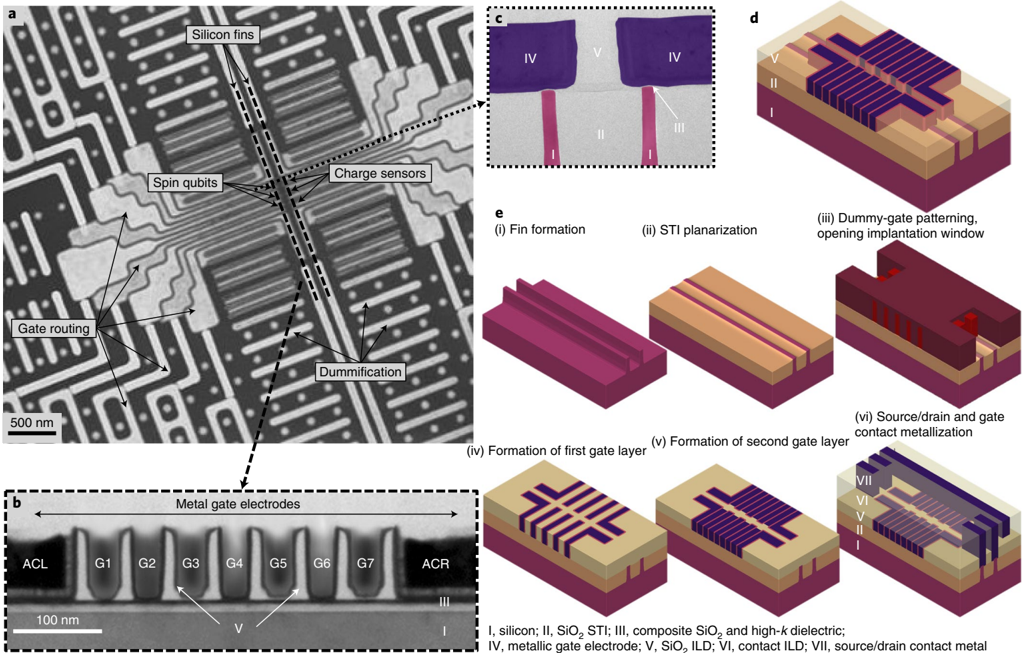
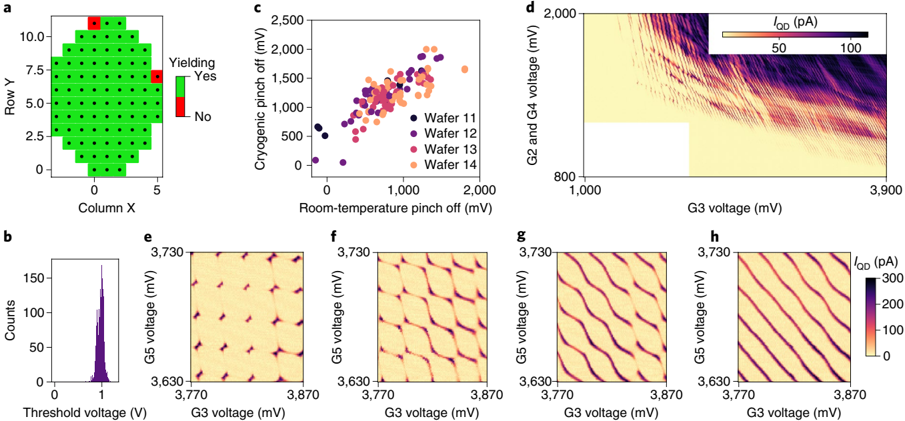
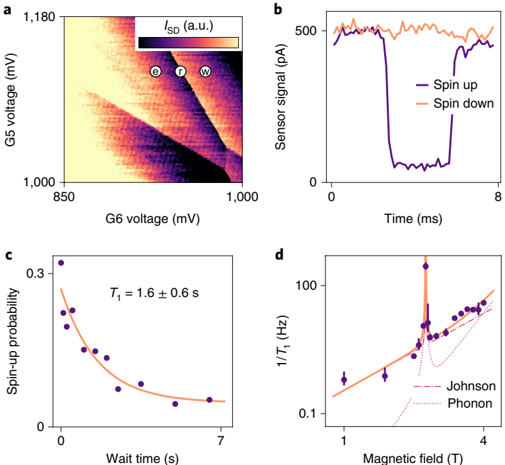
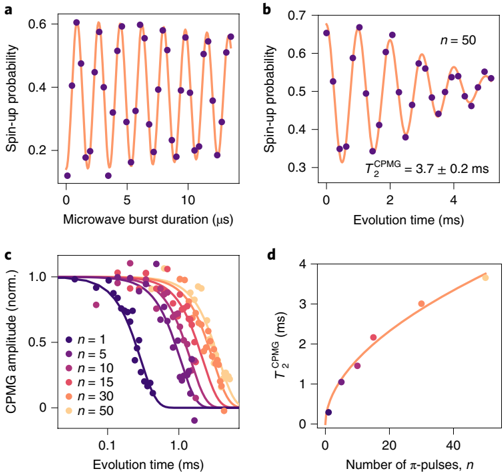
Full-scale quantum computers require the integration of millions of qubits, and the potential of using industrial semiconductor manufacturing to meet this need has driven the development of quantum computing in silicon quantum dots. However, fabrication has so far relied on electron-beam lithography and, with a few exceptions, conventional lift-off processes that suffer from low yield and poor uniformity. Here we report quantum dots that are hosted at a 28 Si/ 28 SiO 2 interface and fabricated in a 300 mm semiconductor manufacturing facility using all-optical lithography and fully industrial processing. With this approach, we achieve nanoscale gate patterns with excellent yield. In the multi-electron regime, the quantum dots allow good tunnel barrier control—a crucial feature for fault-tolerant two-qubit gates. Single-spin qubit operation using magnetic resonance in the few-electron regime reveals relaxation times of over 1 s at 1 T and coherence times of over 3 ms.
Overview
The claims and statistics of this paper haven’t been checked yet.
Free: it reads the open-access text and checks the first 5 claims that cite a source we can check. Create a free account to check every claim.
Integrity signals
Registry
Cites
Statistics
Figures

Verification
Claims the paper makes
The claims and statistics of this paper haven’t been checked yet.
Free: it reads the open-access text and checks the first 5 claims that cite a source we can check. Create a free account to check every claim.
Claims other papers make about this one
Each is checked against this paper’s own text: does it say what the citing paper says it does?
The source backs part of the claim, not all of it — or backs it for a different population, condition or comparison.
In the citing paper
“More fully industry-compatible devices in Si-MOS have also been demonstrated25,26 but are at present limited by high levels of disorder owing to the qubits being formed directly at the Si/SiO2 interface.”
From Probing single electrons across 300-mm spin qubit wafers (2024) · cites this paper as [26]
Experimental — accuracy not yet measured
Self-check
Percentages, sums and reported differences re-computed from the paper’s own numbers.
The self-check needs the paper’s full text.
Citations
Cites
Simulating physics with computers
Feynman, R. P. (1982) · International Journal of Theoretical Physics · doi:10.1007/bf02650179 · Cited by 7,691
Quantum computation with quantum dots
Loss, D., & DiVincenzo, D. P. (1998) · Physical Review A · doi:10.1103/physreva.57.120 · Cited by 6,840
Surface codes: Towards practical large-scale quantum computation
Fowler, A. G., Mariantoni, M., Martinis, J. M., & Cleland, A. N. (2012) · Physical Review A · doi:10.1103/physreva.86.032324 · Cited by 3,059 · cited 2×
“The most promising architectures require a scalable qubit system of individually-addressable qubits with a gate fidelity over 99% and tunable nearest-neighbour couplings [17, 18].”
BackgroundSpins in few-electron quantum dots
Hanson, R., Kouwenhoven, L. P., Petta, J. R., Tarucha, S., & Vandersypen, L. M. K. (2007) · Reviews of Modern Physics · doi:10.1103/revmodphys.79.1217 · Cited by 2,665
Self-citationMOS /metal oxide semiconductor/ physics and technology
Nicollian, E. H., & Brews, J. R. (1982) · CERN Document Server (European Organization for Nuclear Research) · Cited by 2,098
Electron transport through double quantum dots
van der Wiel, W. G., De Franceschi, S., Elzerman, J. M., Fujisawa, T., Tarucha, S., & Kouwenhoven, L. P. (2002) · Reviews of Modern Physics · doi:10.1103/revmodphys.75.1 · Cited by 1,820 · cited 2×
“At these points, the electrochemical potentials of the reservoirs are aligned with the electrochemical potentials of the left and the right dot, such that electrons can tunnel sequentially through the two dots [38].”
BackgroundSingle-shot read-out of an individual electron spin in a quantum dot
Elzerman, J. M., Hanson, R., Willems van Beveren, L. H., Witkamp, B., Vandersypen, L. M. K., & Kouwenhoven, L. P. (2004) · Nature · doi:10.1038/nature02693 · Cited by 1,679 · cited 2×
“Spin readout In order to read out the spin eigenstate we use energyselective tunneling to the electron reservoir [46].”
MethodSelf-citationDriven coherent oscillations of a single electron spin in a quantum dot
Koppens, F. H. L., Buizert, C., Tielrooij, K. J., Vink, I. T., Nowack, K. C., Meunier, T., Kouwenhoven, L. P., & Vandersypen, L. M. K. (2006) · Nature · doi:10.1038/nature05065 · Cited by 1,359 · cited 2×
“Furthermore, bringing the quantum dots on the inside of the stripline [48] will increase the ratio of magnetic field and (unwanted) electric fields and heating.”
BackgroundMethodSelf-citationZwanenburg, F. A., Dzurak, A. S., Morello, A., Simmons, M. Y., Hollenberg, L. C. L., Klimeck, G., Rogge, S., Coppersmith, S. N., & Eriksson, M. A. (2013) · Reviews of Modern Physics · doi:10.1103/revmodphys.85.961 · Cited by 1,210
Randomized benchmarking of quantum gates
Knill, E., Leibfried, D., Reichle, R., Britton, J., Blakestad, R. B., Jost, J. D., Langer, C., Ozeri, R., Seidelin, S., & Wineland, D. J. (2008) · Physical Review A · doi:10.1103/physreva.77.012307 · Cited by 1,019 · cited 1×
“To analyse the single-qubit gate fidelity, we employ randomised benchmarking [49] (Extended Fig.”
Method
Research works printed but not linked: 1
- Xue, X. et al. Benchmarking gate fidelities in a Si/SiGe two-qubit device. Phys. Rev. X 9, 021011 (2019).
Cited by
Items 501–516 of 516
Huffman, A. R., Schug, D., Losert, M. P., Park, S., King, D. J., Chun, Y., Scappucci, G., Eriksson, M. A., & Zwolak, J. P. (2026) · arXiv (Cornell University) · doi:10.48550/arxiv.2609.05686
“Spin qubits are a promising platform owing to their small footprint and their compatibility with existing semiconductor manufacturing processes [1, 2].”
Self-citationZhang, X.-L., Chang, P.-Y., Du, G., Liu, X., & Yi, X. (2026) · Solid-State Electronics · doi:10.1016/j.sse.2026.109415
Electrostatically defined ZnO quantum devices
Kozuka, Y., & Otsuka, T. (2026) · Modern Physics Letters B · doi:10.1142/s0217984926502337
A Passive Front-End Receiver for RF Reflectometry Readout in Spin Qubits
Prabowo, B., Pietx-Casas, O., Montazerolghaem, M. A., Tryputen, L., Scappucci, G., Vandersypen, L. M. K., Sebastiano, F., & Babaie, M. (2026) · IEEE Journal of Solid-State Circuits · doi:10.1109/jssc.2026.3734377
Self-citationReservoir- and Measurement-free Microwave Initialization of Semiconductor Spin QubitsPreprint
Camenzind, L. C., Jin, I. K., Noiri, A., Takeda, K., Nakajima, T., Kobayashi, T., & Tarucha, S. (2026) · arXiv (Cornell University) · doi:10.48550/arxiv.2609.39415
“Silicon spin qubits combine small device footprints, long coherence times and compatibility with industrial semiconductor processing, making them a promising route toward large-scale quantum processors [1, 2, 3, 4, 5, 6, 7].”
Single-photon controlled phase shifts with colloidal quantum dots at room temperature
Hu, C., Dai, W., Zhou, Y., Xu, H., Liu, J., & Xu, X. X. (2026) · Science Advances · doi:10.1126/sciadv.aee1340
Elsayed, S. (2026) · World Research of Political Science Journal
Cochrane, O. L. (2026) · Apollo (University of Cambridge) · doi:10.17863/cam.135261
Optimal Hamiltonian control for variational quantum algorithms: on spin-qubit quantum processors
Long, C. K. (2026) · Apollo (University of Cambridge) · doi:10.17863/cam.135673
Gate-defined quantum dot and charge noise analysis in a Forksheet transistorPreprint
Leclerc, D., Rohrbacher, C., Morel, A., Rivard, J., Ritzenthaler, R., Lupien, C., Mertens, H., Horiguchi, N., & Dupont-Ferrier, E. (2026) · arXiv (Cornell University) · doi:10.48550/arxiv.2610.24136
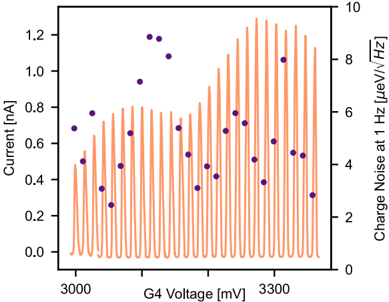
“5 – 10 µ eV / √ Hz [26], [27], [29], [32].”
High-fidelity flopping-mode single-spin operation via triple-dot orbital-band engineering
Matsumoto, Y., Liu, X.-F., Ludwig, A., Wieck, A. D., Koike, K., Miyoshi, T., Fujita, T., & Oiwa, A. (2026) · npj Quantum Information · doi:10.1038/s41534-026-01400-1
Camenzind, L. C., Jin, I. K., Wu, Y.-H., Noiri, A., Takeda, K., Nakajima, T., Kobayashi, T., Scappucci, G., & Tarucha, S. (2026) · arXiv (Cornell University) · doi:10.48550/arxiv.2610.41890
“They combine long coherence times, operation fidelities exceeding fault-tolerance thresholds [12–15], and compact footprints with compatibility with advanced semiconductor manufacturing [16–20].”
Self-citationValidation of the five-electron pO qubit in Si using full configuration interactionPreprint
Kanaar, D. W., Caporaletti, J. H., Kestner, J. P., Anderson, C. R., & Gyure, M. F. (2026) · arXiv (Cornell University) · doi:10.48550/arxiv.2611.00443
FNO-Based Inverse Co-Design of Semiconducting Quantum-Dot DevicesPreprint
Rychetsky, M., Duruisseaux, V., Shah, F., Craig, D., Ni, M., Katsaros, G., Patti, T. L., Anandkumar, A., & Ares, N. (2026) · arXiv (Cornell University) · doi:10.48550/arxiv.2611.06994
Thermal spin writing in a quantum-dot qubit via spin accumulation
Zhang, Z., Liu, H., & Shao, L. (2026) · Applied Physics Letters · doi:10.1063/5.0353502
Kong, Z., Liao, W., Chu, N., Zhang, Y., Zhang, Y., Li, J., Xu, C., Hao, Y., Zhou, Y., Song, Y., et al. (2026) · arXiv (Cornell University) · doi:10.48550/arxiv.2611.11405
Metadata
- Authors
- Zwerver, A. M. J., Krähenmann, T., Watson, T. F., Lampert, L., George, H. C., Pillarisetty, R., Bojarski, S. A., Amin, P., Amitonov, S. V., Boter, J. M., Caudillo, R., Correas-Serrano, D., Dehollain, J. P., Droulers, G., Henry, E. M., Kotlyar, R., Lodari, M., Lüthi, F., Michalak, D. J., Mueller, B. K., Neyens, S., Roberts, J., Samkharadze, N., Zheng, G., Zietz, O. K., Scappucci, G., Veldhorst, M., Vandersypen, L. M. K., & Clarke, J. S.
- Affiliations
- QuTech (NL)
- Intel (United States) (US)
- Corresponding author
- Vandersypen, L. M. K.
- Clarke, J. S.
- ORCID
- Venue
- Nature Electronics
- Published
- 2022-03-29
- Volume
- 5
- Issue
- 3
- Pages
- 184-190
- ISSN
- 2520-1131 (ISSN-L)
- OpenAlex
- W3128881740
- Cited by
- 364
- References
- 67
- Citations by year
- 2026: 49 · 2025: 94 · 2024: 85 · 2023: 88 · 2022: 40
- FWCI
- 31.47
- Type
- journal article
- Language
- en
- Update notices
- correction (2022-04-27)
- Open access
- hybrid
- doi.org
- Licence
- cc-by
- creativecommons.org/licenses/by/4.0 (tdm)
- creativecommons.org/licenses/by/4.0 (vor)
- Locations
- Nature Electronics (publishedVersion, cc-by)
- arXiv (Cornell University) (submittedVersion)
- OPUS - Open Publications of UTS Scholars (University of Technology Sydney) (submittedVersion)
- Research Repository (Delft University of Technology) (submittedVersion, cc-by)
- Data Archiving and Networked Services (DANS) (submittedVersion, other-oa)
- arXiv (Cornell University)
- Funders
- Intel Corporation
- European Commission (HORIZON2020)
- Nederlandse Organisatie voor Wetenschappelijk Onderzoek
- QuantERA
- Topics
- Physical Sciences › Physics and Astronomy › Condensed Matter Physics › Quantum and electron transport phenomena
- Physical Sciences › Physics and Astronomy › Atomic and Molecular Physics, and Optics › Semiconductor Quantum Structures and Devices
- Physical Sciences › Materials Science › Materials Chemistry › Diamond and Carbon-based Materials Research
- Keywords
- silicon quantum dots, qubits, semiconductor manufacturing, two-qubit gates, single spin qubits, magnetic resonance, spin relaxation, coherence time, industrial fabrication
About these checks
Registry, retraction, Cites and statistics results are computed, not judged, with one exception: a printed reference that no index lists is read once by a model before it counts as a citation error. Claims are extracted by a model and kept only when their quote appears verbatim in the text; each cited source is then checked, with a model’s help, for whether it says what the claim relies on. Those verdicts can be wrong — read the claim’s quote and the cited source before relying on one.
Statistics and arithmetic are recomputed, not judged.
Confidence bands are shown only for fields calibrated on our annotated test set. None is calibrated yet, so no band is shown.
What counts as a claim ›How we measure confidence ›How we check this ›
Are you an author, or do you see a problem with this page? Request a review
Data sources
Bibliographic data: Semantic Scholar, OpenAlex, Crossref.
Contains information from the Semantic Scholar Academic Graph Datasets, made available under the ODC Attribution License (ODC-BY 1.0).
Semantic Scholar’s data is described in: Kinney, R., et al. (2023). The Semantic Scholar Open Data Platform. arXiv:2301.10140.
