

Qubits made by advanced semiconductor manufacturing
Open accessThe DOI matches its Crossref record; 68 of the 68 references it cites were found in a registry or an index.
Abstract
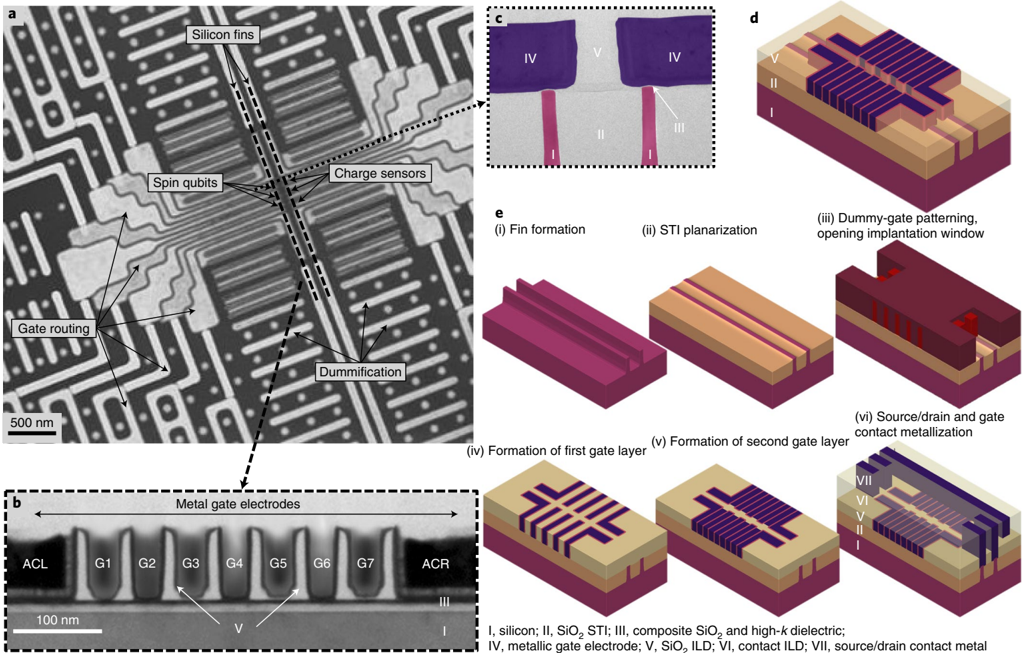
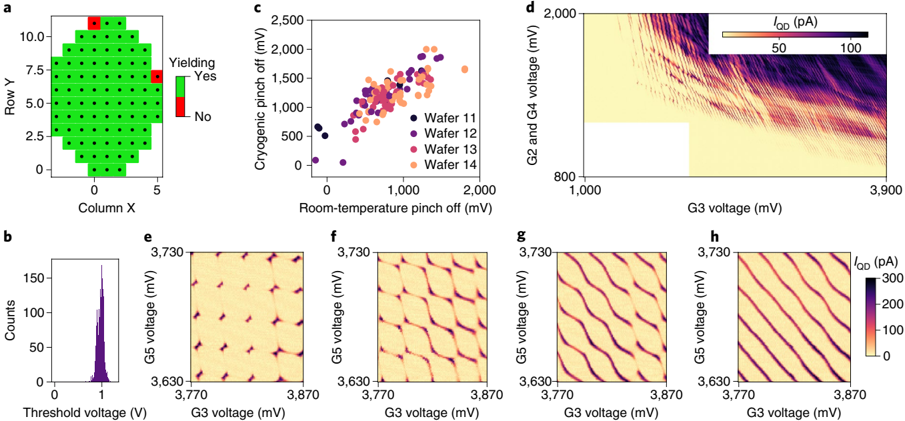
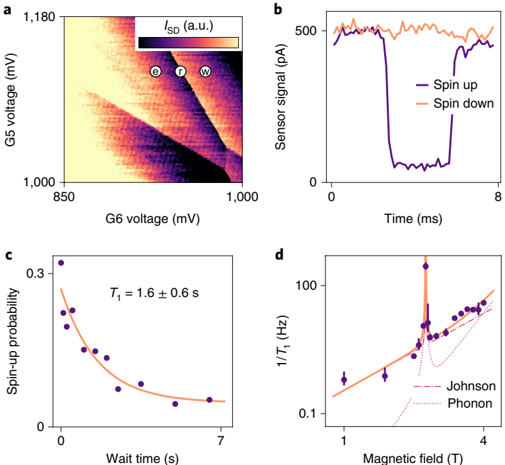
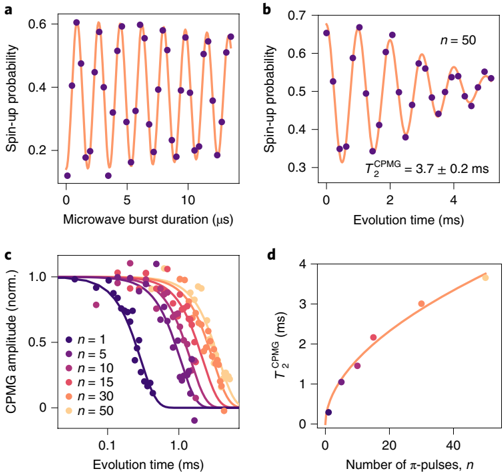
Full-scale quantum computers require the integration of millions of qubits, and the potential of using industrial semiconductor manufacturing to meet this need has driven the development of quantum computing in silicon quantum dots. However, fabrication has so far relied on electron-beam lithography and, with a few exceptions, conventional lift-off processes that suffer from low yield and poor uniformity. Here we report quantum dots that are hosted at a 28 Si/ 28 SiO 2 interface and fabricated in a 300 mm semiconductor manufacturing facility using all-optical lithography and fully industrial processing. With this approach, we achieve nanoscale gate patterns with excellent yield. In the multi-electron regime, the quantum dots allow good tunnel barrier control—a crucial feature for fault-tolerant two-qubit gates. Single-spin qubit operation using magnetic resonance in the few-electron regime reveals relaxation times of over 1 s at 1 T and coherence times of over 3 ms.
Overview
The claims and statistics of this paper haven’t been checked yet.
Free: it reads the open-access text and checks the first 5 claims that cite a source we can check. Create a free account to check every claim.
Integrity signals
Registry
Cites
Statistics
Figures

Verification
Claims the paper makes
The claims and statistics of this paper haven’t been checked yet.
Free: it reads the open-access text and checks the first 5 claims that cite a source we can check. Create a free account to check every claim.
Claims other papers make about this one
Each is checked against this paper’s own text: does it say what the citing paper says it does?
The source backs part of the claim, not all of it — or backs it for a different population, condition or comparison.
In the citing paper
“More fully industry-compatible devices in Si-MOS have also been demonstrated25,26 but are at present limited by high levels of disorder owing to the qubits being formed directly at the Si/SiO2 interface.”
From Probing single electrons across 300-mm spin qubit wafers (2024) · cites this paper as [26]
Experimental — accuracy not yet measured
Self-check
Percentages, sums and reported differences re-computed from the paper’s own numbers.
The self-check needs the paper’s full text.
Citations
Cites
Simulating physics with computers
Feynman, R. P. (1982) · International Journal of Theoretical Physics · doi:10.1007/bf02650179 · Cited by 7,691
Quantum computation with quantum dots
Loss, D., & DiVincenzo, D. P. (1998) · Physical Review A · doi:10.1103/physreva.57.120 · Cited by 6,840
Surface codes: Towards practical large-scale quantum computation
Fowler, A. G., Mariantoni, M., Martinis, J. M., & Cleland, A. N. (2012) · Physical Review A · doi:10.1103/physreva.86.032324 · Cited by 3,059 · cited 2×
“The most promising architectures require a scalable qubit system of individually-addressable qubits with a gate fidelity over 99% and tunable nearest-neighbour couplings [17, 18].”
BackgroundSpins in few-electron quantum dots
Hanson, R., Kouwenhoven, L. P., Petta, J. R., Tarucha, S., & Vandersypen, L. M. K. (2007) · Reviews of Modern Physics · doi:10.1103/revmodphys.79.1217 · Cited by 2,665
Self-citationMOS /metal oxide semiconductor/ physics and technology
Nicollian, E. H., & Brews, J. R. (1982) · CERN Document Server (European Organization for Nuclear Research) · Cited by 2,098
Electron transport through double quantum dots
van der Wiel, W. G., De Franceschi, S., Elzerman, J. M., Fujisawa, T., Tarucha, S., & Kouwenhoven, L. P. (2002) · Reviews of Modern Physics · doi:10.1103/revmodphys.75.1 · Cited by 1,820 · cited 2×
“At these points, the electrochemical potentials of the reservoirs are aligned with the electrochemical potentials of the left and the right dot, such that electrons can tunnel sequentially through the two dots [38].”
BackgroundSingle-shot read-out of an individual electron spin in a quantum dot
Elzerman, J. M., Hanson, R., Willems van Beveren, L. H., Witkamp, B., Vandersypen, L. M. K., & Kouwenhoven, L. P. (2004) · Nature · doi:10.1038/nature02693 · Cited by 1,679 · cited 2×
“Spin readout In order to read out the spin eigenstate we use energyselective tunneling to the electron reservoir [46].”
MethodSelf-citationDriven coherent oscillations of a single electron spin in a quantum dot
Koppens, F. H. L., Buizert, C., Tielrooij, K. J., Vink, I. T., Nowack, K. C., Meunier, T., Kouwenhoven, L. P., & Vandersypen, L. M. K. (2006) · Nature · doi:10.1038/nature05065 · Cited by 1,359 · cited 2×
“Furthermore, bringing the quantum dots on the inside of the stripline [48] will increase the ratio of magnetic field and (unwanted) electric fields and heating.”
BackgroundMethodSelf-citationZwanenburg, F. A., Dzurak, A. S., Morello, A., Simmons, M. Y., Hollenberg, L. C. L., Klimeck, G., Rogge, S., Coppersmith, S. N., & Eriksson, M. A. (2013) · Reviews of Modern Physics · doi:10.1103/revmodphys.85.961 · Cited by 1,210
Randomized benchmarking of quantum gates
Knill, E., Leibfried, D., Reichle, R., Britton, J., Blakestad, R. B., Jost, J. D., Langer, C., Ozeri, R., Seidelin, S., & Wineland, D. J. (2008) · Physical Review A · doi:10.1103/physreva.77.012307 · Cited by 1,019 · cited 1×
“To analyse the single-qubit gate fidelity, we employ randomised benchmarking [49] (Extended Fig.”
Method
Research works printed but not linked: 1
- Xue, X. et al. Benchmarking gate fidelities in a Si/SiGe two-qubit device. Phys. Rev. X 9, 021011 (2019).
Cited by
Items 401–500 of 516
(111) Si spin qubits constructed on L point of band structurePreprint
Tokunaga, T., & Nakazato, H. (2025) · arXiv (Cornell University) · doi:10.48550/arxiv.2501.13546 · Cited by 1
Pulse Generation for Spin-Qubit Control Using Adiabatic ChargingPreprint
Duipmans, L., van Waasen, S., & Geck, L. (2025) · doi:10.36227/techrxiv.176231736.66174866/v1 · Cited by 1
Towards integration of optically active defects in silicon photonics
DeAbreu, A. (n.d.) · Summit (Simon Fraser University) · Cited by 1
Catapano, E. (2022) · theses.fr (ABES) · doi:10.70675/5cc68e01z9a42z4865z92cbzaaf54b5d79e5 · Cited by 1
Silicon-based light emitters towards quantum devices at telecom frequency
Khoury, M. (2022) · theses.fr (ABES) · doi:10.70675/f46421aezfb31z490dz8019zf5e9b8753876 · Cited by 1
high fidelity readout of electron spins in silicon mos quantum dots
Niegemann, D. J. (2022) · theses.fr (ABES) · doi:10.70675/e9e7d37ez8bbcz48b2zad06z2a7254839393 · Cited by 1
Tunable resilience to charge noise of a hole spin
Bassi, M. (2024) · theses.fr (ABES) · doi:10.70675/ae2184eezf4e2z43ddzaa34z28b7efe324a2 · Cited by 1
Klemt, B. (2023) · theses.fr (ABES) · doi:10.70675/c9289d27z7165z4474z83c2ze6a5cd30184e · Cited by 1
Valley-Aware Optimal Control of Spin Shuttling Using Cryogenic Integrated ElectronicsPreprint
Romero, P. D., Chaabani, N., Duipmans, L., David, A., Motzoi, F., van Waasen, S., & Geck, L. (2026) · JuSER (Forschungszentrum Jülich) · doi:10.48550/arxiv.2604.20482 · Cited by 1
g-tensor Optimization in Ge/SiGe Quantum DotsPreprint
Shojaei, A., Valvo, E., Rimbach-Russ, M., Greplová, E., & Silva, A. (2026) · arXiv (Cornell University) · doi:10.48550/arxiv.2604.28081 · Cited by 1
Individually tunable Si/SiGe quantum dot operating voltages via gate-biased illuminationPreprint
Benson, J., Park, S., Eskandari, O. M., Wolfe, M. A., Coe, B., Dodson, J. P., Coppersmith, S. N., Friesen, M., & Eriksson, M. A. (2026) · arXiv (Cornell University) · doi:10.48550/arxiv.2606.00446 · Cited by 1
“4) of the charge sensor under P4 in each case [2, 31, 32].”
Excess energy fluctuations with applications to deviations from Debye's specific heatPreprint
Chamberlin, R. V., & Abe, S. (2026) · arXiv (Cornell University) · doi:10.48550/arxiv.2606.09566 · Cited by 1
“Similarly, excess noise in quantum devices , including qubits and single - particle detectors [17-21], has also been attributed to TTLS.”
Quantum geometrical description of hole spin qubits far away from the $Γ$-pointPreprint
György, Z., Miserev, D., Klinovaja, J., & Loss, D. (2026) · arXiv (Cornell University) · doi:10.48550/arxiv.2606.14683 · Cited by 1
“…11], high-fidelity single-and two-qubit operations [12– 20], their compatibility with semiconductor manufacturing processes [10, 21, 22], and the prospect of creating entanglement between distant qubits via the integration of superconducting elements [21, 23–27] or long-distance shuttling [28–33].”
Classical Reversible Computation by Quantum CoherencePreprint
Loss, D. (2026) · arXiv (Cornell University) · doi:10.48550/arxiv.2607.06219 · Cited by 1
“The quantum dot footprint is set by lithography and therefore scalable with the fabrication node [47, 48].”
Complete measurement of tunnel- and valley-coupling parameters in a silicon double quantum dotPreprint
King, D. J., Kim, M., Reily, J., Marcks, J. C., Friesen, M., Woods, B. D., & Eriksson, M. A. (2026) · arXiv (Cornell University) · doi:10.48550/arxiv.2607.09638 · Cited by 1
Electron shuttling as a probe for charge defectsPreprint
Jnane, H., Lipovics, T. D., & Burkard, G. (2026) · arXiv (Cornell University) · doi:10.48550/arxiv.2607.21718 · Cited by 1
Excess energy fluctuations with applications to deviations from Debye’s specific heatPreprint
Chamberlin, R. V., & Abe, S. (2026) · SSRN Electronic Journal · doi:10.2139/ssrn.7194888 · Cited by 1
Depth-Resolved Lattice Distortions in a Silicon-Germanium Qubit HostPreprint
Marcks, J. C., Joseph, E. S., Reily, J., Oh, T., Postlewaite, A., Zhou, T., Eriksson, M. A., Friesen, M. G., & Holt, M. V. (2026) · arXiv (Cornell University) · doi:10.48550/arxiv.2607.26962 · Cited by 1
Exchange-only qubit stabilized by a single-spin qubitPreprint
Heinz, I., Sharma, M., & Kattemölle, J. (2026) · Research Square · doi:10.21203/rs.3.rs-10700701/v1 · Cited by 1
Switchable heavy-hole/light-hole spin qubitPreprint
György, Z., Miserev, D., Klinovaja, J., & Loss, D. (2026) · arXiv (Cornell University) · doi:10.48550/arxiv.2608.25914 · Cited by 1
“The required long-range entanglement can be mediated either through coherent shuttling [26–31] or via the integration of superconducting microwave resonators [14, 32–34].”
Low-Frequency Charge Noise in Bilayer Graphene Quantum DotsPreprint
Richter, J., Ruckriegel, M. J., Gerber, J. D., Degroote, T., Adam, C., Niese, M., Ostertag, L., Agero, C. G., Watanabe, K., Taniguchi, T., et al. (2026) · arXiv (Cornell University) · doi:10.48550/arxiv.2609.03650 · Cited by 1
Huang, D., Liu, J.-H., Gao, H., Zhang, J.-Y., Wang, J., Liu, F.-Z., Zhou, X.-Y., Luo, Y., Fu, B.-X., Liu, X.-F., et al. (2026) · arXiv (Cornell University) · doi:10.48550/arxiv.2609.11214 · Cited by 1
NeST: ultra-high-rate qLDPC codes with sub-$50μ$s stabiliser cycles via spin shuttlingPreprint
Siegel, A. (2026) · arXiv (Cornell University) · doi:10.48550/arxiv.2610.28538 · Cited by 2
Defects and Strain in Silicon Metal-Oxide-Semiconductor (MOS) Quantum Dots
Stein, R. (2021) · University Libraries (University of Maryland) · doi:10.13016/qmcx-mgrd
Robust electron spin qubit control in a nanowire double quantum dot
Lu, R., Liu, K., & Ban, Y. (2022) · Philosophical Transactions of the Royal Society A Mathematical Physical and Engineering Sciences · doi:10.1098/rsta.2021.0270
“Demonstrating the potential applications in the noisy intermediate-scale quantum era, electron spin qubits in QDs present the following advantages: long coherence time [7,8], compatibility in semiconductor manufacturing technology [9] and recently achieved high fidelity exceeding 99% that overcomes the barrier for two…”
BackgroundThe Ground SwitcherPreprint
Thakur, U. S. (2023) · doi:10.36227/techrxiv.22257148.v1
Ensslin, K. (2023) · Elsevier eBooks · doi:10.1016/b978-0-323-90800-9.00221-3
Cao, D. L., & Dinh, K. (2023) · Journal of Quantum Information Science · doi:10.4236/jqis.2023.134008
Ji, S., & Iwamoto, S. (2023) · Optics Continuum · doi:10.1364/optcon.492718
Superconducting route to quantum computing
Abe, E. (2023) · International Conference on Simulation of Semiconductor Processes and Devices · doi:10.23919/sispad57422.2023.10319629
“In semiconductor qubits, it is a logical step toward large-scale quantum processors to leverage the state-of-the-art CMOS fabrication facilities, as the fabrication processes are quite similar [22].”
BackgroundCharge and Spin Transport in Semiconductor Devices
Sverdlov, V. A., & Selberherr, S. (2023) · IEEE International Conference on ASIC (ASICON) · doi:10.1109/asicon58565.2023.10396645
“It provides the path towards spin qubits integration on 300 mm wafers [12].”
BackgroundCorrection of Quantum State Readout Statistics Using the Fuzzy Measurements Model
Dmitriev, I. A., Bogdanov, Y. I., Bantysh, B. I., Богданова, Н. А., & Lukichev, V. F. (2023) · Russian Microelectronics · doi:10.1134/s1063739723600656
Intel brings quantum-computing microchips a step closer
Li, R. (2024) · Nature · doi:10.1038/d41586-024-01208-z
Towards Scalable Cryogenic Quantum Dot Biasing Using Memristor-Based Dc SourcesPreprint
Mouny, P.-A., Dawant, R., Dufour, P., Valdenaire, M., Ecoffey, S., Pioro-Ladrière, M., Beilliard, Y., & Drouin, D. (2024) · SSRN Electronic Journal · doi:10.2139/ssrn.4814534
Exploring Quantum Supremacy: A Review Of Quantum Technologies And Algorithms
Joseph, M., & Murthy, M. S. D. (2025) · The Bombay Technologist · doi:10.36664/bt/2024/v71i1/173220
Color Centers in Silicon Carbide for Quantum Technologies
Shafizadeh, D. (2025) · Linköping studies in science and technology. Dissertations · doi:10.3384/9789181180879
Iizuka, S., Asai, H., Kato, K., Oka, H., Chiashi, Y., Hattori, J., Fukuda, K., & Mori, T. (2025) · Japanese Journal of Applied Physics · doi:10.35848/1347-4065/ade214
Quantum algorithm compiler for architectures with semiconductor spin qubits
Tadokoro, M., Matsuoka, R., & Kodera, T. (2025) · EPJ Quantum Technology · doi:10.1140/epjqt/s40507-025-00384-9
“Semiconductor spin qubits are promising candidate systems for high-fidelity and high-speed gate operation [1–10], and the scalability of qubits utilizing existing mature micro-fabrication techniques [11–14].”
Superimposed two-contact gate stacks for an improved electrostatic control of Si spin qubits
Martínez, B., Bertrand, B., Niquet, Y., & Vinet, M. (2025) · Solid-State Electronics · doi:10.1016/j.sse.2025.109178
Udoisoh, M. G., Akpan, S. S., Ahmad, S., Babalola, A. V., Odoguje, I. A., & Shehu, M. E. (2025) · Research Square · doi:10.21203/rs.3.rs-6578635/v1
Lai, C.-C., Tsai, T., Lin, H., & Li, P.-W. (2025) · Silicon Nanoelectronics Workshop (SNW) · doi:10.23919/snw65111.2025.11097226
Scaling Quantum-Dot-Qubit Systems
Bishop, N. C. (2025) · Physics · doi:10.1103/physics.18.88
“Semiconductor technology enables the fabrication of quantum-mechanical devices with unparalleled control [ 3 ], performance [ 4 ], reproducibility [ 5 ], and large-scale integration [ 6 ]—exactly what is needed for a highly scalable quantum computer.”
Quantum entanglement response to pulsed gate modulation
Fernandes, E. M., Sanz, L., & de Souza, F. M. (2025) · Physical Review A · doi:10.1103/sjjp-syxx
“Alternatively, quantum computing based on semiconductors can also be of great significance as it relies on advanced semiconductor manufacturing 12,13 .”
Long-distance interaction of gate-defined quantum dots under Floquet driving
Liu, X.-F., Liu, Z.-H., Wang, T.-J., Wang, C., & Xu, H. Q. (2025) · Physical Review Applied · doi:10.1103/zbcs-jdq2
Electron transfer between surface-acoustic-wave-induced moving and static quantum dotsPreprint
Olano, M., & Giedke, G. (2025) · arXiv (Cornell University) · doi:10.48550/arxiv.2509.01525
Compact radio frequency module for gate-defined quantum dot qubits
Wu, Z., Zhou, Z., Pan, X., Li, Y., & Huang, S. (2025) · Applied Physics Letters · doi:10.1063/5.0291408
Quantum Computing with Semiconductor Spin
Ramanandan, S. P., & Morral, A. F. I. (2025) · Springer eBooks · doi:10.1007/978-3-031-90727-2_4
Technologies for Scaling Silicon-MOS Quantum Processors
Gilbert, W. (2023) · UNSWorks (University of New South Wales, Sydney, Australia) · doi:10.26190/unsworks/24622
Long Distance Coupling of Spin Qubits in Silicon
Feng, M. (2023) · UNSWorks (University of New South Wales, Sydney, Australia) · doi:10.26190/unsworks/25389
Constantinos, B. (2022) · DSpace - NTUA (National Technical University of Athens) · doi:10.26240/heal.ntua.23677
Towards scalable solid-state spin qubits and quantum simulation of thermal states
Warren, A. (2024) · VTechWorks (Virginia Tech)
Designing Adaptive Ansätze in Quantum Simulation and Geometric Entangling Gates
Tang, H. L. (2024) · VTechWorks (Virginia Tech)
Wanningen, N. (. (2022) · Research Repository (Delft University of Technology)
The Business Ecosystem of the Quantum Computing Market: Cooperation and Competition
Rot, P. (. (2023) · Research Repository (Delft University of Technology)
Paving the Way towards Mass Diffusion of Quantum Processors
Feirabend, N. (2023) · Research Repository (Delft University of Technology)
A study of charge sensing techniques in physically defined silicon quantum dots
溝口来成, & Mizokuchi, R. (2021) · Institutional Repositories DataBase (IRDB)
Veldhuizen, D. (2021) · Research Repository (Delft University of Technology)
Sarker, S. (2025) · Jyväskylä University Digital Archive (University of Jyväskylä)
Li, P.-W. (2025) · IEEE Electron Devices Magazine · doi:10.1109/med.2025.3577179
Applied theory for practical silicon-based quantum computing: from hardware to applications
Jnane, H. (2024) · Oxford University Research Archive (ORA) (University of Oxford) · doi:10.5287/ora-jn19zndr0
Ultra-high vacuum scanning tunneling microscope-assisted atomic-scale manufacture of quantum devices
Yang, J., Li, Y., Li, X., & Pan, Y. (2025) · Chinese Science Bulletin (Chinese Version) · doi:10.1360/csb-2025-5148
Using Near-Flat-Band Electrons for Read-Out of Molecular Spin Qubit Entangled States
Bunker, C., Hoffman, S., Liu, S., Zhang, X.-G., & Cheng, H. (2026) · ACS Nano · doi:10.1021/acsnano.5c16530
“15 20 For semiconductor spin qubits, spin-to-charge conversion 4,21 is a trusted electrical read-out protocol requiring tunneling of the qubit electrons.”
Magneto-Optical Trapping and Control for a Neutral Atom Quantum Computer
Hu, B. (2025) · ResearchWorks at the University of Washington (University of Washington)
Nanomaterials in Quantum Computing
Khan, N. R. (2026) · Wiley eBooks · doi:10.1002/9783527817474.ch13
Light-Driven Materials and Devices
(2025) · Directory of Open access Books (OAPEN Foundation)
Fast Readout for Large Scale Spin-Based Qubits
Luo, X., Bertrand, B., Niebojewski, H., Martins, F., Smith, C. G., & Yang, T.-Y. (2026) · IEEE Electron Device Letters · doi:10.1109/led.2026.3673832
“However, scaling up a spin qubit system is challenging for (1) microstructure fabrication [1-4], (2) wiring at a large scale, and (3) thermal budget in a cryogenic system.”
Single-atomic copper doped fullerene materials for electron-nuclear hybrid spin quditPreprint
Chen, B., Fu, P., Chen, J., Yuan, J., Li, X., Zhang, D., Wang, S., & Zhou, S. (2026) · ChemRxiv · doi:10.26434/chemrxiv.15001077/v1
State Control and Measurement System for Semiconductor Quantum Dots Qubits
Mikhailov, P. O., Surkov, M. A., Shorokhov, V. V., & Трифонов, А. С. (2025) · Russian Microelectronics · doi:10.1134/s1063739725601171
Thermolabile molecules deposited by electrospray probed by STM
Lawes, P. (2025) · theses.fr (ABES) · doi:10.70675/b8add302z2435z4dd3z9a24z81ce1e1a9c77
Charge and spin control of electron and holes in silicon quantum dot arrays
Aprá, A. (2023) · theses.fr (ABES) · doi:10.70675/e8ff03a2z656cz4847za912z9cea6f501898
Piot, N. (2023) · theses.fr (ABES) · doi:10.70675/37d095adzd522z4386z80d0zdd272b37cbd6
Point defects in silicon : towards a novel platform for quantum technologies
Baron, Y. (2022) · theses.fr (ABES) · doi:10.70675/edbff12dz0d59z4c68z8ef9zf2ee62a857b0
Physics of the valley splitting in silicon MOSFETs : Untangling a multi-factorial dependency
Aubergier, N. (2023) · theses.fr (ABES) · doi:10.70675/d5763ddaza553z43acz8a3dz20247577bb17
Taming noise for CMOS electron spin qubits
El-Homsy, V. (2024) · theses.fr (ABES) · doi:10.70675/1576e82fzb695z413bza0d8zf7d10a0ddcfa
Hrytsaienko, M. (2023) · theses.fr (ABES) · doi:10.70675/c663f063zf8d7z4342zaab1z3c053fd8d123
Multiplexed cryo-CMOS control of an isolated double quantum dotPreprint
Darnas, M., Ouvrier-Buffet, M., Faurie, A., Casanova, J.-B., Bertrand, B., Thomas, C., Charbonnier, J., Michel, J.-P., Paz, B. C., Thonnart, Y., et al. (2026) · arXiv (Cornell University) · doi:10.48550/arxiv.2604.11266
Clarifying the physical origin of long-period charge fluctuations in Si fin-type quantum dots
Oka, H., Asai, H., Kato, K., Inaba, T., Shitakata, S., Iizuka, S., Chiashi, Y., Kobayashi, Y., Yui, H., Nagano, S., et al. (2026) · Japanese Journal of Applied Physics · doi:10.35848/1347-4065/ae611c
On the Improvement of Gate Fidelity in Spin Qubits With Two-Level Fluctuators at Higher Temperatures
Sato, Y., Asai, H., Mori, T., & Kawahara, T. (2026) · IEEE Access · doi:10.1109/access.2026.3690197
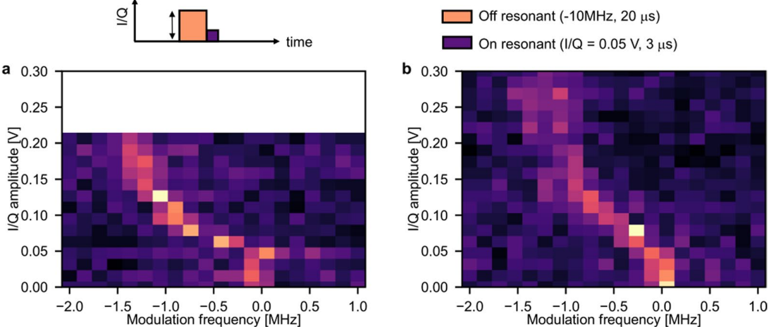
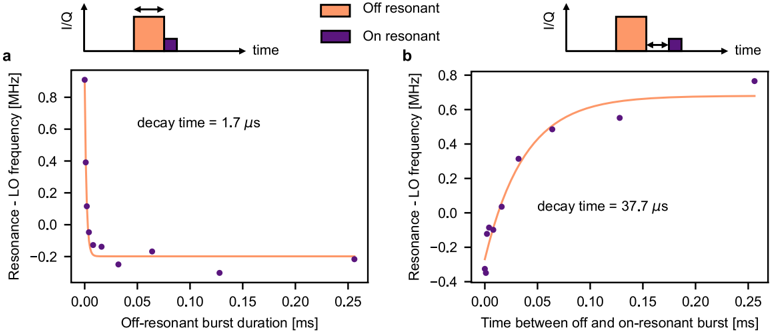
“However, some experiments demonstrated that the f q value can shift during operation by approximately 1 MHz, either positively or negatively, depending on the devices [3], [11], [12], [13].”
3 D NAND Flash Memories: Technological Evolution and Prospective Applications
Refaldi, D. G., Malavena, G., Compagnoni, C. M., & Spinelli, A. S. (2026) · Wiley eBooks · doi:10.1002/9783527847419.ch2
Multi-Qubit Entanglement of Unit Cell Pairs in SiMOSPreprint
Jones, C., Huang, J. Y., Serrano, S., Feng, M., Paz-Silva, G. A., Tanttu, T., Steinacker, P., Hudson, F. E., Lim, W. H., Abrosimov, N. V., et al. (2026) · arXiv (Cornell University) · doi:10.48550/arxiv.2605.20781
“Results from foundry-fabricated devices report improved oxide uniformity and reduced charge noise [28, 32, 49], along with improved single-and two-qubit fidelities and T 2 times an order of magnitude longer than those observed here [27, 29, 31].”
Four-state discrimination for a pair of spin qubits via gate reflectometry
Sen, A., & Pályi, A. (2026) · Physical review. B./Physical review. B · doi:10.1103/737j-gmns
“In particular, silicon-based devices benefit from the availability of isotopically enriched material, which strongly suppresses hyperfine-induced decoherence [10, 25–32], and from their compatibility with established semiconductor technology [14, 33– 41].”
Hu, Z., Fan, S., Wei, T., Yan, L., An, J., wei, L. Z., Li, S., Huang, S., Wang, J., & Yu, L. (2026) · ACS Nano · doi:10.1021/acsnano.6c00514
Smooth velocity shuttling for suppressing valley excitations in disordered Si/SiGe quantum dotsPreprint
Nagai, R., Takemoto, T., & Mizuno, H. (2026) · arXiv (Cornell University) · doi:10.48550/arxiv.2606.01541
Cryo-CMOS Integrator-Based DAC for Scalable Biasing of Semiconductor Qubits
Enthoven, L., van Staveren, J., Gong, J., Babaie, M., & Sebastiano, F. (2026) · IEEE Transactions on Circuits and Systems I Regular Papers · doi:10.1109/tcsi.2026.3692714
“The biasing DAC must generate voltages that are calibrated for each individual electrode to account for device variations, with the required bias voltage range exceeding 3 V, depending on the layer stack, materials and pinch-o ff variability [6], [16], [17].”
MODELING OF FINFET DEVICES AT CRYOGENIC TEMPERATURES
Saeed, I. (n.d.) · BOA (University of Milano-Bicocca)
Coherent control of orthogonal continuum states in XUV photoionizationPreprint
Kukreti, N., & Holkundkar, A. R. (2026) · arXiv (Cornell University) · doi:10.48550/arxiv.2606.16964
Paul, N., & Chattopadhyay, S. (2026) · Physica Scripta · doi:10.1088/1402-4896/ae82ce
Recent Advances in Materials and Technologies for Semiconductor Qubits
Otsuka, T. (2026) · The Journal of the Institute of Electrical Engineers of Japan · doi:10.1541/ieejjournal.146.386
A Unified Electrostatic-to-Spin Framework for Asymmetric Multi-Gate CMOS Quantum DevicesPreprint
Wang, Z., Liu, Y., Hao, Y., & Han, G. (2026) · arXiv (Cornell University) · doi:10.48550/arxiv.2607.04876
SiMOS quantum-dot spin qubits enabled by extreme-ultraviolet lithographyPreprint
Caekenberghe, T. V., Steinacker, P., Raes, B., Beyne, S., Godfrin, C., Damme, J. V., Baudot, S., Loenders, A., Jaliel, G., Kubicek, S., et al. (2026) · arXiv (Cornell University) · doi:10.48550/arxiv.2607.13121
Impact of gate-voltage noise on silicon spin-qubit variational quantum eigensolvers
Wang, X., Khromets, B., Merino, Z. D., & Baugh, J. (2026) · Quantum Science and Technology · doi:10.1088/2058-9565/ae9188
Lu, Y., Liu, X., & Liu, F. (2026) · arXiv (Cornell University) · doi:10.48550/arxiv.2607.26938
“Silicon is especially attractive because isotopic enrichment suppresses nuclear-spin noise, while its compatibility with complementary metal–oxide– semiconductor (CMOS) processing offers a route to dense and reproducible devices [2, 4, 5].”
Initialisation d'un qubit de spin chaud dans une boîte quantique par rétroaction quantique
Aarab, A. (2022) · Knowledge UdeS (Institutional Deposit of the University of Sherbrooke)
Quantum-Device Simulation of Optical Decoherence of Hole-Spin Qubits in Self-Assembled Quantum DotsPreprint
Jiang, J.-J., Philippopoulos, P., Beaudoin, F., & Guo, H. (2026) · arXiv (Cornell University) · doi:10.48550/arxiv.2608.08475
Quantum computing-driven evolution of drug discovery paradigms
Han, L., Ke, Z., Liu, L., Cao, L., Wang, Z., Zhang, X., Zhou, W., & Xiao, W. (2026) · Chinese Science Bulletin (Chinese Version) · doi:10.1360/csb-2026-0450
Rapid Charge Stability Diagram Generation from Device-level Modeling of Semiconductor Quantum DotsPreprint
Nodel, R., Kanaar, D. W., Nasseraddin, C., Wilson, T. J., Jiang, H. W., Petta, J. R., Anderson, C., & Gyure, M. F. (2026) · arXiv (Cornell University) · doi:10.48550/arxiv.2608.28263
Correlated noise in spin qubits
ROJAS, A. J. S. (2022) · Institutional Repositories DataBase (IRDB) · doi:10.15083/0002010885
Transversal Gates and Magic State Distillation in an Optimally Synthesized Spin-Qubit Shuttling BusPreprint
Escofet, P., Semenov, A., Murphy, N., Blokhina, E., Almudéver, C. G., Abadal, S., & Alarcón, E. (2026) · arXiv (Cornell University) · doi:10.48550/arxiv.2609.02641
“Perhaps most critically for near-term devices, fewer quantum dots reduce the probability of a manufacturing defect rendering the processor unusable: since semiconductor fabrication imperfections such as charge traps or lithographic variation can make individual dots inoperable [55].”
Trion-mediated quantum operations on a double-dot charge qubitPreprint
Tsukanov, A. V. (2026) · arXiv (Cornell University) · doi:10.48550/arxiv.2609.07342
“There are several options for encoding quantum information into electronic (see reviews [4, 5]), spin (see reviews [6, 7]), and exciton (see reviews [8, 9]) states of QDs. Quantum operations are performed using external electromagnetic fields that induce resonant optical and/or tunneling…”
Metadata
- Authors
- Zwerver, A. M. J., Krähenmann, T., Watson, T. F., Lampert, L., George, H. C., Pillarisetty, R., Bojarski, S. A., Amin, P., Amitonov, S. V., Boter, J. M., Caudillo, R., Correas-Serrano, D., Dehollain, J. P., Droulers, G., Henry, E. M., Kotlyar, R., Lodari, M., Lüthi, F., Michalak, D. J., Mueller, B. K., Neyens, S., Roberts, J., Samkharadze, N., Zheng, G., Zietz, O. K., Scappucci, G., Veldhorst, M., Vandersypen, L. M. K., & Clarke, J. S.
- Affiliations
- QuTech (NL)
- Intel (United States) (US)
- Corresponding author
- Vandersypen, L. M. K.
- Clarke, J. S.
- ORCID
- Venue
- Nature Electronics
- Published
- 2022-03-29
- Volume
- 5
- Issue
- 3
- Pages
- 184-190
- ISSN
- 2520-1131 (ISSN-L)
- OpenAlex
- W3128881740
- Cited by
- 364
- References
- 67
- Citations by year
- 2026: 49 · 2025: 94 · 2024: 85 · 2023: 88 · 2022: 40
- FWCI
- 31.47
- Type
- journal article
- Language
- en
- Update notices
- correction (2022-04-27)
- Open access
- hybrid
- doi.org
- Licence
- cc-by
- creativecommons.org/licenses/by/4.0 (tdm)
- creativecommons.org/licenses/by/4.0 (vor)
- Locations
- Nature Electronics (publishedVersion, cc-by)
- arXiv (Cornell University) (submittedVersion)
- OPUS - Open Publications of UTS Scholars (University of Technology Sydney) (submittedVersion)
- Research Repository (Delft University of Technology) (submittedVersion, cc-by)
- Data Archiving and Networked Services (DANS) (submittedVersion, other-oa)
- arXiv (Cornell University)
- Funders
- Intel Corporation
- European Commission (HORIZON2020)
- Nederlandse Organisatie voor Wetenschappelijk Onderzoek
- QuantERA
- Topics
- Physical Sciences › Physics and Astronomy › Condensed Matter Physics › Quantum and electron transport phenomena
- Physical Sciences › Physics and Astronomy › Atomic and Molecular Physics, and Optics › Semiconductor Quantum Structures and Devices
- Physical Sciences › Materials Science › Materials Chemistry › Diamond and Carbon-based Materials Research
- Keywords
- silicon quantum dots, qubits, semiconductor manufacturing, two-qubit gates, single spin qubits, magnetic resonance, spin relaxation, coherence time, industrial fabrication
About these checks
Registry, retraction, Cites and statistics results are computed, not judged, with one exception: a printed reference that no index lists is read once by a model before it counts as a citation error. Claims are extracted by a model and kept only when their quote appears verbatim in the text; each cited source is then checked, with a model’s help, for whether it says what the claim relies on. Those verdicts can be wrong — read the claim’s quote and the cited source before relying on one.
Statistics and arithmetic are recomputed, not judged.
Confidence bands are shown only for fields calibrated on our annotated test set. None is calibrated yet, so no band is shown.
What counts as a claim ›How we measure confidence ›How we check this ›
Are you an author, or do you see a problem with this page? Request a review
Data sources
Bibliographic data: Semantic Scholar, OpenAlex, Crossref.
Contains information from the Semantic Scholar Academic Graph Datasets, made available under the ODC Attribution License (ODC-BY 1.0).
Semantic Scholar’s data is described in: Kinney, R., et al. (2023). The Semantic Scholar Open Data Platform. arXiv:2301.10140.
