

Deep learning-based kcat prediction enables improved enzyme-constrained model reconstruction
Open accessPublished version of a preprint
The DOI matches its Crossref record; 77 of the 77 references it cites were found in a registry or an index; 44 of the 59 sources its claims cite were checked for support.
Abstract
Enzyme turnover numbers ( k cat ) are key to understanding cellular metabolism, proteome allocation and physiological diversity, but experimentally measured k cat data are sparse and noisy. Here we provide a deep learning approach (DLKcat) for high-throughput k cat prediction for metabolic enzymes from any organism merely from substrate structures and protein sequences. DLKcat can capture k cat changes for mutated enzymes and identify amino acid residues with a strong impact on k cat values. We applied this approach to predict genome-scale k cat values for more than 300 yeast species. Additionally, we designed a Bayesian pipeline to parameterize enzyme-constrained genome-scale metabolic models from predicted k cat values. The resulting models outperformed the corresponding original enzyme-constrained genome-scale metabolic models from previous pipelines in predicting phenotypes and proteomes, and enabled us to explain phenotypic differences. DLKcat and the enzyme-constrained genome-scale metabolic model construction pipeline are valuable tools to uncover global trends of enzyme kinetics and physiological diversity, and to further elucidate cellular metabolism on a large scale.
Overview
CoChat Summary
TL;DR
The authors developed DLKcat, a deep learning model that predicts enzyme turnover numbers (kcat) from substrate structures and protein sequences, and used it to reconstruct enzyme-constrained genome-scale metabolic models for 343 yeast/fungi species. The resulting models improved kcat coverage and phenotype/proteome predictions compared with previous ecGEM pipelines.
Key findings
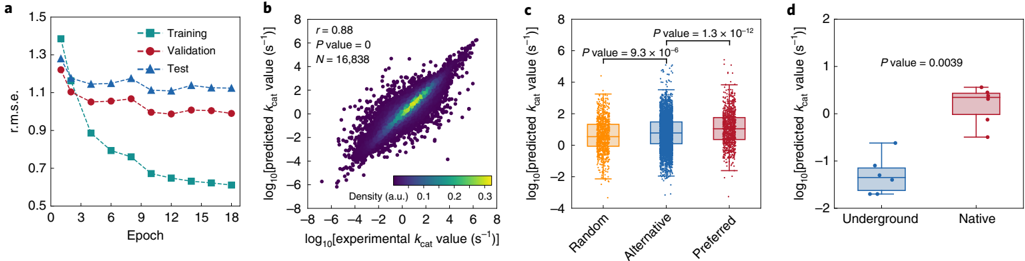
- DLKcat was trained on 16,838 unique entries covering 7,822 unique protein sequences, 851 organisms and 2,672 unique substrates; it achieved a test-set r.m.s.e. of 1.06 and Pearson’s r = 0.88 on the whole dataset (r = 0.71 on the test dataset).
- For promiscuous enzymes, predicted kcat values were higher for preferred substrates (median 11.07 s⁻¹) than alternative substrates (median 6.01 s⁻¹; P = 1.3 × 10⁻¹²) and random substrates (median 3.51 s⁻¹; P = 9.3 × 10⁻⁶).
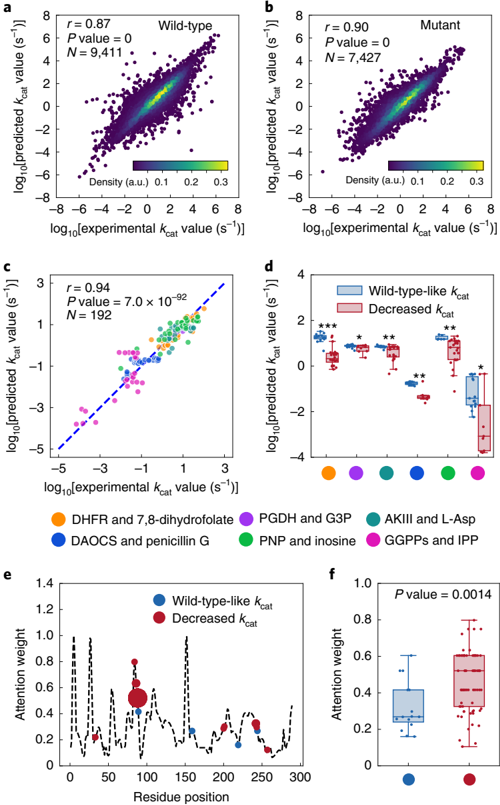
- DLKcat captured mutation effects: whole-dataset Pearson’s r = 0.90 for mutated enzymes and r = 0.94 for well-studied enzyme–substrate pairs with rich mutagenesis data; attention weights were significantly higher for residues mutated in the decreased-kcat group (P = 0.0014).
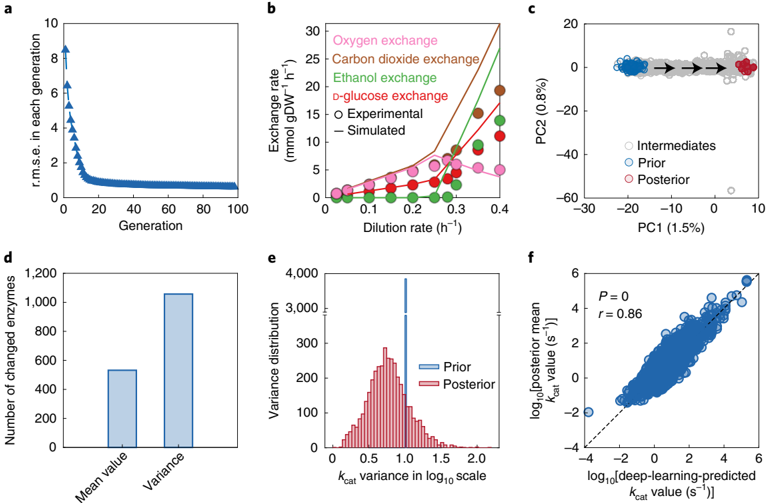
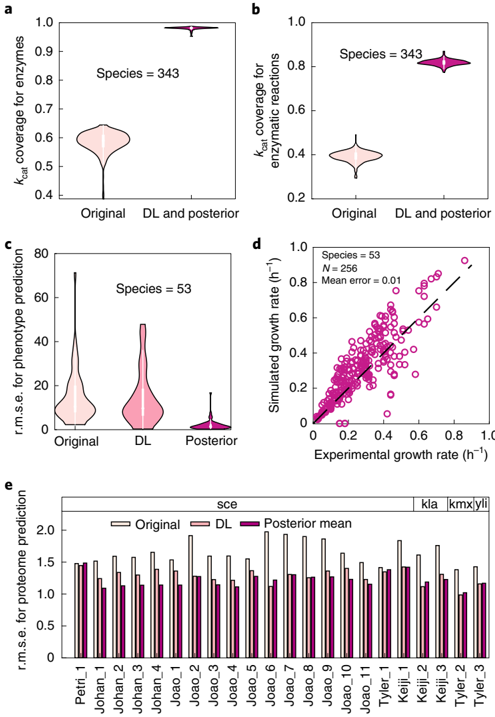
- DL-ecGEMs and posterior-mean-ecGEMs covered kcat values for ~80% of enzymes and defined enzymatic constraints for ~90% of enzymatic reactions, versus ~40% and ~60% for original-ecGEMs; DL-ecGEMs reduced proteome prediction r.m.s.e. by 30% compared with original-ecGEMs.
Methods
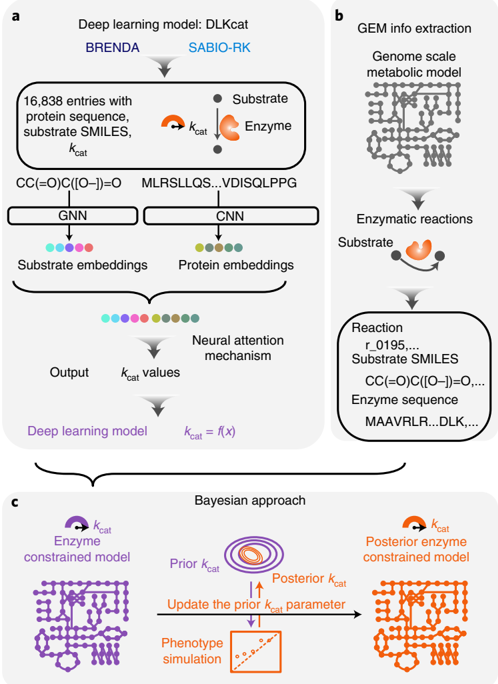
- DLKcat combines a graph neural network for substrates, represented as molecular graphs from SMILES, with a convolutional neural network for protein sequences split into overlapping n-gram amino acids; it was trained on data extracted from BRENDA and SABIO-RK, randomly split 80% training, 10% validation and 10% test.
- A Bayesian SMC-ABC pipeline used predicted kcat values as prior means with log-normal distributions N(kcat_i, 1) and updated them against experimental growth data collated as 371 entries for 53 species with 16 carbon sources; posterior-mean kcat values were used to parameterize posterior-mean-ecGEMs.
- The study reconstructed and compared original-ecGEMs, DL-ecGEMs and posterior-mean-ecGEMs for 343 yeast/fungi species, evaluating kcat coverage, growth/exchange-rate predictions, proteome predictions and Crabtree-phenotype-related enzyme differences.
Limitations
- The paper states that DLKcat still predicts a level of kinetic activity towards random substrates that is likely too high, due to limited negative data; it also did not consider environmental factors such as pH and temperature.
- The paper states that for reactions with multiple substrates or heteromeric enzyme complexes, multiple predicted kcat values can arise and the current approach selects the maximum, which is not ideal.
- The paper states that DL-ecGEMs and posterior-mean-ecGEMs inherit limitations from basic GEMs, including the steady-state assumption and lack of regulatory behaviour; kcat is not the only kinetic parameter, and affinity constants and internal metabolite concentrations are not readily considered.
Model-written summary. Check it against the paper before relying on it.
Integrity signals
Registry
Cites
Statistics
Figures
Verification
Claims the paper makes
21 Valid · 4 Not valid · 9 Not checked · 71 Own results and interpretations
The cited sources that could be checked couldn’t confirm or dispute this claim.
In the paper
“Since more than 200 out of 343 yeast/fungi species are not annotated in UniProt 58 and KEGG 62”
What the sources say
- Could not verifycites [58] The UniProt Consortium. UniProt: the universal protein knowledgebase. Nucleic Acids Res. 45, D158–D169 (2017). sourceExperimental — accuracy not yet measured
The 'Growth of reference proteomes' section describes UniProt's species coverage and annotation practices, while 'Identifying redundant proteomes' discusses fungal entries removed for redundancy. Neither reports an assessment of 343 yeast or fungal species or says that more than 200 lack annotation in UniProt and KEGG; searches for those figures and KEGG found no supporting passage. The indexed passages provide no page numbers. (LLM, conf=0.76)
- Could not verifycites [62] Kanehisa, M., Furumichi, M., Tanabe, M., Sato, Y. & Morishima, K. KEGG: new perspectives on genomes, pathways, diseases and drugs. Nucleic Acids Res. 45, D353–D361 (2017). sourceExperimental — accuracy not yet measured
The 'Improvement of GENES and KO databases' section describes how UniProt and KEGG annotate sequences, and Table 3 describes KEGG's sequence collections. Neither reports coverage of yeast or fungal species or the figure of more than 200 out of 343; searches for those terms and numbers found no supporting passage in our copy. (LLM, conf=0.76)
plain- Asserted: passes — The authors put it forward as true.
- Checkable: passes — It can be checked against evidence.
- Load-bearing: passes — The paper’s conclusions depend on it.
- Based: passes — The paper gives a reason why it holds.
- Could not verify
The cited sources support only part of this claim — read each source’s verdict below.
In the paper
“The scarcity of mutated enzymes with k cat values over twofold of the wild-type k cat values precluded defining the 'increased k cat ' group 25,26 .”
What the sources say
- Not checked — no full text of the sourcecites [25] Yep, A., Kenyon, G. L. & McLeish, M. J. Saturation mutagenesis of putative catalytic residues of benzoylformate decarboxylase provides a challenge to the accepted mechanism. Proc. Natl Acad. Sci. USA 105, 5733–5738 (2008). source
- Partly supportedcites [26] Lin, Y.-H. T., Huang, C. L. V., Ho, C., Shatsky, M. & Kirsch, J. F. A general method to predict the effect of single amino acid substitutions on enzyme catalytic activity. Preprint at bioRxiv https://doi.org/10.1101/236265 (2017). sourceExperimental — accuracy not yet measured
The Assessment of classification accuracy section (page unavailable) defines only deleterious and neutral mutation groups, not an 'increased kcat' group. It does not say that mutants exceeding twice the wild-type kcat were scarce or that scarcity prevented defining such a group; its classification concerns catalytic activity measured chiefly as kcat/Km. (LLM, conf=0.78)
plainstates a cause- Asserted: passes — The authors put it forward as true.
- Checkable: passes — It can be checked against evidence.
- Load-bearing: unclear — It is unclear whether the paper’s conclusions depend on it.
- Based: passes — The paper gives a reason why it holds.
The cited sources support only part of this claim — read each source’s verdict below.
In the paper
“In a S. cerevisiae ecGEM, only 5% of all enzymatic reactions have fully matched k cat values in BRENDA 2 .”
What the sources say
- Partly supportedcites [2] 2. Sánchez, B. J. et al. Improving the phenotype predictions of a yeast genome -scale metabolic model by incorporating enzymatic constraints. Mol. Syst. Biol. 13 , 935 (2017). sourceExperimental — accuracy not yet measured
The Materials and Methods section, “Criteria for obtaining kinetic data” (page unavailable), says the yeast model retrieved kcat values from BRENDA and relaxed the matching criteria when data were missing. It does not report that only 5% of enzymatic reactions had fully matched values; searches for that percentage and exact-match rates found no such figure in our copy. (LLM, conf=0.82)
plain- Asserted: passes — The authors put it forward as true.
- Checkable: passes — It can be checked against evidence.
- Load-bearing: passes — The paper’s conclusions depend on it.
- Based: passes — The paper gives a reason why it holds.
- Partly supported
The sources with a verdict support this claim; the rest weren’t checked yet, have no full text we could read, or their verdicts aren’t rated yet.
In the paper
“Moreover, even for those well-studied organisms, the k cat coverage is far from complete 13,15,16 .”
What the sources say
- Supportedcites [13] Nilsson, A., Nielsen, J. & Palsson, B. O. Metabolic models of protein allocation call for the kinetome. Cell Syst. 5, 538–541 (2017). source
In “The Current Gaps in the Kinetome” (page unavailable), the paper says that kinetic properties of most enzymes have not been measured. It also reports direct matching kcat values for only 5% of 3,249 enzymatic reactions in a genome-scale model, supporting the claim that coverage remains far from complete. (LLM, conf=0.93)
- Not checked — no full text of the sourcecites [15] Davidi, D. & Milo, R. Lessons on enzyme kinetics from quantitative proteomics. Curr. Opin. Biotechnol. 46, 81–89 (2017). source
- Supportedcites [16] Heckmann, D. et al. Machine learning applied to enzyme turnover numbers reveals protein structural correlates and improves metabolic models. Nat. Commun. 9, 5252 (2018). source
The Introduction states that in vitro kcat data are far from genome-scale, covering about 12% of direction-specific reactions in E. coli. This supports the claim that kcat coverage remains incomplete even in a well-studied organism. (LLM, conf=0.93)
plain- Asserted: passes — The authors put it forward as true.
- Checkable: passes — It can be checked against evidence.
- Load-bearing: passes — The paper’s conclusions depend on it.
- Based: passes — The paper gives a reason why it holds.
- Supported
The sources with a verdict support this claim; the rest weren’t checked yet, have no full text we could read, or their verdicts aren’t rated yet.
In the paper
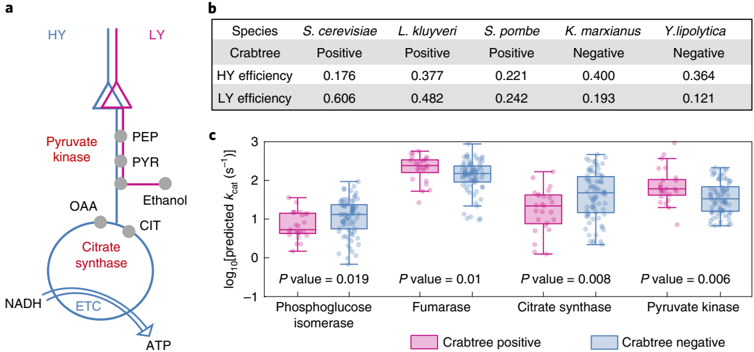
“Crabtree negative species have higher TCA flux 39,40 .”
What the sources say
- Supportedcites [39] Christen, S. & Sauer, U. Intracellular characterization of aerobic glucose metabolism in seven yeast species by 13C flux analysis and metabolomics. FEMS Yeast Res. 11, 263–272 (2011). source
The Intracellular flux distribution section reports negligible respiratory TCA-cycle flux in Crabtree-positive species, whereas the TCA cycle is a major pathway in aerobic species. The Discussion further reports about threefold higher respiratory TCA-cycle fluxes in aerobic species than in respiring Crabtree-positive S. cerevisiae when compared at equal overall metabolic rates. (LLM, conf=0.92)
- Not checked — no full text of the sourcecites [40] Blank, L. M., Lehmbeck, F. & Sauer, U. Metabolic-flux and network analysis in fourteen hemiascomycetous yeasts. FEMS Yeast Res. 5, 545–558 (2005). source
plainstates an association- Asserted: passes — The authors put it forward as true.
- Checkable: passes — It can be checked against evidence.
- Load-bearing: unclear — It is unclear whether the paper’s conclusions depend on it.
- Based: passes — The paper gives a reason why it holds.
- Supported
52 more claims · 10 with their cited sources checked
Create a free account to see all 105 claims and every source verdict.
- It may state two separate claims as one. 21
- Probably not a substantial claim. 30
- The quote only partly states this claim. 1
Claims other papers make about this one
Each is checked against this paper’s own text: does it say what the citing paper says it does?
The cited source says what the claim attributes to it.
In the citing paper
“Our resulting Turnover Number Prediction model— TurNuP—outperforms a simple similarity-based approach and both previous methods for predicting k cat 14 , 16 .”
From Turnover number predictions for kinetically uncharacterized enzymes using machine and deep learning (2023) · cites this paper as [16]
In the citing paper
“Using genome-scale, enzyme-constrained metabolic models for different yeast species 16 , we demonstrate that parameterizations with TurNuP k cat predictions lead to improved proteome allocation predictions.”
From Turnover number predictions for kinetically uncharacterized enzymes using machine and deep learning (2023) · cites this paper as [16]
In the citing paper
“DLKcat predicts k cat using information about the enzyme’s amino acid sequence and about one of the reaction’s substrates, ignoring other reaction details such as products and co-substrates.”
From Turnover number predictions for kinetically uncharacterized enzymes using machine and deep learning (2023) · cites this paper as [16]
In the citing paper
“However, while DLKcat can in principle be applied to any enzymatic reaction, its predictions become poor for enzymes not similar to those in the training set (see below).”
From Turnover number predictions for kinetically uncharacterized enzymes using machine and deep learning (2023) · cites this paper as [16]
In the citing paper
“Li et al. 16 designed a pipeline to use predicted k cat values for the parameterization of enzyme-constrained genome-scale metabolic models, with the goal of predicting the proteome allocation patterns of yeast species.”
From Turnover number predictions for kinetically uncharacterized enzymes using machine and deep learning (2023) · cites this paper as [16]
3 more claims about this paper
Create a free account to see every claim other papers make about this one.
Self-check
Percentages, sums and reported differences re-computed from the paper’s own numbers.
Each contradiction between two passages listed here was confirmed by an independent check.
Rated minor: it would not touch a result — a value no result rests on, a p-value that stays on the same side of the significance level, or a conflict that is clerical, resolved elsewhere in the paper, or outside its own findings.
In the paper
§ Deep learning and Bayesian approaches improve ecGEM quality. · p. 4
“protein efficiency (that is, ATP produced per protein mass per time)”
§ Articles · p. 9
“Protein efficiency is defined as the protein cost for producing one flux ATP in each pathway.”
Citations
Cites
LeCun, Y., Bengio, Y., & Hinton, G. (2015) · Nature · doi:10.1038/nature14539 · Cited by 84,126
Neural Machine Translation by Jointly Learning to Align and Translate
Bahdanau, D., Cho, K., & Bengio, Y. (2014) · arXiv · doi:10.48550/arxiv.1409.0473 · Cited by 16,213
PAML 4: Phylogenetic Analysis by Maximum Likelihood
Yang, Z. (2007) · Molecular Biology and Evolution · doi:10.1093/molbev/msm088 · Cited by 13,879 · cited 1×
“64 ).”
KEGG: new perspectives on genomes, pathways, diseases and drugs
Kanehisa, M., Furumichi, M., Tanabe, M., Sato, Y., & Morishima, K. (2017) · Nucleic Acids Research · doi:10.1093/nar/gkw1092 · Cited by 8,865
PubChem Substance and Compound databases
Kim, S., Thiessen, P. A., Bolton, E. E., Chen, J., Fu, G., Gindulyte, A., Han, L., He, J., He, S., Shoemaker, B. A., et al. (2016) · Nucleic Acids Research · doi:10.1093/nar/gkv951 · Cited by 5,436
UniProt: the universal protein knowledgebase
The UniProt Consortium (2017) · Nucleic Acids Research · doi:10.1093/nar/gkw1099 · Cited by 4,436
PubChem 2019 update: improved access to chemical data
Kim, S., Chen, J., Cheng, T., Gindulyte, A., He, J., He, S., Li, Q., Shoemaker, B. A., Thiessen, P. A., Yu, B., et al. (2019) · Nucleic Acids Research · doi:10.1093/nar/gky1033 · Cited by 3,249 · cited 3×
“…on EC number annotation, DLKcat is furthermore able to predict isozyme-specific k cat values, while the use of SMILES (matching via the PubChem 48 or MetaNetX 49 databases) avoids the issues of ununified substrate naming between the GEM and BRENDA that original-ecGEM reconstruction pipelines…”
MethodNo evidence that carotenoid pigments boost either immune or antioxidant defenses in a songbird
Koch, R. E., Kavazis, A. N., Hasselquist, D., Hood, W. R., Zhang, Y., Toomey, M. B., & Hill, G. E. (2018) · Nature Communications · doi:10.1038/s41467-018-02974-x · Cited by 1,924
Perineuronal nets stabilize the grid cell network
Christensen, A. C., Lensjø, K. K., Lepperød, M. E., Dragly, S.-A., Sutterud, H., Blackstad, J. S., Fyhn, M., & Hafting, T. (2021) · Nature Communications · doi:10.1038/s41467-020-20241-w · Cited by 1,865
Creation and analysis of biochemical constraint-based models using the COBRA Toolbox v.3.0
Heirendt, L., Arreckx, S., Pfau, T., Mendoza, S. N., Richelle, A., Heinken, A., Haraldsdóttir, H. S., Wachowiak, J., Keating, S. M., Vlasov, V., et al. (2019) · Nature Protocols · doi:10.1038/s41596-018-0098-2 · Cited by 1,242 · cited 1×
“The MATLAB (2019b), COBRA (v.3.2) 66 , RAVEN (v.2.4) 67 and libSBML (v.5.17.0) toolboxes were used in the process with solver IBM ILOG CPLEX optimizer.”
MethodInfluential
Cited by
Items 201–300 of 470
BioStructNet: Structure-Based Network with Transfer Learning for Predicting Biocatalyst Functions
Wang, X., Zhou, J., Mueller, J., Quinn, D., Carvalho, A., Moody, T. S., & Huang, M. (2025) · Journal of Chemical Theory and Computation · doi:10.1021/acs.jctc.4c01391 · Cited by 7
Machine learning-assisted protein engineering for improving stereoselectivity
Ao, Y. (2025) · Chem Catalysis · doi:10.1016/j.checat.2025.101442 · Cited by 8
Rubisco is slow across the tree of life
de Pins, B., Malbranke, C., Jabłońska, J., Shmuel, A., Sharon, I., Bitbol, A., Mueller‐Cajar, O., Noor, Ε., & Milo, R. (2025) · Proceedings of the National Academy of Sciences · doi:10.1073/pnas.2501433122 · Cited by 17
A structure-oriented kinetics dataset of enzyme-substrate interactions
Krishnan, S. R., Pandey, N., Srinivasan, R., & Roy, A. (2025) · Scientific Data · doi:10.1038/s41597-025-05829-5 · Cited by 9
GotEnzymes2: expanding coverage of enzyme kinetics and thermal properties
Lyu, B., Wu, K., Huang, Y., Anton, M., Li, X., Viknander, S., Anwer, D., Yang, Y., Lu, D., Kerkhoven, E. J., et al. (2025) · Nucleic Acids Research · doi:10.1093/nar/gkaf1053 · Cited by 12
Self-citationJiang, J., Hu, J., Xie, S., Guo, M.-H., Dong, Y., Fu, S., Jiang, X., Yue, Z., Shi, J., Zhang, X., et al. (2025) · bioRxiv (Cold Spring Harbor Laboratory) · doi:10.1101/2025.03.03.641178 · Cited by 10
Self-citation(2025) · doi:10.1128/msystems.00690-25 · Cited by 7
Data-driven revolution of enzyme catalysis from the perspective of reactions, pathways, and enzymes
Liu, T., Zhai, S., Zhan, X., & Siu, S. W. I. (2025) · Cell Reports Physical Science · doi:10.1016/j.xcrp.2025.102466 · Cited by 11
Optimal protein allocation controls the inhibition of GltA and AcnB in Neisseria gonorrhoeae
Shahreen, N., Chowdhury, N. B., & Saha, R. (2024) · Pathogens and Disease · doi:10.1093/femspd/ftae023 · Cited by 6
Improving the enzymatic activity and stability of N-carbamoyl hydrolase using deep learning approach
Fa, Z., Naeem, M., Yu, B., Liu, F., & Ju, J. (2024) · Microbial Cell Factories · doi:10.1186/s12934-024-02439-5 · Cited by 8
Bottom-up parameterization of enzyme rate constants: Reconciling inconsistent data
Zielinski, D. C., Matos, M. R. A., de Bree, J. E., Glass, K., Sonnenschein, N., & Palsson, B. O. (2024) · Metabolic Engineering Communications · doi:10.1016/j.mec.2024.e00234 · Cited by 6
Li, Y., Rao, J., Jiang, Z., Zhang, X., Zhu, Q., Zhu, C., Yu, W., Dong, X. W., Gao, S., Zhang, W., et al. (2025) · International Journal of Biological Macromolecules · doi:10.1016/j.ijbiomac.2025.147266 · Cited by 7
Bottom-up parameterization of enzyme rate constants: Reconciling inconsistent data
Zielinski, D. C., Matos, M. R. A., de Bree, J. E., Glass, K., Sonnenschein, N., & Palsson, B. O. (2023) · doi:10.1101/2023.12.05.570215 · Cited by 6
Electrostatic potential as a reactivity scoring function in computer‐assisted enzyme engineering
Vega, A., Planas, A., & Biarnés, X. (2025) · FEBS Journal · doi:10.1111/febs.70121 · Cited by 6
Optimal Protein Allocation Controls the Inhibition of GltA and AcnB in Neisseria gonorrhoeae
Shahreen, N., Chowdhury, N. B., & Saha, R. (2024) · doi:10.1101/2024.05.22.595331 · Cited by 6
Natural Enzymes and Nanozymes: A Comparative Review of Structure, Mechanism and Kinetics
Sharma, M. V., Ibeyaima, A., Sharmah, B., Afzal, N. U., & Manna, P. (2025) · Topics in Catalysis · doi:10.1007/s11244-025-02201-0 · Cited by 20
EnzymeCAGE: A Geometric Foundation Model for Enzyme Retrieval with Evolutionary InsightsPreprint
Liu, Y., Hua, C., Zeng, T., Rao, J., Zhang, Z., Wu, R., Coley, C. W., & Zheng, S. (2024) · bioRxiv (Cold Spring Harbor Laboratory) · doi:10.1101/2024.12.15.628585 · Cited by 6
A Deep Learning-Based Approach for Predicting Michaelis Constants from Enzymatic Reactions
Li, Y., & Wang, K. (2025) · Applied Sciences · doi:10.3390/app15074017 · Cited by 6
He, H., Chen, J., Xie, J., Ding, J., Pan, H., Li, Y., & Jia, H. (2024) · Applied Biochemistry and Biotechnology · doi:10.1007/s12010-024-05009-y · Cited by 9
Miao, L., Zheng, Y., Cheng, R., Liu, J., Zheng, Z., Yang, H. Y., & Zhao, J. (2024) · Catalysts · doi:10.3390/catal14120905 · Cited by 9
Wang, J., Zhao, Y., Yang, Z., Ge, Y., Han, P., Liu, J., Chen, C., Zan, P., Wan, X., Bo, X., et al. (2025) · Briefings in Bioinformatics · doi:10.1093/bib/bbaf283 · Cited by 8
Metabolic modelling: Insights into the machine room of plant metabolism
Machado, T. M., Töpfer, N., & Soltani, F. (2025) · Journal of Plant Physiology · doi:10.1016/j.jplph.2025.154584 · Cited by 9
Reconstruction of human metabolic models with large language models
Luo, J., Wang, H., Moyer, D. C., Guo, Z., Robinson, J. L., Gustafsson, J., Anton, M., Chen, Y., Kerkhoven, E. J., Nielsen, J., et al. (2026) · Proceedings of the National Academy of Sciences · doi:10.1073/pnas.2516511123 · Cited by 16
Self-citationDeep Learning Enables Rapid Identification of Mycotoxin-Degrading EnzymesPreprint
Zhang, D., Xing, H., Liu, D., Han, M., Cai, P., Lin, H., Tian, Y. T., Guo, Y., Sun, B., Tian, Y., et al. (2023) · ChemRxiv · doi:10.26434/chemrxiv-2023-g6qb5 · Cited by 5
Deng, R., Wu, K., Lin, J., Wang, D., Huang, Y., Li, Y., Shi, Z., Zhang, Z., Wang, Z., Mao, Z., et al. (2024) · International Journal of Molecular Sciences · doi:10.3390/ijms25094803 · Cited by 4
Sugar phosphatases as biocatalysts for biomanufacturing: Recent advances and applications
Liu, J., Xu, G., Liang, L., & Meng, D. (2025) · Biotechnology Advances · doi:10.1016/j.biotechadv.2025.108596 · Cited by 5
Technologies for whole‐cell modeling: Genome‐wide reconstruction of a cell in silico
Kaizu, K., & Takahashi, K. (2023) · Development Growth & Differentiation · doi:10.1111/dgd.12897 · Cited by 6
Han, J., You, J., Fan, Z., Liu, F., Zhang, H., Zhu, R., Chen, X., Zhang, R., & Rao, Z. (2025) · Journal of Agricultural and Food Chemistry · doi:10.1021/acs.jafc.5c14467 · Cited by 6
Synergy and antagonism in a genome-scale model of metabolic hijacking by bacteriophagesPreprint
Rozum, J. C., Sineath, W., Bohutskyi, P., et al. (2024) · bioRxiv (Cold Spring Harbor Laboratory) · doi:10.1101/2024.12.11.628001 · Cited by 3
Flux sampling and context-specific genome-scale metabolic models for biotechnological applications
Moyer, D. C., Reimertz, J. M., Bass, J. I. F., & Segrè, D. (2025) · Trends in biotechnology · doi:10.1016/j.tibtech.2025.07.010 · Cited by 8
Theoretical basis for cell deaths
Himeoka, Y., Horiguchi, S. A., & Kobayashi, T. J. (2024) · Physical Review Research · doi:10.1103/physrevresearch.6.043217 · Cited by 5
Protein Representations: Encoding Biological Information for Machine Learning in Biocatalysis
(2024) · doi:10.26434/chemrxiv-2024-7hwf7 · Cited by 38
Deep Learning-Based Self-Adaptive Evolution of Enzymes
Jiang, S., & Yi, D. (2024) · Pharmaceutical Fronts · doi:10.1055/s-0044-1788317 · Cited by 5
A protein dynamics–based deep learning model enhances predictions of fitness and epistasis
Huynh, N., Kazan, I. C., Lu, J., Kolbaba‐Kartchner, B., Mills, J. H., & Ozkan, S. B. (2025) · Proceedings of the National Academy of Sciences · doi:10.1073/pnas.2502444122 · Cited by 9
Shahreen, N., Chowdhury, N. B., Stone, E., Knobbe, E., & Saha, R. (2025) · mSystems · doi:10.1128/msystems.01555-24 · Cited by 6
Chen, M., Jiang, J., Xie, T., Zhuang, Y., & Xia, J. (2025) · Biotechnology Journal · doi:10.1002/biot.70024 · Cited by 6
Du, B.-X., Yu, H., Zhu, B., Long, Y., Wu, M., & Shi, J. (2025) · Methods · doi:10.1016/j.ymeth.2025.02.010 · Cited by 5
A theoretical basis for cell deaths
Himeoka, Y., Horiguchi, S. A., & Kobayashi, T. J. (2024) · doi:10.1101/2024.03.04.583348 · Cited by 5
Proteomic insights into the physiology and metabolism of oleaginous yeasts and filamentous fungi
Gluth, A., Trejo, J. B., Czaijka, J. J., Deng, S. H., Qian, W., Yang, B., & Zhang, T. (2025) · Frontiers in Microbiology · doi:10.3389/fmicb.2025.1637123 · Cited by 9
Multi-omics integration in genome-scale metabolic models: a review of constraint-based approaches
Shahreen, N., Osinuga, A., Malla, S., Razmpour, T., Tabibian, M., & Saha, R. (2026) · Molecular Omics · doi:10.1093/molecular-omics/aaiag005 · Cited by 12
Wang, X., Chen, Q., Huang, Z., et al. (2025) · International Journal of Biological Macromolecules · doi:10.1016/j.ijbiomac.2025.144283 · Cited by 4
Resource allocation models: theory and applications in microbial biotechnology
Teusink, B., Grigaitis, P., Remeijer, M., Bruggeman, F. J., & Steuer, R. (2025) · Current Opinion in Biotechnology · doi:10.1016/j.copbio.2025.103391 · Cited by 6
Mapping, Modeling, and Reprogramming Cell-Fate Decision-Making Systems
Ham, L., Woodward, T. E., Coomer, M. A., & Stumpf, M. P. H. (2025) · Annual Review of Biomedical Data Science · doi:10.1146/annurev-biodatasci-101424-121439 · Cited by 11
A multimodal deep learning framework for enzyme turnover prediction with missing modality
Sun, X., Wang, Y. G., & Shen, Y. (2025) · Computers in Biology and Medicine · doi:10.1016/j.compbiomed.2025.110348 · Cited by 7
Directed evolution of Escherichia coli Nissle 1917 functioning as a methylotrophic chassis
Liu, L.-H., Zhang, Z., Xu, B., Yang, G., Cui, H., Su, L., Zhang, Y., Sun, B., Wu, Y., & Jiang, A. (2025) · Chemical Engineering Journal · doi:10.1016/j.cej.2025.164608 · Cited by 8
Wilken, S. E., Besançon, M., Kratochvíl, M., Foko Kuate, C. A., Trefois, C., Gu, W., & Ebenhöh, O. (2022) · doi:10.1101/2022.07.11.499575 · Cited by 13
Wang, Z., Zhou, M., Cao, N., & Wang, X. (2023) · World Journal of Microbiology and Biotechnology · doi:10.1007/s11274-023-03663-8 · Cited by 4
Probiotics: From natural to artificial
Liu, L.-H., Zhang, X., Huang, Y., Chen, R., Huang, J., Wang, S., Li, W., & Jiang, A. (2026) · Biotechnology Advances · doi:10.1016/j.biotechadv.2026.108916 · Cited by 5
Zhang, X., Wu, X., Chen, H., Shao, Q., Ma, Z., Wu, Y., Wu, S., Yin, L., & Ding, N. (2025) · Biotechnology Advances · doi:10.1016/j.biotechadv.2025.108765 · Cited by 6
Erkanli, M. E., Jang, Y., Malli, A., El‐Halabi, K., Ryu, C., & Kim, J. R. (2025) · ACS Synthetic Biology · doi:10.1021/acssynbio.5c00257 · Cited by 5
ML helps predict enzyme turnover rates
Boorla, V. S., Upadhyay, V., & Maranas, C. D. (2022) · Nature Catalysis · doi:10.1038/s41929-022-00827-x · Cited by 4
Tabibian, M., Razmpour, T., & Saha, R. (2025) · doi:10.1101/2025.03.06.641923 · Cited by 4
Wang, Z., Wu, F., Wang, R., Cao, N., Wang, Y., & Wang, X. (2024) · Industrial Crops and Products · doi:10.1016/j.indcrop.2024.120158 · Cited by 4
Boorla, V. S., & Maranas, C. D. (2024) · bioRxiv (Cold Spring Harbor Laboratory) · doi:10.1101/2024.03.10.584340 · Cited by 4
SELFprot: Effective and Efficient Multitask Finetuning Methods for Protein Parameter Prediction
Wilson, M. O., Coudrat, T., & Warden, A. C. (2025) · Journal of Chemical Information and Modeling · doi:10.1021/acs.jcim.4c02230 · Cited by 6
SAKPE: A Site Attention Kinetic Parameters Prediction Method for Enzyme EngineeringPreprint
Qiu, J.-H., Lin, Z., Chen, K., Sun, T., Zhang, X., Li, Y., Tian, Y., & Wu, Y. (2025) · bioRxiv (Cold Spring Harbor Laboratory) · doi:10.1101/2025.04.30.651216 · Cited by 3
A geometric deep learning framework for genome-wide prediction of enzyme turnover number
Pan, T., Cui, X., Koh, H. Y., Bi, Y., Wang, X., Zhang, Y., Hu, S., Webb, G. I., Kurgan, L., Zhang, G., et al. (2026) · Genome biology · doi:10.1186/s13059-026-03986-3 · Cited by 11
Pan, T., Cui, X., Koh, H. Y., Bi, Y., Wang, X., Zhang, Y., Hu, S., Webb, G. I., Kurgan, L., Zhang, G., et al. (2025) · bioRxiv (Cold Spring Harbor Laboratory) · doi:10.1101/2025.03.09.642294 · Cited by 3
Systematically exploring yeast metabolism through retrobiosynthesis and deep learning
Wu, K., Liu, H., Zhou, R., Sun, M., Mao, R., Jiang, Y., Kerkhoven, E. J., Chen, Y., Nielsen, J., Tang, H., et al. (2026) · Nature Catalysis · doi:10.1038/s41929-026-01523-w · Cited by 6
Self-citationHarnessing the optimization of enzyme catalytic rates in engineering of metabolic phenotypes
Razaghi‐Moghadam, Z., Babadi, F. S., & Nikoloski, Z. (2024) · PLoS Computational Biology · doi:10.1371/journal.pcbi.1012576 · Cited by 6
Engineering microbial cell factories for succinic acid biomanufacturing: Challenges and perspectives
Bai, L.-L., Li, N., Yang, J.-R., Zhangyang, J.-J., Li, B.-Z., & Liu, Z.-H. (2026) · Biotechnology Advances · doi:10.1016/j.biotechadv.2026.108861 · Cited by 8
Mutexa: A Computational Ecosystem for IntelligentProtein Engineering
Yang, Z., Shao, Q., Jiang, Y., Jurich, C., Ran, X., Juarez, R., Yan, B., Stull, S., Gollu, A., & Ding, N. (2023) · doi:10.26434/chemrxiv-2023-2cvbs · Cited by 28
Accelerating functional protein discovery with GPT models: Antimicrobials and enzymes
Zeng, Z., Xu, R.-F., Guo, J., Jin, J., He, H., & Luo, X. (2025) · The Innovation Life · doi:10.59717/j.xinn-life.2025.100133 · Cited by 7
Karakoltzidis, A., Karakitsios, S., & Sarigiannis, D. A. (2025) · NAM journal. · doi:10.1016/j.namjnl.2025.100012 · Cited by 3
Li, H., Yang, Y., Hou, S., Zhang, L., Yang, J., & Gao, B. (2025) · BioFactors · doi:10.1002/biof.70048 · Cited by 5
Binary Discriminator Facilitates GPT-based Protein Design
Zeng, Z.-S., Xu, R.-F., Guo, J., & Luo, X.-Z. (2024) · bioRxiv · doi:10.1101/2023.11.20.567789 · Cited by 3
Investigating Enzyme Biochemistry by Deep Learning: A Computational Tool for a New Era
Rayka, M., Mirzaei, M., Farnoosh, G., & Latifi, A. M. (2024) · Journal of Computational Biophysics and Chemistry · doi:10.1142/s2737416524400052 · Cited by 3
Cao, Y., Qiu, B., Ning, X., Fan, L., Qin, Y., Yu, D., Yang, C., Ma, H., Liao, X., & You, C. (2024) · International Journal of Molecular Sciences · doi:10.3390/ijms25116252 · Cited by 4
Chowdhury, N. B., Pokorzynski, N., Rucks, E. A., Ouellette, S. P., Carabeo, R. A., & Saha, R. (2024) · mSystems · doi:10.1128/msystems.00717-24 · Cited by 3
Biotechnology systems engineering: preparing the next generation of bioengineers
Espinel‐Ríos, S. (2025) · Frontiers in Systems Biology · doi:10.3389/fsysb.2025.1583534 · Cited by 3
Computational Bioprospecting of Enzymes
Xiang, R., Martinez-Sugrañes, M., Muñoz‐Tafalla, R., Floor, M., & Guallar, V. (2025) · Wiley Interdisciplinary Reviews Computational Molecular Science · doi:10.1002/wcms.70037 · Cited by 5
Applications of machine learning in plant biotechnology
Ogra, I. O., Silué, Y., Fawole, O. A., Aremu, A. O., & Opara, U. L. (2026) · Discover Artificial Intelligence · doi:10.1007/s44163-026-01166-7 · Cited by 3
Pang, C., Cao, Y., Hu, Z., et al. (2026) · Journal of Environmental Management · doi:10.1016/j.jenvman.2026.128606 · Cited by 3
Tian, Y., Zhang, D., Xing, H., Tang, M., Zhao, C., He, W., Lin, H., Yan, W., Hu, Q., & Wu, A. (2025) · Journal of Advanced Research · doi:10.1016/j.jare.2025.08.045 · Cited by 4
CACLENS: A Multitask Deep Learning System for Enzyme Discovery
Xin, Y., Tan, Y., Lin, H., Zhang, G., Tian, Y., & Wu, A. (2025) · Advanced Science · doi:10.1002/advs.202518063 · Cited by 7
LICEDB: light industrial core enzyme database for industrial applications and AI enzyme design
Gong, L., Liu, F., Zhang, C., Ming, Y., Mou, Y., Yuan, Z., Jiang, H., Gao, B., Lu, F., & Zhang, L. (2025) · Database · doi:10.1093/database/baaf001 · Cited by 3
Liu, S., Wang, J., Yuan, B., Meng, X., Qu, G., & Sun, Z. (2025) · Molecular Catalysis · doi:10.1016/j.mcat.2025.115078 · Cited by 3
Liu, Q., Wang, H., Zhu, S., Wang, T., Zhao, S., Wang, Z., Liu, Y., Xue, Z., Qian, S., Tian, S., et al. (2025) · LWT · doi:10.1016/j.lwt.2025.117951 · Cited by 4
Self-citationMetabolic engineering of Escherichia coli for the biosynthesis of nylon 6 and nylon 6,6 monomers
Ahn, D., Chae, T. U., & Lee, S. Y. (2026) · Proceedings of the National Academy of Sciences · doi:10.1073/pnas.2535786123 · Cited by 3
Li, Q., Su, H., Meng, D., Qin, Y., Wu, R., Zhu, Z., Sheng, X., You, C., & Zhang, Y. ‐. P. (2024) · ChemSusChem · doi:10.1002/cssc.202401263 · Cited by 2
Ashcroft, E., Poma, M., Tischler, D., & Muñoz-Muñoz, J. (2025) · Methods in enzymology on CD-ROM/Methods in enzymology · doi:10.1016/bs.mie.2025.02.008 · Cited by 3
Wu, Y., Du, F., Li, N., Zheng, W., Duan, M., Cao, M., Zheng, S., Dong, L., Ma, M., & Luo, Z. (2025) · Catalysis Letters · doi:10.1007/s10562-025-05130-5 · Cited by 2
Deep learning-driven automatic reconstruction of genome-scale metabolic networksPreprint
Liu, X., Yang, H., Ai, C., Ding, Y., Tang, J., & Guo, F. (2023) · Research Square · doi:10.21203/rs.3.rs-2605759/v1 · Cited by 2
Zhang, S., He, J., Duan, X., Liu, Z., Lan, Z., Wang, Q., Wang, J., Liu, W., Zhai, Q., Cruz‐Morales, P., et al. (2026) · Journal of Agricultural and Food Chemistry · doi:10.1021/acs.jafc.5c06841 · Cited by 2
AI- and Biotechnology-Driven Digital Design of Biohydrogen-Producing Microbiota
Liu, Q., Gao, S., Hou, Y., Liu, J., Yuan, Q., Wang, A.-J., Ren, N., & Huang, C. (2025) · Engineering · doi:10.1016/j.eng.2025.09.027 · Cited by 3
Jiang, S., ZHENG, Z., Dong, H., Zhang, S., Tong, Q., & Yi, D. (2026) · Journal of Agricultural and Food Chemistry · doi:10.1021/acs.jafc.5c14148 · Cited by 2
Wang, J., Wang, W., Ma, P., et al. (2025) · Chemical Engineering Journal · doi:10.1016/j.cej.2025.165291 · Cited by 2
Enhancing kcat prediction through residue-aware attention mechanism and pre-trained representations
Cai, Y., Ge, F., Zhang, C., Chen, H., Qi, X., Liao, X., & Wang, L. (2026) · Communications Biology · doi:10.1038/s42003-026-09551-9 · Cited by 2
Zhang, J., Wang, S., Gao, L., & Li, Q. (2026) · Journal of Biotechnology · doi:10.1016/j.jbiotec.2026.03.012 · Cited by 4
IntEnzyDB: an Integrated Structure-Kinetics Enzymology Database
Yan, B., Ran, X., Gollu, A., Cheng, Z., Zhou, X., Chen, Y., & Yang, Z. (2022) · doi:10.26434/chemrxiv-2022-k1n52 · Cited by 23
Self-citationWu, Z., Wang, Y., Lao, Y., Gao, Y., Kong, L., Jiang, H., Zou, Y., Gu, P., Huang, M., Liu, X., et al. (2025) · Food Bioscience · doi:10.1016/j.fbio.2025.107908 · Cited by 2
Transformer‐Based Model for Drug Design and Therapy Response Prediction
Gu, Z., & Yu, J. (2025) · Chemical Biology & Drug Design · doi:10.1111/cbdd.70200 · Cited by 2
Redox poise in R. rubrum phototrophic growth drives large-scale changes in macromolecular pathways
Cannon, W. R., King, E., Huening, K. A., & North, J. A. (2025) · PLoS Computational Biology · doi:10.1371/journal.pcbi.1013015 · Cited by 3
AI and mechanistic modeling for characterizing biosynthetic pathways of natural products
Lee, B. T., Lee, B., Kwon, J. Y., Weber, T., & Kim, H. U. (2026) · Natural Product Reports · doi:10.1039/d5np00059a · Cited by 3
Low-dimensional representations of genome-scale metabolismPreprint
Cain, S., Merzbacher, C., & Oyarzún, D. A. (2024) · bioRxiv (Cold Spring Harbor Laboratory) · doi:10.1101/2024.05.31.596808 · Cited by 1
Structuring complexity by mapping the possible in microbial ecosystems
Bajić, D., van Oort, M., Gabriëls, M., & Gojković, U. (2025) · Current Opinion in Microbiology · doi:10.1016/j.mib.2025.102658 · Cited by 2
Oulia, F., Charton, P., Lo-Thong-Viramoutou, O., Acevedo‐Rocha, C. G., Liu, W., Huynh, D. Q., Damour, C., Wang, J. B., & Cadet, F. (2024) · International Journal of Molecular Sciences · doi:10.3390/ijms252413390 · Cited by 4
A De Novo Design Strategy to Convert FAcD from Dimer to Active MonomerPreprint
Chen, K.-W., Wang, C., Huang, H.-S., Wu, X., Chen, J., Qiu, J.-H., Hoi, K. K., Sun, T., Wang, J., & Wu, Y. (2025) · bioRxiv (Cold Spring Harbor Laboratory) · doi:10.1101/2025.01.11.632520 · Cited by 3
Kennedy, L. S., Harper, M., & Čuperlović‐Culf, M. (2025) · Briefings in Bioinformatics · doi:10.1093/bib/bbaf635 · Cited by 6
Metadata
- Authors
- Li, F., Yuan, L., Lu, H., Li, G., Chen, Y., Engqvist, M. K. M., Kerkhoven, E. J., & Nielsen, J.
- Affiliations
- Chalmers University of Technology (SE)
- BioInnovation Institute (DK)
- Corresponding author
- Kerkhoven, Eduard J.
- ORCID
- Venue
- Nature Catalysis
- Published
- 2022-06-16
- Volume
- 5
- Issue
- 8
- Pages
- 662-672
- ISSN
- 2520-1158 (ISSN-L)
- OpenAlex
- W4283032119
- Semantic Scholar
- 86a572fb9c57eb45e89f2e6d35af77dce2750d61
- Cited by
- 466
- References
- 68
- Citations by year
- 2026: 128 · 2025: 146 · 2024: 104 · 2023: 65 · 2022: 22
- FWCI
- 27.49
- Type
- journal article
- Language
- en
- Open access
- hybrid
- doi.org
- Licence
- cc-by
- creativecommons.org/licenses/by/4.0 (tdm)
- creativecommons.org/licenses/by/4.0 (vor)
- Locations
- Nature Catalysis (publishedVersion, cc-by)
- bioRxiv (Cold Spring Harbor Laboratory) (acceptedVersion, cc-by)
- Chalmers Research (Chalmers University of Technology) (submittedVersion)
- Funders
- European Commission (HORIZON2020, 686070)
- Chalmers Tekniska Högskola
- Knut och Alice Wallenbergs Stiftelse (NNF10CC1016517)
- Novo Nordisk (NNF10CC1016517)
- Vetenskapsrådet (05973, 2018-, 201805973)
- Novo Nordisk Fonden (NNF10CC1016517)
- Topics
- Life Sciences › Biochemistry, Genetics and Molecular Biology › Molecular Biology › Microbial Metabolic Engineering and Bioproduction
- Life Sciences › Biochemistry, Genetics and Molecular Biology › Molecular Biology › Bioinformatics and Genomic Networks
- Life Sciences › Biochemistry, Genetics and Molecular Biology › Molecular Biology › Machine Learning in Bioinformatics
- Keywords
- turnover number, metabolic enzymes, deep learning, genome-scale metabolic models, enzyme kinetics, yeast, substrate structure, protein sequences, amino acid residues, phenotype prediction, physiological diversity
About these checks
Registry, retraction, Cites and statistics results are computed, not judged, with one exception: a printed reference that no index lists is read once by a model before it counts as a citation error. Claims are extracted by a model and kept only when their quote appears verbatim in the text; each cited source is then checked, with a model’s help, for whether it says what the claim relies on. Those verdicts can be wrong — read the claim’s quote and the cited source before relying on one.
The claim verdicts this report counts are experimental: their accuracy is not yet measured.
A language model drew the claims from the paper on 2026-10-10, under version 3 of the claim definition (model deepseek-v4.1-flash, prompt extract-v3).
A second model labelled each claim on 2026-10-10 (model jev-1.13-20260917, definition revision gold-guideline-v0.2).
Cited sources are checked with a language model’s help (gpt-6-sol).
Statistics and arithmetic are recomputed, not judged.
Confidence bands are shown only for fields calibrated on our annotated test set. None is calibrated yet, so no band is shown.
What counts as a claim ›How we measure confidence ›How we check this ›
Are you an author, or do you see a problem with this page? Request a review
Data sources
Bibliographic data: Semantic Scholar, OpenAlex, Crossref.
Contains information from the Semantic Scholar Academic Graph Datasets, made available under the ODC Attribution License (ODC-BY 1.0).
Semantic Scholar’s data is described in: Kinney, R., et al. (2023). The Semantic Scholar Open Data Platform. arXiv:2301.10140.
