

Deep learning-based kcat prediction enables improved enzyme-constrained model reconstruction
Open accessPublished version of a preprint
The DOI matches its Crossref record; 77 of the 77 references it cites were found in a registry or an index; 44 of the 59 sources its claims cite were checked for support.
Abstract
Enzyme turnover numbers ( k cat ) are key to understanding cellular metabolism, proteome allocation and physiological diversity, but experimentally measured k cat data are sparse and noisy. Here we provide a deep learning approach (DLKcat) for high-throughput k cat prediction for metabolic enzymes from any organism merely from substrate structures and protein sequences. DLKcat can capture k cat changes for mutated enzymes and identify amino acid residues with a strong impact on k cat values. We applied this approach to predict genome-scale k cat values for more than 300 yeast species. Additionally, we designed a Bayesian pipeline to parameterize enzyme-constrained genome-scale metabolic models from predicted k cat values. The resulting models outperformed the corresponding original enzyme-constrained genome-scale metabolic models from previous pipelines in predicting phenotypes and proteomes, and enabled us to explain phenotypic differences. DLKcat and the enzyme-constrained genome-scale metabolic model construction pipeline are valuable tools to uncover global trends of enzyme kinetics and physiological diversity, and to further elucidate cellular metabolism on a large scale.
Overview
CoChat Summary
TL;DR
The authors developed DLKcat, a deep learning model that predicts enzyme turnover numbers (kcat) from substrate structures and protein sequences, and used it to reconstruct enzyme-constrained genome-scale metabolic models for 343 yeast/fungi species. The resulting models improved kcat coverage and phenotype/proteome predictions compared with previous ecGEM pipelines.
Key findings
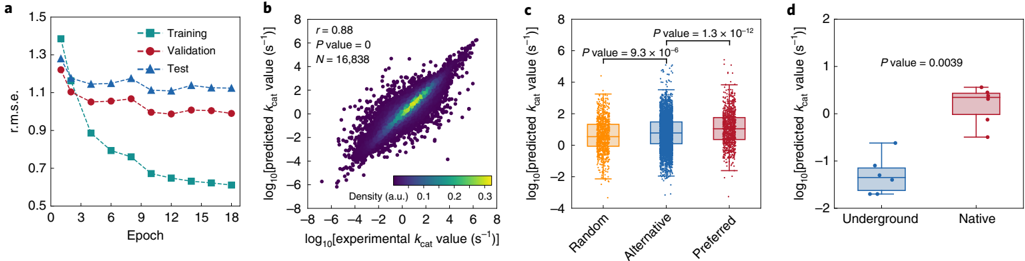
- DLKcat was trained on 16,838 unique entries covering 7,822 unique protein sequences, 851 organisms and 2,672 unique substrates; it achieved a test-set r.m.s.e. of 1.06 and Pearson’s r = 0.88 on the whole dataset (r = 0.71 on the test dataset).
- For promiscuous enzymes, predicted kcat values were higher for preferred substrates (median 11.07 s⁻¹) than alternative substrates (median 6.01 s⁻¹; P = 1.3 × 10⁻¹²) and random substrates (median 3.51 s⁻¹; P = 9.3 × 10⁻⁶).
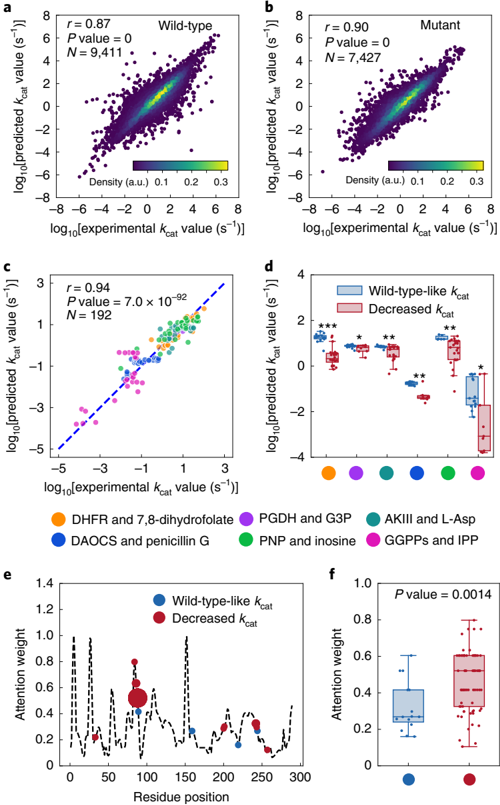
- DLKcat captured mutation effects: whole-dataset Pearson’s r = 0.90 for mutated enzymes and r = 0.94 for well-studied enzyme–substrate pairs with rich mutagenesis data; attention weights were significantly higher for residues mutated in the decreased-kcat group (P = 0.0014).
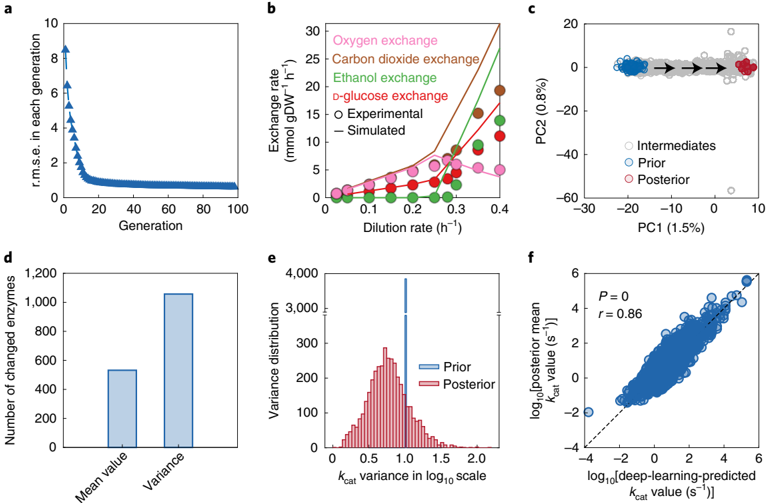
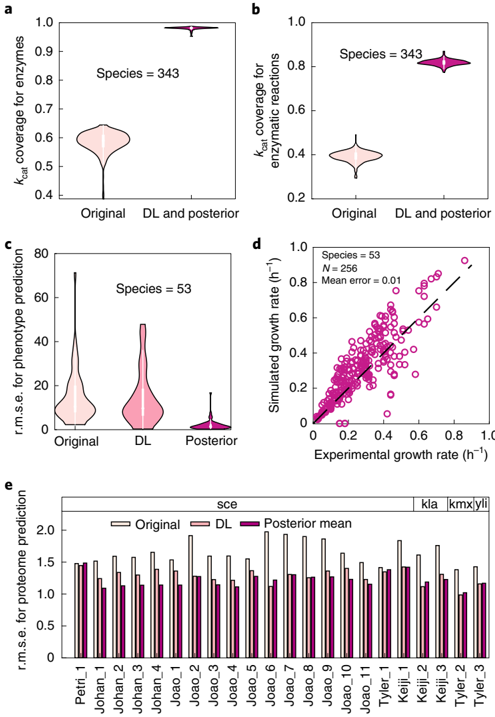
- DL-ecGEMs and posterior-mean-ecGEMs covered kcat values for ~80% of enzymes and defined enzymatic constraints for ~90% of enzymatic reactions, versus ~40% and ~60% for original-ecGEMs; DL-ecGEMs reduced proteome prediction r.m.s.e. by 30% compared with original-ecGEMs.
Methods
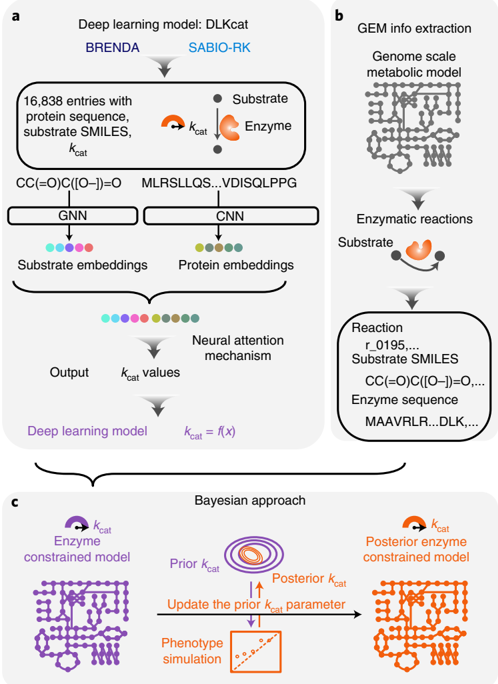
- DLKcat combines a graph neural network for substrates, represented as molecular graphs from SMILES, with a convolutional neural network for protein sequences split into overlapping n-gram amino acids; it was trained on data extracted from BRENDA and SABIO-RK, randomly split 80% training, 10% validation and 10% test.
- A Bayesian SMC-ABC pipeline used predicted kcat values as prior means with log-normal distributions N(kcat_i, 1) and updated them against experimental growth data collated as 371 entries for 53 species with 16 carbon sources; posterior-mean kcat values were used to parameterize posterior-mean-ecGEMs.
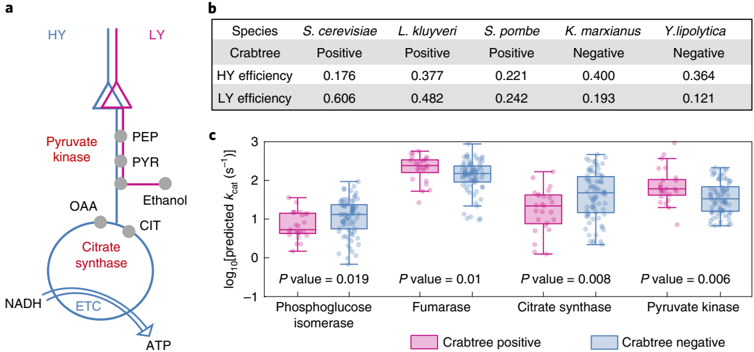
- The study reconstructed and compared original-ecGEMs, DL-ecGEMs and posterior-mean-ecGEMs for 343 yeast/fungi species, evaluating kcat coverage, growth/exchange-rate predictions, proteome predictions and Crabtree-phenotype-related enzyme differences.
Limitations
- The paper states that DLKcat still predicts a level of kinetic activity towards random substrates that is likely too high, due to limited negative data; it also did not consider environmental factors such as pH and temperature.
- The paper states that for reactions with multiple substrates or heteromeric enzyme complexes, multiple predicted kcat values can arise and the current approach selects the maximum, which is not ideal.
- The paper states that DL-ecGEMs and posterior-mean-ecGEMs inherit limitations from basic GEMs, including the steady-state assumption and lack of regulatory behaviour; kcat is not the only kinetic parameter, and affinity constants and internal metabolite concentrations are not readily considered.
Model-written summary. Check it against the paper before relying on it.
Integrity signals
Registry
Cites
Statistics
Figures
Verification
Claims the paper makes
21 Valid · 4 Not valid · 9 Not checked · 71 Own results and interpretations
The cited sources that could be checked couldn’t confirm or dispute this claim.
In the paper
“Since more than 200 out of 343 yeast/fungi species are not annotated in UniProt 58 and KEGG 62”
What the sources say
- Could not verifycites [58] The UniProt Consortium. UniProt: the universal protein knowledgebase. Nucleic Acids Res. 45, D158–D169 (2017). sourceExperimental — accuracy not yet measured
The 'Growth of reference proteomes' section describes UniProt's species coverage and annotation practices, while 'Identifying redundant proteomes' discusses fungal entries removed for redundancy. Neither reports an assessment of 343 yeast or fungal species or says that more than 200 lack annotation in UniProt and KEGG; searches for those figures and KEGG found no supporting passage. The indexed passages provide no page numbers. (LLM, conf=0.76)
- Could not verifycites [62] Kanehisa, M., Furumichi, M., Tanabe, M., Sato, Y. & Morishima, K. KEGG: new perspectives on genomes, pathways, diseases and drugs. Nucleic Acids Res. 45, D353–D361 (2017). sourceExperimental — accuracy not yet measured
The 'Improvement of GENES and KO databases' section describes how UniProt and KEGG annotate sequences, and Table 3 describes KEGG's sequence collections. Neither reports coverage of yeast or fungal species or the figure of more than 200 out of 343; searches for those terms and numbers found no supporting passage in our copy. (LLM, conf=0.76)
plain- Asserted: passes — The authors put it forward as true.
- Checkable: passes — It can be checked against evidence.
- Load-bearing: passes — The paper’s conclusions depend on it.
- Based: passes — The paper gives a reason why it holds.
- Could not verify
The cited sources support only part of this claim — read each source’s verdict below.
In the paper
“The scarcity of mutated enzymes with k cat values over twofold of the wild-type k cat values precluded defining the 'increased k cat ' group 25,26 .”
What the sources say
- Not checked — no full text of the sourcecites [25] Yep, A., Kenyon, G. L. & McLeish, M. J. Saturation mutagenesis of putative catalytic residues of benzoylformate decarboxylase provides a challenge to the accepted mechanism. Proc. Natl Acad. Sci. USA 105, 5733–5738 (2008). source
- Partly supportedcites [26] Lin, Y.-H. T., Huang, C. L. V., Ho, C., Shatsky, M. & Kirsch, J. F. A general method to predict the effect of single amino acid substitutions on enzyme catalytic activity. Preprint at bioRxiv https://doi.org/10.1101/236265 (2017). sourceExperimental — accuracy not yet measured
The Assessment of classification accuracy section (page unavailable) defines only deleterious and neutral mutation groups, not an 'increased kcat' group. It does not say that mutants exceeding twice the wild-type kcat were scarce or that scarcity prevented defining such a group; its classification concerns catalytic activity measured chiefly as kcat/Km. (LLM, conf=0.78)
plainstates a cause- Asserted: passes — The authors put it forward as true.
- Checkable: passes — It can be checked against evidence.
- Load-bearing: unclear — It is unclear whether the paper’s conclusions depend on it.
- Based: passes — The paper gives a reason why it holds.
The cited sources support only part of this claim — read each source’s verdict below.
In the paper
“In a S. cerevisiae ecGEM, only 5% of all enzymatic reactions have fully matched k cat values in BRENDA 2 .”
What the sources say
- Partly supportedcites [2] 2. Sánchez, B. J. et al. Improving the phenotype predictions of a yeast genome -scale metabolic model by incorporating enzymatic constraints. Mol. Syst. Biol. 13 , 935 (2017). sourceExperimental — accuracy not yet measured
The Materials and Methods section, “Criteria for obtaining kinetic data” (page unavailable), says the yeast model retrieved kcat values from BRENDA and relaxed the matching criteria when data were missing. It does not report that only 5% of enzymatic reactions had fully matched values; searches for that percentage and exact-match rates found no such figure in our copy. (LLM, conf=0.82)
plain- Asserted: passes — The authors put it forward as true.
- Checkable: passes — It can be checked against evidence.
- Load-bearing: passes — The paper’s conclusions depend on it.
- Based: passes — The paper gives a reason why it holds.
- Partly supported
The sources with a verdict support this claim; the rest weren’t checked yet, have no full text we could read, or their verdicts aren’t rated yet.
In the paper
“Moreover, even for those well-studied organisms, the k cat coverage is far from complete 13,15,16 .”
What the sources say
- Supportedcites [13] Nilsson, A., Nielsen, J. & Palsson, B. O. Metabolic models of protein allocation call for the kinetome. Cell Syst. 5, 538–541 (2017). source
In “The Current Gaps in the Kinetome” (page unavailable), the paper says that kinetic properties of most enzymes have not been measured. It also reports direct matching kcat values for only 5% of 3,249 enzymatic reactions in a genome-scale model, supporting the claim that coverage remains far from complete. (LLM, conf=0.93)
- Not checked — no full text of the sourcecites [15] Davidi, D. & Milo, R. Lessons on enzyme kinetics from quantitative proteomics. Curr. Opin. Biotechnol. 46, 81–89 (2017). source
- Supportedcites [16] Heckmann, D. et al. Machine learning applied to enzyme turnover numbers reveals protein structural correlates and improves metabolic models. Nat. Commun. 9, 5252 (2018). source
The Introduction states that in vitro kcat data are far from genome-scale, covering about 12% of direction-specific reactions in E. coli. This supports the claim that kcat coverage remains incomplete even in a well-studied organism. (LLM, conf=0.93)
plain- Asserted: passes — The authors put it forward as true.
- Checkable: passes — It can be checked against evidence.
- Load-bearing: passes — The paper’s conclusions depend on it.
- Based: passes — The paper gives a reason why it holds.
- Supported
The sources with a verdict support this claim; the rest weren’t checked yet, have no full text we could read, or their verdicts aren’t rated yet.
In the paper
“Crabtree negative species have higher TCA flux 39,40 .”
What the sources say
- Supportedcites [39] Christen, S. & Sauer, U. Intracellular characterization of aerobic glucose metabolism in seven yeast species by 13C flux analysis and metabolomics. FEMS Yeast Res. 11, 263–272 (2011). source
The Intracellular flux distribution section reports negligible respiratory TCA-cycle flux in Crabtree-positive species, whereas the TCA cycle is a major pathway in aerobic species. The Discussion further reports about threefold higher respiratory TCA-cycle fluxes in aerobic species than in respiring Crabtree-positive S. cerevisiae when compared at equal overall metabolic rates. (LLM, conf=0.92)
- Not checked — no full text of the sourcecites [40] Blank, L. M., Lehmbeck, F. & Sauer, U. Metabolic-flux and network analysis in fourteen hemiascomycetous yeasts. FEMS Yeast Res. 5, 545–558 (2005). source
plainstates an association- Asserted: passes — The authors put it forward as true.
- Checkable: passes — It can be checked against evidence.
- Load-bearing: unclear — It is unclear whether the paper’s conclusions depend on it.
- Based: passes — The paper gives a reason why it holds.
- Supported
52 more claims · 10 with their cited sources checked
Create a free account to see all 105 claims and every source verdict.
- It may state two separate claims as one. 21
- Probably not a substantial claim. 30
- The quote only partly states this claim. 1
Claims other papers make about this one
Each is checked against this paper’s own text: does it say what the citing paper says it does?
The cited source says what the claim attributes to it.
In the citing paper
“Our resulting Turnover Number Prediction model— TurNuP—outperforms a simple similarity-based approach and both previous methods for predicting k cat 14 , 16 .”
From Turnover number predictions for kinetically uncharacterized enzymes using machine and deep learning (2023) · cites this paper as [16]
In the citing paper
“Using genome-scale, enzyme-constrained metabolic models for different yeast species 16 , we demonstrate that parameterizations with TurNuP k cat predictions lead to improved proteome allocation predictions.”
From Turnover number predictions for kinetically uncharacterized enzymes using machine and deep learning (2023) · cites this paper as [16]
In the citing paper
“DLKcat predicts k cat using information about the enzyme’s amino acid sequence and about one of the reaction’s substrates, ignoring other reaction details such as products and co-substrates.”
From Turnover number predictions for kinetically uncharacterized enzymes using machine and deep learning (2023) · cites this paper as [16]
In the citing paper
“However, while DLKcat can in principle be applied to any enzymatic reaction, its predictions become poor for enzymes not similar to those in the training set (see below).”
From Turnover number predictions for kinetically uncharacterized enzymes using machine and deep learning (2023) · cites this paper as [16]
In the citing paper
“Li et al. 16 designed a pipeline to use predicted k cat values for the parameterization of enzyme-constrained genome-scale metabolic models, with the goal of predicting the proteome allocation patterns of yeast species.”
From Turnover number predictions for kinetically uncharacterized enzymes using machine and deep learning (2023) · cites this paper as [16]
3 more claims about this paper
Create a free account to see every claim other papers make about this one.
Self-check
Percentages, sums and reported differences re-computed from the paper’s own numbers.
Each contradiction between two passages listed here was confirmed by an independent check.
Rated minor: it would not touch a result — a value no result rests on, a p-value that stays on the same side of the significance level, or a conflict that is clerical, resolved elsewhere in the paper, or outside its own findings.
In the paper
§ Deep learning and Bayesian approaches improve ecGEM quality. · p. 4
“protein efficiency (that is, ATP produced per protein mass per time)”
§ Articles · p. 9
“Protein efficiency is defined as the protein cost for producing one flux ATP in each pathway.”
Citations
Cites
LeCun, Y., Bengio, Y., & Hinton, G. (2015) · Nature · doi:10.1038/nature14539 · Cited by 84,126
Neural Machine Translation by Jointly Learning to Align and Translate
Bahdanau, D., Cho, K., & Bengio, Y. (2014) · arXiv · doi:10.48550/arxiv.1409.0473 · Cited by 16,213
PAML 4: Phylogenetic Analysis by Maximum Likelihood
Yang, Z. (2007) · Molecular Biology and Evolution · doi:10.1093/molbev/msm088 · Cited by 13,879 · cited 1×
“64 ).”
KEGG: new perspectives on genomes, pathways, diseases and drugs
Kanehisa, M., Furumichi, M., Tanabe, M., Sato, Y., & Morishima, K. (2017) · Nucleic Acids Research · doi:10.1093/nar/gkw1092 · Cited by 8,865
PubChem Substance and Compound databases
Kim, S., Thiessen, P. A., Bolton, E. E., Chen, J., Fu, G., Gindulyte, A., Han, L., He, J., He, S., Shoemaker, B. A., et al. (2016) · Nucleic Acids Research · doi:10.1093/nar/gkv951 · Cited by 5,436
UniProt: the universal protein knowledgebase
The UniProt Consortium (2017) · Nucleic Acids Research · doi:10.1093/nar/gkw1099 · Cited by 4,436
PubChem 2019 update: improved access to chemical data
Kim, S., Chen, J., Cheng, T., Gindulyte, A., He, J., He, S., Li, Q., Shoemaker, B. A., Thiessen, P. A., Yu, B., et al. (2019) · Nucleic Acids Research · doi:10.1093/nar/gky1033 · Cited by 3,249 · cited 3×
“…on EC number annotation, DLKcat is furthermore able to predict isozyme-specific k cat values, while the use of SMILES (matching via the PubChem 48 or MetaNetX 49 databases) avoids the issues of ununified substrate naming between the GEM and BRENDA that original-ecGEM reconstruction pipelines…”
MethodNo evidence that carotenoid pigments boost either immune or antioxidant defenses in a songbird
Koch, R. E., Kavazis, A. N., Hasselquist, D., Hood, W. R., Zhang, Y., Toomey, M. B., & Hill, G. E. (2018) · Nature Communications · doi:10.1038/s41467-018-02974-x · Cited by 1,924
Perineuronal nets stabilize the grid cell network
Christensen, A. C., Lensjø, K. K., Lepperød, M. E., Dragly, S.-A., Sutterud, H., Blackstad, J. S., Fyhn, M., & Hafting, T. (2021) · Nature Communications · doi:10.1038/s41467-020-20241-w · Cited by 1,865
Creation and analysis of biochemical constraint-based models using the COBRA Toolbox v.3.0
Heirendt, L., Arreckx, S., Pfau, T., Mendoza, S. N., Richelle, A., Heinken, A., Haraldsdóttir, H. S., Wachowiak, J., Keating, S. M., Vlasov, V., et al. (2019) · Nature Protocols · doi:10.1038/s41596-018-0098-2 · Cited by 1,242 · cited 1×
“The MATLAB (2019b), COBRA (v.3.2) 66 , RAVEN (v.2.4) 67 and libSBML (v.5.17.0) toolboxes were used in the process with solver IBM ILOG CPLEX optimizer.”
MethodInfluential
Cited by
Items 101–200 of 470
The Dawn of High-Throughput and Genome-Scale Kinetic Modeling: Recent Advances and Future Directions
Toumpe, I., Choudhury, S., Hatzimanikatis, V., & Mišković, L. (2025) · ACS Synthetic Biology · doi:10.1021/acssynbio.4c00868 · Cited by 26
The multifunctionality of the caspase family of proteases: A new perspective beyond cell death
Li, J., Zhai, Q., Zhang, W., Chen, Y., Wang, C., Deng, X., Zhang, H., Lin, Z., & Zhu, Y. (2025) · Molecular Aspects of Medicine · doi:10.1016/j.mam.2025.101411 · Cited by 24
Self-citationAdvances in genome-scale metabolic models of industrially important fungi
Han, Y., Rangel, A. E. T., Pomraning, K., Kerkhoven, E. J., & Kim, J. (2023) · Current Opinion in Biotechnology · doi:10.1016/j.copbio.2023.103005 · Cited by 19
Self-citationShao, Q., Hollenbeak, A. C., Jiang, Y., Ran, X., Bachmann, B. O., & Yang, Z. J. (2025) · Chem Catalysis · doi:10.1016/j.checat.2025.101334 · Cited by 22
Protein engineering of amine transaminases
Meng, Q., Ramírez-Palacios, C., Wijma, H. J., & Janssen, D. B. (2022) · Frontiers in Catalysis · doi:10.3389/fctls.2022.1049179 · Cited by 23
REME: an integrated platform for reaction enzyme mining and evaluation
Shi, Z., Wang, D., Li, Y., Deng, R., Lin, J., Liu, C., Li, H., Wang, R., Zhao, M., Mao, Z., et al. (2024) · Nucleic Acids Research · doi:10.1093/nar/gkae405 · Cited by 18
“…we offer three tools for calculating reaction similarity (RDKit, RXNFP, DRFP) along with three evaluation metrics: Tanimoto similarity for RD-Kit, cosine measure, and Euclidean distance for RXNFP and DRFP. Higher Tanimoto and cosine scores are preferred, while a lower Euclidean distance is favored.”
Liu, L., Liu, S., Hu, X., Zhou, S., & Deng, Y. (2024) · Synthetic and Systems Biotechnology · doi:10.1016/j.synbio.2024.04.014 · Cited by 17
GRACE: Generative Redesign in Artificial Computational Enzymology
Hu, R.-E., Yu, C., & Ng, I. (2024) · ACS Synthetic Biology · doi:10.1021/acssynbio.4c00624 · Cited by 19
High-Level Production of Nicotinamide Mononucleotide by Engineered Escherichia Coli
Gan, J., Chen, X., He, Y., Pan, C., Zhang, Y., & Dong, Z. (2024) · Journal of Agricultural and Food Chemistry · doi:10.1021/acs.jafc.4c10205 · Cited by 16
Resource allocation in mammalian systems
Baghdassarian, H. M., & Lewis, N. E. (2024) · Biotechnology Advances · doi:10.1016/j.biotechadv.2023.108305 · Cited by 17
Machine Learning Enables Prediction of Pyrrolysyl-tRNA Synthetase Substrate Specificity
Zhang, Q., Zheng, W., Song, Z., Zhang, Q., Yang, L., Wu, J., Lin, J., Xu, G., & Yu, H. (2023) · ACS Synthetic Biology · doi:10.1021/acssynbio.3c00225 · Cited by 18
Wang, Y., Cheng, L., Zhang, Y., Cao, Y., & Alghazzawi, D. (2025) · Briefings in Bioinformatics · doi:10.1093/bib/bbaf187 · Cited by 24
Bi, X., Cheng, Y., Lv, X., Liu, Y., Li, J., Du, G., Chen, J., & Liu, L. (2024) · Advanced Science · doi:10.1002/advs.202408705 · Cited by 21
DiNuzzo, M. (2022) · Frontiers in Drug Discovery · doi:10.3389/fddsv.2022.1019706 · Cited by 18
Zeng, D.-W., Zhu, Y., Jiang, Y.-H., Ding, Y.-H., Wang, Z., Li, K., Liao, S., Fan, Y.-C., Zhang, L., Wang, Y., et al. (2025) · Chemical Engineering Journal · doi:10.1016/j.cej.2025.168210 · Cited by 18
Wu, Y., Lu, G., Zeng, R., Li, Z., Xu, X., Gui, Y., Guo, C., Deng, L., Bie, Y., Zhang, D., et al. (2025) · Chemical Engineering Journal · doi:10.1016/j.cej.2025.159573 · Cited by 17
Qin, N., Zhu, F., Liu, Y., et al. (2025) · ACS Synthetic Biology · doi:10.1021/acssynbio.4c00881 · Cited by 15
Platero-Rochart, D., Krivobokova, T., Gastegger, M., Reibnegger, G., & Sánchez-Murcia, P. A. (2023) · Journal of Chemical Information and Modeling · doi:10.1021/acs.jcim.3c00772 · Cited by 15
(2022) · doi:10.1016/j.ymben.2022.09.002 · Cited by 13
Domenzain, I., Lu, Y. P., Wang, H., Shi, J., Lu, H., & Nielsen, J. (2025) · Proceedings of the National Academy of Sciences · doi:10.1073/pnas.2417322122 · Cited by 24
Self-citationRen, Y., Celińska, E., Cai, P., & Zhou, Y. J. (2025) · Chem & Bio Engineering · doi:10.1021/cbe.5c00002 · Cited by 19
Prediction of Protein‐Ligand Binding Affinity by a Hybrid Quantum‐Classical Deep Learning Algorithm
Dong, L., Li, Y., Liu, D., Ji, Y., Hu, B., Shi, S., Zhang, F., Hu, J., Qian, K., Jin, X., et al. (2023) · Advanced Quantum Technologies · doi:10.1002/qute.202300107 · Cited by 18
From machine learning to multimodal models: The AI revolution in enzyme engineering
Shi, Z., Xu, S., Xue, S., Chen, K., Lu, Y., Wang, F., Long, S., Tian, Y., Zhang, P., Wang, J., et al. (2025) · BioDesign Research · doi:10.1016/j.bidere.2025.100044 · Cited by 22
Cai, Y., Zhang, W., Dou, Z., Wang, C., Yu, W., & Wang, L. (2025) · Computational Biology and Chemistry · doi:10.1016/j.compbiolchem.2024.108327 · Cited by 15
Growth Mechanics: General principles of optimal cellular resource allocation in balanced growth
(2022) · doi:10.1101/2022.10.27.514082 · Cited by 14
Enzyme catalytic efficiency prediction: employing convolutional neural networks and XGBoost
Alazmi, M. (2024) · Frontiers in Artificial Intelligence · doi:10.3389/frai.2024.1446063 · Cited by 17
Mathematical properties of optimal fluxes in cellular reaction networks at balanced growth
Dourado, H., Liebermeister, W., Ebenhöh, O., & Lercher, M. J. (2023) · PLOS Computational Biology · doi:10.1371/journal.pcbi.1011156 · Cited by 14
A geometric foundation model for enzyme retrieval with evolutionary insights
Liu, Y., Hua, C., Xu, M., Zeng, T., Rao, J., Zhang, Z., Wu, R., Weng, J., Coley, C. W., & Zheng, S. (2026) · Nature Catalysis · doi:10.1038/s41929-026-01478-y · Cited by 37
Molecular understanding of Eubacterium limosum chemostat methanol metabolism
Wood, J. C., González-García, R. A., Daygon, V. D., Talbo, G. H., Plan, M. R., Marcellin, E., & Virdis, B. (2023) · Sustainable Energy & Fuels · doi:10.1039/d2se01551j · Cited by 14
High-Temperature Tolerance Protein Engineering through Deep Evolution
Chu, H., Tian, Z., Hu, L., Zhang, H., Chang, H., Bai, J., Liu, D., Lu, L., Cheng, J., & Jiang, H. (2024) · BioDesign Research · doi:10.34133/bdr.0031 · Cited by 14
Advances in Machine Learning Models for Predicting Enzyme Kinetic Parameters
Malli, A., Vasyutyn, D., & Kim, J. R. (2025) · Journal of Chemical Information and Modeling · doi:10.1021/acs.jcim.5c02428 · Cited by 28
Non-canonical plant metabolism
Sweetlove, L. J., Ratcliffe, R. G., & Fernie, A. R. (2025) · Nature Plants · doi:10.1038/s41477-025-01965-3 · Cited by 18
Wu, Y., Yuan, Q., Yang, Y., Liu, D., Yang, S., & Ma, H. (2023) · Synthetic and Systems Biotechnology · doi:10.1016/j.synbio.2023.07.001 · Cited by 17
AI-driven exploration of microbial resources in fermented foods
Shi, P., Liu, S., Mao, J., Liu, X., Tu, R., Qin, H., Sun, A., Zhang, D., & Mao, J. (2025) · Trends in Food Science & Technology · doi:10.1016/j.tifs.2025.105450 · Cited by 23
Modeling host–pathway dynamics at the genome scale with machine learning
Merzbacher, C., Mac Aodha, O., & Oyarzún, D. A. (2025) · Metabolic Engineering · doi:10.1016/j.ymben.2025.05.008 · Cited by 13
Pereira, O., Ruth, M., Gerbig, D., Wende, R. C., & Schreiner, P. R. (2024) · Journal of the American Chemical Society · doi:10.1021/jacs.4c01286 · Cited by 15
Dissecting Metabolic Landscape of Alveolar Macrophage
Malla, S., Sajeevan, K. A., Acharya, B., Chowdhury, R., & Saha, R. (2023) · doi:10.1101/2023.09.08.556783 · Cited by 13
Modelling dynamic host-pathway interactions at the genome scale with machine learning
(2024) · doi:10.1101/2024.04.09.588720 · Cited by 13
Machine learning for predicting protein properties: A comprehensive review
Wang, Y., Zhang, Y., Zhan, X., He, Y., Yang, Y., Cheng, L., & Alghazzawi, D. (2024) · Neurocomputing · doi:10.1016/j.neucom.2024.128103 · Cited by 18
Wang, X., Mohsin, A., Sun, Y., Li, C., Zhuang, Y., & Wang, G. (2023) · Bioengineering · doi:10.3390/bioengineering10060744 · Cited by 20
Next-generation metabolic models informed by biomolecular simulations
Noor, M. S., Ferdous, S., Salehi, R., Gates, H., Dey, S., Raghunath, V. S., Zargar, M. R., & Chowdhury, R. (2025) · Current Opinion in Biotechnology · doi:10.1016/j.copbio.2025.103259 · Cited by 13
Caivano, A., van Winden, W. V., Dragone, G. M., & Mussatto, S. (2023) · Computational and Structural Biotechnology Journal · doi:10.1016/j.csbj.2023.09.015 · Cited by 11
Recycling of Thermoplastics with Machine Learning: A Review
Albuquerque, R. Q., Stephan, F., Pongratz, A., Brütting, C., Krause, K., & Ruckdäschel, H. (2025) · Advanced Functional Materials · doi:10.1002/adfm.202509447 · Cited by 21
Directed Evolution of Escherichia coli Nissle 1917 to Utilize Allulose as Sole Carbon Source
Xu, B., Liu, L., Lai, S., Chen, J., Wu, S., Lei, W., Lin, H., Zhang, Y., Hu, Y., He, J., et al. (2024) · Small Methods · doi:10.1002/smtd.202301385 · Cited by 18
Ali, R., & Zhang, Y. (2024) · Frontiers of Chemical Science and Engineering · doi:10.1007/s11705-024-2500-7 · Cited by 17
OMEGA-guided DNA polymerases enable random mutagenesis in a tunable window
Liu, L.-H., Lei, W., Zhang, Z., Lai, S., Xu, B., Ge, Q., Luo, J., Yang, M., Zhang, Y., Chen, J., et al. (2025) · Trends in biotechnology · doi:10.1016/j.tibtech.2025.02.011 · Cited by 14
Advances in Zero‐Shot Prediction‐Guided Enzyme Engineering Using Machine Learning
Liu, C., Wu, J., Chen, Y., Liu, Y., Zheng, Y., Liu, L., & Zhao, J. B. (2024) · ChemCatChem · doi:10.1002/cctc.202401542 · Cited by 18
Self-citationZhao, D., Zeng, H., Xiao, S., Yu, Y., Wang, J., Zhang, P., & Deng, Z. (2024) · Process Biochemistry · doi:10.1016/j.procbio.2024.01.017 · Cited by 14
Machine learning-driven optimization of metabolic balance for β-carotene production
Tu, W., Xu, J., Ma, Y., Katsimpouras, C., & Stephanopoulos, G. N. (2025) · Metabolic Engineering · doi:10.1016/j.ymben.2025.12.002 · Cited by 15
Biosynthesis of Edible Terpenoids: Hosts and Applications
Wang, M., Zhang, Z., Liu, X., Liu, Z., & Liu, R. (2025) · Foods · doi:10.3390/foods14040673 · Cited by 19
The return of metabolism: biochemistry and physiology of glycolysis
Grüning, N., Agostini, F., Caldana, C., Hartl, J., Heinemann, M., Keller, M. A., Krüsemann, J. L., Lamperti, C., Linster, C. L., Lindner, S. N., et al. (2025) · Biological reviews/Biological reviews of the Cambridge Philosophical Society · doi:10.1111/brv.70104 · Cited by 23
Self-citationGenome-scale models as a vehicle for knowledge transfer from microbial to mammalian cell systems
Strain, B., Morrissey, J., Antonakoudis, A., & Kontoravdi, C. (2023) · Computational and Structural Biotechnology Journal · doi:10.1016/j.csbj.2023.02.011 · Cited by 14
Xu, S., Chen, Y.-M., Meng, X., Pan, R., Yan, A.-X., Li, Z., & Li, Z. (2025) · Bioresource Technology · doi:10.1016/j.biortech.2025.133081 · Cited by 13
Self-citationHarrer, S., Rane, R., & Speight, R. E. (2024) · EBioMedicine · doi:10.1016/j.ebiom.2024.105446 · Cited by 15
Wang, B., Zhou, T., Shen, Y. C., Hu, W. W., Zhou, J., Tang, J., Han, R., Xu, G., Schwaneberg, U., Wang, B., et al. (2025) · ACS Catalysis · doi:10.1021/acscatal.5c01569 · Cited by 13
Song, Y., Han, B., Feng, Y., Jiang, Y., Zhang, W., Wang, H., Xin, F., & Jiang, W. (2025) · ACS Synthetic Biology · doi:10.1021/acssynbio.5c00475 · Cited by 12
Tang, H. L., Zhu, H., Huang, Y.-F., Wu, Z., Zou, S., Liu, Z., & Zheng, Y. (2024) · International Journal of Biological Macromolecules · doi:10.1016/j.ijbiomac.2024.131473 · Cited by 12
Qiu, W., Yang, P., Ye, J., Zhou, J., & Liu, S. (2025) · Journal of Agricultural and Food Chemistry · doi:10.1021/acs.jafc.4c11502 · Cited by 14
Understanding Cytochrome P450 Enzyme Substrate Inhibition and Prospects for Elimination Strategies
Zhang, Y. F., Zhang, G., Wang, T., Chen, Y., Wang, J., Li, P., Wang, R., & Su, J. (2024) · ChemBioChem · doi:10.1002/cbic.202400297 · Cited by 11
Self-citationIntegration of proteomic data with genome‐scale metabolic models: A methodological overview
Zare, F., & Fleming, R. (2024) · Protein Science · doi:10.1002/pro.5150 · Cited by 13
Intelligent Protein Design and Molecular Characterization Techniques: A Comprehensive Review
Wang, J., Chen, C., Yao, G., Ding, J., Wang, L., & Jiang, H. (2023) · Molecules · doi:10.3390/molecules28237865 · Cited by 11
Zhai, J., Qi, X., Cai, L., Liu, Y., Tang, H., Xie, L., & Wang, J. (2025) · Briefings in Bioinformatics · doi:10.1093/bib/bbaf212 · Cited by 15
DLKcat cannot predict meaningful k cat values for mutants and unfamiliar enzymes
Kroll, A., & Lercher, M. J. (2023) · doi:10.1101/2023.02.06.526991 · Cited by 10
From reactants to products: computational methods for biosynthetic pathway design
Ding, S., Liu, D., Tian, Y. T., Zhang, D., Xing, H., Chen, J., Liu, Z., & Hu, Q. (2025) · Synthetic and Systems Biotechnology · doi:10.1016/j.synbio.2025.05.005 · Cited by 10
Pettersen, J. P., Castillo, S., Jouhten, P., & Almaas, E. (2023) · BMC Bioinformatics · doi:10.1186/s12859-023-05506-7 · Cited by 10
Kroll, A., & Rousset, Y. (2025) · Current Opinion in Structural Biology · doi:10.1016/j.sbi.2025.103070 · Cited by 14
Recreating metabolic interactions of the tumour microenvironment
Curvello, R., Berndt, N., Hauser, S., & Loessner, D. (2024) · Trends in Endocrinology and Metabolism · doi:10.1016/j.tem.2023.12.005 · Cited by 10
Machine learning for enzyme catalytic activity: current progress and future horizons
Qiu, S., Saeed, H., Leonard, W., Li, F., & Yang, A. (2026) · Briefings in Bioinformatics · doi:10.1093/bib/bbag002 · Cited by 15
Self-citationFinding the dark matter: Large language model‐based enzyme kinetic data extractor and its validation
Wei, G., Ran, X., AI‐Abssi, R., & Yang, Z. (2025) · Protein Science · doi:10.1002/pro.70251 · Cited by 10
“…on predictive modeling of a total 44,376 data-points, we retrained three previously published machine learning kcal predictors (i.e., MESI [Nie et al., 2024], DLKcat [Li et al., 2022], and TurNuP [Kroll et al., 2023]) using a curated training set of 36,980 kcat entries extracted via EnzyExtract.”
Temporal analysis of doxorubicin-induced cardiac toxicity and hypertrophy
Lin, Y.-T., Lee, Y., Tseng, W.-W., Chen, Z.-H., Hsieh, H.-C., Lin, K., Su, J., & Wei, A. (2025) · npj Systems Biology and Applications · doi:10.1038/s41540-025-00545-7 · Cited by 15
Machine Learning Empowering Microbial Cell Factory: A Comprehensive Review
Kong, D., Qian, J., Gao, C., Wang, Y., Shi, T., & Ye, C. (2025) · Applied Biochemistry and Biotechnology · doi:10.1007/s12010-025-05260-x · Cited by 12
Enzyme property prediction using artificial intelligence
Yuan, L., Shafaei, S., & Zhao, H. (2025) · Current Opinion in Chemical Engineering · doi:10.1016/j.coche.2025.101208 · Cited by 16
Self-citationSjöberg, G., Reķēna, A., Fornstad, M., Lahtvee, P., & van Maris, A. J. A. (2024) · Metabolic Engineering · doi:10.1016/j.ymben.2024.01.007 · Cited by 11
Breaking Evolution’s Ceiling: AI-Powered Protein Engineering
Jin, S., Wu, Q., Fu, G., Lu, D. X., Wang, F., Deng, L. F., & Nie, K. (2025) · Catalysts · doi:10.3390/catal15090842 · Cited by 15
Specialized pro-resolving mediators: Biosynthetic pathways, biocatalytic synthesis, and applications
Lee, T., Shin, K., Park, J., & Oh, D. (2025) · Biotechnology Advances · doi:10.1016/j.biotechadv.2025.108682 · Cited by 12
Integrating yeast biodiversity and machine learning for predictive metabolic engineering
Watcharawipas, A., Runguphan, W., Khamwachirapithak, P., & Laothanachareon, T. (2025) · FEMS Yeast Research · doi:10.1093/femsyr/foaf072 · Cited by 14
Lu, X., Cao, M., Ma, M., Wu, Y., Qu, M., Du, F., Ji, R., Duan, M., Dong, L., Liu, K., et al. (2025) · Food Bioengineering · doi:10.1002/fbe2.70029 · Cited by 14
Optimizing VLP production in gene therapy: Opportunities and challenges for in silico modeling
Zehetner, L., Széliová, D., Kraus, B., Graninger, M., Zanghellini, J., & Bort, J. A. H. (2023) · Biotechnology Journal · doi:10.1002/biot.202200636 · Cited by 9
Precise metabolic modeling in post-omics era: accomplishments and perspectives
Kong, Y., Chen, H., Huang, X., Chang, L., Yang, B. K., & Chen, W. (2024) · Critical Reviews in Biotechnology · doi:10.1080/07388551.2024.2390089 · Cited by 10
Overcoming bottlenecks towards complete biocatalytic conversions and complete product recovery
Wohlgemuth, R. (2025) · Reaction Chemistry & Engineering · doi:10.1039/d4re00349g · Cited by 12
EP-Pred: A Machine Learning Tool for Bioprospecting Promiscuous Ester Hydrolases
Xiang, R., Fernandez-Lopez, L., Robles-Martín, A., Ferrer, M., & Guallar, V. (2022) · Biomolecules · doi:10.3390/biom12101529 · Cited by 9
“Therefore, methods to directly identify substrate promiscuity from sequence alone would greatly increase the efficiency of bioprospecting for new esterase candidates, a task ideal for machine learning algorithms (see for example, other recently developed methods for activity predictions [12]).”
MethodModern machine learning methods for protein property prediction
Dosajh, A., Agrawal, P., Chatterjee, P., & Priyakumar, U. D. (2025) · Current Opinion in Structural Biology · doi:10.1016/j.sbi.2025.102990 · Cited by 11
Avoiding Replicates in Biocatalysis Experiments: Machine Learning for Enzyme Cascade Optimization
Siedentop, R., Siska, M., Hermes, J., Lütz, S., von Lieres, E., & Rosenthal, K. (2024) · ChemCatChem · doi:10.1002/cctc.202400777 · Cited by 12
Wang, Y., Mao, Z., Dong, J., Zhang, P., Gao, Q., Liu, D., Tian, C., & Ma, H. (2024) · Microbial Cell Factories · doi:10.1186/s12934-024-02415-z · Cited by 12
A compact model of Escherichia coli core and biosynthetic metabolism
Corrao, M., He, H., Liebermeister, W., Noor, Ε., & Bar‐Even, A. (2025) · PLoS Computational Biology · doi:10.1371/journal.pcbi.1013564 · Cited by 16
CarveAdornCurate: a versatile cloud-based platform for constructing multiscale metabolic models
Cheng, Y., Yu, W., Bi, X., Liu, Y., Li, J., Du, G., Chen, J., Lv, X., & Liu, L. (2025) · Trends in biotechnology · doi:10.1016/j.tibtech.2025.01.011 · Cited by 8
Qiu, K., Song, F., Wang, K., Zhang, H., Yin, X., Qin, Z., Zhou, J., & Xu, S. (2025) · Journal of Agricultural and Food Chemistry · doi:10.1021/acs.jafc.4c10027 · Cited by 9
Qiang, T., Chen, Y., Li, B., Dong, Y., Wei, X., Liu, J., Zhang, B., Liu, H., & Xiao, P. (2023) · Synthetic and Systems Biotechnology · doi:10.1016/j.synbio.2023.11.011 · Cited by 9
Self-citationZhang, Z., Li, Z., Nan, J., Ouyang, J., Chen, X., Wang, H., & Wang, A. (2024) · Bioresource Technology · doi:10.1016/j.biortech.2024.132011 · Cited by 10
Kim, S., Lim, J., Kim, S., et al. (2025) · Advanced Materials · doi:10.1002/adma.202416121 · Cited by 8
Descriptor-augmented machine learning for enzyme-chemical interaction predictions
Han, Y., Zhang, H., Zeng, Z., Liu, Z., Lu, D., & Liu, Z. (2024) · Synthetic and Systems Biotechnology · doi:10.1016/j.synbio.2024.02.006 · Cited by 11
Advances in the Modification of Enzymatic Properties Based on Protein Engineering Strategies
Huang, Y., Wen, L., & Yang, B. K. (2026) · Journal of Agricultural and Food Chemistry · doi:10.1021/acs.jafc.5c13434 · Cited by 12
Jiang, H., Wang, J., Yang, Z., Chen, C., Ge, Y., Bao, S., Wan, X., Ding, J., & Wang, L. (2024) · Research Square · doi:10.21203/rs.3.rs-3916417/v1 · Cited by 6
Liu, Z., Chen, M., Hu, J., Wang, Y., & Chen, Y. (2024) · doi:10.1101/2024.01.23.576957 · Cited by 7
Self-citationMa, S., Li, M., Yan, S., Wang, Y., Wang, B., & Luo, W. (2024) · International Journal of Biological Macromolecules · doi:10.1016/j.ijbiomac.2024.137014 · Cited by 8
Understanding methanol metabolism through systems biology: advances and future perspectives
Wang, H., Bai, F., Lu, H., & Zhou, Y. J. (2025) · Current Opinion in Biotechnology · doi:10.1016/j.copbio.2025.103370 · Cited by 7
Self-citationBioStructNet: Structure-Based Network with Transfer Learning for Predicting Biocatalyst Functions
Wang, X., Zhou, J., Mueller, J., Quinn, D., Moody, T. S., & Huang, M. (2024) · doi:10.1101/2024.10.16.618725 · Cited by 7
Ma, Y., & Eser, B. E. (2025) · Catalysts · doi:10.3390/catal15121139 · Cited by 11
AI-enabled alkaline-resistant evolution of protein to apply in mass production
Kang, L., Wu, B., Zhou, B., Tan, P., Kang, Y. (., Yan, Y., Zong, Y., Li, S., Liu, Z., & Hong, L. (2025) · eLife · doi:10.7554/elife.102788 · Cited by 7
Open Enzyme Database: a community-wide repository for sharing enzyme data
Yuan, L., Bianchi, D. M., Arneson, K., Guo, B., Lambert, S., Stephens, C., Wasnik, Y., Pond, C., Berry, M. J., & Zhao, H. (2025) · Nucleic Acids Research · doi:10.1093/nar/gkaf1082 · Cited by 9
Self-citation
Metadata
- Authors
- Li, F., Yuan, L., Lu, H., Li, G., Chen, Y., Engqvist, M. K. M., Kerkhoven, E. J., & Nielsen, J.
- Affiliations
- Chalmers University of Technology (SE)
- BioInnovation Institute (DK)
- Corresponding author
- Kerkhoven, Eduard J.
- ORCID
- Venue
- Nature Catalysis
- Published
- 2022-06-16
- Volume
- 5
- Issue
- 8
- Pages
- 662-672
- ISSN
- 2520-1158 (ISSN-L)
- OpenAlex
- W4283032119
- Semantic Scholar
- 86a572fb9c57eb45e89f2e6d35af77dce2750d61
- Cited by
- 466
- References
- 68
- Citations by year
- 2026: 128 · 2025: 146 · 2024: 104 · 2023: 65 · 2022: 22
- FWCI
- 27.49
- Type
- journal article
- Language
- en
- Open access
- hybrid
- doi.org
- Licence
- cc-by
- creativecommons.org/licenses/by/4.0 (tdm)
- creativecommons.org/licenses/by/4.0 (vor)
- Locations
- Nature Catalysis (publishedVersion, cc-by)
- bioRxiv (Cold Spring Harbor Laboratory) (acceptedVersion, cc-by)
- Chalmers Research (Chalmers University of Technology) (submittedVersion)
- Funders
- European Commission (HORIZON2020, 686070)
- Chalmers Tekniska Högskola
- Knut och Alice Wallenbergs Stiftelse (NNF10CC1016517)
- Novo Nordisk (NNF10CC1016517)
- Vetenskapsrådet (05973, 2018-, 201805973)
- Novo Nordisk Fonden (NNF10CC1016517)
- Topics
- Life Sciences › Biochemistry, Genetics and Molecular Biology › Molecular Biology › Microbial Metabolic Engineering and Bioproduction
- Life Sciences › Biochemistry, Genetics and Molecular Biology › Molecular Biology › Bioinformatics and Genomic Networks
- Life Sciences › Biochemistry, Genetics and Molecular Biology › Molecular Biology › Machine Learning in Bioinformatics
- Keywords
- turnover number, metabolic enzymes, deep learning, genome-scale metabolic models, enzyme kinetics, yeast, substrate structure, protein sequences, amino acid residues, phenotype prediction, physiological diversity
About these checks
Registry, retraction, Cites and statistics results are computed, not judged, with one exception: a printed reference that no index lists is read once by a model before it counts as a citation error. Claims are extracted by a model and kept only when their quote appears verbatim in the text; each cited source is then checked, with a model’s help, for whether it says what the claim relies on. Those verdicts can be wrong — read the claim’s quote and the cited source before relying on one.
The claim verdicts this report counts are experimental: their accuracy is not yet measured.
A language model drew the claims from the paper on 2026-10-10, under version 3 of the claim definition (model deepseek-v4.1-flash, prompt extract-v3).
A second model labelled each claim on 2026-10-10 (model jev-1.13-20260917, definition revision gold-guideline-v0.2).
Cited sources are checked with a language model’s help (gpt-6-sol).
Statistics and arithmetic are recomputed, not judged.
Confidence bands are shown only for fields calibrated on our annotated test set. None is calibrated yet, so no band is shown.
What counts as a claim ›How we measure confidence ›How we check this ›
Are you an author, or do you see a problem with this page? Request a review
Data sources
Bibliographic data: Semantic Scholar, OpenAlex, Crossref.
Contains information from the Semantic Scholar Academic Graph Datasets, made available under the ODC Attribution License (ODC-BY 1.0).
Semantic Scholar’s data is described in: Kinney, R., et al. (2023). The Semantic Scholar Open Data Platform. arXiv:2301.10140.
