

The DOI matches its Crossref record; 61 of the 61 references it cites were found in a registry or an index.
AlphaFold2 reveals commonalities and novelties in protein structure space for 21 model organisms
Open accessPublished version of a preprint
Abstract
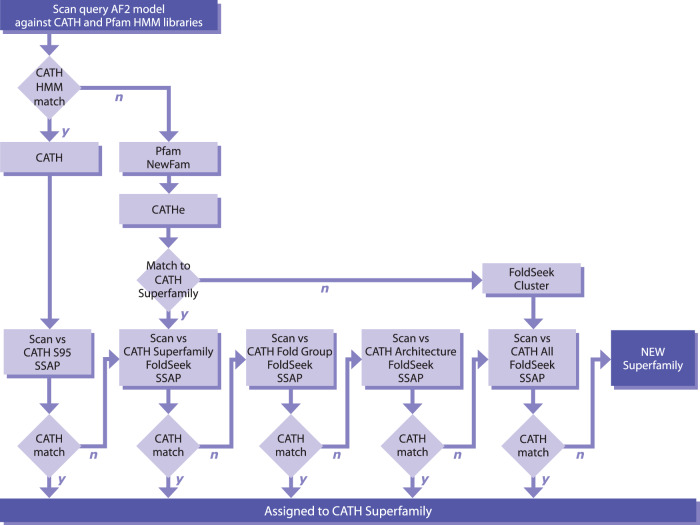
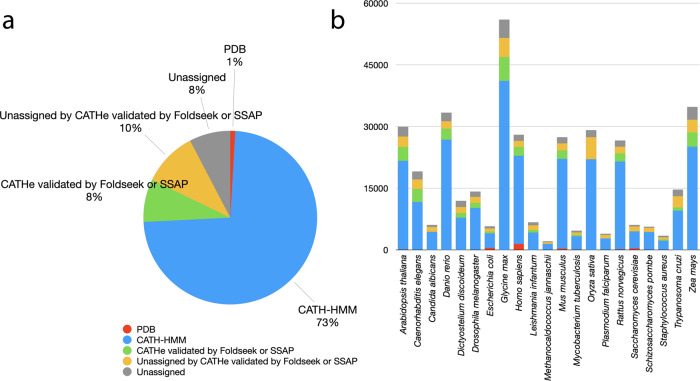
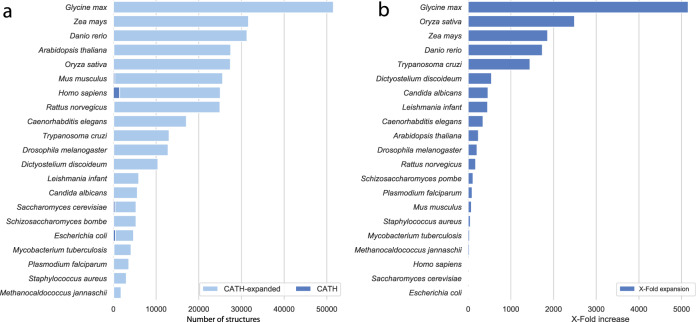
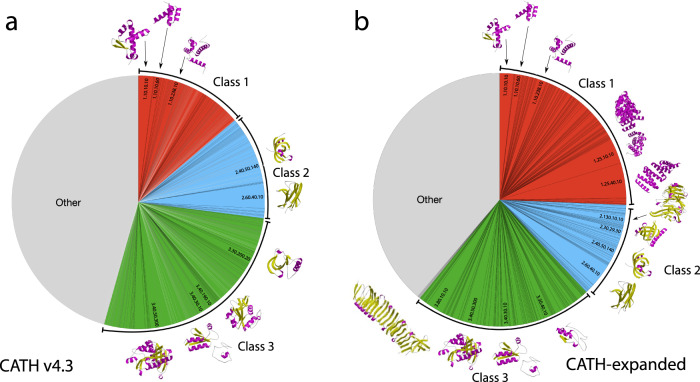
Abstract Deep-learning (DL) methods like DeepMind’s AlphaFold2 (AF2) have led to substantial improvements in protein structure prediction. We analyse confident AF2 models from 21 model organisms using a new classification protocol (CATH-Assign) which exploits novel DL methods for structural comparison and classification. Of ~370,000 confident models, 92% can be assigned to 3253 superfamilies in our CATH domain superfamily classification. The remaining cluster into 2367 putative novel superfamilies. Detailed manual analysis on 618 of these, having at least one human relative, reveal extremely remote homologies and further unusual features. Only 25 novel superfamilies could be confirmed. Although most models map to existing superfamilies, AF2 domains expand CATH by 67% and increases the number of unique ‘global’ folds by 36% and will provide valuable insights on structure function relationships. CATH-Assign will harness the huge expansion in structural data provided by DeepMind to rationalise evolutionary changes driving functional divergence.
Overview
The claims and statistics of this paper haven’t been checked yet.
Run the check — free, no account needed. It reads the open-access text and checks the sources it cites.
Integrity signals
Registry
Cites
Statistics
Figures
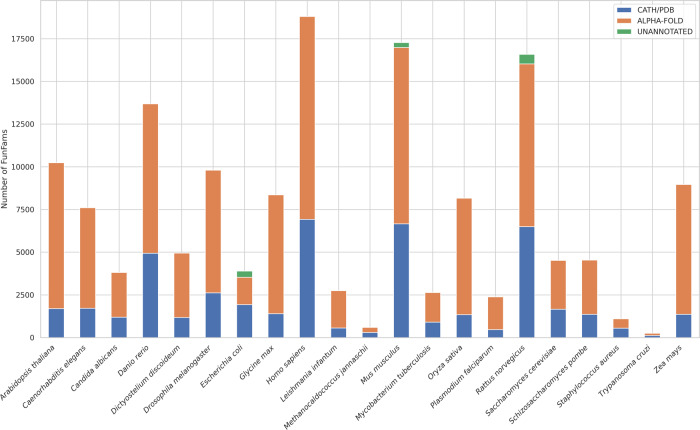
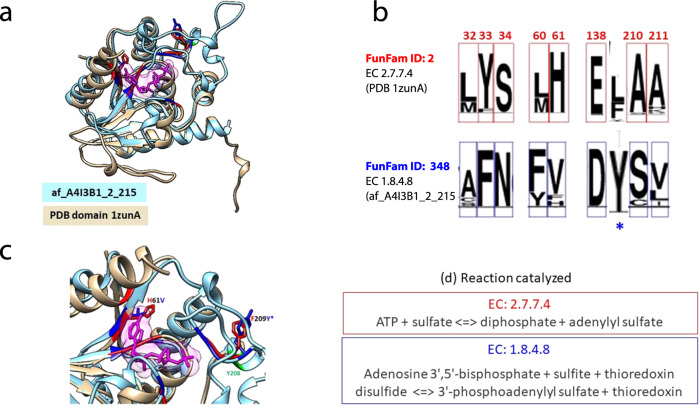
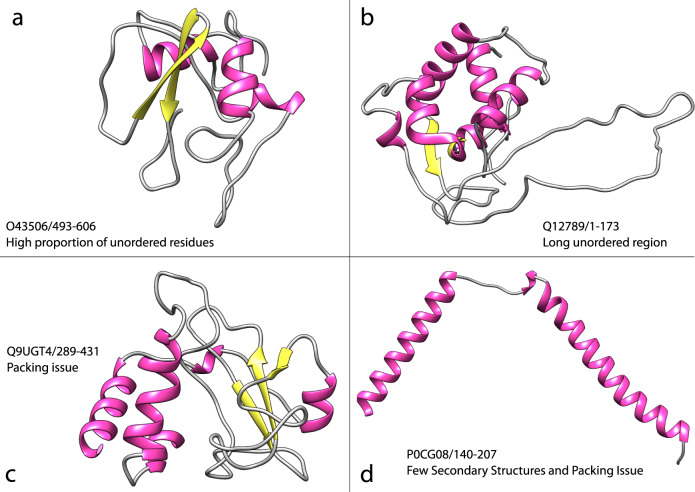
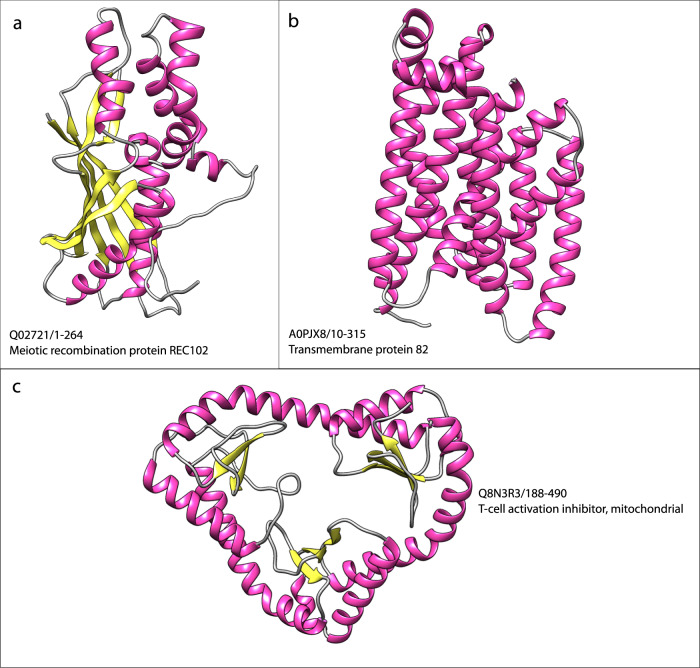
Verification
Claims the paper makes
The claims and statistics of this paper haven’t been checked yet.
Run the check — free, no account needed. It reads the open-access text and checks the sources it cites.
Claims other papers make about this one
Each is checked against this paper’s own text: does it say what the citing paper says it does?
The source backs part of the claim, not all of it — or backs it for a different population, condition or comparison.
In the citing paper
“As a result, numerous areas within the life sciences have experienced considerable impact due to the availability of accurately predicted protein structures. The primary domains notably affected include structure determination, structure-based drug discovery, and structural bioinformatics (11–13).”
From AlphaFold Protein Structure Database in 2024: providing structure coverage for over 214 million protein sequences (2024) · cites this paper as [11]
Experimental — accuracy not yet measured
Self-check
Percentages, sums and reported differences re-computed from the paper’s own numbers.
The self-check needs the paper’s full text.
Citations
Cites
UCSF Chimera—A visualization system for exploratory research and analysis
Pettersen, E. F., Goddard, T. D., Huang, C. C., Couch, G. S., Greenblatt, D. M., Meng, E. C., & Ferrin, T. E. (2004) · Journal of Computational Chemistry · doi:10.1002/jcc.20084 · Cited by 46,061
Highly accurate protein structure prediction with AlphaFold
Jumper, J., Evans, R., Pritzel, A., Green, T., Figurnov, M., Ronneberger, O., Tunyasuvunakool, K., Bates, R., Žídek, A., Potapenko, A., et al. (2021) · Nature · doi:10.1038/s41586-021-03819-2 · Cited by 43,764
Self-citationKabsch, W., & Sander, C. (1983) · Biopolymers · doi:10.1002/bip.360221211 · Cited by 15,320
Szklarczyk, D., Gable, A. L., Nastou, K. C., Lyon, D., Kirsch, R., Pyysalo, S., Doncheva, N. T., Legeay, M., Fang, T., Bork, P., et al. (2021) · Nucleic Acids Research · doi:10.1093/nar/gkaa1074 · Cited by 8,056
Varadi, M., Anyango, S., Deshpande, M., Nair, S., Natassia, C., Yordanova, G., Yuan, D., Stroe, O., Wood, G., Laydon, A., et al. (2022) · Nucleic Acids Research · doi:10.1093/nar/gkab1061 · Cited by 7,850
Self-citationMurzin, A. G., Brenner, S. E., Hubbard, T., & Chothia, C. (1995) · Journal of Molecular Biology · doi:10.1016/s0022-2836(05)80134-2 · Cited by 6,445
Biopython: freely available python tools for computational molecular biology and bioinformatics
Cock, P. J. A., Antao, T., Chang, J. T., Chapman, B. A., Cox, C. J., Dalke, A., Friedberg, I., Hamelryck, T., Kauff, F., Wilczynski, B., et al. (2009) · Bioinformatics · doi:10.1093/bioinformatics/btp163 · Cited by 6,080
Accurate prediction of protein structures and interactions using a 3-track network
Baek, M., DiMaio, F., Anishchenko, I., Dauparas, J., Ovchinnikov, S., Lee, G. R., Wang, J., Cong, Q., Kinch, L. N., Schaeffer, R. D., et al. (2021) · doi:10.1101/2021.06.14.448402 · Cited by 5,549
Protein complex prediction with AlphaFold-Multimer
Evans, R., O’Neill, M., Pritzel, A., Antropova, N., Senior, A., Green, T., Žídek, A., Bates, R., Blackwell, S., Yim, J., et al. (2021) · doi:10.1101/2021.10.04.463034 · Cited by 3,808
TM-align: a protein structure alignment algorithm based on the TM-score
Zhang, Y. (2005) · Nucleic Acids Research · doi:10.1093/nar/gki524 · Cited by 3,774
Cited by
Sorted by citations
Fast and accurate protein structure search with Foldseek
van Kempen, M., Kim, S. S., Tumescheit, C., Mirdita, M., Lee, J., Gilchrist, C. L. M., Söding, J., & Steinegger, M. (2022) · doi:10.1101/2022.02.07.479398 · Cited by 2,598
Self-citationFast and accurate protein structure search with Foldseek
van Kempen, M., Kim, S. S., Tumescheit, C., Mirdita, M., Lee, J., Gilchrist, C. L. M., Söding, J., & Steinegger, M. (2024) · Nature Biotechnology · doi:10.1038/s41587-023-01773-0 · Cited by 2,596
Self-citationVaradi, M., Bertoni, D., Magana, P., Paramval, U., Pidruchna, I., Radhakrishnan, M., Tsenkov, M., Nair, S., Mirdita, M., Yeo, J., et al. (2024) · Nucleic Acids Research · doi:10.1093/nar/gkad1011 · Cited by 2,052
Self-citationDALI shines a light on remote homologs: One hundred discoveries
Holm, L., Laiho, A., Törönen, P., & Salgado, M. G. (2022) · Protein Science · doi:10.1002/pro.4519 · Cited by 723
Clustering predicted structures at the scale of the known protein universe
Barrio-Hernandez, I., Yeo, J., Jänes, J., Mirdita, M., Gilchrist, C. L. M., Wein, T., Varadi, M., Velankar, S., Beltrao, P., & Steinegger, M. (2023) · Nature · doi:10.1038/s41586-023-06510-w · Cited by 362
Self-citationBilingual language model for protein sequence and structure
Heinzinger, M., Weissenow, K., Sanchez, J. G., Henkel, A., Mirdita, M., Steinegger, M., & Rost, B. (2024) · NAR Genomics and Bioinformatics · doi:10.1093/nargab/lqae150 · Cited by 311
Self-citationAn atlas of protein homo-oligomerization across domains of life
Schweke, H., Pacesa, M., Levin, T., Goverde, C. A., Kumar, P., Duhoo, Y., Dornfeld, L. J., Dubreuil, B., Georgeon, S., Ovchinnikov, S., et al. (2024) · Cell · doi:10.1016/j.cell.2024.01.022 · Cited by 144
Uncovering new families and folds in the natural protein universe
Durairaj, J., Waterhouse, A. M., Mets, T., Brodiazhenko, T., Abdullah, M., Studer, G., Tauriello, G., Akdel, M., Andreeva, A. E., Bateman, A. G., et al. (2023) · Nature · doi:10.1038/s41586-023-06622-3 · Cited by 159
Exploring structural diversity across the protein universe with The Encyclopedia of Domains
Lau, A. M., Bordin, N., Kandathil, S. M., Sillitoe, I., Waman, V. P., Wells, J., Orengo, C. A., & Jones, D. T. (2024) · Science · doi:10.1126/science.adq4946 · Cited by 140
Self-citationThe impact of AlphaFold Protein Structure Database on the fields of life sciences
Váradi, M., & Velankar, S. S. (2022) · PROTEOMICS · doi:10.1002/pmic.202200128 · Cited by 139
Self-citationTMbed: transmembrane proteins predicted through language model embeddings
Bernhofer, M., & Rost, B. (2022) · BMC Bioinformatics · doi:10.1186/s12859-022-04873-x · Cited by 109
Self-citationBittrich, S., Bhikadiya, C., Bi, C., Chao, H., Duarte, J. M., Dutta, S., Fayazi, M., Henry, J., Khokhriakov, I., Lowe, R., et al. (2023) · Journal of Molecular Biology · doi:10.1016/j.jmb.2023.167994 · Cited by 85
AlphaFold two years on: Validation and impact
Kovalevskiy, O. V., Mateos-Garcia, J. C., & Tunyasuvunakool, K. (2024) · Proceedings of the National Academy of Sciences · doi:10.1073/pnas.2315002121 · Cited by 92
Novel machine learning approaches revolutionize protein knowledge
Bordin, N., Dallago, C., Heinzinger, M., Kim, S., Littmann, M., Rauer, C., Steinegger, M., Rost, B., & Orengo, C. (2023) · Trends in Biochemical Sciences · doi:10.1016/j.tibs.2022.11.001 · Cited by 72
Self-citationDeep learning for protein structure prediction and design—progress and applications
Jänes, J., & Beltrão, P. (2024) · Molecular Systems Biology · doi:10.1038/s44320-024-00016-x · Cited by 76
SETH predicts nuances of residue disorder from protein embeddings
Ilzhöfer, D., Heinzinger, M., & Rost, B. (2022) · Frontiers in Bioinformatics · doi:10.3389/fbinf.2022.1019597 · Cited by 52
Self-citationGoldtzvik, Y., Sen, N., Lam, S. D., & Orengo, C. A. (2023) · Current Opinion in Structural Biology · doi:10.1016/j.sbi.2023.102640 · Cited by 48
Self-citationCATH 2024: CATH-AlphaFlow Doubles the Number of Structures in CATH and Reveals Nearly 200 New Folds
Waman, V., Bordin, N., Alcraft, R., Vickerstaff, R. J., Rauer, C., Chan, Q., Sillitoe, I., Yamamori, H., & Orengo, C. A. (2024) · Journal of Molecular Biology · doi:10.1016/j.jmb.2024.168551 · Cited by 46
Self-citationA pathogen effector FOLD diversified in symbiotic fungi
Teulet, A., Quan, C., Evangelisti, E., Wanke, A., Yang, W., & Schornack, S. (2023) · New Phytologist · doi:10.1111/nph.18996 · Cited by 40
Recent Progress of Protein Tertiary Structure Prediction
Wuyun, Q., Chen, Y., Shen, Y., Cao, Y., Hu, G., Cui, W., Gao, J., & Zheng, W. H. (2024) · Molecules · doi:10.3390/molecules29040832 · Cited by 48
Challenges in bridging the gap between protein structure prediction and functional interpretation
Varadi, M., Tsenkov, M., & Velankar, S. (2025) · Proteins: Structure, Function, and Bioinformatics · doi:10.1002/prot.26614 · Cited by 36
Self-citationMcCafferty, C. L., Pennington, E. L., Papoulas, O., Taylor, D. W., & Marcotte, E. M. (2023) · Communications Biology · doi:10.1038/s42003-023-04773-7 · Cited by 35
“Its broad applicability across protein families without requiring prior structural knowledge has already led to the discovery of at least 26 entirely new protein folds (10).”
BackgroundRecent Advances and Challenges in Protein Structure Prediction
Peng, C., Liang, F., Xia, Y., Zhao, K., Hou, M., & Zhang, G. (2023) · Journal of Chemical Information and Modeling · doi:10.1021/acs.jcim.3c01324 · Cited by 42
Varadi, M., Nair, S., Sillitoe, I., Tauriello, G., Anyango, S., Bienert, S., Borges, C., Deshpande, M., Green, T., Hassabis, D., et al. (2022) · GigaScience · doi:10.1093/gigascience/giac118 · Cited by 32
Self-citationBeyond sequence: Structure-based machine learning
Durairaj, J., de Ridder, D., & van Dijk, A. D. J. (2022) · Computational and Structural Biotechnology Journal · doi:10.1016/j.csbj.2022.12.039 · Cited by 32
Varadi, M., Bordin, N., Orengo, C., & Velankar, S. (2023) · Current Opinion in Structural Biology · doi:10.1016/j.sbi.2023.102543 · Cited by 29
Self-citationECOD domain classification of 48 whole proteomes from AlphaFold Structure Database using DPAM2
Schaeffer, R. D., Zhang, J., Medvedev, K. E., Kinch, L. N., Cong, Q., & Grishin, N. V. (2024) · PLOS Computational Biology · doi:10.1371/journal.pcbi.1011586 · Cited by 22
Aubel, M., Eicholt, L. A., & Bornberg‐Bauer, E. (2023) · F1000Research · doi:10.12688/f1000research.130443.1 · Cited by 24
Protein functional site annotation using local structure embeddings
Derry, A., Tartici, A., & Altman, R. B. (2025) · Proceedings of the National Academy of Sciences · doi:10.1073/pnas.2513219122 · Cited by 21
Functional domain annotation by structural similarity
Borujeni, P. M., & Salavati, R. (2024) · NAR Genomics and Bioinformatics · doi:10.1093/nargab/lqae005 · Cited by 19
LambdaPP : Fast and accessible protein‐specific phenotype predictions
(2022) · doi:10.1002/pro.4524 · Cited by 19
Self-citationGalaxySagittarius-AF: Predicting Targets for Drug-Like Compounds in the Extended Human 3D Proteome
Kwon, S., Jung, N., Yang, J., & Seok, C. (2024) · Journal of Molecular Biology · doi:10.1016/j.jmb.2024.168617 · Cited by 18
AlphaFold2 Update and Perspectives
Tourlet, S., Radjasandirane, R., Diharce, J., & de Brevern, A. G. (2023) · BioMedInformatics · doi:10.3390/biomedinformatics3020025 · Cited by 18
AlphaFold2 Predicts Whether Proteins Interact Amidst Confounding Structural Compatibility
Martin, J. (2024) · Journal of Chemical Information and Modeling · doi:10.1021/acs.jcim.3c01805 · Cited by 20
KinFams: De-Novo Classification of Protein Kinases Using CATH Functional Units
Adeyelu, T. T., Bordin, N., Waman, V., Sadlej, M., Sillitoe, I., Moya‐García, A. A., & Orengo, C. A. (2023) · Biomolecules · doi:10.3390/biom13020277 · Cited by 14
Self-citationGenerative artificial intelligence performs rudimentary structural biology modeling
Ille, A. M., Markosian, C., Burley, S. K., Mathews, M. B., Pasqualini, R., & Arap, W. (2024) · Scientific Reports · doi:10.1038/s41598-024-69021-2 · Cited by 16
Structure-enabled enzyme function prediction unveils elusive terpenoid biosynthesis in archaeaPreprint
Samusevich, R., Akmeşe, S. M., Hebra, T., Bushuiev, R., Engst, M., Kulhánek, J., Bushuiev, A., Smith, J. D., Čalounová, T., Smrčková, H., et al. (2024) · bioRxiv (Cold Spring Harbor Laboratory) · doi:10.1101/2024.01.29.577750 · Cited by 18
Everything AlphaFold tells us about protein knots
Perlinska, A. P., Sikora, M., & Sulkowska, J. I. (2024) · Journal of Molecular Biology · doi:10.1016/j.jmb.2024.168715 · Cited by 13
Pang, Y. T., Yang, L., Kuo, K. M., & Gumbart, J. C. (2026) · Chemical Science · doi:10.1039/d5sc08253f · Cited by 13
Alternative Reading Frames are an Underappreciated Source of Protein Sequence Novelty
Ardern, Z. (2023) · Journal of Molecular Evolution · doi:10.1007/s00239-023-10122-3 · Cited by 15
Gavalda-Garcia, J., Dixit, B., Díaz, A., Ghysels, A., & Vranken, W. (2025) · Journal of Molecular Biology · doi:10.1016/j.jmb.2024.168900 · Cited by 12
Chen, H., Lu, D. X., Xiao, Z., Li, S., Zhang, W., Luan, X., Zhang, W., & Zheng, G. (2024) · Health Information Science and Systems · doi:10.1007/s13755-024-00300-y · Cited by 10
Koga, N., & Koga, R. (2024) · Journal of Molecular Biology · doi:10.1016/j.jmb.2024.168791 · Cited by 9
Huynh, U., King, J., & Zastrow, M. L. (2025) · Scientific Reports · doi:10.1038/s41598-025-98577-w · Cited by 10
Fast protein structure searching using structure graph embeddings
Greener, J. G., & Jamali, K. (2024) · Bioinformatics Advances · doi:10.1093/bioadv/vbaf042 · Cited by 19
Atlas of predicted protein complex structures across kingdoms
Qi, X., Ye, C., Liang, J., Wen, S., Li, Y., Ding, K., Hao, Y., Fei, J., Mao, W., Li, L., et al. (2026) · Nature Communications · doi:10.1038/s41467-026-70884-4 · Cited by 11
Bordin, N., Lau, A. M., & Orengo, C. A. (2023) · Molecular Cell · doi:10.1016/j.molcel.2023.10.039 · Cited by 7
Self-citationHaley, O. C., Tibbs‐Cortes, L. E., Hayford, R. K., Harding, S. F., Woodhouse, M. R., Cannon, E. K. S., Gardiner, J. M., Portwood, J. L., Sen, T. Z., Kim, H.-S., et al. (2025) · bioRxiv (Cold Spring Harbor Laboratory) · doi:10.1101/2025.07.05.663230 · Cited by 8
Durairaj, J., Waterhouse, A. M., Mets, T., Brodiazhenko, T., Abdullah, M., Studer, G., Akdel, M., Andreeva, A. E., Bateman, A. G., Tenson, T., et al. (2023) · bioRxiv (Cold Spring Harbor Laboratory) · doi:10.1101/2023.03.14.532539 · Cited by 8
The topological properties of the protein universe
Madsen, C. D., Barbensi, A., Zhang, S. Y., Ham, L., David, A., Pires, D. E. V., & Stumpf, M. P. H. (2025) · Nature Communications · doi:10.1038/s41467-025-61108-2 · Cited by 7
Large protein databases reveal structural complementarity and functional locality
Szczerbiak, P., Szydlowski, L. M., Wydmański, W., Renfrew, P. D., Leman, J. K., & Kościółek, T. (2025) · Nature Communications · doi:10.1038/s41467-025-63250-3 · Cited by 9
Greenshields-Watson, A., Abanades, B., & Deane, C. M. (2024) · Frontiers in Immunology · doi:10.3389/fimmu.2024.1352703 · Cited by 7
Next-generation direct reprogramming
Keshri, R., Detraux, D., Phal, A., McCurdy, C., Jhajharia, S., Chan, T. C., Mathieu, J., & Ruohola‐Baker, H. (2024) · Frontiers in Cell and Developmental Biology · doi:10.3389/fcell.2024.1343106 · Cited by 7
Regularly updated benchmark sets for statistically correct evaluations of AlphaFold applications
Dobson, L., Tusnády, G. E., & Tompa, P. (2025) · Briefings in Bioinformatics · doi:10.1093/bib/bbaf104 · Cited by 6
Cho, Y., Seo, C. W., Cho, H. J., Jin, Y., Lupala, A. S., Shim, S. H., & Lim, Y. W. (2025) · BMC Genomics · doi:10.1186/s12864-025-11542-9 · Cited by 8
Asghar, R., Wu, N., Ali, N., Wang, Y., & Akkaya, M. S. (2025) · PLoS Computational Biology · doi:10.1371/journal.pcbi.1012503 · Cited by 6
Shi, W., Cao, Z., Long, X.-B., Yao, C.-R., Zhang, J., Chen, C.-E., & Ying, G. (2025) · Journal of Hazardous Materials · doi:10.1016/j.jhazmat.2025.138629 · Cited by 4
FoldExplorer: Fast and Accurate Protein Structure Search with Sequence-Enhanced Graph Embedding
Liu, Y., Zhang, Y., Zhou, Z. P., & Shen, H. (2025) · Journal of Molecular Biology · doi:10.1016/j.jmb.2025.169412 · Cited by 4
Dual‐wield NTPases : A novel protein family mined from AlphaFold DB
Sakuma, K., Koike, R., & Ota, M. (2024) · Protein Science · doi:10.1002/pro.4934 · Cited by 2
Edsinger, E., & Moroz, L. L. (2024) · Frontiers in Marine Science · doi:10.3389/fmars.2024.1434130 · Cited by 4
Geist, J. L., Lee, C. Y., Strom, J. M., Naveja, J. J., & Luck, K. (2024) · Bioinformatics · doi:10.1093/bioinformatics/btae482 · Cited by 4
AlphaFold2 predicts interactions amidst confounding structural compatibilityPreprint
Martin, J. (2023) · bioRxiv (Cold Spring Harbor Laboratory) · doi:10.1101/2023.08.25.554771 · Cited by 4
Artificial Intelligence Learns Protein PredictionPreprint
Heinzinger, M., & Rost, B. (2024) · Cold Spring Harbor Perspectives in Biology · doi:10.1101/cshperspect.a041458 · Cited by 4
Self-citationYin, J., Waman, V., Sen, N., Firdaus‐Raih, M., Lam, S. D., & Orengo, C. A. (2025) · Structure · doi:10.1016/j.str.2024.12.016 · Cited by 3
Self-citationUnsupervised Domain Classification of AlphaFold2-Predicted Protein Structures
Barone, F., Laio, A., Punta, M., Cozzini, S., Ansuini, A., & Cazzaniga, A. (2025) · PRX Life · doi:10.1103/prxlife.3.023009 · Cited by 3
Role of Chemoinformatics and Machine Learning in Drug Repurposing
Sirci, F., & Güney, E. (2025) · Drug repurposing · doi:10.58647/drugrepo.25.1.0005 · Cited by 2
Gribkova, A. K., Armeev, G. A., Kirpichnikov, M. P., & Shaytan, A. К. (2025) · Nucleic Acids Research · doi:10.1093/nar/gkaf1489 · Cited by 3
Zhao, Y., Liang, Y., Luo, G., Li, Y., Han, X.-L., & Wen, M. (2024) · Biomolecules · doi:10.3390/biom14010120 · Cited by 2
Asghar, R., Wu, N., Ali, N., Wang, Y., & Akkaya, M. S. (2024) · bioRxiv (Cold Spring Harbor Laboratory) · doi:10.1101/2024.09.12.612600 · Cited by 2
What is hidden in the darkness? Characterization of AlphaFold structural spacePreprint
Durairaj, J., Pereira, J., Akdel, M., & Schwede, T. F. (2022) · bioRxiv (Cold Spring Harbor Laboratory) · doi:10.1101/2022.10.11.511548 · Cited by 2
Tahzima, R., Charon, J., Díaz, A., Jonghe, K. D., Massart, S., Michon, T., & Vranken, W. (2025) · Frontiers in Virology · doi:10.3389/fviro.2025.1501616 · Cited by 1
Bailey, J., Spina, S. C., Hu, A., Phan, N., Getman, R. B., & Kimmel, B. R. (2026) · ACS Engineering Au · doi:10.1021/acsengineeringau.5c00099 · Cited by 3
Artificial intelligence for CRISPR-based biosensing: From molecular design to assay intelligence
Wang, R., Zhang, Q., Gaira, S., Zhao, Y., Lai, J., Li, M., Zhang, C., Wu, L., Deng, F., & Tang, S. (2026) · TrAC Trends in Analytical Chemistry · doi:10.1016/j.trac.2026.119061 · Cited by 1
Assessing Structural Classification Using AlphaFold2 Models Through ECOD ‐Based Comparative Analysis
Kawabata, T., & Kinoshita, K. (2025) · Proteins Structure Function and Bioinformatics · doi:10.1002/prot.26828
Opinion piece/Book chapter: Artificial Intelligence learns protein predictionPreprint
Heinzinger, M., & Rost, B. (2023) · OSF Preprints (OSF Preprints) · doi:10.31219/osf.io/n7wfp · Cited by 1
Self-citationDeep Learning-based structural and functional annotation of Pandoravirus hypothetical proteinsPreprint
Horder, J. L., Connor, A. J., Duggan, A. L., Hale, J. J., McDermott, F. J., Norris, L. E., Whinney, S. J. D., Mesdaghi, S., Murphy, D., Simpkin, A. J., et al. (2023) · bioRxiv (Cold Spring Harbor Laboratory) · doi:10.1101/2023.12.02.569716 · Cited by 1
Conservation of the hydrogen-bond network in bacterial response regulatorsPreprint
Hamid, M., Jabeen, I., Chaudhary, S. U., & Khan, S. (2025) · bioRxiv (Cold Spring Harbor Laboratory) · doi:10.1101/2025.09.13.674700 · Cited by 1
Shukla, D., Martin, J., Morcos, F., & Potoyan, D. A. (2025) · bioRxiv (Cold Spring Harbor Laboratory) · doi:10.1101/2025.09.18.676787 · Cited by 1
Waman, V., Yin, J., Sen, N., Firdaus‐Raih, M., Lam, S. D., & Orengo, C. A. (2023) · bioRxiv (Cold Spring Harbor Laboratory) · doi:10.1101/2023.10.12.562014
Self-citationNaumann, T. A., Dowling, N. V., Price, N. P. J., & Rose, D. R. (2024) · Biochemical and Biophysical Research Communications · doi:10.1016/j.bbrc.2024.149746
Large scale analysis of predicted protein structures links model features to in vivo behaviourPreprint
Stam, M. J., Oyarzún, D. A., Laohakunakorn, N., & Wood, C. W. (2024) · bioRxiv (Cold Spring Harbor Laboratory) · doi:10.1101/2024.04.10.588835
Remote Homology Detection Via 3d Structural Comparison of Alphafold2-Predicted Tertiary StructuresPreprint
Kawabata, T., & Kinoshita, K. (2024) · SSRN Electronic Journal · doi:10.2139/ssrn.4906071
Protein Structure Classification in the Era of AlphaFold2
Waman, V., Dawson, N. L., Das, S., Lees, J., & Orengo, C. A. (2024) · Elsevier eBooks · doi:10.1016/b978-0-323-95502-7.00047-6
Self-citationAlgorithms for Structure Comparison and Analysis: Prediction of Structures of Proteins
D’Arminio, N., Giordano, D., Facchiano, A. M., & Marabotti, A. (2024) · Elsevier eBooks · doi:10.1016/b978-0-323-95502-7.00114-7
Databases of Protein Families and Superfamilies
Birwal, R., Kajal, K., Kaur, L., Goyal, R., Singh, H., & Kaur, D. (2024) · Elsevier eBooks · doi:10.1016/b978-0-323-95502-7.00187-1
Zhang, Y., Liu, Y., Zhou, P., Pan, X., Chou, J. J., & Shen, H. (2025) · Protein Science · doi:10.1002/pro.70311
Exploring the structural lexicon of the Proteome via Metric Geometry
Gunther, E., & Cámara, P. G. (2026) · PLoS Computational Biology · doi:10.1371/journal.pcbi.1014487
Boosting Dataset Distillation With the Assistance of Crucial Samples for Visual Learning
Li, X., Zhu, Y., Chen, Y., Chen, C., Guo, J., & Wang, S. (2025) · IEEE Transactions on Multimedia · doi:10.1109/tmm.2025.3618578
In Silico Analysis of the Binding Mode of Verteporfin, a YAP–TEAD Interaction Inhibitor
Ikegami, Y., Kudo, G., Hirao, T., Yoshino, R., & Hirokawa, T. (2026) · Chemical and Pharmaceutical Bulletin · doi:10.1248/cpb.c25-00587
Boukherissa, A. (2024) · theses.fr (ABES) · doi:10.70675/e0071d31z973az4bd7z83dez00769e30143d
Dai, Y., Yue, R., Chen, J., Liu, Y., Luo, J., Fang, S., Shen, Q., Pan, K., & Zeng, L. (2026) · Food Research International · doi:10.1016/j.foodres.2026.119285
AI-derived Protein Structures Validation: AlphaFold2 Models in the Twilight ZonePreprint
Griffin, P., Deganutti, G., Jadeja, K., Idigbe, C., Pipitò, L., Mejuto, L., Ng, C. P., Peck, S., Greaves, J., & Reynolds, C. A. (2026) · bioRxiv (Cold Spring Harbor Laboratory) · doi:10.64898/2026.05.12.724499
Lécureuil, C., Almunia, C., Guérin, V., Armengaud, J., Moreau, T., & Fouchécourt, S. (2026) · BMC Genomics · doi:10.1186/s12864-026-12918-1
Laksmi, F. A., Nugraha, Y., Lischer, K., Khaerunnisa, Herawan, D., Juanssilfero, A. B., Wibowo, D. S., Nuryana, I., Wibowo, S., Vidilaseris, K., et al. (2026) · Scientific Reports · doi:10.1038/s41598-026-54479-z
Conserved folds enable immune antagonism across the tree of lifePreprint
Profeta, L., Doherty, E., Ebner, J. M., Deák, G., Arasa-Verge, E. A., Poehlman, L., Shukla, A., Kikugawa, M. S., Barnett, A., Jordan, T. X., et al. (2026) · bioRxiv (Cold Spring Harbor Laboratory) · doi:10.64898/2026.07.21.739742
Minor, C. E., Takayesu, A., Arbing, M. A., Ha, S. M., Gunsalus, R. P., Pellegrini, M. A., Sawaya, M. R., & Clubb, R. (2026) · mBio · doi:10.1128/mbio.01295-26
Li, L., Soriano, L. D., Kedir, W. M., Hoch, F. L., & Loke, D. K. (2026) · Molecular Biomedicine · doi:10.1186/s43556-026-00498-1
Metadata
- Authors
- Bordin, N., Sillitoe, I., Nallapareddy, V., Rauer, C., Lam, S. D., Waman, V. P., Sen, N., Heinzinger, M., Littmann, M., Kim, S., Velankar, S., Steinegger, M., Rost, B., & Orengo, C.
- Affiliations
- Institute of Structural and Molecular Biology (GB)
- Technical University of Munich (DE)
- Seoul National University (KR)
- European Bioinformatics Institute (GB)
- Corresponding author
- Orengo, Christine
- ORCID
- Venue
- Communications Biology
- Published
- 2023-02-08
- Volume
- 6
- Issue
- 1
- Pages
- 160-160
- ISSN
- 2399-3642 (ISSN-L)
- PMC
- PMC9908985
- OpenAlex
- W4319593844
- Cited by
- 103
- References
- 57
- Citations by year
- 2026: 17 · 2025: 22 · 2024: 33 · 2023: 21
- FWCI
- 8.26
- Type
- journal article
- Language
- en
- Open access
- gold
- doi.org
- Locations
- Communications Biology (publishedVersion, cc-by)
- bioRxiv (Cold Spring Harbor Laboratory) (acceptedVersion, cc-by-nd)
- PubMed Central (publishedVersion, cc-by)
- PubMed (publishedVersion)
- UCL Discovery (University College London) (submittedVersion, cc-by)
- DOAJ (DOAJ: Directory of Open Access Journals) (submittedVersion, cc-by-sa)
- Seoul National University Open Repository (Seoul National University) (submittedVersion)
- Padua Research Archive (University of Padova) (submittedVersion, cc-by)
- Funders
- Alexander von Humboldt-Stiftung
- Wellcome Trust (BB/R014892/1, 221327/Z/20/Z, 221327, BB/T002735/1)
- European Molecular Biology Laboratory
- DeepMind
- National Research Foundation (2019R1A6A1A10073437, 2021-R1C1-C102065)
- Deutsche Forschungsgemeinschaft (DFG-GZ: RO1320/4-1, RO1320/4‐1)
- Bundesministerium für Bildung und Forschung (01IS17049)
- Seoul National University
- National Research Foundation of Korea (2021-R1C1-C102065, 2021-M3A9-I4021220, 2020M3‐A9G7‐103933, 2019R1-A6A1-A10073437)
- Biotechnology and Biological Sciences Research Council (BB/R014892/1, BB/R009597/1, BB/V014722/1, BB/S020039/1, BB/T002735/1, 221327/Z/20/Z, BB/S020144/1)
- Topics
- Life Sciences › Biochemistry, Genetics and Molecular Biology › Molecular Biology › Protein Structure and Dynamics
- Life Sciences › Biochemistry, Genetics and Molecular Biology › Structural Biology › Enzyme Structure and Function
- Life Sciences › Biochemistry, Genetics and Molecular Biology › Molecular Biology › Machine Learning in Bioinformatics
- Keywords
- AlphaFold2, protein structure prediction, model organisms, remote homology, protein fold evolution, structure-function relationship
- MeSH terms
- Furylfuramide, Humans, Proteins, Databases, Protein
About these checks
Registry, retraction, Cites and statistics results are computed, not judged, with one exception: a printed reference that no index lists is read once by a model before it counts as a citation error. Claims are extracted by a model and kept only when their quote appears verbatim in the text; each cited source is then checked, with a model’s help, for whether it says what the claim relies on. Those verdicts can be wrong — read the claim’s quote and the cited source before relying on one.
Statistics and arithmetic are recomputed, not judged.
Confidence bands are shown only for fields calibrated on our annotated test set. None is calibrated yet, so no band is shown.
What counts as a claim ›How we measure confidence ›How we check this ›
Are you an author, or do you see a problem with this page? Request a review
