

The future landscape of large language models in medicine
Open accessThe DOI matches its Crossref record; 70 of the 70 references it cites were found in a registry or an index; 35 of the 78 sources its claims cite were checked for support.
Abstract
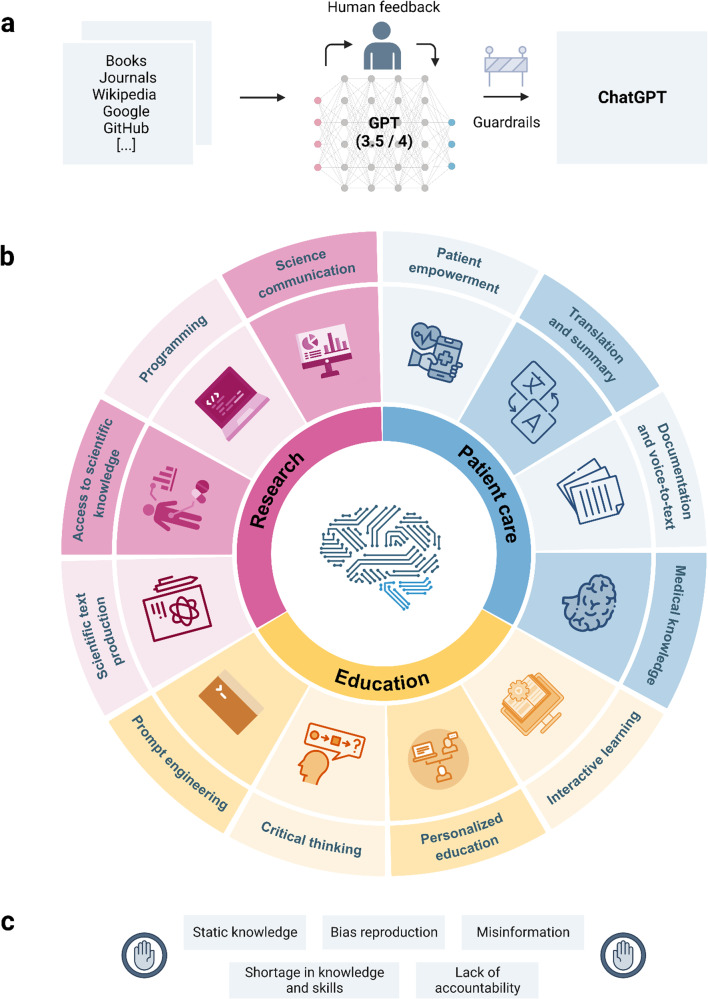
Large language models (LLMs) are artificial intelligence (AI) tools specifically trained to process and generate text. LLMs attracted substantial public attention after OpenAI’s ChatGPT was made publicly available in November 2022. LLMs can often answer questions, summarize, paraphrase and translate text on a level that is nearly indistinguishable from human capabilities. The possibility to actively interact with models like ChatGPT makes LLMs attractive tools in various fields, including medicine. While these models have the potential to democratize medical knowledge and facilitate access to healthcare, they could equally distribute misinformation and exacerbate scientific misconduct due to a lack of accountability and transparency. In this article, we provide a systematic and comprehensive overview of the potentials and limitations of LLMs in clinical practice, medical research and medical education.
Overview
CoChat Summary
TL;DR
This review surveys how large language models (LLMs) may affect patient care, medical research, and medical education, emphasizing both their capabilities and their risks. It argues that LLMs could democratize medical knowledge and assist communication, documentation, research, and teaching, but current limitations in factuality, bias, accountability, transparency, and reproducibility must be addressed before clinical use.
Key findings
- LLMs can augment patient care through medical knowledge and reasoning, translations, summaries, and documentation; GPT-4 “now exceeds the passing score on every step of the US-medical licensing exam (USMLE),” and documentation/administrative requirements consume around 25% of clinicians’ workdays.
- In medical research, LLMs can summarize evidence, generate scientific abstracts that humans struggle to differentiate from human-written ones, and assist with coding, but outputs currently require significant human revision and LLMs do not always provide appropriate detailed summaries or critical appraisals of up-to-date, high-quality, peer-reviewed evidence.
- In medical education, LLMs can serve as personalized teaching assistants, simplify complex concepts, and simulate patient conversations, but they risk decreasing critical thinking and creativity and may lead to “externalization of medical reasoning.”
- Ethical and safety concerns include misinformation, data privacy and leakage, prompt injection attacks, lack of public training datasets and source code, commercial monopolies, and reproducibility problems due to model version changes; the authors observed substantial differences between GPT-3.5 and GPT-4 prompted queries and minor changes across GPT-3.5 versions.
Methods
- Narrative review/overview; the abstract describes it as a “systematic and comprehensive overview of the potentials and limitations of LLMs in clinical practice, medical research and medical education.”
- No primary data, sample, or formal quantitative analysis are reported; illustrative model outputs were generated using ChatGPT (GPT-4—May 3, 2023; GPT-3.5—May 3, 2023) and additional examples are in Supplementary Data.
- The main analysis is a qualitative synthesis across patient care, medical research, and medical education, with example prompts and outputs used to illustrate capabilities and limitations.
Limitations
- Stated by the paper: LLMs reproduce existing biases, hallucinate false information, spread misinformation, lack accountability, and currently have no mechanisms to ensure output correctness; their knowledge is static, reproducibility is compromised by model updates or access restrictions, training datasets and source code are often not public, and development is driven primarily by commercial companies.
- Stated by the paper: safety guardrails can themselves pose limitations, for example if bias prevention leads to different symptoms in men and women being overlooked.
- Evident from the text: despite being described as “systematic,” no formal systematic review methodology, search strategy, inclusion criteria, or data extraction process is reported, and the illustrative examples are limited to selected ChatGPT versions rather than a comprehensive empirical evaluation.
Model-written summary. Check it against the paper before relying on it.
Integrity signals
Registry
Cites
Statistics
Figures
Verification
Claims the paper makes
16 Valid · 3 Not valid · 21 Not checked · 36 Own results and interpretations
The cited sources support only part of this claim — read each source’s verdict below.
In the paper
“Through their text simplification capabilities33, LLMs may improve communication between healthcare staff and patients34.”
§ The future landscape of large language models in medicine > Patient care > Medical knowledge and medical core competencies
What the sources say
- Partly supportedcites [33] Devaraj, A., Marshall, I., Wallace, B. & Li, J. J. Paragraph-level simplification of medical texts. In Proc. 2021 Conference of the North American Chapter of the Association for Computational Linguistics: Human Language Technologies, 4972–4984. 10.18653/v1/2021.naacl-main.395 (Association for Computational Linguistics, 2021). PMC9161242 35663507 sourceExperimental — accuracy not yet measured
The Introduction (page unavailable) says automatic simplification may make specialist medical information accessible to a wider audience, and the Conclusions report simpler model outputs. The paper does not examine communication between healthcare staff and patients, so it supports the proposed mechanism but not that specific application. (LLM, conf=0.83)
- Supportedcites [34] Ayers, J. W. et al. Comparing physician and artificial intelligence Chatbot responses to patient questions posted to a public social media forum. JAMA Intern. Med. 10.1001/jamainternmed.2023.1838 (2023). PMC10148230 37115527 source
The Discussion says chatbots could assist clinicians in messaging patients by drafting replies and could help staff improve their communication skills. The citing sentence attaches a separate citation to text simplification; this paper supports the hedged communication claim attributed to it. (LLM, conf=0.90)
hedgedstates a possible cause- Asserted: passes — The authors put it forward as true.
- Checkable: passes — It can be checked against evidence.
- Load-bearing: unclear — It is unclear whether the paper’s conclusions depend on it.
- Based: passes — The paper gives a reason why it holds.
- Partly supported
The cited sources support only part of this claim — read each source’s verdict below.
In the paper
“GPT-4 thus far demonstrates the highest medical domain knowledge of LLMs to date5.”
§ The future landscape of large language models in medicine > Patient care > Medical knowledge and medical core competencies
What the sources say
- Partly supportedcites [5] Nori, H., King, N., McKinney, S. M., Carignan, D. & Horvitz, E. Capabilities of GPT-4 on medical challenge problems. Preprint at arXiv10.48550/arXiv.2303.13375 (2023). sourceExperimental — accuracy not yet measured
The Abstract (p. 1) reports that GPT-4 outperformed GPT-3.5 and a medically tuned model on medical examinations and benchmarks. The Conclusion (p. 22) says it outperformed Flan-PaLM 540B on all but one MultiMedQA dataset. These comparisons support strong medical-benchmark performance, but not the unqualified claim that GPT-4 had the highest medical domain knowledge of all LLMs to date. (LLM, conf=0.86)
boosted- Asserted: passes — The authors put it forward as true.
- Checkable: passes — It can be checked against evidence.
- Load-bearing: unclear — It is unclear whether the paper’s conclusions depend on it.
- Based: passes — The paper gives a reason why it holds.
- Partly supported
The cited sources support only part of this claim — read each source’s verdict below.
In the paper
“Technical options to overcome limitations in factuality and mitigate (bias-related) harms can generally be implemented throughout the entire development process of LLMs.”
§ The future landscape of large language models in medicine > Ethical use and misinformation
What the sources say
- Partly supportedcites [33] Devaraj, A., Marshall, I., Wallace, B. & Li, J. J. Paragraph-level simplification of medical texts. In Proc. 2021 Conference of the North American Chapter of the Association for Computational Linguistics: Human Language Technologies, 4972–4984. 10.18653/v1/2021.naacl-main.395 (Association for Computational Linguistics, 2021). PMC9161242 35663507 sourceExperimental — accuracy not yet measured
The Ethical Considerations section says hallucinations in generated medical summaries can misinform readers and recommends examining outputs before use. That supports a limited way to address factuality harms, but the paper does not discuss bias-related harms or establish that technical options can be implemented throughout the entire LLM development process. (LLM, conf=0.79)
- Not checked yetcites [64] Kumar, S., Balachandran, V., Njoo, L., Anastasopoulos, A. & Tsvetkov, Y. Language generation models can cause harm: so what can we do about it? An actionable survey. In Proc. 17th Conference of the European Chapter of the Association for Computational Linguistics, 3299–3321 (Association for Computational Linguistics, 2023). source
- Not checked yetcites [65] Ma, Y., Seneviratne, S. & Daskalaki, E. Improving text simplification with factuality error detection. In Proc. Workshop on Text Simplification, Accessibility, and Readability (TSAR–2022), 173–178 (Association for Computational Linguistics, 2022). source
- Partly supportedcites [66] Devaraj, A., Sheffield, W., Wallace, B. & Li, J. J. Evaluating factuality in text simplification. In Proc. 60th Annual Meeting of the Association for Computational Linguistics (Volume 1: Long Papers), 7331–7345. 10.18653/v1/2022.acl-long.506 (Association for Computational Linguistics, 2022). PMC9671157 36404800 sourceExperimental — accuracy not yet measured
The Qualitative Analysis section suggests including document context or decontextualizing text before simplification, and the Conclusion describes work on automatic factuality assessment. These support technical approaches to factuality in text simplification, but the paper does not establish that options can be implemented throughout LLM development or address mitigation of bias-related harms. The cited passages provide no page numbers. (LLM, conf=0.78)
- Partly supportedcites [67] Fleisig, E. et al. FairPrism: evaluating fairness-related harms in text generation. In Proc. 61st Annual Meeting of the Association for Computational Linguistics (Volume 1: Long Papers), 6231–6251 (Association for Computational Linguistics, 2023). sourceExperimental — accuracy not yet measured
The Recommendations (p. 8) describe ways to improve datasets for measuring and mitigating harms in AI-generated text. They do not address factuality or say that technical options can be implemented throughout the entire LLM development process; the paper's supported point is narrower. (LLM, conf=0.85)
- Not checked yetcites [68] Sha, L., Li, Y., Gasevic, D. & Chen, G. Bigger data or fairer data? Augmenting BERT via active sampling for educational text classification. In Proc. 29th International Conference on Computational Linguistics, 1275–1285 (International Committee on Computational Linguistics, 2022).
plain- Asserted: passes — The authors put it forward as true.
- Checkable: passes — It can be checked against evidence.
- Load-bearing: unclear — It is unclear whether the paper’s conclusions depend on it.
- Based: passes — The paper gives a reason why it holds.
- Partly supported
Every source the paper cites for this claim was checked and supports it.
In the paper
“Lastly, to date, the development of LLMs has been driven primarily by commercial companies such as OpenAI/Microsoft21, Meta24, and Google2.”
§ The future landscape of large language models in medicine > Ethical use and misinformation
What the sources say
- Supportedcites [21] OpenAI. GPT-4 Technical Report. Preprint at arXiv10.48550/arXiv.2303.08774 (2023). source
The citation is attached to OpenAI/Microsoft as an example, rather than to the claims about Meta or Google. The report identifies GPT-4 as a model developed by OpenAI (Abstract, p. 1) and credits Microsoft Azure with supporting its training infrastructure (Authorship & credit attribution, p. 17). (LLM, conf=0.88)
- Supportedcites [24] Touvron, H. et al. LLaMA: open and efficient foundation language models. Preprint at arXiv10.48550/arXiv.2302.13971 (2023). source
The citation is attached to Meta in a list of companies developing LLMs. The title page (p. 1) identifies the LLaMA authors as Meta AI, and the Abstract (p. 1) says they developed the LLaMA foundation language models. This supports Meta as an example; this citation need not establish the sentence’s broader claim about who primarily drives LLM development. (LLM, conf=0.91)
- Supportedcites [2] Singhal, K. et al. Large language models encode clinical knowledge. Nature620, 172–180 (2023). PMC10396962 37438534 source
The citation is attached specifically to Google as an example of an LLM developer. The Methods > Modelling section describes the authors building Med-PaLM from PaLM and Flan-PaLM, supporting that example; it does not establish the separate, broader assertion that commercial companies primarily drive LLM development. (LLM, conf=0.86)
plainstates a cause- Asserted: passes — The authors put it forward as true.
- Checkable: passes — It can be checked against evidence.
- Load-bearing: passes — The paper’s conclusions depend on it.
- Based: passes — The paper gives a reason why it holds.
- Supported
The cited sources support only part of this claim — read each source’s verdict below.
In the paper
“as misconceived prompts may result in biases or misinformation with potentially serious consequences4.”
§ The future landscape of large language models in medicine > Medical education > Education about LLMs
What the sources say
- Partly supportedcites [4] Binz M Schulz E Using cognitive psychology to understand GPT-3 Proc. Natl Acad. Sci. USA 2023 120 e2218523120 10.1073/pnas.2218523120 36730192 PMC9963545 sourceExperimental — accuracy not yet measured
In Results, under “Problems with vignette-based investigations” (page unavailable), the paper reports that slightly modified prompts produced incorrect or contradictory GPT-3 answers. This supports the possibility that poorly framed prompts yield misleading responses, but the cited passages do not establish that such responses have potentially serious consequences. (LLM, conf=0.84)
hedgedstates a possible cause- Asserted: passes — The authors put it forward as true.
- Checkable: passes — It can be checked against evidence.
- Load-bearing: passes — The paper’s conclusions depend on it.
- Based: passes — The paper gives a reason why it holds.
- Partly supported
23 more claims
Create a free account to see all 76 claims and to verify the 43 references still open.
- It may state two separate claims as one. 31
- Probably not a substantial claim. 29
Claims other papers make about this one
Each is checked against this paper’s own text: does it say what the citing paper says it does?
The source backs part of the claim, not all of it — or backs it for a different population, condition or comparison.
In the citing paper
“Further to this, there is potential for these LLM-based applications to reduce medical errors and capturing missed information by providing a layer of scrutiny when embedded in EHRs [45].”
From Generative AI in healthcare: an implementation science informed translational path on application, integration and governance (2024) · cites this paper as [45]
Experimental — accuracy not yet measuredThe source backs part of the claim, not all of it — or backs it for a different population, condition or comparison.
In the citing paper
“Use cases like workflow and documentation automation, personalized predictive analytics, and patient education chatbots confirm vast potential [26, 41, 45], provided the technology supports rather than supplants human expertise.”
From Generative AI in healthcare: an implementation science informed translational path on application, integration and governance (2024) · cites this paper as [45]
Experimental — accuracy not yet measuredThe source backs part of the claim, not all of it — or backs it for a different population, condition or comparison.
In the citing paper
“Large language models (LLMs) have been shown to interpret complex clinical situations and offer recommendations, from differential diagnoses to care management, leading to growing interest in their application in the medical field [13-16].”
From Identifying Deprescribing Opportunities With Large Language Models in Older Adults: Retrospective Cohort Study (2025) · cites this paper as [13]
Experimental — accuracy not yet measuredThe source backs part of the claim, not all of it — or backs it for a different population, condition or comparison.
In the citing paper
“they lack the nuanced understanding, empathy, and ethical reasoning inherent to human practitioners [19].”
From Mitigating cognitive biases in clinical decision-making through multi-agent conversations using large language models: simulation study (2024) · cites this paper as [19]
Experimental — accuracy not yet measuredThe source backs part of the claim, not all of it — or backs it for a different population, condition or comparison.
In the citing paper
“While we recognize that these issues are affected by the use of LLMs in significant ways6,98,99 these, challenges are not specific to health-related applications.”
From The ethics of ChatGPT in medicine and healthcare: a systematic review on large language models (LLMs) (2024) · cites this paper as [6]
Experimental — accuracy not yet measured
5 more claims about this paper
Create a free account to see every claim other papers make about this one.
Citations
Cites
BERT: Pre-training of Deep Bidirectional Transformers for Language Understanding
Devlin, J., Chang, M.-W., Lee, K., & Toutanova, K. (2019) · Proceedings of the 2019 Conference of the North American Chapter of the Association for Computational Linguistics: Human Language Technologies, Volume 1 (Long and Short Papers) · doi:10.18653/v1/n19-1423 · Cited by 54,325
BioBERT: a pre-trained biomedical language representation model for biomedical text mining
Lee, J., Yoon, W., Kim, S., Kim, D., Kim, S., So, C. H., & Kang, J. (2020) · Bioinformatics · doi:10.1093/bioinformatics/btz682 · Cited by 7,218
LLaMA: Open and Efficient Foundation Language Models
Touvron, H., Lavril, T., Izacard, G., Martinet, X., Lachaux, M.-A., Lacroix, T., Rozière, B., Goyal, N., Hambro, E., Azhar, F., et al. (2023) · arXiv · doi:10.48550/arxiv.2302.13971 · Cited by 4,602 · cited 5×
“this was followed by the release of other LLMs from companies such as Google and Meta 2,15 – 17 .”
MethodInfluentialKung, T. H., Cheatham, M., Medenilla, A., Sillos, C., De Leon, L., Elepaño, C., Madriaga, M., Aggabao, R., Diaz-Candido, G., Maningo, J., et al. (2023) · PLOS Digital Health · doi:10.1371/journal.pdig.0000198 · Cited by 4,115 · cited 3×
“Nonetheless, using LLMs for scienti fi c writing currently requires signi fi cant revisions by human authors due to inaccurate, shallow and repetitive outputs (Supplementary Data, example 6).”
BackgroundMethodKung, T. H., Cheatham, M., ChatGPT, Medenilla, A., Sillos, C., De Leon, L., Elepaño, C., Madriaga, M., Aggabao, R., Diaz-Candido, G., et al. (2022) · doi:10.1101/2022.12.19.22283643 · Cited by 4,115
Large language models encode clinical knowledge
Singhal, K., Azizi, S., Tu, T., Mahdavi, S. S., Wei, J., Chung, H. W., Scales, N., Tanwani, A., Cole-Lewis, H., Pfohl, S., et al. (2023) · Nature · doi:10.1038/s41586-023-06291-2 · Cited by 4,083
Large Language Models Encode Clinical Knowledge
Singhal, K., Azizi, S., Tu, T., Mahdavi, S. S., Wei, J., Chung, H. W., Scales, N., Tanwani, A., Cole-Lewis, H., Pfohl, S., et al. (2022) · arXiv · doi:10.48550/arxiv.2212.13138 · Cited by 4,083
SciBERT: A Pretrained Language Model for Scientific Text
Beltagy, I., Lo, K., & Cohan, A. (2019) · Proceedings of the 2019 Conference on Empirical Methods in Natural Language Processing and the 9th International Joint Conference on Natural Language Processing (EMNLP-IJCNLP) · doi:10.18653/v1/d19-1371 · Cited by 3,218
Sallam, M. (2023) · Healthcare · doi:10.3390/healthcare11060887 · Cited by 3,126
Ayers, J. W., Poliak, A., Dredze, M., Leas, E. C., Zhu, Z., Kelley, J. B., Faix, D. J., Goodman, A. M., Longhurst, C. A., Hogarth, M., et al. (2023) · JAMA Internal Medicine · doi:10.1001/jamainternmed.2023.1838 · Cited by 2,613 · cited 1×
“Through their text simpli fi cation capabilities 33 , LLMs may improve communication between healthcare staff and patients 34 .”
Background
Research works printed but not linked: 2
- Xiu Y Thompson P Flipped university class: a study of motivation and learning Int. J. Inf. Commun. Technol. Educ. 2020 19 41 63
- Sha, L., Li, Y., Gasevic, D. & Chen, G. Bigger data or fairer data? Augmenting BERT via active sampling for educational text classification. In Proc. 29th International Conference on Computational Linguistics, 1275–1285 (International Committee on Computational Linguistics, 2022).
Cited by
Items 901–1,000 of 1,017
Development of Artificial Intelligence Chatbot (AI Chatbot) for Undergraduate Engineering Students
Majumder, S., Wagner, J. A., Schweisinger, T., & Flynn, K. (2026) · ASEE Southeast Section Conference · doi:10.18260/1-2--57965
Hastings, J., Wosny, M., Kennett, J., Homiar, A., Malhi, G. S., Furukawa, T. A., Potts, J., Thomas, J., & Cipriani, A. (2026) · BMJ Mental Health · doi:10.1136/bmjment-2025-302379 · Cited by 1
Kim, M. J., Park, J. S., & Kang, S. H. (2026) · Scientific Reports · doi:10.1038/s41598-026-44333-7
Huang, K. A., Samvelian, D. A., Xu, A. L., Sanchez, A., Choudhary, H. K., Ghosh, A., & Prakash, N. S. (2026) · Cureus · doi:10.7759/cureus.106486 · Cited by 1
Nazaretyan, L., & Kircher, M. (2026) · Trends in Genetics · doi:10.1016/j.tig.2026.02.007 · Cited by 3
Comparing Large Language Models' Performances on Otolaryngology Knowledge Assessment Questions
Cook, R., Kahan, A. A., Scharfenberger, T., Tasoulas, J., Hawks-Ladds, N., Chouake, R. J., Jariwala, S. P., & Arora, S. (2026) · Applied Clinical Informatics · doi:10.1055/a-2835-4634 · Cited by 1
Bahaaeldin, M., Nowak, S., Seidel, O., Isaak, A., Kravchenko, D., Proff, A., Dell, T., Kuetting, D. L. R., Luetkens, J. A., & Mesropyan, N. (2026) · European Radiology Experimental · doi:10.1186/s41747-026-00712-3 · Cited by 1
“In radiology, recent studies have demonstrated their utility for automated report generation, error and inconsistency detection, extraction of structured fi ndings from free-text reports, and integration into clinical work fl ow systems [4, 5, 7 – 10].”
Zhao, Y., Fangqi, Y., Wang, L., Wang, M., Zhang, L., Ren, T., & Wang, H. (2026) · Research Square · doi:10.21203/rs.3.rs-9109873/v1
Fatima, K., Singh, P., Alagarsamy, R., Chaudhary, G. R., Kharbanda, O. P., Lal, B., & Barathi, A. (2026) · The Cleft Palate-Craniofacial Journal · doi:10.1177/10556656261438912
From Expectation to Evaluation: Expectation Cues Systematically Bias LLM and Human Judgment
Sun, Y., Dillion, D., Gray, K. J., Lyu, M., Zhang, Z., & Li, F. (2026) · CHI Conference on Human Factors in Computing Systems · doi:10.1145/3772318.3790492 · Cited by 2
Aggarwal, I., Rhee, C. H., Chura, M., Bora, V., & Reddy, D. M. (2026) · A&A Practice · doi:10.1213/xaa.0000000000002183
Beyond Answers: Trajectory Semantic Entropy for Reliable Uncertainty Quantification in LLMs
Song, B., Feng, Z., Wang, S., & Zhou, Y. (2026) · IEEE International Conference on Acoustics Speech and Signal Processing · doi:10.1109/icassp55912.2026.11463008 · Cited by 2
Game-Theoretic Insights into Multi-Agent LLM Debate for Enhanced Clinical Question Answering
Sudhakara, S., & Sudhakara, S. (2026) · IEEE International Conference on Acoustics Speech and Signal Processing · doi:10.1109/icassp55912.2026.11461952
Psilopatis, I., Emons, J., Vrettou, K., & Zwimpfer, T. A. (2026) · Journal of Clinical Medicine · doi:10.3390/jcm15093234
“The rapid and revolutionary advancement of artificial intelligence (AI), particularly in the domain of large language models (LLMs), presents an unprecedented opportunity to address this critical gap [11].”
MyDigitalHealth: Rethinking the health data management
Zeiser, F. A., de Mello, B. H., Vanin, F. N. D. S., Righi, R. D. R., Rigo, S. J., Ramos, G. D. O., Antunes, R. S., & da Costa, C. A. (2026) · Smart Health · doi:10.1016/j.smhl.2026.100660
Psilopatis, I., Redling, K., Filippi, V., Kappos, S., Emons, J., Mosimann, B., & Zwimpfer, T. A. (2026) · Archives of Gynecology and Obstetrics · doi:10.1007/s00404-026-08423-1
“This ability has opened new avenues for innovation in health-care, with potential applications ranging from medical record analysis and clinical decision support to patient communication and education [2].”
Large Language Models in Hybrid Intelligent Medical Systems
Averkin, A., Volkov, E. N., & Yarushev, S. (2025) · Pattern Recognition and Image Analysis · doi:10.1134/s1054661825700956
Genç, M., Bulut, B., Öz, M. A., Gur, A., Yortanlı, M., Yortanlı, B. Ç., Sariyildiz, O., Yazıcı, R., Mutlu, H., & Uykan, Z. (2026) · PLoS ONE · doi:10.1371/journal.pone.0347611 · Cited by 1
“The first was ChatGPT-4o, also known as ChatGPT 4 Omni, which is currently widely reported to demonstrate strong performance in medical tasks [14,15].”
The role of artificial intelligence in urological malignancies: an overview of systematic reviews
Sakalis, V. I., Chatzigriva, E., Pang, K. H., Rai, B. P., Filippidis, I., Moris, L., Chalkidou, M., Yuan, Y., Bussmann, M., Papanikolaou, D., et al. (2026) · Canadian Journal of Urology · doi:10.32604/cju.2026.077632
“82 There is skepticism among physicians that LLMs pose a risk to exacerbate scientific misconduct due to a lack of accountability and transparency.”
Artificial Intelligence in surgical planning
Murugesan, K., Gidean Arularasan, S., & Kumar, M. P. S. (2026) · Elsevier eBooks · doi:10.1016/b978-0-443-34423-7.00003-1
Phillips, C., & Harrison, D. (2026) · JMIR Formative Research · doi:10.2196/87121 · Cited by 2
“Within GenAI, natural language processing allows computers to understand human language; analyze, process, and interpret text; extract meaning; and perform tasks previously thought to require real intelligence [4].”
McCarthy, C. J., Ramalingam, V., Barash, Y., Chadalavada, S. C., Wu, X., Kutsenko, O., Raskin, D., Sorin, V., & Sarwar, A. (2026) · Academic Radiology · doi:10.1016/j.acra.2026.04.021
Babli, S. A., Gairola, P., Ogbu, C. E., Longa, F. A., Rautaray, A., Alamu, O. S., & Rizvi, S. F. H. (2026) · Cureus · doi:10.7759/cureus.108550
“First, we evaluated only three LLMs at fixed API versions during a specific time window; LLM capabilities evolve rapidly, and results may differ with subsequent model releases [20,29].”
Zheng, H., Zare, Z. Y., Li, M., Pan, Y., Ren, S., Cui, H., & Li, Y. (2026) · BMC Oral Health · doi:10.1186/s12903-026-08551-9
AI code execution amplifies clinical hallucinations in medical triagePreprint
Basu, S., Patel, S., & Batniji, R. (2026) · Research Square · doi:10.21203/rs.3.rs-9269573/v1
PawMed Bot: A Retrieval-Grounded AI System for Evidence-Based Veterinary Care
Saha, P., Poornashree, E., & Kavitha, G. (2026) · IEEE International Conference for Convergence in Computing Technology (I3CTCON) · doi:10.1109/i3ctcon68242.2026.11508088
“[8],[9].”
Generative Edge AI in Healthcare and Management: A Case Study
Parwani, P., & Sharma, V. (2026) · Advances in computational intelligence and robotics book series · doi:10.4018/979-8-3373-7340-9.ch013
An, D. (2026) · Information Research · doi:10.47989/ir31260845
Dobranski, N., Viscariello, N. N., Pitcher, G. M., Stam, A. M., Belliveau, J., Kirby, K. M., Solis, D. E., Ashford, J., Spears, H., Dalton, A., et al. (2026) · International Journal of Radiation Oncology*Biology*Physics · doi:10.1016/j.ijrobp.2026.05.003
Fede, G. D., Alrabie, L., & Andolina, S. (2026) · Springer eBooks · doi:10.1007/978-981-95-3658-0_49 · Cited by 1
White, A., Leyton, K. A., Patel, N., Scott-Coombes, D. M., Egan, R. J., & Stechman, M. (2026) · Updates in Surgery · doi:10.1007/s13304-026-02822-4
Evaluation of Large Language Models for Automated Simple CPT Coding in Foot and Ankle Surgery
Glenn, E. R., Rowshan, A. P., Mao, E., Ryu, D., Parekh, Y. H., Hsu, N. N., Thompson, J. M., & Aiyer, A. A. (2026) · Foot & Ankle Orthopaedics · doi:10.1177/24730114261448207
“19,20 Their ability to process natural language and map clinical documentation to structured outputs positions them as potential accelerators of efficiency in health care coding workflows.”
Benchmarking general and medical LLM performance in Parkinson's disease management
Shechter, Y., Klevor, R., Kouchache, T., Bouhadoun, S., & Postuma, R. B. (2026) · Clinical Parkinsonism & Related Disorders · doi:10.64898/2026.05.13.26353021
Selvaraj, M., Monisha, J., Nivethitha, B., Bedi, A., Das, T., & Madhan, B. (2026) · The Cleft Palate-Craniofacial Journal · doi:10.1177/10556656261451939
Taşkırdı, İ., Yiğit, E. Ş., Akarcan, S. E., & Tunçel, T. (2026) · Journal of Clinical Medicine · doi:10.3390/jcm15114025
“Large language models (LLMs) are artificial intelligence systems capable of generating human-like text in response to user prompts and are increasingly used for question answering, summarization, and health information support [6,7].”
Chuang, K.-C., Lin, H., & Lin, H.-M. (2026) · medRxiv · doi:10.64898/2026.05.23.26353939
Yu, X., & Qianqian, Y. (2026) · Neuropsychiatric Disease and Treatment · doi:10.2147/ndt.s614952
“9 This is a meaningful advantage in a field characterised by rapidly expanding literature.”
A Multi-Agent RAG Framework for Biomedical Literature AnalysisPreprint
Palem, R. R., Chen, H., & Yue, Z. (2026) · bioRxiv (Cold Spring Harbor Laboratory) · doi:10.64898/2026.05.26.727050
“The deployment of large language models in clinical settings has been extensively discussed in recent literature [22, 26, 27], with particular attention to both their transformative potential and the risks they introduce.”
Palaganas, J. C., Morton, A., Adem, F., Ramos, J., Kumar, A. A., Jawed, K., & Bajwa, M. (2026) · Cureus Journal of Computer Science. · doi:10.7759/s44389-026-00094-y
Zhang, J., Ren, W., Chen, H., Song, Y., Feng, J., Zhan, X., Chen, S., Ouyang, L., Liu, F., Cai, X., et al. (2026) · doi:10.2196/preprints.101283
Sultanov, R., Aarthi, S., Srinivasan, S., Ravikumar, R. N., & Umarov, D. (2026) · Advances in computational intelligence and robotics book series · doi:10.4018/979-8-3373-7862-6.ch013
Care in Pieces: Unpacking Experiences of Using LLMs for Self-management of Endometriosis and PCOS
Lucchini, A., Rojas, C. L., Bozzon, A., & Colombo, S. (2026) · Designing Interactive Systems Conference · doi:10.1145/3800645.3812813
“While promising, LLMs are not originally designed for or tailored to provide medical knowledge support [8], raising critical questions on their role in self-management.”
Palem, R. R., Chen, H., & Yue, Z. (2026) · JMIR Bioinformatics and Biotechnology · doi:10.2196/103794
Development and Implementation of an AI System for Generating Clinical Urine Drug Test Sign-Outs
Laha, N., Keebaugh, M. W., Liao, H.-C., Amankwaa, B., Adesoye, O. G., Pablo, A., Phipps, W. S., Hoofnagle, A. N., Baird, G. S., Mathias, P. C., et al. (2026) · JAMA Network Open · doi:10.1001/jamanetworkopen.2026.19816
Devanand, N. A., Verghese, S., Bacchi, S., Bain, C., Subramaniam, A., & Sundararajan, K. (2026) · Critical Care and Resuscitation · doi:10.1016/j.ccrj.2026.100194 · Cited by 3
Lee, S., Jeon, K., Lim, J. S., Park, Y., Kim, M. S., Jin, J. H., Han, C. H., Yoon, S. H., & You, S. C. (2026) · Journal of Biomedical Informatics · doi:10.1016/j.jbi.2026.105071 · Cited by 1
Revolutionizing healthcare systems through large language models
Divakaran, P., Saiyad, F. B. J., Chhetri, Y., Upreti, S., Sharma, V., & Goyal, K. (2026) · Elsevier eBooks · doi:10.1016/b978-0-443-44344-2.00021-2
Transforming healthcare with large language models: Innovation, integration, and impact
Joshi, G., Ghai, B., Goutam, N., & Joshi, N. (2026) · Elsevier eBooks · doi:10.1016/b978-0-443-44344-2.00010-8
Wu, S. S., Shanmugam, M. V., Lee, Y., & Ayoub, N. (2026) · World Journal of Otorhinolaryngology - Head and Neck Surgery · doi:10.1002/wjo2.70130
Automated iridocorneal angle classification using a multimodal large language model
Rubegni, G., Romano, D., Colizzi, B., Castellino, N., Cartocci, A., Luschi, A., Rabiolo, A., Cillà, S. D., Tosi, G. M., & Rossetti, L. M. (2026) · Graefe s Archive for Clinical and Experimental Ophthalmology · doi:10.1007/s00417-026-07333-x
Zhu, B., Kang, X., Matsumoto, K., & Yoshida, M. (2026) · Artificial Intelligence in Health · doi:10.36922/aih026170040
Understanding OB/GYN Physicians’ Perceptions Towards the Use of AI in Menopausal Care
Appah, A., Manvi, S., Smith, D. L., Ismail, A., & Kaonga, N. (2026) · ACM Interactive Health Conference · doi:10.1145/3786579.3804969
Privacy Leakage in Small Agentic Healthcare Models: An Empirical Analysis
Aguzzi, G., Montagna, S., & Ferretti, S. (2026) · IEEE International Conference on Pervasive Computing and Communications Workshops (PerCom Workshops) · doi:10.1109/percomworkshops68308.2026.11585450
“Agentic AI represents a new paradigm recently adopted in the healthcare domain [2], that goes beyond the adoption of LLMs which, despite their recent emergence, have already been widely discussed in the medical informatics literature [10].”
A Bibliometric Mapping of Transformer-Based Misinformation Detection: Trends and Gaps
Rahman, B. A., Nazri, M. Z. A., & Yaakub, M. R. (2026) · International Journal of Advanced Computer Science and Applications · doi:10.14569/ijacsa.2026.0170645
The Hawash Method: A Bedside-First Framework for Safe Clinical GenAI Decision Support
Hawash, A. M. (2026) · ICEENG International Conference for Innovations in Intelligent Computing and Cybersecurity (IICC) · doi:10.1109/iicc69623.2026.11582187
“Surveys indicate growing physician use of generative AI (GenAI) platforms for clinical queries, differential diagnosis, and treatment planning [3].”
Nadeem, F., Ibrahim, S. M., Taylor, S., Rawall, S., Mohammad, Z., Pirzadah, H., Ayala-Ortiz, J. L., & Rajaram, S. M. (2026) · Southern Medical Journal · doi:10.14423/smj.0000000000001989
Hunt, D., & Miceli, M. D. (2026) · American Journal of STEM Education · doi:10.32674/tfptev94 · Cited by 1
Liu, Z., Yang, X., Zhang, Y., Xu, Y., Xiang, Y., & 王鸿雁 (2026) · Frontiers in Digital Health · doi:10.3389/fdgth.2026.1825576
Aydoğan, C. N., Kazaz, I., & Hoşbul, T. (2026) · Journal of Imaging Informatics in Medicine · doi:10.1007/s10278-026-02102-y
Chen, H., Tan, X., Wu, D., & Kang, L. (2026) · Updates in Surgery · doi:10.1007/s13304-026-02766-9
Tong, M., Liu, J.-L., Zeng, L., Gu, J., Yue, Y., Yu, Y., Qiu, Y.-F., & Yang, F. (2026) · Psychiatric Quarterly · doi:10.1007/s11126-026-10298-z
Yasser, M., Barakat, G., Awny, S., Ezzat, M., Ahmed, M. S. A., Wael, S., Moustafa, M., & Hamdy, O. (2026) · Scientific Reports · doi:10.1038/s41598-026-60786-2
“…( p = 0.04), as did Metastasis and Palliative Management accuracy www.nature.com/scientificreports 5, though improved over its predecessor, did not match the leading models, illustrating how the competitive AI landscape does not reward any single model family with linear improvement 27 .”
InfluentialHung, M., Ward, C., Cohen, O., Marx, J., Smit, Z., Newman, J., & Lipsky, M. S. (2026) · JMIR Medical Education · doi:10.2196/90736
“Large language models (LLMs), such as OpenAI’s ChatGPT series [1], have rapidly transformed how information is accessed, synthesized, and applied across educational and professional domains [2-4].”
Enhancing Patients’ Informed Consent Through AI: Systematic Review
Dababneh, S., Hebert, N., Meloche, L., Dababneh, N. E., Aleksieva, P., & Tanoubi, I. (2026) · JMIR AI · doi:10.2196/93501
“With extensive training on vast datasets and optimization for human-like language generation, these models have demonstrated significant potential to improve the clarity, accessibility, and comprehensiveness of patient information across various medical specialties [6,48,49].”
Safi, S., Golmakani, A., Rahmani, S., Bayan, N., Moshtaghion, S. M., Najafimehr, H., & Kangari, H. (2026) · Health Informatics Journal · doi:10.1177/14604582261470624
Khot, R., Lee, M., Brankaert, R., & IJsselsteijn, W. A. (2026) · ACM Conference on Conversational User Interfaces (CUI) · doi:10.1145/3816046.3816309
Pinto, A. D., Julio, Y. R., Ramos, C. C., García, N. A. P., Rivera‐Julio, J., & Torres-Tovio, J. M. (2026) · Sensors · doi:10.3390/s26144610
“Nevertheless, the integration of LLMs into health services requires strict safeguards [18,19].”
Benchmarking large language models for de-identification of electronic health record notes
Panchal, O., Chang, N., Zhao, Z., Nadar, D. R., Dai, H.-J., & Jonnagaddala, J. (2026) · BMJ Health & Care Informatics · doi:10.1136/bmjhci-2025-101894 · Cited by 10
Application of large language models to answer sample FCFP(SA) examination questions
Singh, Y. (2026) · Suid-Afrikaanse Tydskrif vir Natuurwetenskap en Tegnologie · doi:10.36303/satnt.2026.45.1.3649
Mittal, S., Ajmera, A., Devine, H., Vijay, A., LaFiandra, L., & Gadewadikar, J. (2026) · IEEE International Conference on AI and Data Analytics (ICAD) · doi:10.1109/icad69378.2026.11608726
“Several reviews are done to propose a landscape of integrating different aspects of AI including LLMs in healthcare flow [4], [5], [6].”
Amirrajab, S., Vehof, V., Bietenbeck, M., Akyol, N., Bouras, R., Isgandarova, K., Zlibut, A., Stalling, P., & Yılmaz, A. (2026) · Research Square · doi:10.21203/rs.3.rs-10456929/v1
Rao, A. S., Nwokemodo-Ihejirika, C., Kincaid, J. W. R., Крылова, М. В., Esmail, K. P., Nguyen, D. S., Rivera, C., Koranteng, E., & Succi, M. D. (2026) · Journal of Medical Internet Research · doi:10.2196/87818
“In these domains, LLMs function as drafting aids, retrieval tools, and translators, with outputs subject to professional review prior to clinical use [47-49].”
Lin, S., Wang, S., Huang, Z., & Su, H. (2026) · Big Data and Cognitive Computing · doi:10.3390/bdcc10080248
Çörekci, A. M., Ateş, B., Dinç, O., & Öztürk, A. A. (2026) · The Pediatric Infectious Disease Journal · doi:10.1097/inf.0000000000005335
СИСТЕМА ПІДТРИМКИ ПРИЙНЯТТЯ ДІАГНОСТИЧНИХ РІШЕНЬ ЗАСОБАМИ ВЕЛИКИХ МОВНИХ МОДЕЛЕЙ
Липовченко, С., Бутко, В., Bovsunovskaya, K. S., Корнієнко, Г., & Павлов, В. (2026) · Перспективи та інновації науки · doi:10.52058/2786-4952-2026-6(64)-1999-2009
Ding, X., Zhang, L., Ming, F., & Li, L. (2026) · IEEE Transactions on Computational Biology and Bioinformatics · doi:10.1109/tcbbio.2026.3718442
“Large language models (LLMs) are powerful tools for integrating biological knowledge into neural networks, offering practical solutions to address the complexities of TME modeling in biomedical research [64], [65].”
Woo, H. J., & Kim, M. (2026) · Scientific Reports · doi:10.1038/s41598-026-64139-x
Kamaleddin, M. A., Mirjalili, M., Barzegar, R., Le, N. T., Visram, A., Nezhad, F. G., Rueda, A., Teferra, B. G., Monson, C. M., Glatard, T., et al. (2026) · Translational Psychiatry · doi:10.1038/s41398-026-04335-5
“Recent advances in large language models (LLMs) enable context-aware, naturalistic dialogue and response interpretation [11 – 14], but naïve deployment risks deviation from structured diagnostic protocols [15].”
Wang, C., Liu, Z., Jiang, Y., Zhang, T., Wang, H., Xue, T., & Liu, P. (2026) · Frontiers in Public Health · doi:10.3389/fpubh.2026.1850996
“Since the public release of ChatGPT in late 2022, LLMs have been adopted across a wide range of health-related applications, including patient education, symptom checking, and clinical decision support (10, 11).”
ICU mortality prediction via multimodal learning on MIMIC-IV clinical data
Falcone, A., Forestiero, A., Malivindi, R., & Settino, M. (2026) · Bioinformatics Advances · doi:10.1093/bioadv/vbag214
“Their explicit ob-jective is to successfully predict the next word or a missing word in a sentence (Clusmann et al .”
Bragazzi, N. L., Ceylan, H. İ., & Garbarino, S. (2026) · doi:10.2196/preprints.108858
Kwolek, K., Laskowska, W., Pilarek, M., Ożga, S., Roszkowska, M., Furtak, M., Janczarski, S., Sarna, D., Wąs, L., & Tryczyński, P. (2026) · International Journal of Innovative Technologies in Social Science · doi:10.31435/ijitss.3(51).2026.6076
Fan, B., Fang, Y., Wang, Z., & Ma, F. (2026) · Frontiers in Pharmacology · doi:10.3389/fphar.2026.1884526 · Cited by 1
“2 The paradigm shift from static LLMs to RAG in healthcare Large Language Models (LLMs) have demonstrated profound potential in clinical decision support, demonstrating strong capabilities in comprehending complex medical narratives (Clusmann et al., 2023).”
Supplementary Material for Evaluating AI-Based Mental Health Interventions
Sharma, A. (2026) · ACM eBooks · doi:10.1145/3749728.3749737
Human–AI Collaboration to Empower People Seeking Support
Sharma, A. (2026) · ACM eBooks · doi:10.1145/3749728.3749732
(2026) · ACM eBooks · doi:10.1145/3749728.3749738
(2026) · ACM eBooks · doi:10.1145/3749728.3749739
Supplementary Materials for Human–AI Collaboration to Empower People Providing Support
Sharma, A. (2026) · ACM eBooks · doi:10.1145/3749728.3749735
Human–AI Collaboration to Empower People Providing Support
Sharma, A. (2026) · ACM eBooks · doi:10.1145/3749728.3749731
Sharma, A. (2026) · ACM eBooks · doi:10.1145/3749728.3749730
(2026) · ACM eBooks · doi:10.1145/3749728.3749729
Supplementary Materials for Human–AI Collaboration to Empower People Seeking Support
Sharma, A. (2026) · ACM eBooks · doi:10.1145/3749728.3749736
Analysis of Large Language Models for Magnetic Resonance Imaging Brain Tumor Segmentation Reporting
Vennila, M., & Kalaiselvi, T. (2026) · Cureus Journal of Computer Science. · doi:10.7759/s44389-026-00225-5
(2026) · ACM eBooks · doi:10.1145/3749728.3749734
Vocal Cord Dysfunction: Evaluating the Utility of AI Large Language Models for Patient Education
Cook, K., Tseng, P. K., Ahmadian, D., Demirjian, N. L., Liu, V., Weinstein, T. J., & Yip, H. T. (2026) · World Journal of Otorhinolaryngology - Head and Neck Surgery · doi:10.1002/wjo2.70158
Alnemari, A., & Alsulami, M. M. (2026) · Electronics · doi:10.3390/electronics15163640
Gao, J., Dong, L., & Hu, J. (2026) · doi:10.2196/preprints.109941
Gu, X., Yang, Y., Lin, X., & Xu, C. (2026) · Frontiers in Medicine · doi:10.3389/fmed.2026.1934968 · Cited by 1
Lequeux, B., Gardent, C., & Girerd, N. (2026) · Archives of cardiovascular diseases · doi:10.1016/j.acvd.2026.07.002
Metadata
- Authors
- Clusmann, J., Kolbinger, F. R., Muti, H. S., Carrero, Z. I., Eckardt, J.-N., Laleh, N. G., Löffler, C. M. L., Schwarzkopf, S.-C., Unger, M., Veldhuizen, G. P., Wagner, S. J., & Kather, J. N.
- Affiliations
- Universitätsklinikum Aachen (DE)
- University Hospital Carl Gustav Carus (DE)
- Else Kröner Fresenius Center for Digital Health (DE)
- Helmholtz Munich (DE)
- Heidelberg University (DE)
- Corresponding author
- Kather, Jakob Nikolas
- ORCID
- Venue
- Communications Medicine
- Published
- 2023-10-10
- Volume
- 3
- Issue
- 1
- Pages
- 141-141
- ISSN
- 2730-664X (ISSN-L)
- PMC
- PMC10564921
- OpenAlex
- W4387500346
- Semantic Scholar
- 282c568302701bc163d454702eae10e43ca784a3
- Cited by
- 1,045
- References
- 63
- Citations by year
- 2026: 304 · 2025: 435 · 2024: 293 · 2023: 13
- FWCI
- 12.29
- Type
- journal article
- Language
- en
- Open access
- gold
- doi.org
- Licence
- cc-by
- creativecommons.org/licenses/by/4.0 (tdm)
- creativecommons.org/licenses/by/4.0 (vor)
- Locations
- Communications Medicine (publishedVersion, cc-by)
- PubMed Central (publishedVersion, cc-by)
- PubMed (publishedVersion)
- Qucosa (Saxon State and University Library Dresden) (submittedVersion, cc-by)
- DOAJ (DOAJ: Directory of Open Access Journals) (submittedVersion, cc-by-sa)
- mediaTUM – the media and publications repository of the Technical University Munich (Technical University Munich) (submittedVersion, other-oa)
- Funders
- European Union’s Horizon Europe and innovation programme
- Topics
- Health Sciences › Medicine › Health Informatics › Artificial Intelligence in Healthcare and Education
- Physical Sciences › Computer Science › Artificial Intelligence › Machine Learning in Healthcare
- Physical Sciences › Computer Science › Artificial Intelligence › Artificial Intelligence Applications
- Keywords
- large language models, ChatGPT, artificial intelligence in healthcare, clinical practice, medical research, medical education, misinformation, research misconduct, transparency and accountability, health care access
About these checks
Registry, retraction, Cites and statistics results are computed, not judged, with one exception: a printed reference that no index lists is read once by a model before it counts as a citation error. Claims are extracted by a model and kept only when their quote appears verbatim in the text; each cited source is then checked, with a model’s help, for whether it says what the claim relies on. Those verdicts can be wrong — read the claim’s quote and the cited source before relying on one.
The claim verdicts this report counts are experimental: their accuracy is not yet measured.
A language model drew the claims from the paper on 2026-10-04, under version 3 of the claim definition (model deepseek-v4.1-flash, prompt extract-v3).
A second model labelled each claim on 2026-10-04 (model jev-1.13-20260917, definition revision gold-guideline-v0.2).
Cited sources are checked with a language model’s help (gpt-6-sol).
Statistics and arithmetic are recomputed, not judged.
Confidence bands are shown only for fields calibrated on our annotated test set. None is calibrated yet, so no band is shown.
What counts as a claim ›How we measure confidence ›How we check this ›
Are you an author, or do you see a problem with this page? Request a review
Data sources
Bibliographic data: Semantic Scholar, OpenAlex, Crossref.
Contains information from the Semantic Scholar Academic Graph Datasets, made available under the ODC Attribution License (ODC-BY 1.0).
Semantic Scholar’s data is described in: Kinney, R., et al. (2023). The Semantic Scholar Open Data Platform. arXiv:2301.10140.
