

The future landscape of large language models in medicine
Open accessThe DOI matches its Crossref record; 70 of the 70 references it cites were found in a registry or an index; 35 of the 78 sources its claims cite were checked for support.
Abstract
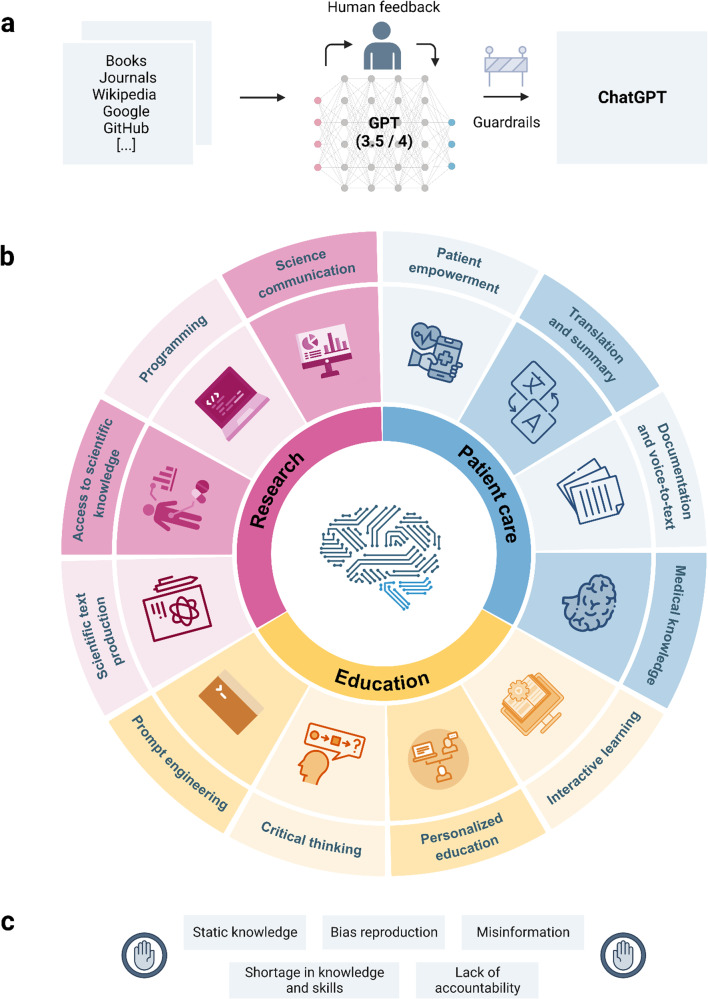
Large language models (LLMs) are artificial intelligence (AI) tools specifically trained to process and generate text. LLMs attracted substantial public attention after OpenAI’s ChatGPT was made publicly available in November 2022. LLMs can often answer questions, summarize, paraphrase and translate text on a level that is nearly indistinguishable from human capabilities. The possibility to actively interact with models like ChatGPT makes LLMs attractive tools in various fields, including medicine. While these models have the potential to democratize medical knowledge and facilitate access to healthcare, they could equally distribute misinformation and exacerbate scientific misconduct due to a lack of accountability and transparency. In this article, we provide a systematic and comprehensive overview of the potentials and limitations of LLMs in clinical practice, medical research and medical education.
Overview
CoChat Summary
TL;DR
This review surveys how large language models (LLMs) may affect patient care, medical research, and medical education, emphasizing both their capabilities and their risks. It argues that LLMs could democratize medical knowledge and assist communication, documentation, research, and teaching, but current limitations in factuality, bias, accountability, transparency, and reproducibility must be addressed before clinical use.
Key findings
- LLMs can augment patient care through medical knowledge and reasoning, translations, summaries, and documentation; GPT-4 “now exceeds the passing score on every step of the US-medical licensing exam (USMLE),” and documentation/administrative requirements consume around 25% of clinicians’ workdays.
- In medical research, LLMs can summarize evidence, generate scientific abstracts that humans struggle to differentiate from human-written ones, and assist with coding, but outputs currently require significant human revision and LLMs do not always provide appropriate detailed summaries or critical appraisals of up-to-date, high-quality, peer-reviewed evidence.
- In medical education, LLMs can serve as personalized teaching assistants, simplify complex concepts, and simulate patient conversations, but they risk decreasing critical thinking and creativity and may lead to “externalization of medical reasoning.”
- Ethical and safety concerns include misinformation, data privacy and leakage, prompt injection attacks, lack of public training datasets and source code, commercial monopolies, and reproducibility problems due to model version changes; the authors observed substantial differences between GPT-3.5 and GPT-4 prompted queries and minor changes across GPT-3.5 versions.
Methods
- Narrative review/overview; the abstract describes it as a “systematic and comprehensive overview of the potentials and limitations of LLMs in clinical practice, medical research and medical education.”
- No primary data, sample, or formal quantitative analysis are reported; illustrative model outputs were generated using ChatGPT (GPT-4—May 3, 2023; GPT-3.5—May 3, 2023) and additional examples are in Supplementary Data.
- The main analysis is a qualitative synthesis across patient care, medical research, and medical education, with example prompts and outputs used to illustrate capabilities and limitations.
Limitations
- Stated by the paper: LLMs reproduce existing biases, hallucinate false information, spread misinformation, lack accountability, and currently have no mechanisms to ensure output correctness; their knowledge is static, reproducibility is compromised by model updates or access restrictions, training datasets and source code are often not public, and development is driven primarily by commercial companies.
- Stated by the paper: safety guardrails can themselves pose limitations, for example if bias prevention leads to different symptoms in men and women being overlooked.
- Evident from the text: despite being described as “systematic,” no formal systematic review methodology, search strategy, inclusion criteria, or data extraction process is reported, and the illustrative examples are limited to selected ChatGPT versions rather than a comprehensive empirical evaluation.
Model-written summary. Check it against the paper before relying on it.
Integrity signals
Registry
Cites
Statistics
Figures
Verification
Claims the paper makes
16 Valid · 3 Not valid · 21 Not checked · 36 Own results and interpretations
The cited sources support only part of this claim — read each source’s verdict below.
In the paper
“Through their text simplification capabilities33, LLMs may improve communication between healthcare staff and patients34.”
§ The future landscape of large language models in medicine > Patient care > Medical knowledge and medical core competencies
What the sources say
- Partly supportedcites [33] Devaraj, A., Marshall, I., Wallace, B. & Li, J. J. Paragraph-level simplification of medical texts. In Proc. 2021 Conference of the North American Chapter of the Association for Computational Linguistics: Human Language Technologies, 4972–4984. 10.18653/v1/2021.naacl-main.395 (Association for Computational Linguistics, 2021). PMC9161242 35663507 sourceExperimental — accuracy not yet measured
The Introduction (page unavailable) says automatic simplification may make specialist medical information accessible to a wider audience, and the Conclusions report simpler model outputs. The paper does not examine communication between healthcare staff and patients, so it supports the proposed mechanism but not that specific application. (LLM, conf=0.83)
- Supportedcites [34] Ayers, J. W. et al. Comparing physician and artificial intelligence Chatbot responses to patient questions posted to a public social media forum. JAMA Intern. Med. 10.1001/jamainternmed.2023.1838 (2023). PMC10148230 37115527 source
The Discussion says chatbots could assist clinicians in messaging patients by drafting replies and could help staff improve their communication skills. The citing sentence attaches a separate citation to text simplification; this paper supports the hedged communication claim attributed to it. (LLM, conf=0.90)
hedgedstates a possible cause- Asserted: passes — The authors put it forward as true.
- Checkable: passes — It can be checked against evidence.
- Load-bearing: unclear — It is unclear whether the paper’s conclusions depend on it.
- Based: passes — The paper gives a reason why it holds.
- Partly supported
The cited sources support only part of this claim — read each source’s verdict below.
In the paper
“GPT-4 thus far demonstrates the highest medical domain knowledge of LLMs to date5.”
§ The future landscape of large language models in medicine > Patient care > Medical knowledge and medical core competencies
What the sources say
- Partly supportedcites [5] Nori, H., King, N., McKinney, S. M., Carignan, D. & Horvitz, E. Capabilities of GPT-4 on medical challenge problems. Preprint at arXiv10.48550/arXiv.2303.13375 (2023). sourceExperimental — accuracy not yet measured
The Abstract (p. 1) reports that GPT-4 outperformed GPT-3.5 and a medically tuned model on medical examinations and benchmarks. The Conclusion (p. 22) says it outperformed Flan-PaLM 540B on all but one MultiMedQA dataset. These comparisons support strong medical-benchmark performance, but not the unqualified claim that GPT-4 had the highest medical domain knowledge of all LLMs to date. (LLM, conf=0.86)
boosted- Asserted: passes — The authors put it forward as true.
- Checkable: passes — It can be checked against evidence.
- Load-bearing: unclear — It is unclear whether the paper’s conclusions depend on it.
- Based: passes — The paper gives a reason why it holds.
- Partly supported
The cited sources support only part of this claim — read each source’s verdict below.
In the paper
“Technical options to overcome limitations in factuality and mitigate (bias-related) harms can generally be implemented throughout the entire development process of LLMs.”
§ The future landscape of large language models in medicine > Ethical use and misinformation
What the sources say
- Partly supportedcites [33] Devaraj, A., Marshall, I., Wallace, B. & Li, J. J. Paragraph-level simplification of medical texts. In Proc. 2021 Conference of the North American Chapter of the Association for Computational Linguistics: Human Language Technologies, 4972–4984. 10.18653/v1/2021.naacl-main.395 (Association for Computational Linguistics, 2021). PMC9161242 35663507 sourceExperimental — accuracy not yet measured
The Ethical Considerations section says hallucinations in generated medical summaries can misinform readers and recommends examining outputs before use. That supports a limited way to address factuality harms, but the paper does not discuss bias-related harms or establish that technical options can be implemented throughout the entire LLM development process. (LLM, conf=0.79)
- Not checked yetcites [64] Kumar, S., Balachandran, V., Njoo, L., Anastasopoulos, A. & Tsvetkov, Y. Language generation models can cause harm: so what can we do about it? An actionable survey. In Proc. 17th Conference of the European Chapter of the Association for Computational Linguistics, 3299–3321 (Association for Computational Linguistics, 2023). source
- Not checked yetcites [65] Ma, Y., Seneviratne, S. & Daskalaki, E. Improving text simplification with factuality error detection. In Proc. Workshop on Text Simplification, Accessibility, and Readability (TSAR–2022), 173–178 (Association for Computational Linguistics, 2022). source
- Partly supportedcites [66] Devaraj, A., Sheffield, W., Wallace, B. & Li, J. J. Evaluating factuality in text simplification. In Proc. 60th Annual Meeting of the Association for Computational Linguistics (Volume 1: Long Papers), 7331–7345. 10.18653/v1/2022.acl-long.506 (Association for Computational Linguistics, 2022). PMC9671157 36404800 sourceExperimental — accuracy not yet measured
The Qualitative Analysis section suggests including document context or decontextualizing text before simplification, and the Conclusion describes work on automatic factuality assessment. These support technical approaches to factuality in text simplification, but the paper does not establish that options can be implemented throughout LLM development or address mitigation of bias-related harms. The cited passages provide no page numbers. (LLM, conf=0.78)
- Partly supportedcites [67] Fleisig, E. et al. FairPrism: evaluating fairness-related harms in text generation. In Proc. 61st Annual Meeting of the Association for Computational Linguistics (Volume 1: Long Papers), 6231–6251 (Association for Computational Linguistics, 2023). sourceExperimental — accuracy not yet measured
The Recommendations (p. 8) describe ways to improve datasets for measuring and mitigating harms in AI-generated text. They do not address factuality or say that technical options can be implemented throughout the entire LLM development process; the paper's supported point is narrower. (LLM, conf=0.85)
- Not checked yetcites [68] Sha, L., Li, Y., Gasevic, D. & Chen, G. Bigger data or fairer data? Augmenting BERT via active sampling for educational text classification. In Proc. 29th International Conference on Computational Linguistics, 1275–1285 (International Committee on Computational Linguistics, 2022).
plain- Asserted: passes — The authors put it forward as true.
- Checkable: passes — It can be checked against evidence.
- Load-bearing: unclear — It is unclear whether the paper’s conclusions depend on it.
- Based: passes — The paper gives a reason why it holds.
- Partly supported
Every source the paper cites for this claim was checked and supports it.
In the paper
“Lastly, to date, the development of LLMs has been driven primarily by commercial companies such as OpenAI/Microsoft21, Meta24, and Google2.”
§ The future landscape of large language models in medicine > Ethical use and misinformation
What the sources say
- Supportedcites [21] OpenAI. GPT-4 Technical Report. Preprint at arXiv10.48550/arXiv.2303.08774 (2023). source
The citation is attached to OpenAI/Microsoft as an example, rather than to the claims about Meta or Google. The report identifies GPT-4 as a model developed by OpenAI (Abstract, p. 1) and credits Microsoft Azure with supporting its training infrastructure (Authorship & credit attribution, p. 17). (LLM, conf=0.88)
- Supportedcites [24] Touvron, H. et al. LLaMA: open and efficient foundation language models. Preprint at arXiv10.48550/arXiv.2302.13971 (2023). source
The citation is attached to Meta in a list of companies developing LLMs. The title page (p. 1) identifies the LLaMA authors as Meta AI, and the Abstract (p. 1) says they developed the LLaMA foundation language models. This supports Meta as an example; this citation need not establish the sentence’s broader claim about who primarily drives LLM development. (LLM, conf=0.91)
- Supportedcites [2] Singhal, K. et al. Large language models encode clinical knowledge. Nature620, 172–180 (2023). PMC10396962 37438534 source
The citation is attached specifically to Google as an example of an LLM developer. The Methods > Modelling section describes the authors building Med-PaLM from PaLM and Flan-PaLM, supporting that example; it does not establish the separate, broader assertion that commercial companies primarily drive LLM development. (LLM, conf=0.86)
plainstates a cause- Asserted: passes — The authors put it forward as true.
- Checkable: passes — It can be checked against evidence.
- Load-bearing: passes — The paper’s conclusions depend on it.
- Based: passes — The paper gives a reason why it holds.
- Supported
The cited sources support only part of this claim — read each source’s verdict below.
In the paper
“as misconceived prompts may result in biases or misinformation with potentially serious consequences4.”
§ The future landscape of large language models in medicine > Medical education > Education about LLMs
What the sources say
- Partly supportedcites [4] Binz M Schulz E Using cognitive psychology to understand GPT-3 Proc. Natl Acad. Sci. USA 2023 120 e2218523120 10.1073/pnas.2218523120 36730192 PMC9963545 sourceExperimental — accuracy not yet measured
In Results, under “Problems with vignette-based investigations” (page unavailable), the paper reports that slightly modified prompts produced incorrect or contradictory GPT-3 answers. This supports the possibility that poorly framed prompts yield misleading responses, but the cited passages do not establish that such responses have potentially serious consequences. (LLM, conf=0.84)
hedgedstates a possible cause- Asserted: passes — The authors put it forward as true.
- Checkable: passes — It can be checked against evidence.
- Load-bearing: passes — The paper’s conclusions depend on it.
- Based: passes — The paper gives a reason why it holds.
- Partly supported
23 more claims
Create a free account to see all 76 claims and to verify the 43 references still open.
- It may state two separate claims as one. 31
- Probably not a substantial claim. 29
Claims other papers make about this one
Each is checked against this paper’s own text: does it say what the citing paper says it does?
The source backs part of the claim, not all of it — or backs it for a different population, condition or comparison.
In the citing paper
“Further to this, there is potential for these LLM-based applications to reduce medical errors and capturing missed information by providing a layer of scrutiny when embedded in EHRs [45].”
From Generative AI in healthcare: an implementation science informed translational path on application, integration and governance (2024) · cites this paper as [45]
Experimental — accuracy not yet measuredThe source backs part of the claim, not all of it — or backs it for a different population, condition or comparison.
In the citing paper
“Use cases like workflow and documentation automation, personalized predictive analytics, and patient education chatbots confirm vast potential [26, 41, 45], provided the technology supports rather than supplants human expertise.”
From Generative AI in healthcare: an implementation science informed translational path on application, integration and governance (2024) · cites this paper as [45]
Experimental — accuracy not yet measuredThe source backs part of the claim, not all of it — or backs it for a different population, condition or comparison.
In the citing paper
“Large language models (LLMs) have been shown to interpret complex clinical situations and offer recommendations, from differential diagnoses to care management, leading to growing interest in their application in the medical field [13-16].”
From Identifying Deprescribing Opportunities With Large Language Models in Older Adults: Retrospective Cohort Study (2025) · cites this paper as [13]
Experimental — accuracy not yet measuredThe source backs part of the claim, not all of it — or backs it for a different population, condition or comparison.
In the citing paper
“they lack the nuanced understanding, empathy, and ethical reasoning inherent to human practitioners [19].”
From Mitigating cognitive biases in clinical decision-making through multi-agent conversations using large language models: simulation study (2024) · cites this paper as [19]
Experimental — accuracy not yet measuredThe source backs part of the claim, not all of it — or backs it for a different population, condition or comparison.
In the citing paper
“While we recognize that these issues are affected by the use of LLMs in significant ways6,98,99 these, challenges are not specific to health-related applications.”
From The ethics of ChatGPT in medicine and healthcare: a systematic review on large language models (LLMs) (2024) · cites this paper as [6]
Experimental — accuracy not yet measured
5 more claims about this paper
Create a free account to see every claim other papers make about this one.
Citations
Cites
BERT: Pre-training of Deep Bidirectional Transformers for Language Understanding
Devlin, J., Chang, M.-W., Lee, K., & Toutanova, K. (2019) · Proceedings of the 2019 Conference of the North American Chapter of the Association for Computational Linguistics: Human Language Technologies, Volume 1 (Long and Short Papers) · doi:10.18653/v1/n19-1423 · Cited by 54,325
BioBERT: a pre-trained biomedical language representation model for biomedical text mining
Lee, J., Yoon, W., Kim, S., Kim, D., Kim, S., So, C. H., & Kang, J. (2020) · Bioinformatics · doi:10.1093/bioinformatics/btz682 · Cited by 7,218
LLaMA: Open and Efficient Foundation Language Models
Touvron, H., Lavril, T., Izacard, G., Martinet, X., Lachaux, M.-A., Lacroix, T., Rozière, B., Goyal, N., Hambro, E., Azhar, F., et al. (2023) · arXiv · doi:10.48550/arxiv.2302.13971 · Cited by 4,602 · cited 5×
“this was followed by the release of other LLMs from companies such as Google and Meta 2,15 – 17 .”
MethodInfluentialKung, T. H., Cheatham, M., Medenilla, A., Sillos, C., De Leon, L., Elepaño, C., Madriaga, M., Aggabao, R., Diaz-Candido, G., Maningo, J., et al. (2023) · PLOS Digital Health · doi:10.1371/journal.pdig.0000198 · Cited by 4,115 · cited 3×
“Nonetheless, using LLMs for scienti fi c writing currently requires signi fi cant revisions by human authors due to inaccurate, shallow and repetitive outputs (Supplementary Data, example 6).”
BackgroundMethodKung, T. H., Cheatham, M., ChatGPT, Medenilla, A., Sillos, C., De Leon, L., Elepaño, C., Madriaga, M., Aggabao, R., Diaz-Candido, G., et al. (2022) · doi:10.1101/2022.12.19.22283643 · Cited by 4,115
Large language models encode clinical knowledge
Singhal, K., Azizi, S., Tu, T., Mahdavi, S. S., Wei, J., Chung, H. W., Scales, N., Tanwani, A., Cole-Lewis, H., Pfohl, S., et al. (2023) · Nature · doi:10.1038/s41586-023-06291-2 · Cited by 4,083
Large Language Models Encode Clinical Knowledge
Singhal, K., Azizi, S., Tu, T., Mahdavi, S. S., Wei, J., Chung, H. W., Scales, N., Tanwani, A., Cole-Lewis, H., Pfohl, S., et al. (2022) · arXiv · doi:10.48550/arxiv.2212.13138 · Cited by 4,083
SciBERT: A Pretrained Language Model for Scientific Text
Beltagy, I., Lo, K., & Cohan, A. (2019) · Proceedings of the 2019 Conference on Empirical Methods in Natural Language Processing and the 9th International Joint Conference on Natural Language Processing (EMNLP-IJCNLP) · doi:10.18653/v1/d19-1371 · Cited by 3,218
Sallam, M. (2023) · Healthcare · doi:10.3390/healthcare11060887 · Cited by 3,126
Ayers, J. W., Poliak, A., Dredze, M., Leas, E. C., Zhu, Z., Kelley, J. B., Faix, D. J., Goodman, A. M., Longhurst, C. A., Hogarth, M., et al. (2023) · JAMA Internal Medicine · doi:10.1001/jamainternmed.2023.1838 · Cited by 2,613 · cited 1×
“Through their text simpli fi cation capabilities 33 , LLMs may improve communication between healthcare staff and patients 34 .”
Background
Research works printed but not linked: 2
- Xiu Y Thompson P Flipped university class: a study of motivation and learning Int. J. Inf. Commun. Technol. Educ. 2020 19 41 63
- Sha, L., Li, Y., Gasevic, D. & Chen, G. Bigger data or fairer data? Augmenting BERT via active sampling for educational text classification. In Proc. 29th International Conference on Computational Linguistics, 1275–1285 (International Committee on Computational Linguistics, 2022).
Cited by
Items 601–700 of 1,017
Romanyukha, A. A., Mazloumi, M., Waelheyns, T. D., Mishra, N., Jacobs, J., & Fitousi, N. T. (2025) · Physica Medica · doi:10.1016/j.ejmp.2025.105090 · Cited by 2
Large language models in scientific publications: challenges and opportunities
Vardas, P. E. (2025) · European Heart Journal · doi:10.1093/eurheartj/ehaf669 · Cited by 2
AI-driven fabrication of healthcare survey data: methods, motivations, and ethical implications
Timothy, T. R. (2025) · Ethics & Behavior · doi:10.1080/10508422.2025.2552777 · Cited by 3
“…domain, large language models (LLMs) are deep neural network models trained on web-scale text corpora to model and generate natural language with high contextual fidelity, often producing outputs that can appear indistinguishable from human writing in specialized domains (Clusmann et al., 2023).”
Designing Patient-Centered Communication Aids in Pediatric Surgery Using Large Language Models
Rao, A. S., Mazumder, A., Roux, E. L., Young, C. C., Bott, E., Wang, J., Kochis, M. A., Stetson, A. E., Butler, A. M., Hilker, S., et al. (2025) · Journal of Pediatric Surgery · doi:10.1016/j.jpedsurg.2025.162654 · Cited by 3
Scheuerman, M. K., Zhao, D., Andrews, J. T. A., Birhane, A., Liao, Q. V., Panagiotidou, G., Chitre, P., Pine, K. H., Walker, S., Zhao, J., et al. (2025) · ACM Conference on Computer Supported Cooperative Work (CSCW) · doi:10.1145/3715070.3748285 · Cited by 2
Conrado, R. C. G., Campos, E. M., Traina, C., Traina, A. J. M., & Cazzolato, M. T. (2025) · Simpósio Brasileiro de Bancos de Dados (SBBD) · doi:10.5753/sbbd_estendido.2025.247610 · Cited by 2
“LLMs. Large Language Models (LLMs) are Artificial Intelligence Models trained in extensive amounts of textual data, allowing the generation of responses, summarization, paraphrasing, and text translation with a level of proficiency comparable to human capabilities [Clusmann et al. 2023].”
Amirrajab, S., Vehof, V., Bietenbeck, M., & Yılmaz, A. (2026) · Scientific Reports · doi:10.1038/s41598-026-75150-7 · Cited by 2
Exploring Artificial Intelligence's Potential to Enhance Conventional Anticancer Drug Development
Bobolea, S., Hinoveanu, M. I., Dimitriu, A., Brașoveanu, M., Iliescu, C., Dinu‐Pîrvu, C., Ghica, M. V., Anuța, V., Popa, L., & Prisada, R. M. (2025) · Drug Development Research · doi:10.1002/ddr.70182 · Cited by 2
A large language model-based chatbot system framework for urban planners
Zhou, X., Jeong, B., & Chapple, K. (2025) · Expert Systems with Applications · doi:10.1016/j.eswa.2025.130307 · Cited by 8
Farooq, A., Anuragi, D., Li, Z., Ziat, M., Cooperstock, J. R., & Raisamo, R. (2025) · Human-Intelligent Systems Integration · doi:10.1007/s42454-025-00085-9 · Cited by 3
“These models power conversational interfaces that are transforming diverse sectors such as research (Jumper et al. 2021) medicine (Clusmann et al. 2023) and even transportation and logistics (Wandelt et al. 2024).”
EchoGraph system for automated quality assessment of echocardiography reports
Chao, C., Delbrouck, J.-B., Asadi, M., Banerjee, I., Farina, J., Galasso, F. I., Mahmoud, A., Abbas, M. T., Wang, Y.-C., Arsanjani, R., et al. (2025) · npj Digital Medicine · doi:10.1038/s41746-025-02140-w · Cited by 4
“With the rise of generative AI, particularly language models 4,5 , there is an increasing need for automatic, generic metrics to evaluate the factual correctness of generated clinical text to facilitate the pace of progress in developing vision-language models that produce accurate reports 3,6,7 .”
Guan, J. (2025) · Springer eBooks · doi:10.1007/978-981-95-2806-6 · Cited by 3
Governance and Management of Medical Artificial Intelligence
Guan, J. (2025) · Springer eBooks · doi:10.1007/978-981-95-2806-6_14 · Cited by 2
Batubara, M. H., Sibarani, B., Murni, S., & Ginting, S. A. (2025) · Journal of Linguistics Literature and Language Teaching (JLLLT) · doi:10.37249/jlllt.v5i1.934 · Cited by 3
“Clusmann et al. (2023) showed that LLMs may translate complicated medical terminology into plain English, improving communication between physicians and patients.”
Using large language model to aid in teaching medical imaging report writing
Chen, Y., Xiang, P., Zhou, Q., Li, C., Zhang, X., Wang, J., Wang, H. J., Gao, Z., Yang, Z., Ye, S., et al. (2025) · Medical Teacher · doi:10.1080/0142159x.2025.2603353 · Cited by 2
“The dynamically updating models may affect the quality of feedback due to poor reproducibility [24].”
Zheng, X., Li, N., Luan, X., Wang, K., Shi, L., Sun, M., & Wang, H. (2026) · ACM/IEEE International Conference on Software Engineering: Companion Proceedings (ICSE-Companion) · doi:10.1145/3744916.3787820 · Cited by 9
“Their success has driven their adoption in high-stakes domains including healthcare [6], law [21], finance [26], and scientific research [57, 59], where reliable reasoning is essential.”
Park, G. L., Dallaghan, G. L. B., Bradley, J. A., Sikander, Q., Jung, H., Zhang, K., Polites, G. M., & Jokela, J. A. (2026) · Medical Science Educator · doi:10.1007/s40670-025-02623-1 · Cited by 2
Cutting-edge AI technologies in skin cancer applications
Diao, Y., Chen, X., Huang, Z., Tan, Q., Yang, M., Yu, H., Xu, Y., & Hu, X. (2026) · Cancer Letters · doi:10.1016/j.canlet.2026.218256 · Cited by 2
Mahdaoui, E. H. E., & Mykhalko, Y. O. (2025) · Polski Merkuriusz Lekarski · doi:10.36740/merkur202506117 · Cited by 3
LCM-Net: LLM-Driven Cross-Modality MoE Feature Fusion Network for Cancer Survival Analysis
Yang, S., Zhou, H., Yang, Y., Wang, W., Chen, S., Yang, G., Fu, H., & Zhu, L. (2026) · IEEE Transactions on Medical Imaging · doi:10.1109/tmi.2026.3657518 · Cited by 4
“Question-Answering [37], [38], clinical decision-making [39], and other healthcare tasks [40].”
Rajkumar, P., Tang, R., Sapre, H., Zemlin, J., Deleray, V., Seo, J. I., Mohan, S., Xing, S., Gouda, H., Abiead, Y. E., et al. (2026) · Analytical Chemistry · doi:10.1021/acs.analchem.5c05301 · Cited by 3
Zeng, H., Yuan, Y., Wu, X., Ye, Z., Yuan, H., Luo, S., Zhang, K., Wang, L., Liu, H., & Yang, H. (2026) · International Journal of Surgery · doi:10.1097/js9.0000000000004454 · Cited by 2
Poser, P. L., Klimas, R., Luerweg, J., Reuter, E., Hanefeld, C., Gold, R., Salmen, A., & Motte, J. (2026) · Frontiers in Artificial Intelligence · doi:10.3389/frai.2026.1658575 · Cited by 4
“Additionally, the use of LLMs bears several limitations and may introduce a qualitative bias into scientific data analyses due to a lack of accountability and transparency (Clusmann et al., 2023).”
Hasheminasab, S. A., Jamil, F., Afzal, M. U., Khan, A. H., Ilyas, S., Noor, A., Touseef, A., Abbas, S. M., Cheema, H. N., Shabbir, M. U., et al. (2026) · BMC Medical Informatics and Decision Making · doi:10.1186/s12911-026-03366-8 · Cited by 6
Huang, T., Kirk, B., Close, J., Lim, J.-Y., Duque, G., Ebeling, P. R., Yang, M., Tian, M., Chui, C. S., Liu, C., et al. (2026) · Frontiers in Aging · doi:10.3389/fragi.2026.1712785 · Cited by 2
“Prior studies (Chen et al., 2025; Clusmann et al., 2023) have also noted that newer LLMs tend to converge in performance metrics, particularly on well-established topics.”
GrapheneChat: A Large Language Model for Enhancing Graphene Research
Yang, D., Lu, C., Feng, Y., Mao, W., Wang, K., Sun, L., Wang, Y., Hu, B., Tan, J., Liu, Z., et al. (2026) · ACS Nano · doi:10.1021/acsnano.5c21335 · Cited by 2
Blocking the Reflection: Milestones and Hurdles for Digital Twins in Mental Health
Verhees, F. G., Wiest, I. C., Kather, J. N., Kambeitz, J., & Mikoláš, P. (2026) · Pharmacopsychiatry · doi:10.1055/a-2816-2869 · Cited by 3
Self-citationApplications and research trends of large language models in healthcare: A bibliometric analysis
Öztürk, H., & Hayat, E. (2026) · Medical Journal of Western Black Sea · doi:10.29058/mjwbs.1733561 · Cited by 2
Xu, H. A., Pythoud, R., Thorball, C. W., Carra, G., Kulynych, B., Despraz, J., Galland-Decker, C., Maslias, E., Baudson, E., Brahier, T., et al. (2026) · Journal of Medical Internet Research · doi:10.2196/86453 · Cited by 3
“This versatility and the observed high performance in standardized benchmarks prompted advocates across academia [4] and industry [5] to call for broader adoption of LLMs into medical informatics systems, for example, for decision support or assistance in operational and administrative tasks [6].”
Metzger, A., Patil, S., Sugarmann, L., Karabacak, M., & Margetis, K. D. (2026) · JMIR AI · doi:10.2196/81134 · Cited by 2
Giorgi, S., Ryan, K., & Kim, J. P. (2026) · npj Digital Medicine · doi:10.1038/s41746-026-02691-6 · Cited by 3
Li, Y. J., Su, F., Banyi, N., Edgcumbe, P., Thamboo, A. V., & Amanian, A. (2026) · Otolaryngology · doi:10.1002/ohn.70285 · Cited by 4
How Does Generative AI Reshape Chinese Patients’ Perceptions of Medical Authority?
Yuan, X., Jin, Q., Tang, Y., & Xu, J. (2026) · Media and Communication · doi:10.17645/mac.11485 · Cited by 3
“First, GAI renders complex medical terminology into accessible health narratives while providing real‐time multilingual support (Ayers et al., 2023; Clusmann et al., 2023; Grewal et al., 2023).”
Evaluation of ChatGPT-5.2 responses to frequently asked questions about benign bone tumors
Ayhan, B., Yoğurt, S. B., & Ayhan, Z. D. (2026) · Frontiers in Oncology · doi:10.3389/fonc.2026.1826346 · Cited by 2
“…models in medicine, identifying their greatest potential as accessible fi rst-contact informational tools that reduce informational asymmetry before specialist consultations, while emphasizing the continued necessity of physician oversight to ensure clinical safety and contextual accuracy (7).”
Strategies for mitigating artificial intelligence bias in healthcare: a systematic review
Gadhoumi, K., Senior, R., Wei, S., Ledbetter, L., Green, M. D., Bonner, B. D., Mosley, Y., Seidler, K., Green, K., Lee, D. M., et al. (2026) · JAMIA Open · doi:10.1093/jamiaopen/ooag081 · Cited by 3
“28,29 Empirically, analysis of Dimensions bibliometric data (Dimensions.ai, Digital Science, London, United Kingdom) shows that publications explicitly referencing “foundational model(s),” “large language model(s),” and related AI terminology increased more than 10-fold beginning in December 2022…”
Akbasli, I. T., Oztürk, B., Serin, O., Doğan, V., Berikol, G. B., Comeau, D. S., Celi, L. A., & Ozguner, O. (2026) · Journal of medical imaging · doi:10.1117/1.jmi.13.4.045501 · Cited by 2
Assessing ChatGPT Ability to Answer Frequently Asked Questions About Essential Tremor
Sorrentino, C., Canoro, V., Russo, M., Giordano, C., Barone, P., & Erro, R. (2024) · Tremor and Other Hyperkinetic Movements · doi:10.5334/tohm.917 · Cited by 3
“A systematic assessment of the capabilities of LLMs to answer any queries, with their respective pros and cons, would require multiple iterations, changes in wording, different priming, etc [28, 29].”
BackgroundGupta, S., Liu, J., Wong, Z. S.-Y., & Jonnagaddala, J. (2024) · Studies in health technology and informatics · doi:10.3233/shti240515 · Cited by 3
Ye, S. (2025) · Highlights in Science Engineering and Technology · doi:10.54097/m92y8a35 · Cited by 2
“Nature Medicine [20] and npj Digital Medicine [21] suggest that LLMs will provide highly personalized recommendations based on user habits, such as managing personal finances, planning travel, or optimizing daily tasks.”
An Evaluation of Current Trends in AI ‐Generated Text in Otolaryngology Publications
Kutler, R. B., Setzen, S. A., Tsai, S., & Rameau, A. (2025) · The Laryngoscope · doi:10.1002/lary.32202 · Cited by 3
Evaluating Large Language Models on Aerospace Medicine Principles
Anderson, K. D., Davis, C. A., Pickett, S. M., & Pohlen, M. (2025) · Wilderness and Environmental Medicine · doi:10.1177/10806032251330628 · Cited by 2
“13 In practice, strategies such as hyperparameter tuning, regularization, and increasing training data size are employed to mitigate over fi tting and under-fi tting issues in LLM training.”
Navigating the Future: Opportunities and Challenges of Generative AI in Nursing Research
An, K. (2025) · Research in Nursing & Health · doi:10.1002/nur.22464 · Cited by 2
Comparative Analysis of Large Language Models for Answering Cancer-Related Questions in Korean
Chang, H. K., Jung, J.-W., & Kim, Y. (2025) · Yonsei Medical Journal · doi:10.3349/ymj.2024.0200 · Cited by 2
Trustworthiness Evaluation of Large Language Models
Chen, P., & Liu, S. (2025) · Springer eBooks · doi:10.1007/978-3-031-76770-8_12 · Cited by 2
Reliability of Large Language Model Knowledge Across Brand and Generic Cancer Drug Names
Gallifant, J., Chen, S., Jain, S. K., Moreira, P. A. M., Topaloĝlu, Ü., Aerts, H. J. W. L., Warner, J. L., Cava, W. L., & Bitterman, D. S. (2025) · JCO Clinical Cancer Informatics · doi:10.1200/cci-24-00257 · Cited by 3
An adaptive design approach for AIGC-based VR rehabilitation training systems
Bu, L., Qu, J., Ding, J., Wang, C., Li, X., & Shi, P. (2025) · Journal of Engineering Design · doi:10.1080/09544828.2025.2540239 · Cited by 4
Tran, F., Meybohm, P., Blum, L. V., Neef, V., Kloka, J. A., Rumpf, F., Haas, T. E., Hottenrott, S., Helmer, P., Kranke, P., et al. (2025) · Minerva Anestesiologica · doi:10.23736/s0375-9393.25.19014-7 · Cited by 2
Design da informação para saúde: imaginando e criando novas formas de cuidado
Goldchmit, S. M. (2024) · InfoDesign - Revista Brasileira de Design da Informação · doi:10.51358/id.v21i1.1140 · Cited by 6
The impact of AI on surgery residency programs: improving competency, performance, and the future
Thanawala, R. M. (2024) · Global Surgical Education - Journal of the Association for Surgical Education · doi:10.1007/s44186-024-00255-4 · Cited by 2
“…and decision sciences. about the capabilities of AI must be paired with knowledge about the inherent risks which include perpetuating biases within training datasets, violations of privacy, and the generation of inaccurate information and generated hallucinations of the AI algorithms [45, 46].”
Artificial Intelligence in Newborn Medicine
Huisman, T. A. G. M., & Huisman, T. A. G. M. (2024) · Newborn · doi:10.5005/jp-journals-11002-0095 · Cited by 2
Machine Learning and Human Expertise in the Balance: Generative AI in Healthcare Settings
Montalvo, F. L., Pavlov, K., Thai, P., Devkota, B., & Takahashi, B. (2024) · Proceedings of the International Symposium on Human Factors and Ergonomics in Health Care · doi:10.1177/2327857924131010 · Cited by 2
“LLM-based AIs have been useful to physicians as they help cut down the time it takes to edit and to structure standardized reports (Clusmann et al., 2023).”
Medical AI in the EU: Regulatory Considerations and Future Outlook
Ranttila, P., Sahebi, G., Kontio, E., & Salmi, J. (2024) · Artificial intelligence · doi:10.5772/intechopen.1007443 · Cited by 2
Kokkorakis, M., Folkertsma, P., Anagnostakis, F., Sirotin, N., Agarwal, M. A., Shantouf, R. S., Henning, R. H., Pijl, H., Wolffenbuttel, B. H. R., Bax, J. J., et al. (2024) · EBioMedicine · doi:10.1016/j.ebiom.2024.105518 · Cited by 2
“37 Moreover, QUES-CAD showed greater uniformity in its discriminative performance across eth-nicities compared to currently used clinical tools, and the absence of blood biomarkers enables individual risk calculation outside the “ strict ” healthcare setting, such as Caribbean, East Asian, Black,…”
Mileti, A., de Cosmo, L. M., Piper, L., Baldassarre, F. F., Schillaci, C. E., & Guido, G. (2025) · Journal of Economic Surveys · doi:10.1111/joes.12696 · Cited by 2
Abrantes, J. (2025) · Cureus · doi:10.7759/cureus.84165 · Cited by 3
Jantos, B. A., Wierzbicki, M. P., & Tomaszewski, M. (2025) · Lecture notes in networks and systems · doi:10.1007/978-3-031-92734-8_7 · Cited by 2
Evaluating the Performance of Large Language Models on Multispecialty FRCS Section 1 Questions
Ahmed, H. S. (2025) · Journal of Surgical Research · doi:10.1016/j.jss.2025.06.026 · Cited by 2
Ishadya, A. P. D., Withanaarachchi, A. S., & Jayalal, S. (2025) · International Conference on Advances in Technology and Computing (ICATC) · doi:10.1109/icatc68823.2025.11407841 · Cited by 2
“5, GPT-4, ChatGPT), reflecting global publication trends rather than comparative model diversity; similar patterns were reported in [22] and [11].”
LLMs in the Heart of Differential Testing: A Case Study on a Medical Rule Engine
Isaku, E., Laaber, C., Sartaj, H., Ali, S., Schwitalla, T., & Nygård, J. F. (2025) · IEEE International Conference on Software Testing, Verification and Validation (ICST) · doi:10.1109/icst62969.2025.10989025 · Cited by 7
“Surveys [9, 15, 38] highlight the potential and challenges of LLMs in healthcare, noting limited practical use.”
The Future of Medicine: Large Language Models Redefining Healthcare DynamicsPreprint
Haque, A., Chowdhury, M. N.-U.-R., & Neha, F. F. (2023) · doi:10.36227/techrxiv.24354451.v1 · Cited by 2
The Future of Medicine: Large Language Models Redefining Healthcare DynamicsPreprint
Haque, A., Chowdhury, M. N.-U.-R., & Neha, F. F. (2023) · doi:10.36227/techrxiv.24354451.v2 · Cited by 3
État de la situation sur les impacts sociétaux de l'intelligence artificielle et du numérique - 2024
Obvia, Langlois, L., Cousineau, M., Gagnon, M.-P., Larnder, C. I., Naffi, N., Garneau, J., Lévesque, C., Brin, C., Guèvremont, V., et al. (2024) · doi:10.61737/cfrt3613 · Cited by 3
Real-World Usage Patterns of Large Language Models in HealthcarePreprint
Unell, A., Kashyap, M., Pfeffer, M. A., & Shah, N. H. (2025) · medRxiv · doi:10.1101/2025.05.02.25326781 · Cited by 7
“While research literature has explored numerous potential applications, less is known about how healthcare professionals actually utilize these tools when given access in real-world clinical settings [7, 8, 9, 10].”
Singhal, P., Li, Z., Yang, Z. X., Nandi, T., Morse, C., Rodriguez, Z., Rodriguez, A., Kindratenko, V., Sirugo, G., Pyeritz, R. E., et al. (2025) · medRxiv · doi:10.1101/2025.09.05.25333227 · Cited by 3
Scanlin, J., Cuesta, A. G., & Varsavsky, M. (2026) · medRxiv · doi:10.64898/2026.02.13.26346256 · Cited by 4
The new wave of generative artificial intelligence in medical education
Jung, E., & Samuel, A. (2026) · Korean journal of medical education · doi:10.3946/kjme.2025.139 · Cited by 2
“Users can interact directly with LLMs in a conversational manner [5].”
AI-Generated Responses to Patient's Messages: Effectiveness, Feasibility and ImplementationPreprint
Bladder, K. J. M., Verburg, A. C., Arts-Tenhagen, M., Willemsen, R., van den Broek, G. B., Driessen, C. M. L., Driessen, R. J. B., Robberts, B., Scheffer, A. R. T., de Vries, A. P., et al. (2026) · medRxiv · doi:10.64898/2026.03.02.26347175 · Cited by 2
Tan, Y. Z., Nah, S. A., Saw, S. N., Rajandram, R., & Ong, T. A. (2025) · Urological Science · doi:10.1097/us9.0000000000000089 · Cited by 2
FlashDecoding++Next: High Throughput LLM Inference With Latency and Memory Optimization
Dai, G., Hong, K., Mao, Q., Li, X., Xu, J., Huang, H., Xia, H., Ning, X., Yan, S., Liang, Y. E., et al. (2025) · IEEE Transactions on Computers · doi:10.1109/tc.2025.3585339 · Cited by 11
“A S the Large Language Model (LLM) achieved unprecedented success in various domains [5], [6], [7], [8], the LLM inference workload is skyrocketing.”
From accuracy to comprehensibility: Evaluating large language models for myopia patient queries
Karataş, E., & Engin, C. D. (2025) · Health Policy and Technology · doi:10.1016/j.hlpt.2025.101073 · Cited by 2
Mallick, C., Banerjee, S., & Amin, S. A. (2025) · Expert Opinion on Drug Discovery · doi:10.1080/17460441.2025.2532688 · Cited by 2
“The performance of ML models for h KMOis can be improved by incorporating large language models (LLMs) and generative artificial intelligence (AI) systems [68,69].”
Singireddi, S., Pandey, S., Pardasani, R., Kiran, R., V, & Awasthi, N. (2025) · IEEE International Conference on Healthcare Informatics (ICHI) · doi:10.1109/ichi64645.2025.00036 · Cited by 1
“Large language models (LLMs) have proven their ability to process and synthesize vast volumes of data that are inherently complex, heterogeneous, and ever-expanding [1], [2].”
A Comprehensive Review of LLMs: Architecture, Performance, and Applications
Yılmaz, Y., Öztürk, M. M., & Nejković, V. (2025) · International Conference on Electrical, Electronic and Computing Engineering (IcETRAN) · doi:10.1109/icetran66854.2025.11114289 · Cited by 3
“Transformers try to detect the contextual relationships between words in sentences, paragraphs, and documents in the input to perform language tasks and ensure that this relationship is perfectly understood [20], [21].”
Zhang, J., Lan, F., Chen, Q., Li, Y., Zhao, M., & Luo, Y. (2025) · IEEE International Conference on Image Processing and Computer Applications (ICIPCA) · doi:10.1109/icipca65645.2025.11138180 · Cited by 1
“As innovative and powerful tools to learn and infer, extract knowledge from data, and perform various operations, a new generation of automated intelligent systems, LLMs, can process natural language text at the near-human level [1].”
Pan, J., Tyrtova, E., Wiseman, D. B., Park, C., & Hofstetter, C. P. (2025) · World Neurosurgery · doi:10.1016/j.wneu.2025.124519 · Cited by 1
Artificial Intelligence Clinical Reasoning in Board-Style Clinical Vignettes: A Comparative Study
Gjunkshi, L., Gjunkshi, L., Quezada, K. A., Persaud, N. A., & Braun, J. (2025) · Cureus · doi:10.7759/cureus.94563 · Cited by 1
“The origins of artificial intelligence can be traced to Alan Turing's foundational work in 1950, with the term “artificial intelligence” subsequently coined by John McCarthy as the field developed [4,5].”
Danvirutai, P., Tola, S., Yuangsoi, B., Charoenwattanasak, S., Thaiso, K., & Srichan, C. (2025) · International Conference on Computer Communication and Information Systems (CCCIS) · doi:10.1109/cccis64581.2025.00032 · Cited by 1
Obafemi-Ajayi, T., Bright, T. J., Wong, E., Wunsch, D. C., Peckham, J., & Moore, J. H. (2025) · International Joint Conference on Neural Networks (IJCNN) · doi:10.1109/ijcnn64981.2025.11227432 · Cited by 1
“Without robust mechanisms to distinguish between valid and invalid text, these models susceptible to parroting biases and misinformation that exist in natural language [24].”
Large language models support delivery of telemedicine in pharmacy: A cross-sectional study
Sridharan, K., & Sivaramakrishnan, G. (2025) · Intelligent Medicine · doi:10.1016/j.imed.2025.12.001 · Cited by 1
Çiçek, V., Zhao, L., Tur, Y., Öz, A., Kılıç, Ş., Durak, G., Şaylık, F., Hayıroğlu, M. İ., Çınar, T., & Bağcı, U. (2026) · Medical Sciences · doi:10.3390/medsci14010033 · Cited by 1
“Still, the medical community has responded to these technologies with a mix of cautious optimism and genuine skepticism, recognizing both their trans-formative potential and the crucial need to ensure patient safety [6].”
Small, W. R., Crowley, R. J., Pariente, C. S., Zhang, J., Eaton, K. P., Jiang, L. Y., Oermann, E. K., & Aphinyanaphongs, Y. (2026) · npj Health Systems · doi:10.1038/s44401-025-00059-8 · Cited by 2
Basmaci, N., Aksun, S., & Yildiz, B. O. (2026) · Endocrine · doi:10.1007/s12020-025-04491-6 · Cited by 1
“The integration of AI chatbots into clinical practice also holds promise for supporting healthcare professionals by providing up-to-date educational resources and clinical guidance, thereby contributing to improved patient care and healthcare efficiency [ 7].”
Novak, S. R., Reed-Jones, L., Kedrowicz, A. A., Birkenheuer, A. J., Royal, K. D., & McCool, K. E. (2026) · Journal of Veterinary Internal Medicine · doi:10.1093/jvimsj/aalaf058 · Cited by 1
Jardim, R. R.-A. J., Gonçalves, G., Lopes, L. S., Dantas, T. F., Paulino, D., Netto, A. T. C., Guimarães, D., Rocha, A., Vivacqua, A. S., & Paredes, H. (2025) · Conference proceedings/Conference proceedings - IEEE International Conference on Systems, Man, and Cybernetics · doi:10.1109/smc58881.2025.11342613 · Cited by 1
“This external review by medical professionals guards against potential inaccuracies and provides an essential layer of validation, increasing the credibility of the claims posed to the LLMs [16], [17].”
Maruyama, H., Toyama, Y., Araki, Y., Takanami, K., Ito, M., Nakajima, Y., Takase, K., & Kamei, T. (2026) · JMIR Cancer · doi:10.2196/86630 · Cited by 1
Transforming Medical Machine Translation with Next-Generation Large Language Models
Suram, P., & Patro, P. (2025) · OITS International Conference on Information Technology (OCIT) · doi:10.1109/ocit66168.2025.11400016 · Cited by 1
Forero, D. A. (2026) · Current Genomics · doi:10.2174/0113892029403403260112075225 · Cited by 1
Guo, Y., Meng, X., Yu, E., Zhang, W., Yang, Y., Ma, H., Shao, C., Wang, W., Wang, R., Wang, H., et al. (2026) · npj Digital Medicine · doi:10.1038/s41746-026-02644-z · Cited by 3
“Theirtrainingparadigmsare basedmainlyonquestion – answer tasks and general medical knowledge, with limited adaptation to specialty-speci fi c contexts and clinical work fl ows 37,38 .”
Kasa, K., Yoshimaru, D., Ohta, H., Ohki, T., & Okano, H. J. (2026) · General Thoracic and Cardiovascular Surgery · doi:10.1007/s11748-026-02304-9 · Cited by 1
“Recent evaluations highlight their potential to expand access to medical knowledge and enhance medical education, although challenges regarding bias, misinformation, and accountability remain [3–5].”
Validating large language model–assisted data extraction from clinical notes
Koevorden, J. W. V., Aben, N., Struben, V. M. D., Rollings, A., Kurban, M., Wessels, L. F. A., van der Noort, V., Burger, A. V. M., Dijk, S. W., Karssemakers, L. H. E., et al. (2026) · ESMO Real World Data and Digital Oncology · doi:10.1016/j.esmorw.2026.100718 · Cited by 6
Aroua, R., Kammoun, I., Louati, M. A., Adjeroh, D., & Duan, T. (2026) · Frontiers in Artificial Intelligence · doi:10.3389/frai.2026.1816692 · Cited by 1
Léon, M., Feng, R., Quiroz-Flores, M., Pelletier, G. J., Bethencourt, D. M., Shibata, M., He, H., & Ruaengsri, C. (2026) · Frontiers in Digital Health · doi:10.3389/fdgth.2026.1769467 · Cited by 2
“Large language models (LLMs) are transforming healthcare by enhancing communication, improving diagnosis, and enabling personalized decision support (1–3).”
Qin, X., Song, P., Yan, Z., Qian, H., Jiang, L., & Wang, C. (2026) · Frontiers in Medicine · doi:10.3389/fmed.2026.1874243 · Cited by 1
Wojtas, J., Pak, G., & Górski, W. J. (2026) · Cureus · doi:10.7759/cureus.112868 · Cited by 1
“Nevertheless, their use in medicine remains associated with important limitations, including hallucinations, incomplete transparency of training data, inconsistent performance across tasks, and the risk of generating plausible but incorrect answers [5,6,7].”
Geantă, M., Боата, А., Cucoş, B., & Cioroboiu, C. (2024) · Springer eBooks · doi:10.1007/978-981-97-4974-4_8 · Cited by 1
Patient-Centered and Practical Privacy to Support AI for Healthcare
Liu, R., Lee, H. K., Bhavani, S. V., Jiang, X., Ohno-Machado, L., & Xiong, L. (2024) · IEEE International Conference on Trust, Privacy and Security in Intelligent Systems and Applications (TPS-ISA) · doi:10.1109/tps-isa62245.2024.00038 · Cited by 6
Ethical Aspects of Generative AI in Medicine
Põder, J.-C., & Helgesson, G. (2025) · Integrated science · doi:10.1007/978-3-031-87023-1_12 · Cited by 3
Evaluating Large Language Models on Twitter Based on Hashtag Dynamics and Scaling Properties
Su, S., Zhang, H., & Wang, Z. (2025) · Communications in computer and information science · doi:10.1007/978-981-96-5123-8_16 · Cited by 2
A Fine-Tuning Pipeline with Small Conversational Data for Healthcare Chatbot
Aguzzi, G., Magnini, M., Pengo, M. F., Mirko Viroli, D., & Montagna, S. (2025) · Lecture notes in computer science · doi:10.1007/978-3-031-95841-0_1 · Cited by 1
Metadata
- Authors
- Clusmann, J., Kolbinger, F. R., Muti, H. S., Carrero, Z. I., Eckardt, J.-N., Laleh, N. G., Löffler, C. M. L., Schwarzkopf, S.-C., Unger, M., Veldhuizen, G. P., Wagner, S. J., & Kather, J. N.
- Affiliations
- Universitätsklinikum Aachen (DE)
- University Hospital Carl Gustav Carus (DE)
- Else Kröner Fresenius Center for Digital Health (DE)
- Helmholtz Munich (DE)
- Heidelberg University (DE)
- Corresponding author
- Kather, Jakob Nikolas
- ORCID
- Venue
- Communications Medicine
- Published
- 2023-10-10
- Volume
- 3
- Issue
- 1
- Pages
- 141-141
- ISSN
- 2730-664X (ISSN-L)
- PMC
- PMC10564921
- OpenAlex
- W4387500346
- Semantic Scholar
- 282c568302701bc163d454702eae10e43ca784a3
- Cited by
- 1,045
- References
- 63
- Citations by year
- 2026: 304 · 2025: 435 · 2024: 293 · 2023: 13
- FWCI
- 12.29
- Type
- journal article
- Language
- en
- Open access
- gold
- doi.org
- Licence
- cc-by
- creativecommons.org/licenses/by/4.0 (tdm)
- creativecommons.org/licenses/by/4.0 (vor)
- Locations
- Communications Medicine (publishedVersion, cc-by)
- PubMed Central (publishedVersion, cc-by)
- PubMed (publishedVersion)
- Qucosa (Saxon State and University Library Dresden) (submittedVersion, cc-by)
- DOAJ (DOAJ: Directory of Open Access Journals) (submittedVersion, cc-by-sa)
- mediaTUM – the media and publications repository of the Technical University Munich (Technical University Munich) (submittedVersion, other-oa)
- Funders
- European Union’s Horizon Europe and innovation programme
- Topics
- Health Sciences › Medicine › Health Informatics › Artificial Intelligence in Healthcare and Education
- Physical Sciences › Computer Science › Artificial Intelligence › Machine Learning in Healthcare
- Physical Sciences › Computer Science › Artificial Intelligence › Artificial Intelligence Applications
- Keywords
- large language models, ChatGPT, artificial intelligence in healthcare, clinical practice, medical research, medical education, misinformation, research misconduct, transparency and accountability, health care access
About these checks
Registry, retraction, Cites and statistics results are computed, not judged, with one exception: a printed reference that no index lists is read once by a model before it counts as a citation error. Claims are extracted by a model and kept only when their quote appears verbatim in the text; each cited source is then checked, with a model’s help, for whether it says what the claim relies on. Those verdicts can be wrong — read the claim’s quote and the cited source before relying on one.
The claim verdicts this report counts are experimental: their accuracy is not yet measured.
A language model drew the claims from the paper on 2026-10-04, under version 3 of the claim definition (model deepseek-v4.1-flash, prompt extract-v3).
A second model labelled each claim on 2026-10-04 (model jev-1.13-20260917, definition revision gold-guideline-v0.2).
Cited sources are checked with a language model’s help (gpt-6-sol).
Statistics and arithmetic are recomputed, not judged.
Confidence bands are shown only for fields calibrated on our annotated test set. None is calibrated yet, so no band is shown.
What counts as a claim ›How we measure confidence ›How we check this ›
Are you an author, or do you see a problem with this page? Request a review
Data sources
Bibliographic data: Semantic Scholar, OpenAlex, Crossref.
Contains information from the Semantic Scholar Academic Graph Datasets, made available under the ODC Attribution License (ODC-BY 1.0).
Semantic Scholar’s data is described in: Kinney, R., et al. (2023). The Semantic Scholar Open Data Platform. arXiv:2301.10140.
