

The future landscape of large language models in medicine
Open accessThe DOI matches its Crossref record; 70 of the 70 references it cites were found in a registry or an index; 35 of the 78 sources its claims cite were checked for support.
Abstract
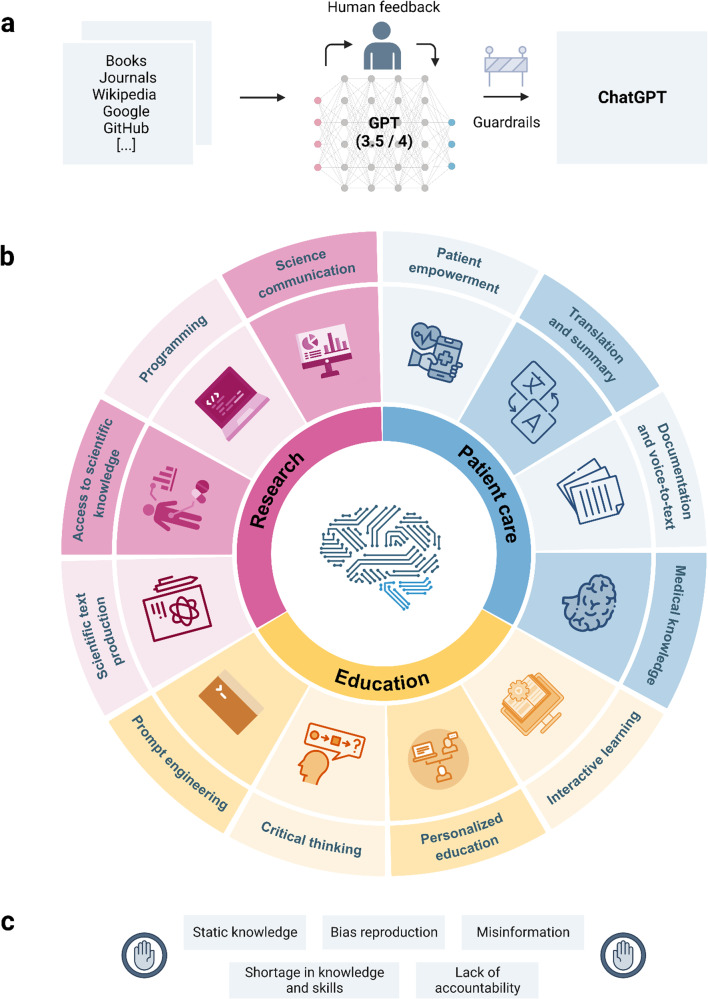
Large language models (LLMs) are artificial intelligence (AI) tools specifically trained to process and generate text. LLMs attracted substantial public attention after OpenAI’s ChatGPT was made publicly available in November 2022. LLMs can often answer questions, summarize, paraphrase and translate text on a level that is nearly indistinguishable from human capabilities. The possibility to actively interact with models like ChatGPT makes LLMs attractive tools in various fields, including medicine. While these models have the potential to democratize medical knowledge and facilitate access to healthcare, they could equally distribute misinformation and exacerbate scientific misconduct due to a lack of accountability and transparency. In this article, we provide a systematic and comprehensive overview of the potentials and limitations of LLMs in clinical practice, medical research and medical education.
Overview
CoChat Summary
TL;DR
This review surveys how large language models (LLMs) may affect patient care, medical research, and medical education, emphasizing both their capabilities and their risks. It argues that LLMs could democratize medical knowledge and assist communication, documentation, research, and teaching, but current limitations in factuality, bias, accountability, transparency, and reproducibility must be addressed before clinical use.
Key findings
- LLMs can augment patient care through medical knowledge and reasoning, translations, summaries, and documentation; GPT-4 “now exceeds the passing score on every step of the US-medical licensing exam (USMLE),” and documentation/administrative requirements consume around 25% of clinicians’ workdays.
- In medical research, LLMs can summarize evidence, generate scientific abstracts that humans struggle to differentiate from human-written ones, and assist with coding, but outputs currently require significant human revision and LLMs do not always provide appropriate detailed summaries or critical appraisals of up-to-date, high-quality, peer-reviewed evidence.
- In medical education, LLMs can serve as personalized teaching assistants, simplify complex concepts, and simulate patient conversations, but they risk decreasing critical thinking and creativity and may lead to “externalization of medical reasoning.”
- Ethical and safety concerns include misinformation, data privacy and leakage, prompt injection attacks, lack of public training datasets and source code, commercial monopolies, and reproducibility problems due to model version changes; the authors observed substantial differences between GPT-3.5 and GPT-4 prompted queries and minor changes across GPT-3.5 versions.
Methods
- Narrative review/overview; the abstract describes it as a “systematic and comprehensive overview of the potentials and limitations of LLMs in clinical practice, medical research and medical education.”
- No primary data, sample, or formal quantitative analysis are reported; illustrative model outputs were generated using ChatGPT (GPT-4—May 3, 2023; GPT-3.5—May 3, 2023) and additional examples are in Supplementary Data.
- The main analysis is a qualitative synthesis across patient care, medical research, and medical education, with example prompts and outputs used to illustrate capabilities and limitations.
Limitations
- Stated by the paper: LLMs reproduce existing biases, hallucinate false information, spread misinformation, lack accountability, and currently have no mechanisms to ensure output correctness; their knowledge is static, reproducibility is compromised by model updates or access restrictions, training datasets and source code are often not public, and development is driven primarily by commercial companies.
- Stated by the paper: safety guardrails can themselves pose limitations, for example if bias prevention leads to different symptoms in men and women being overlooked.
- Evident from the text: despite being described as “systematic,” no formal systematic review methodology, search strategy, inclusion criteria, or data extraction process is reported, and the illustrative examples are limited to selected ChatGPT versions rather than a comprehensive empirical evaluation.
Model-written summary. Check it against the paper before relying on it.
Integrity signals
Registry
Cites
Statistics
Figures
Verification
Claims the paper makes
16 Valid · 3 Not valid · 21 Not checked · 36 Own results and interpretations
The cited sources support only part of this claim — read each source’s verdict below.
In the paper
“Through their text simplification capabilities33, LLMs may improve communication between healthcare staff and patients34.”
§ The future landscape of large language models in medicine > Patient care > Medical knowledge and medical core competencies
What the sources say
- Partly supportedcites [33] Devaraj, A., Marshall, I., Wallace, B. & Li, J. J. Paragraph-level simplification of medical texts. In Proc. 2021 Conference of the North American Chapter of the Association for Computational Linguistics: Human Language Technologies, 4972–4984. 10.18653/v1/2021.naacl-main.395 (Association for Computational Linguistics, 2021). PMC9161242 35663507 sourceExperimental — accuracy not yet measured
The Introduction (page unavailable) says automatic simplification may make specialist medical information accessible to a wider audience, and the Conclusions report simpler model outputs. The paper does not examine communication between healthcare staff and patients, so it supports the proposed mechanism but not that specific application. (LLM, conf=0.83)
- Supportedcites [34] Ayers, J. W. et al. Comparing physician and artificial intelligence Chatbot responses to patient questions posted to a public social media forum. JAMA Intern. Med. 10.1001/jamainternmed.2023.1838 (2023). PMC10148230 37115527 source
The Discussion says chatbots could assist clinicians in messaging patients by drafting replies and could help staff improve their communication skills. The citing sentence attaches a separate citation to text simplification; this paper supports the hedged communication claim attributed to it. (LLM, conf=0.90)
hedgedstates a possible cause- Asserted: passes — The authors put it forward as true.
- Checkable: passes — It can be checked against evidence.
- Load-bearing: unclear — It is unclear whether the paper’s conclusions depend on it.
- Based: passes — The paper gives a reason why it holds.
- Partly supported
The cited sources support only part of this claim — read each source’s verdict below.
In the paper
“GPT-4 thus far demonstrates the highest medical domain knowledge of LLMs to date5.”
§ The future landscape of large language models in medicine > Patient care > Medical knowledge and medical core competencies
What the sources say
- Partly supportedcites [5] Nori, H., King, N., McKinney, S. M., Carignan, D. & Horvitz, E. Capabilities of GPT-4 on medical challenge problems. Preprint at arXiv10.48550/arXiv.2303.13375 (2023). sourceExperimental — accuracy not yet measured
The Abstract (p. 1) reports that GPT-4 outperformed GPT-3.5 and a medically tuned model on medical examinations and benchmarks. The Conclusion (p. 22) says it outperformed Flan-PaLM 540B on all but one MultiMedQA dataset. These comparisons support strong medical-benchmark performance, but not the unqualified claim that GPT-4 had the highest medical domain knowledge of all LLMs to date. (LLM, conf=0.86)
boosted- Asserted: passes — The authors put it forward as true.
- Checkable: passes — It can be checked against evidence.
- Load-bearing: unclear — It is unclear whether the paper’s conclusions depend on it.
- Based: passes — The paper gives a reason why it holds.
- Partly supported
The cited sources support only part of this claim — read each source’s verdict below.
In the paper
“Technical options to overcome limitations in factuality and mitigate (bias-related) harms can generally be implemented throughout the entire development process of LLMs.”
§ The future landscape of large language models in medicine > Ethical use and misinformation
What the sources say
- Partly supportedcites [33] Devaraj, A., Marshall, I., Wallace, B. & Li, J. J. Paragraph-level simplification of medical texts. In Proc. 2021 Conference of the North American Chapter of the Association for Computational Linguistics: Human Language Technologies, 4972–4984. 10.18653/v1/2021.naacl-main.395 (Association for Computational Linguistics, 2021). PMC9161242 35663507 sourceExperimental — accuracy not yet measured
The Ethical Considerations section says hallucinations in generated medical summaries can misinform readers and recommends examining outputs before use. That supports a limited way to address factuality harms, but the paper does not discuss bias-related harms or establish that technical options can be implemented throughout the entire LLM development process. (LLM, conf=0.79)
- Not checked yetcites [64] Kumar, S., Balachandran, V., Njoo, L., Anastasopoulos, A. & Tsvetkov, Y. Language generation models can cause harm: so what can we do about it? An actionable survey. In Proc. 17th Conference of the European Chapter of the Association for Computational Linguistics, 3299–3321 (Association for Computational Linguistics, 2023). source
- Not checked yetcites [65] Ma, Y., Seneviratne, S. & Daskalaki, E. Improving text simplification with factuality error detection. In Proc. Workshop on Text Simplification, Accessibility, and Readability (TSAR–2022), 173–178 (Association for Computational Linguistics, 2022). source
- Partly supportedcites [66] Devaraj, A., Sheffield, W., Wallace, B. & Li, J. J. Evaluating factuality in text simplification. In Proc. 60th Annual Meeting of the Association for Computational Linguistics (Volume 1: Long Papers), 7331–7345. 10.18653/v1/2022.acl-long.506 (Association for Computational Linguistics, 2022). PMC9671157 36404800 sourceExperimental — accuracy not yet measured
The Qualitative Analysis section suggests including document context or decontextualizing text before simplification, and the Conclusion describes work on automatic factuality assessment. These support technical approaches to factuality in text simplification, but the paper does not establish that options can be implemented throughout LLM development or address mitigation of bias-related harms. The cited passages provide no page numbers. (LLM, conf=0.78)
- Partly supportedcites [67] Fleisig, E. et al. FairPrism: evaluating fairness-related harms in text generation. In Proc. 61st Annual Meeting of the Association for Computational Linguistics (Volume 1: Long Papers), 6231–6251 (Association for Computational Linguistics, 2023). sourceExperimental — accuracy not yet measured
The Recommendations (p. 8) describe ways to improve datasets for measuring and mitigating harms in AI-generated text. They do not address factuality or say that technical options can be implemented throughout the entire LLM development process; the paper's supported point is narrower. (LLM, conf=0.85)
- Not checked yetcites [68] Sha, L., Li, Y., Gasevic, D. & Chen, G. Bigger data or fairer data? Augmenting BERT via active sampling for educational text classification. In Proc. 29th International Conference on Computational Linguistics, 1275–1285 (International Committee on Computational Linguistics, 2022).
plain- Asserted: passes — The authors put it forward as true.
- Checkable: passes — It can be checked against evidence.
- Load-bearing: unclear — It is unclear whether the paper’s conclusions depend on it.
- Based: passes — The paper gives a reason why it holds.
- Partly supported
Every source the paper cites for this claim was checked and supports it.
In the paper
“Lastly, to date, the development of LLMs has been driven primarily by commercial companies such as OpenAI/Microsoft21, Meta24, and Google2.”
§ The future landscape of large language models in medicine > Ethical use and misinformation
What the sources say
- Supportedcites [21] OpenAI. GPT-4 Technical Report. Preprint at arXiv10.48550/arXiv.2303.08774 (2023). source
The citation is attached to OpenAI/Microsoft as an example, rather than to the claims about Meta or Google. The report identifies GPT-4 as a model developed by OpenAI (Abstract, p. 1) and credits Microsoft Azure with supporting its training infrastructure (Authorship & credit attribution, p. 17). (LLM, conf=0.88)
- Supportedcites [24] Touvron, H. et al. LLaMA: open and efficient foundation language models. Preprint at arXiv10.48550/arXiv.2302.13971 (2023). source
The citation is attached to Meta in a list of companies developing LLMs. The title page (p. 1) identifies the LLaMA authors as Meta AI, and the Abstract (p. 1) says they developed the LLaMA foundation language models. This supports Meta as an example; this citation need not establish the sentence’s broader claim about who primarily drives LLM development. (LLM, conf=0.91)
- Supportedcites [2] Singhal, K. et al. Large language models encode clinical knowledge. Nature620, 172–180 (2023). PMC10396962 37438534 source
The citation is attached specifically to Google as an example of an LLM developer. The Methods > Modelling section describes the authors building Med-PaLM from PaLM and Flan-PaLM, supporting that example; it does not establish the separate, broader assertion that commercial companies primarily drive LLM development. (LLM, conf=0.86)
plainstates a cause- Asserted: passes — The authors put it forward as true.
- Checkable: passes — It can be checked against evidence.
- Load-bearing: passes — The paper’s conclusions depend on it.
- Based: passes — The paper gives a reason why it holds.
- Supported
The cited sources support only part of this claim — read each source’s verdict below.
In the paper
“as misconceived prompts may result in biases or misinformation with potentially serious consequences4.”
§ The future landscape of large language models in medicine > Medical education > Education about LLMs
What the sources say
- Partly supportedcites [4] Binz M Schulz E Using cognitive psychology to understand GPT-3 Proc. Natl Acad. Sci. USA 2023 120 e2218523120 10.1073/pnas.2218523120 36730192 PMC9963545 sourceExperimental — accuracy not yet measured
In Results, under “Problems with vignette-based investigations” (page unavailable), the paper reports that slightly modified prompts produced incorrect or contradictory GPT-3 answers. This supports the possibility that poorly framed prompts yield misleading responses, but the cited passages do not establish that such responses have potentially serious consequences. (LLM, conf=0.84)
hedgedstates a possible cause- Asserted: passes — The authors put it forward as true.
- Checkable: passes — It can be checked against evidence.
- Load-bearing: passes — The paper’s conclusions depend on it.
- Based: passes — The paper gives a reason why it holds.
- Partly supported
23 more claims
Create a free account to see all 76 claims and to verify the 43 references still open.
- It may state two separate claims as one. 31
- Probably not a substantial claim. 29
Claims other papers make about this one
Each is checked against this paper’s own text: does it say what the citing paper says it does?
The source backs part of the claim, not all of it — or backs it for a different population, condition or comparison.
In the citing paper
“Further to this, there is potential for these LLM-based applications to reduce medical errors and capturing missed information by providing a layer of scrutiny when embedded in EHRs [45].”
From Generative AI in healthcare: an implementation science informed translational path on application, integration and governance (2024) · cites this paper as [45]
Experimental — accuracy not yet measuredThe source backs part of the claim, not all of it — or backs it for a different population, condition or comparison.
In the citing paper
“Use cases like workflow and documentation automation, personalized predictive analytics, and patient education chatbots confirm vast potential [26, 41, 45], provided the technology supports rather than supplants human expertise.”
From Generative AI in healthcare: an implementation science informed translational path on application, integration and governance (2024) · cites this paper as [45]
Experimental — accuracy not yet measuredThe source backs part of the claim, not all of it — or backs it for a different population, condition or comparison.
In the citing paper
“Large language models (LLMs) have been shown to interpret complex clinical situations and offer recommendations, from differential diagnoses to care management, leading to growing interest in their application in the medical field [13-16].”
From Identifying Deprescribing Opportunities With Large Language Models in Older Adults: Retrospective Cohort Study (2025) · cites this paper as [13]
Experimental — accuracy not yet measuredThe source backs part of the claim, not all of it — or backs it for a different population, condition or comparison.
In the citing paper
“they lack the nuanced understanding, empathy, and ethical reasoning inherent to human practitioners [19].”
From Mitigating cognitive biases in clinical decision-making through multi-agent conversations using large language models: simulation study (2024) · cites this paper as [19]
Experimental — accuracy not yet measuredThe source backs part of the claim, not all of it — or backs it for a different population, condition or comparison.
In the citing paper
“While we recognize that these issues are affected by the use of LLMs in significant ways6,98,99 these, challenges are not specific to health-related applications.”
From The ethics of ChatGPT in medicine and healthcare: a systematic review on large language models (LLMs) (2024) · cites this paper as [6]
Experimental — accuracy not yet measured
5 more claims about this paper
Create a free account to see every claim other papers make about this one.
Citations
Cites
BERT: Pre-training of Deep Bidirectional Transformers for Language Understanding
Devlin, J., Chang, M.-W., Lee, K., & Toutanova, K. (2019) · Proceedings of the 2019 Conference of the North American Chapter of the Association for Computational Linguistics: Human Language Technologies, Volume 1 (Long and Short Papers) · doi:10.18653/v1/n19-1423 · Cited by 54,325
BioBERT: a pre-trained biomedical language representation model for biomedical text mining
Lee, J., Yoon, W., Kim, S., Kim, D., Kim, S., So, C. H., & Kang, J. (2020) · Bioinformatics · doi:10.1093/bioinformatics/btz682 · Cited by 7,218
LLaMA: Open and Efficient Foundation Language Models
Touvron, H., Lavril, T., Izacard, G., Martinet, X., Lachaux, M.-A., Lacroix, T., Rozière, B., Goyal, N., Hambro, E., Azhar, F., et al. (2023) · arXiv · doi:10.48550/arxiv.2302.13971 · Cited by 4,602 · cited 5×
“this was followed by the release of other LLMs from companies such as Google and Meta 2,15 – 17 .”
MethodInfluentialKung, T. H., Cheatham, M., Medenilla, A., Sillos, C., De Leon, L., Elepaño, C., Madriaga, M., Aggabao, R., Diaz-Candido, G., Maningo, J., et al. (2023) · PLOS Digital Health · doi:10.1371/journal.pdig.0000198 · Cited by 4,115 · cited 3×
“Nonetheless, using LLMs for scienti fi c writing currently requires signi fi cant revisions by human authors due to inaccurate, shallow and repetitive outputs (Supplementary Data, example 6).”
BackgroundMethodKung, T. H., Cheatham, M., ChatGPT, Medenilla, A., Sillos, C., De Leon, L., Elepaño, C., Madriaga, M., Aggabao, R., Diaz-Candido, G., et al. (2022) · doi:10.1101/2022.12.19.22283643 · Cited by 4,115
Large language models encode clinical knowledge
Singhal, K., Azizi, S., Tu, T., Mahdavi, S. S., Wei, J., Chung, H. W., Scales, N., Tanwani, A., Cole-Lewis, H., Pfohl, S., et al. (2023) · Nature · doi:10.1038/s41586-023-06291-2 · Cited by 4,083
Large Language Models Encode Clinical Knowledge
Singhal, K., Azizi, S., Tu, T., Mahdavi, S. S., Wei, J., Chung, H. W., Scales, N., Tanwani, A., Cole-Lewis, H., Pfohl, S., et al. (2022) · arXiv · doi:10.48550/arxiv.2212.13138 · Cited by 4,083
SciBERT: A Pretrained Language Model for Scientific Text
Beltagy, I., Lo, K., & Cohan, A. (2019) · Proceedings of the 2019 Conference on Empirical Methods in Natural Language Processing and the 9th International Joint Conference on Natural Language Processing (EMNLP-IJCNLP) · doi:10.18653/v1/d19-1371 · Cited by 3,218
Sallam, M. (2023) · Healthcare · doi:10.3390/healthcare11060887 · Cited by 3,126
Ayers, J. W., Poliak, A., Dredze, M., Leas, E. C., Zhu, Z., Kelley, J. B., Faix, D. J., Goodman, A. M., Longhurst, C. A., Hogarth, M., et al. (2023) · JAMA Internal Medicine · doi:10.1001/jamainternmed.2023.1838 · Cited by 2,613 · cited 1×
“Through their text simpli fi cation capabilities 33 , LLMs may improve communication between healthcare staff and patients 34 .”
Background
Research works printed but not linked: 2
- Xiu Y Thompson P Flipped university class: a study of motivation and learning Int. J. Inf. Commun. Technol. Educ. 2020 19 41 63
- Sha, L., Li, Y., Gasevic, D. & Chen, G. Bigger data or fairer data? Augmenting BERT via active sampling for educational text classification. In Proc. 29th International Conference on Computational Linguistics, 1275–1285 (International Committee on Computational Linguistics, 2022).
Cited by
Items 801–900 of 1,017
Beyond Scaling Laws: Towards Scientific Reasoning-Driven LLM ArchitecturesPreprint
Chen, F. (2025) · Preprints.org · doi:10.20944/preprints202504.2088.v1 · Cited by 2
Domain specific models outperform large vision language models on cytomorphology tasksPreprint
Kukuljan, I., Dasdelen, M. F., Schäfer, J., Buck, M. C., Götze, K. S. S., & Marr, C. (2025) · medRxiv · doi:10.1101/2025.05.05.25326989 · Cited by 2
Min, D., Kim, S. Y., Hwang, S., Jin, K. N., Bang, S., Jeong, W. G., Choi, J., Chang, J. M., & Park, C. M. (2025) · Research Square · doi:10.21203/rs.3.rs-6267208/v1 · Cited by 1
Lee, K., & Hong, S. (2025) · Healthcare Informatics Research · doi:10.4258/hir.2025.31.2.175 · Cited by 1
“As unstructured digital text data become increasingly available, NLP and text mining techniques have emerged as valuable tools for health research [11,12].”
Cornelius, J., Knitza, J., Hack, J., Pavlović, M., & Kühn, S. (2025) · Die Unfallchirurgie · doi:10.1007/s00113-025-01581-y
Implementing Large Language Models in Critical Care
Gharib, K. E. (2025) · CHEST Critical Care · doi:10.1016/j.chstcc.2025.100180 · Cited by 1
Promise, Pitfalls and the Path Ahead for LLMs as Diagnostic Assistants for Focal Liver Lesions
Chen, Y., & Schneider, C. V. (2025) · Liver International · doi:10.1111/liv.70153
Callaghan, J. P., Freimane, K. Z., Brown, R. M., Cratchley, A. L., & Kendall, T. J. (2025) · The Journal of Pathology Clinical Research · doi:10.1002/2056-4538.70032
Modeling Clinical Data with Attention: A Knowledge Graph Approach with CliniKG
Moura, E., Conrado, R. C. G., Campos, L. O., Olivatto, M. M., Gutierrez, M. A., Traina, C., Traina, A. J. M., & Cazzolato, M. T. (2025) · Proceedings - IEEE Symposium on Computer-Based Medical Systems · doi:10.1109/cbms65348.2025.00156
Passban, P., Rezagholizadeh, M., & Way, A. (2025) · Machine translation · doi:10.1007/978-3-031-85747-8_1
In Reply to Sengul I and Sengul D
Dennstädt, F., Hastings, J., Putora, P. M., Vu, E., Fischer, G. F., Süveg, K., Glatzer, M., Riggenbach, E., Hà, H.-L., & Čihorić, N. (2025) · Advances in Radiation Oncology · doi:10.1016/j.adro.2025.101800 · Cited by 1
Ding, S., Bhattacharya, S., Sarwal, M., Sirota, M., & Butte, A. J. (2025) · bioRxiv (Cold Spring Harbor Laboratory) · doi:10.1101/2025.07.10.664265 · Cited by 1
Chua, H. C., & Nguyen, T. V. (2025) · The Journal for Nurse Practitioners · doi:10.1016/j.nurpra.2025.105490
Nursing students’ reflections of artificial intelligence use in assessments
Agovic, E., Sousa, I. M. O., & Forsyth, F. (2025) · European Journal of Cardiovascular Nursing · doi:10.1093/eurjcn/zvaf150
Future utility of generative artificial intelligence in colorectal surgery
Yiu, A. J., & Lam, K. (2025) · Frontline Gastroenterology · doi:10.1136/flgastro-2024-103023
“23 24 To become a primary source of medical information, chatbots will need to achieve trustworthiness and acceptability with patients and clinicians—as is the aim of efforts to fine-tune medical LLMs. 25”
KI in der medizinischen Forschung
Kather, J. N. (2025) · Springer eBooks · doi:10.1007/978-3-662-71042-5_6
Self-citationDer Mensch und die KI – unser neues Gegenüber
Kather, J. N. (2025) · Springer eBooks · doi:10.1007/978-3-662-71042-5_3
Self-citationTechnische Grundlagen der Künstlichen Intelligenz
Kather, J. N. (2025) · Springer eBooks · doi:10.1007/978-3-662-71042-5_2
Self-citationTaylor, A., & Junck, L. D. (2025) · SSRN Electronic Journal · doi:10.2139/ssrn.5338803
Mukisa, R., & Matovu, R. (2025) · Lecture notes in networks and systems · doi:10.1007/978-3-031-92611-2_3
Glenn, E., Mao, E., O'Connell, E., Rowshan, A., Beeram, I. R., & LaPorte, D. M. (2025) · Journal of Orthopaedic Reports · doi:10.1016/j.jorep.2025.100770
When Silence Speaks: Understanding Open-Ended Responses via LLMs in Therapeutic Voice Interaction
Busch, M., Jose, A., & Siegert, I. (2025) · Lecture notes in computer science · doi:10.1007/978-3-032-02548-7_31
Haber, T. S. W., Hinman, R. S., & Merolli, M. (2025) · Arthritis Care & Research · doi:10.1002/acr.25638
“6 Taken together, integrating AI into interventions could usher in an era of truly personalized “ precision ” medicine — in which AI integrates and analyses multiple sources of data (eg, clinical laboratory and omics data) to predict which treatments are most likely to bene fi t a given patient.”
Patel, J., Banik, K., Ibrahim, S. T., & Katapally, T. R. (2025) · medRxiv · doi:10.1101/2025.08.21.25334182
“While developed for natural language processing, they can also operate on structured datasets – such as electronic health records, physiological time series from wearables, and patient-reported outcomes – when formatted as text [25,27].”
AI-based research mentors: Plausible scenarios and ethical issues
Crean, D., Wieczorek, M., Gordijn, B., & Kearns, A. J. (2025) · Accountability in Research · doi:10.1080/08989621.2025.2551890
“Considering the rapid adoption of AI-based systems in research (Birhane et al. 2023; Clusmann et al. 2023; Kaebnick et al. 2023), and the emerging discourse surrounding AI mentors in general (Abu-Rasheed et al. 2024; Arora et al. 2023; Balse, Prasad, and Warriem 2023; Köbis and Mehner 2021; Murray…”
Kirupaharan, N., Edalat, C., Dalvin, L. A., Mishra, K., Marshall, R. F., Xu, H., Francis, J. H., & Berkenstock, M. (2025) · Eye · doi:10.1038/s41433-025-03961-5
“Large language models (LLMs) such as ChatGPT, Bard, and Llama analyse extensive medical data and assist clinicians [2].”
Query Augmented Generation (QAG) from the Genomic Data Commons for Accurate Variant StatisticsPreprint
Venkat, A., Wysocki, W. P., Lukowski, M., Song, S., Subramanyam, A., Zhang, Z., & Grossman, R. L. (2025) · bioRxiv (Cold Spring Harbor Laboratory) · doi:10.1101/2025.09.02.673797
Künstliche Intelligenz in der Diagnostik und Behandlung des kolorektalen Karzinoms
Kather, J. N. (2025) · Die Onkologie · doi:10.1007/s00761-025-01832-y
Self-citationYamagishi, Y., Hanaoka, S., Nakamura, Y., Kikuchi, T., Shimizu, A., Yoshikawa, T., & Abe, O. (2025) · Lecture notes in computer science · doi:10.1007/978-3-032-06004-4_23 · Cited by 1
Pohyer, V., de Margerie‐Mellon, C., Perronne, L., Duron, L., Thibault, C., Oudard, S. M., Fournier, L. S., & Rance, B. (2025) · Research Square · doi:10.21203/rs.3.rs-7630430/v1 · Cited by 1
Large language models and their current use in perioperative medicine: a scoping review protocol
Hondjeu, A. R. M., Zhao, Z. Y., Newton, L., Ajenkar, A., Termos, B., Shorr, R., Ladha, K. S., Wijeysundera, D. N., & McIsaac, D. I. (2025) · JBI Evidence Synthesis · doi:10.11124/jbies-25-00003 · Cited by 2
“LLMs have the potential to enhance these processes by summarizing complex medical histories, aiding clinical decisions, 10 and providing responsive, AI-driven communication tools to improve patient engagement 11 while reducing provider burden.”
Enhancing Cosine Similarity: A Unified Approach to Reduce Common Entity Bias in Sentence Similarity
Gupta, A. K., Gupta, A., Gupta, S., Tarun, P., & Jain, S. (2025) · International Conference on Data Science and Network Security (ICDSNS) · doi:10.1109/icdsns65743.2025.11168662
“Rapid advancement of Large Language Model has significant impact on the society [11], [12].”
Digitale Patientenkommunikation und LLM-basierte Gesprächsagenten
Gilbert, S., & Freyer, O. (2025) · Springer eBooks · doi:10.1007/978-3-662-71034-0_10
Ikhtiar, I., Fidiana, F., & Islamiyah, W. R. (2025) · Journal of Neurosciences in Rural Practice · doi:10.25259/jnrp_401_2024
Performance of a Large Language Model in BI-RADS Classification of Ultrasound Based Breast LesionsPreprint
Pillai, K., & Nausheen, F. (2025) · medRxiv · doi:10.1101/2025.09.28.25336860
The Future of Digital Medicine
Cesario, A., Gorini, M., & D’Amario, D. (2025) · Springer eBooks · doi:10.1007/978-3-032-01272-2_7
Evaluation of Artificial Intelligence for the Anatomy Content in Medical CollegePreprint
Kausar, N., & Khashram, N. A. (2025) · Preprints.org · doi:10.20944/preprints202510.0659.v1
Baptista, J. P., Silva, D. C. D. C., Avdeenko, O., Capitaneanu, C., & Franco, A. (2025) · Egyptian Journal of Forensic Sciences · doi:10.1186/s41935-025-00488-4 · Cited by 1
“Hence, training data can be scientific, such as research articles and technical books, or not (Clusmann et al. 2023).”
A Machine Learning System to Automate Body Computed Tomography Protocoling
Shokrollahi, P., Chaves, J. M. Z., Lam, J. P. H., Sharma, A., Pal, D., Bahrami, N., Gatidis, S., Chaudhari, A. S., & Loening, A. M. (2025) · Journal of Imaging Informatics in Medicine · doi:10.1007/s10278-025-01715-z · Cited by 1
“Additionally, LLMs require large-scale labeled datasets for fine-tuning, which may not be feasible given institutional data-sharing restrictions and privacy concerns [31, 32].”
Holst, C., Wiegräbe, F., Redecker, C., & Lohweg, V. (2025) · Springer eBooks · doi:10.1007/978-3-658-48573-3_11 · Cited by 2
Artificial Intelligence for Patient Education: A Primer, Not a Proxy
D'Souza, R. S., Benzon, H. T., & Nelson, A. M. (2025) · A&A Practice · doi:10.1213/xaa.0000000000002071
Ahmad, H. F., Sajid, J., Rasool, R. U., & Malik, A. W. (2025) · Cluster Computing · doi:10.1007/s10586-025-05793-0 · Cited by 1
“Others, such as [49] and [50], offer a broad [46] 2022 [47] 2023 [38] 2023 [48] 2023 [45] 2023 [52] 2023 [37] 2023 Harrer [44] 2023 [49] 2023 [54] 2024 [55] 2024 [57] 2024 [50] 2024 [58] 2024 [60] 2025 healthcare.”
Application and Prospect of ChatGPT in Medical Imaging Education
蔡, 一. (2025) · Advances in Clinical Medicine · doi:10.12677/acm.2025.1572005
A polarization-based dehazing method leveraging multi-angle DoP distribution and dual constraints
Zhao, K., Fan, Z., Jin, H., Zhao, C., Shen, C., & Gao, W. (2025) · Expert Systems with Applications · doi:10.1016/j.eswa.2025.130242 · Cited by 2
Neural Architecture Search-Based Meta-Reinforcement Learning in Robotic Simulation Environments
Guo, J. F., Zheng, X., Chen, Y., & Zhang, X. (2025) · International Joint Conference on Neural Networks (IJCNN) · doi:10.1109/ijcnn64981.2025.11229305
“RL plays a crucial role in various fields, including large language models [1-4], where it significantly contributes to improving performance, adaptability, and decision-making capabilities.”
From Accuracy to Applicability: Rethinking Large Language Model Integration in Radiology Exam Design
Aphale, P., Shekhar, H., & Dokania, S. (2025) · Academic Radiology · doi:10.1016/j.acra.2025.10.062
Kovalainen, J., & de Heer, S. (2025) · Perspectives in law, business and innovation · doi:10.1007/978-981-95-2058-9_12
Large Language Models, argumentation, and healthcare: A socio-cognitive perspective
Paglieri, F. (2025) · Journal of Argumentation in Context · doi:10.1075/jaic.25024.pag
Personalized Case- and Evidence-Based TBI Prognosis with Small Language Models
Manjunath, P., Adil, S. M., Wissel, B. D., Sexton, D. P., Lerner, B., & Dunn, T. (2025) · IEEE-EMBS International Conference on Biomedical and Health Informatics (BHI ...) · doi:10.1109/bhi67747.2025.11269507 · Cited by 1
“Recent studies have explored the potential of large language models (LLMs) in encoding clinical knowledge [7] and augmenting EBP [8], [9], highlighting their strong zero-shot reasoning capabilities, effective summarization, and knowledge transfer through prompting.”
Yuan, M.-Y., Hong, W.-Q., Hu, R.-H., Jiang, X., & Zhang, S. (2025) · Journal of Cancer Education · doi:10.1007/s13187-025-02793-x
Artificial Intelligence in Surgery: Learning and Applications
Tahir, U., Sadaf, I., Ayub, M., Hashmi, S. A. M. K., & Tanzeel, I. (2025) · Journal of Bahria University Medical and Dental College · doi:10.51985/jbumdc2025592
The Uniqueness of Digital Transformation and Data-Based Systems (DS)
Kirchschlaeger, P. G. (2025) · Springer eBooks · doi:10.1007/978-3-031-98704-5_3
Wu, P.-Y., Huang, P.-C., Chen, T.-Y., Ku, C., Lin, M.-Y., & Kang, Y. (2025) · IEEE International Conference on Information Reuse and Integration (IRI) · doi:10.1109/iri66576.2025.00059
“These models, pretrained on large-scale datasets, have shown potential in medical applications by integrating domain knowledge and generating interpretable outputs [6].”
Artificial Intelligence Applications in Global Surgery and Surgical Nursing
Yeşilyurt, K. Ö. (2025) · Hemşirelik Bilimi Dergisi · doi:10.54189/hbd.1606325
Exploring the Role of Large Language Models in Radiology
Brower, B., Li, D., & Chong, J. (2025) · Roentgen Ray Review · doi:10.2214/r3j.25.01121
Apostolopoulos, I. D., Papathanasiou, N. D., Apostolopoulos, D. J., Papandrianos, N. I., & Papageorgiou, E. I. (2025) · International Conference on Information, Intelligence, Systems & Applications (IISA) · doi:10.1109/iisa66859.2025.11311233
“…the capability of LLMs to perform complex tasks such as medical summarization, question answering, and even radiological interpretation [16], [18], [19]One emerging application is the use of LLMs in data preprocessing and feature engineering, where models are prompted to derive new variables or…”
Intelligent Report Generation for Medical Imaging Enhanced by LLM
Naveen Kumar, S., Rajakumar, K., Samesh Enathe, V. P., & Venu Kishore, S. B. (2025) · International Conference on Sustainable Communication Networks and Application (ICSCNA) · doi:10.1109/icscn67106.2025.11308249
Pre-consultation Medical Assistant: An LLM-Based Support System for Physicians
Hu, Y., Chen, P., & Shen, Z. (2026) · Lecture notes in computer science · doi:10.1007/978-3-032-13184-3_21
PCOS Diagnosis: Data-Driven Predictions and Workflow Enhancement
Rai, S., Dubey, M., Jalan, S., Singhi, A., Chandra, K., & Prabhu, S. (2026) · Lecture notes on multidisciplinary industrial engineering · doi:10.1007/978-981-96-8327-7_15
The Security of Deep Learning Defenses in Medical Imaging
Levy, M., Amit, G., & Mirsky, Y. (2026) · Communications in computer and information science · doi:10.1007/978-3-032-13800-2_5
MediCERN: An LLM-Powered Platform for Quality Evaluation of Medical Videos
Alesh, Y., Mohamed, F., & Shoufan, A. (2026) · IEEE Access · doi:10.1109/access.2026.3650815
“Unimodal Evaluation: Evaluations are based solely on transcripts, excluding visual or auditory features that may influence perceived credibility [24].”
Sun, M.-Y., Chen, Y., & Bai, J. (2026) · Fire technology · doi:10.1007/s10694-025-01837-4
“For example, researchers tried to feed LLMs with extensive medical knowledge and develop a medical LLM to assist doctors in diagnosing diseases [ 3, 38, 42 ].”
Applying Large Language Models for Summarizing Electronic Health Records of Oncology Patients
de Brito, B. A. O., Filho, I. D. M. B., Malaquias, R. S., Lima, J. M. M. D., & Gurgel, A. M. (2025) · IEEE Symposium on Computers and Communications (ISCC) · doi:10.1109/iscc65549.2025.11326412 · Cited by 1
“These limitations are corroborated by Clusmann et al. [7], who explored the impact of LLMs on medicine and highlighted their ability to democratize medical knowledge and optimize clinical documentation.”
LISLLM: Long Context Inference of Large Language Models with Short KV Cache
Liu, T., Li, G., Zhu, Z., Mo, Z., Yao, X., & Cheng, J. (2025) · IEEE International Conference on Parallel and Distributed Systems (ICPADS) · doi:10.1109/icpads67057.2025.11323105
Wiseman, B., Li, H., Mason, E., Lonergan, K., Mitchell, R. E., & Hayward, J. (2026) · medRxiv · doi:10.64898/2026.01.13.26344087 · Cited by 1
Srivastava, A., Jain, S., & Maity, R. (2026) · Advances in chemical pollution, environmental management and protection · doi:10.1016/bs.apmp.2025.11.004
Digitale Diagnoseunterstützung seltener rheumatologischer Erkrankungen: Evidenz und Perspektiven
Kremer, P., Krusche, M., & Knitza, J. (2026) · rheuma plus · doi:10.1007/s12688-025-00922-4
Saad, M., Mughal, S. F., Mustafa, M., Ahmed, I., & Masood, A. (2025) · International Multi-Topic Conference · doi:10.1109/inmic65900.2025.11348502
“In public policy, LLMs may perpetuate biases, spread misinformation, and lack accountability, potentially influencing public opinion or policy decisions with far-reaching societal impacts [5].”
Li, A., Bi, X., Chen, S., Hu, J., & Shi, Y. (2026) · Health Information Science and Systems · doi:10.1007/s13755-026-00432-3
“However, the research and application of LLMs in the healthcare field are still in the exploratory stage [6].”
Trends in publications on scientific misconduct from 2000 to 2024: a Scopus-based bibliometric study
Castro, J. E. Q., & Castro, M. D. P. Q. (2026) · Science Editing · doi:10.6087/kcse.389
Schlüssel zur Krebstherapie der Zukunft?
Kather, J. N. (2026) · InFo Hämatologie + Onkologie · doi:10.1007/s15004-025-1238-9
“Beispiele sind das Zusammen-fassen langer Arztbriefe, die Übersetzung von Fachjargon in patientenverständliche Sprache oder die Unterstützung bei ad-ministrativen Aufgaben [10].”
Self-citationPei, L., Hu, J., Wanqing, Z., Wang, Q., & Fang, A. (2026) · doi:10.2196/preprints.92241
An Inspection on Paraphrase in Healthcare Using Natural Language Processing Approaches
Kundu, M., Mukherjee, M., & Mondal, A. (2025) · International Conference on Internet of Everything, Microwave Engineering, Communication and Networks (IEMECON) · doi:10.1109/iemecon69302.2025.11365865
Enhancing Fraud Detection and Financial Forecasting: The Role of LLMs in Healthcare and Finance
Simhadri, C. G., Sistla, V., & Reddy, C. R. K. (2026) · IGI Global eBooks · doi:10.4018/979-8-3373-3912-2.ch007 · Cited by 1
Metahealthcare: A Survey on Metaverse Through Healthcare (Preprint)Preprint
Rahimi, F., Sadeghi-Niaraki, A., Abuhmed, T., & Choi, S.-M. (2025) · doi:10.2196/preprints.81855
Kanapeckaitė, A., Peters, C. J., Laurinavičius, A., & Geris, L. (2026) · Integrative Biology · doi:10.1093/intbio/zyaf024
Al-Garadi, M. A., Gobbel, G. T., Gregg, L. P., Richardson, P. A., Herrera, A. A., Noriega, R. J., Wydermyer, S. R., Whitaker, J. M., French, T., McLemore, M. F., et al. (2026) · medRxiv · doi:10.64898/2026.02.10.26346025
Analysis on the application of large language model in generating exercise prescription for obesity
Liang, J., Sun, Z., Yang, J., Wang, X., Pan, K., Huang, S., & Huang, C. (2026) · International Conference on Information Technology and Contemporary Sports (TCS) · doi:10.1117/12.3105982
“…Model (LLM), which has shown outstanding capabilities in natural language processing, clinical text analysis and medical knowledge extraction [7] 。 In addition, as an important tool for structured knowledge expression, Knowledge Graph can integrate multi-source information and provide…”
Anindo, I. R., Sajid, M. A. U. I., Mahmood, M. S., Prottush, N., & Morol, M. K. (2025) · IEEE International Conference on Computing, Applications and Systems (COMPAS) · doi:10.1109/compas67506.2025.11381760
“Addressing this challenge requires innovative solutions that facilitate accurate and accessible communication [11] [14].”
Francis, J., Chimsuk, B., Peng, E. W. K., & Corno, A. F. (2026) · Regenerative medicine reports . · doi:10.4103/regenmed.regenmed-d-25-00045
Artificial intelligence in oncology: from tools to teammates
Kather, J. (2026) · Annals of Oncology · doi:10.1016/j.annonc.2026.02.004
Self-citationMcMaster, B., Yanamala, S. R., Alshaibi, R. R., Okoroha, K. R., Hevesi, M., Saris, D. B. F., Krych, A. J., & Tagliero, A. J. (2026) · Journal of ISAKOS Joint Disorders & Orthopaedic Sports Medicine · doi:10.1016/j.jisako.2026.101085
Al-Garadi, M. A., Desai, R. J., Ngan, K., Lenoue-Newton, M. L., Reeves, R., Park, D., Hernández‐Muñoz, J. J., Wang, S. V., Maro, J. C., Fuller, C. C., et al. (2026) · JAMIA Open · doi:10.1093/jamiaopen/ooaf175
“23,24 In this multi-institutional retrospective cohort study, we aimed to develop and validate machine learning (ML) models capable of predicting CoD by integrating comprehensive features from structured EHR data, unstructured clinical notes, and publicly available data.”
Leveraging Large Language Models to Extract Prognostic Pathology Features in Ewing SarcomaPreprint
Huang, J., Batool, A., Gu, Z., Zhao, Z., Yao, B., Black, J. O., Davis, J. L., Al‐Ibraheemi, A., DuBois, S., Barkauskas, D. A., et al. (2026) · SSRN Electronic Journal · doi:10.64898/2026.02.20.707103
Thomas, N., Hirose, A., & Xenopoulou, D. (2026) · doi:10.2196/preprints.93128
Sikka, R., & Mittu, S. (2025) · International Conference on Artificial Intelligence for Innovations in Healthcare Industries (ICAIIHI) · doi:10.1109/icaiihi67124.2025.11403850
“With LLMs being efficient in natural language processing (NLP) tasks like information retrieval, text extraction, summarization, and entity recognition, they can also be adopted for medical NLP [5], [16].”
InfluentialA Mobile Application Approach to Deep Learning for Symptom-Based Disease Detection From User Textual
Garidzira, T. C., & Matobobo, C. (2025) · International Multidisciplinary Information Technology and Engineering Conference (IMITEC) · doi:10.1109/imitec67386.2025.11410504
“As highlighted by [4], [5], large language models (LLMs) such as Bidirectional Encoder Representations from Transformers (BERT) and Generative Pretrained Transformer (GPT) have shown potential in medical natural language processing (NLP) tasks.”
Xu, W., Cao, L., Shen, Q., Shan, Y., Pan, S., & Ruan, M. (2026) · Frontiers in Digital Health · doi:10.3389/fdgth.2026.1741973 · Cited by 2
“Importantly, successive iterations from ChatGPT 3.5 to ChatGPT 4o and most recently ChatGPT-5 have shown marked gains in reasoning, factual consistency, and efficiency, underscoring the need to reassess performance with each new generation (8–10).”
InfluentialNatural Language Processing and Machine Learning Classification Model for Injury Mechanism in Trauma
Chan, W. P., Smith, S. M., Scantling, D. R., Torres, C. M., Janeway, M. G., Tripodis, Y., Nudel, J., & Sanchez, S. E. (2026) · Journal of Surgical Research · doi:10.1016/j.jss.2026.01.032
AutoHAAP: Automated Heterogeneity-Aware Asymmetric Partitioning for LLM Training
Wang, Y., Tang, N., Wang, Y., Pan, S., Yu, D., Wang, Z., Sun, M., Fu, K., Wang, F., Chen, Y., et al. (2026) · IEEE International Symposium on High-Performance Computer Architecture (HPCA) · doi:10.1109/hpca68181.2026.11408533 · Cited by 1
Gunter, M., Cho, D., Hammar, A. M., Matre, E. T. V., & Thaqi, M. (2026) · doi:10.2196/preprints.94531
Castano-Villegas, N., Barrientos, K. M., Villa, M. C., Zea, J., Velásquez, L., & Gómez, O. I. Q. (2026) · doi:10.2196/preprints.93699
Optimizing in-context learning for large language models to diagnose mandibular deformities
Lee, J., Xu, X., Kim, D., Deng, H., Kuang, T., Lampen, N., Fang, X. F., Gateño, J., & Yan, P. (2026) · Informatics and Health · doi:10.1016/j.infoh.2025.09.002
Kırıştıoğlu, M. Ö., Yıldız, M., İŞLEKER, S., Sarı, E. S., Özmen, A., & Baykara, M. (2026) · Uludağ Üniversitesi Tıp Fakültesi Dergisi · doi:10.32708/uutfd.1780297
Digital health communication beyond computations: A distributed and phenomenological approach
Simonsen, L. M., & Hvidt, E. A. (2026) · Qualitative Health Communication · doi:10.7146/qhc.157438
Happonen, H. D. I., Bollard, S. M., & Dolan, R. T. (2026) · Annals of Plastic Surgery · doi:10.1097/sap.0000000000004726
Zhou, Z. (2026) · Research Square · doi:10.21203/rs.3.rs-9171815/v1
Yang, J., Yang, S., Shao, Z., Chen, T., Shen, H., Zhou, P., Xia, B., Lei, X., Wang, L., Xue, D., et al. (2026) · Burns & Trauma · doi:10.1093/burnst/tkag026 · Cited by 3
Vladika, J., Fichtl, A. M., & Matthes, F. (2026) · Scientific Reports · doi:10.1038/s41598-026-45245-2 · Cited by 1
Benchmarking Large Language Models Against Web of Science
Mangal, R. K., Jessup, M., Desai, A., Khandekar, A., Prasad, S., Tadisina, K. K., & Singh, D. P. (2026) · Annals of Plastic Surgery · doi:10.1097/sap.0000000000004730
Metadata
- Authors
- Clusmann, J., Kolbinger, F. R., Muti, H. S., Carrero, Z. I., Eckardt, J.-N., Laleh, N. G., Löffler, C. M. L., Schwarzkopf, S.-C., Unger, M., Veldhuizen, G. P., Wagner, S. J., & Kather, J. N.
- Affiliations
- Universitätsklinikum Aachen (DE)
- University Hospital Carl Gustav Carus (DE)
- Else Kröner Fresenius Center for Digital Health (DE)
- Helmholtz Munich (DE)
- Heidelberg University (DE)
- Corresponding author
- Kather, Jakob Nikolas
- ORCID
- Venue
- Communications Medicine
- Published
- 2023-10-10
- Volume
- 3
- Issue
- 1
- Pages
- 141-141
- ISSN
- 2730-664X (ISSN-L)
- PMC
- PMC10564921
- OpenAlex
- W4387500346
- Semantic Scholar
- 282c568302701bc163d454702eae10e43ca784a3
- Cited by
- 1,045
- References
- 63
- Citations by year
- 2026: 304 · 2025: 435 · 2024: 293 · 2023: 13
- FWCI
- 12.29
- Type
- journal article
- Language
- en
- Open access
- gold
- doi.org
- Licence
- cc-by
- creativecommons.org/licenses/by/4.0 (tdm)
- creativecommons.org/licenses/by/4.0 (vor)
- Locations
- Communications Medicine (publishedVersion, cc-by)
- PubMed Central (publishedVersion, cc-by)
- PubMed (publishedVersion)
- Qucosa (Saxon State and University Library Dresden) (submittedVersion, cc-by)
- DOAJ (DOAJ: Directory of Open Access Journals) (submittedVersion, cc-by-sa)
- mediaTUM – the media and publications repository of the Technical University Munich (Technical University Munich) (submittedVersion, other-oa)
- Funders
- European Union’s Horizon Europe and innovation programme
- Topics
- Health Sciences › Medicine › Health Informatics › Artificial Intelligence in Healthcare and Education
- Physical Sciences › Computer Science › Artificial Intelligence › Machine Learning in Healthcare
- Physical Sciences › Computer Science › Artificial Intelligence › Artificial Intelligence Applications
- Keywords
- large language models, ChatGPT, artificial intelligence in healthcare, clinical practice, medical research, medical education, misinformation, research misconduct, transparency and accountability, health care access
About these checks
Registry, retraction, Cites and statistics results are computed, not judged, with one exception: a printed reference that no index lists is read once by a model before it counts as a citation error. Claims are extracted by a model and kept only when their quote appears verbatim in the text; each cited source is then checked, with a model’s help, for whether it says what the claim relies on. Those verdicts can be wrong — read the claim’s quote and the cited source before relying on one.
The claim verdicts this report counts are experimental: their accuracy is not yet measured.
A language model drew the claims from the paper on 2026-10-04, under version 3 of the claim definition (model deepseek-v4.1-flash, prompt extract-v3).
A second model labelled each claim on 2026-10-04 (model jev-1.13-20260917, definition revision gold-guideline-v0.2).
Cited sources are checked with a language model’s help (gpt-6-sol).
Statistics and arithmetic are recomputed, not judged.
Confidence bands are shown only for fields calibrated on our annotated test set. None is calibrated yet, so no band is shown.
What counts as a claim ›How we measure confidence ›How we check this ›
Are you an author, or do you see a problem with this page? Request a review
Data sources
Bibliographic data: Semantic Scholar, OpenAlex, Crossref.
Contains information from the Semantic Scholar Academic Graph Datasets, made available under the ODC Attribution License (ODC-BY 1.0).
Semantic Scholar’s data is described in: Kinney, R., et al. (2023). The Semantic Scholar Open Data Platform. arXiv:2301.10140.
