

The future landscape of large language models in medicine
Open accessThe DOI matches its Crossref record; 70 of the 70 references it cites were found in a registry or an index; 35 of the 78 sources its claims cite were checked for support.
Abstract
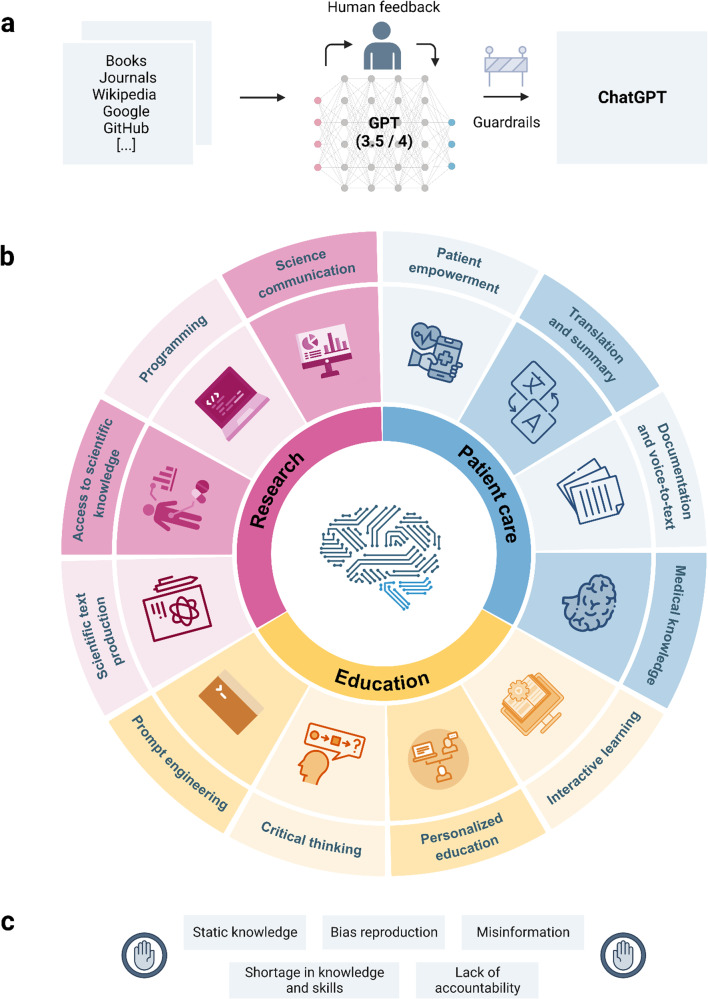
Large language models (LLMs) are artificial intelligence (AI) tools specifically trained to process and generate text. LLMs attracted substantial public attention after OpenAI’s ChatGPT was made publicly available in November 2022. LLMs can often answer questions, summarize, paraphrase and translate text on a level that is nearly indistinguishable from human capabilities. The possibility to actively interact with models like ChatGPT makes LLMs attractive tools in various fields, including medicine. While these models have the potential to democratize medical knowledge and facilitate access to healthcare, they could equally distribute misinformation and exacerbate scientific misconduct due to a lack of accountability and transparency. In this article, we provide a systematic and comprehensive overview of the potentials and limitations of LLMs in clinical practice, medical research and medical education.
Overview
CoChat Summary
TL;DR
This review surveys how large language models (LLMs) may affect patient care, medical research, and medical education, emphasizing both their capabilities and their risks. It argues that LLMs could democratize medical knowledge and assist communication, documentation, research, and teaching, but current limitations in factuality, bias, accountability, transparency, and reproducibility must be addressed before clinical use.
Key findings
- LLMs can augment patient care through medical knowledge and reasoning, translations, summaries, and documentation; GPT-4 “now exceeds the passing score on every step of the US-medical licensing exam (USMLE),” and documentation/administrative requirements consume around 25% of clinicians’ workdays.
- In medical research, LLMs can summarize evidence, generate scientific abstracts that humans struggle to differentiate from human-written ones, and assist with coding, but outputs currently require significant human revision and LLMs do not always provide appropriate detailed summaries or critical appraisals of up-to-date, high-quality, peer-reviewed evidence.
- In medical education, LLMs can serve as personalized teaching assistants, simplify complex concepts, and simulate patient conversations, but they risk decreasing critical thinking and creativity and may lead to “externalization of medical reasoning.”
- Ethical and safety concerns include misinformation, data privacy and leakage, prompt injection attacks, lack of public training datasets and source code, commercial monopolies, and reproducibility problems due to model version changes; the authors observed substantial differences between GPT-3.5 and GPT-4 prompted queries and minor changes across GPT-3.5 versions.
Methods
- Narrative review/overview; the abstract describes it as a “systematic and comprehensive overview of the potentials and limitations of LLMs in clinical practice, medical research and medical education.”
- No primary data, sample, or formal quantitative analysis are reported; illustrative model outputs were generated using ChatGPT (GPT-4—May 3, 2023; GPT-3.5—May 3, 2023) and additional examples are in Supplementary Data.
- The main analysis is a qualitative synthesis across patient care, medical research, and medical education, with example prompts and outputs used to illustrate capabilities and limitations.
Limitations
- Stated by the paper: LLMs reproduce existing biases, hallucinate false information, spread misinformation, lack accountability, and currently have no mechanisms to ensure output correctness; their knowledge is static, reproducibility is compromised by model updates or access restrictions, training datasets and source code are often not public, and development is driven primarily by commercial companies.
- Stated by the paper: safety guardrails can themselves pose limitations, for example if bias prevention leads to different symptoms in men and women being overlooked.
- Evident from the text: despite being described as “systematic,” no formal systematic review methodology, search strategy, inclusion criteria, or data extraction process is reported, and the illustrative examples are limited to selected ChatGPT versions rather than a comprehensive empirical evaluation.
Model-written summary. Check it against the paper before relying on it.
Integrity signals
Registry
Cites
Statistics
Figures
Verification
Claims the paper makes
16 Valid · 3 Not valid · 21 Not checked · 36 Own results and interpretations
The cited sources support only part of this claim — read each source’s verdict below.
In the paper
“Through their text simplification capabilities33, LLMs may improve communication between healthcare staff and patients34.”
§ The future landscape of large language models in medicine > Patient care > Medical knowledge and medical core competencies
What the sources say
- Partly supportedcites [33] Devaraj, A., Marshall, I., Wallace, B. & Li, J. J. Paragraph-level simplification of medical texts. In Proc. 2021 Conference of the North American Chapter of the Association for Computational Linguistics: Human Language Technologies, 4972–4984. 10.18653/v1/2021.naacl-main.395 (Association for Computational Linguistics, 2021). PMC9161242 35663507 sourceExperimental — accuracy not yet measured
The Introduction (page unavailable) says automatic simplification may make specialist medical information accessible to a wider audience, and the Conclusions report simpler model outputs. The paper does not examine communication between healthcare staff and patients, so it supports the proposed mechanism but not that specific application. (LLM, conf=0.83)
- Supportedcites [34] Ayers, J. W. et al. Comparing physician and artificial intelligence Chatbot responses to patient questions posted to a public social media forum. JAMA Intern. Med. 10.1001/jamainternmed.2023.1838 (2023). PMC10148230 37115527 source
The Discussion says chatbots could assist clinicians in messaging patients by drafting replies and could help staff improve their communication skills. The citing sentence attaches a separate citation to text simplification; this paper supports the hedged communication claim attributed to it. (LLM, conf=0.90)
hedgedstates a possible cause- Asserted: passes — The authors put it forward as true.
- Checkable: passes — It can be checked against evidence.
- Load-bearing: unclear — It is unclear whether the paper’s conclusions depend on it.
- Based: passes — The paper gives a reason why it holds.
- Partly supported
The cited sources support only part of this claim — read each source’s verdict below.
In the paper
“GPT-4 thus far demonstrates the highest medical domain knowledge of LLMs to date5.”
§ The future landscape of large language models in medicine > Patient care > Medical knowledge and medical core competencies
What the sources say
- Partly supportedcites [5] Nori, H., King, N., McKinney, S. M., Carignan, D. & Horvitz, E. Capabilities of GPT-4 on medical challenge problems. Preprint at arXiv10.48550/arXiv.2303.13375 (2023). sourceExperimental — accuracy not yet measured
The Abstract (p. 1) reports that GPT-4 outperformed GPT-3.5 and a medically tuned model on medical examinations and benchmarks. The Conclusion (p. 22) says it outperformed Flan-PaLM 540B on all but one MultiMedQA dataset. These comparisons support strong medical-benchmark performance, but not the unqualified claim that GPT-4 had the highest medical domain knowledge of all LLMs to date. (LLM, conf=0.86)
boosted- Asserted: passes — The authors put it forward as true.
- Checkable: passes — It can be checked against evidence.
- Load-bearing: unclear — It is unclear whether the paper’s conclusions depend on it.
- Based: passes — The paper gives a reason why it holds.
- Partly supported
The cited sources support only part of this claim — read each source’s verdict below.
In the paper
“Technical options to overcome limitations in factuality and mitigate (bias-related) harms can generally be implemented throughout the entire development process of LLMs.”
§ The future landscape of large language models in medicine > Ethical use and misinformation
What the sources say
- Partly supportedcites [33] Devaraj, A., Marshall, I., Wallace, B. & Li, J. J. Paragraph-level simplification of medical texts. In Proc. 2021 Conference of the North American Chapter of the Association for Computational Linguistics: Human Language Technologies, 4972–4984. 10.18653/v1/2021.naacl-main.395 (Association for Computational Linguistics, 2021). PMC9161242 35663507 sourceExperimental — accuracy not yet measured
The Ethical Considerations section says hallucinations in generated medical summaries can misinform readers and recommends examining outputs before use. That supports a limited way to address factuality harms, but the paper does not discuss bias-related harms or establish that technical options can be implemented throughout the entire LLM development process. (LLM, conf=0.79)
- Not checked yetcites [64] Kumar, S., Balachandran, V., Njoo, L., Anastasopoulos, A. & Tsvetkov, Y. Language generation models can cause harm: so what can we do about it? An actionable survey. In Proc. 17th Conference of the European Chapter of the Association for Computational Linguistics, 3299–3321 (Association for Computational Linguistics, 2023). source
- Not checked yetcites [65] Ma, Y., Seneviratne, S. & Daskalaki, E. Improving text simplification with factuality error detection. In Proc. Workshop on Text Simplification, Accessibility, and Readability (TSAR–2022), 173–178 (Association for Computational Linguistics, 2022). source
- Partly supportedcites [66] Devaraj, A., Sheffield, W., Wallace, B. & Li, J. J. Evaluating factuality in text simplification. In Proc. 60th Annual Meeting of the Association for Computational Linguistics (Volume 1: Long Papers), 7331–7345. 10.18653/v1/2022.acl-long.506 (Association for Computational Linguistics, 2022). PMC9671157 36404800 sourceExperimental — accuracy not yet measured
The Qualitative Analysis section suggests including document context or decontextualizing text before simplification, and the Conclusion describes work on automatic factuality assessment. These support technical approaches to factuality in text simplification, but the paper does not establish that options can be implemented throughout LLM development or address mitigation of bias-related harms. The cited passages provide no page numbers. (LLM, conf=0.78)
- Partly supportedcites [67] Fleisig, E. et al. FairPrism: evaluating fairness-related harms in text generation. In Proc. 61st Annual Meeting of the Association for Computational Linguistics (Volume 1: Long Papers), 6231–6251 (Association for Computational Linguistics, 2023). sourceExperimental — accuracy not yet measured
The Recommendations (p. 8) describe ways to improve datasets for measuring and mitigating harms in AI-generated text. They do not address factuality or say that technical options can be implemented throughout the entire LLM development process; the paper's supported point is narrower. (LLM, conf=0.85)
- Not checked yetcites [68] Sha, L., Li, Y., Gasevic, D. & Chen, G. Bigger data or fairer data? Augmenting BERT via active sampling for educational text classification. In Proc. 29th International Conference on Computational Linguistics, 1275–1285 (International Committee on Computational Linguistics, 2022).
plain- Asserted: passes — The authors put it forward as true.
- Checkable: passes — It can be checked against evidence.
- Load-bearing: unclear — It is unclear whether the paper’s conclusions depend on it.
- Based: passes — The paper gives a reason why it holds.
- Partly supported
Every source the paper cites for this claim was checked and supports it.
In the paper
“Lastly, to date, the development of LLMs has been driven primarily by commercial companies such as OpenAI/Microsoft21, Meta24, and Google2.”
§ The future landscape of large language models in medicine > Ethical use and misinformation
What the sources say
- Supportedcites [21] OpenAI. GPT-4 Technical Report. Preprint at arXiv10.48550/arXiv.2303.08774 (2023). source
The citation is attached to OpenAI/Microsoft as an example, rather than to the claims about Meta or Google. The report identifies GPT-4 as a model developed by OpenAI (Abstract, p. 1) and credits Microsoft Azure with supporting its training infrastructure (Authorship & credit attribution, p. 17). (LLM, conf=0.88)
- Supportedcites [24] Touvron, H. et al. LLaMA: open and efficient foundation language models. Preprint at arXiv10.48550/arXiv.2302.13971 (2023). source
The citation is attached to Meta in a list of companies developing LLMs. The title page (p. 1) identifies the LLaMA authors as Meta AI, and the Abstract (p. 1) says they developed the LLaMA foundation language models. This supports Meta as an example; this citation need not establish the sentence’s broader claim about who primarily drives LLM development. (LLM, conf=0.91)
- Supportedcites [2] Singhal, K. et al. Large language models encode clinical knowledge. Nature620, 172–180 (2023). PMC10396962 37438534 source
The citation is attached specifically to Google as an example of an LLM developer. The Methods > Modelling section describes the authors building Med-PaLM from PaLM and Flan-PaLM, supporting that example; it does not establish the separate, broader assertion that commercial companies primarily drive LLM development. (LLM, conf=0.86)
plainstates a cause- Asserted: passes — The authors put it forward as true.
- Checkable: passes — It can be checked against evidence.
- Load-bearing: passes — The paper’s conclusions depend on it.
- Based: passes — The paper gives a reason why it holds.
- Supported
The cited sources support only part of this claim — read each source’s verdict below.
In the paper
“as misconceived prompts may result in biases or misinformation with potentially serious consequences4.”
§ The future landscape of large language models in medicine > Medical education > Education about LLMs
What the sources say
- Partly supportedcites [4] Binz M Schulz E Using cognitive psychology to understand GPT-3 Proc. Natl Acad. Sci. USA 2023 120 e2218523120 10.1073/pnas.2218523120 36730192 PMC9963545 sourceExperimental — accuracy not yet measured
In Results, under “Problems with vignette-based investigations” (page unavailable), the paper reports that slightly modified prompts produced incorrect or contradictory GPT-3 answers. This supports the possibility that poorly framed prompts yield misleading responses, but the cited passages do not establish that such responses have potentially serious consequences. (LLM, conf=0.84)
hedgedstates a possible cause- Asserted: passes — The authors put it forward as true.
- Checkable: passes — It can be checked against evidence.
- Load-bearing: passes — The paper’s conclusions depend on it.
- Based: passes — The paper gives a reason why it holds.
- Partly supported
23 more claims
Create a free account to see all 76 claims and to verify the 43 references still open.
- It may state two separate claims as one. 31
- Probably not a substantial claim. 29
Claims other papers make about this one
Each is checked against this paper’s own text: does it say what the citing paper says it does?
The source backs part of the claim, not all of it — or backs it for a different population, condition or comparison.
In the citing paper
“Further to this, there is potential for these LLM-based applications to reduce medical errors and capturing missed information by providing a layer of scrutiny when embedded in EHRs [45].”
From Generative AI in healthcare: an implementation science informed translational path on application, integration and governance (2024) · cites this paper as [45]
Experimental — accuracy not yet measuredThe source backs part of the claim, not all of it — or backs it for a different population, condition or comparison.
In the citing paper
“Use cases like workflow and documentation automation, personalized predictive analytics, and patient education chatbots confirm vast potential [26, 41, 45], provided the technology supports rather than supplants human expertise.”
From Generative AI in healthcare: an implementation science informed translational path on application, integration and governance (2024) · cites this paper as [45]
Experimental — accuracy not yet measuredThe source backs part of the claim, not all of it — or backs it for a different population, condition or comparison.
In the citing paper
“Large language models (LLMs) have been shown to interpret complex clinical situations and offer recommendations, from differential diagnoses to care management, leading to growing interest in their application in the medical field [13-16].”
From Identifying Deprescribing Opportunities With Large Language Models in Older Adults: Retrospective Cohort Study (2025) · cites this paper as [13]
Experimental — accuracy not yet measuredThe source backs part of the claim, not all of it — or backs it for a different population, condition or comparison.
In the citing paper
“they lack the nuanced understanding, empathy, and ethical reasoning inherent to human practitioners [19].”
From Mitigating cognitive biases in clinical decision-making through multi-agent conversations using large language models: simulation study (2024) · cites this paper as [19]
Experimental — accuracy not yet measuredThe source backs part of the claim, not all of it — or backs it for a different population, condition or comparison.
In the citing paper
“While we recognize that these issues are affected by the use of LLMs in significant ways6,98,99 these, challenges are not specific to health-related applications.”
From The ethics of ChatGPT in medicine and healthcare: a systematic review on large language models (LLMs) (2024) · cites this paper as [6]
Experimental — accuracy not yet measured
5 more claims about this paper
Create a free account to see every claim other papers make about this one.
Citations
Cites
BERT: Pre-training of Deep Bidirectional Transformers for Language Understanding
Devlin, J., Chang, M.-W., Lee, K., & Toutanova, K. (2019) · Proceedings of the 2019 Conference of the North American Chapter of the Association for Computational Linguistics: Human Language Technologies, Volume 1 (Long and Short Papers) · doi:10.18653/v1/n19-1423 · Cited by 54,325
BioBERT: a pre-trained biomedical language representation model for biomedical text mining
Lee, J., Yoon, W., Kim, S., Kim, D., Kim, S., So, C. H., & Kang, J. (2020) · Bioinformatics · doi:10.1093/bioinformatics/btz682 · Cited by 7,218
LLaMA: Open and Efficient Foundation Language Models
Touvron, H., Lavril, T., Izacard, G., Martinet, X., Lachaux, M.-A., Lacroix, T., Rozière, B., Goyal, N., Hambro, E., Azhar, F., et al. (2023) · arXiv · doi:10.48550/arxiv.2302.13971 · Cited by 4,602 · cited 5×
“this was followed by the release of other LLMs from companies such as Google and Meta 2,15 – 17 .”
MethodInfluentialKung, T. H., Cheatham, M., Medenilla, A., Sillos, C., De Leon, L., Elepaño, C., Madriaga, M., Aggabao, R., Diaz-Candido, G., Maningo, J., et al. (2023) · PLOS Digital Health · doi:10.1371/journal.pdig.0000198 · Cited by 4,115 · cited 3×
“Nonetheless, using LLMs for scienti fi c writing currently requires signi fi cant revisions by human authors due to inaccurate, shallow and repetitive outputs (Supplementary Data, example 6).”
BackgroundMethodKung, T. H., Cheatham, M., ChatGPT, Medenilla, A., Sillos, C., De Leon, L., Elepaño, C., Madriaga, M., Aggabao, R., Diaz-Candido, G., et al. (2022) · doi:10.1101/2022.12.19.22283643 · Cited by 4,115
Large language models encode clinical knowledge
Singhal, K., Azizi, S., Tu, T., Mahdavi, S. S., Wei, J., Chung, H. W., Scales, N., Tanwani, A., Cole-Lewis, H., Pfohl, S., et al. (2023) · Nature · doi:10.1038/s41586-023-06291-2 · Cited by 4,083
Large Language Models Encode Clinical Knowledge
Singhal, K., Azizi, S., Tu, T., Mahdavi, S. S., Wei, J., Chung, H. W., Scales, N., Tanwani, A., Cole-Lewis, H., Pfohl, S., et al. (2022) · arXiv · doi:10.48550/arxiv.2212.13138 · Cited by 4,083
SciBERT: A Pretrained Language Model for Scientific Text
Beltagy, I., Lo, K., & Cohan, A. (2019) · Proceedings of the 2019 Conference on Empirical Methods in Natural Language Processing and the 9th International Joint Conference on Natural Language Processing (EMNLP-IJCNLP) · doi:10.18653/v1/d19-1371 · Cited by 3,218
Sallam, M. (2023) · Healthcare · doi:10.3390/healthcare11060887 · Cited by 3,126
Ayers, J. W., Poliak, A., Dredze, M., Leas, E. C., Zhu, Z., Kelley, J. B., Faix, D. J., Goodman, A. M., Longhurst, C. A., Hogarth, M., et al. (2023) · JAMA Internal Medicine · doi:10.1001/jamainternmed.2023.1838 · Cited by 2,613 · cited 1×
“Through their text simpli fi cation capabilities 33 , LLMs may improve communication between healthcare staff and patients 34 .”
Background
Research works printed but not linked: 2
- Xiu Y Thompson P Flipped university class: a study of motivation and learning Int. J. Inf. Commun. Technol. Educ. 2020 19 41 63
- Sha, L., Li, Y., Gasevic, D. & Chen, G. Bigger data or fairer data? Augmenting BERT via active sampling for educational text classification. In Proc. 29th International Conference on Computational Linguistics, 1275–1285 (International Committee on Computational Linguistics, 2022).
Cited by
Items 401–500 of 1,017
Challener, D. W., Ayanian, S., Ryu, A. J., O’Horo, J. C., & Heaton, H. A. (2025) · Journal of Hospital Medicine · doi:10.1002/jhm.70163 · Cited by 13
GPT-4o and the quest for machine learning interpretability in ICU risk of death prediction
Samadi, M. E., Nikulina, K., Fritsch, S. J., & Schuppert, A. (2025) · BMC Medical Informatics and Decision Making · doi:10.1186/s12911-025-03224-z · Cited by 14
“Trained on vast amounts of data, LLMs have initiated a significant shift in artificial intelligence applications for healthcare [21, 22], prompting the need for ethical and secure pipelines [23, 24].”
Susceptibility of Large Language Models to User-Driven Factors in Medical Queries
Lim, K. H., Kang, U., Li, X., Kim, J. S., Jung, Y., Park, S. J., & Kim, B.-H. (2025) · Journal of Healthcare Informatics Research · doi:10.1007/s41666-025-00218-4 · Cited by 17
Rhee, J. Y., Miller, P. J., Tentor, Z., Reich, A. J., Wright, A. A., & Lindvall, C. (2026) · Palliative Medicine · doi:10.1177/02692163251409290 · Cited by 9
“1,2 There has also been growing interest in using AI to enhance the delivery of palliative care, particularly by improving the accuracy of clinicians’ prognostic estimates 3–5 and facilitating serious illness conversations.”
Zhou, H., Chow, L. S., Harnack, L., Panda, S., Manoogian, E. N. C., Li, M., Xiao, Y., & Zhang, R. (2026) · Journal of the American Medical Informatics Association · doi:10.1093/jamia/ocag003 · Cited by 14
Digital health delivery in respiratory medicine: adjunct, replacement or cause for division?
Ottewill, C., Gleeson, M., Kerr, P., MacHale, E., & Costello, R. W. (2024) · European Respiratory Review · doi:10.1183/16000617.0251-2023 · Cited by 12
Madrid-García, A., Barbancho, B. M., Freites, D., Rodríguez‐Rodríguez, L., Menasalvas, E., Rodríguez‐González, A., & Peñas, A. (2024) · Computers in Biology and Medicine · doi:10.1016/j.compbiomed.2024.108920 · Cited by 8
Gautam, S., Chandra, M., De, A., Chakravorti, T., Malik, G., & De Choudhury, M. (2025) · arXiv · doi:10.48550/arxiv.2508.06849 · Cited by 7
“…the potential to transform the field of healthcare through increasing diagnosis efficiency (dia 2025; Williams et al. 2024; Kern, Wu, and Chao 2024), newer scientific discoveries (Theodoris et al. 2023; M. Bran et al. 2024), and democratizing access to medical information (Clusmann et al. 2023).”
Ji, K., Han, J., Zhai, G., & Liu, J. (2024) · International Dental Journal · doi:10.1016/j.identj.2024.06.024 · Cited by 13
“22,23 24-27 In this study, we amassed an array of 60 questions frequently posed within the oral cancer domain.”
ChatGPT and pediatric advanced life support: A performance evaluation
Kokulu, K., Demirtaş, M. S., Sert, E. T., & Mutlu, H. (2024) · Resuscitation · doi:10.1016/j.resuscitation.2024.110451 · Cited by 7
Ito, R., Kato, K., Nanataki, K., Abe, Y., Ogawa, H., Minamimoto, R., Kato, K., Taoka, T., & Naganawa, S. (2025) · EJNMMI Reports · doi:10.1186/s41824-025-00246-8 · Cited by 7
“Recently, LLMs have emerged as significant advancements in natural language processing (NLP), demonstrating remarkable capabilities in understanding and analyzing complex medical texts across multiple languages (Wang and Zhang 2024; Clusmann et al. 2023).”
Spagl, K. T., Watson, E. W., Jatowt, A., & Weidmann, A. E. (2025) · International Journal of Clinical Pharmacy · doi:10.1007/s11096-025-01900-8 · Cited by 7
“3 Average performance metrics results for the DELSTAR foundation model combinations using dataset 2 (D2) and dataset 3 (D3): displays the results of the calculations of the performance metrics averaged from the test runs performed high-quality data [27].”
InfluentialGenovese, A., Prabha, S., Gomez-Cabello, C. A., Haider, S. A., Borna, S., Trabilsy, M., & Forte, A. J. (2025) · Journal of surgical education · doi:10.1016/j.jsurg.2025.103622 · Cited by 8
Rao, A. S., Lee, R. S., Bott, E., Jiang, S., Jiao, Q., Dacier, B. M., Haider, A. H., Farrell, S., Ortega, G., & Succi, M. D. (2025) · Journal of the American College of Surgeons · doi:10.1097/xcs.0000000000001505 · Cited by 9
Yao, M. S., Chae, A., Saraiya, P. V., Kahn, C. E., Witschey, W. R. T., Gee, J. C., Sagreiya, H., & Bastani, O. (2025) · Communications Medicine · doi:10.1038/s43856-025-01061-9 · Cited by 10
Voice-based AI Agents: Filling the Economic Gaps in Digital Health Delivery
Wen, B., Wang, C. Y., Han, Q., Norel, R., Liu, J. C., Stappenbeck, T. S., & Rogers, J. L. (2025) · IEEE International Conference on Digital Health (ICDH) · doi:10.1109/icdh67620.2025.00040 · Cited by 11
Mind the (widening) gap: why public health must engage with AI now
Rey-Puech, P. D., Payne, R., Saund, J., & McKee, M. (2025) · Public Health · doi:10.1016/j.puhe.2025.106047 · Cited by 9
Popov, V., Nguyen, S., & Ochôa, X. (2025) · Learning and Instruction · doi:10.1016/j.learninstruc.2025.102267 · Cited by 10
Mathes, S., Ferber, D., Dreyer, T. F., Borm, K. J., Modersohn, L., Willem, T., Dirven, R. J., Vibert, J., Kreutzfeldt, S., Pérez-López, R., et al. (2025) · npj Precision Oncology · doi:10.1038/s41698-025-01180-5 · Cited by 12
Self-citationDundas, N. E., Law, T. J., Brender, T. D., Mills, H., Espejo, E., Heintz, T. A., Wallace, A. W., & Cobert, J. M. (2025) · Anesthesiology · doi:10.1097/aln.0000000000005795 · Cited by 8
Akrout, M., Cirone, K. D., & Vender, R. B. (2024) · Journal of Cutaneous Medicine and Surgery · doi:10.1177/12034754231220934 · Cited by 7
Künstliche Intelligenz in der Intensivmedizin
Baumgart, A., Beck, G. C., & Ghezel-Ahmadi, D. (2024) · Medizinische Klinik - Intensivmedizin und Notfallmedizin · doi:10.1007/s00063-024-01117-z · Cited by 7
Kikuchi, T., Nakao, T., Nakamura, Y., Hanaoka, S., Mori, H., & Yoshikawa, T. (2024) · American Journal of Neuroradiology · doi:10.3174/ajnr.a8332 · Cited by 9
Sridharan, K., & Sivaramakrishnan, G. (2024) · Expert Review of Clinical Pharmacology · doi:10.1080/17512433.2024.2363840 · Cited by 9
“Patient communication is key to successful patient care that enhances patient engagement, patient-caregiver rapport, patient, and caregiver’s satisfaction, and optimizes the clinical outcomes [21].”
A Scoping Review of Large Language Models: Architecture and Applications
Moujahid, H., Boutahar, K., Gannour, O. E., Saleh, S., Cherradi, B., & Abbassi, A. E. (2024) · International Conference on Innovative Research in Applied Science, Engineering and Technology (IRASET) · doi:10.1109/iraset60544.2024.10549006 · Cited by 9
“For language tasks, transformers enable excellent understanding of contextual relationships between words in sentences, paragraphs, documents [3].”
BackgroundUsing Large Language Models for Robot-Assisted Therapeutic Role-Play: Factuality is not enough!
Höhn, S., Nasir, J., Paikan, A., Ziafati, P., & André, E. (2024) · ACM Conference on Conversational User Interfaces (CUI) · doi:10.1145/3640794.3665886 · Cited by 9
Performance of ChatGPT in providing patient information about upper tract urothelial carcinoma
Łaszkiewicz, J., Krajewski, W. R., Tomczak, W. A., Chorbińska, J., Nowak, Ł., Chełmoński, A., Krajewski, P. K., Sójka, A., Małkiewicz, B., & Szydełko, T. (2024) · Współczesna Onkologia · doi:10.5114/wo.2024.141567 · Cited by 7
“Even though AI is expected to assist with multiple tasks, LLMs can have limitations in medicine, as they can spread misinformation and reproduce authors’ bias [8].”
BackgroundPorto, J. R., Morgan, K. A., Hecht, C. J., Burkhart, R. J., & Liu, R. W. (2024) · Journal of the American Academy of Orthopaedic Surgeons · doi:10.5435/jaaos-d-24-00084 · Cited by 9
Celsa, C., Quartararo, A., Maida, M. F., Giusino, G., Gaudioso, V., Sparacino, A., Cusimano, G., Rao, S., Grova, A., Ciccia, R., et al. (2025) · Hepatoma Research · doi:10.20517/2394-5079.2024.126 · Cited by 12
Güneş, Y. C., & Ülkir, M. (2025) · Uludağ Üniversitesi Tıp Fakültesi Dergisi · doi:10.32708/uutfd.1568479 · Cited by 9
Evaluating ChatGPT for neurocognitive disorder diagnosis: a multicenter study
Dimmick, A. A., Su, C. C., Rafiuddin, H. S., & Cicero, D. C. (2025) · The Clinical Neuropsychologist · doi:10.1080/13854046.2025.2475567 · Cited by 7
“In addition to streamlining clinical practice, integrating LLMs like ChatGPT into clinical practice has the potential to significantly augment medical knowledge, enhance the quality and speed of documentation, and improve patient communication (Clusmann et al., 2023; Maida et al., 2024).”
Evaluating Large Language Models for Burning Mouth Syndrome Diagnosis
Suga, T., Uehara, O., Abiko, Y., & Toyofuku, A. (2025) · Journal of Pain Research · doi:10.2147/jpr.s509845 · Cited by 8
“12,13 Furthermore, LLMs offer significant benefits in medical and dental education through simulations and case studies, aiding skill development and potentially improving healthcare delivery.”
Large language models in thyroid diseases: Opportunities and challenges
Zhang, Y., Li, P., Xu, L., Zhang, X., Ji, H., & Wang, Y. (2025) · EngMedicine · doi:10.1016/j.engmed.2025.100076 · Cited by 7
Generative artificial intelligence in neurology: Opportunities and risks
Cerasa, A., & Crowe, B. (2024) · European Journal of Neurology · doi:10.1111/ene.16232 · Cited by 9
“Finally, we agree with Clusmann et al. [7] that AI-related algorithms will give us the opportunity to democratize access to scientific evidence and to excellent health care services.”
ResultMeng, Y., Yao, M.-M., Xu, M., Shi, D., He, Y., Xu, Y., Wang, W., Xiong, W., Zhao, Y., Wang, L., et al. (2025) · medRxiv · doi:10.1101/2025.05.15.25326843 · Cited by 8
Large language models and women’s health: a digital companion for informed decision-making
Recker, F., Neubauer, R., Wittek, A., & Scholten, N. (2025) · Archives of Gynecology and Obstetrics · doi:10.1007/s00404-025-08065-9 · Cited by 14
“ChatGPT is gradually becoming a key player in physician–patient communication, and its relevance is expected to increase in the future [11].”
A Dataset for Evaluating Large Language Models on Chinese National Medical Licensing Examinations
Zong, H., Cha, J., Wang, J., Song, Y., Zhao, Y., Shi, M., & Shen, B. (2026) · Scientific Data · doi:10.1038/s41597-026-07261-9 · Cited by 8
Unlocking electronic health records: a hybrid graph RAG approach to safe clinical AI for patient QA
Thio, S., Lewis, M., Denaxas, S., & Dobson, R. J. B. (2026) · Frontiers in Digital Health · doi:10.3389/fdgth.2026.1780700 · Cited by 6
“Recent advances in large language models (LLMs) have demonstrated transformative potential for natural language processing in healthcare (5, 6).”
Sarangi, P. K., Hui, P., Mondal, H., Kumar Nayak, D. S., Swarup, M. S., Ishan, & Panda, S. (2025) · iRADIOLOGY · doi:10.1002/ird3.70030 · Cited by 6
“Large language model (LLM) chatbots, such as ChatGPT, Claude, Copilot, Gemini, Meta AI, and Perplexity, have demonstrated remarkable capabilities in natural language processing including text summarization, translation [8], and content generation [9].”
Large Language Model for Automating the Analysis of Cryoprotectants
Ashikhmina, M. S., Zenkin, A. M., Ivanova, A. O., Pavlishina, I. R., Orlova, O. Y., Pantiukhin, I. S., & Скорб, Е. В. (2024) · Journal of Chemical Information and Modeling · doi:10.1021/acs.jcim.4c02049 · Cited by 7
Nair, R. A. S., Härtung, M., Heinisch, P., Jaskolski, J., Starke-Knäusel, C., Veríssimo, S., Schmidt, D. M., & Cimiano, P. (2025) · JMIR Medical Informatics · doi:10.2196/62909 · Cited by 7
“In a recent overview paper, Clusmann et al [35] described the main areas in which there is the potential to apply LLMs in health care: research, patient care, and education.”
Leveraging Large Language Models for Accurate AO Fracture Classification from CT Text Reports
Mergen, M., Spitzl, D., Ketzer, C., Strenzke, M., Marka, A. W., Makowski, M. R., Bressem, K. K., Adams, L. C., & Gassert, F. T. (2025) · Journal of Imaging Informatics in Medicine · doi:10.1007/s10278-025-01603-6 · Cited by 9
“Furthermore, LLMs have shown promise in supporting clinical decision-making in oncology and facilitating the application of various clinical guidelines [34–39].”
Prucker, P., Bressem, K. K., Kim, S. H., Weller, D., Kader, A., Dorfner, F. J., Ziegelmayer, S., Graf, M. M., Lemke, T., Gassert, F. T., et al. (2025) · Journal of Imaging Informatics in Medicine · doi:10.1007/s10278-025-01618-z · Cited by 7
“Their application in radiology could streamline documentation processes, enhance workflow efficiency, and improve clinical decision-making by analyzing and processing vast amounts of clinical data [7].”
Wang, X., Liu, Y., Song, L., Wen, Y., Peng, S., Ren, R., Zhang, Y., Chen, T., & Jiang, Y. (2025) · Frontiers in Artificial Intelligence · doi:10.3389/frai.2025.1639221 · Cited by 6
Confirmation of Large Language Models in Head and Neck Cancer Staging
Kayaalp, M., Bölek, H., & Yaşar, A. (2025) · Diagnostics · doi:10.3390/diagnostics15182375 · Cited by 6
“Although these models aim to improve healthcare accessibility, they may yield inaccurate outcomes that can result in medical errors [9].”
Egli, S. B., Arpagaus, A., Amacher, S. A., Hunziker, S., & Bassetti, S. (2025) · BMJ Health & Care Informatics · doi:10.1136/bmjhci-2025-101470 · Cited by 7
Individualized Medicine in the Era of Artificial Intelligence
Lazaridis, K. N., Klee, E. W., Curry, T. B., Ortega, V. E., Bobo, W. V., Athreya, A. P., & Samsonraj, R. M. (2025) · Mayo Clinic Proceedings · doi:10.1016/j.mayocp.2025.07.028 · Cited by 6
Analysing the role of LLMs in cybersecurity incident management
Jones, G., Kasimatis, D., Pitropakis, N., Macfarlane, R., & Buchanan, W. J. (2025) · International Journal of Information Security · doi:10.1007/s10207-025-01144-7 · Cited by 16
“LLMs focus specifically on language and are capable of generating human-like text in response to input prompts [12].”
Hadiprakoso, R. B., Sejati, W. W., & Amiruddin, A. (2025) · Journal of Information Systems Engineering and Business Intelligence · doi:10.20473/jisebi.11.3.473-487 · Cited by 9
“In healthcare, LLMs are used for medical image analysis [4] and treatment recommendations [5], [6].”
Ishida, K., Murakami, R., Yamanoi, K., Hamada, K., Hasebe, K., Sakurai, A., Miyamoto, T., Mizuno, R., Taki, M., Yamaguchi, K., et al. (2025) · npj Precision Oncology · doi:10.1038/s41698-025-01157-4 · Cited by 9
“These technologies have diverse application possibilities in the medical fi eld, including enhancing patient care, streamlining medical document creation, and improving access to scienti fi c evidence 15 .”
Performance of Large Language Models in Metabolic Bariatric Surgery: a Comparative Study
El-Masry, H., El‐mezayen, M. Y., Farouk, B., Tawfik, A. M., Sharsher, P. S., Mohamed, B. H., Elmagd, A. A., Khammas, A. A., Nimeri, A. A., COHEN, R. V., et al. (2025) · Obesity Surgery · doi:10.1007/s11695-025-08418-y · Cited by 6
“They can perform complex language tasks such as answering queries, summarizing infor - mation, rephrasing content, and translating languages, often with a fluency and accuracy that closely mirrors human per - formance [ 3].”
Zeng, T., & Zhang, Y. (2025) · Ocean Engineering · doi:10.1016/j.oceaneng.2025.123628 · Cited by 9
Bogdanffy, R., Mundzic, A., Nymberg, P., Sundemo, D. S., Moberg, A. B., Wikberg, C., Gunnarsson, R. K., Widén, J., Sundvall, P., & Entezarjou, A. (2026) · JMIR AI · doi:10.2196/72210 · Cited by 8
“Current large language models (LLMs) have started to play a more prominent role in health care, and new applications are frequently identified [14].”
Hang, Y.-Q., wu, J., Bai, L., Wu, M., Yu, J., Li, L., & Piao, X. L. (2026) · BMC Medical Informatics and Decision Making · doi:10.1186/s12911-026-03371-x · Cited by 8
“In adult respiratory care, NLP tools have demonstrated utility in interpreting asthma control metrics and synthesizing guideline-based recommendations, thereby optimizing clinical work-flows [4–6].”
A systematic review of the limitations of large language models in generating healthcare content
Khosravi, M., Zamaninasab, Z., Mojtabaeian, S. M., Demiray, E. K. D., & Arab‐Zozani, M. (2026) · PLOS Digital Health · doi:10.1371/journal.pdig.0001354 · Cited by 12
“The specified time span was chosen because the initial release of LLMs dates back to 2018 [122].”
Primary Care Informatics: Vitalizing the Bedrock of Health Care
You, J. G.-T., Leung, T. I., Pandita, D., & Sakumoto, M. (2024) · Journal of Medical Internet Research · doi:10.2196/60081 · Cited by 7
“Furthermore, as technologies, like generative AI, are implemented across health care [52,53], PCI professionals have and continue to lead the charge in steering the primary care and informatics communities toward equitable [54-56] and ethical [57] approaches to implementing these technologies.”
Leveraging Large Language Models for Generating Personalized Care Recommendations in Dementia
Hu, H., Lin, Y., Chia, C.-H., Chuang, E., & Ru, Y. C. (2024) · IEEE International Workshop on Electromagnetics: Applications and Student Innovation Competition · doi:10.1109/iwem59914.2024.10649066 · Cited by 7
“Recent advancements in artificial intelligence (AI), specifically Large Language Models (LLMs), offer unprecedented opportunities to revolutionize healthcare and medicine [1][2].”
BackgroundKrál, J., Hradiš, M., Bužga, M., & Kunovský, L. (2024) · Biomedical Papers · doi:10.5507/bp.2024.027 · Cited by 9
Artificial intelligence generates proficient Spanish obstetrics and gynecology counseling templates
Solmonovich, R. L., Kouba, I., Quezada, O., Rodríguez-Ayala, G., Rojas, V., Bonilla, K., Espino, K., & Bracero, L. A. (2024) · AJOG Global Reports · doi:10.1016/j.xagr.2024.100400 · Cited by 6
Patient Engagement in a Hybrid Care Pathway for Hypertension: Not One Size Fits All
van Steenkiste, J., Verberk, I., de Koning, S., Haan, J. V.-D., de Jong-Verhagen, B., & Dohmen, D. (2024) · Journal of Patient Experience · doi:10.1177/23743735241297626 · Cited by 8
Roch, F. E., Hahn, F. M., Jäckle, K., Meier, M., Stinus, H., Lehmann, W., Perthel, R., & Roch, P. J. (2024) · Foot and Ankle Surgery · doi:10.1016/j.fas.2024.12.003 · Cited by 6
Geissler, M. E., Goeben, M., Glasmacher, K. A., Bereuter, J., Geissler, R. B., Wiest, I. C., Kolbinger, F. R., & Kather, J. N. (2024) · Deutsches Ärzteblatt international · doi:10.3238/arztebl.m2024.0231 · Cited by 6
Self-citationMalik, S., Frey, L. J., Gutman, J., Mushtaq, A., Warraich, F. Z., & Qureshi, K. (2024) · The American Journal of Gastroenterology · doi:10.14309/ajg.0000000000003255 · Cited by 11
Kim, S. H., Schramm, S., Wihl, J., Raffler, P., Tahedl, M., Canisius, J., Luiken, I., Endrös, L., Reischl, S., Marka, A. W., et al. (2025) · Neuroradiology · doi:10.1007/s00234-025-03664-4 · Cited by 12
WiseMind: a knowledge-guided multi-agent framework for accurate and empathetic psychiatric diagnosis
Wu, Y., Wan, G., Li, J., Zhao, S., Ma, L., Ye, T., Zhang, M., Pop, I., Zhang, Y., & Chen, J. (2026) · npj Digital Medicine · doi:10.1038/s41746-026-02559-9 · Cited by 22
Toward Reliable Detection of LLM-Generated Texts: A Comprehensive Evaluation Framework with CUDRT
Tao, Z., Chen, Y., Xi, D., li, Z., & Xu, W. X. (2026) · ACM Transactions on Intelligent Systems and Technology · doi:10.1145/3779427 · Cited by 22
Alignment of large language models in solving medical ethical dilemmas
Sorin, V., Glicksberg, B. S., Korfiatis, P. D., Collins, J. D., Yeow, M.-E., Brandeland, M. A., Nadkarni, G. N., & Klang, E. (2026) · Digital Health · doi:10.1177/20552076261428395 · Cited by 8
“8,9 This raises concerns about alignment with established ethics.”
Will ChatGPT soon replace otolaryngologists?
Mat, Q., Briganti, G., Maniaci, A., & Lelubre, C. (2024) · European Archives of Oto-Rhino-Laryngology · doi:10.1007/s00405-024-08543-x · Cited by 6
“Also, LLMs can hallucinate [1–3], meaning it can report false information such as false references or report logical contradictions [3].”
InfluentialGrillo, G., Torda, T., Voena, C., Ciardiello, A., & Giagu, S. (2024) · Proceedings - IEEE Symposium on Computer-Based Medical Systems · doi:10.1109/cbms61543.2024.00060 · Cited by 7
Retrieval Augmented Thought Process for Private Data Handling in Healthcare
Pouplin, T., Sun, H., Holt, S., & van der Schaar, M. (2025) · IEEE Journal of Biomedical and Health Informatics · doi:10.1109/jbhi.2025.3645636 · Cited by 17
Maslinski, J., Grasfield, R. H., Awasthi, R., Mishra, S. V., Mahapatra, D., & Mathur, P. (2025) · Cureus · doi:10.7759/cureus.82397 · Cited by 9
Large Language Models in Spine Surgery: A Promising Technology
Shah, R., & Schwab, J. H. (2025) · HSS Journal®: The Musculoskeletal Journal of Hospital for Special Surgery · doi:10.1177/15563316251340696 · Cited by 5
Choi, S., Seo, J., Krishnan, A., Kamath, S. S., Kitsiou, S., & Haegele, J. A. (2025) · mHealth · doi:10.21037/mhealth-24-60 · Cited by 7
“LLMs utilize advanced artificial intelligence (AI) algorithms to produce text that mimics human language (28).”
Kadi, H., Abdellatif, A., Njamen, D. I. K., & Pereme, F. (2025) · Frontiers in Medicine · doi:10.3389/fmed.2025.1598979 · Cited by 5
“.1 Large language models in healthcare and pharmaceutical Generative AI (Gen AI) is transforming healthcare by optimizing clinical workflows and enhancing patient care through various impactful applications (11).”
C-PATH: Conversational Patient Assistance and Triage in Healthcare System
Shi, Q. F., Han, Q., & Soares, C. (2025) · IEEE International Conference on Digital Health (ICDH) · doi:10.1109/icdh67620.2025.00016 · Cited by 7
“However, their integration in patient-facing medical conversations remains underdeveloped due to risks such as hallucination [3], misinformation [16], and limited alignment of health literacy [4].”
Sebo, P., & Wang, T. (2025) · Family Practice · doi:10.1093/fampra/cmaf069 · Cited by 5
Mudumbai, S. C., Chung, P., Chen, J., Litake, O., Regala, S., Madhok, J., Krause, M., Pearl, R. G., Boateng, A., & Gabriel, R. A. (2025) · A&A Practice · doi:10.1213/xaa.0000000000002057 · Cited by 6
Bendella, Z., Wichtmann, B. D., Clauberg, R., Keil, V. C., Lehnen, N. C., Haase, R., Sáez, L. C., Wiest, I. C., Kather, J. N., Endler, C., et al. (2025) · European Journal of Radiology · doi:10.1016/j.ejrad.2025.112416 · Cited by 6
Self-citationGenetic and epigenetic drivers of neurodegenerative disorders
Roy, K., Syed, M., Narad, P., & Sengupta, A. (2025) · Progress in brain research · doi:10.1016/bs.pbr.2025.08.002 · Cited by 5
Shukla, M., Pandey, D., Kaur, S., Agarwal, M., Goyal, A., & Sharma, H. (2025) · Cureus · doi:10.7759/cureus.94949 · Cited by 7
“The increasing accessibility and capability of large language models (LLMs) have sparked significant interest in their potential to assist with academic and professional tasks, including statistical analysis [1].”
Evolving Consultation: Enhancing Ophthalmic Diagnostic Performance Using Large Language Model
Inooka, T., Ota, H., Taki, Y., Yasuda, S., Sajiki, A. F., Suzumura, A., Shimizu, H., Takeuchi, J., Tomita, R., Kominami, T., et al. (2025) · Ophthalmology Science · doi:10.1016/j.xops.2025.101004 · Cited by 5
Wang, G., Yang, R., Zhang, Y., Wen, X., Liu, C., Liu, E., Tang, M., Xue, L., & Liu, Z. (2025) · International Journal of Medical Informatics · doi:10.1016/j.ijmedinf.2025.106172 · Cited by 5
Grace, B., Zhu, J., Dudakia, H., Ajao-Rotimi, F., & Colton, N. A. (2025) · Human Fertility · doi:10.1080/14647273.2025.2584673 · Cited by 7
“LLMs use a generative approach by synthesising a new set of information from large datasets, rather than surfacing individual, human-generated articles (Clusmann et al., 2023).”
Dursun, B., Torlak, M. S., & Tüfekçi, O. (2025) · Revista da Associação Médica Brasileira · doi:10.1590/1806-9282.20250750 · Cited by 6
The rise of large language models in wearable health sensing
Farrahi, V. (2025) · Intelligent Medicine · doi:10.1016/j.imed.2025.12.003 · Cited by 5
Advancing Healthcare with Large Language Models: Techniques and Application
Hu, Z., Peng, Z., Bi, Z., Shen, Q., Liu, Z., Lou, J., & Luo, X. (2025) · IEEE/CAA Journal of Automatica Sinica · doi:10.1109/jas.2025.125540 · Cited by 12
Deep learning for detecting depression in individuals with and without alexithymia
Lam, C., Xian, L., Huang, R., Chen, J., Chan, K. Y., Chan, J. W. Y., Chau, S. W. H., Chan, N., Li, S. X., Wing, Y. K., et al. (2026) · Communications Medicine · doi:10.1038/s43856-026-01393-0 · Cited by 6
“LLMs have been employed for various mental health tasks, such as targeted information extraction, human-computer interaction, content generation (also known as generative AI), and logical reasoning that simulates human judgment 34,35 .”
Şahin, M. Z., Derdiyok, F. B., Kılıç, S. A., Serbest, K., & Nas, K. (2026) · Bioengineering · doi:10.3390/bioengineering13010125 · Cited by 5
“These developments, along with the continuous improvement of productive artificial intelligence systems in the field of medicine, have begun to revolutionize the field in recent years [2].”
Chen, C.-H., Chen, C.-W., Hsieh, K.-Y., Huang, K.-E., & Lai, H.-Y. (2026) · Diagnostics · doi:10.3390/diagnostics16030376 · Cited by 6
“It is important to note that while publicly available LLMs provide similar interpretations, they also have the potential to spread misinformation and exacerbate the misuse of AI in medical imaging due to a lack of accountability [19].”
Parmar, R. P., Daulat, S. R., Shah, R., Brady, T. T., Montague, M., & Roth, C. A. (2026) · Hand · doi:10.1177/15589447251415391 · Cited by 5
Clinical decision support in hematological malignancies using a case-grounded AI agent
Zoller, J., Kalz, M., Wu, X., Cuntz, S., Kruk, L., Kehl, N., Michel, J. J., Funk, C. M., Richter, S., Tix, T., et al. (2026) · Nature Medicine · doi:10.1038/s41591-026-04494-4 · Cited by 9
“While early LLM applications focused on well-defined clinical tasks, recent evidence, particularly in specialized fields such as hematology and oncology, demonstrates their growing capability to support complex decision-making and longitudinal patient care 5–7 .”
Self-citationHarnessing artificial intelligence for advancing early diagnosis in hidradenitis suppurativa
Crovella, S., Suleman, M., Tricarico, P. M., Al-Khuzaei, S., Moltrasio, C., Omri, A. E., & Marzano, A. V. (2024) · Italian Journal of Dermatology and Venereology · doi:10.23736/s2784-8671.23.07829-5 · Cited by 5
Rodríguez, J. C. T., Gracia‐Ramos, A. E., & Forero, D. A. (2024) · Journal of Scientometric Research · doi:10.5530/jscires.13.1.9 · Cited by 7
“[35,36] A potential and recent aspect of health research in Latin American institutions involves the adequate use of novel Artificial Intelligence (IA) tools, [37] including the local challenge of the need of having automated resources for identifying IA-generated texts.”
BackgroundMcPeak, G., Sautmann, A., George, O. S., Hallal, A., Simal, E. A., Schwartz, A. L., Abaluck, J., Ravi, N., & Pless, R. B. (2024) · IEEE International Conference on Healthcare Informatics (ICHI) · doi:10.1109/ichi61247.2024.00094 · Cited by 7
“There are many places they could support healthcare and medicine, from research to education to patient diagnosis and care [1], [4].”
BackgroundSeong, D., Mataraso, S. J., Espinosa, C. A., Berson, E., Reincke, S. M., Xue, L., Kashiwagi, C. M., Kim, Y., Shu, C.-H., Chung, P., et al. (2024) · Briefings in Bioinformatics · doi:10.1093/bib/bbae574 · Cited by 7
Integrating generative AI with neurophysiological methods in psychiatric practice
Feng, Y., Zhou, Y., Xu, J., Lu, X., Gu, R., & Qiao, Z. (2025) · Asian Journal of Psychiatry · doi:10.1016/j.ajp.2025.104499 · Cited by 5
WeInfer: Unleashing the Power of WebGPU on LLM Inference in Web Browsers
Chen, Z., Ma, Y., Shen, H., & Liu, M. (2025) · International World Wide Web Conference (WWW) · doi:10.1145/3696410.3714553 · Cited by 21
A Narrative Review of Artificial Intelligence in Medical Diagnostics
Hirosawa, T., & Shimizu, T. (2025) · Computers, materials & continua/Computers, materials & continua (Print) · doi:10.32604/cmc.2025.063803 · Cited by 11
“The integration of AI into CDSS has brought about significant improvements in diagnostic practices [49,50].”
Armitage, R. C. (2025) · Journal of Evaluation in Clinical Practice · doi:10.1111/jep.70129 · Cited by 7
Balch, J. A., Desaraju, S. S., Nolan, V. J., Vellanki, D., Buchanan, T. R., Brinkley, L. M., Penev, Y. P., Bilgili, A., Patel, A., Chatham, C. E., et al. (2025) · JMIR Medical Informatics · doi:10.2196/71176 · Cited by 7
“State-of-the-art clinical NLP tasks rely on transformer-based, foundational LLMs [25,37,38].”
Metadata
- Authors
- Clusmann, J., Kolbinger, F. R., Muti, H. S., Carrero, Z. I., Eckardt, J.-N., Laleh, N. G., Löffler, C. M. L., Schwarzkopf, S.-C., Unger, M., Veldhuizen, G. P., Wagner, S. J., & Kather, J. N.
- Affiliations
- Universitätsklinikum Aachen (DE)
- University Hospital Carl Gustav Carus (DE)
- Else Kröner Fresenius Center for Digital Health (DE)
- Helmholtz Munich (DE)
- Heidelberg University (DE)
- Corresponding author
- Kather, Jakob Nikolas
- ORCID
- Venue
- Communications Medicine
- Published
- 2023-10-10
- Volume
- 3
- Issue
- 1
- Pages
- 141-141
- ISSN
- 2730-664X (ISSN-L)
- PMC
- PMC10564921
- OpenAlex
- W4387500346
- Semantic Scholar
- 282c568302701bc163d454702eae10e43ca784a3
- Cited by
- 1,045
- References
- 63
- Citations by year
- 2026: 304 · 2025: 435 · 2024: 293 · 2023: 13
- FWCI
- 12.29
- Type
- journal article
- Language
- en
- Open access
- gold
- doi.org
- Licence
- cc-by
- creativecommons.org/licenses/by/4.0 (tdm)
- creativecommons.org/licenses/by/4.0 (vor)
- Locations
- Communications Medicine (publishedVersion, cc-by)
- PubMed Central (publishedVersion, cc-by)
- PubMed (publishedVersion)
- Qucosa (Saxon State and University Library Dresden) (submittedVersion, cc-by)
- DOAJ (DOAJ: Directory of Open Access Journals) (submittedVersion, cc-by-sa)
- mediaTUM – the media and publications repository of the Technical University Munich (Technical University Munich) (submittedVersion, other-oa)
- Funders
- European Union’s Horizon Europe and innovation programme
- Topics
- Health Sciences › Medicine › Health Informatics › Artificial Intelligence in Healthcare and Education
- Physical Sciences › Computer Science › Artificial Intelligence › Machine Learning in Healthcare
- Physical Sciences › Computer Science › Artificial Intelligence › Artificial Intelligence Applications
- Keywords
- large language models, ChatGPT, artificial intelligence in healthcare, clinical practice, medical research, medical education, misinformation, research misconduct, transparency and accountability, health care access
About these checks
Registry, retraction, Cites and statistics results are computed, not judged, with one exception: a printed reference that no index lists is read once by a model before it counts as a citation error. Claims are extracted by a model and kept only when their quote appears verbatim in the text; each cited source is then checked, with a model’s help, for whether it says what the claim relies on. Those verdicts can be wrong — read the claim’s quote and the cited source before relying on one.
The claim verdicts this report counts are experimental: their accuracy is not yet measured.
A language model drew the claims from the paper on 2026-10-04, under version 3 of the claim definition (model deepseek-v4.1-flash, prompt extract-v3).
A second model labelled each claim on 2026-10-04 (model jev-1.13-20260917, definition revision gold-guideline-v0.2).
Cited sources are checked with a language model’s help (gpt-6-sol).
Statistics and arithmetic are recomputed, not judged.
Confidence bands are shown only for fields calibrated on our annotated test set. None is calibrated yet, so no band is shown.
What counts as a claim ›How we measure confidence ›How we check this ›
Are you an author, or do you see a problem with this page? Request a review
Data sources
Bibliographic data: Semantic Scholar, OpenAlex, Crossref.
Contains information from the Semantic Scholar Academic Graph Datasets, made available under the ODC Attribution License (ODC-BY 1.0).
Semantic Scholar’s data is described in: Kinney, R., et al. (2023). The Semantic Scholar Open Data Platform. arXiv:2301.10140.
