

The future landscape of large language models in medicine
Open accessThe DOI matches its Crossref record; 70 of the 70 references it cites were found in a registry or an index; 35 of the 78 sources its claims cite were checked for support.
Abstract
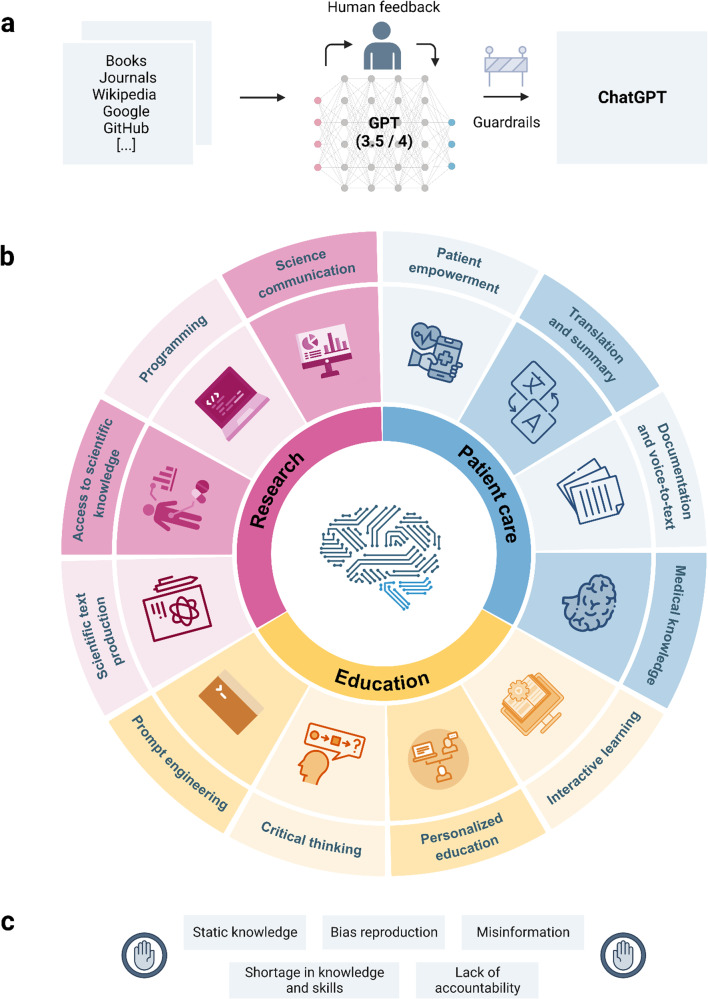
Large language models (LLMs) are artificial intelligence (AI) tools specifically trained to process and generate text. LLMs attracted substantial public attention after OpenAI’s ChatGPT was made publicly available in November 2022. LLMs can often answer questions, summarize, paraphrase and translate text on a level that is nearly indistinguishable from human capabilities. The possibility to actively interact with models like ChatGPT makes LLMs attractive tools in various fields, including medicine. While these models have the potential to democratize medical knowledge and facilitate access to healthcare, they could equally distribute misinformation and exacerbate scientific misconduct due to a lack of accountability and transparency. In this article, we provide a systematic and comprehensive overview of the potentials and limitations of LLMs in clinical practice, medical research and medical education.
Overview
CoChat Summary
TL;DR
This review surveys how large language models (LLMs) may affect patient care, medical research, and medical education, emphasizing both their capabilities and their risks. It argues that LLMs could democratize medical knowledge and assist communication, documentation, research, and teaching, but current limitations in factuality, bias, accountability, transparency, and reproducibility must be addressed before clinical use.
Key findings
- LLMs can augment patient care through medical knowledge and reasoning, translations, summaries, and documentation; GPT-4 “now exceeds the passing score on every step of the US-medical licensing exam (USMLE),” and documentation/administrative requirements consume around 25% of clinicians’ workdays.
- In medical research, LLMs can summarize evidence, generate scientific abstracts that humans struggle to differentiate from human-written ones, and assist with coding, but outputs currently require significant human revision and LLMs do not always provide appropriate detailed summaries or critical appraisals of up-to-date, high-quality, peer-reviewed evidence.
- In medical education, LLMs can serve as personalized teaching assistants, simplify complex concepts, and simulate patient conversations, but they risk decreasing critical thinking and creativity and may lead to “externalization of medical reasoning.”
- Ethical and safety concerns include misinformation, data privacy and leakage, prompt injection attacks, lack of public training datasets and source code, commercial monopolies, and reproducibility problems due to model version changes; the authors observed substantial differences between GPT-3.5 and GPT-4 prompted queries and minor changes across GPT-3.5 versions.
Methods
- Narrative review/overview; the abstract describes it as a “systematic and comprehensive overview of the potentials and limitations of LLMs in clinical practice, medical research and medical education.”
- No primary data, sample, or formal quantitative analysis are reported; illustrative model outputs were generated using ChatGPT (GPT-4—May 3, 2023; GPT-3.5—May 3, 2023) and additional examples are in Supplementary Data.
- The main analysis is a qualitative synthesis across patient care, medical research, and medical education, with example prompts and outputs used to illustrate capabilities and limitations.
Limitations
- Stated by the paper: LLMs reproduce existing biases, hallucinate false information, spread misinformation, lack accountability, and currently have no mechanisms to ensure output correctness; their knowledge is static, reproducibility is compromised by model updates or access restrictions, training datasets and source code are often not public, and development is driven primarily by commercial companies.
- Stated by the paper: safety guardrails can themselves pose limitations, for example if bias prevention leads to different symptoms in men and women being overlooked.
- Evident from the text: despite being described as “systematic,” no formal systematic review methodology, search strategy, inclusion criteria, or data extraction process is reported, and the illustrative examples are limited to selected ChatGPT versions rather than a comprehensive empirical evaluation.
Model-written summary. Check it against the paper before relying on it.
Integrity signals
Registry
Cites
Statistics
Figures
Verification
Claims the paper makes
16 Valid · 3 Not valid · 21 Not checked · 36 Own results and interpretations
The cited sources support only part of this claim — read each source’s verdict below.
In the paper
“Through their text simplification capabilities33, LLMs may improve communication between healthcare staff and patients34.”
§ The future landscape of large language models in medicine > Patient care > Medical knowledge and medical core competencies
What the sources say
- Partly supportedcites [33] Devaraj, A., Marshall, I., Wallace, B. & Li, J. J. Paragraph-level simplification of medical texts. In Proc. 2021 Conference of the North American Chapter of the Association for Computational Linguistics: Human Language Technologies, 4972–4984. 10.18653/v1/2021.naacl-main.395 (Association for Computational Linguistics, 2021). PMC9161242 35663507 sourceExperimental — accuracy not yet measured
The Introduction (page unavailable) says automatic simplification may make specialist medical information accessible to a wider audience, and the Conclusions report simpler model outputs. The paper does not examine communication between healthcare staff and patients, so it supports the proposed mechanism but not that specific application. (LLM, conf=0.83)
- Supportedcites [34] Ayers, J. W. et al. Comparing physician and artificial intelligence Chatbot responses to patient questions posted to a public social media forum. JAMA Intern. Med. 10.1001/jamainternmed.2023.1838 (2023). PMC10148230 37115527 source
The Discussion says chatbots could assist clinicians in messaging patients by drafting replies and could help staff improve their communication skills. The citing sentence attaches a separate citation to text simplification; this paper supports the hedged communication claim attributed to it. (LLM, conf=0.90)
hedgedstates a possible cause- Asserted: passes — The authors put it forward as true.
- Checkable: passes — It can be checked against evidence.
- Load-bearing: unclear — It is unclear whether the paper’s conclusions depend on it.
- Based: passes — The paper gives a reason why it holds.
- Partly supported
The cited sources support only part of this claim — read each source’s verdict below.
In the paper
“GPT-4 thus far demonstrates the highest medical domain knowledge of LLMs to date5.”
§ The future landscape of large language models in medicine > Patient care > Medical knowledge and medical core competencies
What the sources say
- Partly supportedcites [5] Nori, H., King, N., McKinney, S. M., Carignan, D. & Horvitz, E. Capabilities of GPT-4 on medical challenge problems. Preprint at arXiv10.48550/arXiv.2303.13375 (2023). sourceExperimental — accuracy not yet measured
The Abstract (p. 1) reports that GPT-4 outperformed GPT-3.5 and a medically tuned model on medical examinations and benchmarks. The Conclusion (p. 22) says it outperformed Flan-PaLM 540B on all but one MultiMedQA dataset. These comparisons support strong medical-benchmark performance, but not the unqualified claim that GPT-4 had the highest medical domain knowledge of all LLMs to date. (LLM, conf=0.86)
boosted- Asserted: passes — The authors put it forward as true.
- Checkable: passes — It can be checked against evidence.
- Load-bearing: unclear — It is unclear whether the paper’s conclusions depend on it.
- Based: passes — The paper gives a reason why it holds.
- Partly supported
The cited sources support only part of this claim — read each source’s verdict below.
In the paper
“Technical options to overcome limitations in factuality and mitigate (bias-related) harms can generally be implemented throughout the entire development process of LLMs.”
§ The future landscape of large language models in medicine > Ethical use and misinformation
What the sources say
- Partly supportedcites [33] Devaraj, A., Marshall, I., Wallace, B. & Li, J. J. Paragraph-level simplification of medical texts. In Proc. 2021 Conference of the North American Chapter of the Association for Computational Linguistics: Human Language Technologies, 4972–4984. 10.18653/v1/2021.naacl-main.395 (Association for Computational Linguistics, 2021). PMC9161242 35663507 sourceExperimental — accuracy not yet measured
The Ethical Considerations section says hallucinations in generated medical summaries can misinform readers and recommends examining outputs before use. That supports a limited way to address factuality harms, but the paper does not discuss bias-related harms or establish that technical options can be implemented throughout the entire LLM development process. (LLM, conf=0.79)
- Not checked yetcites [64] Kumar, S., Balachandran, V., Njoo, L., Anastasopoulos, A. & Tsvetkov, Y. Language generation models can cause harm: so what can we do about it? An actionable survey. In Proc. 17th Conference of the European Chapter of the Association for Computational Linguistics, 3299–3321 (Association for Computational Linguistics, 2023). source
- Not checked yetcites [65] Ma, Y., Seneviratne, S. & Daskalaki, E. Improving text simplification with factuality error detection. In Proc. Workshop on Text Simplification, Accessibility, and Readability (TSAR–2022), 173–178 (Association for Computational Linguistics, 2022). source
- Partly supportedcites [66] Devaraj, A., Sheffield, W., Wallace, B. & Li, J. J. Evaluating factuality in text simplification. In Proc. 60th Annual Meeting of the Association for Computational Linguistics (Volume 1: Long Papers), 7331–7345. 10.18653/v1/2022.acl-long.506 (Association for Computational Linguistics, 2022). PMC9671157 36404800 sourceExperimental — accuracy not yet measured
The Qualitative Analysis section suggests including document context or decontextualizing text before simplification, and the Conclusion describes work on automatic factuality assessment. These support technical approaches to factuality in text simplification, but the paper does not establish that options can be implemented throughout LLM development or address mitigation of bias-related harms. The cited passages provide no page numbers. (LLM, conf=0.78)
- Partly supportedcites [67] Fleisig, E. et al. FairPrism: evaluating fairness-related harms in text generation. In Proc. 61st Annual Meeting of the Association for Computational Linguistics (Volume 1: Long Papers), 6231–6251 (Association for Computational Linguistics, 2023). sourceExperimental — accuracy not yet measured
The Recommendations (p. 8) describe ways to improve datasets for measuring and mitigating harms in AI-generated text. They do not address factuality or say that technical options can be implemented throughout the entire LLM development process; the paper's supported point is narrower. (LLM, conf=0.85)
- Not checked yetcites [68] Sha, L., Li, Y., Gasevic, D. & Chen, G. Bigger data or fairer data? Augmenting BERT via active sampling for educational text classification. In Proc. 29th International Conference on Computational Linguistics, 1275–1285 (International Committee on Computational Linguistics, 2022).
plain- Asserted: passes — The authors put it forward as true.
- Checkable: passes — It can be checked against evidence.
- Load-bearing: unclear — It is unclear whether the paper’s conclusions depend on it.
- Based: passes — The paper gives a reason why it holds.
- Partly supported
Every source the paper cites for this claim was checked and supports it.
In the paper
“Lastly, to date, the development of LLMs has been driven primarily by commercial companies such as OpenAI/Microsoft21, Meta24, and Google2.”
§ The future landscape of large language models in medicine > Ethical use and misinformation
What the sources say
- Supportedcites [21] OpenAI. GPT-4 Technical Report. Preprint at arXiv10.48550/arXiv.2303.08774 (2023). source
The citation is attached to OpenAI/Microsoft as an example, rather than to the claims about Meta or Google. The report identifies GPT-4 as a model developed by OpenAI (Abstract, p. 1) and credits Microsoft Azure with supporting its training infrastructure (Authorship & credit attribution, p. 17). (LLM, conf=0.88)
- Supportedcites [24] Touvron, H. et al. LLaMA: open and efficient foundation language models. Preprint at arXiv10.48550/arXiv.2302.13971 (2023). source
The citation is attached to Meta in a list of companies developing LLMs. The title page (p. 1) identifies the LLaMA authors as Meta AI, and the Abstract (p. 1) says they developed the LLaMA foundation language models. This supports Meta as an example; this citation need not establish the sentence’s broader claim about who primarily drives LLM development. (LLM, conf=0.91)
- Supportedcites [2] Singhal, K. et al. Large language models encode clinical knowledge. Nature620, 172–180 (2023). PMC10396962 37438534 source
The citation is attached specifically to Google as an example of an LLM developer. The Methods > Modelling section describes the authors building Med-PaLM from PaLM and Flan-PaLM, supporting that example; it does not establish the separate, broader assertion that commercial companies primarily drive LLM development. (LLM, conf=0.86)
plainstates a cause- Asserted: passes — The authors put it forward as true.
- Checkable: passes — It can be checked against evidence.
- Load-bearing: passes — The paper’s conclusions depend on it.
- Based: passes — The paper gives a reason why it holds.
- Supported
The cited sources support only part of this claim — read each source’s verdict below.
In the paper
“as misconceived prompts may result in biases or misinformation with potentially serious consequences4.”
§ The future landscape of large language models in medicine > Medical education > Education about LLMs
What the sources say
- Partly supportedcites [4] Binz M Schulz E Using cognitive psychology to understand GPT-3 Proc. Natl Acad. Sci. USA 2023 120 e2218523120 10.1073/pnas.2218523120 36730192 PMC9963545 sourceExperimental — accuracy not yet measured
In Results, under “Problems with vignette-based investigations” (page unavailable), the paper reports that slightly modified prompts produced incorrect or contradictory GPT-3 answers. This supports the possibility that poorly framed prompts yield misleading responses, but the cited passages do not establish that such responses have potentially serious consequences. (LLM, conf=0.84)
hedgedstates a possible cause- Asserted: passes — The authors put it forward as true.
- Checkable: passes — It can be checked against evidence.
- Load-bearing: passes — The paper’s conclusions depend on it.
- Based: passes — The paper gives a reason why it holds.
- Partly supported
23 more claims
Create a free account to see all 76 claims and to verify the 43 references still open.
- It may state two separate claims as one. 31
- Probably not a substantial claim. 29
Claims other papers make about this one
Each is checked against this paper’s own text: does it say what the citing paper says it does?
The source backs part of the claim, not all of it — or backs it for a different population, condition or comparison.
In the citing paper
“Further to this, there is potential for these LLM-based applications to reduce medical errors and capturing missed information by providing a layer of scrutiny when embedded in EHRs [45].”
From Generative AI in healthcare: an implementation science informed translational path on application, integration and governance (2024) · cites this paper as [45]
Experimental — accuracy not yet measuredThe source backs part of the claim, not all of it — or backs it for a different population, condition or comparison.
In the citing paper
“Use cases like workflow and documentation automation, personalized predictive analytics, and patient education chatbots confirm vast potential [26, 41, 45], provided the technology supports rather than supplants human expertise.”
From Generative AI in healthcare: an implementation science informed translational path on application, integration and governance (2024) · cites this paper as [45]
Experimental — accuracy not yet measuredThe source backs part of the claim, not all of it — or backs it for a different population, condition or comparison.
In the citing paper
“Large language models (LLMs) have been shown to interpret complex clinical situations and offer recommendations, from differential diagnoses to care management, leading to growing interest in their application in the medical field [13-16].”
From Identifying Deprescribing Opportunities With Large Language Models in Older Adults: Retrospective Cohort Study (2025) · cites this paper as [13]
Experimental — accuracy not yet measuredThe source backs part of the claim, not all of it — or backs it for a different population, condition or comparison.
In the citing paper
“they lack the nuanced understanding, empathy, and ethical reasoning inherent to human practitioners [19].”
From Mitigating cognitive biases in clinical decision-making through multi-agent conversations using large language models: simulation study (2024) · cites this paper as [19]
Experimental — accuracy not yet measuredThe source backs part of the claim, not all of it — or backs it for a different population, condition or comparison.
In the citing paper
“While we recognize that these issues are affected by the use of LLMs in significant ways6,98,99 these, challenges are not specific to health-related applications.”
From The ethics of ChatGPT in medicine and healthcare: a systematic review on large language models (LLMs) (2024) · cites this paper as [6]
Experimental — accuracy not yet measured
5 more claims about this paper
Create a free account to see every claim other papers make about this one.
Citations
Cites
BERT: Pre-training of Deep Bidirectional Transformers for Language Understanding
Devlin, J., Chang, M.-W., Lee, K., & Toutanova, K. (2019) · Proceedings of the 2019 Conference of the North American Chapter of the Association for Computational Linguistics: Human Language Technologies, Volume 1 (Long and Short Papers) · doi:10.18653/v1/n19-1423 · Cited by 54,325
BioBERT: a pre-trained biomedical language representation model for biomedical text mining
Lee, J., Yoon, W., Kim, S., Kim, D., Kim, S., So, C. H., & Kang, J. (2020) · Bioinformatics · doi:10.1093/bioinformatics/btz682 · Cited by 7,218
LLaMA: Open and Efficient Foundation Language Models
Touvron, H., Lavril, T., Izacard, G., Martinet, X., Lachaux, M.-A., Lacroix, T., Rozière, B., Goyal, N., Hambro, E., Azhar, F., et al. (2023) · arXiv · doi:10.48550/arxiv.2302.13971 · Cited by 4,602 · cited 5×
“this was followed by the release of other LLMs from companies such as Google and Meta 2,15 – 17 .”
MethodInfluentialKung, T. H., Cheatham, M., Medenilla, A., Sillos, C., De Leon, L., Elepaño, C., Madriaga, M., Aggabao, R., Diaz-Candido, G., Maningo, J., et al. (2023) · PLOS Digital Health · doi:10.1371/journal.pdig.0000198 · Cited by 4,115 · cited 3×
“Nonetheless, using LLMs for scienti fi c writing currently requires signi fi cant revisions by human authors due to inaccurate, shallow and repetitive outputs (Supplementary Data, example 6).”
BackgroundMethodKung, T. H., Cheatham, M., ChatGPT, Medenilla, A., Sillos, C., De Leon, L., Elepaño, C., Madriaga, M., Aggabao, R., Diaz-Candido, G., et al. (2022) · doi:10.1101/2022.12.19.22283643 · Cited by 4,115
Large language models encode clinical knowledge
Singhal, K., Azizi, S., Tu, T., Mahdavi, S. S., Wei, J., Chung, H. W., Scales, N., Tanwani, A., Cole-Lewis, H., Pfohl, S., et al. (2023) · Nature · doi:10.1038/s41586-023-06291-2 · Cited by 4,083
Large Language Models Encode Clinical Knowledge
Singhal, K., Azizi, S., Tu, T., Mahdavi, S. S., Wei, J., Chung, H. W., Scales, N., Tanwani, A., Cole-Lewis, H., Pfohl, S., et al. (2022) · arXiv · doi:10.48550/arxiv.2212.13138 · Cited by 4,083
SciBERT: A Pretrained Language Model for Scientific Text
Beltagy, I., Lo, K., & Cohan, A. (2019) · Proceedings of the 2019 Conference on Empirical Methods in Natural Language Processing and the 9th International Joint Conference on Natural Language Processing (EMNLP-IJCNLP) · doi:10.18653/v1/d19-1371 · Cited by 3,218
Sallam, M. (2023) · Healthcare · doi:10.3390/healthcare11060887 · Cited by 3,126
Ayers, J. W., Poliak, A., Dredze, M., Leas, E. C., Zhu, Z., Kelley, J. B., Faix, D. J., Goodman, A. M., Longhurst, C. A., Hogarth, M., et al. (2023) · JAMA Internal Medicine · doi:10.1001/jamainternmed.2023.1838 · Cited by 2,613 · cited 1×
“Through their text simpli fi cation capabilities 33 , LLMs may improve communication between healthcare staff and patients 34 .”
Background
Research works printed but not linked: 2
- Xiu Y Thompson P Flipped university class: a study of motivation and learning Int. J. Inf. Commun. Technol. Educ. 2020 19 41 63
- Sha, L., Li, Y., Gasevic, D. & Chen, G. Bigger data or fairer data? Augmenting BERT via active sampling for educational text classification. In Proc. 29th International Conference on Computational Linguistics, 1275–1285 (International Committee on Computational Linguistics, 2022).
Cited by
Items 701–800 of 1,017
Current and Future Applications of AI in EMS Training: A Scoping Review
Pasquariello, L. D., Sims, J. K., O'Brien, J., & Upperman, J. S. (2025) · Cureus · doi:10.7759/cureus.90469 · Cited by 2
“The healthcare sector is rapidly adopting AI because of its ability to generate and/or synthesize large quantities of data quickly [2,4,5].”
Architectural Deep Dive into Large Language Models
Ghabi, A., & Hamam, H. (2025) · Studies in computational intelligence · doi:10.1007/978-3-031-90573-5_3 · Cited by 1
Potential for Editorial Committee Use of Large Language Models in Peer Review
Armitage, R. C. (2025) · Journal of Evaluation in Clinical Practice · doi:10.1111/jep.70260 · Cited by 1
Technological Evolution and Research Trends of Intelligent Question-Answering Systems in Healthcare
Lei, B., & Yin, P. (2025) · Healthcare · doi:10.3390/healthcare13182269 · Cited by 3
“In case of intellectual errors or misleading information, patients’ compliance may significantly decrease, and physicians may question their reliability [77].”
Tuncer, M., & Tuncer, G. Z. (2025) · Journal of Nursing Scholarship · doi:10.1111/jnu.70048 · Cited by 2
Minian, N., Mehra, K., Rose, J., Veldhuizen, S., Zawertailo, L. A., Ratto, M., Ting‐A‐Kee, R. A., Melamed, O. C., Tang, V. M., & Selby, P. L. (2025) · Digital Health · doi:10.1177/20552076251380324 · Cited by 1
“9 However, implementing conversational agents within healthcare settings also poses several challenges.”
Bains, B., Rapuri, S., Robitaille, E., Wang, J., Khera, A., Gómez, C., Reyes, E., Perry, C., Wilson, J., & Tracey, E. (2026) · JMIR Medical Informatics · doi:10.2196/80205 · Cited by 2
Improving Rare and Common ICD Coding via a Multi-Agent LLM-Based Approach
Li, R., Wang, X., & Yu, H. Q. (2025) · ACM International Conference on Information and Knowledge Management (CIKM) · doi:10.1145/3746252.3760894 · Cited by 7
Hirosawa, T., Harada, Y., & Shimizu, T. (2025) · AI & Society · doi:10.1007/s00146-025-02750-8 · Cited by 2
Youssef, S., Brehmer, A., Melcher, P., Henkelmann, R., Hepp, P., Theopold, J., Elze, M., Youssef, Y., & Osterhoff, G. (2025) · The Knee · doi:10.1016/j.knee.2025.11.002 · Cited by 1
Maarseveen, T. D., Selani, D., Steinz, N., ten Brinck, R. M., Glas, H. K., Dieren, J. V.-V., Reinders, M. J. T., van den Akker, E. B., & Knevel, R. (2025) · Annals of the Rheumatic Diseases · doi:10.1016/j.ard.2025.11.001 · Cited by 1
Einsatz von Large Language Models (LLMs) in der Gefäßchirurgie: Möglichkeiten und Limitationen
Hatzl, J., Bartos, O., Behrendt, C., Dorweiler, B., Heckenkamp, J., Hoffmann, G., Reutersberg, B., Uhl, C., & Gefäßmedizin, K. K. I. U. D. T. D. D. G. F. G. U. (2025) · Gefässchirurgie · doi:10.1007/s00772-025-01285-y · Cited by 1
Künstliche Intelligenz: Chancen und Grenzen
Clusmann, J., Schneider, C. V., Foersch, S., Truhn, D., & Kather, J. N. (2025) · Forum · doi:10.1007/s12312-025-01520-3 · Cited by 1
Self-citationNavigating the new frontier: psychiatrist’s guide to using large language models in daily practice
Krishnadas, R., & Thilakan, V. (2025) · BJPsych Advances · doi:10.1192/bja.2025.10186 · Cited by 1
Mora-Delgado, J., Ramos-Ruperto, L., Pardilla, M. J., Sicilia, M., Rodríguez‐González, A., Sempere, J. M., & Puchades, R. (2025) · Revista Clínica Española (English Edition) · doi:10.1016/j.rceng.2025.502413 · Cited by 7
AI-Driven Advances in Personalized Therapeutic Strategies for Precision Medicine
Simone, L., Chen, Y. F. F., Lussier, Y. A., Elkin, P., & Zhu, X. (2026) · Springer eBooks · doi:10.1007/978-3-031-98022-0_26 · Cited by 2
Li, R., Berlowitz, D. R., Mez, J., Silver, B., Wang, X., Hu, W., Goodwin, R., Keating, H., Liu, W., Lin, H., et al. (2026) · Communications Medicine · doi:10.1038/s43856-025-01206-w · Cited by 2
Gu, S.-Y., Yao, D., Yao, Y., Cen, X., & Yuan, J.-Y. (2026) · BMC Medical Informatics and Decision Making · doi:10.1186/s12911-026-03340-4 · Cited by 1
“Although the performance of LLMs has been validated in several areas of medicine, their utilization in NRS scenarios remains underexplored [18].”
Ahmed, H., & Sadka, A. H. (2026) · IEEE Access · doi:10.1109/access.2026.3656396 · Cited by 3
“By translating complex medical knowledge into accessible language, automating documentation, and supporting decision-making, LLMs are beginning to bridge the gap between data, understanding, and patient care [1], [2].”
Ma, S., Zhou, Q., & Wu, H. (2026) · Advances in Medical Education and Practice · doi:10.2147/amep.s573537 · Cited by 2
Alhur, A. A., & Al-Kahtani, N. K. (2026) · International Journal of Advances in Signal and Image Sciences · doi:10.29284/r2man269 · Cited by 3
Khuwaileh, B. A., & Matesha, P. (2026) · Annals of Nuclear Energy · doi:10.1016/j.anucene.2026.112223 · Cited by 2
Lin, A., Zeng, M., Gan, W., Jiang, A., Liu, Y., Qi, C., Zhu, L., Mou, W., Zeng, D., Xiao, M., et al. (2026) · Journal of Translational Medicine · doi:10.1186/s12967-026-07912-w · Cited by 2
“If students become overly dependent on AI-chatbot while neglecting in-depth understanding and critical assessment, this may affect their future clinical decision-making abilities [8], warranting serious attention [61].”
InfluentialRen, S., Zheng, X., Zhao, J., Du, J., Zhang, Y., Bi, C., Song, J., Zhang, J., Lang, H., Zhang, F., et al. (2026) · JMIR Medical Informatics · doi:10.2196/78519 · Cited by 1
“Their ability to integrate knowledge and process complex clinical text holds significant promise for bridging gaps between scattered information and practical decision-making [23-26].”
Yin, C., Sun, X., Dai, A., Ye, X., Lu, Y., Wang, W., Chen, Y., Jiang, H., Yu, J., Chong, S., et al. (2026) · APL Bioengineering · doi:10.1063/5.0299327 · Cited by 2
Károlyi, M., Wilzeck, V., Tramèr, L., Groenhoff, L., von Spiczak, J., Bigvava, T., Alkadhi, H., & Manka, R. (2026) · The International Journal of Cardiovascular Imaging · doi:10.1007/s10554-026-03689-7 · Cited by 1
“Recent advances in large language models (LLMs) have demonstrated their ability to extract, synthesize, and reason over complex medical text [14, 15–16].”
Saeedi, M., Wei, L., Edoho, M. E., & Mooney, C. (2026) · Applied Sciences · doi:10.3390/app16073444 · Cited by 2
Lemieux, A., Kutcher, S., Tietcheu, B. R. G., Seitz, G., Trickovic, J., Archibald, D., Grosjean, S., Hogg, W. E., & Johnston, S. (2026) · BMJ Open · doi:10.1136/bmjopen-2025-115673 · Cited by 1
Alzyood, M. A. (2026) · International Health · doi:10.1093/inthealth/ihag033 · Cited by 1
Lightweight large language models for early sepsis prediction via a semantic abstraction rule engine
Yang, Y., Yi, B., & Chen, Y. (2026) · Scientific Reports · doi:10.1038/s41598-026-49672-z · Cited by 2
“With the rapid development of general LLMs, increasing attention has been directed toward their potential applications in healthcare 36,37 .”
Desai, R. K., Saggu, S., Panahi, M., Nguyen, K., Yeganeh, P. R., Douglas, O., Rizi, M. M., Fallah, N., Chernesky, J., Noonan, V. K., et al. (2026) · Neurotrauma Reports · doi:10.1177/2689288x261425900 · Cited by 1
Yoon, S., Seo, W.-K., Kim, K. H., Ju, S., Kim, H. J., Kim, H. J., Chung, J., Bang, O. Y., Kim, G. S., Lee, E. Y., et al. (2026) · Healthcare Informatics Research · doi:10.4258/hir.2026.32.2.179 · Cited by 1
Integration of large language models and evidence-based Chinese medicine: A scoping review
Yao, Y., Liu, H., Yang, D., Luo, X. F., Lai, H., Wang, Z., Chen, Y., & Bian, Z. (2026) · Integrative Medicine Research · doi:10.1016/j.imr.2026.101349 · Cited by 1
iS2C2: a cointelligent platform for mechanistic discovery of disease cellular crosstalk
Sheng, J., Ahn, J. Y., Yang, L., Wan, Z., Qi, S., Yu, X., Xu, Z., Cao, Y., Vasquez, M., Irfan, A., et al. (2026) · Signal Transduction and Targeted Therapy · doi:10.1038/s41392-026-02691-8 · Cited by 2
Al-Garadi, M. A., Davis, S. E., Matheny, M. E., Westerman, D. M., Conger, A. K., Richmond, B. W., Lasko, T. A., Ricket, I. M., Paulin, L. M., Brown, J. R., et al. (2026) · JMIR Medical Informatics · doi:10.2196/84326 · Cited by 1
Nguyen, Q. M., Chen, F., Liu, C., Campbell, I. M., Zhang, G., Wu, D., Szigety, K. M., Sheppard, S. E., Ahimaz, P. R., Ta, C., et al. (2026) · npj Digital Medicine · doi:10.1038/s41746-026-02733-z · Cited by 1
“LLMs can often answer questions, summarize, paraphrase and translate text on a level that is sometimes indistinguishable from human capabilities 23 .”
Gandhi, S., & Balas, M. (2026) · BMC Medical Ethics · doi:10.1186/s12910-026-01496-2 · Cited by 1
“Any contemplated use should be embedded in governance that sets scope narrowly, documents intended and prohibited uses, and ensures meaningful human control – principles now reflected in consensus guidance and regulatory frameworks [27, 28, 31, 37–39].”
Guo, Y., Hu, D., Zhou, Y., Lyu, T., Yang, Z., Reynolds, T. L., & Zheng, K. (2026) · npj Health Systems · doi:10.1038/s44401-026-00091-2 · Cited by 2
Jeong, Y., Cha, H., & Suh, E. E. (2026) · JMIR Cancer · doi:10.2196/96241 · Cited by 5
“Chatbots using LLMs can generate responses in multiturn interactions while maintaining context, without relying on predefined rules or response scenarios [2,3].”
Joachim, M. V., Rushinek, H., & Laviv, A. (2026) · International Journal of Oral and Maxillofacial Surgery · doi:10.1016/j.ijom.2026.06.010 · Cited by 3
Çakıcı, Ş., & Akkoç, S. (2026) · Caries Research · doi:10.1159/000553200 · Cited by 1
Weapon, wonder or both? Political framings of AI in global north and south media
Mota, B. M. F. (2026) · Information Communication & Society · doi:10.1080/1369118x.2026.2691775 · Cited by 3
Confirmation Bias in Large Language Models: Risks for Clinical Decision Support Systems
Jardim, R. R.-A. J., Gonçalves, G., Lopes, L. S., Dantas, T., Paulino, D., Netto, A. T. C., Guimarães, D., Teixeira, O., Rocha, A., Vivacqua, A. S., et al. (2026) · International Conference on Computer Supported Cooperative Work in Design (CSCWD) · doi:10.1109/cscwd68734.2026.11581664 · Cited by 1
“LLMs are increasingly embedded in CDSS, where they assist physicians in diagnostic reasoning, treatment planning, and patient data interpretation (this alone account for about 25% of physicians' workdays: [8].”
Suenghataiphorn, T., Boonpiraks, K., Prasitsumrit, V., Kulthamrongsri, N., & Danpanichkul, P. (2026) · International Journal of Obesity · doi:10.1038/s41366-026-02145-9 · Cited by 1
Liu, Y., Li, R., Yu, P., Zhang, Y., Zhao, A., Xiao, X., Li, Z., Liang, R., Peng, L., & Dong, Z. (2026) · Journal of Robotic Surgery · doi:10.1007/s11701-026-03698-7 · Cited by 2
“Recent studies have shown that LLMs can encode substantial clinical knowledge, answer medical examination-style questions, and generate fluent responses to health-related prompts [ 17 – 20 ].”
Giacobbe, D. R., Lucis, R., Banerjee, S., Carra, G., Dexter, E., McFadden, B. R., & Rizzo, A. (2026) · Therapeutic Advances in Infectious Disease · doi:10.1177/20499361261467605 · Cited by 2
Kumar, R. (2026) · International Journal of Web of Multidisciplinary Studies · doi:10.71366/ijwos03062643533 · Cited by 1
Evaluating AI-based Mental Health Interventions
Sharma, A. (2026) · ACM eBooks · doi:10.1145/3749728.3749733 · Cited by 1
Farajiamiri, M., Sopa, J., Afza, S., Adams, L. C., Ordonez, F. B., Nguyen, T.-T., Lotfinia, M., Wind, S., Bressem, K. K., Nebelung, S., et al. (2026) · Patterns · doi:10.1016/j.patter.2026.101639 · Cited by 2
Performance evaluation of a large language model for medication management tasks
Henry, K., Xu, S., Blotske, K., Cargile, M., Barreto, E. F., Murray, B., Smith, S. E., Bauer, S. R., Zhao, X., Tilley, A., et al. (2026) · American Journal of Health-System Pharmacy · doi:10.1093/ajhp/zxag282 · Cited by 3
BAYDİLİ, I., Taşçı, B., Taşçı, G., Doğan, Ş., & Tuncer, T. (2026) · Bioengineering · doi:10.3390/bioengineering13101175 · Cited by 1
ODS 3, Legal Design y nuevas tecnologías en seguros de vida y salud
da Silva, A. C. D. N., & Olivo, C. A. (2024) · Revista Ibero-Latinoamericana de seguro · doi:10.11144/javeriana.ris59.oldn · Cited by 6
Angyal, V., & Dinya, E. (2024) · IME - Az egészségügyi vezetők szaklapja · doi:10.53020/ime-2024-ksz-103 · Cited by 2
Lopes, F. S. S., Trindade, C., Carvalho, T., Almeida, M. S., & Carvalho, A. S. (2024) · Drug repurposing · doi:10.58647/drugrepo.24.2.0015 · Cited by 1
Creating, Sustaining, and Evaluating Personalized Digital Health Systems
Sittig, S., Iyengar, M. S., Florez-Arango, J. F., & Chaudhry, B. M. (2024) · IEEE International Conference on Big Data (BigData) · doi:10.1109/bigdata62323.2024.10825134 · Cited by 5
Adapting Large Language Models to Biomedical Domain: A Survey of Techniques and Approaches
Klila, J., Bannour, S., Boujelbane, R., Semmar, N., & Belguith, L. H. (2025) · Lecture notes in networks and systems · doi:10.1007/978-3-031-85067-7_15 · Cited by 2
Einführung in die Künstliche Intelligenz
Kather, J. N. (2025) · Springer eBooks · doi:10.1007/978-3-662-71042-5_1 · Cited by 1
Self-citationBrogly, C., Rjaibi, S. T., Liang, C., Lam, E., Wang, E., Paleczny, S., Levitan, A. Z., & Cusimano, M. D. (2025) · IEEE International Conference on Computing and Machine Intelligence (ICMI) · doi:10.1109/icmi65310.2025.11141224 · Cited by 1
“Large language models (LLMs) can encode clinical knowledge [4][5][6] and could be used for a variety of tasks in biomedical settings [2][7][8].”
Temporal trends of artificial intelligence in medical education: a global perspective
Parente, S. B. M., Rocha, S. S., Moreira, M. E. S., Filho, A. B. D. O., & Simeone, D. (2025) · Discover Artificial Intelligence · doi:10.1007/s44163-025-00609-x · Cited by 1
“The rapid advancement of artificial intelligence (AI) is transforming various sectors, particularly the medical field [1].”
Valanci, S., Hlede, V., MacNeill, H., Margolis, Á., & Masters, K. (2026) · Journal of Continuing Education in the Health Professions · doi:10.1097/ceh.0000000000000648 · Cited by 2
Das, A., Tariq, A., Batalini, F., Dhara, B., & Banerjee, I. (2024) · doi:10.36227/techrxiv.171777861.19290790/v1 · Cited by 1
Customizing GPT-4 for clinical information retrieval from standard operating proceduresPreprint
Muti, H. S., Loeffler, C. M. L., Leßmann, M.-E., Stueker, E. H., Kirchberg, J., Bonin, M. V., Kolditz, M., Ferber, D., Egger‐Heidrich, K., Merboth, F., et al. (2024) · medRxiv · doi:10.1101/2024.06.24.24309221 · Cited by 2
“[7] LLMs have been shown to pass medical licensing exams[8,9], develop models for medical data analysis[10] or generate summaries of patient interactions and medical histories.”
BackgroundSelf-citationTung, J. Y. M., Le, Q., Yao, J., Huang, Y., Lim, D. Y. Z., Sng, G. G. R., Lau, R. S. E., Tan, Y. G., Chen, K., Tay, K. J., et al. (2025) · Research Square · doi:10.21203/rs.3.rs-5760861/v1 · Cited by 1
Guo, Y., Hu, D., Zhou, Y., Lyu, T., & Zheng, K. (2025) · medRxiv · doi:10.1101/2025.05.19.25327936 · Cited by 1
Song, S., Peng, K. C., Wang, E. T., & Liu, T. Y. A. (2025) · medRxiv · doi:10.1101/2025.09.12.25334809 · Cited by 2
Large Language Models Readability Classification: A Variability Analysis of Sources and MetricsPreprint
de Matos, H. G. C., Wasmann, J.-W. A., Morata, T. C., Alvarenga, K. D. F., & JACOB, L. C. B. (2026) · medRxiv · doi:10.64898/2026.02.20.26346638 · Cited by 1
Kalejahi, B. K., Khalimova, K., & Rajabi, M. J. (2026) · Research Square · doi:10.21203/rs.3.rs-8859031/v1 · Cited by 1
Zhao, Y., Cai, Q., Chen, D., & Chen, J. (2026) · bioRxiv (Cold Spring Harbor Laboratory) · doi:10.64898/2026.06.06.730646 · Cited by 1
Explainability of decoder-only clinical large language models: A scoping review
Mishra, N., Abu-Hanna, A., & Calixto, I. (2026) · Artificial Intelligence in Medicine · doi:10.1016/j.artmed.2026.103501
The Future of Medicine: Large Language Models Redefining Healthcare DynamicsPreprint
Haque, A., & Chowdhury, M. N.-U.-R. (2023) · TechRxiv · doi:10.36227/techrxiv.24354451 · Cited by 1
Zhang, Y., Lu, J., Wang, J., Wu, R., Liu, X., He, M., Zong, H., Zhan, C., Zhang, Y., Huang, J., et al. (2024) · doi:10.2196/preprints.56294
Einsatzmöglichkeiten von „large language models“ in der Onkologie
Loeffler, C. M. L., Bressem, K. K., & Truhn, D. (2024) · Die Onkologie · doi:10.1007/s00761-024-01481-7
Four change-makers seek impact in medical research
Coombs, A., & Ong, S. (2024) · Nature · doi:10.1038/d41586-024-00754-w
Use of POCUS for earlier diagnosis of aortic dissection
Loo, S. V. D. (2024) · Canadian Family Physician · doi:10.46747/cfp.7003153
Complex, responsive primary care
Wilson, C. (2024) · Canadian Family Physician · doi:10.46747/cfp.7003153_1
Von der Bildauswertung bis zur Entscheidungsunterstützung: KI-Anwendungen in der Onkologie
Kather, J. N., & Schmidberger, H. (2024) · Die Onkologie · doi:10.1007/s00761-024-01509-y
Self-citationLopes, F. S. S., Trindade, C., Carvalho, T., Almeida, M. S., & Carvalho, A. S. (2024) · doi:10.58647/rexpo.24000050.v1
(2024) · Compunet ( The Egyptian Information Journal ) · doi:10.21608/jstc.2024.355421
In Reply to Daungsupawong and Wiwanitkit
Dennstädt, F., Hastings, J., Putora, P. M., Vu, E., Fischer, G. F., Süveg, K., Glatzer, M., Riggenbach, E., Hà, H.-L., & Čihorić, N. (2024) · Advances in Radiation Oncology · doi:10.1016/j.adro.2024.101511
Promises and Perils of Generative AI in the Healthcare Sector
Garg, P. (2024) · Advances in medical technologies and clinical practice book series · doi:10.4018/979-8-3693-3731-8.ch015
ЗАСТОСУВАННЯ ВЕЛИКИХ МОВНИХ МОДЕЛЕЙ В ОПТИМІЗАЦІЇ ПРОЦЕСУ Е-РЕКРУТИНГУ
Doskach, D., & Хавалко, В. (2024) · Herald of Khmelnytskyi National University Technical sciences · doi:10.31891/2307-5732-2024-335-3-53 · Cited by 1
Large language models and artificial intelligence: the coming storm for academia
Murali, M., & Wiles, M. D. (2024) · Anaesthesia · doi:10.1111/anae.16441 · Cited by 1
“Postulated applications include assisting communication with patients by reducing jargon or providing translation [13] and in medical education, complementing existing educational methods through summaries, explanations or step-by-step guides [14].”
Musunuri, R. L., & Bhatt, A. (2024) · Advances in healthcare information systems and administration book series · doi:10.4018/979-8-3693-8552-4.ch003
Tomorrow’s patient management: LLMs empowered by external tools
Szolnoky, K., Nordström, T., & Eklund, M. (2024) · Nature Reviews Urology · doi:10.1038/s41585-024-00965-w · Cited by 1
“Some discussions have touched on the application of LLMs in medicine 4,5 , but an important yet overlooked aspect is their capacity to interact and integrate with tools.”
Papers on artificial intelligence in healthcare
Greenhalgh, T., & Dijkstra, P. (2024) · Wiley eBooks · doi:10.1002/9781394206933.ch17
Chérrez-Ojeda, I., Zuberbier, T., Rodas‐Valero, G., Sanchez, J. M., Rudenko, M., Dramburg, S., Demoly, P. M., Caimmi, D. P., Gómez, R. M., Ramon, G. D., et al. (2024) · SSRN Electronic Journal · doi:10.2139/ssrn.5042342
KI-Systeme in der HNO-Heilkunde aus Patientensicht
Fiedler, L. S., Becker, S., Meyer, T., & Lippert, B. M. (2025) · Die MKG-Chirurgie · doi:10.1007/s12285-024-00507-8
Gupta, S., Alla, N. L. V., Panchal, O., Witowski, J. S., & Jonnagaddala, J. (2025) · Communications in computer and information science · doi:10.1007/978-981-97-7966-6_8
Liew, C., Tan, E. X., Salim, N. I. M., Razali, N. A. N., Sharifudin, A. H., Teo, S. Y., Subramaniam, S., Ngoo, Q. Z., Muthaiyah, S., & Muthu, K. S. (2025) · Research Square · doi:10.21203/rs.3.rs-5909259/v1
Künstliche Intelligenz in der Radiologie: Literaturübersicht und Leseempfehlungen
Halfmann, M. C., Mildenberger, P., & Jorg, T. (2025) · Die Radiologie · doi:10.1007/s00117-025-01419-z
Zhang, Y., Wang, J., Wu, R., Liu, X., Zong, H., Lu, J., Zhan, C., Huang, J., & Shen, B. (2025) · Research Square · doi:10.21203/rs.3.rs-6000333/v1
Drug Pills Identification System using Google Gemini LLM: A Generative AI approach
Menaha, R., Abilaash, R., Mohanram, P., Unnikrishnan, A., & Sukumar, S. V. (2024) · International Conference on Emerging Research in Computational Science (ICERCS) · doi:10.1109/icercs63125.2024.10895371 · Cited by 1
“To overcome those difficulties, they used a few methods like pharmBERT, two-stage fine-tuning, and only fine-tuning LayerNorm [10].”
KG-Infused LLM for Virtual Health Assistant: Accelerated Inference and Enhanced Performance
Katta, S. K., Ray, A., Firouzi, F., & Chakrabarty, K. (2024) · International Conference on Machine Learning and Applications · doi:10.1109/icmla61862.2024.00099 · Cited by 2
“With the aid of these LLMs, VHAs can interactively engage users, addressing a wide array of health-related inquiries with insights derived from extensive training data [3], [4].”
(2025) · Frontiers research topics · doi:10.3389/978-2-8325-6095-2
What will the future role for large language models (LLMs) be in managing patients with glaucoma?
Tavakoli, K., Hallaj, S., & Baxter, S. L. (2025) · Expert Review of Ophthalmology · doi:10.1080/17469899.2025.2487532
“They may also provide clinical decision support by generating actionable recommendations for clinicians or even help reduce operational costs by assisting with non-clinical duties, such as medical coding and documentation [2].”
Pathomics Image Analysis of Tumor Infiltrating Lymphocytes (TILs) in Colon CancerPreprint
Zhang, Y., Abousamra, S., Hasan, M., Torre-Healy, L. A., Krichevsky, S., Shrestha, S., Bremer, E., Oldridge, D. A., Rech, A. J., Furth, E. E., et al. (2025) · Research Square · doi:10.21203/rs.3.rs-6173056/v1 · Cited by 1
“…ecosystem of innovative Pathomics tools with the capability to predict clinical outcomes, mutations, abnormal molecular pathways, and treatment response directly from H&E WSIs, which are all being actively incorporated into foundation models and combined with large language models (LLMs) 49–52 .”
Reflections on the value of Canadian multiculturalism in health care delivery
Lee, S. H., Reaume, M., Fung, C., & MacLeod, K. K. (2025) · Canadian Family Physician · doi:10.46747/cfp.7104238
“14,16,17 Second, each language is rich with different dialects.”
Réflexions sur la valeur du multiculturalisme canadien dans la prestation des soins de santé
Lee, S. H., Reaume, M., Fung, C., & MacLeod, K. K. (2025) · Canadian Family Physician · doi:10.46747/cfp.7104246
Mohammed, H. H., Kiss, G. H., Serrano, J. A., & Lindseth, F. (2025) · doi:10.1109/cihm64979.2025.10969481
“Furthermore, well-being activity-infused models hold promise in improving digital health tools by offering compassionate, non-judgmental responses to users, which can significantly improve user experiences in health applications [10] [14].”
Metadata
- Authors
- Clusmann, J., Kolbinger, F. R., Muti, H. S., Carrero, Z. I., Eckardt, J.-N., Laleh, N. G., Löffler, C. M. L., Schwarzkopf, S.-C., Unger, M., Veldhuizen, G. P., Wagner, S. J., & Kather, J. N.
- Affiliations
- Universitätsklinikum Aachen (DE)
- University Hospital Carl Gustav Carus (DE)
- Else Kröner Fresenius Center for Digital Health (DE)
- Helmholtz Munich (DE)
- Heidelberg University (DE)
- Corresponding author
- Kather, Jakob Nikolas
- ORCID
- Venue
- Communications Medicine
- Published
- 2023-10-10
- Volume
- 3
- Issue
- 1
- Pages
- 141-141
- ISSN
- 2730-664X (ISSN-L)
- PMC
- PMC10564921
- OpenAlex
- W4387500346
- Semantic Scholar
- 282c568302701bc163d454702eae10e43ca784a3
- Cited by
- 1,045
- References
- 63
- Citations by year
- 2026: 304 · 2025: 435 · 2024: 293 · 2023: 13
- FWCI
- 12.29
- Type
- journal article
- Language
- en
- Open access
- gold
- doi.org
- Licence
- cc-by
- creativecommons.org/licenses/by/4.0 (tdm)
- creativecommons.org/licenses/by/4.0 (vor)
- Locations
- Communications Medicine (publishedVersion, cc-by)
- PubMed Central (publishedVersion, cc-by)
- PubMed (publishedVersion)
- Qucosa (Saxon State and University Library Dresden) (submittedVersion, cc-by)
- DOAJ (DOAJ: Directory of Open Access Journals) (submittedVersion, cc-by-sa)
- mediaTUM – the media and publications repository of the Technical University Munich (Technical University Munich) (submittedVersion, other-oa)
- Funders
- European Union’s Horizon Europe and innovation programme
- Topics
- Health Sciences › Medicine › Health Informatics › Artificial Intelligence in Healthcare and Education
- Physical Sciences › Computer Science › Artificial Intelligence › Machine Learning in Healthcare
- Physical Sciences › Computer Science › Artificial Intelligence › Artificial Intelligence Applications
- Keywords
- large language models, ChatGPT, artificial intelligence in healthcare, clinical practice, medical research, medical education, misinformation, research misconduct, transparency and accountability, health care access
About these checks
Registry, retraction, Cites and statistics results are computed, not judged, with one exception: a printed reference that no index lists is read once by a model before it counts as a citation error. Claims are extracted by a model and kept only when their quote appears verbatim in the text; each cited source is then checked, with a model’s help, for whether it says what the claim relies on. Those verdicts can be wrong — read the claim’s quote and the cited source before relying on one.
The claim verdicts this report counts are experimental: their accuracy is not yet measured.
A language model drew the claims from the paper on 2026-10-04, under version 3 of the claim definition (model deepseek-v4.1-flash, prompt extract-v3).
A second model labelled each claim on 2026-10-04 (model jev-1.13-20260917, definition revision gold-guideline-v0.2).
Cited sources are checked with a language model’s help (gpt-6-sol).
Statistics and arithmetic are recomputed, not judged.
Confidence bands are shown only for fields calibrated on our annotated test set. None is calibrated yet, so no band is shown.
What counts as a claim ›How we measure confidence ›How we check this ›
Are you an author, or do you see a problem with this page? Request a review
Data sources
Bibliographic data: Semantic Scholar, OpenAlex, Crossref.
Contains information from the Semantic Scholar Academic Graph Datasets, made available under the ODC Attribution License (ODC-BY 1.0).
Semantic Scholar’s data is described in: Kinney, R., et al. (2023). The Semantic Scholar Open Data Platform. arXiv:2301.10140.
