

The future landscape of large language models in medicine
Open accessThe DOI matches its Crossref record; 70 of the 70 references it cites were found in a registry or an index; 35 of the 78 sources its claims cite were checked for support.
Abstract
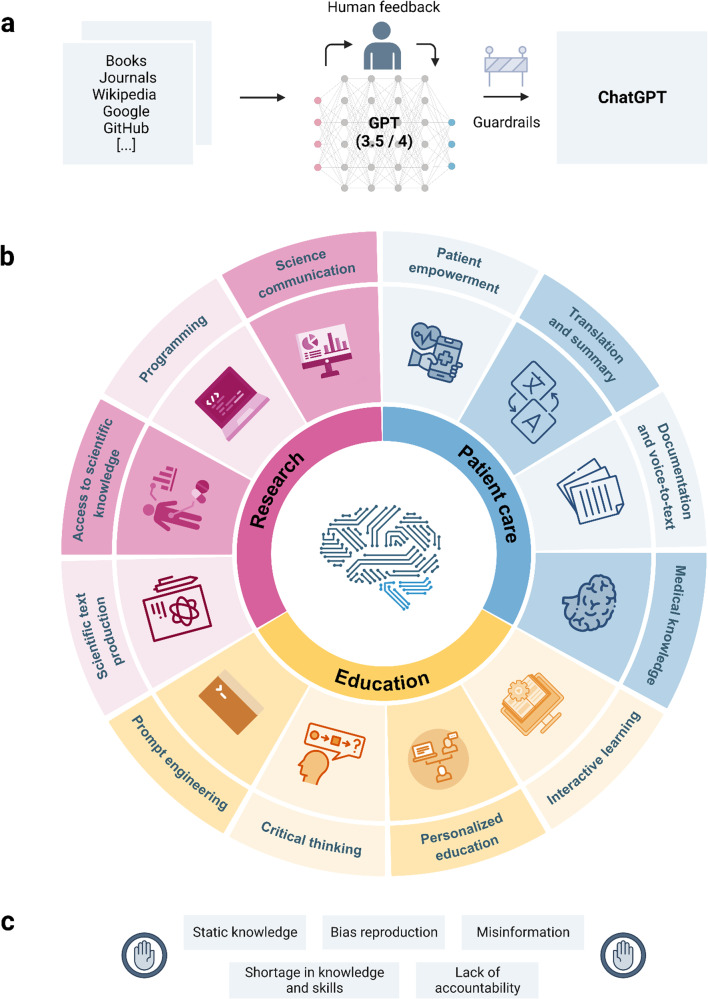
Large language models (LLMs) are artificial intelligence (AI) tools specifically trained to process and generate text. LLMs attracted substantial public attention after OpenAI’s ChatGPT was made publicly available in November 2022. LLMs can often answer questions, summarize, paraphrase and translate text on a level that is nearly indistinguishable from human capabilities. The possibility to actively interact with models like ChatGPT makes LLMs attractive tools in various fields, including medicine. While these models have the potential to democratize medical knowledge and facilitate access to healthcare, they could equally distribute misinformation and exacerbate scientific misconduct due to a lack of accountability and transparency. In this article, we provide a systematic and comprehensive overview of the potentials and limitations of LLMs in clinical practice, medical research and medical education.
Overview
CoChat Summary
TL;DR
This review surveys how large language models (LLMs) may affect patient care, medical research, and medical education, emphasizing both their capabilities and their risks. It argues that LLMs could democratize medical knowledge and assist communication, documentation, research, and teaching, but current limitations in factuality, bias, accountability, transparency, and reproducibility must be addressed before clinical use.
Key findings
- LLMs can augment patient care through medical knowledge and reasoning, translations, summaries, and documentation; GPT-4 “now exceeds the passing score on every step of the US-medical licensing exam (USMLE),” and documentation/administrative requirements consume around 25% of clinicians’ workdays.
- In medical research, LLMs can summarize evidence, generate scientific abstracts that humans struggle to differentiate from human-written ones, and assist with coding, but outputs currently require significant human revision and LLMs do not always provide appropriate detailed summaries or critical appraisals of up-to-date, high-quality, peer-reviewed evidence.
- In medical education, LLMs can serve as personalized teaching assistants, simplify complex concepts, and simulate patient conversations, but they risk decreasing critical thinking and creativity and may lead to “externalization of medical reasoning.”
- Ethical and safety concerns include misinformation, data privacy and leakage, prompt injection attacks, lack of public training datasets and source code, commercial monopolies, and reproducibility problems due to model version changes; the authors observed substantial differences between GPT-3.5 and GPT-4 prompted queries and minor changes across GPT-3.5 versions.
Methods
- Narrative review/overview; the abstract describes it as a “systematic and comprehensive overview of the potentials and limitations of LLMs in clinical practice, medical research and medical education.”
- No primary data, sample, or formal quantitative analysis are reported; illustrative model outputs were generated using ChatGPT (GPT-4—May 3, 2023; GPT-3.5—May 3, 2023) and additional examples are in Supplementary Data.
- The main analysis is a qualitative synthesis across patient care, medical research, and medical education, with example prompts and outputs used to illustrate capabilities and limitations.
Limitations
- Stated by the paper: LLMs reproduce existing biases, hallucinate false information, spread misinformation, lack accountability, and currently have no mechanisms to ensure output correctness; their knowledge is static, reproducibility is compromised by model updates or access restrictions, training datasets and source code are often not public, and development is driven primarily by commercial companies.
- Stated by the paper: safety guardrails can themselves pose limitations, for example if bias prevention leads to different symptoms in men and women being overlooked.
- Evident from the text: despite being described as “systematic,” no formal systematic review methodology, search strategy, inclusion criteria, or data extraction process is reported, and the illustrative examples are limited to selected ChatGPT versions rather than a comprehensive empirical evaluation.
Model-written summary. Check it against the paper before relying on it.
Integrity signals
Registry
Cites
Statistics
Figures
Verification
Claims the paper makes
16 Valid · 3 Not valid · 21 Not checked · 36 Own results and interpretations
The cited sources support only part of this claim — read each source’s verdict below.
In the paper
“Through their text simplification capabilities33, LLMs may improve communication between healthcare staff and patients34.”
§ The future landscape of large language models in medicine > Patient care > Medical knowledge and medical core competencies
What the sources say
- Partly supportedcites [33] Devaraj, A., Marshall, I., Wallace, B. & Li, J. J. Paragraph-level simplification of medical texts. In Proc. 2021 Conference of the North American Chapter of the Association for Computational Linguistics: Human Language Technologies, 4972–4984. 10.18653/v1/2021.naacl-main.395 (Association for Computational Linguistics, 2021). PMC9161242 35663507 sourceExperimental — accuracy not yet measured
The Introduction (page unavailable) says automatic simplification may make specialist medical information accessible to a wider audience, and the Conclusions report simpler model outputs. The paper does not examine communication between healthcare staff and patients, so it supports the proposed mechanism but not that specific application. (LLM, conf=0.83)
- Supportedcites [34] Ayers, J. W. et al. Comparing physician and artificial intelligence Chatbot responses to patient questions posted to a public social media forum. JAMA Intern. Med. 10.1001/jamainternmed.2023.1838 (2023). PMC10148230 37115527 source
The Discussion says chatbots could assist clinicians in messaging patients by drafting replies and could help staff improve their communication skills. The citing sentence attaches a separate citation to text simplification; this paper supports the hedged communication claim attributed to it. (LLM, conf=0.90)
hedgedstates a possible cause- Asserted: passes — The authors put it forward as true.
- Checkable: passes — It can be checked against evidence.
- Load-bearing: unclear — It is unclear whether the paper’s conclusions depend on it.
- Based: passes — The paper gives a reason why it holds.
- Partly supported
The cited sources support only part of this claim — read each source’s verdict below.
In the paper
“GPT-4 thus far demonstrates the highest medical domain knowledge of LLMs to date5.”
§ The future landscape of large language models in medicine > Patient care > Medical knowledge and medical core competencies
What the sources say
- Partly supportedcites [5] Nori, H., King, N., McKinney, S. M., Carignan, D. & Horvitz, E. Capabilities of GPT-4 on medical challenge problems. Preprint at arXiv10.48550/arXiv.2303.13375 (2023). sourceExperimental — accuracy not yet measured
The Abstract (p. 1) reports that GPT-4 outperformed GPT-3.5 and a medically tuned model on medical examinations and benchmarks. The Conclusion (p. 22) says it outperformed Flan-PaLM 540B on all but one MultiMedQA dataset. These comparisons support strong medical-benchmark performance, but not the unqualified claim that GPT-4 had the highest medical domain knowledge of all LLMs to date. (LLM, conf=0.86)
boosted- Asserted: passes — The authors put it forward as true.
- Checkable: passes — It can be checked against evidence.
- Load-bearing: unclear — It is unclear whether the paper’s conclusions depend on it.
- Based: passes — The paper gives a reason why it holds.
- Partly supported
The cited sources support only part of this claim — read each source’s verdict below.
In the paper
“Technical options to overcome limitations in factuality and mitigate (bias-related) harms can generally be implemented throughout the entire development process of LLMs.”
§ The future landscape of large language models in medicine > Ethical use and misinformation
What the sources say
- Partly supportedcites [33] Devaraj, A., Marshall, I., Wallace, B. & Li, J. J. Paragraph-level simplification of medical texts. In Proc. 2021 Conference of the North American Chapter of the Association for Computational Linguistics: Human Language Technologies, 4972–4984. 10.18653/v1/2021.naacl-main.395 (Association for Computational Linguistics, 2021). PMC9161242 35663507 sourceExperimental — accuracy not yet measured
The Ethical Considerations section says hallucinations in generated medical summaries can misinform readers and recommends examining outputs before use. That supports a limited way to address factuality harms, but the paper does not discuss bias-related harms or establish that technical options can be implemented throughout the entire LLM development process. (LLM, conf=0.79)
- Not checked yetcites [64] Kumar, S., Balachandran, V., Njoo, L., Anastasopoulos, A. & Tsvetkov, Y. Language generation models can cause harm: so what can we do about it? An actionable survey. In Proc. 17th Conference of the European Chapter of the Association for Computational Linguistics, 3299–3321 (Association for Computational Linguistics, 2023). source
- Not checked yetcites [65] Ma, Y., Seneviratne, S. & Daskalaki, E. Improving text simplification with factuality error detection. In Proc. Workshop on Text Simplification, Accessibility, and Readability (TSAR–2022), 173–178 (Association for Computational Linguistics, 2022). source
- Partly supportedcites [66] Devaraj, A., Sheffield, W., Wallace, B. & Li, J. J. Evaluating factuality in text simplification. In Proc. 60th Annual Meeting of the Association for Computational Linguistics (Volume 1: Long Papers), 7331–7345. 10.18653/v1/2022.acl-long.506 (Association for Computational Linguistics, 2022). PMC9671157 36404800 sourceExperimental — accuracy not yet measured
The Qualitative Analysis section suggests including document context or decontextualizing text before simplification, and the Conclusion describes work on automatic factuality assessment. These support technical approaches to factuality in text simplification, but the paper does not establish that options can be implemented throughout LLM development or address mitigation of bias-related harms. The cited passages provide no page numbers. (LLM, conf=0.78)
- Partly supportedcites [67] Fleisig, E. et al. FairPrism: evaluating fairness-related harms in text generation. In Proc. 61st Annual Meeting of the Association for Computational Linguistics (Volume 1: Long Papers), 6231–6251 (Association for Computational Linguistics, 2023). sourceExperimental — accuracy not yet measured
The Recommendations (p. 8) describe ways to improve datasets for measuring and mitigating harms in AI-generated text. They do not address factuality or say that technical options can be implemented throughout the entire LLM development process; the paper's supported point is narrower. (LLM, conf=0.85)
- Not checked yetcites [68] Sha, L., Li, Y., Gasevic, D. & Chen, G. Bigger data or fairer data? Augmenting BERT via active sampling for educational text classification. In Proc. 29th International Conference on Computational Linguistics, 1275–1285 (International Committee on Computational Linguistics, 2022).
plain- Asserted: passes — The authors put it forward as true.
- Checkable: passes — It can be checked against evidence.
- Load-bearing: unclear — It is unclear whether the paper’s conclusions depend on it.
- Based: passes — The paper gives a reason why it holds.
- Partly supported
Every source the paper cites for this claim was checked and supports it.
In the paper
“Lastly, to date, the development of LLMs has been driven primarily by commercial companies such as OpenAI/Microsoft21, Meta24, and Google2.”
§ The future landscape of large language models in medicine > Ethical use and misinformation
What the sources say
- Supportedcites [21] OpenAI. GPT-4 Technical Report. Preprint at arXiv10.48550/arXiv.2303.08774 (2023). source
The citation is attached to OpenAI/Microsoft as an example, rather than to the claims about Meta or Google. The report identifies GPT-4 as a model developed by OpenAI (Abstract, p. 1) and credits Microsoft Azure with supporting its training infrastructure (Authorship & credit attribution, p. 17). (LLM, conf=0.88)
- Supportedcites [24] Touvron, H. et al. LLaMA: open and efficient foundation language models. Preprint at arXiv10.48550/arXiv.2302.13971 (2023). source
The citation is attached to Meta in a list of companies developing LLMs. The title page (p. 1) identifies the LLaMA authors as Meta AI, and the Abstract (p. 1) says they developed the LLaMA foundation language models. This supports Meta as an example; this citation need not establish the sentence’s broader claim about who primarily drives LLM development. (LLM, conf=0.91)
- Supportedcites [2] Singhal, K. et al. Large language models encode clinical knowledge. Nature620, 172–180 (2023). PMC10396962 37438534 source
The citation is attached specifically to Google as an example of an LLM developer. The Methods > Modelling section describes the authors building Med-PaLM from PaLM and Flan-PaLM, supporting that example; it does not establish the separate, broader assertion that commercial companies primarily drive LLM development. (LLM, conf=0.86)
plainstates a cause- Asserted: passes — The authors put it forward as true.
- Checkable: passes — It can be checked against evidence.
- Load-bearing: passes — The paper’s conclusions depend on it.
- Based: passes — The paper gives a reason why it holds.
- Supported
The cited sources support only part of this claim — read each source’s verdict below.
In the paper
“as misconceived prompts may result in biases or misinformation with potentially serious consequences4.”
§ The future landscape of large language models in medicine > Medical education > Education about LLMs
What the sources say
- Partly supportedcites [4] Binz M Schulz E Using cognitive psychology to understand GPT-3 Proc. Natl Acad. Sci. USA 2023 120 e2218523120 10.1073/pnas.2218523120 36730192 PMC9963545 sourceExperimental — accuracy not yet measured
In Results, under “Problems with vignette-based investigations” (page unavailable), the paper reports that slightly modified prompts produced incorrect or contradictory GPT-3 answers. This supports the possibility that poorly framed prompts yield misleading responses, but the cited passages do not establish that such responses have potentially serious consequences. (LLM, conf=0.84)
hedgedstates a possible cause- Asserted: passes — The authors put it forward as true.
- Checkable: passes — It can be checked against evidence.
- Load-bearing: passes — The paper’s conclusions depend on it.
- Based: passes — The paper gives a reason why it holds.
- Partly supported
23 more claims
Create a free account to see all 76 claims and to verify the 43 references still open.
- It may state two separate claims as one. 31
- Probably not a substantial claim. 29
Claims other papers make about this one
Each is checked against this paper’s own text: does it say what the citing paper says it does?
The source backs part of the claim, not all of it — or backs it for a different population, condition or comparison.
In the citing paper
“Further to this, there is potential for these LLM-based applications to reduce medical errors and capturing missed information by providing a layer of scrutiny when embedded in EHRs [45].”
From Generative AI in healthcare: an implementation science informed translational path on application, integration and governance (2024) · cites this paper as [45]
Experimental — accuracy not yet measuredThe source backs part of the claim, not all of it — or backs it for a different population, condition or comparison.
In the citing paper
“Use cases like workflow and documentation automation, personalized predictive analytics, and patient education chatbots confirm vast potential [26, 41, 45], provided the technology supports rather than supplants human expertise.”
From Generative AI in healthcare: an implementation science informed translational path on application, integration and governance (2024) · cites this paper as [45]
Experimental — accuracy not yet measuredThe source backs part of the claim, not all of it — or backs it for a different population, condition or comparison.
In the citing paper
“Large language models (LLMs) have been shown to interpret complex clinical situations and offer recommendations, from differential diagnoses to care management, leading to growing interest in their application in the medical field [13-16].”
From Identifying Deprescribing Opportunities With Large Language Models in Older Adults: Retrospective Cohort Study (2025) · cites this paper as [13]
Experimental — accuracy not yet measuredThe source backs part of the claim, not all of it — or backs it for a different population, condition or comparison.
In the citing paper
“they lack the nuanced understanding, empathy, and ethical reasoning inherent to human practitioners [19].”
From Mitigating cognitive biases in clinical decision-making through multi-agent conversations using large language models: simulation study (2024) · cites this paper as [19]
Experimental — accuracy not yet measuredThe source backs part of the claim, not all of it — or backs it for a different population, condition or comparison.
In the citing paper
“While we recognize that these issues are affected by the use of LLMs in significant ways6,98,99 these, challenges are not specific to health-related applications.”
From The ethics of ChatGPT in medicine and healthcare: a systematic review on large language models (LLMs) (2024) · cites this paper as [6]
Experimental — accuracy not yet measured
5 more claims about this paper
Create a free account to see every claim other papers make about this one.
Citations
Cites
BERT: Pre-training of Deep Bidirectional Transformers for Language Understanding
Devlin, J., Chang, M.-W., Lee, K., & Toutanova, K. (2019) · Proceedings of the 2019 Conference of the North American Chapter of the Association for Computational Linguistics: Human Language Technologies, Volume 1 (Long and Short Papers) · doi:10.18653/v1/n19-1423 · Cited by 54,325
BioBERT: a pre-trained biomedical language representation model for biomedical text mining
Lee, J., Yoon, W., Kim, S., Kim, D., Kim, S., So, C. H., & Kang, J. (2020) · Bioinformatics · doi:10.1093/bioinformatics/btz682 · Cited by 7,218
LLaMA: Open and Efficient Foundation Language Models
Touvron, H., Lavril, T., Izacard, G., Martinet, X., Lachaux, M.-A., Lacroix, T., Rozière, B., Goyal, N., Hambro, E., Azhar, F., et al. (2023) · arXiv · doi:10.48550/arxiv.2302.13971 · Cited by 4,602 · cited 5×
“this was followed by the release of other LLMs from companies such as Google and Meta 2,15 – 17 .”
MethodInfluentialKung, T. H., Cheatham, M., Medenilla, A., Sillos, C., De Leon, L., Elepaño, C., Madriaga, M., Aggabao, R., Diaz-Candido, G., Maningo, J., et al. (2023) · PLOS Digital Health · doi:10.1371/journal.pdig.0000198 · Cited by 4,115 · cited 3×
“Nonetheless, using LLMs for scienti fi c writing currently requires signi fi cant revisions by human authors due to inaccurate, shallow and repetitive outputs (Supplementary Data, example 6).”
BackgroundMethodKung, T. H., Cheatham, M., ChatGPT, Medenilla, A., Sillos, C., De Leon, L., Elepaño, C., Madriaga, M., Aggabao, R., Diaz-Candido, G., et al. (2022) · doi:10.1101/2022.12.19.22283643 · Cited by 4,115
Large language models encode clinical knowledge
Singhal, K., Azizi, S., Tu, T., Mahdavi, S. S., Wei, J., Chung, H. W., Scales, N., Tanwani, A., Cole-Lewis, H., Pfohl, S., et al. (2023) · Nature · doi:10.1038/s41586-023-06291-2 · Cited by 4,083
Large Language Models Encode Clinical Knowledge
Singhal, K., Azizi, S., Tu, T., Mahdavi, S. S., Wei, J., Chung, H. W., Scales, N., Tanwani, A., Cole-Lewis, H., Pfohl, S., et al. (2022) · arXiv · doi:10.48550/arxiv.2212.13138 · Cited by 4,083
SciBERT: A Pretrained Language Model for Scientific Text
Beltagy, I., Lo, K., & Cohan, A. (2019) · Proceedings of the 2019 Conference on Empirical Methods in Natural Language Processing and the 9th International Joint Conference on Natural Language Processing (EMNLP-IJCNLP) · doi:10.18653/v1/d19-1371 · Cited by 3,218
Sallam, M. (2023) · Healthcare · doi:10.3390/healthcare11060887 · Cited by 3,126
Ayers, J. W., Poliak, A., Dredze, M., Leas, E. C., Zhu, Z., Kelley, J. B., Faix, D. J., Goodman, A. M., Longhurst, C. A., Hogarth, M., et al. (2023) · JAMA Internal Medicine · doi:10.1001/jamainternmed.2023.1838 · Cited by 2,613 · cited 1×
“Through their text simpli fi cation capabilities 33 , LLMs may improve communication between healthcare staff and patients 34 .”
Background
Research works printed but not linked: 2
- Xiu Y Thompson P Flipped university class: a study of motivation and learning Int. J. Inf. Commun. Technol. Educ. 2020 19 41 63
- Sha, L., Li, Y., Gasevic, D. & Chen, G. Bigger data or fairer data? Augmenting BERT via active sampling for educational text classification. In Proc. 29th International Conference on Computational Linguistics, 1275–1285 (International Committee on Computational Linguistics, 2022).
Cited by
Items 101–200 of 1,017
Assessing and alleviating state anxiety in large language models
Ben‐Zion, Z., Witte, K., Jagadish, A. K., Duek, O. A., Harpaz‐Rotem, I., Khorsandian, M.-C., Burrer, A., Seifritz, E., Homan, P., Schulz, E., et al. (2025) · npj Digital Medicine · doi:10.1038/s41746-025-01512-6 · Cited by 83
“LLMs are AI tools designed to process and generate text, often capable of answering questions, summarizing information, and translating languageonalevelthatisnearlyindistinguishablefromhumancapabilities 3 .”
Zambrano Chaves, J. M., Huang, S.-C., Xu, Y., Xu, H., Usuyama, N., Zhang, S., Wang, F., Xie, Y., Khademi, M., Yang, Z., et al. (2025) · Nature Communications · doi:10.1038/s41467-025-58344-x · Cited by 45
“Hence it is crucial to develop reliablemethodstoevaluatethecorrectnessofmodeloutputsatscale, especially in the specialized fi eld of biomedicine 18 .”
Li, H., Fu, J., & Python, A. (2025) · Journal of Medical Internet Research · doi:10.2196/71916 · Cited by 69
“Systematic reviews of LLMs have highlighted their strengths, limitations, and future development directions in health care [10,11,71,72].”
ESMO guidance on the use of Large Language Models in Clinical Practice (ELCAP)
Wong, E. Y. T., Verlingue, L., Aldea, M., Franzoi, M. A., Umeton, R., Halabi, S., Harbeck, N., Indini, A., Prelaj, A., Romano, E., et al. (2025) · Annals of Oncology · doi:10.1016/j.annonc.2025.09.001 · Cited by 44
Self-citationLarge language models facilitate the generation of electronic health record phenotyping algorithms
Yan, C., Ong, H. H., Grabowska, M. E., Krantz, M. S., Su, W.-C., Dickson, A. L., Peterson, J. F., Feng, Q., Roden, D. M., Stein, C. M., et al. (2024) · Journal of the American Medical Informatics Association · doi:10.1093/jamia/ocae072 · Cited by 65
“Recently, large language models (LLMs) have demonstrated effectiveness in information extraction and summarization, 9 indicating a potential benefit in phenotyping by reducing the time required for literature review and synthesis during the phenotype generation process.”
Towards equitable AI in oncology
Viswanathan, V. S., Parmar, V. V., & Madabhushi, A. (2024) · Nature Reviews Clinical Oncology · doi:10.1038/s41571-024-00909-8 · Cited by 56
Cirone, K. D., Akrout, M., Abid, L., & Oakley, A. M. (2024) · JMIR Dermatology · doi:10.2196/55508 · Cited by 46
“The versatility of LLMs in addressing various requests, coupled with their capabilities in handling complex concepts and engaging in real-time user interactions, indicates their potential integration into health care and dermatology [1,2].”
BackgroundBelkhouribchia, J., & Pen, J. J. (2025) · Frontiers in Nutrition · doi:10.3389/fnut.2025.1635682 · Cited by 51
“Biases present in the training data are often reflected in the outputs of LLMs, perpetuating stereotypes and inequities (69).”
Towards autonomous medical artificial intelligence agents
Ferber, D., Hilgers, L., Höper, C., Kinny‐Köster, B., Eckardt, J., Egger‐Heidrich, K., Bill, M., Schneider, M. M. K., Clusmann, J., Kadric, L., et al. (2026) · Nature · doi:10.1038/s41586-026-10675-5 · Cited by 85
Self-citationLarge Language Models (LLMs) and Empathy – A Systematic Review
Sorin, V., Brin, D., Barash, Y., Konen, E., Charney, A., Nadkarni, G., & Klang, E. (2023) · medRxiv · doi:10.1101/2023.08.07.23293769 · Cited by 43
Artificial Intelligence and Pain Medicine: An Introduction
Hagedorn, J. M., George, T. K., Aiyer, R., Schmidt, K., Halamka, J. D., & D'Souza, R. S. (2024) · Journal of Pain Research · doi:10.2147/jpr.s429594 · Cited by 50
LEAP: LLM instruction-example adaptive prompting framework for biomedical relation extraction
Zhou, H., Li, M., Xiao, Y., Yang, H., & Zhang, R. (2024) · Journal of the American Medical Informatics Association · doi:10.1093/jamia/ocae147 · Cited by 54
LLM-Augmented Agent-Based Modelling for Social Simulations: Challenges and Opportunities
Gürcan, Ö. (2024) · Frontiers in artificial intelligence and applications · doi:10.3233/faia240190 · Cited by 84
Lee, J. E., Park, K. S., Kim, Y., Song, H.-C., Park, B., & Jeong, Y. J. (2024) · American Journal of Roentgenology · doi:10.2214/ajr.24.31696 · Cited by 50
Amangeldy, B., Tasmurzayev, N., Imankulov, T., Baigarayeva, Z., Izmailov, N., Riza, T., Abdukarimov, A., Mukazhan, M., & Zhumagulov, B. (2025) · Sensors · doi:10.3390/s25175265 · Cited by 58
“These agile models are often simplified versions of their larger cloud-based counterparts, trained to manage immediate tasks with minimal delay [187].”
Sevgi, M., Antaki, F., & Keane, P. A. (2024) · British Journal of Ophthalmology · doi:10.1136/bjo-2023-325046 · Cited by 47
Leveraging Large Language Models to Generate Clinical Histories for Oncologic Imaging Requisitions
Bhayana, R., Alwahbi, O. A., Ladak, A. M., Deng, Y., Dias, A. B., Elbanna, K. Y., Gomez, J. A., Jajodia, A., Jhaveri, K. S., Johnson, S. A., et al. (2025) · Radiology · doi:10.1148/radiol.242134 · Cited by 39
Generative artificial intelligence–mediated confirmation bias in health information seeking
Lopez‐Lopez, E., Abels, C. M., Holford, D., Herzog, S. M., & Lewandowsky, S. (2025) · Annals of the New York Academy of Sciences · doi:10.1111/nyas.15413 · Cited by 38
“47 In domains like healthcare, 48,49 behavioral and social sciences, 23,50,51 and collective intelligence, 52 these models are being used to refine research, access information, enhance decision-making, and support complex problem-solving.”
Bhattacharya, M., Pal, S., Chatterjee, S., Lee, S., & Chakraborty, C. (2024) · Molecular Therapy — Nucleic Acids · doi:10.1016/j.omtn.2024.102255 · Cited by 54
“151 Addressing these limitations requires ongoing research and development efforts in bias mitigation, robustness testing, model interpretability, and ethical AI frameworks.”
BackgroundPashangpour, S., & Nejat, G. (2024) · Robotics · doi:10.3390/robotics13080112 · Cited by 50
“There have been extensive separate reviews of the ethics of the use of LLMs in health-care [171–180] and the use of robots in healthcare [181–191].”
BackgroundStatus and Trends of the Digital Healthcare Industry
Lee, N.-K., & Kim, J. S. (2024) · Healthcare Informatics Research · doi:10.4258/hir.2024.30.3.172 · Cited by 52
“…improve patient care by empowering patients, facilitating translation and summarization, enhancing documentation, providing voice-to-text capabilities, leveraging medical knowledge, and simplifying and automating management tasks, as well as providing other critical AI functionalities [14,19,20].”
BackgroundDiagnostic Accuracy of a Custom Large Language Model on Rare Pediatric Disease Case Reports
Young, C. C., Enichen, E., Rivera, C., Auger, C. A., Grant, N., Rao, A. S., & Succi, M. D. (2024) · American Journal of Medical Genetics Part A · doi:10.1002/ajmg.a.63878 · Cited by 47
“As the accuracy of LLMs continues to improve, they are increasingly being considered for clinical decision support in healthcare settings (Clusmann et al. 2023; Hirosawa et al. 2023; Koranteng et al. 2023; Rao, Kim, Kamineni et al. 2023; Rao et al. 2024; Rao, Pang, Kim et al. 2023; Sallam 2023;…”
Accuracy of Large Language Models for Infective Endocarditis Prophylaxis in Dental Procedures
Rewthamrongsris, P., Burapacheep, J., Trachoo, V., & Porntaveetus, T. (2024) · International Dental Journal · doi:10.1016/j.identj.2024.09.033 · Cited by 43
“4,5 The emergence of AI in dentistry has gained significant traction in answering dentistry-related questions, particularly in areas like dental trauma, oral and maxillofacial surgery, and pediatric dentistry.”
Shahin, M. H., Goswami, S., Lobentanzer, S., & Corrigan, B. (2025) · Clinical and Translational Science · doi:10.1111/cts.70188 · Cited by 50
Ohta, K., & Ohta, S. (2023) · Cureus · doi:10.7759/cureus.50369 · Cited by 45
A Survey of Wearable Sensors and Machine Learning Algorithms for Automated Stroke Rehabilitation
Sengupta, N., Rao, A. S., Yan, B., & Palaniswami, M. S. (2024) · IEEE Access · doi:10.1109/access.2024.3373910 · Cited by 40
“Large language models (LLMs) have recently been used in medicine [139].”
MethodGomez-Cabello, C. A., Borna, S., Pressman, S. M., Haider, S. A., Sehgal, A., Leibovich, B. C., & Forte, A. J. (2024) · Healthcare · doi:10.3390/healthcare12111083 · Cited by 39
“This risks the models being biased as they cannot only inherit but also amplify biases present in their training data [31,32], perpetuating inequalities related to factors such as race, gender, and socioeconomic status [1,11].”
BackgroundThe Utility and Implications of Ambient Scribes in Primary Care
Seth, P., Carretas, R., & Rudzicz, F. (2024) · JMIR AI · doi:10.2196/57673 · Cited by 43
“Moreover, recent LLMs such as GPT-4, developed with reinforcement learning, have shown capabilities beyond traditional models, including passing scores on all steps of the USMLE (United States Medical Licensing Examination), demonstrating understanding and potential across medical contexts [4].”
BackgroundLevra, A. G., Gatti, M., Menè, R., Shiffer, D., Costantino, G., Solbiati, M., Furlan, R., & Dipaola, F. (2024) · European Journal of Internal Medicine · doi:10.1016/j.ejim.2024.09.017 · Cited by 48
Generative AI: driving productivity and scientific breakthroughs in pharmaceutical R&D
Doron, G., Genway, S., Roberts, M., & Jasti, S. (2024) · Drug Discovery Today · doi:10.1016/j.drudis.2024.104272 · Cited by 49
An LLM chatbot to facilitate primary-to-specialist care transitions: a randomized controlled trial
Tao, X., Zhou, S., Ding, K., Li, S., Li, Y., Wu, B., Huang, Q., Chen, W., Shen, M., Meng, E., et al. (2026) · Nature Medicine · doi:10.1038/s41591-025-04176-7 · Cited by 66
Generative artificial intelligence in nursing: A scoping review
Park, G. E., Kim, H., & Go, U. R. (2024) · Collegian Journal of the Royal College of Nursing Australia · doi:10.1016/j.colegn.2024.10.004 · Cited by 41
Digital twins in healthcare: a review of AI-powered practical applications across health domains
Elgammal, Z., Albrijawi, M. T., & Alhajj, R. (2025) · Journal Of Big Data · doi:10.1186/s40537-025-01280-w · Cited by 50
“The rise of Large Language Models (LLMs) is revolutionizing digital twin applications, especially in healthcare [35, 77].”
Lim, B., Seth, I., Cuomo, R., Kenney, P. S., Ross, R. J., Sofiadellis, F., Pentangelo, P., Ceccaroni, A., Alfano, C., & Rozen, W. M. (2024) · Aesthetic Plastic Surgery · doi:10.1007/s00266-024-04157-0 · Cited by 38
Pan, G., & Ni, J. (2024) · BMC Medical Education · doi:10.1186/s12909-024-05871-8 · Cited by 37
Opportunities, challenges and risks of using artificial intelligence for evidence synthesis
Siemens, W., von Elm, E. B., Binder, H., Böhringer, D., Eisele‐Metzger, A., Gartlehner, G., Hanegraaf, P., Metzendorf, M., Mosselman, J. J., Nowak, A. J., et al. (2025) · BMJ Evidence-Based Medicine · doi:10.1136/bmjebm-2024-113320 · Cited by 45
Use of artificial intelligence for liver diseases: A survey from the EASL congress 2024
Žigutytė, L., Sorz-Nechay, T., Clusmann, J., & Kather, J. N. (2024) · JHEP Reports · doi:10.1016/j.jhepr.2024.101209 · Cited by 33
Self-citationUndheim, T. A. (2024) · Frontiers in Bioengineering and Biotechnology · doi:10.3389/fbioe.2024.1359768 · Cited by 36
Tosun, B., & Yilmaz, Z. S. (2025) · Journal of Dental Sciences · doi:10.1016/j.jds.2025.01.025 · Cited by 39
Large language models for clinical decision support in gastroenterology and hepatology
Wiest, I. C., Bhat, M., Clusmann, J., Schneider, C. V., Jiang, X., & Kather, J. N. (2025) · Nature Reviews Gastroenterology & Hepatology · doi:10.1038/s41575-025-01108-1 · Cited by 50
“have seen near-instant uptake across health-care settings for the same purpose that CDSS have traditionally struggled with 19,155 .”
Self-citationA large language model for complex cardiology care
O’Sullivan, J. W., Palepu, A. K., Saab, K. K., Weng, W., Amponsah, D., Cheng, E., Cheng, Y., Chu, E. L., Desai, Y. B., Elezaby, A., et al. (2026) · Nature Medicine · doi:10.1038/s41591-025-04190-9 · Cited by 52
“Large language models (LLMs) have emerged as potential assistive tools for an array of healthcare issues 7,8 .”
Hakim, J. B., Painter, J. L., Ramcharran, D., Kara, V., Powell, G., Sobczak, P., Sato, C., Bate, A., & Beam, A. (2025) · Scientific Reports · doi:10.1038/s41598-025-09138-0 · Cited by 32
ChatGPT’s Impact Across Sectors: A Systematic Review of Key Themes and Challenges
Hussein, H., Gordon, M., Hodgkinson, C., Foreman, R., & Wagad, S. (2025) · Big Data and Cognitive Computing · doi:10.3390/bdcc9030056 · Cited by 34
“Examining how ChatGPT is received and adapted across diverse cultural and socioeconomic contexts can illuminate variations in user behaviour, ethical expectations, and accessibility challenges.”
Validity of ChatGPT-generated musculoskeletal images
Ajmera, P., Nischal, N., Ariyaratne, S., Botchu, B., Bhamidipaty, K. D. P., Iyengar, K. P., Ajmera, S. R., Jenko, N., & Botchu, R. (2024) · Skeletal Radiology · doi:10.1007/s00256-024-04638-y · Cited by 34
“The technology enabling LLMs has been evolving over the past few decades; the attention it has particularly garnered is due to the launch of Chat-Generative Pre-Trained Transformer (Chat-GPT) by Open AI [3].”
Tripathi, S., Alkhulaifat, D., Doo, F. X., Rajpurkar, P., McBeth, R., Daye, D., & Cook, T. S. (2025) · NEJM AI · doi:10.1056/aip2401106 · Cited by 31
Rossettini, G., Bargeri, S., Cook, C., Guida, S., Palese, A., Rodeghiero, L., Pillastrini, P., Turolla, A., Castellini, G., & Gianola, S. (2025) · Frontiers in Digital Health · doi:10.3389/fdgth.2025.1574287 · Cited by 31
“In the fi eld of LLMs, arti fi cial intelligence (AI) chatbots (e.g., ChatGPT, Google Gemini, Microsoft Copilot) represent emerging tools that use algorithms to predict and generate words and phrases based on provided text input (2, 3).”
Hetz, M. J., Carl, N., Haggenmüller, S., Wies, C., Kather, J. N., Michel, M., Wessels, F., & Brinker, T. J. (2024) · ESMO Real World Data and Digital Oncology · doi:10.1016/j.esmorw.2024.100078 · Cited by 38
Self-citationDetection of suicidality from medical text using privacy-preserving large language models
Wiest, I. C., Verhees, F. G., Ferber, D., Zhu, J., Bauer, M., Lewitzka, U., Pfennig, A., Mikoláš, P., & Kather, J. N. (2024) · The British Journal of Psychiatry · doi:10.1192/bjp.2024.134 · Cited by 40
Self-citationHo, C., Tian, T., Ayers, A. T., Aaron, R. E., Phillips, V., Wolf, R. M., Mathioudakis, N. N., Dai, T., & Klonoff, D. C. (2024) · BMC Medical Informatics and Decision Making · doi:10.1186/s12911-024-02757-z · Cited by 42
“However, because of the tendency of LLMs to produce hallucinations or incorporate biases based on the training data [4, 5], their use in medicine to support clinical decisions has been limited.”
Scott, I. A., & Zuccon, G. (2024) · Internal Medicine Journal · doi:10.1111/imj.16393 · Cited by 39
Large language models could make natural language again the universal interface of healthcare
Kather, J. N., Ferber, D., Wiest, I. C., Gilbert, S., & Truhn, D. (2024) · Nature Medicine · doi:10.1038/s41591-024-03199-w · Cited by 41
Self-citationNew horizons in prediction modelling using machine learning in older people’s healthcare research
Stahl, D. R. (2024) · Age and Ageing · doi:10.1093/ageing/afae201 · Cited by 33
“They are expected to significantly D. Stahl impact clinical care, research and medical education, but they require careful use because they can perpetuate existing biases and may generate false information [35].”
BackgroundOpen-source small language models for personal medical assistant chatbots
Magnini, M., Aguzzi, G., & Montagna, S. (2025) · Intelligence-Based Medicine · doi:10.1016/j.ibmed.2024.100197 · Cited by 40
“For instance, conversational agents are a well known approach to implement personal cognitive assistants [10] and accordingly, since the advent of LLMs, the interest of the scientific community is incredibly increased and the discussion around this theme is impressively lively [1,11–13].”
Li, C., Zhao, Y., Bai, Y., Zhao, B., Tola, Y. O., Chan, C. W. H., Zhang, M., & Fu, X. (2025) · Journal of Medical Internet Research · doi:10.2196/70535 · Cited by 41
“However, several challenges impede their optimal integration in this domain [26,27].”
Can large language models detect drug–drug interactions leading to adverse drug reactions?
Sicard, J., Montastruc, F., Achalme, C., Jonville-Bera, A. P., Songue, P., Babin, M., Soeiro, T., Schiro, P., de Canecaude, C., & Barus, R. (2025) · Therapeutic Advances in Drug Safety · doi:10.1177/20420986251339358 · Cited by 29
Evaluating Large Language Model (LLM) Performance on Established Breast Classification Systems
Haider, S. A., Pressman, S. M., Borna, S., Gomez-Cabello, C. A., Sehgal, A., Leibovich, B. C., & Forte, A. J. (2024) · Diagnostics · doi:10.3390/diagnostics14141491 · Cited by 31
“Additionally, training LLMs on extensive real-life clinical data could address their shortcomings, like hallucinations or false information [40].”
BackgroundRancati, S., Bosoni, P., Schiaffini, R., Deodati, A., Mongini, P. A., Sacchi, L., Toffanin, C., & Bellazzi, R. (2024) · Diabetology · doi:10.3390/diabetology5060042 · Cited by 31
“However, developing such a model presents significant challenges, particularly due to the diverse and complex nature of time series data, especially in the medical context [7].”
Giacobbe, D. R., Marelli, C., Manna, B. L., Padua, D., Malva, A., Guastavino, S., Signori, A., Mora, S., Rosso, N., Campi, C., et al. (2025) · npj Antimicrobials and Resistance · doi:10.1038/s44259-025-00084-5 · Cited by 33
Puniya, B. L. (2025) · Journal of Molecular Biology · doi:10.1016/j.jmb.2025.169181 · Cited by 31
HealthBench: Evaluating Large Language Models Towards Improved Human Health
Arora, R. K., Wei, J., Hicks, R. S., Bowman, P., Quiñonero-Candela, J., Tsimpourlas, F., Sharman, M., Shah, M., Vallone, A., Beutel, A., et al. (2025) · arXiv · doi:10.48550/arxiv.2505.08775 · Cited by 654
“With the success of scaling language models, there has been increased interest in their application in healthcare (Clusmann et al., 2023; Thirunavukarasu et al., 2023; Lee et al., 2023; Liu et al., 2023; Moor et al., 2023; Singhal et al., 2023; Omiye et al., 2024; Zakka et al., 2024; Nori et al.,…”
Performance of Large Language Models on the Korean Dental Licensing Examination: A Comparative Study
Kim, W., Kim, B.-C., & Yeom, H.-G. (2024) · International Dental Journal · doi:10.1016/j.identj.2024.09.002 · Cited by 35
Mahmoud, R., Shuster, A., Kleinman, S., Arbel, S., Ianculovici, C., & Peleg, O. (2024) · Journal of Oral and Maxillofacial Surgery · doi:10.1016/j.joms.2024.11.007 · Cited by 36
AI-Powered Wearable Sensors for Health Monitoring and Clinical Decision Making
Soumma, S. B., Mamun, A., & Ghasemzadeh, H. G. (2025) · Current Opinion in Biomedical Engineering · doi:10.1016/j.cobme.2025.100628 · Cited by 31
Neuro-symbolic AI for auditable cognitive information extraction from medical reports
Prenosil, G., Weitzel, T., Bello, S. C., Mingels, C., Manzini, G., Meier, L. P., Shi, K., Rominger, A., & Afshar‐Oromieh, A. (2025) · Communications Medicine · doi:10.1038/s43856-025-01194-x · Cited by 49
“Furthermore, LLMs under the transparent control of an expert system can be applied wherever humane rules and values must be respected 19 , such as indexing electronic patient dossiers or supervising clinical work fl ows 5 .”
Exploring the effectiveness of instruction tuning in biomedical language processing
Rohanian, O., Nouriborji, M., Kouchaki, S., Nooralahzadeh, F., Clifton, L., & Clifton, D. A. (2024) · Artificial Intelligence in Medicine · doi:10.1016/j.artmed.2024.103007 · Cited by 46
Taşsöker, M. (2025) · BMC Oral Health · doi:10.1186/s12903-025-06444-x · Cited by 29
“Recent advances in artificial intelligence (AI) and natural language processing (NLP) have introduced large language models (LLMs) such as ChatGPT, which are capable of interpreting unstructured clinical data and generating contextually appropriate responses [2].”
LLM-MedQA: Enhancing Medical Question Answering through Case Studies in Large Language Models
Yang, H., Chen, H. M., Hui, G., Chen, Y., Lin, C.-S., Hu, S., Hu, J., Wu, X., & Wang, X. (2025) · International Joint Conference on Neural Networks (IJCNN) · doi:10.1109/ijcnn64981.2025.11228647 · Cited by 83
“By assisting physicians in symptom analysis and disease diagnosis [14], LLMs enhance the accuracy and efficiency of medical assessments [15], [16].”
Large Language Models in Oncology: Revolution or Cause for Concern?
Caglayan, A., Slusarczyk, W., Rabbani, R. D., Ghose, A., Papadopoulos, V. P., & Boussios, S. (2024) · Current Oncology · doi:10.3390/curroncol31040137 · Cited by 30
“Through the conversion of unstructured notes to structured formats and the creation of standardised reports, LLMs can ease administrative duties in routine cancer care or clinical trials [38].”
BackgroundInfluentialAspects of 6th generation sensing technology: from sensing to sense
Mazumdar, H., Khondakar, K. R., Das, S., & Kaushik, A. K. (2024) · Frontiers in Nanotechnology · doi:10.3389/fnano.2024.1434014 · Cited by 29
“…there is also concern about the risks associated with bias and stereotypes, hallucinations and fabrications, and patient privacy and ethics (Clusmann et al., 2023; Madani et al., 2023; Mazumder et al., 2023; Mazumdar et al., 2023; Meskó and Topol, 2023; Peng et al., 2023; Wornow et al.,…”
BackgroundLarge language models in neurosurgery: a systematic review and meta-analysis
Patil, A., Serrato, P., Chisvo, N. S., Arnaout, O. M., See, P. A., & Huang, K. T. (2024) · Acta Neurochirurgica · doi:10.1007/s00701-024-06372-9 · Cited by 32
“Large language models (LLMs) are a subtype of ML algorithms trained on massive textual datasets, resulting in high performance across a variety of natural language processing (NLP) tasks and ability to generate high-quality text [11, 60, 63].”
Privacy-preserving LLM-based chatbots for hypertensive patient self-management
Montagna, S., Ferretti, S., Klopfenstein, L. C., Ungolo, M., Pengo, M. F., Aguzzi, G., & Magnini, M. (2025) · Smart Health · doi:10.1016/j.smhl.2025.100552 · Cited by 33
Ostrowska, M., Kacała, P., Onolememen, D., Vaughan-Lane, K., Joseph, A. S., Ostrowski, A., Pietruszewska, W., Banaszewski, J., & Wróbel, M. (2024) · European Archives of Oto-Rhino-Laryngology · doi:10.1007/s00405-024-08643-8 · Cited by 31
“The use of LLMs within the medical and surgical practice has been documented [13].”
MethodDoo, F. X., Savani, D., Kanhere, A., Carlos, R. C., Joshi, A., Yi, P. H., & Parekh, V. S. (2024) · Radiology · doi:10.1148/radiol.240320 · Cited by 28
Integrating large language models in care, research, and education in multiple sclerosis management
Inojosa, H., Voigt, I., Wenk, J., Ferber, D., Wiest, I. C., Antweiler, D., Weicken, E., Gilbert, S., Kather, J. N., Akgün, K., et al. (2024) · Multiple Sclerosis Journal · doi:10.1177/13524585241277376 · Cited by 29
“8 These complexities are not fully addressed by existing AI tools, considering the distinctive characteristics and varying disability progression of MS.”
BackgroundInfluentialSelf-citationLarge Language Models in Psychiatry: Current Applications, Limitations, and Future Scope
Liu, Z., Bao, Y., Zeng, S., Qian, R., Deng, M., Gu, A., Li, J., Wang, W., Cai, W., Li, W., et al. (2024) · Big Data Mining and Analytics · doi:10.26599/bdma.2024.9020046 · Cited by 32
Haag, D., Kumar, D., Gruber, S., Hofer, D. P., Sareban, M., Treff, G., Niebauer, J., Bull, C. N., Schmidt, A., & Smeddinck, J. D. (2025) · CHI Conference on Human Factors in Computing Systems · doi:10.1145/3706598.3713307 · Cited by 49
Perspectives and Experiences With Large Language Models in Health Care: Survey Study
Sumner, J., Wang, Y., Tan, S. Y., Chew, E. H. H., & Yip, A. W. (2025) · Journal of Medical Internet Research · doi:10.2196/67383 · Cited by 34
“This finding aligns with current opinion on using LLMs in health care [5,19,31,32].”
Multi-step retrieval and reasoning improves radiology question answering with large language models
Wind, S., Sopa, J., Truhn, D., Lotfinia, M., Nguyen, T.-T., Bressem, K. K., Adams, L. C., Rusu, M., Koestler, H., Wellein, G., et al. (2025) · npj Digital Medicine · doi:10.1038/s41746-025-02250-5 · Cited by 42
Safavi‐Naini, S. A. A., Ali, S., Shahab, O., Shahhoseini, Z., Savage, T., Rafiee, S., Samaan, J. S., Shabeeb, R. Q. A., Ladak, F., Yang, J. O., et al. (2025) · npj Digital Medicine · doi:10.1038/s41746-025-02174-0 · Cited by 34
Artificial intelligence agents in cancer research and oncology
Truhn, D., Azizi, S., Zou, J., Cerdá-Alberich, L., Mahmood, F., & Kather, J. N. (2026) · Nature reviews. Cancer · doi:10.1038/s41568-025-00900-0 · Cited by 46
Self-citationKafkas, Ş., Abdelhakim, M., Althagafi, A., Toonsi, S., Alghamdi, M. A., Schofield, P. N., & Hoehndorf, R. (2025) · Scientific Reports · doi:10.1038/s41598-025-99539-y · Cited by 31
“They have been applied successfully to a wide range of tasks, including clinical question answering [24], medical reasoning, record keeping, and patient facing interactions [25].”
Lang, S., Vitale, J. A., Fekete, T. F., Haschtmann, D., Reitmeir, R., Ropelato, M. D., Puhakka, J., Galbusera, F., & Loibl, M. (2024) · Brain and Spine · doi:10.1016/j.bas.2024.102804 · Cited by 27
Racial, ethnic, and sex bias in large language model opioid recommendations for pain management
Young, C. C., Enichen, E. J., Rao, A. S., & Succi, M. D. (2024) · Pain · doi:10.1097/j.pain.0000000000003388 · Cited by 32
Artificial intelligence in bioinformatics: a survey
Jiang, J., Li, Y., Cao, S., Shan, Y., Liu, Y., Fei, T., Yu, Y., Feng, Y., Li, Y., Li, Y., et al. (2025) · Briefings in Bioinformatics · doi:10.1093/bib/bbaf576 · Cited by 35
Ritoré, Á., Jiménez, C. M., González-Caballero, J. L., Rejón-Parrilla, J. C., Hervás, P., Toro, E., Parra-Calderón, C. L., Celi, L. A., Túnez, I., & de la Hoz, M. Á. A. (2024) · PLOS Digital Health · doi:10.1371/journal.pdig.0000599 · Cited by 27
Cecchini, M. J., Borowitz, M. J., Glassy, E. F., Gullapalli, R. R., Hart, S. N., Hassell, L. A., Homer, R., Jackups, R., McNeal, J. L., & Anderson, S. R. (2024) · Archives of Pathology & Laboratory Medicine · doi:10.5858/arpa.2024-0187-ra · Cited by 32
Stephanian, B., Karki, S., Debnath, K., Saltychev, M., Rossi-Meyer, M. K., Kandathil, C. K., & Most, S. P. (2024) · Facial Plastic Surgery & Aesthetic Medicine · doi:10.1089/fpsam.2024.0204 · Cited by 30
Demir, S. (2024) · Eye & Contact Lens Science & Clinical Practice · doi:10.1097/icl.0000000000001158 · Cited by 27
“36 Chatbots may be effective in conjunction with traditional tools for educating patients with ker-atoconus.”
A survey on biomedical automatic text summarization with large language models
Huang, Z., Chen, X., Wang, Y., Huang, J., & Zhao, X. (2025) · Information Processing & Management · doi:10.1016/j.ipm.2025.104216 · Cited by 27
Kaya, K., Gietzen, C., Hahnfeldt, R., Zoubi, M. S. A., Emrich, T., Halfmann, M. C., Sieren, M. M., Elser, Y., Krumm, P., Brendel, J. M., et al. (2024) · Journal of Cardiovascular Magnetic Resonance · doi:10.1016/j.jocmr.2024.101068 · Cited by 25
“However, LLMs tend to show dependency on textual information and the language style of text information reports [35].”
BackgroundTan, R. E. S., Teo, W. Z. W., & Puhaindran, M. E. (2024) · The Journal of Hand Surgery (Asian-Pacific Volume) · doi:10.1142/s2424835524300019 · Cited by 22
Advancements in Machine Learning for Microrobotics in Biomedicine
Salehi, A., Hosseinpour, S., Tabatabaei, S. N., Firouz, M. S., Zadebana, N., Nauber, R., & Medina‐Sánchez, M. (2024) · Advanced Intelligent Systems · doi:10.1002/aisy.202400458 · Cited by 30
Evaluating interactions of patients with large language models for medical information
Carl, N., Haggenmüller, S., Wies, C., Nguyen, L., Winterstein, J. T., Hetz, M. J., Mangold, M. H., Hartung, F. O., Grüne, B., Holland‐Letz, T., et al. (2025) · British Journal of Urology · doi:10.1111/bju.16676 · Cited by 30
“Their user-friendly interfaces and ability to provide tailored, accessible information have positioned LLMs as promising tools for medical education [17,18].”
Nguyen, O. N., Amin, D., Bennett, J. P., Hetlevik, Ø., Malik, S., Tout, A., Vornhagen, H., & Vellinga, A. (2025) · Journal of Antimicrobial Chemotherapy · doi:10.1093/jac/dkaf077 · Cited by 25
Chen, L., Darko, A., Zhang, F., Chan, A. P. C., & Yang, Q. (2025) · Building and Environment · doi:10.1016/j.buildenv.2025.112891 · Cited by 32
Understanding Users' Security and Privacy Concerns and Attitudes Towards Conversational AI Platforms
Ali, M. T., Arunasalam, A., & Farrukh, H. (2025) · IEEE Symposium on Security and Privacy (S&P) · doi:10.1109/sp61157.2025.00241 · Cited by 54
“They are being integrated into a diverse range of applications, including customer service [6], [7], [8], personal assistants [9], [10], healthcare [11], [12], and finance [13], [14], due to their advanced natural language abilities, enabling more intuitive user interactions.”
Arboit, L., Schneider, D. N., Collins, T., Hashimoto, D. A., Perretta, S., Dallemagne, B., Marescaux, J., Mintz, Y., Nakajima, K., Diana, M., et al. (2025) · European Journal of Surgical Oncology · doi:10.1016/j.ejso.2025.110525 · Cited by 24
“These widely available platforms have not only showcased AIs potential but have also raised new concerns, especially within the medical community [11].”
An evaluation of estimative uncertainty in large language models
Tang, Z., Shen, K., & Kejriwal, M. (2026) · npj Complexity · doi:10.1038/s44260-026-00070-6 · Cited by 35
“LLMs are being cited asuseful tools in all of these applications owing to their powerful generative abilities 72 – 74 .”
Kumar, H., Yoo, S., Bernuy, A. Z., Shi, J., Luo, H., Williams, J. J., Kuzminykh, A., Anderson, A., & Kornfield, R. (2025) · Proceedings of the ACM on Human-Computer Interaction · doi:10.1145/3757619 · Cited by 29
Das, A., Tariq, A., Batalini, F., Dhara, B., & Banerjee, I. (2024) · medRxiv · doi:10.1101/2024.03.20.24304627 · Cited by 42
Metadata
- Authors
- Clusmann, J., Kolbinger, F. R., Muti, H. S., Carrero, Z. I., Eckardt, J.-N., Laleh, N. G., Löffler, C. M. L., Schwarzkopf, S.-C., Unger, M., Veldhuizen, G. P., Wagner, S. J., & Kather, J. N.
- Affiliations
- Universitätsklinikum Aachen (DE)
- University Hospital Carl Gustav Carus (DE)
- Else Kröner Fresenius Center for Digital Health (DE)
- Helmholtz Munich (DE)
- Heidelberg University (DE)
- Corresponding author
- Kather, Jakob Nikolas
- ORCID
- Venue
- Communications Medicine
- Published
- 2023-10-10
- Volume
- 3
- Issue
- 1
- Pages
- 141-141
- ISSN
- 2730-664X (ISSN-L)
- PMC
- PMC10564921
- OpenAlex
- W4387500346
- Semantic Scholar
- 282c568302701bc163d454702eae10e43ca784a3
- Cited by
- 1,045
- References
- 63
- Citations by year
- 2026: 304 · 2025: 435 · 2024: 293 · 2023: 13
- FWCI
- 12.29
- Type
- journal article
- Language
- en
- Open access
- gold
- doi.org
- Licence
- cc-by
- creativecommons.org/licenses/by/4.0 (tdm)
- creativecommons.org/licenses/by/4.0 (vor)
- Locations
- Communications Medicine (publishedVersion, cc-by)
- PubMed Central (publishedVersion, cc-by)
- PubMed (publishedVersion)
- Qucosa (Saxon State and University Library Dresden) (submittedVersion, cc-by)
- DOAJ (DOAJ: Directory of Open Access Journals) (submittedVersion, cc-by-sa)
- mediaTUM – the media and publications repository of the Technical University Munich (Technical University Munich) (submittedVersion, other-oa)
- Funders
- European Union’s Horizon Europe and innovation programme
- Topics
- Health Sciences › Medicine › Health Informatics › Artificial Intelligence in Healthcare and Education
- Physical Sciences › Computer Science › Artificial Intelligence › Machine Learning in Healthcare
- Physical Sciences › Computer Science › Artificial Intelligence › Artificial Intelligence Applications
- Keywords
- large language models, ChatGPT, artificial intelligence in healthcare, clinical practice, medical research, medical education, misinformation, research misconduct, transparency and accountability, health care access
About these checks
Registry, retraction, Cites and statistics results are computed, not judged, with one exception: a printed reference that no index lists is read once by a model before it counts as a citation error. Claims are extracted by a model and kept only when their quote appears verbatim in the text; each cited source is then checked, with a model’s help, for whether it says what the claim relies on. Those verdicts can be wrong — read the claim’s quote and the cited source before relying on one.
The claim verdicts this report counts are experimental: their accuracy is not yet measured.
A language model drew the claims from the paper on 2026-10-04, under version 3 of the claim definition (model deepseek-v4.1-flash, prompt extract-v3).
A second model labelled each claim on 2026-10-04 (model jev-1.13-20260917, definition revision gold-guideline-v0.2).
Cited sources are checked with a language model’s help (gpt-6-sol).
Statistics and arithmetic are recomputed, not judged.
Confidence bands are shown only for fields calibrated on our annotated test set. None is calibrated yet, so no band is shown.
What counts as a claim ›How we measure confidence ›How we check this ›
Are you an author, or do you see a problem with this page? Request a review
Data sources
Bibliographic data: Semantic Scholar, OpenAlex, Crossref.
Contains information from the Semantic Scholar Academic Graph Datasets, made available under the ODC Attribution License (ODC-BY 1.0).
Semantic Scholar’s data is described in: Kinney, R., et al. (2023). The Semantic Scholar Open Data Platform. arXiv:2301.10140.
