

The DOI matches its Crossref record; 31 of the 31 references it cites were found in a registry or an index; 2 of the 30 sources its claims cite were checked for support.
Health and economic impact of HPV 16 and 18 vaccination and cervical cancer screening in India
Open accessAbstract
Cervical cancer is a leading cause of cancer death among women in low-income countries, with approximately 25% of cases worldwide occurring in India. We estimated the potential health and economic impact of different cervical cancer prevention strategies. After empirically calibrating a cervical cancer model to country-specific epidemiologic data, we projected cancer incidence, life expectancy, and lifetime costs (I$2005), and calculated incremental cost-effectiveness ratios (I$/YLS) for the following strategies: pre-adolescent vaccination of girls before age 12, screening of women over age 30, and combined vaccination and screening. Screening differed by test (cytology, visual inspection, HPV DNA testing), number of clinical visits (1, 2 or 3), frequency (1 x , 2 x , 3 x per lifetime), and age range (35-45). Vaccine efficacy, coverage, and costs were varied in sensitivity analyses. Assuming 70% coverage, mean reduction in lifetime cancer risk was 44% (range, 28-57%) with HPV 16,18 vaccination alone, and 21-33% with screening three times per lifetime. Combining vaccination and screening three times per lifetime provided a mean reduction of 56% (vaccination plus 3-visit conventional cytology) to 63% (vaccination plus 2-visit HPV DNA testing). At a cost per vaccinated girl of I$10 (per dose cost of $2), pre-adolescent vaccination followed by screening three times per lifetime using either VIA or HPV DNA testing, would be considered cost-effective using the country's per capita gross domestic product (I$3452) as a threshold. In India, if high coverage of pre-adolescent girls with a low-cost HPV vaccine that provides long-term protection is achievable, vaccination followed by screening three times per lifetime is expected to reduce cancer deaths by half, and be cost-effective.
Overview
AI snapshot
Written from the paper’s full text.
TL;DR
This modeling study projected that in India, pre-adolescent HPV 16/18 vaccination plus screening three times per lifetime could substantially reduce cervical cancer burden and be cost-effective if the vaccine is very low-cost. At a cost per vaccinated girl of I$10 (about $2 per dose), vaccination followed by VIA or HPV DNA screening was expected to be cost-effective using India’s per capita GDP (I$3452) as a threshold.
Key findings
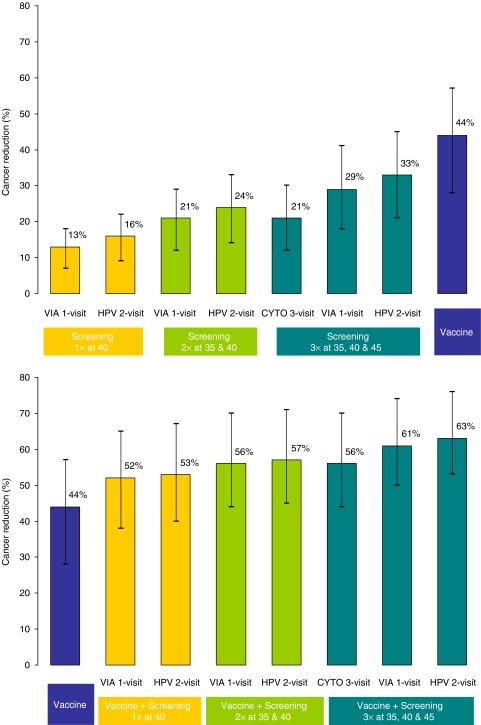
- Assuming 70% coverage, pre-adolescent HPV 16/18 vaccination alone reduced mean lifetime cervical cancer risk by 44% (range, 28–57%); screening three times per lifetime reduced risk by 21–33%.
- Combining vaccination with screening three times per lifetime gave a mean reduction of 56% (vaccination plus 3-visit conventional cytology) to 63% (vaccination plus 2-visit HPV DNA testing).
- At I$10 per vaccinated girl, vaccination followed by screening three times per lifetime using VIA cost I$290 per year of life saved (YLS); at I$20 per vaccinated girl, single-visit VIA screening alone cost I$60 per YLS compared with no intervention and became more cost-effective than vaccination alone.
- At a vaccine price of about $100 per dose (I$360 per vaccinated girl), vaccination was dominated by screening alone; combined vaccination plus single-visit VIA rose to I$7230 per YLS. If only HPV DNA testing was available, screening alone was dominated below I$50 per vaccinated girl, and combined vaccination plus two-visit HPV DNA testing three times per lifetime was I$1780 per YLS across that range.
Methods
- An individual-based stochastic microsimulation model of cervical carcinogenesis was calibrated to country-specific epidemiologic data from southeastern India, including HPV prevalence and type distribution from Tamil Nadu and cancer incidence from Bangalore and Chennai registries; a single birth cohort of girls entered at age 9 and was followed for life.
- Strategies compared were pre-adolescent HPV 16/18 vaccination before age 12, screening of women over age 30 by cytology, VIA, or HPV DNA testing with varying visits, frequency, and ages, and combined vaccination plus screening; base case assumed 70% coverage, screening at ages 35, 40, and 45, 3% annual discounting, societal perspective, and costs in I$2005.
- Outcomes were cancer incidence reduction, life expectancy gains, discounted lifetime costs, and incremental cost-effectiveness ratios (I$/YLS), with one-way, two-way, and probabilistic sensitivity analyses across good-fitting parameter sets.
Limitations
- The paper states that model parameter uncertainty remains, especially about HPV natural history in older women, type-specific immunity after natural infection, and multiple HPV infections; lack of high-quality temporal trend data limited calibration to a single birth cohort.
- The authors state they used a microsimulation model rather than an HPV transmission model, so herd immunity was not directly modeled, and they describe the findings as exploratory and cost-effectiveness estimates as approximate; affordability was not equivalent to cost-effectiveness.
- Evident from the text: base-case results assume lifelong vaccine protection and 70% coverage, use cost estimates from a prior India screening analysis, and assume 15% loss to follow-up between visits; actual vaccine price and programmatic delivery costs in India were unknown.
Model-written summary. Check it against the paper before relying on it.
Integrity signals
Registry
Cites
Statistics
Figures
Verification
Claims the paper makes
34 Own result · 19 Own interpretation · 12 Sources not found · 10 Own method · 5 No full text of the sources · 3 Not checked yet · 3 No basis given · 1 Partly supported · 1 Not supported · accuracy not yet measured
The cited sources support only part of this claim — read each source’s verdict below.
In the paper
“While our independent dynamic model (Kim et al, 2007b) has been previously used to include the herd immunity effects in an HPV vaccine policy analysis, sensitivity analyses that reduced incidence based on these findings, found the main policy results would be unlikely to change.”
§ Health and economic impact of HPV 16 and 18 vaccination and cervical cancer screening in India > Discussion
What the sources say
- Partly supportedcites Kim et al, 2007b sourceExperimental — accuracy not yet measured
The Methods (Dynamic model; page unavailable) say that projected reductions in HPV incidence, including herd-immunity effects, were used as inputs to the policy model. The Results report sensitivity analyses and the Discussion favours prioritising vaccination of girls, but our copy does not identify a sensitivity analysis that reduced incidence based on those herd-immunity findings or state that such an analysis left the main policy results unchanged. (LLM, conf=0.82)
hedged- Asserted: passes — The authors put it forward as true.
- Checkable: passes — It can be checked against evidence.
- Load-bearing: unclear — It is unclear whether the paper’s conclusions depend on it.
- Based: passes — The paper gives a reason why it holds.
- Partly supported
A result the paper reports from its own data — it cites no other source for it, so there is none to check. The quote shows it is in the paper.
In the paper
“Pre-adolescent vaccination alone reduced cancer incidence by 44% (range, 28–57%) and was more effective than screening alone (Figure 2, upper panel).”
§ Health and economic impact of HPV 16 and 18 vaccination and cervical cancer screening in India > Results > Reduction in lifetime risk of cancer
plaindirect- Asserted: passes — The authors put it forward as true.
- Checkable: passes — It can be checked against evidence.
- Load-bearing: passes — The paper’s conclusions depend on it.
- Based: passes — The paper gives a reason why it holds.
A result the paper reports from its own data — it cites no other source for it, so there is none to check. The quote shows it is in the paper.
In the paper
“At a vaccine price per dose of approximately $100 (I$360 per vaccinated girl), vaccination was dominated by (i.e., either less costly and less cost-effective than or more costly and less effective than) screening alone.”
§ Health and economic impact of HPV 16 and 18 vaccination and cervical cancer screening in India > Results > Cost-effectiveness of vaccination and screening
plain- Asserted: passes — The authors put it forward as true.
- Checkable: passes — It can be checked against evidence.
- Load-bearing: passes — The paper’s conclusions depend on it.
- Based: passes — The paper gives a reason why it holds.
A result the paper reports from its own data — it cites no other source for it, so there is none to check. The quote shows it is in the paper.
In the paper
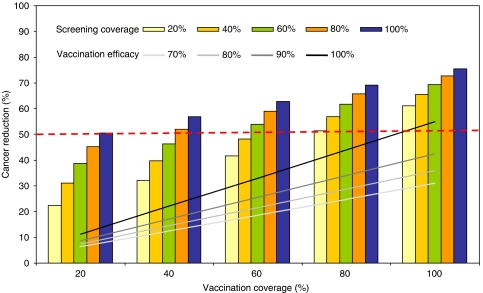
“For example, without screening, a threshold of 50% cancer reduction (dashed red line) was expected to be attainable with vaccination alone only at vaccination coverage rates exceeding 80% and vaccine efficacy of 100%.”
§ Health and economic impact of HPV 16 and 18 vaccination and cervical cancer screening in India > Results > Sensitivity analysis
hedgedconditional- Asserted: passes — The authors put it forward as true.
- Checkable: passes — It can be checked against evidence.
- Load-bearing: unclear — It is unclear whether the paper’s conclusions depend on it.
- Based: passes — The paper gives a reason why it holds.
A result the paper reports from its own data — it cites no other source for it, so there is none to check. The quote shows it is in the paper.
In the paper
“Assuming 70% coverage, mean reduction in lifetime cancer risk was 44% (range, 28–57%) with HPV 16,18 vaccination alone”
- Also stated in: § Reduction in lifetime risk of cancer · plain
“Pre-adolescent vaccination alone reduced cancer incidence by 44% (range, 28–57%)”
§ Health and economic impact of HPV 16 and 18 vaccination and cervical cancer screening in India > Abstract
plaindirect- Asserted: passes — The authors put it forward as true.
- Checkable: passes — It can be checked against evidence.
- Load-bearing: passes — The paper’s conclusions depend on it.
- Based: passes — The paper gives a reason why it holds.
- The authors state this as an assumption: The mechanism of cervical carcinogenesis does not fundamentally differ between countries.
- The authors state this as an assumption: Vaccinated girls have life-long protection against HPV 16 and 18.
- The authors state this as an assumption: Vaccinated girls are subject to the same rate of infection with other high-risk HPV types as those who are not vaccinated.
- Also stated in: § Reduction in lifetime risk of cancer · plain
A result the paper reports from its own data — it cites no other source for it, so there is none to check. The quote shows it is in the paper.
In the paper
“Once the cost per vaccinated girl reached I$50, screening alone was no longer dominated.”
§ Health and economic impact of HPV 16 and 18 vaccination and cervical cancer screening in India > Results > Cost-effectiveness of vaccination and screening
plaindirect- Asserted: passes — The authors put it forward as true.
- Checkable: passes — It can be checked against evidence.
- Load-bearing: passes — The paper’s conclusions depend on it.
- Based: passes — The paper gives a reason why it holds.
A result the paper reports from its own data — it cites no other source for it, so there is none to check. The quote shows it is in the paper.
In the paper
“Vaccination and screening three times per lifetime with VIA was I$290 per YLS.”
§ Health and economic impact of HPV 16 and 18 vaccination and cervical cancer screening in India > Results > Cost-effectiveness of vaccination and screening
plain- Asserted: passes — The authors put it forward as true.
- Checkable: passes — It can be checked against evidence.
- Load-bearing: passes — The paper’s conclusions depend on it.
- Based: passes — The paper gives a reason why it holds.
A result the paper reports from its own data — it cites no other source for it, so there is none to check. The quote shows it is in the paper.
In the paper
“In this case, screening three times per lifetime with two-visit HPV DNA testing was I$720 per YLS, compared to no intervention.”
§ Health and economic impact of HPV 16 and 18 vaccination and cervical cancer screening in India > Results > Cost-effectiveness of vaccination and screening
plain- Asserted: passes — The authors put it forward as true.
- Checkable: passes — It can be checked against evidence.
- Load-bearing: passes — The paper’s conclusions depend on it.
- Based: passes — The paper gives a reason why it holds.
The paper states this without a source or data behind it here, so there is nothing to check it against. The quote shows it is in the paper.
In the paper
“All strategies requiring multiple visits became more attractive when loss to follow-up was reduced.”
§ Health and economic impact of HPV 16 and 18 vaccination and cervical cancer screening in India > Results > Sensitivity analysis
plaindirect- Asserted: passes — The authors put it forward as true.
- Checkable: passes — It can be checked against evidence.
- Load-bearing: unclear — It is unclear whether the paper’s conclusions depend on it.
- Based: passes — The paper gives a reason why it holds.
A result the paper reports from its own data — it cites no other source for it, so there is none to check. The quote shows it is in the paper.
In the paper
“Combining vaccination and screening three times per lifetime provided a mean reduction of 56% (vaccination plus 3-visit conventional cytology) to 63% (vaccination plus 2-visit HPV DNA testing).”
§ Health and economic impact of HPV 16 and 18 vaccination and cervical cancer screening in India > Abstract
plaindirect- Asserted: passes — The authors put it forward as true.
- Checkable: passes — It can be checked against evidence.
- Load-bearing: passes — The paper’s conclusions depend on it.
- Based: passes — The paper gives a reason why it holds.
- The authors state this as an assumption: The mechanism of cervical carcinogenesis does not fundamentally differ between countries.
- The authors state this as an assumption: Vaccinated girls have life-long protection against HPV 16 and 18.
- The authors state this as an assumption: Vaccinated girls are subject to the same rate of infection with other high-risk HPV types as those who are not vaccinated.
- It may state two separate claims as one. 25
- The quote only partly states this claim. 1
- Probably not a substantial claim. 21
At least one cited source doesn’t support this claim or points to a different paper, and none confirmed it — see the verdicts below.
In the paper
“This was a purposeful decision as the former can simulate detailed screening strategies as well as vaccination, and includes other HPV types not targeted by the vaccine, enabling us to take advantage of all available data by calibrating to many epidemiological targets (Garnett et al, 2006).”
§ Health and economic impact of HPV 16 and 18 vaccination and cervical cancer screening in India > Discussion
What the sources say
- Disputedcites Kim et al, 2007b sourceExperimental — accuracy not yet measured
Split into 2 atoms — 0 confirmed, 1 partially supported, 1 disputed, 0 misattributed, 0 unverifiable. Expand the claim to see per-atom verdicts.
Checked by a reasoning model — may be wrong.
- Not checked — no full text of the sourcecites Garnett et al, 2006 source
plaindirect- Asserted: passes — The authors put it forward as true.
- Checkable: passes — It can be checked against evidence.
- Load-bearing: passes — The paper’s conclusions depend on it.
- Based: passes — The paper gives a reason why it holds.
It may state two separate claims as one.
- Disputed
A result the paper reports from its own data — it cites no other source for it, so there is none to check. The quote shows it is in the paper.
In the paper
“Across this same range of vaccine costs, pre-adolescent vaccination combined with two-visit HPV DNA testing three times per lifetime was I$1780 per YLS; at higher costs (I$360 per vaccinated girl) this strategy increased to I$7650 per YLS, compared to the next best strategy.”
§ Health and economic impact of HPV 16 and 18 vaccination and cervical cancer screening in India > Results > Cost-effectiveness of vaccination and screening
plaindirect- Asserted: passes — The authors put it forward as true.
- Checkable: passes — It can be checked against evidence.
- Load-bearing: passes — The paper’s conclusions depend on it.
- Based: passes — The paper gives a reason why it holds.
It may state two separate claims as one.
A result the paper reports from its own data — it cites no other source for it, so there is none to check. The quote shows it is in the paper.
In the paper
“Assuming a cost of I$20 per vaccinated girl, if VIA screening was 30% less sensitive and costs were increased to I$2, vaccination alone dominated VIA screening, although VIA combined with vaccination approximated I$975 per YLS (see Supplementary Appendix).”
§ Health and economic impact of HPV 16 and 18 vaccination and cervical cancer screening in India > Results > Sensitivity analysis
plaindirect- Asserted: passes — The authors put it forward as true.
- Checkable: passes — It can be checked against evidence.
- Load-bearing: unclear — It is unclear whether the paper’s conclusions depend on it.
- Based: passes — The paper gives a reason why it holds.
It may state two separate claims as one.
A result the paper reports from its own data — it cites no other source for it, so there is none to check. The quote shows it is in the paper.
In the paper
“When the cost per vaccinated girl reached and exceeded I$20, screening three times per lifetime (at ages 35, 40, and 45) with a single-visit VIA strategy was less costly and more cost-effective than vaccination alone, and cost I$60 per YLS compared to no intervention.”
§ Health and economic impact of HPV 16 and 18 vaccination and cervical cancer screening in India > Results > Cost-effectiveness of vaccination and screening
plaindirect- Asserted: passes — The authors put it forward as true.
- Checkable: passes — It can be checked against evidence.
- Load-bearing: passes — The paper’s conclusions depend on it.
- Based: passes — The paper gives a reason why it holds.
It may state two separate claims as one.
A result the paper reports from its own data — it cites no other source for it, so there is none to check. The quote shows it is in the paper.
In the paper
“and 21–33% with screening three times per lifetime.”
§ Health and economic impact of HPV 16 and 18 vaccination and cervical cancer screening in India > Abstract
plaindirect- Asserted: passes — The authors put it forward as true.
- Checkable: passes — It can be checked against evidence.
- Load-bearing: passes — The paper’s conclusions depend on it.
- Based: passes — The paper gives a reason why it holds.
The quote only partly states this claim.
- The authors state this as an assumption: The mechanism of cervical carcinogenesis does not fundamentally differ between countries.
A result the paper reports from its own data — it cites no other source for it, so there is none to check. The quote shows it is in the paper.
In the paper
“A combined strategy of vaccination and screening always provided greater cancer reduction than vaccination alone; however, the incremental benefits achieved by adding screening three times per lifetime were greater at lower vaccination coverage rates.”
§ Health and economic impact of HPV 16 and 18 vaccination and cervical cancer screening in India > Results > Sensitivity analysis
plaindirect- Asserted: passes — The authors put it forward as true.
- Checkable: passes — It can be checked against evidence.
- Load-bearing: passes — The paper’s conclusions depend on it.
- Based: passes — The paper gives a reason why it holds.
It may state two separate claims as one.
A result the paper reports from its own data — it cites no other source for it, so there is none to check. The quote shows it is in the paper.
In the paper
“Assuming that all strategies were equally available (Table 2a) and provided the cost per vaccinated girl was I$10 ($2 per dose) or less, vaccination alone was more effective and cost-effective than screening alone.”
§ Health and economic impact of HPV 16 and 18 vaccination and cervical cancer screening in India > Results > Cost-effectiveness of vaccination and screening
plaindirect- Asserted: passes — The authors put it forward as true.
- Checkable: passes — It can be checked against evidence.
- Load-bearing: passes — The paper’s conclusions depend on it.
- Based: passes — The paper gives a reason why it holds.
It may state two separate claims as one.
A result the paper reports from its own data — it cites no other source for it, so there is none to check. The quote shows it is in the paper.
In the paper
“For example, if training costs associated with VIA raised the total screening cost such that it would approach that of HPV DNA testing, vaccination plus screening three times per lifetime with two-visit HPV DNA testing was favored, at I$1780 per YLS – if a rapid HPV DNA test was available, allowing for a single-visit screen-and-treat strategy, this result would become even more favourable.”
§ Health and economic impact of HPV 16 and 18 vaccination and cervical cancer screening in India > Results > Sensitivity analysis
hedgeddirect- Asserted: passes — The authors put it forward as true.
- Checkable: passes — It can be checked against evidence.
- Load-bearing: unclear — It is unclear whether the paper’s conclusions depend on it.
- Based: passes — The paper gives a reason why it holds.
It may state two separate claims as one.
A result the paper reports from its own data — it cites no other source for it, so there is none to check. The quote shows it is in the paper.
In the paper
“At vaccination coverage rates of 40–50%, screening coverage would need to exceed 80%, but at vaccination coverage of 70%, screening coverage of 40–50% would suffice.”
§ Health and economic impact of HPV 16 and 18 vaccination and cervical cancer screening in India > Results > Sensitivity analysis
hedgeddirect- Asserted: passes — The authors put it forward as true.
- Checkable: passes — It can be checked against evidence.
- Load-bearing: passes — The paper’s conclusions depend on it.
- Based: passes — The paper gives a reason why it holds.
It may state two separate claims as one.
None of the sources cited for this claim have been checked yet.
In the paper
“For example, we found that per 1000 girls vaccinated, 15 deaths would be averted (Goldie et al. 2008 in press), which compares favourably to 3 deaths prevented per 1000 children vaccinated for rotavirus (IAVI/PATH, 2007).”
§ Health and economic impact of HPV 16 and 18 vaccination and cervical cancer screening in India > Discussion
What the sources say
- Not checked — no full text of the sourcecites Goldie et al. 2008 in press source
- Not matchedcites IAVI/PATH, 2007
Couldn’t be matched to a paper in Crossref, so it can’t be checked.
plaindirectn = 1,000- Asserted: passes — The authors put it forward as true.
- Checkable: passes — It can be checked against evidence.
- Load-bearing: unclear — It is unclear whether the paper’s conclusions depend on it.
- Based: passes — The paper gives a reason why it holds.
It may state two separate claims as one.
In the paper
“We have previously documented a small expected increase in non-16,18 cancers (Goldie et al, 2003, 2007), although we again found that the impact on the main cost-effectiveness results was small.”
§ Health and economic impact of HPV 16 and 18 vaccination and cervical cancer screening in India > Discussion
What the sources say
- Not matchedcites Goldie et al, 2003, 2007
Couldn’t be matched to a paper in Crossref, so it can’t be checked.
plain- Asserted: passes — The authors put it forward as true.
- Checkable: passes — It can be checked against evidence.
- Load-bearing: unclear — It is unclear whether the paper’s conclusions depend on it.
- Based: passes — The paper gives a reason why it holds.
It may state two separate claims as one.
- Not matched
A result the paper reports from its own data — it cites no other source for it, so there is none to check. The quote shows it is in the paper.
In the paper
“Although the rank-ordering of screening strategies from most effective to least effective, was two-visit HPV DNA testing, single-visit VIA, and three-visit cytology, differences between these screening approaches were somewhat attenuated at higher vaccination coverage rates.”
§ Health and economic impact of HPV 16 and 18 vaccination and cervical cancer screening in India > Discussion
plaincorrelational- Asserted: passes — The authors put it forward as true.
- Checkable: passes — It can be checked against evidence.
- Load-bearing: passes — The paper’s conclusions depend on it.
- Based: passes — The paper gives a reason why it holds.
It may state two separate claims as one.
A result the paper reports from its own data — it cites no other source for it, so there is none to check. The quote shows it is in the paper.
In the paper
“For example, across the good-fitting parameter sets, the mean cancer reduction with vaccination alone ranged from 28 to 57%, whereas with combined vaccination and screening three times per lifetime using two-visit HPV DNA testing ranged from 53 to 76%.”
§ Health and economic impact of HPV 16 and 18 vaccination and cervical cancer screening in India > Discussion
plaindirect- Asserted: passes — The authors put it forward as true.
- Checkable: passes — It can be checked against evidence.
- Load-bearing: passes — The paper’s conclusions depend on it.
- Based: passes — The paper gives a reason why it holds.
It may state two separate claims as one.
- Rests on an assumption: Vaccination prevents infections with HPV types 16 and 18.
- Rests on an assumption: Screening allows for treatment of precancerous lesions (caused by any high-risk HPV type) before progression to invasive cancer.
None of the sources cited for this claim have been checked yet.
In the paper
“We followed published recommendations for economic evaluations (DCPP; Gold et al, 1996; Drummond et al, 2005; WHO CHOICE) by adopting a societal perspective and discounting future costs and life years by 3% annually.”
§ Health and economic impact of HPV 16 and 18 vaccination and cervical cancer screening in India > Materials and methods > Analytic overview
What the sources say
- Not matchedcites Gold et al, 1996
Couldn’t be matched to a paper in Crossref, so it can’t be checked.
- Not checked — no full text of the sourcecites Drummond et al, 2005 source
- Not matchedcites WHO CHOICE
Couldn’t be matched to a paper in Crossref, so it can’t be checked.
plain- Asserted: passes — The authors put it forward as true.
- Checkable: passes — It can be checked against evidence.
- Load-bearing: passes — The paper’s conclusions depend on it.
- Based: passes — The paper gives a reason why it holds.
Probably not a substantial claim. It may state two separate claims as one.
- Not matched
What the paper did — it cites no source for this, so there is none to check. The quote shows it is in the paper.
In the paper
“To explicitly incorporate the effect of parameter uncertainty, cost-effectiveness analyses were conducted with a random sample of good-fitting parameter sets, and results were reported as the mean and range of outcomes, whereas incremental cost-effectiveness ratios were reported as the ratio of the mean costs divided by the mean effects of one strategy vs another across the good-fitting parameter”
§ Health and economic impact of HPV 16 and 18 vaccination and cervical cancer screening in India > Materials and methods > Epidemiological data
plain- Asserted: passes — The authors put it forward as true.
- Checkable: passes — It can be checked against evidence.
- Load-bearing: passes — The paper’s conclusions depend on it.
- Based: passes — The paper gives a reason why it holds.
Probably not a substantial claim. It may state two separate claims as one.
In the paper
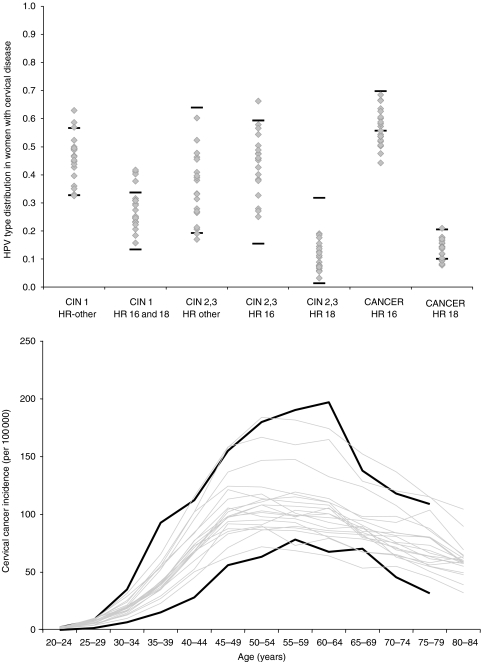
“Although cervical cancer is the most frequent cancer diagnosis in Indian women, age-adjusted incidence rates vary between regions, ranging from 10.9 in Trivandrum to 47.2 per 100 000 person-years at risk in Chennai (Parkin et al, 2005).”
§ Health and economic impact of HPV 16 and 18 vaccination and cervical cancer screening in India > Abstract
What the sources say
- Not matchedcites Parkin et al, 2005
Couldn’t be matched to a paper in Crossref, so it can’t be checked.
plain- Asserted: passes — The authors put it forward as true.
- Checkable: passes — It can be checked against evidence.
- Load-bearing: fails — The paper’s conclusions may not depend on it.
- Based: passes — The paper gives a reason why it holds.
Probably not a substantial claim. The paper’s conclusions may not depend on it.
- Not matched
A conclusion the paper draws from its own results — it cites no other source for it, so there is none to check. The quote shows it is in the paper.
In the paper
“In India, if high coverage of pre-adolescent girls with a low-cost HPV vaccine that provides long-term protection is achievable, vaccination followed by screening three times per lifetime is expected to reduce cancer deaths by half, and be cost-effective.”
§ Health and economic impact of HPV 16 and 18 vaccination and cervical cancer screening in India > Abstract
hedgeddirect- Asserted: passes — The authors put it forward as true.
- Checkable: passes — It can be checked against evidence.
- Load-bearing: passes — The paper’s conclusions depend on it.
- Based: passes — The paper gives a reason why it holds.
It may state two separate claims as one.
- The authors state this as an assumption: The mechanism of cervical carcinogenesis does not fundamentally differ between countries.
- The authors state this as an assumption: Vaccinated girls have life-long protection against HPV 16 and 18.
- The authors state this as an assumption: Vaccinated girls are subject to the same rate of infection with other high-risk HPV types as those who are not vaccinated.
In the paper
“Although there is no consensus on a specific cost-effectiveness threshold, below which an intervention would be considered cost-effective, one suggested heuristic has been to use the country's per capita GDP (WHO, 2001).”
§ Health and economic impact of HPV 16 and 18 vaccination and cervical cancer screening in India > Results > Cost-effectiveness of vaccination and screening
What the sources say
- Not matchedcites WHO, 2001
Couldn’t be matched to a paper in Crossref, so it can’t be checked.
hedged- Asserted: passes — The authors put it forward as true.
- Checkable: passes — It can be checked against evidence.
- Load-bearing: passes — The paper’s conclusions depend on it.
- Based: passes — The paper gives a reason why it holds.
Probably not a substantial claim.
- Not matched
In the paper
“Although cervical cancer is the most frequent cancer diagnosis in Indian women, age-adjusted incidence rates vary between regions, ranging from 10.9 in Trivandrum to 47.2 per 100 000 person-years at risk in Chennai (Parkin et al, 2005).”
§ Health and economic impact of HPV 16 and 18 vaccination and cervical cancer screening in India > Abstract
What the sources say
- Not matchedcites Parkin et al, 2005
Couldn’t be matched to a paper in Crossref, so it can’t be checked.
plain- Asserted: passes — The authors put it forward as true.
- Checkable: passes — It can be checked against evidence.
- Load-bearing: fails — The paper’s conclusions may not depend on it.
- Based: passes — The paper gives a reason why it holds.
Probably not a substantial claim. The paper’s conclusions may not depend on it.
- Not matched
In the paper
“More than 25% of cervical cancer cases worldwide occur in India (Ferlay et al, 2004).”
§ Health and economic impact of HPV 16 and 18 vaccination and cervical cancer screening in India > Abstract
What the sources say
- Not matchedcites Ferlay et al, 2004
Couldn’t be matched to a paper in Crossref, so it can’t be checked.
plain- Asserted: passes — The authors put it forward as true.
- Checkable: passes — It can be checked against evidence.
- Load-bearing: fails — The paper’s conclusions may not depend on it.
- Based: passes — The paper gives a reason why it holds.
Probably not a substantial claim. The paper’s conclusions may not depend on it.
- Not matched
What the paper did — it cites no source for this, so there is none to check. The quote shows it is in the paper.
In the paper
“Parameter uncertainty was evaluated using one- and two-way sensitivity analysis, and probabilistic analysis.”
§ Health and economic impact of HPV 16 and 18 vaccination and cervical cancer screening in India > Materials and methods > Analytic overview
plain- Asserted: passes — The authors put it forward as true.
- Checkable: passes — It can be checked against evidence.
- Load-bearing: passes — The paper’s conclusions depend on it.
- Based: passes — The paper gives a reason why it holds.
Probably not a substantial claim. It may state two separate claims as one.
What the paper did — it cites no source for this, so there is none to check. The quote shows it is in the paper.
In the paper
“As the model includes vaccine-targeted and non-targeted HPV types, we were able to explore the potential effect of an increase in non-vaccine-targeted HPV types.”
§ Health and economic impact of HPV 16 and 18 vaccination and cervical cancer screening in India > Discussion
plain- Asserted: passes — The authors put it forward as true.
- Checkable: passes — It can be checked against evidence.
- Load-bearing: passes — The paper’s conclusions depend on it.
- Based: passes — The paper gives a reason why it holds.
It may state two separate claims as one.
In the paper
“On the basis of age-specific incidence and projected demographic changes, the expected new cases of cervical cancer in India will increase from 132 082 in year 2002, to more than 330 000 in 2050 (Ferlay et al, 2004).”
§ Health and economic impact of HPV 16 and 18 vaccination and cervical cancer screening in India > Discussion
What the sources say
- Not matchedcites Ferlay et al, 2004
Couldn’t be matched to a paper in Crossref, so it can’t be checked.
plaindirect- Asserted: passes — The authors put it forward as true.
- Checkable: passes — It can be checked against evidence.
- Load-bearing: fails — The paper’s conclusions may not depend on it.
- Based: passes — The paper gives a reason why it holds.
Probably not a substantial claim. The paper’s conclusions may not depend on it.
- Not matched
A conclusion the paper draws from its own results — it cites no other source for it, so there is none to check. The quote shows it is in the paper.
In the paper
“they are synergistic, and provide substantially greater benefits than either alone.”
§ Health and economic impact of HPV 16 and 18 vaccination and cervical cancer screening in India > Discussion
plaindirect- Asserted: passes — The authors put it forward as true.
- Checkable: passes — It can be checked against evidence.
- Load-bearing: passes — The paper’s conclusions depend on it.
- Based: passes — The paper gives a reason why it holds.
It may state two separate claims as one.
- Rests on an assumption: Vaccination prevents infections with HPV types 16 and 18.
- Rests on an assumption: Screening allows for treatment of precancerous lesions (caused by any high-risk HPV type) before progression to invasive cancer.
A conclusion the paper draws from its own results — it cites no other source for it, so there is none to check. The quote shows it is in the paper.
In the paper
“The strategies that we have identified as cost-effective in this analysis may still be prohibitively expensive in India”
§ Health and economic impact of HPV 16 and 18 vaccination and cervical cancer screening in India > Discussion
hedged- Asserted: passes — The authors put it forward as true.
- Checkable: passes — It can be checked against evidence.
- Load-bearing: fails — The paper’s conclusions may not depend on it.
- Based: passes — The paper gives a reason why it holds.
Probably not a substantial claim. The paper’s conclusions may not depend on it.
A conclusion the paper draws from its own results — it cites no other source for it, so there is none to check. The quote shows it is in the paper.
In the paper
“if there is less robust vaccine-induced immunity in girls with other diseases, such as severe anaemia, chronic illness or HIV”
§ Health and economic impact of HPV 16 and 18 vaccination and cervical cancer screening in India > Discussion
hedgedconditional- Asserted: passes — The authors put it forward as true.
- Checkable: passes — It can be checked against evidence.
- Load-bearing: fails — The paper’s conclusions may not depend on it.
- Based: fails — The paper may give no reason why it holds.
Probably not a substantial claim. The paper’s conclusions may not depend on it. The paper may give no reason why it holds.
What the paper did — it cites no source for this, so there is none to check. The quote shows it is in the paper.
In the paper
“For most of these factors, a lack of data prohibit us from estimating the magnitude of individual potential effects; that being said, these are uncertain issues for which empiric data are needed.”
§ Health and economic impact of HPV 16 and 18 vaccination and cervical cancer screening in India > Discussion
plain- Asserted: passes — The authors put it forward as true.
- Checkable: passes — It can be checked against evidence.
- Load-bearing: fails — The paper’s conclusions may not depend on it.
- Based: passes — The paper gives a reason why it holds.
Probably not a substantial claim. The paper’s conclusions may not depend on it. It may state two separate claims as one.
In the paper
“Prevention and treatment of cervical cancer, the leading cause of cancer in Indian women, is a priority according to the country's National Cancer Control Programme (Government of India, 2005).”
§ Health and economic impact of HPV 16 and 18 vaccination and cervical cancer screening in India > Discussion
What the sources say
- Not matchedcites Government of India, 2005
Couldn’t be matched to a paper in Crossref, so it can’t be checked.
plain- Asserted: passes — The authors put it forward as true.
- Checkable: passes — It can be checked against evidence.
- Load-bearing: fails — The paper’s conclusions may not depend on it.
- Based: passes — The paper gives a reason why it holds.
Probably not a substantial claim. The paper’s conclusions may not depend on it.
- Not matched
A conclusion the paper draws from its own results — it cites no other source for it, so there is none to check. The quote shows it is in the paper.
In the paper
“if there are herd immunity benefits to unvaccinated individuals”
§ Health and economic impact of HPV 16 and 18 vaccination and cervical cancer screening in India > Discussion
hedgedconditional- Asserted: passes — The authors put it forward as true.
- Checkable: passes — It can be checked against evidence.
- Load-bearing: fails — The paper’s conclusions may not depend on it.
- Based: passes — The paper gives a reason why it holds.
Probably not a substantial claim. The paper’s conclusions may not depend on it.
In the paper
“this ratio is a fraction of India's per capita GDP, and would be considered very cost-effective according to suggested benchmarks for developing countries (WHO, 2001).”
§ Health and economic impact of HPV 16 and 18 vaccination and cervical cancer screening in India > Discussion
What the sources say
- Not matchedcites WHO, 2001
Couldn’t be matched to a paper in Crossref, so it can’t be checked.
hedged- Asserted: passes — The authors put it forward as true.
- Checkable: passes — It can be checked against evidence.
- Load-bearing: passes — The paper’s conclusions depend on it.
- Based: passes — The paper gives a reason why it holds.
It may state two separate claims as one.
- Not matched
A conclusion the paper draws from its own results — it cites no other source for it, so there is none to check. The quote shows it is in the paper.
In the paper
“If a cytology-based strategy could be conducted in two visits without the use of colposcopy for diagnostic confirmation, it could be more attractive than predicted by our analysis due to reduced loss to follow-up.”
§ Health and economic impact of HPV 16 and 18 vaccination and cervical cancer screening in India > Discussion
hedgedconditional- Asserted: passes — The authors put it forward as true.
- Checkable: passes — It can be checked against evidence.
- Load-bearing: fails — The paper’s conclusions may not depend on it.
- Based: passes — The paper gives a reason why it holds.
Probably not a substantial claim. The paper’s conclusions may not depend on it.
What the paper did — it cites no source for this, so there is none to check. The quote shows it is in the paper.
In the paper
“Our analysis has several limitations, and thus, we emphasise that our results are intended to provide quantitative approximations of the potential benefits of HPV vaccination, and to provide qualitative insight into the relative value of primary and secondary prevention.”
§ Health and economic impact of HPV 16 and 18 vaccination and cervical cancer screening in India > Discussion
plain- Asserted: passes — The authors put it forward as true.
- Checkable: passes — It can be checked against evidence.
- Load-bearing: fails — The paper’s conclusions may not depend on it.
- Based: passes — The paper gives a reason why it holds.
Probably not a substantial claim. The paper’s conclusions may not depend on it. It may state two separate claims as one.
What the paper did — it cites no source for this, so there is none to check. The quote shows it is in the paper.
In the paper
“Given the range of uncertainties and the limitations of this analysis, our findings should be considered exploratory and our estimates of cost-effectiveness approximate, and should be interpreted in the context of the analytic purpose of this work, that is, to leverage the best available data to provide insight into decisions that policy makers in India are discussing right now.”
§ Health and economic impact of HPV 16 and 18 vaccination and cervical cancer screening in India > Discussion
hedged- Asserted: passes — The authors put it forward as true.
- Checkable: fails — It may be too vague to check against evidence.
- Load-bearing: passes — The paper’s conclusions depend on it.
- Based: passes — The paper gives a reason why it holds.
Probably not a substantial claim. It may be too vague to check against evidence. It may state two separate claims as one.
A conclusion the paper draws from its own results — it cites no other source for it, so there is none to check. The quote shows it is in the paper.
In the paper
“the impact of the vaccine could be higher if there is long-term cross-protection against non-16,18 type infection”
§ Health and economic impact of HPV 16 and 18 vaccination and cervical cancer screening in India > Discussion
hedgedconditional- Asserted: passes — The authors put it forward as true.
- Checkable: passes — It can be checked against evidence.
- Load-bearing: fails — The paper’s conclusions may not depend on it.
- Based: passes — The paper gives a reason why it holds.
Probably not a substantial claim. The paper’s conclusions may not depend on it.
What the paper did — it cites no source for this, so there is none to check. The quote shows it is in the paper.
In the paper
“Similarly, a lack of high quality data on temporal trends of HPV-related disease limited our ability to calibrate the model to different time points, and contributed to the choice to simulate a single birth cohort.”
§ Health and economic impact of HPV 16 and 18 vaccination and cervical cancer screening in India > Discussion
plaindirect- Asserted: passes — The authors put it forward as true.
- Checkable: passes — It can be checked against evidence.
- Load-bearing: passes — The paper’s conclusions depend on it.
- Based: passes — The paper gives a reason why it holds.
It may state two separate claims as one.
A conclusion the paper draws from its own results — it cites no other source for it, so there is none to check. The quote shows it is in the paper.
In the paper
“or if vaccine-induced immunity wanes while individuals are still at risk for new HPV infections.”
§ Health and economic impact of HPV 16 and 18 vaccination and cervical cancer screening in India > Discussion
hedgedconditional- Asserted: passes — The authors put it forward as true.
- Checkable: passes — It can be checked against evidence.
- Load-bearing: fails — The paper’s conclusions may not depend on it.
- Based: passes — The paper gives a reason why it holds.
Probably not a substantial claim. The paper’s conclusions may not depend on it.
A conclusion the paper draws from its own results — it cites no other source for it, so there is none to check. The quote shows it is in the paper.
In the paper
“and if non-cervical HPV 16,18-related cancers and diseases are prevented.”
§ Health and economic impact of HPV 16 and 18 vaccination and cervical cancer screening in India > Discussion
hedgedconditional- Asserted: passes — The authors put it forward as true.
- Checkable: passes — It can be checked against evidence.
- Load-bearing: fails — The paper’s conclusions may not depend on it.
- Based: passes — The paper gives a reason why it holds.
Probably not a substantial claim. The paper’s conclusions may not depend on it.
What the paper did — it cites no source for this, so there is none to check. The quote shows it is in the paper.
In the paper
“In addition to model parameter uncertainty, there are uncertainties with respect to the natural history of HPV, especially in older women, the nature of type-specific immunity following natural infection, and the relationships between different HPV types in the case of multiple infections.”
§ Health and economic impact of HPV 16 and 18 vaccination and cervical cancer screening in India > Discussion
plain- Asserted: passes — The authors put it forward as true.
- Checkable: passes — It can be checked against evidence.
- Load-bearing: fails — The paper’s conclusions may not depend on it.
- Based: passes — The paper gives a reason why it holds.
Probably not a substantial claim. The paper’s conclusions may not depend on it. It may state two separate claims as one.
A conclusion the paper draws from its own results — it cites no other source for it, so there is none to check. The quote shows it is in the paper.
In the paper
“The effectiveness of the vaccine could be lower than we projected if older girls, who may have been infected previously with type 16 or 18, are vaccinated”
§ Health and economic impact of HPV 16 and 18 vaccination and cervical cancer screening in India > Discussion
hedgedconditional- Asserted: passes — The authors put it forward as true.
- Checkable: passes — It can be checked against evidence.
- Load-bearing: fails — The paper’s conclusions may not depend on it.
- Based: passes — The paper gives a reason why it holds.
Probably not a substantial claim. The paper’s conclusions may not depend on it.
A conclusion the paper draws from its own results — it cites no other source for it, so there is none to check. The quote shows it is in the paper.
In the paper
“Although screening three time per lifetime prevents additional deaths from non-16 and 18-type associated cancers, as well as 16,18-associated cancers in the proportion of the population not vaccinated, it also provides some insurance of cancer risk protection in the context of the uncertainty around long-term vaccine performance in a non-clinical trial situation.”
§ Health and economic impact of HPV 16 and 18 vaccination and cervical cancer screening in India > Discussion
plaindirect- Asserted: passes — The authors put it forward as true.
- Checkable: passes — It can be checked against evidence.
- Load-bearing: passes — The paper’s conclusions depend on it.
- Based: passes — The paper gives a reason why it holds.
It may state two separate claims as one.
- Rests on an assumption: Screening allows for treatment of precancerous lesions (caused by any high-risk HPV type) before progression to invasive cancer.
The authors state this as an assumption.
The mechanism of cervical carcinogenesis does not fundamentally differ between countries.
“We assumed that the mechanism of cervical carcinogenesis does not fundamentally differ between countries; as such, initial natural history model estimates, and their plausible ranges, were based on the best available data regardless of specific setting.”
The authors state this as an assumption.
Vaccinated girls have life-long protection against HPV 16 and 18.
“We also assumed vaccinated girls have life-long protection against HPV 16 and 18, but are subject to the same rate of infection with other high-risk HPV types as those who are not vaccinated.”
The authors state this as an assumption.
Vaccinated girls are subject to the same rate of infection with other high-risk HPV types as those who are not vaccinated.
“We also assumed vaccinated girls have life-long protection against HPV 16 and 18, but are subject to the same rate of infection with other high-risk HPV types as those who are not vaccinated.”
The paper relies on this without support.
Vaccination prevents infections with HPV types 16 and 18.
“with vaccination preventing infections with HPV types 16 and 18”
The paper relies on this without support.
Screening allows for treatment of precancerous lesions (caused by any high-risk HPV type) before progression to invasive cancer.
“screening allowing for treatment of precancerous lesions (caused by any high-risk HPV type) before progression to invasive cancer”
The paper relies on this without support.
The vast majority of women will lack curative treatment, and approximately two-thirds will die from cervical cancer.
“The vast majority of women will lack curative treatment, and thus, approximately two-thirds will die from this preventable disease.”
The paper relies on this without support.
Women who will benefit from vaccination are not in the same birth cohorts as the women who benefit from screening in the short-run.
“women who will benefit from vaccination are not in the same birth cohorts as the women who benefit from screening in the short-run”
The paper relies on this without support.
The vaccine-preventable cervical cancer burden in India is a product of underlying cervical cancer incidence, the proportion of cancer attributable to HPV 16 and 18, long-term vaccine efficacy, and ability to achieve high coverage in adolescent girls before sexual activity.
“The vaccine-preventable cervical cancer burden in India is a product of several factors, including the underlying cervical cancer incidence, the proportion of cancer attributable to HPV 16 and 18, the long-term vaccine efficacy, and the ability to achieve high coverage in adolescent girls before sexual activity.”
Claims other papers make about this one
Each is checked against this paper’s own text: does it say what the citing paper says it does?
The source backs part of the claim, not all of it — or backs it for a different population, condition or comparison.
In the citing paper
“Using an individual based stochastic model for India, Diaz et al (2008) reported mean cancer reduction as 29%, 21% and 33%, when women were screened thrice per lifetime with VIA, cytology and HPV DNA, respectively. [47]”
From Cost effectiveness of strategies for cervical cancer prevention in India (2020) · cites this paper as [47]
Experimental — accuracy not yet measuredThe source backs part of the claim, not all of it — or backs it for a different population, condition or comparison.
In the citing paper
“Our projections also support previous modelling studies2, 31, 32 that found high coverage of vaccination against HPV16 and HPV18 in girls aged 10 years could reduce the burden of cervical cancer in India considerably, and enable the country to reach the WHO elimination target even with single-dose vaccination.”
From Evidence-based impact projections of single-dose human papillomavirus vaccination in India: a modelling study (2022) · cites this paper as [32]
Experimental — accuracy not yet measuredThe cited source says what the claim attributes to it.
In the citing paper
“Screening three times in a lifetime reduces cervical cancer risk by 21-33% (Diaz et al., 2008).”
From Indian Parents Prefer Vaccinating their Daughters against HPV at Older Ages (2014) · cites this paper as Diaz et al., 2008
The cited source says what the claim attributes to it.
In the citing paper
“However, our cost estimates were higher than what was reported by Diaz et al and Goldie et al even after adjustment of latter estimates for inflation since the year of estimation. [47, 48].”
From Cost effectiveness of strategies for cervical cancer prevention in India (2020) · cites this paper as [47]
Citations
Cites
Methods for the Economic Evaluation of Health Care Programmes
Drummond, M. E., Sculpher, M. J., Torrance, G. W., O’Brien, B. J., & Stoddart, G. L. (2005) · doi:10.1093/oso/9780198529446.001.0001 · Cited by 13,648
IARC Monographs on the Evaluation of Carcinogenic Risks to Humans
Zuckerman, A. J. (1995) · Journal of Clinical Pathology · doi:10.1136/jcp.48.7.691-a · Cited by 8,766
Cancer Incidence in Five Continents
Doll, R., Muir, C. S., & Waterhouse, J. A. H. (1970) · Springer eBooks · doi:10.1007/978-3-642-85851-2 · Cited by 8,485 · cited 3×
“Parameter uncertainty was evaluated using one- and two-way sensitivity analysis, and probabilistic analysis.”
BackgroundMethodInfluentialCost-Effectiveness in Health and Medicine
(1996) · doi:10.1093/oso/9780195108248.001.0001 · Cited by 7,193
Epidemiologic classification of human papillomavirus types associated with cervical cancer
Muñoz, N., Bosch, F. X., de Sanjosé, S., Herrero, R., Castellsagué, X., Shah, K. V., Snijders, P. J. F., & Meijer, C. J. L. M. (2003) · New England Journal of Medicine · doi:10.1056/nejmoa021641 · Cited by 6,249 · cited 2×
“…39, 45, 51, 52, 53, 56, 58, 59, 66, 68, 73, and 82 (IS39 and MM4 subtypes)), and (4) low-risk types (LR) (LR types: 6, 11, 30, 32, 34, 40, 42, 43, 44, 54, 55, 57, 61, 64, 67, 69, 70, 71 (CP8061), 72, 81 (CP8304), 83 (MM7), and 84 (MM8), cand85, 86, cand89 (CP6108) and JC9710) (Muñoz et al, 2003).”
Self-citationCancer incidence, mortality and prevalence worldwide
Ferlay, J. (2004) · Medical Entomology and Zoology · Cited by 3,796
Macroeconomics and health: investing in health for economic development
Sachs, J. D. (2002) · Revista Panamericana de Salud Pública · doi:10.1590/s1020-49892002000800017 · Cited by 1,844
de Sanjosé, S., Diaz, M., Castellsagué, X., Clifford, G., Bruni, L., Muñoz, N., & Bosch, F. X. (2007) · The Lancet Infectious Diseases · doi:10.1016/s1473-3099(07)70158-5 · Cited by 1,669 · cited 1×
“…acid (VIA) have been demonstrated to be acceptable and promising alternatives when embedded in a screening protocol that requires fewer visits (Bhatla et al, 2007; Ramachandran et al, 2007) and utilises cryotherapy conducted by nurses to treat the majority of early cancer precursors…”
BackgroundSelf-citationSachs, J. D. (2001) · World Health Organization eBooks · Cited by 800
Effective screening programmes for cervical cancer in low- and middle-income developing countries.
(2001) · Europe PMC (PubMed Central) · Cited by 724
Research works printed but not linked: 2
- Bhatla N, Ramachandran S, Virmani A, Arora VK, Gulati A, Singla S, Kriplani A, Bell L, Sellors J, Lorincz A, Eder P (2007) Correlation of FastHPV and Cytology: Performance trial results from India. 24th International Papillomavirus Conference and Clinical Workshop, November 3–9 2007, Beijing, China, 1C-03
- Ramachandran S, Bhatla N, Virmani A, Bell L, Payne E, Dong L, Chen G, Sellors J, Lorincz A, Eder P (2007) A fast affordable sensitive test for Hpv in developing countries: performance trial results from India. 24th International Papillomavirus Conference and Clinical Workshop, November 3–9, 2007, Beijing, China, PS6-59
Cited by
Sorted by citations
Ozawa, S., Mirelman, A. J., Stack, M. L., Walker, D. G., & Levine, O. S. (2012) · Vaccine · doi:10.1016/j.vaccine.2012.10.103 · Cited by 254
“2 for our search strategy) [10–117].”
Mezei, A. K., Armstrong, H. L., Pedersen, H. N., Campos, N. G., Mitchell, S. M., Sekikubo, M., Byamugisha, J. K., Kim, J. J., Bryan, S., & Ogilvie, G. S. (2017) · International Journal of Cancer · doi:10.1002/ijc.30695 · Cited by 212
“Diaz et al.(18) Microsimulation Kim et al.”
Self-citationLee, L. A., Franzel, L., Atwell, J. E., Datta, S., Friberg, I. K., Goldie, S. J., Reef, S. E., Schwalbe, N., Simons, E. A., Strebel, P. M., et al. (2013) · Vaccine · doi:10.1016/j.vaccine.2012.11.035 · Cited by 185
Self-citationCurrent status of human papillomavirus vaccination in India's cervical cancer prevention efforts
Sankaranarayanan, R., Basu, P., Kaur, P., Bhaskar, R., Singh, G. B., Denzongpa, P., Grover, R. K., Sebastian, P., Saikia, T., Oswal, K., et al. (2019) · The Lancet Oncology · doi:10.1016/s1470-2045(19)30531-5 · Cited by 136
Cervical Cancer Prevention in Low- and Middle-Income Countries: Feasible, Affordable, Essential
Sahasrabuddhe, V. V., Parham, G. P., Mwanahamuntu, M. H., & Vermund, S. H. (2012) · Cancer Prevention Research · doi:10.1158/1940-6207.capr-11-0540 · Cited by 131
“both current and future generations of at-risk populations (27, 28).”
Fesenfeld, M., Hutubessy, R., & Jit, M. (2013) · Vaccine · doi:10.1016/j.vaccine.2013.06.060 · Cited by 123
Cancer epidemiology in South Asia - past, present and future.
Moore, M. A., Ariyaratne, Y., Badar, F., Bhurgri, Y., Datta, K., Mathew, A., Gangadharan, P., Nandakumar, A., Pradhananga, K. K., Talukder, M. H., et al. (2010) · PubMed · Cited by 120
Longer term efficacy of a prophylactic monovalent human papillomavirus type 16 vaccine
Rowhani‐Rahbar, A., Mao, C., Hughes, J. P., Alvarez, F. B., Bryan, J. T., Hawes, S. E., Weiss, N. S., & Koutsky, L. A. (2009) · Vaccine · doi:10.1016/j.vaccine.2009.07.027 · Cited by 91
The Cost Effectiveness of Human Papillomavirus Vaccines
Seto, K., Marra, F., Raymakers, A., & Marra, C. A. (2012) · Drugs · doi:10.2165/11599470-000000000-00000 · Cited by 89
“, 2008 Diaz et al.([44]) looked at cervical cancer outcomes by adapting a previously published model with epidemiological and cost data specific to India.”
InfluentialGoldie, S. J., O'Shea, M. K. H., Díaz, M., & Kim, S. (2008) · Reproductive Health Matters · doi:10.1016/s0968-8080(08)32409-4 · Cited by 82
Self-citationCanfell, K., Shi, J.-F., Lew, J.-B., Walker, R., Zhao, F.-H., Simonella, L., Chen, J.-F., Legood, R., Smith, M. A., & Nickson, C. (2011) · Vaccine · doi:10.1016/j.vaccine.2010.12.085 · Cited by 83
A Systematic Review of the State of Economic Evaluation for Health Care in India
Prinja, S., Chauhan, A. S., Angell, B. J., Gupta, I., & Jan, S. (2015) · Applied Health Economics and Health Policy · doi:10.1007/s40258-015-0201-6 · Cited by 82
“Ultimately, 104 articles were found eligible for this systematic review [19–122].”
BackgroundEconomic Evaluation of Policy Options for Prevention and Control of Cervical Cancer in Thailand
Praditsitthikorn, N., Teerawattananon, Y., Tantivess, S., Limwattananon, S., Riewpaiboon, A., Chichareon, S., Ieumwananonthachai, N., & Tangcharoensathien, V. (2011) · PharmacoEconomics · doi:10.2165/11586560-000000000-00000 · Cited by 79
“With the availability of newly developed interventions for the prevention and control of cervical cancer, several countries in both the developed and the developing world are currently reviewing their strategies and are planning to strengthen systems for cervical cancer control.([21,41-45]) This study indicates that t…”
BackgroundCost effectiveness of strategies for cervical cancer prevention in India
Chauhan, A. S., Prinja, S., Srinivasan, R., Rai, B., Malliga, J., Jyani, G., Gupta, N., & Ghoshal, S. (2020) · PLOS ONE · doi:10.1371/journal.pone.0238291 · Cited by 75
“[47] This implies that our estimates on health outcomes are on similar lines as predicted by the previous cost effectiveness model.”
ResultCervical Cancer Screening and Prevention in Low-resource Settings
Bradford, L. S., & Goodman, A. (2013) · Clinical Obstetrics & Gynecology · doi:10.1097/grf.0b013e31828237ac · Cited by 77
Campos, N. G., Castle, P. E., Wright, T. C., & Kim, J. J. (2015) · International Journal of Cancer · doi:10.1002/ijc.29594 · Cited by 73
Self-citationCanfell, K., Kim, J. J., Kulasingam, S., Berkhof, J., Barnabas, R., Bogaards, J. A., Campos, N., Jennett, C., Sharma, M., Simms, K. T., et al. (2019) · Papillomavirus Research · doi:10.1016/j.pvr.2019.100184 · Cited by 68
Self-citationPrinja, S., Bahuguna, P., Faujdar, D. S., Jyani, G., Srinivasan, R., Ghoshal, S., Suri, V., Singh, M. P., & Kumar, R. (2017) · Cancer · doi:10.1002/cncr.30734 · Cited by 68
“In the context of the HPV vaccine, several studies have evaluated its cost-effectiveness in a variety of countries.11,12 Diaz et al reported that the HPV vaccine is cost-effective in India.”
BackgroundInfluentialMathematical Models of Cervical Cancer Prevention in the Asia Pacific Region
Goldie, S. J., Díaz, M., Kim, S., Levin, C., Minh, H. V., & Kim, J. J. (2008) · Vaccine · doi:10.1016/j.vaccine.2008.06.018 · Cited by 65
Self-citationMcKeage, K., & Romanowski, B. (2011) · PubMed · doi:10.2165/11206820-000000000-00000 · Cited by 62
“quadrivalent vaccine not specified) in developing countries, where the risk of dying from cervical cancer is greater than in developed countries.([72-74]) These models suggest that where vaccine costs are kept low (10 to <25 International Dollars [based on purchasing power parities of local”
BackgroundSahasrabuddhe, V. V., Bhosale, R. A., Kavatkar, A. N., Nagwanshi, C. A., Joshi, S. N., Jenkins, C. A., Shepherd, B. E., Kelkar, R. S., Sahay, S., Risbud, A., et al. (2011) · International Journal of Cancer · doi:10.1002/ijc.25971 · Cited by 59
“Number of births (median, IQR) 2 (1, 3) 2 (1, 3) 2 (1, 3) 2 (1, 3) 2 (1, 3)”
Advancing Cervical Cancer Prevention in India: Implementation Science Priorities
Krishnan, S., Madsen, E., Porterfield, D. S., & Varghese, B. (2013) · The Oncologist · doi:10.1634/theoncologist.2013-0292 · Cited by 60
Campos, N. G., Tsu, V., Jeronimo, J., Mvundura, M., Lee, K., & Kim, J. J. (2015) · Papillomavirus Research · doi:10.1016/j.pvr.2015.05.003 · Cited by 56
Self-citationCampos, N. G., Maza, M., Alfaro, K. M., Gage, J. C., Castle, P. E., Felix, J. C., Cremer, M., & Kim, J. J. (2015) · International Journal of Cancer · doi:10.1002/ijc.29438 · Cited by 53
Self-citationBhatla, N., Suri, V., Basu, P. S., et al. (2010) · Journal of obstetrics and gynaecology research · doi:10.1111/j.1447-0756.2009.01167.x · Cited by 53
“There is a high global disease burden of cervical cancer with nearly half a million new cases reported each year and more than 270 000 women dying annually.1 More than 80% of cervical cancers occur in developing countries.2 Estimates indicate that cervical cancer is the most common cancer in women in South Asia,3 incl…”
BackgroundInfluentialIntellectual property, technology transfer and manufacture of low-cost HPV vaccines in India
Padmanabhan, S., Amin, T., Sampat, B. N., Cook-Deegan, R. M., & Chandrasekharan, S. (2010) · Nature Biotechnology · doi:10.1038/nbt0710-671 · Cited by 54
Kim, J. J., Sharma, M., O'Shea, M. K. H., Sweet, S., Díaz, M., Sancho-Garnier, H., & Seoud, M. A.-F. (2013) · Vaccine · doi:10.1016/j.vaccine.2012.06.096 · Cited by 54
Self-citationCost‐effectiveness of human papillomavirus vaccination and cervical cancer screening in Thailand
Sharma, M., Ortendahl, J. D., van der Ham, E., Sy, S., & Jj, K. (2011) · BJOG An International Journal of Obstetrics & Gynaecology · doi:10.1111/j.1471-0528.2011.02974.x · Cited by 49
Systematic review of model-based cervical screening evaluations
Mendes, D., Bains, I., Vanni, T., & Jit, M. (2015) · BMC Cancer · doi:10.1186/s12885-015-1332-8 · Cited by 47
“All studies comparing VIA with HPV DNA and/or cytology for primary screening (n = 11) were economic analyses and most comparing HPV DNA testing and VIA (6/9) recommended HPV DNA testing (n = 2) [19,31] or either (n = 4) [18,20,32,33].”
BackgroundMethodModel-Based Impact and Cost-Effectiveness of Cervical Cancer Prevention in Sub-Saharan Africa
Kim, J. J., Campos, N. G., O'Shea, M. K. H., Díaz, M., & Mutyaba, I. (2013) · Vaccine · doi:10.1016/j.vaccine.2012.07.093 · Cited by 54
Self-citationMan, I., Georges, D., de Carvalho, T. M., Ray Saraswati, L., Bhandari, P., Kataria, I., Siddiqui, M., Muwonge, R., Lucas, E., Berkhof, J., et al. (2022) · The Lancet Oncology · doi:10.1016/s1470-2045(22)00543-5 · Cited by 44
Bärnighausen, T., Bloom, D. E., Cafiero, E. T., & O’Brien, J. (2012) · Clinical Microbiology and Infection · doi:10.1111/j.1469-0691.2012.03977.x · Cited by 45
“Previous economic evaluations of relatively new vaccinations have largely focused on a ‘narrow’ set of benefit categories [61–64]—a practice that has probably led to substantial underestimates of the value of vaccination.”
BackgroundMo, X., Gai, R. T., Wang, L., Liu, X., Wu, B. Y., Luo, H., Nagata, C., Mori, R., & Nakayama, T. (2017) · BMC Infectious Diseases · doi:10.1186/s12879-017-2592-5 · Cited by 43
Resources Required for Cervical Cancer Prevention in Low- and Middle-Income Countries
Campos, N. G., Sharma, M., Clark, A. D., Kim, J. J., & Resch, S. (2016) · PLoS ONE · doi:10.1371/journal.pone.0164000 · Cited by 43
Self-citationCervical cancer screening & HPV vaccination: a comprehensive approach to cervical cancer control.
Basu, P. S., & Chowdhury, D. (2009) · PubMed · Cited by 41
Next Generation Cancer Protection: The Bivalent HPV Vaccine for Females
Harper, D. M., & Vierthaler, S. L. (2011) · ISRN Obstetrics and Gynecology · doi:10.5402/2011/457204 · Cited by 43
“Modelers agree that duration of vaccine efficacy is the primary parameter determining costeffectiveness of vaccination followed closely by the cost of the vaccine [74, 76, 80–82, 88–100].”
BackgroundKhatun, S., Hussain, S. M. A., Chowdhury, S., Ferdous, J., Hossain, F. A., Begum, S., Jahan, M., Tabassum, S., Khatun, S., & Karim, A. B. M. F. (2011) · Japanese Journal of Clinical Oncology · doi:10.1093/jjco/hyr173 · Cited by 40
“Therefore, due to a higher cervical cancer burden in Bangladesh and a deficient planned mass screening program for early detection, an effective prophylactic HPV vaccination program combined with effective screening could facilitate the control and prevention of cervical cancer in Bangladesh (29).”
BackgroundTomljenovic, L., Spinosa, J. P., & Shaw, C. A. (2013) · Current Pharmaceutical Design · doi:10.2174/138161213804805478 · Cited by 36
HPV vaccination: The most pragmatic cervical cancer primary prevention strategy
Sankaranarayanan, R. (2015) · International Journal of Gynecology & Obstetrics · doi:10.1016/j.ijgo.2015.02.014 · Cited by 36
“Cost-effectiveness studies support the implementation of HPV vaccination of pre-adolescent/adolescent girls before sexual onset including LMICs provided the vaccines are affordable; the costeffectiveness in LMICs is heavily influenced by the unit cost of the vaccine [7,8,10–12].”
BackgroundCancer of the cervix: Early detection and cost‐effective solutions
Denny, L., & Prendiville, W. J. (2015) · International Journal of Gynecology & Obstetrics · doi:10.1016/j.ijgo.2015.02.009 · Cited by 35
“[19] estimated a reduction in lifetime cancer risk of 63% in the context of the Indian healthcare environment.”
BackgroundHuman Papillomavirus (HPV) Prevalence and Type Distribution in Urban Areas of Malaysia
Rahmat, F., Kuan, J., Hajiman, Z., et al. (2021) · Asian Pacific Journal of Cancer Prevention · doi:10.31557/apjcp.2021.22.9.2969 · Cited by 31
“In India, HPV 16 and 18 account for about 70% of all infections among Indian women (Diaz et al., 2008).”
BackgroundWorldwide Impact of the Human Papillomavirus Vaccine
Hakim, A. A., & Dinh, T. A. (2009) · Current Treatment Options in Oncology · doi:10.1007/s11864-009-0094-4 · Cited by 31
Tracy, L. A., Gaff, H. D., Burgess, C., et al. (2011) · Clinical Infectious Diseases · doi:10.1093/cid/ciq190 · Cited by 31
“Diaz et al [19] modeled the impact of HPV vaccination on cervical cancer prevention in India, reporting a 44% reduction with 70% vaccination coverage.”
BackgroundEkwunife, O. I., O’Mahony, J. F., Grote, A. G., Mosch, C. G., Paeck, T., & Lhachimi, S. K. (2016) · PharmacoEconomics · doi:10.1007/s40273-016-0451-7 · Cited by 31
“Nine studies identified screening coverage as a challenge [25, 26, 30, 31, 33, 34, 42, 43, 46, 49].”
BackgroundMethodInfluentialChen, M., Hung, H.-F., Duffy, S. W., Yen, A. M., & Chen, H.-H. (2011) · Journal of Evaluation in Clinical Practice · doi:10.1111/j.1365-2753.2010.01453.x · Cited by 31
Puig‐Junoy, J., & López‐Valcárcel, B. G. (2009) · Preventive Medicine · doi:10.1016/j.ypmed.2009.02.011 · Cited by 30
“For instance, the price of the vaccine ranges from $2 per dose in studies for developing countries (Diaz et al., 2008; Goldie et al., 2008) to $120–$150 in USA and UK (Chesson et al.”
BackgroundCurrent prophylactic HPV vaccines and gynecologic premalignancies
Harper, D. M. (2009) · Current Opinion in Obstetrics & Gynecology · doi:10.1097/gco.0b013e328332c910 · Cited by 29
Setiawan, D., Dolk, F. C. K., Suwantika, A. A., Westra, T. A., Wilschut, J., & Postma, M. J. (2016) · Value in Health Regional Issues · doi:10.1016/j.vhri.2015.10.010 · Cited by 28
Human papillomavirus vaccine for cancer cervix prevention
Kaur, P., Mehrotra, R., Sankaranarayanan, R., Kaur, T., Hariprasad, R., Mehendale, S. M., Rajaraman, P., Rath, G. K., Bhatla, N., Krishnan, S., et al. (2017) · The Indian Journal of Medical Research · doi:10.4103/ijmr.ijmr_1906_16 · Cited by 27
Assessing the Quality of Pharmacoeconomic Studies in India
Desai, P. R., Chandwani, H. S., & Rascati, K. L. (2012) · PharmacoEconomics · doi:10.2165/11590140-000000000-00000 · Cited by 26
“Costs were calculated from a payer’s perspective in three (10%) articles,([17,26,41]) the healthcare sector’s perspective in five (17%) articles,([15,16,28,31,35]) the societal perspective in seven (24%) articles([14,18,25,33,34,36,39]) and a mixed perspective in two (7%) articles.”
MethodNatunen, K., Lehtinen, J., Namujju, P. B., Sellors, J. W., & Lehtinen, M. (2011) · Infectious Diseases in Obstetrics and Gynecology · doi:10.1155/2011/675858 · Cited by 24
“The vaccination strategies are in line with the results of numerous costeffectiveness studies which suggest that with high vaccine coverage (≥75%) vaccination of males would not be cost effective [71–82].”
ResultKim, S., Sweet, S., Chang, J., & Goldie, S. J. (2011) · BMC Infectious Diseases · doi:10.1186/1471-2334-11-174 · Cited by 24
“We leveraged our empirically-calibrated models [15,33,34] to validate the companion model by comparing projected model outcomes for selected countries to those obtained using the companion model.”
BackgroundMethodSelf-citationEconomic evaluation of cervical cancer screening strategies in urban China
Ma, L., Wang, Y., Gao, X. W., Dai, Y., Zhang, Y., Wang, Z., Wang, X., Wang, L., Jiang, J., Xinhua, J., et al. (2019) · Chinese Journal of Cancer Research · doi:10.21147/j.issn.1000-9604.2019.06.13 · Cited by 24
“Colposcopy referral rates were obtained from the results of a preliminary project of the CICAMS on the referral rate of cervical carcinoma with colposcopy, including Shanxi Province of Cervical Cancer Screening (SPOCCS) studies and the Screening Technologies to Advance Rapid Testing (START) (18-21).”
MethodGoldie, S. J., Levin, C., Mosqueira-Lovón, N. R., Ortendahl, J. D., Kim, J., O'Shea, M. K. H., Díaz, M., & Araujo, M. A. M. (2012) · Revista Panamericana de Salud Pública · doi:10.1590/s1020-49892012001300006 · Cited by 23
Self-citationPortnoy, A., Abbas, K., Sweet, S., Kim, J. J., & Jit, M. (2021) · BMJ Global Health · doi:10.1136/bmjgh-2021-006940 · Cited by 23
Self-citationPolyzos, N., Valachis, A., Mauri, D., & Ioannidis, J. (2011) · Canadian Medical Association Journal · doi:10.1503/cmaj.101506 · Cited by 25
“Yes 61 (10) 95 (2) 82 (13) 98 (1) 46 (15) 81 (22)”
Economic analyses of vaccine policies
Miller, M. A., & Hinman, A. R. (2013) · Elsevier eBooks · doi:10.1016/b978-1-4557-0090-5.00072-0 · Cited by 23
A brief history of economic evaluation for human papillomavirus vaccination policy
Beutels, P., & Jit, M. (2010) · Sexual Health · doi:10.1071/sh10018 · Cited by 21
Azangou‐Khyavy, M., Ghasemi, E., Rezaei, N., Khanali, J., Kolahi, A., Malekpour, M., Heidari‐Foroozan, M., Nasserinejad, M., Mohammadi, E., Abbasi‐Kangevari, M., et al. (2024) · BMC Women s Health · doi:10.1186/s12905-024-02884-9 · Cited by 23
Zhao, J., Guo, Z., Wang, Q., Si, T., Pei, S., Wang, C., Qu, H., Zhong, J., Ma, Y., Nie, C., et al. (2017) · Infectious Agents and Cancer · doi:10.1186/s13027-017-0116-y · Cited by 23
Primary prophylactic human papillomavirus vaccination programs: future perspective on global impact
Brotherton, J. M. L., & Gertig, D. M. (2011) · Expert Review of Anti-infective Therapy · doi:10.1586/eri.11.78 · Cited by 22
Silas, O. A., Achenbach, C. J., Murphy, R. L., Hou, L., Sagay, S. A., Banwat, E. B., Adoga, A. A., Musa, J., & French, D. D. (2017) · Expert Review of Vaccines · doi:10.1080/14760584.2018.1411195 · Cited by 20
“[31] conducted a study in India, and VIA was used followed by Pap test.”
MethodLiu, X. (2013) · BioScience Trends · doi:10.5582/bst.2013.v7.4.159 · Cited by 19
“As summarized in Table 2 (11-42), the vaccination program has showed significant cost-effectiveness and great health and economic impacts on cervical cancer prevention and control in both high-income and middle- and low-income countries, even if the protocol of vaccination and coverage is diversified depending on the…”
BackgroundAdvancing Cervical Cancer Prevention in India: Implementation Science Priorities
Krishnan, S., Madsen, E., Porterfield, D. S., & Varghese, B. (2013) · The Oncologist · doi:10.1634/theoncologist.18-s2-13 · Cited by 20
Indian Parents Prefer Vaccinating their Daughters against HPV at Older Ages
Madhivanan, P., Srinivas, V., Marlow, L., Mukherjee, S., Narayanappa, D., Mysore, S., Arun, A., & Krupp, K. (2014) · Asian Pacific Journal of Cancer Prevention · doi:10.7314/apjcp.2014.15.1.107 · Cited by 17
“Screening three times in a lifetime reduces cervical cancer risk by 21-33% (Diaz et al., 2008).”
BackgroundNatunen, K. (2013) · Journal of Vaccines & Vaccination · doi:10.4172/2157-7560.1000172 · Cited by 15
“Vaccination combined with organized screening [26-28] or vaccination alone [29,30] are often recommended as the most cost-effective overall strategies [26-81] even though in the latter case the role of any screening remains often undefined.”
BackgroundMethodInfluentialComparison of Visual Inspection with Acetic Acid and the Pap Smear for Cervical Cancer Screening
Sinha, P., Srivastava, P., & Srivastava, A. (2017) · Acta Cytologica · doi:10.1159/000484036 · Cited by 19
Frio, G. S., & França, M. T. A. (2020) · Economics & Human Biology · doi:10.1016/j.ehb.2020.100946 · Cited by 19
“HPV can cause abnormal growth of the baby's cells, which can lead to death (Diaz et al., 2008).”
BackgroundCan HPV testing replace the pap smear?
Αγοραστός, Θ., Sotiriadis, A., & Chatzigeorgiou, K. (2010) · Annals of the New York Academy of Sciences · doi:10.1111/j.1749-6632.2010.05661.x · Cited by 17
The human papillomavirus vaccination: a review of the cost-effectiveness studies.
Giraldi, G., Martinoli, L., & De Luca D'Alessandro, E. (2017) · PubMed · doi:10.7417/ct.2014.1787 · Cited by 15
“At a cost per vaccinated girl of US$ 10 (per dose cost of US$ 2), pre-adolescent vaccination followed by screening three times per lifetime using either visual inspection with acetic acid or HPV DNA testing, would be considered cost-effective using the country’s per capita gross domestic product (GDP, US$ 3,452) as a…”
MethodSharma, M., Seoud, M. A.-F., & Kim, J. J. (2016) · Vaccine · doi:10.1016/j.vaccine.2016.12.015 · Cited by 14
Self-citationXiao, M., Xu, Q., Li, H., Gao, H., Bie, Y., & Zhang, Z. (2016) · Medicine · doi:10.1097/md.0000000000002555 · Cited by 14
“prophylactic HPV vaccines,(7,8) the bivalent Cervarix(1) HPV vaccine (which primarily prevents HPV16 and 18) and the quadrivalent Gardasil(1) HPV vaccine (which targets HPV6, 11, 16, and 18), have been developed and are available in many countries worldwide but not in China.(7,9,10) These vaccines address 70% of cervi…”
BackgroundInfluentialDenny, L., Herrero, R., Levin, C., & Kim, J. J. (2015) · World Bank, Washington, DC eBooks · doi:10.1596/978-1-4648-0349-9_ch4 · Cited by 15
Self-citationCervical cancer prevention in Morocco: a model-based cost-effectiveness analysis
MESSOUDI, W., Mahi, T. E., Nejjari, C., Tachfouti, N., Zidouh, A., Saadani, G., Moriña, D., & Díaz, M. (2019) · Journal of Medical Economics · doi:10.1080/13696998.2019.1624556 · Cited by 15
Arora, S., & Tuffaha, H. (2023) · Asia-Pacific Journal of Clinical Oncology · doi:10.1111/ajco.13962 · Cited by 17
MacCosham, A., El‐Zein, M., Burchell, A. N., Tellier, P., Coutlée, F., & Franco, E. L. (2020) · BMJ Open · doi:10.1136/bmjopen-2020-039383 · Cited by 15
Awareness about human papilloma virus vaccine among medical students
Kamini, S., & Bhimarasetty, D. M. (2016) · Asian Journal of Medical Sciences · doi:10.3126/ajms.v7i4.14613 · Cited by 15
Setiawan, D., Kotsopoulos, N., Wilschut, J., et al. (2016) · PLoS ONE · doi:10.1371/journal.pone.0160707 · Cited by 13
Wang, W., Sawleshwarkar, S., & Piraveenan, M. (2025) · Journal of Biological Dynamics · doi:10.1080/17513758.2024.2436376 · Cited by 14
The HPV vaccine demonstration projects: we should wait, watch and learn
Ramanathan, M., & Varghese, J. (2010) · Indian Journal of Medical Ethics · doi:10.20529/ijme.2010.017 · Cited by 12
de Carvalho, T. M., Man, I., Georges, D., Saraswati, L. R., Bhandari, P., Kataria, I., Siddiqui, M., Muwonge, R., Lucas, E., Sankaranarayanan, R., et al. (2023) · BMJ Global Health · doi:10.1136/bmjgh-2023-012580 · Cited by 12
“These results could be used by Indian government health officials in their decision-making on the introduction of HPV vaccination and could convey several lessons for implementation in other LMICs.”
Gender-Neutral HPV Vaccine in India; Requisite for a Healthy Community: A Review
Kaur, K. N., Niazi, F., Nandi, D., & Taneja, N. (2024) · Cancer Control · doi:10.1177/10732748241285184 · Cited by 13
Human Papillomavirus Vaccines and Vaccine Implementation
de Sanjosé, S., Alemany, L., Castellsagué, X., et al. (2008) · Women s Health · doi:10.2217/17455057.4.6.595 · Cited by 11
“In India, for example, a vaccination cost of $2 in preadolescence followed by screening three-times per lifetime using visual inspection or testing for HPV DNA would be considered a cost-effective intervention under regular economical standards [40].”
BackgroundSelf-citationAdvancing Cervical Cancer Prevention in India : Insights from Research and Programs
Krishnan, S., Madson, E., Porterfield, D. S., & Varghese, B. (2013) · World Bank, Washington, DC eBooks · doi:10.1596/17850 · Cited by 10
Suneja, G., Bacon, M. A., Small, W. C., et al. (2015) · Frontiers in Oncology · doi:10.3389/fonc.2015.00014 · Cited by 9
Benefits and Costs of the Women’s Health Targets for the Post-2015 Development Agenda
Luca, D. L., Iversen, J. H., Lubet, A., Mitgang, E. A., Onarheim, K. H., Klaus Prettner, A., & Bloom, D. E. (2018) · Cambridge University Press eBooks · doi:10.1017/9781108233767.014 · Cited by 9
“More complex models that take into account interaction effects from both vaccination and screening indicate that vaccination combined with screening at later ages would be even more cost-effective [46-49].”
BackgroundHuman papilloma virus vaccine for low and middle income countries: A step too soon?
Jindal, H. A., Kaur, A., & Murugan, S. (2017) · Human Vaccines & Immunotherapeutics · doi:10.1080/21645515.2017.1358837 · Cited by 8
“With only HPV DNA testing available, screening alone or a combined approach becomes more cost-effective as the price per vaccinated female exceeds $30 per vaccinated female (ICER of vaccination-alone being $390/YLS compared with $1780/LYS (life-year saved) with the combined strategy.(19)”
BackgroundEconomic Studies on Non-Communicable Diseases and Injuries in India: A Systematic Review
Gupta, I., & Roy, A. (2018) · Applied Health Economics and Health Policy · doi:10.1007/s40258-018-0370-1 · Cited by 7
Cervical cancer control in India: Taking evidence to action
Farooqui, H. H., & ZODPEY, S. P. (2012) · Journal of Public Health Policy · doi:10.1057/jphp.2012.7 · Cited by 7
Global access to HPV vaccination: what are we waiting for?
Clifford, G. M. (2009) · The Lancet · doi:10.1016/s0140-6736(09)61789-x · Cited by 7
Self-citationLikeness: a toolkit for connecting the social fabric of place to human dynamics
Tuccillo, J., & Gaboardi, J. (2022) · Proceedings of the Python in Science Conferences · doi:10.25080/majora-212e5952-014 · Cited by 7
India can do more for breast and cervical cancer control.
Singh, A. A. (2009) · PubMed · Cited by 7
Editorial: “Global Challenges in Radiation Oncology”
Petereit, D. G., & Coleman, C. N. (2015) · Frontiers in Oncology · doi:10.3389/fonc.2015.00103 · Cited by 7
Current Status and Future Perspectives of Molecular Prevention Strategies for Cervical Cancers
Krishnamurthy, A., & Ramshankar, V. (2019) · Indian Journal of Surgical Oncology · doi:10.1007/s13193-019-00910-z · Cited by 5
Vacuna frente al virus del papiloma humano y cribado de cáncer de cuello de útero
Cortés, J., Vilaplana, E. V., Miranda, P., Ferret, G., Andı́a, D., y Cajal, J. M. R., & Vidart, J. A. (2009) · Progresos de Obstetricia y Ginecología · doi:10.1016/s0304-5013(09)71474-8 · Cited by 5
Cost‐effectiveness calculations of human papillomavirus vaccination in Punjab may be flawed
Suman, V., & Puliyel, J. M. (2017) · Cancer · doi:10.1002/cncr.31075 · Cited by 4
Kumar, S., Rath, P., & Malaviya, A. N. (2017) · Indian Journal of Rheumatology · doi:10.4103/injr.injr_2_17 · Cited by 4
“[36] There is a generally held notion that India is a conservative society and sexual exposure is low among adolescents.”
Preventing cervical cancer: pediatricians role.
Choudhury, P. (2009) · PubMed · Cited by 4
Human papilloma virus vaccination - a systematic review of cost-effectiveness analyses
Čubro, H. (2013) · Cited by 4
Novaes, H. M. D. (2008) · Revista Brasileira de Epidemiologia · doi:10.1590/s1415-790x2008000300022 · Cited by 4
Metadata
- Authors
- Diaz, M., Kim, J. J., Albero, G., de Sanjosé, S., Clifford, G., Bosch, F. X., & Goldie, S. J.
- Affiliations
- Harvard University (US)
- Institut Català d'Oncologia (ES)
- Centre international de recherche sur le cancer (FR)
- Corresponding author
- Goldie, S J
- Venue
- British Journal of Cancer
- Published
- 2008-07
- Volume
- 99
- Issue
- 2
- Pages
- 230-238
- ISSN
- 0007-0920 (ISSN-L)
- 1532-1827
- PMC
- PMC2480962
- OpenAlex
- W1987323551
- Semantic Scholar
- 8c34bd3b6bae21af6572788bf120992d70c59ffe
- Cited by
- 132
- References
- 30
- Citations by year
- 2026: 1 · 2025: 2 · 2024: 10 · 2023: 5 · 2022: 2 · 2021: 5 · 2020: 4 · 2019: 6 · 2018: 3 · 2017: 14 · 2016: 9 · 2015: 12 · 2014: 3 · 2013: 14 · 2012: 8
- FWCI
- 7.44
- Type
- journal article
- Language
- en
- Open access
- hybrid
- doi.org
- Licence
- cc-by-nc-sa
- www.springer.com/tdm (unspecified)
- Locations
- British Journal of Cancer (publishedVersion, cc-by-nc-sa)
- PubMed (publishedVersion)
- Europe PMC (PubMed Central) (submittedVersion, cc-by)
- PubMed Central (submittedVersion, cc-by)
- Funders
- Bill and Melinda Gates Foundation (30505)
- Topics
- Health Sciences › Medicine › Epidemiology › Cervical Cancer and HPV Research
- Health Sciences › Medicine › Public Health, Environmental and Occupational Health › Women's cancer prevention and management
- Social Sciences › Economics, Econometrics and Finance › Economics and Econometrics › Health Systems, Economic Evaluations, Quality of Life
- Keywords
- cervical cancer, cervical cancer screening, cost-effectiveness, HPV testing, visual inspection with acetic acid, cytology, cancer incidence, life expectancy, lifetime costs, cancer prevention, India
- MeSH terms
- Uterine Cervical Neoplasms, Cost-Benefit Analysis, DNA, Viral, Female, Humans, India, Mass Screening, Risk Factors, Stochastic Processes, Vaccination, Models, Statistical, Models, Economic, Papillomavirus Infections, Human papillomavirus 18, Human papillomavirus 16, Papillomavirus Vaccines
About these checks
Registry, retraction, Cites and statistics results are computed, not judged, with one exception: a printed reference that no index lists is read once by a model before it counts as a citation error. Claims are extracted by a model and kept only when their quote appears verbatim in the text; each cited source is then checked, with a model’s help, for whether it says what the claim relies on. Those verdicts can be wrong — read the claim’s quote and the cited source before relying on one.
A language model drew the claims from the paper on 2026-10-16, under version 3 of the claim definition (model deepseek-v4.1-flash, prompt extract-v3).
A second model labelled each claim on 2026-10-16 (model jev-1.13-20260917, definition revision gold-guideline-v0.2).
Cited sources are checked with a language model’s help (gpt-6-sol).
Statistics and arithmetic are recomputed, not judged.
Confidence bands are shown only for fields calibrated on our annotated test set. None is calibrated yet, so no band is shown.
What counts as a claim ›How we measure confidence ›How we check this ›
Are you an author, or do you see a problem with this page? Request a review
