

Prevalence and Predictors of Persistent Speech Sound Disorder at Eight Years Old: Findings From a Population Cohort Study
Open accessThe DOI matches its Crossref record; 97 of the 97 references it cites were found in a registry or an index.
Abstract
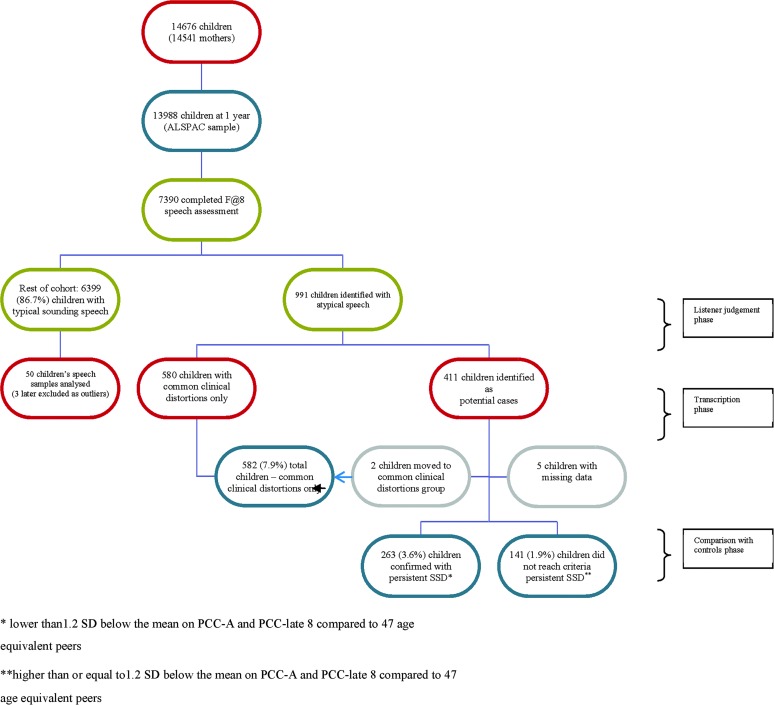
Purpose: The purpose of this study was to determine prevalence and predictors of persistent speech sound disorder (SSD) in children aged 8 years after disregarding children presenting solely with common clinical distortions (i.e., residual errors). Method: Data from the Avon Longitudinal Study of Parents and Children (Boyd et al., 2012) were used. Children were classified as having persistent SSD on the basis of percentage of consonants correct measures from connected speech samples. Multivariable logistic regression analyses were performed to identify predictors. Results: The estimated prevalence of persistent SSD was 3.6%. Children with persistent SSD were more likely to be boys and from families who were not homeowners. Early childhood predictors identified as important were weak sucking at 4 weeks, not often combining words at 24 months, limited use of word morphology at 38 months, and being unintelligible to strangers at age 38 months. School-age predictors identified as important were maternal report of difficulty pronouncing certain sounds and hearing impairment at age 7 years, tympanostomy tube insertion at any age up to 8 years, and a history of suspected coordination problems. The contribution of these findings to our understanding of risk factors for persistent SSD and the nature of the condition is considered. Conclusion: Variables identified as predictive of persistent SSD suggest that factors across motor, cognitive, and linguistic processes may place a child at risk. Supplemental Material: https://doi.org/10.23641/asha.14963811
Overview
The claims and statistics of this paper haven’t been checked yet.
Free: it reads the open-access text and checks the first 5 claims that cite a source we can check. Create a free account to check every claim.
Integrity signals
Registry
Cites
Statistics
Figures
Verification
Claims the paper makes
The claims and statistics of this paper haven’t been checked yet.
Free: it reads the open-access text and checks the first 5 claims that cite a source we can check. Create a free account to check every claim.
Claims other papers make about this one
Each is checked against this paper’s own text: does it say what the citing paper says it does?
The source backs part of the claim, not all of it — or backs it for a different population, condition or comparison.
In the citing paper
“Studies demonstrate that boys are more likely to be diagnosed with SSDs compared to girls, with a meaningful male-to-female ratio of approximately 2:1 . 19”
From Artificial intelligence (AI)-driven technologies for managing pediatric speech and language therapy: A scoping review (2025) · cites this paper as [19]
Experimental — accuracy not yet measured
Self-check
Percentages, sums and reported differences re-computed from the paper’s own numbers.
The self-check needs the paper’s full text.
Citations
Cites
Boyd, A., Golding, J., Macleod, J., Lawlor, D. A., Fraser, A., Henderson, J., Molloy, L., Ness, A., Ring, S., & Davey Smith, G. (2013) · International Journal of Epidemiology · doi:10.1093/ije/dys064 · Cited by 2,996 · cited 1×
“A description of the cohort profile is available (Boyd et al., 2012).”
Bishop, D. V. M., & Adams, C. (1990) · Journal of Child Psychology and Psychiatry · doi:10.1111/j.1469-7610.1990.tb00844.x · Cited by 1,064 · cited 1×
“Moreover, the relationship between (Bishop & Adams, 1990; Broomfield & Dodd, 2004; Lewis et al., 2006; Raitano, Pennington, Tunick, Boada, & Shriberg, 2004; Shriberg et al., 1999).”
Certain Language Skills in Children: Their Development and Interrelationships
TEMPLIN, M. C. (1957) · University of Minnesota Press eBooks · doi:10.5749/j.ctttv2st · Cited by 899 · cited 2×
“espite variation in the rate of speech development, most children who are native speakers of English master accurate production of all vowels and by age 8 years (Dodd, Hulm, Hua, & Crosbie, 2003; James, 2001; Smit, 1993a, 1993b; Templin, 1957).”
The children's test of nonword repetition: A test of phonological working memory
Gathercole, S. E., Willis, C. S., Baddeley, A. D., & Emslie, H. (1994) · Memory · doi:10.1080/09658219408258940 · Cited by 897
Language-Impaired 4-Year-Olds: Distinguishing Transient from Persistent Impairment
Bishop, D. V. M., & Edmundson, A. (1987) · Journal of Speech and Hearing Disorders · doi:10.1044/jshd.5202.156 · Cited by 659 · cited 1×
“…has been positively associated with SSD (Eadie et al., 2015; Highman, Hennessey, Sherwood, & Laitao, 2008) and with speech and language impairment (Bishop & Edmundson, 1987; Dale, Price, Bishop, & Plomin, 2003; Glogowska, Roulstone, Peters, & Enderby, 2006; Rescorla, 2002; Rice, Taylor, &…”
The Percentage of Consonants Correct (PCC) Metric: Extensions and Reliability Data
Shriberg, L. D., Austin, D., Lewis, B. A., McSweeny, J. L., & Wilson, D. L. (1997) · Journal of Speech, Language, and Hearing Research · doi:10.1044/jslhr.4004.708 · Cited by 647 · cited 3×
“Means and standard deviations for the percentage consonants correct (PCC) late eight (/s, z, ʃ , ʒ , θ , ð, ɹ , l/; PCC late 8) and PCC adjusted (PCC-A) measures (Shriberg, Austin, Lewis, McSweeny, & Wilson, 1997a) were calculated for the 50 control children.”
Prevalence of Speech Delay in 6-Year-Old Children and Comorbidity With Language Impairment
Shriberg, L. D., Tomblin, J. B., & McSweeny, J. L. (1999) · Journal of Speech, Language, and Hearing Research · doi:10.1044/jslhr.4206.1461 · Cited by 582 · cited 11×
“Moreover, the relationship between (Bishop & Adams, 1990; Broomfield & Dodd, 2004; Lewis et al., 2006; Raitano, Pennington, Tunick, Boada, & Shriberg, 2004; Shriberg et al., 1999).”
InfluentialChildren's Speech and Literacy Difficulties: A Psycholinguistic Framework
Stackhouse, J., & Wells, B. (1997) · Whurr eBooks · Cited by 540
Hill, E. L. (2001) · International Journal of Language & Communication Disorders · doi:10.1080/13682820010019874 · Cited by 527 · cited 2×
“This is consistent with reports in the literature of links between general coordination problems and speech impairment (Gaines & Missiuna, 2007; Gibbon, 2002; Hill, 2001; Hill & Bishop, 1998; Robinson, 1991; Visscher et al., 2007, 2010; Webster et al., 2005).”
The Auditory Analysis Test: An Initial Report
Rosner, J., & Simon, D. P. (1971) · Journal of Learning Disabilities · doi:10.1177/002221947100400706 · Cited by 464
Grommets (ventilation tubes) for hearing loss associated with otitis media with effusion in children
Browning, G. G., Rovers, M. M., Williamson, I., Lous, J., & Burton, M. J. (2010) · Cochrane Database of Systematic Reviews · doi:10.1002/14651858.cd001801.pub3 · Cited by 448
Wolke, D., & Meyer, R. (1999) · Developmental Medicine & Child Neurology · doi:10.1017/s0012162299000201 · Cited by 445 · cited 1×
“Family and environmental factors extend to the pre-and perinatal factors studied by Delgado et al. (2005), Fox et al. (2002), and Wolke and Meyer (1999), as these factors relate to the medical status into which the child is born.”
Phonological Awareness and Literacy Development in Children With Expressive Phonological Impairments
Bird, J., Bishop, D. V. M., & Freeman, N. H. (1995) · Journal of Speech, Language, and Hearing Research · doi:10.1044/jshr.3802.446 · Cited by 445 · cited 1×
“…been much debate about whether literacy skill should be regarded as an outcome of SSD or whether the two are part of the same underlying condition (Bird, Bishop, & Freeman, 1995; Felsenfeld, Broen, & McGue, 1994; Gillon & Moriarty, 2007; Hesketh, 2004; Larrivee & Catts, 1999; Leitao, Fletcher, &…”
Zubrick, S. R., Taylor, C. L., Rice, M. L., & Slegers, D. W. (2007) · Journal of Speech, Language, and Hearing Research · doi:10.1044/1092-4388(2007/106 · Cited by 438
Phonological development: a normative study of British English‐speaking children
DODD, B., HOLM, A., HUA, Z., & CROSBIE, S. (2003) · Clinical Linguistics & Phonetics · doi:10.1080/0269920031000111348 · Cited by 416
Coady, J. A., & Evans, J. L. (2008) · International Journal of Language & Communication Disorders · doi:10.1080/13682820601116485 · Cited by 405 · cited 1×
“…as a measure of phonological working memory (Gathercole, Willis, Baddeley, & Emslie, 1994); it has been associated with measures of vocabulary development in typically developing children and with poor performance in children with language impairment (for a review see Coady & Evans, 2008).”
Law, J., Rush, R., Schoon, I., & Parsons, S. (2009) · Journal of Speech, Language, and Hearing Research · doi:10.1044/1092-4388(2009/08-0142 · Cited by 387
Predicting Language Outcomes at 4 Years of Age: Findings From Early Language in Victoria Study
Reilly, S., Wake, M., Ukoumunne, O. C., Bavin, E., Prior, M., Cini, E., Conway, L., Eadie, P., & Bretherton, L. (2010) · Pediatrics · doi:10.1542/peds.2010-0254 · Cited by 378 · cited 2×
“…are more likely to be identified as speech or language impaired when the language spoken at home is different from that spoken out of the home (Reilly et al., 2007, 2010), whereas others have found the reverse (Broomfield & Dodd, 2004; Harrison & McLeod, 2010; Stanton-Chapman et al., 2002).”
Shriberg, L. D. (1993) · Journal of Speech, Language, and Hearing Research · doi:10.1044/jshr.3601.105 · Cited by 374 · cited 7×
“Those children whose errors, as observed by asses-sors, were limited solely to common clinical distortions as defined by Shriberg (1993) were identified.”
InfluentialNathan, L., Stackhouse, J., Goulandris, N., & Snowling, M. J. (2004) · Journal of Speech, Language, and Hearing Research · doi:10.1044/1092-4388(2004/031 · Cited by 341
Language and Reading Outcomes to Age 9 in Late-Talking Toddlers
Rescorla, L. (2002) · Journal of Speech, Language, and Hearing Research · doi:10.1044/1092-4388(2002/028 · Cited by 308
Children's Speech and Literacy Difficulties: A Psycholinguistic Framework
Wells, B., & Stackhouse, J. (1997) · Cited by 301
Phonologic Error Distributions in the Iowa-Nebraska Articulation Norms Project: Consonant Singletons
Smit, A. B. (1993) · Journal of Speech, Language, and Hearing Research · doi:10.1044/jshr.3603.533 · Cited by 270 · cited 1×
“espite variation in the rate of speech development, most children who are native speakers of English master accurate production of all vowels and by age 8 years (Dodd, Hulm, Hua, & Crosbie, 2003; James, 2001; Smit, 1993a, 1993b; Templin, 1957).”
Risk Factors for Speech Delay of Unknown Origin in 3-Year-Old Children
Campbell, T. F., Dollaghan, C. A., Rockette, H. E., Paradise, J. L., Feldman, H. M., Shriberg, L. D., Sabo, D. L., & Kurs-Lasky, M. (2003) · Child Development · doi:10.1111/1467-8624.7402002 · Cited by 264 · cited 9×
“This contrasts with Campbell et al. ’ s (2003) study of risk factors for SSD in 3-year-olds, which found that of two measures of SES — maternal education and health insurance categories — maternal education was more important.”
InfluentialOtitis Media and Speech and Language: A Meta-analysis of Prospective Studies
Roberts, J. E., Rosenfeld, R. M., & Zeisel, S. A. (2004) · Pediatrics · doi:10.1542/peds.113.3.e238 · Cited by 248 · cited 1×
“…Majerus et al., 2005; Nittrouer & Burton, 2005), a strong body of evidence suggests that the impact of otitis media and associated hearing loss on the development of speech and language is negligible (Paradise et al., 2005, 2007; Roberts, Hunter, et al., 2004; Roberts, Rosenfeld, & Zeisel, 2004).”
Predicting Language at 2 Years of Age: A Prospective Community Study
Reilly, S., Wake, M., Bavin, E. L., Prior, M., Williams, J., Bretherton, L., Eadie, P., Barrett, Y., & Ukoumunne, O. C. (2007) · Pediatrics · doi:10.1542/peds.2007-0045 · Cited by 237 · cited 2×
“Associations have been shown between lower language levels and birth order or family size (Choudhury & Benasich, 2003; Harrison & McLeod, 2010; Reilly et al., 2007; Stanton-Chapman, Chapman, Bainbridge, & Scott, 2002; J. B. Tomblin, Hardy, & Hein, 1991; Zubrick, Taylor, Rice, & Slegers, 2007),…”
Pre‐literacy skills of subgroups of children with speech sound disorders
Raitano, N. A., Pennington, B. F., Tunick, R. A., Boada, R., & Shriberg, L. D. (2004) · Journal of Child Psychology and Psychiatry · doi:10.1111/j.1469-7610.2004.00275.x · Cited by 235 · cited 1×
“…1995; Felsenfeld, Broen, & McGue, 1994; Gillon & Moriarty, 2007; Hesketh, 2004; Larrivee & Catts, 1999; Leitao, Fletcher, & Hogben, 2000; Nathan, Stackhouse, Goulandris, & Snowling, 2004; Peterson, Pennington, Shriberg, & Boada, 2009; Raitano et al., 2004; Rvachew, 2007; Sutherland & Gillon, 2007).”
Rice, M. L., Taylor, C. L., & Zubrick, S. R. (2008) · Journal of Speech, Language, and Hearing Research · doi:10.1044/1092-4388(2008/029 · Cited by 232
Eadie, P., Morgan, A., Ukoumunne, O. C., Ttofari Eecen, K., Wake, M., & Reilly, S. (2015) · Developmental Medicine & Child Neurology · doi:10.1111/dmcn.12635 · Cited by 228 · cited 11×
“With regard to family history, Campbell et al. (2003), Eadie et al. (2015); Fox et al. (2002), Felsenfeld and Plomin (1997), and Lewis and Freebairn (1997) all showed a positive association with SSD, though this was not replicated by Broomfield and Dodd (2004).”
InfluentialThe Speech Disorders Classification System (SDCS): Extensions and Lifespan Reference Data
Shriberg, L. D., Austin, D., Lewis, B. A., McSweeny, J. L., & Wilson, D. L. (1997) · Journal of Speech, Language, and Hearing Research · doi:10.1044/jslhr.4004.723 · Cited by 224 · cited 3×
“For example, decreasing prevalence rates have been associated with increasing age (McKinnon et al., 2007; Shriberg et al., 1997b), and differences in inclusion criteria relating to speech only versus speech and language impairment (Jessup et al., 2008) and variations in the definition of SSD in…”
InfluentialEpidemiology of specific language impairment: Prenatal and perinatal risk factors
Tomblin, J. B., Smith, E., & Zhang, X. (1997) · Journal of Communication Disorders · doi:10.1016/s0021-9924(97)00015-4 · Cited by 221
Clinical Decision Making: Describing the Decision Rules of Practicing Speech-Language Pathologists
Records, N. L., & Tomblin, J. B. (1994) · Journal of Speech, Language, and Hearing Research · doi:10.1044/jshr.3701.144 · Cited by 218
Early Reading Achievement in Children With Expressive Phonological Disorders
Larrivee, L. S., & Catts, H. W. (1999) · American Journal of Speech-Language Pathology · doi:10.1044/1058-0360.0802.118 · Cited by 205 · cited 1×
“…are part of the same underlying condition (Bird, Bishop, & Freeman, 1995; Felsenfeld, Broen, & McGue, 1994; Gillon & Moriarty, 2007; Hesketh, 2004; Larrivee & Catts, 1999; Leitao, Fletcher, & Hogben, 2000; Nathan, Stackhouse, Goulandris, & Snowling, 2004; Peterson, Pennington, Shriberg, & Boada,…”
Baron, I. S. (2001) · Child Neuropsychology · doi:10.1076/chin.7.3.190.8742 · Cited by 197
Randomised controlled trial of community based speech and language therapy in preschool children
Glogowska, M. (2000) · BMJ · doi:10.1136/bmj.321.7266.923 · Cited by 193 · cited 1×
“However, concurrent evidence detailing intervention suggests that a very low dosage of therapy was typical (Glogowska, Roulstone, Enderby, & Peters, 2000).”
What Influences Literacy Outcome in Children With Speech Sound Disorder?
Peterson, R. L., Pennington, B. F., Shriberg, L. D., & Boada, R. (2009) · Journal of Speech, Language, and Hearing Research · doi:10.1044/1092-4388(2009/08-0024 · Cited by 189
Identification of early risk factors for language impairment
Stanton‐Chapman, T. L., Chapman, D. A., Bainbridge, N. L., & Scott, K. G. (2002) · Research in Developmental Disabilities · doi:10.1016/s0891-4222(02)00141-5 · Cited by 174 · cited 4×
“…are more likely to be identified as speech or language impaired when the language spoken at home is different from that spoken out of the home (Reilly et al., 2007, 2010), whereas others have found the reverse (Broomfield & Dodd, 2004; Harrison & McLeod, 2010; Stanton-Chapman et al., 2002).”
InfluentialNittrouer, S., & Burton, L. T. (2005) · Journal of Communication Disorders · doi:10.1016/j.jcomdis.2004.03.006 · Cited by 174 · cited 1×
“…that there may be an impact on some subtle language skills (e.g., aspects of phonological processing or verbal working memory; Majerus et al., 2005; Nittrouer & Burton, 2005), a strong body of evidence suggests that the impact of otitis media and associated hearing loss on the development of…”
Harrison, L. J., & McLeod, S. (2010) · Journal of Speech, Language, and Hearing Research · doi:10.1044/1092-4388(2009/08-0086 · Cited by 169
Otitis Media, Hearing Loss, and Language Learning: Controversies and Current Research
ROBERTS, J., HUNTER, L., GRAVEL, J., ROSENFELD, R., BERMAN, S., HAGGARD, M., HALL, J., LANNON, C., MOORE, D., VERNON-FEAGANS, L., et al. (2004) · Journal of Developmental & Behavioral Pediatrics · doi:10.1097/00004703-200404000-00007 · Cited by 169 · cited 2×
“Roberts, Rosenfeld, et al. (2004) carried out a meta-analysis of 14 studies, and Paradise and colleagues collected longitudinal data; however, the measure used in the analysis reported here was a single hearing assessment and parental report of whether tubes had been fitted.”
McKinnon, D. H., McLeod, S., & Reilly, S. (2007) · Language, Speech, and Hearing Services in Schools · doi:10.1044/0161-1461(2007/002 · Cited by 168
Investigations in Clinical Phonetics and Linguistics
(2012) · Psychology Press eBooks · doi:10.4324/9781410613158 · Cited by 165 · cited 1×
“This is consistent with reports in the literature of links between general coordination problems and speech impairment (Gaines & Missiuna, 2007; Gibbon, 2002; Hill, 2001; Hill & Bishop, 1998; Robinson, 1991; Visscher et al., 2007, 2010; Webster et al., 2005).”
Tympanostomy Tubes and Developmental Outcomes at 9 to 11 Years of Age
Paradise, J. L., Feldman, H. M., Campbell, T. F., Dollaghan, C. A., Rockette, H. E., Pitcairn, D. L., Smith, C. G., Colborn, D. K., Bernard, B. S., Kurs-Lasky, M., et al. (2007) · New England Journal of Medicine · doi:10.1056/nejmoa062980 · Cited by 164 · cited 2×
“Indeed, the findings of Paradise et al. (2005, 2007) from a large-scale longitudinal study suggest that otitis media with effusion and associated hearing loss are not associated with SSD in otherwise healthy individuals.”
Felsenfeld, S., Broen, P. A., & McGue, M. (1994) · Journal of Speech, Language, and Hearing Research · doi:10.1044/jshr.3706.1341 · Cited by 159 · cited 1×
“…literacy skill should be regarded as an outcome of SSD or whether the two are part of the same underlying condition (Bird, Bishop, & Freeman, 1995; Felsenfeld, Broen, & McGue, 1994; Gillon & Moriarty, 2007; Hesketh, 2004; Larrivee & Catts, 1999; Leitao, Fletcher, & Hogben, 2000; Nathan,…”
Law, J., Boyle, J., Harris, F., Harkness, A., & Nye, C. (2000) · International Journal of Language & Communication Disorders · doi:10.1111/j.1460-6984.2000.tb00001.x · Cited by 158 · cited 2×
“…of SSD have reported rates ranging from 2.3% to 24.6% (Eadie et al., 2015; Jessup, Ward, Cahill, & Heating, 2008; Keating, Turrell, & Ozanne, 2001; Law, Boyle, Harris, Harkness, & Nye, 2000; McKinnon, McLeod, & Reilly, 2007; Shriberg, Austin, Lewis, McSweeny, & Wilson, 1997b; Shriberg, Tomblin, &…”
InfluentialThe nature of referred subtypes of primary speech disability
Broomfield, J., & Dodd, B. (2004) · Child Language Teaching and Therapy · doi:10.1191/0265659004ct267oa · Cited by 156 · cited 8×
“With regard to family history, Campbell et al. (2003), Eadie et al. (2015); Fox et al. (2002), Felsenfeld and Plomin (1997), and Lewis and Freebairn (1997) all showed a positive association with SSD, though this was not replicated by Broomfield and Dodd (2004).”
InfluentialCAUSES AND ASSOCIATIONS OF SEVERE AND PERSISTENT SPECIFIC SPEECH AND LANGUAGE DISORDERS IN CHILDREN
Robinson, R. J. (1991) · Developmental Medicine & Child Neurology · doi:10.1111/j.1469-8749.1991.tb14811.x · Cited by 147 · cited 2×
“…et al., 2002); delay in motor skills, including feeding and dribbling (Eadie et al., 2015; Highman et al., 2008; Hill, 2001; Hill & Bishop, 1998; Robinson, 1991; Visscher, Houwen, Scherder, Moolenaar, & Hartman, 2007; Visscher et al., 2010; Webster, Majnemer, Platt, & Shevell, 2005); general…”
Webster, R., Majnemer, A., Platt, R. W., & Shevell, M. I. (2005) · The Journal of Pediatrics · doi:10.1016/j.jpeds.2004.09.005 · Cited by 138 · cited 2×
“…et al., 2008; Hill, 2001; Hill & Bishop, 1998; Robinson, 1991; Visscher, Houwen, Scherder, Moolenaar, & Hartman, 2007; Visscher et al., 2010; Webster, Majnemer, Platt, & Shevell, 2005); general delays and medical conditions (Broomfield & Dodd, 2004; Delgado et al., 2005); and low birth…”
Assessment of Phonological Representations in Children With Speech Impairment
Sutherland, D., & Gillon, G. T. (2005) · Language Speech and Hearing Services in Schools · doi:10.1044/0161-1461(2005/030 · Cited by 132
Motor Profile of Children With Developmental Speech and Language Disorders
Visscher, C., Houwen, S., Scherder, E., Moolenaar, B., & Hartman, E. (2007) · PEDIATRICS · doi:10.1542/peds.2006-2462 · Cited by 130 · cited 2×
“This is consistent with reports in the literature of links between general coordination problems and speech impairment (Gaines & Missiuna, 2007; Gibbon, 2002; Hill, 2001; Hill & Bishop, 1998; Robinson, 1991; Visscher et al., 2007, 2010; Webster et al., 2005).”
Felsenfeld, S., Broen, P. A., & McGue, M. (1992) · Journal of Speech, Language, and Hearing Research · doi:10.1044/jshr.3505.1114 · Cited by 120
Phonologic Error Distributions in the Iowa-Nebraska Articulation Norms Project
Smit, A. B. (1993) · Journal of Speech Language and Hearing Research · doi:10.1044/jshr.3605.931 · Cited by 111 · cited 1×
“espite variation in the rate of speech development, most children who are native speakers of English master accurate production of all vowels and by age 8 years (Dodd, Hulm, Hua, & Crosbie, 2003; James, 2001; Smit, 1993a, 1993b; Templin, 1957).”
Gaines, R., & Missiuna, C. A. (2006) · Child Care Health and Development · doi:10.1111/j.1365-2214.2006.00677.x · Cited by 108 · cited 1×
“This is consistent with reports in the literature of links between general coordination problems and speech impairment (Gaines & Missiuna, 2007; Gibbon, 2002; Hill, 2001; Hill & Bishop, 1998; Robinson, 1991; Visscher et al., 2007, 2010; Webster et al., 2005).”
Paradise, J. L., Dollaghan, C. A., Campbell, T. F., Feldman, H. M., Bernard, B. S., Colborn, D. K., Rockette, H. E., Janosky, J. E., Pitcairn, D. L., Kurs-Lasky, M., et al. (2003) · Pediatrics · doi:10.1542/peds.112.2.265 · Cited by 108
Patel, R. R., Peters, T. J., & Murphy, D. J. (2005) · International Journal of Epidemiology · doi:10.1093/ije/dyh401 · Cited by 106 · cited 1×
“A staged multivariable regression approach (Patel, Peters, Murphy, & the ALSPAC Study Team, 2005) was then used, first within the groups of conceptual variables (as listed in Tables 4 and 5) and then across groups.”
Self-citationPhonological Processing and Reading in Children With Speech Sound Disorders
Rvachew, S. (2007) · American Journal of Speech-Language Pathology · doi:10.1044/1058-0360(2007/030 · Cited by 99
Sutherland, D., & Gillon, G. T. (2007) · International Journal of Language & Communication Disorders · doi:10.1080/13682820600806672 · Cited by 95 · cited 1×
“…1995; Felsenfeld, Broen, & McGue, 1994; Gillon & Moriarty, 2007; Hesketh, 2004; Larrivee & Catts, 1999; Leitao, Fletcher, & Hogben, 2000; Nathan, Stackhouse, Goulandris, & Snowling, 2004; Peterson, Pennington, Shriberg, & Boada, 2009; Raitano et al., 2004; Rvachew, 2007; Sutherland & Gillon, 2007).”
Risk factors for speech disorders in children
Fox, A. V., Dodd, B., & Howard, D. (2002) · International Journal of Language & Communication Disorders · doi:10.1080/13682820110116776 · Cited by 92 · cited 9×
“With regard to family history, Campbell et al. (2003), Eadie et al. (2015); Fox et al. (2002), Felsenfeld and Plomin (1997), and Lewis and Freebairn (1997) all showed a positive association with SSD, though this was not replicated by Broomfield and Dodd (2004).”
InfluentialEmond, A. M., Drewett, R., Blair, P. S., & Emmett, P. M. (2006) · Archives of Disease in Childhood · doi:10.1136/adc.2005.091496 · Cited by 92 · cited 1×
“Moreover, evidence associates poor sucking with other developmental factors such as early growth faltering, low IQ, and delayed gross motor development (Emond, Drewett, Blair, & Emmett, 2007; Motion, Northstone, Emond, Stucke, & Golding, 2002).”
Self-citationDimensions of early speech sound disorders: A factor analytic study
Lewis, B. A., Freebairn, L. A., Hansen, A. J., Stein, C. M., Shriberg, L. D., Iyengar, S. K., & Taylor, H. G. (2006) · Journal of Communication Disorders · doi:10.1016/j.jcomdis.2005.11.003 · Cited by 90 · cited 3×
“Moreover, the relationship between (Bishop & Adams, 1990; Broomfield & Dodd, 2004; Lewis et al., 2006; Raitano, Pennington, Tunick, Boada, & Shriberg, 2004; Shriberg et al., 1999).”
Childhood speech disorders: Reported prevalence, comorbidity and socioeconomic profile
Keating, D., Turrell, G., & Ozanne, A. (2001) · Journal of Paediatrics and Child Health · doi:10.1046/j.1440-1754.2001.00697.x · Cited by 89 · cited 4×
“Second, studies have used a variety of methods to identify SSD, including parent or teacher identification (Keating et al., 2001; McKinnon et al., 2007), formal assessments (Eadie et al., 2015; Jessup et al., 2008), and speech sampling (Shriberg et al., 1999).”
InfluentialEarly feeding problems in children with cerebral palsy: weight and neuro-developmental outcomes
Motion, S., Northstone, K., Emond, A. M., Stucke, S., & Golding, J. (2002) · Developmental Medicine & Child Neurology · doi:10.1017/s0012162201001633 · Cited by 83 · cited 1×
“Moreover, evidence associates poor sucking with other developmental factors such as early growth faltering, low IQ, and delayed gross motor development (Emond, Drewett, Blair, & Emmett, 2007; Motion, Northstone, Emond, Stucke, & Golding, 2002).”
Self-citationPredicting Poor-Communication Status in Preschool Children Using Risk Factors Present at Birth
Tomblin, J. B., Hardy, J. C., & Hein, H. A. (1991) · Journal of Speech, Language, and Hearing Research · doi:10.1044/jshr.3405.1096 · Cited by 78 · cited 5×
“Oral sucking habits have been associated with SSD in other studies of risk factors for SSD (Highman et al., 2008; Tomblin et al., 1991).”
InfluentialHill, E. L., & Bishop, D. (1998) · Laterality Asymmetries of Body Brain and Cognition · doi:10.1080/713754314 · Cited by 77 · cited 2×
“…use of pacifiers (Fox et al., 2002); delay in motor skills, including feeding and dribbling (Eadie et al., 2015; Highman et al., 2008; Hill, 2001; Hill & Bishop, 1998; Robinson, 1991; Visscher, Houwen, Scherder, Moolenaar, & Hartman, 2007; Visscher et al., 2010; Webster, Majnemer, Platt, &…”
Recent friendships in anxious and depressed school age children
Goodyer, I. M., Wright, C., & Altham, P. M. E. (1989) · Psychological Medicine · doi:10.1017/s0033291700011119 · Cited by 73
Felsenfeld, S., & Plomin, R. J. (1997) · Journal of Speech Language and Hearing Research · doi:10.1044/jslhr.4004.778 · Cited by 71 · cited 4×
“This factor has emerged as an important predictor in a number of studies of SSD specifically and speech and language impairment more generally (Campbell et al., 2003; Eadie et al., 2015; Felsenfeld & Plomin, 1997; Fox et al., 2002; Lewis et al., 2006, 2007; J. B. Tomblin et al., 1991).”
InfluentialSlattery, J. M., Morgan, A. T., & Douglas, J. M. (2012) · Developmental Medicine & Child Neurology · doi:10.1111/j.1469-8749.2012.04318.x · Cited by 69 · cited 1×
“It is thought that sucking difficulties in the first few weeks of life may be a marker of subtle neurological impairment, accounting for the lowered IQ score, though a recent systematic review was unable to confirm this (Slattery, Morgan, & Douglas, 2012).”
Speech impairment and literacy difficulties: Underlying links
Leitão, S., Fletcher, J. F., & Hogben, J. H. (2000) · The Australian Educational and Developmental Psychologist · doi:10.1017/s0816512200028030 · Cited by 65
Childhood Apraxia of Speech: Children at Risk for Persistent Reading and Spelling Disorder
Gillon, G., & Moriarty, B. (2007) · Seminars in Speech and Language · doi:10.1055/s-2007-967929 · Cited by 59 · cited 1×
“…as an outcome of SSD or whether the two are part of the same underlying condition (Bird, Bishop, & Freeman, 1995; Felsenfeld, Broen, & McGue, 1994; Gillon & Moriarty, 2007; Hesketh, 2004; Larrivee & Catts, 1999; Leitao, Fletcher, & Hogben, 2000; Nathan, Stackhouse, Goulandris, & Snowling, 2004;…”
Yliherva, A., Olsén, P., Mäki‐Torkko, E., Koiranen, M., & Järvelin, M. (2001) · Acta Paediatrica · doi:10.1111/j.1651-2227.2001.tb01611.x · Cited by 49
Speech characteristics of 8-year-old children: Findings from a prospective population study
Wren, Y. E., McLeod, S. L., White, P., Miller, L. L., & Roulstone, S. (2012) · Journal of Communication Disorders · doi:10.1016/j.jcomdis.2012.08.008 · Cited by 48 · cited 1×
“Further analysis has been reported on the characteristics of the sample in terms of speech production (Wren et al., 2013) and features that distinguish the groups identified through the process of case identification described in this article (Wren et al., 2012).”
Self-citationSpeech and Language Skills of Parents of Children With Speech Sound Disorders
Lewis, B. A., Freebairn, L. A., Hansen, A. J., Miscimarra, L., Iyengar, S. K., & Taylor, H. G. (2007) · American Journal of Speech-Language Pathology · doi:10.1044/1058-0360(2007/015 · Cited by 47
Early literacy achievement of children with a history of speech problems
Hesketh, A. (2004) · International Journal of Language & Communication Disorders · doi:10.1080/13682820410001686013 · Cited by 44 · cited 1×
“…whether the two are part of the same underlying condition (Bird, Bishop, & Freeman, 1995; Felsenfeld, Broen, & McGue, 1994; Gillon & Moriarty, 2007; Hesketh, 2004; Larrivee & Catts, 1999; Leitao, Fletcher, & Hogben, 2000; Nathan, Stackhouse, Goulandris, & Snowling, 2004; Peterson, Pennington,…”
Prevalence of speech and/or language impairment in preparatory students in northern Tasmania
Jessup, B., Ward, E. C., Cahill, L., & Keating, D. (2008) · International Journal of Speech-Language Pathology · doi:10.1080/17549500701871171 · Cited by 44 · cited 4×
“Second, studies have used a variety of methods to identify SSD, including parent or teacher identification (Keating et al., 2001; McKinnon et al., 2007), formal assessments (Eadie et al., 2015; Jessup et al., 2008), and speech sampling (Shriberg et al., 1999).”
InfluentialWren, Y. E., Roulstone, S., & Miller, L. L. (2011) · Logopedics Phoniatrics Vocology · doi:10.3109/14015439.2011.625973 · Cited by 43 · cited 4×
“A separate analysis revealed that these latter two groups showed distinct features in terms of demographic factors, IQ, nonword repetition, and diadochokinetic (DDK) tasks compared with the case children and those in the rest of the cohort (Wren et al., 2012).”
InfluentialSelf-citationEarly speech- and language-impaired children: linguistic, literacy, and social outcomes
Glogowska, M., Roulstone, S., Peters, T. J., & Enderby, P. (2006) · Developmental Medicine & Child Neurology · doi:10.1017/s0012162206001046 · Cited by 41 · cited 1×
“…et al., 2015; Highman, Hennessey, Sherwood, & Laitao, 2008) and with speech and language impairment (Bishop & Edmundson, 1987; Dale, Price, Bishop, & Plomin, 2003; Glogowska, Roulstone, Peters, & Enderby, 2006; Rescorla, 2002; Rice, Taylor, & Zubrick, 2008; Roulstone, Miller, Wren, & Peters, 2009).”
Self-citationHighman, C., Hennessey, N. W., Sherwood, M., & Leitão, S. (2008) · Child Language Teaching and Therapy · doi:10.1177/0265659008096294 · Cited by 37 · cited 3×
“Highman et al. (2008) also found word combinations to be a predictor of later speech status — in their case, childhood apraxia of speech as well as difficulties with gross motor development, feeding, and dribbling.”
Recent Achievements and Adversities in Anxious and Depressed School Age Children
Goodyer, I., Wright, C., & Altham, P. (1990) · Journal of Child Psychology and Psychiatry · doi:10.1111/j.1469-7610.1990.tb00846.x · Cited by 36
Motor proficiency of 6‐ to 9‐year‐old children with speech and language problems
Visscher, C., Houwen, S., Moolenaar, B., Lyons, J. L., Scherder, E., & Hartman, E. (2010) · Developmental Medicine & Child Neurology · doi:10.1111/j.1469-8749.2010.03774.x · Cited by 35 · cited 2×
“…(Eadie et al., 2015; Highman et al., 2008; Hill, 2001; Hill & Bishop, 1998; Robinson, 1991; Visscher, Houwen, Scherder, Moolenaar, & Hartman, 2007; Visscher et al., 2010; Webster, Majnemer, Platt, & Shevell, 2005); general delays and medical conditions (Broomfield & Dodd, 2004; Delgado et al.,…”
Roulstone, S., Miller, L. L., Wren, Y. E., & Peters, T. J. (2009) · International Journal of Speech-Language Pathology · doi:10.1080/17549500903125111 · Cited by 35 · cited 5×
“…on a range of health and developmental factors have reported on the ALSPAC data to date, including five on findings relating to children ’ s speech and language development (Roulstone et al., 2009, 2011; Wren, 2015; Wren, McLeod, White, Miller, & Roulstone, 2013; Wren, Roulstone, & Miller, 2012).”
InfluentialSelf-citationPrevalence of Articulation Errors in New South Wales Primary School Pupils
Kirkpatrick, E., & Ward, J. (1984) · Australian Journal of Human Communication Disorders · doi:10.3109/asl2.1984.12.issue-1.05 · Cited by 34 · cited 2×
“…of 3.6% obtained in this study for persistent SSD is consistent with findings from other studies carried out in other English-speaking countries (Kirkpatrick & Ward, 1984: 4.6% of children aged 5 – 7 years in Australia; Shriberg et al., 1999: 3.8% of children aged 6 years in the United States).”
InfluentialUse of Phonological Processes in Australian Children Ages 2 to 7;11 Years
James, D. G. H. (2001) · International Journal of Speech-Language Pathology · doi:10.3109/14417040109003718 · Cited by 32 · cited 1×
“espite variation in the rate of speech development, most children who are native speakers of English master accurate production of all vowels and by age 8 years (Dodd, Hulm, Hua, & Crosbie, 2003; James, 2001; Smit, 1993a, 1993b; Templin, 1957).”
Early Correlates of Speech, Language, and Hearing.
Kopra, L. L. (1981) · Ear and Hearing · doi:10.1097/00003446-198105000-00011 · Cited by 30
Early Risk Factors for Speech and Language Impairments
Delgado, C. F., Vagi, S. J., & Scott, K. G. (2005) · Exceptionality · doi:10.1207/s15327035ex1303_3 · Cited by 28 · cited 3×
“, 2010; Webster, Majnemer, Platt, & Shevell, 2005); general delays and medical conditions (Broomfield & Dodd, 2004; Delgado et al., 2005); and low birth weight (Stanton-Chapman et al.”
Multifarious terminology: multivariable or multivariate? univariable or univariate?
Peters, T. J. (2008) · Paediatric and Perinatal Epidemiology · doi:10.1111/j.1365-3016.2008.00966.x · Cited by 28 · cited 1×
“…appropriate descriptive statistics (means, standard deviations, and proportions), univariable and multivariable logistic regression analyses (Peters, 2008) were used to obtain odds ratios (ORs), 95% confidence intervals (CIs), and likelihood ratio p values for the associations between…”
Self-citationMajerus, S., Amand, P., Boniver, V., Demanez, J.-P., Demanez, L., & der Linden, M. V. (2005) · Journal of Communication Disorders · doi:10.1016/j.jcomdis.2005.04.002 · Cited by 25 · cited 1×
“…is some suggestion that there may be an impact on some subtle language skills (e.g., aspects of phonological processing or verbal working memory; Majerus et al., 2005; Nittrouer & Burton, 2005), a strong body of evidence suggests that the impact of otitis media and associated hearing loss on…”
Howard, S. (2007) · International Journal of Speech-Language Pathology · doi:10.1080/14417040601057692 · Cited by 22 · cited 5×
“Single word naming (Kirkpatrick & Ward, 1984) provides a rapid means of case identification but may miss errors that occur across word boundaries (Howard, 2004, 2007) and that would be observed in the connected speech samples used in this study and that of Shriberg et al. (1999).”
InfluentialDale (2003) · Oxford University Research Archive (ORA) (University of Oxford) · doi:10.1044/1092-4388(2003/044 · Cited by 21
Farquharson, K. (2015) · Perspectives on School-Based Issues · doi:10.1044/sbi16.2.50 · Cited by 20 · cited 1×
“Indeed, a recent investigation by Farquharson (2015) found that children aged between 9 and 13 years with reme-diated SSD performed significantly worse on a test of non-word repetition.”
Howard, S. (2004) · Clinical Linguistics & Phonetics · doi:10.1080/02699200410001703547 · Cited by 16 · cited 1×
“Single word naming (Kirkpatrick & Ward, 1984) provides a rapid means of case identification but may miss errors that occur across word boundaries (Howard, 2004, 2007) and that would be observed in the connected speech samples used in this study and that of Shriberg et al. (1999).”
Subgrouping children with familial phonologic disorders
Lewis, B. A., & Freebairn, L. A. (1997) · Journal of Communication Disorders · doi:10.1016/s0021-9924(96)00110-4 · Cited by 14 · cited 1×
“With regard to family history, Campbell et al. (2003), Eadie et al. (2015); Fox et al. (2002), Felsenfeld and Plomin (1997), and Lewis and Freebairn (1997) all showed a positive association with SSD, though this was not replicated by Broomfield and Dodd (2004).”
Otitis media and disordered phonologies
Paden, E. P. (1994) · Topics in Language Disorders · doi:10.1097/00011363-199402000-00008 · Cited by 10 · cited 1×
“With regard to hearing and ear, nose, and throat status, mixed findings have emerged, with some studies showing a relationship with SSD and others suggesting that none exists (Browning, Rovers, Williamson, Lous, & Burton, 2010; Campbell et al., 2003; Fox et al., 2002; Pagel Paden, 1994).”
Bralley, R. C., & Stoudt, R. J. (1977) · Language Speech and Hearing Services in Schools · doi:10.1044/0161-1461.0803.176 · Cited by 8 · cited 1×
“However, some individuals experience difficulties with speech production beyond this age and even into adulthood (Bralley & Stoudt, 1977; Felsenfeld, Broen, & McGue, 1992).”
Yliherva, A. (2001) · Acta Paediatrica · doi:10.1080/08035250152708879 · Cited by 8
Wren, Y. E. (2015) · Perspectives on School-Based Issues · doi:10.1044/sbi16.2.25 · Cited by 5 · cited 1×
“…on a range of health and developmental factors have reported on the ALSPAC data to date, including five on findings relating to children ’ s speech and language development (Roulstone et al., 2009, 2011; Wren, 2015; Wren, McLeod, White, Miller, & Roulstone, 2013; Wren, Roulstone, & Miller, 2012).”
Self-citationTympanostomy Tubes and Development Outcomes at 9 to 11 Years of Age
Stockman, J. A. (2008) · Yearbook of Pediatrics · doi:10.1016/s0084-3954(08)70337-3 · Cited by 2 · cited 2×
“Indeed, the findings of Paradise et al. (2005, 2007) from a large-scale longitudinal study suggest that otitis media with effusion and associated hearing loss are not associated with SSD in otherwise healthy individuals.”
Choudhury, N., & Benasich, A. A. (2003) · Journal of Speech, Language, and Hearing Research · doi:10.1044/1092-4388(2003/021
Research works printed but not linked: 9
- Fenson L., Dale P., Reznick J., Thal D., Bates E., Hartung J., … Reilly J. (1993). The MacArthur Communicative Development Inventories: User's guide and technical manual. San Diego, CA: Singular Publishing.
- Long S. H., Fey M. E., & Channell R. W. (2006). Computerized Profiling (MS-DOS Version 9.7.0). Cleveland, OH: Case Western Reserve University.
- Northstone K., Bonnell S., Horwood J., Bell C., Sadler S., Carmichael A., & the Focus@8 study team. (2006). Avon longitudinal study of parents and children: Focus at 8 built files documentation (No. v3a). Bristol, UK: ALSPAC.
- Northstone K., Bonnell S., Sadler S., Carmichael A., & the Focus@7 study team. (2005). Avon longitudinal study of parents and children: Focus @7 built files (No. version 3c). Bristol, UK: ALSPAC.
- Roulstone S., Law J., Rush R., Clegg J., & Peters T. J. (2011). Investigating the role of language in children's early educational outcomes (Research report DFE-RR134). London, United Kingdom: Department for Education.
- Rust J., Golombok S., & Trickey G. (1993). WORD: Wechsler Objective Reading Dimensions Manual. Sidcup, UK: The Psychological Corporation.
- Rust J. (1996). Wechsler Objective Language Dimensions Manual. London, United Kingdom: The Psychological Corporation.
- Tuomi S., & Ivanoff P. (1977). Incidence of speech and hearing disorders among kindergarten and grade 1 children. Special Education in Canada, 51, 5– 8.
- Wechsler D., Golombok S., & Rust J. (1992). Wechsler Intelligence Scale for Children–Third UK Edition manual. Sidcup, UK: The Psychological Corporation.
Cited by
Speech and language delay in children: Prevalence and risk factors
Kanhere, S. V., & Sunderajan, T. (2019) · Journal of Family Medicine and Primary Care · doi:10.4103/jfmpc.jfmpc_162_19 · Cited by 185
“These results are similar to the prevalence reported from developed countries which ranges from 2% to 8%.[3,11] Other studies have shown a higher incidence of speech–language delay in males[12] and attributed it to the slower maturation of the central nervous system among boys and also by the influence of testosterone…”
ResultEstimates of the prevalence of motor speech disorders in children with idiopathic speech delay
Shriberg, L. D., Kwiatkowski, J., & Mabie, H. L. (2019) · Clinical Linguistics & Phonetics · doi:10.1080/02699206.2019.1595731 · Cited by 152
“The middle section of Table 5 includes information on the three population-based estimates of the prevalence of idiopathic SD, including 1,494 4-year-old children from Australia (Eadie et al., 2015), 1,328 6-year-old children from the United States (Shriberg, Tomblin, & McSweeny, 1999), and 7,390 8-year-old children f…”
BackgroundInfluentialLewis, B. A., Freebairn, L., Tag, J., Ciesla, A. A., Iyengar, S. K., Stein, C. M., & Taylor, H. G. (2015) · American Journal of Speech-Language Pathology · doi:10.1044/2014_ajslp-14-0075 · Cited by 120
Shriberg, L. D., Strand, E. A., Fourakis, M. S., Jakielski, K. J., Hall, S. D., Karlsson, H. B., Mabie, H. L., McSweeny, J. L., Tilkens, C. M., & Wilson, D. L. (2017) · Journal of Speech Language and Hearing Research · doi:10.1044/2016_jslhr-s-15-0296 · Cited by 113
Who to Refer for Speech Therapy at 4 Years of Age Versus Who to “Watch and Wait”?
Morgan, A. T., Eecen, K. T., Pezic, A., Brommeyer, K., Mei, C., Eadie, P. A., Reilly, S., & Dodd, B. J. (2017) · The Journal of Pediatrics · doi:10.1016/j.jpeds.2017.02.059 · Cited by 105
“A range of sociodemographic and early developmental factors are commonly hypothesized to predict speech outcome, including sex, socioeconomic status, maternal education, early language skills, early feeding skills, intelligence, and family history.(1,3,8-14) These findings are based largely on clinical studies(8-11) o…”
BackgroundResultInfluential
Metadata
- Authors
- Wren, Y., Miller, L. L., Peters, T. J., Emond, A., & Roulstone, S.
- Affiliations
- North Bristol NHS Trust (GB)
- University of Bristol (GB)
- University of the West of England (GB)
- Corresponding author
- Wren, Yvonne
- Venue
- Journal of Speech, Language, and Hearing Research
- Published
- 2016-08
- Volume
- 59
- Issue
- 4
- Pages
- 647-673
- ISSN
- 1092-4388 (ISSN-L)
- 1558-9102
- PMC
- PMC5280061
- OpenAlex
- W2471412687
- Semantic Scholar
- e1b37ac7141ddb98e37ca66ab7db9116acede5c9
- Cited by
- 198
- References
- 96
- Citations by year
- 2026: 26 · 2025: 26 · 2024: 26 · 2023: 24 · 2022: 26 · 2021: 23 · 2020: 14 · 2019: 14 · 2018: 7 · 2017: 10
- FWCI
- 24.12
- Type
- journal article
- Language
- en
- Open access
- hybrid
- doi.org
- Locations
- Journal of Speech Language and Hearing Research (publishedVersion, cc-by)
- PubMed Central (publishedVersion, cc-by)
- PubMed (publishedVersion)
- Explore Bristol Research (publishedVersion, cc-by)
- Bristol Research (University of Bristol) (publishedVersion, cc-by)
- UWE Research Repository (UWE Bristol) (submittedVersion, cc-by)
- Funders
- Wellcome Trust (102215/2/13/2), 102215)
- University of Bristol (102215/2/13/2)
- North Bristol NHS Trust
- Medical Research Council (102215, 102215/2/13/2, MC_PC_15018, G0501804 ID 76829)
- Topics
- Social Sciences › Psychology › Developmental and Educational Psychology › Language Development and Disorders
- Health Sciences › Health Professions › Speech and Hearing › Voice and Speech Disorders
- Social Sciences › Psychology › Experimental and Cognitive Psychology › Phonetics and Phonology Research
- Keywords
- speech sound disorders, prevalence, risk factors, children, early childhood predictors, word morphology, sucking, hearing loss, tympanostomy tubes, coordination problems, connected speech, Avon Longitudinal Study of Parents and Children
- MeSH terms
- Child, Female, Humans, Longitudinal Studies, Male, Prognosis, Prospective Studies, Risk Factors, Sex Factors, Socioeconomic Factors, Prevalence, Multivariate Analysis, Logistic Models, Speech Sound Disorder
About these checks
Registry, retraction, Cites and statistics results are computed, not judged, with one exception: a printed reference that no index lists is read once by a model before it counts as a citation error. Claims are extracted by a model and kept only when their quote appears verbatim in the text; each cited source is then checked, with a model’s help, for whether it says what the claim relies on. Those verdicts can be wrong — read the claim’s quote and the cited source before relying on one.
Statistics and arithmetic are recomputed, not judged.
Confidence bands are shown only for fields calibrated on our annotated test set. None is calibrated yet, so no band is shown.
What counts as a claim ›How we measure confidence ›How we check this ›
Are you an author, or do you see a problem with this page? Request a review
Data sources
Bibliographic data: Semantic Scholar, OpenAlex, Crossref.
Contains information from the Semantic Scholar Academic Graph Datasets, made available under the ODC Attribution License (ODC-BY 1.0).
Semantic Scholar’s data is described in: Kinney, R., et al. (2023). The Semantic Scholar Open Data Platform. arXiv:2301.10140.
