

Prevalence and Predictors of Persistent Speech Sound Disorder at Eight Years Old: Findings From a Population Cohort Study
Open accessThe DOI matches its Crossref record; 97 of the 97 references it cites were found in a registry or an index.
Abstract
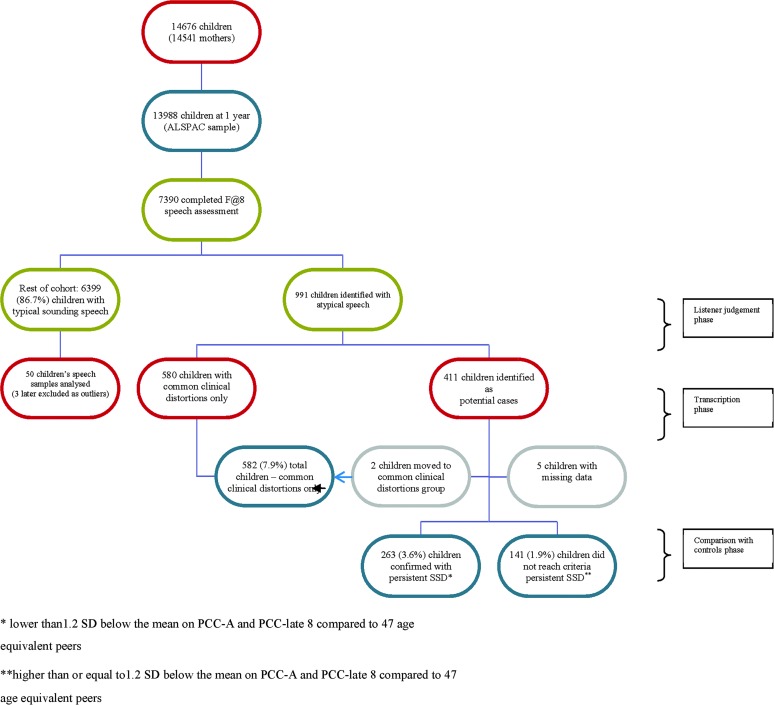
Purpose: The purpose of this study was to determine prevalence and predictors of persistent speech sound disorder (SSD) in children aged 8 years after disregarding children presenting solely with common clinical distortions (i.e., residual errors). Method: Data from the Avon Longitudinal Study of Parents and Children (Boyd et al., 2012) were used. Children were classified as having persistent SSD on the basis of percentage of consonants correct measures from connected speech samples. Multivariable logistic regression analyses were performed to identify predictors. Results: The estimated prevalence of persistent SSD was 3.6%. Children with persistent SSD were more likely to be boys and from families who were not homeowners. Early childhood predictors identified as important were weak sucking at 4 weeks, not often combining words at 24 months, limited use of word morphology at 38 months, and being unintelligible to strangers at age 38 months. School-age predictors identified as important were maternal report of difficulty pronouncing certain sounds and hearing impairment at age 7 years, tympanostomy tube insertion at any age up to 8 years, and a history of suspected coordination problems. The contribution of these findings to our understanding of risk factors for persistent SSD and the nature of the condition is considered. Conclusion: Variables identified as predictive of persistent SSD suggest that factors across motor, cognitive, and linguistic processes may place a child at risk. Supplemental Material: https://doi.org/10.23641/asha.14963811
Overview
The claims and statistics of this paper haven’t been checked yet.
Free: it reads the open-access text and checks the first 5 claims that cite a source we can check. Create a free account to check every claim.
Integrity signals
Registry
Cites
Statistics
Figures
Verification
Claims the paper makes
The claims and statistics of this paper haven’t been checked yet.
Free: it reads the open-access text and checks the first 5 claims that cite a source we can check. Create a free account to check every claim.
Claims other papers make about this one
Each is checked against this paper’s own text: does it say what the citing paper says it does?
The source backs part of the claim, not all of it — or backs it for a different population, condition or comparison.
In the citing paper
“Studies demonstrate that boys are more likely to be diagnosed with SSDs compared to girls, with a meaningful male-to-female ratio of approximately 2:1 . 19”
From Artificial intelligence (AI)-driven technologies for managing pediatric speech and language therapy: A scoping review (2025) · cites this paper as [19]
Experimental — accuracy not yet measured
Self-check
Percentages, sums and reported differences re-computed from the paper’s own numbers.
The self-check needs the paper’s full text.
Citations
Cites
Boyd, A., Golding, J., Macleod, J., Lawlor, D. A., Fraser, A., Henderson, J., Molloy, L., Ness, A., Ring, S., & Davey Smith, G. (2013) · International Journal of Epidemiology · doi:10.1093/ije/dys064 · Cited by 2,996 · cited 1×
“A description of the cohort profile is available (Boyd et al., 2012).”
Bishop, D. V. M., & Adams, C. (1990) · Journal of Child Psychology and Psychiatry · doi:10.1111/j.1469-7610.1990.tb00844.x · Cited by 1,064 · cited 1×
“Moreover, the relationship between (Bishop & Adams, 1990; Broomfield & Dodd, 2004; Lewis et al., 2006; Raitano, Pennington, Tunick, Boada, & Shriberg, 2004; Shriberg et al., 1999).”
Certain Language Skills in Children: Their Development and Interrelationships
TEMPLIN, M. C. (1957) · University of Minnesota Press eBooks · doi:10.5749/j.ctttv2st · Cited by 899 · cited 2×
“espite variation in the rate of speech development, most children who are native speakers of English master accurate production of all vowels and by age 8 years (Dodd, Hulm, Hua, & Crosbie, 2003; James, 2001; Smit, 1993a, 1993b; Templin, 1957).”
The children's test of nonword repetition: A test of phonological working memory
Gathercole, S. E., Willis, C. S., Baddeley, A. D., & Emslie, H. (1994) · Memory · doi:10.1080/09658219408258940 · Cited by 897
Language-Impaired 4-Year-Olds: Distinguishing Transient from Persistent Impairment
Bishop, D. V. M., & Edmundson, A. (1987) · Journal of Speech and Hearing Disorders · doi:10.1044/jshd.5202.156 · Cited by 659 · cited 1×
“…has been positively associated with SSD (Eadie et al., 2015; Highman, Hennessey, Sherwood, & Laitao, 2008) and with speech and language impairment (Bishop & Edmundson, 1987; Dale, Price, Bishop, & Plomin, 2003; Glogowska, Roulstone, Peters, & Enderby, 2006; Rescorla, 2002; Rice, Taylor, &…”
The Percentage of Consonants Correct (PCC) Metric: Extensions and Reliability Data
Shriberg, L. D., Austin, D., Lewis, B. A., McSweeny, J. L., & Wilson, D. L. (1997) · Journal of Speech, Language, and Hearing Research · doi:10.1044/jslhr.4004.708 · Cited by 647 · cited 3×
“Means and standard deviations for the percentage consonants correct (PCC) late eight (/s, z, ʃ , ʒ , θ , ð, ɹ , l/; PCC late 8) and PCC adjusted (PCC-A) measures (Shriberg, Austin, Lewis, McSweeny, & Wilson, 1997a) were calculated for the 50 control children.”
Prevalence of Speech Delay in 6-Year-Old Children and Comorbidity With Language Impairment
Shriberg, L. D., Tomblin, J. B., & McSweeny, J. L. (1999) · Journal of Speech, Language, and Hearing Research · doi:10.1044/jslhr.4206.1461 · Cited by 582 · cited 11×
“Moreover, the relationship between (Bishop & Adams, 1990; Broomfield & Dodd, 2004; Lewis et al., 2006; Raitano, Pennington, Tunick, Boada, & Shriberg, 2004; Shriberg et al., 1999).”
InfluentialChildren's Speech and Literacy Difficulties: A Psycholinguistic Framework
Stackhouse, J., & Wells, B. (1997) · Whurr eBooks · Cited by 540
Hill, E. L. (2001) · International Journal of Language & Communication Disorders · doi:10.1080/13682820010019874 · Cited by 527 · cited 2×
“This is consistent with reports in the literature of links between general coordination problems and speech impairment (Gaines & Missiuna, 2007; Gibbon, 2002; Hill, 2001; Hill & Bishop, 1998; Robinson, 1991; Visscher et al., 2007, 2010; Webster et al., 2005).”
The Auditory Analysis Test: An Initial Report
Rosner, J., & Simon, D. P. (1971) · Journal of Learning Disabilities · doi:10.1177/002221947100400706 · Cited by 464
Research works printed but not linked: 9
- Fenson L., Dale P., Reznick J., Thal D., Bates E., Hartung J., … Reilly J. (1993). The MacArthur Communicative Development Inventories: User's guide and technical manual. San Diego, CA: Singular Publishing.
- Long S. H., Fey M. E., & Channell R. W. (2006). Computerized Profiling (MS-DOS Version 9.7.0). Cleveland, OH: Case Western Reserve University.
- Northstone K., Bonnell S., Horwood J., Bell C., Sadler S., Carmichael A., & the Focus@8 study team. (2006). Avon longitudinal study of parents and children: Focus at 8 built files documentation (No. v3a). Bristol, UK: ALSPAC.
- Northstone K., Bonnell S., Sadler S., Carmichael A., & the Focus@7 study team. (2005). Avon longitudinal study of parents and children: Focus @7 built files (No. version 3c). Bristol, UK: ALSPAC.
- Roulstone S., Law J., Rush R., Clegg J., & Peters T. J. (2011). Investigating the role of language in children's early educational outcomes (Research report DFE-RR134). London, United Kingdom: Department for Education.
- Rust J., Golombok S., & Trickey G. (1993). WORD: Wechsler Objective Reading Dimensions Manual. Sidcup, UK: The Psychological Corporation.
- Rust J. (1996). Wechsler Objective Language Dimensions Manual. London, United Kingdom: The Psychological Corporation.
- Tuomi S., & Ivanoff P. (1977). Incidence of speech and hearing disorders among kindergarten and grade 1 children. Special Education in Canada, 51, 5– 8.
- Wechsler D., Golombok S., & Rust J. (1992). Wechsler Intelligence Scale for Children–Third UK Edition manual. Sidcup, UK: The Psychological Corporation.
Cited by
Speech and language delay in children: Prevalence and risk factors
Kanhere, S. V., & Sunderajan, T. (2019) · Journal of Family Medicine and Primary Care · doi:10.4103/jfmpc.jfmpc_162_19 · Cited by 185
“These results are similar to the prevalence reported from developed countries which ranges from 2% to 8%.[3,11] Other studies have shown a higher incidence of speech–language delay in males[12] and attributed it to the slower maturation of the central nervous system among boys and also by the influence of testosterone…”
ResultEstimates of the prevalence of motor speech disorders in children with idiopathic speech delay
Shriberg, L. D., Kwiatkowski, J., & Mabie, H. L. (2019) · Clinical Linguistics & Phonetics · doi:10.1080/02699206.2019.1595731 · Cited by 152
“The middle section of Table 5 includes information on the three population-based estimates of the prevalence of idiopathic SD, including 1,494 4-year-old children from Australia (Eadie et al., 2015), 1,328 6-year-old children from the United States (Shriberg, Tomblin, & McSweeny, 1999), and 7,390 8-year-old children f…”
BackgroundInfluentialLewis, B. A., Freebairn, L., Tag, J., Ciesla, A. A., Iyengar, S. K., Stein, C. M., & Taylor, H. G. (2015) · American Journal of Speech-Language Pathology · doi:10.1044/2014_ajslp-14-0075 · Cited by 120
Shriberg, L. D., Strand, E. A., Fourakis, M. S., Jakielski, K. J., Hall, S. D., Karlsson, H. B., Mabie, H. L., McSweeny, J. L., Tilkens, C. M., & Wilson, D. L. (2017) · Journal of Speech Language and Hearing Research · doi:10.1044/2016_jslhr-s-15-0296 · Cited by 113
Who to Refer for Speech Therapy at 4 Years of Age Versus Who to “Watch and Wait”?
Morgan, A. T., Eecen, K. T., Pezic, A., Brommeyer, K., Mei, C., Eadie, P. A., Reilly, S., & Dodd, B. J. (2017) · The Journal of Pediatrics · doi:10.1016/j.jpeds.2017.02.059 · Cited by 105
“A range of sociodemographic and early developmental factors are commonly hypothesized to predict speech outcome, including sex, socioeconomic status, maternal education, early language skills, early feeding skills, intelligence, and family history.(1,3,8-14) These findings are based largely on clinical studies(8-11) o…”
BackgroundResultInfluentialShriberg, L. D., Strand, E. A., Jakielski, K. J., & Mabie, H. L. (2019) · Clinical Linguistics & Phonetics · doi:10.1080/02699206.2019.1595732 · Cited by 111
(2022) · American Psychiatric Association Publishing eBooks · doi:10.1176/appi.books.9780890425787.x01_neurodevelopmental_disorders · Cited by 107
Systematic review of ultrasound visual biofeedback in intervention for speech sound disorders
Sugden, E., Lloyd, S., Lam, J., & Cleland, J. (2019) · International Journal of Language & Communication Disorders · doi:10.1111/1460-6984.12478 · Cited by 87
“Introduction Speech sound disorders (SSD) are one of the most common childhood communication impairments with prevalence rates of between 2.3% and 24.6% (Law et al. 2000, Wren et al. 2016).”
BackgroundInfluentialLinguistic comprehension and narrative skills predict reading ability: A 9‐year longitudinal study
Babayiğit, S., Roulstone, S., & Wren, Y. E. (2020) · British Journal of Educational Psychology · doi:10.1111/bjep.12353 · Cited by 113
Self-citationHearnshaw, S., Baker, E., & Munro, N. (2019) · Journal of Speech Language and Hearing Research · doi:10.1044/2019_jslhr-s-18-0519 · Cited by 105
UltraSuite: A Repository of Ultrasound and Acoustic Data from Child Speech Therapy Sessions
Eshky, A., Ribeiro, M. S., Cleland, J., Richmond, K., Roxburgh, Z., Scobbie, J. M., & Wrench, A. (2018) · Interspeech 2018 · doi:10.21437/interspeech.2018-1736 · Cited by 64
“4% of eight year olds(1) have persistent SSDs, ranging from common clinical distortions to speech that is unintelligible even to close family members [1].”
BackgroundInfluentialMcLeod, S. L., Harrison, L. J., & Wang, C. (2018) · Early Childhood Research Quarterly · doi:10.1016/j.ecresq.2018.07.004 · Cited by 73
Educational outcomes associated with persistent speech disorder
Wren, Y. E., Pagnamenta, E., Peters, T. J., Emond, A. M., Northstone, K., Miller, L. L., & Roulstone, S. (2021) · International Journal of Language & Communication Disorders · doi:10.1111/1460-6984.12599 · Cited by 67
“However, findings from a prospective population-based study found that 3.6% of 8-year-olds have SSD, indicating that this is a persistent problem for some children whose difficulties remain after the period of typical speech acquisition (Wren et al. 2016).”
BackgroundInfluentialSelf-citationWren, Y. E., Pagnamenta, E., Orchard, F., Peters, T. J., Emond, A. M., Northstone, K., Miller, L. L., & Roulstone, S. (2023) · JCPP Advances · doi:10.1002/jcv2.12126 · Cited by 61
“PSD has an estimated prevalence of 3.6% at 8 years of age (Wren et al., 2016).”
BackgroundInfluentialSelf-citationMcLeod, S., Baker, E., McCormack, J., Wren, Y., Roulstone, S., Crowe, K., Masso, S., White, P., & Howland, C. (2017) · Journal of Speech, Language, and Hearing Research · doi:10.1044/2017_jslhr-s-16-0385 · Cited by 52
Self-citationDelayed and disordered development of articulation and phonology between four and seven years
Dodd, B. J., Eecen, K. T., Brommeyer, K., Ng, K., Reilly, S., & Morgan, A. T. (2017) · Child Language Teaching and Therapy · doi:10.1177/0265659017735958 · Cited by 57
“Wren et al. (2016) analysed data from the Avon Longitudinal Study of Parents and Children (ALSPAC).”
MethodSell, D., Southby, L., Wren, Y. E., Wills, A. K., Hall, A. J., Mahmoud, O., Waylen, A. E., Sandy, J. R., & Ness, A. (2017) · Orthodontics and Craniofacial Research · doi:10.1111/ocr.12186 · Cited by 48
Self-citationDeka, C., Shrivastava, A., Abraham, A. K., Nautiyal, S., & Chauhan, P. (2025) · Speech, Language and Hearing · doi:10.1080/2050571x.2024.2359274 · Cited by 44
“In various studies overall, 1.06% to 13.4% of school-aged children were estimated to have SSD (Eadie et al., 2015; Karbasi, Fallah, & Gole-stan, 2011; McKinnon, McLeod, & Reilly, 2007; Wren, Miller, Peters, Emond, & Roulstone, 2016).”
InfluentialCleland, J., Scobbie, J. M., Roxburgh, Z., Heyde, C., & Wrench, A. (2019) · Journal of Speech Language and Hearing Research · doi:10.1044/2018_jslhr-s-17-0360 · Cited by 44
Speech sound disorder or DLD (phonology)? Towards a consensus agreement on terminology
Stringer, H., Cleland, J., Wren, Y. E., Rees, R., & Williams, P. (2023) · International Journal of Language & Communication Disorders · doi:10.1111/1460-6984.12989 · Cited by 48
Self-citationRaghavan, R., Camarata, S., White, K., Barbaresi, W., Parish, S., & Krahn, G. (2018) · Journal of Speech, Language, and Hearing Research · doi:10.1044/2018_jslhr-l-16-0459 · Cited by 39
It Might Not Be “Just Artic”: The Case for the Single Sound Error
Farquharson, K. (2019) · Perspectives of the ASHA Special Interest Groups · doi:10.1044/2018_pers-sig1-2018-0019 · Cited by 39
Bellon-Harn, M. L., Morris, L. R., Manchaiah, V. K. C., & Harn, W. E. (2020) · Journal of Child and Family Studies · doi:10.1007/s10826-020-01842-x · Cited by 42
Predicting Which Children Will Normalize Without Intervention for Speech Sound Disorders
To, C. K. S., McLeod, S. L., Sam, K. L., & Law, T. K. T. (2022) · Journal of Speech Language and Hearing Research · doi:10.1044/2022_jslhr-21-00444 · Cited by 36
Orofacial function in children with Speech Sound Disorders persisting after the age of six years
Mogren, Å., Sjögreen, L., Agholme, M. B., & McAllister, A. M. (2020) · International Journal of Speech-Language Pathology · doi:10.1080/17549507.2019.1701081 · Cited by 36
“Persistent SSD has been defined differently in different studies and, in several studies, only children over the age of eight years are included in the definition (Wren et al., 2016; Flipsen, 2015).”
BackgroundFarquharson, K., Tambyraja, S. R., & Justice, L. M. (2020) · Language Speech and Hearing Services in Schools · doi:10.1044/2019_lshss-19-00079 · Cited by 35
McFaul, H., Mulgrew, L., Smyth, J., & Titterington, J. (2022) · BMJ Open Quality · doi:10.1136/bmjoq-2021-001761 · Cited by 34
Speech production and perception: Learning and memory
Fuchs, S. I., Cleland, J., & Rochet‐Capellan, A. (2019) · Peter Lang D eBooks · doi:10.3726/b15982 · Cited by 32
Benway, N. R., Garcia, K., Hitchcock, E. R., McAllister, T., Leece, M. C., Wang, Q., & Preston, J. L. (2021) · Journal of Speech Language and Hearing Research · doi:10.1044/2020_jslhr-20-00356 · Cited by 30
de López, K. M. J., Lyons, R., Novogrodsky, R., Baena, S., Feilberg, J., Harding, S. A., Kelić, M., Klatte, I. S., Mantel, T. C., Olujić, M., et al. (2021) · Journal of Speech Language and Hearing Research · doi:10.1044/2020_jslhr-20-00415 · Cited by 34
Differential Long-Term Outcomes for Individuals With Histories of Preschool Speech Sound Disorders
Lewis, B. A., Freebairn, L. A., Tag, J., Igo, R. P., Ciesla, A. A., Iyengar, S. K., Stein, C. M., & Taylor, H. G. (2019) · American Journal of Speech-Language Pathology · doi:10.1044/2019_ajslp-18-0247 · Cited by 33
“Furthermore, individuals with PSD may be variable in terms of etiology (i.e., known and unknown etiologies) and accompanying deficits in motor, language, and literacy skills (Cabbage, et al., 2016; Wren et al., 2016).”
BackgroundInfluentialHall, A. J., Wills, A. K., Mahmoud, O., Sell, D., Waylen, A. E., Grewal, S., Sandy, J. R., & Ness, A. (2017) · Orthodontics and Craniofacial Research · doi:10.1111/ocr.12184 · Cited by 32
Butterworth, S., Fitzsimons, K. J., Medina, J., Britton, L., van Eeden, S., Wahedally, M. A. H., Park, M. H., van der Muelen, J., & Russell, C. J. H. (2022) · The Cleft Palate-Craniofacial Journal · doi:10.1177/10556656221110094 · Cited by 29
Process-Oriented Profiling of Speech Sound Disorders
Diepeveen, S., Terband, H., van Haaften, L., van de Zande, A. M., Megens-Huigh, C., de Swart, B. J., & Maassen, B. (2022) · Children · doi:10.3390/children9101502 · Cited by 31
“The sample consisted of 94 boys and 56 girls; this ratio between boys and girls is consistent with other international studies [2,29].”
ResultWilladsen, E., Jørgensen, L. D., Alaluusua, S. A., Pedersen, N.-H., Nielsen, J. B., Hölttä, E., Hide, Ø., Hayden, C., Havstam, C., Hammarström, I. L., et al. (2022) · International Journal of Language & Communication Disorders · doi:10.1111/1460-6984.12830 · Cited by 28
Exploiting ultrasound tongue imaging for the automatic detection of speech articulation errors
Ribeiro, M. S., Cleland, J., Eshky, A., Richmond, K., & Renals, S. (2021) · Speech Communication · doi:10.1016/j.specom.2021.02.001 · Cited by 27
“Additionally, /r/ is a less common target for intervention in the UK (Wren et al., 2016).”
BackgroundEarly speech and language intervention in Brazilian-Portuguese toddlers with cleft lip and/or palate
Scherer, N. J., Yamashita, R. P., de Oliveira, D. N., DiLallo, J., Trindade, I. E. K., Fukushiro, A. P., & Richards, K. (2021) · Clinical Linguistics & Phonetics · doi:10.1080/02699206.2021.1912187 · Cited by 29
Nakamichi, N., Takamoto, K., Nishimaru, H., Fujiwara, K., Takamura, Y., Matsumoto, J., Noguchi, M., & Nishijo, H. (2018) · Frontiers in Neurology · doi:10.3389/fneur.2018.00939 · Cited by 32
Schachinger-Lorentzon, U., Kadesjö, B., Gillberg, C., & Miniscalco, C. (2018) · Neuropsychiatric Disease and Treatment · doi:10.2147/ndt.s179055 · Cited by 29
“motor skills in children with language disorder have been shown in numerous previous studies.(11,13,23)”
The Association Between Atypical Speech Development and Adolescent Self-Harm
McAllister, J., Skinner, J. S., Hayhow, R., Heron, J. E., & Wren, Y. E. (2023) · Journal of Speech Language and Hearing Research · doi:10.1044/2023_jslhr-21-00652 · Cited by 28
Self-citationBrosseau‐Lapré, F., & Schumaker, J. (2020) · Journal of Speech Language and Hearing Research · doi:10.1044/2020_jslhr-20-00119 · Cited by 25
“Recently, the prevalence of persistent SSD in children age 8 years was found to be 3.6%, with an additional 7.9% of the children presenting with common clinical distortions of /s/ and /r/ often called residual speech errors (Wren et al., 2016).”
BackgroundInfluentialBrosseau‐Lapré, F., & Roepke, E. (2022) · Language Speech and Hearing Services in Schools · doi:10.1044/2022_lshss-21-00117 · Cited by 29
Does the duration and frequency of dummy (pacifier) use affect the development of speech?
Strutt, C., Khattab, G., & Willoughby, J. (2021) · International Journal of Language & Communication Disorders · doi:10.1111/1460-6984.12605 · Cited by 24
“This was interesting given evidence in the literature for a gender imbalance regarding speech-sound development (Eadie et al. 2015, Wren et al. 2016).”
BackgroundBurr, S., Harding, S. A., Wren, Y. E., & Deave, T. (2020) · Folia Phoniatrica et Logopaedica · doi:10.1159/000505266 · Cited by 34
Self-citationWren, Y. E., Humphries, K., Stock, N. M., Rumsey, N., Lewis, S. J., Davies, A., Bennett, R., & Sandy, J. R. (2017) · International Journal of Language & Communication Disorders · doi:10.1111/1460-6984.12364 · Cited by 23
Self-citationSeifert, M., Davies, A., Harding, S. A., McLeod, S. L., & Wren, Y. E. (2021) · The Cleft Palate-Craniofacial Journal · doi:10.1177/1055665620985747 · Cited by 22
“This finding echoes the results from Wren et al. (2016) who also asked parents of a normative sample of 8-year-old children within a community population study, how often their children are understood by strangers, via a questionnaire.”
Self-citationRodgers, L., Harding, S. A., Rees, R., & Clarke, M. (2022) · International Journal of Language & Communication Disorders · doi:10.1111/1460-6984.12719 · Cited by 21
Mogren, Å., Havner, C., Westerlund, A., Sjögreen, L., Agholme, M. B., & McAllister, A. M. (2022) · European Archives of Paediatric Dentistry · doi:10.1007/s40368-022-00728-4 · Cited by 21
“Between 2 and 13% of children in the age range of 6–8 years are reported to have SSD depending on the applied definition of the disorder (Shriberg et al. 1999; Wren et al. 2016).”
BackgroundCabbage, K. L., & Hitchcock, E. R. (2022) · Language Speech and Hearing Services in Schools · doi:10.1044/2022_lshss-21-00120 · Cited by 21
Outcome measures for children with speech sound disorder: an umbrella review
Harding, S. A., Burr, S., Cleland, J., Stringer, H., & Wren, Y. E. (2024) · BMJ Open · doi:10.1136/bmjopen-2023-081446 · Cited by 23
Self-citationBarrozo, T. F., Pagan-Neves, L. D. O., da Silva, J. P., & Wertzner, H. F. (2017) · CoDAS · doi:10.1590/2317-1782/20172016038 · Cited by 24
“Children with Speech Sound Disorder (SSD) widely differ with respect to their manifestations of speech and language(1,2).”
BackgroundSiemons-Lühring, D. I., Euler, H. Α., Mathmann, P., Suchan, B., & Neumann, K. (2021) · Children · doi:10.3390/children8121190 · Cited by 25
“6% [5], though these values differ between studies and vary by child age, with most studies reporting a prevalence between 6 and 16% [6–9].”
BackgroundPrevalence of Speech Sound Disorders among Primary School Children
Aslam, I., Mumtaz, N., & Saqulain, G. (2020) · Journal of Islamabad Medical & Dental College · doi:10.35787/jimdc.v9i3.283 · Cited by 24
Wren, Y. E., Titterington, J., & White, P. (2020) · Clinical Linguistics & Phonetics · doi:10.1080/02699206.2020.1827458 · Cited by 17
“This is despite SODA analysis of CS having added value in identifying the speech characteristics of older children with more persistent SSD (e.g., Wren et al., 2016).”
Self-citationMogren, Å., Sand, A., Havner, C., Sjögreen, L., Westerlund, A., Agholme, M. B., & McAllister, A. M. (2022) · Clinical and Experimental Dental Research · doi:10.1002/cre2.602 · Cited by 20
“Wren et al. (2016) and Stein et al. (2020) longitudinally studies children with SSD and found that week sucking and similar early fine motor coordination problems were important predictors of persistent and severe SSD.”
BackgroundResultA frequent acoustic sign of speech motor delay (SMD)
Shriberg, L. D., & Wren, Y. E. (2019) · Clinical Linguistics & Phonetics · doi:10.1080/02699206.2019.1595734 · Cited by 18
“…fi cation of participants as Persistent Speech Disorder was based on the speech assessment measures and criteria described in Wren et al. (2013) and Wren et al. (2016), and classi fi cation of the delay as idiopathic was based on the extensive developmental data obtained for each participant in the…”
Self-citationSeifert, M., Morgan, L., Gibbin, S., & Wren, Y. E. (2019) · Folia Phoniatrica et Logopaedica · doi:10.1159/000502324 · Cited by 17
Self-citationSouthby, L., Harding, S. A., Phillips, V., Wren, Y. E., & Joinson, C. J. (2021) · International Journal of Language & Communication Disorders · doi:10.1111/1460-6984.12633 · Cited by 16
“It also requires intact cognitive skills, which enable identification and understanding of the organization and struc- ture of the sound system being learnt and the planning of subsequent output (Chapman and Willadsen 2011, Wren et al. 2016).”
BackgroundInfluentialSelf-citationRey, O. A., Delgado, P. S., Palmer, M. R. S., Anda, M. C. O. D., & Paredes‐Gallardo, V. (2022) · Psicologí a Educativa · doi:10.5093/psed2022a1 · Cited by 16
“Relating phonology with learning, it can be said that between 0 and 6 years of age is enough time for the phonological system of any language to be adequately developed (McLeod & Crowe, 2018; Priester et al., 2011; Wren et al., 2016).”
BackgroundDeep-Learning-Based Automated Classification of Chinese Speech Sound Disorders
Kuo, Y.-M., Ruan, S.-J., Chen, Y.-C., & Tu, Y. (2022) · Children · doi:10.3390/children9070996 · Cited by 16
“Based on [2], speech delay or SSDs affect 2.”
BackgroundFarabolini, G., Ceravolo, M. G., & Marini, A. (2023) · International Journal of Environmental Research and Public Health · doi:10.3390/ijerph20021563 · Cited by 19
“Moreover, SES measures seem to have a low [56] or mixed [57,58] predictive value for language difficulties.”
BackgroundAssessing Phonological Processing in Children With Speech Sound Disorders
Roepke, E. (2023) · Perspectives of the ASHA Special Interest Groups · doi:10.1044/2023_persp-23-00036 · Cited by 20
“Young children with strong nonword repetition skills and SSD are likely to remediate their speech sound errors, while children with poorer nonword repetition performance are more likely to have persistent SSD (Wren et al., 2016).”
The effects of sex on prevalence and mechanisms underlying neurodevelopmental disorders
Nowak, S., & Jacquemont, S. (2020) · Handbook of clinical neurology · doi:10.1016/b978-0-444-64150-2.00025-3 · Cited by 22
Sugden, E., & Cleland, J. (2021) · Clinical Linguistics & Phonetics · doi:10.1080/02699206.2021.1966101 · Cited by 15
“SSDs – especially of unknown origin – are common, affecting 3.6% of eight-year-old children (Wren et al., 2016).”
BackgroundInfluentialJasso, J., & Potratz, J. R. (2020) · Perspectives of the ASHA Special Interest Groups · doi:10.1044/2020_persp-19-00151 · Cited by 15
Rodgers, L., Botting, N., Cartwright, M., Harding, S. A., & Herman, R. (2023) · BMJ Open · doi:10.1136/bmjopen-2022-071262 · Cited by 16
Equitable access to speech practice for rural Australian children using the SayBananas! mobile game
McLeod, S., Kelly, G., Ahmed, B., & Ballard, K. J. (2023) · International Journal of Speech-Language Pathology · doi:10.1080/17549507.2023.2205057 · Cited by 13
Warren, S. E., Lopez, L. C., Anthony, T., & Coco, L. (2024) · Journal of Speech Language and Hearing Research · doi:10.1044/2024_jslhr-23-00491 · Cited by 13
Reproducible Speech Research With the Artificial Intelligence–Ready PERCEPT Corpora
Benway, N. R., Preston, J. L., Hitchcock, E., Rose, Y., Salekin, A., Liang, W., & McAllister, T. (2023) · Journal of Speech, Language, and Hearing Research · doi:10.1044/2023_jslhr-22-00343 · Cited by 12
Clausen, M. C., & Fox-Boyer, A. V. (2021) · Journal of Communication Disorders · doi:10.1016/j.jcomdis.2021.106168 · Cited by 15
Carvalho, S. A., Trindade, I. A., Duarte, J., Menezes, P. J., Patrão, B., Nogueira, M. R., Guiomar, R. N. R. M., Lapa, T. A. S. C., Pinto‐Gouveia, J., & Castilho, P. (2021) · Frontiers in Psychology · doi:10.3389/fpsyg.2021.630766 · Cited by 16
Icelandic Children's Acquisition of Consonants and Consonant Clusters
Másdóttir, Þ., McLeod, S. L., & Crowe, K. M. (2021) · Journal of Speech Language and Hearing Research · doi:10.1044/2021_jslhr-20-00463 · Cited by 11
Cleland, J., Burr, S., Harding, S. A., Stringer, H., & Wren, Y. E. (2025) · International Journal of Language & Communication Disorders · doi:10.1111/1460-6984.70052 · Cited by 14
“While the use of the umbrella term is convenient, it can also be problematic in that it may be difficult to predict which children are most likely to have persistent SSD and therefore which children should be prioritised for treatment (Wren et al. 2016).”
InfluentialSelf-citationPhonological acquisition in Vietnamese-speaking children with central dialect
Lee, S. A. S., Nguyen-Phuoc, T. M., Thi, N. Q. T., Thi, H. T., Thi, L. M. H., & Ha, N. C. (2023) · Speech Language and Hearing · doi:10.1080/2050571x.2023.2289252 · Cited by 10
Automatic Detection of Speech Sound Disorder in Cantonese-Speaking Pre-School Children
Ng, S.-I., Ng, C. W.-Y., Wang, J., & Lee, T. (2024) · IEEE/ACM Transactions on Audio Speech and Language Processing · doi:10.1109/taslp.2024.3463503 · Cited by 11
Prevalence, severity and risk factors for speech disorders in US children
Choo, A. L., Smith, S. A., & Li, H. (2022) · Journal of Monolingual and Bilingual Speech · doi:10.1558/jmbs.20879 · Cited by 10
Salvago, P., Gorgone, E., Giaimo, S., Battaglia, E., Dispenza, F., Ferrara, S., & Martines, F. (2019) · International Journal of Pediatric Otorhinolaryngology · doi:10.1016/j.ijporl.2019.109602 · Cited by 12
Ng, S.-I., Ng, C. W.-Y., Wang, J., & Lee, T. (2022) · Interspeech (USB) · doi:10.21437/interspeech.2022-935 · Cited by 14
Tongue Shape Complexity in Children With and Without Speech Sound Disorders
Dokovova, M., Sugden, E., Cartney, G., Schaeffler, S., & Cleland, J. (2023) · Journal of Speech Language and Hearing Research · doi:10.1044/2023_jslhr-22-00472 · Cited by 10
“The diagnosis of persistent speech sound disorder is given to children who have not acquired the phonemes of their language by the age of 8 years (Wren et al., 2016), and research suggests that some speech sound disorders resolve by the age of 6.5 years (To et al., 2022).”
InfluentialRodgers, L., Botting, N., Harding, S. A., Cartwright, M., Amer-El-Khedoud, M., & Herman, R. (2024) · BMJ Open · doi:10.1136/bmjopen-2023-081571 · Cited by 9
“It is therefore unsurprising that co-occurring phonological SSD/DLD features in early childhood are associated with negative long-term outcomes relating to literacy 20 21 and communication, 22 23 with downstream consequences on quality of life 23 24 and emotional well-being.”
Ani, S. A., Cleland, J., & Zoha, A. (2025) · Frontiers in Artificial Intelligence · doi:10.3389/frai.2025.1631134 · Cited by 11
Reevaluating the classification of pediatric speech sound disorders: a ground truthing perspective
Namasivayam, A. K., Kent, R., Preston, J. L., Maassen, B., Hagedorn, C., Nip, I. S. B., McAllister, A. M., Wang, J., Hustad, K. C., Ménard, L., et al. (2025) · Frontiers in Human Neuroscience · doi:10.3389/fnhum.2025.1700505 · Cited by 8
McNeill, B., McIlraith, A. L., Macrae, T., Gath, M. E., & Gillon, G. T. (2022) · Journal of Speech Language and Hearing Research · doi:10.1044/2022_jslhr-21-00611 · Cited by 8
How does nature support early language learning? A systematic literature review
Richardson, T., Waite, S., Askerlund, P., Almers, E., & Lindstrand, S. H. (2023) · Early Years Journal of International Research and Development · doi:10.1080/09575146.2023.2220978 · Cited by 17
“The differential in international prevalence figures may stem from variable definitions of difficulty, the extent to which speech and language difficulties are reported, and the sampling processes that have been adopted (Wren et al., 2016; Nwosu 2015).”
Pelkonen, A.-M., Närhi, L., Häkli, S., Raatikainen, A.-M., Pirttiniemi, P. M., & Silvola, A. (2023) · Acta Odontologica Scandinavica · doi:10.1080/00016357.2023.2249547 · Cited by 11
Nickless, T., Davidson, B. J., Finch, S. J., Gold, L. H., & Dowell, R. C. (2024) · Health Policy OPEN · doi:10.1016/j.hpopen.2024.100117 · Cited by 8
“In addition, a body of international evidence exists where concerns have been raised over: (a) dosage principles that produce ineffective SLP management due to limited therapeutic inputs [7 – 9]; and (b) identification of which individuals should receive intervention [10,11].”
BackgroundPhonological Treatment Options for Children with Expressive Language Impairment
Hoover, J. R. (2019) · Seminars in Speech and Language · doi:10.1055/s-0039-1677764 · Cited by 9
“, measured by reduced utterance length at age 2 and errors in word morphology at age 3) have been identified as a risk factor for persistent phonological disorder.(13)Additionally, children with PD þ LI may show different phonological error types than children with PD alone.”
BackgroundGenome Sequencing of Idiopathic Speech Delay
Eising, E., Vino, A., Mabie, H. L., Campbell, T. F., Shriberg, L. D., & Fisher, S. E. (2024) · Human Mutation · doi:10.1155/2024/9692863 · Cited by 8
The impact of otitis media on speech production in children: A systematic review
Conlon, C., Zupan, B., Pirie, E., & Gupta, C. C. (2024) · Journal of Communication Disorders · doi:10.1016/j.jcomdis.2024.106490 · Cited by 10
McKechnie, J., Shahin, M. A., Ahmed, B., McCabe, P., Arciuli, J., & Ballard, K. J. (2021) · Brain Sciences · doi:10.3390/brainsci11111408 · Cited by 10
“Note that the CAS group has significantly more males, reflecting the male bias for paediatric speech sound disorders [52].”
BackgroundCharacterizing sensorimotor profiles in children with residual speech sound disorder: a pilot study
Kabakoff, H. M., Gritsyk, O., Harel, D., Tiede, M., Preston, J. L., Whalen, D. H., & McAllister, T. (2022) · Journal of Communication Disorders · doi:10.1016/j.jcomdis.2022.106230 · Cited by 8
Smith, G., Verdon, S. E., Chu, S. Y., Razak, R. A., Chow, D., Rusli, Y. A., Aziz, M. A. A., Phạm, B., Pratomo, H. T. A., & Garraffa, M. (2025) · International Journal of Speech-Language Pathology · doi:10.1080/17549507.2024.2443052 · Cited by 7
“Speech and language disorders are the most prevalent childhood disorders (Wren et al., 2016).”
McConkey, R., Swift, A., & Titterington, J. (2021) · International Journal of Environmental Research and Public Health · doi:10.3390/ijerph18168483 · Cited by 6
“Contrasting the characteristics of children who seemed to improve with those with persistent problems would further identify those at greatest risk of having more severe speech and language difficulties and an increased need for additional support from teachers and therapists [3,14].”
BackgroundResultHuman-Centered AI Goals for Speech Therapy Tools
Deka, C., Shrivastava, A., Nautiyal, S., & Chauhan, P. (2023) · Communications in computer and information science · doi:10.1007/978-3-031-49368-3_8 · Cited by 7
What is in a name: Taxonomy of speech sound disorders from a cross‐linguistic perspective
Petinou, K., Eecen, K. T., & Filippou, E. (2024) · International Journal of Language & Communication Disorders · doi:10.1111/1460-6984.13092 · Cited by 7
“…prevalence of SSD in school-age children is estimated to range from 3% to 16%, with figures reaching 40% in the presence of concomitant communication impairments such as developmental language disorder (DLD) (Broomfield & Dodd, 2004; Eadie et al., 2015; Shriberg et al., 1999; Wren et al., 2016).”
BackgroundSpeech sound error patterns may signal language disorder in Swedish preschool children with autism
Miniscalco, C., Reinholdson, A., Gillberg, C., & Johnels, J. Å. (2024) · International Journal of Language & Communication Disorders · doi:10.1111/1460-6984.13099 · Cited by 9
Communication Disorders: Neurodevelopmental Considerations
Dockrell, J. E., & Joye, N. (2018) · Oxford University Press eBooks · doi:10.1093/oxfordhb/9780190634841.013.53 · Cited by 6
Bellon-Harn, M. L., Manchaiah, V. K. C., & Kunda, K. (2020) · Journal of Consumer Health on the Internet · doi:10.1080/15398285.2020.1791667 · Cited by 7
Predictors of Functional Communication Outcomes in Children With Idiopathic Motor Speech Disorders
Namasivayam, A. K., Shin, H., Nisenbaum, R. A., Pukonen, M., & Lieshout, P. H. H. M. V. (2023) · Journal of Speech Language and Hearing Research · doi:10.1044/2023_jslhr-23-00070 · Cited by 7
Phonological Profile of Patients With Velopharyngeal Dysfunction and Palatal Anomalies
Nachmani, A., Masalha, M., & Kassem, F. (2021) · Journal of Speech Language and Hearing Research · doi:10.1044/2021_jslhr-20-00652 · Cited by 6
Metadata
- Authors
- Wren, Y., Miller, L. L., Peters, T. J., Emond, A., & Roulstone, S.
- Affiliations
- North Bristol NHS Trust (GB)
- University of Bristol (GB)
- University of the West of England (GB)
- Corresponding author
- Wren, Yvonne
- Venue
- Journal of Speech, Language, and Hearing Research
- Published
- 2016-08
- Volume
- 59
- Issue
- 4
- Pages
- 647-673
- ISSN
- 1092-4388 (ISSN-L)
- 1558-9102
- PMC
- PMC5280061
- OpenAlex
- W2471412687
- Cited by
- 198
- References
- 96
- Citations by year
- 2026: 26 · 2025: 26 · 2024: 26 · 2023: 24 · 2022: 26 · 2021: 23 · 2020: 14 · 2019: 14 · 2018: 7 · 2017: 10
- FWCI
- 24.12
- Type
- journal article
- Language
- en
- Open access
- hybrid
- doi.org
- Locations
- Journal of Speech Language and Hearing Research (publishedVersion, cc-by)
- PubMed Central (publishedVersion, cc-by)
- PubMed (publishedVersion)
- Explore Bristol Research (publishedVersion, cc-by)
- Bristol Research (University of Bristol) (publishedVersion, cc-by)
- UWE Research Repository (UWE Bristol) (submittedVersion, cc-by)
- Funders
- Wellcome Trust (102215/2/13/2), 102215)
- University of Bristol (102215/2/13/2)
- North Bristol NHS Trust
- Medical Research Council (102215, 102215/2/13/2, MC_PC_15018, G0501804 ID 76829)
- Topics
- Social Sciences › Psychology › Developmental and Educational Psychology › Language Development and Disorders
- Health Sciences › Health Professions › Speech and Hearing › Voice and Speech Disorders
- Social Sciences › Psychology › Experimental and Cognitive Psychology › Phonetics and Phonology Research
- Keywords
- speech sound disorders, prevalence, risk factors, children, early childhood predictors, word morphology, sucking, hearing loss, tympanostomy tubes, coordination problems, connected speech, Avon Longitudinal Study of Parents and Children
- MeSH terms
- Child, Female, Humans, Longitudinal Studies, Male, Prognosis, Prospective Studies, Risk Factors, Sex Factors, Socioeconomic Factors, Prevalence, Multivariate Analysis, Logistic Models, Speech Sound Disorder
About these checks
Registry, retraction, Cites and statistics results are computed, not judged, with one exception: a printed reference that no index lists is read once by a model before it counts as a citation error. Claims are extracted by a model and kept only when their quote appears verbatim in the text; each cited source is then checked, with a model’s help, for whether it says what the claim relies on. Those verdicts can be wrong — read the claim’s quote and the cited source before relying on one.
Statistics and arithmetic are recomputed, not judged.
Confidence bands are shown only for fields calibrated on our annotated test set. None is calibrated yet, so no band is shown.
What counts as a claim ›How we measure confidence ›How we check this ›
Are you an author, or do you see a problem with this page? Request a review
Data sources
Bibliographic data: Semantic Scholar, OpenAlex, Crossref.
Contains information from the Semantic Scholar Academic Graph Datasets, made available under the ODC Attribution License (ODC-BY 1.0).
Semantic Scholar’s data is described in: Kinney, R., et al. (2023). The Semantic Scholar Open Data Platform. arXiv:2301.10140.
