

A search for transiting companions in the J1407 (V1400 Cen) system
Open accessThe DOI matches its Crossref record; 39 of the 40 references it cites were found in a registry or an index; 10 of the 20 sources its claims cite were checked for support.
Abstract
We combine the photometry of J1407 from several observatories, spanning a 19 yr baseline. We remove the rotational modulation by modeling the variability as a periodic signal, whose periodicity changes slowly with time over several years due to the activity cycle of the star. A transit least squares (TLS) analysis is used to search for any periodic transiting signals within the cleaned light curve. Results. We identify an activity cycle of J1407 with a period of 5.4 yr. A TLS search does not find any plausible periodic eclipses in the light curve, from 1.2% amplitude at 5 days up to 1.9% at 20 days.
Overview
CoChat Summary
TL;DR
The authors combine 19 years of ground-based photometry plus 25 days of TESS data to remove J1407’s stellar activity and search for transiting substellar companions. They find no plausible transit signals and constrain unseen companions in the sampled period-radius space to roughly Jupiter-sized objects or smaller.
Key findings
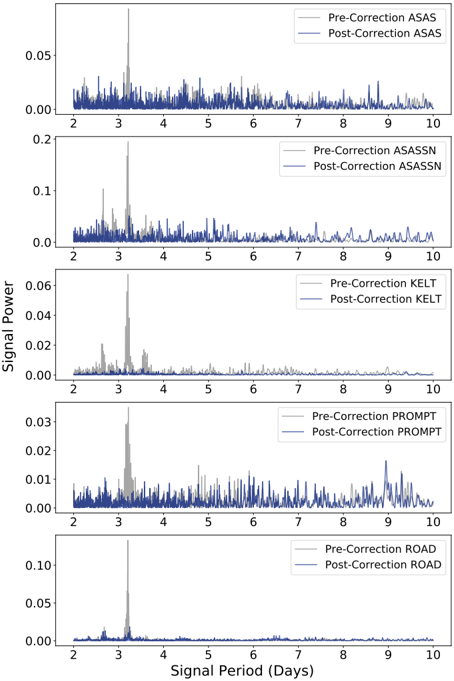
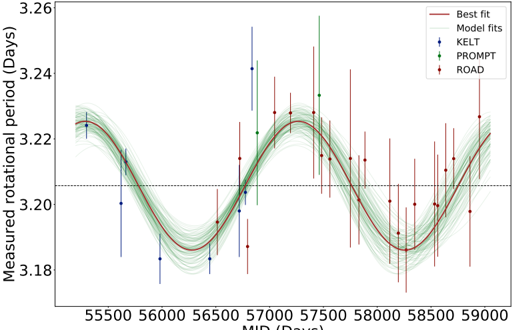
- The stellar rotation signal is measured as a cycle with best-fitting period \(P_{\rm cyc} = 1981^{+94}_{-83}\) days, i.e. about 5.4 years, with the spot rotation period oscillating around \(P_{\rm rot} = 3.206 \pm 0.002\) days and amplitude \(a = 0.020 \pm 0.003\) days.
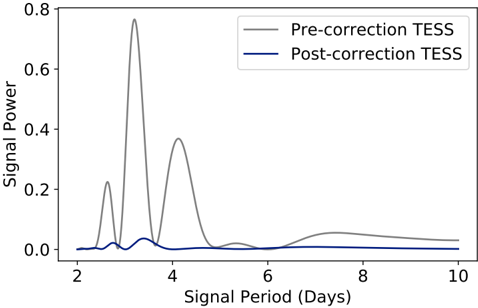
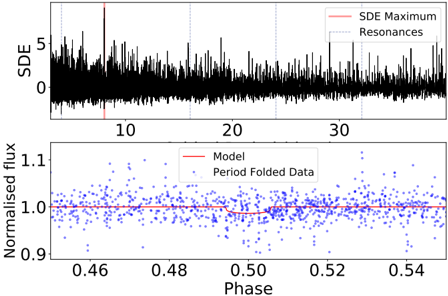
- The TLS transit search found no significant periodicities in either dataset: the ground-based data’s highest TLS value was 9.09 at 8.03 days, which the paper says is likely an artifact of integer-day cadence; the TESS search had maximum SDE just over 4.
- No additional transiting objects were found in the J1407 system.
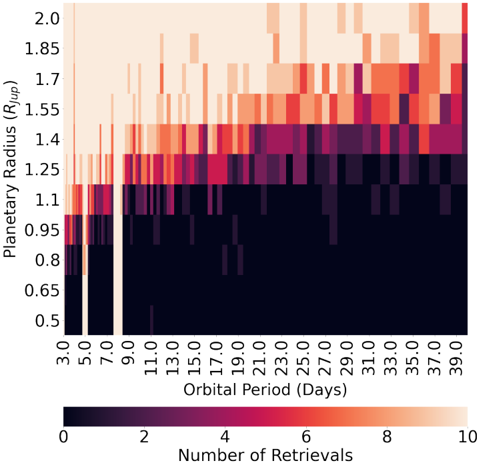
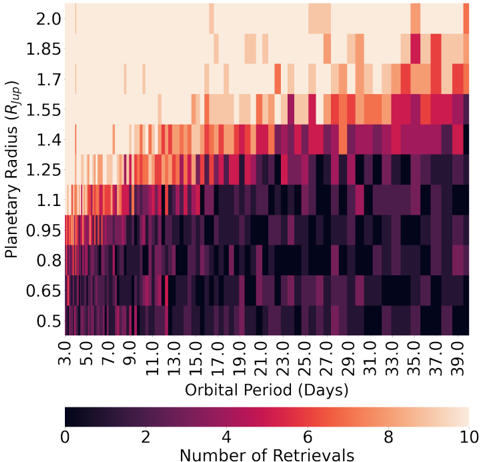
- Sensitivity limits from injection-recovery testing gave 50% recovery radii of 0.95 \(R_{\rm Jup}\) at 3 days, 1.25 \(R_{\rm Jup}\) at 10 days, and no larger than 1.4 \(R_{\rm Jup}\) at 20 days; the conclusions state that companions larger than about 1 \(R_{\rm Jup}\) are ruled out in the sampled space, and the discussion says planetary-mass companions at shorter periods are ruled out.
Methods
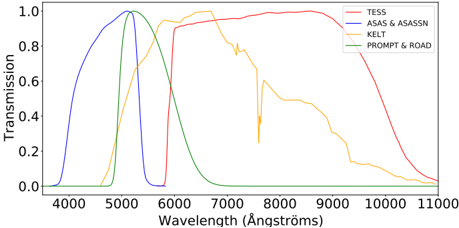
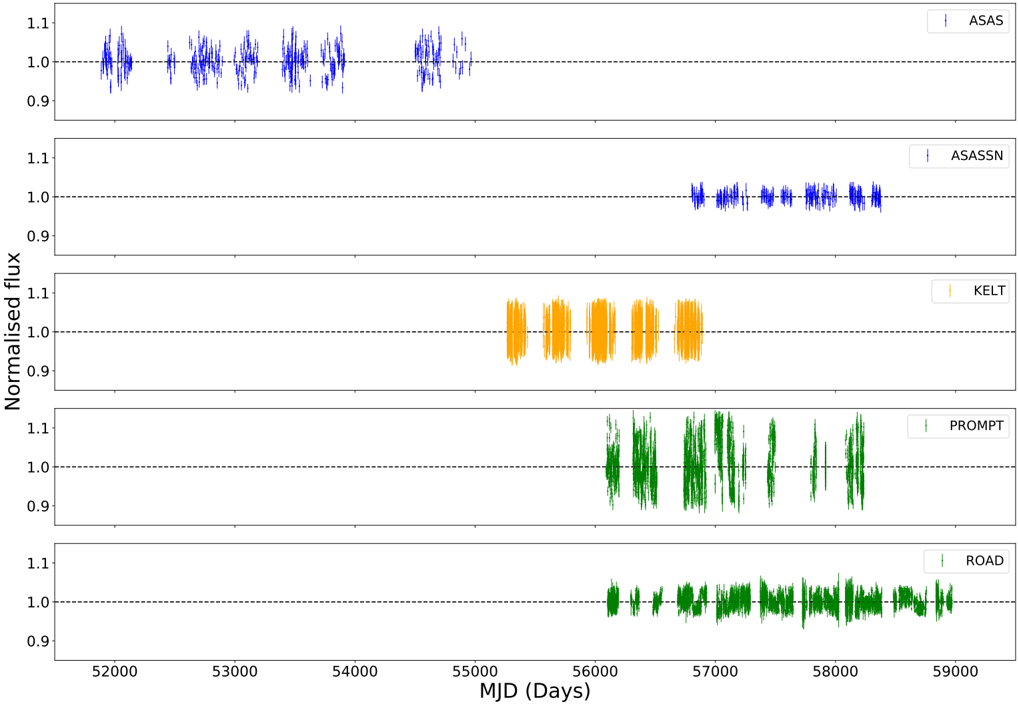
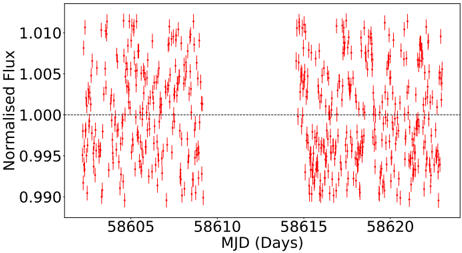
- Combined photometry from five ground-based telescopes over a 19-year baseline: ASAS, ASAS-SN, KELT, PROMPT, and ROAD; plus TESS Sector 11 data spanning 23 days with 744 observations.
- Corrected the light curves by removing a linear long-term trend, then modeling and subtracting rotational modulation in segments using Lomb-Scargle periodograms and fitted sinusoids; the cleaned data were then stitched together and outliers removed.
- Searched for transits with the Transit Least Squares (TLS) algorithm over periods of 3–40 days for ground-based data and 1.5–6 days for TESS, and performed injection-recovery tests with artificial transits spanning 0.5–2.0 \(R_{\rm Jup}\) and 3–40 days.
Limitations
- The paper itself notes that the rotation-period interpretation should be treated with caution because J1407 is in a regime where magnetic activity no longer follows the usual activity/rotation relation.
- The ground-based sensitivity is affected by red noise and unmodeled systematics; the paper explicitly says the real data require larger radii for transit recovery than idealized white-noise simulations.
- Evident from the text: the TESS baseline is only 23–25 days, so it is only sensitive to relatively short orbital periods; the ground-based data also have gaps from diurnal/annual observing windows, which limits transit detectability.
Model-written summary. Check it against the paper before relying on it.
Integrity signals
Registry
Cites
Statistics
Figures
Verification
Claims the paper makes
9 Valid · 1 Not valid · 8 Not checked · 39 Own results and interpretations
The cited sources support only part of this claim — read each source’s verdict below.
In the paper
“In 2007, it displayed a complex symmetric dimming pattern of up to 3 magnitudes during a 56 day eclipse.”
What the sources say
- Partly supportedcites Mamajek et al. 2012 matched to “PLANETARY CONSTRUCTION ZONES IN OCCULTATION: DISCOVERY OF AN EXTRASOLAR RING SYSTEM TRANSITING A YOUNG SUN-LIKE STAR AND FUTURE PROSPECTS FOR DETECTING ECLIPSES BY CIRCUMSECONDARY AND CIRCUMPLANETARY DISKS” (2012) sourceExperimental — accuracy not yet measured
Section 3.2 (page unavailable) reports a complex 2007 eclipse reaching about 3 magnitudes; the Figure 5 caption describes paired peripheral dips roughly 52 days apart, consistent with an approximately 56-day span. But Section 3.3 explicitly calls the eclipse asymmetric, so describing the overall dimming pattern as symmetric is not supported. (LLM, conf=0.88)
plainSingle case- Asserted: passes — The authors put it forward as true.
- Checkable: passes — It can be checked against evidence.
- Load-bearing: passes — The paper’s conclusions depend on it.
- Based: passes — The paper gives a reason why it holds.
- Partly supported
The cited sources that could be checked couldn’t confirm or dispute this claim.
In the paper
“We note that the logarithm of the ratio of the periods is log Prot = Pcyc = 2 : 79, and that this is at least consistent with other young K-type stars (Saar & Brandenburg 1999).”
What the sources say
- Could not verifycites Saar & Brandenburg 1999 matched to “Time Evolution of the Magnetic Activity Cycle Period. II. Results for an Expanded Stellar Sample” (1999) sourceExperimental — accuracy not yet measured
Our copy of Saar & Brandenburg (1999) never gives a value of log(P_rot/P_cyc) — searched for '2.79', 'log(P_rot/P_cyc)', 'ratio of cycle and rotation period', 'young K-type stars' — and no passage compares period ratios among young K stars. The nearest material is the scaling work itself (§4.1 / 'Additional information': ω_cyc/Ω ∝ Ro^-1.09 with p_fit ≈ 0.31–0.32 dex, and the 2w fits ω_cyc/Ω ∝ Ro^-0.48), the summary statement that 'Younger G and K stars tend to have primary [cycles] on the A branch', and Table 5's predicted P_cyc for Pleiades/a Per cluster stars from measured P_rot. Those treat the topic of rotation–cycle relations in young stars but do not state that a ratio of 2.79 in the log is consistent with other young K-type stars, so the attribution can be neither confirmed nor contradicted from our copy. (LLM, conf=0.62)
hedgedSingle case- Asserted: passes — The authors put it forward as true.
- Checkable: passes — It can be checked against evidence.
- Load-bearing: unclear — It is unclear whether the paper’s conclusions depend on it.
- Based: passes — The paper gives a reason why it holds.
- Could not verify
Every source the paper cites for this claim was checked and supports it.
In the paper
“For these rings to show detectable transit signatures, they must be significantly misaligned with respect to the orbital plane of J1407 b (Zanazzi & Lai 2017).”
What the sources say
- Supportedcites Zanazzi & Lai 2017 matched to “Extended transiting discs and rings around planets and brown dwarfs: theoretical constraints” (2017) source
The Abstract (p. 1) states the condition directly: an extended disc/ring 'can exhibit unique, detectable transit signatures, provided that the disc/ring is significantly misaligned with the orbital plane of the planet,' and repeats it ('In order to produce a transiting signature, the disc/ring must be inclined with respect to the orbital plane'). Section 2 (p. 3953) applies this specifically to J1407, noting that an outer disc aligned with the planetary orbit 'would not produce the transit signal claimed in the J1407 system,' so a significant inclination must be maintained. The paraphrase therefore matches what the source attributes, including the J1407b context. (LLM, conf=0.93)
plainstates a cause- Asserted: passes — The authors put it forward as true.
- Checkable: passes — It can be checked against evidence.
- Load-bearing: unclear — It is unclear whether the paper’s conclusions depend on it.
- Based: passes — The paper gives a reason why it holds.
- Supported
A result the paper reports from its own data — it cites no other source for it, so there is none to check. The quote shows it is in the paper.
In the paper
“A Transit Least Squares search does not find any plausible periodic eclipses in the light curve, from 1.2% amplitude at 5 days up to 1.9% at 20 days.”
plainSingle case- Asserted: passes — The authors put it forward as true.
- Checkable: passes — It can be checked against evidence.
- Load-bearing: passes — The paper’s conclusions depend on it.
- Based: passes — The paper gives a reason why it holds.
- Rests on 2 assumptions not shown here.
A result the paper reports from its own data — it cites no other source for it, so there is none to check. The quote shows it is in the paper.
In the paper
“where the calculated rotation period oscillates around the median Prot = 3 : 206 0 : 002 days with an amplitude a of 0 : 020 0 : 003 days.”
plainstates an association- Asserted: passes — The authors put it forward as true.
- Checkable: passes — It can be checked against evidence.
- Load-bearing: passes — The paper’s conclusions depend on it.
- Based: passes — The paper gives a reason why it holds.
21 more claims
Create a free account to see all 57 claims and to verify the 5 references still open.
- It may state two separate claims as one. 24
- Probably not a substantial claim. 8
- The quote only partly states this claim. 1
Self-check
Percentages, sums and reported differences re-computed from the paper’s own numbers.
Each contradiction between two passages listed here was confirmed by an independent check.
Rated minor: it would not touch a result — a value no result rests on, a p-value that stays on the same side of the significance level, or a conflict that is clerical, resolved elsewhere in the paper, or outside its own findings.
In the paper
§ 2.2. TESS
“The data for J1407 contains 744 observations over 23 days”
§ 6. Conclusions
“After removing a simple model for the stellar activity, we searched the activity subtracted data, as well as 25 days of short cadence TESS data, for exoplanet transits.”
Citations
Cites
Matplotlib: a 2D graphics environment
Hunter, J. D. (2007) · Computing in Science & Engineering · doi:10.1109/mcse.2007.55 · Cited by 39,249 · cited 2×
“…the scientific results presented in this article we made use of the Python programming language2, especially the SciPy (Virtanen et al. 2020), NumPy (Oliphant 2006), Matplotlib (Hunter 2007), emcee (Foreman-Mackey et al. 2013b), and astropy (Astropy Collaboration et al. 2013, 2018) packages.”
MethodSciPy 1.0: fundamental algorithms for scientific computing in Python
Virtanen, P., Gommers, R., Oliphant, T. E., Haberland, M., Reddy, T., Cournapeau, D., Burovski, E., Peterson, P., Weckesser, W., Bright, J., et al. (2020) · Nature Methods · doi:10.1038/s41592-019-0686-2 · Cited by 38,430
Astropy: A community Python package for astronomy
The Astropy Collaboration, Robitaille, T. P., Tollerud, E. J., Greenfield, P., Droettboom, M., Bray, E., Aldcroft, T., Davis, M., Ginsburg, A., Price-Whelan, A. M., et al. (2013) · Astronomy & Astrophysics · doi:10.1051/0004-6361/201322068 · Cited by 14,620
<tt>emcee</tt>: The MCMC Hammer
Foreman-Mackey, D., Hogg, D. W., Lang, D., & Goodman, J. (2013) · Publications of the Astronomical Society of the Pacific · doi:10.1086/670067 · Cited by 12,414
Transiting Exoplanet Survey Satellite
Ricker, G. R., Winn, J. N., Vanderspek, R., Latham, D. W., Bakos, G. Á., Bean, J. L., Berta-Thompson, Z. K., Brown, T. M., Buchhave, L., Butler, N. R., et al. (2014) · Journal of Astronomical Telescopes, Instruments, and Systems · doi:10.1117/1.jatis.1.1.014003 · Cited by 4,056
Binary Companions of Evolved Stars in APOGEE DR14: Search Method and Catalog of ∼5000 Companions
Price-Whelan, A. M., Hogg, D. W., Rix, H.-W., De Lee, N., Majewski, S. R., Nidever, D. L., Troup, N., Fernández-Trincado, J. G., García-Hernández, D. A., Longa-Peña, P., et al. (2018) · The Astronomical Journal · doi:10.3847/1538-3881/aac387 · Cited by 3,756
The SIMBAD astronomical database: The CDS reference database for astronomical objects
Wenger, M., Ochsenbein, F., Egret, D., Dubois, P., Bonnarel, F., Borde, S., Genova, F., Jasniewicz, G., Laloë, S., Lesteven, S., et al. (2000) · Astronomy and Astrophysics Supplement Series · doi:10.1051/aas:2000332 · Cited by 2,329
LMFIT: Non-Linear Least-Square Minimization and Curve-Fitting for Python
Newville, M. G., Stensitzki, T., Allen, D. B., et al. (2014) · Zenodo (CERN European Organization for Nuclear Research) · doi:10.5281/zenodo.11813 · Cited by 1,339
The All-Sky Automated Survey for Supernovae (ASAS-SN) Light Curve Server v1.0
Kochanek, C. S., Shappee, B. J., Stanek, K. Z., Holoien, T. W.-S., Thompson, T. A., Prieto, J. L., Dong, S., Shields, J. V., Will, D., Britt, C., et al. (2017) · Publications of the Astronomical Society of the Pacific · doi:10.1088/1538-3873/aa80d9 · Cited by 1,262
Hathaway, D. H. (2015) · Living Reviews in Solar Physics · doi:10.1007/lrsp-2015-4 · Cited by 1,180 · cited 2×
“Due to the differential rotation of the star, there are different rotational periods at each latitude, analogous to the 11 year Schwabe cycle of the Sun (Hathaway 2015).”
MethodClaret, A., & Bloemen, S. (2011) · Astronomy & Astrophysics · doi:10.1051/0004-6361/201116451 · Cited by 1,155
<tt>batman</tt>: BAsic Transit Model cAlculatioN in Python
Kreidberg, L. (2015) · Publications of the Astronomical Society of the Pacific · doi:10.1086/683602 · Cited by 1,075 · cited 1×
“For the creation of fake transit signals, the BATMAN package (Kreidberg 2015) was used.”
MethodThe Limiting Effects of Dust in Brown Dwarf Model Atmospheres
Allard, F., Hauschildt, P. H., Alexander, D. R., Tamanai, A., & Schweitzer, A. (2001) · The Astrophysical Journal · doi:10.1086/321547 · Cited by 1,062
A box-fitting algorithm in the search for periodic transits
Kovács, G., Zucker, S., & Mazeh, T. (2002) · Astronomy & Astrophysics · doi:10.1051/0004-6361:20020802 · Cited by 995
Pizzolato, N., Maggio, A., Micela, G., Sciortino, S., & Ventura, P. (2003) · Astronomy & Astrophysics · doi:10.1051/0004-6361:20021560 · Cited by 853
Pepper, J., Pogge, R. W., DePoy, D. L., Marshall, J. L., Stanek, K. Z., Stutz, A. M., Poindexter, S., Siverd, R., O’Brien, T. P., Trueblood, M., et al. (2007) · Publications of the Astronomical Society of the Pacific · doi:10.1086/521836 · Cited by 406
Time Evolution of the Magnetic Activity Cycle Period. II. Results for an Expanded Stellar Sample
Saar, S. H., & Brandenburg, A. (1999) · The Astrophysical Journal · doi:10.1086/307794 · Cited by 323
A ring system detected around the Centaur (10199) Chariklo
Braga-Ribas, F., Sicardy, B., Ortiz, J. L., Snodgrass, C., Roques, F., Vieira-Martins, R., Camargo, J. I. B., Assafin, M., Duffard, R., Jehin, E., et al. (2014) · Nature · doi:10.1038/nature13155 · Cited by 296
Self-citationeleanor: An Open-source Tool for Extracting Light Curves from the TESS Full-frame Images
Feinstein, A. D., Montet, B. T., Foreman-Mackey, D., Bedell, M. E., Saunders, N., Bean, J. L., Christiansen, J. L., Hedges, C., Luger, R., Scolnic, D., et al. (2019) · Publications of the Astronomical Society of the Pacific · doi:10.1088/1538-3873/ab291c · Cited by 266
Optimized transit detection algorithm to search for periodic transits of small planets
Hippke, M., & Heller, R. (2019) · Astronomy & Astrophysics · doi:10.1051/0004-6361/201834672 · Cited by 250
Pepper, J., Kuhn, R. B., Siverd, R., James, D., & Stassun, K. (2012) · Publications of the Astronomical Society of the Pacific · doi:10.1086/665044 · Cited by 160
Statistical properties of brown dwarf companions: implications for different formation mechanisms
Ma, B., & Ge, J. (2014) · Monthly Notices of the Royal Astronomical Society · doi:10.1093/mnras/stu134 · Cited by 153
Mamajek, E. E., Quillen, A. C., Pecaut, M. J., Moolekamp, F., Scott, E. L., Kenworthy, M. A., Cameron, A. C., & Parley, N. R. (2012) · The Astronomical Journal · doi:10.1088/0004-6256/143/3/72 · Cited by 140
Self-citationSearching the Entirety of Kepler Data. II. Occurrence Rate Estimates for FGK Stars
Kunimoto, M., & Matthews, J. M. (2020) · The Astronomical Journal · doi:10.3847/1538-3881/ab88b0 · Cited by 139
MODELING GIANT EXTRASOLAR RING SYSTEMS IN ECLIPSE AND THE CASE OF J1407B: SCULPTING BY EXOMOONS?
Kenworthy, M. A., & Mamajek, E. E. (2015) · The Astrophysical Journal · doi:10.1088/0004-637x/800/2/126 · Cited by 123
Self-citationTiscareno, M. S. (2013) · Planets, Stars and Stellar Systems · doi:10.1007/978-94-007-5606-9_7 · Cited by 37 · cited 1×
“…a ubiquitous feature in planetary systems - all the gas giants in the Solar System have ring systems around them of varying optical depths (see e.g. Tiscareno 2013; Charnoz et al. 2018), and ring systems have been detected around minor planets (e.g. Chariklo; Braga-Ribas et al. 2014), so it is…”
BackgroundMass and period limits on the ringed companion transiting the young star J1407
Kenworthy, M. A., Lacour, S., Kraus, A., Triaud, A. H. M. J., Mamajek, E. E., Scott, E. L., Ségransan, D., Ireland, M., Hambsch, F.-J., Reichart, D. E., et al. (2015) · Monthly Notices of the Royal Astronomical Society · doi:10.1093/mnras/stu2067 · Cited by 36
Self-citationRodriguez, J. E., Stassun, K. G., Lund, M. B., Siverd, R. J., Pepper, J. A., Tang, S., Kafka, S., Gaudi, B. S., Conroy, K. E., Beatty, T. G., et al. (2016) · The Astronomical Journal · doi:10.3847/0004-6256/151/5/123 · Cited by 34
Self-citationLipunov, V., Gorbovskoy, E., Afanasiev, V., Tatarnikova, A., Denisenko, D., Makarov, D. I., Tiurina, N., Krushinsky, V., Vinokurov, A., Balanutsa, P., et al. (2016) · Astronomy and Astrophysics · doi:10.1051/0004-6361/201526528 · Cited by 31
Is the eclipsing variable EE Cep a cousin of Aur?
Mikolajewski, M., & Graczyk, D. (1999) · Monthly Notices of the Royal Astronomical Society · doi:10.1046/j.1365-8711.1999.02257.x · Cited by 28
Constraints on the size and dynamics of the J1407b ring system
Rieder, S., & Kenworthy, M. A. (2016) · Astronomy & Astrophysics · doi:10.1051/0004-6361/201629567 · Cited by 23
Self-citationExtended transiting discs and rings around planets and brown dwarfs: theoretical constraints
Zanazzi, J. J., & Lai, D. (2017) · Monthly Notices of the Royal Astronomical Society · doi:10.1093/mnras/stw2629 · Cited by 21
Extended Transiting Disks and Rings Around Planets and Brown Dwarfs: Theoretical Constraints
Zanazzi, J. J., & Lai, D. (2016) · arXiv · doi:10.48550/arxiv.1605.02365 · Cited by 21
Mentel, R. T., Kenworthy, M. A., Cameron, D. A., Scott, E. L., Mellon, S. N., Hudec, R., Birkby, J. L., Mamajek, E. E., Schrimpf, A., Reichart, D. E., et al. (2018) · Astronomy & Astrophysics · doi:10.1051/0004-6361/201834004 · Cited by 14
Self-citationShapes of stellar activity cycles
Willamo, T., Hackman, T., Lehtinen, J. J., Korpi, M. J., Olspert, N., Viviani, M., & Warnecke, J. (2020) · Astronomy and Astrophysics · doi:10.1051/0004-6361/202037666 · Cited by 14
A search for transiting planets in the β Pictoris system
Mol Lous, M., Weenk, E., Kenworthy, M. A., Zwintz, K., & Kuschnig, R. (2018) · Astronomy & Astrophysics · doi:10.1051/0004-6361/201731941 · Cited by 10
Self-citationGuinan, E., & DeWarf, L. E. (2002) · International Astronomical Union Colloquium · doi:10.1017/s0252921100001317 · Cited by 8 · cited 2×
“…by an extended dark disk-like structure that periodically eclipses the other component, have already been observed, such as EE Cep (Mikolajewski & Graczyk 1999), Aurigae (Guinan & Dewarf 2002) and TYC 2505-672-1, with a companion period of 69 years (Lipunov et al. 2016; Rodriguez et al. 2016).”
BackgroundRings in the Solar System: A Short Review
Charnoz, S., Crida, A., & Hyodo, R. (2018) · Springer eBooks · doi:10.1007/978-3-319-55333-7_54 · Cited by 6 · cited 1×
“…in planetary systems - all the gas giants in the Solar System have ring systems around them of varying optical depths (see e.g. Tiscareno 2013; Charnoz et al. 2018), and ring systems have been detected around minor planets (e.g. Chariklo; Braga-Ribas et al. 2014), so it is reasonable that…”
BackgroundRings in the Solar System: A Short Review
Charnoz, S., Crida, A., & Hyodo, R. (2018) · Springer eBooks · doi:10.1007/978-3-319-30648-3_54-1 · Cited by 5
Tiscareno, M. S., & Hedman, M. M. (2014) · Elsevier eBooks · doi:10.1016/b978-0-12-415845-0.00041-4
Research works printed but not linked: 4
- Hambsch, F. J. 2012, Journal of the American Association of Variable Star Observers (JAAVSO), 40, 1003
- Oliphant, T. E. 2006, A guide to NumPy, Vol. 1 (Trelgol Publishing USA)
- Pojmanski, G. 1997, Acta Astronomica, 47, 467
- Reichart, D., Nysewander, M., Moran, J., et al. 2005, Nuovo Cimento C Geophysics Space Physics C, 28, 767
Cited by
ZTF J185259.31+124955.2: A new evolved disc-eclipsing binary system
Bernhard, K., & Lloyd, C. (2024) · Astronomy and Astrophysics · doi:10.1051/0004-6361/202450203 · Cited by 3
Beyond Circular Eclipsers (BeyonCE) light curve modelling: I. Shallot Explorer
van Dam, D. M., & Kenworthy, M. A. (2024) · Astronomy & Astrophysics · doi:10.1051/0004-6361/202245620 · Cited by 1
Self-citation
Metadata
- Authors
- Barmentloo, S., Dik, C., Kenworthy, M. A., Mamajek, E. E., Hambsch, F.-J., Reichart, D. E., Rodriguez, J. E., & van Dam, D. M.
- Affiliations
- Leiden University (NL)
- California Institute of Technology (US)
- American Association of Variable Star Observers (US)
- University of North Carolina at Chapel Hill (US)
- Michigan State University (US)
- Venue
- Astronomy & Astrophysics
- Publisher
- EDP Sciences
- Published
- 2021-08
- Volume
- 652
- Pages
- A117
- ISSN
- 0004-6361 (ISSN-L)
- 1432-0746
- OpenAlex
- W3174891798
- Cited by
- 2
- References
- 36
- Citations by year
- 2024: 2
- FWCI
- 0.27
- Type
- journal article
- Language
- en
- Open access
- bronze
- doi.org
- Locations
- Astronomy and Astrophysics (publishedVersion)
- arXiv (Cornell University) (submittedVersion)
- Leiden Repository (Leiden University) (submittedVersion)
- Data Archiving and Networked Services (DANS) (submittedVersion, other-oa)
- arXiv (Cornell University)
- Funders
- National Science Foundation (0908816, 1056524, 1515927, CAREER)
- National Aeronautics and Space Administration (NNG04GO70G, 80NM0018D0004)
- Gordon and Betty Moore Foundation (GBMF5490)
- Vanderbilt University
- Ohio State University (AST-1515927)
- California Institute of Technology (80 NM0018D0004)
- Villum Fonden
- Chinese Academy of Sciences South America Center for Astronomy
- European Space Agency (80NM0018D0004)
- Chinese Academy of Sciences
- Jet Propulsion Laboratory (80NM0018D0004)
- Center for Cosmology and Astroparticle Physics, Ohio State University
- Topics
- Physical Sciences › Physics and Astronomy › Astronomy and Astrophysics › Stellar, planetary, and galactic studies
- Physical Sciences › Physics and Astronomy › Instrumentation › Astronomy and Astrophysical Research
- Physical Sciences › Physics and Astronomy › Astronomy and Astrophysics › History and Developments in Astronomy
- Keywords
- substellar companions, stellar activity cycles, stellar rotation, stellar spots, light curve modeling, young active stars, planetary mass limits, ring systems
About these checks
Registry, retraction, Cites and statistics results are computed, not judged, with one exception: a printed reference that no index lists is read once by a model before it counts as a citation error. Claims are extracted by a model and kept only when their quote appears verbatim in the text; each cited source is then checked, with a model’s help, for whether it says what the claim relies on. Those verdicts can be wrong — read the claim’s quote and the cited source before relying on one.
The claim verdicts this report counts are experimental: their accuracy is not yet measured.
A language model drew the claims from the paper on 2026-10-11, under version 3 of the claim definition (model deepseek-v4.1-flash, prompt extract-v3).
A second model labelled each claim on 2026-10-11 (model jev-1.13-20260917, definition revision gold-guideline-v0.2).
Cited sources are checked with a language model’s help (gpt-6-sol and qwen3.8-omni-flash).
Statistics and arithmetic are recomputed, not judged.
Confidence bands are shown only for fields calibrated on our annotated test set. None is calibrated yet, so no band is shown.
What counts as a claim ›How we measure confidence ›How we check this ›
Are you an author, or do you see a problem with this page? Request a review
Data sources
Bibliographic data: Semantic Scholar, OpenAlex, Crossref.
Contains information from the Semantic Scholar Academic Graph Datasets, made available under the ODC Attribution License (ODC-BY 1.0).
Semantic Scholar’s data is described in: Kinney, R., et al. (2023). The Semantic Scholar Open Data Platform. arXiv:2301.10140.
