

Extreme ultraviolet photoemission of a tin-based photoresist
Open accessThe DOI matches its Crossref record; 45 of the 45 references it cites were found in a registry or an index.
Abstract
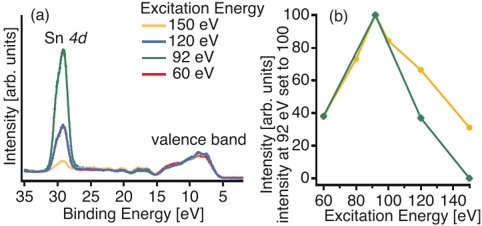
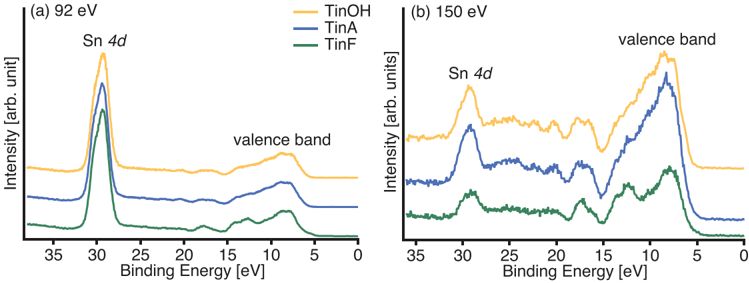
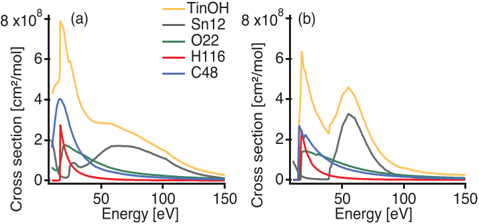
Tin is a suitable element for inclusion in extreme ultraviolet photoresists because of its relatively high-absorption cross section at 92 eV. The electrons emitted after photon absorption are expected to generate secondary electrons in the solid film. In this way, several pathways lead to reactive species that cause a solubility switch. Here, we report the photoelectron spectra of tin oxo cage photoresists over the photon energy range 60–150 eV, and the relative yields of photoelectrons from the valence band of the resist, from the Sn 4d orbitals, and of inelastically scattered electrons. The experimental excitation spectra differ considerably from those predicted by commonly used database cross section values, and from the combined computed subshell spectra: the maximum efficiency of ionization of Sn 4d both in the photoresists and in Sn metal occurs near the industrially relevant EUV wavelength of 13.5 nm.
Overview
The claims and statistics of this paper haven’t been checked yet.
Free: it reads the open-access text and checks the first 5 claims that cite a source we can check. Create a free account to check every claim.
Integrity signals
Registry
Cites
Statistics
Figures
Verification
Claims the paper makes
The claims and statistics of this paper haven’t been checked yet.
Free: it reads the open-access text and checks the first 5 claims that cite a source we can check. Create a free account to check every claim.
Claims other papers make about this one
Each is checked against this paper’s own text: does it say what the citing paper says it does?
The source backs part of the claim, not all of it — or backs it for a different population, condition or comparison.
In the citing paper
“A study indicated that the reactivity of the clusters was more closely related to the strength of the tin–carbon bonds.”
From Recent Advances in Metal-Oxide-Based Photoresists for EUV Lithography (2024) · cites this paper as [93]
Experimental — accuracy not yet measuredThe check wasn’t confident either way, so it gives no verdict — never disputed.
In the citing paper
“Specifically, the cluster with the weakest tin–allyl bond exhibited the highest sensitivity.”
From Recent Advances in Metal-Oxide-Based Photoresists for EUV Lithography (2024) · cites this paper as [93]
Experimental — accuracy not yet measuredThe check wasn’t confident either way, so it gives no verdict — never disputed.
In the citing paper
“Furthermore, larger counterions would increase the spacing between clusters, thereby hindering tin–tin bond formation and decreasing the resist sensitivity [93] (Figure 16b).”
From Recent Advances in Metal-Oxide-Based Photoresists for EUV Lithography (2024) · cites this paper as [93]
Experimental — accuracy not yet measuredThe check wasn’t confident either way, so it gives no verdict — never disputed.
In the citing paper
“Studies have shown that depending on the type of counteranion attached to the cluster, the photochemical behavior can differ significantly, affecting the sensitivity and resolution of the photoresist.”
From Recent Advances in Metal-Oxide-Based Photoresists for EUV Lithography (2024) · cites this paper as [93]
Experimental — accuracy not yet measured
Self-check
Percentages, sums and reported differences re-computed from the paper’s own numbers.
The self-check needs the paper’s full text.
Citations
Cites
Henke, B. L., Gullikson, E. M., & Davis, J. C. (1993) · Atomic Data and Nuclear Data Tables · doi:10.1006/adnd.1993.1013 · Cited by 6,285 · cited 1×
“16 In order to estimate the photoabsorption and photo-emission cross sections of the elements, values from the Centre for X-ray Optics, Berkeley database 17 often reasonably reproduce experimental data, 18–21 especially for the higher photon energies.”
Makuła, P., Pacia, M., & Macyk, W. (2018) · The Journal of Physical Chemistry Letters · doi:10.1021/acs.jpclett.8b02892 · Cited by 5,157 · cited 1×
“38) of the UV/Vis absorption spectrum (see the supplementary material Fig.”
Atomic subshell photoionization cross sections and asymmetry parameters: 1 ⩽ Z ⩽ 103
Yeh, J. J., & Lindau, I. (1985) · Atomic Data and Nuclear Data Tables · doi:10.1016/0092-640x(85)90016-6 · Cited by 4,978
Energy‐Level Alignment at Organic/Metal and Organic/Organic Interfaces
Braun, S., Salaneck, W. R., & Fahlman, M. (2009) · Advanced Materials · doi:10.1002/adma.200802893 · Cited by 1,593
Atomic calculation of photoionization cross-sections and asymmetry parameters
Yeh, J. J. (1993) · Medical Entomology and Zoology · Cited by 366
Radiation Chemistry in Chemically Amplified Resists
Kozawa, T., & Tagawa, S. (2010) · Japanese Journal of Applied Physics · doi:10.1143/jjap.49.030001 · Cited by 360 · cited 1×
“24,45 After the initial photoionization at 92eV, the primary electrons emitted from the occupied molecular orbitals have kinetic energies up to 80eV.”
Review of recent advances in inorganic photoresists
Luo, C., Xu, C., Lv, L., Li, H., Huang, X., & Liu, W. (2020) · RSC Advances · doi:10.1039/c9ra08977b · Cited by 207
Photolithographic properties of tin-oxo clusters using extreme ultraviolet light (13.5nm)
Cardineau, B., Del Re, R., Marnell, M., Al-Mashat, H., Vockenhuber, M., Ekinci, Y., Sarma, C., Freedman, D. A., & Brainard, R. L. (2014) · Microelectronic Engineering · doi:10.1016/j.mee.2014.04.024 · Cited by 202
Manouras, T., & Argitis, P. (2020) · Nanomaterials · doi:10.3390/nano10081593 · Cited by 196
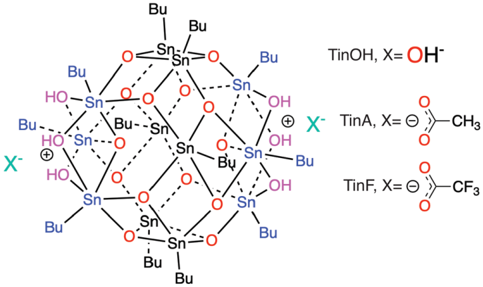
Hydrolysis of Monobutyltin Trialkoxides: Synthesis and Characterizations of {(BuSn)12O14(OH)6}(OH)2
Banse, F., Ribot, F. O., Tolédano, P., Maquet, J., & Sánchez, C. (1995) · Inorganic Chemistry · doi:10.1021/ic00129a023 · Cited by 151
Research works printed but not linked: 2
- N. Fu, Y. Liu, X. Ma, and Z. Chen, "EUV lithography: State-of-the-art review," J. Microelectron. Manuf. 2, 1-6 (2019).
- M. J. Frisch, G. W. Trucks, H. B. Schlegel, G. E. Scuseria, M. A. Robb, J. R. Cheeseman, G. Scalmani, V. Barone, G. A. Petersson, H. Nakatsuji, X. Li, M. Caricato, A. V. Marenich, J. Bloino, B. G. Janesko, R. Gomperts, B. Mennucci, H. P. Hratchian, J. V. Ortiz, A. F. Izmaylov, J. L. Sonnenberg, D. Williams- Young, F. Ding, F. Lipparini, F. Egidi, J. Goings, B. Peng, A. Petrone, T. Henderson, D. Ranasinghe, V. G. Zakrzewski, J. Gao, N. Rega, G. Zheng, W. Liang, M. Hada, M. Ehara, K. Toyota, R. Fukuda, J. Hasegawa, M. Ishida, T. Nakajima, Y. Honda, O. Kitao, H. Nakai, T. Vreven, K. Throssell, J. A. Montgomery, Jr., J. E. Peralta, F. Ogliaro, M. J. Bearpark, J. J. Heyd, E. N. Brothers, K. N. Kudin, V. N. Staroverov, T. A. Keith, R. Kobayashi, J. Normand, K. Raghavachari, A. P. Rendell, J. C. Burant, S. S. Iyengar, J. Tomasi, M. Cossi, J. M. Millam, M. Klene, C. Adamo, R. Cammi, J. W. Ochterski, R. L. Martin, K. Morokuma, O. Farkas, J. B. Foresman, and D. J. Fox, Gaussian16 Revision A.03 (Gaussian Inc., Wallingford, CT, 2016).
Cited by
Non-alkyl tin-oxo clusters as new-type patterning materials for nanolithography
Wang, D., Yi, X., & Zhang, L. (2022) · Science China Chemistry · doi:10.1007/s11426-021-1092-2 · Cited by 42
Recent progress of inorganic photoresists for next-generation EUV lithography
Kang, Y. K., Lee, S. J., Eom, S., Kim, B. G., Hwang, C.-C., & Kim, M. (2024) · Journal of Materials Chemistry C · doi:10.1039/d4tc02671c · Cited by 44
UV and VUV-induced fragmentation of tin-oxo cage ions
Haitjema, J., Wu, L., Giuliani, A., Nahon, L., Castellanos, S., & Brouwer, A. M. (2021) · Physical Chemistry Chemical Physics · doi:10.1039/d1cp03148a · Cited by 36
Key Challenges and Opportunities for Advanced Extreme Ultraviolet Lithography Photoresist Materials
Li, M., & Aqad, E. (2025) · Advanced Functional Materials · doi:10.1002/adfm.202420962 · Cited by 33
Recent Advances in Metal-Oxide-Based Photoresists for EUV Lithography
Hasan, M. W., Deeb, L., Kumaniaev, S., Wei, C., & Wang, K. (2024) · Micromachines · doi:10.3390/mi15091122 · Cited by 35
Kang, Y. K., Kim, H., Lee, S. J., Oh, D., Yoon, Y.-H., Kim, C.-J., Yeom, G. Y., Hwang, C.-C., & Kim, M. (2024) · Applied Surface Science · doi:10.1016/j.apsusc.2024.159564 · Cited by 32
Heterometallic Ti-Zr oxo nanocluster photoresists for advanced lithography
Qiao, Y., Shi, G., Zhang, O., You, L., Vockenhuber, M., Ekinci, Y., Luo, F. C., & Zhang, L. (2024) · Science China Materials · doi:10.1007/s40843-024-3013-9 · Cited by 33
Li, C.-D., Lin, T., Chen, P.-H., Gau, T.-S., Lin, B.-J., Chiu, P., & Liu, J.-H. (2024) · Nanoscale Advances · doi:10.1039/d4na00006d · Cited by 21
Macrocycle Network-Aided Nanopatterning of Inorganic Resists on Silicon
Nandi, S., Khillare, L. D., Moinuddin, M. G., Kumar, S., Chauhan, M. S., Sharma, S. K., Ghosh, S., & Gonsalves, K. E. (2022) · ACS Applied Nano Materials · doi:10.1021/acsanm.2c01321 · Cited by 18
Advances in metal-based photoresist materials for EUV lithography and lithographic mechanisms
Wang, Y., Yu, H., Wang, L., Zhang, Y., Zhu, Z., Zhang, Y., Lu, Y., & Ouyang, C. (2025) · Journal of Materials Chemistry A · doi:10.1039/d5ta04194e · Cited by 18
Chemical Mechanisms of Metal-Based Extreme Ultraviolet Resists
Brouwer, A. M. (2022) · Journal of Photopolymer Science and Technology · doi:10.2494/photopolymer.35.81 · Cited by 14
Molecular layer deposition of tin-based organic–inorganic hybrid films as photoresists
Kim, D. G., Ha, K., Kim, H., Kim, W., Park, T. J., & Ahn, J. (2025) · Applied Surface Science · doi:10.1016/j.apsusc.2024.162240 · Cited by 14
XUV Absorption Spectroscopy and Photoconversion of a Tin-Oxo Cage Photoresist
Sadegh, N., Evrard, Q., Kraus, P. M., & Brouwer, A. M. (2024) · The Journal of Physical Chemistry C · doi:10.1021/acs.jpcc.3c07480 · Cited by 13
Du, T., Yang, X., Zhao, Y., Han, P., Zhao, J., & Zhou, S. (2024) · The Journal of Chemical Physics · doi:10.1063/5.0200630 · Cited by 14
Experimental characterization of model extreme ultraviolet resist materials
Kostko, O., McAfee, T. R., Ma, J., Blackwell, J. M., & Naulleau, P. P. (2024) · Journal of Micro/Nanopatterning Materials and Metrology · doi:10.1117/1.jmm.23.1.014602 · Cited by 13
Yang, F., Ye, Z., Chen, Y., Wang, M.-H., Zhou, P., & Gou, F. (2023) · New Journal of Chemistry · doi:10.1039/d3nj01464a · Cited by 10
Electron Generation in Tin-oxo Cage Extreme Ultraviolet Photoresists
Sadegh, N., Evrard, Q., Mahne, N., Giglia, A., Nannarone, S., & Brouwer, A. M. (2023) · Journal of Photopolymer Science and Technology · doi:10.2494/photopolymer.36.373 · Cited by 9
Soft X-ray absorption and fragmentation of tin-oxo cage photoresists
Haitjema, J., Castellanos, S., Lugier, O. C. M., Bespalov, I., Lindblad, R., Timm, M., Bülow, C., Zamudio‐Bayer, V., Lau, J. T., Issendorff, B. V., et al. (2024) · Physical Chemistry Chemical Physics · doi:10.1039/d3cp05428d · Cited by 8
Effect of Cl2 Radical on Dry Development of Spin-Coated Metal Oxide Resist
Namgoong, S., Kim, H., Kang, Y. K., Kim, M. C., Jang, Y. J., Tak, H., Kang, J. E., Lee, S. J., Kim, M., Kim, D., et al. (2024) · ACS Applied Materials & Interfaces · doi:10.1021/acsami.4c10523 · Cited by 8
Miguez, L. F., Bobbert, P. A., & Coehoorn, R. (2024) · Journal of Applied Physics · doi:10.1063/5.0239120 · Cited by 7
Singh, D. P., Galleni, L., Sajjadian, F. S., Pollentier, I. K., Holzmeier, F., Pourtois, G., Gendt, S. D., van Setten, M. J., Conard, T. S., Petersen, J. S., et al. (2025) · ACS Applied Materials & Interfaces · doi:10.1021/acsami.5c09589 · Cited by 8
Yang, F., Ye, Z., Chen, Y., Zhou, P., & Gou, F. (2024) · The Journal of Physical Chemistry Letters · doi:10.1021/acs.jpclett.4c03250 · Cited by 5
Extreme ultraviolet induced reactions of tin–oxo cage photoresists
Sadegh, N., Haitjema, J., Zhang, Y. Q. (., Wu, L., Lugier, O. C. M., Bespalov, I., Kazazis, D., Vockenhuber, M., Ekinci, Y., Witte, K., et al. (2026) · Journal of Materials Chemistry C · doi:10.1039/d5tc04167h · Cited by 5
Byeon, J., Kim, D., Kim, S., Ahn, J., Oh, D. S., Yoon, Y. H., Jee, H., Kim, Y., Hwang, C.-C., & Hong, S. (2024) · Materials Today Chemistry · doi:10.1016/j.mtchem.2024.102474 · Cited by 4
Recent Progress of Nonchemically‐Amplified Resists for High‐Resolution Lithography †
Li, H., Peng, R., Liu, Z., Lian, P., Chen, J., Yu, T., Zeng, Y., Wang, S., Guo, X., Hu, R., et al. (2026) · Chinese Journal of Chemistry · doi:10.1002/cjoc.70573 · Cited by 2
Regulation and Synthesis of Mixed‐Ligand Titanium–Oxide Nanoparticles for 12 nm Nanolithography
Xing, S., Wang, D., Fan, Z., Kang, W., Wang, Q., & Wang, X. (2025) · Small · doi:10.1002/smll.202510779 · Cited by 2
Liu, J. H., Wei, J., Zhu, H., & Peng, X. (2026) · Smart Molecules · doi:10.1002/smo2.70056 · Cited by 2
Sajjadian, F. S., Laffert, V., Singh, D. P., Galleni, L., Pollentier, I. K., Richter, R. M., van Setten, M. J., Gendt, S. D., Conard, T. S., & Holzmeier, F. (2025) · ACS Applied Polymer Materials · doi:10.1021/acsapm.4c03223 · Cited by 3
Galleni, L., Singh, D. P., Conard, T. S., Pourtois, G., van der Heide, P. A. W., Petersen, J. S., Dorney, K. M., & van Setten, M. J. (2025) · Advances in Patterning Materials and Processes · doi:10.1117/12.3051002 · Cited by 2
“It is important to note that we do not use metallic underlayers as used in previous measurements of EUV PES on photoresist materials,[45, 46] as the additional electrons generated from the metallic underlayer can trigger further chemistries in the photoresist that would deviate from the expected…”
Ueno, T. (2024) · Journal of Photopolymer Science and Technology · doi:10.2494/photopolymer.37.305 · Cited by 1
Werner, W., Simperl, F., Blödorn, F., Ridzel, O., Evrard, Q., & Brouwer, A. M. (2025) · The Journal of Physical Chemistry C · doi:10.1021/acs.jpcc.5c06405 · Cited by 1
Gupta, V., Anand, R., Park, I. K., Brette, F., & Lee, G. (2026) · The Journal of Physical Chemistry A · doi:10.1021/acs.jpca.5c08102
Suqin, 南. N., Yuheng, 黎. L., Wei, 谭. T., Ziran, 萧. X., Chuhan, 邹. Z., Xianwei, 黄. H., Yanfeng, 白. B., & Xiquan, 傅. F. (2026) · Acta Optica Sinica · doi:10.3788/aos260490
Upadhyay, N. S., & Lee, Y. C. (2026) · Coordination Chemistry Reviews · doi:10.1016/j.ccr.2026.218693
Metadata
- Authors
- Zhang, Y., Haitjema, J., Castellanos, S., Lugier, O., Sadegh, N., Ovsyannikov, R., Giangrisostomi, E., Johansson, F. O. L., Berggren, E., Lindblad, A., & Brouwer, A. M.
- Affiliations
- Advanced Research Center for Nanolithography (Netherlands) (NL)
- Helmholtz-Zentrum Berlin für Materialien und Energie (DE)
- Uppsala University (SE)
- Corresponding author
- Lindblad, Andreas
- Brouwer, Albert M.
- ORCID
- Venue
- Applied Physics Letters
- Publisher
- AIP Publishing
- Published
- 2021-04-26
- Volume
- 118
- Issue
- 17
- ISSN
- 0003-6951 (ISSN-L)
- 1077-3118
- OpenAlex
- W3157377921
- Cited by
- 35
- References
- 45
- Citations by year
- 2026: 7 · 2025: 8 · 2024: 14 · 2023: 2 · 2022: 2 · 2021: 2
- FWCI
- 1.47
- Type
- journal article
- Language
- en
- Open access
- hybrid
- doi.org
- Licence
- cc-by
- creativecommons.org/licenses/by/4.0/ (vor, 1 d)
- creativecommons.org/licenses/by/4.0/ (tdm, 1 d)
- Locations
- Applied Physics Letters (publishedVersion, cc-by)
- ARCNL Institutional Repository (ARCNL) (submittedVersion)
- Uppsala University Publications (Uppsala University) (submittedVersion, other-oa)
- UvA-DARE (University of Amsterdam) (submittedVersion, cc-by)
- HZB Repository (Helmholtz-Zentrum Berlin für Materialien und Energie GmbH (HZB)) (submittedVersion, other-oa)
- Data Archiving and Networked Services (DANS) (submittedVersion, other-oa)
- Funders
- Swedish Science Council (2018-05336)
- Helmholtz Zentrum Berlin beamtime (181-06674-ST)
- Topics
- Physical Sciences › Engineering › Electrical and Electronic Engineering › Advancements in Photolithography Techniques
- Physical Sciences › Materials Science › Surfaces, Coatings and Films › Electron and X-Ray Spectroscopy Techniques
- Physical Sciences › Physics and Astronomy › Radiation › X-ray Spectroscopy and Fluorescence Analysis
- Keywords
- photoelectron spectra, valence band, inelastically scattered electrons, photoionization efficiency
About these checks
Registry, retraction, Cites and statistics results are computed, not judged, with one exception: a printed reference that no index lists is read once by a model before it counts as a citation error. Claims are extracted by a model and kept only when their quote appears verbatim in the text; each cited source is then checked, with a model’s help, for whether it says what the claim relies on. Those verdicts can be wrong — read the claim’s quote and the cited source before relying on one.
Statistics and arithmetic are recomputed, not judged.
Confidence bands are shown only for fields calibrated on our annotated test set. None is calibrated yet, so no band is shown.
What counts as a claim ›How we measure confidence ›How we check this ›
Are you an author, or do you see a problem with this page? Request a review
Data sources
Bibliographic data: Semantic Scholar, OpenAlex, Crossref.
Contains information from the Semantic Scholar Academic Graph Datasets, made available under the ODC Attribution License (ODC-BY 1.0).
Semantic Scholar’s data is described in: Kinney, R., et al. (2023). The Semantic Scholar Open Data Platform. arXiv:2301.10140.
