

Extreme ultraviolet photoemission of a tin-based photoresist
Open accessThe DOI matches its Crossref record; 45 of the 45 references it cites were found in a registry or an index.
Abstract
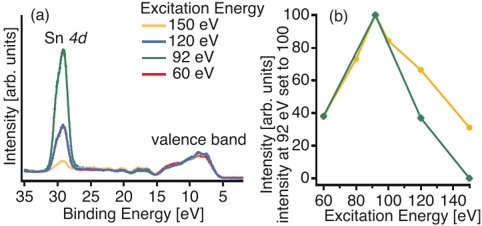
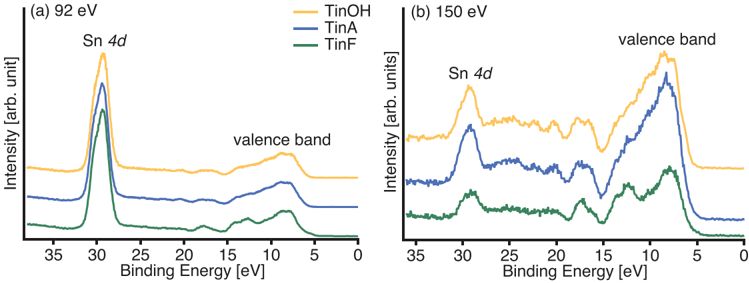
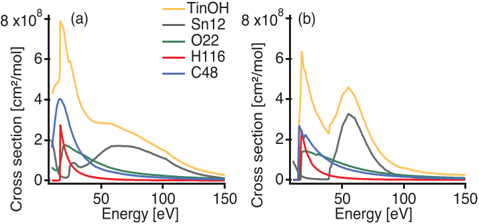
Tin is a suitable element for inclusion in extreme ultraviolet photoresists because of its relatively high-absorption cross section at 92 eV. The electrons emitted after photon absorption are expected to generate secondary electrons in the solid film. In this way, several pathways lead to reactive species that cause a solubility switch. Here, we report the photoelectron spectra of tin oxo cage photoresists over the photon energy range 60–150 eV, and the relative yields of photoelectrons from the valence band of the resist, from the Sn 4d orbitals, and of inelastically scattered electrons. The experimental excitation spectra differ considerably from those predicted by commonly used database cross section values, and from the combined computed subshell spectra: the maximum efficiency of ionization of Sn 4d both in the photoresists and in Sn metal occurs near the industrially relevant EUV wavelength of 13.5 nm.
Overview
The claims and statistics of this paper haven’t been checked yet.
Free: it reads the open-access text and checks the first 5 claims that cite a source we can check. Create a free account to check every claim.
Integrity signals
Registry
Cites
Statistics
Figures
Verification
Claims the paper makes
The claims and statistics of this paper haven’t been checked yet.
Free: it reads the open-access text and checks the first 5 claims that cite a source we can check. Create a free account to check every claim.
Claims other papers make about this one
Each is checked against this paper’s own text: does it say what the citing paper says it does?
The source backs part of the claim, not all of it — or backs it for a different population, condition or comparison.
In the citing paper
“A study indicated that the reactivity of the clusters was more closely related to the strength of the tin–carbon bonds.”
From Recent Advances in Metal-Oxide-Based Photoresists for EUV Lithography (2024) · cites this paper as [93]
Experimental — accuracy not yet measuredThe check wasn’t confident either way, so it gives no verdict — never disputed.
In the citing paper
“Specifically, the cluster with the weakest tin–allyl bond exhibited the highest sensitivity.”
From Recent Advances in Metal-Oxide-Based Photoresists for EUV Lithography (2024) · cites this paper as [93]
Experimental — accuracy not yet measuredThe check wasn’t confident either way, so it gives no verdict — never disputed.
In the citing paper
“Furthermore, larger counterions would increase the spacing between clusters, thereby hindering tin–tin bond formation and decreasing the resist sensitivity [93] (Figure 16b).”
From Recent Advances in Metal-Oxide-Based Photoresists for EUV Lithography (2024) · cites this paper as [93]
Experimental — accuracy not yet measuredThe check wasn’t confident either way, so it gives no verdict — never disputed.
In the citing paper
“Studies have shown that depending on the type of counteranion attached to the cluster, the photochemical behavior can differ significantly, affecting the sensitivity and resolution of the photoresist.”
From Recent Advances in Metal-Oxide-Based Photoresists for EUV Lithography (2024) · cites this paper as [93]
Experimental — accuracy not yet measured
Self-check
Percentages, sums and reported differences re-computed from the paper’s own numbers.
The self-check needs the paper’s full text.
Citations
Cites
Henke, B. L., Gullikson, E. M., & Davis, J. C. (1993) · Atomic Data and Nuclear Data Tables · doi:10.1006/adnd.1993.1013 · Cited by 6,285 · cited 1×
“16 In order to estimate the photoabsorption and photo-emission cross sections of the elements, values from the Centre for X-ray Optics, Berkeley database 17 often reasonably reproduce experimental data, 18–21 especially for the higher photon energies.”
Makuła, P., Pacia, M., & Macyk, W. (2018) · The Journal of Physical Chemistry Letters · doi:10.1021/acs.jpclett.8b02892 · Cited by 5,157 · cited 1×
“38) of the UV/Vis absorption spectrum (see the supplementary material Fig.”
Atomic subshell photoionization cross sections and asymmetry parameters: 1 ⩽ Z ⩽ 103
Yeh, J. J., & Lindau, I. (1985) · Atomic Data and Nuclear Data Tables · doi:10.1016/0092-640x(85)90016-6 · Cited by 4,978
Energy‐Level Alignment at Organic/Metal and Organic/Organic Interfaces
Braun, S., Salaneck, W. R., & Fahlman, M. (2009) · Advanced Materials · doi:10.1002/adma.200802893 · Cited by 1,593
Atomic calculation of photoionization cross-sections and asymmetry parameters
Yeh, J. J. (1993) · Medical Entomology and Zoology · Cited by 366
Radiation Chemistry in Chemically Amplified Resists
Kozawa, T., & Tagawa, S. (2010) · Japanese Journal of Applied Physics · doi:10.1143/jjap.49.030001 · Cited by 360 · cited 1×
“24,45 After the initial photoionization at 92eV, the primary electrons emitted from the occupied molecular orbitals have kinetic energies up to 80eV.”
Review of recent advances in inorganic photoresists
Luo, C., Xu, C., Lv, L., Li, H., Huang, X., & Liu, W. (2020) · RSC Advances · doi:10.1039/c9ra08977b · Cited by 207
Photolithographic properties of tin-oxo clusters using extreme ultraviolet light (13.5nm)
Cardineau, B., Del Re, R., Marnell, M., Al-Mashat, H., Vockenhuber, M., Ekinci, Y., Sarma, C., Freedman, D. A., & Brainard, R. L. (2014) · Microelectronic Engineering · doi:10.1016/j.mee.2014.04.024 · Cited by 202
Manouras, T., & Argitis, P. (2020) · Nanomaterials · doi:10.3390/nano10081593 · Cited by 196
Hydrolysis of Monobutyltin Trialkoxides: Synthesis and Characterizations of {(BuSn)12O14(OH)6}(OH)2
Banse, F., Ribot, F. O., Tolédano, P., Maquet, J., & Sánchez, C. (1995) · Inorganic Chemistry · doi:10.1021/ic00129a023 · Cited by 151
Energy level alignment at organic/metal interfaces: Dipole and ionization potential
Peisert, H., Knupfer, M., & Fink, J. (2002) · Applied Physics Letters · doi:10.1063/1.1509472 · Cited by 151
Bespalov, I., Zhang, Y., Haitjema, J., Tromp, R. M., van der Molen, S. J., Brouwer, A. M., Jobst, J., & Castellanos, S. (2020) · ACS Applied Materials & Interfaces · doi:10.1021/acsami.9b19004 · Cited by 112
Absorption coefficient of metal-containing photoresists in the extreme ultraviolet
Fallica, R., Haitjema, J., Wu, L., Castellanos Ortega, S., Brouwer, A. M., & Ekinci, Y. (2018) · Journal of Micro/Nanopatterning Materials and Metrology · doi:10.1117/1.jmm.17.2.023505 · Cited by 105
Self-citationAn HAXPES study of Sn, SnS, SnO and SnO2
Fondell, M., Gorgoi, M., Boman, M., & Lindblad, A. (2014) · Journal of Electron Spectroscopy and Related Phenomena · doi:10.1016/j.elspec.2014.07.012 · Cited by 101 · cited 1×
“The comparison between the computed DOS and the experimental spectrum can be used to identify plasmon components of the experimental spectrum on the high binding energy side (as has been done for other Sn compounds 34,35 ).”
Fallica, R., Stowers, J. K., Grenville, A., Frommhold, A., Robinson, A. P. G., & Ekinci, Y. (2016) · Journal of Micro/Nanolithography, MEMS, and MOEMS · doi:10.1117/1.jmm.15.3.033506 · Cited by 81
EUV Lithography, Second Edition
(2018) · SPIE eBooks · doi:10.1117/3.2305675 · Cited by 77
Extreme ultraviolet patterning of tin-oxo cages
Haitjema, J., Zhang, Y., Vockenhuber, M., Kazazis, D., Ekinci, Y., & Brouwer, A. M. (2017) · Journal of Micro/Nanolithography, MEMS, and MOEMS · doi:10.1117/1.jmm.16.3.033510 · Cited by 72
High NA EUV lithography: Next step in EUV imaging
van Setten, E., Bottiglieri, G., McNamara, J., van Schoot, J., Troost, K., Zekry, J., Fliervoet, T. F., Hsu, S., Zimmermann, J., Roesch, M., et al. (2019) · Extreme Ultraviolet (EUV) Lithography · doi:10.1117/12.2514952 · Cited by 71
Cooper, G., Green, J. C., Payne, M. P., Dobson, B. R., & Hillier, I. H. (1987) · Journal of the American Chemical Society · doi:10.1021/ja00247a003 · Cited by 70 · cited 1×
“44 It is commonly accepted that the chemistry of EUV photoresists is electron-driven.”
Zhang, Y., Haitjema, J., Liu, X., Johansson, F., Lindblad, A., Castellanos, S., Ottosson, N., & Brouwer, A. M. (2017) · Journal of Micro/Nanopatterning Materials and Metrology · doi:10.1117/1.jmm.16.2.023510 · Cited by 67
Self-citationOlney, T. N., Cooper, G., & Brion, C. E. (1998) · Chemical Physics · doi:10.1016/s0301-0104(97)00368-6 · Cited by 53 · cited 1×
“43 This suggest that improved methods are needed for a more accurate computational picture of 4 d ionization.”
Closser, K. D., Ogletree, D. F., Naulleau, P., & Prendergast, D. (2017) · The Journal of Chemical Physics · doi:10.1063/1.4981815 · Cited by 52 · cited 2×
“16 From a theoretical point-of-view, Cooper and co-workers point out that going beyond the central field approximation and treating electron–electron interaction with more sophistication can shift the maxima of cross sections toward higher kinetic energies.”
Mechanistic insights in Zr-and Hf-based molecular hybrid EUV photoresists
Wu, L., Baljozovic, M., Portale, G., Kazazis, D., Vockenhuber, M., Jung, T., Ekinci, Y., & Castellanos Ortega, S. (2019) · Journal of Micro/Nanopatterning Materials and Metrology · doi:10.1117/1.jmm.18.1.013504 · Cited by 49
Kwark, Y.-J., Bravo-Vasquez, J. P., Chandhok, M., Cao, H., Deng, H., Gullikson, E., & Ober, C. K. (2006) · Journal of Vacuum Science & Technology B: Microelectronics and Nanometer Structures Processing, Measurement, and Phenomena · doi:10.1116/1.2214708 · Cited by 44 · cited 1×
“16 In order to estimate the photoabsorption and photo-emission cross sections of the elements, values from the Centre for X-ray Optics, Berkeley database 17 often reasonably reproduce experimental data, 18–21 especially for the higher photon energies.”
Low Dose Photoelectron Spectroscopy at BESSY II: Electronic structure of matter in its native state
Giangrisostomi, E., Ovsyannikov, R., Sorgenfrei, F., Zhang, T., Lindblad, A., Sassa, Y., Cappel, U. B., Leitner, T., Mitzner, R., Svensson, S., et al. (2017) · Journal of Electron Spectroscopy and Related Phenomena · doi:10.1016/j.elspec.2017.05.011 · Cited by 44
Lysaght, M., Kilbane, D., Murphy, N., Cummings, A., Dunne, P. A., & O’Sullivan, G. (2005) · Physical Review A · doi:10.1103/physreva.72.014502 · Cited by 43
Photoreactions of Tin Oxo Cages, Model EUV Photoresists
Haitjema, J., Zhang, Y., Ottosson, N., & Brouwer, A. M. (2017) · Journal of Photopolymer Science and Technology · doi:10.2494/photopolymer.30.99 · Cited by 43
Thermal and radiation chemistry of butyltin oxo hydroxo: A model inorganic photoresist
Frederick, R. T., Saha, S., Trey Diulus, J., Luo, F., Amador, J. M., Li, M., Park, D.-H., Garfunkel, E. L., Keszler, D. A., & Herman, G. S. (2019) · Microelectronic Engineering · doi:10.1016/j.mee.2018.11.011 · Cited by 42
Photo-induced Fragmentation of a Tin-oxo Cage Compound
Haitjema, J., Wu, L., Giuliani, A., Nahon, L., Castellanos, S., & Brouwer, A. M. (2018) · Journal of Photopolymer Science and Technology · doi:10.2494/photopolymer.31.243 · Cited by 30
Effects of the open-shell electronic structure in 4d photoionization and Auger decay of atomic Sn
Huttula, M., Kukk, E., Heinäsmäki, S., Jurvansuu, M., Fritzsche, S., Aksela, H., & Aksela, S. (2004) · Physical Review A · doi:10.1103/physreva.69.012702 · Cited by 26
Buitrago, E., Nagahara, S., Yildirim, O., Nakagawa, H., Tagawa, S., Meeuwissen, M., Nagai, T., Naruoka, T., Verspaget, C., Hoefnagels, R., et al. (2016) · Journal of Micro/Nanopatterning Materials and Metrology · doi:10.1117/1.jmm.15.3.033502 · Cited by 25
EUV photolithography: resist progress in metal–organic complex photoresists
Xu, H., Kosma, V., Sakai, K., Giannelis, E. P., & Ober, C. K. (2018) · Journal of Micro/Nanolithography, MEMS, and MOEMS · doi:10.1117/1.jmm.18.1.011007 · Cited by 24
EUV Photoresists: A Progress Report and Future Prospects
Lio, A. (2019) · Synchrotron Radiation News · doi:10.1080/08940886.2019.1634431 · Cited by 22
Ti, Zr, and Hf-based molecular hybrid materials as EUV photoresists
Castellanos Ortega, S., Wu, L., Baljozovic, M., Portale, G., Kazazis, D., Vockenhuber, M., Ekinci, Y., & Jung, T. (2018) · Extreme Ultraviolet (EUV) Lithography IX · doi:10.1117/12.2297167 · Cited by 14
Bice, J. E., Tan, K. H., Bancroft, G. M., & Tse, J. S. (1987) · Inorganic Chemistry · doi:10.1021/ic00271a028 · Cited by 13
XUV Induced Bleaching of a Tin Oxo Cage Photoresist Studied by High Harmonic Absorption Spectroscopy
Sadegh, N., van der Geest, M. L. S., Haitjema, J., Campi, F., Castellanos, S., Kraus, P. M., & Brouwer, A. M. (2020) · Journal of Photopolymer Science and Technology · doi:10.2494/photopolymer.33.145 · Cited by 13 · cited 1×
“16 In order to estimate the photoabsorption and photo-emission cross sections of the elements, values from the Centre for X-ray Optics, Berkeley database 17 often reasonably reproduce experimental data, 18–21 especially for the higher photon energies.”
The Path to Better Understanding Stochastics in EUV Photoresist
Simone, D. D., Vesters, Y., & Vandenberghe, G. (2018) · Journal of Photopolymer Science and Technology · doi:10.2494/photopolymer.31.651 · Cited by 11
Photoelectron study of tetramethyl stannane using synchrotron radiation
Novak, I., Benson, J. M., Svensson, A., & Potts, A. W. (1987) · Chemical Physics Letters · doi:10.1016/0009-2614(87)85193-x · Cited by 10
Calibration of a MOx-specific EUV photoresist lithography model
Needham, C. D., Narasimhan, A. K., Welling, U., Melvin, L. S., Schepper, P. D., Wouters, J., Severi, J., Simone, D. D., & Meyers, S. T. (2020) · SPIE Conference on Extreme Ultraviolet (EUV) Lithography · doi:10.1117/12.2552151 · Cited by 10 · cited 1×
“All spectra have been normalized so that the area of the valence band (the energy range 5–15eV) is set to unity.”
Novel Sn-based photoresist for high aspect ratio patterning
Li, M., Manichev, V., Garfunkel, E. L., Gustafsson, T., Nyman, M., Hutchison, D. C., Feldman, L. C., & Yu, F. (2018) · Advances in Patterning Materials and Processes · doi:10.1117/12.2297440 · Cited by 9 · cited 1×
“6,7 8–15 The elements with atomic numbers 49 to 54 (In, Sn, Sb, Te, I, and Xe) have large photoionization cross sections at 92eV that mainly derive from the core level excitation of 4 d electrons.”
Novak, I., & Potts, A. W. (1983) · Journal of the Chemical Society Dalton Transactions · doi:10.1039/dt9830002211 · Cited by 7 · cited 1×
“For SnF 2 ca. 2.8eV, smaller binding energies were found in the solid state than in the gas phase, 41 and if the same difference applies for the tin oxo cages and Sn(CH 3 ) 4 , we find that the 4 d electrons are somewhat more strongly bound in the tin oxo cages than in Sn(CH 3 ) 4 .”
Role of excess ligand and effect of thermal treatment in hybrid inorganic-organic EUV resists
Mattson, E. C., Rupich, S. M., Cabrera, Y., & Chabal, Y. J. (2018) · Extreme Ultraviolet (EUV) Lithography · doi:10.1117/12.2300064 · Cited by 7
HAXPES study of Sn core levels and their plasmon loss features
Fondell, M., Gorgoi, M., Boman, M., & Lindblad, A. (2014) · Results in Physics · doi:10.1016/j.rinp.2014.08.006 · Cited by 6 · cited 1×
“The comparison between the computed DOS and the experimental spectrum can be used to identify plasmon components of the experimental spectrum on the high binding energy side (as has been done for other Sn compounds 34,35 ).”
Excitation selectivity in model tin-oxo resist: a computational chemistry perspective
Jonathan, H., Wang, H., Prendergast, D., Neureuther, A. R., & Naulleau, P. P. (2020) · SPIE Conference on Extreme Ultraviolet (EUV) Lithography · doi:10.1117/12.2553055 · Cited by 6
The energy-dependence of the Au 4f photoionization cross-section
Johansson, L. I., Hecht, M. H., & Lindau, I. (1980) · Journal of Electron Spectroscopy and Related Phenomena · doi:10.1016/0368-2048(80)80053-3 · Cited by 4
Research works printed but not linked: 2
- N. Fu, Y. Liu, X. Ma, and Z. Chen, "EUV lithography: State-of-the-art review," J. Microelectron. Manuf. 2, 1-6 (2019).
- M. J. Frisch, G. W. Trucks, H. B. Schlegel, G. E. Scuseria, M. A. Robb, J. R. Cheeseman, G. Scalmani, V. Barone, G. A. Petersson, H. Nakatsuji, X. Li, M. Caricato, A. V. Marenich, J. Bloino, B. G. Janesko, R. Gomperts, B. Mennucci, H. P. Hratchian, J. V. Ortiz, A. F. Izmaylov, J. L. Sonnenberg, D. Williams- Young, F. Ding, F. Lipparini, F. Egidi, J. Goings, B. Peng, A. Petrone, T. Henderson, D. Ranasinghe, V. G. Zakrzewski, J. Gao, N. Rega, G. Zheng, W. Liang, M. Hada, M. Ehara, K. Toyota, R. Fukuda, J. Hasegawa, M. Ishida, T. Nakajima, Y. Honda, O. Kitao, H. Nakai, T. Vreven, K. Throssell, J. A. Montgomery, Jr., J. E. Peralta, F. Ogliaro, M. J. Bearpark, J. J. Heyd, E. N. Brothers, K. N. Kudin, V. N. Staroverov, T. A. Keith, R. Kobayashi, J. Normand, K. Raghavachari, A. P. Rendell, J. C. Burant, S. S. Iyengar, J. Tomasi, M. Cossi, J. M. Millam, M. Klene, C. Adamo, R. Cammi, J. W. Ochterski, R. L. Martin, K. Morokuma, O. Farkas, J. B. Foresman, and D. J. Fox, Gaussian16 Revision A.03 (Gaussian Inc., Wallingford, CT, 2016).
Cited by
Non-alkyl tin-oxo clusters as new-type patterning materials for nanolithography
Wang, D., Yi, X., & Zhang, L. (2022) · Science China Chemistry · doi:10.1007/s11426-021-1092-2 · Cited by 42
Recent progress of inorganic photoresists for next-generation EUV lithography
Kang, Y. K., Lee, S. J., Eom, S., Kim, B. G., Hwang, C.-C., & Kim, M. (2024) · Journal of Materials Chemistry C · doi:10.1039/d4tc02671c · Cited by 44
UV and VUV-induced fragmentation of tin-oxo cage ions
Haitjema, J., Wu, L., Giuliani, A., Nahon, L., Castellanos, S., & Brouwer, A. M. (2021) · Physical Chemistry Chemical Physics · doi:10.1039/d1cp03148a · Cited by 36
Key Challenges and Opportunities for Advanced Extreme Ultraviolet Lithography Photoresist Materials
Li, M., & Aqad, E. (2025) · Advanced Functional Materials · doi:10.1002/adfm.202420962 · Cited by 33
Recent Advances in Metal-Oxide-Based Photoresists for EUV Lithography
Hasan, M. W., Deeb, L., Kumaniaev, S., Wei, C., & Wang, K. (2024) · Micromachines · doi:10.3390/mi15091122 · Cited by 35
Metadata
- Authors
- Zhang, Y., Haitjema, J., Castellanos, S., Lugier, O., Sadegh, N., Ovsyannikov, R., Giangrisostomi, E., Johansson, F. O. L., Berggren, E., Lindblad, A., & Brouwer, A. M.
- Affiliations
- Advanced Research Center for Nanolithography (Netherlands) (NL)
- Helmholtz-Zentrum Berlin für Materialien und Energie (DE)
- Uppsala University (SE)
- Corresponding author
- Lindblad, Andreas
- Brouwer, Albert M.
- ORCID
- Venue
- Applied Physics Letters
- Publisher
- AIP Publishing
- Published
- 2021-04-26
- Volume
- 118
- Issue
- 17
- ISSN
- 0003-6951 (ISSN-L)
- 1077-3118
- OpenAlex
- W3157377921
- Cited by
- 35
- References
- 45
- Citations by year
- 2026: 7 · 2025: 8 · 2024: 14 · 2023: 2 · 2022: 2 · 2021: 2
- FWCI
- 1.47
- Type
- journal article
- Language
- en
- Open access
- hybrid
- doi.org
- Licence
- cc-by
- creativecommons.org/licenses/by/4.0/ (vor, 1 d)
- creativecommons.org/licenses/by/4.0/ (tdm, 1 d)
- Locations
- Applied Physics Letters (publishedVersion, cc-by)
- ARCNL Institutional Repository (ARCNL) (submittedVersion)
- Uppsala University Publications (Uppsala University) (submittedVersion, other-oa)
- UvA-DARE (University of Amsterdam) (submittedVersion, cc-by)
- HZB Repository (Helmholtz-Zentrum Berlin für Materialien und Energie GmbH (HZB)) (submittedVersion, other-oa)
- Data Archiving and Networked Services (DANS) (submittedVersion, other-oa)
- Funders
- Swedish Science Council (2018-05336)
- Helmholtz Zentrum Berlin beamtime (181-06674-ST)
- Topics
- Physical Sciences › Engineering › Electrical and Electronic Engineering › Advancements in Photolithography Techniques
- Physical Sciences › Materials Science › Surfaces, Coatings and Films › Electron and X-Ray Spectroscopy Techniques
- Physical Sciences › Physics and Astronomy › Radiation › X-ray Spectroscopy and Fluorescence Analysis
- Keywords
- photoelectron spectra, valence band, inelastically scattered electrons, photoionization efficiency
About these checks
Registry, retraction, Cites and statistics results are computed, not judged, with one exception: a printed reference that no index lists is read once by a model before it counts as a citation error. Claims are extracted by a model and kept only when their quote appears verbatim in the text; each cited source is then checked, with a model’s help, for whether it says what the claim relies on. Those verdicts can be wrong — read the claim’s quote and the cited source before relying on one.
Statistics and arithmetic are recomputed, not judged.
Confidence bands are shown only for fields calibrated on our annotated test set. None is calibrated yet, so no band is shown.
What counts as a claim ›How we measure confidence ›How we check this ›
Are you an author, or do you see a problem with this page? Request a review
Data sources
Bibliographic data: Semantic Scholar, OpenAlex, Crossref.
Contains information from the Semantic Scholar Academic Graph Datasets, made available under the ODC Attribution License (ODC-BY 1.0).
Semantic Scholar’s data is described in: Kinney, R., et al. (2023). The Semantic Scholar Open Data Platform. arXiv:2301.10140.
