

Situating the default-mode network along a principal gradient of macroscale cortical organization
Open accessThe DOI matches its Crossref record; 100 of the 100 references it cites were found in a registry or an index; 26 of the 58 sources its claims cite were checked for support.
Abstract
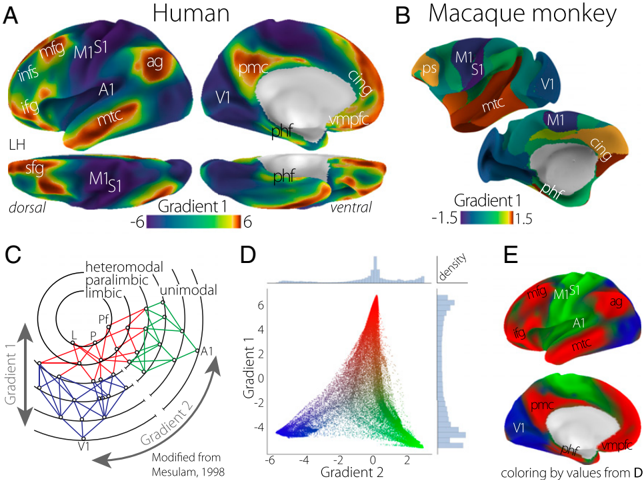
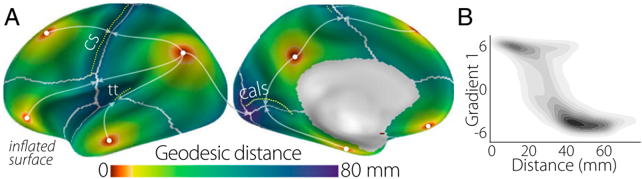
Understanding how the structure of cognition arises from the topographical organization of the cortex is a primary goal in neuroscience. Previous work has described local functional gradients extending from perceptual and motor regions to cortical areas representing more abstract functions, but an overarching framework for the association between structure and function is still lacking. Here, we show that the principal gradient revealed by the decomposition of connectivity data in humans and the macaque monkey is anchored by, at one end, regions serving primary sensory/motor functions and at the other end, transmodal regions that, in humans, are known as the default-mode network (DMN). These DMN regions exhibit the greatest geodesic distance along the cortical surface-and are precisely equidistant-from primary sensory/motor morphological landmarks. The principal gradient also provides an organizing spatial framework for multiple large-scale networks and characterizes a spectrum from unimodal to heteromodal activity in a functional metaanalysis. Together, these observations provide a characterization of the topographical organization of cortex and indicate that the role of the DMN in cognition might arise from its position at one extreme of a hierarchy, allowing it to process transmodal information that is unrelated to immediate sensory input.
Overview
CoChat Summary
TL;DR
The paper identifies a principal connectivity gradient in human and macaque cortex that runs from primary/unimodal sensory-motor regions to transmodal default-mode network (DMN) regions. It argues that the DMN’s position at one extreme, maximally distant from primary areas, helps explain its role in abstract, stimulus-independent cognition.
Key findings
- A principal gradient of functional connectivity, derived from 91,282 cortical/subcortical grayordinates at 2 mm resolution in 820 healthy adults (1 hour resting-state fMRI per participant, HCP S900), is anchored by primary/unimodal visual, somatosensory/motor, and auditory regions at one end and DMN regions at the other.
- Seven peak DMN nodes are maximally distant along the cortical surface from primary sensory/motor landmarks; four are equidistant from the central sulcus, and geodesic distance from DMN peaks relates to the principal gradient with \(R^2 = 0.55\). Beyond 40 mm from DMN peaks, cortex exclusively consists of unimodal regions.
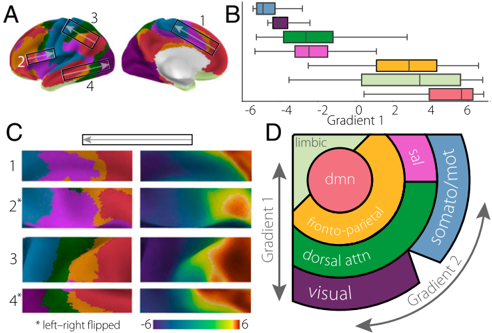
- The principal gradient orders the 7-network Yeo parcellation, with DMN at one extreme and visual/motor networks at the other; the limbic network is an exception, spanning a wide range of values.
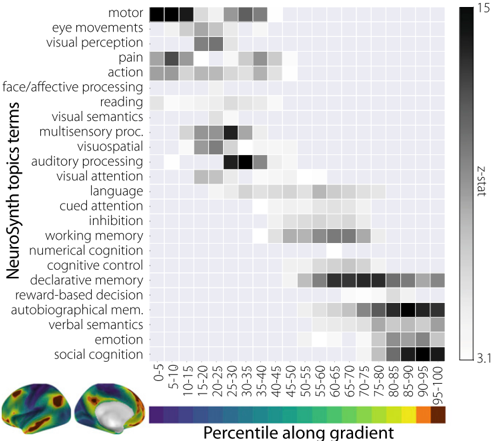
- A NeuroSynth meta-analysis using 24 topic terms shows a functional shift along the gradient: motor, visual perception, multisensory, and auditory terms at the unimodal end; cued attention, inhibition, and working memory in the middle; and social cognition, verbal semantics, and autobiographical memory at the DMN end.
Methods
- Human data were from the Human Connectome Project dense connectome S900 release: 91,282 grayordinates at 2 mm resolution, based on 1 hour of resting-state fMRI from 820 healthy adults, with no further processing beyond HCP minimal preprocessing including 2 mm FWHM smoothing.
- The main analysis used diffusion embedding, a nonlinear dimensionality reduction method, to extract connectivity gradients (“connectopies”) rather than discrete network parcellations; the same embedding was applied to a publicly available macaque tract-tracing database.
- Additional analyses calculated minimum geodesic distance from 7 DMN peak nodes, related gradient values to the 7-network Yeo parcellation, and performed a NeuroSynth meta-analysis with 24 topic terms across 5-percentile bins of the principal gradient.
Limitations
- Stated: the limbic network captures an extensive range of gradient values, which the authors suggest may be due to low signal-to-noise in the original parcellation data and may not accurately reflect its constituent regions’ connectivity.
- Stated: future studies are needed to better characterize transitions between large-scale connectivity patterns and to identify where processing occurs stepwise versus gradientially.
- Evident from the text: the macaque cross-species correspondence is described as “initial evidence” that the axis may be phylogenetically conserved, and the analyses are descriptive/spatial rather than causal tests of the proposed hierarchy.
Model-written summary. Check it against the paper before relying on it.
Integrity signals
Registry
Cites
Statistics
Figures

Verification
Claims the paper makes
14 Valid · 2 Not valid · 11 Not checked · 50 Own results and interpretations
The cited sources support only part of this claim — read each source’s verdict below.
In the paper
“Second, the location of the DMN as equidistant from all sensory/motor systems is aligned with its broad range of functions that require integration between multiple sensory systems, including episodic [51] and semantic memory [52-54], social cognition [55, 56], goal-directed working memory tasks [26, 32, 33, 35] and reward-guided decision making [57, 58].”
What the sources say
- Supportedcites [51] Schacter DL, Addis DR (2007) The cognitive neuroscience of constructive memory: remembering the past and imagining the future. Philos Trans R Soc Lond B Biol Sci 362(1481):773786. 661 662 663 source
Split into 2 atoms — 2 confirmed, 0 partially supported, 0 disputed, 0 misattributed, 0 unverifiable. Expand the claim to see per-atom verdicts.
- Supportedcites [52] Binder JR, Desai RH, Graves WW, Conant LL (2009) Where is the semantic system? a critical review and meta-analysis of 120 functional neuroimaging studies. Cereb Cortex 19(12):27672796. 664 665 source
The citation to this paper is attached to the semantic-memory part of the sentence, not the other listed functions. “Semantic Processing and the ‘Default Network’” says the semantic system closely resembles the default network, while “The Semantic System of the Human Brain” describes its regions as receiving multimodal input and supporting integrative processes. Page numbers are unavailable in our copy. (LLM, conf=0.91)
- Not checked — no full text of the sourcecites [53] Jefferies E (2013) The neural basis of semantic cognition: converging evidence from neuropsychology, neuroimaging and TMS. Cortex 49(3):611-625. 666 source
- Partly supportedcites [54] Constantinescu AO, O'Reilly JX, Behrens TEJ (2016) Organizing conceptual knowledge in humans with a gridlike code. Science 352(6292):1464-8. sourceExperimental — accuracy not yet measured
Split into 2 atoms — 1 confirmed, 1 partially supported, 0 disputed, 0 misattributed, 0 unverifiable. Expand the claim to see per-atom verdicts.
- Not checked — no full text of the sourcecites [55] Amodio DM, Frith CD (2006) Meeting of minds: the medial frontal cortex and social cognition. Nat Rev Neurosci 7(4):268-277. source
- Supportedcites [56] Amft M et al. (2015) Definition and characterization of an extended social-affective default network. Brain Struct Funct 220(2):1031-49. source
Split into 2 atoms — 2 confirmed, 0 partially supported, 0 disputed, 0 misattributed, 0 unverifiable. Expand the claim to see per-atom verdicts.
plainstates an association- Asserted: passes — The authors put it forward as true.
- Checkable: passes — It can be checked against evidence.
- Load-bearing: passes — The paper’s conclusions depend on it.
- Based: passes — The paper gives a reason why it holds.
- Supported
The cited sources support only part of this claim — read each source’s verdict below.
In the paper
“The DMN is at a maximal distance from systems involved in perception and action in both functional connectivity and anatomical space, indicating that the neural activity in these regions is likely to be comparably insulated from direct environmental input [49, 50].”
What the sources say
- Partly supportedcites [49] Kiebel SJ, Daunizeau J, Friston KJ (2008) A hierarchy of time-scales and the brain. PLoS Comput Biol 4(11):e1000209. 659 660 sourceExperimental — accuracy not yet measured
The Introduction and Discussion > Neuroscience Account describe higher cortical levels as farther from sensory input and as representing slower-changing context. But the paper does not identify the DMN as such a level or establish that activity in DMN regions is insulated from direct environmental input; its Conclusion says representations at different levels interact. (LLM, conf=0.78)
- Partly supportedcites [50] Friston K (2013) Life as we know it. J R Soc Interface 10(86):20130475. sourceExperimental — accuracy not yet measured
The Heuristic proof (page unavailable) says a Markov blanket insulates internal states from direct access to external states, and the Proof of principle > The Markov blanket section reports no direct connections between those states in a simulation. The paper does not identify DMN regions as those internal states or establish that DMN activity is insulated from environmental input. (LLM, conf=0.84)
hedged- Asserted: passes — The authors put it forward as true.
- Checkable: passes — It can be checked against evidence.
- Load-bearing: passes — The paper’s conclusions depend on it.
- Based: passes — The paper gives a reason why it holds.
- Partly supported
Every source the paper cites for this claim was checked and supports it.
In the paper
“The principal gradient illustrates a broader topographic organization of large-scale connectivity [38] that accounts for the spatial arrangement of local processing streams throughout the cerebral cortex.”
What the sources say
- Supportedcites [38] Jbabdi S, Sotiropoulos SN, Behrens TE (2013) The topographic connectome. Curr Opin Neurobiol 23(2):207-15. 643 644 source
The Introduction (page unavailable) describes topographic, spatial patterns in large-scale connections between grey-matter regions. The citation is attached to that broader organization of connectivity; the sentence’s interpretation of the principal gradient is the citing authors’ framing. (LLM, conf=0.87)
plainstates a cause- Asserted: passes — The authors put it forward as true.
- Checkable: passes — It can be checked against evidence.
- Load-bearing: passes — The paper’s conclusions depend on it.
- Based: passes — The paper gives a reason why it holds.
- Supported
The sources with a verdict support this claim; the rest weren’t checked yet, have no full text we could read, or their verdicts aren’t rated yet.
In the paper
“Notably, our results are consistent with a recent modification of the rostral-caudal processing gradient described within lateral frontal cortex [59, 60].”
What the sources say
- Supportedcites [59] Goulas A, Uylings HBM, Stiers P (2014) Mapping the hierarchical layout of the structural network of the macaque prefrontal cortex. Cereb Cortex 24(5):1178-94. 684 source
In the ABH Optimization section (page unavailable), the paper reports that the strict anterior–posterior gradient was not observed even when the analysis was limited to lateral prefrontal regions. In the Relation Between Asymmetry-Based Hierarchy and Laminar-Based Hierarchy section (page unavailable), it proposes a laminar-based hierarchy as a more plausible basis for models of that gradient. This supports the citation's identification of a modification; the citing authors' statement that their own results are consistent with it is their interpretation. (LLM, conf=0.86)
- Not checked — no full text of the sourcecites [60] Nee DE, D'Esposito M (2016) The hierarchical organization of the lateral prefrontal cortex. eLife 5. source
plainstates an association- Asserted: passes — The authors put it forward as true.
- Checkable: passes — It can be checked against evidence.
- Load-bearing: unclear — It is unclear whether the paper’s conclusions depend on it.
- Based: passes — The paper gives a reason why it holds.
- Supported
A result the paper reports from its own data — it cites no other source for it, so there is none to check. The quote shows it is in the paper.
In the paper
“Here we show that the principal gradient revealed by the decomposition of connectivity data in humans and the macaque monkey is anchored, at one end, by regions serving primary sensory/motor functions and, at the other, by transmodal regions that, in humans, are known as the default-mode network (DMN).”
- Also stated in: § Situating the default-mode network in a principal gradient of macroscale cortical organization · p. 2 · plain
“We describe an overarching organization of large-scale connectivity that situates the default-mode network at the opposite end of a spectrum from primary sensory and motor regions.”
- Also stated in: § Results · p. 3 · plain
“The principal gradient (Figure 1A), which accounts for the greatest variance in connectivity in the human brain (see Figure S1), is anchored at one end by the primary and unimodal visual, somatosensory/motor, and auditory regions. At the other end are regions including the angular gyrus, rostral anterior cingulate, posteromedial cortex, middle temporal gyrus, and middle and superior frontal gyri -”
boostedstates an association- Asserted: passes — The authors put it forward as true.
- Checkable: passes — It can be checked against evidence.
- Load-bearing: passes — The paper’s conclusions depend on it.
- Based: passes — The paper gives a reason why it holds.
- Also stated in: § Situating the default-mode network in a principal gradient of macroscale cortical organization · p. 2 · plain
33 more claims
Create a free account to see all 77 claims and every source verdict.
- The quote only partly states this claim. 1
- It may state two separate claims as one. 24
- Probably not a substantial claim. 21
Claims other papers make about this one
Each is checked against this paper’s own text: does it say what the citing paper says it does?
The cited source says what the claim attributes to it.
In the citing paper
“Because the DMN integrates information from multiple pathways (Binder and Desai 2011; Margulies et al. 2016), we propose that, as stimulus information travels up the cortical hierarchy of timescales during encoding, from low-level sensory areas up to high-level areas, a form of compression takes place (Hasson et al. 2015).”
From How We Transmit Memories to Other Brains: Constructing Shared Neural Representations Via Communication (2017) · cites this paper as Margulies et al. 2016
Citations
Cites
A Global Geometric Framework for Nonlinear Dimensionality Reduction
Tenenbaum, J. B., Silva, V. D., & Langford, J. C. (2000) · Science · doi:10.1126/science.290.5500.2319 · Cited by 13,585
Jenkinson, M., Bannister, P., Brady, M., & Smith, S. (2002) · NeuroImage · doi:10.1006/nimg.2002.1132 · Cited by 11,888
Jenkinson, M., Beckmann, C. F., Behrens, T. E. J., Woolrich, M. W., & Smith, S. M. (2012) · NeuroImage · doi:10.1016/j.neuroimage.2011.09.015 · Cited by 11,314
A tutorial on spectral clustering
von Luxburg, U. (2007) · Statistics and Computing · doi:10.1007/s11222-007-9033-z · Cited by 10,349
Fischl, B. (2012) · NeuroImage · doi:10.1016/j.neuroimage.2012.01.021 · Cited by 9,526
The organization of the human cerebral cortex estimated by intrinsic functional connectivity
Thomas Yeo, B. T., Krienen, F. M., Sepulcre, J., Sabuncu, M. R., Lashkari, D., Hollinshead, M., Roffman, J. L., Smoller, J. W., Zöllei, L., Polimeni, J. R., et al. (2011) · Journal of Neurophysiology · doi:10.1152/jn.00338.2011 · Cited by 9,182
The organization of the human cerebellum estimated by intrinsic functional connectivity
Buckner, R. L., Krienen, F. M., Castellanos, A., Diaz, J. C., & Yeo, B. T. T. (2011) · Journal of Neurophysiology · doi:10.1152/jn.00339.2011 · Cited by 7,304
Separate visual pathways for perception and action
Goodale, M. A., & Milner, A. D. (1992) · Trends in Neurosciences · doi:10.1016/0166-2236(92)90344-8 · Cited by 6,519
Functional connectivity in the resting brain: a network analysis of the default mode hypothesis
Greicius, M. D., Krasnow, B., Reiss, A. L., & Menon, V. (2003) · Proceedings of the National Academy of Sciences · doi:10.1073/pnas.0135058100 · Cited by 6,358
The WU-Minn Human Connectome Project: An overview
Van Essen, D. C., Smith, S. M., Barch, D. M., Behrens, T. E. J., Yacoub, E., & Ugurbil, K. (2013) · NeuroImage · doi:10.1016/j.neuroimage.2013.05.041 · Cited by 5,651
Research works printed but not linked: 2
- Von Bonin G, Bailey P (1947)
- Langs G, Golland P , Tie Y, Rigolo L, Golby AJ (2010) Functional geometry alignment and localization of brain areas. Adv. Neural Inf. Process. Syst. 1:1225-1233.
Cited by
Items 1,901–2,000 of 2,372
Multimodal Gradient Mapping of Rodent HippocampusPreprint
Gunnarsdóttir, B., Zerbi, V., & Kelly, C. A. M. (2021) · bioRxiv (Cold Spring Harbor Laboratory) · doi:10.1101/2021.11.22.469439
Connecting the dots: Structural and functional connections in healthy and diseased brain
Straathof, M. (2021) · Utrecht University Repository (Utrecht University) · doi:10.33540/877
Marugán, F. F. (1998) · Sistema: Revista de ciencias sociales
Basile, G. A., Bertino, S., Nozais, V., Bramanti, A., Ciurleo, R., Anastasi, G., Milardi, D., & Cacciola, A. (2021) · bioRxiv (Cold Spring Harbor Laboratory) · doi:10.1101/2021.12.04.471233
Extracting dynamical understanding from neural-mass models of mouse cortexPreprint
Siu, P. H., Müller, E. J., Zerbi, V., et al. (2021) · bioRxiv (Cold Spring Harbor Laboratory) · doi:10.1101/2021.12.22.473927
Psychedelic Science of Spirituality and Religion: An Attachment-Informed Agenda ProposalPreprint
Cherniak, A. D., Brulin, J. G., Östlind, S., et al. (2021) · doi:10.31234/osf.io/jgcrk
Theories, Models, and Hypotheses
Barbey, A. K., Karama, S., & Haier, R. J. (2021) · Cambridge University Press eBooks · doi:10.1017/9781108635462.007
Bayesian stroke modeling details sex biases in the white matter substrates of aphasiaPreprint
Kernbach, J. M., Hartwigsen, G., Lim, J., et al. (2022) · bioRxiv (Cold Spring Harbor Laboratory) · doi:10.1101/2022.01.18.474989
Manifold-Derived Gradients Link the Cortical Morphology to Gene Expression in Patients with Epilepsy
Yang, S., Meng, Y., Zhang, Z., & Liao, W. (2021) · International Computer Conference on Wavelet Active Media Technology and Information Processing (ICCWAMTIP) · doi:10.1109/iccwamtip53232.2021.9674125
“The manifold parameters and processing steps followed previous studies [8-10].”
ResultHow Social Coordination and Cooperation are Achieved
Kirmayer, L. J., Worthman, C. M., Kitayama, S., Lemelson, R., & Cummings, C. A. (2020) · Cambridge University Press eBooks · doi:10.1017/9781108695374.013
Kirmayer, L. J., Worthman, C. M., Kitayama, S., Lemelson, R., & Cummings, C. A. (2020) · Cambridge University Press eBooks · doi:10.1017/9781108695374.001
The Co-emergence of Culture, Mind, and Brain
Kirmayer, L. J., Worthman, C. M., Kitayama, S., Lemelson, R., & Cummings, C. A. (2020) · Cambridge University Press eBooks · doi:10.1017/9781108695374.004
Kirmayer, L. J., Worthman, C. M., Kitayama, S., Lemelson, R., & Cummings, C. A. (2020) · Cambridge University Press eBooks · doi:10.1017/9781108695374.008
Kirmayer, L. J., Worthman, C. M., Kitayama, S., Lemelson, R., & Cummings, C. A. (2020) · Cambridge University Press eBooks · doi:10.1017/9781108695374.017
Functional parcellation of human brain using localized topo-connectivity mappingPreprint
Zhao, Y. Q., Gao, Y., Li, M., et al. (2021) · doi:10.36227/techrxiv.16550097
Faculty Opinions recommendation of Processing of different spatial scales in the human brain.
Grady, C. L., & Rieck, J. R. (2020) · Faculty Opinions – Post-Publication Peer Review of the Biomedical Literature · doi:10.3410/f.736581491.793570869
Grady, C. L., & Bellana, B. (2017) · Faculty Opinions – Post-Publication Peer Review of the Biomedical Literature · doi:10.3410/f.728648445.793538199
Borrell, V. (2019) · Faculty Opinions – Post-Publication Peer Review of the Biomedical Literature · doi:10.3410/f.736322744.793566115
Kemmerer, D. L. (2019) · Oxford University Press eBooks · doi:10.1093/oso/9780190682620.003.0004
Faculty Opinions recommendation of Frontal cortex and the hierarchical control of behavior.
Fellows, L. K. (2020) · Faculty Opinions – Post-Publication Peer Review of the Biomedical Literature · doi:10.3410/f.732274976.793571333
Kemmerer, D. L. (2019) · Oxford University Press eBooks · doi:10.1093/oso/9780190682620.003.0003
Kemmerer, D. L. (2019) · Oxford University Press eBooks · doi:10.1093/oso/9780190682620.003.0005
Kirmayer, L. J., Worthman, C. M., Kitayama, S., Lemelson, R., & Cummings, C. A. (2020) · Cambridge University Press eBooks · doi:10.1017/9781108695374.029
Kemmerer, D. L. (2019) · Oxford University Press eBooks · doi:10.1093/oso/9780190682620.003.0008
Plinio, S. D., Scalabrini, A., & Ebisch, S. J. H. (2022) · doi:10.31234/osf.io/pf5uh
A critique of: Skepticism About Recent Evidence that Psilocybin Opens Depressed MindsPreprint
Carhart-Harris, R. L., Daws, R. E., & Nutt, D. J. (2022) · PsyArXiv (OSF Preprints) · doi:10.31234/osf.io/pdbf5 · Cited by 1
Flexing the principal gradient of the cerebral cortex to suit changing semantic task demandsPreprint
Gao, Z., Zheng, L. J., Krieger‐Redwood, K., et al. (2022) · bioRxiv (Cold Spring Harbor Laboratory) · doi:10.1101/2022.05.14.491226
Self-citationFunctional imaging of the anesthetized brain in primates and rodents
Sirmpilatze, N. (2022) · eDiss (Georg-August-Universität Göttingen) · doi:10.53846/goediss-9333
The specificity of different-distance connections in human structural connectomesPreprint
Yang, Y., Zheng, Y., Zhen, Y., Tang, S., Zheng, H., & Zheng, Z. (2022) · bioRxiv (Cold Spring Harbor Laboratory) · doi:10.1101/2022.07.09.499310
“Recently, a tight coupling relationship between brain structural and functional connectivity [30] and a macroscale gradient that linked the topographic organization to an increasingly abstract functional spectrum [31] have been revealed.”
BackgroundCarroll, J., Johnson, J. A., Jonsson, E., Jung, R. E., & van Mulukom, V. (2022) · Frontiers in Psychology · doi:10.3389/fpsyg.2022.999057
“It integrates information from diverse sources and uses that information to construct an emotionally and aesthetically modulated model of the world (Margulies et al., 2016; Buckner and DiNicola, 2019).”
BackgroundExplainable Contrastive Multiview Graph Representation of Brain, Mind, and Behavior
Zhao, C., Zhan, L., Thompson, P. M., & Huang, H. (2022) · Lecture notes in computer science · doi:10.1007/978-3-031-16431-6_34 · Cited by 4
Seyfried, F., & Uddén, J. (2022) · Language Cognition and Neuroscience · doi:10.1080/23273798.2022.2116462
“It has even been suggested that gradients are present throughout the entire cortex (Margulies et al., 2016).”
BackgroundGao, L., & Xu, H. (2022) · Journal of Magnetic Resonance Imaging · doi:10.1002/jmri.28437
“The default network has been a research hotspot in the field over the past two decades,(7) and it is also considered to be a hallmark of the successful evolution of the human brain and the topographic basis of advanced cognition.(8) The normalization of the eigenvector centrality of the ventral default network in para…”
BackgroundA phylogenetically-conserved axis of thalamocortical connectivity in the human brainPreprint
Oldham, S., & Ball, G. (2022) · bioRxiv (Cold Spring Harbor Laboratory) · doi:10.1101/2022.11.15.516574
Dong, D., Wang, Y., Zhou, F., et al. (2023) · Research Square · doi:10.21203/rs.3.rs-2442195/v1
Nanda, A., & Rubinov, M. (2023) · doi:10.31219/osf.io/ce9xv
Alderson-Day, B. (2023) · Manchester University Press eBooks · doi:10.7765/9781526173515.00021
(2021) · Odile Jacob eBooks · doi:10.3917/oj.becch.2021.01.0239
Hu, S., Li, C., Wang, Y., Wei, T., Wang, X., Dong, T., Yang, Y., Ding, Y., Qiu, B., & Yang, W. (2023) · medRxiv · doi:10.1101/2023.06.19.23291569
Modeling the Neurocognitive Dynamics of Language across the LifespanPreprint
Guichet, C., Banjac, S., Achard, S., Mermillod, M., & Baciu, M. V. (2023) · bioRxiv (Cold Spring Harbor Laboratory) · doi:10.1101/2023.07.04.547510 · Cited by 1
Reconfigurations of cortical manifold structure during reward-based motor learningPreprint
Nick, Q., Gale, D. J., Areshenkoff, C. N., de Brouwer, A. J., Nashed, J. Y., Wammes, J. D., Zhu, T., Flanagan, R., Smallwood, J., & Gallivan, J. P. (2023) · bioRxiv (Cold Spring Harbor Laboratory) · doi:10.1101/2023.07.05.547880
Self-citationBrain mechanisms of reversible symbolic reference: a potential singularity of the human brainPreprint
van Kerkoerle, T., Pape, L., Ekramnia, M., Feng, X., Tasserie, J., Dupont, M., Li, X., Jarraya, B., Vanduffel, W., Dehaene, S., et al. (2023) · eLife · doi:10.7554/elife.87380.1 · Cited by 3
Nenning, K., Xu, T., Tambini, A., et al. (2023) · bioRxiv (Cold Spring Harbor Laboratory) · doi:10.1101/2023.07.22.550017
Self-citationRapid eye movements in sleep: probe into infant visual brain development in autismPreprint
Hong, C. C.-H. (2023) · Research Square · doi:10.21203/rs.3.rs-3249590/v1
Moore, J. W., Wilson, S., Oldehinkel, M., et al. (2023) · doi:10.7554/elife.90536.1.sa1
Li, S., Chen, Y., Ren, P., Li, Z., Zhang, J., & Liang, X. (2023) · Brain Structure and Function · doi:10.1007/s00429-023-02708-w
“Moreover, the DMN has been suggested to be responsible for heteromodal information integration (Margulies et al. 2016), which has been shown to significantly decrease during loss of consciousness in human (Luppi et al. 2020).”
BackgroundDynamic Functional Connectome Harmonics
Taylor, H. P., & Yap, P. (2023) · Lecture notes in computer science · doi:10.1007/978-3-031-43993-3_26
A neurocomputational account of the link between social perception and social actionPreprint
Bas, L. M., Roberts, I. D., Hutcherson, C., & Tusche, A. (2023) · bioRxiv · doi:10.1101/2023.10.02.560256 · Cited by 3
“Although a supplementary multivariate pattern analysis yielded little additional insight, exploring alternative methods such as the gradient approach or functional connectivity 142,143 could prove more revealing.”
Seoane, S., van den Heuvel, M. P., Acebes, Á., et al. (2023) · medRxiv · doi:10.1101/2023.10.02.23296420
Distributed illusory figure-ground segmentation signatures across the dorsal and ventral streamsPreprint
Arsenovic, A., Ischebeck, A. K., & Zaretskaya, N. (2023) · bioRxiv (Cold Spring Harbor Laboratory) · doi:10.1101/2023.11.01.565170
Bas, L. M., Roberts, I. D., Hutcherson, C. A. C., et al. (2023) · eLife · doi:10.7554/elife.92539.1.sa2
Bas, L. M., Roberts, I. D., Hutcherson, C. A. C., et al. (2023) · eLife · doi:10.7554/elife.92539.1.sa0
Bas, L. M., Roberts, I. D., Hutcherson, C. A. C., et al. (2023) · eLife · doi:10.7554/elife.92539.1.sa1
Shaping dynamical neural computations using spatiotemporal constraintsPreprint
Kim, J. Z., Larsen, B. L., & Parkes, L. (2023) · PubMed · doi:10.48550/arxiv.2311.15572
“The S-A axis is observed across multiple diverse features of brain structure and function [51] and is conserved across species [52, 53], demonstrating its evolutionary roots.”
BackgroundAltered Brain Functional Connectome Hierarchical Organization in HIV PatientsPreprint
Liu, J., Xia, Y., Wang#, X., Wang, W., Wang, Y. Y., Liu, M.-M., Aili, X., Ma, J., Xu, F., Hou, C., et al. (2023) · Research Square · doi:10.21203/rs.3.rs-3665285/v1
What We Are for Us, What We Are for Others: Consciousness and Identity
López-Segura, P., & Alonso, T. O. (2023) · Logic, argumentation & reasoning · doi:10.1007/978-3-031-46742-4_12
Endogenous Neuromodulation at Infra-Low Frequency: Method and TheoryPreprint
Othmer, S., & Othmer, S. F. (2024) · Preprints.org · doi:10.20944/preprints202310.1085.v2 · Cited by 3
Rhoads, S. A., & Marsh, A. A. (2024) · PsyArXiv (OSF Preprints) · doi:10.31234/osf.io/g9e3z
Feng, G., Wang, Y., Huang, W., Chen, H., Cheng, J., & Shu, N. (2024) · eLife · doi:10.7554/elife.93325.1 · Cited by 3
Wang, X., Sun, L., Liang, X., Zhao, T., Xia, M., Liao, X., & Yong He, A. (2024) · bioRxiv (Cold Spring Harbor Laboratory) · doi:10.1101/2024.01.21.576523
“Connectome mapping studies have consistently shown a major primary-to-transmodal axis in the human brain 27, 28 , with association cortices, including the default mode and frontoparietal regions, primarily involved in abstract cognition 29 .”
BackgroundInfluentialThe Environmental Model of MindfulnessPreprint
Meaden, J. (2024) · doi:10.31234/osf.io/3a78g
Lateral prefrontal cortex and rule-based control
Nee, D. E., & Pitts, M. (2024) · Elsevier eBooks · doi:10.1016/b978-0-12-820480-1.00066-8
How Does the “Default Mode” Network Contribute to Semantic Cognition?Preprint
Fernandino, L., & Binder, J. R. (2024) · doi:10.31219/osf.io/j2fb8
A neurocomputational account of the link between social perception and social actionPreprint
Bas, L. M., Roberts, I. D., Hutcherson, C. A. C., & Tusche, A. (2024) · eLife · doi:10.7554/elife.92539.2 · Cited by 2
Integrative, Segregative, and Degenerate Harmonics of the Structural ConnectomePreprint
Sipes, B. S., Nagarajan, S. S., & Raj, A. (2024) · bioRxiv (Cold Spring Harbor Laboratory) · doi:10.1101/2024.02.23.581784
Estimating the Energy of Dissipative Neural SystemsPreprint
Fagerholm, E. D., Leech, R., Turkheimer, F., et al. (2024) · doi:10.31219/osf.io/4kcw5
MULTIMODAL GRADIENTS UNIFY LOCAL AND GLOBAL CORTICAL ORGANIZATIONPreprint
Wang, Y., Eichert, N., Paquola, C., Rodríguez‐Cruces, R., DeKraker, J., Royer, J., Cabalo, D. G., Auer, H., Ngo, A., Leppert, I. R., et al. (2024) · bioRxiv (Cold Spring Harbor Laboratory) · doi:10.1101/2024.03.11.583969
Self-citationFan, L., Li, Y., Zhao, X., Huang, Z., Liu, T., & Wang, J. (2024) · Cerebral Cortex · doi:10.1093/cercor/bhae098
Self-reports map the landscape of task states derived from brain imagingPreprint
Mckeown, B., Goodall-Halliwell, I., Wallace, R. S., Chitiz, L., Mulholland, B., Karapanagiotidis, T., Hardikar, S., Strawson, W., Turnbull, A. G., Vanderwal, T., et al. (2024) · Research Square · doi:10.21203/rs.3.rs-4131471/v1
Self-citationUltrahigh Field Magnetic Resonance Imaging for Model-Based Neuroscience
Priovoulos, N., de Oliveira, I. A. F., van der Zwaag, W., & Bazin, P. (2024) · Springer eBooks · doi:10.1007/978-3-031-45271-0_7
From brain to consciousness—“common currency hypothesis”
Northoff, G. (2024) · Elsevier eBooks · doi:10.1016/b978-0-12-821935-5.00012-0
Dynamic layer model of brain (DLB)—An introduction
Northoff, G. (2024) · Elsevier eBooks · doi:10.1016/b978-0-12-821935-5.00033-8 · Cited by 2
Northoff, G. (2024) · Elsevier eBooks · doi:10.1016/b978-0-12-821935-5.00018-1
Baseline model of cognition II
Northoff, G. (2024) · Elsevier eBooks · doi:10.1016/b978-0-12-821935-5.00017-x
From Chronos and Kairos to the brain's temporal receptive windows
Northoff, G. (2024) · Elsevier eBooks · doi:10.1016/b978-0-12-821935-5.00032-6
The self—psychological baseline or default
Northoff, G. (2024) · Elsevier eBooks · doi:10.1016/b978-0-12-821935-5.00034-x
Northoff, G. (2024) · Elsevier eBooks · doi:10.1016/b978-0-12-821935-5.00040-5
Northoff, G. (2024) · Elsevier eBooks · doi:10.1016/b978-0-12-821935-5.00031-4
How dynamics shape our thoughts
Northoff, G. (2024) · Elsevier eBooks · doi:10.1016/b978-0-12-821935-5.00042-9
Philosophical tools to understand conceptual development in neurosciencePreprint
Haueis, P., & Margulies, D. S. (2024) · doi:10.22541/au.171378066.62365747/v1
Self-citationFunctionally Specialized Spectral Organization of the Resting Human CortexPreprint
Bai, W., Yamashita, O., & Yoshimoto, J. (2024) · SSRN Electronic Journal · doi:10.2139/ssrn.4790568
Luppi, A. I., Mediano, P. A. M., Rosas, F. E., et al. (2024) · eLife · doi:10.7554/elife.88173.2.sa5
Luppi, A. I., Mediano, P. A. M., Rosas, F. E., Allanson, J., Pickard, J. D., Carhart-Harris, R. L., Williams, G. B., Craig, M. M., Finoia, P., Owen, A. M., et al. (2024) · eLife · doi:10.7554/elife.88173.2.sa7
Luppi, A. I., Mediano, P. A. M., Rosas, F. E., et al. (2024) · eLife · doi:10.7554/elife.88173.2.sa4
Serio, B., Yilmaz, D., Pritschet, L., Grotzinger, H., Jacobs, E. G., Eickhoff, S. B., & Valk, S. L. (2024) · bioRxiv (Cold Spring Harbor Laboratory) · doi:10.1101/2024.05.04.592501
Self-citationDevelopment of the overlapping network modules in the human brainPreprint
Lei, T., Liao, X., Liang, X., Sun, L., Xia, M., Xia, Y., Zhao, T., Chen, X., Men, W., Wang, Y., et al. (2024) · bioRxiv (Cold Spring Harbor Laboratory) · doi:10.1101/2024.05.03.592316
“These systems contained in the same functional module have usually been found to be located in adjacent functional gradients [44].”
BackgroundKemmerer, D. L. (2019) · Oxford University Press eBooks · doi:10.1093/oso/9780190682620.002.0003
Kemmerer, D. L. (2019) · Oxford University Press eBooks · doi:10.1093/oso/9780190682620.002.0005
Visual to default network pathways: A double dissociation between semantic and spatial cognitionPreprint
Alam, T. R. G., Krieger‐Redwood, K., Varga, D., Gao, Z., Horner, A. J., Hartley, T., de Schotten, M. T., Sliwinska, M. W., Pitcher, D., Margulies, D. S., et al. (2024) · eLife · doi:10.7554/elife.94902.1 · Cited by 3
Self-citationFan, Y., Xu, Y. J., Wan, B., Sheng, W., Wang, C., Valk, S. L., & Chen, H. (2024) · bioRxiv (Cold Spring Harbor Laboratory) · doi:10.1101/2024.06.03.597077
“Next, its dimensionality was nonlinearly reduced by using a diffusion embedding method ( = 0.5, a parameter which controls the impact of sampling density) 22, 37 .”
MethodInfluentialModelling whole-brain dynamics
Jerotic, K., Guzman, E. G., Kringelbach, M. L., & Deco, G. (2024) · Elsevier eBooks · doi:10.1016/b978-0-12-820480-1.00175-3
Hardikar, S., Mckeown, B., Schaare, H. L., et al. (2024) · eLife · doi:10.7554/elife.93689.2.sa1
Self-citationHardikar, S., Mckeown, B., Schaare, H. L., et al. (2024) · eLife · doi:10.7554/elife.93689.2.sa0
Self-citationHardikar, S., Mckeown, B., Schaare, H. L., Wallace, R. S., Xu, T., Lauckner, M. E., Valk, S. L., Margulies, D. S., Turnbull, A. G., Bernhardt, B. C., et al. (2024) · eLife · doi:10.7554/elife.93689.2.sa3
Self-citation
Metadata
- Authors
- Margulies, D. S., Ghosh, S. S., Goulas, A., Falkiewicz, M., Huntenburg, J. M., Langs, G., Bezgin, G., Eickhoff, S. B., Castellanos, F. X., Petrides, M., Jefferies, E., & Smallwood, J.
- Affiliations
- Max Planck Institute for Human Cognitive and Brain Sciences (DE)
- Harvard University (US)
- University Medical Center Hamburg-Eppendorf (DE)
- MIT Computer Science and Artificial Intelligence Laboratory (US)
- Montreal Neurological Institute and Hospital (CA)
- Forschungszentrum Jülich (DE)
- Nathan Kline Institute for Psychiatric Research (US)
- University of York (GB)
- ORCID
- Venue
- Proceedings of the National Academy of Sciences
- Publisher
- National Academy of Sciences
- Published
- 2016-10-18
- Volume
- 113
- Issue
- 44
- Pages
- 12574-12579
- ISSN
- 0027-8424 (ISSN-L)
- 1091-6490
- PMC
- PMC5098630
- OpenAlex
- W2536956629
- Cited by
- 2,321
- References
- 96
- Citations by year
- 2026: 365 · 2025: 381 · 2024: 388 · 2023: 292 · 2022: 233 · 2021: 218 · 2020: 215 · 2019: 109 · 2018: 65 · 2017: 50 · 2016: 4
- FWCI
- 48.22
- Type
- journal article
- Language
- en
- Open access
- bronze
- doi.org
- Locations
- Proceedings of the National Academy of Sciences (publishedVersion)
- PubMed Central (publishedVersion)
- PubMed (publishedVersion)
- White Rose Research Online (University of Leeds, The University of Sheffield, University of York) (submittedVersion)
- DSpace@MIT (Massachusetts Institute of Technology) (submittedVersion, cc-by-nc)
- Funders
- EC | European Research Council (283530-SEMBIND, WANDERINGMINDS - 646927)
- John Templeton Foundation (Prospective Psychology Stage 2: A Research Competition)
- Gouvernement du Canada | Canadian Institutes of Health Research (FDN-143212)
- NIH (1R01EB020740-01A1, 1P41EB019936-01A1, 3R01MH092380-04S2, 1U01MH108168-01)
- Topics
- Life Sciences › Neuroscience › Cognitive Neuroscience › Functional Brain Connectivity Studies
- Health Sciences › Medicine › Radiology, Nuclear Medicine and Imaging › Advanced Neuroimaging Techniques and Applications
- Life Sciences › Neuroscience › Cognitive Neuroscience › Neural dynamics and brain function
- Keywords
- default mode network, cortical topography, geodesic distance, cortical connectivity, large-scale brain networks, structure-function relationship, macaque cortex, human cortex
- MeSH terms
- Animals, Brain, Brain Mapping, Humans, Macaca, Magnetic Resonance Imaging, Models, Neurological, Nerve Net, Sensation, Sensorimotor Cortex
About these checks
Registry, retraction, Cites and statistics results are computed, not judged, with one exception: a printed reference that no index lists is read once by a model before it counts as a citation error. Claims are extracted by a model and kept only when their quote appears verbatim in the text; each cited source is then checked, with a model’s help, for whether it says what the claim relies on. Those verdicts can be wrong — read the claim’s quote and the cited source before relying on one.
The claim verdicts this report counts are experimental: their accuracy is not yet measured.
A language model drew the claims from the paper on 2026-09-30, under version 3 of the claim definition (model deepseek-v4.1-flash, prompt extract-v3).
A second model labelled each claim on 2026-09-30 (model jev-1.13-20260917, definition revision gold-guideline-v0.2).
Cited sources are checked with a language model’s help (gpt-6-sol).
Statistics and arithmetic are recomputed, not judged.
Confidence bands are shown only for fields calibrated on our annotated test set. None is calibrated yet, so no band is shown.
What counts as a claim ›How we measure confidence ›How we check this ›
Are you an author, or do you see a problem with this page? Request a review
Data sources
Bibliographic data: Semantic Scholar, OpenAlex, Crossref.
Contains information from the Semantic Scholar Academic Graph Datasets, made available under the ODC Attribution License (ODC-BY 1.0).
Semantic Scholar’s data is described in: Kinney, R., et al. (2023). The Semantic Scholar Open Data Platform. arXiv:2301.10140.
