

Situating the default-mode network along a principal gradient of macroscale cortical organization
Open accessThe DOI matches its Crossref record; 100 of the 100 references it cites were found in a registry or an index; 26 of the 58 sources its claims cite were checked for support.
Abstract
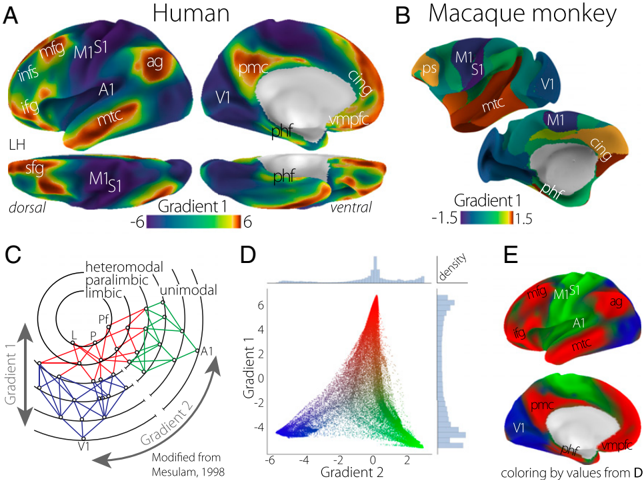
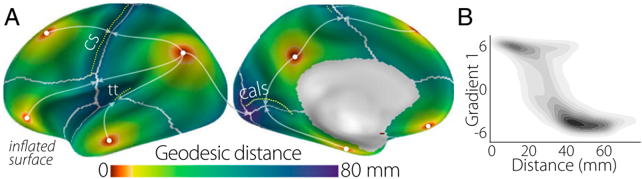
Understanding how the structure of cognition arises from the topographical organization of the cortex is a primary goal in neuroscience. Previous work has described local functional gradients extending from perceptual and motor regions to cortical areas representing more abstract functions, but an overarching framework for the association between structure and function is still lacking. Here, we show that the principal gradient revealed by the decomposition of connectivity data in humans and the macaque monkey is anchored by, at one end, regions serving primary sensory/motor functions and at the other end, transmodal regions that, in humans, are known as the default-mode network (DMN). These DMN regions exhibit the greatest geodesic distance along the cortical surface-and are precisely equidistant-from primary sensory/motor morphological landmarks. The principal gradient also provides an organizing spatial framework for multiple large-scale networks and characterizes a spectrum from unimodal to heteromodal activity in a functional metaanalysis. Together, these observations provide a characterization of the topographical organization of cortex and indicate that the role of the DMN in cognition might arise from its position at one extreme of a hierarchy, allowing it to process transmodal information that is unrelated to immediate sensory input.
Overview
CoChat Summary
TL;DR
The paper identifies a principal connectivity gradient in human and macaque cortex that runs from primary/unimodal sensory-motor regions to transmodal default-mode network (DMN) regions. It argues that the DMN’s position at one extreme, maximally distant from primary areas, helps explain its role in abstract, stimulus-independent cognition.
Key findings
- A principal gradient of functional connectivity, derived from 91,282 cortical/subcortical grayordinates at 2 mm resolution in 820 healthy adults (1 hour resting-state fMRI per participant, HCP S900), is anchored by primary/unimodal visual, somatosensory/motor, and auditory regions at one end and DMN regions at the other.
- Seven peak DMN nodes are maximally distant along the cortical surface from primary sensory/motor landmarks; four are equidistant from the central sulcus, and geodesic distance from DMN peaks relates to the principal gradient with \(R^2 = 0.55\). Beyond 40 mm from DMN peaks, cortex exclusively consists of unimodal regions.
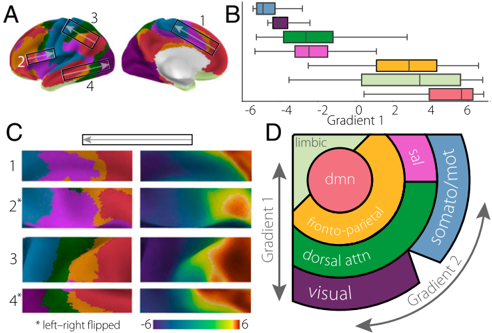
- The principal gradient orders the 7-network Yeo parcellation, with DMN at one extreme and visual/motor networks at the other; the limbic network is an exception, spanning a wide range of values.
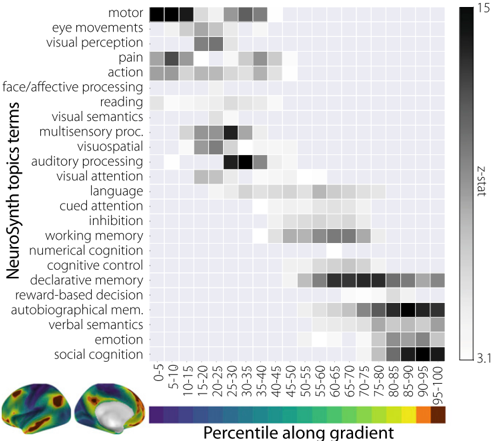
- A NeuroSynth meta-analysis using 24 topic terms shows a functional shift along the gradient: motor, visual perception, multisensory, and auditory terms at the unimodal end; cued attention, inhibition, and working memory in the middle; and social cognition, verbal semantics, and autobiographical memory at the DMN end.
Methods
- Human data were from the Human Connectome Project dense connectome S900 release: 91,282 grayordinates at 2 mm resolution, based on 1 hour of resting-state fMRI from 820 healthy adults, with no further processing beyond HCP minimal preprocessing including 2 mm FWHM smoothing.
- The main analysis used diffusion embedding, a nonlinear dimensionality reduction method, to extract connectivity gradients (“connectopies”) rather than discrete network parcellations; the same embedding was applied to a publicly available macaque tract-tracing database.
- Additional analyses calculated minimum geodesic distance from 7 DMN peak nodes, related gradient values to the 7-network Yeo parcellation, and performed a NeuroSynth meta-analysis with 24 topic terms across 5-percentile bins of the principal gradient.
Limitations
- Stated: the limbic network captures an extensive range of gradient values, which the authors suggest may be due to low signal-to-noise in the original parcellation data and may not accurately reflect its constituent regions’ connectivity.
- Stated: future studies are needed to better characterize transitions between large-scale connectivity patterns and to identify where processing occurs stepwise versus gradientially.
- Evident from the text: the macaque cross-species correspondence is described as “initial evidence” that the axis may be phylogenetically conserved, and the analyses are descriptive/spatial rather than causal tests of the proposed hierarchy.
Model-written summary. Check it against the paper before relying on it.
Integrity signals
Registry
Cites
Statistics
Figures

Verification
Claims the paper makes
14 Valid · 2 Not valid · 11 Not checked · 50 Own results and interpretations
The cited sources support only part of this claim — read each source’s verdict below.
In the paper
“Second, the location of the DMN as equidistant from all sensory/motor systems is aligned with its broad range of functions that require integration between multiple sensory systems, including episodic [51] and semantic memory [52-54], social cognition [55, 56], goal-directed working memory tasks [26, 32, 33, 35] and reward-guided decision making [57, 58].”
What the sources say
- Supportedcites [51] Schacter DL, Addis DR (2007) The cognitive neuroscience of constructive memory: remembering the past and imagining the future. Philos Trans R Soc Lond B Biol Sci 362(1481):773786. 661 662 663 source
Split into 2 atoms — 2 confirmed, 0 partially supported, 0 disputed, 0 misattributed, 0 unverifiable. Expand the claim to see per-atom verdicts.
- Supportedcites [52] Binder JR, Desai RH, Graves WW, Conant LL (2009) Where is the semantic system? a critical review and meta-analysis of 120 functional neuroimaging studies. Cereb Cortex 19(12):27672796. 664 665 source
The citation to this paper is attached to the semantic-memory part of the sentence, not the other listed functions. “Semantic Processing and the ‘Default Network’” says the semantic system closely resembles the default network, while “The Semantic System of the Human Brain” describes its regions as receiving multimodal input and supporting integrative processes. Page numbers are unavailable in our copy. (LLM, conf=0.91)
- Not checked — no full text of the sourcecites [53] Jefferies E (2013) The neural basis of semantic cognition: converging evidence from neuropsychology, neuroimaging and TMS. Cortex 49(3):611-625. 666 source
- Partly supportedcites [54] Constantinescu AO, O'Reilly JX, Behrens TEJ (2016) Organizing conceptual knowledge in humans with a gridlike code. Science 352(6292):1464-8. sourceExperimental — accuracy not yet measured
Split into 2 atoms — 1 confirmed, 1 partially supported, 0 disputed, 0 misattributed, 0 unverifiable. Expand the claim to see per-atom verdicts.
- Not checked — no full text of the sourcecites [55] Amodio DM, Frith CD (2006) Meeting of minds: the medial frontal cortex and social cognition. Nat Rev Neurosci 7(4):268-277. source
- Supportedcites [56] Amft M et al. (2015) Definition and characterization of an extended social-affective default network. Brain Struct Funct 220(2):1031-49. source
Split into 2 atoms — 2 confirmed, 0 partially supported, 0 disputed, 0 misattributed, 0 unverifiable. Expand the claim to see per-atom verdicts.
plainstates an association- Asserted: passes — The authors put it forward as true.
- Checkable: passes — It can be checked against evidence.
- Load-bearing: passes — The paper’s conclusions depend on it.
- Based: passes — The paper gives a reason why it holds.
- Supported
The cited sources support only part of this claim — read each source’s verdict below.
In the paper
“The DMN is at a maximal distance from systems involved in perception and action in both functional connectivity and anatomical space, indicating that the neural activity in these regions is likely to be comparably insulated from direct environmental input [49, 50].”
What the sources say
- Partly supportedcites [49] Kiebel SJ, Daunizeau J, Friston KJ (2008) A hierarchy of time-scales and the brain. PLoS Comput Biol 4(11):e1000209. 659 660 sourceExperimental — accuracy not yet measured
The Introduction and Discussion > Neuroscience Account describe higher cortical levels as farther from sensory input and as representing slower-changing context. But the paper does not identify the DMN as such a level or establish that activity in DMN regions is insulated from direct environmental input; its Conclusion says representations at different levels interact. (LLM, conf=0.78)
- Partly supportedcites [50] Friston K (2013) Life as we know it. J R Soc Interface 10(86):20130475. sourceExperimental — accuracy not yet measured
The Heuristic proof (page unavailable) says a Markov blanket insulates internal states from direct access to external states, and the Proof of principle > The Markov blanket section reports no direct connections between those states in a simulation. The paper does not identify DMN regions as those internal states or establish that DMN activity is insulated from environmental input. (LLM, conf=0.84)
hedged- Asserted: passes — The authors put it forward as true.
- Checkable: passes — It can be checked against evidence.
- Load-bearing: passes — The paper’s conclusions depend on it.
- Based: passes — The paper gives a reason why it holds.
- Partly supported
Every source the paper cites for this claim was checked and supports it.
In the paper
“The principal gradient illustrates a broader topographic organization of large-scale connectivity [38] that accounts for the spatial arrangement of local processing streams throughout the cerebral cortex.”
What the sources say
- Supportedcites [38] Jbabdi S, Sotiropoulos SN, Behrens TE (2013) The topographic connectome. Curr Opin Neurobiol 23(2):207-15. 643 644 source
The Introduction (page unavailable) describes topographic, spatial patterns in large-scale connections between grey-matter regions. The citation is attached to that broader organization of connectivity; the sentence’s interpretation of the principal gradient is the citing authors’ framing. (LLM, conf=0.87)
plainstates a cause- Asserted: passes — The authors put it forward as true.
- Checkable: passes — It can be checked against evidence.
- Load-bearing: passes — The paper’s conclusions depend on it.
- Based: passes — The paper gives a reason why it holds.
- Supported
The sources with a verdict support this claim; the rest weren’t checked yet, have no full text we could read, or their verdicts aren’t rated yet.
In the paper
“Notably, our results are consistent with a recent modification of the rostral-caudal processing gradient described within lateral frontal cortex [59, 60].”
What the sources say
- Supportedcites [59] Goulas A, Uylings HBM, Stiers P (2014) Mapping the hierarchical layout of the structural network of the macaque prefrontal cortex. Cereb Cortex 24(5):1178-94. 684 source
In the ABH Optimization section (page unavailable), the paper reports that the strict anterior–posterior gradient was not observed even when the analysis was limited to lateral prefrontal regions. In the Relation Between Asymmetry-Based Hierarchy and Laminar-Based Hierarchy section (page unavailable), it proposes a laminar-based hierarchy as a more plausible basis for models of that gradient. This supports the citation's identification of a modification; the citing authors' statement that their own results are consistent with it is their interpretation. (LLM, conf=0.86)
- Not checked — no full text of the sourcecites [60] Nee DE, D'Esposito M (2016) The hierarchical organization of the lateral prefrontal cortex. eLife 5. source
plainstates an association- Asserted: passes — The authors put it forward as true.
- Checkable: passes — It can be checked against evidence.
- Load-bearing: unclear — It is unclear whether the paper’s conclusions depend on it.
- Based: passes — The paper gives a reason why it holds.
- Supported
A result the paper reports from its own data — it cites no other source for it, so there is none to check. The quote shows it is in the paper.
In the paper
“Here we show that the principal gradient revealed by the decomposition of connectivity data in humans and the macaque monkey is anchored, at one end, by regions serving primary sensory/motor functions and, at the other, by transmodal regions that, in humans, are known as the default-mode network (DMN).”
- Also stated in: § Situating the default-mode network in a principal gradient of macroscale cortical organization · p. 2 · plain
“We describe an overarching organization of large-scale connectivity that situates the default-mode network at the opposite end of a spectrum from primary sensory and motor regions.”
- Also stated in: § Results · p. 3 · plain
“The principal gradient (Figure 1A), which accounts for the greatest variance in connectivity in the human brain (see Figure S1), is anchored at one end by the primary and unimodal visual, somatosensory/motor, and auditory regions. At the other end are regions including the angular gyrus, rostral anterior cingulate, posteromedial cortex, middle temporal gyrus, and middle and superior frontal gyri -”
boostedstates an association- Asserted: passes — The authors put it forward as true.
- Checkable: passes — It can be checked against evidence.
- Load-bearing: passes — The paper’s conclusions depend on it.
- Based: passes — The paper gives a reason why it holds.
- Also stated in: § Situating the default-mode network in a principal gradient of macroscale cortical organization · p. 2 · plain
33 more claims
Create a free account to see all 77 claims and every source verdict.
- The quote only partly states this claim. 1
- It may state two separate claims as one. 24
- Probably not a substantial claim. 21
Claims other papers make about this one
Each is checked against this paper’s own text: does it say what the citing paper says it does?
The cited source says what the claim attributes to it.
In the citing paper
“Because the DMN integrates information from multiple pathways (Binder and Desai 2011; Margulies et al. 2016), we propose that, as stimulus information travels up the cortical hierarchy of timescales during encoding, from low-level sensory areas up to high-level areas, a form of compression takes place (Hasson et al. 2015).”
From How We Transmit Memories to Other Brains: Constructing Shared Neural Representations Via Communication (2017) · cites this paper as Margulies et al. 2016
Citations
Cites
A Global Geometric Framework for Nonlinear Dimensionality Reduction
Tenenbaum, J. B., Silva, V. D., & Langford, J. C. (2000) · Science · doi:10.1126/science.290.5500.2319 · Cited by 13,585
Jenkinson, M., Bannister, P., Brady, M., & Smith, S. (2002) · NeuroImage · doi:10.1006/nimg.2002.1132 · Cited by 11,888
Jenkinson, M., Beckmann, C. F., Behrens, T. E. J., Woolrich, M. W., & Smith, S. M. (2012) · NeuroImage · doi:10.1016/j.neuroimage.2011.09.015 · Cited by 11,314
A tutorial on spectral clustering
von Luxburg, U. (2007) · Statistics and Computing · doi:10.1007/s11222-007-9033-z · Cited by 10,349
Fischl, B. (2012) · NeuroImage · doi:10.1016/j.neuroimage.2012.01.021 · Cited by 9,526
The organization of the human cerebral cortex estimated by intrinsic functional connectivity
Thomas Yeo, B. T., Krienen, F. M., Sepulcre, J., Sabuncu, M. R., Lashkari, D., Hollinshead, M., Roffman, J. L., Smoller, J. W., Zöllei, L., Polimeni, J. R., et al. (2011) · Journal of Neurophysiology · doi:10.1152/jn.00338.2011 · Cited by 9,182
The organization of the human cerebellum estimated by intrinsic functional connectivity
Buckner, R. L., Krienen, F. M., Castellanos, A., Diaz, J. C., & Yeo, B. T. T. (2011) · Journal of Neurophysiology · doi:10.1152/jn.00339.2011 · Cited by 7,304
Separate visual pathways for perception and action
Goodale, M. A., & Milner, A. D. (1992) · Trends in Neurosciences · doi:10.1016/0166-2236(92)90344-8 · Cited by 6,519
Functional connectivity in the resting brain: a network analysis of the default mode hypothesis
Greicius, M. D., Krasnow, B., Reiss, A. L., & Menon, V. (2003) · Proceedings of the National Academy of Sciences · doi:10.1073/pnas.0135058100 · Cited by 6,358
The WU-Minn Human Connectome Project: An overview
Van Essen, D. C., Smith, S. M., Barch, D. M., Behrens, T. E. J., Yacoub, E., & Ugurbil, K. (2013) · NeuroImage · doi:10.1016/j.neuroimage.2013.05.041 · Cited by 5,651
Research works printed but not linked: 2
- Von Bonin G, Bailey P (1947)
- Langs G, Golland P , Tie Y, Rigolo L, Golby AJ (2010) Functional geometry alignment and localization of brain areas. Adv. Neural Inf. Process. Syst. 1:1225-1233.
Cited by
Items 1,801–1,900 of 2,372
Mishra, S., Asif, M., & Tiwary, U. S. (2021) · bioRxiv (Cold Spring Harbor Laboratory) · doi:10.1101/2021.08.05.455187 · Cited by 3
“In addition, DMN nodes are observed to be functionally distant regions from the early sensory cortices [72, 50].”
BackgroundCeh, S. M., Annerer‐Walcher, S., Koschutnig, K., Körner, C., & Benedek, M. (2020) · PsyArXiv (OSF Preprints) · doi:10.31234/osf.io/fbdr9 · Cited by 1
Missing links: the functional unification of language and memory (L∪M)Preprint
Roger, É., Banjac, S., de Schotten, M. T., et al. (2021) · doi:10.31234/osf.io/p98n3 · Cited by 1
Fan, Y., Xu, Y., Bayrak, Ş., et al. (2022) · bioRxiv (Cold Spring Harbor Laboratory) · doi:10.1101/2022.05.11.489776 · Cited by 1
“spatial gradients of connectivity variations (16, 17).”
BackgroundMethodHierarchical Fluctuation Shapes a Dynamic Flow Linked to States of ConsciousnessPreprint
Li, A., Liu, H., Lei, X., He, Y., Wu, Q., Yan, Y., Zhou, X., Tian, X., Peng, Y., Yan, H., et al. (2022) · Research Square · doi:10.21203/rs.3.rs-1750692/v1 · Cited by 1
Reduced emergent character of neural dynamics in patients with a disrupted connectomePreprint
Luppi, A. I., Mediano, P. A. M., Rosas, F. E., et al. (2022) · bioRxiv (Cold Spring Harbor Laboratory) · doi:10.1101/2022.06.16.496445 · Cited by 1
Semantic novelty modulates neural responses to visual change across the human brainPreprint
Nentwich, M., Leszczyński, M., Russ, B. E., et al. (2022) · bioRxiv (Cold Spring Harbor Laboratory) · doi:10.1101/2022.06.20.496467 · Cited by 1
The Intrinsic Hierarchy of Self – Converging Topography and DynamicsPreprint
Çatal, Y., Günay, M. A., Li, C., Wang, J., Cui, H., Li, W., & Northoff, G. (2022) · bioRxiv (Cold Spring Harbor Laboratory) · doi:10.1101/2022.06.23.497287 · Cited by 2
“In contrast, transmodal regions like the default-mode network constitute the core [42, 48, 67, 71, 74].”
BackgroundHormozi, H. K., Patel, R., Dai, A., Ziolkowski, J., Dong, H.-M., Holmes, A. J., Raznahan, A., Devenyi, G. A., & Chakravarty, M. M. (2022) · bioRxiv (Cold Spring Harbor Laboratory) · doi:10.1101/2022.07.21.501018 · Cited by 1
“As in [57], we used the second gradient in the < 12-year-old group to represent the transition from unimodal to heteromodal described in the literature [58].”
BackgroundMethodAreshenkoff, C. N., de Brouwer, A. J., Gale, D. J., Nashed, J. Y., & Gallivan, J. P. (2022) · bioRxiv (Cold Spring Harbor Laboratory) · doi:10.1101/2022.08.16.504134 · Cited by 2
“As a large body of research suggests that the dominant patterns of variability in functional connectivity are related either to the gross topographical properties of functional brain organization (Margulies et al., 2016), or to static subject-level differences unrelated to task performance (Gratton et al.”
BackgroundLayer-dependent activity in the human superior colliculus during working memoryPreprint
Chen, D., Kragel, P. A., Wager, T. D., Wald, L. L., Bianciardi, M., Satpute, A. B., Quigley, K. S., Barrett, L. F., Katsumi, Y., & Theriault, J. E. (2022) · bioRxiv (Cold Spring Harbor Laboratory) · doi:10.1101/2022.12.06.518975 · Cited by 3
“(2016b). R: A language and environment for statistical computing. 16. Redgrave, P., Mitchell, I. J., & Dean, P. (1987). Descending projections from the superior”
BackgroundInfluentialManifold Learning for fMRI time-varying FCPreprint
González-Castillo, J., Fernandez, I. S., Lam, K. C., Handwerker, D. A., Pereira, F., & Bandettini, P. A. (2023) · bioRxiv (Cold Spring Harbor Laboratory) · doi:10.1101/2023.01.14.523992 · Cited by 1
“Additionally, previous applications of LE to FC data have proven quite successful (Gonzalez-Castillo et al., 2019; Margulies et al., 2016; Mckeown et al., 2020; Rué-Queralt et al., 2021).”
BackgroundMethodMehta, K., Pines, A., Adebimpe, A., Larsen, B., Bassett, D., Calkins, M., Baller, E. B., Gell, M., Patrick, L. M., Gur, R. E., et al. (2023) · bioRxiv · doi:10.1101/2023.01.25.525577 · Cited by 1
“Prior work suggests that adolescence is an important period for the general organization of largescale FC, in which changes in connectivity adhere to a sensorimotor-association gradient that culminates in the DMN, a network clearly implicated in our analyses (Sydnor et al., 2022; Margulies et al., 2016).”
BackgroundEstablishing brain states in neuroimaging dataPreprint
Dezhina, Z., Smallwood, J., Xu, T., et al. (2023) · doi:10.31219/osf.io/74px8 · Cited by 1
Self-citationBrain structure-function relationships across the human lifespan based on network eigenmodesPreprint
Yang, Y., Tang, S., Wang, X., Zhen, Y., Zheng, Y., Zheng, H., Liu, L., & Zheng, Z. (2023) · bioRxiv (Cold Spring Harbor Laboratory) · doi:10.1101/2023.03.08.531719 · Cited by 1
Saberi, A., Paquola, C., Wagstyl, K., Hettwer, M. D., Bernhardt, B. C., Eickhoff, S. B., & Valk, S. L. (2023) · bioRxiv (Cold Spring Harbor Laboratory) · doi:10.1101/2023.03.25.532115 · Cited by 1
“Of note, several definitions exist for cortical hierarchy, and alternative mappings based on theory [63] or proxy measures, such as the principal axis of functional connectivity [64], or T1w/T2w ratio [39] have been used in the literature.”
MethodSelf-citationInvestigating individual variability in microstructural-functional coupling in the human cortexPreprint
Patel, R., Dai, A., Valk, S. L., Desrosiers-Grégoire, G., Devenyi, G. A., & Chakravarty, M. M. (2023) · bioRxiv (Cold Spring Harbor Laboratory) · doi:10.1101/2023.05.29.542730 · Cited by 3
“When assessed in the context of a functional gradient (Margulies et al., 2016) microstructure-function coupling strength is increased in unimodal regions such as motor and visual areas, but this correspondence weakens moving towards transmodal association areas (Huntenburg et al., 2017; Paquola et…”
BackgroundDimitriadis, S. I. (2023) · bioRxiv (Cold Spring Harbor Laboratory) · doi:10.1101/2023.05.31.543029 · Cited by 4
Moore, J. W., Wilson, S., Oldehinkel, M., Cordero‐Grande, L., Uus, A. U., Kyriakopoulou, V., Duff, E. P., O’Muircheartaigh, J., Rutherford, M., Andreae, L. C., et al. (2023) · bioRxiv (Cold Spring Harbor Laboratory) · doi:10.1101/2023.06.26.546607 · Cited by 2
Xia, Y., Xu, Y., Duan, D., Xia, M., Jeon, T., Ouyang, M., Chalak, L. F., Rollins, N. K., Huang, H., & Yong He, A. (2023) · bioRxiv (Cold Spring Harbor Laboratory) · doi:10.1101/2023.09.07.556778 · Cited by 1
Moore, J. W., Wilson, S., Oldehinkel, M., Cordero‐Grande, L., Uus, A. U., Kyriakopoulou, V., Duff, E. P., O’Muircheartaigh, J., Rutherford, M., Andreae, L. C., et al. (2023) · doi:10.7554/elife.90536 · Cited by 2
Endogenous Neuromodulation at Infra-Low Frequency: Method and TheoryPreprint
Othmer, S., & Othmer, S. F. (2023) · Preprints.org · doi:10.20944/preprints202310.1085.v1
Dual long-axis reorganization of hippocampus in youthPreprint
Zeng, D., Li, Q., Li, D., He, Y., Dong, X., Li, S., Bi, S., Liao, X., Zhao, T., Chen, X., et al. (2023) · bioRxiv (Cold Spring Harbor Laboratory) · doi:10.1101/2023.11.03.565423 · Cited by 2
Reconfigurations of cortical manifold structure during reward-based motor learningPreprint
Nick, Q., Gale, D. J., Areshenkoff, C. N., de Brouwer, A. J., Nashed, J. Y., Wammes, J. D., Flanagan, R., Smallwood, J., & Gallivan, J. P. (2023) · eLife · doi:10.7554/elife.91928.1 · Cited by 1
Self-citationLee, J. J., Earnest, T., Ha, S. M., Bani, A., Kothapalli, D., Liu, P., & Sotiras, A. (2023) · medRxiv · doi:10.1101/2023.11.10.23298396 · Cited by 2
Low-dimensional controllability of brain networksPreprint
Messaoud, R. B., Du, V. L., Kaufmann, B. C., Couvy‐Duchesne, B., Migliaccio, R., Bartolomeo, P., Chávez, M., & Fallani, F. D. V. (2023) · arXiv (Cornell University) · doi:10.48550/arxiv.2311.11132 · Cited by 3
“…systems as controlling drivers and that of associative systems as controlled targets, match previous results obtained with network communication models of brain cognition 72 and align with theories postulating that the brain topography is organized along spatial and functional gradients 73,74 .”
Visual to default network pathways: A double dissociation between semantic and spatial cognitionPreprint
Alam, T. R. G., Krieger‐Redwood, K., Varga, D., et al. (2023) · bioRxiv (Cold Spring Harbor Laboratory) · doi:10.1101/2023.11.28.568861 · Cited by 1
Self-citationA Comparative Machine Learning Study of Connectivity-Based Biomarkers of SchizophreniaPreprint
Shevchenko, V., Benn, R. A., Scholz, R., Wei, W., Pallavicini, C., Klatzmann, U., Alberti, F., Satterthwaite, T. D., Wassermann, D., Bazin, P., et al. (2024) · bioRxiv (Cold Spring Harbor Laboratory) · doi:10.1101/2024.01.05.573898 · Cited by 1
“…overfitting when the aim is prediction 6–8 . ple Recently, low-dimensional representations of the connectome such as macroscale cortica gradients 9,10 and gradient dispersion 11,12 have been proposed. ical The gradients are derived from functional connectivity matrices through dimensionality…”
BackgroundResultSelf-citationHardikar, S., Mckeown, B., Schaare, H. L., Xu, T., Lauckner, M. E., Valk, S. L., Margulies, D. S., Turnbull, A. G., Bernhardt, B. C., de Wael, R. V., et al. (2024) · doi:10.7554/elife.93689.1 · Cited by 2
Self-citationBig and deep data aggregation and analysis strategies for human neuroscience
Bernhardt, B. C., Royer, J., Valk, S. L., & Evans, A. C. (2024) · Elsevier eBooks · doi:10.1016/b978-0-12-820480-1.00089-9 · Cited by 1
Howell, A. M., Warrington, S., Fonteneau, C., Cho, Y., Sotiropoulos, S. N., Murray, J. D., & Anticevic, A. (2024) · eLife · doi:10.7554/elife.95018.1 · Cited by 2
Macroscale brain states support the control of semantic cognitionPreprint
Wang, X., Krieger‐Redwood, K., Cui, Y., et al. (2024) · bioRxiv (Cold Spring Harbor Laboratory) · doi:10.1101/2024.02.29.582250 · Cited by 1
Self-citationCharacterizing Large-Scale Human Circuit Development with In Vivo Neuroimaging
Arichi, T. (2024) · Cold Spring Harbor Perspectives in Biology · doi:10.1101/cshperspect.a041496 · Cited by 2
A Human Brain Map of Mitochondrial Respiratory Capacity and DiversityPreprint
Picard, M. A., Mosharov, E. V., Rosenberg, A. M., Monzel, A. S., Osto, C. A., Stiles, L., Rosoklija, G. B., Dwork, A. J., Bindra, S., Zhang, Y., et al. (2024) · Research Square · doi:10.21203/rs.3.rs-4047706/v1 · Cited by 1
Reconfigurations of cortical manifold structure during reward-based motor learningPreprint
Nick, Q., Gale, D. J., Areshenkoff, C. N., de Brouwer, A. J., Nashed, J. Y., Wammes, J. D., Zhu, T., Flanagan, J. R., Smallwood, J., & Gallivan, J. P. (2024) · eLife · doi:10.7554/elife.91928.2 · Cited by 1
Self-citationA Synergistic Workspace for Human Consciousness Revealed by Integrated Information DecompositionPreprint
Luppi, A. I., Mediano, P. A. M., Rosas, F. E., Allanson, J., Pickard, J. D., Carhart-Harris, R. L., Williams, G. B., Craig, M. M., Finoia, P., Owen, A. M., et al. (2024) · eLife · doi:10.7554/elife.88173.2 · Cited by 7
Akgür, B. F., Gezici, T., Oymagil, E., & Farooqui, A. A. (2024) · bioRxiv (Cold Spring Harbor Laboratory) · doi:10.1101/2024.05.23.595496 · Cited by 1
“For others, the DMN may be about the higher-levels of cognition and may represent temporally extended episodes in cognition (Margulies et al., 2016; Speer et al., 2007; Wen et al., 2020).”
BackgroundFeng, G., Wang, Y., Huang, W., Chen, H., Cheng, J., & Shu, N. (2024) · eLife · doi:10.7554/elife.93325.2 · Cited by 1
Esposito, F. (2024) · Elsevier eBooks · doi:10.1016/b978-0-12-820480-1.00177-7 · Cited by 1
Multimodal precision MRI of the individual human brain at ultra-high fieldsPreprint
Cabalo, D. G., Leppert, I. R., Thevakumaran, R., DeKraker, J., Hwang, Y., Royer, J., Kebets, V., Tavakol, S., Wang, Y., Zhou, Y., et al. (2024) · bioRxiv (Cold Spring Harbor Laboratory) · doi:10.1101/2024.06.17.596303 · Cited by 1
Self-citationThalamic Influence Over Adaptive Cortical Dynamics Across Conscious StatesPreprint
Müller, E. J., Munn, B., Baracchini, G., Fulcher, B., Medel, V., Redinbaugh, M. J., Saalmann, Y. B., Brunton, B. W., Brunton, S. L., & Shine, J. M. (2024) · bioRxiv (Cold Spring Harbor Laboratory) · doi:10.1101/2024.07.02.601788 · Cited by 1
Brain areas for reversible symbolic reference, a potential singularity of the human brainPreprint
van Kerkoerle, T., Pape, L., Ekramnia, M., Feng, X., Tasserie, J., Dupont, M., Li, X., Jarraya, B., Vanduffel, W., Dehaene, S., et al. (2024) · eLife · doi:10.7554/elife.87380.2 · Cited by 1
Longevity or Well-being? A Dual-Dimension Structure of NeuroticismPreprint
He, Y., Xiao, J., Hu, K., Gao, T., Yan, Y., Wang, L., Li, K., Lei, W., Zhao, K., Dong, C.-S., et al. (2024) · bioRxiv · doi:10.1101/2024.07.23.604876
“(h) Drawing on the style of the earlier brain’s functional gradient schematic 23 , we depicted the geometric structure of neuroticism based on our findings.”
MethodMapping the topographic organization of the human zona incerta using diffusion MRI
Haast, R. A. M., Kai, J., Taha, A., Liu, V. M., Kasa, L. W., Gilmore, G., Guye, M., KHAN, A. R., & Lau, J. C. (2026) · eLife · doi:10.1101/2024.09.05.610266 · Cited by 1
“Diffusion map embedding, a method for mapping transitions in structural connectivity, provides nuanced views of connectivity differences that might resemble those observed in animal models better (Margulies et al., 2016; Royer et al., 2024).”
Mapping patterns of thought onto brain activity during movie-watchingPreprint
Wallace, R. S., Mckeown, B., Goodall-Halliwell, I., Chitiz, L., Forest, P., Karapanagiotidis, T., Mulholland, B., Turnbull, A. G., Vanderwal, T., Hardikar, S., et al. (2024) · eLife · doi:10.7554/elife.97731.2 · Cited by 1
Self-citationNeural Correlates of Psychedelic, Sleep, and Sedated States Support Global Theories of ConsciousnessPreprint
Dai, R., Jang, H., Hudetz, A. G., Huang, Z., & Mashour, G. A. (2024) · bioRxiv (Cold Spring Harbor Laboratory) · doi:10.1101/2024.10.23.619731 · Cited by 5
Nie, P., Zhan, Y., Chen, R., Qi, R., Liu, C., & Wang, G.-Z. (2024) · bioRxiv (Cold Spring Harbor Laboratory) · doi:10.1101/2024.12.11.627878 · Cited by 1
Lee, Y., Lee, H., & Chen, J. (2024) · bioRxiv (Cold Spring Harbor Laboratory) · doi:10.1101/2024.12.11.627957 · Cited by 3
Canonical neurodevelopmental trajectories of structural and functional manifoldsPreprint
Monaghan, A., Bethlehem, R. A. I., Akarca, D., Margulies, D. S., the Team CALM, & Astle, D. E. (2025) · eLife · doi:10.7554/elife.103097.1 · Cited by 2
Self-citationHuman brain-wide activation of sleep rhythmsPreprint
Wang, H., Zou, Q., Zhang, J., Gao, J., & Liu, Y. (2026) · eLife · doi:10.7554/elife.103956 · Cited by 3
“For functional decoding, we followed the approach in Margulies et al., 2016 .”
Sub-Second Fluctuation between Top-Down and Bottom-Up Modes Distinguishes Diverse Human Brain StatesPreprint
Park, Y., Cha, Y.-H., Kim, H., Kim, Y., Woo, J. H., Cho, H., Mashour, G. A., Xu, T., Lee, U., Hong, S., et al. (2025) · bioRxiv (Cold Spring Harbor Laboratory) · doi:10.1101/2025.03.12.642768 · Cited by 5
Benchmarking overlapping community detection methods for applications in human connectomicsPreprint
Bryant, A. G., Jha, A., Agarwal, S., Cahill, P., Lam, B., Oldham, S., Arnatkevic̆iūtė, A., Fornito, A., & Fulcher, B. D. (2025) · bioRxiv · doi:10.1101/2025.03.19.643839 · Cited by 4
“We next quantitatively compared the location of each overlapping node along the cortical hi-442 erarchy by examining the first and second principal gradients (PGs) of functional connectivity [75] provided in the neuromaps atlas [76] (cf. Sec 2.6).”
InfluentialLiu, X., Wan, B., Zhang, X.-H., Liu, L., Long, S., Ge, R., Cui, R., Wen, X., Yang, G., & Gao, Y. (2025) · bioRxiv (Cold Spring Harbor Laboratory) · doi:10.1101/2025.03.29.646114 · Cited by 1
Luppi, A. I., Milisav, F., Suárez, L. E., Shafiei, G., Vohryzek, J., Perl, Y. S., Ali, H., Rosas, F. E., Mediano, P. A. M., Mišić, B., et al. (2025) · bioRxiv (Cold Spring Harbor Laboratory) · doi:10.1101/2025.04.05.647237 · Cited by 2
“…Allen Human Brain Atlas transcriptomic database (‘AHBA PC1’) [10], the principal component of variation in task activation from the NeuroSynth database (‘Neu-roSynth PC1’) [123], the principal component of variation in receptor density (‘receptor PC1’) [2], and the principal gradient of FC [55].”
InfluentialAperiodic neural timescales in prefrontal cortex dilate with increased task abstractionPreprint
Cellier, D., Riddle, J., Hammonds, R., Frӧhlich, F., & Voytek, B. (2025) · bioRxiv (Cold Spring Harbor Laboratory) · doi:10.1101/2025.04.21.649913 · Cited by 1
“Task abstraction requires neural integration of lower-order inputs in higher-order cortical regions (5,14,15), and neural timescales are thought to reflect this integration (3,16–18).”
Heterogeneous ageing of brain networks across the Alzheimer’s disease continuumPreprint
Huo, Y., Huang, W., Liu, Z., Bai, T., Chen, H., Wang, Y., Wang, K., Zhang, D., Cheng, J., Sun, Y., et al. (2025) · medRxiv · doi:10.1101/2025.05.14.25327582 · Cited by 1
“Compared with unimodal brain networks, these transmodal networks are more vulnerable to pathological ageing 16–18 .”
Different functional connectivity gradients reflect aging and Alzheimer’s diseasePreprint
Rittmo, J. Ö., Franzmeier, N., Strandberg, O. T., et al. (2025) · bioRxiv (Cold Spring Harbor Laboratory) · doi:10.1101/2025.05.22.655469 · Cited by 1
Convergent and Divergent Brain–Cognition DevelopmentPreprint
Xie, Y., Zhang, S., Orbán, C., Ooi, L. Q. R., Kong, R., Floris, D. L., Zuo, X., Dhamala, E., Holmes, A. J., Uddin, L. Q., et al. (2025) · bioRxiv (Cold Spring Harbor Laboratory) · doi:10.1101/2025.06.06.658294 · Cited by 1
“The S-A axis represents a key axis of hierarchical cortical organization, spanning from primary sensorimotor to transmodal association cortices (Margulies et al., 2016; Sydnor et al., 2021).”
Tolle, H. M., Luppi, A. I., Lawn, T., Roseman, L., Nutt, D. J., Carhart-Harris, R. L., & Mediano, P. A. M. (2025) · bioRxiv (Cold Spring Harbor Laboratory) · doi:10.1101/2025.07.02.662710 · Cited by 1
“These mirror-reversed spatial patterns closely align with the unimodal-transmodal cortical gradient, which captures key anatomical, functional, and neurochemical distinctions across the cortex [20, 38–41].”
Function aligns with geometry in locally connected neuronal networksPreprint
Légaré, A., Ribordy, O., Koninck, P. D., Allard, A., & Desrosiers, P. (2025) · bioRxiv (Cold Spring Harbor Laboratory) · doi:10.1101/2025.08.08.669348 · Cited by 3
“A recent and influential extension of FC analysis is the derivation of FC gradients that capture the dominant axes of variation in connectivity 11;12;13 .”
Precision Functional Mapping of Imagined and Experienced PainPreprint
Sun, M. M. C., Petre, B., Bo, K., Bango, C. I., Hershkop, M., Shohan, S. L., Jung, H., & Wager, T. D. (2025) · bioRxiv (Cold Spring Harbor Laboratory) · doi:10.1101/2025.08.06.668906 · Cited by 1
“…similarity between regions with similar imagined and experienced pain patterns after Bonferroni correction with the principal gradient map of Margulies et al. 2016 66 , which defined a gradient from unimodal sensorimotor regions to transmodal regions that integrate information across modalities.”
InfluentialMulti-Scale Anti-Correlated Neural States Dominate Naturalistic Whole-Brain ActivityPreprint
Gözükara, D., Oetringer, D., Ahmad, N., & Geerligs, L. (2025) · bioRxiv (Cold Spring Harbor Laboratory) · doi:10.1101/2025.08.27.672600 · Cited by 1
“This relationship aligns with the cortical hierarchy described by Margulies et al. ( 2016 ), where the DMN occupies the apex of abstraction while sensory-motor regions anchor the opposite end.”
InfluentialWang, Y., Tahmasian, M., Genon, S., Samea, F., He, Z., Liu, X., Lei, X., Eickhoff, S. B., & Dong, D. (2025) · medRxiv · doi:10.1101/2025.09.22.25336312 · Cited by 1
Self-citationQuah, S. K. L., Pirzada, S., Madsen, S., Jo, B., Uddin, L. Q., Mumford, J. A., Barch, D. M., Gotlib, I. H., Fair, D. A., Poldrack, R. A., et al. (2025) · bioRxiv (Cold Spring Harbor Laboratory) · doi:10.1101/2025.10.13.682124 · Cited by 2
“Reproducibility across cohorts, correspondence with resting-state gradients 12 , and network-wise distributions were evaluated.”
InfluentialRegional Brain Entropy, Brain Network and Structural-Functional Coupling in Human BrainPreprint
Song, D. (2024) · bioRxiv (Cold Spring Harbor Laboratory) · doi:10.1101/2024.11.14.623700 · Cited by 9
The Neural Code of NeuroticismPreprint
Popp, J. L., Weiß, M., Faskowitz, J., & Hilger, K. (2026) · bioRxiv (Cold Spring Harbor Laboratory) · doi:10.64898/2026.01.19.700296 · Cited by 1
“In contrast, as regions move up in the cortical processing hierarchy 55 and take on higher-order functions such as emotion processing, their neural signal contains less of this consistent stimulus-evoked response and is increasingly dominated by individual, potentially trait-related patterns.”
Integrating Functional Transdiagnostic Dimensions of Psychopathology with Cortical OrganizationPreprint
Monaghan, A., Mišić, B., Shafiei, G., Tsvetanov, K. A., Astle, D. E., & Bethlehem, R. A. I. (2026) · bioRxiv (Cold Spring Harbor Laboratory) · doi:10.64898/2026.02.02.702560 · Cited by 2
Single-cell multimodal atlas reveals regulatory programs in the human brain
Xie, Y., Chang, L., Zhong, G., Rink, J. A., Baez-Becerra, T., Armand, E. J., Ding, W., Li, K., Bonne, É., Indralingam, H. S., et al. (2026) · Cell · doi:10.64898/2026.02.02.703166 · Cited by 7
“We next examined regional heterogeneity within the cerebral cortex, which is organized along a continuous anterior-posterior (A-P) functional axis rather than showing discrete structural boundaries 75-77 .”
Cao, S., Shi, L., Liu, J., Lian, Z., Teng, L., Xiao, Q., Xia, X., Sun, K., Shi, F., Meng, X., et al. (2026) · bioRxiv (Cold Spring Harbor Laboratory) · doi:10.64898/2026.02.05.703937 · Cited by 1
“To move beyond isolated areal contrasts, we examined two prespecified unimodal-to-association or transmodal hierarchies (fronto-motor and auditory-perisylvian) and observed ordered profile shifts with localized deviations along the prespecified ROI ordering (25,26).”
Overarching Programs that Frame Episodes of Focused CognitionPreprint
Giray, İ., Çiftçi, İ., & Farooqui, A. A. (2026) · bioRxiv (Cold Spring Harbor Laboratory) · doi:10.64898/2026.02.20.706994 · Cited by 1
García-San-Martín, N., Bethlehem, R. A. I., Sebenius, I., Saraiva, L. C., Segura, P., Alemán-Morillo, C., Gomez, C., Salguero-Quiros, P., Pasquini, A., Montagnese, M., et al. (2026) · medRxiv · doi:10.64898/2026.02.25.26347075 · Cited by 1
Treeratana, S., Kasemsantitham, A., Jarukasemkit, S., Phusuwan, W., Chokesuwattanaskul, A., Sriswasdi, S., Bijsterbosch, J. D., & Chunharas, C. (2026) · bioRxiv (Cold Spring Harbor Laboratory) · doi:10.64898/2026.03.04.709716 · Cited by 4
Erigüç, D. Y., Marsiglia, M., John, A., Bayrak, Ş., Wan, B., Jakovčić, A., DeKraker, J., Royer, J., Bernhardt, B. C., & Valk, S. L. (2026) · bioRxiv (Cold Spring Harbor Laboratory) · doi:10.64898/2026.07.06.736898 · Cited by 1
DeKraker, J., Eichert, N., Hong, S.-J., Evans, A. C., & Bernhardt, B. C. (2026) · Neuroscience & Biobehavioral Reviews · doi:10.1016/j.neubiorev.2026.106890 · Cited by 1
Gradients of cortical hierarchy in Autism
Bethlehem, R. A. I., Falkiewicz, M., Freyberg, J., et al. (2017) · Apollo (University of Cambridge) · doi:10.17863/cam.20787
“We investigate potential differences in the scale of the gradient, its overlap with the DMN and its overlap with maps corresponding to the associated hierarchical cognitive processing as reported in figure 4 of Margulies et al. (2016).”
BackgroundMethodInfluentialSelf-citationConflicting Bottom-up and Top-down Signals during Misrecognition of Visual ObjectsPreprint
Abdelhack, M., & Kamitani, Y. (2019) · bioRxiv (Cold Spring Harbor Laboratory) · doi:10.1101/521252
“In addition, we also constructed the MTG in our study based on its location in the principal gradient (Margulies et al., 2016), meaning that this region is a location at which signals from different modalities converge, and is not modality-bound itself.”
MethodInfluentialLinear Input as a Fundamental Motif of Brain Connectivity OrganizationPreprint
O’Rawe, J. F., & Leung, H. (2019) · bioRxiv (Cold Spring Harbor Laboratory) · doi:10.1101/549345
Protective inhibition and workability during extreme human activity
Artemenkov, A. A. (2019) · Sports medicine research and practice · doi:10.17238/issn2223-2524.2018.4.5
“Топографическая организация коры представляет собой пространственную структуру для множества крупномасштабных сетей и характеризует спектр нейродинамики от унимодальной до гетеромодальной активности в функциональном метаанализе [12].”
Are We Ever Conscious of Concepts?
Kemmerer, D. L. (2019) · Oxford University Press eBooks · doi:10.1093/oso/9780190682620.003.0007
Koide‐Majima, N., & Nishimoto, S. (2019) · bioRxiv (Cold Spring Harbor Laboratory) · doi:10.1101/639252
“We found that topographic organization in functional connectivity (fcTO) was preserved between the DMN-related regions (Figure 2, 3, Figure S1, S5), which are known to be related to transmodal representation [Margulies et al., 2016].”
BackgroundGradient Theories of Brain Activation: a Novel Application to Studying the Parental Brain
Rutherford, H. J. V., Xu, J., Worhunsky, P. D., Zhang, R., Yip, S. W., Morie, K. P., Calhoun, V. D., Kim, S., Strathearn, L., Mayes, L. C., et al. (2019) · Current Behavioral Neuroscience Reports · doi:10.1007/s40473-019-00182-5
Exploring the Neural Correlates of Mind-mindedness
Cotter, Z. (2018) · White Rose eTheses Online (University of Leeds, The University of Sheffield, University of York) · Cited by 1
Ho, N. S. P., Baker, D. H., Karapanagiotidis, T., Seli, P., Wang, H. T., Leech, R., Bernhardt, B. C., Margulies, D. S., Jefferies, E., & Smallwood, J. (2020) · bioRxiv (Cold Spring Harbor Laboratory) · doi:10.1101/2019.12.31.891853
Self-citationHemispheric differences in semantic cognition and their contribution to behaviour
Alam, G., & del Jesus, T. R. (2019) · White Rose eTheses Online (University of Leeds, The University of Sheffield, University of York)
The role of the default mode network in contextual control
Smith, V. (2019) · Apollo (University of Cambridge) · doi:10.17863/cam.49069
Mckeown, B. L. A., Strawson, W., Wang, H.-T., et al. (2020) · White Rose Research Online (University of Leeds, The University of Sheffield, University of York) · doi:10.48550/arxiv.2006.10723
“The first gradient describes the difference between regions of unimodal and transmodal cortex (Margulies et al., 2016).”
InfluentialSelf-citationNo metabolic “default mode” of human brain functionPreprint
Jonasson, L. S., Grill, F., Hahn, A., Rischka, L., Lanzenberger, R. R., Lundmark, V. P., Riklund, K., Axelsson, J., & Rieckmann, A. (2020) · bioRxiv (Cold Spring Harbor Laboratory) · doi:10.1101/2020.08.17.245183
A Precuneal Causal Loop Mediates External and Internal Information Integration in the Human BrainPreprint
Lu, D., Pappas, I., Menon, D. K., et al. (2020) · bioRxiv (Cold Spring Harbor Laboratory) · doi:10.1101/2020.08.20.259846
“The DMN has been postulated to be at the highest level of information processing in the brain (Margulies et al., 2016) and has the highest number of optimal inter-network connections in the brain (Pappas et al.”
BackgroundSocial Neuroscience in Global Mental Health: Case Study on Stigma Reduction in Nepal
Kohrt, B. A. (2020) · Cambridge University Press eBooks · doi:10.1017/9781108695374.024 · Cited by 3
Literary Analysis and Weak Theories
Moses, O. (2020) · Cambridge University Press eBooks · doi:10.1017/9781108695374.022
Cities, Psychosis, and Social Defeat
Sayanvala, F., Bornstein, L., Choudhury, S., Shah, J. L., Weinstock, D., & Gold, I. (2020) · Cambridge University Press eBooks · doi:10.1017/9781108695374.025 · Cited by 1
Experience-Dependent Plasticity in the Hippocampus
West, G. L., & Bohbot, V. D. (2020) · Cambridge University Press eBooks · doi:10.1017/9781108695374.019
Sawyer, K. S., Oscar‐Berman, M., Ruiz, S. M., Marinković, K., Valmas, M. M., & Harris, G. J. (2021) · bioRxiv (Cold Spring Harbor Laboratory) · doi:10.1101/2021.03.31.437778
Network dynamics scale with levels of awarenessPreprint
Coppola, P., Spindler, L. R. B., Luppi, A. I., et al. (2021) · bioRxiv (Cold Spring Harbor Laboratory) · doi:10.1101/2021.04.12.439452
Bohi, A., Auzias, G., Noûs, C., et al. (2022) · Proceedings - International Conference on Image Processing · doi:10.1109/icip46576.2022.9897251
“ing state fMRI [14] or deformation fields resulting from surface registration techniques.”
Ahrends, C., Vuust, P., & Kringelbach, M. L. (2021) · Cambridge University Press eBooks · doi:10.1017/9781108635462.012
Atypical development of subcortico-cortical effective connectivity in autismPreprint
Lorenzini, L., van Wingen, G. A., & Cerliani, L. (2021) · bioRxiv (Cold Spring Harbor Laboratory) · doi:10.1101/2021.07.02.450977
“…to reframe the idea of ‘local’ overconnectivity in terms of functional hierarchy of neural information processing (Mesulam 2000; Sepulcre et al. 2012; Margulies et al. 2016; Tian et al. 2020): while the hypothesis of long-range underconnectivity in ASD is consistent with many findings of decreased…”
BackgroundResultResting-state functional MRI-based connectivity
Shine, J. M. (2021) · Elsevier eBooks · doi:10.1016/b978-0-12-821861-7.00017-8 · Cited by 1
Using Evolution to Explain the Evolutionary Imagination
Jonsson, E. (2021) · Springer eBooks · doi:10.1007/978-3-030-82738-0_1
Xiao, X.-Z., Hammond, C., Salmeron, B., Wang, D.-N., Gu, H., Zhai, T., Nguyen, H., Lu, H., Ross, T., & Yang, Y. (2021) · bioRxiv · doi:10.1101/2021.10.14.464403 · Cited by 15
Metadata
- Authors
- Margulies, D. S., Ghosh, S. S., Goulas, A., Falkiewicz, M., Huntenburg, J. M., Langs, G., Bezgin, G., Eickhoff, S. B., Castellanos, F. X., Petrides, M., Jefferies, E., & Smallwood, J.
- Affiliations
- Max Planck Institute for Human Cognitive and Brain Sciences (DE)
- Harvard University (US)
- University Medical Center Hamburg-Eppendorf (DE)
- MIT Computer Science and Artificial Intelligence Laboratory (US)
- Montreal Neurological Institute and Hospital (CA)
- Forschungszentrum Jülich (DE)
- Nathan Kline Institute for Psychiatric Research (US)
- University of York (GB)
- ORCID
- Venue
- Proceedings of the National Academy of Sciences
- Publisher
- National Academy of Sciences
- Published
- 2016-10-18
- Volume
- 113
- Issue
- 44
- Pages
- 12574-12579
- ISSN
- 0027-8424 (ISSN-L)
- 1091-6490
- PMC
- PMC5098630
- OpenAlex
- W2536956629
- Cited by
- 2,321
- References
- 96
- Citations by year
- 2026: 365 · 2025: 381 · 2024: 388 · 2023: 292 · 2022: 233 · 2021: 218 · 2020: 215 · 2019: 109 · 2018: 65 · 2017: 50 · 2016: 4
- FWCI
- 48.22
- Type
- journal article
- Language
- en
- Open access
- bronze
- doi.org
- Locations
- Proceedings of the National Academy of Sciences (publishedVersion)
- PubMed Central (publishedVersion)
- PubMed (publishedVersion)
- White Rose Research Online (University of Leeds, The University of Sheffield, University of York) (submittedVersion)
- DSpace@MIT (Massachusetts Institute of Technology) (submittedVersion, cc-by-nc)
- Funders
- EC | European Research Council (283530-SEMBIND, WANDERINGMINDS - 646927)
- John Templeton Foundation (Prospective Psychology Stage 2: A Research Competition)
- Gouvernement du Canada | Canadian Institutes of Health Research (FDN-143212)
- NIH (1R01EB020740-01A1, 1P41EB019936-01A1, 3R01MH092380-04S2, 1U01MH108168-01)
- Topics
- Life Sciences › Neuroscience › Cognitive Neuroscience › Functional Brain Connectivity Studies
- Health Sciences › Medicine › Radiology, Nuclear Medicine and Imaging › Advanced Neuroimaging Techniques and Applications
- Life Sciences › Neuroscience › Cognitive Neuroscience › Neural dynamics and brain function
- Keywords
- default mode network, cortical topography, geodesic distance, cortical connectivity, large-scale brain networks, structure-function relationship, macaque cortex, human cortex
- MeSH terms
- Animals, Brain, Brain Mapping, Humans, Macaca, Magnetic Resonance Imaging, Models, Neurological, Nerve Net, Sensation, Sensorimotor Cortex
About these checks
Registry, retraction, Cites and statistics results are computed, not judged, with one exception: a printed reference that no index lists is read once by a model before it counts as a citation error. Claims are extracted by a model and kept only when their quote appears verbatim in the text; each cited source is then checked, with a model’s help, for whether it says what the claim relies on. Those verdicts can be wrong — read the claim’s quote and the cited source before relying on one.
The claim verdicts this report counts are experimental: their accuracy is not yet measured.
A language model drew the claims from the paper on 2026-09-30, under version 3 of the claim definition (model deepseek-v4.1-flash, prompt extract-v3).
A second model labelled each claim on 2026-09-30 (model jev-1.13-20260917, definition revision gold-guideline-v0.2).
Cited sources are checked with a language model’s help (gpt-6-sol).
Statistics and arithmetic are recomputed, not judged.
Confidence bands are shown only for fields calibrated on our annotated test set. None is calibrated yet, so no band is shown.
What counts as a claim ›How we measure confidence ›How we check this ›
Are you an author, or do you see a problem with this page? Request a review
Data sources
Bibliographic data: Semantic Scholar, OpenAlex, Crossref.
Contains information from the Semantic Scholar Academic Graph Datasets, made available under the ODC Attribution License (ODC-BY 1.0).
Semantic Scholar’s data is described in: Kinney, R., et al. (2023). The Semantic Scholar Open Data Platform. arXiv:2301.10140.
