

Situating the default-mode network along a principal gradient of macroscale cortical organization
Open accessThe DOI matches its Crossref record; 100 of the 100 references it cites were found in a registry or an index; 26 of the 58 sources its claims cite were checked for support.
Abstract
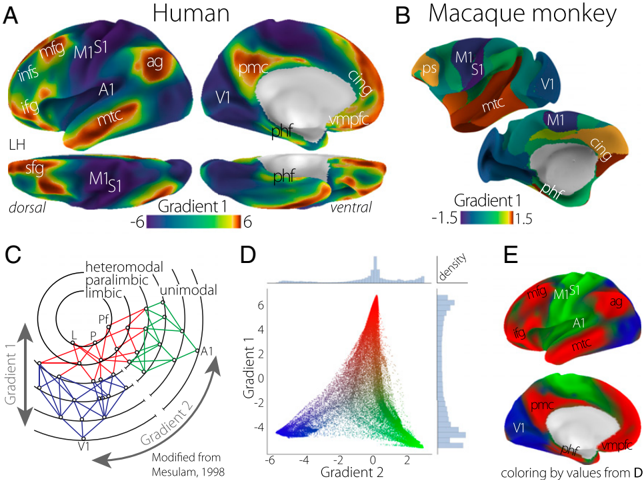
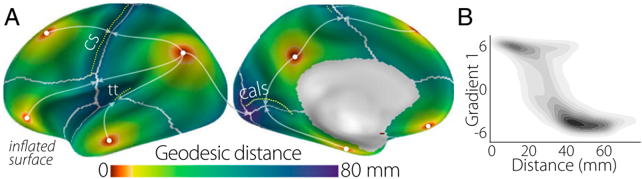
Understanding how the structure of cognition arises from the topographical organization of the cortex is a primary goal in neuroscience. Previous work has described local functional gradients extending from perceptual and motor regions to cortical areas representing more abstract functions, but an overarching framework for the association between structure and function is still lacking. Here, we show that the principal gradient revealed by the decomposition of connectivity data in humans and the macaque monkey is anchored by, at one end, regions serving primary sensory/motor functions and at the other end, transmodal regions that, in humans, are known as the default-mode network (DMN). These DMN regions exhibit the greatest geodesic distance along the cortical surface-and are precisely equidistant-from primary sensory/motor morphological landmarks. The principal gradient also provides an organizing spatial framework for multiple large-scale networks and characterizes a spectrum from unimodal to heteromodal activity in a functional metaanalysis. Together, these observations provide a characterization of the topographical organization of cortex and indicate that the role of the DMN in cognition might arise from its position at one extreme of a hierarchy, allowing it to process transmodal information that is unrelated to immediate sensory input.
Overview
CoChat Summary
TL;DR
The paper identifies a principal connectivity gradient in human and macaque cortex that runs from primary/unimodal sensory-motor regions to transmodal default-mode network (DMN) regions. It argues that the DMN’s position at one extreme, maximally distant from primary areas, helps explain its role in abstract, stimulus-independent cognition.
Key findings
- A principal gradient of functional connectivity, derived from 91,282 cortical/subcortical grayordinates at 2 mm resolution in 820 healthy adults (1 hour resting-state fMRI per participant, HCP S900), is anchored by primary/unimodal visual, somatosensory/motor, and auditory regions at one end and DMN regions at the other.
- Seven peak DMN nodes are maximally distant along the cortical surface from primary sensory/motor landmarks; four are equidistant from the central sulcus, and geodesic distance from DMN peaks relates to the principal gradient with \(R^2 = 0.55\). Beyond 40 mm from DMN peaks, cortex exclusively consists of unimodal regions.
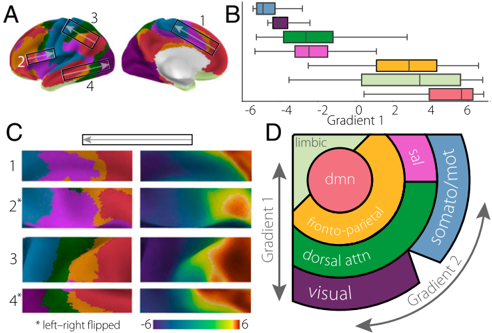
- The principal gradient orders the 7-network Yeo parcellation, with DMN at one extreme and visual/motor networks at the other; the limbic network is an exception, spanning a wide range of values.
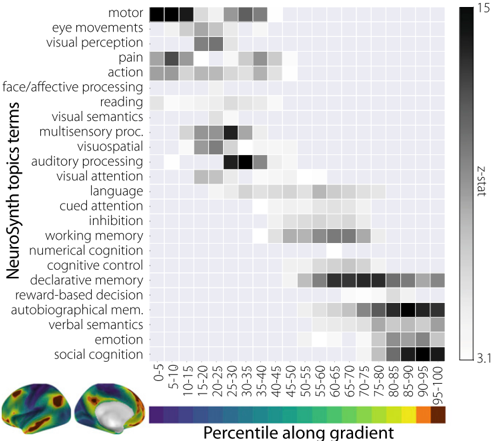
- A NeuroSynth meta-analysis using 24 topic terms shows a functional shift along the gradient: motor, visual perception, multisensory, and auditory terms at the unimodal end; cued attention, inhibition, and working memory in the middle; and social cognition, verbal semantics, and autobiographical memory at the DMN end.
Methods
- Human data were from the Human Connectome Project dense connectome S900 release: 91,282 grayordinates at 2 mm resolution, based on 1 hour of resting-state fMRI from 820 healthy adults, with no further processing beyond HCP minimal preprocessing including 2 mm FWHM smoothing.
- The main analysis used diffusion embedding, a nonlinear dimensionality reduction method, to extract connectivity gradients (“connectopies”) rather than discrete network parcellations; the same embedding was applied to a publicly available macaque tract-tracing database.
- Additional analyses calculated minimum geodesic distance from 7 DMN peak nodes, related gradient values to the 7-network Yeo parcellation, and performed a NeuroSynth meta-analysis with 24 topic terms across 5-percentile bins of the principal gradient.
Limitations
- Stated: the limbic network captures an extensive range of gradient values, which the authors suggest may be due to low signal-to-noise in the original parcellation data and may not accurately reflect its constituent regions’ connectivity.
- Stated: future studies are needed to better characterize transitions between large-scale connectivity patterns and to identify where processing occurs stepwise versus gradientially.
- Evident from the text: the macaque cross-species correspondence is described as “initial evidence” that the axis may be phylogenetically conserved, and the analyses are descriptive/spatial rather than causal tests of the proposed hierarchy.
Model-written summary. Check it against the paper before relying on it.
Integrity signals
Registry
Cites
Statistics
Figures

Verification
Claims the paper makes
14 Valid · 2 Not valid · 11 Not checked · 50 Own results and interpretations
The cited sources support only part of this claim — read each source’s verdict below.
In the paper
“Second, the location of the DMN as equidistant from all sensory/motor systems is aligned with its broad range of functions that require integration between multiple sensory systems, including episodic [51] and semantic memory [52-54], social cognition [55, 56], goal-directed working memory tasks [26, 32, 33, 35] and reward-guided decision making [57, 58].”
What the sources say
- Supportedcites [51] Schacter DL, Addis DR (2007) The cognitive neuroscience of constructive memory: remembering the past and imagining the future. Philos Trans R Soc Lond B Biol Sci 362(1481):773786. 661 662 663 source
Split into 2 atoms — 2 confirmed, 0 partially supported, 0 disputed, 0 misattributed, 0 unverifiable. Expand the claim to see per-atom verdicts.
- Supportedcites [52] Binder JR, Desai RH, Graves WW, Conant LL (2009) Where is the semantic system? a critical review and meta-analysis of 120 functional neuroimaging studies. Cereb Cortex 19(12):27672796. 664 665 source
The citation to this paper is attached to the semantic-memory part of the sentence, not the other listed functions. “Semantic Processing and the ‘Default Network’” says the semantic system closely resembles the default network, while “The Semantic System of the Human Brain” describes its regions as receiving multimodal input and supporting integrative processes. Page numbers are unavailable in our copy. (LLM, conf=0.91)
- Not checked — no full text of the sourcecites [53] Jefferies E (2013) The neural basis of semantic cognition: converging evidence from neuropsychology, neuroimaging and TMS. Cortex 49(3):611-625. 666 source
- Partly supportedcites [54] Constantinescu AO, O'Reilly JX, Behrens TEJ (2016) Organizing conceptual knowledge in humans with a gridlike code. Science 352(6292):1464-8. sourceExperimental — accuracy not yet measured
Split into 2 atoms — 1 confirmed, 1 partially supported, 0 disputed, 0 misattributed, 0 unverifiable. Expand the claim to see per-atom verdicts.
- Not checked — no full text of the sourcecites [55] Amodio DM, Frith CD (2006) Meeting of minds: the medial frontal cortex and social cognition. Nat Rev Neurosci 7(4):268-277. source
- Supportedcites [56] Amft M et al. (2015) Definition and characterization of an extended social-affective default network. Brain Struct Funct 220(2):1031-49. source
Split into 2 atoms — 2 confirmed, 0 partially supported, 0 disputed, 0 misattributed, 0 unverifiable. Expand the claim to see per-atom verdicts.
plainstates an association- Asserted: passes — The authors put it forward as true.
- Checkable: passes — It can be checked against evidence.
- Load-bearing: passes — The paper’s conclusions depend on it.
- Based: passes — The paper gives a reason why it holds.
- Supported
The cited sources support only part of this claim — read each source’s verdict below.
In the paper
“The DMN is at a maximal distance from systems involved in perception and action in both functional connectivity and anatomical space, indicating that the neural activity in these regions is likely to be comparably insulated from direct environmental input [49, 50].”
What the sources say
- Partly supportedcites [49] Kiebel SJ, Daunizeau J, Friston KJ (2008) A hierarchy of time-scales and the brain. PLoS Comput Biol 4(11):e1000209. 659 660 sourceExperimental — accuracy not yet measured
The Introduction and Discussion > Neuroscience Account describe higher cortical levels as farther from sensory input and as representing slower-changing context. But the paper does not identify the DMN as such a level or establish that activity in DMN regions is insulated from direct environmental input; its Conclusion says representations at different levels interact. (LLM, conf=0.78)
- Partly supportedcites [50] Friston K (2013) Life as we know it. J R Soc Interface 10(86):20130475. sourceExperimental — accuracy not yet measured
The Heuristic proof (page unavailable) says a Markov blanket insulates internal states from direct access to external states, and the Proof of principle > The Markov blanket section reports no direct connections between those states in a simulation. The paper does not identify DMN regions as those internal states or establish that DMN activity is insulated from environmental input. (LLM, conf=0.84)
hedged- Asserted: passes — The authors put it forward as true.
- Checkable: passes — It can be checked against evidence.
- Load-bearing: passes — The paper’s conclusions depend on it.
- Based: passes — The paper gives a reason why it holds.
- Partly supported
Every source the paper cites for this claim was checked and supports it.
In the paper
“The principal gradient illustrates a broader topographic organization of large-scale connectivity [38] that accounts for the spatial arrangement of local processing streams throughout the cerebral cortex.”
What the sources say
- Supportedcites [38] Jbabdi S, Sotiropoulos SN, Behrens TE (2013) The topographic connectome. Curr Opin Neurobiol 23(2):207-15. 643 644 source
The Introduction (page unavailable) describes topographic, spatial patterns in large-scale connections between grey-matter regions. The citation is attached to that broader organization of connectivity; the sentence’s interpretation of the principal gradient is the citing authors’ framing. (LLM, conf=0.87)
plainstates a cause- Asserted: passes — The authors put it forward as true.
- Checkable: passes — It can be checked against evidence.
- Load-bearing: passes — The paper’s conclusions depend on it.
- Based: passes — The paper gives a reason why it holds.
- Supported
The sources with a verdict support this claim; the rest weren’t checked yet, have no full text we could read, or their verdicts aren’t rated yet.
In the paper
“Notably, our results are consistent with a recent modification of the rostral-caudal processing gradient described within lateral frontal cortex [59, 60].”
What the sources say
- Supportedcites [59] Goulas A, Uylings HBM, Stiers P (2014) Mapping the hierarchical layout of the structural network of the macaque prefrontal cortex. Cereb Cortex 24(5):1178-94. 684 source
In the ABH Optimization section (page unavailable), the paper reports that the strict anterior–posterior gradient was not observed even when the analysis was limited to lateral prefrontal regions. In the Relation Between Asymmetry-Based Hierarchy and Laminar-Based Hierarchy section (page unavailable), it proposes a laminar-based hierarchy as a more plausible basis for models of that gradient. This supports the citation's identification of a modification; the citing authors' statement that their own results are consistent with it is their interpretation. (LLM, conf=0.86)
- Not checked — no full text of the sourcecites [60] Nee DE, D'Esposito M (2016) The hierarchical organization of the lateral prefrontal cortex. eLife 5. source
plainstates an association- Asserted: passes — The authors put it forward as true.
- Checkable: passes — It can be checked against evidence.
- Load-bearing: unclear — It is unclear whether the paper’s conclusions depend on it.
- Based: passes — The paper gives a reason why it holds.
- Supported
A result the paper reports from its own data — it cites no other source for it, so there is none to check. The quote shows it is in the paper.
In the paper
“Here we show that the principal gradient revealed by the decomposition of connectivity data in humans and the macaque monkey is anchored, at one end, by regions serving primary sensory/motor functions and, at the other, by transmodal regions that, in humans, are known as the default-mode network (DMN).”
- Also stated in: § Situating the default-mode network in a principal gradient of macroscale cortical organization · p. 2 · plain
“We describe an overarching organization of large-scale connectivity that situates the default-mode network at the opposite end of a spectrum from primary sensory and motor regions.”
- Also stated in: § Results · p. 3 · plain
“The principal gradient (Figure 1A), which accounts for the greatest variance in connectivity in the human brain (see Figure S1), is anchored at one end by the primary and unimodal visual, somatosensory/motor, and auditory regions. At the other end are regions including the angular gyrus, rostral anterior cingulate, posteromedial cortex, middle temporal gyrus, and middle and superior frontal gyri -”
boostedstates an association- Asserted: passes — The authors put it forward as true.
- Checkable: passes — It can be checked against evidence.
- Load-bearing: passes — The paper’s conclusions depend on it.
- Based: passes — The paper gives a reason why it holds.
- Also stated in: § Situating the default-mode network in a principal gradient of macroscale cortical organization · p. 2 · plain
33 more claims
Create a free account to see all 77 claims and every source verdict.
- The quote only partly states this claim. 1
- It may state two separate claims as one. 24
- Probably not a substantial claim. 21
Claims other papers make about this one
Each is checked against this paper’s own text: does it say what the citing paper says it does?
The cited source says what the claim attributes to it.
In the citing paper
“Because the DMN integrates information from multiple pathways (Binder and Desai 2011; Margulies et al. 2016), we propose that, as stimulus information travels up the cortical hierarchy of timescales during encoding, from low-level sensory areas up to high-level areas, a form of compression takes place (Hasson et al. 2015).”
From How We Transmit Memories to Other Brains: Constructing Shared Neural Representations Via Communication (2017) · cites this paper as Margulies et al. 2016
Citations
Cites
A Global Geometric Framework for Nonlinear Dimensionality Reduction
Tenenbaum, J. B., Silva, V. D., & Langford, J. C. (2000) · Science · doi:10.1126/science.290.5500.2319 · Cited by 13,585
Jenkinson, M., Bannister, P., Brady, M., & Smith, S. (2002) · NeuroImage · doi:10.1006/nimg.2002.1132 · Cited by 11,888
Jenkinson, M., Beckmann, C. F., Behrens, T. E. J., Woolrich, M. W., & Smith, S. M. (2012) · NeuroImage · doi:10.1016/j.neuroimage.2011.09.015 · Cited by 11,314
A tutorial on spectral clustering
von Luxburg, U. (2007) · Statistics and Computing · doi:10.1007/s11222-007-9033-z · Cited by 10,349
Fischl, B. (2012) · NeuroImage · doi:10.1016/j.neuroimage.2012.01.021 · Cited by 9,526
The organization of the human cerebral cortex estimated by intrinsic functional connectivity
Thomas Yeo, B. T., Krienen, F. M., Sepulcre, J., Sabuncu, M. R., Lashkari, D., Hollinshead, M., Roffman, J. L., Smoller, J. W., Zöllei, L., Polimeni, J. R., et al. (2011) · Journal of Neurophysiology · doi:10.1152/jn.00338.2011 · Cited by 9,182
The organization of the human cerebellum estimated by intrinsic functional connectivity
Buckner, R. L., Krienen, F. M., Castellanos, A., Diaz, J. C., & Yeo, B. T. T. (2011) · Journal of Neurophysiology · doi:10.1152/jn.00339.2011 · Cited by 7,304
Separate visual pathways for perception and action
Goodale, M. A., & Milner, A. D. (1992) · Trends in Neurosciences · doi:10.1016/0166-2236(92)90344-8 · Cited by 6,519
Functional connectivity in the resting brain: a network analysis of the default mode hypothesis
Greicius, M. D., Krasnow, B., Reiss, A. L., & Menon, V. (2003) · Proceedings of the National Academy of Sciences · doi:10.1073/pnas.0135058100 · Cited by 6,358
The WU-Minn Human Connectome Project: An overview
Van Essen, D. C., Smith, S. M., Barch, D. M., Behrens, T. E. J., Yacoub, E., & Ugurbil, K. (2013) · NeuroImage · doi:10.1016/j.neuroimage.2013.05.041 · Cited by 5,651
Research works printed but not linked: 2
- Von Bonin G, Bailey P (1947)
- Langs G, Golland P , Tie Y, Rigolo L, Golby AJ (2010) Functional geometry alignment and localization of brain areas. Adv. Neural Inf. Process. Syst. 1:1225-1233.
Cited by
Items 2,101–2,200 of 2,372
Spatial Connectivity Pattern of The Human Brain’s Action NetworkPreprint
Xing, X.-X., & Zuo, X. (2025) · bioRxiv (Cold Spring Harbor Laboratory) · doi:10.1101/2025.10.12.681882
Spatial and semantic memory reorganize a hippocampal long-axis gradient
Jordan, A. G., Voss, J. L., & Kragel, J. E. (2026) · Proceedings of the National Academy of Sciences · doi:10.1073/pnas.2525724123 · Cited by 1
“Recent fMRI studies have used connectopic mapping (also referred to as gradient mapping, 26) to characterize hippocampal organization based on changes in connectivity along its long axis (27).”
State dependent shifts in large scale functional topographiesPreprint
Wang, Y., DeKraker, J., Rodríguez‐Cruces, R., Cabalo, D. G., Royer, J., Ngo, A., Smith, M., Mckeown, B., Hwang, Y., Leppert, I. R., et al. (2025) · bioRxiv (Cold Spring Harbor Laboratory) · doi:10.1101/2025.10.16.682912 · Cited by 2
“This gradient suggests that different cortical areas operate at different spatial integration scales depending on their hierarchical level, a view that complements prior evidence of functional gradients across the cortex (Huntenburg et al., 2018; Margulies, Ghosh, et al., 2016).”
Self-citationPatterns of intersubject correlations parallel organizational gradients during naturalistic viewingPreprint
Smith, M., Samara, A., Cabalo, D. G., Ngo, A., Shearer, H., Vanderwal, T., & Bernhardt, B. C. (2025) · bioRxiv (Cold Spring Harbor Laboratory) · doi:10.1101/2025.10.19.683222 · Cited by 1
“These results have the possibility to deepen our understanding of the brain's functional organization by providing insight as to how individual networks are integrated into the whole-brain organization (Margulies et al., 2016; Y. Wang et al., 2025).”
InfluentialSihn, D., Kim, M., & Kim, S.-P. (2025) · Neuropsychologia · doi:10.1016/j.neuropsychologia.2025.109296 · Cited by 1
Zhang, S., Zhuang, M., Tian, Y., Yan, W., Jiang, X., Palombo, M., Zhang, T., & Wang, H. (2025) · bioRxiv (Cold Spring Harbor Laboratory) · doi:10.1101/2025.10.20.683586
“Gradient 2 (G2) captures modality segregation, distinguishing somatomotor and auditory cortices (yellow) from visual areas (blue) [34].”
Li, B., Krsnik, Ž., Pierotich, L., et al. (2025) · bioRxiv (Cold Spring Harbor Laboratory) · doi:10.1101/2025.10.20.683525
“…a functional gradient from primary sensorimotor areas to higher-order association cortices, consistent with the sensorimotor-association (or unimodal-transmodal) axis featured in human cortical organization (Mesulam, 1998; Margulies et al., 2016; Huntenburg et al., 2018; Sydnor et al., 2021).”
Min, J. J., Bao, J., Baik, J. Y., Wen, J., Zhao, Y., Thompson, P. M., Shen, L., & Duong-Tran, D. A. (2025) · medRxiv · doi:10.1101/2025.10.26.25338821
“These two systems occupy opposite poles of the cortical hierarchy [54]: the limbic network, deeply embedded and affectively oriented and the visual network, positioned at the perceptual interface.”
Liu, X., Liu, X., Huang, Z., et al. (2025) · medRxiv · doi:10.1101/2025.10.31.25338831
Baron, G., Danesin, L., Ranzini, M., Menardi, A., Vallesi, A., Bonato, M., Oliveri, M., Semenza, C., Bottini, G., & Burgio, F. (2025) · NeuroImage · doi:10.1016/j.neuroimage.2025.121573
Proteomic insights into the macaque insular parcellation based on structural connectivity gradients
Liu, X., Cao, L., Du, Z., Cui, Y. J., Saleem, K. S., Zhang, Y., Lu, Y., Zhang, B., Liu, Y., Hou, X., et al. (2025) · Cerebral Cortex · doi:10.1093/cercor/bhaf307
Structured Neural Variability from Repeated Naturalistic Video Watching ExperiencesPreprint
Yang, M., Chen, P.-H. A., Brandt, A. M., Sadhukha, S., Farrens, M., Jolly, E., & Chang, L. J. (2025) · bioRxiv (Cold Spring Harbor Laboratory) · doi:10.1101/2025.11.07.687258
“This intricate process begins with perception , where exogenous signals from the external world are transduced into neural signals within unimodal primary sensory cortices (Margulies et al., 2016; Mesulam, 1998; Zhang et al., 2024).”
Brain function in language and associated networks in non- or minimally verbal children
Montaña-Valverde, G., Linke, A. C., Slušná, D., Lopez, J. M., Rodríguez‐Fornells, A., Deco, G., & Hinzen, W. (2026) · Brain Communications · doi:10.1093/braincomms/fcag151
“In turn, dimensionality-reduction methods such as diffusion embedding might illuminate shifts in the cortical hierarchy as depicted above, 102 which independent work already established relates to language function, and semantic processing in particular.”
The Cortical Temporal Axis: MEG-Based Cross-Frequency Gradients with Biological AnchorsPreprint
Liu, X., Xin, W., Long, S., Power, L., Boutet, D., Liu, L., Liu, Z.-Q., Ge, R., Wang, S.-W., Zhang, J., et al. (2025) · bioRxiv (Cold Spring Harbor Laboratory) · doi:10.1101/2025.11.07.687284 · Cited by 2
“The parsimonious macroscale functional architecture of the brain is typically inferred from haemodynamic activity (Margulies et al. 2016a).”
InfluentialRoseby, W., & Moar, C. O. (2025) · Psychoactives · doi:10.3390/psychoactives4040041
“…DMN connectivity and signal diversity can also be reconciled with the cortical hierarchy via analysis of the principal functional connectivity gradient, which captures the dominant axis of cortical organisation spanning unimodal sensory and motor regions to transmodal association regions [215,216].”
Baron, G., Baggio, G., Facca, M., Benozzo, D., Chiuso, A., Zampieri, S., & Bertoldo, A. (2026) · iScience · doi:10.1101/2025.11.16.688716
“Previous studies have described global functional harmonic modes, or gradients, that capture principal axes of cortical organization and reveal functional hierarchies embedded in large-scale connectivity 3,4 .”
InfluentialMultimodal neuroimaging data boosts the prediction of multifaceted cognitionPreprint
Wu, J., Li, J., Jung, K., Eickhoff, S. B., Yeo, B. T. T., & Genon, S. (2025) · Research Square · doi:10.21203/rs.3.rs-7721822/v1 · Cited by 1
“…coe�cients, using the brain connectivity toolbox (Rubinov, et al., 2009; Rubinov and Sporns, 2010), as well as gradient loadings using diffusion mapping from the mapalign package (https://github.com/sensein/mapalign; Coifman and Lafon, 2006; Langs et al., 2015; Margulies et al., 2016).”
Self-citationFan, Y.-S., Ye, M., Xu, Y., Xu, Y. J., Guo, J., Yang, M., Huang, W., & Chen, H. (2025) · Schizophrenia Research · doi:10.1016/j.schres.2025.11.007 · Cited by 1
The Growth of the Brain in a Changing Environment
Biesalski, H. K. (2025) · Springer eBooks · doi:10.1007/978-3-031-99121-9_10
Structural connectome gradients and their relationship to IQ in childhood
Hong, Y., Cornea, E. A., Girault, J. B., Stephens, R. L., Bagonis, M., Foster, M. B., Kim, S. H., Prieto, J. C., Styner, M. A., & Gilmore, J. H. (2025) · Frontiers in Human Neuroscience · doi:10.3389/fnhum.2025.1688296 · Cited by 1
Anderson, A. J., Turnbull, A. G., Smallwood, J., & Lin, F. V. (2025) · bioRxiv (Cold Spring Harbor Laboratory) · doi:10.1101/2025.11.25.690561
“…researchers have emphasized whole-brain activation patterns that reflect cooperation and competition between large-scale networks, characterized using functional gradients derived from factor analyses of resting-state data (Margulies et al., 2016; Huntenburg et al., 2018; Smallwood et al., 2021).”
InfluentialSelf-citationInferring intrinsic neural timescales using optimal control theory
Kim, J. Z., Betzel, R. F., Beyh, A., Howell, A. M., Kuceyeski, A. F., Larsen, B., Seguin, C., Zhang, X.-H., Holmes, A. J., & Parkes, L. (2025) · Nature Communications · doi:10.1038/s41467-025-66542-w · Cited by 3
“Such identi fi ability issues may be mitigated via additional cost function terms such as optimizing more empirically-derived states along the trajectory, or incentivizing biophysically realistic conditions, such as distance-based constraints 91 based upon known hierarchical organization 69,70 .”
A deformable attractor manifold organizes human resting-state brain dynamicsPreprint
Athanasiadis, A. P., Woodman, M., Hashemi, M., Triebkorn, P., Petkoski, S., & Jirsa, V. (2025) · bioRxiv (Cold Spring Harbor Laboratory) · doi:10.64898/2025.12.02.691788
“(1)) consistent with the functional gradient (Margulies et al., 2016), and temporal hierarchies that revealed slow timescales for SVA and core networks.”
InfluentialLiu, Q., Sun, L., Zhao, X., Qu, W., Zhou, J., Wang, Z. P., Li, K. X., Lei, H., & Liang, X. (2025) · bioRxiv (Cold Spring Harbor Laboratory) · doi:10.64898/2025.11.30.691450 · Cited by 1
“…state, which is often associated with the DMN, situated at the highest hierarchical level (Baldassano et al., 2017; Geerligs et al., 2022; Margulies et al., 2016), Our thalamic analyses yielded two key insights into the neural dynamics of state transitions and provided new evidence for…”
Cognitive cartography of mammalian brains using meta-analysis of AI expertsPreprint
Luppi, A. I., Ali, H., Liu, Z.-Q., Milisav, F., Sala, A., Annen, J., Gozzi, A., Bzdok, D., & Mišić, B. (2025) · bioRxiv (Cold Spring Harbor Laboratory) · doi:10.64898/2025.12.01.691701
Ma, W., Yuan, T., Meng, F., & Wang, J. (2025) · Physical review. E · doi:10.1103/jwrf-fk75
The Default Mode Network and Language Impairment in Stroke and Neurodegeneration
Duncan, E. S., Pradeep, A. A., Kidwai, J., & Buchwald, A. B. (2025) · Cambridge University Press eBooks · doi:10.1017/9781009202336.010 · Cited by 1
Language and Cognitive Plasticity and Processing
Andrews, E., & Kiran, S. (2025) · Cambridge University Press eBooks · doi:10.1017/9781009202336.007
Fuhr, B. P., Perl, Y. S., Severino, I., Kringelbach, M. L., Deco, G., Ruhé, H. G., & Lombardo, M. V. (2026) · Biological Psychiatry Global Open Science · doi:10.1016/j.bpsgos.2026.100787 · Cited by 1
“Moving beyond distance-dependent connectivity patterns, a substantial body of research suggests that the human brain is hierarchically organized along a gradient that spans sensori-motor to association regions (i.e., the S-A axis) (36,37).”
Li, X., Wang, L., Huang, Q., Tan, L., Liu, X., Chen, T., Huang, R., & Tan, X. (2025) · Rheumatology · doi:10.1093/rheumatology/keaf628 · Cited by 1
Mapping Early Brain Maturation: Anatomical Substrates of Cortical Connectivity Shifts in Neonates
Li, D., Wang, Y., Cheng, L., Eickhoff, S. B., Chu, C., & Fan, L. (2025) · International Conference on Bioinformatics and Biomedical Technology (ICBBT) · doi:10.1109/icbbt65815.2025.11276348
“Here, we set α = 0.5 and t = 0 as recommended [30].”
InfluentialSelf-citationEmergence of functional topography in the neonatal white matter
Xu, Y., Xu, Y., Zhang, J., Dou, W., Li, M., Sheng, Y., Zheng, W., Li, B., & Zhang, Z. (2025) · NeuroImage · doi:10.1016/j.neuroimage.2025.121648 · Cited by 1
Zhang, L., Shi, W., Zhao, Z., Wang, Z., Chu, C., Zhao, B., Zhang, J., Liu, Q., Lan, Y., & Jiang, T. (2025) · PLoS Computational Biology · doi:10.1371/journal.pcbi.1013822
Jang, Y., Choi, H., Yoo, S., Park, H., & Park, B.-Y. (2024) · Figshare · doi:10.6084/m9.figshare.26672289
Anatomical white matter tracts span the cortical hierarchy to support cognitive diversity
Bagautdinova, J., Shafiei, G., Luo, A. C., Pecsok, M. K., Salo, T., Alexander‐Bloch, A. F., Bassett, D. S., Gardner, M., Gur, R. E., Gur, R. C., et al. (2026) · Nature Human Behaviour · doi:10.1038/s41562-026-02559-5 · Cited by 3
Qiu, S., Zhang, Z., Guo, J., & Hu, Y. (2025) · Molecular Psychiatry · doi:10.1038/s41380-025-03427-w
Cerebral Cortical Reorganization After Intracerebral Hemorrhage in ChildrenPreprint
Choi, H. L., Mahuvakar, S., Schollenberger, J., Shuere, R., Sadikov, A., Cai, L. T., Mrakotsky, C., Nesbit, K. C., Hess, L. G., Kim, H., et al. (2025) · medRxiv · doi:10.64898/2025.12.19.25341480
Functional Connectivity-based Attractor Dynamics in Rest, Task, and DiseasePreprint
Englert, R., Kincses, B., Kotikalapudi, R., Gallitto, G., Li, J., Hoffschlag, K., Woo, C., Wager, T. D., Timmann, D., Bingel, U., et al. (2025) · eLife · doi:10.7554/elife.98725.2 · Cited by 2
The dominance of large-scale phase dynamics in human cortex, from delta to gammaPreprint
Alexander, D. M., & Dugué, L. (2025) · eLife · doi:10.7554/elife.100674.2 · Cited by 1
Structural connectivity shapes a cross-modal gradient of brain flexibilityPreprint
Neri, M., Angioielli, M., Bourges, E., Mazzara, C., Lopez, E. T., Demuru, M., Luca, M. D., Gallo, E., Quarantelli, M., Brovelli, A., et al. (2025) · bioRxiv (Cold Spring Harbor Laboratory) · doi:10.64898/2025.12.29.696703
“Notably, this finding does not contradict the unimodal positioning of visual cortex along the functional gradient and sensory-association axis 17,26 , but rather reflects its prominent placement along secondary gradients of cortical organization, where occipital regions occupy an extreme position 17 .”
Altered Connectome Gradient and Its Association with Gene Expression Profiles in Patients with MELAS
Wang, R., Yu, Q., Sun, C., Liu, X., Hu, B., Yang, L., Geng, D., Lin, J., & Li, Y. (2025) · American Journal of Neuroradiology · doi:10.3174/ajnr.a9154
Neural Architectures of Slow and Fast Dynamics in the Human BrainPreprint
Lu, Y., Li, Z., Mao, H., Lyu, Q., Lu, Y., Chen, J., Chen, J., Tao, L., Xiao, Z., & Tian, X. (2025) · bioRxiv (Cold Spring Harbor Laboratory) · doi:10.64898/2025.12.31.696728 · Cited by 2
Cheng, J., Hu, D., Han, K., Xia, W., Yuan, X., Yin, W., Wu, Z., Wang, L., Lin, W., & Li, G. (2026) · Lecture notes in computer science · doi:10.1007/978-3-032-09513-8_60 · Cited by 1
Menardi, A., Rocca, B. L., Saglam, C., Alberti, F., Cecchin, D., Venneri, A., Cagnin, A., & Vallesi, A. (2026) · NeuroImage · doi:10.1016/j.neuroimage.2026.121696 · Cited by 2
Neuro-metabolic pathways of high-protein meal reducing food cravingPreprint
Pu, M., Janet, R., Artigas, S. O., Ulrich, A., Tardu, J., Mohr, P. N. C., Wilms, B., Koletzko, B. V., Meyhoefer, S. M., & Park, S. Q. (2026) · bioRxiv (Cold Spring Harbor Laboratory) · doi:10.64898/2026.01.06.697861
“We used established whole-brain gradient maps (available at https://neurovault.org/collections/1598/) derived from resting-state fMRI data from the Human Connectome Project 26 .”
Kong, X., Li, S., & Gong, G. (2026) · eLife · doi:10.64898/2026.01.06.697875 · Cited by 1
Functional fingerprinting for the developing brain using deep metric learning
Xu, R., Zhao, S., Liu, Z., Jin, Q., Wang, Z., Liu, D., Zhao, K., Zhong, S., Zhang, J., Liu, Y., et al. (2026) · Imaging Neuroscience · doi:10.1162/imag.a.1112 · Cited by 2
“First, considering the top 10 functional gradients proposed by Margulies et al. (2016), the observed pattern of coefficient W was significantly correlated to the principal gradient ( r = 0.379, p = 0.001; false discovery rate (FDR) corrected p < 0.05 across 74 brain maps in the neuromaps; Fig.”
InfluentialQiu, S., Zhang, Z., Liang, H., Guo, J., You, H., Hu, Y., Liu, J., & Wang, Y. (2026) · Translational Psychiatry · doi:10.1038/s41398-025-03803-8
Wang, N., Cao, Z., Xu, R., Shang, S., Zhang, H., & Jia, J. (2026) · Research Square · doi:10.21203/rs.3.rs-8393739/v1
Mapping direct cortical responses to their underlying cytoarchitectonics
Lysomiski, A. L., Dijk, J. V., & Giampiccolo, D. (2026) · Clinical Neurophysiology · doi:10.1016/j.clinph.2026.2111505
The abstraction habituation model of knowledge worker burnout
Meaden, J. (2026) · Frontiers in Psychology · doi:10.3389/fpsyg.2026.1763376
The neural correlates of shared and individual experience
Coppola, P., Owen, A. M., Menon, D. K., Naçi, L., & Stamatakis, E. A. (2026) · Communications Biology · doi:10.1038/s42003-025-09355-3 · Cited by 1
“…is associated with the most complex types of cognition in humans (e.g. social, self-referential thought, mental time-travel; imagination; creativity; context-integration 32,42,56,78 ), and is known to show aberrant properties in many heritable neurological and neuropsychiatric disorders (e.g. refs.”
Mapping high-amplitude fMRI edge time series events across space and time
Faskowitz, J., Bandettini, P. A., & González-Castillo, J. (2026) · Imaging Neuroscience · doi:10.1162/imag.a.1126
Xue, W., Qin, Z., Zhong, X., An, L., Shi, H., Wang, H., Wang, J., Gao, L., & Zhao, Y. (2026) · Frontiers in Neurology · doi:10.3389/fneur.2026.1683526
Cortical Structure in Relation to Empathy and Psychopathy in 800 Incarcerated Men
Radecki, M. A., Maurer, J. M., Harenski, K. A., Stephenson, D. D., Sampaolo, E., Lettieri, G., Handjaras, G., Ricciardi, E., Rodriguez, S. N., Neumann, C. S., et al. (2026) · Biological Psychiatry Global Open Science · doi:10.1016/j.bpsgos.2026.100695
“First, the total sample revealed primary gradients of CT and SA that traversed anterior-posterior axes and were spatially correlated with those in the HCP sample (Figure 5A–”
Liu, Q., Sun, L., Zhao, X., Qu, W., Zhou, J., Wang, Z., Li, K. X., Lei, H., & Liang, X. (2026) · eLife · doi:10.7554/elife.110061
Liu, Q., Sun, L., Zhao, X., Qu, W., Zhou, J., Wang, Z., Li, K. X., Lei, H., & Liang, X. (2026) · eLife · doi:10.7554/elife.110061.1
Gu, Y., Zhao, J., Feng, W. L., Wang, C., Yan, Y., Wang, X., & Li, X. (2026) · Journal of Integrative Neuroscience · doi:10.31083/jin47508 · Cited by 2
Liu, X., Le, X., Huang, Z., Wang, Y., Zhang, Q., Feng, J., & Li, C. (2026) · medRxiv · doi:10.64898/2026.01.26.26344800
A rostral prefrontal mediolateral gradient predicts creativity in frontotemporal dementia
Altmayer, V., Ovando‐Tellez, M., Bieth, T., Batrancourt, B. M., Rametti‐Lacroux, A., Moreno-Rodriguez, S., Bouzigues, A., Ledu, V., Garcin, B., Lopez‐Persem, A., et al. (2026) · Brain · doi:10.1093/brain/awag032 · Cited by 2
“…connectivity changes between rostromedial and rostro-lateral PFC related to creativity, we applied novel functional gradient mapping techniques 101,102 to resting-state functional connectivity (RSFC) data within the rostral PFC and investigated the main axis of functional variation in this…”
Self-citationDopamine shapes brain metastate dynamicsPreprint
Matsuyoshi, D., Kimura, Y., Takahata, K., Ikoma, Y., Chie, S. E. K. I., Zhang, M.-R., Higuchi, M., Suhara, T., & Yamada, M. (2026) · bioRxiv (Cold Spring Harbor Laboratory) · doi:10.64898/2026.01.30.702810
Neural geometry of social knowledge emerging from observed social interactionsPreprint
Kwon, D., Jolly, E., Chang, L. J., & Shim, W. M. (2026) · bioRxiv (Cold Spring Harbor Laboratory) · doi:10.64898/2026.02.01.703160
Spatiotemporal mapping of brain organisation following the administration of 2C-B and psilocybin
Mallaroni, P., Singleton, S. P., Mason, N. L., Satterthwaite, T. D., & Ramaekers, J. G. (2026) · Molecular Psychiatry · doi:10.1038/s41380-026-03447-0 · Cited by 7
“Cortical bootstrap ratios correlated with the primary gradient of cortical FC [59] and the sensorimotor-associative (S-A) axis of brain organisation [60] following spin permutation tests (FC gradient: r = 0.50 , p FDRspin < 0.0001; S-A axis: r = − 0.51 , p FDRspin < 0.0001).”
InfluentialMulti-Scale Anti-Correlated Neural States Dominate Naturalistic Whole-Brain ActivityPreprint
Gözükara, D., Oetringer, D., Ahmad, N., & Geerligs, L. (2026) · eLife · doi:10.7554/elife.109116 · Cited by 2
Multi-Scale Anti-Correlated Neural States Dominate Naturalistic Whole-Brain ActivityPreprint
Gözükara, D., Oetringer, D., Ahmad, N., & Geerligs, L. (2026) · eLife · doi:10.7554/elife.109116.1 · Cited by 2
Neural integrator and orchestrator communities shape spontaneous signaling in the human brain
Pini, L., Dugo, R., Pigato, P., & Corbetta, M. (2026) · PNAS Nexus · doi:10.1093/pnasnexus/pgag285
“” This bipartite organization spatially agrees with the principal connectivity gradient of Margulies et al. (3), which similarly anchors the cortex along a unimodal-to-transmodal axis.”
Evaluating oscillatory mechanisms underlying flexible neural communication in the human brain
Mohan, V. M., Varley, T. F., Harris, A. M., Cash, R. F. H., Seguin, C., & Zalesky, A. (2026) · Network Neuroscience · doi:10.1162/netn.a.550 · Cited by 1
Individual differences of cortical and subcortical emotion-informed functional gradientsPreprint
Chan, C. H. M., Vilaclara, L., Vuilleumier, P. O., et al. (2026) · bioRxiv (Cold Spring Harbor Laboratory) · doi:10.64898/2026.02.09.704784
Age-related reorganization of locus coeruleus–cortical functional connectivity gradientsPreprint
Dave, A., Ye, S., Lan, X., Salami, A., Jacobs, H. I. L., & Ziaei, M. (2026) · bioRxiv (Cold Spring Harbor Laboratory) · doi:10.64898/2026.02.05.704005 · Cited by 1
Mecklenbrauck, F., & Schubotz, R. I. (2026) · NeuroImage · doi:10.1016/j.neuroimage.2026.121809
Representations converge as brain maps diverge along the cortical hierarchyPreprint
Petre, B., Lindquist, M. A., & Wager, T. D. (2026) · bioRxiv (Cold Spring Harbor Laboratory) · doi:10.64898/2026.02.12.702420
“Meanwhile, network hierarchy is an indirect measure of polysynaptic distance from sensory and motor areas of the brain 49 .”
Hierarchical Signatures of Language in the Human BrainPreprint
Eichert, N., Favre, C., Cabalo, D. G., Ngo, A., DeKraker, J., Hwang, Y., Smith, M., Crooks, V., Bautin, P., Rodríguez‐Cruces, R., et al. (2026) · bioRxiv (Cold Spring Harbor Laboratory) · doi:10.64898/2026.02.15.705992 · Cited by 1
“This result indicates that the phonological network co-localized with the apex of the gradient associated with more low-level features and local signal processing (Margulies et al. 2016).”
InfluentialResolving the Abstract–Concrete Paradox in the Angular Gyrus: A Multimethod Investigation
Chiou, R. Y.-C., Branzi, F. M., & Jefferies, E. (2026) · Journal of Neuroscience · doi:10.1523/jneurosci.0285-26.2026 · Cited by 1
“The angular gyrus (AG) is a parietal region located at the intersection of large-scale brain networks (Seghier, 2013; Humphreyset al., 2022), occupying the transmodal apex of a connectomic gradient (Margulies et al., 2016).”
Self-citationHuman Cerebral Cortex Organization Characterized by Functional PET-FDG “Metabolic Connectivity”Preprint
Du, P., Coursey, S. E., Xu, T., et al. (2026) · bioRxiv (Cold Spring Harbor Laboratory) · doi:10.64898/2026.02.15.706044
Xu, T., Yu, Y., Deng, Z., Li, L., Wei, S., Meng, X., Duan, F., Qin, X., Duan, W., Meng, F.-G., et al. (2026) · Movement Disorders · doi:10.1002/mds.70233
“11 Speci fi cally, functional connectivity gradients describe a spatial continuum from unimodal sensorimotor regions to transmodal association cortices, 12 and emerging evidence shows that this hierarchical organization is disrupted in PD across multiple networks.”
Linking macroscale structure and function in brain-like recurrent neural networksPreprint
Chen, P., Cui, Z., & Constantinidis, C. (2026) · bioRxiv (Cold Spring Harbor Laboratory) · doi:10.64898/2026.02.19.706880
Nago, H., Kojima, H., Yamaguchi, H., & Yamashita, Y. (2026) · bioRxiv (Cold Spring Harbor Laboratory) · doi:10.64898/2026.02.20.706948
“We selected 24 topic terms based on previous studies, spanning the hierarchy from lower sensorimotor functions to higher-order cognitive domains [36, 43].”
Wang, L., Liu, C., Gan, X., Kendrick, K. M., Zhao, W. G. W., Montag, C., Xu, T., & Becker, B. (2026) · Psychopharmacology · doi:10.1007/s00213-026-07029-4
Functional changes of precuneus architecture across newborns, infants, and early adolescents
Wang, J., Peng, Q., Ouyang, M., Li, R., Wu, W., Zhang, L., Peng, Y., & Huang, H. (2026) · Scientific Reports · doi:10.1038/s41598-026-40813-y · Cited by 1
Kong, X., Li, S., & Gong, G. (2026) · eLife · doi:10.7554/elife.110294.1
Kong, X., Li, S., & Gong, G. (2026) · eLife · doi:10.7554/elife.110294
“The hierarchical community pattern—where unimodal interactions cluster into fewer patterns while heteromodal systems participate broadly—is compatible with theories that place heteromodal cortex at the apex of large-scale integrative gradients ( Mesulam, 1998 ; Margulies et al., 2016 ).”
Chen, J., Liang, Y., Li, W., Wu, Y., Chen, M., Tao, X., Zi, T., Dong, X., Cheng, B., Chen, K., et al. (2026) · Communications Medicine · doi:10.1038/s43856-026-01477-x · Cited by 1
“Meta-analytic decoding was conducted using 24 topic terms de fi ned by Margulies et al. 38 .”
Ma, J., Li, W., Ma, Y., Chen, J., Su, J., Wu, Y., Luo, C., Li, W., & Wang, J. (2026) · bioRxiv (Cold Spring Harbor Laboratory) · doi:10.64898/2026.03.02.708906
“Functional associations linked to SFC were examined following the 24 topic terms identified by Margulies et al. ( 52 ).”
The dominance of large-scale phase dynamics in human cortex, from delta to gammaPreprint
Alexander, D. M., & Dugué, L. (2026) · eLife · doi:10.7554/elife.100674.3
LSD Relaxes Structural Constraints on Brain Dynamics: A Connectome Harmonic MEG StudyPreprint
Subramani, V., Pascarella, A., Brunel, J., Harel, Y., Muthukumaraswamy, S. D., Carhart-Harris, R. L., Jerbi, K., Lioi, G., & Farrugia, N. (2026) · bioRxiv (Cold Spring Harbor Laboratory) · doi:10.64898/2026.03.02.709138
“Following previous work [29], topic terms were ranked based on the weighted average of their z-scores across deciles, highlighting the cognitive and affective domains most strongly associated with regions exhibiting the largest LSD-induced alterations in SFC.”
InfluentialBielski, K., Wichary, S., Nȩcka, E., & Senderecka, M. (2026) · Scientific Reports · doi:10.1038/s41598-026-42784-6
“This suggests that error expectancy processing may be carried out in other areas, underscoring the need for further studies to refine the parcellation of pMFC subregions and clarify their roles in error monitoring and behavioral adjustments 55,56 .”
Zhang, L., Xu, H., Yang, Y., Mo, Y., & Gao, L. (2026) · Scientific Reports · doi:10.1038/s41598-026-38523-6
“A set of 24 topic terms was selected, covering a comprehensive range of behavioral and cognitive domains previously examined in the literature 102,103 (See Table S1 in the Appendix).”
Recursion beyond language: Lexical and arithmetic interference in visual hierarchical embedding
Martins, M. J. D., Cook, D. J., & Villringer, A. (2026) · Psychological Research · doi:10.1007/s00426-026-02252-2
“…preferentially engages the default mode network (DMN), implicated in abstraction, internal model construction, and distributed semantic integration (Margulies et al., 2016), whereas iteration recruits the frontoparietal network (FPN), associated with serial control and externally oriented…”
Chen, Z., Lu, M., Ding, Z., Guan, T., Lai, Z., Li, Z., Huang, J., Huang, G., Lyu, Y., & Liu, Y. (2026) · Health · doi:10.4236/health.2026.183015
PaSTA: Fast parametric inference of significance for spatial associations between brain mapsPreprint
Liu, Y., & Zalesky, A. (2026) · bioRxiv (Cold Spring Harbor Laboratory) · doi:10.64898/2026.03.08.710410
Rezaei, A., Areshenkoff, C. N., Gale, D. J., Oby, E. R., Smallwood, J., Flanagan, J. R., Wammes, J. D., & Gallivan, J. P. (2026) · PLoS Biology · doi:10.1371/journal.pbio.3003684 · Cited by 1
“Its position at the apex of the cortical hierarchy allows it to integrate information across distributed brain systems [64], while its unique microstructure provides a flexible interface between current sensory inputs and retrieved internal states [65].”
InfluentialSelf-citationZhang, C., Shi, J., Wang, Z., Wei, P., Lu, C., Wang, Y., Zhang, H., Fan, X., Shan, Y., Lu, J., et al. (2026) · Brain and Behavior · doi:10.1002/brb3.71306
“…into the hierarchical gradient of functional processing suggests that the commissural fibers in the ventral splenium, posterior midbody, and isthmus are projections from lower-level sensorimotor areas that peak in the negative spectrum (Friedrich, Forkel et al. 2020 ; Margulies et al. 2016 ).”
Xie, K., Chen, J., Sahlas, E., Fadaie, F., Arafat, T., Rodríguez‐Cruces, R., Naish, M., Ngo, A., Dascal, A., Barnett, A., et al. (2026) · bioRxiv (Cold Spring Harbor Laboratory) · doi:10.64898/2026.03.11.711198
Xu, L., Yan, J., Zhang, H., Zhang, J., Zhang, J., & Zhang, X. (2026) · Brain Research Bulletin · doi:10.1016/j.brainresbull.2026.111825
Wang, L., Yang, J. Y., Yan, R., Wang, X., Sang, L., Zhang, J., Zhang, Y., Qiao, L., Qiu, M., & Liu, C. (2026) · European Journal of Neuroscience · doi:10.1111/ejn.70457
“This spatial configuration differs from the canonical unimodal- to-transmodal hierarchy typically reported in young adults (Margulies et al. 2016) and may reflect a “gradient switch-ing” phenomenon potentially influenced by the combined effects of aging and stroke-related pathology.”
Xiong, J., Liang, X., Yang, C., Lv, H., Zou, W., Qin, S., Lü, J., Kuang, H., Gu, L., & Jiang, J. (2026) · The Journal of Headache and Pain · doi:10.1186/s10194-026-02331-0 · Cited by 2
“In reality, the functions of the brain are not disordered; rather, they follow a hierarchical organization that ranges from primary sensory processing to higher-level abstract cognition [15].”
InfluentialWhat episodic memory reveals about the default mode network
Ritchey, M. (2026) · Current Opinion in Behavioral Sciences · doi:10.1016/j.cobeha.2026.101646 · Cited by 3
Macroscale Gradient‐Informed Neural Oscillation Topography in Parkinson's Disease
Ding, H., Xie, K., Bange, M., Kühne, H., Blech, J., Nasseroleslami, B., Volkmann, J., Groppa, S., & Muthuraman, M. (2026) · Movement Disorders · doi:10.1002/mds.70277
“17 Individual gradients were aligned to the control group via Procrustes alignment, and between-group differences were tested using surface-based linear models in BrainStat.”
Expanding the cross-species lens: Rodents in focus
Gini, S., & Gozzi, A. (2026) · Aperture Neuro · doi:10.52294/001c.154764 · Cited by 1
Reflections on current trends in functional MRI — The State of the Brain 2025
Chen, J. J. (2026) · Aperture Neuro · doi:10.52294/001c.157595 · Cited by 1
Metadata
- Authors
- Margulies, D. S., Ghosh, S. S., Goulas, A., Falkiewicz, M., Huntenburg, J. M., Langs, G., Bezgin, G., Eickhoff, S. B., Castellanos, F. X., Petrides, M., Jefferies, E., & Smallwood, J.
- Affiliations
- Max Planck Institute for Human Cognitive and Brain Sciences (DE)
- Harvard University (US)
- University Medical Center Hamburg-Eppendorf (DE)
- MIT Computer Science and Artificial Intelligence Laboratory (US)
- Montreal Neurological Institute and Hospital (CA)
- Forschungszentrum Jülich (DE)
- Nathan Kline Institute for Psychiatric Research (US)
- University of York (GB)
- ORCID
- Venue
- Proceedings of the National Academy of Sciences
- Publisher
- National Academy of Sciences
- Published
- 2016-10-18
- Volume
- 113
- Issue
- 44
- Pages
- 12574-12579
- ISSN
- 0027-8424 (ISSN-L)
- 1091-6490
- PMC
- PMC5098630
- OpenAlex
- W2536956629
- Cited by
- 2,321
- References
- 96
- Citations by year
- 2026: 365 · 2025: 381 · 2024: 388 · 2023: 292 · 2022: 233 · 2021: 218 · 2020: 215 · 2019: 109 · 2018: 65 · 2017: 50 · 2016: 4
- FWCI
- 48.22
- Type
- journal article
- Language
- en
- Open access
- bronze
- doi.org
- Locations
- Proceedings of the National Academy of Sciences (publishedVersion)
- PubMed Central (publishedVersion)
- PubMed (publishedVersion)
- White Rose Research Online (University of Leeds, The University of Sheffield, University of York) (submittedVersion)
- DSpace@MIT (Massachusetts Institute of Technology) (submittedVersion, cc-by-nc)
- Funders
- EC | European Research Council (283530-SEMBIND, WANDERINGMINDS - 646927)
- John Templeton Foundation (Prospective Psychology Stage 2: A Research Competition)
- Gouvernement du Canada | Canadian Institutes of Health Research (FDN-143212)
- NIH (1R01EB020740-01A1, 1P41EB019936-01A1, 3R01MH092380-04S2, 1U01MH108168-01)
- Topics
- Life Sciences › Neuroscience › Cognitive Neuroscience › Functional Brain Connectivity Studies
- Health Sciences › Medicine › Radiology, Nuclear Medicine and Imaging › Advanced Neuroimaging Techniques and Applications
- Life Sciences › Neuroscience › Cognitive Neuroscience › Neural dynamics and brain function
- Keywords
- default mode network, cortical topography, geodesic distance, cortical connectivity, large-scale brain networks, structure-function relationship, macaque cortex, human cortex
- MeSH terms
- Animals, Brain, Brain Mapping, Humans, Macaca, Magnetic Resonance Imaging, Models, Neurological, Nerve Net, Sensation, Sensorimotor Cortex
About these checks
Registry, retraction, Cites and statistics results are computed, not judged, with one exception: a printed reference that no index lists is read once by a model before it counts as a citation error. Claims are extracted by a model and kept only when their quote appears verbatim in the text; each cited source is then checked, with a model’s help, for whether it says what the claim relies on. Those verdicts can be wrong — read the claim’s quote and the cited source before relying on one.
The claim verdicts this report counts are experimental: their accuracy is not yet measured.
A language model drew the claims from the paper on 2026-09-30, under version 3 of the claim definition (model deepseek-v4.1-flash, prompt extract-v3).
A second model labelled each claim on 2026-09-30 (model jev-1.13-20260917, definition revision gold-guideline-v0.2).
Cited sources are checked with a language model’s help (gpt-6-sol).
Statistics and arithmetic are recomputed, not judged.
Confidence bands are shown only for fields calibrated on our annotated test set. None is calibrated yet, so no band is shown.
What counts as a claim ›How we measure confidence ›How we check this ›
Are you an author, or do you see a problem with this page? Request a review
Data sources
Bibliographic data: Semantic Scholar, OpenAlex, Crossref.
Contains information from the Semantic Scholar Academic Graph Datasets, made available under the ODC Attribution License (ODC-BY 1.0).
Semantic Scholar’s data is described in: Kinney, R., et al. (2023). The Semantic Scholar Open Data Platform. arXiv:2301.10140.
