

Situating the default-mode network along a principal gradient of macroscale cortical organization
Open accessThe DOI matches its Crossref record; 100 of the 100 references it cites were found in a registry or an index; 26 of the 58 sources its claims cite were checked for support.
Abstract
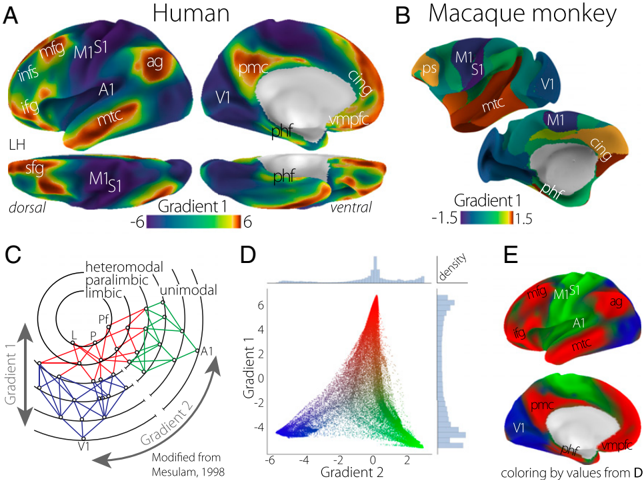
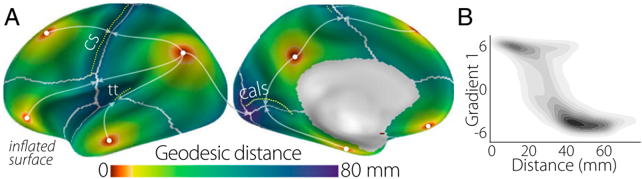
Understanding how the structure of cognition arises from the topographical organization of the cortex is a primary goal in neuroscience. Previous work has described local functional gradients extending from perceptual and motor regions to cortical areas representing more abstract functions, but an overarching framework for the association between structure and function is still lacking. Here, we show that the principal gradient revealed by the decomposition of connectivity data in humans and the macaque monkey is anchored by, at one end, regions serving primary sensory/motor functions and at the other end, transmodal regions that, in humans, are known as the default-mode network (DMN). These DMN regions exhibit the greatest geodesic distance along the cortical surface-and are precisely equidistant-from primary sensory/motor morphological landmarks. The principal gradient also provides an organizing spatial framework for multiple large-scale networks and characterizes a spectrum from unimodal to heteromodal activity in a functional metaanalysis. Together, these observations provide a characterization of the topographical organization of cortex and indicate that the role of the DMN in cognition might arise from its position at one extreme of a hierarchy, allowing it to process transmodal information that is unrelated to immediate sensory input.
Overview
CoChat Summary
TL;DR
The paper identifies a principal connectivity gradient in human and macaque cortex that runs from primary/unimodal sensory-motor regions to transmodal default-mode network (DMN) regions. It argues that the DMN’s position at one extreme, maximally distant from primary areas, helps explain its role in abstract, stimulus-independent cognition.
Key findings
- A principal gradient of functional connectivity, derived from 91,282 cortical/subcortical grayordinates at 2 mm resolution in 820 healthy adults (1 hour resting-state fMRI per participant, HCP S900), is anchored by primary/unimodal visual, somatosensory/motor, and auditory regions at one end and DMN regions at the other.
- Seven peak DMN nodes are maximally distant along the cortical surface from primary sensory/motor landmarks; four are equidistant from the central sulcus, and geodesic distance from DMN peaks relates to the principal gradient with \(R^2 = 0.55\). Beyond 40 mm from DMN peaks, cortex exclusively consists of unimodal regions.
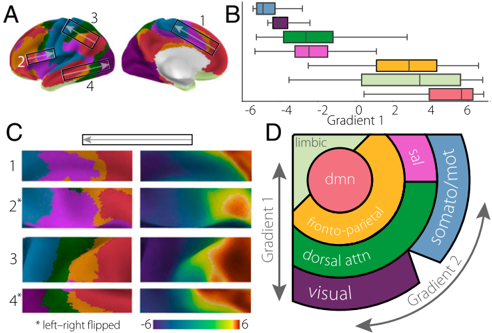
- The principal gradient orders the 7-network Yeo parcellation, with DMN at one extreme and visual/motor networks at the other; the limbic network is an exception, spanning a wide range of values.
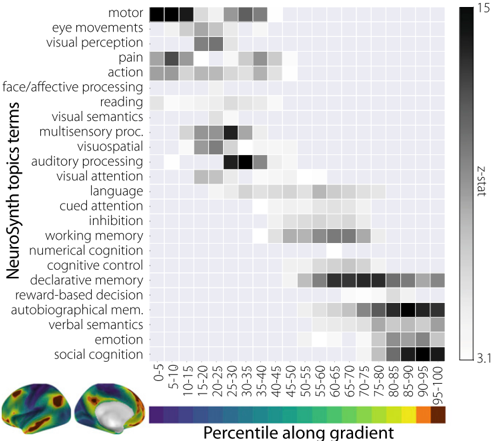
- A NeuroSynth meta-analysis using 24 topic terms shows a functional shift along the gradient: motor, visual perception, multisensory, and auditory terms at the unimodal end; cued attention, inhibition, and working memory in the middle; and social cognition, verbal semantics, and autobiographical memory at the DMN end.
Methods
- Human data were from the Human Connectome Project dense connectome S900 release: 91,282 grayordinates at 2 mm resolution, based on 1 hour of resting-state fMRI from 820 healthy adults, with no further processing beyond HCP minimal preprocessing including 2 mm FWHM smoothing.
- The main analysis used diffusion embedding, a nonlinear dimensionality reduction method, to extract connectivity gradients (“connectopies”) rather than discrete network parcellations; the same embedding was applied to a publicly available macaque tract-tracing database.
- Additional analyses calculated minimum geodesic distance from 7 DMN peak nodes, related gradient values to the 7-network Yeo parcellation, and performed a NeuroSynth meta-analysis with 24 topic terms across 5-percentile bins of the principal gradient.
Limitations
- Stated: the limbic network captures an extensive range of gradient values, which the authors suggest may be due to low signal-to-noise in the original parcellation data and may not accurately reflect its constituent regions’ connectivity.
- Stated: future studies are needed to better characterize transitions between large-scale connectivity patterns and to identify where processing occurs stepwise versus gradientially.
- Evident from the text: the macaque cross-species correspondence is described as “initial evidence” that the axis may be phylogenetically conserved, and the analyses are descriptive/spatial rather than causal tests of the proposed hierarchy.
Model-written summary. Check it against the paper before relying on it.
Integrity signals
Registry
Cites
Statistics
Figures

Verification
Claims the paper makes
14 Valid · 2 Not valid · 11 Not checked · 50 Own results and interpretations
The cited sources support only part of this claim — read each source’s verdict below.
In the paper
“Second, the location of the DMN as equidistant from all sensory/motor systems is aligned with its broad range of functions that require integration between multiple sensory systems, including episodic [51] and semantic memory [52-54], social cognition [55, 56], goal-directed working memory tasks [26, 32, 33, 35] and reward-guided decision making [57, 58].”
What the sources say
- Supportedcites [51] Schacter DL, Addis DR (2007) The cognitive neuroscience of constructive memory: remembering the past and imagining the future. Philos Trans R Soc Lond B Biol Sci 362(1481):773786. 661 662 663 source
Split into 2 atoms — 2 confirmed, 0 partially supported, 0 disputed, 0 misattributed, 0 unverifiable. Expand the claim to see per-atom verdicts.
- Supportedcites [52] Binder JR, Desai RH, Graves WW, Conant LL (2009) Where is the semantic system? a critical review and meta-analysis of 120 functional neuroimaging studies. Cereb Cortex 19(12):27672796. 664 665 source
The citation to this paper is attached to the semantic-memory part of the sentence, not the other listed functions. “Semantic Processing and the ‘Default Network’” says the semantic system closely resembles the default network, while “The Semantic System of the Human Brain” describes its regions as receiving multimodal input and supporting integrative processes. Page numbers are unavailable in our copy. (LLM, conf=0.91)
- Not checked — no full text of the sourcecites [53] Jefferies E (2013) The neural basis of semantic cognition: converging evidence from neuropsychology, neuroimaging and TMS. Cortex 49(3):611-625. 666 source
- Partly supportedcites [54] Constantinescu AO, O'Reilly JX, Behrens TEJ (2016) Organizing conceptual knowledge in humans with a gridlike code. Science 352(6292):1464-8. sourceExperimental — accuracy not yet measured
Split into 2 atoms — 1 confirmed, 1 partially supported, 0 disputed, 0 misattributed, 0 unverifiable. Expand the claim to see per-atom verdicts.
- Not checked — no full text of the sourcecites [55] Amodio DM, Frith CD (2006) Meeting of minds: the medial frontal cortex and social cognition. Nat Rev Neurosci 7(4):268-277. source
- Supportedcites [56] Amft M et al. (2015) Definition and characterization of an extended social-affective default network. Brain Struct Funct 220(2):1031-49. source
Split into 2 atoms — 2 confirmed, 0 partially supported, 0 disputed, 0 misattributed, 0 unverifiable. Expand the claim to see per-atom verdicts.
plainstates an association- Asserted: passes — The authors put it forward as true.
- Checkable: passes — It can be checked against evidence.
- Load-bearing: passes — The paper’s conclusions depend on it.
- Based: passes — The paper gives a reason why it holds.
- Supported
The cited sources support only part of this claim — read each source’s verdict below.
In the paper
“The DMN is at a maximal distance from systems involved in perception and action in both functional connectivity and anatomical space, indicating that the neural activity in these regions is likely to be comparably insulated from direct environmental input [49, 50].”
What the sources say
- Partly supportedcites [49] Kiebel SJ, Daunizeau J, Friston KJ (2008) A hierarchy of time-scales and the brain. PLoS Comput Biol 4(11):e1000209. 659 660 sourceExperimental — accuracy not yet measured
The Introduction and Discussion > Neuroscience Account describe higher cortical levels as farther from sensory input and as representing slower-changing context. But the paper does not identify the DMN as such a level or establish that activity in DMN regions is insulated from direct environmental input; its Conclusion says representations at different levels interact. (LLM, conf=0.78)
- Partly supportedcites [50] Friston K (2013) Life as we know it. J R Soc Interface 10(86):20130475. sourceExperimental — accuracy not yet measured
The Heuristic proof (page unavailable) says a Markov blanket insulates internal states from direct access to external states, and the Proof of principle > The Markov blanket section reports no direct connections between those states in a simulation. The paper does not identify DMN regions as those internal states or establish that DMN activity is insulated from environmental input. (LLM, conf=0.84)
hedged- Asserted: passes — The authors put it forward as true.
- Checkable: passes — It can be checked against evidence.
- Load-bearing: passes — The paper’s conclusions depend on it.
- Based: passes — The paper gives a reason why it holds.
- Partly supported
Every source the paper cites for this claim was checked and supports it.
In the paper
“The principal gradient illustrates a broader topographic organization of large-scale connectivity [38] that accounts for the spatial arrangement of local processing streams throughout the cerebral cortex.”
What the sources say
- Supportedcites [38] Jbabdi S, Sotiropoulos SN, Behrens TE (2013) The topographic connectome. Curr Opin Neurobiol 23(2):207-15. 643 644 source
The Introduction (page unavailable) describes topographic, spatial patterns in large-scale connections between grey-matter regions. The citation is attached to that broader organization of connectivity; the sentence’s interpretation of the principal gradient is the citing authors’ framing. (LLM, conf=0.87)
plainstates a cause- Asserted: passes — The authors put it forward as true.
- Checkable: passes — It can be checked against evidence.
- Load-bearing: passes — The paper’s conclusions depend on it.
- Based: passes — The paper gives a reason why it holds.
- Supported
The sources with a verdict support this claim; the rest weren’t checked yet, have no full text we could read, or their verdicts aren’t rated yet.
In the paper
“Notably, our results are consistent with a recent modification of the rostral-caudal processing gradient described within lateral frontal cortex [59, 60].”
What the sources say
- Supportedcites [59] Goulas A, Uylings HBM, Stiers P (2014) Mapping the hierarchical layout of the structural network of the macaque prefrontal cortex. Cereb Cortex 24(5):1178-94. 684 source
In the ABH Optimization section (page unavailable), the paper reports that the strict anterior–posterior gradient was not observed even when the analysis was limited to lateral prefrontal regions. In the Relation Between Asymmetry-Based Hierarchy and Laminar-Based Hierarchy section (page unavailable), it proposes a laminar-based hierarchy as a more plausible basis for models of that gradient. This supports the citation's identification of a modification; the citing authors' statement that their own results are consistent with it is their interpretation. (LLM, conf=0.86)
- Not checked — no full text of the sourcecites [60] Nee DE, D'Esposito M (2016) The hierarchical organization of the lateral prefrontal cortex. eLife 5. source
plainstates an association- Asserted: passes — The authors put it forward as true.
- Checkable: passes — It can be checked against evidence.
- Load-bearing: unclear — It is unclear whether the paper’s conclusions depend on it.
- Based: passes — The paper gives a reason why it holds.
- Supported
A result the paper reports from its own data — it cites no other source for it, so there is none to check. The quote shows it is in the paper.
In the paper
“Here we show that the principal gradient revealed by the decomposition of connectivity data in humans and the macaque monkey is anchored, at one end, by regions serving primary sensory/motor functions and, at the other, by transmodal regions that, in humans, are known as the default-mode network (DMN).”
- Also stated in: § Situating the default-mode network in a principal gradient of macroscale cortical organization · p. 2 · plain
“We describe an overarching organization of large-scale connectivity that situates the default-mode network at the opposite end of a spectrum from primary sensory and motor regions.”
- Also stated in: § Results · p. 3 · plain
“The principal gradient (Figure 1A), which accounts for the greatest variance in connectivity in the human brain (see Figure S1), is anchored at one end by the primary and unimodal visual, somatosensory/motor, and auditory regions. At the other end are regions including the angular gyrus, rostral anterior cingulate, posteromedial cortex, middle temporal gyrus, and middle and superior frontal gyri -”
boostedstates an association- Asserted: passes — The authors put it forward as true.
- Checkable: passes — It can be checked against evidence.
- Load-bearing: passes — The paper’s conclusions depend on it.
- Based: passes — The paper gives a reason why it holds.
- Also stated in: § Situating the default-mode network in a principal gradient of macroscale cortical organization · p. 2 · plain
33 more claims
Create a free account to see all 77 claims and every source verdict.
- The quote only partly states this claim. 1
- It may state two separate claims as one. 24
- Probably not a substantial claim. 21
Claims other papers make about this one
Each is checked against this paper’s own text: does it say what the citing paper says it does?
The cited source says what the claim attributes to it.
In the citing paper
“Because the DMN integrates information from multiple pathways (Binder and Desai 2011; Margulies et al. 2016), we propose that, as stimulus information travels up the cortical hierarchy of timescales during encoding, from low-level sensory areas up to high-level areas, a form of compression takes place (Hasson et al. 2015).”
From How We Transmit Memories to Other Brains: Constructing Shared Neural Representations Via Communication (2017) · cites this paper as Margulies et al. 2016
Citations
Cites
A Global Geometric Framework for Nonlinear Dimensionality Reduction
Tenenbaum, J. B., Silva, V. D., & Langford, J. C. (2000) · Science · doi:10.1126/science.290.5500.2319 · Cited by 13,585
Jenkinson, M., Bannister, P., Brady, M., & Smith, S. (2002) · NeuroImage · doi:10.1006/nimg.2002.1132 · Cited by 11,888
Jenkinson, M., Beckmann, C. F., Behrens, T. E. J., Woolrich, M. W., & Smith, S. M. (2012) · NeuroImage · doi:10.1016/j.neuroimage.2011.09.015 · Cited by 11,314
A tutorial on spectral clustering
von Luxburg, U. (2007) · Statistics and Computing · doi:10.1007/s11222-007-9033-z · Cited by 10,349
Fischl, B. (2012) · NeuroImage · doi:10.1016/j.neuroimage.2012.01.021 · Cited by 9,526
The organization of the human cerebral cortex estimated by intrinsic functional connectivity
Thomas Yeo, B. T., Krienen, F. M., Sepulcre, J., Sabuncu, M. R., Lashkari, D., Hollinshead, M., Roffman, J. L., Smoller, J. W., Zöllei, L., Polimeni, J. R., et al. (2011) · Journal of Neurophysiology · doi:10.1152/jn.00338.2011 · Cited by 9,182
The organization of the human cerebellum estimated by intrinsic functional connectivity
Buckner, R. L., Krienen, F. M., Castellanos, A., Diaz, J. C., & Yeo, B. T. T. (2011) · Journal of Neurophysiology · doi:10.1152/jn.00339.2011 · Cited by 7,304
Separate visual pathways for perception and action
Goodale, M. A., & Milner, A. D. (1992) · Trends in Neurosciences · doi:10.1016/0166-2236(92)90344-8 · Cited by 6,519
Functional connectivity in the resting brain: a network analysis of the default mode hypothesis
Greicius, M. D., Krasnow, B., Reiss, A. L., & Menon, V. (2003) · Proceedings of the National Academy of Sciences · doi:10.1073/pnas.0135058100 · Cited by 6,358
The WU-Minn Human Connectome Project: An overview
Van Essen, D. C., Smith, S. M., Barch, D. M., Behrens, T. E. J., Yacoub, E., & Ugurbil, K. (2013) · NeuroImage · doi:10.1016/j.neuroimage.2013.05.041 · Cited by 5,651
Research works printed but not linked: 2
- Von Bonin G, Bailey P (1947)
- Langs G, Golland P , Tie Y, Rigolo L, Golby AJ (2010) Functional geometry alignment and localization of brain areas. Adv. Neural Inf. Process. Syst. 1:1225-1233.
Cited by
Items 2,201–2,300 of 2,372
Luo, J., Zeng, X., Xiong, Y., Xu, Y., Zhou, C., Wang, Y., Yao, D., & Guo, D. (2026) · bioRxiv (Cold Spring Harbor Laboratory) · doi:10.64898/2026.03.19.712967
“4A), closely resembling the organization observed in empirical FC [3].”
InfluentialDual-axis myelination covariance drives the functional connectivity emergence during infancy
Liu, W., Chen, Y., Wang, X., Fang, T., Wang, R., Cheng, Y., Zhao, X., Fan, Q., Gao, W., & Ming, D. (2026) · Nature Communications · doi:10.1038/s41467-026-70660-4 · Cited by 1
Justo Gonzalo (1910–1986): a pioneer of brain dynamics
Gonzalo, I. (2026) · Frontiers in Neuroanatomy · doi:10.3389/fnana.2026.1754934
Wang, Y., Liang, X., Yang, C., Xiong, C., Liu, J., Sun, L., Liu, Y., Xiong, W., & Zeng, X. (2026) · Communications Biology · doi:10.1038/s42003-026-09886-3 · Cited by 1
“The principal gradient typically re fl ects a functional transition from unimodal sensorimotor regions to transmodal default mode network (DMN) areas, servingasacoreaxisofcognitivehierarchy 19,20 .”
Yue, S., Yang, R., Chen, J., Jiang, S., He, H., Yu, Y., Yu, S., Liu, L., Pu, L., Yao, G., et al. (2026) · Journal of Affective Disorders · doi:10.1016/j.jad.2026.121665
Naccarato, M., Ricci, E., Furlanis, G., et al. (2026) · Journal of Neurology · doi:10.1007/s00415-026-13750-z
Cascading periods of language-related brain plasticity across early childhoodPreprint
Ellwood-Lowe, M. E., Nishio, M., Dufford, A. J., et al. (2026) · bioRxiv (Cold Spring Harbor Laboratory) · doi:10.64898/2026.03.27.714739
“We then applied diffusion map embedding 56,57 .”
Cognition emerges from phase dynamics of intrinsic coordinationPreprint
Song, Y., Chen, J., Calhoun, V. D., & Iraji, A. (2026) · eLife · doi:10.64898/2026.03.26.714488 · Cited by 1
“Notably, the voxel-level projection of flow sequence encapsulate the dominant axes of cortical FC organization—the SA hierarchy (FC gradient 1) and the visual–somatomotor (VS) axis (FC gradient 2) [31] (Figure 4b, right).”
Su, S., Qin, B., Sun, Y., Qin, L., Hu, H., Zhou, Q., & Zheng, J. (2026) · Neurobiology of Disease · doi:10.1016/j.nbd.2026.107371
Liu, L., Tang, C., Chen, J., Lei, Y., Li, Y., & Ding, G. (2026) · Communications Biology · doi:10.1038/s42003-026-09900-8 · Cited by 2
“…termed cortical gradients — derived from dimensionality reduction of resting-state FC — subsuming multiple functions and functional networks ranging from unimodal systems supporting perception and action to transmodal association cortices involved in abstract cognition 25,27 .”
InfluentialXu, X., Fang, Z.-H., Xia, Y., Li, S., Feng, Y., Wu, Y., Salvi, R., Yin, X., & Chen, Y. (2026) · Human Brain Mapping · doi:10.1002/hbm.70521
“…structure) is the fundamental organizing principle of the human brain (Mesulam 1998), enabling the seamless encoding, transformation, and integration of information across multiple levels of processing from primary sensorimotor regions to higher-order cognitive areas (Margulies et al. 2016).”
Steel, A., Angeli, P. A., & Robertson, C. E. (2026) · eLife · doi:10.7554/elife.110234 · Cited by 2
Steel, A., Angeli, P. A., & Robertson, C. E. (2026) · eLife · doi:10.7554/elife.110234.1
How the brain copes with bad times
Gowin, J. L., & Sheller, C. (2026) · PLoS Biology · doi:10.1371/journal.pbio.3003710
Miao, Z., Jung, H., Kragel, P. A., Bo, K., Sadil, P. S., Lindquist, M. A., & Wager, T. D. (2026) · Nature Communications · doi:10.1038/s41467-026-71151-2 · Cited by 6
“…of socialinteraction processing and ToM were associated with the Default Mode Network (DMN) 51 , which primarily consists of transmodal regions 58,59 that are functionally distant from unimodal cortices and encode higher-level conceptual information during narrative experiences 60 – 62 .”
Cai, Z.-W., Zhuang, S.-P., Huang, Z.-Y., Shi, J., Huang, N., Chen, S., Zou, Z., & Chen, H.-J. (2026) · Brain Research Bulletin · doi:10.1016/j.brainresbull.2026.111850
Using connectivity to investigate brain (dys)function
Kopál, J. (2021) · theses.fr (ABES) · doi:10.70675/6742c30ez63b7z4280zb0acza9b27dc994c8
Resting-state functional connectivity in children and adults with spinal muscular atrophy
Groulx‐Boivin, É., Carlson, H. L., Oliveira-Carneiro, A., Floer, A., Kirton, A., Mah, J. K., Saint‐Martin, C., Piana, R. L., Mugisha, N., & Oskoui, M. (2026) · Aperture Neuro · doi:10.52294/001c.159517
Esfeh, M. A., Rezaei, A., Rowchan, K., Mohseni, H., Gale, D. J., Wammes, J. D., Chen, J., Flanagan, J. R., & Gallivan, J. P. (2026) · Journal of Neuroscience · doi:10.1523/jneurosci.2129-25.2026
The default mode network in a hierarchical generative model of the brain
Satpute, A. B., & Lee, K. M. (2026) · Current Opinion in Behavioral Sciences · doi:10.1016/j.cobeha.2026.101656 · Cited by 2
Lin, C., Dai, C., Hu, Y., Zhang, X., Tao, Z., Liu, X., Li, X., Xu, T., Ye, M., Cao, Y., et al. (2026) · The Journal of Headache and Pain · doi:10.1186/s10194-026-02366-3 · Cited by 1
“Efficient brain function relies on the flexible integration of local signals across the cortical hierarchy [9]; thus, the compressed gradient raises the possibility that transmodal regions may suffer from a restricted dynamic range in chronic migraine.”
Gao, F., He, Y., Lin, Y., Tang, S., Ning, Y., & Yuan, Z. (2026) · Bilingualism Language and Cognition · doi:10.1017/s1366728926101163 · Cited by 1
Resting-state EEG alpha-BOLD coupling spatially follows cortical cell-type and receptor gradientsPreprint
Jiříček, S., Chien, V. S. C., Schmidt, H., Koudelka, V., Mareček, R., Mantini, D., & Hlinka, J. (2026) · bioRxiv (Cold Spring Harbor Laboratory) · doi:10.64898/2026.04.14.718407
Structuro‐Functional Differentiation and Coupling of Gyri and Sulci in the Neonatal Cortex
Mao, W., He, Z., Jin, X., Hamouda, E., Ou, X., Kendrick, K. M., Zhang, T., & Jiang, X. (2026) · Human Brain Mapping · doi:10.1002/hbm.70524 · Cited by 2
“…adult studies demonstrate that stronger FC-SC coupling typically characterizes unimodal regions, likely reflecting their need for rapid, stimulus-driven response mediated by direct structural connections (Margulies et al. 2016; Huntenburg et al. 2017; Cioli et al. 2014; Hawrylycz et al. 2012).”
Creative embodiment and the arts therapies relational neuroscience (ATR-N) approach
Hass‐Cohen, N., & Vaisvaser, S. (2026) · The Arts in Psychotherapy · doi:10.1016/j.aip.2026.102472 · Cited by 1
Adezati, E., Thye, M. D., Butta, S., Pecchioli, L., Hoffman, P., & Mirman, D. (2026) · Cortex · doi:10.1016/j.cortex.2026.04.005
Tzalavras, A., Osher, D. E., Cocuzza, C. V., Chakravarthula, L. N. C., Mill, R. D., Peterson, K. L., & Cole, M. W. (2026) · bioRxiv (Cold Spring Harbor Laboratory) · doi:10.64898/2026.04.21.719298
Lim, M., & Kim, M. J. (2026) · Scientific Reports · doi:10.1038/s41598-026-49773-9
“This coupling may reflect the capacity of the DMN to represent information from task-positive systems, as DMN regions can contain signals relating to neural functioning in other cortical systems 41,42 .”
Nanayakkara, N. D., Meusel, L.-A., Anderson, N. D., & Chen, J. J. (2026) · NeuroImage · doi:10.1016/j.neuroimage.2026.121952
Bo, T., Huang, Y., Lu, Y., Song, Y., Zhang, J., Zhang, J., Wang, H., & Wang, Z. (2026) · Neuroscience Bulletin · doi:10.1007/s12264-026-01627-0 · Cited by 1
“MRI studies have further revealed the conservation of structure and neuronal connectivity across humans and macaques [98, 169–172], indicating that spatial patterning of gene expression and imaging measurements are closely linked in both species.”
Wang, D., Yan, S., Zhou, R., Li, Y., Liu, L., Wei, Y., Wang, D., Yao, H., Zhou, B., Lu, J., et al. (2026) · Science Advances · doi:10.1126/sciadv.aef3787
“Briefly, the diffusion map embedding is a nonlinear dimensionality reduction method that models data through a diffusion process, converting Euclidean distances into transition probabilities to reveal intrinsic data structure ( 40 ).”
Nonlinear shift along the sensorimotor-association-axis in brain responses to task performance
Yuan, Y., Zhang, B., Perkins, K., & Cao, F. (2026) · NeuroImage · doi:10.1016/j.neuroimage.2026.121978 · Cited by 1
Benchmarking spatial interpolation methods for brain mapsPreprint
Zhou, Y., Bazinet, V., & Mišić, B. (2026) · bioRxiv (Cold Spring Harbor Laboratory) · doi:10.64898/2026.04.27.721143
“…79,80,90 , structure (myelin and cortical thickness) 28 , function (homology, gradient, inter-subject variability, and sensory-association axis) 52,60,84,98 , metabolism (cerebral blood volume, cerebral blood flow, metabolic rate of oxygen, metabolic rate of glucose consumption) 88 , and…”
Miao, W., Jiao, X., Zeng, N., Wang, M., Zhang, K., Yang, C., Xie, Y., Wang, Z., & Hu, Q. (2026) · NeuroImage Clinical · doi:10.1016/j.nicl.2026.104002
“…no single threshold or kernel is universally optimal, the present parameter settings were chosen to align with commonly used practices in connectome gradient analysis and to balance noise suppression with preservation of meaningful large-scale connectivity structure (Margulies et al., 2016).”
Mapping the Hierarchical Brain Architecture of Functional Neurological Disorders
Crossley, N. A. (2026) · Biological Psychiatry Cognitive Neuroscience and Neuroimaging · doi:10.1016/j.bpsc.2026.03.014
Li, J., Li, X., Li, R., Luo, J., Xu, Y., & Yao, G. (2026) · Social Cognitive and Affective Neuroscience · doi:10.1093/scan/nsag035
“Next, to efficiently associate functional connectivity gradient differences with transcriptomic data while minimizing computational demands, we employed the Python abagen toolbox to map these gene expression profiles to 180 distinct brain regions in the left hemisphere (Margulies et al. 2016).”
Yan, T., Wang, K., Han, Z., Ma, Y., Wang, X. G., Zhang, K., Yang, G., & Liu, T. (2026) · BMC Medicine · doi:10.1186/s12916-026-04919-4
“Aligning with previous findings on large-scale brain organization [87], this evidence confirms the GP’s dual role in mediating not only cortico-subcortical pathways but also information transfer between cortical networks, highlighting the contribution of its subregions to the brain’s hierarchical…”
Effect of rTMS on cerebral functional hierarchical structure in schizophrenia
Wu, H., Li, H., Xiong, K., Jiang, S., Huang, H., Hou, C., Zhou, J., Rodríguez-Labrada, R., Yao, D., & Luo, C. (2026) · Psychoradiology · doi:10.1093/psyrad/kkag019 · Cited by 1
“Consistent with previous research (Margulies et al. , 2016 ), the two ends of the principal gradient (referred to as Gradient 1) corresponded to the sensorimotor cortex and the DMN.”
Gao, L., Zhang, A., Liu, J., Cui, D., & Guo, X. (2026) · NeuroImage · doi:10.1016/j.neuroimage.2026.121998 · Cited by 1
Verde, F. (2026) · Cognitive Semiotics · doi:10.1515/cogsem-2026-3002
“…its distinctive topographic and structural properties, the DMN would occupy the apex of the semantic neurofunctional hierarchy (Lanzoni et al. 2020; Margulies et al. 2016), acting as a heteromodal hub for the free combination – that is, dissociated from immediate sensory input – of semantic…”
Ji, Y., Huang, X., Wang, Y., Zhou, L., Dong, Z.-E., & Wu, X. (2026) · CNS Neuroscience & Therapeutics · doi:10.1002/cns.70925
“The covariance matrices were thresholded at 90% sparsity and converted to affinity matrices using a normalized angle kernel ( α = 0.5) [27, 55].”
InfluentialNappe, L. F. (2026) · Medical Hypotheses · doi:10.1016/j.mehy.2026.111994
Functional Gradients of the Spinal Cord and Corticospinal System
Sareen, E., Nambiar, N. S., & Ville, D. V. D. (2026) · IEEE International Symposium on Biomedical Imaging (ISBI) · doi:10.1109/isbi61048.2026.11515526
“Consistent with prior studies [1], we set α = 0 .”
InfluentialCross domain consistency of aesthetic preference-driven social behavior
Pham, T. Q., & Chikazoe, J. (2026) · Frontiers in Neural Circuits · doi:10.3389/fncir.2026.1793443
“This architecture suggests these prefrontal regions act as a functional hub for the universal encoding of aesthetic value.”
Liang, X., Wang, Y., Yang, C., Yang, Z., Ji, Y., Pei, Y., Xiong, W., Zuo, X., Peng, X., Dai, J., et al. (2026) · Pain · doi:10.1097/j.pain.0000000000004010
Electrophysiological lag threads reveal a temporal hierarchy of the human cortexPreprint
Hege, P., Giehl, J., & Siegel, M. (2026) · bioRxiv (Cold Spring Harbor Laboratory) · doi:10.64898/2026.05.27.728161
“In resting-state MEG, cortical amplitude fluctuations followed a re-producible temporal ordering that was most coherent in the alpha and beta bands and broadly aligned with the sensory-to-association organization of the cortex 1,2 .”
Commentary: White matter functional connectome gradient dysfunction in major depressive disorder
Cheng, S., Chen, B., & Lu, J. J. (2026) · Psychoradiology · doi:10.1093/psyrad/kkag021
“Diffusion-embedding approaches reliably recover a principal sensory-to-transmodal axis that captures macroscale cortical hierarchy (Margulies et al. , 2016 ).”
Beyond networks: Functional connectivity as eigenmode resonance
Cabral, J. M. S., & Sun, H. (2026) · Aperture Neuro · doi:10.52294/001c.162128 · Cited by 2
Nasiri, M., Afshani, M., & Mohammadi, A. (2026) · NeuroImage · doi:10.1016/j.neuroimage.2026.122023
Kong, X., Li, S., & Gong, G. (2026) · eLife · doi:10.7554/elife.110294.2
Gu, S., Wang, S. W., Wang, S. W., Yang, H., Liu, J.-P., Ji, Y.-N., Zhang, H., Chen, H. M., Chen, L., Song, C.-M., et al. (2026) · Frontiers in Immunology · doi:10.3389/fimmu.2026.1724276
Hippocampal Long Axis Differentiation in Memory and Seizure Networks
McClain, K., Nguyen, Q.-A., Sepeta, L. N., Soltész, I., & Liu, A. A. (2026) · Epiliepsy currents/Epilepsy currents · doi:10.1177/15357597261436406 · Cited by 1
Ou, M., Shen, H., Liu, W., Su, J.-P., Zeng, L., & Hu, D. (2026) · Journal of Affective Disorders · doi:10.1016/j.jad.2026.122078 · Cited by 1
Linking EEG markers of oscillopathy and default mode network dysfunction in Alzheimer’s disease
Chen, C., Jose, D., Cheng, P. K.-H., Massa, J. J., & Li, W. (2026) · Frontiers in Human Neuroscience · doi:10.3389/fnhum.2026.1750878
Viswanathan, S., Spinney, S., Watts, J. J., & Conrod, P. (2026) · Human Brain Mapping · doi:10.1002/hbm.70549
“…dynamics as traveling and standing waves along multiple cortical gradients, while (Xia et al. 2022) confirmed longitudinal strengthening of the unimodal- to-transmodal gradient originally described by (Margulies et al. 2016) alongside development along the task-positive to default mode axis.”
Computational spirits: a neuroscientific account of psychedelic entity encounters
Mago, J., Deane, G., Sandved-Smith, L., Safron, A., Timmermann, C., Ramstead, M. J. D., Dupuis, D., Carhart-Harris, R. L., Greenway, K. T., & Lifshitz, M. (2026) · Neuroscience of Consciousness · doi:10.1093/nc/niaf069 · Cited by 1
“Some researchers propose that the DMN sits at the top of a hierarchical processing system, by which information from different brain regions and sensory modalities is integrated ( Margulies et al. 2016; Friston 2018; Fris-ton et al. 2018).”
Pines, A. R., Zhang, X., Kochalka, J., Vesuna, S. S., Kauvar, I., Rajasekharan, D., Reneau, T. R., Akiki, T. J., Hack, L. M., Siegel, J. S., et al. (2026) · Proceedings of the National Academy of Sciences · doi:10.1073/pnas.2522000123 · Cited by 4
Navigating Pubertal Goldilocks: The Optimal Pace for Hierarchical Brain OrganizationPreprint
Balestrieri, G., Gombos, F., Kringelbach, M. L., Deco, G., Szakács, H., Braun, J., Mutlu, M. C., & Kovács, I. (2024) · OSF Preprints (OSF Preprints)
Kringelbach, M. L., & Deco, G. (2026) · bioRxiv (Cold Spring Harbor Laboratory) · doi:10.64898/2026.06.05.730423 · Cited by 3
“The first nontrivial functional harmonics coincide with the principal functional gradient, i.e. the unimodal-to-transmodal cortical hierarchy (Glomb et al., 2021; Margulies et al., 2016).”
InfluentialDohnány, S., Jerotic, K., Orsenigo, D., Serra, E., Ali, H., Buhler, J., Liu, Z.-Q., Muta, K., Hata, J., Okano, H., et al. (2026) · bioRxiv (Cold Spring Harbor Laboratory) · doi:10.64898/2026.06.06.730576
“In this way, each gradient represents one dimension of covariance in the inter-regional similarity between FC patterns, with a small number of gradients capturing most of the dimensions of inter-regional similarity, this can then be visualised through a low-dimensional scatter plot [6, 7].”
InfluentialYu, Q., Guan, X., Wu, J., Sun, X., Chen, Q., Yu, D., Liu, L., Kuang, G., Li, J., Hu, X., et al. (2026) · European Journal of Nuclear Medicine and Molecular Imaging · doi:10.1007/s00259-026-07975-3
“Yeo et al. [30]. divided the cerebral cortex into seven functional networks, which Margulies et al. [29]. subsequently organized into five gradients reflecting the brain’s organi - zation.”
InfluentialReorganisation of Functional Connectivity Gradients in Post-Stroke AphasiaPreprint
Balakrishnan, R., Alam, T. R. G., Leech, R., Price, C. J., & Jefferies, E. (2026) · bioRxiv (Cold Spring Harbor Laboratory) · doi:10.64898/2026.06.07.730675
“What is missing is a holistic description that situates local and network-level changes within the brain’s continuous macroscale organisation 21 .”
InfluentialSelf-citationNago, H., Kojima, H., Yamaguchi, H., & Yamashita, Y. (2026) · Brain Informatics · doi:10.1186/s40708-026-00312-2
“We selected 24 topic terms based on previous studies, spanning the hierarchy from lower sensorimotor functions to higher-order cognitive domains [40, 41].”
Cortical geometry constrains the unimodal anchors of sensory integrationPreprint
Holmes, A., Wei, W., Benn, R. A., Alberti, F., Scholz, R., Pang, J. C. S., Fornito, A., Robinson, P. A., & Margulies, D. S. (2026) · bioRxiv (Cold Spring Harbor Laboratory) · doi:10.64898/2026.06.13.732038
Self-citationLesion-gradient mapping: Effects of stroke on connectivity gradients in semantic aphasia
Balakrishnan, R., Alam, T. R. G., Mckeown, B., Souter, N., Karapanagiotidis, T., Smallwood, J., Krieger‐Redwood, K., & Jefferies, E. (2026) · Cortex · doi:10.64898/2026.06.12.731654
Self-citationDefault-mode network activity is retained in the isolated hemisphere of people after hemispherotomy
Bauer, T., Gauvry, C., Markett, S. A., Kreter-Schönleber, T., Borger, V., Vatter, H., Sander, J. W. A. S., Gabriel, M., Radbruch, A., Surges, R., et al. (2026) · Brain Communications · doi:10.1093/braincomms/fcag211 · Cited by 1
“11,12 The most extensively studied and consistently reported network at the transmodal end of this gradient is the default mode network.”
Adaptive Gaussian graph-spectral filtering for scale-specific connectivity inference
Fotoohinasab, A., Ugonna, C., Calhoun, V. D., & Chen, N. (2026) · NeuroImage · doi:10.1016/j.neuroimage.2026.122055
Gao, Q., Wen, J., Lü, Y., Li, L., Li, J. J., Hua, B., Mao, Y., Zhao, W., Xu, Y. J., Xia, P., et al. (2026) · European Journal of Radiology · doi:10.1016/j.ejrad.2026.113018
Xia, K., Wang, S., Wu, T., Sun, D., Wang, W., Wang, X. J., & Han, Y. (2026) · Neurobiology of Disease · doi:10.1016/j.nbd.2026.107495
Infra-slow brain fluctuations: A taxonomy of mechanistic hypotheses
Mäki-Marttunen, V. (2026) · Neuroscience & Biobehavioral Reviews · doi:10.1016/j.neubiorev.2026.106825 · Cited by 1
The genuine problem of consciousness
Jack, A. I., Robbins, P., Friedman, J. P., & Roepstorff, A. (2026) · Elsevier eBooks · doi:10.1016/b978-0-443-29258-3.00037-9 · Cited by 1
Liu, J., Xiao, Y., Zheng, J., Zhao, P., Wang, L., Tang, R., Duan, J., Zheng, H., Wei, D., Qiu, J., et al. (2026) · Nature Mental Health · doi:10.1038/s44220-026-00665-x
“Notably, the most pronounced disruptions were observed in these two key hubs—the dmPFC within the higher-order cognitive–affective network of DMN and the VC within the unimodal visual network 29,30 .”
Smimih, K., Azzouhri, C., El‐Mansoury, B., Draoui, A., Lahouaoui, H., Bitar, A., Merzouki, M., & Hiba, O. E. (2026) · Neurology International · doi:10.3390/neurolint18070123
“…manifold and gradient approaches indicate that this architecture is organized along a sensorimotor association axis: primary sensorimotor and visual regions occupy one end of the hierarchy, while trans modal association cortices (default-mode and fronto–parietal regions) occupy the other [129,130].”
Decomposition of task-specific responses in the multiple demand networkPreprint
Afzalian, N., Katebi, M. E., & Rajimehr, R. (2026) · bioRxiv (Cold Spring Harbor Laboratory) · doi:10.64898/2026.06.21.732474
“This gradient-like organization aligns with established principles of cortical architecture in which large-scale functional gradients extend from sensory cortex toward increasingly sensory-motor distal association regions [82,83].”
Impact of amyloid-Beta on the functional hierarchies and clinical outcomes in late-life depression
Je, N., Kang, D. W., Um, Y. H., Kim, S., Lim, H. K., Kim, M., & Wang, S. M. (2026) · Journal of Affective Disorders · doi:10.1016/j.jad.2026.122179
Rosenblatt, M., Vandewouw, M. M., Fox-Jurkowitz, H., et al. (2026) · bioRxiv (Cold Spring Harbor Laboratory) · doi:10.64898/2026.06.22.733725
“…myelination and laminar differentiation 20,96 ; 8. the principal axis of functional connectivity, representing a unimodal-to-transmodal gradient 20,97 ; 9. a gradient of plasticity that measures age-related changes in low-frequency fluctuation amplitude of resting-state fMRI data from eight to 22…”
Brain Connectivity Modelling Through Joint Estimation of Parcels and GradientsPreprint
Rekavandi, A. M., Jbabdi, S., & Smith, S. M. (2026) · bioRxiv (Cold Spring Harbor Laboratory) · doi:10.64898/2026.06.23.734045
“We next investigate whether gradient embeddings derived using the DLS framework (capturing true local variations) reveal meaningful large-scale organisation when projected onto the cortical surface, in a manner analogous to the visualisation presented in [15].”
InfluentialSymptom Overlap and Neurobiological Similarities Between Posttraumatic Stress Disorder and Tinnitus
Moring, J. C., Husain, F. T., Franklin, C., Kaniewska, E., Hecht, Q. A., Flores, A., Mullen, D. K., Esquivel, C., Fallon, A., Lovelace, S., et al. (2026) · Human Brain Mapping · doi:10.1002/hbm.70582
“Although discrepancies in the literature exist, studies have found decreased functional connectivity between the parahippocampus, a key region in the EMO, and the left middle temporal gyrus among PTSD patients compared to non- trauma-exposed controls (Bao et al. 2021; Margulies et al. 2016).”
Ferrari, A., Wan, B., Kabbeck, J., Saberi, A., Kaiser, S., Kebets, V., Moreau, C. A., Thompson, P. M., van Erp, T. G. M., Turner, J. A., et al. (2026) · medRxiv · doi:10.64898/2026.06.30.26356921
Choi, Y., Fuentes‐Claramonte, P., McKenna, P. J., Pomarol‐Clotet, E., Sihn, D., & Kim, S.-P. (2026) · NeuroImage · doi:10.1016/j.neuroimage.2026.122100
Li, P. J., Mu, J., Zhu, X., Yuan, H., Luo, Z.-Y., Zhu, Q.-G., Niu, X., Feng, X.-L., Han, Y., Ge, T., et al. (2026) · CNS Neuroscience & Therapeutics · doi:10.1002/cns.70976
“Cortical functional gradients represent a novel, principled framework to quantify the continuous, macroscale hierarchical organization of resting-state functional connectivity (rsFC) [16].”
InfluentialThe human language processing system straightens natural speechPreprint
Xu, J., Nguyen, T. D., Tang, J., Huth, A. G., & Goris, R. L. T. (2026) · bioRxiv (Cold Spring Harbor Laboratory) · doi:10.64898/2026.06.30.735613
“This topographic structure resembles the large-scale organization of connectivity patterns [37] and local synaptic strength [38].”
Sub-second fluctuations between top-down and bottom-up modes distinguish diverse human brain states
Park, Y., Cha, Y.-H., Kim, H., Kim, Y., Woo, J. H., Lee, J., Cho, H., Mashour, G. A., Xu, T., Lee, U., et al. (2026) · Current Biology · doi:10.1016/j.cub.2026.06.014 · Cited by 2
Zhang, X., & He, X. (2026) · Lecture notes in computer science · doi:10.1007/978-981-95-9575-4_4
Higson, L. (2026) · Frontiers in Neurology · doi:10.3389/fneur.2026.1865708
“The brain is the body’s most metabolically demanding organ, and its energy consumption is unevenly distributed across regions and networks, meaning that some networks are far more metabolically expensive to sustain than others (15).”
InfluentialGenerative AI as a transformational logic for cognitive neuroscience
Beste, C., & Safavi, S. (2026) · Communications Biology · doi:10.1038/s42003-026-10642-w · Cited by 2
“A related descriptive perspective comes from large-scale functional connectivity gradient approaches in systems neuroscience 43 – 45 .”
Zeng, C., Wu, Z., Yang, R., Liu, Q., Li, S., Yao, Z., Fu, Y., & Wang, X. (2026) · Behavioural Brain Research · doi:10.1016/j.bbr.2026.116361
Suarez, G. L., Meier, H. C. S., Michael, C., Tillem, S., Palomba, I., Hardi, F. A., Neblett, E. W., Mitchell, C., Monk, C. S., & Hyde, L. W. (2026) · Brain and Environment · doi:10.1016/j.braen.2026.100026 · Cited by 1
Blunted modulation of hierarchical brain organization in opioid use disorderPreprint
Tomasi, D. G., Manza, P., Demiral, Ş. B., Giddens, N. T., Belcher, A. M., Yan, W., Miller, K., Veenker, F., Lildharrie, C., Yonga, M.-V., et al. (2026) · Research Square · doi:10.21203/rs.3.rs-9889932/v1
“The principal gradient reflects a unimodal-to-transmodal hierarchy, spanning primary sensory and motor cortices to heteromodal association regions such as the default mode network (DMN), while secondary gradients capture orthogonal axes of functional specialization 9 .”
Brain structural and functional connectivity converge prenatally but diverge after birth
Zhao, R., Li, M., ZHANG, Y., Chen, R., Ning, C., Zhao, Z., Yan, Z., Wang, M., & Wu, D. W. (2026) · PLoS Biology · doi:10.1371/journal.pbio.3003927
“To elucidate the spatial pattern of SF coupling at birth, we compared it with established cortical hierarchies, including the principal functional gradient [26], evolutionary surface area expansion [73], and the sensorimotor-association axis [74].”
InfluentialDevelopmental Landscape of Gradients in Human HippocampusPreprint
Zeng, D., Li, Q., Li, D., He, Y., Dong, X., Yang, Z., Zhang, Y., Li, S., Bi, S., Xu, T. L., et al. (2026) · eLife · doi:10.21203/rs.3.rs-10317075/v1
Hou, Y., Pizzuti, A., Knoblauch, K., Vezoli, J., Goebel, R., Vinck, M. A., & Kennedy, H. (2026) · PLoS Biology · doi:10.1371/journal.pbio.3003906
“This heterogeneity might in part reflect hierarchical gradients [217–219], but the dependence of temporal dynamics on stimulus drive and other factors can further increase the divergence in frequencies.”
Human Brain-Wide Activation of Sleep RhythmsPreprint
Wang, H., Zou, Q., Zhang, J., Gao, J., & Liu, Y. (2026) · eLife · doi:10.7554/elife.103956.3
Yao, W., Lv, T., Zheng, W., Liu, Y., Shi, X., Zhang, Y., Song, Y. W., Bai, Y., & Bai, F. (2026) · Alzheimer s & Dementia Translational Research & Clinical Interventions · doi:10.1002/trc2.70294
Bolton, T. A. W., Schöttner, M., Patel, J. H., Chan, C. H. M., Ville, D. V. D., & Hagmann, P. (2026) · bioRxiv (Cold Spring Harbor Laboratory) · doi:10.64898/2026.07.19.739422 · Cited by 1
“More broadly, this view places connectome harmonics within a growing family of low-dimensional coordinate systems for describing large-scale brain organization, alongside cortical gradients 16,33 , geometric eigenmodes 52,69 , and low-dimensional dynamical representations 72 .”
Pan, J., Zhang, H., Zhai, Y., Zhang, J., & Deng, H. (2026) · Frontiers in Neuroscience · doi:10.3389/fnins.2026.1780430
“The underlying search space comprised 24 behavioral and cognitive terms (Margulies et al., 2016; Preti and Van De Ville, 2019), spanning social, executive, language, and perceptual processing.”
Metadata
- Authors
- Margulies, D. S., Ghosh, S. S., Goulas, A., Falkiewicz, M., Huntenburg, J. M., Langs, G., Bezgin, G., Eickhoff, S. B., Castellanos, F. X., Petrides, M., Jefferies, E., & Smallwood, J.
- Affiliations
- Max Planck Institute for Human Cognitive and Brain Sciences (DE)
- Harvard University (US)
- University Medical Center Hamburg-Eppendorf (DE)
- MIT Computer Science and Artificial Intelligence Laboratory (US)
- Montreal Neurological Institute and Hospital (CA)
- Forschungszentrum Jülich (DE)
- Nathan Kline Institute for Psychiatric Research (US)
- University of York (GB)
- ORCID
- Venue
- Proceedings of the National Academy of Sciences
- Publisher
- National Academy of Sciences
- Published
- 2016-10-18
- Volume
- 113
- Issue
- 44
- Pages
- 12574-12579
- ISSN
- 0027-8424 (ISSN-L)
- 1091-6490
- PMC
- PMC5098630
- OpenAlex
- W2536956629
- Cited by
- 2,321
- References
- 96
- Citations by year
- 2026: 365 · 2025: 381 · 2024: 388 · 2023: 292 · 2022: 233 · 2021: 218 · 2020: 215 · 2019: 109 · 2018: 65 · 2017: 50 · 2016: 4
- FWCI
- 48.22
- Type
- journal article
- Language
- en
- Open access
- bronze
- doi.org
- Locations
- Proceedings of the National Academy of Sciences (publishedVersion)
- PubMed Central (publishedVersion)
- PubMed (publishedVersion)
- White Rose Research Online (University of Leeds, The University of Sheffield, University of York) (submittedVersion)
- DSpace@MIT (Massachusetts Institute of Technology) (submittedVersion, cc-by-nc)
- Funders
- EC | European Research Council (283530-SEMBIND, WANDERINGMINDS - 646927)
- John Templeton Foundation (Prospective Psychology Stage 2: A Research Competition)
- Gouvernement du Canada | Canadian Institutes of Health Research (FDN-143212)
- NIH (1R01EB020740-01A1, 1P41EB019936-01A1, 3R01MH092380-04S2, 1U01MH108168-01)
- Topics
- Life Sciences › Neuroscience › Cognitive Neuroscience › Functional Brain Connectivity Studies
- Health Sciences › Medicine › Radiology, Nuclear Medicine and Imaging › Advanced Neuroimaging Techniques and Applications
- Life Sciences › Neuroscience › Cognitive Neuroscience › Neural dynamics and brain function
- Keywords
- default mode network, cortical topography, geodesic distance, cortical connectivity, large-scale brain networks, structure-function relationship, macaque cortex, human cortex
- MeSH terms
- Animals, Brain, Brain Mapping, Humans, Macaca, Magnetic Resonance Imaging, Models, Neurological, Nerve Net, Sensation, Sensorimotor Cortex
About these checks
Registry, retraction, Cites and statistics results are computed, not judged, with one exception: a printed reference that no index lists is read once by a model before it counts as a citation error. Claims are extracted by a model and kept only when their quote appears verbatim in the text; each cited source is then checked, with a model’s help, for whether it says what the claim relies on. Those verdicts can be wrong — read the claim’s quote and the cited source before relying on one.
The claim verdicts this report counts are experimental: their accuracy is not yet measured.
A language model drew the claims from the paper on 2026-09-30, under version 3 of the claim definition (model deepseek-v4.1-flash, prompt extract-v3).
A second model labelled each claim on 2026-09-30 (model jev-1.13-20260917, definition revision gold-guideline-v0.2).
Cited sources are checked with a language model’s help (gpt-6-sol).
Statistics and arithmetic are recomputed, not judged.
Confidence bands are shown only for fields calibrated on our annotated test set. None is calibrated yet, so no band is shown.
What counts as a claim ›How we measure confidence ›How we check this ›
Are you an author, or do you see a problem with this page? Request a review
Data sources
Bibliographic data: Semantic Scholar, OpenAlex, Crossref.
Contains information from the Semantic Scholar Academic Graph Datasets, made available under the ODC Attribution License (ODC-BY 1.0).
Semantic Scholar’s data is described in: Kinney, R., et al. (2023). The Semantic Scholar Open Data Platform. arXiv:2301.10140.
