

The DOI matches its Crossref record; 45 of the 46 references it cites were found in a registry or an index.
Facebook language predicts depression in medical records
Open accessAbstract
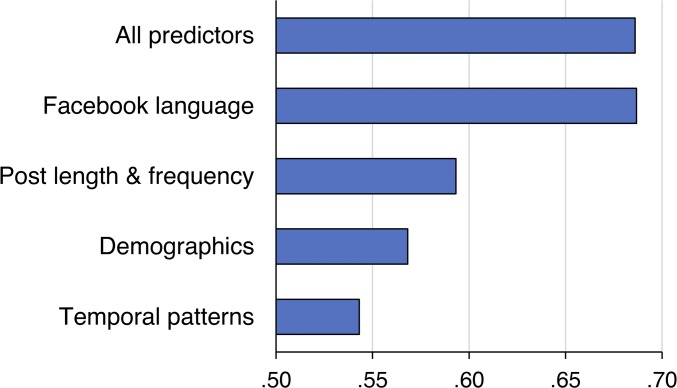
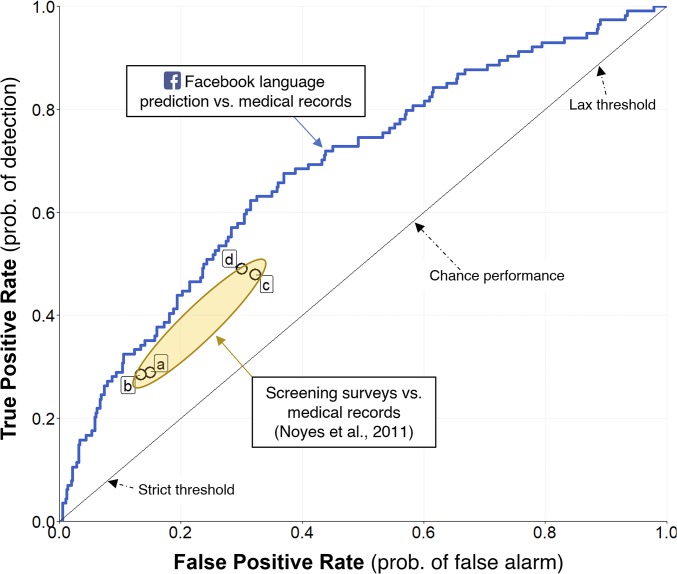
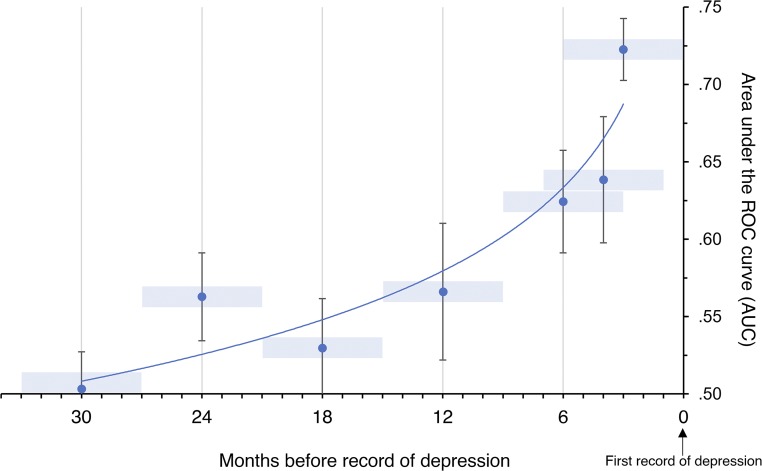
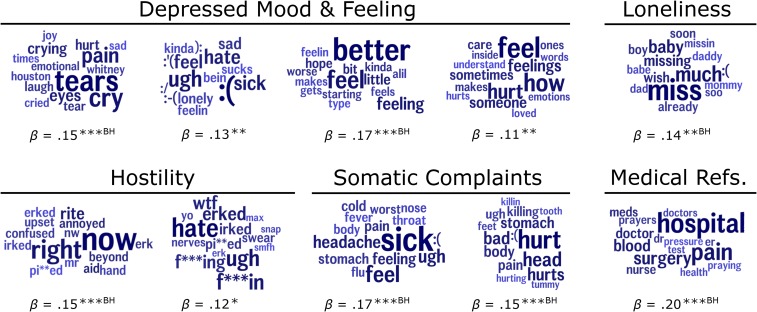
Significance: Depression is disabling and treatable, but underdiagnosed. In this study, we show that the content shared by consenting users on Facebook can predict a future occurrence of depression in their medical records. Language predictive of depression includes references to typical symptoms, including sadness, loneliness, hostility, rumination, and increased self-reference. This study suggests that an analysis of social media data could be used to screen consenting individuals for depression. Further, social media content may point clinicians to specific symptoms of depression.
Overview
The claims and statistics of this paper haven’t been checked yet.
Run the check — free, no account needed. It reads the open-access text and checks the sources it cites.
Integrity signals
Registry
Cites
Statistics
Figures
Verification
Claims the paper makes
The claims and statistics of this paper haven’t been checked yet.
Run the check — free, no account needed. It reads the open-access text and checks the sources it cites.
Claims other papers make about this one
Each is checked against this paper’s own text: does it say what the citing paper says it does?
In the citing paper
“These include words related to sadness, as well as words related to somatic health concerns (health and biology words, with the biology category combining body, health, sexual, and ingestion words) [22,23].”
From Behavioral Activation and Depression Symptomatology: Longitudinal Assessment of Linguistic Indicators in Text-Based Therapy Sessions (2021) · cites this paper as [23]
In the citing paper
“Over the years, Facebook developed machine learning algorithms studying the behavior of their users in detail on the platform. In order to get to know their users better, they do not only record what people ‘like’ (i.e., give a ‘thumbs up’) but also how long they hover over a certain post. This could be interpreted as showing a special interest in a certain area. ‘Textmining’ enables Facebook & Co”
From Addictive Features of Social Media/Messenger Platforms and Freemium Games against the Background of Psychological and Economic Theories (2019) · cites this paper as [67]
Self-check
Percentages, sums and reported differences re-computed from the paper’s own numbers.
The self-check needs the paper’s full text.
Citations
Cites
Controlling the False Discovery Rate: A Practical and Powerful Approach to Multiple Testing
Benjamini, Y., & Hochberg, Y. (1995) · Journal of the Royal Statistical Society Series B: Statistical Methodology · doi:10.1111/j.2517-6161.1995.tb02031.x · Cited by 109,482
(2003) · Journal of Machine Learning Research · doi:10.5555/944919.944937 · Cited by 32,337
Zhang, Q., Wang, C., Zheng, M., Li, Y., Li, J., Zhang, L., Shang, X., & Yan, C. (2014) · Cerebrovascular Diseases · doi:10.1159/000369778 · Cited by 11,609
Projections of Global Mortality and Burden of Disease from 2002 to 2030
Mathers, C. D., & Loncar, D. (2006) · PLoS Medicine · doi:10.1371/journal.pmed.0030442 · Cited by 11,386
Adjusting batch effects in microarray expression data using empirical Bayes methods
Johnson, W. E., Li, C., & Rabinovic, A. (2007) · Biostatistics · doi:10.1093/biostatistics/kxj037 · Cited by 8,658
Kessler, R. C., Berglund, P., Demler, O., Jin, R., Koretz, D., Merikangas, K. R., Rush, A. J., Walters, E. E., & Wang, P. S. (2003) · JAMA · doi:10.1001/jama.289.23.3095 · Cited by 7,988
Private traits and attributes are predictable from digital records of human behavior
Kosinski, M., Stillwell, D., & Graepel, T. (2013) · Proceedings of the National Academy of Sciences · doi:10.1073/pnas.1218772110 · Cited by 2,829
Wang, P. S., Lane, M., Olfson, M., Pincus, H. A., Wells, K. B., & Kessler, R. C. (2005) · Archives of General Psychiatry · doi:10.1001/archpsyc.62.6.629 · Cited by 2,695 · cited 1×
“E year, 7–26% of the US population experiences depression (1, 2), of whom only 13–49% receive minimally adequate treatment (3).”
BackgroundPredicting Depression via Social Media
Choudhury, M. D., Gamon, M., Counts, S., & Horvitz, E. (2021) · Proceedings of the International AAAI Conference on Web and Social Media · doi:10.1609/icwsm.v7i1.14432 · Cited by 1,583
Cited by
Sorted by citations
Items 101–200 of 640
Wisdom from words: The psychology of consumer language
Berger, J. A., & Packard, G. M. (2022) · Consumer Psychology Review · doi:10.1002/arcp.1085 · Cited by 38
Consumer Views on Privacy Protections and Sharing of Personal Digital Health Information
Gupta, R., Iyengar, R., Sharma, M., Cannuscio, C. C., Merchant, R. M., Asch, D. A., Mitra, N., & Grande, D. (2023) · JAMA Network Open · doi:10.1001/jamanetworkopen.2023.1305 · Cited by 45
Self-citationSikström, S., Kelmendi, B., & Persson, N. (2023) · npj Mental Health Research · doi:10.1038/s44184-023-00032-z · Cited by 46
Large Language Models and Text Embeddings for Detecting Depression and Suicide in Patient Narratives
Lho, S. K., Park, S. C., Lee, H., Oh, D. Y., Kim, H., Jang, S., Jung, H. Y., Yoo, S. Y., Park, S. M., & Lee, J. (2025) · JAMA Network Open · doi:10.1001/jamanetworkopen.2025.11922 · Cited by 36
Consumer Willingness to Share Personal Digital Information for Health-Related Uses
Grande, D., Mitra, N., Iyengar, R., Merchant, R. M., Asch, D. A., Sharma, M., & Cannuscio, C. C. (2022) · JAMA Network Open · doi:10.1001/jamanetworkopen.2021.44787 · Cited by 36
Self-citationFindings of the Shared Task on Detecting Signs of Depression from Social Media
Sampath, K., Thenmozhi, D., Chakravarthi, B. R., & Jerin Mahibha, C. (2022) · Workshop on Language Technology for Equality, Diversity, Inclusion (LT-EDI) · doi:10.18653/v1/2022.ltedi-1.51 · Cited by 35
Shrestha, A., Serra, E., & Spezzano, F. (2020) · Network Modeling Analysis in Health Informatics and Bioinformatics · doi:10.1007/s13721-020-0226-0 · Cited by 37
Gender differences in language are small but matter for disorders
Wallentin, M. (2020) · Handbook of clinical neurology · doi:10.1016/b978-0-444-64123-6.00007-2 · Cited by 42
Kjell, O., Daukantaité, D., & Sikström, S. (2021) · Frontiers in Psychology · doi:10.3389/fpsyg.2021.601679 · Cited by 32
MacAvaney, S., Mittu, A., Coppersmith, G., Leintz, J., & Resnik, P. (2021) · Workshop on Computational Linguistics and Clinical Psychology (CLPsych) · doi:10.18653/v1/2021.clpsych-1.7 · Cited by 38
Declining well-being during the COVID-19 pandemic reveals US social inequities
Bathina, K. C., ten Thij, M., Valdez, D., Rutter, L. A., & Bollen, J. (2021) · PLoS ONE · doi:10.1371/journal.pone.0254114 · Cited by 35
Sampath, K., & Thenmozhi, D. (2022) · IFIP advances in information and communication technology · doi:10.1007/978-3-031-16364-7_11 · Cited by 34
Schick, A., Rauschenberg, C., Ader, L., Daemen, M., Wieland, L. M., Paetzold, I., Postma, M. R., Schulte‐Strathaus, J. C. C., & Reininghaus, U. (2022) · Psychological Medicine · doi:10.1017/s0033291722003336 · Cited by 32
Markowitz, D. M., & Griffin, D. J. (2019) · Psychology Crime and Law · doi:10.1080/1068316x.2019.1652751 · Cited by 32
Stangl, F. J., Riedl, R., Kiemeswenger, R., & Montag, C. (2023) · Frontiers in Psychology · doi:10.3389/fpsyg.2023.1141663 · Cited by 39
Matteo, D. D., Wang, W., Fotinos, K., Lokuge, S., Yu, J., Sternat, T., Katzman, M. A., & Rose, J. (2021) · JMIR Formative Research · doi:10.2196/22723 · Cited by 33
Ovalle, A., Goldstein, O., Kachuee, M., Wu, E. S. C., Hong, C., Holloway, I. W., & Sarrafzadeh, M. (2021) · Journal of Medical Internet Research · doi:10.2196/22042 · Cited by 32
Hawes, M. T., Schwartz, H. A., Son, Y., & Klein, D. N. (2022) · Psychological Medicine · doi:10.1017/s0033291722003452 · Cited by 36
Self-citationKjell, O., Giorgi, S., & Schwartz, H. A. (2021) · PsyArXiv (OSF Preprints) · doi:10.31234/osf.io/293kt · Cited by 38
Self-citationTeferra, B. G., Borwein, S., DeSouza, D. D., Simpson, W. S., Rheault, L., & Rose, J. (2022) · JMIR Mental Health · doi:10.2196/36828 · Cited by 31
Stade, E. C., Ungar, L., Eichstaedt, J. C., Sherman, G. T., & Ruscio, A. M. (2023) · Journal of Psychopathology and Clinical Science · doi:10.1037/abn0000850 · Cited by 38
Self-citationFunkhouser, C. J., Trivedi, E., Li, L. Y., Helgren, F., Zhang, E., Sritharan, A., Cherner, R., Pagliaccio, D., Durham, K., Kyler, M., et al. (2023) · Journal of Child Psychology and Psychiatry · doi:10.1111/jcpp.13931 · Cited by 32
Agurto, C., Cecchi, G., Norel, R., Ostrand, R., Kirkpatrick, M. G., Baggott, M. J., Wardle, M. C., de Wit, H., & Bedi, G. (2020) · Neuropsychopharmacology · doi:10.1038/s41386-020-0620-4 · Cited by 31
Hunt, X., Tomlinson, M., Sikander, S., Skeen, S., Marlow, M., Toit, S. D., & Eisner, M. (2020) · Frontiers in Artificial Intelligence · doi:10.3389/frai.2020.543305 · Cited by 37
Predicting Depression in Community Dwellers Using a Machine Learning Algorithm
Cho, S., Geem, Z. W., & Na, K. (2021) · Diagnostics · doi:10.3390/diagnostics11081429 · Cited by 31
Analysis of recreational psychedelic substance use experiences classified by substance
Hase, A., Erdmann, M., Limbach, V., & Hasler, G. (2022) · Psychopharmacology · doi:10.1007/s00213-022-06062-3 · Cited by 33
Marengo, D., Elhai, J. D., & Montag, C. (2023) · Journal of Personality · doi:10.1111/jopy.12817 · Cited by 36
Kamra, V., Kumar, P., & Mohammadian, M. (2022) · Intelligent Systems with Applications · doi:10.1016/j.iswa.2023.200208 · Cited by 31
DepressionEmo: A novel dataset for multilabel classification of depression emotions
Rahman, A. B. S., Ta, H. T., Najjar, L., Azadmanesh, A., & Gönül, A. S. (2024) · Journal of Affective Disorders · doi:10.1016/j.jad.2024.08.013 · Cited by 41
Birnbaum, M., Kulkarni, P., Meter, A. V., Chen, V., Rizvi, A., Arenare, E., de Choudhury, M., & Kane, J. (2020) · JMIR Mental Health · doi:10.2196/19348 · Cited by 30
Hobbs, K., Monette, P., Owoyemi, P., Beard, C., Rauch, S. L., Ressler, K. J., & Vahia, I. V. (2019) · Journal of Medical Internet Research · doi:10.2196/13218 · Cited by 26
Ethical Considerations of Digital Phenotyping from the Perspective of a Healthcare Practitioner
Dagum, P., & Montag, C. (2019) · Studies in neuroscience, psychology and behavioral economics · doi:10.1007/978-3-030-31620-4_2 · Cited by 30
Entrepreneurial Disappointment: Let Down and Breaking Down, a Machine-Learning Study
Williamson, A. J., Drencheva, A., & Battisti, M. (2020) · Entrepreneurship Theory and Practice · doi:10.1177/1042258720964447 · Cited by 38
Analytic thinking as revealed by function words: What does language really measure?
Markowitz, D. M. (2023) · Applied Cognitive Psychology · doi:10.1002/acp.4057 · Cited by 29
Meyerhoff, J., Liu, T., Stamatis, C. A., Liu, T., Wang, H., Meng, Y., Curtis, B. L., Karr, C. J., Sherman, G. T., Ungar, L., et al. (2023) · Behaviour Research and Therapy · doi:10.1016/j.brat.2023.104342 · Cited by 28
Self-citationFrom privacy to anti-discrimination in times of machine learning
Hagendorff, T. (2019) · Ethics and Information Technology · doi:10.1007/s10676-019-09510-5 · Cited by 30
The story of “I” tracking: Psychological implications of self‐referential language use
Berry‐Blunt, A. K., Holtzman, N. S., Donnellan, M. B., & Mehl, M. R. (2021) · Social and Personality Psychology Compass · doi:10.1111/spc3.12647 · Cited by 35
Xu, L., Li, L., Jiang, Z., Sun, Z., Wen, X., Shi, J., Sun, R. F., & Qian, X. (2020) · IEEE Access · doi:10.1109/access.2020.3009292 · Cited by 30
Zhang, Y., Folarin, A., Dineley, J., Conde, P., de Angel, V., Sun, S., Ranjan, Y., Rashid, Z., Stewart, C., Laiou, P., et al. (2024) · Journal of Affective Disorders · doi:10.1016/j.jad.2024.03.106 · Cited by 32
Mental Health Applications of Generative AI and Large Language Modeling in the United States
Banerjee, S. K., Dunn, P. J., Conard, S. E., & Ali, A. (2024) · International Journal of Environmental Research and Public Health · doi:10.3390/ijerph21070910 · Cited by 27
Modeling Depression Symptoms from Social Network Data through Multiple Instance Learning.
Wongkoblap, A., Vadillo, M. A., & Ćurčin, V. (2019) · PubMed Central · Cited by 27
McNeilly, E. A., Mills, K. L., Kahn, L. E., Crowley, R. N., Pfeifer, J. H., & Allen, N. B. (2023) · Clinical Psychological Science · doi:10.1177/21677026221125180 · Cited by 30
Head versus heart: social media reveals differential language of loneliness from depression
Liu, T., Ungar, L., Curtis, B. L., Sherman, G. T., Yadeta, K., Tay, L., Eichstaedt, J. C., & Guntuku, S. C. (2022) · npj Mental Health Research · doi:10.1038/s44184-022-00014-7 · Cited by 33
Self-citationThe Language That Drives Engagement: A Systematic Large-scale Analysis of Headline Experiments
Banerjee, A., & Urminsky, O. (2021) · Marketing Science · doi:10.1287/mksc.2021.0018 · Cited by 27
Chahar, R., Dubey, A. K., & Narang, S. K. (2021) · International Journal of Advanced Technology and Engineering Exploration · doi:10.19101/ijatee.2021.874198 · Cited by 28
Machine learning of language use on Twitter reveals weak and non-specific predictions
Kelley, S., Mhaonaigh, C. N., Burke, L., Whelan, R., & Gillan, C. M. (2022) · npj Digital Medicine · doi:10.1038/s41746-022-00576-y · Cited by 34
Owen, D. C., Lynham, A. J., Smart, S. E., Pardiñas, A. F., & Camacho-Collados, J. (2024) · Journal of Medical Internet Research · doi:10.2196/59225 · Cited by 30
Phiri, D., Makowa, F., Amelia, V. L., Phiri, Y. V. A., Dlamini, L. P., & Chung, M. (2025) · Journal of Medical Internet Research · doi:10.2196/59002 · Cited by 44
Mori, K., & Haruno, M. (2020) · Journal of Personality · doi:10.1111/jopy.12578 · Cited by 25
Depression prediction based on BiAttention-GRU
Cao, Y., Hao, Y., Li, B., & Xue, J. (2022) · Journal of Ambient Intelligence and Humanized Computing · doi:10.1007/s12652-021-03497-y · Cited by 26
Rocca, R., Tamagnone, N., Fekih, S., Contla, X., & Rekabsaz, N. (2023) · Frontiers in Big Data · doi:10.3389/fdata.2023.1082787 · Cited by 31
Leveraging ChatGPT to optimize depression intervention through explainable deep learning
Liu, Y., Ding, X., Peng, S., & Zhang, C. (2024) · Frontiers in Psychiatry · doi:10.3389/fpsyt.2024.1383648 · Cited by 32
Artificial intelligence to aid the detection of mood disorders
Cummins, N., Matcham, F., Klapper, J., & Schuller, B. W. (2020) · Elsevier eBooks · doi:10.1016/b978-0-12-817133-2.00010-0 · Cited by 25
The Future is Knocking: How Artificial Intelligence Will Fundamentally Change Psychiatry
Brunn, M., Diefenbacher, A., Courtet, P., & Genieys, W. (2020) · Academic Psychiatry · doi:10.1007/s40596-020-01243-8 · Cited by 32
Precision, Equity, and Public Health and Epidemiology Informatics – A Scoping Review
Buckeridge, D. L. (2020) · Yearbook of Medical Informatics · doi:10.1055/s-0040-1701989 · Cited by 25
Comparing emotion feature extraction approaches for predicting depression and anxiety
Burkhardt, H. A., Pullmann, M. D., Hull, T., Aren, P., & Cohen, T. (2022) · Workshop on Computational Linguistics and Clinical Psychology (CLPsych) · doi:10.18653/v1/2022.clpsych-1.9 · Cited by 26
AI-based analysis of social media language predicts addiction treatment dropout at 90 days
Curtis, B. L., Giorgi, S., Ungar, L., Vu, H., Yaden, D. B., Liu, T., Yadeta, K., & Schwartz, H. A. (2023) · Neuropsychopharmacology · doi:10.1038/s41386-023-01585-5 · Cited by 28
Self-citationSimchon, A., Guntuku, S. C., Simhon, R., Ungar, L., Hassin, R. R., & Gilead, M. (2020) · Journal of Experimental Psychology General · doi:10.1037/xge0000767 · Cited by 24
Self-citationEvaluation of deep learning-based depression detection using medical claims data
Bertl, M., Bignoumba, N., Ross, P., Yahia, S. B., & Draheim, D. (2023) · Artificial Intelligence in Medicine · doi:10.1016/j.artmed.2023.102745 · Cited by 24
Language sentiment predicts changes in depressive symptoms
Hur, J. K., Heffner, J., Feng, G. W., Joormann, J., & Rutledge, R. B. (2024) · Proceedings of the National Academy of Sciences · doi:10.1073/pnas.2321321121 · Cited by 28
Review of Advancements in Depression Detection Using Social Media Data
Dalal, S., Jain, S., & Dave, M. (2024) · IEEE Transactions on Computational Social Systems · doi:10.1109/tcss.2024.3448624 · Cited by 27
Mental health ubiquitous monitoring supported by social situation awareness: A systematic review
de Moura, I. R., Teles, A. S., Silva, F., Viana, D., Coutinho, L., Barros, F., & Endler, M. (2020) · Journal of Biomedical Informatics · doi:10.1016/j.jbi.2020.103454 · Cited by 25
Andy, A., Guntuku, S. C., Adusumalli, S., Asch, D. A., Groeneveld, P. W., Ungar, L., & Merchant, R. M. (2021) · JMIR Cardio · doi:10.2196/24473 · Cited by 23
Self-citationRagheb, W., Azé, J., Bringay, S., & Servajean, M. (2021) · IEEE Transactions on Knowledge and Data Engineering · doi:10.1109/tkde.2021.3078898 · Cited by 22
Comparison between sentiments of people from affected and non-affected regions after the flood
Guo, D., Zhao, Q., Chen, Q., Wu, J., Li, L., & Gao, H. (2021) · Geomatics Natural Hazards and Risk · doi:10.1080/19475705.2021.2012530 · Cited by 23
Psychiatric Scale Guided Risky Post Screening for Early Detection of Depression
Zhang, Z., Chen, S., Wu, M., & Zhu, K. Q. (2022) · International Joint Conference on Artificial Intelligence · doi:10.24963/ijcai.2022/725 · Cited by 30
O’Connor, K., Sarker, A., Perrone, J., & Gonzalez‐Hernandez, G. (2019) · Journal of Medical Internet Research · doi:10.2196/15861 · Cited by 23
Taiwo, O., & Al‐Bander, B. (2025) · Cognitive Computation and Systems · doi:10.1049/ccs2.12116 · Cited by 27
County-level estimates of suicide mortality in the USA: a modelling study
Kandula, S., Martínez‐Alés, G., Rutherford, C. G., Gimbrone, C., Olfson, M., Gould, M. S., Keyes, K. M., & Shaman, J. L. (2023) · The Lancet Public Health · doi:10.1016/s2468-2667(22)00290-0 · Cited by 23
Owen, D. C., Antypas, D., Hassoulas, A., Pardiñas, A. F., Espinosa-Anke, L., & Camacho-Collados, J. (2023) · JMIR AI · doi:10.2196/41205 · Cited by 26
Seyedi, S. S., Griner, E. L., Corbin, L., Jiang, Z., Roberts, K., Iacobelli, L., Milloy, A., Boazak, M., Rad, A. B., Abbasi, A., et al. (2023) · JMIR Mental Health · doi:10.2196/48517 · Cited by 25
Abed-Esfahani, P., Howard, D., Maslej, M. M., Patel, S., Mann, V., Goegan, S. A., & French, L. (2019) · CLEF (Working Notes) · Cited by 22
Kjell, K., Johnsson, P., & Sikström, S. (2021) · Frontiers in Psychology · doi:10.3389/fpsyg.2021.602581 · Cited by 24
Ahmed, S., Jaidka, K., Chen, V. H. H., Cai, M., Chen, A., Emes, C. S., Yu, V., & Chib, A. I. (2024) · Frontiers in Psychology · doi:10.3389/fpsyg.2024.1280366 · Cited by 21
ALGAN: Time Series Anomaly Detection with Adjusted-LSTM GAN
Bashar, M. A., & Nayak, R. (2025) · International Journal of Data Science and Analytics · doi:10.1007/s41060-025-00810-2 · Cited by 33
Iyer, H. S., Karasaki, S., Li, Y., Hswen, Y., James, P., & VoPham, T. (2025) · Current Environmental Health Reports · doi:10.1007/s40572-025-00497-4 · Cited by 30
Ahmed, S., Chen, V. H. H., Jaidka, K., Hooi, R., & Chib, A. I. (2021) · Asian Journal of Communication · doi:10.1080/01292986.2021.1929358 · Cited by 26
Overview of the role of big data in mental health: A scoping review
Ahmed, A., Agus, M., Alzubaidi, M. S., Aziz, S., Abd-Alrazaq, A. A., Giannicchi, A., & Househ, M. S. (2022) · Computer Methods and Programs in Biomedicine Update · doi:10.1016/j.cmpbup.2022.100076 · Cited by 21
Reilly, T. J., Mechelli, A., McGuire, P. K., Fusar‐Poli, P., & Uhlhaas, P. J. (2019) · JMIR Mental Health · doi:10.2196/14581 · Cited by 22
Forbidden knowledge in machine learning reflections on the limits of research and publication
Hagendorff, T. (2020) · AI & Society · doi:10.1007/s00146-020-01045-4 · Cited by 25
Lozoya, D. C., Conway, M., Duro, E. S. D., & D’Alfonso, S. (2025) · JMIR Medical Education · doi:10.2196/68056 · Cited by 22
Detecting Low Self-Esteem in Youths from Web Search Data
Zaman, A., Acharyya, R., Kautz, H., & Silenzio, V. (2019) · International World Wide Web Conference (WWW) · doi:10.1145/3308558.3313557 · Cited by 20
Measuring Forecasting Skill from Text
Zong, S., Ritter, A., & Hovy, E. H. (2020) · Proceedings of the conference - Association for Computational Linguistics. Meeting · doi:10.18653/v1/2020.acl-main.473 · Cited by 20
A Framework for Understanding the Relationship between Social Media Discourse and Mental Health
Mendu, S., Baglione, A. N., Baee, S., Wu, C., Ng, B., Shaked, A., Clore, G. L., Boukhechba, M., & Barnes, L. E. (2020) · Proceedings of the ACM on Human-Computer Interaction · doi:10.1145/3415215 · Cited by 23
Exploring Social Media for Early Detection of Depression in COVID-19 Patients
Wu, J., Wu, X., Hua, Y., Lin, S., Zheng, Y., & Yang, J. (2023) · International World Wide Web Conference (WWW) · doi:10.1145/3543507.3583867 · Cited by 20
Sutranggono, A. N., Sarno, R., & Ghozali, I. (2024) · Journal of Information and Communication Technology · doi:10.32890/jict2024.23.1.4 · Cited by 26
Using technology to unobtrusively observe relationship development
Brinberg, M., Vanderbilt, R., Solomon, D., Brinberg, D., & Ram, N. (2021) · Journal of Social and Personal Relationships · doi:10.1177/02654075211028654 · Cited by 17
Understanding Patterns of Anorexia Manifestations in Social Media Data with Deep Learning
Uban, A. S., Chulvi, B., & Rosso, P. (2021) · Workshop on Computational Linguistics and Clinical Psychology (CLPsych) · doi:10.18653/v1/2021.clpsych-1.24 · Cited by 19
Utilizing Instagram Data to Identify Usage Patterns Associated With Schizophrenia Spectrum Disorders
Hänsel, K., Lin, I. W., Sobolev, M., Muscat, W., Yum-Chan, S., Choudhury, M. D., Kane, J. M., & Birnbaum, M. L. (2021) · Frontiers in Psychiatry · doi:10.3389/fpsyt.2021.691327 · Cited by 18
Predicting subjective well-being in a high-risk sample of Russian mental health app users
Panicheva, P., Mararitsa, L. V., Sorokin, S., Koltsova, O. Y., & Rosso, P. (2022) · EPJ Data Science · doi:10.1140/epjds/s13688-022-00333-x · Cited by 21
A BERT-encoded ensembled CNN model for suicide risk identification in social media posts
Gorai, J., & Shaw, D. K. (2024) · Neural Computing and Applications · doi:10.1007/s00521-024-09642-w · Cited by 19
Uban, A. S., & Rosso, P. (2020) · RiuNet (Universitat Politècnica de València) · Cited by 20
Deep Bag-of-Sub-Emotions for Depression Detection in Social Media
Lara, J. S., Aragón, M. E., Gonzalez, F. A., & Montes-y-Gómez, M. (2021) · Lecture notes in computer science · doi:10.1007/978-3-030-83527-9_5 · Cited by 19
Artificial Intelligence in the Healthcare SectorPreprint
Puaschunder, J. M., & Feierabend, D. (2019) · SSRN Electronic Journal · doi:10.2139/ssrn.3469423 · Cited by 19
Chan, G. J., Fung, M. K. Y., Warrington, J. S., & Nowak, S. A. (2025) · JMIR Formative Research · doi:10.2196/55309 · Cited by 18
Identifying psychological indexes based on social media data: A machine learning method
Su, Y., Liu, M., Nan, Z. H. A. O., Liu, X., & Zhu, T. (2021) · Advances in Psychological Science · doi:10.3724/sp.j.1042.2021.00571 · Cited by 19
Social Media Terms and Conditions and Informed Consent From Children: Ethical Analysis
Schneble, C. O., Favaretto, M., Elger, B. S., & Shaw, D. (2021) · JMIR Pediatrics and Parenting · doi:10.2196/22281 · Cited by 18
Three families of automated text analysis
van Loon, A. (2022) · Social Science Research · doi:10.1016/j.ssresearch.2022.102798 · Cited by 20
Beyond Mobile Apps: A Survey of Technologies for Mental Well-Being
Woodward, K., Kanjo, E., Brown, D. J., McGinnity, T. M., Inkster, B., Macintyre, D. J., & Tsanas, A. (2022) · IEEE Transactions on Affective Computing · doi:10.1109/taffc.2020.3015018 · Cited by 18
Metadata
- Authors
- Eichstaedt, J. C., Smith, R. J., Merchant, R. M., Ungar, L. H., Crutchley, P., Preoţiuc-Pietro, D., Asch, D. A., & Schwartz, H. A.
- Affiliations
- University of Pennsylvania (US)
- University of Pennsylvania Health System (US)
- Positive Psychology Center, University of Pennsylvania, Philadelphia, PA 19104;
- Philadelphia VA Medical Center (US)
- Stony Brook University (US)
- Corresponding author
- Eichstaedt, Johannes C.
- ORCID
- Venue
- Proceedings of the National Academy of Sciences
- Publisher
- National Academy of Sciences
- Published
- 2018-10-15
- Volume
- 115
- Issue
- 44
- Pages
- 11203-11208
- ISSN
- 0027-8424 (ISSN-L)
- 1091-6490
- PMC
- PMC6217418
- OpenAlex
- W2897583329
- Cited by
- 643
- References
- 46
- Citations by year
- 2026: 64 · 2025: 68 · 2024: 77 · 2023: 87 · 2022: 107 · 2021: 111 · 2020: 84 · 2019: 41 · 2018: 3
- FWCI
- 80.90
- Type
- journal article
- Language
- en
- Open access
- hybrid
- doi.org
- Licence
- Locations
- Proceedings of the National Academy of Sciences (publishedVersion, cc-by-nc-nd)
- Europe PMC (PubMed Central) (publishedVersion, cc-by-nc-nd)
- PubMed Central (publishedVersion, cc-by-nc-nd)
- PubMed (publishedVersion)
- Funders
- Robert Wood Johnson Foundation (Pioneer Award)
- Templeton Religion Trust (TRT0048)
- HHS | NIH | National Heart, Lung, and Blood Institute (HL122457)
- Topics
- Social Sciences › Psychology › Social Psychology › Mental Health via Writing
- Physical Sciences › Computer Science › Artificial Intelligence › Emotion and Mood Recognition
- Physical Sciences › Computer Science › Artificial Intelligence › Sentiment Analysis and Opinion Mining
- Keywords
- depression, Facebook posts, social media language, depression prediction, electronic health records, depression screening, emergency department patients, rumination, loneliness, sadness, self-absorption, hostility
- MeSH terms
- Adult, Depression, Depressive Disorder, Female, Humans, Language, Male, Surveys and Questionnaires, Electronic Health Records, Social Media
About these checks
Registry, retraction, Cites and statistics results are computed, not judged, with one exception: a printed reference that no index lists is read once by a model before it counts as a citation error. Claims are extracted by a model and kept only when their quote appears verbatim in the text; each cited source is then checked, with a model’s help, for whether it says what the claim relies on. Those verdicts can be wrong — read the claim’s quote and the cited source before relying on one.
Statistics and arithmetic are recomputed, not judged.
Confidence bands are shown only for fields calibrated on our annotated test set. None is calibrated yet, so no band is shown.
What counts as a claim ›How we measure confidence ›How we check this ›
Are you an author, or do you see a problem with this page? Request a review
