

The DOI matches its Crossref record; 45 of the 46 references it cites were found in a registry or an index.
Facebook language predicts depression in medical records
Open accessAbstract
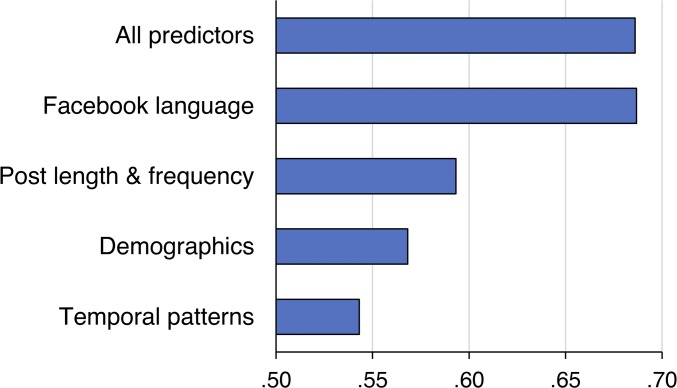
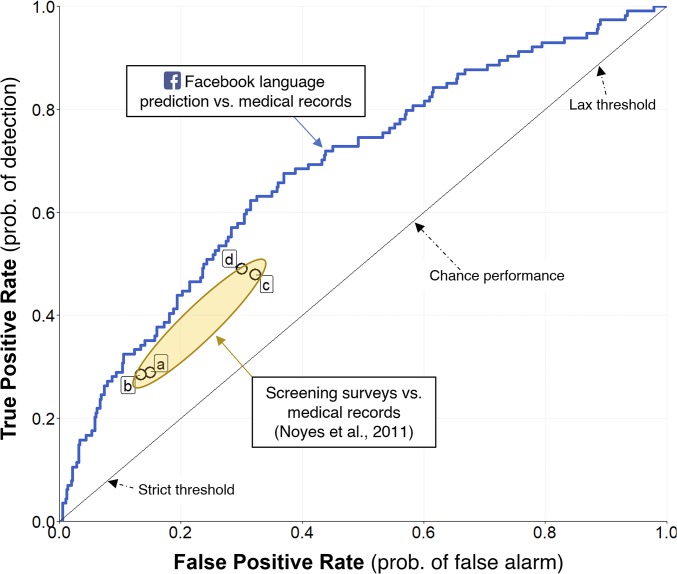
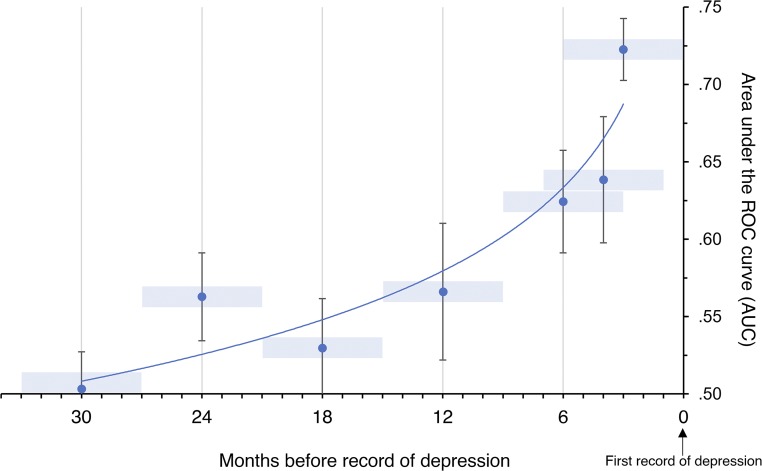
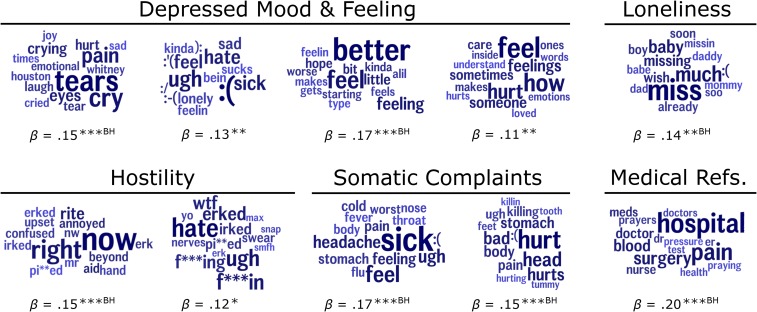
Significance: Depression is disabling and treatable, but underdiagnosed. In this study, we show that the content shared by consenting users on Facebook can predict a future occurrence of depression in their medical records. Language predictive of depression includes references to typical symptoms, including sadness, loneliness, hostility, rumination, and increased self-reference. This study suggests that an analysis of social media data could be used to screen consenting individuals for depression. Further, social media content may point clinicians to specific symptoms of depression.
Overview
The claims and statistics of this paper haven’t been checked yet.
Run the check — free, no account needed. It reads the open-access text and checks the sources it cites.
Integrity signals
Registry
Cites
Statistics
Figures
Verification
Claims the paper makes
The claims and statistics of this paper haven’t been checked yet.
Run the check — free, no account needed. It reads the open-access text and checks the sources it cites.
Claims other papers make about this one
Each is checked against this paper’s own text: does it say what the citing paper says it does?
In the citing paper
“These include words related to sadness, as well as words related to somatic health concerns (health and biology words, with the biology category combining body, health, sexual, and ingestion words) [22,23].”
From Behavioral Activation and Depression Symptomatology: Longitudinal Assessment of Linguistic Indicators in Text-Based Therapy Sessions (2021) · cites this paper as [23]
In the citing paper
“Over the years, Facebook developed machine learning algorithms studying the behavior of their users in detail on the platform. In order to get to know their users better, they do not only record what people ‘like’ (i.e., give a ‘thumbs up’) but also how long they hover over a certain post. This could be interpreted as showing a special interest in a certain area. ‘Textmining’ enables Facebook & Co”
From Addictive Features of Social Media/Messenger Platforms and Freemium Games against the Background of Psychological and Economic Theories (2019) · cites this paper as [67]
Self-check
Percentages, sums and reported differences re-computed from the paper’s own numbers.
The self-check needs the paper’s full text.
Citations
Cites
Controlling the False Discovery Rate: A Practical and Powerful Approach to Multiple Testing
Benjamini, Y., & Hochberg, Y. (1995) · Journal of the Royal Statistical Society Series B: Statistical Methodology · doi:10.1111/j.2517-6161.1995.tb02031.x · Cited by 109,482
(2003) · Journal of Machine Learning Research · doi:10.5555/944919.944937 · Cited by 32,337
Zhang, Q., Wang, C., Zheng, M., Li, Y., Li, J., Zhang, L., Shang, X., & Yan, C. (2014) · Cerebrovascular Diseases · doi:10.1159/000369778 · Cited by 11,609
Projections of Global Mortality and Burden of Disease from 2002 to 2030
Mathers, C. D., & Loncar, D. (2006) · PLoS Medicine · doi:10.1371/journal.pmed.0030442 · Cited by 11,386
Adjusting batch effects in microarray expression data using empirical Bayes methods
Johnson, W. E., Li, C., & Rabinovic, A. (2007) · Biostatistics · doi:10.1093/biostatistics/kxj037 · Cited by 8,658
Kessler, R. C., Berglund, P., Demler, O., Jin, R., Koretz, D., Merikangas, K. R., Rush, A. J., Walters, E. E., & Wang, P. S. (2003) · JAMA · doi:10.1001/jama.289.23.3095 · Cited by 7,988
Private traits and attributes are predictable from digital records of human behavior
Kosinski, M., Stillwell, D., & Graepel, T. (2013) · Proceedings of the National Academy of Sciences · doi:10.1073/pnas.1218772110 · Cited by 2,829
Wang, P. S., Lane, M., Olfson, M., Pincus, H. A., Wells, K. B., & Kessler, R. C. (2005) · Archives of General Psychiatry · doi:10.1001/archpsyc.62.6.629 · Cited by 2,695 · cited 1×
“E year, 7–26% of the US population experiences depression (1, 2), of whom only 13–49% receive minimally adequate treatment (3).”
BackgroundPredicting Depression via Social Media
Choudhury, M. D., Gamon, M., Counts, S., & Horvitz, E. (2021) · Proceedings of the International AAAI Conference on Web and Social Media · doi:10.1609/icwsm.v7i1.14432 · Cited by 1,583
Cited by
Sorted by citations
Items 301–400 of 640
Emotional and cognitive changes surrounding online depression identity claims
Biester, L., Pennebaker, J. W., & Mihalcea, R. F. (2022) · PLoS ONE · doi:10.1371/journal.pone.0278179 · Cited by 10
Perseverative thinking is associated with features of spoken language
Stade, E. C., Ungar, L., Havaldar, S., & Ruscio, A. M. (2023) · Behaviour Research and Therapy · doi:10.1016/j.brat.2023.104307 · Cited by 8
Self-citationRani, S., Ahmed, K. E. U., & Subramani, S. (2024) · Applied Sciences · doi:10.3390/app14041547 · Cited by 9
Linguistic features and psychological states: A machine-learning based approach
Du, X., & Sun, Y. (2022) · Frontiers in Psychology · doi:10.3389/fpsyg.2022.955850 · Cited by 7
Cognitive and social well-being in older adulthood: The CoSoWELL corpus of written life stories
Kyröläinen, A.-J., Gillett, J., Karabin, M., Sonnadara, R., & Kuperman, V. (2022) · Behavior Research Methods · doi:10.3758/s13428-022-01926-0 · Cited by 8
Mental health status of doctors and nurses in a Nigerian tertiary hospital: A COVID-19 experience
Olude, O. A., Odeyemi, K., Kanma-Okafor, O. J., Badru, O. A., Bashir, S. A., Olusegun, J. O., & Atilola, O. (2022) · South African Journal of Psychiatry · doi:10.4102/sajpsychiatry.v28i0.1904 · Cited by 7
Shen, J., Zhang, S., Tong, Y., Dong, X., Wang, X., Fu, G., Zhao, L., Wu, M., Yin, Y., Wang, Y., et al. (2022) · Frontiers in Psychiatry · doi:10.3389/fpsyt.2022.1022036 · Cited by 8
Towards automatic conceptual metaphor detection for psychological tasks
Panicheva, P., Mamaev, I. D., & Litvinova, T. (2022) · Information Processing & Management · doi:10.1016/j.ipm.2022.103191 · Cited by 9
Using Psychologically-Informed Priors for Suicide Prediction in the CLPsych 2021 Shared Task
Gamoran, A., Kaplan, Y., Orr, R. I., Simchon, A., & Gilead, M. (2021) · Workshop on Computational Linguistics and Clinical Psychology (CLPsych) · doi:10.18653/v1/2021.clpsych-1.12 · Cited by 9
Graves, R. L., Sarker, A., Al-Garadi, M. A., Yang, Y., Love, J. S., O’Connor, K., Gonzalez‐Hernandez, G., & Perrone, J. (2019) · bioRxiv (Cold Spring Harbor Laboratory) · doi:10.1101/871608 · Cited by 7
Knowing when to act: A call for an open misinformation library to guide actionable surveillance
Dunn, A. G., Steffens, M., Dyda, A., & Mandl, K. D. (2021) · Big Data & Society · doi:10.1177/20539517211018788 · Cited by 7
Nesbitt, B., Virgadamo, D. S., Aguirre, C. A., DeCamp, M. W., Dredze, M. H., Harrigian, K., Lhaksampa, T. C., Meuchel, J. M., Meyer, A. M., Walker, A., et al. (2025) · JMIR Research Protocols · doi:10.2196/63279 · Cited by 5
Li, C., Zhang, K., Lin, Q., Huang, S. H., Cheng, W., Lei, Y., Zhao, X., & Zhao, J. (2025) · BMC Medicine · doi:10.1186/s12916-025-04101-2 · Cited by 6
dos Santos, W. R., Paraboni, I., Matsushima, E. H., Silva, C. A. D., Meira, E. S. D. M., Guimarães, J. V. R. F., Lins, J., Azeredo, L. E. D., Nunes, L. G. C., & Rego, V. T. S. M. (2025) · IEEE Access · doi:10.1109/access.2025.3583259 · Cited by 7
Gu, Z., Kjell, K., Schwartz, H. A., & Kjell, O. (2025) · Assessment · doi:10.1177/10731911251364022 · Cited by 10
Self-citationPsychAdapter: adapting LLMs to reflect traits, personality, and mental health
Vu, H., Nguyen, H. A., Ganesan, A. V., Juhng, S., Kjell, O., Sedoc, J., Kern, M. L., Boyd, R. L., Ungar, L., Schwartz, H. A., et al. (2026) · npj Artificial Intelligence · doi:10.1038/s44387-026-00071-9 · Cited by 22
Self-citationSocial big data applications and challenges
Erol, S. E., Aksoy, Ç., & Sağıroğlu, Ş. (2022) · Concurrency and Computation Practice and Experience · doi:10.1002/cpe.7567 · Cited by 6
Inferring Depression and Its Semantic Underpinnings from Simple Lexical Choices
Kruse, L., Rocca, R., & Wallentin, M. (2024) · Depression and Anxiety · doi:10.1155/2024/3010831 · Cited by 5
Neural correlates of depression-related smartphone language use in adolescents
McNeilly, E. A., Teresi, G. I., Coury, S. M., Bajwa, Z., Kahn, L. E., Crowley, R. N., Allen, N. B., & Ho, T. C. (2024) · NPP—Digital Psychiatry and Neuroscience · doi:10.1038/s44277-024-00009-6 · Cited by 6
Harnessing Internet Search Data as a Potential Tool for Medical Diagnosis: Literature Review
Downing, G. J., Tramontozzi, L. M., Garcia, J., & Villanueva, E. (2024) · JMIR Mental Health · doi:10.2196/63149 · Cited by 6
Chen, T., Chu, H., Tai, Y., & Yang, S. (2022) · Taiwanese Journal of Psychiatry · doi:10.4103/tpsy.tpsy_9_22 · Cited by 6
Detecting Depression on Sina Microblog Using Depressing Domain Lexicon
Bi, Y., Li, B., & Wang, H. (2021) · IEEE Intl Conf on Dependable, Autonomic and Secure Computing, Intl Conf on Pervasive Intelligence and Computing, Intl Conf on Cloud and Big Data Computing, Intl Conf on Cyber Science and Technology Congress (DASC/PiCom/CBDCom/CyberSciTech) · doi:10.1109/dasc-picom-cbdcom-cyberscitech52372.2021.00161 · Cited by 5
Lorenzo‐Luaces, L., Howard, J., Edinger, A., Yan, H. Y., Rutter, L. A., Valdez, D., & Bollen, J. (2022) · JMIR Formative Research · doi:10.2196/39324 · Cited by 6
Language Use in Mother-Adolescent Dyadic Interaction: Preliminary Results
Cariola, L. A., Hinduja, S., Bilalpur, M., Sheeber, L., Allen, N. B., Morency, L., & Cohn, J. F. (2022) · International Conference on Affective Computing and Intelligent Interaction and workshops · doi:10.1109/acii55700.2022.9953886 · Cited by 6
Singh, A., & Singh, J. (2022) · International Journal of Mental Health and Addiction · doi:10.1007/s11469-022-00966-z · Cited by 9
del Rio-Chanona, R. M., Carrillo, A. H., Sepahpour‐Fard, M., Sun, L., Topinková, R., & Nedelkoska, L. (2023) · EPJ Data Science · doi:10.1140/epjds/s13688-023-00417-2 · Cited by 6
Efe, Z., Baldofski, S., Kohls, E., Eckert, M., Saee, S., Thomas, J., Wundrack, R., & Rummel‐Kluge, C. (2023) · JMIR Formative Research · doi:10.2196/51795 · Cited by 5
Dwivedi, D. N., & Mahanty, G. (2024) · Advances in psychology, mental health, and behavioral studies (APMHBS) book series · doi:10.4018/979-8-3693-1910-9.ch009 · Cited by 6
Depression Detection on e-Risk 2017 using Long Short-term Memory Models
Sheikhi, F., Fakher, L., & Chekani, D. (2024) · CSI International Symposium on Artificial Intelligence and Signal Processing · doi:10.1109/aisp61396.2024.10475293 · Cited by 6
Slavkovik, M., Stachl, C., Pitman, C., & Askonas, J. (2021) · Proceedings of the AAAI/ACM Conference on AI Ethics and Society · doi:10.1145/3461702.3462626 · Cited by 9
Increasing Well-Being and Mental Health Through Cutting-Edge Technology and Artificial Intelligence
Podina, I. R., & Caculidis-Tudor, D. (2023) · Integrated science · doi:10.1007/978-3-031-15959-6_17 · Cited by 6
Markowitz, D. M. (2021) · Journal of Language and Social Psychology · doi:10.1177/0261927x20988765 · Cited by 6
Quantifying the Suicidal Tendency on Social Media: A SurveyPreprint
Garg, M. (2021) · arXiv (Cornell University) · doi:10.48550/arxiv.2110.03663 · Cited by 11
Cognitive modeling of real-world behavior for understanding mental health
Mirea, D.-M., Nook, E. C., & Niv, Y. (2025) · Trends in Cognitive Sciences · doi:10.1016/j.tics.2025.07.009 · Cited by 11
Gu, L., Li, M., & Li, Y. (2025) · Journal of Affective Disorders · doi:10.1016/j.jad.2025.120765 · Cited by 6
Puri, A., Agrawal, G., Dukare, A., & Jawale, M. A. (2023) · International Conference on Computation, Automation and Knowledge Management (ICCAKM) · doi:10.1109/iccakm58659.2023.10449608 · Cited by 5
Beech, A., Fan, H., Shu, J., Oyarzún, J. P., Nadel, P., Karaman, O. T., Vranos, S., Phelps, E. A., & Kredlow, M. A. (2025) · Journal of Affective Disorders · doi:10.1016/j.jad.2025.01.139 · Cited by 7
Stress Analysis in Social Media using ML Algorithms
Selvadass, S., Bruntha, P. M., & Priyadharsini, K. (2022) · International Conference on Smart Systems and Inventive Technology (ICSSIT) · doi:10.1109/icssit53264.2022.9716396 · Cited by 5
New digital opportunities in diagnosis and prevention of students’ mental health
Goncharova, G. (2022) · doi:10.24075/rbh.2021.030 · Cited by 5
The language of healthcare worker emotional exhaustion: A linguistic analysis of longitudinal survey
Belz, F. F., Adair, K. C., Proulx, J., Frankel, A. S., & Sexton, J. B. (2022) · Frontiers in Psychiatry · doi:10.3389/fpsyt.2022.1044378 · Cited by 5
Sametoğlu, S., Pelt, D. H. M., Eichstaedt, J. C., Ungar, L., & Bartels, M. (2023) · Applied Psychology Health and Well-Being · doi:10.1111/aphw.12451 · Cited by 7
Self-citationLiu, T., Giorgi, S., Tao, X., Guntuku, S. C., Bellew, D., Curtis, B. L., & Ungar, L. (2023) · Proceedings of the International AAAI Conference on Web and Social Media · doi:10.1609/icwsm.v17i1.22226 · Cited by 5
Self-citationYang, E. F., Kornfield, R., Liu, Y., Chih, M., Sarma, P. K., Gustafson, D. H., Curtin, J. J., & Shah, D. V. (2023) · Journal of Medical Internet Research · doi:10.2196/45589 · Cited by 5
Comparative Analysis of Different Machine Learning Algorithms to Predict Depression
Sudhishna, K. S., Kumar, C., Kishore, B. S., & Arun, A. (2023) · International Conference on Sustainable Computing and Smart Systems (ICSCSS) · doi:10.1109/icscss57650.2023.10169826 · Cited by 5
A Machine-Learning Approach to Classify Depressive Posts from Reddit Social Media
Quader, A. W., Jamil, M. S., Uddin, M. I., & Patwary, M. J. A. (2023) · International Conference on Next-Generation Computing, IoT and Machine Learning (NCIM) · doi:10.1109/ncim59001.2023.10212779 · Cited by 5
Linguistic Markers in Individuals With Symptoms of Depression in Bi-Multilingual Context
Savekar, A., Tarai, S., & Singh, M. (2019) · Advances in medical technologies and clinical practice book series · doi:10.4018/978-1-5225-8567-1.ch012 · Cited by 5
Technological Advances in Clinical Assessment
Heinz, M. V., Thomas, N., Nguyen, N. D., Griffin, T. Z., & Jacobson, N. C. (2021) · Elsevier eBooks · doi:10.1016/b978-0-12-818697-8.00171-0 · Cited by 6
BurnoutWords - Detecting Burnout for a Clinical Setting
Nath, S., & Kurpicz-Briki, M. (2021) · International Conference on Machine Learning Techniques and Data Science (MLDS) · doi:10.5121/csit.2021.111815 · Cited by 9
Linguistische Perspektiven auf Emotion und Sprache
Kauschke, C. (2019) · J.B. Metzler eBooks · doi:10.1007/978-3-476-05353-4_41 · Cited by 5
Fontana, M. A. (2020) · Clinical Orthopaedics and Related Research · doi:10.1097/corr.0000000000001402 · Cited by 5
Inflexitext: A program assessing psychological inflexibility in unstructured verbal data
Berkout, O. V., Cathey, A. J., & Berkout, D. V. (2020) · Journal of Contextual Behavioral Science · doi:10.1016/j.jcbs.2020.09.002 · Cited by 5
Chapter 25. Social Media and the Internet
Recupero, P. R. (2020) · American Psychiatric Association Publishing eBooks · doi:10.1176/appi.books.9781615375288.lg25 · Cited by 5
Tournesol: A quest for a large, secure and trustworthy database of reliable human judgmentsPreprint
Hoang, L. N., Faucon, L., Jungo, A., Volodin, S., Papuc, D., Liossatos, O., Crulis, B., Tighanimine, M., Constantin, I., Kucherenko, A., et al. (2021) · arXiv (Cornell University) · doi:10.48550/arxiv.2107.07334 · Cited by 12
Deep Neural Networks Detect Suicide Risk from Textual Facebook PostsPreprint
Ophir, Y., Tikochinski, R., Asterhan, C. S. C., Sisso, I., & Reichart, R. (2020) · OSF Preprints (OSF Preprints) · doi:10.31219/osf.io/ywn8h · Cited by 6
A Comparison of HIPAA-Compliant Transcription Services for Virtual Psychiatric InterviewsPreprint
Seyedi, S. S., Griner, E. L., Corbin, L., Jiang, Z., Roberts, K., Iacobelli, L., Milloy, A., Boazak, M., Rad, A. B., Abbasi, A., et al. (2023) · doi:10.31234/osf.io/vyz9p · Cited by 5
NLP as a Lens for Causal Analysis and Perception Mining to Infer Mental Health on Social MediaPreprint
Garg, M., Saxena, C., Naseem, U., Sohn, S., & Dorr, B. J. (2023) · doi:10.36227/techrxiv.21972974.v1 · Cited by 5
Prospects of machine learning applications in affective disorders
Mosolova, E., Alfimov, A. Е., Kostyukova, E. G., & Mosolov, S. N. (2025) · Digital Diagnostics · doi:10.17816/dd634885 · Cited by 6
Beyond the black box: why algorithms cannot replace the unconscious or the psychodynamic therapist
Govrin, A. (2025) · Frontiers in Psychiatry · doi:10.3389/fpsyt.2025.1614125 · Cited by 4
ChatGPT for Mental Health Applications: A study on biases
Soun, R. S., & Nair, A. (2023) · International Conference on AI-ML Systems (AIMLSystems) · doi:10.1145/3639856.3639894 · Cited by 5
A RoBERTa-based model on measuring the severity of the signs of depression.
Wu, S.-H., & Qiu, Z.-J. (2021) · CLEF (Working Notes) · Cited by 4
UPV-Symanto at eRisk 2021: Mental Health Author Profiling for Early Risk Prediction on the Internet.
Basile, A., Chinea-Ríos, M., Uban, A. S., Müller, T., Rössler, L., Yenikent, S., Chulvi, B., Rosso, P., & Franco-Salvador, M. (2021) · RiuNet (Universitat Politècnica de València) · Cited by 4
Improving Mental Health Classifier Generalization with Pre-diagnosis Data
Liu, Y., Biester, L., & Mihalcea, R. F. (2023) · Proceedings of the International AAAI Conference on Web and Social Media · doi:10.1609/icwsm.v17i1.22169 · Cited by 3
Li, H., Li, Y., Duan, Y., Wang, S., Liu, M., Luo, Y., Wang, J., Chen, Z., Yang, P., & Xie, J. (2024) · Journal of Affective Disorders · doi:10.1016/j.jad.2024.09.016 · Cited by 4
MyDAS Corpus: Malay Social Media Texts for Detecting Depression, Anxiety, and Stress on Facebook
Ahmad, Z., Mohamed, A., Conway, M., Zakaria, R., Teo, N. H. I., & Maskat, R. (2024) · International Conference on Artificial Intelligence and Data Sciences (AiDAS) · doi:10.1109/aidas63860.2024.10730385 · Cited by 5
Detecting ADHD through natural language processing and stylometric analysis of adolescent narratives
Barrios, J., Poznyak, E., Samson, J. L., Rafi, H., Gabay, S., Cafiero, F., & Debbané, M. (2025) · Frontiers in Child and Adolescent Psychiatry · doi:10.3389/frcha.2025.1519753 · Cited by 4
Nguyen, V. C., Jain, M., Chauhan, A., Soled, H. J., Lesmes, S. A., Li, Z., Birnbaum, M. L., Tang, S. X., Kumar, S., & Choudhury, M. D. (2025) · Proceedings of the International AAAI Conference on Web and Social Media · doi:10.1609/icwsm.v19i1.35875 · Cited by 10
Abdo, M. S., Ali, A., & Sarhan, N. N. (2019) · The Egyptian Journal of Language Engineering /The Egyptian Journal of Language Engineering · doi:10.21608/ejle.2019.59103 · Cited by 4
Early Detection of Depression and Anorexia from Social Media: A Machine Learning Approach
Ramiandrisoa, F., & Mothe, J. (2020) · HAL · Cited by 4
Engaging Smartphones and Social Data for Curing Depressive Disorders: An Overview and Survey
Bhatia, S., Kesarwani, Y., Basantani, A., & Jain, S. (2021) · Algorithms for intelligent systems · doi:10.1007/978-981-15-7533-4_64 · Cited by 4
Introduction: Ethical Issues of Neurotechnologies and Artificial Intelligence
Friedrich, O., & Wolkenstein, A. (2021) · Advances in neuroethics · doi:10.1007/978-3-030-64590-8_1 · Cited by 4
Can language use in social media help in the treatment of severe mental illness?
Kelly, D. L., Spaderna, M., Hodzic, V., Coppersmith, G., Chen, S., & Resnik, P. (2021) · Current research in psychiatry · doi:10.46439/psychiatry.1.001 · Cited by 5
Predicting time preference from social media behavior
Kurz, C., & König, A. (2021) · Future Generation Computer Systems · doi:10.1016/j.future.2021.12.017 · Cited by 4
Dunn, A. G., Purnat, T. D., Ishizumi, A., Nguyen, T., & Briand, S. C. (2023) · Archives of Public Health · doi:10.1186/s13690-023-01101-7 · Cited by 4
Humayun, M., Brouillette, M., Fellows, L. K., & Mayo, N. E. (2023) · Quality of Life Research · doi:10.1007/s11136-023-03475-1 · Cited by 3
Language as a fingerprint: Self-supervised learning of user encodings using transformers
Rocca, R., & Yarkoni, T. (2022) · Findings of the Association for Computational Linguistics: EMNLP (Findings of EMNLP) · doi:10.18653/v1/2022.findings-emnlp.123 · Cited by 4
Montag, C., & Hall, B. J. (2023) · Nature Mental Health · doi:10.1038/s44220-023-00129-6 · Cited by 4
Language use on Twitter reflects social structure and social disparities
Mayor, E., & Bietti, L. M. (2023) · Heliyon · doi:10.1016/j.heliyon.2023.e23528 · Cited by 5
Ilyinskaya, E., Snæbjarnarson, V., Carlsen, H. K., & Oddsson, B. (2024) · Natural hazards and earth system sciences · doi:10.5194/nhess-24-3115-2024 · Cited by 5
Dictionaries and Decision Trees for the 2019
Iserman, M., Nalabandian, T., & Ireland, M. E. (2019) · Workshop on Computational Linguistics and Clinical Psychology (CLPsych) · doi:10.18653/v1/w19-3025 · Cited by 5
Psychological targeting in the age of Big Data
Appel, R. E., & Matz, S. (2021) · Elsevier eBooks · doi:10.1016/b978-0-12-819200-9.00015-6 · Cited by 4
Mining Facebook Data for Personality Prediction: An Overview
Marengo, D., & Settanni, M. (2022) · Studies in neuroscience, psychology and behavioral economics · doi:10.1007/978-3-030-98546-2_8 · Cited by 4
Call for a wake standard for artificial intelligence
Subirana, B. (2020) · Communications of the ACM · doi:10.1145/3402193 · Cited by 4
From Text to Thought: How Analyzing Language Can Advance Psychological SciencePreprint
Jackson, J. C., Watts, J., List, J., Puryear, C., Drabble, R., & Lindquist, K. A. (2020) · PsyArXiv (OSF Preprints) · doi:10.31234/osf.io/qat4r · Cited by 4
Kjell, O., Sikström, S., Kjell, K., & Schwartz, H. A. (2021) · doi:10.31234/osf.io/suf2r · Cited by 3
Self-citationLi, L. Y., Kim, N., Trivedi, E., Sarkas, S. E., McGregor, M. M., Sritharan, A., Durham, K., Alekseichuk, I., Letkiewicz, A. M., Mittal, V. A., et al. (2025) · Journal of Child Psychology and Psychiatry · doi:10.1111/jcpp.70096 · Cited by 3
A Blueprint for Next Generation of Clinical Trials in Precision Psychiatry
Pham, K. T., Sheynin, J., & Liberzon, I. (2023) · Elsevier eBooks · doi:10.1016/b978-0-12-824010-6.00073-3 · Cited by 3
Societal Implications of Recommendation Systems: A Technical Perspective
Gonçalves-Sá, J., & Pinheiro, F. L. (2023) · Law, governance and technology series · doi:10.1007/978-3-031-41264-6_3 · Cited by 5
Pavarini, G., Lyreskog, D. M., Newby, D., Lorimer, J., Bennett, V., Jacobs, E., Winchester, L. M., Nevado‐Holgado, A. J., & Singh, I. (2024) · BMJ Mental Health · doi:10.1136/bmjment-2023-300897 · Cited by 4
Social Media and Early Psychosis Intervention: A Comprehensive Review of the Literature
Li, I., Estafanous, A., Choudhury, M. D., Álvarez‐Jiménez, M., & Birnbaum, M. L. (2024) · Current Treatment Options in Psychiatry · doi:10.1007/s40501-024-00314-z · Cited by 4
ALBA: Adaptive Language-Based Assessments for Mental Health
Varadarajan, V., Sikström, S., Kjell, O., & Schwartz, H. A. (2024) · Conference of the North American Chapter of the Association for Computational Linguistics: Human Language Technologies (NAACL-HLT) · doi:10.18653/v1/2024.naacl-long.136 · Cited by 3
Self-citationLanguage use in depressed and non-depressed mothers and their adolescent offspring
Cariola, L. A., Sheeber, L., Allen, N. B., Bilalpur, M., Bird, T., Hinduja, S., Morency, L., & Cohn, J. F. (2024) · Journal of Affective Disorders · doi:10.1016/j.jad.2024.08.131 · Cited by 3
Digital assessment of nonverbal behaviors forecasts first onset of depression
Ozturk, S., Feltman, S. M., Klein, D. N., Kotov, R., & Mohanty, A. (2024) · Psychological Medicine · doi:10.1017/s0033291724002010 · Cited by 5
Kim, N., Li, L. Y., Funkhouser, C. J., Letkiewicz, A. M., Trivedi, E., Sritharan, A., Sarkas, S. E., McGregor, M. M., Durham, K., Pagliaccio, D., et al. (2025) · NPP—Digital Psychiatry and Neuroscience · doi:10.1038/s44277-025-00044-x · Cited by 3
Displayed Depression Symptoms on Facebook at Two Time Points: Content Analysis
Moreno, M. A., Gaus, Q., Wilt, M., Arseniev‐Koehler, A., Ton, A., Adrian, M. C., & VanderStoep, A. (2021) · JMIR Formative Research · doi:10.2196/20179 · Cited by 3
Rains, S. A., & Carter, S. N. (2022) · Journal of Language and Social Psychology · doi:10.1177/0261927x221115443 · Cited by 3
Understanding Alcohol Use Discourse and Stigma Patterns in Perinatal Care on Twitter
Culp, F., Wu, Y., Wu, D., Ren, Y., Raynor, P., Hung, P., Shan, Q., Li, X., & Eichelberger, K. Y. (2022) · Healthcare · doi:10.3390/healthcare10122375 · Cited by 4
Vloga umetne inteligence v izobraževanju in za izobraževanje
Pesek, I., & Krašna, M. (2022) · doi:10.18690/um.ff.11.2022.13 · Cited by 3
Markowitz, D. M. (2023) · Journal of Language and Social Psychology · doi:10.1177/0261927x231154911 · Cited by 3
Increase in Linguistic Complexity in Older Adults During COVID-19
Karabin, M., Kyröläinen, A.-J., & Kuperman, V. (2023) · Experimental Aging Research · doi:10.1080/0361073x.2022.2163831 · Cited by 3
Sadness and Anxiety Language in Reddit Messages Before and After Quitting a Job
Ireland, M. E., Iserman, M., & Adams, K. (2023) · Workshop on Computational Approaches to Subjectivity, Sentiment and Social Media Analysis (WASSA) · doi:10.18653/v1/2023.wassa-1.41 · Cited by 3
Metadata
- Authors
- Eichstaedt, J. C., Smith, R. J., Merchant, R. M., Ungar, L. H., Crutchley, P., Preoţiuc-Pietro, D., Asch, D. A., & Schwartz, H. A.
- Affiliations
- University of Pennsylvania (US)
- University of Pennsylvania Health System (US)
- Positive Psychology Center, University of Pennsylvania, Philadelphia, PA 19104;
- Philadelphia VA Medical Center (US)
- Stony Brook University (US)
- Corresponding author
- Eichstaedt, Johannes C.
- ORCID
- Venue
- Proceedings of the National Academy of Sciences
- Publisher
- National Academy of Sciences
- Published
- 2018-10-15
- Volume
- 115
- Issue
- 44
- Pages
- 11203-11208
- ISSN
- 0027-8424 (ISSN-L)
- 1091-6490
- PMC
- PMC6217418
- OpenAlex
- W2897583329
- Cited by
- 643
- References
- 46
- Citations by year
- 2026: 64 · 2025: 68 · 2024: 77 · 2023: 87 · 2022: 107 · 2021: 111 · 2020: 84 · 2019: 41 · 2018: 3
- FWCI
- 80.90
- Type
- journal article
- Language
- en
- Open access
- hybrid
- doi.org
- Licence
- Locations
- Proceedings of the National Academy of Sciences (publishedVersion, cc-by-nc-nd)
- Europe PMC (PubMed Central) (publishedVersion, cc-by-nc-nd)
- PubMed Central (publishedVersion, cc-by-nc-nd)
- PubMed (publishedVersion)
- Funders
- Robert Wood Johnson Foundation (Pioneer Award)
- Templeton Religion Trust (TRT0048)
- HHS | NIH | National Heart, Lung, and Blood Institute (HL122457)
- Topics
- Social Sciences › Psychology › Social Psychology › Mental Health via Writing
- Physical Sciences › Computer Science › Artificial Intelligence › Emotion and Mood Recognition
- Physical Sciences › Computer Science › Artificial Intelligence › Sentiment Analysis and Opinion Mining
- Keywords
- depression, Facebook posts, social media language, depression prediction, electronic health records, depression screening, emergency department patients, rumination, loneliness, sadness, self-absorption, hostility
- MeSH terms
- Adult, Depression, Depressive Disorder, Female, Humans, Language, Male, Surveys and Questionnaires, Electronic Health Records, Social Media
About these checks
Registry, retraction, Cites and statistics results are computed, not judged, with one exception: a printed reference that no index lists is read once by a model before it counts as a citation error. Claims are extracted by a model and kept only when their quote appears verbatim in the text; each cited source is then checked, with a model’s help, for whether it says what the claim relies on. Those verdicts can be wrong — read the claim’s quote and the cited source before relying on one.
Statistics and arithmetic are recomputed, not judged.
Confidence bands are shown only for fields calibrated on our annotated test set. None is calibrated yet, so no band is shown.
What counts as a claim ›How we measure confidence ›How we check this ›
Are you an author, or do you see a problem with this page? Request a review
