

The DOI matches its Crossref record; 45 of the 46 references it cites were found in a registry or an index.
Facebook language predicts depression in medical records
Open accessAbstract
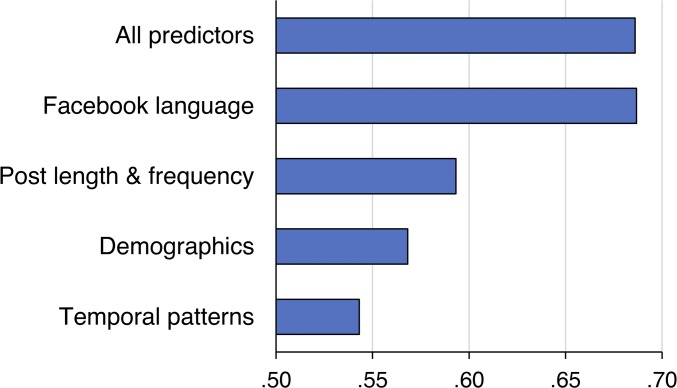
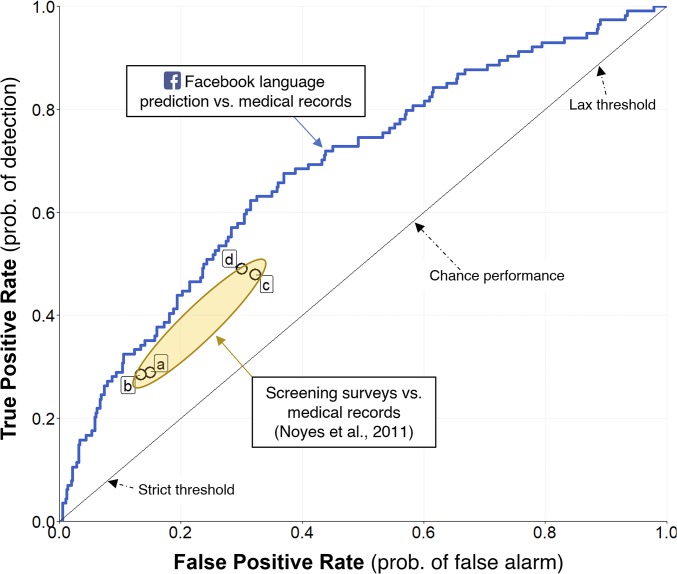
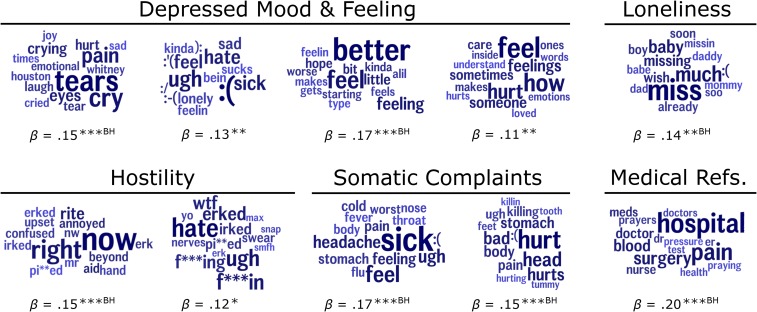
Significance: Depression is disabling and treatable, but underdiagnosed. In this study, we show that the content shared by consenting users on Facebook can predict a future occurrence of depression in their medical records. Language predictive of depression includes references to typical symptoms, including sadness, loneliness, hostility, rumination, and increased self-reference. This study suggests that an analysis of social media data could be used to screen consenting individuals for depression. Further, social media content may point clinicians to specific symptoms of depression.
Overview
The claims and statistics of this paper haven’t been checked yet.
Run the check — free, no account needed. It reads the open-access text and checks the sources it cites.
Integrity signals
Registry
Cites
Statistics
Figures
Verification
Claims the paper makes
The claims and statistics of this paper haven’t been checked yet.
Run the check — free, no account needed. It reads the open-access text and checks the sources it cites.
Claims other papers make about this one
Each is checked against this paper’s own text: does it say what the citing paper says it does?
In the citing paper
“These include words related to sadness, as well as words related to somatic health concerns (health and biology words, with the biology category combining body, health, sexual, and ingestion words) [22,23].”
From Behavioral Activation and Depression Symptomatology: Longitudinal Assessment of Linguistic Indicators in Text-Based Therapy Sessions (2021) · cites this paper as [23]
In the citing paper
“Over the years, Facebook developed machine learning algorithms studying the behavior of their users in detail on the platform. In order to get to know their users better, they do not only record what people ‘like’ (i.e., give a ‘thumbs up’) but also how long they hover over a certain post. This could be interpreted as showing a special interest in a certain area. ‘Textmining’ enables Facebook & Co”
From Addictive Features of Social Media/Messenger Platforms and Freemium Games against the Background of Psychological and Economic Theories (2019) · cites this paper as [67]
Self-check
Percentages, sums and reported differences re-computed from the paper’s own numbers.
The self-check needs the paper’s full text.
Citations
Cites
Controlling the False Discovery Rate: A Practical and Powerful Approach to Multiple Testing
Benjamini, Y., & Hochberg, Y. (1995) · Journal of the Royal Statistical Society Series B: Statistical Methodology · doi:10.1111/j.2517-6161.1995.tb02031.x · Cited by 109,482
(2003) · Journal of Machine Learning Research · doi:10.5555/944919.944937 · Cited by 32,337
Zhang, Q., Wang, C., Zheng, M., Li, Y., Li, J., Zhang, L., Shang, X., & Yan, C. (2014) · Cerebrovascular Diseases · doi:10.1159/000369778 · Cited by 11,609
Projections of Global Mortality and Burden of Disease from 2002 to 2030
Mathers, C. D., & Loncar, D. (2006) · PLoS Medicine · doi:10.1371/journal.pmed.0030442 · Cited by 11,386
Adjusting batch effects in microarray expression data using empirical Bayes methods
Johnson, W. E., Li, C., & Rabinovic, A. (2007) · Biostatistics · doi:10.1093/biostatistics/kxj037 · Cited by 8,658
Kessler, R. C., Berglund, P., Demler, O., Jin, R., Koretz, D., Merikangas, K. R., Rush, A. J., Walters, E. E., & Wang, P. S. (2003) · JAMA · doi:10.1001/jama.289.23.3095 · Cited by 7,988
Private traits and attributes are predictable from digital records of human behavior
Kosinski, M., Stillwell, D., & Graepel, T. (2013) · Proceedings of the National Academy of Sciences · doi:10.1073/pnas.1218772110 · Cited by 2,829
Wang, P. S., Lane, M., Olfson, M., Pincus, H. A., Wells, K. B., & Kessler, R. C. (2005) · Archives of General Psychiatry · doi:10.1001/archpsyc.62.6.629 · Cited by 2,695 · cited 1×
“E year, 7–26% of the US population experiences depression (1, 2), of whom only 13–49% receive minimally adequate treatment (3).”
BackgroundPredicting Depression via Social Media
Choudhury, M. D., Gamon, M., Counts, S., & Horvitz, E. (2021) · Proceedings of the International AAAI Conference on Web and Social Media · doi:10.1609/icwsm.v7i1.14432 · Cited by 1,583
Cited by
Sorted by citations
High-performance medicine: the convergence of human and artificial intelligence
Topol, E. J. (2019) · Nature Medicine · doi:10.1038/s41591-018-0300-7 · Cited by 10,450
Methods in predictive techniques for mental health status on social media: a critical review
Chancellor, S., & De Choudhury, M. (2020) · npj Digital Medicine · doi:10.1038/s41746-020-0233-7 · Cited by 557
Detection of Depression-Related Posts in Reddit Social Media Forum
Tadesse, M. M., Lin, H., Xu, B., & Yang, L. (2019) · IEEE Access · doi:10.1109/access.2019.2909180 · Cited by 502
D’Alfonso, S. (2020) · Current Opinion in Psychology · doi:10.1016/j.copsyc.2020.04.005 · Cited by 408
Deep learning in mental health outcome research: a scoping review
Su, C., Xu, Z., Pathak, J., & Wang, F. (2020) · Translational Psychiatry · doi:10.1038/s41398-020-0780-3 · Cited by 368
Montag, C., Lachmann, B., Herrlich, M., & Zweig, K. (2019) · International Journal of Environmental Research and Public Health · doi:10.3390/ijerph16142612 · Cited by 387
ChatGPT for shaping the future of dentistry: the potential of multi-modal large language model
Huang, H., Zheng, O., Wang, D., Yin, J., Wang, Z., Ding, S., Yin, H., Xu, C., Yang, R., Zheng, Q., et al. (2023) · International Journal of Oral Science · doi:10.1038/s41368-023-00239-y · Cited by 324
GPT is an effective tool for multilingual psychological text analysis
Rathje, S., Mirea, D.-M., Sucholutsky, I., Marjieh, R., Robertson, C. E., & Van Bavel, J. J. (2024) · Proceedings of the National Academy of Sciences · doi:10.1073/pnas.2308950121 · Cited by 297
Mental-LLM: Leveraging Large Language Models for Mental Health Prediction via Online Text Data
Xu, X., Yao, B., Dong, Y., Gabriel, S., Yu, H., Hendler, J., Ghassemi, M., Dey, A. K., & Wang, D. (2024) · Proceedings of the ACM on Interactive, Mobile, Wearable and Ubiquitous Technologies · doi:10.1145/3643540 · Cited by 278
Modern views of machine learning for precision psychiatry
Chen, Z. S., Kulkarni, P., Galatzer‐Levy, I. R., Bigio, B., Nasca, C., & Zhang, Y. (2022) · Patterns · doi:10.1016/j.patter.2022.100602 · Cited by 247
Kour, H., & Gupta, M. K. (2022) · Multimedia Tools and Applications · doi:10.1007/s11042-022-12648-y · Cited by 195
Kong, L., Liu, Z., & Wu, J. (2020) · Journal of Cleaner Production · doi:10.1016/j.jclepro.2020.123142 · Cited by 180
From Text to Thought: How Analyzing Language Can Advance Psychological Science
Jackson, J. C., Watts, J., List, J., Puryear, C., Drabble, R., & Lindquist, K. A. (2021) · Perspectives on Psychological Science · doi:10.1177/17456916211004899 · Cited by 203
Moral foundations twitter corpus: a collection of 35k tweets annotated for moral sentiment
Hoover, J., Portillo-Wightman, G., Yeh, L., Havaldar, S., Davani, A. M., Lin, Y., Kennedy, B., Atari, M., Kamel, Z., Mendlen, M., et al. (2020) · Social Psychological and Personality Science · doi:10.1177/1948550619876629 · Cited by 177
A survey on big data-driven digital phenotyping of mental health
Liang, Y., Zheng, X., & Zeng, D. D. (2019) · Information Fusion · doi:10.1016/j.inffus.2019.04.001 · Cited by 164
Personality Research and Assessment in the Era of Machine Learning
Stachl, C., Pargent, F., Hilbert, S., Harari, G. M., Schoedel, R., Vaid, S. S., Gosling, S. D., & Bühner, M. (2020) · European Journal of Personality · doi:10.1002/per.2257 · Cited by 178
Protecting the Value of Medical Science in the Age of Social Media and “Fake News”
Merchant, R. M., & Asch, D. A. (2018) · JAMA · doi:10.1001/jama.2018.18416 · Cited by 152
Self-citationAn emotion and cognitive based analysis of mental health disorders from social media data
Uban, A. S., Chulvi, B., & Rosso, P. (2021) · Future Generation Computer Systems · doi:10.1016/j.future.2021.05.032 · Cited by 156
Using natural language processing to analyse text data in behavioural science
Feuerriegel, S., Maarouf, A., Bär, D., Geissler, D., Schweisthal, J., Pröllochs, N., Robertson, C. E., Rathje, S., Hartmann, J., Mohammad, S. M., et al. (2025) · Nature Reviews Psychology · doi:10.1038/s44159-024-00392-z · Cited by 140
Social Media, E‐Health, and Medical Ethics
Terrasse, M., Gorin, M., & Sisti, D. A. (2019) · The Hastings Center Report · doi:10.1002/hast.975 · Cited by 134
Baclic, O., Tunis, M. C., Young, K., Doan, C., & Swerdfeger, H. (2020) · Canada Communicable Disease Report · doi:10.14745/ccdr.v46i06a02 · Cited by 144
Mental Health Analysis in Social Media Posts: A Survey
Garg, M. (2023) · Archives of Computational Methods in Engineering · doi:10.1007/s11831-022-09863-z · Cited by 161
Digital Phenotyping: Data-Driven Psychiatry to Redefine Mental Health
Oudin, A., Maatoug, R., Bourla, A., Ferreri, F., Bonnot, O., Millet, B., Schoeller, F., Mouchabac, S., & Adrien, V. (2023) · Journal of Medical Internet Research · doi:10.2196/44502 · Cited by 156
Multimodal Categorization of Crisis Events in Social Media
Abavisani, M., Wu, L., Hu, S., Tetreault, J., & Jaimes, A. (2020) · IEEE Computer Society Conference on Computer Vision and Pattern Recognition/Proceedings - IEEE Computer Society Conference on Computer Vision and Pattern Recognition/Proceedings · doi:10.1109/cvpr42600.2020.01469 · Cited by 137
GPT is an effective tool for multilingual psychological text analysisPreprint
Rathje, S., Mirea, D.-M., Sucholutsky, I., Marjieh, R., Robertson, C., & Bavel, J. J. V. (2023) · doi:10.31234/osf.io/sekf5 · Cited by 129
Leist, A. K., Klee, M., Kim, J. H., Rehkopf, D. H., Bordas, S., Terrera, G. M., & Wade, S. (2022) · Science Advances · doi:10.1126/sciadv.abk1942 · Cited by 152
Individuals with depression express more distorted thinking on social media
Bathina, K. C., ten Thij, M., Lorenzo‐Luaces, L., Rutter, L. A., & Bollen, J. (2021) · Nature Human Behaviour · doi:10.1038/s41562-021-01050-7 · Cited by 146
Language left behind on social media exposes the emotional and cognitive costs of a romantic breakup
Seraj, S., Blackburn, K. G., & Pennebaker, J. W. (2021) · Proceedings of the National Academy of Sciences · doi:10.1073/pnas.2017154118 · Cited by 130
Schultebraucks, K., Yadav, V., Shalev, A. Y., Bonanno, G. A., & Galatzer-Levy, I. R. (2022) · Psychological Medicine · doi:10.1017/s0033291720002718 · Cited by 108
Deep neural networks detect suicide risk from textual facebook posts
Ophir, Y., Tikochinski, R., Asterhan, C. S. C., Sisso, I., & Reichart, R. (2020) · Scientific Reports · doi:10.1038/s41598-020-73917-0 · Cited by 121
Birnbaum, M. L., Ernala, S. K., Rizvi, A. F., Arenare, E., Meter, A. V., Choudhury, M. D., & Kane, J. M. (2019) · Schizophrenia · doi:10.1038/s41537-019-0085-9 · Cited by 120
Health Policy and Privacy Challenges Associated With Digital Technology
Grande, D., Marti, X. L., Feuerstein-Simon, R., Merchant, R. M., Asch, D. A., Lewson, A. B., & Cannuscio, C. C. (2020) · JAMA Network Open · doi:10.1001/jamanetworkopen.2020.8285 · Cited by 108
Self-citationStudying expressions of loneliness in individuals using twitter: an observational study
Guntuku, S. C., Schneider, R., Pelullo, A., Young, J. F., Wong, V., Ungar, L., Polsky, D. E., Volpp, K. G. M., & Merchant, R. M. (2019) · BMJ Open · doi:10.1136/bmjopen-2019-030355 · Cited by 110
Self-citationSuicide Risk Assessment with Multi-level Dual-Context Language and
Matero, M., Idnani, A., Son, Y., Giorgi, S., Vu, H., Zamani, M., Limbachiya, P., Guntuku, S. C., & Schwartz, H. A. (2019) · Proceedings of the Sixth Workshop on Computational Linguistics and Clinical Psychology · doi:10.18653/v1/w19-3005 · Cited by 102
Self-citationGooding, P., & Kariotis, T. (2021) · JMIR Mental Health · doi:10.2196/24668 · Cited by 100
Evaluating the predictability of medical conditions from social media posts
Merchant, R. M., Asch, D. A., Crutchley, P., Ungar, L., Guntuku, S. C., Eichstaedt, J. C., Hill, S., Padrez, K., Smith, R. J., & Schwartz, H. A. (2019) · PLoS ONE · doi:10.1371/journal.pone.0215476 · Cited by 104
Self-citationConway, M., Hu, M., & Chapman, W. W. (2019) · Yearbook of Medical Informatics · doi:10.1055/s-0039-1677918 · Cited by 91
Social, psychological, and demographic characteristics of dehumanization toward immigrants
Markowitz, D. M., & Slovic, P. (2020) · Proceedings of the National Academy of Sciences · doi:10.1073/pnas.1921790117 · Cited by 94
Illuminating the Black Box: Interpreting Deep Neural Network Models for Psychiatric Research
Sheu, Y.-H. (2020) · Frontiers in Psychiatry · doi:10.3389/fpsyt.2020.551299 · Cited by 101
Depression Screening in Humans With AI and Deep Learning Techniques
Wani, M. A., ELAffendi, M. A., Shakil, K. A., Imran, A. S., & El‐Latif, A. A. A. (2022) · IEEE Transactions on Computational Social Systems · doi:10.1109/tcss.2022.3200213 · Cited by 98
Kjell, O., Sikström, S., Kjell, K., & Schwartz, H. A. (2022) · Scientific Reports · doi:10.1038/s41598-022-07520-w · Cited by 100
Self-citationHistorical analysis of national subjective wellbeing using millions of digitized books
Hills, T. T., Proto, E., Sgroi, D., & Seresinhe, C. I. (2019) · Nature Human Behaviour · doi:10.1038/s41562-019-0750-z · Cited by 89
Liang, Y., Li, H., Guo, B., Yu, Z., Zheng, X., Samtani, S., & Zeng, D. D. (2020) · Information Sciences · doi:10.1016/j.ins.2020.10.021 · Cited by 87
Montag, C., Sindermann, C., & Baumeister, H. (2020) · Current Opinion in Psychology · doi:10.1016/j.copsyc.2020.03.013 · Cited by 86
Artificial Intelligence in Clinical Neuroscience: Methodological and Ethical Challenges
Ienca, M., & Ignatiadis, K. (2020) · AJOB Neuroscience · doi:10.1080/21507740.2020.1740352 · Cited by 87
Lanz, L., Briker, R., & Gerpott, F. H. (2023) · Journal of Business Ethics · doi:10.1007/s10551-023-05393-1 · Cited by 70
Digital Psychiatry: Risks and Opportunities for Public Health and Wellbeing
Burr, C., Morley, J., Taddeo, M., & Floridi, L. (2020) · IEEE Transactions on Technology and Society · doi:10.1109/tts.2020.2977059 · Cited by 85
Laacke, S., Mueller, R., Schomerus, G., & Salloch, S. (2021) · The American Journal of Bioethics · doi:10.1080/15265161.2020.1863515 · Cited by 81
Kjell, O., Kjell, K., & Schwartz, H. A. (2023) · Psychiatry Research · doi:10.1016/j.psychres.2023.115667 · Cited by 115
Self-citationHistorical language records reveal a surge of cognitive distortions in recent decades
Bollen, J., ten Thij, M., Breithaupt, F. A., Barron, A. T. J., Rutter, L. A., Lorenzo‐Luaces, L., & Scheffer, M. (2021) · Proceedings of the National Academy of Sciences · doi:10.1073/pnas.2102061118 · Cited by 80
Real-world data and the patient perspective: the PROmise of social media?
McDonald, L., Malcolm, B., Ramagopalan, S. V., & Syrad, H. (2019) · BMC Medicine · doi:10.1186/s12916-018-1247-8 · Cited by 70
Depression detection in social media posts using transformer-based models and auxiliary features
Kerasiotis, M., Ilias, L., & Askounis, D. (2024) · Social Network Analysis and Mining · doi:10.1007/s13278-024-01360-4 · Cited by 92
Maximizing the value of twin studies in health and behaviour
Hagenbeek, F. A., Hirzinger, J. S., Breunig, S., Bruins, S., Kuznetsov, D. V., Schut, K., Odintsova, V. V., & Boomsma, D. I. (2023) · Nature Human Behaviour · doi:10.1038/s41562-023-01609-6 · Cited by 78
Burkhardt, H. A., Alexopoulos, G. S., Pullmann, M. D., Hull, T. D., Areán, P. A., & Cohen, T. (2021) · Journal of Medical Internet Research · doi:10.2196/28244 · Cited by 68
Seltzer, E., Goldshear, J. L., Guntuku, S. C., Grande, D., Asch, D. A., Klinger, E. V., & Merchant, R. M. (2019) · BMC Medical Informatics and Decision Making · doi:10.1186/s12911-019-0886-9 · Cited by 80
Self-citationMining Social Media Data for Biomedical Signals and Health-Related Behavior
Correia, R. B., Wood, I. B., Bollen, J., & Rocha, L. M. (2020) · Annual Review of Biomedical Data Science · doi:10.1146/annurev-biodatasci-030320-040844 · Cited by 69
The relationship between text message sentiment and self-reported depression
Liu, T., Meyerhoff, J., Eichstaedt, J. C., Karr, C. J., Kaiser, S. M., Kording, K. P., Mohr, D. C., & Ungar, L. (2021) · Journal of Affective Disorders · doi:10.1016/j.jad.2021.12.048 · Cited by 72
Self-citationClinically relevant acute subjective effects of psychedelics beyond mystical experience
Yaden, D. B., Goldy, S. P., Weiss, B., & Griffiths, R. R. (2024) · Nature Reviews Psychology · doi:10.1038/s44159-024-00345-6 · Cited by 67
Digital Phenotyping of Big Five Personality via Facebook Data Mining: A Meta-Analysis
Marengo, D., & Montag, C. (2020) · Digital Psychology · doi:10.24989/dp.v1i1.1823 · Cited by 71
Kim, J., Uddin, Z. A., Lee, Y. L., Nasri, F., Gill, H., Subramanieapillai, M., Lee, R., Udovica, A., Phan, L., Lui, L. M. W., et al. (2021) · Journal of Affective Disorders · doi:10.1016/j.jad.2020.08.091 · Cited by 63
Cai, Y., Wang, H., Ye, H., Jin, Y., & Gao, W. (2023) · Expert Systems with Applications · doi:10.1016/j.eswa.2023.119538 · Cited by 70
Mansoor, M. A., & Ansari, K. (2024) · Journal of Personalized Medicine · doi:10.3390/jpm14090958 · Cited by 91
Linking excess mortality to mobility data during the first wave of COVID-19 in England and Wales
Basellini, U., Alburez‐Gutierrez, D., Fava, E. D., Perrotta, D., Bonetti, M., Camarda, C. G., & Zagheni, E. (2021) · SSM - Population Health · doi:10.1016/j.ssmph.2021.100799 · Cited by 62
Big Data in Forecasting Research: A Literature Review
Tang, L., Li, J., Du, H., Li, L., Wu, J., & Wang, S. (2021) · Big Data Research · doi:10.1016/j.bdr.2021.100289 · Cited by 74
Artificial intelligence-assisted psychosis risk screening in adolescents: Practices and challenges
Cao, X., & Liu, X. (2022) · World Journal of Psychiatry · doi:10.5498/wjp.v12.i10.1287 · Cited by 65
Moral concerns are differentially observable in language
Kennedy, B., Atari, M., Davani, A. M., Hoover, J., Omrani, A., Graham, J., & Dehghani, M. (2021) · Cognition · doi:10.1016/j.cognition.2021.104696 · Cited by 67
The Emergence and Evolution of Consumer Language Research
Packard, G. M., & Berger, J. A. (2022) · Journal of Consumer Research · doi:10.1093/jcr/ucad013 · Cited by 59
Adair, K. C., Rodriguez-Homs, L. G., Masoud, S. J., Mosca, P. J., & Sexton, J. B. (2020) · Journal of Medical Internet Research · doi:10.2196/15562 · Cited by 70
On the State of Social Media Data for Mental Health Research
Harrigian, K., Aguirre, C., & Dredze, M. H. (2021) · Workshop on Computational Linguistics and Clinical Psychology (CLPsych) · doi:10.18653/v1/2021.clpsych-1.2 · Cited by 73
Müller, S. R., Chen, X., Peters, H., Chaintreau, A., & Matz, S. C. (2021) · Scientific Reports · doi:10.1038/s41598-021-93087-x · Cited by 51
Barua, P. D., Vicnesh, J., Lih, O. S., Palmer, E. E., Yamakawa, T., Kobayashi, M., & Acharya, U. R. (2022) · Cognitive Neurodynamics · doi:10.1007/s11571-022-09904-0 · Cited by 53
Digital phenotyping in depression diagnostics: Integrating psychiatric and engineering perspectives
Kamath, J., León-Barriera, R., Jain, N., Keisari, E. J., & Wang, B. (2022) · World Journal of Psychiatry · doi:10.5498/wjp.v12.i3.393 · Cited by 56
Google search histories of patients presenting to an emergency department: an observational study
Asch, J. M., Asch, D. A., Klinger, E. V., Marks, J., Sadek, N. H., & Merchant, R. M. (2019) · BMJ Open · doi:10.1136/bmjopen-2018-024791 · Cited by 48
Self-citationMontag, C., & Rumpf, H.-J. (2021) · Current Addiction Reports · doi:10.1007/s40429-021-00376-6 · Cited by 44
Using language in social media posts to study the network dynamics of depression longitudinally
Kelley, S., & Gillan, C. M. (2022) · Nature Communications · doi:10.1038/s41467-022-28513-3 · Cited by 56
Birnbaum, M. L., Norel, R., Meter, A. V., Ali, A. F., Arenare, E., Eyigöz, E., Agurto, C., Germano, N., Kane, J. M., & Cecchi, G. (2020) · Schizophrenia · doi:10.1038/s41537-020-00125-0 · Cited by 45
Web-browsing patterns reflect and shape mood and mental health
Kelly, C., & Sharot, T. (2024) · Nature Human Behaviour · doi:10.1038/s41562-024-02065-6 · Cited by 55
Ganesan, A. V., Matero, M., Ravula, A. R., Vu, H., & Schwartz, H. A. (2021) · Conference of the North American Chapter of the Association for Computational Linguistics: Human Language Technologies (NAACL-HLT) · doi:10.18653/v1/2021.naacl-main.357 · Cited by 50
Self-citationDepression alters the circadian pattern of online activity
ten Thij, M., Bathina, K. C., Rutter, L. A., Lorenzo‐Luaces, L., van de Leemput, I. A., Scheffer, M., & Bollen, J. (2020) · Scientific Reports · doi:10.1038/s41598-020-74314-3 · Cited by 43
Association between polypharmacy and depression: a systematic review and meta‐analysis
Palapinyo, S., Methaneethorn, J., & Leelakanok, N. (2021) · Journal of Pharmacy Practice and Research · doi:10.1002/jppr.1749 · Cited by 43
Kedra, J., Radstake, T. R. D. J., Pandit, A., Baraliakos, X., Berenbaum, F., Finckh, A., Fautrel, B., Stamm, T., Gómez-Cabrero, D., Pristipino, C., et al. (2019) · RMD Open · doi:10.1136/rmdopen-2019-001004 · Cited by 44
A Mobile Sensing App to Monitor Youth Mental Health: Observational Pilot Study
MacLeod, L., Suruliraj, B., Gall, D., Bessenyei, K., Hamm, S. I., Romkey, I. D., Bagnell, A. L., Mattheisen, M., Muthukumaraswamy, V., Orji, R., et al. (2021) · JMIR mhealth and uhealth · doi:10.2196/20638 · Cited by 44
O’Dea, B., Boonstra, T. W., Larsen, M. E., Nguyen, T., Venkatesh, S., & Christensen, H. M. (2021) · PLoS ONE · doi:10.1371/journal.pone.0251787 · Cited by 42
Son, Y., Clouston, S. A. P., Kotov, R., Eichstaedt, J. C., Bromet, E. J., Luft, B. J., & Schwartz, H. A. (2023) · Psychological Medicine · doi:10.1017/s0033291721002294 · Cited by 42
Self-citationYeskuatov, E., Chua, S.-L., & Foo, L. K. (2022) · International Journal of Environmental Research and Public Health · doi:10.3390/ijerph191610347 · Cited by 43
Predicting individual-level income from Facebook profiles
Matz, S., Menges, J. I., Stillwell, D. J., & Schwartz, H. A. (2019) · PLoS ONE · doi:10.1371/journal.pone.0214369 · Cited by 45
Self-citationDunn, A. G., Surian, D., Dalmazzo, J., Rezazadegan, D., Steffens, M., Dyda, A., Leask, J., Coiera, E. W., Dey, A., & Mandl, K. D. (2020) · American Journal of Public Health · doi:10.2105/ajph.2020.305902 · Cited by 41
Wongkoblap, A., Vadillo, M. A., & Ćurčin, V. (2021) · JMIR Mental Health · doi:10.2196/19824 · Cited by 41
Stamatis, C. A., Meyerhoff, J., Liu, T., Sherman, G. T., Wang, H., Liu, T., Curtis, B. L., Ungar, L., & Mohr, D. C. (2022) · Depression and Anxiety · doi:10.1002/da.23286 · Cited by 40
Self-citationA Comprehensive Review on the Use of Artificial Intelligence in Mental Health Care
Mittal, A., Dumka, L., & Mohan, L. (2023) · International Conference on Computing, Communication and Networking Technologies (ICCCNT) · doi:10.1109/icccnt56998.2023.10308255 · Cited by 45
Multiple Facets of Value-Based Decision Making in Major Depressive Disorder
Mukherjee, D., Lee, S., Kazinka, R., Satterthwaite, T. D., & Kable, J. W. (2020) · Scientific Reports · doi:10.1038/s41598-020-60230-z · Cited by 46
Characterization of time-variant and time-invariant assessment of suicidality on Reddit using C-SSRS
Gaur, M., Aribandi, V., Alambo, A., Kursuncu, U., Thirunarayan, K., Beich, J., Pathak, J., & Sheth, A. (2021) · PLoS ONE · doi:10.1371/journal.pone.0250448 · Cited by 40
AWARE-Light: a smartphone tool for experience sampling and digital phenotyping
van Berkel, N., D’Alfonso, S., Susanto, R., Ferreira, D., & Kostakos, V. (2022) · Personal and Ubiquitous Computing · doi:10.1007/s00779-022-01697-7 · Cited by 39
On artificial intelligence and global mental health
Montag, C., Ali, R., Al‐Thani, D., & Hall, B. J. (2023) · Asian Journal of Psychiatry · doi:10.1016/j.ajp.2023.103855 · Cited by 40
Arachchige, I. A. N., Sandanapitchai, P., & Weerasinghe, R. (2021) · Information · doi:10.3390/info12110444 · Cited by 45
Putting your best pet forward: Language patterns of persuasion in online pet advertisements
Markowitz, D. M. (2019) · Journal of Applied Social Psychology · doi:10.1111/jasp.12647 · Cited by 38
Big data in healthcare: Conceptual network structure, key challenges and opportunities
Furstenau, L. B., Leivas, P. D. O., Sott, M. K., Dohan, M. S., López-Robles, J. R., Cobo, M. J., Bragazzi, N. L., & Choo, K. R. (2023) · Digital Communications and Networks · doi:10.1016/j.dcan.2023.03.005 · Cited by 38
Artificial intelligence and diagnosis in general practice
Summerton, N., & Cansdale, M. (2019) · British Journal of General Practice · doi:10.3399/bjgp19x704165 · Cited by 39
Choi, D., Sumner, S. A., Holland, K. M., Draper, J., Murphy, S. F., Bowen, D. A., Zwald, M. L., Wang, J., Law, R., Taylor, J., et al. (2020) · JAMA Network Open · doi:10.1001/jamanetworkopen.2020.30932 · Cited by 36
Tracking group identity through natural language within groups
Ashokkumar, A., & Pennebaker, J. W. (2022) · PNAS Nexus · doi:10.1093/pnasnexus/pgac022 · Cited by 36
Metadata
- Authors
- Eichstaedt, J. C., Smith, R. J., Merchant, R. M., Ungar, L. H., Crutchley, P., Preoţiuc-Pietro, D., Asch, D. A., & Schwartz, H. A.
- Affiliations
- University of Pennsylvania (US)
- University of Pennsylvania Health System (US)
- Positive Psychology Center, University of Pennsylvania, Philadelphia, PA 19104;
- Philadelphia VA Medical Center (US)
- Stony Brook University (US)
- Corresponding author
- Eichstaedt, Johannes C.
- ORCID
- Venue
- Proceedings of the National Academy of Sciences
- Publisher
- National Academy of Sciences
- Published
- 2018-10-15
- Volume
- 115
- Issue
- 44
- Pages
- 11203-11208
- ISSN
- 0027-8424 (ISSN-L)
- 1091-6490
- PMC
- PMC6217418
- OpenAlex
- W2897583329
- Cited by
- 643
- References
- 46
- Citations by year
- 2026: 64 · 2025: 68 · 2024: 77 · 2023: 87 · 2022: 107 · 2021: 111 · 2020: 84 · 2019: 41 · 2018: 3
- FWCI
- 80.90
- Type
- journal article
- Language
- en
- Open access
- hybrid
- doi.org
- Licence
- Locations
- Proceedings of the National Academy of Sciences (publishedVersion, cc-by-nc-nd)
- Europe PMC (PubMed Central) (publishedVersion, cc-by-nc-nd)
- PubMed Central (publishedVersion, cc-by-nc-nd)
- PubMed (publishedVersion)
- Funders
- Robert Wood Johnson Foundation (Pioneer Award)
- Templeton Religion Trust (TRT0048)
- HHS | NIH | National Heart, Lung, and Blood Institute (HL122457)
- Topics
- Social Sciences › Psychology › Social Psychology › Mental Health via Writing
- Physical Sciences › Computer Science › Artificial Intelligence › Emotion and Mood Recognition
- Physical Sciences › Computer Science › Artificial Intelligence › Sentiment Analysis and Opinion Mining
- Keywords
- depression, Facebook posts, social media language, depression prediction, electronic health records, depression screening, emergency department patients, rumination, loneliness, sadness, self-absorption, hostility
- MeSH terms
- Adult, Depression, Depressive Disorder, Female, Humans, Language, Male, Surveys and Questionnaires, Electronic Health Records, Social Media
About these checks
Registry, retraction, Cites and statistics results are computed, not judged, with one exception: a printed reference that no index lists is read once by a model before it counts as a citation error. Claims are extracted by a model and kept only when their quote appears verbatim in the text; each cited source is then checked, with a model’s help, for whether it says what the claim relies on. Those verdicts can be wrong — read the claim’s quote and the cited source before relying on one.
Statistics and arithmetic are recomputed, not judged.
Confidence bands are shown only for fields calibrated on our annotated test set. None is calibrated yet, so no band is shown.
What counts as a claim ›How we measure confidence ›How we check this ›
Are you an author, or do you see a problem with this page? Request a review
