

The DOI matches its Crossref record; 45 of the 46 references it cites were found in a registry or an index.
Facebook language predicts depression in medical records
Open accessAbstract
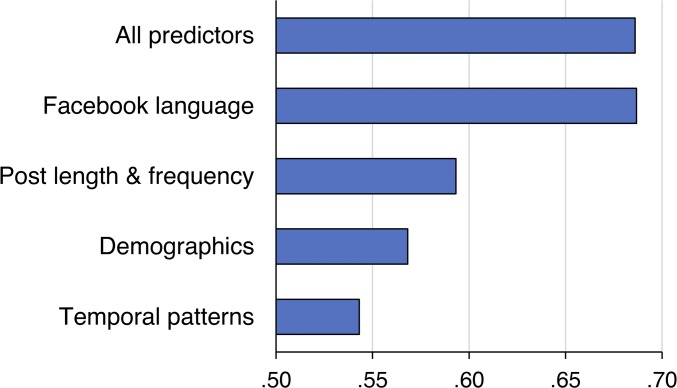
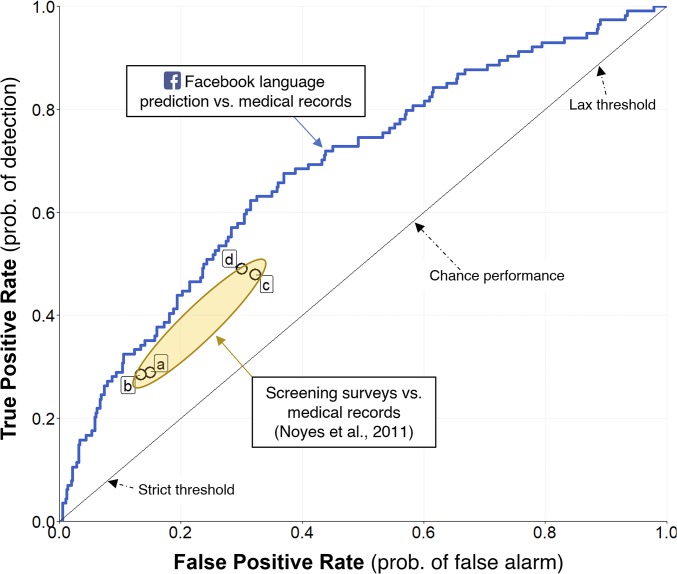
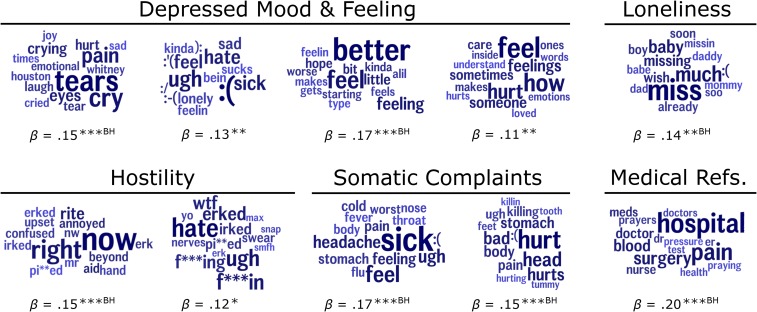
Significance: Depression is disabling and treatable, but underdiagnosed. In this study, we show that the content shared by consenting users on Facebook can predict a future occurrence of depression in their medical records. Language predictive of depression includes references to typical symptoms, including sadness, loneliness, hostility, rumination, and increased self-reference. This study suggests that an analysis of social media data could be used to screen consenting individuals for depression. Further, social media content may point clinicians to specific symptoms of depression.
Overview
The claims and statistics of this paper haven’t been checked yet.
Run the check — free, no account needed. It reads the open-access text and checks the sources it cites.
Integrity signals
Registry
Cites
Statistics
Figures
Verification
Claims the paper makes
The claims and statistics of this paper haven’t been checked yet.
Run the check — free, no account needed. It reads the open-access text and checks the sources it cites.
Claims other papers make about this one
Each is checked against this paper’s own text: does it say what the citing paper says it does?
In the citing paper
“These include words related to sadness, as well as words related to somatic health concerns (health and biology words, with the biology category combining body, health, sexual, and ingestion words) [22,23].”
From Behavioral Activation and Depression Symptomatology: Longitudinal Assessment of Linguistic Indicators in Text-Based Therapy Sessions (2021) · cites this paper as [23]
In the citing paper
“Over the years, Facebook developed machine learning algorithms studying the behavior of their users in detail on the platform. In order to get to know their users better, they do not only record what people ‘like’ (i.e., give a ‘thumbs up’) but also how long they hover over a certain post. This could be interpreted as showing a special interest in a certain area. ‘Textmining’ enables Facebook & Co”
From Addictive Features of Social Media/Messenger Platforms and Freemium Games against the Background of Psychological and Economic Theories (2019) · cites this paper as [67]
Self-check
Percentages, sums and reported differences re-computed from the paper’s own numbers.
The self-check needs the paper’s full text.
Citations
Cites
Controlling the False Discovery Rate: A Practical and Powerful Approach to Multiple Testing
Benjamini, Y., & Hochberg, Y. (1995) · Journal of the Royal Statistical Society Series B: Statistical Methodology · doi:10.1111/j.2517-6161.1995.tb02031.x · Cited by 109,482
(2003) · Journal of Machine Learning Research · doi:10.5555/944919.944937 · Cited by 32,337
Zhang, Q., Wang, C., Zheng, M., Li, Y., Li, J., Zhang, L., Shang, X., & Yan, C. (2014) · Cerebrovascular Diseases · doi:10.1159/000369778 · Cited by 11,609
Projections of Global Mortality and Burden of Disease from 2002 to 2030
Mathers, C. D., & Loncar, D. (2006) · PLoS Medicine · doi:10.1371/journal.pmed.0030442 · Cited by 11,386
Adjusting batch effects in microarray expression data using empirical Bayes methods
Johnson, W. E., Li, C., & Rabinovic, A. (2007) · Biostatistics · doi:10.1093/biostatistics/kxj037 · Cited by 8,658
Kessler, R. C., Berglund, P., Demler, O., Jin, R., Koretz, D., Merikangas, K. R., Rush, A. J., Walters, E. E., & Wang, P. S. (2003) · JAMA · doi:10.1001/jama.289.23.3095 · Cited by 7,988
Private traits and attributes are predictable from digital records of human behavior
Kosinski, M., Stillwell, D., & Graepel, T. (2013) · Proceedings of the National Academy of Sciences · doi:10.1073/pnas.1218772110 · Cited by 2,829
Wang, P. S., Lane, M., Olfson, M., Pincus, H. A., Wells, K. B., & Kessler, R. C. (2005) · Archives of General Psychiatry · doi:10.1001/archpsyc.62.6.629 · Cited by 2,695 · cited 1×
“E year, 7–26% of the US population experiences depression (1, 2), of whom only 13–49% receive minimally adequate treatment (3).”
BackgroundPredicting Depression via Social Media
Choudhury, M. D., Gamon, M., Counts, S., & Horvitz, E. (2021) · Proceedings of the International AAAI Conference on Web and Social Media · doi:10.1609/icwsm.v7i1.14432 · Cited by 1,583
Cited by
Sorted by citations
Items 501–600 of 640
Markowitz, D. M. (2023) · doi:10.31234/osf.io/dwyqa · Cited by 1
NLP as a Lens for Causal Analysis and Perception Mining to Infer Mental Health on Social MediaPreprint
Garg, M., Saxena, C., Naseem, U., Sohn, S., & Dorr, B. J. (2023) · doi:10.36227/techrxiv.21972974 · Cited by 1
Barrios, J., Gabay, S., Cafiero, F., & Debbané, M. (2023) · doi:10.31234/osf.io/s5cm3 · Cited by 1
Harnessing Internet Search Data as a Potential Tool for Medical DiagnosisPreprint
Downing, G. J., Tramontozzi, L. M., Garcia, J., & Villanueva, E. (2024) · medRxiv · doi:10.1101/2024.05.03.24305695 · Cited by 1
Harnessing Internet Search Data as a Potential Tool for Medical Diagnosis (Preprint)Preprint
Downing, G. J., Tramontozzi, L. M., Garcia, J., & Villanueva, E. (2024) · doi:10.2196/preprints.63149 · Cited by 1
Affective behavior modeling on social networks
Ragheb, W. (2020) · theses.fr (ABES) · doi:10.70675/bce319edz6f07z4ee2za880z8da9302d2585 · Cited by 1
Measuring Adolescents’ Well-Being: Correspondence of Naïve Digital Traces to Survey Data
Сивак, Е., & Smirnov, I. (2020) · Lecture notes in computer science · doi:10.1007/978-3-030-60975-7_26 · Cited by 3
Lingford-Hughes, A. R., Watson, S., & Young, A. H. (2018) · The British Journal of Psychiatry · doi:10.1192/bjp.2018.266
Montag, C. (2019) · Springer eBooks · doi:10.1007/978-3-658-22954-2_13
Identification of Depression Severity for Users of Online Platforms.
Bandyopadhyay, A. K., Achilles, L., Mandl, T., Mitra, M., & Saha, S. K. (2019) · LWDA
Stein, M. D., & Galea, S. (2020) · doi:10.1093/oso/9780197510384.003.0054
Baclic, O., Tunis, M. C., Young, K., Doan, C., & Swerdfeger, H. (2020) · Relevé des maladies transmissibles au Canada · doi:10.14745/ccdr.v46i06a02f
Predicting Strategic Behavior from Free Text (Extended Abstract)
Ben-Porat, O., Kuchy, L., Hirsch, S., Elad, G., Reichart, R., & Tennenholtz, M. (2020) · International Joint Conference on Artificial Intelligence · doi:10.24963/ijcai.2020/699
Системный подход к выявлению депрессии методами машинного обучения
Романова, Е. Ю. (2020) · Естественные и Технические Науки · doi:10.37882/2223-2966.2020.12.31
Symptoms of anxiety and depression in social media in connection with the threat of COVID-19
Wieczorek, Z. (2020) · Edukacyjna Analiza Transakcyjna · doi:10.16926/eat.2020.09.09
The Transcendental Quality of Digital Health and Social Media
Ferrarello, S., & Agostinelli, M. (2021) · The International Library of Bioethics · doi:10.1007/978-3-030-65613-3_7
The Depressed Decision-Maker: How Value Based Decision Making Differs in Major Depressive DisorderPreprint
Mukherjee, D., Lee, S., Kazinka, R., Satterthwaite, T. D., & Kable, J. (2020) · PsyArXiv (OSF Preprints) · doi:10.31234/osf.io/7gnb9 · Cited by 1
Estimating the Regional Development in Gems Mining Areas in Brazil
Nääs, I. D. A., Brandão, L. D. A. M., & Neto, P. L. D. O. C. (2021) · European Journal of Sustainable Development Research · doi:10.21601/ejosdr/11284
Körmeling, J. (2010) · Pasajes de arquitectura y crítica
Time to Get Social: Adaptive Social Processes in the Daily Lives of Youth (Full PhD thesis)Preprint
Achterhof, R. (2022) · PsyArXiv (OSF Preprints) · doi:10.31234/osf.io/knzms
Psikolojik Sağlık Hizmetlerinde Dijital Fenotipleme Kullanımı: Fırsatlar, Etik ve Yasal Sorunlar
GÜLTEKİN, M. (2021) · Nesne Psikoloji Dergisi · doi:10.7816/nesne-09-22-13
Overview of the role of big data in mental health: A scoping review (Preprint)Preprint
Ahmed, A., Aziz, S., Angus, M., Alzubaidi, M. S., Abd-Alrazaq, A. A., Giannicchi, A., & Househ, M. S. (2021) · doi:10.2196/preprints.32424
Protecting Vulnerable Groups in Big Data Research (Preprint)Preprint
Shaw, D., Schneble, C. O., Delden, M.-L. V., & Elger, B. S. (2021) · doi:10.2196/preprints.31250
Affect Dynamic Signatures of Psychosis Risk Across Multiple Timescales and ContextsPreprint
Li, L. Y., Schiffman, J. E., & Martin, E. A. (2021) · doi:10.31234/osf.io/wxhyq
Brinberg, M., Vanderbilt, R. R., & Solomon, D. H. (2022) · Emerald Group Publishing Limited eBooks · doi:10.1108/978-1-80071-597-420221004
Assessing Mental Comfort Effect in Social Media InteractionPreprint
Chen, R. B. (2022) · doi:10.31124/advance.20101181
Assessing Mental Comfort Effect in Social Media InteractionPreprint
Chen, R. B. (2022) · doi:10.31124/advance.20101181.v1
Machine Learning Can Predict Shooting Victimization Well Enough to Help Prevent ItPreprint
Heller, S., Jakubowski, B., Jelveh, Z., & Kapustin, M. (2022) · SSRN Electronic Journal · doi:10.2139/ssrn.4140888
Lorenzo‐Luaces, L., Howard, J., Edinger, A., Yan, H. Y., Rutter, L. A., Valdez, D., & Bollen, J. (2022) · doi:10.31234/osf.io/e2n9t
High-Level Characteristics of Web Queries Change Under ThreatPreprint
Kelly, C., Blain, B., & Sharot, T. (2022) · doi:10.31234/osf.io/c45jn
Automatically Estimating the Severity of Multiple Symptoms Associated with Depression
Maupomé, D., Armstrong, M. D., Belbahar, R. M., Alezot, J., Balassiano, R., Rancourt, F., Queudot, M., Mosser, S., & Meurs, M. (2022) · Studies in computational intelligence · doi:10.1007/978-3-031-04431-1_11
Beyond Risk: Individual Mental Health Trajectories from Large-Scale Social Media Data
Bollen, J., ten Thij, M., Lorenzo‐Luaces, L., & Rutter, L. A. (2022) · Studies in computational intelligence · doi:10.1007/978-3-031-04431-1_12 · Cited by 1
Yáñez, E. A., Reyes, S. V., Gómez, J. F. R., Velasco-Elizondo, P., Gonzalez, A. M., & Hernández, A. G. (2022) · Lecture notes in networks and systems · doi:10.1007/978-3-031-20322-0_14
Musil, B., & Plohl, N. (2022) · doi:10.18690/um.ff.11.2022.11 · Cited by 1
Umetna inteligenca in eksistenčno tveganje
Lipuš, A. (2022) · doi:10.18690/um.ff.11.2022.10
Borstner, B., & Šetar, N. (2022) · doi:10.18690/um.ff.11.2022.5
Transformacija 'inteligence roja' {Swarm Intelligence} na umetno inteligenco
Martinc, U., Aberšek, B., & Borstner, B. (2022) · doi:10.18690/um.ff.11.2022.9
Maximising the Value of Twin Studies in Health and BehaviourPreprint
Hagenbeek, F. A., Hirzinger, J. S., Breunig, S., Bruins, S., Kuznetsov, D. V., Schut, K., Odintsova, V. V., & Boomsma, D. I. (2022) · doi:10.31219/osf.io/rne4s
Petrović, S. A., & Marić, N. P. (2022) · Medicinska istrazivanja · doi:10.5937/medi55-37718 · Cited by 1
Косуха, О. Ю., & Shevchuk, I. M. (2022) · Journal of Numerical and Applied Mathematics · doi:10.17721/2706-9699.2022.2.07
Molina, A. E. M., & Agudelo, J. E. E. (2022) · doi:10.11144/javeriana.10554.61568
The datafied polity: Voter privacy in the age of data-driven political campaigning
Cohen, T. (2023) · Queensland University of Technology · doi:10.5204/thesis.eprints.242466
Emoji Based Sentiment Classification Using Machine Learning Approach
Verma, P., & Srivastava, R. (2023) · Communications in computer and information science · doi:10.1007/978-3-031-48781-1_15
Markowitz, D. M. (2024) · doi:10.31234/osf.io/fq5am
Automatic analysis of X (Twitter) data for supporting depression diagnosis
Królak, A., Wiktorski, T., & Żmudzińska, A. (2023) · Human Technology · doi:10.14254/1795-6889.2023.19-3.4
Applications of AI in the psychological and psychiatric fields: what the experts offer us
Collecchia, G., & Gobbi, R. D. (2024) · Elsevier eBooks · doi:10.1016/b978-0-443-14054-9.00007-7
Iddiols, B. C., Daoust, A. R., Mullen, J. N., Kotelnikova, Y., & Hayden, E. P. (2024) · Journal of Psychopathology and Behavioral Assessment · doi:10.1007/s10862-024-10124-5
Xu, X., An, F., Wu, S., Wang, H., Kang, Q., Wang, Y., Zhu, T., Zhang, B., Huang, W., Liu, X., et al. (2024) · Frontiers in Psychiatry · doi:10.3389/fpsyt.2024.1309501
Leveraging Social Media Data for Unobtrusive Measurement of Academics’ Well-BeingPreprint
Müller, S. M., & Bittermann, A. (2024) · doi:10.31219/osf.io/957h8
Mehta, U. M., Bagali, K. B., & Kommanapalli, S. (2024) · Springer eBooks · doi:10.1007/978-981-97-0503-0_10
(2024) · Natural hazards and earth system sciences · doi:10.5194/nhess-2023-6-rc1
(2024) · Natural hazards and earth system sciences · doi:10.5194/nhess-2023-6-rc2
Agarwal, H., & Kešelj, V. (2024) · International Symposium INFOTEH-JAHORINA (INFOTEH) · doi:10.1109/infoteh60418.2024.10495942 · Cited by 1
Gul, K., Panicker, S., Morandé, S., & Tewari, V. (2024) · Advances in medical diagnosis, treatment, and care (AMDTC) book series · doi:10.4018/979-8-3693-3230-6.ch023
Markowitz, D. M., & Bailenson, J. N. (2024) · doi:10.31234/osf.io/2z5cj
Depression Tendency Estimation Method Using AI Chatbot
Indo, R., Tochishita, F., Miwa, H., Nomiyama, D., & Kude, S. (2024) · Lecture notes on data engineering and communications technologies · doi:10.1007/978-3-031-72322-3_1
Applying Machine Learning to Detect and Measure Depression via Social Media
Malik, A. (2024) · Smart innovation, systems and technologies · doi:10.1007/978-981-97-3690-4_54
Language Research in Social Personality Psychology
Ireland, M. E., & Pennebaker, J. W. (2024) · Cambridge University Press eBooks · doi:10.1017/9781009170123.015
Semantic Coherence and NLP: Redesigning post-COVID Mental Health Diagnostics with CNNs and LSTMs
Gunhal, P. R. (2024) · ASIAN JOURNAL OF CONVERGENCE IN TECHNOLOGY · doi:10.33130/ajct.2024v10i03.002
Jagannathan, S. K., & Bizel, G. (2025) · Communications in computer and information science · doi:10.1007/978-3-031-81455-6_19
Digital Assessments of Psychiatric Disorders
Quist, R. E., Bhattacharya, S., Chacko, S. M., & Jacobson, N. C. (2025) · Oxford University Press eBooks · doi:10.1093/med/9780197640654.003.0072
Liu, J., Li, K., Li, S., Liu, S., Wang, C., Huang, S., Tu, Y., Wang, B., Zhang, P., Luo, Y., et al. (2025) · Frontiers in Computational Neuroscience · doi:10.3389/fncom.2025.1555416
Miller, L., Lhaksampa, T. C., Walker, A., Aguirre, C. A., DeCamp, M. W., Harrigian, K., Meuchel, J. M., Meyer, A. M., Nesbitt, B., Sthapit, S., et al. (2025) · doi:10.2196/preprints.74212
Brahim, L., Ennouni, A., Jallaglag, A., Sabri, A., Aghoutane, B., & Aarab, A. (2025) · Lecture notes in networks and systems · doi:10.1007/978-3-031-88304-0_50
Multi-view Fusion Enhanced Social Text Representation for Depression Detection
Chen, J., You, X., Zhao, S. G., Xiao, J., & Zhang, Y. (2025) · Lecture notes in computer science · doi:10.1007/978-3-031-92741-6_15
Zhang, X., Jiang, T., Zhou, G., Zheng, Y., & Luo, J. (2025) · Information Processing & Management · doi:10.1016/j.ipm.2025.104204
Using the Language of elite athletes to predict their personality and on court transgressions
Levitin, M. D., Ger, I. Z., Sovik, Z., Taieb, A., Ungar, L., & Gilead, M. (2025) · Scientific Reports · doi:10.1038/s41598-025-99667-5 · Cited by 1
Self-citationStrelluf, C., & Hills, T. T. (2025) · Languages · doi:10.3390/languages10060136
Mathouri, Y., Korchiyne, R., Chihab, Y., Mohcine, B., & Alaeddine, B. (2025) · Lecture notes in networks and systems · doi:10.1007/978-3-031-95326-2_33
Prevalence of cognitive distortion markers in a suicide prevention chat service (Preprint)Preprint
ten Thij, M., Mérelle, S. Y. M., Gilissen, R., & Bollen, J. (2025) · doi:10.2196/preprints.81213
Venkataiah, V., Shruthi, G., Mogili, R., & Maneiah, D. (2025) · Lecture notes in networks and systems · doi:10.1007/978-981-96-5238-9_58
Advancing AI: Exploring the Potentials of Multimodal Large Language Models
Jewel, M. J. A., Al-Sinayyid, A., & Rahman, M. (2025) · Communications in computer and information science · doi:10.1007/978-3-031-94937-1_15
Contextualizing Smartphone-Typed Language With User Input Intention
Bemmann, F., Koch, T. K., Bergmann, M., Stachl, C., Buschek, D., Schoedel, R., & Mayer, S. (2025) · Mensch und Computer (MuC) · doi:10.1145/3743049.3748537
Song-making in a group (SING): a longitudinal study for people experiencing psychosis
Greco, D. L., Castiello, S., Camilo, S., Freeland, C. M., Pavlo, A. J., Bien, C., Nachemson, J., Lubinski, C., Christoferson, A., Kenney, J. G., et al. (2026) · Psychosis · doi:10.1080/17522439.2026.2634654
del Rio-Chanona, R. M., Carrillo, A. H., Sepahpour‐Fard, M., Sun, L., Topinková, R., & Nedelkoska, L. (2023) · Figshare · doi:10.6084/m9.figshare.24303340
Dunn, A. G., Purnat, T. D., Ishizumi, A., Nguyen, T., & Briand, S. C. (2023) · Figshare · doi:10.6084/m9.figshare.23298884
Fine-Grained Emotion Classification in Reddit Mental Health Posts Using LLMs
Orjuela-Llanos, V. P., & Galpin, I. (2025) · Communications in computer and information science · doi:10.1007/978-3-032-07175-0_24
Analyzing Depression-Related Tweets with VADER, SentiWordNet, and TextBlob Analyzers
Nor, N. M., Rahman, N. A., Yaakub, M. R., & Aliman, S. (2025) · Lecture notes on data engineering and communications technologies · doi:10.1007/978-981-96-7749-8_28
Why Do People Conceal Mental Health Problems? A Qualitative Analysis of TikTok Posts (Preprint)Preprint
Roske, C., Ragnini, K., Zhu, S., Palmer, A., Kells, M. R., Davis, H. A., & Nock, M. K. (2025) · doi:10.2196/preprints.88244
Liu, J. (2025) · SSRN Electronic Journal · doi:10.2139/ssrn.5971317
Tian, X., Wenjie, Z. H. O. U., Luo, F., Qiao, Z., & Yi, F. E. N. G. (2026) · Advances in Psychological Science · doi:10.3724/sp.j.1042.2026.0404
Garg, M., Liu, X., Jeon, E., Biernacka, J. M., Frye, M. A., Geda, Y. E., & Sohn, S. (2026) · Frontiers in Psychiatry · doi:10.3389/fpsyt.2025.1726100 · Cited by 1
Liu, J. (2026) · SSRN Electronic Journal · doi:10.2139/ssrn.5964774
Analyzing Language for Insights into Cognitive and Social Processes
Yeo, G. C., & Jaidka, K. (2026) · Routledge eBooks · doi:10.4324/9781003411741-44
Hyperparameter-Tuned Neural Networks for Binary Text Classification in Mental Health Detection
Maheshwari, R., Pradhan, R., & Sharma, D. K. (2025) · IEEE Global Conference for Advancement in Technology (GCAT) · doi:10.1109/gcat66372.2025.11368583
Ireland, M. E., & Pennebaker, J. W. (2026) · Elsevier eBooks · doi:10.1016/b978-0-323-95504-1.01142-x
How robust are linguistic markers of aging? The case of aging-related social media text
Cong, Y., Hu, J., Reese, T., & Liu, H. (2026) · Natural Language Processing Journal · doi:10.1016/j.nlp.2026.100203 · Cited by 1
AI-Driven Mental Health Surveillance and Positive Feed Curation Using Social Media Data
Bhalodia, H. M., Undavia, J. N., Bhatt, N., & Soni, K. G. (2026) · Communications in computer and information science · doi:10.1007/978-3-032-17300-3_4
Prevalence of Cognitive Distortion Markers in a Suicide Prevention Chat Service: Mixed Methods Study
ten Thij, M., Mérelle, S. Y. M., Gilissen, R., & Bollen, J. (2026) · JMIR Mental Health · doi:10.2196/81213
ELM: Leveraging Large Language Models for Reliable Emotion Recognition
Feng, R. (2025) · IEEE International Conference on Cognitive Machine Intelligence (CogMI) · doi:10.1109/cogmi67134.2025.00025
Symbiotic Intelligence in Healthcare: Can AI Help Us Understand – and Prevent – Suicide?Preprint
Krumsvik, R. J., Høydal, K., & Høydal, Ø. A. (2026) · SSRN Electronic Journal · doi:10.2139/ssrn.6437298
Wang, Z., Daniel, K. E., Barnes, L. E., & Chow, P. I. (2026) · CHI Conference on Human Factors in Computing Systems · doi:10.1145/3772318.3791352 · Cited by 1
Metadata
- Authors
- Eichstaedt, J. C., Smith, R. J., Merchant, R. M., Ungar, L. H., Crutchley, P., Preoţiuc-Pietro, D., Asch, D. A., & Schwartz, H. A.
- Affiliations
- University of Pennsylvania (US)
- University of Pennsylvania Health System (US)
- Positive Psychology Center, University of Pennsylvania, Philadelphia, PA 19104;
- Philadelphia VA Medical Center (US)
- Stony Brook University (US)
- Corresponding author
- Eichstaedt, Johannes C.
- ORCID
- Venue
- Proceedings of the National Academy of Sciences
- Publisher
- National Academy of Sciences
- Published
- 2018-10-15
- Volume
- 115
- Issue
- 44
- Pages
- 11203-11208
- ISSN
- 0027-8424 (ISSN-L)
- 1091-6490
- PMC
- PMC6217418
- OpenAlex
- W2897583329
- Cited by
- 643
- References
- 46
- Citations by year
- 2026: 64 · 2025: 68 · 2024: 77 · 2023: 87 · 2022: 107 · 2021: 111 · 2020: 84 · 2019: 41 · 2018: 3
- FWCI
- 80.90
- Type
- journal article
- Language
- en
- Open access
- hybrid
- doi.org
- Licence
- Locations
- Proceedings of the National Academy of Sciences (publishedVersion, cc-by-nc-nd)
- Europe PMC (PubMed Central) (publishedVersion, cc-by-nc-nd)
- PubMed Central (publishedVersion, cc-by-nc-nd)
- PubMed (publishedVersion)
- Funders
- Robert Wood Johnson Foundation (Pioneer Award)
- Templeton Religion Trust (TRT0048)
- HHS | NIH | National Heart, Lung, and Blood Institute (HL122457)
- Topics
- Social Sciences › Psychology › Social Psychology › Mental Health via Writing
- Physical Sciences › Computer Science › Artificial Intelligence › Emotion and Mood Recognition
- Physical Sciences › Computer Science › Artificial Intelligence › Sentiment Analysis and Opinion Mining
- Keywords
- depression, Facebook posts, social media language, depression prediction, electronic health records, depression screening, emergency department patients, rumination, loneliness, sadness, self-absorption, hostility
- MeSH terms
- Adult, Depression, Depressive Disorder, Female, Humans, Language, Male, Surveys and Questionnaires, Electronic Health Records, Social Media
About these checks
Registry, retraction, Cites and statistics results are computed, not judged, with one exception: a printed reference that no index lists is read once by a model before it counts as a citation error. Claims are extracted by a model and kept only when their quote appears verbatim in the text; each cited source is then checked, with a model’s help, for whether it says what the claim relies on. Those verdicts can be wrong — read the claim’s quote and the cited source before relying on one.
Statistics and arithmetic are recomputed, not judged.
Confidence bands are shown only for fields calibrated on our annotated test set. None is calibrated yet, so no band is shown.
What counts as a claim ›How we measure confidence ›How we check this ›
Are you an author, or do you see a problem with this page? Request a review
