

Fighting misinformation on social media using crowdsourced judgments of news source quality
Open accessThe DOI matches its Crossref record; 26 of the 26 references it cites were found in a registry or an index.
Abstract
Significance: Many people consume news via social media. It is therefore desirable to reduce social media users’ exposure to low-quality news content. One possible intervention is for social media ranking algorithms to show relatively less content from sources that users deem to be untrustworthy. But are laypeople’s judgments reliable indicators of quality, or are they corrupted by either partisan bias or lack of information? Perhaps surprisingly, we find that laypeople—on average—are quite good at distinguishing between lower- and higher-quality sources. These results indicate that incorporating the trust ratings of laypeople into social media ranking algorithms may prove an effective intervention against misinformation, fake news, and news content with heavy political bias.
Overview
The claims and statistics of this paper haven’t been checked yet.
Free: it reads the open-access text and checks the first 5 claims that cite a source we can check. Create a free account to check every claim.
Integrity signals
Registry
Cites
Statistics
Figures
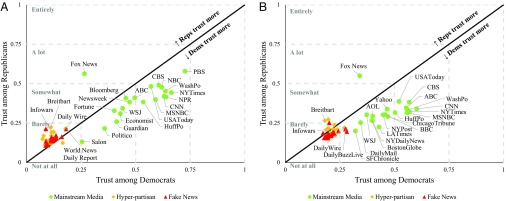
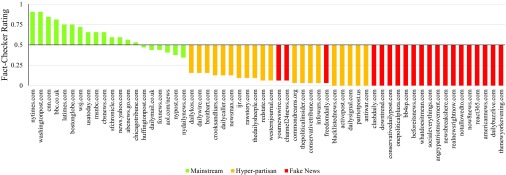
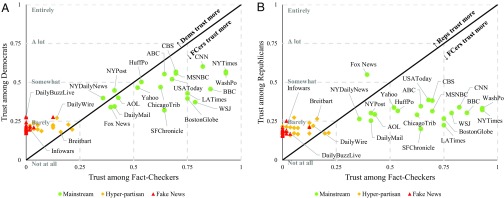
Verification
Claims the paper makes
The claims and statistics of this paper haven’t been checked yet.
Free: it reads the open-access text and checks the first 5 claims that cite a source we can check. Create a free account to check every claim.
Claims other papers make about this one
Each is checked against this paper’s own text: does it say what the citing paper says it does?
The source backs part of the claim, not all of it — or backs it for a different population, condition or comparison.
In the citing paper
“Recent empirical research finds that averaged responses of ordinary people are on par with third-party fact-checkers for both factual claims in articles (47) and overall accuracy of content from URL domain names (48, 49).”
From Deepfake detection by human crowds, machines, and machine-informed crowds (2022) · cites this paper as [49]
Experimental — accuracy not yet measuredThe cited source says what the claim attributes to it.
In the citing paper
“These approaches rely on the collective contributions and crowd signals (Tschiatschek et al. 2018) of a group of people for the aggregation of crowd intelligence to detect fake news (Tchakounté et al. 2020) and to reduce the spread of misinformation on social media (Pennycook and Rand 2019; Micallef et al. 2020).”
From Fake news, disinformation and misinformation in social media: a review (2023) · cites this paper as Pennycook and Rand 2019
The cited source says what the claim attributes to it.
In the citing paper
“Recent research suggests that human reasoning is “meaningfully directed toward the formation of accurate, rather than merely identity-confirming, beliefs” (ref. 24 p. 2525)”
From Factual knowledge can reduce attitude polarization (2025) · cites this paper as [24]
The cited source says what the claim attributes to it.
In the citing paper
“Research on news source quality demonstrates that people in the United States are generally accurate at identifying high and low-quality publishers54”
From Human detection of political speech deepfakes across transcripts, audio, and video (2024) · cites this paper as [54]
The cited source says what the claim attributes to it.
In the citing paper
“The crowdsourced accuracy ratings generated by this process may also be useful for identifying misinformation, as has been found for crowd ratings of source trustworthiness 138,139 .”
From Using social and behavioural science to support COVID-19 pandemic response (2020) · cites this paper as [139]
1 more claim about this paper
Create a free account to see every claim other papers make about this one.
Self-check
Percentages, sums and reported differences re-computed from the paper’s own numbers.
The self-check needs the paper’s full text.
Citations
Cites
Cognitive Reflection and Decision Making
Frederick, S. (2005) · Journal of Economic Perspectives · doi:10.1257/089533005775196732 · Cited by 5,256
Lazer, D. M. J., Baum, M. A., Benkler, Y., Berinsky, A. J., Greenhill, K. M., Menczer, F., Metzger, M. J., Nyhan, B., Pennycook, G., Rothschild, D., et al. (2018) · Science · doi:10.1126/science.aao2998 · Cited by 4,160 · cited 1×
“This is illustrated by the recent rise of an old form of misinformation: blatantly false news stories that are presented as if they are legitimate (2).”
BackgroundSelf-citationMisinformation and Its Correction: Continued Influence and Successful Debiasing
Lewandowsky, S., Ecker, U. K. H., Seifert, C. M., Schwarz, N., & Cook, J. (2012) · Psychological Science in the Public Interest · doi:10.1177/1529100612451018 · Cited by 2,920
Evidence for a Collective Intelligence Factor in the Performance of Human Groups
Woolley, A. W., Chabris, C. F., Pentland, A., Hashmi, N., & Malone, T. W. (2010) · Science · doi:10.1126/science.1193147 · Cited by 2,685 · cited 1×
“Here, we consider an alternative approach that builds off the large literature on collective intelligence and the “ wisdom of crowds ” (10, 11): using crowdsourcing (rather than professional fact-checkers) to assess the reliability of news websites (rather than individual stories), and then…”
BackgroundWhy do humans reason? Arguments for an argumentative theory
Mercier, H., & Sperber, D. (2011) · Behavioral and Brain Sciences · doi:10.1017/s0140525x10000968 · Cited by 2,254
Pennycook, G., & Rand, D. G. (2019) · Cognition · doi:10.1016/j.cognition.2018.06.011 · Cited by 2,022
Self-citationFake news on Twitter during the 2016 U.S. presidential election
Grinberg, N., Joseph, K., Friedland, L., Swire-Thompson, B., & Lazer, D. (2019) · Science · doi:10.1126/science.aau2706 · Cited by 1,803 · cited 1×
“(25), as well as websites that generated fake stories (as indicated by snopes.”
BackgroundIdeology, motivated reasoning, and cognitive reflection
Kahan, D. M. (2013) · Judgment and Decision Making · doi:10.1017/s1930297500005271 · Cited by 1,302 · cited 1×
“Specifically, motivated reasoning accounts (17, 30, 31) argue that humans reason akin to lawyers (as opposed to philosophers): We engage analytic thought as a means to justify our prior beliefs and thus facilitate argumentation.”
BackgroundPrior exposure increases perceived accuracy of fake news
Pennycook, G., Cannon, T. D., & Rand, D. G. (2018) · Journal of Experimental Psychology General · doi:10.1037/xge0000465 · Cited by 1,268
Self-citationCoppock, A., & McClellan, O. A. (2019) · Research & Politics · doi:10.1177/2053168018822174 · Cited by 987 · cited 1×
“In the second study, we tested the generalizability of our findings by surveying an additional n = 970 Americans recruited from Lucid, providing a subject pool that is nationally representative on age, gender, ethnicity, and geography (27).”
Result
Research works printed but not linked: 3
- 10.1037/h0101809 · doi:10.1037/h0101809 · Paper page
- G Pennycook DG Rand The implied truth effect: Attaching warnings to a subset of fake news stories increases perceived accuracy of stories without warnings. Available at https://papers.ssrn.com/sol3/papers.cfm?abstract_id=3035384. Accessed December 10 2017. (2017).
- RM Faris Partisanship propaganda and disinformation: Online media and the 2016 US Presidential Election. Berkman Klein Center for Internet Society and Research Paper . Available at https://papers.ssrn.com/sol3/papers.cfm?abstract_id=3019414. Accessed August 28 2017. (2017).
Cited by
Items 901–944 of 944
Collins, D. J., & Taylor, R. D. (2026) · Psychology International · doi:10.3390/psycholint8030040
“For example, in recent years, information grounds (i.e., environments temporarily created through people coming together for a single purpose; Pettigrew, 1999) have become dominated by the use of online and social media for communication and information sharing (Pennycook & Rand, 2019).”
Mattavelli, S. (2026) · European Review of Social Psychology · doi:10.1080/10463283.2026.2694208
Unmasking the Backfire Effect: An Exploration of Resistance to Fact-Checking in the Digital Age
Li, J., & Chang, X. (2026) · Information Systems Frontiers · doi:10.1007/s10796-026-10780-w
“Additionally, Pennycook and Rand ( 2019 ) suggested incorporating crowdsourced debunking into the moderation of misinformation on social media platforms, a concept exemplified by Twitter’s (now X) “Com-munity Notes” feature.”
Chen, H.-Y., & Lin, Y.-S. (2026) · SSRN Electronic Journal · doi:10.2139/ssrn.7067668
Schemer, C., Langmann, K., Hasell, A., & Weeks, B. E. (2026) · Political Communication · doi:10.1080/10584609.2026.2699105
Scrolling with Caution: Perceptions of Older Adults on Ethical Issues in Social Media
Katib, H. H., Kota, S. P., & Guzmán, E. (2026) · ACM/IEEE International Conference on Software Engineering: Companion Proceedings (ICSE-Companion) · doi:10.1145/3786581.3786925
“The recommendations echo existing research reports [70] analyzing how digital literacy can help people stop the spread of misinformation and engage online in a safe way.”
Reasonably partisan: Bayesian belief updating in politically charged contextsPreprint
Sanna, G. A., Pilditch, T. D., & Lagnado, D. A. (2026) · SSRN Electronic Journal · doi:10.2139/ssrn.7070489
Ramos, R., & Rodrigues, M. J. (2026) · Social Sciences · doi:10.3390/socsci15070453
Szromek, A. R. (2026) · Publications · doi:10.3390/publications14030041 · Cited by 1
“Pennycook and Rand (2019), in turn, demonstrated the usefulness of crowdsourced ratings of information-source quality as a potential tool for counteracting misinformation.”
The role of critical thinking and media literacy in enhancing fake news detection among students
Nerantzaki, K., & Meladianos, P. (2026) · Media Practice and Education · doi:10.1080/25741136.2026.2699573
Peter, A. S., Egbogun, F., & Gberevbie, R. (2026) · Frontiers in Communication · doi:10.3389/fcomm.2026.1868067
Chen, X. K., Na, J., & Ye, Y. E. (2026) · Journal of Information Science · doi:10.1177/01655515261467993
American Presidential Campaigns in the Attention Economy
Budak, C., Ladd, J. M., Pasek, J., Singh, L., & Traugott, M. W. (2026) · Cambridge University Press eBooks · doi:10.1017/9781047779982
Asfari, A., Ouassini, N., & Thomsen, E. (2026) · Oxford University Press eBooks · doi:10.1093/9780198945246.003.0137
Dewantara, I. P. M., Darmayanti, I. A. M., & Suandi, I. N. (2026) · Multidisciplinary Science Journal · doi:10.31893/multiscience.2027149 · Cited by 1
“Weak critical literacy skills have contributed to the widespread circulation of hoaxes, digital fraud, and failures in data-driven decision-making (Halpern, 2013; Pennycook & Rand, 2019; Wittenberg & Berinsky, 2020).”
Fake news detection via wisdom of synthetic and representative crowds
t'Serstevens, F., Cerina, R., & Piccillo, G. (2026) · Journal of the Royal Statistical Society Series A (Statistics in Society) · doi:10.1093/jrsssa/qnag095 · Cited by 3
Architectures of Automation: How AI Systems Operationalize Fact-Checking
Shin, D. (2026) · Oxford University Press eBooks · doi:10.1093/9780197849644.003.0003
Reimagining Truth and Trust: Toward Epistemic Sustainability in AI Fact-Checking
Shin, D. (2026) · Oxford University Press eBooks · doi:10.1093/9780197849644.003.0015
Gyftopoulos, S., Chatziamanetoglou, D., Rantos, K., & Drosatos, G. (2026) · International Conference on Computer, Information and Telecommunication Systems · doi:10.1109/cits70307.2026.11637223
“Crowdsourced judgements of news-source quality can help identify unreliable information sources [21], and presentation format or source-rating cues influence how users evaluate news in social media contexts [22], [23].”
Banerjee, S., & John, P. C. (2026) · Springer eBooks · doi:10.1007/978-3-032-13261-1_2
Alam, S. F. E., Elham, A., Qamar, M., & Ali, A. (2026) · The regional tribune. · doi:10.55737/trt/v-v.300
A Gamified Strategy to Resist Migration Disinformation in Adolescents
Ondrušková, D. (2026) · International Migration · doi:10.1111/imig.70214
Bagging-Augmented Ensemble Scheme for Binary Fake News Detection Using Logistic Regression
Jadon, A., Porwal, V., & Kumar, A. (2026) · 2026 International Conference on NextGen Data Science and Analytics (ICNDSA) · doi:10.1109/icndsa68777.2026.11652308
“It also tends to exploit the psychological component like emotional appeal, fear, outrage and confirmation bias and is thus more prone to sharing with unsubstantiating response by the user [4], [15].”
Gan, C. L., Lee, Y. Y., & Balakrishnan, V. (2026) · Computers in Human Behavior Reports · doi:10.1016/j.chbr.2026.101272
Ngo, T. T. A., NGUYEN, K. T. K., Huu Loc, T. R. A. N., & NGUYEN, N. Q. H. (2026) · Telematics and Informatics Reports · doi:10.1016/j.teler.2026.100362 · Cited by 1
Kruger, A., Howe, P. D. L., & Saletta, M. (2026) · Harvard Kennedy School Misinformation Review · doi:10.37016/mr-2020-210
Collective Signals and Truth Perception in AI-Generated Multimedia
Cavicchioli, R., Furini, M., & Tagliani, G. (2026) · International Conference on Distributed Computing in Smart Systems and the Internet of Things (DCOSS-IoT) · doi:10.1109/dcoss-iot69657.2026.00126
“In particular, assessing the credibility of multimodal news is a challenging task characterized by uncertainty, ambiguity, and cognitive biases [10], [16].”
Liçenji, L., Gjerazi, B., & Hoxha, J. (2026) · Atlantic Journal of Communication · doi:10.1080/15456870.2026.2727609
Determinants of Public Trust in Digital Media: A Systematic Literature Review
Kalumba, C., Siluonde, M., & Mwiiya, C. (2026) · African Journal of Commercial Studies · doi:10.59413/ajocs/v7.i5.10
“Pennycook and Rand (2019) show the resistance of analytically oriented people, those who reason rather than intuit, to misinformation and their ability to “calibrate” their level of trust appropriately.”
Poor, S. V., & Herman, B. C. (2026) · Science & Education · doi:10.1007/s11191-026-00779-9
Al-Mugheed, A. T., & Hatamleh, I. H. M. (2026) · Frontiers in Human Dynamics · doi:10.3389/fhumd.2026.1927700
Wired to believe: source-authority cues shape perceived AI capability and neural persuasion.
Ding, Y., Deng, Z.-Y., Zhang, W., Lyu, W., Duffy, B. M., & Zhang, D.-L. (2026) · Ergonomics · doi:10.1080/00140139.2026.2734930 · Cited by 2
Reporting Non-Consensual Intimate Imagery: An Audit Study of Deepfakes
Qiwei, L., Zhang, S., Kasper, A. T., Eaton, A. A., Ashkinaze, J., Schoenebeck, S. Y., & Gilbert, É. (2026) · Proceedings of the ACM on Human-Computer Interaction · doi:10.1145/3816990 · Cited by 11
“(2) Misinformation: Political misinformation rose as an important research topic during the prior decade [85, 123].”
A, H. E., & Subramani, R. (2026) · ShodhVichar Journal of Media and Mass Communication · doi:10.29121/shodhvichar.v2.i2.2026.134
“…Initiatives Digital platforms have transformed traditional communication patterns in that information can be disseminated in an instant to millions of users without any editorial gatekeeping Wardle and Derakhshan (2017), Vosoughi et al. (2018), Pennycook and Rand (2019), Chadwick (2019).”
Barzen, A., & Göpfert, D. (2026) · Canadian Review of Sociology/Revue canadienne de sociologie · doi:10.1111/cars.70055
“Particular attention has been paid to the spread and acceptance of misinformation (Pennycook and Rand 2019 ) as well as implausible conspiracy narratives (Harambam & Aupers 2015 ).”
Bellur, S. S., & Borah, P. (2026) · Atlantic Journal of Communication · doi:10.1080/15456870.2026.2737679
Shivers, B. N., & Wojdynski, B. W. (2026) · Social Media + Society · doi:10.1177/20563051261487526
“Pennycook and Rand (2019) reached a similar conclusion in their study of news source trust, stating that “participants’ trust ratings were, in the aggregate, quite successful at differentiating mainstream media outlets from hyperpartisan and fake news websites” (p. 2524).”
InfluentialIordache, M., Coman, C., Dalban, C. M., Bătrânu-Pințea, V., Șerbănescu, R.-M., & Cojocaru, I. (2026) · Journalism and Media · doi:10.3390/journalmedia7040200
“Grounded in dual-process theories of information processing (Kahneman, 2011; applied to misinformation by Pennycook & Rand, 2019), this perspective distinguishes between two models of processing: System 1, which is fast, automatic, intuitive, and affective, and System 2, which is slower,…”
Yang, Y., Li, J., Li, Y., Zhang, S., & Guo, K. (2026) · Computers in Human Behavior · doi:10.1016/j.chb.2026.109205
DİJİTAL DEZENFORMASYON, TEKNOLOJİLER, MÜCADELE STRATEJİLERİ VE BİR MODEL ÖNERİSİ
Şahinaslan, E. (2026) · Gümüşhane Üniversitesi İletişim Fakültesi Elektronik Dergisi · doi:10.19145/e-gifder.1848038
Exploring bias filters as a source evaluation tool
Goodsett, M., Richards, B., & Rapp, D. N. (2026) · The Journal of Academic Librarianship · doi:10.1016/j.acalib.2026.103354
Towards a Provenance-Aware Communication EcosystemPreprint
Protopopescu, D. (2026) · SSRN Electronic Journal · doi:10.2139/ssrn.7654421
Peñafiel, C. E. V., Báscones, G. G. U., & Arias, M. A. S. (2026) · Revista Científica Multidisciplinar G-nerando · doi:10.66473/rcmg.v7i2.1554
Social Media & Investigative Journalism in Pakistan: Prospects and Challenges
Jabeen, T., & Sadaf, D. A. (2026) · Media and Communication Review · doi:10.32350/mcr.61.09
Metadata
- Authors
- Pennycook, G., & Rand, D. G.
- Affiliations
- University of Regina (CA)
- Massachusetts Institute of Technology (US)
- Corresponding author
- Pennycook, Gordon
- Rand, David G.
- Venue
- Proceedings of the National Academy of Sciences
- Publisher
- National Academy of Sciences
- Published
- 2019-01-28
- Volume
- 116
- Issue
- 7
- Pages
- 2521-2526
- ISSN
- 0027-8424 (ISSN-L)
- 1091-6490
- PMC
- PMC6377495
- OpenAlex
- W2913081045
- Cited by
- 947
- References
- 26
- Citations by year
- 2026: 99 · 2025: 152 · 2024: 139 · 2023: 126 · 2022: 138 · 2021: 142 · 2020: 125 · 2019: 22
- FWCI
- 214.50
- Type
- journal article
- Language
- en
- Open access
- hybrid
- doi.org
- Licence
- Locations
- Proceedings of the National Academy of Sciences (publishedVersion, cc-by-nc-nd)
- Europe PMC (PubMed Central) (publishedVersion, cc-by-nc-nd)
- PubMed Central (publishedVersion, cc-by-nc-nd)
- PubMed (publishedVersion)
- DSpace@MIT (Massachusetts Institute of Technology) (submittedVersion)
- OSF Preprints (OSF Preprints) (submittedVersion)
- Funders
- Miami Foundation (-1)
- Templeton World Charity Foundation (TWCF0209)
- DOD | Defense Advanced Research Projects Agency (D17AC00005)
- Gouvernement du Canada | Social Sciences and Humanities Research Council of Canada (430-2018-00452)
- Topics
- Social Sciences › Sociology and Political Science › Misinformation and Its Impacts
- Social Sciences › Sociology and Political Science › Media Influence and Politics
- Physical Sciences › Computer Science › Information Systems › Spam and Phishing Detection
- Keywords
- misinformation, fake news, social media, source trustworthiness, ranking algorithms, partisan bias, political bias
- MeSH terms
- Algorithms, Humans, Judgment, Politics, Social Media, Crowdsourcing
About these checks
Registry, retraction, Cites and statistics results are computed, not judged, with one exception: a printed reference that no index lists is read once by a model before it counts as a citation error. Claims are extracted by a model and kept only when their quote appears verbatim in the text; each cited source is then checked, with a model’s help, for whether it says what the claim relies on. Those verdicts can be wrong — read the claim’s quote and the cited source before relying on one.
Statistics and arithmetic are recomputed, not judged.
Confidence bands are shown only for fields calibrated on our annotated test set. None is calibrated yet, so no band is shown.
What counts as a claim ›How we measure confidence ›How we check this ›
Are you an author, or do you see a problem with this page? Request a review
Data sources
Bibliographic data: Semantic Scholar, OpenAlex, Crossref.
Contains information from the Semantic Scholar Academic Graph Datasets, made available under the ODC Attribution License (ODC-BY 1.0).
Semantic Scholar’s data is described in: Kinney, R., et al. (2023). The Semantic Scholar Open Data Platform. arXiv:2301.10140.
