

Fighting misinformation on social media using crowdsourced judgments of news source quality
Open accessThe DOI matches its Crossref record; 26 of the 26 references it cites were found in a registry or an index.
Abstract
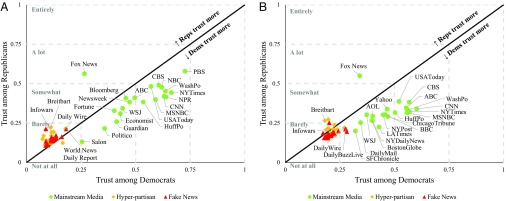
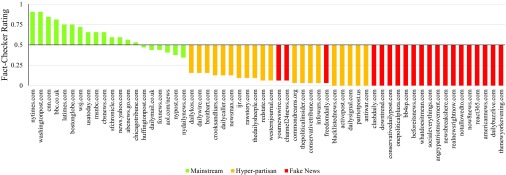
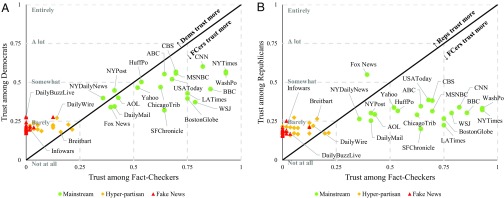
Significance: Many people consume news via social media. It is therefore desirable to reduce social media users’ exposure to low-quality news content. One possible intervention is for social media ranking algorithms to show relatively less content from sources that users deem to be untrustworthy. But are laypeople’s judgments reliable indicators of quality, or are they corrupted by either partisan bias or lack of information? Perhaps surprisingly, we find that laypeople—on average—are quite good at distinguishing between lower- and higher-quality sources. These results indicate that incorporating the trust ratings of laypeople into social media ranking algorithms may prove an effective intervention against misinformation, fake news, and news content with heavy political bias.
Overview
The claims and statistics of this paper haven’t been checked yet.
Free: it reads the open-access text and checks the first 5 claims that cite a source we can check. Create a free account to check every claim.
Integrity signals
Registry
Cites
Statistics
Figures
Verification
Claims the paper makes
The claims and statistics of this paper haven’t been checked yet.
Free: it reads the open-access text and checks the first 5 claims that cite a source we can check. Create a free account to check every claim.
Claims other papers make about this one
Each is checked against this paper’s own text: does it say what the citing paper says it does?
The source backs part of the claim, not all of it — or backs it for a different population, condition or comparison.
In the citing paper
“Recent empirical research finds that averaged responses of ordinary people are on par with third-party fact-checkers for both factual claims in articles (47) and overall accuracy of content from URL domain names (48, 49).”
From Deepfake detection by human crowds, machines, and machine-informed crowds (2022) · cites this paper as [49]
Experimental — accuracy not yet measuredThe cited source says what the claim attributes to it.
In the citing paper
“These approaches rely on the collective contributions and crowd signals (Tschiatschek et al. 2018) of a group of people for the aggregation of crowd intelligence to detect fake news (Tchakounté et al. 2020) and to reduce the spread of misinformation on social media (Pennycook and Rand 2019; Micallef et al. 2020).”
From Fake news, disinformation and misinformation in social media: a review (2023) · cites this paper as Pennycook and Rand 2019
The cited source says what the claim attributes to it.
In the citing paper
“Recent research suggests that human reasoning is “meaningfully directed toward the formation of accurate, rather than merely identity-confirming, beliefs” (ref. 24 p. 2525)”
From Factual knowledge can reduce attitude polarization (2025) · cites this paper as [24]
The cited source says what the claim attributes to it.
In the citing paper
“Research on news source quality demonstrates that people in the United States are generally accurate at identifying high and low-quality publishers54”
From Human detection of political speech deepfakes across transcripts, audio, and video (2024) · cites this paper as [54]
The cited source says what the claim attributes to it.
In the citing paper
“The crowdsourced accuracy ratings generated by this process may also be useful for identifying misinformation, as has been found for crowd ratings of source trustworthiness 138,139 .”
From Using social and behavioural science to support COVID-19 pandemic response (2020) · cites this paper as [139]
1 more claim about this paper
Create a free account to see every claim other papers make about this one.
Self-check
Percentages, sums and reported differences re-computed from the paper’s own numbers.
The self-check needs the paper’s full text.
Citations
Cites
Cognitive Reflection and Decision Making
Frederick, S. (2005) · Journal of Economic Perspectives · doi:10.1257/089533005775196732 · Cited by 5,256
Lazer, D. M. J., Baum, M. A., Benkler, Y., Berinsky, A. J., Greenhill, K. M., Menczer, F., Metzger, M. J., Nyhan, B., Pennycook, G., Rothschild, D., et al. (2018) · Science · doi:10.1126/science.aao2998 · Cited by 4,160 · cited 1×
“This is illustrated by the recent rise of an old form of misinformation: blatantly false news stories that are presented as if they are legitimate (2).”
BackgroundSelf-citationMisinformation and Its Correction: Continued Influence and Successful Debiasing
Lewandowsky, S., Ecker, U. K. H., Seifert, C. M., Schwarz, N., & Cook, J. (2012) · Psychological Science in the Public Interest · doi:10.1177/1529100612451018 · Cited by 2,920
Evidence for a Collective Intelligence Factor in the Performance of Human Groups
Woolley, A. W., Chabris, C. F., Pentland, A., Hashmi, N., & Malone, T. W. (2010) · Science · doi:10.1126/science.1193147 · Cited by 2,685 · cited 1×
“Here, we consider an alternative approach that builds off the large literature on collective intelligence and the “ wisdom of crowds ” (10, 11): using crowdsourcing (rather than professional fact-checkers) to assess the reliability of news websites (rather than individual stories), and then…”
BackgroundWhy do humans reason? Arguments for an argumentative theory
Mercier, H., & Sperber, D. (2011) · Behavioral and Brain Sciences · doi:10.1017/s0140525x10000968 · Cited by 2,254
Pennycook, G., & Rand, D. G. (2019) · Cognition · doi:10.1016/j.cognition.2018.06.011 · Cited by 2,022
Self-citationFake news on Twitter during the 2016 U.S. presidential election
Grinberg, N., Joseph, K., Friedland, L., Swire-Thompson, B., & Lazer, D. (2019) · Science · doi:10.1126/science.aau2706 · Cited by 1,803 · cited 1×
“(25), as well as websites that generated fake stories (as indicated by snopes.”
BackgroundIdeology, motivated reasoning, and cognitive reflection
Kahan, D. M. (2013) · Judgment and Decision Making · doi:10.1017/s1930297500005271 · Cited by 1,302 · cited 1×
“Specifically, motivated reasoning accounts (17, 30, 31) argue that humans reason akin to lawyers (as opposed to philosophers): We engage analytic thought as a means to justify our prior beliefs and thus facilitate argumentation.”
BackgroundPrior exposure increases perceived accuracy of fake news
Pennycook, G., Cannon, T. D., & Rand, D. G. (2018) · Journal of Experimental Psychology General · doi:10.1037/xge0000465 · Cited by 1,268
Self-citationCoppock, A., & McClellan, O. A. (2019) · Research & Politics · doi:10.1177/2053168018822174 · Cited by 987 · cited 1×
“In the second study, we tested the generalizability of our findings by surveying an additional n = 970 Americans recruited from Lucid, providing a subject pool that is nationally representative on age, gender, ethnicity, and geography (27).”
Result
Research works printed but not linked: 3
- 10.1037/h0101809 · doi:10.1037/h0101809 · Paper page
- G Pennycook DG Rand The implied truth effect: Attaching warnings to a subset of fake news stories increases perceived accuracy of stories without warnings. Available at https://papers.ssrn.com/sol3/papers.cfm?abstract_id=3035384. Accessed December 10 2017. (2017).
- RM Faris Partisanship propaganda and disinformation: Online media and the 2016 US Presidential Election. Berkman Klein Center for Internet Society and Research Paper . Available at https://papers.ssrn.com/sol3/papers.cfm?abstract_id=3019414. Accessed August 28 2017. (2017).
Cited by
Items 601–700 of 944
Believing Zoos and Aquariums as Conservation Informants
Voiklis, J., Gupta, R., Rank, S. J., Dwyer, J. D. L. T., Fraser, J., & Thomas, U. G. (2023) · Psychology and our planet · doi:10.1007/978-3-030-84942-9_8 · Cited by 3
Roessger, K. M. (2023) · Adult Education Quarterly · doi:10.1177/07417136231165007 · Cited by 4
“They are less likely to use social media “echo chambers” (Mosleh et al., 2021, para 1), believe fake news stories (Bago, et al., 2020), hold conspiracy beliefs (Kantorowicz-Reznichenko et al., 2022), and trust hyper-partisan news stories (Pennycook & Rand, 2019).”
BackgroundObywatel w centrum działań e-administracji w Unii Europejskiej
Dudzik, S., Kawka, I., Śliwa, R., Ruczkowski, P., Mitaľ, O., Kozłowski, J., Podleśny, T., Grabowska, M., Ziółkowska, A., Adamczyk, M., et al. (2023) · Ksiegarnia Akademicka Publishing eBooks · doi:10.12797/9788381388894 · Cited by 11
Falsehood and satire on social media: does partisan-motivated reasoning influence fake news sharing?
Wu, Y., & Garrison, B. (2023) · Communication Research and Practice · doi:10.1080/22041451.2023.2217074 · Cited by 5
“Sources that produce the largest amounts of partisan content may be judged as the most trustworthy (Pennycook & Rand, 2019a).”
BackgroundResultInfluentialThe Effect of Misinformation Intervention: Evidence from Trump’s Tweets and the 2020 Election
Li, Z., Cao, J., Adams-Cohen, N., & Alvarez, R. M. (2023) · Lecture notes in computer science · doi:10.1007/978-3-031-47896-3_7 · Cited by 3
Khokhar, R. H., Dadkhah, S., Zhao, T., Zhang, X., & Ghorbani, A. A. (2023) · Conference on Privacy, Security and Trust · doi:10.1109/pst58708.2023.10320194 · Cited by 2
“A group of works has proposed to use machine learning (ML) techniques [1], [13], crowd-sourced expertise [4], [21], [27] and community-driven approaches [19], [23] to curb the spread of misinformation and identify spammy behavior over the Twitter network.”
BackgroundAutomated Fact Checking Using A Knowledge Graph-based Model
Kundu, A., & Nguyen, U. T. (2024) · International Conference on Artificial Intelligence in Information and Communication (ICAIIC) · doi:10.1109/icaiic60209.2024.10463196 · Cited by 6
“Fact checkers help combat the spread of misinformation and promote informed decision making among the public [4].”
BackgroundSayed, A. A. (2024) · Frontiers in Public Health · doi:10.3389/fpubh.2024.1327944 · Cited by 4
Wang, M.-J. (2023) · IEEE International Symposium on Parallel and Distributed Processing with Applications (ISPA) · doi:10.1109/ispa-bdcloud-socialcom-sustaincom59178.2023.00159 · Cited by 4
“According to [48], these effects may be particularly pronounced for the younger generation, e.g., post-millennials, who are deeply immersed in electronic communication.”
BackgroundUnveiling News Publishers Trustworthiness Through Social Interactions
Pratelli, M., Saracco, F., & Petrocchi, M. (2024) · ACM Web Science Conference (WebSci) · doi:10.1145/3614419.3644015 · Cited by 6
Employing Traditional Stories to Enhance Critical Thinking Skills of Junior High School Students
Fauzia, N., Kuswardani, R., Rosyid, A., Abida, F. I. N., & Darma, D. B. (2023) · Humanitatis Journal of Language and Literature · doi:10.30812/humanitatis.v10i1.3184 · Cited by 2
“However, much of this information is unverified, inaccurate, or even misleading (Rifkin, 2014), (Vosoughi, 2018), (Pennycook, 2020).”
BackgroundDey, P., Luceri, L., & Ferrara, E. (2024) · International World Wide Web Conference (WWW) · doi:10.1145/3589335.3651483 · Cited by 13
“For instance, research has illustrated the adverse effects of "fake news" on public perception and behavior [7, 18], while others have highlighted the proliferation of misinformation and unreliable information amidst crises like the COVID-19 pandemic [4, 6].”
BackgroundDigital Technologies Used to Combat Disinformation and Fake News
Andreea Florina, R. A. D. U., & PETCU, I. (2024) · Romanian Cyber Security Journal · doi:10.54851/v6i1y202402 · Cited by 2
SEIR MODEL OF DISSEMINATION FALSE INFORMATION ON FACEBOOK
Razak, M. I. A. R. A., Sharif, N., Akil, K. A. K., & Bidin, J. (2024) · Journal of Information System and Technology Management · doi:10.35631/jistm.935006 · Cited by 2
Impact of gist intervention on automated system interpretability and user decision making
Gleaves, L. P., & Broniatowski, D. A. (2024) · Cognitive Research Principles and Implications · doi:10.1186/s41235-024-00594-2 · Cited by 2
“Although prior work shows that credibility ratings can facilitate misinformation discernment (Pennycook and Rand, 2019a), fuzzy-trace theory suggests that communicating the gist that these sources might have been “pos-sibly not credible” may have made them even less compelling (see discussion of…”
BackgroundMethodInfluentialFake news and Nigeria’s 2019 presidential election
Omotola, J. S. (2024) · Politikon · doi:10.1080/02589346.2024.2428881 · Cited by 5
“This is in line with established studies on the subject (Al-Rawi 2019; Carr, Sanchez, and Daros 2020; Pennycook and Rand 2019; Van Duyn and Collier 2019).”
Cherry‐Picking Tolerance About Untruthful News
Li, X., Hsee, C. K., & Wang, S. (2024) · Journal of Behavioral Decision Making · doi:10.1002/bdm.70003 · Cited by 5
Disinformation for hire: A field experiment on unethical jobs in online labor markets
Cohn, A., & Stoop, J. (2024) · European Economic Review · doi:10.1016/j.euroecorev.2024.104936 · Cited by 2
NeuroFuzDetect–A Neural and Fuzzy Inference System for Fake News Classification
Vineetha, B., & Nirmala, M. (2025) · IEEE Access · doi:10.1109/access.2025.3547123 · Cited by 4
“Fake information could spread rapidly due to the prevalence of disinformation, [11], [12], [13], [14], [15], misinformation [16], [17], [18], [19], shape public opinion in misleading ways, and even influence critical societal events such as elections [8], [9].”
Peterson, E., Darr, J., Allamong, M. B., & Henderson, M. (2025) · American Journal of Political Science · doi:10.1111/ajps.12969 · Cited by 9
Heyerdahl, L. W., Guillemot, V., Lana, B., Bizel-Bizellot, G., & Giles‐Vernick, T. (2025) · BMC Public Health · doi:10.1186/s12889-025-22406-y · Cited by 2
“Its global scale, unprecedented mobility restrictions, changing knowledge about the virus, and the rapid circulation of information and misinformation via social media amplified care workers’ uncertainties [48, 60, 66].”
The Utilization of Social Media by Far-Right Political Parties: A Study on Victory Party
Çakıcı, Z., & Aslıbay, E. (2025) · Advances in wireless technologies and telecommunication book series · doi:10.4018/979-8-3693-9999-6.ch009 · Cited by 2
Perceived legitimacy of layperson and expert content moderators
Martel, C., Berinsky, A. J., Rand, D. G., Zhang, A. X., & Resnick, P. (2025) · PNAS Nexus · doi:10.1093/pnasnexus/pgaf111 · Cited by 5
“For instance, layperson crowds have the flexibility to consist of different possible configurations, such as politically balanced (47) or nationally representative (48, 49) samples.”
Self-citationSun, Y., Shen, L., Choi, J. S., Borah, P., Wagner, M. W., Shah, D. V., & Yang, S. (2025) · Journalism & Mass Communication Quarterly · doi:10.1177/10776990251359659 · Cited by 3
“Source credibility plays a critical role in shaping how audiences evaluate and trust corrective information (Pennycook & Rand, 2019; Vraga & Bode, 2017).”
Conspiracy beliefs and analytical thinking in COVID-19 information web search
Vital, N., Chevalier, A., Dosso, C., & Trémolière, B. (2025) · Computers in Human Behavior Reports · doi:10.1016/j.chbr.2025.100804 · Cited by 3
Fighting Disinformation Online: Building the Database of Web Tools
Kavanagh, J., Cherney, S., Reininger, H., & Griffin, N. (2020) · RAND Corporation eBooks · doi:10.7249/rr3000 · Cited by 3
Sorting Fact From Fiction Without Source Evaluation Is a 50-50 Guess in the Disinformation Age
Endresen, A., Campbell, A. J., Torresson, B., & Terry, C. P. (2020) · Psi Chi Journal of Psychological Research · doi:10.24839/2325-7342.jn25.3.213 · Cited by 3
“Recently, this has become of particular concern across social media platforms (Pennycook & Rand, 2019a), the most heavily targeted domain of current disinformation campaigns (Bradshaw & Howard, 2019).”
BackgroundYates, T. (2021) · Journal of Human Rights Practice · doi:10.1093/jhuman/huab007 · Cited by 2
The Role of (Dis)information in Society During the COVID-19 Pandemic
Czudy, Z., Matuszczak, M., Donderska, M., & Haczyński, J. (2021) · Problemy Zarządzania - Management Issues · doi:10.7172/1644-9584.92.3 · Cited by 3
Mariniello, M. (2022) · Oxford University Press eBooks · doi:10.1093/oso/9780198831471.003.0005 · Cited by 2
The Correlates of Prejudice: Groupthink and Individual Psychological Attributes
Cuevas, J. A., & Dawson, B. L. (2022) · Springer eBooks · doi:10.1007/978-3-031-13559-0_14 · Cited by 2
Political Hoaxes in the Post-Truth Era: An Islamic Political Analysis
Agustina, I. F., Ali, Z. Z., Sakirman, S., Octavianne, H., & Jamal, M. A. A. (2023) · Al-ISTINBATH Jurnal Hukum Islam · doi:10.29240/jhi.v8i2.8457 · Cited by 13
Detecting Misinformation: Identifying False News Spread by Political Leaders in the Global South
Pereira, F. B., Bueno, N., Nunes, F., Pavão, N. D. C., dos Santos, J. ̃. P. O., & Wirtschafter, V. (2024) · Journal of Quantitative Description Digital Media · doi:10.51685/jqd.2024.007 · Cited by 5
Cialdini, R. B., Lasky-Fink, J., Demaine, L. J., Barrett, D. W., Sagarin, B. J., & Rogers, T. (2021) · Psychological Science · doi:10.1177/09567976211015182 · Cited by 2
“In recent years, disinformation in politics, advertising, and mass communications has proliferated (Lazer et al., 2018; Pennycook & Rand, 2019; Vosoughi et al., 2018).”
BackgroundEmotional news affects social judgments independent of perceived media credibilityPreprint
Baum, J., & Rahman, R. A. (2020) · bioRxiv (Cold Spring Harbor Laboratory) · doi:10.1101/2020.02.29.971234 · Cited by 3
Chipidza, W., & Yan, J. (2020) · SocArXiv (OSF Preprints) · doi:10.31235/osf.io/69hkb · Cited by 3
Baum, J., Frömer, R., & Rahman, R. A. (2020) · doi:10.31234/osf.io/3zr24 · Cited by 2
A cognitive mechanism for the persistence of widespread false beliefsPreprint
Frigo, V., Chen, L., & Rogers, T. T. (2020) · PsyArXiv (OSF Preprints) · doi:10.31234/osf.io/4zfrp · Cited by 3
Kumar, N., & Janmohamed, K. (2021) · Research Square · doi:10.21203/rs.3.rs-1058467/v1 · Cited by 2
“Interventions that ask respondents to judge information accuracy around vaping [54, 55], may nudge individuals toward accurate information regarding vaping during news events which possibly distort vaping perceptions.”
BackgroundMisinformation Analysis and Online Quality Theory (A Wittgensteinian Approach)Preprint
Omoregie, U. (2021) · SocArXiv (OSF Preprints) · doi:10.31235/osf.io/82swk · Cited by 4
The Social Anatomy of Climate Change Denial in the United StatesPreprint
Yang, J., Gounaridis, D., Liu, M., & Newell, J. (2022) · Research Square · doi:10.21203/rs.3.rs-2163106/v1 · Cited by 2
Pedriza, S. B. (2023) · Encyclopedia · doi:10.3390/encyclopedia3040099 · Cited by 4
“According to the works published by Guess, Nagler and Tucker [52] and G ó mez-Calder ó n, C ó rdoba-Cab ú s and Lopez-Mart í n [53], young people are more affected by disinformation, as is the case with people of conservative ideology [52,53] and those with a lower level of education [54].”
ResultCommunity notes increase trust in fact-checking on social mediaPreprint
Drolsbach, C., Solovev, K., & Pröllochs, N. (2024) · doi:10.31219/osf.io/ydc42 · Cited by 2
Altay, S., Hoes, E., & Wojcieszak, M. (2024) · PsyArXiv (OSF Preprints) · doi:10.31234/osf.io/hq5ru · Cited by 6
Wikipedia vs. Traditional Books: A Comparative Study of Knowledge Retention and MisinformationPreprint
Sariyev, Y. (2025) · SSRN Electronic Journal · doi:10.2139/ssrn.5177889 · Cited by 2
Nerantzaki, K., & Meladianos, P. (2025) · European Journal of Contemporary Education and E-Learning · doi:10.59324/ejceel.2025.3(6).12 · Cited by 1
Can Crowdsourcing Rescue the Social Marketplace of Ideas?
Yasseri, T., & Menczer, F. (2023) · Communications of the ACM · doi:10.1145/3578645 · Cited by 45
“Recent experiments suggest that crowdsourced layperson judgments can be effective at identifying misinformation.(12) Such a community approach could scale up fact-checking and moderation practices while mitigating both misinformation and polarization.”
BackgroundMiller, A. L., Wissman, K. T., & Peterson, D. J. (2021) · Applied Cognitive Psychology · doi:10.1002/acp.3818 · Cited by 2
Jayan, V., & Alathur, S. (2021) · International Journal of Electronic Government Research · doi:10.4018/ijegr.289946 · Cited by 3
Rasit, R. M., Ghani, M. Z. A., Aini, Z., Ashaari, M. F., & Sahari, N. (2022) · International Journal of Academic Research in Business and Social Sciences · doi:10.6007/ijarbss/v12-i12/15929 · Cited by 1
Legal Aspects of Telemedicine in Poland and Challenges in Times of Pandemic
Kawczyńska, M. (2023) · Ksiegarnia Akademicka Publishing eBooks · doi:10.12797/9788381388894.09 · Cited by 1
Mind the Gap: Facebook’s measures against information disorder do not go far enough
de‐Lima‐Santos, M., & Ceron, W. (2024) · Media Culture & Society · doi:10.1177/01634437241237936 · Cited by 2
“As a result, users are challenged to discern the quality of the content they encounter on digital environments (Pennycook and Rand, 2019).”
Factors Associated With Vaccination Refusal Among a Sample of the Jordanian Population
Ghaboush, R. A., Al-Olimat, H. S., Hammour, S. A., Buniaian, N. A. A., Anabtawi, M. F., Al-Qdah, T., Alajmi, A. F., & Altarawneh, M. I. (2024) · SAGE Open · doi:10.1177/21582440241260543 · Cited by 1
“These findings are consistent with studies highlighting the rapid spread of false information through online platforms (Pennycook & Rand, 2019; Wardle & Derakhshan, 2017).”
Shoves, nudges and combating misinformation: evidence on a new approach
Porter, E. V., Wood, T., Broniatowski, D. A., & Hosseini, P. (2024) · Behavioural Public Policy · doi:10.1017/bpp.2024.42 · Cited by 2
“While Bode and Vraga (2021) and Pennycook and Rand (2019) offer evidence of the effectiveness of crowd-sourcing to confront misinformation, they do not focus on individuals ’ capacity to change their behavior and thus address a social problem.”
Adebiyi, A. A., Adejumobi, H. O., Aliyu, M. E., & Adeosun, K. G. (2025) · African Journal of Social Sciences and Humanities Research · doi:10.52589/ajsshr-hrxm3oge · Cited by 1
“This theme is further developed by Pennycook and Rand (2020, 2021), who focus on using crowdsourced judgments to assess the credibility of news sources.”
Nanda, A. P., Veluri, K. K., & Beura, D. (2025) · NMIMS Management Review · doi:10.1177/09711023251329630 · Cited by 3
“Pennycook and Rand (2019) demonstrated how cognitive factors such as cognitive laziness and confirmation bias contribute to the susceptibility to misinformation, highlighting the role of individual psychology in its propagation.”
AI-Powered Fact-Checking: Combating Misinformation in the Digital Age
Qin, X. (2025) · Frontiers in Humanities and Social Sciences · doi:10.54691/mbhp6969 · Cited by 2
BIASsist: Empowering News Readers via Bias Identification, Explanation, and Neutralization
Noh, Y.-G., Han, M., Jeon, J., & Hong, J.-H. (2025) · CHI Conference on Human Factors in Computing Systems · doi:10.1145/3706598.3713531 · Cited by 9
“Providing contrasting information when evaluating the credibility of news articles increases the likelihood of making accurate judgments [92].”
Chagas, B. T. (2025) · Advances in wireless technologies and telecommunication book series · doi:10.4018/979-8-3693-9999-6.ch008 · Cited by 2
Exploring disparities in self-reported knowledge about neurotechnology
Sattler, S., Mehlkop, G., Neuhaus, A., Wexler, A., & Reiner, P. B. (2025) · Scientific Reports · doi:10.1038/s41598-025-00460-1 · Cited by 2
What’s in a Label? Propaganda Labels and User Sharing Behavior on Social Media Platforms
Jose, J., Geeng, C., Morales, K. O., McCoy, D., & Greenstadt, R. (2025) · Proceedings of the International AAAI Conference on Web and Social Media · doi:10.1609/icwsm.v19i1.35853 · Cited by 5
Examining How Fact-checking Hubs Counter Information Disorder in Africa
Aliagan, I. Z., & Daranijo, H. O. (2025) · Komunikator · doi:10.18196/jkm.v17i1.25725 · Cited by 3
“Social media platforms, while frequently serving as conduits for misinformation, also offer channels for the swift dissemination of fact-checks (Pennycook & Rand, 2019).”
Erdoğan, E. (2025) · Pamukkale University Journal of Social Sciences Institute · doi:10.30794/pausbed.1612600 · Cited by 1
A Scalable Approach to Fake News Detection Using TF-IDF and Logistic Regression
Pavithra Devi, R., Shesathri, K., Madhumitha, Y., Dinesh, U., & Mohanty, A. (2025) · International Conference on Sensors and Related Networks (SENNET) · doi:10.1109/sennet64220.2025.11135996 · Cited by 3
Religion in the Face of Cognitive Security Challenges
Reczkowski, R., Starzyński, S., & Łużyński, W. (2025) · Pastoral Psychology · doi:10.1007/s11089-025-01257-9 · Cited by 3
Lloyd, T., Nguyen, T., Levy, K. E. C., & Naaman, M. (2026) · CHI Conference on Human Factors in Computing Systems · doi:10.1145/3772318.3791889 · Cited by 13
“While fact-check systems traditionally rely on a central authority, alternative approaches to dealing with information of questionable quality make use of the distributed expertise of a crowd [38, 67].”
A dual typology of social media interventions and deterrence mechanisms against misinformation
Karami, A. (2025) · Harvard Kennedy School Misinformation Review · doi:10.37016/mr-2020-184 · Cited by 1
“Current studies tend to examine platform interventions in isolation or emphasize their technical aspects (Broniatowski et al. 2023; Vincent et al., 2022; Pennycook & Rand, 2019), rather than analyzing their intended impact or positioning them within broader deterrence or governance models.”
Economic implications of AI on media industries: A systematic review
Danso, S., Asafo, S. Y., Kaayeng, F., Aidoo, E. A. K., & Larweh, R. (2025) · Diginomics · doi:10.56294/digi2025223 · Cited by 1
Stoeckel, F., Stöckli, S., Lyons, B. A., Kroker, H., & Reifler, J. (2025) · Cambridge University Press eBooks · doi:10.1017/9781009677165 · Cited by 1
Administraciones públicas contra la desinformación
Pérez, P. J. B. (2025) · Revista Canaria de Administración Pública · doi:10.36151/rcap.4.7 · Cited by 3
Does the Style of Misinformation Condition its Effects? An Experiment in Brazil
Caba, R. F., Chauchard, S., & Mello, F. (2025) · The Journal of Politics · doi:10.1086/739778 · Cited by 1
Engineering epistemic churn: A theory of prolonged meaning-making under platform conditions
Tapper, J., & Bronstein, C. (2025) · New Media & Society · doi:10.1177/14614448251407335 · Cited by 1
SOSYAL MEDYADA GÜVEN VE SAHTE HABER ALGISI: KULLANICI DAVRANIŞLARI VE FAKTÖRLERİN İNCELENMESİ
Arslan, Ş. (2026) · Pamukkale University Journal of Social Sciences Institute · doi:10.30794/pausbed.1731845 · Cited by 1
Truth-Seeking vs. Balance: The Credibility Dilemma in Correcting Political Misinformation
Shin, H. (2026) · Political Communication · doi:10.1080/10584609.2026.2627253 · Cited by 3
“In reality, individuals frequently encounter unfamiliar news sources (Pennycook & Rand, 2019), including those that correct misperceptions, such as fact-checking sites (Guess et al., 2020; Nyhan & Reifler, 2016).”
Fitz-Gerald, A., & Padalko, H. (2026) · Frontiers of artificial intelligence, ethics and multidisciplinary applications. · doi:10.1007/978-3-032-05588-0_11 · Cited by 1
Wang, J., Liu, C., Paerhati, T., Wang, Z., Zhang, X., & Ku, Y. (2026) · Computers in Human Behavior · doi:10.1016/j.chb.2026.108991 · Cited by 1
Simulating Public Opinion Propagation on Social Media Using Large Language Model-based Agents
Zheng, W., & Tang, X. (2026) · Journal of Systems Science and Systems Engineering · doi:10.1007/s11518-026-5726-8 · Cited by 3
Go, M. H., Kweon, Y., Miwa, H., & Ono, Y. (2026) · Public Opinion Quarterly · doi:10.1093/poq/nfag030 · Cited by 1
“In these situations, accuracy motivations are more likely to pre-vail, making individuals more inclined to accept credible corrective information (Bullock 2011; Hill 2017 ; Pennycook and Rand 2019).”
Fox, G., van der Werff, L., Santos, G., Egli, A., Wood, C., & Lynn, T. (2026) · Journal of Health Population and Nutrition · doi:10.1186/s41043-026-01321-x · Cited by 2
“Consumers’ expectations of lower accuracy in social media contexts [43, 44] and limited effort in processing information [45] may further increase the likelihood of consuming misinformation, and recent evidence suggests health misinformation may be harder to detect than misinformation in other…”
The structural fingerprints of disinformation: a content-agnostic framework
Redaelli, S., Spitale, G., & Germani, F. (2026) · Ethics and Information Technology · doi:10.1007/s10676-025-09886-7 · Cited by 2
“…media by testing the hypothesis that large and diverse publics can reliably judge the quality of news when prompted to engage in reasoning and focus on the trustworthiness of news sources, an effect that, under these conditions, appears to hold regardless of partisanship (Pennycook & Rand, 2019 ).”
Sun, Z., Yuan, M., 林, 轩., Ni, W., & Zhang, L. (2026) · Behavioral Sciences · doi:10.3390/bs16050803 · Cited by 1
“…noting, for instance, that the velocity and reach of refutation information often lag significantly behind the rumors themselves (Vosoughi et al., 2018), or on macro-level strategies such as institutional interventions by governments and media (Paek & Hove, 2019; Pennycook & Rand, 2019).”
Sportelli, C., Cicirelli, P. G., Corbelli, G., Paciello, M., & D’Errico, F. (2026) · Journal of Media Psychology Theories Methods and Applications · doi:10.1027/1864-1105/a000512 · Cited by 1
An Introduction to Online Platforms
Mariniello, M. (2022) · Oxford University Press eBooks · doi:10.1093/oso/9780198831471.003.0008 · Cited by 2
Mariniello, M. (2022) · Oxford University Press eBooks · doi:10.1093/oso/9780198831471.003.0012 · Cited by 1
Russian-Language Media of YouTube: Trends of the “Fifth Power” in 2021
Kruglova, L. A., & Kostrukov, A. I. (2023) · Vestnik NSU Series History and Philology · doi:10.25205/1818-7919-2023-22-6-82-93 · Cited by 1
Social Media and Political Propaganda: A double-edged Sword for Democratic Consolidation in Nigeria
Uwa, O. G., & Ronke, A. C. (2023) · International Journal of Social Science Management and Economics Research · doi:10.61421/ijssmer.2023.1201 · Cited by 5
“These frames can influence how social media users perceive and interpret political events and personalities, shaping their attitudes and behaviors (Pennycook et al., 2020).”
BackgroundThe rapid spread of online misinformation and its impact on the digital economy
Shah, S. I. H., Kapantai, E., & Peristeras, V. (2023) · International Conference on Theory and Practice of Electronic Governance · doi:10.1145/3614321.3614368 · Cited by 1
“…spread [7, 22], less focus on introducing special norms aligned with international human rights law by the governments to tackle misinformation [23], individual and collective biases [24–26], lack of global cooperation for coordinated efforts across diverse cultural, and political contexts…”
BackgroundAbiodun, A. (2024) · International Journal of Communication and Public Relation · doi:10.47604/ijcpr.2272 · Cited by 11
“…research gap categories that is conceptual, contextual and methodological gaps Conceptual Research Gap: While the studies by Vosoughi (2018) and Pennycook and Rand (2019) focus on the impact of fake news and misinformation on political behavior and cognitive mechanisms, there is a conceptual…”
BackgroundInfluentialSaisir les pratiques de production et de réception des « fake news » en contexte numérique
Carlino, V., & Pignard-Cheynel, N. (2024) · Les Enjeux de l information et de la communication · doi:10.3917/enic.hs13.0005 · Cited by 1
Creatively and Critically Challenging Assumptions
Feist, G. J. (2024) · Springer eBooks · doi:10.1007/978-3-031-51590-3_9 · Cited by 2
The Relationship between Political Ideology and Social Media Echo Chambers
Namazzi, S. N. S. (2024) · International Journal of Humanity and Social Sciences · doi:10.47941/ijhss.1781 · Cited by 4
Kim, S., & Oh, S. (2024) · International Journal of Strategic Communication · doi:10.1080/1553118x.2024.2342460 · Cited by 1
“…other websites that have been viewed as relatively credible sources of information (Bakshy et al., 2015; Grinberg et al., 2019; Guess et al., 2019; Pennycook & Rand, 2019; T. Yang et al., 2020) and low-credibility information sources known to spread misinformation and unsubstantiated narratives…”
Disinformation in Times of Disaster and Crisis
DALAYLI, F. Ü. (2024) · Afet ve Risk Dergisi · doi:10.35341/afet.1322738 · Cited by 2
Shin, H. (2024) · The International Journal of Press/Politics · doi:10.1177/19401612241277137 · Cited by 3
“Because Democrats have higher baseline trust in news media and fact-checking (Pennycook and Rand 2019; Walker and Gottfried 2019), it is possible that treatment effects of nonpolitical popular culture coverage could be more muted among Democrats than Republicans.”
Ailakhu, U. V. (2025) · Records Management Journal · doi:10.1108/rmj-02-2024-0006 · Cited by 1
Consumo y percepción de Fake News. Un análisis bibliométrico
Palacio, J. D. Á., Vergara, F., & Ávila, F. J. M. (2024) · Revista Palobra palabra que obra · doi:10.32997/2346-2884-vol.24-num.2-2024-5190 · Cited by 1
Unveiling Utopia of False Information in The Digital Era through The Lens of Bibliometric Analysis
Wijaya, M. I., Suzanna, S., Budiharto, W., Utomo, D., & Ivana, J. (2024) · International Multi-Topic Conference · doi:10.1109/inmic64792.2024.11004361 · Cited by 1
“Human knowledge is a combination rating that is based on expert judgment, and users (crowd) as suggested by Pennycook and Rand [55], Micallef et al. [56], Vlachos and Riedel [57], Chung and Kim [58].”
Should we be Afraid of an Infodemic?
Seytre, B. (2025) · Health Behavior Research · doi:10.4148/2572-1836.1353 · Cited by 1
The Tribe Has Spoken: Evidence for the Impact of Tribal Differences in Social Science Is Equivocal
Quinn, K. A., Bellovary, A. K., & Cole, C. E. (2020) · Psychological Inquiry · doi:10.1080/1047840x.2020.1722579 · Cited by 1
“…(specifically, Democrat) evaluations of media quality were more similar than conservative (Republican) evaluations to fact-checker conclusions (Pennycook & Rand, 2019a); (c) liberals showed better truth discernment than conservatives (Pennycook & Rand, 2019b); and (d) conservatives, relative…”
BackgroundResultNear Real-Time Detection of Misinformation on Online Social Networks
van de Guchte, L., Raaijmakers, S. A., Meeuwissen, E., & Spenader, J. K. (2020) · Lecture notes in computer science · doi:10.1007/978-3-030-61841-4_17 · Cited by 3
“In order to provide a list of news sources that publish reliable and trusted articles we rely on earlier research that used crowd-sourced judgments to define the quality of a news source (Pennycook and Rand, 2019).”
Method
Metadata
- Authors
- Pennycook, G., & Rand, D. G.
- Affiliations
- University of Regina (CA)
- Massachusetts Institute of Technology (US)
- Corresponding author
- Pennycook, Gordon
- Rand, David G.
- Venue
- Proceedings of the National Academy of Sciences
- Publisher
- National Academy of Sciences
- Published
- 2019-01-28
- Volume
- 116
- Issue
- 7
- Pages
- 2521-2526
- ISSN
- 0027-8424 (ISSN-L)
- 1091-6490
- PMC
- PMC6377495
- OpenAlex
- W2913081045
- Cited by
- 947
- References
- 26
- Citations by year
- 2026: 99 · 2025: 152 · 2024: 139 · 2023: 126 · 2022: 138 · 2021: 142 · 2020: 125 · 2019: 22
- FWCI
- 214.50
- Type
- journal article
- Language
- en
- Open access
- hybrid
- doi.org
- Licence
- Locations
- Proceedings of the National Academy of Sciences (publishedVersion, cc-by-nc-nd)
- Europe PMC (PubMed Central) (publishedVersion, cc-by-nc-nd)
- PubMed Central (publishedVersion, cc-by-nc-nd)
- PubMed (publishedVersion)
- DSpace@MIT (Massachusetts Institute of Technology) (submittedVersion)
- OSF Preprints (OSF Preprints) (submittedVersion)
- Funders
- Miami Foundation (-1)
- Templeton World Charity Foundation (TWCF0209)
- DOD | Defense Advanced Research Projects Agency (D17AC00005)
- Gouvernement du Canada | Social Sciences and Humanities Research Council of Canada (430-2018-00452)
- Topics
- Social Sciences › Sociology and Political Science › Misinformation and Its Impacts
- Social Sciences › Sociology and Political Science › Media Influence and Politics
- Physical Sciences › Computer Science › Information Systems › Spam and Phishing Detection
- Keywords
- misinformation, fake news, social media, source trustworthiness, ranking algorithms, partisan bias, political bias
- MeSH terms
- Algorithms, Humans, Judgment, Politics, Social Media, Crowdsourcing
About these checks
Registry, retraction, Cites and statistics results are computed, not judged, with one exception: a printed reference that no index lists is read once by a model before it counts as a citation error. Claims are extracted by a model and kept only when their quote appears verbatim in the text; each cited source is then checked, with a model’s help, for whether it says what the claim relies on. Those verdicts can be wrong — read the claim’s quote and the cited source before relying on one.
Statistics and arithmetic are recomputed, not judged.
Confidence bands are shown only for fields calibrated on our annotated test set. None is calibrated yet, so no band is shown.
What counts as a claim ›How we measure confidence ›How we check this ›
Are you an author, or do you see a problem with this page? Request a review
Data sources
Bibliographic data: Semantic Scholar, OpenAlex, Crossref.
Contains information from the Semantic Scholar Academic Graph Datasets, made available under the ODC Attribution License (ODC-BY 1.0).
Semantic Scholar’s data is described in: Kinney, R., et al. (2023). The Semantic Scholar Open Data Platform. arXiv:2301.10140.
