

Fighting misinformation on social media using crowdsourced judgments of news source quality
Open accessThe DOI matches its Crossref record; 26 of the 26 references it cites were found in a registry or an index.
Abstract
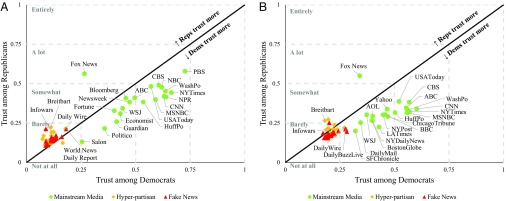
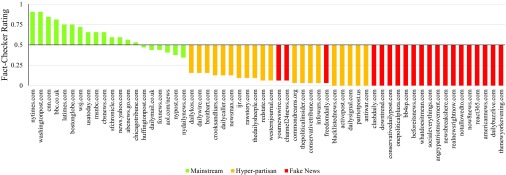
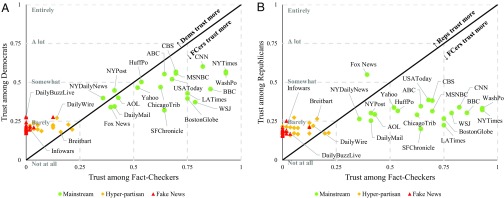
Significance: Many people consume news via social media. It is therefore desirable to reduce social media users’ exposure to low-quality news content. One possible intervention is for social media ranking algorithms to show relatively less content from sources that users deem to be untrustworthy. But are laypeople’s judgments reliable indicators of quality, or are they corrupted by either partisan bias or lack of information? Perhaps surprisingly, we find that laypeople—on average—are quite good at distinguishing between lower- and higher-quality sources. These results indicate that incorporating the trust ratings of laypeople into social media ranking algorithms may prove an effective intervention against misinformation, fake news, and news content with heavy political bias.
Overview
The claims and statistics of this paper haven’t been checked yet.
Free: it reads the open-access text and checks the first 5 claims that cite a source we can check. Create a free account to check every claim.
Integrity signals
Registry
Cites
Statistics
Figures
Verification
Claims the paper makes
The claims and statistics of this paper haven’t been checked yet.
Free: it reads the open-access text and checks the first 5 claims that cite a source we can check. Create a free account to check every claim.
Claims other papers make about this one
Each is checked against this paper’s own text: does it say what the citing paper says it does?
The source backs part of the claim, not all of it — or backs it for a different population, condition or comparison.
In the citing paper
“Recent empirical research finds that averaged responses of ordinary people are on par with third-party fact-checkers for both factual claims in articles (47) and overall accuracy of content from URL domain names (48, 49).”
From Deepfake detection by human crowds, machines, and machine-informed crowds (2022) · cites this paper as [49]
Experimental — accuracy not yet measuredThe cited source says what the claim attributes to it.
In the citing paper
“These approaches rely on the collective contributions and crowd signals (Tschiatschek et al. 2018) of a group of people for the aggregation of crowd intelligence to detect fake news (Tchakounté et al. 2020) and to reduce the spread of misinformation on social media (Pennycook and Rand 2019; Micallef et al. 2020).”
From Fake news, disinformation and misinformation in social media: a review (2023) · cites this paper as Pennycook and Rand 2019
The cited source says what the claim attributes to it.
In the citing paper
“Recent research suggests that human reasoning is “meaningfully directed toward the formation of accurate, rather than merely identity-confirming, beliefs” (ref. 24 p. 2525)”
From Factual knowledge can reduce attitude polarization (2025) · cites this paper as [24]
The cited source says what the claim attributes to it.
In the citing paper
“Research on news source quality demonstrates that people in the United States are generally accurate at identifying high and low-quality publishers54”
From Human detection of political speech deepfakes across transcripts, audio, and video (2024) · cites this paper as [54]
The cited source says what the claim attributes to it.
In the citing paper
“The crowdsourced accuracy ratings generated by this process may also be useful for identifying misinformation, as has been found for crowd ratings of source trustworthiness 138,139 .”
From Using social and behavioural science to support COVID-19 pandemic response (2020) · cites this paper as [139]
1 more claim about this paper
Create a free account to see every claim other papers make about this one.
Self-check
Percentages, sums and reported differences re-computed from the paper’s own numbers.
The self-check needs the paper’s full text.
Citations
Cites
Cognitive Reflection and Decision Making
Frederick, S. (2005) · Journal of Economic Perspectives · doi:10.1257/089533005775196732 · Cited by 5,256
Lazer, D. M. J., Baum, M. A., Benkler, Y., Berinsky, A. J., Greenhill, K. M., Menczer, F., Metzger, M. J., Nyhan, B., Pennycook, G., Rothschild, D., et al. (2018) · Science · doi:10.1126/science.aao2998 · Cited by 4,160 · cited 1×
“This is illustrated by the recent rise of an old form of misinformation: blatantly false news stories that are presented as if they are legitimate (2).”
BackgroundSelf-citationMisinformation and Its Correction: Continued Influence and Successful Debiasing
Lewandowsky, S., Ecker, U. K. H., Seifert, C. M., Schwarz, N., & Cook, J. (2012) · Psychological Science in the Public Interest · doi:10.1177/1529100612451018 · Cited by 2,920
Evidence for a Collective Intelligence Factor in the Performance of Human Groups
Woolley, A. W., Chabris, C. F., Pentland, A., Hashmi, N., & Malone, T. W. (2010) · Science · doi:10.1126/science.1193147 · Cited by 2,685 · cited 1×
“Here, we consider an alternative approach that builds off the large literature on collective intelligence and the “ wisdom of crowds ” (10, 11): using crowdsourcing (rather than professional fact-checkers) to assess the reliability of news websites (rather than individual stories), and then…”
BackgroundWhy do humans reason? Arguments for an argumentative theory
Mercier, H., & Sperber, D. (2011) · Behavioral and Brain Sciences · doi:10.1017/s0140525x10000968 · Cited by 2,254
Pennycook, G., & Rand, D. G. (2019) · Cognition · doi:10.1016/j.cognition.2018.06.011 · Cited by 2,022
Self-citationFake news on Twitter during the 2016 U.S. presidential election
Grinberg, N., Joseph, K., Friedland, L., Swire-Thompson, B., & Lazer, D. (2019) · Science · doi:10.1126/science.aau2706 · Cited by 1,803 · cited 1×
“(25), as well as websites that generated fake stories (as indicated by snopes.”
BackgroundIdeology, motivated reasoning, and cognitive reflection
Kahan, D. M. (2013) · Judgment and Decision Making · doi:10.1017/s1930297500005271 · Cited by 1,302 · cited 1×
“Specifically, motivated reasoning accounts (17, 30, 31) argue that humans reason akin to lawyers (as opposed to philosophers): We engage analytic thought as a means to justify our prior beliefs and thus facilitate argumentation.”
BackgroundPrior exposure increases perceived accuracy of fake news
Pennycook, G., Cannon, T. D., & Rand, D. G. (2018) · Journal of Experimental Psychology General · doi:10.1037/xge0000465 · Cited by 1,268
Self-citationCoppock, A., & McClellan, O. A. (2019) · Research & Politics · doi:10.1177/2053168018822174 · Cited by 987 · cited 1×
“In the second study, we tested the generalizability of our findings by surveying an additional n = 970 Americans recruited from Lucid, providing a subject pool that is nationally representative on age, gender, ethnicity, and geography (27).”
Result
Research works printed but not linked: 3
- 10.1037/h0101809 · doi:10.1037/h0101809 · Paper page
- G Pennycook DG Rand The implied truth effect: Attaching warnings to a subset of fake news stories increases perceived accuracy of stories without warnings. Available at https://papers.ssrn.com/sol3/papers.cfm?abstract_id=3035384. Accessed December 10 2017. (2017).
- RM Faris Partisanship propaganda and disinformation: Online media and the 2016 US Presidential Election. Berkman Klein Center for Internet Society and Research Paper . Available at https://papers.ssrn.com/sol3/papers.cfm?abstract_id=3019414. Accessed August 28 2017. (2017).
Cited by
Items 501–600 of 944
Identifying and Debunking Environmentally-Related False News Stories – An Experimental Investigation
Grüner, S. (2021) · German Journal of Agricultural Economics · doi:10.30430/gjae.2021.0176 · Cited by 5
News events and their relationship with US vape sales: an interrupted time series analysis
Janmohamed, K., Nakamura-Sakai, S., Soale, A., Forastiere, L., Altice, F. L., & Kumar, N. (2022) · BMC Public Health · doi:10.1186/s12889-022-12858-x · Cited by 4
“Interventions that ask respondents to judge information accuracy around vaping [40, 41], may nudge individuals toward accurate information regarding vaping during news events which possibly distort vaping perceptions.”
BackgroundCutler, M., Jalbert, K., Ball, K., Bruhis, N., & Guetschow, T. (2022) · Ecology and Society · doi:10.5751/es-13474-270313 · Cited by 6
Social Media as a Tool for the Development of Future Journalists’ Communicative Competence
Гарачковська, О., Парфенюк, І., Галудзіна‐Горобець, В., Дмитренко, Н. В., Osaula, V., & Гребньов, Г. (2022) · Journal of Curriculum and Teaching · doi:10.5430/jct.v11n6p16 · Cited by 6
The impact of political ideology, knowledge and participation on electoral conspiracy endorsement
Jiang, Y. (2023) · Frontiers in Political Science · doi:10.3389/fpos.2023.1069468 · Cited by 8
Overview of Potential Risks of Artificial General Intelligence Robots
Institution, Š. V. K. /. Š. S. H. E., Gündoğar, A., & Niauronis, S. (2023) · doi:10.56131/tmt.2023.2.1.93 · Cited by 7
Detecting science-based health disinformation: a stylometric machine learning approach
Williams, J. A., AlEroud, A. F., & Zimmerman, D. (2023) · Journal of Computational Social Science · doi:10.1007/s42001-023-00213-y · Cited by 5
“Other research areas, such as disin-formation modeling and dynamics [52, 53], social computing and health disinforma-tion [53, 54], crowd-source mediation [55], and crisis-related misinformation [56], could potentially benefit from an IQ-based approach.”
BackgroundClemons, E. K., Savin, A., Schreieck, M., Teilmann-Lock, S., Trzaskowski, J., & Waran, R. V. (2024) · Electronic Markets · doi:10.1007/s12525-024-00713-3 · Cited by 10
“The fake news community has explored labeling false and harmful content (A. Kim & Dennis, 2019; Kim et al., 2019a, 2019b), a form of debunking, with only limited success, and sites like Facebook have abandoned labeling (Pennycook & Rand, 2019; Pennycook et al., 2020).”
BackgroundScaling crowdsourcing interventions to combat partisan misinformation
Pretus, C., Gil-Buitrago, H., Cisma, I., Hendricks, R. C., & Villarreal, D. L. (2024) · advances.in/psychology · doi:10.56296/aip00018 · Cited by 8
Contesting Authority to Adjudicate Misinformation
Radnitz, S. (2025) · Perspectives on Politics · doi:10.1017/s1537592725102028 · Cited by 8
Does Evidence from Peers Help Crowd Workers in Assessing Truthfulness?
Xu, J., Han, L., Fan, S., Sadiq, S. W., & Demartini, G. (2022) · International World Wide Web Conference (WWW) · doi:10.1145/3487553.3524236 · Cited by 4
“Pennycook and Rand [10] point out that some fake stories may never be flagged as the task of judging truthfulness is usually resource intensive and the scale of the problem is massive.”
BackgroundEffects of as-if risk framing of hazards on risk perception and its rebuttal
Wiedemann, P. M., Kirsch, F., Lohmann, M., Böl, G., & Freudenstein, F. (2022) · Regulatory Toxicology and Pharmacology · doi:10.1016/j.yrtph.2022.105282 · Cited by 6
Transforming Education for Sustainability: Discourses on Justice, Inclusion, and Authenticity
Maulucci, M. S. R., Pfirman, S., & Callahan, H. S. (2023) · Environmental discourses in science education · doi:10.1007/978-3-031-13536-1 · Cited by 4
Jasim, M., Fatima, M., Sonni, S. R., & Mahyar, N. (2023) · IEEE Workshop on Visualization for Social Good (VIS4Good) · doi:10.1109/vis4good60218.2023.00012 · Cited by 5
How Sticky Is Pink Slime? Assessing the Credibility of Deceptive Local Media
Darr, J. (2023) · The Annals of the American Academy of Political and Social Science · doi:10.1177/00027162231214696 · Cited by 9
“The void left by the decline of trusted local news sources (Bengani 2019, 2020; Munger 2020; Pennycook and rand 2019; Peterson and Allamong 2022; Van Aelst et al. 2017) has made room for the exploitation of low cost of market entry in pink slime journalism that pushes political agendas.”
BackgroundInfluentialBuilding Bridges: Exploring Digital Strategies for Promoting Tolerance and Global Citizenship
Mariyono, D., & Maskuri, M. (2024) · International Journal of Religion · doi:10.61707/tp31wx90 · Cited by 8
A Pre-training Approach for Stance Classification in Online Forums
Tshimula, J. M., Chikhaoui, B., & Wang, S. (2020) · IEEE/ACM International Conference on Advances in Social Networks Analysis and Mining (ASONAM) · doi:10.1109/asonam49781.2020.9381467 · Cited by 6
“Such knowledge can be used for multiple purposes, such as predicting behavioral deterioration [41], detecting affinity relationships [39], [40], revealing misinformation [26], identifying fickleminded people and weathervanes, recognizing logical fallacies like strawman arguments, targeting public awareness and advocac…”
BackgroundPietro, R. D., Raponi, S., Caprolu, M., & Cresci, S. (2020) · Advances in information security · doi:10.1007/978-3-030-60618-3_2 · Cited by 5
Distinguishing the binary of news – fake and real: The illusory truth effect
Wu, Y. (2021) · Journal of Applied Journalism & Media Studies · doi:10.1386/ajms_00042_1 · Cited by 5
Mariniello, M. (2022) · Oxford University Press eBooks · doi:10.1093/oso/9780198831471.003.0015 · Cited by 4
Political Storms: Tracking Hurricane Evacuation Behavior Using Smartphone DataPreprint
Long, E. F., Chen, K., & Rohla, R. (2019) · SSRN Electronic Journal · doi:10.2139/ssrn.3339723 · Cited by 5
Broniatowski, D. A., Kerchner, D., Farooq, F., Huang, X., Jamison, A., Dredze, M. H., & Quinn, S. C. (2020) · arXiv (Cornell University) · doi:10.48550/arxiv.2007.09682 · Cited by 27
Comparing Human and Machine Deepfake Detection with Affective and Holistic Processing.Preprint
Groh, M., Epstein, Z., Firestone, C., & Picard, R. W. (2021) · arXiv (Cornell University) · Cited by 5
Black Lives Matter and its Counter-Movements on FacebookPreprint
Kim, S., & Lee, A. (2022) · SSRN Electronic Journal · doi:10.2139/ssrn.3980259 · Cited by 6
Scales, D. A., Gorman, J. M., Leff, C., & Gorman, S. E. (2021) · MediArXiv (OSF Preprints) · doi:10.33767/osf.io/rcugs · Cited by 7
Fake News Known as Fake Still Changes Beliefs and Leads to Partisan PolarizationPreprint
Bai, H. (2021) · PsyArXiv (OSF Preprints) · doi:10.31234/osf.io/v9gax · Cited by 3
Challenges of Misinformation in Online Learning: A Post-Pandemic Perspective
Tkáčová, H. (2025) · Encyclopedia · doi:10.3390/encyclopedia5010025 · Cited by 10
“Exposure to and influence by misinformation weaken students’ ability to critically evaluate and analyze information, stunting intellectual growth [64,65].”
Micek, C., & Solovey, E. (2024) · Interacting with Computers · doi:10.1093/iwc/iwae036 · Cited by 5
An evaluation of online information acquisition in US news deserts
Greene, K. T., Pisharody, N., Guevara, A., Evans, N., & Shapiro, J. N. (2024) · Scientific Reports · doi:10.1038/s41598-024-77303-y · Cited by 7
Dinihari, Y., Wiyanti, E., Nazelliana, D., Karyati, Z., Lutfi, L., & Handayani, W. (2025) · KEMBARA Journal of Scientific Language Literature and Teaching · doi:10.22219/kembara.v11i1.40485 · Cited by 12
Alnemr, N. (2025) · Democratization · doi:10.1080/13510347.2025.2522920 · Cited by 9
Liu, X., Shen, W., Hu, X.-Y., & Lu, F. (2025) · The American Journal of Psychology · doi:10.5406/19398298.138.1.03 · Cited by 3
Meng, M., Namkoong, M., & Park, H. S. (2025) · International Journal of Human-Computer Interaction · doi:10.1080/10447318.2025.2546045 · Cited by 5
“Consequently, AI technology is widely used in fact-checking across social media platforms and news agencies, establishing itself as a central player in information security and public opinion guidance (Marconi, 2020; Pennycook & Rand, 2019).”
A toolbox to deal with misinformation in disaster risk management
Vicari, R., Komendantova, N., Elroy, O., Dallo, I., Rapaport, C., de Carolis, C., & Yosipof, A. (2025) · AI & Society · doi:10.1007/s00146-025-02680-5 · Cited by 9
Kaňková, J., & Matthes, J. (2025) · Computers in Human Behavior · doi:10.1016/j.chb.2025.108896 · Cited by 8
Al-Mshashaqbeh, Y. A. A. (2025) · Frontiers in Communication · doi:10.3389/fcomm.2025.1675693 · Cited by 10
“Pennycook and Rand (2019) stated that mobile and social platforms, while providing greater access to news items, do not provide credibility for news items.”
Inoculation Strategies for Misinformation Resistance: A Multidimensional Intervention Approach
Yang, Y., Hu, W., Zhou, J., & Xiang, H. (2025) · International Journal of Human-Computer Interaction · doi:10.1080/10447318.2025.2607550 · Cited by 4
Misinformation Detection using Large Language Models with Explainability
Patel, J., Bhatt, C. M., Trivedi, H., & Nguyen, T. T. (2025) · International Conference on Advances in Computing and Artificial Intelligence · doi:10.1109/acai68217.2025.11406235 · Cited by 7
“As a result, tackling misinformation requires not only technological solutions but also fostering critical thinking, promoting transparency in media, and encouraging responsibility in information sharing [7].”
Bilic, I. (2025) · Military Studies Journal for Strategy Technology and Defense Sciences · doi:10.65932/military-studies-2025-1-6 · Cited by 3
Online oral health misinformation and information quality: a scoping review
Oddy, J., & Holden, A. C. L. (2026) · BDJ Open · doi:10.1038/s41405-026-00457-6 · Cited by 4
“This approach helps readers interpret the evidence base, but it does not provide a formal ranking of study quality.”
An Analysis of the Characteristics and Trends of China’s Mainstream Media Integration
Sun, Z., & Hou, W. (2022) · Studies in Social Science & Humanities · doi:10.56397/sssh.2022.12.05 · Cited by 3
Piltch-Loeb, R. N., Silver, D., Kim, Y., & Abramson, D. M. (2023) · Journal of Public Health Management and Practice · doi:10.1097/phh.0000000000001834 · Cited by 4
Persuasion Versus Manipulation
Sheikh, A. (2023) · Journal of Student Research · doi:10.47611/jsrhs.v12i3.4584 · Cited by 3
Confronting Fake News Through Collective Intelligence in Adolescents
Salinas, A. C., Saso, C. E., Íñiguez‐Berrozpe, T., & Bautista, P. (2024) · International Journal of Human-Computer Interaction · doi:10.1080/10447318.2024.2405567 · Cited by 9
“One potential strategy for detecting fake news is crowd-sourcing (Pennycook & Rand, 2019), where collective judgments on the quality of the news, used in the aggregate, have been an effective intervention against misinformation.”
InfluentialLu, Z., Li, P., Wang, W., & Yin, M. (2025) · CHI Conference on Human Factors in Computing Systems · doi:10.1145/3706598.3713871 · Cited by 7
“However, these warning labels are often produced based on manual fact-checking, relying on judgments of professional fact-checkers [35, 70, 73] or crowd-sourced annotations [34, 55, 88, 95, 118].”
Barbosa, L., Kirshner, S. N., Kopel, R., Lim, E. T. K., & Pagram, T. (2025) · Industrial Management & Data Systems · doi:10.1108/imds-11-2024-1177 · Cited by 8
The Politics of the Professoriate: A Social Media Approach
Havey, N. F., & Her, X. (2024) · Review of higher education/The review of higher education · doi:10.1353/rhe.2025.a962245 · Cited by 3
“Havey & Her / A Social Media Approach 589 used by large swathes of the population and is one of many venues used by & Rand, 2019; Steinert-Threlkeld, 2018).”
Analysing health misinformation with advanced centrality metrics in online social networks
Sikosana, M., Maudsley-Barton, S., & Ajao, O. (2025) · PLOS Digital Health · doi:10.1371/journal.pdig.0000888 · Cited by 3
Repeating Statements Increases Source Credibility
Mattavelli, S., Brambilla, M., & Unkelbach, C. (2025) · Personality and Social Psychology Bulletin · doi:10.1177/01461672251347420 · Cited by 7
Antecedents Driving the Intention to Share Unverified COVID-19 Information on Social Media
Tai, T. B., Liew, T. W., Tan, S.-M., & Khan, M. T. I. (2021) · Advances in social networking and online communities book series · doi:10.4018/978-1-7998-8235-0.ch002 · Cited by 3
IRMA: the 335-million-word Italian coRpus for studying MisinformAtion
Carrella, F., Miani, A., & Lewandowsky, S. (2023) · Conference of the European Chapter of the Association for Computational Linguistics · doi:10.18653/v1/2023.eacl-main.171 · Cited by 9
“Over the last decade, there has been an increase in worry about misinformation, which has led to numerous studies (e.g., Lazer et al. 2018; Pennycook and Rand 2019; Roozenbeek et al. 2020).”
BackgroundSude, D. J., Sharon, G., & Dvir-Gvirsman, S. (2023) · Frontiers in Psychology · doi:10.3389/fpsyg.2023.1242865 · Cited by 20
“Mainstream news outlets are often rated as more trustworthy than either fake or hyperpartisan outlets, accounting for partisan bias (Pennycook and Rand, 2019).”
BackgroundBarbera, D. L., Roitero, K., & Mizzaro, S. (2023) · Intelligenza Artificiale · doi:10.3233/ia-230011 · Cited by 5
“…overestimate the truthfulness and that different type of workers show different biases when evaluating a given statement, Pennycook and Rand [43] used the crowd to study effects of reducing social media users’ exposure to low-quality news, and Allen et al. [2] compared the accuracy ratings…”
On the Impact of Showing Evidence from Peers in Crowdsourced Truthfulness Assessments
Xu, J., Han, L., Sadiq, S. W., & Demartini, G. (2024) · ACM Transactions on Information Systems · doi:10.1145/3637872 · Cited by 3
“Pen-nycook and Rand [33] point out that some fake stories may end up never being flagged as such because the task of judging truthfulness is usually resource intensive and the scale of the problem is massive.”
BackgroundHu, Y., Chen, A., Yang, Y., & Tong, T. (2024) · Mass Communication & Society · doi:10.1080/15205436.2024.2324861 · Cited by 5
“The other is about how the role of laypeople, or the wisdom of crowds (J. Kim et al., 2018), in curbing misinformation has proven robust and effective (Allen et al., 2021; Pennycook & Rand, 2019; Wu, 2023), which may complement the institutional approach.”
Fact or Fake? How News Title, Sentiment and Writing Style help AI to detect COVID-19 Fake News?
Wang, C.-S., Li, B., Wang, K.-W., & Lin, Z.-C. (2024) · Applied Artificial Intelligence · doi:10.1080/08839514.2024.2389502 · Cited by 3
“Article length Fake news articles tend to be shorter and more concise compared to real news (Pennycook and Rand 2019b).”
Moral Values in Social Media for Disinformation and Hate Speech Analysis
Brugnoli, E., Gravino, P., & Prevedello, G. (2024) · Lecture notes in computer science · doi:10.1007/978-3-031-58202-8_5 · Cited by 8
Béchard, B., Gramaccia, J. A., Gagnon, D., Laouan-Sidi, E. A., Dubé, È., Ouimet, M., de Hemptinne, D., & Tremblay, S. (2024) · JMIR Formative Research · doi:10.2196/52871 · Cited by 5
“Communication-based strategies [27,28], fact-checking [29-31], prebunking [32], and debunking [33] have been proposed as promising approaches to counter the detrimental effects of misinformation, including reinformation, during “infodemics.””
Gagandeep, G., & Verma, J. (2024) · Abhigyan · doi:10.1177/09702385241284879 · Cited by 5
“The criteria consist of a range of pathologies including cyber-aggression, hate speech and disinformation (Davidson et al., 2017; Pennycook & Rand, 2019).”
Sosyal Medyada Dezenformasyon Kavramına Bibliyometrik Bir Bakış
Tarakcı, H. N. (2025) · Erciyes İletişim Dergisi · doi:10.17680/erciyesiletisim.1526429 · Cited by 3
Ajankar, S., & Dutta, T. (2025) · IT Professional · doi:10.1109/mitp.2024.3518919 · Cited by 3
Taxitari, L., Sitistas, T., & Gavriil, E. (2025) · Social Sciences · doi:10.3390/socsci14030133 · Cited by 8
Online Misinformation: Dissemination Mechanism, Influence Factors and Suppression Strategies
杨, 云. (2021) · Advances in Psychology · doi:10.12677/ap.2021.111009 · Cited by 3
Jahrbuch Qualität der Medien 2021
(2021) · Schwabe Verlag eBooks · doi:10.24894/978-3-7965-4432-3 · Cited by 7
Simulating the Impact of Personality on Fake News.
Coates, A., Müller, T., & Sirur, S. (2021) · Repository@Nottingham (University of Nottingham) · Cited by 3
Implicações da desinformação e da infodemia no contexto da pandemia da Covid-19
de Cristo, H. S., Santos, T. D. A., Horita, F., & Saba, H. C. (2021) · Research Society and Development · doi:10.33448/rsd-v10i2.12998 · Cited by 3
Science, misinformation and digital technology during the Covid-19 pandemic
Astobiza, A. M. (2021) · History & Philosophy of the Life Sciences · doi:10.1007/s40656-021-00424-4 · Cited by 3
“In recent times, much has been discussed on how to combat misinformation in traditional and digital media (Pennycook & Rand, 2019).”
BackgroundProcesamiento cognitivo de fake news políticas. Revisión de estudios experimentales
García, A. P. P., Danieli, N. E., & Freire, I. E. M. (2023) · Dixit · doi:10.22235/d.v37i1.3112 · Cited by 4
Optimal structure of groups under exposure to fake news
Berekméri, E., Derényi, I., & Zafeiris, A. (2019) · Applied Network Science · doi:10.1007/s41109-019-0227-z · Cited by 3
Identifying and debunking environmentally-related false news stories—An experimental studyPreprint
Grüner, S. (2020) · SocArXiv (OSF Preprints) · doi:10.31235/osf.io/zmx5p · Cited by 2
Social Media Surveillance and (Dis)Misinformation in the COVID ‐19 Pandemic
Spitzberg, B. H., Tsou, M., & Gawron, M. (2021) · Wiley eBooks · doi:10.1002/9781119751809.ch12 · Cited by 6
Native advertising and the credibility of online publishersPreprint
Revel, M., Tohidi, A., Eckles, D., Berinsky, A. J., & Jadbabaie, A. (2021) · PsyArXiv (OSF Preprints) · doi:10.31234/osf.io/8vbup · Cited by 3
Combating fake news by empowering fact-checked news spread via topology-based interventionsPreprint
Wang, K., Yaqub, W., Lakhdari, A., & Suleiman, B. (2021) · arXiv (Cornell University) · doi:10.48550/arxiv.2107.05016 · Cited by 7
“Furthermore, it has been shown that fact-checked news is less engaging compared to false news, especially if it is received after the false news [48].”
BackgroundThe Information Ecosystem of Online Groups with Anti- and Pro-vaccine Views on FacebookPreprint
Kim, S., & Kim, K. (2021) · arXiv (Cornell University) · doi:10.48550/arxiv.2108.06641 · Cited by 4
“understanding their information ecosystem: government sources (24, 29), social media sources (27, 28), and news sources (15, 17, 21, 22).”
BackgroundDebunking Misinformation about Consumer Products: Effects on Beliefs and Purchase BehaviorPreprint
Fong, J., Guo, T., & Rao, A. (2021) · SSRN Electronic Journal · doi:10.2139/ssrn.3875665 · Cited by 3
“6See Flynn et al. 2017; Lazer et al. 2018; Vosoughi et al. 2018; Guess et al. 2019; Pennycook and Rand 2019b; Bago et al. 2020; Dias et al. 2020; Guess et al. 2020; Linvill and Warren 2020; Pennycook et al. 2020; Walter et al. 2020; Martel et al. 2020; Simonov et al. 2020; Bursztyn et al. 2020;…”
BackgroundWhat drives support for QAnon? Evidence from a survey experimentPreprint
Thompson, J., & Thomander, S. D. (2021) · OSF Preprints (OSF Preprints) · doi:10.31219/osf.io/23qaj · Cited by 4
Lateral reading and monetary incentives to sort out scientific (dis)informationPreprint
Panizza, F., Ronzani, P., Mattavelli, S., Morisseau, T., Martini, C., & Motterlini, M. (2021) · PsyArXiv (OSF Preprints) · doi:10.31234/osf.io/vuqd3 · Cited by 2
Can Media Literacy Interventions Improve Fake News Discernment? A Meta-AnalysisPreprint
Lu, C. F., Hu, B., Bao, M.-M., Bi, C., & Ju, X. (2023) · SSRN Electronic Journal · doi:10.2139/ssrn.4377372 · Cited by 3
Roitero, K., Soprano, M., Fan, S., Spina, D., Mizzaro, S., & Demartini, G. (2020) · Proceedings of the 43rd International ACM SIGIR Conference on Research and Development in Information Retrieval · doi:10.1145/3397271.3401112 · Cited by 35
“Previous studies have found a positive correlation between cognitive skills (measured by means of the cognitive reflection test or CRT [13]) and the ability to identify true and false news [36–38].”
BackgroundClassification of unlabeled online media
Prakash, S. K. A., & Tucker, C. S. (2021) · Scientific Reports · doi:10.1038/s41598-021-85608-5 · Cited by 3
Trust in media and processing of health information during the Covid-19 pandemic
Park, C. S. (2024) · Health & New Media Research · doi:10.22720/hnmr.2024.00045 · Cited by 3
Nandakumar, A., & Rajivan, P. (2024) · ACM Transactions on Social Computing · doi:10.1145/3688598 · Cited by 3
“In the study of misinformation, Batailler et al. [ 6 ] performed a reanalysis of the data collected by Pennycook et al. [ 51 ] and Pennycook and Rand [ 52 ] using SDT metrics and found that SDT offers deeper insight into the differences due to political orientation.”
Deploying AI-Driven Natural Language Processing Systems for Public Health Crisis Management
Dempere, J. M. (2024) · Springer eBooks · doi:10.1007/978-3-031-57773-4_10 · Cited by 4
Data visualization in shaping the institutional COVID-19 narrative
Ferrari, G., & Diana, P. (2024) · Society Register · doi:10.14746/sr.2024.8.3.03 · Cited by 2
The Phase Model of Misinformation Interventions
Heuer, H. (2025) · Proceedings of the ACM on Human-Computer Interaction · doi:10.1145/3711088 · Cited by 5
“Such socio-technical interventions span a range of approaches, including, but not limited to, trust ratings [48], nudges [6], collaborative fact-checking [21], and crowdsourcing [61].”
Burcă-Voicu, M. I., Cramarenco, R. E., & Dabija, D. (2025) · Oeconomia Copernicana · doi:10.24136/oc.3386 · Cited by 10
“…data while ignoring its true purpose ' (Shao et al. , 2018; Nasir et al. , 2021; Pennycook et al. , 2021; Meel & Vishwakarma, 2021; Aïmeur et al. , 2023) or ' narratives of the media that are obviously counterfeit but are passed off as authentic ' (Pennycook & Rand, 2019; Gurgun et al. , 2024).”
Liu, J., & He, J. (2025) · Conference on Human Information Interaction and Retrieval · doi:10.1145/3698204.3716453 · Cited by 7
“…of IR evaluation, such as usefulness judgment [19, 41], credibility and trustworthiness judgment [28, 34, 39, 82, 84], and retrospective satisfaction and engagement rating [2, 56, 88], especially under the potential threats of on-line misinformation and disinformation [e.g. 57, 61, 76, 89, 92].”
Viguer, P., & Picó, M. J. (2025) · Social Sciences & Humanities Open · doi:10.1016/j.ssaho.2025.101807 · Cited by 7
Critical ignoring when information abundance is detrimental to democracy
Lewandowsky, S., & Hertwig, R. (2025) · Current Opinion in Psychology · doi:10.1016/j.copsyc.2025.102128 · Cited by 6
González-Celi, S., Roa, H. N., Cruz-Silva, J., Loza-Aguirre, E., Reyes, N. E. S., & Guaña–Moya, J. (2025) · Lecture notes in networks and systems · doi:10.1007/978-3-031-99965-9_30 · Cited by 3
Daoud, E., Al-Samydai, A. M., Al‐Halaseh, L. K., Agha, A. S. A. A., Al-Sammarraie, T. R., Al-Tarawneh, Z., Aldulaimi, A., Othman, F. A., Yousif, R. O., & Al-Hussaniy, H. A. (2025) · Journal of Education and Health Promotion · doi:10.4103/jehp.jehp_2126_24 · Cited by 3
Katsaounidou, A. N., Saridou, T. A., Siamtanidou, E., Kotenidis, E., Dimoulas, C. A., & Veglis, A. A. (2025) · Journalism and Media · doi:10.3390/journalmedia6030138 · Cited by 4
“Further insights into how social media platforms operate are provided by Pennycook and Rand (2019a), arguing that people have a strong desire to consume and share accurate information, but social media platforms often divert their attention away from the truth.”
Georgiou, N., Pellizzer, M. L., Balzan, R. P., & Wade, T. D. (2025) · International Journal of Eating Disorders · doi:10.1002/eat.24552 · Cited by 2
“…sequential aspects of how people engage with online content: (a) attention , or what aspects they show preference for when viewing online material (Pennycook and Rand 2019), (b) interpretation , or how they make sense of the material (e.g., what the content means to them; Pennycook et al. 2018;…”
Social Media Information Operations
Zaman, T. R., & Chen, Y.-S. (2025) · doi:10.1287/educ.2025.0289 · Cited by 2
Braeken, J., Lehre, A.-C., & Marcq, K. (2025) · Studies In Educational Evaluation · doi:10.1016/j.stueduc.2025.101552 · Cited by 3
Ferreira, J. M. A., Giannouli, V., & Тукаєв, С. (2026) · Healthcare · doi:10.3390/healthcare14081089 · Cited by 7
“At the interpersonal and group level, repeated exposure to polarising and identity-congruent narratives may reinforce echo chambers and intensify social and political polarisation [6].”
InfluentialZanecosky, R. (2020) · Clinical journal of oncology nursing · doi:10.1188/20.cjon.290-295 · Cited by 2
On media and disinformation: Examining viewer judgment of political video authenticity
McNamara, K., Sherman, I. N., Tavassoli, F., Louis, J. D., & Gilbert, J. E. (2021) · IEEE International Symposium on Technology and Society (ISTAS) · doi:10.1109/istas52410.2021.9629120 · Cited by 2
Mariniello, M. (2022) · Oxford University Press eBooks · doi:10.1093/oso/9780198831471.003.0013 · Cited by 6
Jamiu, M. M., Lasisi, M. I., Limited, I., Mustapha, L. K., & Trofimova, G. (2022) · World of Media Journal of Russian Media and Journalism Studies · doi:10.30547/worldofmedia.3.2022.2 · Cited by 2
Metadata
- Authors
- Pennycook, G., & Rand, D. G.
- Affiliations
- University of Regina (CA)
- Massachusetts Institute of Technology (US)
- Corresponding author
- Pennycook, Gordon
- Rand, David G.
- Venue
- Proceedings of the National Academy of Sciences
- Publisher
- National Academy of Sciences
- Published
- 2019-01-28
- Volume
- 116
- Issue
- 7
- Pages
- 2521-2526
- ISSN
- 0027-8424 (ISSN-L)
- 1091-6490
- PMC
- PMC6377495
- OpenAlex
- W2913081045
- Cited by
- 947
- References
- 26
- Citations by year
- 2026: 99 · 2025: 152 · 2024: 139 · 2023: 126 · 2022: 138 · 2021: 142 · 2020: 125 · 2019: 22
- FWCI
- 214.50
- Type
- journal article
- Language
- en
- Open access
- hybrid
- doi.org
- Licence
- Locations
- Proceedings of the National Academy of Sciences (publishedVersion, cc-by-nc-nd)
- Europe PMC (PubMed Central) (publishedVersion, cc-by-nc-nd)
- PubMed Central (publishedVersion, cc-by-nc-nd)
- PubMed (publishedVersion)
- DSpace@MIT (Massachusetts Institute of Technology) (submittedVersion)
- OSF Preprints (OSF Preprints) (submittedVersion)
- Funders
- Miami Foundation (-1)
- Templeton World Charity Foundation (TWCF0209)
- DOD | Defense Advanced Research Projects Agency (D17AC00005)
- Gouvernement du Canada | Social Sciences and Humanities Research Council of Canada (430-2018-00452)
- Topics
- Social Sciences › Sociology and Political Science › Misinformation and Its Impacts
- Social Sciences › Sociology and Political Science › Media Influence and Politics
- Physical Sciences › Computer Science › Information Systems › Spam and Phishing Detection
- Keywords
- misinformation, fake news, social media, source trustworthiness, ranking algorithms, partisan bias, political bias
- MeSH terms
- Algorithms, Humans, Judgment, Politics, Social Media, Crowdsourcing
About these checks
Registry, retraction, Cites and statistics results are computed, not judged, with one exception: a printed reference that no index lists is read once by a model before it counts as a citation error. Claims are extracted by a model and kept only when their quote appears verbatim in the text; each cited source is then checked, with a model’s help, for whether it says what the claim relies on. Those verdicts can be wrong — read the claim’s quote and the cited source before relying on one.
Statistics and arithmetic are recomputed, not judged.
Confidence bands are shown only for fields calibrated on our annotated test set. None is calibrated yet, so no band is shown.
What counts as a claim ›How we measure confidence ›How we check this ›
Are you an author, or do you see a problem with this page? Request a review
Data sources
Bibliographic data: Semantic Scholar, OpenAlex, Crossref.
Contains information from the Semantic Scholar Academic Graph Datasets, made available under the ODC Attribution License (ODC-BY 1.0).
Semantic Scholar’s data is described in: Kinney, R., et al. (2023). The Semantic Scholar Open Data Platform. arXiv:2301.10140.
