

Residential green space in childhood is associated with lower risk of psychiatric disorders from adolescence into adulthood
Open accessThe DOI matches its Crossref record; 50 of the 50 references it cites were found in a registry or an index.
Abstract
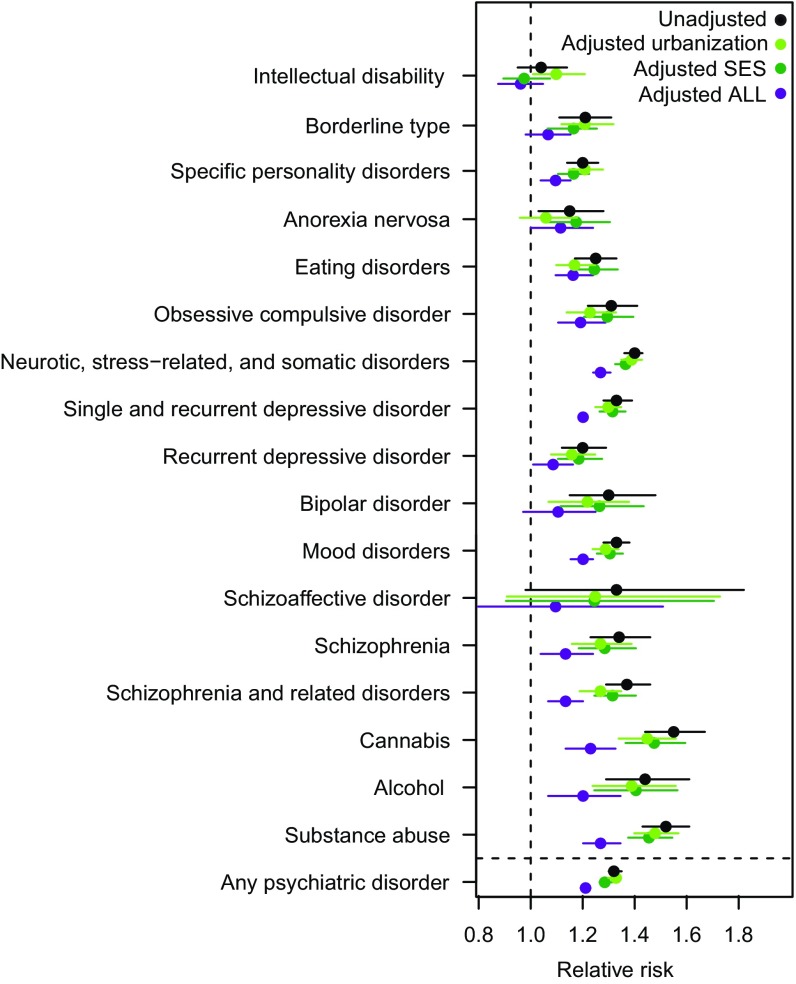
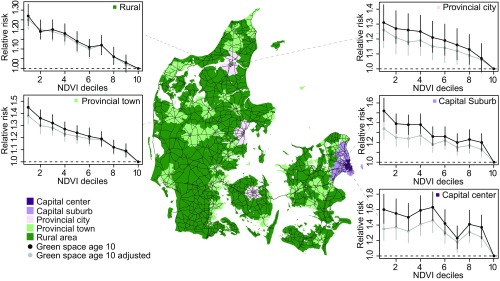
Urban residence is associated with a higher risk of some psychiatric disorders, but the underlying drivers remain unknown. There is increasing evidence that the level of exposure to natural environments impacts mental health, but few large-scale epidemiological studies have assessed the general existence and importance of such associations. Here, we investigate the prospective association between green space and mental health in the Danish population. Green space presence was assessed at the individual level using high-resolution satellite data to calculate the normalized difference vegetation index within a 210 × 210 m square around each person’s place of residence (∼1 million people) from birth to the age of 10. We show that high levels of green space presence during childhood are associated with lower risk of a wide spectrum of psychiatric disorders later in life. Risk for subsequent mental illness for those who lived with the lowest level of green space during childhood was up to 55% higher across various disorders compared with those who lived with the highest level of green space. The association remained even after adjusting for urbanization, socioeconomic factors, parental history of mental illness, and parental age. Stronger association of cumulative green space presence during childhood compared with single-year green space presence suggests that presence throughout childhood is important. Our results show that green space during childhood is associated with better mental health, supporting efforts to better integrate natural environments into urban planning and childhood life.
Overview
The claims and statistics of this paper haven’t been checked yet.
Free: it reads the open-access text and checks the first 5 claims that cite a source we can check. Create a free account to check every claim.
Integrity signals
Registry
Cites
Statistics
Figures
Verification
Claims the paper makes
The claims and statistics of this paper haven’t been checked yet.
Free: it reads the open-access text and checks the first 5 claims that cite a source we can check. Create a free account to check every claim.
Claims other papers make about this one
Each is checked against this paper’s own text: does it say what the citing paper says it does?
The source backs part of the claim, not all of it — or backs it for a different population, condition or comparison.
In the citing paper
“More greenery in urban areas creates higher social cohesion and increases people’s physical activity level, therefore improving children’s cognitive development (137).”
From The Impact of Climate Change on Mental Health: A Systematic Descriptive Review (2020) · cites this paper as [137]
Experimental — accuracy not yet measured
Self-check
Percentages, sums and reported differences re-computed from the paper’s own numbers.
The self-check needs the paper’s full text.
Citations
Cites
Cox’s regression model for counting processes: A large sample study
Andersen, P. K., & Gill, R. D. (1982) · The Annals of Statistics · doi:10.1214/aos/1176345976 · Cited by 4,419 · cited 1×
“IRR of psychiatric disorders were estimated in time-to-event analyses using Cox regressions, using age as the underlying timescale with separate baselines for each gender (51).”
MethodWolch, J. R., Byrne, J., & Newell, J. P. (2014) · Landscape and Urban Planning · doi:10.1016/j.landurbplan.2014.01.017 · Cited by 4,309 · cited 1×
“Lower access to green space could be an added risk factor for mental health among vulnerable groups of society (40, 41).”
BackgroundHartig, T., Mitchell, R., de Vries, S., & Frumkin, H. (2014) · Annual Review of Public Health · doi:10.1146/annurev-publhealth-032013-182443 · Cited by 3,638 · cited 3×
“Green space can enhance psychological restoration, can affect brain structure through positive associations with amygdala integrity, and could mitigate negative effects from the socially dense and noisy city environment that heighten stress (17, 19, 23, 24).”
BackgroundResultExploring pathways linking greenspace to health: theoretical and methodological guidance
Markevych, I., Schoierer, J., Hartig, T., Chudnovsky, A., Hystad, P., Dzhambov, A. M., de Vries, S., Triguero-Mas, M., Brauer, M., Nieuwenhuijsen, M. J., et al. (2017) · Environmental Research · doi:10.1016/j.envres.2017.06.028 · Cited by 2,543 · cited 1×
“Effects of different qualitative aspects and use of green space is important to identify a possible mechanistic link (37).”
BackgroundSchizophrenia risk from complex variation of complement component 4
Sekar, A., Bialas, A. R., de Rivera, H., Davis, A., Hammond, T. R., Kamitaki, N., Tooley, K., Presumey, J., Baum, M., Van Doren, V., et al. (2016) · Nature · doi:10.1038/nature16549 · Cited by 2,394
Extinction of experience: the loss of human–nature interactions
Soga, M., & Gaston, K. J. (2016) · Frontiers in Ecology and the Environment · doi:10.1002/fee.1225 · Cited by 1,802 · cited 1×
“Loss of human− nature interactions presents a health risk, and it can also reduce peoples’ appreciation of natural environments, creating negative feedback loops (42).”
BackgroundTwohig-Bennett, C., & Jones, A. (2018) · Environmental Research · doi:10.1016/j.envres.2018.06.030 · Cited by 1,766
The Danish Psychiatric Central Research Register
Mors, O., Perto, G. P., & Mortensen, P. B. (2011) · Scandinavian Journal of Public Health · doi:10.1177/1403494810395825 · Cited by 1,589 · cited 1×
“We linked all individuals from the study population and their parents and siblings with the Danish Psychiatric Central Research Register (44) to obtain information about psychiatric disorders.”
MethodSelf-citationCity living and urban upbringing affect neural social stress processing in humans
Lederbogen, F., Kirsch, P., Haddad, L., Streit, F., Tost, H., Schuch, P., Wüst, S., Pruessner, J. C., Rietschel, M., Deuschle, M., et al. (2011) · Nature · doi:10.1038/nature10190 · Cited by 1,584 · cited 3×
“Individuals with urban upbringing have high neural activity linked to stress processing, which could lead to higher risk of psychiatric disorders in adults (4).”
BackgroundMorbidity is related to a green living environment
Maas, J., Verheij, R. A., de Vries, S., Spreeuwenberg, P., Schellevis, F. G., & Groenewegen, P. P. (2009) · Journal of Epidemiology and Community Health · doi:10.1136/jech.2008.079038 · Cited by 1,133 · cited 1×
“Exposure to green space has been suggested to lower depression (13, 14) and schizophrenia risk (15), improve children’s cognitive development (16), and reduce neural activity linked to psychiatric disorders (11, 17).”
Background
Research works printed but not linked: 2
- World Health Organization 1992 The ICD-10 Classification of Mental and Behavioural Disorders: Clinical Descriptions and Diagnostics Guidelines World Health Org Geneva
- Danmarks Statistik 1991 IDA–En Integreret Database for Arbejdsmarkedsforskning: Hovedrapport Denmark Stat Copenhagen
Cited by
Items 301–400 of 868
Urban green space, social equity and human wellbeing
Stewart, N. (2020) · Elsevier eBooks · doi:10.1016/b978-0-12-820730-7.00007-0 · Cited by 15
Chen, Y., Chen, G., Liu, Y., Dong, G., Yang, B., Li, S., Huang, H., Jin, Z., & Guo, Y. (2023) · Environmental Pollution · doi:10.1016/j.envpol.2023.122677 · Cited by 15
König, C. (2024) · Urban Studies · doi:10.1177/00420980231224224 · Cited by 17
“…robust associations and plausibly causal effects of environmental quality on physical health (Currie, 2013; Currie and Walker, 2011), mental health (Engemann et al., 2019; Roberts et al., 2019) and other key outcomes, such as educational performance (Heissel et al., 2022), crime (Bondy et al.,…”
Misty, M. S., Hoque, M. A.-A., & Mukul, S. A. (2024) · Land · doi:10.3390/land13091426 · Cited by 14
Rasak, N. T. S., Zamri, M. N., Suhaimi, M. H., & Kamaruddin, K. (2024) · Information Management and Business Review · doi:10.22610/imbr.v16i3s(i)a.4204 · Cited by 14
“Moreover, research indicates that children with enhanced access to green spaces exhibit a reduced likelihood of developing psychiatric illnesses in adulthood, underscoring the enduring mental health advantages of early exposure to nature (Engemann et al., 2019; Alcock et al., 2014).”
BackgroundDeng, B., Boden, J. M., Ye, N., Morgenroth, J. A., Campbell, M. H., Eggleton, P., McLeod, G., & Hobbs, M. (2024) · Environment International · doi:10.1016/j.envint.2024.109223 · Cited by 14
Shaughnessy, S., Messinger, D. S., & Evans, S. C. (2025) · Child and Adolescent Mental Health · doi:10.1111/camh.12763 · Cited by 14
“The NDVI is commonly used in literature examining the impacts of green space exposure on adolescent mental health (Engemann et al., 2019).”
Urban mental health: a position paper of the European psychiatric association
Misiak, B., Karska, J., Kowalski, S., Courtet, P., Volpe, U., Schouler‐Ocak, M., Destoop, M., Adorjan, K., Kraxner, F. H., Buwalda, V. J. A., et al. (2025) · European Psychiatry · doi:10.1192/j.eurpsy.2025.10100 · Cited by 14
“It has been indicated that greater greenspace exposure in early childhood may be associated with a lower risk of psychosis in adulthood, except for schizoaffective disorder [142].”
Jansson, M., Zalar, A., Sundevall, E. P., & Randrup, T. B. (2020) · Frontiers in Sustainable Cities · doi:10.3389/frsc.2020.565418 · Cited by 14
“, 2008) and mental illness later in life (Engemann et al., 2019).”
BackgroundAssociation of greenness with COVID-19 deaths in India: An ecological study at district level
Sikarwar, A., Rani, R., Duthé, G., & Golaz, V. (2022) · Environmental Research · doi:10.1016/j.envres.2022.114906 · Cited by 14
Yan, T., Leng, H., & Yuan, Q. (2023) · International Journal of Environmental Research and Public Health · doi:10.3390/ijerph20032135 · Cited by 14
“This result is consistent with existing findings from adults that paths can encourage physical activity [8,44,45].”
Hobbs, M., Bowden, N., Marek, L., Wiki, J., Kokaua, J., Theodore, R. F., Ruhe, T., Boden, J. M., Thabrew, H., Hetrick, S. E., et al. (2023) · Social Science & Medicine · doi:10.1016/j.socscimed.2023.115893 · Cited by 14
Urban upbringing and psychotic experiences in the United States: A racial and geographic comparison
Oh, H. Y., Koyanagi, A., DeVylder, J., & Link, B. G. (2020) · Psychiatry Research · doi:10.1016/j.psychres.2020.113372 · Cited by 14
Buttazzoni, A. N., Ellard, C. G., Sadiora, S., & Minaker, L. M. (2022) · Journal of Environmental Psychology · doi:10.1016/j.jenvp.2022.101810 · Cited by 16
Vidal, C., Philippe, F. L., Geoffroy, M., & Paquin, V. (2024) · International Journal of Mental Health and Addiction · doi:10.1007/s11469-024-01313-0 · Cited by 13
“…less research on mental health specifically, and heterogeneity in the outcome measures used, cumulative evidence points towards an association between positive mental health outcomes and green spaces (Bezold et al., 2018; Engemann et al., 2019; Gascon et al., 2015; Zhang, Y. et al., 2020b).”
The Effects of Virtual Nature Exposure on State Social Motivation
Castelblanco, S. A. (2021) · Digital Commons - East Tennessee State University (East Tennessee State University) · Cited by 15
Mitigating the effects of climate change in children’s outdoor play environments
Bäckström, M. K., Lundgreen, E., & Slaug, B. (2023) · Scandinavian Journal of Occupational Therapy · doi:10.1080/11038128.2023.2275697 · Cited by 13
Multi-Scape Interventions to Match Spatial Scales of Demand and Supply of Ecosystem Services
Laca, E. A. (2021) · Frontiers in Sustainable Food Systems · doi:10.3389/fsufs.2020.607276 · Cited by 13
Does housing policy impact income sorting near urban amenities? Evidence from Vienna, Austria
Morawetz, U. B., & Klaiber, H. A. (2022) · The Annals of Regional Science · doi:10.1007/s00168-022-01142-w · Cited by 13
Ordóñez, C., Kendal, D., Davern, M. T., & Conway, T. M. (2024) · Environmental Research · doi:10.1016/j.envres.2024.118445 · Cited by 12
Plana‐Ripoll, O., Prinzio, P. D., McGrath, J. J., Mortensen, P. B., & Morgan, V. A. (2021) · Australian & New Zealand Journal of Psychiatry · doi:10.1177/00048674211009615 · Cited by 12
“More recent population-based studies have found that individuals with higher polygenic risk scores related to risk of schizophrenia (but without the clinical diagnosis) are more likely to live in more densely populated settings (Engemann et al., 2020; Fan et al., 2018; Paksarian et al., 2018).”
BackgroundSelf-citationEmotional Intelligence and Resilience: Predictors of Life Satisfaction among Mountain Trainers
Gavín-Chocano, Ó., Talavera, L. M., Sanz-Junoy, G., & López-Barajas, D. M. (2023) · Sustainability · doi:10.3390/su15064991 · Cited by 12
Chronic environmental diseases: burdens, causes, and response
Beyer, K. M. M., & Namin, S. (2023) · Elsevier eBooks · doi:10.1016/b978-0-12-820509-9.00030-7 · Cited by 12
Direct Experience of Nature as a Predictor of Environmentally Responsible Behaviors
Yanniris, C., Gavrilakis, C., & Hoover, M. L. (2023) · Forests · doi:10.3390/f14112233 · Cited by 12
Rook, G. A. W. (2024) · Neuroscience & Biobehavioral Reviews · doi:10.1016/j.neubiorev.2024.105653 · Cited by 12
Holland, F., Harvey, C., Ferris, E., Furlong, R., & Gibson, S. (2024) · Journal of Adventure Education & Outdoor Learning · doi:10.1080/14729679.2024.2350972 · Cited by 13
“…evidence supporting the use of nature-based interventions to increase mental health and wellbeing in children (Harvey et al., 2020; Piccininni et al., 2018), and having contact with green space in childhood is linked with a reduced risk of mental ill-health in adulthood (Engemann et al., 2019).”
Kolawole, D. T. O., & Oladokun, B. D. (2025) · INTERNATIONAL JOURNAL OF KNOWLEDGE CONTENT DEVELOPMENT & TECHNOLOGY · Cited by 12
Parks: A vital community condition
Muqueeth, S. (2021) · Parks Stewardship Forum · doi:10.5070/p537151742 · Cited by 12
Prescott, S. L., & Bland, J. S. (2020) · International Journal of Environmental Research and Public Health · doi:10.3390/ijerph17041407 · Cited by 12
Song, J., Zhu, X., & Yu, X. (2023) · Frontiers in Forests and Global Change · doi:10.3389/ffgc.2023.1071569 · Cited by 12
“The vegetation greenery in residential communities, such as arbor trees, shrubs, bamboos, and lawns, has favorable effects on residents’ sensory and psychological wellbeing (Wolch et al., 2014; Engemann et al., 2019; Wu et al., 2021; Ma et al., 2022).”
BackgroundFuzzy Decision-Making Valuation Model for Urban Green Infrastructure Implementation
Bačić, S., Tomić, H., Rogulj, K., & Andlar, G. (2024) · Energies · doi:10.3390/en17205162 · Cited by 11
“It improves air quality, and various scientific studies prove that in this way it affects a higher quality of life, and better physical and mental health [9–13].”
The study of outdoor thermal comfort in open spaces of cold climate campus
Bian, G., Sheng, Z., Min, K., & Zhao, Y. (2025) · Scientific Reports · doi:10.1038/s41598-025-97758-x · Cited by 11
“Open spaces provide venues for physical activities and recreation, helping to alleviate the negative emotions associated with daily academic stress 17,18 .”
Hobbs, M., Moltchanova, E. V., Marek, L., Yogeeswaran, K., Milfont, T. L., Deng, B., & Sibley, C. G. (2025) · Health & Place · doi:10.1016/j.healthplace.2025.103487 · Cited by 11
Greenspace Exposure and Obsessive-Compulsive Behaviors in Schoolchildren
Ezpeleta, L., Navarro, J. B., Alonso, L., de la Osa, N., Ambrós, A., Ubalde, M., Penelo, E., & Dadvand, P. (2022) · Environment and Behavior · doi:10.1177/00139165221095384 · Cited by 12
“This study conducted in Denmark reported higher greenspace surrounding home (measured as NDVI average) was associated with lower risk of OCD (Engemann et al., 2019).”
BackgroundSogno, P., Kuenzer, C., Bachofer, F., & Traidl‐Hoffmann, C. (2022) · International Journal of Applied Earth Observation and Geoinformation · doi:10.1016/j.jag.2022.103084 · Cited by 11
Elementary Classroom Views of Nature Are Associated with Lower Child Externalizing Behavior Problems
Pearson, A. L., Brown, C. D., Reuben, A., Nicholls, N., Pfeiffer, K. A., & Clevenger, K. A. (2023) · International Journal of Environmental Research and Public Health · doi:10.3390/ijerph20095653 · Cited by 12
“In a compelling longitudinal population study of the mental health benefits of green space, early life exposure to greenness (assessed via satellite imagery, thus indicative of higher levels of tree canopy) was protective against multiple disorders [23].”
Mitiku, K. W., Tegegne, E., Amsalu, M., Habtegiorgis, S. D., & Melaku, B. (2023) · Clinical Child Psychology and Psychiatry · doi:10.1177/13591045231209078 · Cited by 11
“Studies undertaken in Denmark (Engemann et al., 2019), Berlin (Gruebner et al., 2017), and Brussels (Pelgrims et al., 2021) also revealed that living in cities was connected with mental disorders in children.”
ResultStress and the City: Mental Health in Urbanized vs. Rural Areas in Salzburg, Austria
Frey, V., Langthaler, P. B., Huf, M. J., Gruber, G., Prinz, T., Kedenko, L., Iglseder, B., Paulweber, B., & Trinka, E. (2024) · International Journal of Environmental Research and Public Health · doi:10.3390/ijerph21111459 · Cited by 11
“…drivers for this remain unknown [12], yet there are suggestions that air pollution, traffic noise, small housing, social stress, and the restricted availability of green space might be factors influencing mental health in people living in urban regions and with this quality of life [3,4,12–16].”
InfluentialNarayanan, A., Stewart, T. I., Duncan, S., & Pacheco, G. A. (2025) · Scientific Reports · doi:10.1038/s41598-025-90852-0 · Cited by 11
“The ability to link such key environmental information to the Census is crucial, given the established links between the environment and wellbeing 17,18 .”
Olszewska-Guizzo, A., Fogel, A. M., Mejia, D. M. B., & Tahsin, N. (2021) · World sustainability series · doi:10.1007/978-3-030-86304-3_14 · Cited by 11
Yang, Z., & Gao, W. (2022) · International Journal of Environmental Research and Public Health · doi:10.3390/ijerph19159596 · Cited by 11
Neurosains Spiritual: Hubungan Manusia, Alam, dan Tuhan
Pasiak, T. F. (2023) · Penerbit BRIN eBooks · doi:10.55981/brin.594 · Cited by 11
Tian, M., Liu, C., Xi, J., Wang, L., Zhang, P., Liu, C., Zhao, K., Wu, Y., Rong, L., Jia, X., et al. (2023) · International Journal of Environmental Health Research · doi:10.1080/09603123.2023.2263382 · Cited by 11
“Growth is most abundant during the growing seasons of June, July, or August each year, resulting in the highest levels of greenness exposure (Wu et al. 2014; Engemann et al. 2019; Klompmaker et al. 2019).”
BackgroundA Community EcoHealth Index from EnviroAtlas Ecosystem Services Metrics
Cochran, F. V., Jackson, L. E., Neale, A., Lovette, J. P., & Tran, L. T. (2019) · International Journal of Environmental Research and Public Health · doi:10.3390/ijerph16152760 · Cited by 11
“[57], that found greenspace around childhoo residences is associated with better mental health in adolescence and adulthood, illustrates the importance of considering ecohealth relationships across all life periods.”
BackgroundAllostatic interoception and brain health: From neurodegeneration to social adversities
Migeot, J., & Ibáñez, A. (2025) · Encyclopedia of the Human Brain · doi:10.1016/b978-0-12-820480-1.00025-5 · Cited by 10
Ferreira, H. G. G. D. R., & Agostini, O. L. (2022) · Zenodo (CERN European Organization for Nuclear Research) · doi:10.5281/zenodo.7409556 · Cited by 10
Shirazi, A., Brody, A. L., Soltani, M., & Lang, A. J. (2024) · American Journal of Lifestyle Medicine · doi:10.1177/15598276241300475 · Cited by 10
“42 For SUDs, a one-hour walk has been shown to help reduce cravings, 77 offering a simple and accessible starting point for patients with SUDs.”
InfluentialGreenspace Morphology and Preterm Birth: A State-Wide Study in Georgia, United States (2001–2016)
Wang, H., Huang, X., Hao, H., & Chang, H. H. (2024) · Environmental Health Perspectives · doi:10.1289/ehp14571 · Cited by 10
Neighborhood Characteristics and Mental Health From Childhood to Adolescence
Shoari, N., Blangiardo, M., & Pirani, M. (2025) · JAMA Network Open · doi:10.1001/jamanetworkopen.2025.4470 · Cited by 10
Community indicators for mental health in Europe: a scoping review
Schoenweger, P., Kirschneck, M., Biersack, K., Meo, A.-F. J. D., Reindl-Spanner, P., Prommegger, B., Ditzen-Janotta, C., Henningsen, P., Krcmar, H., Gensichen, J. S., et al. (2023) · Frontiers in Public Health · doi:10.3389/fpubh.2023.1188494 · Cited by 10
“(64) Mixed methods United Kingdom No Adults Social networks (65) Longitudinal study Denmark No Adults Built environment (66) Longitudinal study Denmark No Children Built environment”
MethodLyons, R., Colbert, A. M., Browning, M. H. E. M., & Jakub, K. (2023) · Journal of Advanced Nursing · doi:10.1111/jan.15905 · Cited by 10
Greenness and neuropsychiatric symptoms in dementia
Tondelli, M., Chiari, A., Vinceti, G., Galli, C., Salemme, S., Filippini, T., Carbone, C., Minafra, C., Luca, C. D., Prandi, R., et al. (2023) · Environmental Research · doi:10.1016/j.envres.2023.117652 · Cited by 10
Play biotopes put into practice—Creating synergies between children and nature
Hedblom, M., Mårtensson, F., Sang, Å. O., Wiström, B., & Litsmark, A. (2024) · People and Nature · doi:10.1002/pan3.10708 · Cited by 10
Reuben, A., & Himschoot, E. A. (2021) · Parks Stewardship Forum · doi:10.5070/p537253244 · Cited by 10
“…be 55% less likely to develop a mental illness in adulthood than their peers raised in similar but less green neighborhoods, regardless of family socioeconomic circumstances and history of mental illness or of neighborhood socioeconomic circumstances and levels of urbanicity (Engemann et al. 2019).”
BackgroundThe Role of Trees in Winter Air Purification on Children’s Routes to School
Hoppa, A., Sikorska, D., Przybysz, A., Melon, M., & Sikorski, P. (2022) · Forests · doi:10.3390/f13010040 · Cited by 10
Zsido, A. N., Inhóf, O., Kiss, B. L., Bali, C., & March, D. S. (2023) · People and Nature · doi:10.1002/pan3.10500 · Cited by 10
Was ist Gesundheit? Interdisziplinäre Perspektiven aus Medizin, Geschichte und Kultur
van der Eijk, P., Ganten, D., & Marek, R. M. (2021) · De Gruyter eBooks · doi:10.1515/9783110713336 · Cited by 10
Enhancing Adolescent Girls’ Well-Being in the Arctic—Finding What Motivates Spending Time in Nature
Wiens, V., Soronen, K., Kyngäs, H. A., & Pölkki, T. (2021) · International Journal of Environmental Research and Public Health · doi:10.3390/ijerph18042052 · Cited by 9
“Growing up in a natural environment can lower the risks of psychiatric disorders [27], and natural surroundings are associated with lower schizophrenia rates among children and adolescents [28].”
BackgroundA plant by any other name: …Foundations for materialist sociological plant studies
Ergas, C., & York, R. (2021) · Journal of Sociology · doi:10.1177/14407833211017209 · Cited by 9
“Further, childhood access to residential greenspace is associated with a lower risk of psychiatric disorders into adulthood (Engemann et al., 2019).”
BackgroundHamby, S. L., Montgomery, K. M., Storer, H. L., & Banyard, V. L. (2022) · International Journal of Environmental Research and Public Health · doi:10.3390/ijerph192416661 · Cited by 9
Redvers, N., Hartmann‐Boyce, J., & Tonkin-Crine, S. K. (2024) · International Journal of Environmental Research and Public Health · doi:10.3390/ijerph21060806 · Cited by 9
“Those who spend time in nature [1] or have access to greenspace [2] report better health and psychological wellbeing compared to those who do not, with the effects being crosscutting across different occupations, ethnic groups, rich and poor areas, and in people with chronic illnesses and…”
BackgroundScreening for Park Access during a Primary Care Social Determinants Screen
Razani, N., Long, D., Hessler, D., Rutherford, G. W., & Gottlieb, L. M. (2020) · International Journal of Environmental Research and Public Health · doi:10.3390/ijerph17082777 · Cited by 9
“For children, living in a neighborhood with little greenspace is predictive of psychiatric disease in adulthood [10].”
BackgroundTherapeutic mountain hiking in psychiatric rehabilitation
Instytut Psychologii, A. P. S. I. M. G. W. W., Gawrych, M., Słonka, R., & Środowiskowy Dom Samopomocy w Pewli Wielkiej, P. W. (2021) · Psychiatria i Psychologia Kliniczna · doi:10.15557/pipk.2021.0007 · Cited by 9
The effects of urban density on the provision of multiple health-related ecosystem services
Kroft, L. E., & Ziter, C. D. (2023) · Urban Ecosystems · doi:10.1007/s11252-023-01451-8 · Cited by 9
“Distributional inequities in greenspace access are concerning because reduced access and exposure to greenspace can lead to significant negative impacts on physical and mental health, particularly for children (Demoury et al. 2017; Engemann et al. 2019).”
Urban Development in Riyadh: Aligning with Saudi Vision 2030 for Enhanced Quality of Life
Alharbi, H. A. K. (2024) · Journal of Geography Environment and Earth Science International · doi:10.9734/jgeesi/2024/v28i4764 · Cited by 9
Ambiguity and clarity in residential yard ordinances across metropolitan areas in the United States
Engebretson, J. M., Nelson, K. C., Larson, K. L., Andrade, R., Wheeler, M. M., Lerman, S. B., Locke, D. H., Trammell, T. L. E., & Groffman, P. M. (2021) · Journal of Urban Affairs · doi:10.1080/07352166.2021.1901590 · Cited by 10
“Among the social benefits, urban green spaces may improve mental health (Barnes et al., 2019; Barton & Rogerson, 2017; Engemann et al., 2019; Hartig et al., 2014; Maas et al., 2009; Triguero-Mas et al., 2015), mitigate noise pollution and promote natural sounds (Gidlöf-Gunnarsson & Öhrström, 2010),…”
BackgroundConnecting land. A transdisciplinary workshop to envision a nature-connecting human habitat
Giusti, M., Wang, W., & Marriott, T. (2020) · Cities & Health · doi:10.1080/23748834.2020.1742491 · Cited by 9
“…dimension of spatial planning has been largely understudied (Marcus et al. 2016), despite the potential of close interaction with nature being of direct value to personal health (Engemann et al. 2019) and to building the foundation of a sustainable culture (Chawla 1999, Giusti et al. 2014).”
BackgroundNature-Based Meditation Reduces Depressive Rumination and Stress in Adolescents and Young Adults
Owens, M., & Bunce, H. L. I. (2025) · Psychiatry International · doi:10.3390/psychiatryint6020036 · Cited by 8
Sia, A., Soh, M. C. K., Lee, W. M., Poon, H. J., & Er, K. B. H. (2025) · Urban forestry & urban greening · doi:10.1016/j.ufug.2025.128806 · Cited by 8
Sugg, M. M., Ryan, S. C., Rankins, H. A., Ulrich, S. E., & Runkle, J. D. (2025) · GeoJournal · doi:10.1007/s10708-025-11328-2 · Cited by 8
“…health outcomes across the life course, including adolescent mental health (Ryan et al., 2024a, b; Dadvand et al., 2019; Luque-Garcia et al., 2022; Engemann et al., 2019), maternal outcomes (Runkle et al., 2022), obesity (Lachowycz & Jones, 2011; Lee et al., 2017), cardiovascular disease…”
Verheyen, L., van Engelen, B., Winkens, B., Vanbrabant, K., Hannes, E., Nawrot, T. S., Malina, R. M., van Schayck, O. C. P., & Plusquin, M. (2025) · Frontiers in Public Health · doi:10.3389/fpubh.2025.1620199 · Cited by 8
Douglas, J. W. A., Willcock, S., Kibowski, F., Marshall, T. P., & Jones, L. (2026) · Ecosystems and People · doi:10.1080/26395916.2026.2624444 · Cited by 9
Loose, T., Côté, S. M., Malboeuf‐Hurtubise, C., Ayotte‐Beaudet, J., Lessard, G., Chadi, N., Gauvin, L. I., Ouellet‐Morin, I., & Geoffroy, M. (2023) · BMC Public Health · doi:10.1186/s12889-023-15033-y · Cited by 8
“For instance, a recent Danish study including over 900,000 children suggested that proximity to green space in childhood was associated with a lower onset of psychiatric disorders later in life, independently from other known risk factors such as the family socioeconomic status and parents’ psychopathology [5].”
BackgroundŠorytė, D., Rosa, C. D., Collado, S., & Pakalniškienė, V. (2023) · Frontiers in Psychology · doi:10.3389/fpsyg.2023.1145720 · Cited by 8
“, 2017), and lower risk of psychiatric disorders later in life (Engemann et al., 2019).”
BackgroundDo greenness and landscape indices for greenspace correlate with suicide ratio?
Lee, H., Chang, H.-T., Herianto, S., Wu, C., Liu, W., Yu, C.-P., Pan, W., & Wu, C. (2023) · Landscape and Urban Planning · doi:10.1016/j.landurbplan.2023.104935 · Cited by 9
The Potential of Biophilic Design and Nature to Improve Health, Creativity and Well-Being
Sjövall, I. A. K., & Spiers, H. J. (2024) · Springer eBooks · doi:10.1007/978-3-031-64699-7_11 · Cited by 9
Ruas, M. V., Vajana, E., Kherif, F., Lutti, A., Preisig, M., Strippoli, M. F., Vollenweider, P., Marques-Vidal, P. M., von Gunten, A., Joost, S., et al. (2024) · Environmental Research · doi:10.1016/j.envres.2024.120632 · Cited by 8
Zhao, X., Wang, J., Wu, Z., Li, H., Li, Z., Liu, Y., Li, X., Guo, X., & Tao, L. (2025) · Environmental Pollution · doi:10.1016/j.envpol.2025.125857 · Cited by 8
Cheng, A., Zhang, M., & Wang, Y. (2025) · Urban forestry & urban greening · doi:10.1016/j.ufug.2025.128960 · Cited by 8
The role of greenspace deprivation in children’s decision-making
Flouri, E., Ji, D., & Roiser, J. P. (2022) · Urban forestry & urban greening · doi:10.1016/j.ufug.2022.127515 · Cited by 8
Ahmed, S. M., Mishra, G. D., Moss, K. M., Mouly, T. A., Yang, I. A., & Knibbs, L. D. (2022) · Environmental Research · doi:10.1016/j.envres.2022.113759 · Cited by 8
Effects of Self-Rated Health Status on Residents’ Social-Benefit Perceptions of Urban Green Space
Tian, Y., Liu, F., Jim, C. Y., Wang, T., Luan, J., & Yan, M. (2022) · International Journal of Environmental Research and Public Health · doi:10.3390/ijerph191610134 · Cited by 8
“The living environment in childhood is important to their formative physical and mental development, with repercussions on happiness and health [59] and long-term effects on their attitude and behavior in adulthood [60,61].”
BackgroundSonne, C., & Alstrup, A. K. O. (2019) · Marine Pollution Bulletin · doi:10.1016/j.marpolbul.2019.110591 · Cited by 8
Ebisch, S. J. H. (2020) · Frontiers in Psychology · doi:10.3389/fpsyg.2020.531840 · Cited by 8
“A nation-wide, populationbased study including more than 900,000 people showed that a decreased presence of green space near one’s residence during childhood (calculated as the normalized difference vegetation index, NDVI, based on remote sensing satellite images) was associated with higher incidence rate ratios for m…”
BackgroundGreen Space and the Risk of Non-communicable Diseases: A Study of Urban Residents in Dhaka City
Debnath, S., & Das, P. K. (2023) · European Journal of Development Studies · doi:10.24018/ejdevelop.2023.3.6.313 · Cited by 8
“However, there are also opportunities for promoting green spaces in urban areas, such as through community engagement (Engemann et al. , 2019), public-private partnerships (Gianfredi et al. , 2021), and innovative design solutions (Debnath, 2023) In summary, the existing literature suggests that…”
BackgroundNigg, C., Petersen, E., & Macintyre, T. E. (2021) · PsyArXiv (OSF Preprints) · doi:10.31234/osf.io/a9unf · Cited by 9
Fenton, M. P., Smail, E. J., Konyayev, K., McCall-Junkin, P., & LoTemplio, S. B. (2025) · Environment and Behavior · doi:10.1177/00139165251330274 · Cited by 7
“…is beneficial for decreasing stress and aggression and lowers the risk of developing a psychiatric disorder among children and adolescents (Engemann et al., 2019; Nutsford et al., 2013; Younan et al., 2016), and that children living with more greenspace near their homes experienced lower…”
Valladares, F. (2022) · Mètode: Revista de difusió de la investigació de la Universitat de Valencia · doi:10.7203/metode.13.24072 · Cited by 7
Li, K., Du, W., Yang, Z., Yan, H., & Mu, Y. (2024) · Land · doi:10.3390/land13040443 · Cited by 7
“Therefore, VIs are frequently utilized in exploring the interconnected relationship between UGS and human well-being [14,31].”
BackgroundFigueroa, L. P., Poskey, G. A., Rose, K. K., & Pickens, N. D. (2024) · Occupational Therapy In Health Care · doi:10.1080/07380577.2024.2372739 · Cited by 7
de Oliveira, C. V. R., Freire, S. M., Bordignon, S. S., Chechel, L., Springer, P. R., & Palombo, C. N. T. (2024) · PLOS mental health. · doi:10.1371/journal.pmen.0000075 · Cited by 7
Zhang, C., Chen, J., & Lai, Y. (2025) · Child Abuse & Neglect · doi:10.1016/j.chiabu.2025.107294 · Cited by 7
Simonienko, K., Jermakowicz, E., Szefer, P., Wróbel, K., Suprunowicz, U., Cwalina, U., & Kostro‐Ambroziak, A. (2025) · Scientific Reports · doi:10.1038/s41598-025-16420-8 · Cited by 7
Irajpour, A., Baró, F., Edwards, M., Moosavi, S., Lacroix, É., & Llaguno-Munitxa, M. (2025) · Urban forestry & urban greening · doi:10.1016/j.ufug.2025.129040 · Cited by 7
Ury, B., Yang, J., Rosenthal, S. R., Barker, D., McGeary, J. E., DUNSIGER, S. I., & Grigsby‐Toussaint, D. S. (2025) · Urban forestry & urban greening · doi:10.1016/j.ufug.2025.129156 · Cited by 7
Dai, X., Zhang, J., Sun, X., Li, J., & Liu, B. (2023) · International Journal of Environmental Research and Public Health · doi:10.3390/ijerph20054209 · Cited by 7
Bittencourt, R. N., Junior, J. C. F. D. M., & Pedroso, M. V. (2023) · SMAD Revista Eletrônica Saúde Mental Álcool e Drogas (Edição em Português) · doi:10.11606/issn.1806-6976.smad.2023.195671 · Cited by 7
Towards healthy school neighbourhoods: A baseline analysis in Greater London
Shoari, N., Beevers, S. D., Brauer, M. D., & Blangiardo, M. (2022) · Environment International · doi:10.1016/j.envint.2022.107286 · Cited by 7
Mensch – Tier – Gott: Interdisziplinäre Annäherungen an eine christliche Tierethik
Brixen, I. V. F. M. U. S. 2., Lintner, M. M., & Verlagsgesellschaft, N. (2021) · Nomos Verlagsgesellschaft mbH & Co. KG eBooks · doi:10.5771/9783748907084 · Cited by 7
Rewilding the built environment: a resilient response to different crises
Castaño-Rosa, R., Pelsmakers, S., & Järventausta, H. (2024) · Architectural Research in Finland · doi:10.37457/arf.146874 · Cited by 7
Metadata
- Authors
- Engemann, K., Pedersen, C. B., Arge, L., Tsirogiannis, C., Mortensen, P. B., & Svenning, J.-C.
- Affiliations
- Aarhus University (DK)
- Corresponding author
- Engemann, Kristine
- ORCID
- Venue
- Proceedings of the National Academy of Sciences
- Publisher
- National Academy of Sciences
- Published
- 2019-02-25
- Volume
- 116
- Issue
- 11
- Pages
- 5188-5193
- ISSN
- 0027-8424 (ISSN-L)
- 1091-6490
- PMC
- PMC6421415
- OpenAlex
- W2917225355
- Cited by
- 668
- References
- 50
- Citations by year
- 2026: 63 · 2025: 74 · 2024: 89 · 2023: 96 · 2022: 99 · 2021: 114 · 2020: 92 · 2019: 37
- FWCI
- 36.93
- Type
- journal article
- Language
- en
- Open access
- hybrid
- doi.org
- Licence
- Locations
- Proceedings of the National Academy of Sciences (publishedVersion, cc-by-nc-nd)
- Europe PMC (PubMed Central) (publishedVersion, cc-by-nc-nd)
- PubMed Central (publishedVersion, cc-by-nc-nd)
- PubMed (publishedVersion)
- Funders
- Villum Fonden (16549)
- Topics
- Social Sciences › Urban Studies › Urban Green Space and Health
- Social Sciences › Health › Health disparities and outcomes
- Social Sciences › Sociology and Political Science › Environmental Justice and Health Disparities
- Keywords
- residential green space, children's exposure, mental illness, mental health, urbanization, NDVI, satellite remote sensing, cumulative exposure, urban planning, natural environment
- MeSH terms
- Adolescent, Adult, Mental Disorders, Child, Denmark, Environment, Humans, Risk Factors, Urbanization
About these checks
Registry, retraction, Cites and statistics results are computed, not judged, with one exception: a printed reference that no index lists is read once by a model before it counts as a citation error. Claims are extracted by a model and kept only when their quote appears verbatim in the text; each cited source is then checked, with a model’s help, for whether it says what the claim relies on. Those verdicts can be wrong — read the claim’s quote and the cited source before relying on one.
Statistics and arithmetic are recomputed, not judged.
Confidence bands are shown only for fields calibrated on our annotated test set. None is calibrated yet, so no band is shown.
What counts as a claim ›How we measure confidence ›How we check this ›
Are you an author, or do you see a problem with this page? Request a review
Data sources
Bibliographic data: Semantic Scholar, OpenAlex, Crossref.
Contains information from the Semantic Scholar Academic Graph Datasets, made available under the ODC Attribution License (ODC-BY 1.0).
Semantic Scholar’s data is described in: Kinney, R., et al. (2023). The Semantic Scholar Open Data Platform. arXiv:2301.10140.
