

Residential green space in childhood is associated with lower risk of psychiatric disorders from adolescence into adulthood
Open accessThe DOI matches its Crossref record; 50 of the 50 references it cites were found in a registry or an index.
Abstract
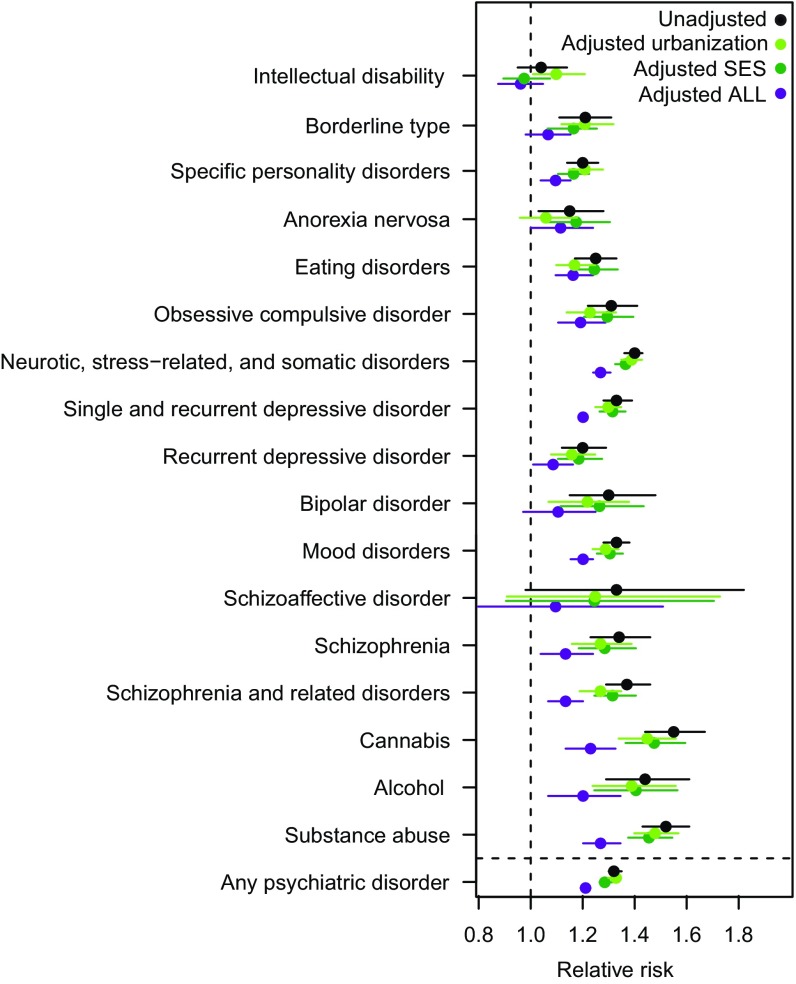
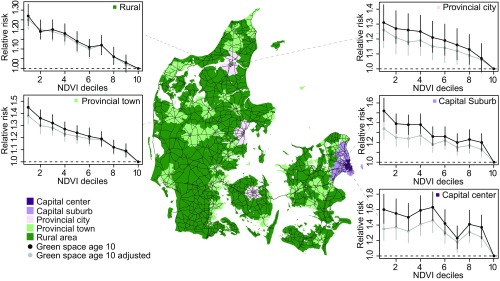
Urban residence is associated with a higher risk of some psychiatric disorders, but the underlying drivers remain unknown. There is increasing evidence that the level of exposure to natural environments impacts mental health, but few large-scale epidemiological studies have assessed the general existence and importance of such associations. Here, we investigate the prospective association between green space and mental health in the Danish population. Green space presence was assessed at the individual level using high-resolution satellite data to calculate the normalized difference vegetation index within a 210 × 210 m square around each person’s place of residence (∼1 million people) from birth to the age of 10. We show that high levels of green space presence during childhood are associated with lower risk of a wide spectrum of psychiatric disorders later in life. Risk for subsequent mental illness for those who lived with the lowest level of green space during childhood was up to 55% higher across various disorders compared with those who lived with the highest level of green space. The association remained even after adjusting for urbanization, socioeconomic factors, parental history of mental illness, and parental age. Stronger association of cumulative green space presence during childhood compared with single-year green space presence suggests that presence throughout childhood is important. Our results show that green space during childhood is associated with better mental health, supporting efforts to better integrate natural environments into urban planning and childhood life.
Overview
The claims and statistics of this paper haven’t been checked yet.
Free: it reads the open-access text and checks the first 5 claims that cite a source we can check. Create a free account to check every claim.
Integrity signals
Registry
Cites
Statistics
Figures
Verification
Claims the paper makes
The claims and statistics of this paper haven’t been checked yet.
Free: it reads the open-access text and checks the first 5 claims that cite a source we can check. Create a free account to check every claim.
Claims other papers make about this one
Each is checked against this paper’s own text: does it say what the citing paper says it does?
The source backs part of the claim, not all of it — or backs it for a different population, condition or comparison.
In the citing paper
“More greenery in urban areas creates higher social cohesion and increases people’s physical activity level, therefore improving children’s cognitive development (137).”
From The Impact of Climate Change on Mental Health: A Systematic Descriptive Review (2020) · cites this paper as [137]
Experimental — accuracy not yet measured
Self-check
Percentages, sums and reported differences re-computed from the paper’s own numbers.
The self-check needs the paper’s full text.
Citations
Cites
Cox’s regression model for counting processes: A large sample study
Andersen, P. K., & Gill, R. D. (1982) · The Annals of Statistics · doi:10.1214/aos/1176345976 · Cited by 4,419 · cited 1×
“IRR of psychiatric disorders were estimated in time-to-event analyses using Cox regressions, using age as the underlying timescale with separate baselines for each gender (51).”
MethodWolch, J. R., Byrne, J., & Newell, J. P. (2014) · Landscape and Urban Planning · doi:10.1016/j.landurbplan.2014.01.017 · Cited by 4,309 · cited 1×
“Lower access to green space could be an added risk factor for mental health among vulnerable groups of society (40, 41).”
BackgroundHartig, T., Mitchell, R., de Vries, S., & Frumkin, H. (2014) · Annual Review of Public Health · doi:10.1146/annurev-publhealth-032013-182443 · Cited by 3,638 · cited 3×
“Green space can enhance psychological restoration, can affect brain structure through positive associations with amygdala integrity, and could mitigate negative effects from the socially dense and noisy city environment that heighten stress (17, 19, 23, 24).”
BackgroundResultExploring pathways linking greenspace to health: theoretical and methodological guidance
Markevych, I., Schoierer, J., Hartig, T., Chudnovsky, A., Hystad, P., Dzhambov, A. M., de Vries, S., Triguero-Mas, M., Brauer, M., Nieuwenhuijsen, M. J., et al. (2017) · Environmental Research · doi:10.1016/j.envres.2017.06.028 · Cited by 2,543 · cited 1×
“Effects of different qualitative aspects and use of green space is important to identify a possible mechanistic link (37).”
BackgroundSchizophrenia risk from complex variation of complement component 4
Sekar, A., Bialas, A. R., de Rivera, H., Davis, A., Hammond, T. R., Kamitaki, N., Tooley, K., Presumey, J., Baum, M., Van Doren, V., et al. (2016) · Nature · doi:10.1038/nature16549 · Cited by 2,394
Extinction of experience: the loss of human–nature interactions
Soga, M., & Gaston, K. J. (2016) · Frontiers in Ecology and the Environment · doi:10.1002/fee.1225 · Cited by 1,802 · cited 1×
“Loss of human− nature interactions presents a health risk, and it can also reduce peoples’ appreciation of natural environments, creating negative feedback loops (42).”
BackgroundTwohig-Bennett, C., & Jones, A. (2018) · Environmental Research · doi:10.1016/j.envres.2018.06.030 · Cited by 1,766
The Danish Psychiatric Central Research Register
Mors, O., Perto, G. P., & Mortensen, P. B. (2011) · Scandinavian Journal of Public Health · doi:10.1177/1403494810395825 · Cited by 1,589 · cited 1×
“We linked all individuals from the study population and their parents and siblings with the Danish Psychiatric Central Research Register (44) to obtain information about psychiatric disorders.”
MethodSelf-citationCity living and urban upbringing affect neural social stress processing in humans
Lederbogen, F., Kirsch, P., Haddad, L., Streit, F., Tost, H., Schuch, P., Wüst, S., Pruessner, J. C., Rietschel, M., Deuschle, M., et al. (2011) · Nature · doi:10.1038/nature10190 · Cited by 1,584 · cited 3×
“Individuals with urban upbringing have high neural activity linked to stress processing, which could lead to higher risk of psychiatric disorders in adults (4).”
BackgroundMorbidity is related to a green living environment
Maas, J., Verheij, R. A., de Vries, S., Spreeuwenberg, P., Schellevis, F. G., & Groenewegen, P. P. (2009) · Journal of Epidemiology and Community Health · doi:10.1136/jech.2008.079038 · Cited by 1,133 · cited 1×
“Exposure to green space has been suggested to lower depression (13, 14) and schizophrenia risk (15), improve children’s cognitive development (16), and reduce neural activity linked to psychiatric disorders (11, 17).”
Background
Research works printed but not linked: 2
- World Health Organization 1992 The ICD-10 Classification of Mental and Behavioural Disorders: Clinical Descriptions and Diagnostics Guidelines World Health Org Geneva
- Danmarks Statistik 1991 IDA–En Integreret Database for Arbejdsmarkedsforskning: Hovedrapport Denmark Stat Copenhagen
Cited by
Items 501–600 of 868
Rice, W. L., Michels, S. Y., Foster, M. J., Graham, J., Whitney, P. J., & Thomsen, J. M. (2023) · Land · doi:10.3390/land12081613 · Cited by 2
Asri, A. K., Yeh, C.-H., Chang, H.-T., Lee, H., Lung, S. C., Spengler, J. D., & Wu, C. (2023) · Health & Place · doi:10.1016/j.healthplace.2023.103097 · Cited by 2
Willdan, M., Kresnanto, N. C., Ramadhan, R. I., Said, N., & Putri, W. H. (2023) · E3S Web of Conferences · doi:10.1051/e3sconf/202344803028 · Cited by 2
Takaya, K., & Tomojiri, D. K. (2023) · European Journal of Wildlife Research · doi:10.1007/s10344-023-01749-0 · Cited by 2
“Furthermore, engagement with nature in childhood reduces the risk of psychiatric disorders from adolescence to adulthood (Engemann et al. 2019) and affects public attitudes toward nature (Rosa et al. 2018; Xu and Jiang 2022).”
BackgroundAddas, A. (2023) · Frontiers in Public Health · doi:10.3389/fpubh.2023.1277479 · Cited by 2
Sudimac, S., Drewelies, J., de Weerth, C., & Kühn, S. (2026) · Environmental Research · doi:10.1016/j.envres.2026.125125 · Cited by 2
Examining the decline of urban green spaces in Gweru City, Zimbabwe: a factor analysis approach
Mukwenyi, P., & Horn, A. (2024) · South African Geographical Journal · doi:10.1080/03736245.2024.2356558 · Cited by 2
“Engemann et al. (2019) revealed that children not exposed to green spaces have a 55% higher risk of developing psychiatric disorders in their lifetime.”
Access to Nature and Child Health
Nerlinger, A. L., Bole, A., & Tandon, P. S. (2024) · Oxford University Press eBooks · doi:10.1093/oso/9780197662526.003.0020 · Cited by 2
Linking Kawasaki Disease to Mental Health: A Nationwide Study on Long-Term Neurological Risks
Lee, J.-H., Shin, T., Park, J., & Seol, J. H. (2025) · Medicina · doi:10.3390/medicina61040604 · Cited by 2
“Continued research will be crucial in refining risk stratification, optimizing follow-up strategies, and improving long-term outcomes for KD patients.”
Ferrari, V., Marzana, D., & D’Angelo, C. (2024) · Journal of Prevention & Intervention in the Community · doi:10.1080/10852352.2025.2479999 · Cited by 2
“Contact with nature and the use of natural environments have been recognized for their contribution to improving and promoting human health and well-being throughout the life course (Engemann et al., 2019; Mygind et al., 2019; Vanaken & Danckaerts, 2018).”
Posio, S., Puhakka, R., & Paloniemi, R. (2025) · Alue ja Ympäristö · doi:10.30663/ay.147046 · Cited by 2
Relating the importance of psychological science in addressing climate change to cities and health
McCunn, L. J., Gifford, R., & Zhao, J. (2021) · Cities & Health · doi:10.1080/23748834.2021.1939640 · Cited by 2
“Youth who live close to nature tend to cope better with stress and develop psychological resilience, whereas those who do not grow up near nature are more likely to be diagnosed with an emotional illness later in life (see Wells 2000, Wells and Evans 2003, Engemann et al. 2019).”
BackgroundRamesh, P., & Alagirisamy, B. (2021) · Lecture notes in civil engineering · doi:10.1007/978-981-16-5543-2_5 · Cited by 2
Gesundheitsdaten als öffentliches Gut
Heisig, J. P., Li, J., & Allmendinger, J. (2021) · De Gruyter eBooks · doi:10.1515/9783110713336-025 · Cited by 2
Sartor, E. D. B., Cobre, A. D. F., Leite, D. R. B., Montrucchio, D. P., Dias, J. D. F. G., Miguel, O. G., Pontarolo, R., & Miguel, M. D. (2022) · Research Society and Development · doi:10.33448/rsd-v11i4.27859 · Cited by 2
Health and Wellbeing in an Outdoor and Adventure Sports Context
(2021) · MDPI eBooks · doi:10.3390/books978-3-03943-449-7 · Cited by 2
Xie, M. W., Goes, V. D. A., Lem, M., Raab, K. K., de Camargo, T. S., Barros, E., Maharaj, S. B., & Potter, T. (2023) · Challenges · doi:10.3390/challe14010017 · Cited by 2
ADOLESCENT MENTAL HEALTH IN RURAL AREA IN DESA BATUR, PROBOLINGGO, INDONESIA
Annisa, F., Rohmawati, N. R., & Muniroh (2023) · Proceeding of International Conference of Kerta Cendekia · doi:10.36720/ickc.v2i1.503 · Cited by 2
Griffiths, A., Chalmin‐Pui, L. S., & Cameron, R. W. F. (2023) · Acta Horticulturae · doi:10.17660/actahortic.2023.1374.20 · Cited by 2
Rosa, A., Mori, S., & Bongiorno, M. (2023) · IUL Research · doi:10.57568/iulresearch.v4i8.469 · Cited by 2
Expanding the definition of pediatric environmental health
Bravender, T. D., & Bravender, L. S. (2019) · Pediatric Research · doi:10.1038/s41390-019-0426-4 · Cited by 2
Landscape Preferences: Climate and Weather
Bennett, K. L. (2019) · Springer eBooks · doi:10.1007/978-3-319-16999-6_3725-1 · Cited by 2
Greenspace in Childhood: A New Avenue to Prevent Inflammatory Bowel Disease?
Teich, N., Stallmach, A., & Bruns, T. (2021) · The American Journal of Gastroenterology · doi:10.14309/ajg.0000000000001300 · Cited by 2
Outdoor Child-Centered Play Therapy with Attention and Social-Emotional Competencies in Children
Walker, K. L. A. (2021) · University of North Texas Digital Library (University of North Texas) · doi:10.12794/metadc1808455 · Cited by 2
Environmental education at work: The case of Kalymnos, Greece
Yanniris, C. (2021) · doi:10.82308/39806 · Cited by 2
THE POTENTIAL OF NATURAL ENVIRONMENTS IN MENTAL HEALTH PROMOTION AND PREVENTION
Tyrväinen, L., Ojala, A., Halonen, J., Kari, T., & Pasanen, T. (2025) · Jukuri (Natural Resources Institute Finland (Luke)) · Cited by 2
Features of landscaping of children's open spaces
Косик, О. І., & Андрієнко, О. Р. (2020) · Teorìâ ta praktika dizajnu/Teorìâ ì praktika dizajnu · doi:10.18372/2415-8151.21.15060 · Cited by 1
da Fonseca, M. N., Roque, K. D. C., & da Silva, L. P. (2024) · Hygeia - Revista Brasileira de Geografia Médica e da Saúde · doi:10.14393/hygeia2069668 · Cited by 1
How Social Determinants of Mental Health Influence Clinical Dimensions of Mental Disorders
Capogrosso, C. A., Cioni, R. M., Crocamo, C., Bartoli, F., & Carrà, G. (2024) · Sustainable development goals series · doi:10.1007/978-3-031-70165-8_3 · Cited by 1
Growing Grass between Concrete: A Choose-Your-Own-Adventure Game for Rewilding Literature Pedagogies
Kuchta, E. C. (2025) · Australian Journal of Environmental Education · doi:10.1017/aee.2025.10 · Cited by 1
“Importantly, exposure to nonhuman nature — and particularly wild nature — offers humans robust and far-reaching physical and mental health benefits (Bratman et al., 2019; Engemann et al., 2019; Kuo, Dettweiler, Faber-Taylor, Jordan & Wells 2023; Kuo, 2015;)”
Liu, Y., Zhou, W., Liu, M., Wang, Y., Chen, S., & Xiong, X. (2025) · Frontiers in Pediatrics · doi:10.3389/fped.2025.1561476 · Cited by 1
“Researchers emphasize that the protective bene fi ts of green spaces accumulate over time and highlight their continued importance throughout childhood (56).”
Burcham, S., Hsu, W., Larson, S. L., Rubinstein, J., & Pinney, S. M. (2025) · International Journal of Environmental Research and Public Health · doi:10.3390/ijerph22050738 · Cited by 1
“Previous studies have also shown that the opposite effect, exposure to residential greenspaces, has an improved effect on child and adolescent mental well-being [69].”
Quintana, S. C. (2025) · Contributions to management science · doi:10.1007/978-3-031-88781-9_10 · Cited by 1
Alsaif, M., & Al‐Sowayan, N. S. (2025) · Journal of Biomedical Science and Engineering · doi:10.4236/jbise.2025.186014 · Cited by 1
Yang, Y. K., Balabhadruni, M., Rodriguez, S. R., Vuong, D., Camberos, V. V., Morales, D., Wadood, H., & Alvarez, O. (2025) · Journal of Child and Adolescent Psychiatric Nursing · doi:10.1111/jcap.70029 · Cited by 1
“Approximately 50% of children experience at least one relocation before their 10th birthday, which often results in psychological distress or traumatic events (Engemann et al. 2019; Carballo et al. 2020).”
Transnational management of water bodies in the Danube and Black Sea region
Sandu, C., Mihăilescu, S., Makarenko, I., & Kocsis-Kupper, Z. (2025) · Elsevier eBooks · doi:10.1016/b978-0-443-18686-8.00005-6 · Cited by 1
SECURITY FACTORS AND HOUSING NEEDS MANAGEMENT IN DEVELOPING COMMUNITIES IN OYO STATE, NIGERIA
Lawal, M. O., Yusuff, R. O., Balogun, O. S., Salihu, H. A., & Isiaka, M. (2025) · Journal of Social Sciences · doi:10.52326/jss.utm.2025.8(2).06 · Cited by 1
Owens, M., Houghton, C., Beattie, P., & Bunce, H. L. I. (2025) · Behavioral Sciences · doi:10.3390/bs15081096 · Cited by 2
“…environments is beneficial for human health and wellbeing (Bratman et al., 2019; Hunter et al., 2023; Yao et al., 2021), and prospective studies on nature exposure suggest that access to greenspace in childhood predicts a lower risk of mental health disorder in adulthood (Engemann et al., 2019).”
Association Between Green Space Exposure and Depressive Symptoms in Adolescents: A Systematic Review
Yu, H. (2025) · Communications in Humanities Research · doi:10.54254/2753-7064/2025.lc26425 · Cited by 1
Yang, W., He, S., & Zuoqiu, S. (2025) · Frontiers in Public Health · doi:10.3389/fpubh.2025.1666873 · Cited by 1
A természetben rejlő erő: Erdőfürdőzés a mentális egyensúlyért
Farkas, D., Szűcs, A. L., & Bősze, J. P. (2025) · Recreation · doi:10.21486/recreation.2025.15.3.4 · Cited by 1
Ugwuanyi, N. L., & Ugwu, D. N. (2025) · Folia Toruniensia · doi:10.12775/ft.2025.003 · Cited by 1
Joshi, P., Sharma, K., & Balyan, P. (2025) · Elsevier eBooks · doi:10.1016/b978-0-443-40407-8.00016-3 · Cited by 1
Integrated Design and Ecological Performance of Vertical Greening Systems in an Academic Building
Semak, U., Mylenka, M., & Melnyk, T. (2025) · Journal of Vasyl Stefanyk Precarpathian National University Biology · doi:10.15330/jpnubio.12.149-159 · Cited by 1
“Empirical studies indicate that exposure to green environments, including vertical greenery, is associated with reduced stress levels, lower prevalence of anxiety and depressive symptoms, and improved cognitive functioning (Hen et al., 2021; Engemann et al., 2019).”
Yang, J., & Qin, B. (2026) · Landscape and Urban Planning · doi:10.1016/j.landurbplan.2026.105581 · Cited by 1
Кимовна, Н.-Б. С., Reznichenko, S. I., Северьянова, Е. Д., Valiullova, M. S., & Vinogradov, I. (2026) · PsyEcology Bilingual Journal of Environmental Psychology · doi:10.1177/21711976251413910 · Cited by 1
“…et al., 1991), awak-ens mindfulness (Howell et al., 2011), mitigates anti-social behaviour and psychiatric disorders, awakens empathy, strengthens social ties, etc. (Engemann et al., 2019; Gaekwad et al., 2022; Nartova-Bochaver & Muhortova, 2020; Nartova-Bochaver et al., 2020; Seymour, 2016).”
Hardelid, P., Atilola, G. O., Rammah, A., Stavola, B. L. D., Clemens, T. L., Cunningham, S., Dibben, C. J. L., Hajna, S., Macfarlane, A., Milojevic, A., et al. (2026) · International Journal for Population Data Science · doi:10.23889/ijpds.v11i1.2990 · Cited by 1
“Exposure to adverse environments or pollutants during pregnancy and early childhood is of particular concern as these can impact health outcomes throughout the life course [6–10].”
[Elucidating the gene-environment interplay in risk factors for Age-related hearing loss].
Zan, H., Li, J., Zhang, R., Jingwen, Y., & Wang, H. (2026) · PubMed Central · doi:10.13201/j.issn.2096-7993.2026.03.007 · Cited by 1
Transforming urban parks into comprehensive-health- promoting spaces
Gan, D., & Wang, T. (2026) · Frontiers in Public Health · doi:10.3389/fpubh.2026.1784105 · Cited by 1
“…health effects of nature exposure: physical activity in blue spaces (natural water bodies) can enhance physical and mentalwellbeing; the mental wellbeing benefits of nature exposure can last up to 7 h; and childhood exposure to green space can reduce the risk of mental disorders by 55% (6–8).”
Gray, C. E., Tandon, P. S., Foster, K. T., & Magis‐Weinberg, L. (2026) · Infant and Child Development · doi:10.1002/icd.70091 · Cited by 1
Youssef, R., Dassuki, N., Natour, D. E., Achcar, J. A., MAADARANI, R., Krayker, G., Azakir, B., Masri, J. E., & Salameh, P. (2026) · PLoS ONE · doi:10.1371/journal.pone.0344534 · Cited by 1
“However, more research is needed on longitudinal changes, particularly in early adolescence [23,24].”
The rule 3-30-300 for a healthier and greener compact Mediterranean city
Torrentí, F., Sicard, P., Alonso, L., & Calatayud, V. (2026) · Journal of Environmental Management · doi:10.1016/j.jenvman.2026.129541 · Cited by 2
Feller, R. L., Narraway, C., Burslem, D. F. R. P., Colucci‐Gray, L., van Noordwijk, C., & van der Wal, R. (2026) · PLoS ONE · doi:10.1371/journal.pone.0289446 · Cited by 1
“Such benefits are especially strong when green spaces are visited over a prolonged period of time [3] and when they display a high biodiversity [4,5].”
Associations between greenspace and memory: Evidence from the COMPASS cohort in Chicago
Xu, W., Craver, A., Luo, J., Connellan, L., Pinto, J. M., Rogalski, E. J., Ahsan, H., Aschebrook‐Kilfoy, B., & McGuinn, L. A. (2026) · Environmental Research · doi:10.1016/j.envres.2026.124554 · Cited by 1
Real-World Evidence and its Impact on Sustainable Health Financing, Economics and Outcomes
(2026) · Frontiers research topics · doi:10.3389/978-2-8325-8376-0 · Cited by 1
Plinio, S. D., Menardo, E., Greco, C., Pasini, M., Brondino, M., & Ebisch, S. J. H. (2026) · Scientific Reports · doi:10.1038/s41598-026-64332-y · Cited by 1
Steininger, M. O., Nitschke, J. P., Schenk, L., White, M. P., & Lamm, C. (2026) · Journal of Environmental Psychology · doi:10.1016/j.jenvp.2026.103181 · Cited by 1
“…in green neighborhoods, visiting urban parks, or engaging in outdoor activities, have been linked with a broad spectrum of health benefits, from reduced risks of preterm birth to lower incidences of psychiatric disorders (Agay-Shay et al., 2014; Engemann et al., 2019; Wolf & Wohlfart, 2014).”
Epilogue: How Children Invented Humanity
Bjorklund, D. F. (2020) · Oxford University Press eBooks · doi:10.1093/oso/9780190066864.003.0008 · Cited by 1
Viheralueisiin liittyvät kokemukset ja merkitykset Espoon kaupunkikeskuksissa asukasnäkökulmasta
Stark, E. (2020) · Työväentutkimus Vuosikirja · Cited by 1
Human-centered perspective on urban agriculture
Ikei, H. (2021) · Elsevier eBooks · doi:10.1016/b978-0-323-85152-7.00012-4 · Cited by 1
Re-signifying Domestic Space in Times of Confinement Based on Biophilic Design
Cobreros, C., Flores-García, M., Biondi, S., Maya, M., & Ontiveros-Ortíz, E. N. (2021) · The urban book series · doi:10.1007/978-3-030-84134-8_8 · Cited by 1
Dinger, U., & Schauenburg, H. (2021) · Elsevier eBooks · doi:10.1016/b978-3-437-22601-4.00005-x · Cited by 1
The Psychomotor Development of Children Attending Forest Kindergartens in Poland
Christ, M. (2021) · Chowanna · doi:10.31261/chowanna.2021.57.02 · Cited by 1
Alfabetización natural de los adolescentes en contextos locales: Factores vinculados
García, R. M., Villar, M. B. C., & Luci, A. R. (2023) · Perfiles Educativos · doi:10.22201/iisue.24486167e.2023.181.60538 · Cited by 1
“…en las primeras etapas de la vida favorece una adultez más sana desde el punto de vista de la salud mental, coadyuva a una mayor percepción de bienestar general y contribuye a un mayor compromiso en la protección del medio ambiente (Chawla, 2020; Engemann et al., 2019; Preuß et al., 2019).”
BackgroundQUALITY OF LIFE ASSESSMENT METHODOLOGY FOR NEW URBAN COMMUNITIES IN THE KINGDOM OF SAUDI ARABIA
Sindi, A., Serag, M. I., & Yousef, W. (2023) · Journal of Al-Azhar University Engineering Sector · doi:10.21608/auej.2023.310373 · Cited by 1
Urban ecological framework as an optimal mechanism for managing the development of urban areas
Tolovenkova, D. (2023) · E3S Web of Conferences · doi:10.1051/e3sconf/202343501006 · Cited by 1
Tolovenkova, D., & Vardanyan, K. K. (2023) · MEDICINE SCIENCE AND EDUCATION · doi:10.56936/18291775-2023.36-79 · Cited by 1
Gola, M., Botta, M., D’Aniello, A. L., & Capolongo, S. (2024) · Urban sustainability · doi:10.1007/978-981-99-8672-9_4 · Cited by 1
Ciudadanía y multiculturalismo: Convergencias y retos del hábitat metropolitano
León, U. A. D. N., Zapata, A. M. C., Adame-Rivera, L. M., Salazar, M. T. C., Hinojosa, K. H., Quiroz, S. F., González, G. F. L., Rincón, F. D. J. C., Rodríguez, F. R. G., Junyent, M. V., et al. (2023) · Ediciones Comunicación Científica eBooks · doi:10.52501/cc.140 · Cited by 1
The mental health climate crisis
Kumar, S., Ghosh, N., & Khanna, S. (2024) · Elsevier eBooks · doi:10.1016/b978-0-443-23788-1.00016-6 · Cited by 1
Krehl, A., Boehnke, D., & Norra, S. (2023) · Repository KITopen (Karlsruhe Institute of Technology) · doi:10.5445/ir/1000158354 · Cited by 1
O direito das crianças à cidade : estudos sobre as cidades de Lisboa e do Porto
(2023) · Open Repository of the University of Porto (University of Porto) · Cited by 1
Darwish, H., Tureson, K., Hokett, E., Allan, A. C., Finlay, J., & Webster, N. J. (2026) · Journal of Aging and Health · doi:10.1177/08982643261506042 · Cited by 1
Urbanisation impacts on rare and endangered plant species
Planchuelo, G. (2019) · DepositOnce · doi:10.14279/depositonce-8978 · Cited by 1
“…links between biodiversity and ecosystem services (Schmitt-Harsh et al. 2013; Briguiche & Zidane 2016; Capotorti et al. 2016), which show that biodiversity conservation could have positive benefits on the well-being and mental health of urban dwellers (Dean et al. 2011; Engemann et al. 2019).”
BackgroundInfluentialBarrable, A. (2020) · Discovery Research Portal (University of Dundee) · Cited by 1
Kurji, N. (2020) · Digital Commons - University of South Florida (University of South Florida) · Cited by 1
Fein, N. (2020) · ResearchWorks at the University of Washington (University of Washington) · Cited by 1
Yang, J., Wang, Y., Li, F., Xie, Y., & Wang, X. (2021) · Research Square · doi:10.21203/rs.3.rs-1074052/v1 · Cited by 1
Urbanization Characteristics of Central Asian Since the New CenturyPreprint
Zhou, C., Sun, L., & He, B. (2023) · Preprints.org · doi:10.20944/preprints202310.0599.v1 · Cited by 1
Desrochers, J. (2023) · Carleton University's Institutional Repository (MacOdrum Library, Carleton University) · doi:10.22215/etd/2023-15774 · Cited by 1
Islam, M. Z., Gomes, R. F. L., & Islam, M. E. (2024) · Research Square · doi:10.21203/rs.3.rs-4333520/v1 · Cited by 1
Bjorklund, D. F. (2020) · Oxford University Press eBooks · doi:10.1093/oso/9780190066864.002.0003 · Cited by 1
König, C., Salomo, K., & Helbig, M. (2024) · SocArXiv (OSF Preprints) · doi:10.31235/osf.io/j4tf2_v1 · Cited by 1
Twitter posts show that people are profoundly sad – and are visiting parks to cheer up
Roman, J., & Ricketts, T. H. (2020) · The Conversation · doi:10.64628/aai.d3fycqdtd · Cited by 1
Breeze, T. D., Kissling, W. D., Lumbierres, M., Santana, J., Morán‐Ordóñez, A., van Grunsven, R. H. A., Hirsch, T., Robionson, T., Potts, S. G., McCallum, I., et al. (2025) · doi:10.3897/arphapreprints.e173693 · Cited by 1
Planetary health-informed health systems change: a circumpolar-based multi-methods approach
Redvers, N. (2024) · Oxford University Research Archive (ORA) (University of Oxford) · doi:10.5287/ora-wrdnmzmke · Cited by 1
Students at the seashore: The effects of a visit to a coastal park on well-being and place meaning
Gannett, A. T. (2019) · eCommons (Cornell University) · doi:10.7298/xsdz-jb46 · Cited by 1
Gildi og vægi útiveru í lífi foreldra og barna á höfuðborgarsvæðinu
Sigurjónsdóttir, B. (2020) · Skemman · Cited by 1
Understanding youth experiences in Mitchells Plain: a narrative photovoice investigation
Marishane, M. (2024) · Open University of Cape Town (University of Cape Town) · Cited by 1
Beauty of Nature : experiences of how nature enhances creativity
Lempinen, L. (2024) · Theseus (Ammattikorkeakoulujen) · Cited by 1
Stephenson, H. (2024) · Open Research Exeter (University of Exeter) · Cited by 1
Health and wellbeing benefits of spending time in nature on urban young adults
Rathnayake, S. (2021) · DSpace repository (University of Tartu) · Cited by 1
Morakabati, E. (2023) · Spectrum Research Repository (Concordia University) · Cited by 1
Daoust, M. (2020) · eScholarship@McGill (McGill) · doi:10.82308/45534 · Cited by 1
Associations between greenspace exposure and mental health and suicide: Evidence across the lifespan
Bolanis, D. (2024) · doi:10.82308/1480 · Cited by 1
Slawsky, E. (2019) · ResearchWorks at the University of Washington (University of Washington) · Cited by 1
Metadata
- Authors
- Engemann, K., Pedersen, C. B., Arge, L., Tsirogiannis, C., Mortensen, P. B., & Svenning, J.-C.
- Affiliations
- Aarhus University (DK)
- Corresponding author
- Engemann, Kristine
- ORCID
- Venue
- Proceedings of the National Academy of Sciences
- Publisher
- National Academy of Sciences
- Published
- 2019-02-25
- Volume
- 116
- Issue
- 11
- Pages
- 5188-5193
- ISSN
- 0027-8424 (ISSN-L)
- 1091-6490
- PMC
- PMC6421415
- OpenAlex
- W2917225355
- Cited by
- 668
- References
- 50
- Citations by year
- 2026: 63 · 2025: 74 · 2024: 89 · 2023: 96 · 2022: 99 · 2021: 114 · 2020: 92 · 2019: 37
- FWCI
- 36.93
- Type
- journal article
- Language
- en
- Open access
- hybrid
- doi.org
- Licence
- Locations
- Proceedings of the National Academy of Sciences (publishedVersion, cc-by-nc-nd)
- Europe PMC (PubMed Central) (publishedVersion, cc-by-nc-nd)
- PubMed Central (publishedVersion, cc-by-nc-nd)
- PubMed (publishedVersion)
- Funders
- Villum Fonden (16549)
- Topics
- Social Sciences › Urban Studies › Urban Green Space and Health
- Social Sciences › Health › Health disparities and outcomes
- Social Sciences › Sociology and Political Science › Environmental Justice and Health Disparities
- Keywords
- residential green space, children's exposure, mental illness, mental health, urbanization, NDVI, satellite remote sensing, cumulative exposure, urban planning, natural environment
- MeSH terms
- Adolescent, Adult, Mental Disorders, Child, Denmark, Environment, Humans, Risk Factors, Urbanization
About these checks
Registry, retraction, Cites and statistics results are computed, not judged, with one exception: a printed reference that no index lists is read once by a model before it counts as a citation error. Claims are extracted by a model and kept only when their quote appears verbatim in the text; each cited source is then checked, with a model’s help, for whether it says what the claim relies on. Those verdicts can be wrong — read the claim’s quote and the cited source before relying on one.
Statistics and arithmetic are recomputed, not judged.
Confidence bands are shown only for fields calibrated on our annotated test set. None is calibrated yet, so no band is shown.
What counts as a claim ›How we measure confidence ›How we check this ›
Are you an author, or do you see a problem with this page? Request a review
Data sources
Bibliographic data: Semantic Scholar, OpenAlex, Crossref.
Contains information from the Semantic Scholar Academic Graph Datasets, made available under the ODC Attribution License (ODC-BY 1.0).
Semantic Scholar’s data is described in: Kinney, R., et al. (2023). The Semantic Scholar Open Data Platform. arXiv:2301.10140.
