

Residential green space in childhood is associated with lower risk of psychiatric disorders from adolescence into adulthood
Open accessThe DOI matches its Crossref record; 50 of the 50 references it cites were found in a registry or an index.
Abstract
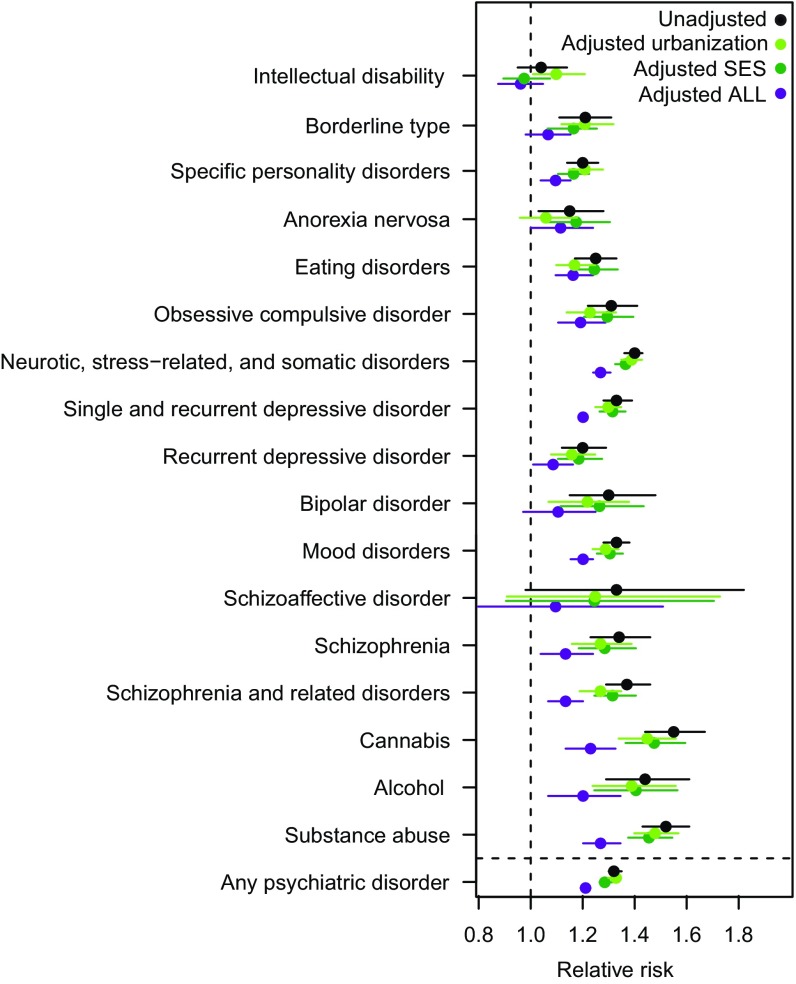
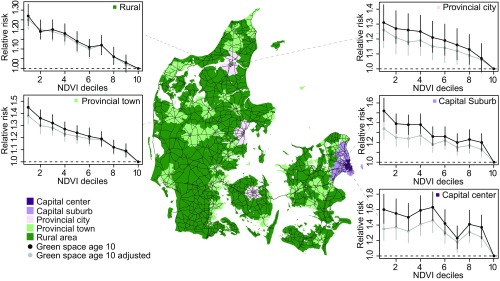
Urban residence is associated with a higher risk of some psychiatric disorders, but the underlying drivers remain unknown. There is increasing evidence that the level of exposure to natural environments impacts mental health, but few large-scale epidemiological studies have assessed the general existence and importance of such associations. Here, we investigate the prospective association between green space and mental health in the Danish population. Green space presence was assessed at the individual level using high-resolution satellite data to calculate the normalized difference vegetation index within a 210 × 210 m square around each person’s place of residence (∼1 million people) from birth to the age of 10. We show that high levels of green space presence during childhood are associated with lower risk of a wide spectrum of psychiatric disorders later in life. Risk for subsequent mental illness for those who lived with the lowest level of green space during childhood was up to 55% higher across various disorders compared with those who lived with the highest level of green space. The association remained even after adjusting for urbanization, socioeconomic factors, parental history of mental illness, and parental age. Stronger association of cumulative green space presence during childhood compared with single-year green space presence suggests that presence throughout childhood is important. Our results show that green space during childhood is associated with better mental health, supporting efforts to better integrate natural environments into urban planning and childhood life.
Overview
The claims and statistics of this paper haven’t been checked yet.
Free: it reads the open-access text and checks the first 5 claims that cite a source we can check. Create a free account to check every claim.
Integrity signals
Registry
Cites
Statistics
Figures
Verification
Claims the paper makes
The claims and statistics of this paper haven’t been checked yet.
Free: it reads the open-access text and checks the first 5 claims that cite a source we can check. Create a free account to check every claim.
Claims other papers make about this one
Each is checked against this paper’s own text: does it say what the citing paper says it does?
The source backs part of the claim, not all of it — or backs it for a different population, condition or comparison.
In the citing paper
“More greenery in urban areas creates higher social cohesion and increases people’s physical activity level, therefore improving children’s cognitive development (137).”
From The Impact of Climate Change on Mental Health: A Systematic Descriptive Review (2020) · cites this paper as [137]
Experimental — accuracy not yet measured
Self-check
Percentages, sums and reported differences re-computed from the paper’s own numbers.
The self-check needs the paper’s full text.
Citations
Cites
Cox’s regression model for counting processes: A large sample study
Andersen, P. K., & Gill, R. D. (1982) · The Annals of Statistics · doi:10.1214/aos/1176345976 · Cited by 4,419 · cited 1×
“IRR of psychiatric disorders were estimated in time-to-event analyses using Cox regressions, using age as the underlying timescale with separate baselines for each gender (51).”
MethodWolch, J. R., Byrne, J., & Newell, J. P. (2014) · Landscape and Urban Planning · doi:10.1016/j.landurbplan.2014.01.017 · Cited by 4,309 · cited 1×
“Lower access to green space could be an added risk factor for mental health among vulnerable groups of society (40, 41).”
BackgroundHartig, T., Mitchell, R., de Vries, S., & Frumkin, H. (2014) · Annual Review of Public Health · doi:10.1146/annurev-publhealth-032013-182443 · Cited by 3,638 · cited 3×
“Green space can enhance psychological restoration, can affect brain structure through positive associations with amygdala integrity, and could mitigate negative effects from the socially dense and noisy city environment that heighten stress (17, 19, 23, 24).”
BackgroundResultExploring pathways linking greenspace to health: theoretical and methodological guidance
Markevych, I., Schoierer, J., Hartig, T., Chudnovsky, A., Hystad, P., Dzhambov, A. M., de Vries, S., Triguero-Mas, M., Brauer, M., Nieuwenhuijsen, M. J., et al. (2017) · Environmental Research · doi:10.1016/j.envres.2017.06.028 · Cited by 2,543 · cited 1×
“Effects of different qualitative aspects and use of green space is important to identify a possible mechanistic link (37).”
BackgroundSchizophrenia risk from complex variation of complement component 4
Sekar, A., Bialas, A. R., de Rivera, H., Davis, A., Hammond, T. R., Kamitaki, N., Tooley, K., Presumey, J., Baum, M., Van Doren, V., et al. (2016) · Nature · doi:10.1038/nature16549 · Cited by 2,394
Extinction of experience: the loss of human–nature interactions
Soga, M., & Gaston, K. J. (2016) · Frontiers in Ecology and the Environment · doi:10.1002/fee.1225 · Cited by 1,802 · cited 1×
“Loss of human− nature interactions presents a health risk, and it can also reduce peoples’ appreciation of natural environments, creating negative feedback loops (42).”
BackgroundTwohig-Bennett, C., & Jones, A. (2018) · Environmental Research · doi:10.1016/j.envres.2018.06.030 · Cited by 1,766
The Danish Psychiatric Central Research Register
Mors, O., Perto, G. P., & Mortensen, P. B. (2011) · Scandinavian Journal of Public Health · doi:10.1177/1403494810395825 · Cited by 1,589 · cited 1×
“We linked all individuals from the study population and their parents and siblings with the Danish Psychiatric Central Research Register (44) to obtain information about psychiatric disorders.”
MethodSelf-citationCity living and urban upbringing affect neural social stress processing in humans
Lederbogen, F., Kirsch, P., Haddad, L., Streit, F., Tost, H., Schuch, P., Wüst, S., Pruessner, J. C., Rietschel, M., Deuschle, M., et al. (2011) · Nature · doi:10.1038/nature10190 · Cited by 1,584 · cited 3×
“Individuals with urban upbringing have high neural activity linked to stress processing, which could lead to higher risk of psychiatric disorders in adults (4).”
BackgroundMorbidity is related to a green living environment
Maas, J., Verheij, R. A., de Vries, S., Spreeuwenberg, P., Schellevis, F. G., & Groenewegen, P. P. (2009) · Journal of Epidemiology and Community Health · doi:10.1136/jech.2008.079038 · Cited by 1,133 · cited 1×
“Exposure to green space has been suggested to lower depression (13, 14) and schizophrenia risk (15), improve children’s cognitive development (16), and reduce neural activity linked to psychiatric disorders (11, 17).”
Background
Research works printed but not linked: 2
- World Health Organization 1992 The ICD-10 Classification of Mental and Behavioural Disorders: Clinical Descriptions and Diagnostics Guidelines World Health Org Geneva
- Danmarks Statistik 1991 IDA–En Integreret Database for Arbejdsmarkedsforskning: Hovedrapport Denmark Stat Copenhagen
Cited by
Items 601–700 of 868
Luonnon vaikutukset leikki-ikäisten lasten terveyteen
Laine, S., & Rechardt, M. (2021) · Theseus (Ammattikorkeakoulujen) · Cited by 1
Partnering with Nature - In search of regenerative approaches in urban environments
Einola, K. (2020) · Aaltodoc (Aalto University) · Cited by 1
Lind, M. (2023) · KTH Publication Database DiVA (KTH Royal Institute of Technology) · Cited by 1
The Relations of Mental Wellness: Indigenous Cree Lessons on Land-Based Healing
Spiegelaar, N. (2023) · TSpace (University of Toronto) · Cited by 1
Functional and structural brain adaptations to changing and uncertain environments in humans
Romand-Monnier, M. (2019) · theses.fr (ABES) · doi:10.70675/7d79d3bez9f17z4c88z8b47z69ffbb1c1c92 · Cited by 1
From the Dirt Up: Layering Story, Place, and Environmentalism Within Three Picture Books
Rowe, L. (2019) · Hollins Digital Commons (Hollins University)
Die Effekte des Waldaufenthaltes – aktuelle Studienlage
Schuh, A., & Immich, G. (2019) · Springer eBooks · doi:10.1007/978-3-662-59026-3_4
Myers, Z. (2019) · Springer eBooks · doi:10.1007/978-981-32-9923-8_1
Mer naturkontakt för barnen i staden med lek bland de gröna bladen
Yttermalm, R. (2019) · Epsilon Archive for Student Projects (Swedish University of Agricultural Sciences)
Interview: Stress and the City – Welche Auswirkungen hat das Stadtleben auf unsere Psyche?
Adli, M., & Etezadzadeh, C. (2020) · Springer eBooks · doi:10.1007/978-3-658-27232-6_22
Environments, resources, and health
Smith, M. (2020) · Elsevier eBooks · doi:10.1016/b978-0-12-819613-7.00011-6
Die Evolution als Basis für das Verhalten
Kindermann, H. (2020) · Springer eBooks · doi:10.1007/978-3-658-28161-8_1
Evolutionary Mismatches in the Development of Today’s Children
Bjorklund, D. F. (2020) · Oxford University Press eBooks · doi:10.1093/oso/9780190066864.003.0007
Adaptable Ancestors: Developmental Plasticity and Evolution
Bjorklund, D. F. (2020) · Oxford University Press eBooks · doi:10.1093/oso/9780190066864.003.0003
Developing the Evolved Social Brain
Bjorklund, D. F. (2020) · Oxford University Press eBooks · doi:10.1093/oso/9780190066864.003.0006
Bjorklund, D. F. (2020) · Oxford University Press eBooks · doi:10.1093/oso/9780190066864.003.0004
Changeable Children: Evolved Plasticity and Development
Bjorklund, D. F. (2020) · Oxford University Press eBooks · doi:10.1093/oso/9780190066864.003.0002
The Adaptive Value of Immaturity (or The Benefits of Being Young at Heart)
Bjorklund, D. F. (2020) · Oxford University Press eBooks · doi:10.1093/oso/9780190066864.003.0005
The benefits of biodiversity: Human-wildlife interactions in urban Guyana
Fisher, J. C. (2020) · Kent Academic Repository (University of Kent) · doi:10.22024/unikent/01.02.84397
Mosby, M. (2020) · NVA (Nasjonalt vitenarkiv)
Eine veränderte Sichtweise auf Tiere durch naturwissenschaftliche Erkenntnisse?
Kotrschal, K. M. (2021) · Nomos Verlagsgesellschaft mbH & Co. KG eBooks · doi:10.5771/9783748907084-85
“Die „Kosten“ dafür bestehen offenbar in einer geringen Resilienz gegenüber mentalen Problemen im Erwachsenenalter (Kristine Engemann et al. 2018).”
BackgroundNatural vs. Artificial Environments
Bennett, K. L. (2019) · Springer eBooks · doi:10.1007/978-3-319-16999-6_2928-1
Nuculović, V. (2021) · Springer eBooks · doi:10.1007/978-3-658-31523-8_14
Morris, A. N., Moustafa, A. A., Ulm, K., Frydecka, D., Piotrowski, P., & Misiak, B. (2021) · Elsevier eBooks · doi:10.1016/b978-0-12-820005-6.00008-6
Adams, J. (2021) · eScholarship@McGill (McGill) · doi:10.82308/22873
Kupinets, L., & Tiutiunnyk, H. (2021) · Economic innovations · doi:10.31520/ei.2021.23.1(78).95-114
Asri, A. K., Tsai, H., Lee, H., Chang, H.-T., Wong, P.-Y., Lung, S. C., Pan, W., Guo, Y. L., Yu, C.-P., Wu, C., et al. (2021) · Research Square · doi:10.21203/rs.3.rs-912080/v1
“For example, greenness can mitigate the burden of psychological diseases such as depressive disorders 3,4 .”
Klimatförändringen utmanar den globala hälsan och hotar särskilt sårbara grupper
Nilsson, M. (2021) · Socialmedicinsk tidskrift · doi:10.62607/smt.v98i2.38078
主観的位置情報を利用した野外学習用地図作成システム (新しいデバイスを用いた学習・教育支援環境/一般)
中澤, 啓., 山本, 友., & 井上, 智. (2005) · 先進的学習科学と工学研究会
Duckworth, A. L., & Lab, C. (2021) · Character Lab Tips · doi:10.53776/tips-step-outside
Relationships between wildlife/biodiversity and human well-being : a macro-level approach
Methorst, J. (2021) · Publication Server of Goethe University Frankfurt am Main (Goethe University Frankfurt) · doi:10.21248/gups.59370
COVID-19: Proteger a las personas y las sociedades
OECD (2020) · Medidas políticas clave de la OCDE ante el coronavirus (Covid-19) · doi:10.1787/56ebae97-es
Zhou, C., Sun, L., He, B. H., Bu, J., Ning, L., & Ji, C. (2022) · SSRN Electronic Journal · doi:10.2139/ssrn.4016061
Health and the City: How Cities Impact on Health, Happiness, and Well-Being
Schmidt, A. (2021) · Springer eBooks · doi:10.1007/978-3-030-51812-7_170-1
Kwok, S. W. H., Mak, Y. W., Chiu, A. P. Y., Chong, Y. K., Suen, L. K. P., Kam, E., Wong, C., & Wu, C. S. T. (2022) · International Journal of Nursing and Health Care Research · doi:10.29011/2688-9501.101276
The Healing and Grounding Potential of Biophilia
(2020) · Practice, progress, and proficiency in sustainability · doi:10.4018/978-1-7998-4408-2.ch005
Need for Greenspace in an Urban Setting for Child Development
Zolnikov, T. R., Furio, F., & Clark, T. (2021) · Springer eBooks · doi:10.1007/978-3-030-51812-7_30-1
A Golden Green Belt: Integrating Nature in Ottawa’s Next Suburbs
Kigel, Y. (2022) · Carleton University's Institutional Repository (MacOdrum Library, Carleton University) · doi:10.22215/etd/2022-15080
Campion, J. (2022) · Oxford University Press eBooks · doi:10.1093/med/9780198861478.003.0051
Facing urbanization: Hypothesizing an association between residential green and facial appearancePreprint
Menzel, C. (2022) · PsyArXiv (OSF Preprints) · doi:10.31234/osf.io/8b2n7
Residential history and changes in perceived health—The Northern Finland Birth Cohort 1966 study
Lankila, T., Puhakka, S., Kärmeniemi, M., Kangas, M., Rusanen, J., & Korpelainen, R. (2022) · Health & Place · doi:10.1016/j.healthplace.2022.102931
Need for Greenspace in an Urban Setting for Child Development
Zolnikov, T. R., Furio, F., & Clark, T. (2022) · Springer eBooks · doi:10.1007/978-3-030-87745-3_30
Health and the City: How Cities Impact on Health, Happiness, and Well-Being
Schmidt, A. (2022) · Springer eBooks · doi:10.1007/978-3-030-87745-3_170
Vos, S., den Bergh, B. R. H. V., Roels, H. A., Martens, D. S., Kindermans, H. P. J., & Nawrot, T. S. (2023) · Tijdschrift voor Geneeskunde · doi:10.47671/tvg.78.22.178
Environmental exposures and mental health
Manczak, E. M., Reuben, A., & Solomon, G. M. (2023) · Elsevier eBooks · doi:10.1016/b978-0-12-824315-2.00427-9
Using EnviroAtlas to Build K-12 Environmental Literacy.
Hartley, J. M., Pugh, C., Stevenson, K. T., & Daniel, J. (2019) · PubMed
Vuong, N., & Woods, N. K. (2023) · Kansas Journal of Medicine · doi:10.17161/kjm.vol16.18542
TELICHENKO, V., РУДЬ, Н. С., VASILEV, M., & DEMCHENKO, T. (2022) · NEWS OF HIGHER EDUCATIONAL INSTITUTIONS CONSTRUCTION · doi:10.32683/0536-1052-2022-763-7-79-91
Beyond Liveable: Planning Cities for Wellness
Banerd, H., Lum, K., Yerin, H., & Acebillo, P. (2022) · ISOCARP World Planning Congress · doi:10.47472/tgpnbmup
The Health Argument of Climate Action during COP26: Commentaries on Mental Health Issues
Ramli, F. F., & Hashim, S. A. S. (2023) · International Journal of Medical Sciences · doi:10.7150/ijms.86368
“A study in Denmark reported that exposure to green spaces during the first ten years of life has protective effects against a broad spectrum of psychiatric disorders, including depression, bipolar disorder, schizophrenia and substance abuse [9].”
BackgroundYeung, H., & Lee, K. (2023) · Annual European Real Estate Society Conference (ERES) · doi:10.15396/eres2023_87
Zu den evolutionären, bio-psychologischen Grundlagen der Mensch-Tier-Beziehung
Kotrschal, K. M. (2023) · Praxis der Kinderpsychologie und Kinderpsychiatrie · doi:10.13109/prkk.2023.72.8.666
Zhang, S. (2023) · Highlights in Business Economics and Management · doi:10.54097/htc07387
“Their findings revealed that all research participants experienced several barriers when participating in urban areas [12].”
BackgroundREDESAIN RUMAH SAKIT JIWA DR. SOEHARTO HEERDJAN DENGAN PENDEKATAN BIOFILIK
Shafiyya, M. H., & Wahyudi, A. (2023) · Jurnal Ilmiah Desain & Konstruksi · doi:10.35760/dk.2023.v22i2.9388
von Schwerin, S., & Lerch, G. (2024) · De Gruyter eBooks · doi:10.1515/9783035624304-011
INSPIRANDO AMBIENTES SUSTENTÁVEIS: A HARMONIA DA BIOFILIA NO DESIGN DE INTERIORES
Batista, A. C. D. S., Gonçalves, L. M., & Godoy, W. I. (2024) · Anais do Terceiro Sustentare e Sexto Wipis · doi:10.29327/sustentare-wipis-2023-311985.644369
Maereg, T. M., Glover, B. A., Im, J., Neal, A. J., McBride, M., Harris, A., & Witherspoon, D. P. (2024) · Elsevier eBooks · doi:10.1016/b978-0-323-96023-6.00123-8
Review of the relationship between green space exposure and mental health
Zhang, L. (2024) · Applied and Computational Engineering · doi:10.54254/2755-2721/59/20240796
Bjorklund, D. F. (2020) · Oxford University Press eBooks · doi:10.1093/oso/9780190066864.002.0004
Bjorklund, D. F. (2020) · Oxford University Press eBooks · doi:10.1093/oso/9780190066864.002.0008
Bjorklund, D. F. (2020) · Oxford University Press eBooks · doi:10.1093/oso/9780190066864.002.0007
Measuring mental health outcomes in Walbridge Fire 2020
McCombs, L., & Brown, N. (2024) · Journal of Emergency Management · doi:10.5055/jem.0828
Pinkney, C., Kirkbride, J. B., Boyd, A., Zammit, S., & Newbury, J. B. (2024) · medRxiv · doi:10.1101/2024.07.23.24310858
“…roles of population density (Newbury et al., 2016; Vassos et al., 2015), neighbourhood deprivation (Kirkbride et al., 2014; Newbury et al., 2022), social fragmentation (Allardyce et al., 2005; Evans et al., 2004), and greenspace (Engemann et al., 2019) with a range of mental health problems.”
BackgroundSantacruz, J. C., Laverde, N., González, C., & Blandón, L. (2024) · Estudios y Perspectivas Revista Científica y Académica · doi:10.61384/r.c.a..v4i3.412
Balancing constraints and requirements in an application process
Menting, S. G. P., McDowell, R. D., Redican, E., Rosato, M., Murphy, J., & Leavey, G. (2024) · Social Psychiatry and Psychiatric Epidemiology · doi:10.1007/s00127-026-03158-5
(2024) · Elsevier eBooks · doi:10.1016/b978-0-443-23565-8.09996-8
Lifestyle Factors Affecting Biological Processes and Health
Anisman, H., Hayley, S. P., & Kusnecov, A. W. (2024) · Elsevier eBooks · doi:10.1016/b978-0-443-23565-8.00009-0
Ernst, A., Reese, G., & Henn, L. (2024) · Springer eBooks · doi:10.1007/978-3-662-69166-3_6
Pinkney, C., Kirkbride, J. B., Boyd, A., Thomas, R., Zammit, S., & Newbury, J. B. (2024) · Wellcome Open Research · doi:10.12688/wellcomeopenres.23331.1
Mumtaz, A. (2025) · Frontiers research topics · doi:10.3389/978-2-8325-5982-6
Yu, X., Ouyang, M., & Shen, Y. (2024) · International Journal of Social Sciences and Public Administration · doi:10.62051/ijsspa.v5n2.07
“Moreover, more biophilic architectural research in the past has been a discussion about the integration of plants into manmade buildings, which benefits to promote human mental health and reduce the burden of mental illness [37].”
Medical facilities as an integrated space in a town: Case of the Geriatric Care Centre in Wieliczka
Nowak, A., Grochulska, M., Owczarek, M., Gierbienis, M., & Fąfara, M. (2024) · Środowisko Mieszkaniowe · doi:10.2478/he-2024-0012
Hoisington, A. J., Stamper, C. E., Penzenik, M. E., Reitter, M., Kovacs, E. J., Bahraini, N. H., & Brenner, L. A. (2025) · Indoor Environments · doi:10.1016/j.indenv.2025.100103
Environmental psychology: Future directions
Bonaiuto, M., & Theodorou, A. (2025) · Elsevier eBooks · doi:10.1016/b978-0-443-23536-8.00018-6
Perceived socio-environmental effects of urban green spaces depletion in Gweru City, Zimbabwe
Mukwenyi, P., Mavhura, E., Bowora, J., Siziba, E., Makambanga, J., Mhlanga, K., Gomo, M., & Samukange, T. (2025) · GeoJournal · doi:10.1007/s10708-025-11401-w
“Research indicates that learning in green environments can improve focus and reduce the risk of psychiatric disorders in children (Lavie & Tal, 2015; Engemann et al., 2019).”
Riskli Ergenlerde İçselleştirilmiş Damgalanmaya Yönelik Terapötik Bir Müdahale: Sanat Terapisi
YILDIRIM, O. (2025) · Current Perspectives in Social Sciences · doi:10.53487/atasobed.1624607
Climate Change and Health Interlinkages for Urban Resilience:A Grey Literature Review
Valderrama, V. A., Tollin, N., Orsetti, E., & Morató, J. (2023) · University of Southern Denmark Research Portal (University of Southern Denmark)
Khamees, W. A. (2025) · Al-Nahrain Journal for Engineering Sciences · doi:10.29194/njes.28020288
Reed, Z. E., Morris, T., Davis, O. S. P., Smith, G. D., Munafo, M. R., & Griffith, G. J. (2025) · medRxiv · doi:10.1101/2025.09.04.25335104
Nature et santé mentale : perspectives pour les soins psychiatriques
Haesebaert, F., & Haesebaert, J. (2025) · Encyclopédie médico-chirurgicale. Psychiatrie · doi:10.1016/s0246-1072(25)49265-7
Natural Buffers to Screen Disorders
Nagel, M. C., & Sharman, R. R. (2025) · Palgrave Studies in Cyberpsychology. · doi:10.1007/978-3-032-00803-9_10
Nagel, M. C., & Sharman, R. R. (2025) · Palgrave Studies in Cyberpsychology. · doi:10.1007/978-3-032-00803-9_5
Exploring the role of green space in mitigating childhood opportunity across the U.S
Yang, J., Ury, B., DUNSIGER, S. I., & Grigsby‐Toussaint, D. S. (2025) · Scientific Reports · doi:10.1038/s41598-025-18374-3
The hidden costs of automation: does robot adoption affect children’s mental health?
Zou, Y. C., Wang, J., & Wang, L. (2025) · Frontiers in Psychology · doi:10.3389/fpsyg.2025.1643849
Trabilsy, M., Rosenthal, D., Meyers, J. L., Peterson, R. E., & Barr, P. B. (2025) · Research Square · doi:10.21203/rs.3.rs-7736027/v1
Kocaman, E. (2023) · doi:10.55094/holistence.28
DYNAMICS OF URBAN GREEN SPACES IN DAVAO CITY: A SPATIOTEMPORAL ANALYSIS
Batican, M. D., Dumdum, R. C., Lemente, R. F., & Paragamac, J. B. R. (2025) · Acta Biologica Universitatis Daugavpiliensis · doi:10.59893/abud.25(1).001
Expanding the Conceptual and Intervention Options
Kazdin, A. E. (2025) · Oxford University Press eBooks · doi:10.1093/oso/9780197773659.003.0013
Challenges, Contexts, and Constraints
Kazdin, A. E. (2025) · Oxford University Press eBooks · doi:10.1093/oso/9780197773659.003.0012
Recommendations and Next Steps
Kazdin, A. E. (2025) · Oxford University Press eBooks · doi:10.1093/oso/9780197773659.003.0014
Social Contacts and Support, Volunteering, and Hobbies and Leisure Activities
Kazdin, A. E. (2025) · Oxford University Press eBooks · doi:10.1093/oso/9780197773659.003.0010
Kazdin, A. E. (2025) · Oxford University Press eBooks · doi:10.1093/oso/9780197773659.002.0004
Kazdin, A. E. (2025) · Oxford University Press eBooks · doi:10.1093/oso/9780197773659.003.0008
Kazdin, A. E. (2025) · Oxford University Press eBooks · doi:10.1093/oso/9780197773659.002.0003
Metadata
- Authors
- Engemann, K., Pedersen, C. B., Arge, L., Tsirogiannis, C., Mortensen, P. B., & Svenning, J.-C.
- Affiliations
- Aarhus University (DK)
- Corresponding author
- Engemann, Kristine
- ORCID
- Venue
- Proceedings of the National Academy of Sciences
- Publisher
- National Academy of Sciences
- Published
- 2019-02-25
- Volume
- 116
- Issue
- 11
- Pages
- 5188-5193
- ISSN
- 0027-8424 (ISSN-L)
- 1091-6490
- PMC
- PMC6421415
- OpenAlex
- W2917225355
- Cited by
- 668
- References
- 50
- Citations by year
- 2026: 63 · 2025: 74 · 2024: 89 · 2023: 96 · 2022: 99 · 2021: 114 · 2020: 92 · 2019: 37
- FWCI
- 36.93
- Type
- journal article
- Language
- en
- Open access
- hybrid
- doi.org
- Licence
- Locations
- Proceedings of the National Academy of Sciences (publishedVersion, cc-by-nc-nd)
- Europe PMC (PubMed Central) (publishedVersion, cc-by-nc-nd)
- PubMed Central (publishedVersion, cc-by-nc-nd)
- PubMed (publishedVersion)
- Funders
- Villum Fonden (16549)
- Topics
- Social Sciences › Urban Studies › Urban Green Space and Health
- Social Sciences › Health › Health disparities and outcomes
- Social Sciences › Sociology and Political Science › Environmental Justice and Health Disparities
- Keywords
- residential green space, children's exposure, mental illness, mental health, urbanization, NDVI, satellite remote sensing, cumulative exposure, urban planning, natural environment
- MeSH terms
- Adolescent, Adult, Mental Disorders, Child, Denmark, Environment, Humans, Risk Factors, Urbanization
About these checks
Registry, retraction, Cites and statistics results are computed, not judged, with one exception: a printed reference that no index lists is read once by a model before it counts as a citation error. Claims are extracted by a model and kept only when their quote appears verbatim in the text; each cited source is then checked, with a model’s help, for whether it says what the claim relies on. Those verdicts can be wrong — read the claim’s quote and the cited source before relying on one.
Statistics and arithmetic are recomputed, not judged.
Confidence bands are shown only for fields calibrated on our annotated test set. None is calibrated yet, so no band is shown.
What counts as a claim ›How we measure confidence ›How we check this ›
Are you an author, or do you see a problem with this page? Request a review
Data sources
Bibliographic data: Semantic Scholar, OpenAlex, Crossref.
Contains information from the Semantic Scholar Academic Graph Datasets, made available under the ODC Attribution License (ODC-BY 1.0).
Semantic Scholar’s data is described in: Kinney, R., et al. (2023). The Semantic Scholar Open Data Platform. arXiv:2301.10140.
