

Residential green space in childhood is associated with lower risk of psychiatric disorders from adolescence into adulthood
Open accessThe DOI matches its Crossref record; 50 of the 50 references it cites were found in a registry or an index.
Abstract
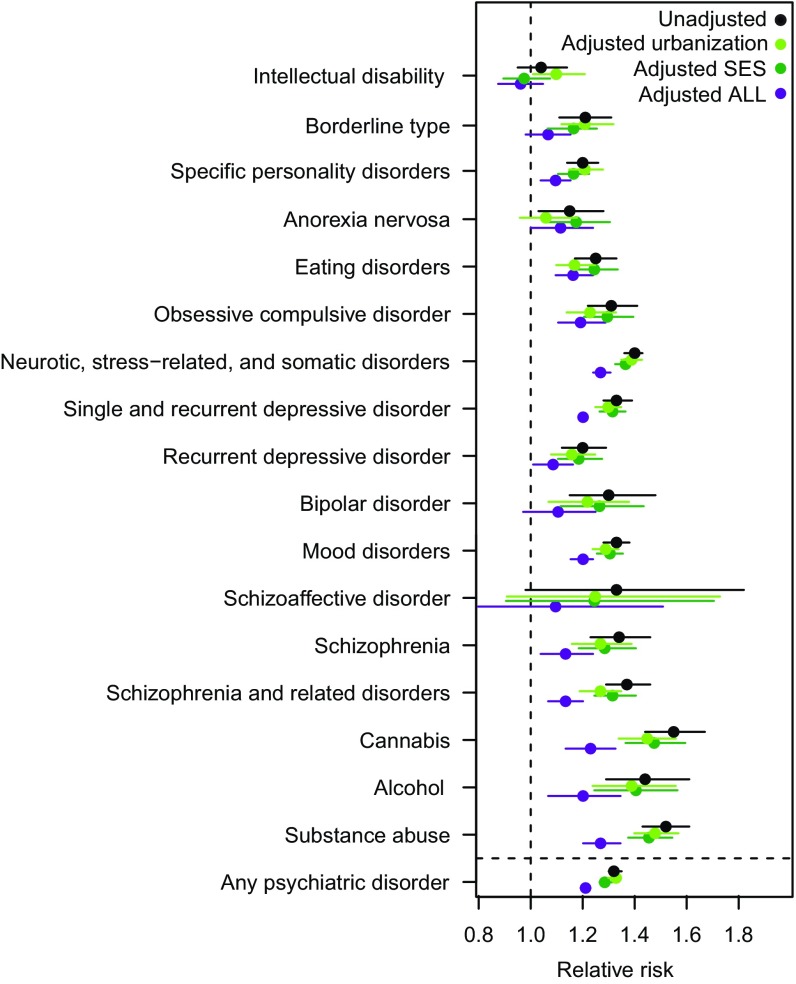
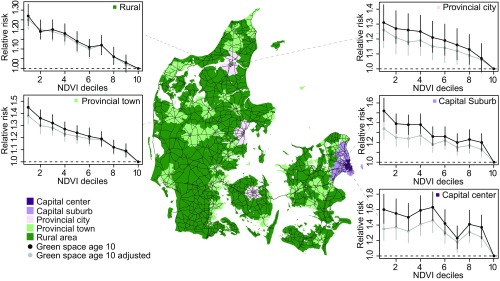
Urban residence is associated with a higher risk of some psychiatric disorders, but the underlying drivers remain unknown. There is increasing evidence that the level of exposure to natural environments impacts mental health, but few large-scale epidemiological studies have assessed the general existence and importance of such associations. Here, we investigate the prospective association between green space and mental health in the Danish population. Green space presence was assessed at the individual level using high-resolution satellite data to calculate the normalized difference vegetation index within a 210 × 210 m square around each person’s place of residence (∼1 million people) from birth to the age of 10. We show that high levels of green space presence during childhood are associated with lower risk of a wide spectrum of psychiatric disorders later in life. Risk for subsequent mental illness for those who lived with the lowest level of green space during childhood was up to 55% higher across various disorders compared with those who lived with the highest level of green space. The association remained even after adjusting for urbanization, socioeconomic factors, parental history of mental illness, and parental age. Stronger association of cumulative green space presence during childhood compared with single-year green space presence suggests that presence throughout childhood is important. Our results show that green space during childhood is associated with better mental health, supporting efforts to better integrate natural environments into urban planning and childhood life.
Overview
The claims and statistics of this paper haven’t been checked yet.
Free: it reads the open-access text and checks the first 5 claims that cite a source we can check. Create a free account to check every claim.
Integrity signals
Registry
Cites
Statistics
Figures
Verification
Claims the paper makes
The claims and statistics of this paper haven’t been checked yet.
Free: it reads the open-access text and checks the first 5 claims that cite a source we can check. Create a free account to check every claim.
Claims other papers make about this one
Each is checked against this paper’s own text: does it say what the citing paper says it does?
The source backs part of the claim, not all of it — or backs it for a different population, condition or comparison.
In the citing paper
“More greenery in urban areas creates higher social cohesion and increases people’s physical activity level, therefore improving children’s cognitive development (137).”
From The Impact of Climate Change on Mental Health: A Systematic Descriptive Review (2020) · cites this paper as [137]
Experimental — accuracy not yet measured
Self-check
Percentages, sums and reported differences re-computed from the paper’s own numbers.
The self-check needs the paper’s full text.
Citations
Cites
Cox’s regression model for counting processes: A large sample study
Andersen, P. K., & Gill, R. D. (1982) · The Annals of Statistics · doi:10.1214/aos/1176345976 · Cited by 4,419 · cited 1×
“IRR of psychiatric disorders were estimated in time-to-event analyses using Cox regressions, using age as the underlying timescale with separate baselines for each gender (51).”
MethodWolch, J. R., Byrne, J., & Newell, J. P. (2014) · Landscape and Urban Planning · doi:10.1016/j.landurbplan.2014.01.017 · Cited by 4,309 · cited 1×
“Lower access to green space could be an added risk factor for mental health among vulnerable groups of society (40, 41).”
BackgroundHartig, T., Mitchell, R., de Vries, S., & Frumkin, H. (2014) · Annual Review of Public Health · doi:10.1146/annurev-publhealth-032013-182443 · Cited by 3,638 · cited 3×
“Green space can enhance psychological restoration, can affect brain structure through positive associations with amygdala integrity, and could mitigate negative effects from the socially dense and noisy city environment that heighten stress (17, 19, 23, 24).”
BackgroundResultExploring pathways linking greenspace to health: theoretical and methodological guidance
Markevych, I., Schoierer, J., Hartig, T., Chudnovsky, A., Hystad, P., Dzhambov, A. M., de Vries, S., Triguero-Mas, M., Brauer, M., Nieuwenhuijsen, M. J., et al. (2017) · Environmental Research · doi:10.1016/j.envres.2017.06.028 · Cited by 2,543 · cited 1×
“Effects of different qualitative aspects and use of green space is important to identify a possible mechanistic link (37).”
BackgroundSchizophrenia risk from complex variation of complement component 4
Sekar, A., Bialas, A. R., de Rivera, H., Davis, A., Hammond, T. R., Kamitaki, N., Tooley, K., Presumey, J., Baum, M., Van Doren, V., et al. (2016) · Nature · doi:10.1038/nature16549 · Cited by 2,394
Extinction of experience: the loss of human–nature interactions
Soga, M., & Gaston, K. J. (2016) · Frontiers in Ecology and the Environment · doi:10.1002/fee.1225 · Cited by 1,802 · cited 1×
“Loss of human− nature interactions presents a health risk, and it can also reduce peoples’ appreciation of natural environments, creating negative feedback loops (42).”
BackgroundTwohig-Bennett, C., & Jones, A. (2018) · Environmental Research · doi:10.1016/j.envres.2018.06.030 · Cited by 1,766
The Danish Psychiatric Central Research Register
Mors, O., Perto, G. P., & Mortensen, P. B. (2011) · Scandinavian Journal of Public Health · doi:10.1177/1403494810395825 · Cited by 1,589 · cited 1×
“We linked all individuals from the study population and their parents and siblings with the Danish Psychiatric Central Research Register (44) to obtain information about psychiatric disorders.”
MethodSelf-citationCity living and urban upbringing affect neural social stress processing in humans
Lederbogen, F., Kirsch, P., Haddad, L., Streit, F., Tost, H., Schuch, P., Wüst, S., Pruessner, J. C., Rietschel, M., Deuschle, M., et al. (2011) · Nature · doi:10.1038/nature10190 · Cited by 1,584 · cited 3×
“Individuals with urban upbringing have high neural activity linked to stress processing, which could lead to higher risk of psychiatric disorders in adults (4).”
BackgroundMorbidity is related to a green living environment
Maas, J., Verheij, R. A., de Vries, S., Spreeuwenberg, P., Schellevis, F. G., & Groenewegen, P. P. (2009) · Journal of Epidemiology and Community Health · doi:10.1136/jech.2008.079038 · Cited by 1,133 · cited 1×
“Exposure to green space has been suggested to lower depression (13, 14) and schizophrenia risk (15), improve children’s cognitive development (16), and reduce neural activity linked to psychiatric disorders (11, 17).”
Background
Research works printed but not linked: 2
- World Health Organization 1992 The ICD-10 Classification of Mental and Behavioural Disorders: Clinical Descriptions and Diagnostics Guidelines World Health Org Geneva
- Danmarks Statistik 1991 IDA–En Integreret Database for Arbejdsmarkedsforskning: Hovedrapport Denmark Stat Copenhagen
Cited by
Items 401–500 of 868
Sabel, C. E., Amegbor, P. M., Zhang, Z., Chen, T. K., Poulsen, M. B., Hertel, O., Sigsgaard, T., Horsdal, H. T., Pedersen, C. B., & Khan, J. (2021) · The urban book series · doi:10.1007/978-981-15-8983-6_17 · Cited by 7
Self-citationExamining the Effects of Exposure to Nature on Well-Being: Implications for College Campuses
Majors, F. T. (2019) · Pace Digital Repository (Pace University) · Cited by 7
The future of recreation on public lands: a horizon scan
Westphal, L. M. (2022) · doi:10.2737/nrs-gtr-208 · Cited by 7
Casanelles‐Abella, J., & Egerer, M. (2025) · Basic and Applied Ecology · doi:10.1016/j.baae.2025.01.002 · Cited by 16
Microbiomes as Modulators of Human and Planetary Health: A Relational and Cross‐Scale Perspective
Handte-Reinecker, A., & Sardeshpande, M. (2025) · Global Change Biology · doi:10.1111/gcb.70152 · Cited by 6
“Ecological and ethnobiological knowledge can have a positive influence on bio- psycho-social experience, also playing into traditional medicine and spiritual pathways to healing and well-being (Engemann et al. 2019; Mollee et al. 2017).”
Simkin, J. (2025) · Dissertationes Forestales · doi:10.14214/df.366 · Cited by 6
Shen, X., Liu, B., Yin, J., Patuano, A., Tang, S., & Yang, F. (2025) · Building and Environment · doi:10.1016/j.buildenv.2025.113204 · Cited by 6
Residential greenness and adolescent mental health trajectories: A longitudinal pre-registered study
Larsen, S. R., Rakesh, D., Whittle, S., Allen, N. B., Enticott, P. G., & Mygind, L. (2025) · Environmental Research · doi:10.1016/j.envres.2025.122150 · Cited by 6
Jones, F., Fisher, J. C., Austen, G. E., Irvine, K. N., Dallimer, M., Croager, L., Nawrath, M., Fish, R. D., & Davies, Z. (2025) · Journal of Environmental Psychology · doi:10.1016/j.jenvp.2025.102897 · Cited by 6
Reese, R. F., Holden, C. J., Hall, C. A., & Wingrove, T. (2022) · Measurement and Evaluation in Counseling and Development · doi:10.1080/07481756.2021.2022984 · Cited by 6
“Further, children raised in areas with minimal nature are at greater risk for developing psychiatric disorders (Engemann et al., 2019) and depressive symptoms in adulthood compared with persons growing up in areas with greater proximity to natural spaces (Bezold et al.”
BackgroundInfluentialGebhard, U. (2023) · Bundesgesundheitsblatt - Gesundheitsforschung - Gesundheitsschutz · doi:10.1007/s00103-023-03729-w · Cited by 6
Ahmed, A. S., Proctor, C. A., & Rohn, M. M. (2025) · New Environmentally-Friendly Materials · doi:10.55121/nefm.v4i1.431 · Cited by 6
Trees in the City – Perception and Aesthetic Expression
Frohmann, E. (2020) · Plants in Urban Areas and Landscape · doi:10.15414/pual/2020.3-9 · Cited by 6
Do Urban Golf Courses Provide Barriers to Equitable Greenspace Access in the United States?
Ryan, J. C. (2023) · Annals of the American Association of Geographers · doi:10.1080/24694452.2023.2166011 · Cited by 6
“…that is accessible (e.g., parks, nature preserves, recreation grounds) and greenspace that is largely inaccessible (e.g., private land, golf courses, green roofs, etc.; Richardson et al. 2012; Browning and Rigolon 2018; Engemann et al. 2019; Su et al. 2019; Labib, Lindley, and Huck 2020).”
BackgroundPerspectives on environment and health research in Denmark
Horsdal, H. T., Pedersen, M. G., Schullehner, J., Østergaard, C. S., McGrath, J. J., Agerbo, E., Timmermann, A., Closter, A. M., Brandt, J. G., Christensen, J. H., et al. (2023) · Scandinavian Journal of Public Health · doi:10.1177/14034948231178076 · Cited by 6
Self-citationSabol, T. J., McCoy, D. C., Gonzalez, K. E., Hanno, E. C., Busby, A. K., Wei, W. S., & Downer, J. T. (2022) · Journal of Research on Educational Effectiveness · doi:10.1080/19345747.2022.2141164 · Cited by 6
“Moreover, higher levels of greenspace, particularly in terms of exposure to open space and nature, can promote children ’ s mental health and self-regulatory skills (Engemann et al., 2019).”
BackgroundLanggartner, D., Weimer, K., Brunner-Weisser, J., Winkler, R., Mannes, M., Huber-Lang, M. S., Sterrett, J. D., Lowry, C. A., Rohleder, N., Bajrami, B., et al. (2025) · Brain Behavior and Immunity · doi:10.1016/j.bbi.2025.03.013 · Cited by 5
“Finally, as exposure to residential green space in childhood is associated with lower risk of psychiatric disorders later in life (Engemann et al., 2019), future studies should also consider the presence and size of residential green space, including residential gardens owned by the study…”
Green pathways to mental health: Relationships between treescapes and well‐being and distress
Alcock, I., Sheffield, D., White, P. C. L., Coventry, P. A., Hunt, M. L., & Richardson, M. (2025) · People and Nature · doi:10.1002/pan3.70179 · Cited by 5
Zheng, Z., Guo, Q., Yang, J., Soebekti, C. R., Huang, T., Zhang, M., & Wang, C. (2023) · International Journal of Sustainable Development & World Ecology · doi:10.1080/13504509.2023.2290180 · Cited by 5
“Research shows that residents’ activities in UGSs can have a positive impact on people’s physical and mental health (Dadvand et al. 2015; Sarkar et al. 2018; Engemann et al. 2019).”
BackgroundGreen space and mental well-being research in India
Banerjee, B., Basu, S., & Kumar, L. (2024) · Elsevier eBooks · doi:10.1016/b978-0-443-23788-1.00010-5 · Cited by 5
Hatala, A. R., Morton, D., Deschenes, C., & Bird‐Naytowhow, K. (2024) · BMC Public Health · doi:10.1186/s12889-024-20007-9 · Cited by 5
Komulainen, K., Elovainio, M. J., Gutvilig, M., Niemi, R., Partonen, T., Ruuhela, R., Virtanen, M., & Hakulinen, C. A. (2025) · Environmental Research · doi:10.1016/j.envres.2025.121206 · Cited by 5
Cui, W., Xu, J., Tang, F., Gao, M. M., Zheng, Y., Zhou, D., Yang, S., & Han, Z. R. (2025) · Journal of Happiness Studies · doi:10.1007/s10902-025-00899-z · Cited by 5
“…examine between-child differences in greenspace exposure and children’s well-being (e.g., whether children who spend more time in greenspace report better emotional well-being than others; Engemann et al., 2019; Bijnens et al., 2020; Feng et al., 2022; Madzia et al., 2019; Maes et al., 2021).”
Rook, G. A. W. (2021) · Advances in environmental microbiology · doi:10.1007/978-3-030-63512-1_18 · Cited by 5
Hautekiet, P., Saenen, N. D., Aerts, R., Martens, D. S., Roels, H. A., Bijnens, E. M., & Nawrot, T. S. (2022) · Environmental Research · doi:10.1016/j.envres.2022.113551 · Cited by 5
Climatic exposures in childhood and the risk of schizophrenia from childhood to early adulthood
Komulainen, K., Elovainio, M. J., Törmälehto, S., Ruuhela, R., Sund, R., Partonen, T., Virtanen, M., & Hakulinen, C. A. (2022) · Schizophrenia Research · doi:10.1016/j.schres.2022.09.013 · Cited by 5
Climate Change: Implications for Community Mental Health
Sullenbarger, J., Schutzenhofer, E., & Haase, E. (2022) · Springer eBooks · doi:10.1007/978-3-031-10239-4_31 · Cited by 5
Song, I., & Luan, H. (2023) · Applied Geography · doi:10.1016/j.apgeog.2023.103127 · Cited by 5
Hu, W., & Tan, S. (2024) · The Journal of Early Adolescence · doi:10.1177/02724316241261403 · Cited by 5
“Previous studies have demonstrated that attractive community landscapes could facilitate residents ’ connection with nature, reduce mental stress, and protect physical health (Engemann et al., 2019; Lee et al., 2015).”
Sanz-Junoy, G., Gavín-Chocano, Ó., Ubago-Jiménez, J. L., & López-Barajas, D. M. (2023) · International Journal of Environmental Research and Public Health · doi:10.3390/ijerph20156525 · Cited by 5
“[39] revealed that the risk of psychological disorders from adolescence to adulthood decreases according to the amount of green space near a person’s residence.”
BackgroundUnderstanding Extreme Sports: A Psychological Perspective
Brymer, E., Feletti, F., Monasterio, E., & Schweitzer, R. (2020) · Frontiers research topics · doi:10.3389/978-2-88963-543-6 · Cited by 5
Juengsiragulwit, D., & Nikapota, A. (2020) · Mental health and illness worldwide · doi:10.1007/978-981-10-2348-4_60 · Cited by 5
Sustainable land management: managing land better for environmental benefits
Parliamentary Office of Science and Technology, Donkersley, P., Carver, L., & Wentworth, J. (2021) · doi:10.58248/pb42 · Cited by 5
“You really feel Invincible”: The impact of open water swimming on student wellbeing
Duffy, E., & Ashbullby, K. J. (2025) · Journal of Environmental Psychology · doi:10.1016/j.jenvp.2025.102654 · Cited by 4
The effect of urban greenspace on adolescent sleep patterns
Tsomokos, D. I., Ji, D., Mueller, M. A. E., Papachristou, E., & Flouri, E. (2023) · Landscape Research · doi:10.1080/01426397.2023.2241387 · Cited by 4
“This neglect is surprising because exposure to nature and residential greenspace during childhood has been associated with better mental health outcomes during childhood and adolescence and into adulthood (Engemann et al., 2019), possibly in a dose-response manner (Feng & Astell-Burt, 2017; Shanahan et al.”
BackgroundClimate Change and Global Mental Health
Charlson, F., Patrick, R., & Dey, C. (2024) · CABI eBooks · doi:10.1079/9781800620025.0026 · Cited by 4
Family poverty, neighbourhood greenspace and perinatal outcomes
Tsomokos, D. I., Papachristou, E., Rakesh, D., & Flouri, E. (2024) · Archives of Disease in Childhood · doi:10.1136/archdischild-2024-327349 · Cited by 4
Sampath, V., Payne-Sturges, D., Slopen, N. B., Harnett, N. G., Lee, A., Nadeau, K. C., Taylor, N. M. I., & Burghardt, L. C. (2025) · Frontiers in Public Health · doi:10.3389/fpubh.2025.1654097 · Cited by 4
Zeng, W., Liu, H., Hou, S., Qiu, X., Chen, X., Liu, M., Wu, D., & Liu, L. (2022) · Atmosphere · doi:10.3390/atmos13071006 · Cited by 4
Walls, F. N., & McGarvey, D. J. (2022) · People and Nature · doi:10.1002/pan3.10427 · Cited by 4
Change detection of Eastern Industrial Area of Jaipur city
Agarwal, N., & Tiwary, A. K. (2023) · AIP conference proceedings · doi:10.1063/5.0120056 · Cited by 4
Yoo, E., Roberts, J. E., & Chen, K. (2024) · Environmental Research Health · doi:10.1088/2752-5309/ad1f3f · Cited by 4
“Emerging studies (Basu et al 2018, Engemann et al 2019, Yoo et al 2021, 2022b, Nori-Sarma et al 2022, Wang and Li 2023) have demonstrated adverse effects of both ambient temperature and a lack of greenspace on emergency room (ER) visits for MDs. Likewise, there is some evidence that ambient air…”
BackgroundThe impact of environmental quality on mental health: an ecological study
Wilson, K., Jackman, M. N., & Moore, W. R. (2024) · Journal of Public Mental Health · doi:10.1108/jpmh-06-2024-0071 · Cited by 4
Puhakka, R., Pienimäki, M., & Marttila, M. (2024) · Nuorisotutkimus · doi:10.57049/nuorisotutkimus.9155135 · Cited by 4
Johansson, C., Fridén, J., & Ahlström, B. H. (2025) · Issues in Mental Health Nursing · doi:10.1080/01612840.2024.2437424 · Cited by 4
McCunn, L. J., Sawyer, K., & Shorting, T. (2023) · Cities & Health · doi:10.1080/23748834.2023.2178363 · Cited by 4
Nicotine as an Environmental Toxin: Implications for Children's Health
Gatzke‐Kopp, L. M., & Rice, D. R. (2023) · Policy Insights from the Behavioral and Brain Sciences · doi:10.1177/23727322231190588 · Cited by 4
“In addition to broad bene fi ts to overall well-being (Engemann et al., 2019), green space is associated with a lower prevalence of smoking (Martin et al., 2020).”
BackgroundRook, G. A. W. (2022) · Progress in inflammation research · doi:10.1007/978-3-030-91051-8_2 · Cited by 4
Effects of Spending Time in the Forest: Current Studies
Schuh, A., & Immich, G. (2022) · Springer eBooks · doi:10.1007/978-3-662-64280-1_4 · Cited by 4
Children, Childhood, and Development in Evolutionary Perspective
Bjorklund, D. F. (2020) · Oxford University Press eBooks · doi:10.1093/oso/9780190066864.003.0001 · Cited by 4
INADEQUATE EXPOSURE TO GREENSPACE AND ITS EFFECTS ON MENTAL HEALTH DURING THE PANDEMIC
Cai, X., Tedong, P. A., & Zainol, R. B. (2022) · PLANNING MALAYSIA · doi:10.21837/pm.v20i24.1182 · Cited by 4
Helminen, J. (2021) · Theseus (Ammattikorkeakoulujen) · Cited by 4
Role of Green Exercise in Mental Health Promotion Among Adolescents
Okechukwu, C. E. (2020) · International Journal of Preventive Medicine · doi:10.4103/ijpvm.ijpvm_262_19 · Cited by 4
“Interaction with green spaces during childhood is associated with better mental health.[3] However, exposure to green exercise during childhood was associated with connectedness to nature in adulthood and improved cardiovascular health.”
Comment va la vie ? Mesurer le bien-être
OECD (2014) · Comment va la vie? · doi:10.1787/23089695 · Cited by 4
Moore, T. (2021) · Figshare · doi:10.25374/mcri.14593878 · Cited by 4
Parental evaluations of neighbourhood green and play spaces and children's mental health
LeClair, J. (2024) · Canadian Geographies / Géographies canadiennes · doi:10.1111/cag.12903 · Cited by 3
City, Neighbourhood and Citizens
Creasy, A., Lane, M., & van der Horst, D. (2024) · Wiley eBooks · doi:10.1002/9781118641156.ch10 · Cited by 3
Urban and Rural Differences in the Efficacy of a Mobile Health Depression Treatment for Young Adults
Mennis, J. L., Coatsworth, J. D., Russell, M. A., Zaharakis, N. M., Brown, A., & Mason, M. J. (2024) · International Journal of Environmental Research and Public Health · doi:10.3390/ijerph21121572 · Cited by 3
Kreider, M. R., Rice, W. L., Leary, C. S., Semmens, E. O., Belote, R. T., & Larson, A. J. (2025) · Landscape and Urban Planning · doi:10.1016/j.landurbplan.2025.105567 · Cited by 3
Nature variables and mental health in the adolescent brain cognitive development (ABCD®) study
Floyd, T. E., Browning, M. H. E. M., Herting, M. M., Cardenas‐Iniguez, C., Calhoun, V. D., & Reuben, A. (2026) · Journal of Environmental Psychology · doi:10.1016/j.jenvp.2026.103089 · Cited by 3
Lee, K. O., & Yeung, A. H. (2026) · Cities · doi:10.1016/j.cities.2025.106734 · Cited by 3
An ecology of suboptimals? Lessons learned from balancing green and gray in cities
Casanelles‐Abella, J., & Egerer, M. (2026) · Frontiers in Sustainable Cities · doi:10.3389/frsc.2026.1759048 · Cited by 3
Moving beyond environmental categories in environmental psychology
Huynh, D. C., Hussein, A. K., Behzadi, F., Kalantarifard, A., Fich, L. B., & Djebbara, Z. (2026) · Journal of Environmental Psychology · doi:10.1016/j.jenvp.2026.103016 · Cited by 4
Urban rewilding as a nature-based solution: a critical perspective
Esperón‐Rodríguez, M., & Svenning, J. (2025) · Critical Insights in Plant Science · doi:10.1080/29932297.2026.2629049 · Cited by 3
Self-citationYong, J. C., Lim, A. J. Y., Tan, E., & Chan, S. (2026) · Behavioral Sciences · doi:10.3390/bs16050650 · Cited by 3
Guo, M., Liu, G., Huo, Z., Chang, W., Zhang, D., Li, J., Dai, X., Romano, A., & Gonella, F. (2026) · Journal of Environmental Psychology · doi:10.1016/j.jenvp.2026.103087 · Cited by 3
Murawiec, S. (2023) · Psychiatria i Psychologia Kliniczna · doi:10.15557/pipk.2023.0003 · Cited by 3
“Engemann et al., 2019 published their study in which they investigated whether access to green space during childhood is associated with the risk of any of the broad range of psychiatric disorders later in life.”
InfluentialRavichandran, V., Archer, J.-M. J., Aiyar, L., Teirstein, M., Barton, K., Azher, Z., Parikh, R., Ada, M. S. D., Shah, A., Rah, A., et al. (2023) · Environmental Justice · doi:10.1089/env.2022.0024 · Cited by 3
Ryan, S. C., Runkle, J. D., Wertis, L., & Sugg, M. M. (2024) · Journal of Adolescent Health · doi:10.1016/j.jadohealth.2024.03.014 · Cited by 3
Zang, Z., Zhang, L., Liu, Y., Yang, X., Wang, Z., Jiao, L., Wang, H., & Luo, Y. (2025) · Chinese Geographical Science · doi:10.1007/s11769-025-1524-3 · Cited by 3
van Engelen, B., Verheyen, L., Winkens, B., Plusquin, M., Malina, R. M., & van Schayck, O. C. P. (2025) · International Journal of Environmental Research and Public Health · doi:10.3390/ijerph22121805 · Cited by 3
“Exposure to nature is associated with lower risks of mental disorders in urban populations [51], supported by the Attention Restoration Theory (ART) and Stress Recovery Theory (SRT), which explain how nature reduces cognitive fatigue and stress [21–23].”
Duy, P. N., Tuan, P. A., & Nguyen, N. P. T. (2025) · City and Environment Interactions · doi:10.1016/j.cacint.2025.100247 · Cited by 3
Perceived and quantified nature exposure in relation to mental health
Bloomfield, L. S. P., Lombardo, S., Price, M., Ricketts, T. H., & Danforth, C. M. (2026) · Health & Place · doi:10.1016/j.healthplace.2026.103636 · Cited by 4
Health and Wellbeing Implications of Urban Green Exposure on Young Adults in a European City
Rathnayke, S., & Amofah, S. (2023) · Journal of Advanced Research in Social Sciences · doi:10.33422/jarss.v6i4.1136 · Cited by 3
“Low levels of childhood green space exposure are associated with psychiatric disorders in adulthood, according to Engemann et al. (2019).”
BackgroundAssessing life expectancy disparities in Chicago with a deep dive into green space
Folkmann, E. J., Hughes, M. C., Hua, L., Alarifi, M., & Vaezi, M. (2024) · Environmental Advances · doi:10.1016/j.envadv.2024.100540 · Cited by 3
Zeng, Y., Stevens, G. W. J. M., Paus, T., & Helbich, M. (2024) · American Journal of Epidemiology · doi:10.1093/aje/kwae373 · Cited by 3
“A few longitudinal studies traced green space exposure back to childhood, reporting better mental health in adolescents with more exposure in childhood 7-9 ; others found null or mixed associations.”
THE ROLE OF GREEN SPACES IN ENHANCING RESIDENTS’ SUBJECTIVE WELL-BEING IN URBAN COMMUNITIES
Lam, C. (2024) · Social science and management. · doi:10.61784/ssm3005 · Cited by 3
“Research has shown that access to high-quality green areas can enhance life satisfaction, reduce stress, and foster social connections among community members [7].”
BackgroundThe Impact of Urban Regeneration and Environmental Improvements on Well-Being
Barnes, C. (2024) · International Journal of Education and Humanities · doi:10.54097/q4tnc506 · Cited by 3
“This evidence underscores the significance of environmental improvements in urban regeneration projects [30].”
BackgroundJuengsiragulwit, D., & Nikapota, A. (2020) · Mental health and illness worldwide · doi:10.1007/978-981-10-0753-8_60-1 · Cited by 3
Long, T., Pantaléon, N., Kleerebezem, R., & Babutsidze, Z. (2021) · Environmental Values · doi:10.3197/096327120x16033868459502 · Cited by 3
“Yet, since we are not only part of but innately are and need nature (Wilson 1984), our lack of contact with nature leads us to new health troubles, known as ‘Nature-deficit disorders’, especially among children (Engemann et al. 2019; Louv 2009).”
BackgroundGorski, I., O’Dell, S. M., Bandeen‐Roche, K., Volk, H. E., Goes, F. S., & Schwartz, B. S. (2021) · Spatial and Spatio-temporal Epidemiology · doi:10.1016/j.sste.2021.100439 · Cited by 3
Rantala, M. J., & Borráz-León, J. I. (2023) · Elsevier eBooks · doi:10.1016/b978-0-12-817558-3.00020-2 · Cited by 3
Crime and Greenspace: Extending the Analysis Across Cities
Ogletree, S. S. (2019) · TigerPrints (Clemson University) · Cited by 3
Whitburn, J.-A. (2020) · Open Access Victoria University of Wellington | Te Herenga Waka (Figshare) · doi:10.26686/wgtn.17145590.v1 · Cited by 4
The Great American Outdoors Act of 2020: a Tool for Improving Urban Health and Health Equity
Kizer, K. W. (2021) · Journal of Urban Health · doi:10.1007/s11524-020-00500-3 · Cited by 3
“mental illness, and degree of urbanization [13].”
Sterlite Copper: Much Ado About Nothing, all the while Ignoring the Elephant in the Room?Preprint
Pandi-Perumal, S. R. (2022) · SSRN Electronic Journal · doi:10.2139/ssrn.4106810 · Cited by 3
Transforming India’s Built Environment: A 2050 vision for Wellness and Resilience
Singh, R., Joshi, S., & Mani, M. (2023) · eScholarship (California Digital Library) · Cited by 3
“Tänk att jag har sått det här själv” : Elevers uppfattningar av sitt lärande i skolträdgården
Strand, A.-S. (2025) · Doria (University of Helsinki) · Cited by 3
Kids' Environment and Health Cohort: Database Protocol
Akaraci, S., Macfarlane, A., Rammah, A., Courtin, É., Lewis, E., Miller, F. A., Powell-Bavester, J., Mitchell, J. L., Cruz, J., Lilliman, M., et al. (2025) · International Journal for Population Data Science · doi:10.23889/ijpds.v10i1.2475 · Cited by 2
A life course approach to mental health and well-being
Keyes, K. M., & Martínez‐Alés, G. (2025) · Oxford University Press eBooks · doi:10.1093/oso/9780198895961.003.0012 · Cited by 2
Implementation of school ground vegetation : interdisciplinary aspects of growing under pressure
Ignell, S. (2025) · Acta universitatis agriculturae Sueciae · doi:10.54612/a.7ubp0j72e8 · Cited by 2
Does heatwaves/above-average temperature increase interpersonal violent behavior? A scoping review
MARAN, D. A., Dibiase, G., Filippetti, S., Sandretto, R., Varetto, A., CORTESE, C. G., & Carraro, E. (2024) · Institutional Research Information System University of Turin (University of Turin) · doi:10.19204/2024/dsht2 · Cited by 2
Zhu, H., Zeng, K., Zhang, S., Zhang, Y., Ci, M., Jin, Z., Wang, Y., Huang, P., ZHENG, Z., Yin, S., et al. (2026) · Cities · doi:10.1016/j.cities.2026.106846 · Cited by 2
König, C., Salomo, K., & Helbig, M. (2026) · Urban Studies · doi:10.1177/00420980251412793 · Cited by 2
“Poor environmental quality negatively affects both physical and mental health (Currie et al., 2014; Engemann et al., 2019).”
Plinio, S. D., Menardo, E., Greco, C., Cardone, D., Perpetuini, D., Merla, A., Brondino, M., Pasini, M., & Ebisch, S. J. H. (2026) · Journal of Environmental Psychology · doi:10.1016/j.jenvp.2026.102973 · Cited by 2
Early-life neighborhood resources and later-life cognitive function
Farmer, J. G., Tang, I. W., James, P., Kubzansky, L. D., Mukherjee, R., Hickman, R. C., Kessler, W., Germine, L. T., & Weisskopf, M. G. (2026) · Environmental Research · doi:10.1016/j.envres.2026.124257 · Cited by 2
Zhang, X., Cheng, Z., Fan, B., & Zhang, D. (2026) · Building and Environment · doi:10.1016/j.buildenv.2026.114544 · Cited by 2
Pärtel, M., Degtjarenko, P., Davison, J., Helm, A., Jõks, M., Kõljalg, U., Kook, E., Mander, Ü., Niinemets, Ü., Org, E., et al. (2026) · Urban forestry & urban greening · doi:10.1016/j.ufug.2026.129514 · Cited by 2
Digital Twin Enabled Autonomous Vehicles for Obstacle Avoidance in Disaster Response
Rose, C., Ahmad, T., McMurray, R. J., Gadekallu, T. R., & Hadi, M. U. (2026) · IEEE Open Journal of Vehicular Technology · doi:10.1109/ojvt.2026.3698301 · Cited by 2
Janes, J. K., & McCunn, L. J. (2022) · Journal of Educational Research and Practice · doi:10.5590/jerap.2022.12.1.18 · Cited by 2
Metadata
- Authors
- Engemann, K., Pedersen, C. B., Arge, L., Tsirogiannis, C., Mortensen, P. B., & Svenning, J.-C.
- Affiliations
- Aarhus University (DK)
- Corresponding author
- Engemann, Kristine
- ORCID
- Venue
- Proceedings of the National Academy of Sciences
- Publisher
- National Academy of Sciences
- Published
- 2019-02-25
- Volume
- 116
- Issue
- 11
- Pages
- 5188-5193
- ISSN
- 0027-8424 (ISSN-L)
- 1091-6490
- PMC
- PMC6421415
- OpenAlex
- W2917225355
- Cited by
- 668
- References
- 50
- Citations by year
- 2026: 63 · 2025: 74 · 2024: 89 · 2023: 96 · 2022: 99 · 2021: 114 · 2020: 92 · 2019: 37
- FWCI
- 36.93
- Type
- journal article
- Language
- en
- Open access
- hybrid
- doi.org
- Licence
- Locations
- Proceedings of the National Academy of Sciences (publishedVersion, cc-by-nc-nd)
- Europe PMC (PubMed Central) (publishedVersion, cc-by-nc-nd)
- PubMed Central (publishedVersion, cc-by-nc-nd)
- PubMed (publishedVersion)
- Funders
- Villum Fonden (16549)
- Topics
- Social Sciences › Urban Studies › Urban Green Space and Health
- Social Sciences › Health › Health disparities and outcomes
- Social Sciences › Sociology and Political Science › Environmental Justice and Health Disparities
- Keywords
- residential green space, children's exposure, mental illness, mental health, urbanization, NDVI, satellite remote sensing, cumulative exposure, urban planning, natural environment
- MeSH terms
- Adolescent, Adult, Mental Disorders, Child, Denmark, Environment, Humans, Risk Factors, Urbanization
About these checks
Registry, retraction, Cites and statistics results are computed, not judged, with one exception: a printed reference that no index lists is read once by a model before it counts as a citation error. Claims are extracted by a model and kept only when their quote appears verbatim in the text; each cited source is then checked, with a model’s help, for whether it says what the claim relies on. Those verdicts can be wrong — read the claim’s quote and the cited source before relying on one.
Statistics and arithmetic are recomputed, not judged.
Confidence bands are shown only for fields calibrated on our annotated test set. None is calibrated yet, so no band is shown.
What counts as a claim ›How we measure confidence ›How we check this ›
Are you an author, or do you see a problem with this page? Request a review
Data sources
Bibliographic data: Semantic Scholar, OpenAlex, Crossref.
Contains information from the Semantic Scholar Academic Graph Datasets, made available under the ODC Attribution License (ODC-BY 1.0).
Semantic Scholar’s data is described in: Kinney, R., et al. (2023). The Semantic Scholar Open Data Platform. arXiv:2301.10140.
