

Residential green space in childhood is associated with lower risk of psychiatric disorders from adolescence into adulthood
Open accessThe DOI matches its Crossref record; 50 of the 50 references it cites were found in a registry or an index.
Abstract
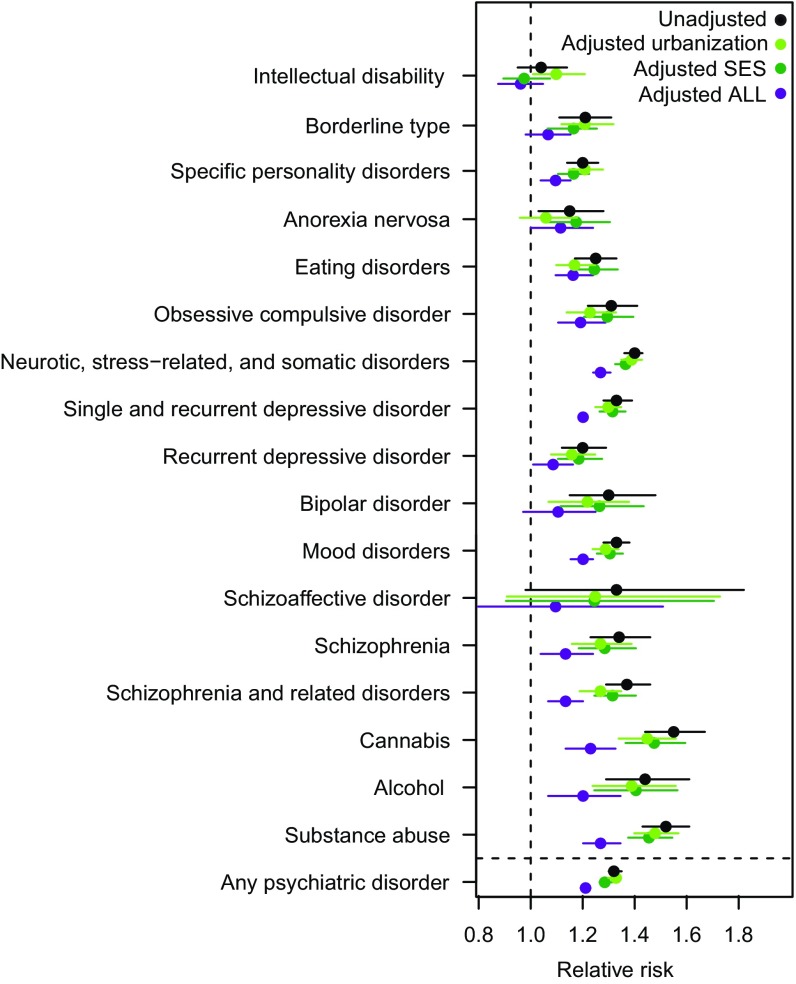
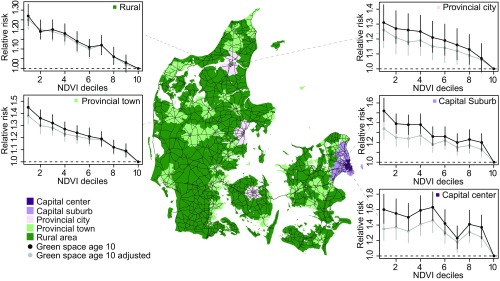
Urban residence is associated with a higher risk of some psychiatric disorders, but the underlying drivers remain unknown. There is increasing evidence that the level of exposure to natural environments impacts mental health, but few large-scale epidemiological studies have assessed the general existence and importance of such associations. Here, we investigate the prospective association between green space and mental health in the Danish population. Green space presence was assessed at the individual level using high-resolution satellite data to calculate the normalized difference vegetation index within a 210 × 210 m square around each person’s place of residence (∼1 million people) from birth to the age of 10. We show that high levels of green space presence during childhood are associated with lower risk of a wide spectrum of psychiatric disorders later in life. Risk for subsequent mental illness for those who lived with the lowest level of green space during childhood was up to 55% higher across various disorders compared with those who lived with the highest level of green space. The association remained even after adjusting for urbanization, socioeconomic factors, parental history of mental illness, and parental age. Stronger association of cumulative green space presence during childhood compared with single-year green space presence suggests that presence throughout childhood is important. Our results show that green space during childhood is associated with better mental health, supporting efforts to better integrate natural environments into urban planning and childhood life.
Overview
The claims and statistics of this paper haven’t been checked yet.
Free: it reads the open-access text and checks the first 5 claims that cite a source we can check. Create a free account to check every claim.
Integrity signals
Registry
Cites
Statistics
Figures
Verification
Claims the paper makes
The claims and statistics of this paper haven’t been checked yet.
Free: it reads the open-access text and checks the first 5 claims that cite a source we can check. Create a free account to check every claim.
Claims other papers make about this one
Each is checked against this paper’s own text: does it say what the citing paper says it does?
The source backs part of the claim, not all of it — or backs it for a different population, condition or comparison.
In the citing paper
“More greenery in urban areas creates higher social cohesion and increases people’s physical activity level, therefore improving children’s cognitive development (137).”
From The Impact of Climate Change on Mental Health: A Systematic Descriptive Review (2020) · cites this paper as [137]
Experimental — accuracy not yet measured
Self-check
Percentages, sums and reported differences re-computed from the paper’s own numbers.
The self-check needs the paper’s full text.
Citations
Cites
Cox’s regression model for counting processes: A large sample study
Andersen, P. K., & Gill, R. D. (1982) · The Annals of Statistics · doi:10.1214/aos/1176345976 · Cited by 4,419 · cited 1×
“IRR of psychiatric disorders were estimated in time-to-event analyses using Cox regressions, using age as the underlying timescale with separate baselines for each gender (51).”
MethodWolch, J. R., Byrne, J., & Newell, J. P. (2014) · Landscape and Urban Planning · doi:10.1016/j.landurbplan.2014.01.017 · Cited by 4,309 · cited 1×
“Lower access to green space could be an added risk factor for mental health among vulnerable groups of society (40, 41).”
BackgroundHartig, T., Mitchell, R., de Vries, S., & Frumkin, H. (2014) · Annual Review of Public Health · doi:10.1146/annurev-publhealth-032013-182443 · Cited by 3,638 · cited 3×
“Green space can enhance psychological restoration, can affect brain structure through positive associations with amygdala integrity, and could mitigate negative effects from the socially dense and noisy city environment that heighten stress (17, 19, 23, 24).”
BackgroundResultExploring pathways linking greenspace to health: theoretical and methodological guidance
Markevych, I., Schoierer, J., Hartig, T., Chudnovsky, A., Hystad, P., Dzhambov, A. M., de Vries, S., Triguero-Mas, M., Brauer, M., Nieuwenhuijsen, M. J., et al. (2017) · Environmental Research · doi:10.1016/j.envres.2017.06.028 · Cited by 2,543 · cited 1×
“Effects of different qualitative aspects and use of green space is important to identify a possible mechanistic link (37).”
BackgroundSchizophrenia risk from complex variation of complement component 4
Sekar, A., Bialas, A. R., de Rivera, H., Davis, A., Hammond, T. R., Kamitaki, N., Tooley, K., Presumey, J., Baum, M., Van Doren, V., et al. (2016) · Nature · doi:10.1038/nature16549 · Cited by 2,394
Extinction of experience: the loss of human–nature interactions
Soga, M., & Gaston, K. J. (2016) · Frontiers in Ecology and the Environment · doi:10.1002/fee.1225 · Cited by 1,802 · cited 1×
“Loss of human− nature interactions presents a health risk, and it can also reduce peoples’ appreciation of natural environments, creating negative feedback loops (42).”
BackgroundTwohig-Bennett, C., & Jones, A. (2018) · Environmental Research · doi:10.1016/j.envres.2018.06.030 · Cited by 1,766
The Danish Psychiatric Central Research Register
Mors, O., Perto, G. P., & Mortensen, P. B. (2011) · Scandinavian Journal of Public Health · doi:10.1177/1403494810395825 · Cited by 1,589 · cited 1×
“We linked all individuals from the study population and their parents and siblings with the Danish Psychiatric Central Research Register (44) to obtain information about psychiatric disorders.”
MethodSelf-citationCity living and urban upbringing affect neural social stress processing in humans
Lederbogen, F., Kirsch, P., Haddad, L., Streit, F., Tost, H., Schuch, P., Wüst, S., Pruessner, J. C., Rietschel, M., Deuschle, M., et al. (2011) · Nature · doi:10.1038/nature10190 · Cited by 1,584 · cited 3×
“Individuals with urban upbringing have high neural activity linked to stress processing, which could lead to higher risk of psychiatric disorders in adults (4).”
BackgroundMorbidity is related to a green living environment
Maas, J., Verheij, R. A., de Vries, S., Spreeuwenberg, P., Schellevis, F. G., & Groenewegen, P. P. (2009) · Journal of Epidemiology and Community Health · doi:10.1136/jech.2008.079038 · Cited by 1,133 · cited 1×
“Exposure to green space has been suggested to lower depression (13, 14) and schizophrenia risk (15), improve children’s cognitive development (16), and reduce neural activity linked to psychiatric disorders (11, 17).”
Background
Research works printed but not linked: 2
- World Health Organization 1992 The ICD-10 Classification of Mental and Behavioural Disorders: Clinical Descriptions and Diagnostics Guidelines World Health Org Geneva
- Danmarks Statistik 1991 IDA–En Integreret Database for Arbejdsmarkedsforskning: Hovedrapport Denmark Stat Copenhagen
Cited by
Items 801–868 of 868
Cumulative benefits of nature: Childhood nature experiences and daily well-being in young adults
Liu, Q., Wang, S., Niu, X., Li, C., Guo, T., Chen, X., & Kong, F. (2026) · Journal of Environmental Psychology · doi:10.1016/j.jenvp.2026.103076
Standl, M., & Hardelid, P. (2026) · Environmental Research Health · doi:10.1088/2752-5309/ae6f41
“…datasets studies have been used for multiple longitudinal studies into the impact of environmental conditions on child health in Denmark [44–46], Wales[47] and Western Australia [48] among other jurisdictions, however legal and administrative challenges in accessing and linking…”
Living Environments and Mental Health: the environMAP databasePreprint
Renner, P., Polemiti, E., Jentsch, M., Banks, J., Cleff, D., Siehl, S., Dallavalle, M., Lett, T. A. P., Buck, C., Castell, S., et al. (2026) · medRxiv · doi:10.64898/2026.05.15.26353275
Aydın, S. Ü., Munir, A., & Asri, R. (2024) · American Psychiatric Association Publishing eBooks · doi:10.1176/appi.books.9798894551906.lg04
AT RISK - Epidemiological studies on adolescent psychopathology
Bouter, D. C. (2025) · EUR Research Repository (Erasmus University Rotterdam)
Zhang, Y., Liang, X., Zhao, S., Chen, Y. C., Zhang, Q., & Zhang, H. (2026) · BMC Medical Education · doi:10.1186/s12909-026-09631-8
“This environment consistently models and reinforces the essential values of respect, empathy, and compassionate care for future healthcare practitioners [43, 44].”
Baranyi, G., Patalay, P., Church, D., de Hoogh, K., Fitzsimons, E., & Tonne, C. C. (2026) · Environment International · doi:10.1016/j.envint.2026.110361
Men om Pelle blir kissnödig och behöver göra nummer två. Vad gör jag då?
Thiman, P., & Leitz, F. (2026) · Epsilon Archive for Student Projects (Swedish University of Agricultural Sciences)
Gregoriou, A., & Ioannou, B. I. (2026) · Research Square · doi:10.21203/rs.3.rs-9651338/v1
A one health sustainability framework for ecologically mediated nature-based wellbeing
Wells, K., Brown, M., Jochem, C., & Garrod, B. (2026) · Environmental Research Letters · doi:10.1088/1748-9326/ae803f
Ghosal, S., Ghosh, M., & Kumar, H. (2026) · Case Studies in the Environment · doi:10.1525/cse.2026.2722477
Clark, H., Leach, M., & Brymer, E. (2026) · Public Health · doi:10.1016/j.puhe.2026.106386 · Cited by 1
Fernández, M. T. S. (2026) · Gredos (University of Salamanca) · doi:10.14201/gredos.171911
The Rivers Flow Through Us: Collective Effervescence Mediates the Effect of Nature on Wellbeing
Gabriel, S., & Schneider, V. (2026) · Sustainability · doi:10.3390/su18136795
Katsiaflaka, G., Pergantis, P., Georgiou, K., & Petropoulos, A. (2026) · World Journal of Advanced Research and Reviews · doi:10.30574/wjarr.2026.31.1.1839
Babalola, O. D., & Adedoyin-Adedipe, S. A. (2026) · Civil Engineering and Architecture · doi:10.13189/cea.2026.141329
Wellbeing effects of outdoor education programs for students over time: a scoping review
Stefanos, K., & Vella‐Brodrick, D. (2026) · Journal of Outdoor and Environmental Education · doi:10.1007/s42322-026-00259-2
Wang, B., Chen, M., Shi, L., Cao, Y., Yang, Y., Yang, J., Liu, S., & Peng, Y. (2026) · Frontiers in Public Health · doi:10.3389/fpubh.2026.1833501
“Population level studies further indicate that long term exposure to residential green space is associated with lower risks of psychiatric disorders (5), while longitudinal evdence suggests that individuals moving to greener urban environments experience measurable improvements in mental health (6).”
Nature-based Solutions for the building system
Catalano, C., & Hasanaj, G. (2025) · Studi e saggi · doi:10.36253/979-12-215-0966-3.19
Kortekaas, C. H., & Hrůzová, L. (2023) · Comillas Repository (Comillas Pontifical University)
Bizuayehu, G., Gashu, K., & Debebe, B. (2026) · Sustainable Futures · doi:10.1016/j.sftr.2026.102037
Everyday Ecotherapy: Nature Connection Practices for Where We Live, Learn, Work, and Play
Schuyler, C., & Ibes, D. C. (2026) · Routledge eBooks · doi:10.4324/9781003591412
-, S. M., Jena, S., & Rath, P. K. (2026) · International Journal of Drug Delivery Technology · doi:10.25258/ijddt.16.72s.129
“A large longitudinal study found that “childhood exposure to green spaces significantly reduced the risk of psychiatric disorders in adulthood” (Engemann et al., 2019).”
Nature and the mind: Towards nature-based mental health care and prevention
Vivaldi, G., Chukwusa, E., Bridge, N., Smythe, M., Bakolis, I., Page, L., Thompson, R., White, M., & Mechelli, A. (2026) · PLOS mental health. · doi:10.1371/journal.pmen.0000647
“This suggests that benefits may extend beyond supporting recovery among people with existing mental health problems and may also play a preventive role [26,27].”
Shang, K., Wei, S., & Hu, B. (2026) · BMC Psychology · doi:10.1186/s40359-026-05293-9
“Formal schooling occupies a substantial share of adolescents’ daily time, opportunities to spend unstructured time outdoors are limited and unevenly distributed across the week [21, 70].”
Hu, C.-C., Ma, X., & Zhou, X. (2026) · Research Square · doi:10.21203/rs.3.rs-10849954/v1
(2018) · Iverieli (National Parliamentary Library of Georgia)
Dinger, U., & Schauenburg, H. (2026) · Elsevier eBooks · doi:10.1016/b978-3-437-21352-6.00010-9
Liu, H., Cheng, B., Wei, W., Qin, L., & Zhang, F. (2026) · BMC Psychiatry · doi:10.1186/s12888-026-08588-8
Ciriza-Barea, E., Carballal-Mariño, M., Díaz-Martínez, F., Núñez-Jiménez, C., Sanchez-Almeida, E., Balaguer-Martínez, J. V., García-Sánchez, J. A., Viver-Gómez, S., Gorrotxategi-Gorrotxategi, P. J., Sampera, E. C., et al. (2026) · Revista Española de Salud Pública · doi:10.67113/resp.v100i1.1544
Pathways to play: Race, neighborhood safety, and other correlates of outdoor play in early childhood
Rice, I., Lastrapes, M., Lee, E., & Anderson, A. R. (2026) · American Journal of Community Psychology · doi:10.1002/ajcp.70106
The effect of nature on mental health
Berman, M. G. (2026) · World Psychiatry · doi:10.1002/wps.70097
LeClair, J. (2026) · Canadian Geographies / Géographies canadiennes · doi:10.1111/cag.70095
Effects of schoolyard greening and health promoting school programs on child development
Wilhelmina, V. E. B. H. (2026) · Research Publications (Maastricht University) · doi:10.26481/dis.20260702be
Wang, L., Kwan, M., & Song, L. (2026) · Environmental Science & Technology · doi:10.1021/acs.est.6c09466
Boko, I. (2026) · SSRN Electronic Journal · doi:10.2139/ssrn.7533079
Architectural design and psychological comfort of the population under Covid pandemic-19
خليفة, ن., بوزاهر, س., & بوخبلة, م. (2022) · مجلة العمارة وبيئة الطفل
Associations Between Biodiversity-Related Exposures and Mental Health: A Scoping Review
Moreau, M., Boroujeni, K. B., Cohen, C. G., & Hudon, A. (2026) · Psychiatry International · doi:10.3390/psychiatryint7050217
“A nationwide Danish cohort study (943,027 participants) identified that greater childhood exposure to residential green space was associated with up to 55% lower risk of several psychiatric disorders later in life [8].”
Systematic review: Natures and urbanizations affect on mental health and disorders.
Lindqvist, J. (2026) · UEF eRepo (University of Eastern Finland)
Πιπίδη, Ά. (2023) · Institutional Repository Hellanicus
Squillacioti, G. (n.d.) · Institutional Research Information System University of Turin (University of Turin)
Harris, J. (2026) · Open Repository and Bibliography (University of Luxembourg)
Shahab, S., Richmond, J., Smith, T., Khan, M., & Harris, N. (2026) · Journal of Urbanism International Research on Placemaking and Urban Sustainability · doi:10.1080/17549175.2026.2740102
Sharp-Newton, E. (2025) · Journal of Urban Design and Mental Health
Quantifying parks as preventive health assets using population-scale mobility data
Su, H., Li, W., Li, S., Ke, S., & Zhang, H. (2026) · Nature Communications · doi:10.1038/s41467-026-78106-7
Burt, S. A., Moyakhe, L. B., Gillenwater, L. A., Klump, K. L., & Pearson, A. L. (2026) · Journal of the American Academy of Child & Adolescent Psychiatry · doi:10.1016/j.jaac.2026.10.002
Cruz-Piedrahita, C., & Delgado-Serrano, M. D. M. (2026) · Cities & Health · doi:10.1080/23748834.2026.2739164
Early-Life Neighborhood Resources and Later-Life Mental Health
Farmer, J. R., Lin, J. J. Y., Kubzansky, L. D., James, P., Mukherjee, R., McAlaine, K., & Weisskopf, M. G. (2026) · Environmental Health Perspectives · doi:10.1021/ehp.6c00793
Mental health benefits of forest visits and digital forest therapy: a narrative review
Gačal, H., Kurjaková, J., Vido, J., Pichlerová, M., Pichler, V., Kurjak, D., & Petrík, P. (2026) · Journal of Forestry Research · doi:10.1007/s11676-026-02157-1
“This protective association remained even after accounting for urbanization, socio-economic factors, family history of mental health problems and parental age, suggesting that nature exposure during formative years may build resilience against mental illness (Engemann et al. 2019).”
Han, Z., Tong, X., Wang, Q., Li, X., Ji, J. S., Tang, K., Duncan, D. T., James, P., & Li, Y. (2026) · Communications Medicine · doi:10.1038/s43856-026-01963-2
Early-life neighborhood resources and adulthood mortality
Farmer, J. R., Lin, J. J. Y., James, P., Kubzansky, L. D., Mukherjee, R., Leung, M., & Weisskopf, M. G. (2026) · Social Science & Medicine · doi:10.1016/j.socscimed.2026.119968
Pontvianne, A., Hahs, A. K., Rayner, J., Williams, N. S. G., Cornish, K. M., & Johnson, K. A. (2026) · Journal of Environmental Psychology · doi:10.1016/j.jenvp.2026.103258
Early-Life Environmental Exposures and Brain Structure in SchizophreniaPreprint
Stano, A., Quinones, J. F., Fischer, D. J., Weber, S., Klock, L., Amaya, I., Lorenz, R. C., & Kühn, S. (2026) · medRxiv · doi:10.64898/2026.10.22.26366215
van Baar, J. M., James, A. M., Chivardi, M., Lane, K., Gradus, J. L., Besser, L. M., Hirsch, J. A., Kaufman, J. D., James, P., & Jimenez, M. P. (2026) · American Journal of Epidemiology · doi:10.1093/aje/kwag278
Carranza, E. P. S., & Jimenez, L. M. O. (2026) · Religación Press eBooks · doi:10.46652/religacionpress.493.c1039
Sarkar, A. (2026) · doi:10.68821/jcube.2026.0001
“Landmark cohort evidence from Denmark found that children raised amid the lowest levels of residential green space had up to 55% higher risk of developing psychiatric disorders in later life, independent of socioeconomic confounders (Engemann et al., 2019).”
Clarke, A. (2026) · The British Journal of Social Work · doi:10.1093/bjsw/bcag237
Guo, Z., Gao, W., Yu, Y., Zhu, Y., Guo, L., & Dewancker, B. J. (2026) · Forests · doi:10.3390/f17111295
NEARBY GREEN SPACE ACCESS IS ASSOCIATED WITH LOWER STRESS AND BETTER SELF-RATED HEALTH
Wantouw, S., Binti, S. J., & Liow, F. E. R. I. (2026) · Jurnal Ilmiah Ilmu Terapan Universitas Jambi|JIITUJ| · doi:10.22437/jiituj.v10i5.58568
Glock, R. (2025) · The Scholarship East Carolina University's Institutional Repository (East Carolina University)
Aguilar-Farias, N., Toledo-Vargas, M., Miranda-Marquez, S., Cortinez-O'Ryan, A., Martino-Fuentealba, P., Cristi-Montero, C., Rodriguez-Rodriguez, F., Guarda-Saavedra, P., Cruz, B. D. P., & Okely, A. D. (2021) · doi:10.3389/fped.2021.667362.s001
Li, H., Li, Y., Wang, Z., & Zhang, G. (2023) · doi:10.3389/fpubh.2023.1254185.s001
Liu, Y., Zhou, W., Liu, M., Wang, Y., Chen, S., & Xiong, X. (2025) · doi:10.3389/fped.2025.1561476.s001
Nature, Nurture, and Early Childhood Development: Emerging Evidence and Opportunities for Pediatrics
Pettoello‐Mantovani, M., Pop, T. L., Giardino, I., Bali, D., Şevketoğlu, E., Pastore, M. N., Bernardo, G. D., Somekh, E., & Vural, M. (2026) · The Journal of Pediatrics · doi:10.1016/j.jpeds.2026.115406
How intergenerational nature stewardship can heal cities
Sylvia, S., Akinyinka, O., Hari, K. N., & Paulo, S. (2026) · doi:10.3724/cn-20260007
Metadata
- Authors
- Engemann, K., Pedersen, C. B., Arge, L., Tsirogiannis, C., Mortensen, P. B., & Svenning, J.-C.
- Affiliations
- Aarhus University (DK)
- Corresponding author
- Engemann, Kristine
- ORCID
- Venue
- Proceedings of the National Academy of Sciences
- Publisher
- National Academy of Sciences
- Published
- 2019-02-25
- Volume
- 116
- Issue
- 11
- Pages
- 5188-5193
- ISSN
- 0027-8424 (ISSN-L)
- 1091-6490
- PMC
- PMC6421415
- OpenAlex
- W2917225355
- Cited by
- 668
- References
- 50
- Citations by year
- 2026: 63 · 2025: 74 · 2024: 89 · 2023: 96 · 2022: 99 · 2021: 114 · 2020: 92 · 2019: 37
- FWCI
- 36.93
- Type
- journal article
- Language
- en
- Open access
- hybrid
- doi.org
- Licence
- Locations
- Proceedings of the National Academy of Sciences (publishedVersion, cc-by-nc-nd)
- Europe PMC (PubMed Central) (publishedVersion, cc-by-nc-nd)
- PubMed Central (publishedVersion, cc-by-nc-nd)
- PubMed (publishedVersion)
- Funders
- Villum Fonden (16549)
- Topics
- Social Sciences › Urban Studies › Urban Green Space and Health
- Social Sciences › Health › Health disparities and outcomes
- Social Sciences › Sociology and Political Science › Environmental Justice and Health Disparities
- Keywords
- residential green space, children's exposure, mental illness, mental health, urbanization, NDVI, satellite remote sensing, cumulative exposure, urban planning, natural environment
- MeSH terms
- Adolescent, Adult, Mental Disorders, Child, Denmark, Environment, Humans, Risk Factors, Urbanization
About these checks
Registry, retraction, Cites and statistics results are computed, not judged, with one exception: a printed reference that no index lists is read once by a model before it counts as a citation error. Claims are extracted by a model and kept only when their quote appears verbatim in the text; each cited source is then checked, with a model’s help, for whether it says what the claim relies on. Those verdicts can be wrong — read the claim’s quote and the cited source before relying on one.
Statistics and arithmetic are recomputed, not judged.
Confidence bands are shown only for fields calibrated on our annotated test set. None is calibrated yet, so no band is shown.
What counts as a claim ›How we measure confidence ›How we check this ›
Are you an author, or do you see a problem with this page? Request a review
Data sources
Bibliographic data: Semantic Scholar, OpenAlex, Crossref.
Contains information from the Semantic Scholar Academic Graph Datasets, made available under the ODC Attribution License (ODC-BY 1.0).
Semantic Scholar’s data is described in: Kinney, R., et al. (2023). The Semantic Scholar Open Data Platform. arXiv:2301.10140.
