

Microbiome interactions shape host fitness
Open accessThe DOI matches its Crossref record; 47 of the 47 references it cites were found in a registry or an index.
Abstract
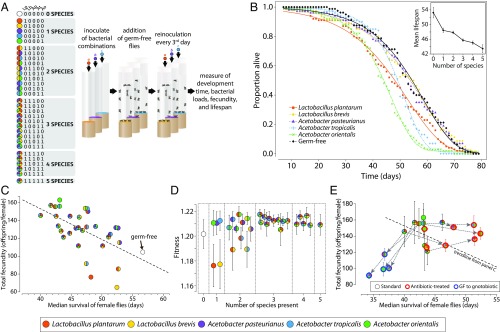
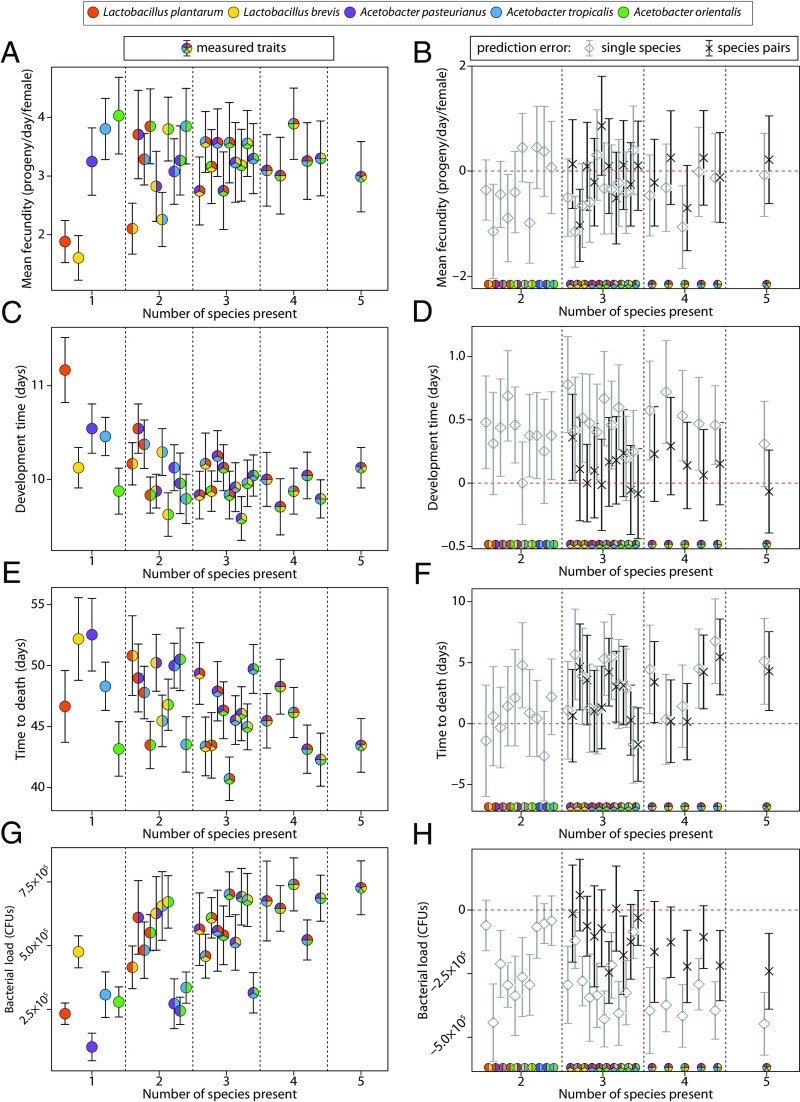
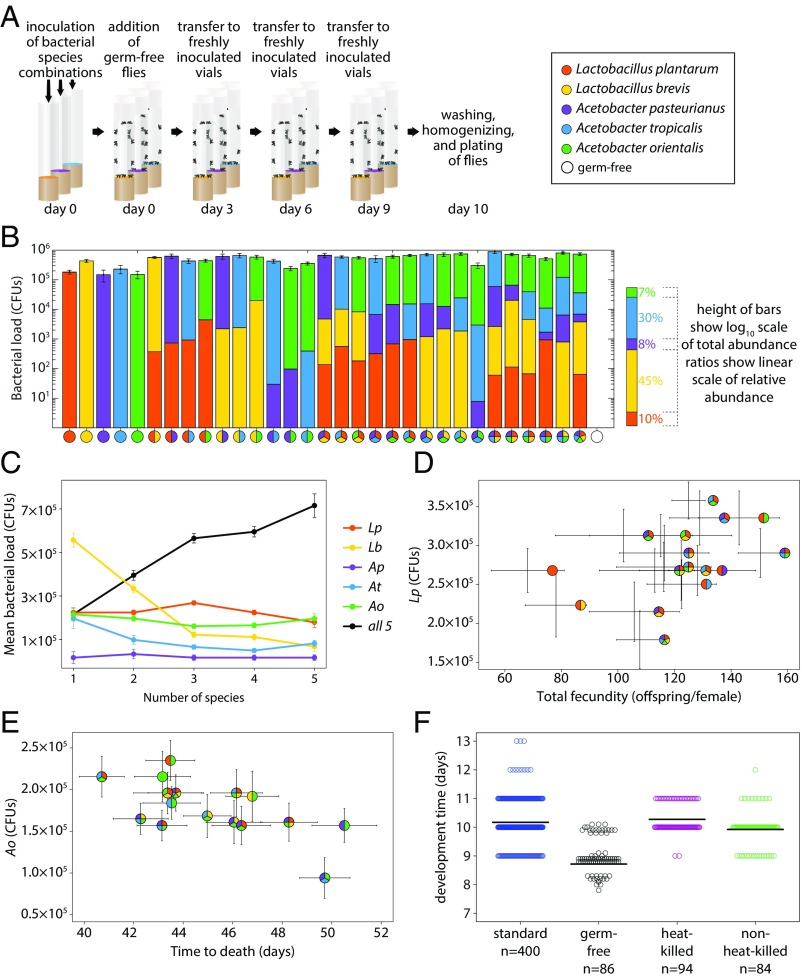
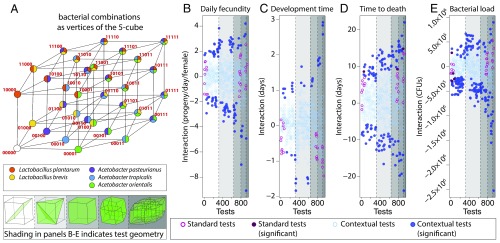
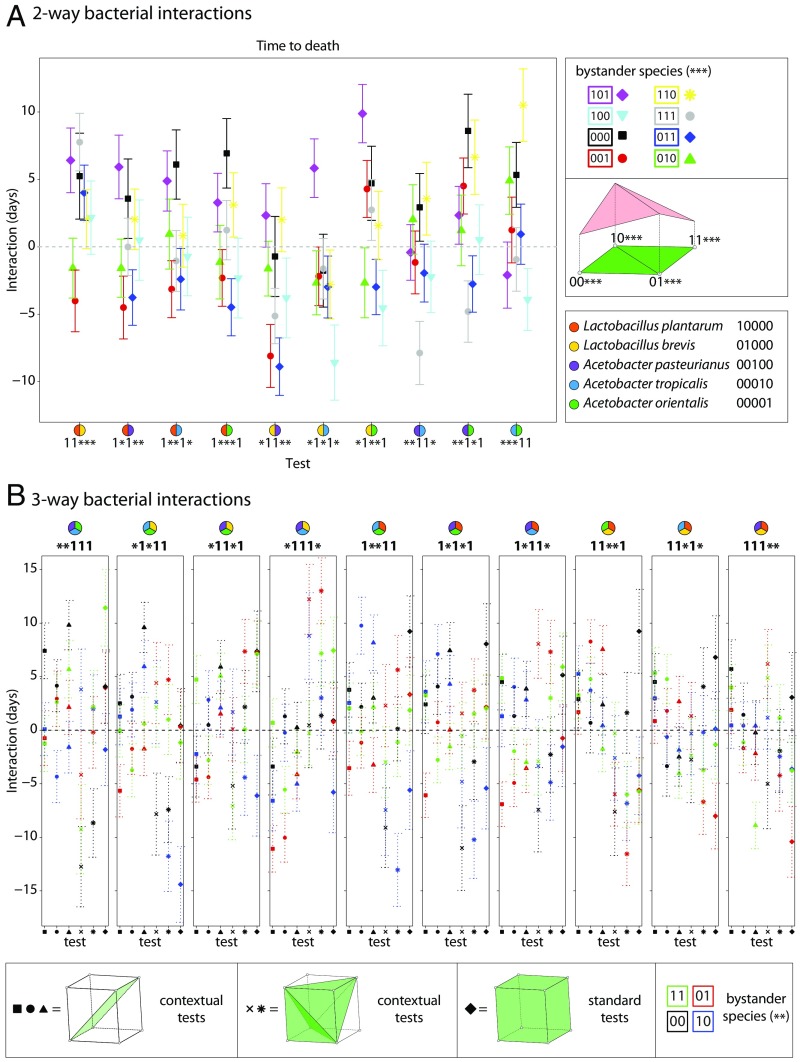
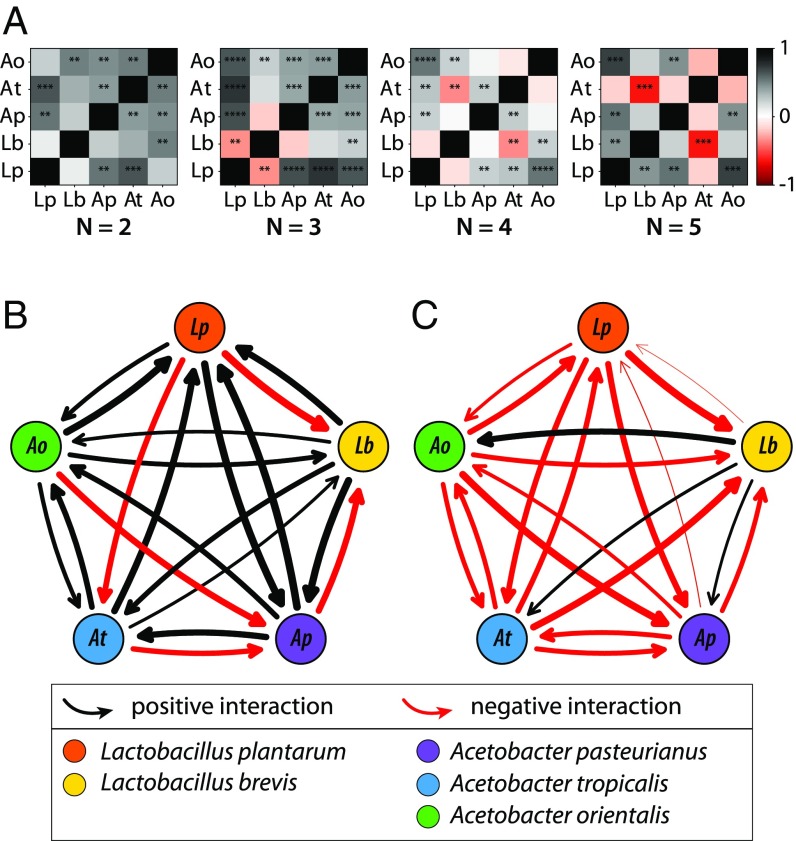
Gut bacteria can affect key aspects of host fitness, such as development, fecundity, and lifespan, while the host, in turn, shapes the gut microbiome. However, it is unclear to what extent individual species versus community interactions within the microbiome are linked to host fitness. Here, we combinatorially dissect the natural microbiome of Drosophila melanogaster and reveal that interactions between bacteria shape host fitness through life history tradeoffs. Empirically, we made germ-free flies colonized with each possible combination of the five core species of fly gut bacteria. We measured the resulting bacterial community abundances and fly fitness traits, including development, reproduction, and lifespan. The fly gut promoted bacterial diversity, which, in turn, accelerated development, reproduction, and aging: Flies that reproduced more died sooner. From these measurements, we calculated the impact of bacterial interactions on fly fitness by adapting the mathematics of genetic epistasis to the microbiome. Development and fecundity converged with higher diversity, suggesting minimal dependence on interactions. However, host lifespan and microbiome abundances were highly dependent on interactions between bacterial species. Higher-order interactions (involving three, four, and five species) occurred in 13–44% of possible cases depending on the trait, with the same interactions affecting multiple traits, a reflection of the life history tradeoff. Overall, we found these interactions were frequently context-dependent and often had the same magnitude as individual species themselves, indicating that the interactions can be as important as the individual species in gut microbiomes.
Overview
The claims and statistics of this paper haven’t been checked yet.
Free: it reads the open-access text and checks the first 5 claims that cite a source we can check. Create a free account to check every claim.
Integrity signals
Registry
Cites
Statistics
Figures
Verification
Claims the paper makes
The claims and statistics of this paper haven’t been checked yet.
Free: it reads the open-access text and checks the first 5 claims that cite a source we can check. Create a free account to check every claim.
Claims other papers make about this one
Each is checked against this paper’s own text: does it say what the citing paper says it does?
In the citing paper
“Recent animal studies have shown that the host fitness is regulated by functional interactions among species, not by a single or a limited group of taxa [139]”
From Gut Microbiota, Muscle Mass and Function in Aging: A Focus on Physical Frailty and Sarcopenia (2019) · cites this paper as [139]
Self-check
Percentages, sums and reported differences re-computed from the paper’s own numbers.
The self-check needs the paper’s full text.
Citations
Cites
The human microbiome: at the interface of health and disease
Cho, I., & Blaser, M. J. (2012) · Nature Reviews Genetics · doi:10.1038/nrg3182 · Cited by 3,449 · cited 1×
“These observations set up two major questions: What is the role of an individual bacterial species versus interactions between them in determining host lifespan, and how is the microbiome effect on lifespan related to overall host fitness? Identifying the host effects of specific bacteria has been difficult, in part,…”
BackgroundWill a Large Complex System be Stable?
MAY, R. M. (1972) · Nature · doi:10.1038/238413a0 · Cited by 2,869
Trade-Offs in Life-History Evolution
Stearns, S. C. (1989) · Functional Ecology · doi:10.2307/2389364 · Cited by 2,852 · cited 1×
“We therefore set up an experiment to measure how defined species compositions change each of the host fitness traits of lifespan, fecundity, and development time, which have been found to covary in life history tradeoffs (5, 6).”
MethodON THE USE OF MATRICES IN CERTAIN POPULATION MATHEMATICS
LESLIE, P. H. (1945) · Biometrika · doi:10.1093/biomet/33.3.183 · Cited by 2,671 · cited 1×
“To address this question, we combined our data for development, fecundity, and lifespan (SI Appendix, Table S1) in a Leslie matrix (26), a classic model of discrete population growth, to calculate organismal fitness under each bacterial association.”
MethodAcquisition and Allocation of Resources: Their Influence on Variation in Life History Tactics
van Noordwijk, A. J., & de Jong, G. (1986) · The American Naturalist · doi:10.1086/284547 · Cited by 2,383
The Long-Term Stability of the Human Gut Microbiota
Faith, J. J., Guruge, J. L., Charbonneau, M., Subramanian, S., Seedorf, H., Goodman, A. L., Clemente, J. C., Knight, R., Heath, A. C., Leibel, R. L., et al. (2013) · Science · doi:10.1126/science.1237439 · Cited by 2,058
Asymmetric Coevolutionary Networks Facilitate Biodiversity Maintenance
Bascompte, J., Jordano, P., & Olesen, J. M. (2006) · Science · doi:10.1126/science.1123412 · Cited by 1,283 · cited 1×
“(35), where asymmetry of interactions is indexed from 0 (perfectly symmetrical) to 2 (exactly opposite).”
BackgroundHost Biology in Light of the Microbiome: Ten Principles of Holobionts and Hologenomes
Bordenstein, S. R., & Theis, K. R. (2015) · PLOS Biology · doi:10.1371/journal.pbio.1002226 · Cited by 1,240 · cited 1×
“Finally, we introduce a mathematical framework to deconstruct microbiome/host complexity by making a conceptual analogy between the bacterial species interactions and genetic epistasis (21, 22).”
MethodMicrobiota-liberated host sugars facilitate post-antibiotic expansion of enteric pathogens
Ng, K. M., Ferreyra, J. A., Higginbottom, S. K., Lynch, J. B., Kashyap, P. C., Gopinath, S., Naidu, N., Choudhury, B., Weimer, B. C., Monack, D. M., et al. (2013) · Nature · doi:10.1038/nature12503 · Cited by 1,035
Innate Immune Homeostasis by the Homeobox Gene Caudal and Commensal-Gut Mutualism in Drosophila
Ryu, J.-H., Kim, S.-H., Lee, H.-Y., Bai, J. Y., Nam, Y.-D., Bae, J.-W., Lee, D. G., Shin, S. C., Ha, E.-M., & Lee, W.-J. (2008) · Science · doi:10.1126/science.1149357 · Cited by 829
Cited by
Items 201–300 of 621
Pekarsky, S., Corl, A. B., Turjeman, S., Kamath, P. L., Getz, W. M., Bowie, R. C. K., Markin, Y. M., & Nathan, R. (2021) · Molecular Ecology · doi:10.1111/mec.16079 · Cited by 21
“…of microbes occupying the gastrointestinal tracts of animals play a fundamental role in immune function, metabolism and development of the host (Claus et al., 2008; Gould et al., 2018; Hooper et al., 2012; Kau et al., 2011; Rowland et al., 2018; Sommer & Bäckhed, 2013; Thaiss et al., 2016).”
BackgroundUnderstanding the impact of third-party species on pairwise coexistence
Deng, J., Taylor, W., & Saavedra, S. (2022) · PLOS Computational Biology · doi:10.1371/journal.pcbi.1010630 · Cited by 20
“[15] and it comprises ten-day experimental trials of five interacting microbes commonly found in the fruit fly Drosophila melanogaster gut microbiota: Lactobacillus plantarum (Lp), Lactobacillus brevis (Lb), Acetobacter pasteurianus (Ap), Acetobacter tropicalis (At), and Acetobacter orientalis (Ao).”
BackgroundWang, J., Hu, C., Tong, X., Gao, Y., Liang, R., Liu, C., & Zhao, K. (2025) · BMC Microbiology · doi:10.1186/s12866-024-03695-6 · Cited by 20
Manothiya, P., Dash, D., & Koiri, R. K. (2025) · Medicine in Microecology · doi:10.1016/j.medmic.2025.100157 · Cited by 25
Sannino, D. R., & Dobson, A. J. (2023) · Applied and Environmental Microbiology · doi:10.1128/aem.00165-23 · Cited by 20
Yunwei, L. U., Zhang, L., Liu, X., Lan, Y., Lixia, W. U., Wang, J., Wu, K., Chaojie, Y. A. N. G., Lv, R., Yi, D., et al. (2024) · Integrative Zoology · doi:10.1111/1749-4877.12813 · Cited by 20
Doms, S., Fokt, H., Rühlemann, M. C., Chung, C. J., Künstner, A., Ibrahim, S. M., Franke, A., Turner, L. M., & Baines, J. F. (2022) · eLife · doi:10.7554/elife.75419 · Cited by 20
“, 2009; Lynch and Pedersen, 2016), laboratory animals (Bäckhed et al., 2004; Turnbaugh et al., 2008; Rolig et al., 2015; Rosshart et al., 2017; Gould et al., 2018), and wild populations (Suzuki, 2017; Roth et al.”
BackgroundIncorporating functional trade-offs into studies of the gut microbiota
Reese, A. T., & Kearney, S. M. (2019) · Current Opinion in Microbiology · doi:10.1016/j.mib.2019.09.003 · Cited by 20
Towards synthetic ecology: strategies for the optimization of microbial community functions
Román, M. S., Arrabal, A., Benitez‐Dominguez, B., Quirós-Rodríguez, I., & Díaz‐Colunga, J. (2025) · Frontiers in Synthetic Biology · doi:10.3389/fsybi.2025.1532846 · Cited by 20
A trans-kingdom T6SS RNase effector targeting both prokaryotic and host cells for pathogenesis
Wang, Y., Li, Y., Yu, Z., Zhang, W., Ren, Z., Zhang, H., Lu, X., Guo, S.-Z., Zhou, J., Zhu, L., et al. (2025) · Cell Reports · doi:10.1016/j.celrep.2025.116074 · Cited by 19
A globally ubiquitous symbiont can drive experimental host evolution
Bates, K. A., Bolton, J. S., & King, K. C. (2021) · Molecular Ecology · doi:10.1111/mec.15998 · Cited by 19
Markalanda, S. H., McFadden, C. J., Cassidy, S. T., & Wood, C. W. (2022) · Ecology and Evolution · doi:10.1002/ece3.8283 · Cited by 20
“…in plant traits may have been apparent if our study had run longer, allowing us to capture effects on fitness components expressed later in life, such as the timing of reproduction or reproductive success (Gould et al., 2018; Lau & Lennon, 2012; Metcalf et al., 2019; Panke- Buisse et al., 2015).”
BackgroundShu, Q., Guo, X., Tian, C., Wang, Y., Zhang, X., Cheng, J., Li, F., & Li, B. (2023) · International Journal of Molecular Sciences · doi:10.3390/ijms241612731 · Cited by 19
Zhu, Y., Song, Z., Huo, S., Yang, K., & Hong, X. (2020) · FEMS Microbiology Ecology · doi:10.1093/femsec/fiaa004 · Cited by 19
“Furthermore, a recent study found that microbiome interactions in the insects shape host fitness (Gould et al. 2018).”
BackgroundLiu, S., Xiao, Y., Wang, X., Guo, D., Wang, Y., & Wang, Y. (2023) · Microbiology Spectrum · doi:10.1128/spectrum.00433-23 · Cited by 18
Pinnow, N., Chibani, C. M., Güllert, S., & Weiland‐Bräuer, N. (2023) · Animal Microbiome · doi:10.1186/s42523-023-00266-4 · Cited by 21
Anneberg, T. J., Turcotte, M. M., & Ashman, T. (2023) · Molecular Ecology · doi:10.1111/mec.17142 · Cited by 18
Naya-Català, F., Torrecillas, S., Piazzon, M. C., Sarih, S., Calduch-Giner, J. À., Fontanillas, R., Hostins, B., Sitjà‐Bobadilla, A., Acosta, F., Pérez‐Sánchez, J., et al. (2024) · Aquaculture · doi:10.1016/j.aquaculture.2024.740770 · Cited by 19
Community assembly of ectomycorrhizal fungal communities in pure and mixed Pinus massoniana forests
Tang, X., Yang, J., Lin, D., Lin, H., Xiao, X., Chen, S., Huang, Y., & Qian, X. (2024) · Journal of Environmental Management · doi:10.1016/j.jenvman.2024.121312 · Cited by 18
Cross, S. T., Brehm, A. L., Dunham, T. J., Rodgers, C. P., Keene-Snickers, A. H., Borlee, G. I., & Stenglein, M. D. (2023) · Viruses · doi:10.3390/v15020539 · Cited by 21
“e compared the lifespan, fecundity, and ev lopmental speed of galbut virus-infect d and uni fected flies [37,47].”
BackgroundMethodInfluentialEcological and evolutionary responses of earthworm holobionts to environmental changes
Adomako, M. O., Wu, J., & Yu, F. (2025) · The ISME Journal · doi:10.1093/ismejo/wraf044 · Cited by 26
“Climate change is perhaps the most critical driver of Earth’s biodiversity loss [6, 34, 35] and can induce rapid host–microbiota responses [30], which are tightly linked with ecological processes and host fitness [15, 36].”
Origins of scaling laws in microbial dynamics
Wang, X., & Liu, Y. (2023) · Physical Review Research · doi:10.1103/physrevresearch.5.013004 · Cited by 18
Ahmed, B., Beneš, F., Hajšlová, J., Fišarová, L., Vosátka, M., & Hijri, M. (2023) · Frontiers in Plant Science · doi:10.3389/fpls.2023.1219836 · Cited by 18
“Finding beneficial microbes with an impact on crop production and fitness is dependent not only on the accuracy of diversity indices but also on how they recruit and interact within the biotopes (Gould et al., 2018; Morella et al., 2020).”
BackgroundNutrition influences immunity: Diet and host-parasite interactions
Eleftherianos, I., Zhang, W., Tettamanti, G., Daley, L., Mohamed, A. A., & STANLEY, D. W. (2024) · Insect Biochemistry and Molecular Biology · doi:10.1016/j.ibmb.2024.104210 · Cited by 17
Nguyen, B. T., Than, A. T., Dinh, H., Morimoto, J., & Ponton, F. (2020) · Microorganisms · doi:10.3390/microorganisms8091289 · Cited by 19
“Axenic individuals might lack essential nutrients that can be provided by beneficial microbes [12,45], hence, possibly having a lower investment on eggs, which resulted in a long-term implication on offspring quality [46–48].”
BackgroundRomer, A. S., Grinath, J. B., Moe, K. C., & Walker, D. M. (2022) · Scientific Reports · doi:10.1038/s41598-022-07042-5 · Cited by 19
Microbiome-by-ethanol interactions impact Drosophila melanogaster fitness, physiology, and behavior
Chandler, J., Innocent, L. V., Martinez, D. J., Huang, I. L., Yang, J. L., Eisen, M. B., & Ludington, W. B. (2022) · iScience · doi:10.1016/j.isci.2022.104000 · Cited by 18
Self-citationCharacterisation of the symbionts in the Mediterranean fruit fly gut
Darrington, M., Leftwich, P. T., Holmes, N. A., Friend, L. A., Clarke, N. V. E., Worsley, S. F., Margaritopolous, J. T., Hogenhout, S. A., Hutchings, M. I., & Chapman, T. (2022) · Microbial Genomics · doi:10.1099/mgen.0.000801 · Cited by 18
“For example, the gut microbiome of Drosophila melanogaster is consistently formed by a core of five species: Lactobacillus plantarum, Lactobacillus brevis, Acetobacter pasteurianus, Acetobacter tropicalis and Acetobacter orientalis (Gould et al 2018).”
BackgroundInfluentialGrenier, T., Consuegra, J., Ferrarini, M. G., Akherraz, H., Bai, L., Dusabyinema, Y., Rahioui, I., Silva, P. D., Gillet, B., Hughes, S., et al. (2023) · eLife · doi:10.7554/elife.76584 · Cited by 17
A novel immune modulator IM33 mediates a glia-gut-neuronal axis that controls lifespan
Xu, W., Rustenhoven, J., Nelson, C. A., Dykstra, T., Ferreiro, A. L., Papadopoulos, Z., Burnham, C. D., Dantas, G. A., Fremont, D. H., & Kipnis, J. (2023) · Neuron · doi:10.1016/j.neuron.2023.07.010 · Cited by 17
Full factorial construction of synthetic microbial communitiesPreprint
Díaz‐Colunga, J., Catalán, P., Román, M. S., Arrabal, A., & Sánchez, Á. (2024) · eLife · doi:10.7554/elife.101906 · Cited by 17
Microbiota Influences Fitness and Timing of Reproduction in the Fruit Fly Drosophila melanogaster
Matthews, M. K., Malcolm, J., & Chaston, J. M. (2021) · Microbiology Spectrum · doi:10.1128/spectrum.00034-21 · Cited by 24
Microbes control Drosophila germline stem cell increase and egg maturation through hormonal pathways
Suyama, R., Cetraro, N., Yew, J. Y., & Kai, T. (2023) · Communications Biology · doi:10.1038/s42003-023-05660-x · Cited by 17
“These fi ndings are consistent with previous studies showing that a combination of intrinsic microbial functions can change host fi tness and control reproduction, development, and longevity 7 .”
InfluentialZhang, S., Li, B., Zeng, L., Yang, K., Jiang, J., Lu, F., Li, L., & Li, W. (2024) · European journal of medical research · doi:10.1186/s40001-024-01777-9 · Cited by 17
Zhou, X., Shen, S., & Wang, Z. (2024) · Scientific Reports · doi:10.1038/s41598-024-77273-1 · Cited by 16
“Furthermore, it provides novel insights into the role of gut microbiomes in the pathogenesis, prevention, clinical improvement, treatment, and prognosis of respiratory diseases 17,18 .”
BackgroundMedeiros, M. J., Seo, L., Macias, A., Price, D. K., & Yew, J. Y. (2024) · ISME Communications · doi:10.1093/ismeco/ycae134 · Cited by 17
“Both taxa have been linked to the fertility of D. melanogaster [41, 42, 66].”
Riaz, M. R., Marquez, I. S., Lindgren, H., Levin, G., Doyle, R. T., Cerón-Romero, M. A., Paoli, J. C., Drnevich, J. M., Fields, C. J., Geddes, B. A., et al. (2025) · Proceedings of the National Academy of Sciences · doi:10.1073/pnas.2411831122 · Cited by 16
“These interactions can have positive, negative, or little impact on one or both species involved ( 1 , 2 ) with mutualistic symbioses resulting in fitness benefits to both partners ( 3 ).”
Leech, T., McDowall, L., Hopkins, K., Sait, S. M., Harrison, X. A., & Bretman, A. J. (2021) · Molecular Ecology · doi:10.1111/mec.16149 · Cited by 19
Cao, W., Fang, L., Li, R. W., Chin, Y., Wang, Y., Xue, C., & Tang, Q. (2021) · Food Science and Human Wellness · doi:10.1016/j.fshw.2021.07.018 · Cited by 17
Successful microbial colonization of space in a more dispersed manner
Liu, X., Wang, M., Nie, Y., & Wu, X. (2021) · ISME Communications · doi:10.1038/s43705-021-00063-7 · Cited by 17
“However, higher-order interactions are also important in the ecosystem [46, 47], and sometimes the community theory of higher-order interactions is contrary to the classic theory that is based on pairwise interactions [48].”
Henry, L. P., & Ayroles, J. F. (2021) · BMC Microbiology · doi:10.1186/s12866-021-02168-4 · Cited by 16
“Higher order interactions among bacteria shape phenotypes in Drosophila [45, 46].”
BackgroundAnsari, A. F., Acharya, N. I. S., Kumaran, S., Ravindra, K., Reddy, Y. B. S., Dixit, N. M., & Raut, J. S. (2019) · Industrial & Engineering Chemistry Research · doi:10.1021/acs.iecr.9b03190 · Cited by 16
Akami, M., Ren, X., Wang, Y., Mansour, A., Cao, S., Qi, X., Ngakou, A., Ngane, R. A. N., & Niu, C. (2022) · International Journal of Tropical Insect Science · doi:10.1007/s42690-022-00733-6 · Cited by 15
“This interaction shapes the host insect fitness and shapes the abundance of gut microbiota (Gould et al. 2018) and is modulated by the availability and nutritional quality of host fruits.”
BackgroundEffects of host species on microbiota composition in Phlebotomus and Lutzomyia sand flies
Tabbabi, A., Mizushima, D., Yamamoto, D. S., & Kato, H. (2023) · Parasites & Vectors · doi:10.1186/s13071-023-05939-2 · Cited by 15
Employing Active Learning in Medium Optimization for Selective Bacterial Growth
Zhang, S., Aida, H., & Ying, B. (2023) · Applied Microbiology · doi:10.3390/applmicrobiol3040091 · Cited by 18
Negroni, M. A., Segers, F. H. I. D., Vogelweith, F., & Foitzik, S. (2020) · BMC Genomics · doi:10.1186/s12864-020-07191-9 · Cited by 17
Ferguson, M., Petkau, K., Shin, M., Galenza, A., Fast, D., & Foley, E. (2021) · Development · doi:10.1242/dev.186106 · Cited by 15
Master regulators of biological systems in higher dimensions
Eble, H., Joswig, M., Lamberti, L., & Ludington, W. B. (2023) · Proceedings of the National Academy of Sciences · doi:10.1073/pnas.2300634120 · Cited by 16
Self-citationThe microbiota influences the Drosophila melanogaster life history strategyPreprint
Walters, A. W., Matthews, M. K., Hughes, R. C., Malcolm, J., Rudman, S. M., Newell, P. D., Douglas, A. E., SCHMIDT, P. S., & Chaston, J. M. (2018) · bioRxiv (Cold Spring Harbor Laboratory) · doi:10.1101/471540 · Cited by 16
Leveraging microbial ecology for mosquito-borne disease control
Nichols, H. L., & Coon, K. L. (2025) · Trends in Parasitology · doi:10.1016/j.pt.2025.06.010 · Cited by 14
Quantitative genetics of microbiome-mediated traits
Week, B., Ralph, P. L., Tavalire, H. F., Cresko, W. A., & Bohannan, B. J. M. (2025) · Evolution · doi:10.1093/evolut/qpaf171 · Cited by 14
Geometry of fitness landscapes: peaks, shapes and universal positive epistasis
Crona, K., Krug, J., & Srivastava, M. (2023) · Journal of Mathematical Biology · doi:10.1007/s00285-023-01889-6 · Cited by 16
Parker-Character, J., Hager, D. R., Call, T. B., Pickup, Z. S., Turnbull, S. A., Marshman, E. M., Korch, S. B., Chaston, J. M., & Call, G. B. (2021) · Scientific Reports · doi:10.1038/s41598-021-02624-1 · Cited by 14
Taubenheim, J., Miklós, M., Tökölyi, J., & Fraune, S. (2022) · Frontiers in Microbiology · doi:10.3389/fmicb.2022.799333 · Cited by 14
Liu, W., Yang, J., Yu, M., Wu, D.-Y., Cui, L., Li, T., Sun, B., & Liu, P. (2022) · Frontiers in Microbiology · doi:10.3389/fmicb.2022.1050750 · Cited by 14
“As a regulator in physiology, immunity, and fitness of animals (Ramakrishna, 2013; Gould et al., 2018; Zhang et al., 2018; Rastelli et al., 2019), the gut microbiota is also depressed by warming temperatures.”
BackgroundJeon, J., Rahman, M. M., Han, C., Shin, J., Jin, K., & Kim, J. (2023) · Insects · doi:10.3390/insects14040358 · Cited by 15
Environmental specificity in Drosophila-bacteria symbiosis affects host developmental plasticity
Guilhot, R., Rombaut, A., Xuéreb, A., Howell, K. S., & Fellous, S. (2020) · Evolutionary Ecology · doi:10.1007/s10682-020-10068-8 · Cited by 14
Generalizing game-changing species across microbial communities
Deng, J., Angulo, M. T., & Saavedra, S. (2021) · ISME Communications · doi:10.1038/s43705-021-00022-2 · Cited by 16
Zhou, H., Sun, R., Nie, X., Xia, L., Dong, H., Liu, Y., Hou, S., Dong, W., Zhu, X., Yao, Y., et al. (2026) · Nature Microbiology · doi:10.1038/s41564-026-02279-6 · Cited by 14
“Beneficial intracommunity interactions have been shown to be critical for natural microbial communities to persist across multiple hosts 34,35 .”
InfluentialLewin‐Epstein, O., Jaques, Y., Feldman, M. W., Kaufer, D., & Hadany, L. (2023) · Communications Biology · doi:10.1038/s42003-023-05099-0 · Cited by 13
Alvarez-Aponte, Z. I., Govindaraju, A. M., Hallberg, Z. F., Nicolas, A. M., Green, M. A., Mok, K. C., Fonseca-García, C., Coleman‐Derr, D., Brodie, E., Carlson, H. K., et al. (2024) · The ISME Journal · doi:10.1093/ismejo/wrae068 · Cited by 15
“…of isolates, we calculated the corrinoid-specific growth enhance-mentas log 2 [1 + ((OD with corrinoid –OD no corrinoid )/(OD no corrinoid ))] [41] and determined a threshold for corrinoid dependence based on the growth of bacteria isolated in the NOC condition that also underwent serial…”
Kristensen, T. N., Schönherz, A. A., Rohde, P. D., Sørensen, J. G., & Loeschcke, V. (2024) · Scientific Reports · doi:10.1038/s41598-024-68753-5 · Cited by 13
Persistent viral infections impact key biological traits in Drosophila melanogaster
Castelló-Sanjuán, M., González, R., Romoli, O., Blanc, H., Nigg, J. C., & Saleh, M. (2025) · PLoS Biology · doi:10.1371/journal.pbio.3003437 · Cited by 13
Can dynamic network modelling be used to identify adaptive microbiomes?
Garcia, J., & Kao‐Kniffin, J. (2019) · Functional Ecology · doi:10.1111/1365-2435.13491 · Cited by 13
BEEM-Static: Accurate inference of ecological interactions from cross-sectional microbiome data
Li, C., Av‐Shalom, T. V., Tan, J. W. G., Kwah, J. S., Chng, K. R., & Nagarajan, N. (2021) · PLoS Computational Biology · doi:10.1371/journal.pcbi.1009343 · Cited by 13
“Interactions between members of a microbial community determine emergent phenomena such as homeostasis in the ecosystem [6, 7] and overall function of the microbiome [8].”
BackgroundBacterial Community Diversity and Bacterial Interaction Network in Eight Mosquito Species
da Silva, H., Oliveira, T. M. P., & Sallum, M. A. M. (2022) · Genes · doi:10.3390/genes13112052 · Cited by 13
“Increased interactions between bacterial microbiota can alter gene expression in the microbial community, the metabolism, and ecological interactions between species [54,55].”
BackgroundMicrobiome, Epigenetics and Fish Health Interactions in Aquaculture
Consuegra, S., Webster, T. M. U., & Anka, I. Z. (2023) · Wiley eBooks · doi:10.1002/9781119821946.ch11 · Cited by 15
Rush, T. A., Tannous, J., Lane, M. J., Meena, M. G., Carrell, A. A., Golan, J. J., Drott, M. T., Cottaz, S., Fort, S., Ané, J., et al. (2022) · mSystems · doi:10.1128/msystems.01052-22 · Cited by 14
Tabbabi, A., Mizushima, D., Yamamoto, D. S., Zhioua, E., & Kato, H. (2024) · PLoS neglected tropical diseases · doi:10.1371/journal.pntd.0012458 · Cited by 12
Henry, L. P., Fernandez, M., Webb, A. E., & Ayroles, J. F. (2025) · Proceedings of the Royal Society B Biological Sciences · doi:10.1098/rspb.2024.2558 · Cited by 13
“The relative importance of the microbiome may vary across these different fitness components [17,70,77]; building a more comprehensive map of host–microbiome interactions underlying fitness is an important research priority.”
Drosophila symbionts in infection: when a friend becomes an enemy
Yu, Y., & Iatsenko, I. (2025) · Infection and Immunity · doi:10.1128/iai.00511-24 · Cited by 13
Teulière, J., Bernard, C., & Bapteste, E. P. (2021) · Ageing Research Reviews · doi:10.1016/j.arr.2021.101375 · Cited by 13
Bacterial community dynamics following antibiotic exposure in a trematode parasite
Jorge, F., Froissard, C., Dheilly, N. M., & Poulin, R. (2021) · International Journal for Parasitology · doi:10.1016/j.ijpara.2021.11.006 · Cited by 12
“The stability and resilience of microbial communities may depend on which specific microbes are eliminated, as removal of some microbes may have differential disruptive impacts on community structure (Gould et al., 2018).”
BackgroundStatistical Methods for Microbiome Compositional Data Network Inference: A Survey
Chen, L., Wan, H. S., He, Q., He, S., & Deng, M. (2022) · Journal of Computational Biology · doi:10.1089/cmb.2021.0406 · Cited by 12
“In fact, high-order interactions have been shown to affect the microbial community both in simulations (Bairey et al., 2016) and in experiments (Gould et al., 2018).”
Cooper, R. O., Tjards, S., Rischling, J., Nguyen, D., & Cressler, C. E. (2022) · FEMS Microbiology Ecology · doi:10.1093/femsec/fiac082 · Cited by 12
Influence of bacteria on the maintenance of a yeast during Drosophila melanogaster metamorphosis
Guilhot, R., Rombaut, A., Xuéreb, A., Howell, K. S., & Fellous, S. (2021) · Animal Microbiome · doi:10.1186/s42523-021-00133-0 · Cited by 13
“Conclusions Microbial interactions are emerging as key features of symbiotic systems [1, 82, 83], including associations between microorganisms and Drosophila flies [10, 27].”
BackgroundInferring microbial interactions with their environment from genomic and metagenomic data
Brunner, J. D., Gallegos-Graves, L., & Kroeger, M. (2023) · PLoS Computational Biology · doi:10.1371/journal.pcbi.1011661 · Cited by 11
Hayes, C., Mitchell, A., Huerlimann, R., Jolly, J., Li, C., Booth, D. J., Ravasi, T., & Nagelkerken, I. (2025) · Molecular Ecology · doi:10.1111/mec.17704 · Cited by 12
“Microbial communities shape host physiology (Gould et al. 2018), immunity (Gerardo et al. 2020), behaviour (Ezenwa et al. 2012) and metabolism (Dvergedal et al. 2020) and can respond to environmental change faster than their host.”
Master of Puppets: How Microbiota Drive the Nematoda Ecology and Evolution?
Trejo‐Meléndez, V. J., & Contreras-Garduño, J. A. (2025) · Ecology and Evolution · doi:10.1002/ece3.71549 · Cited by 12
“Despite these advances, many studies remain focused on isolated life-history traits (Akbar et al. 2020; Diaz et al. 2015; Gould et al. 2018; Hoang et al. 2019; Kolodny and Schulenburg 2020; Macke et al. 2017; Santos et al. 2023), often without comparative analysis across environmental contexts or…”
Environment and diet shape the geography-specific Drosophila melanogaster microbiota composition
Gale, J. T., Kreutz, R., Morgan, S. J. G., Davis, E. K., Hough, C., Cancino, W. A. C., Burnside, B., Barney, R. P., Hunsaker, R., Hoyt, A. T., et al. (2025) · Applied and Environmental Microbiology · doi:10.1128/aem.00883-25 · Cited by 12
“These findings are consistent with the substantial body of work showing that laboratory and wild flies can be colonized persistently by specific sets of microorganisms (22, 24, 27, 30, 51).”
Gut Microbial Community and Host Thermoregulation in Small Mammals
Zhang, X., & Wang, D. (2022) · Frontiers in Physiology · doi:10.3389/fphys.2022.888324 · Cited by 16
“The experiments of gut microbiota transplant revealed that alteration in the gut microbiota induced variations in host phenotypes, further suggesting that the specific gut microbes are of importance for host fitness (Gould et al., 2018).”
BackgroundEvolutionary implications of host genetic control for engineering beneficial microbiomes
Henry, L. P., & Bergelson, J. M. (2023) · Current Opinion in Systems Biology · doi:10.1016/j.coisb.2023.100455 · Cited by 13
What do we mean by “aging”? Questions and perspectives revealed by studies in Drosophila
Wodrich, A. P. K., Scott, A. W., & Giniger, E. (2023) · Mechanisms of Ageing and Development · doi:10.1016/j.mad.2023.111839 · Cited by 11
Rohner, P. T., & Moczek, A. P. (2024) · Proceedings of the Royal Society B Biological Sciences · doi:10.1098/rspb.2024.0122 · Cited by 15
“While there is increasing evidence that microbiomes shape host evolution and development (e.g. [5 – 7]), the effects of symbionts on phenotypic and gen-etic variation of their host remain poorly understood [8], especially in cases where symbiont communities are complex and where hosts actively…”
BackgroundFull factorial construction of synthetic microbial communities
Díaz‐Colunga, J., Catalán, P., Román, M. S., Arrabal, A., & Sánchez, Á. (2026) · eLife · doi:10.7554/elife.101906.3 · Cited by 11
Li, S., Tang, R., Yi, H., Cao, Z., Sun, S., Liu, T., Zhang, S., & Jing, X. (2022) · Frontiers in Microbiology · doi:10.3389/fmicb.2022.849637 · Cited by 11
Barak, N., Fadeev, E., Brekhman, V., Aharonovich, D., Lotan, T., & Sher, D. (2023) · Microorganisms · doi:10.3390/microorganisms11040955 · Cited by 11
“…studies of bacteria as pathogens, there is an increasing evidence on bacteria playing significant roles in shaping the phenotype, development, behavior, and fitness of various hosts (Gould et al., 2018; Rosenberg and Zilber-Rosenberg, 2018; Schnedler-Meyer et al., 2018; Baldassarre et al., 2021).”
BackgroundApplication of Metagenomics to Chilean Aquaculture
Tello, M., Valdés, N., Vargas, R. A., Rojas, J., Parra, M., Gajardo, G., & González, A. (2020) · IntechOpen eBooks · doi:10.5772/intechopen.86302 · Cited by 12
Deconstructing taxa x taxa x environment interactions in the microbiota: A theoretical examinationPreprint
Yitbarek, S., Guittar, J. L., Knutie, S. A., & Ogbunugafor, C. B. (2019) · bioRxiv (Cold Spring Harbor Laboratory) · doi:10.1101/647156 · Cited by 11
“In particular, higher-order epistasis is of interest, as these interactions comprise all of the complexity and challenges of understanding and studying higher-order interactions in other systems, and even in microbes (Gould et al., 2018).”
BackgroundInfluentialCluster partitions and fitness landscapes of the Drosophila fly microbiome
Eble, H., Joswig, M., Lamberti, L., & Ludington, W. B. (2019) · Journal of Mathematical Biology · doi:10.1007/s00285-019-01381-0 · Cited by 13
Self-citationExperimental inheritance of antibiotic acquired dysbiosis affects host phenotypes across generations
Kowallik, V., Das, A., & Mikheyev, A. S. (2022) · Frontiers in Microbiology · doi:10.3389/fmicb.2022.1030771 · Cited by 11
“In general, interactions between symbionts can be as important as the individual species in gut microbiomes, therefore the effects of a disturbed microbiome go far beyond the loss of functions attributable to single taxa (Gould et al., 2018).”
BackgroundComparison between the gut bacterial community of laboratory cultured and wild Daphnia
Houwenhuyse, S., Callens, M., Bulteel, L., & Decaestecker, E. (2023) · FEMS Microbiology Ecology · doi:10.1093/femsec/fiad116 · Cited by 10
Drosophila melanogaster as a model to study polymicrobial synergy and dysbiosis
Cao, X., Scoffield, J. A., Xie, B., Morton, D. B., & Wu, H. (2023) · Frontiers in Cellular and Infection Microbiology · doi:10.3389/fcimb.2023.1279380 · Cited by 10
Lundberg, L. E., Mishra, P. P., Liu, P., Forsberg, M. M., Sverremark‐Ekström, E., Grompone, G., Håkansson, S., Linninge, C., & Roos, S. (2024) · Applied and Environmental Microbiology · doi:10.1128/aem.00247-24 · Cited by 13
“Synergistic and mutualis tic interactions between the strains can potentially give rise to increased tolerance and ecological fitness, as well as potentiate host development and shape host fitness, ultimately improving interactions with the host (3–5).”
BackgroundOral and vaginal microbiota in selected field mice of the genus Apodemus: a wild population study
Matějková, T., Hájková, P., Stopková, R., Stanko, M., Martin, J., Kreisinger, J., & Stopka, P. (2020) · Scientific Reports · doi:10.1038/s41598-020-70249-x · Cited by 10
Insect-Mediated Waste Conversion
Shaboon, A. M., Qi, X., & Omar, M. A. A. (2022) · Springer eBooks · doi:10.1007/978-3-030-91570-4_16 · Cited by 16
Bapteste, E. P., Huneman, P., Keller, L., Teulière, J., Lopez, P., Teeling, E. C., Lindner, A. B., Baudisch, A., Ludington, W. B., & Franceschi, C. (2023) · Ageing Research Reviews · doi:10.1016/j.arr.2023.101982 · Cited by 10
Self-citationEnvironmental microbes promote phenotypic plasticity in reproduction and sleep behaviour
Téfit, M. A., Budiman, T., Dupriest, A., & Yew, J. Y. (2023) · Molecular Ecology · doi:10.1111/mec.17095 · Cited by 12
“Considering the pivotal role microbes can play in fat storage and nutritional availability (Cox et al., 2015; Gould et al., 2018; Khosravi et al., 2015; Kim et al., 2021; Maruvada et al., 2017; Rajala et al., 2014; Schertzer & Lam, 2021; Torres-Fuentes et al., 2019; Zhao, 2013), different…”
Structure, function, and quantitative biology of the Drosophila gut microbiome
Ludington, W. B., Zhu, H., Aumiller, K., Xu, A., & Derrick, J. (2025) · Current Opinion in Microbiology · doi:10.1016/j.mib.2025.102653 · Cited by 9
“…of one, two, three, four, and five species was inoculated into germ-free flies, were used to generate datasets to model both the effects of microbes on one another for colonization studies [41,86] as well as to model the effects of differing microbial compositions on the host physiology [41,76,82].”
InfluentialSelf-citationHorizontal gene transfer-mediated bacterial strain variation affects host fitness in Drosophila
Wang, Y., Baumdicker, F., Schweiger, P., Küenzel, S., & Staubach, F. (2021) · BMC Biology · doi:10.1186/s12915-021-01124-y · Cited by 11
Metadata
- Authors
- Gould, A. L., Zhang, V., Lamberti, L., Jones, E. W., Obadia, B., Korasidis, N., Gavryushkin, A., Carlson, J. M., Beerenwinkel, N., & Ludington, W. B.
- Affiliations
- University of California, Berkeley (US)
- SIB Swiss Institute of Bioinformatics (CH)
- University of California, Santa Barbara (US)
- ETH Zurich (CH)
- Johns Hopkins University (US)
- Corresponding author
- Ludington, William B.
- ORCID
- Venue
- Proceedings of the National Academy of Sciences
- Publisher
- National Academy of Sciences
- Published
- 2018-12-03
- Volume
- 115
- Issue
- 51
- Pages
- E11951-E11960
- ISSN
- 0027-8424 (ISSN-L)
- 1091-6490
- PMC
- PMC6304949
- OpenAlex
- W2902868023
- Cited by
- 579
- References
- 42
- Citations by year
- 2026: 48 · 2025: 72 · 2024: 67 · 2023: 89 · 2022: 82 · 2021: 101 · 2020: 67 · 2019: 48 · 2018: 4
- FWCI
- 51.76
- Type
- journal article
- Language
- en
- Open access
- hybrid
- doi.org
- Licence
- Locations
- Proceedings of the National Academy of Sciences (publishedVersion, cc-by-nc-nd)
- Europe PMC (PubMed Central) (publishedVersion, cc-by-nc-nd)
- PubMed Central (publishedVersion, cc-by-nc-nd)
- PubMed (publishedVersion)
- Repository for Publications and Research Data (ETH Zurich) (submittedVersion, cc-by-nc-nd)
- ETH Zürich Research Collection
- Funders
- HHS | NIH | NIH Office of the Director (1DP5OD017851-01)
- National Science Foundation (1650114)
- Royal Society of New Zealand (RDF-17-UOO-007)
- David and Lucile Packard Foundation (0000)
- DOD | United States Army | RDECOM | Army Research Office (W911NF-09-0001)
- William K. Bowes, Jr. Foundation (0000)
- Topics
- Life Sciences › Agricultural and Biological Sciences › Insect Science › Insect symbiosis and bacterial influences
- Life Sciences › Biochemistry, Genetics and Molecular Biology › Molecular Biology › Gut microbiota and health
- Life Sciences › Biochemistry, Genetics and Molecular Biology › Genetics › Evolution and Genetic Dynamics
- Keywords
- gut microbiota, host fitness, Drosophila melanogaster, bacterial interactions, life-history trade-offs, bacterial diversity, lifespan, fecundity, development (biology), epistasis, higher-order interactions, microbiome assembly
- MeSH terms
- Gastrointestinal Microbiome, Host Microbial Interactions, Animals, Bacteria, Drosophila melanogaster, Epistasis, Genetic, Fertility, Germ-Free Life, Longevity, Phenotype, Reproduction, Gastrointestinal Tract, Biodiversity, Microbial Interactions, Microbiota
About these checks
Registry, retraction, Cites and statistics results are computed, not judged, with one exception: a printed reference that no index lists is read once by a model before it counts as a citation error. Claims are extracted by a model and kept only when their quote appears verbatim in the text; each cited source is then checked, with a model’s help, for whether it says what the claim relies on. Those verdicts can be wrong — read the claim’s quote and the cited source before relying on one.
Statistics and arithmetic are recomputed, not judged.
Confidence bands are shown only for fields calibrated on our annotated test set. None is calibrated yet, so no band is shown.
What counts as a claim ›How we measure confidence ›How we check this ›
Are you an author, or do you see a problem with this page? Request a review
Data sources
Bibliographic data: Semantic Scholar, OpenAlex, Crossref.
Contains information from the Semantic Scholar Academic Graph Datasets, made available under the ODC Attribution License (ODC-BY 1.0).
Semantic Scholar’s data is described in: Kinney, R., et al. (2023). The Semantic Scholar Open Data Platform. arXiv:2301.10140.
