

Microbiome interactions shape host fitness
Open accessThe DOI matches its Crossref record; 47 of the 47 references it cites were found in a registry or an index.
Abstract
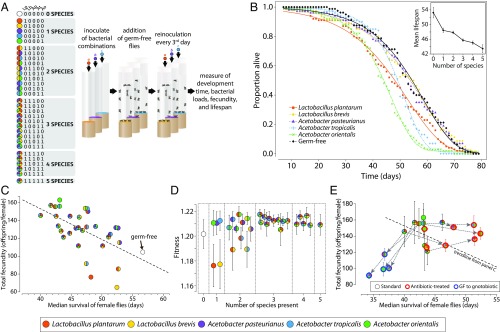
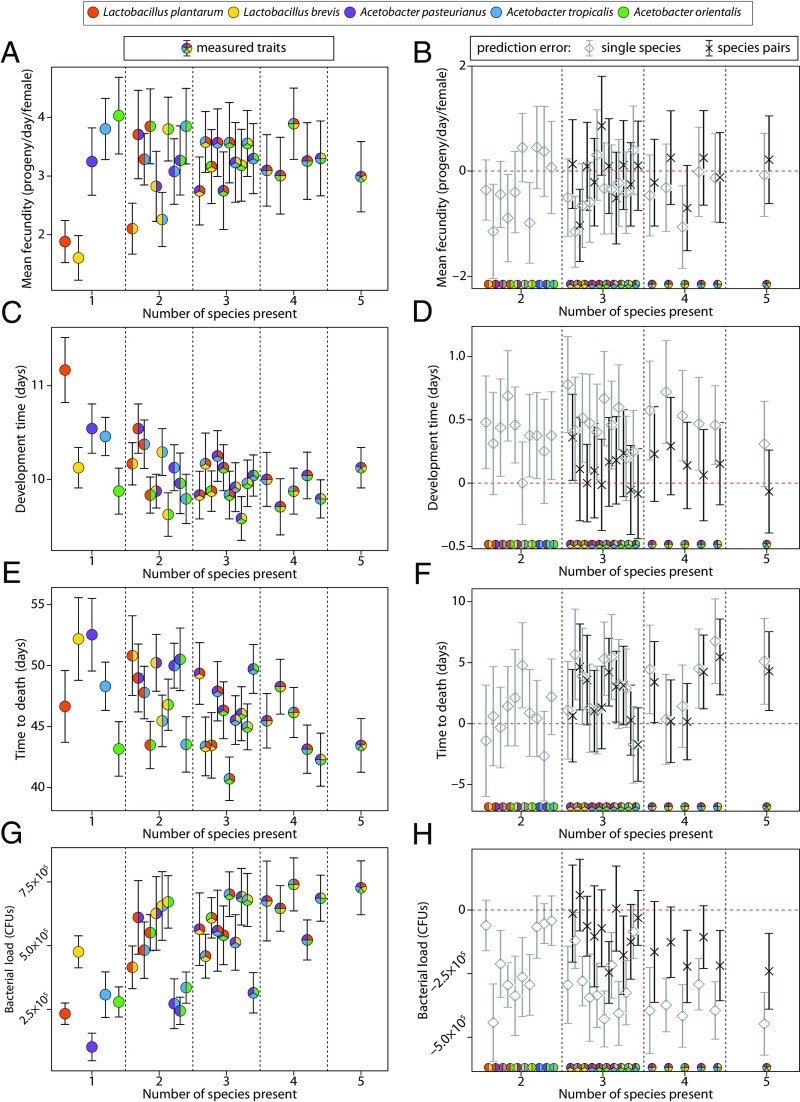
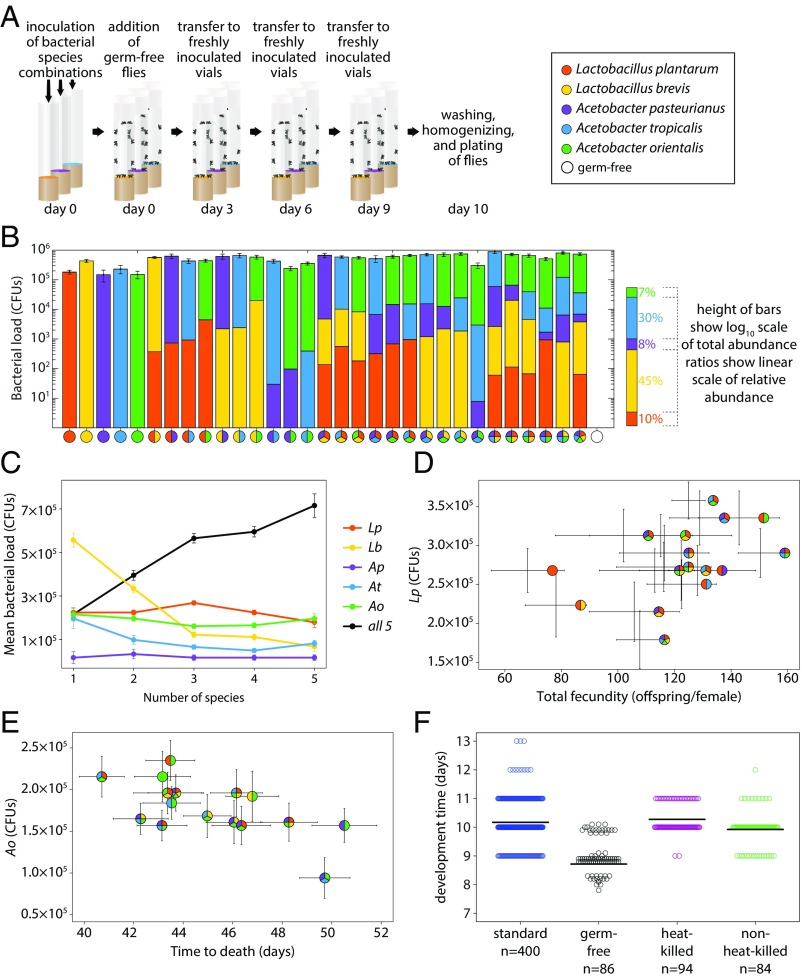
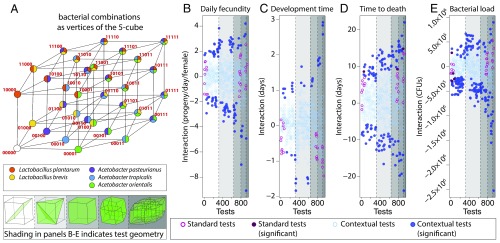
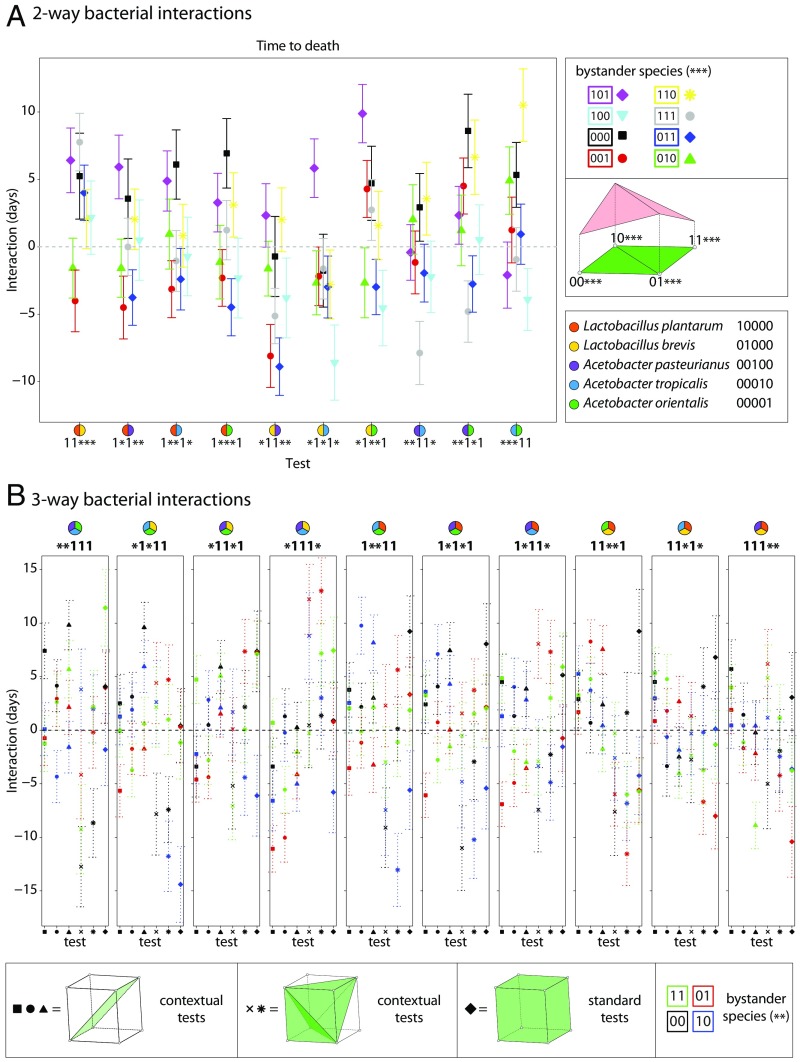
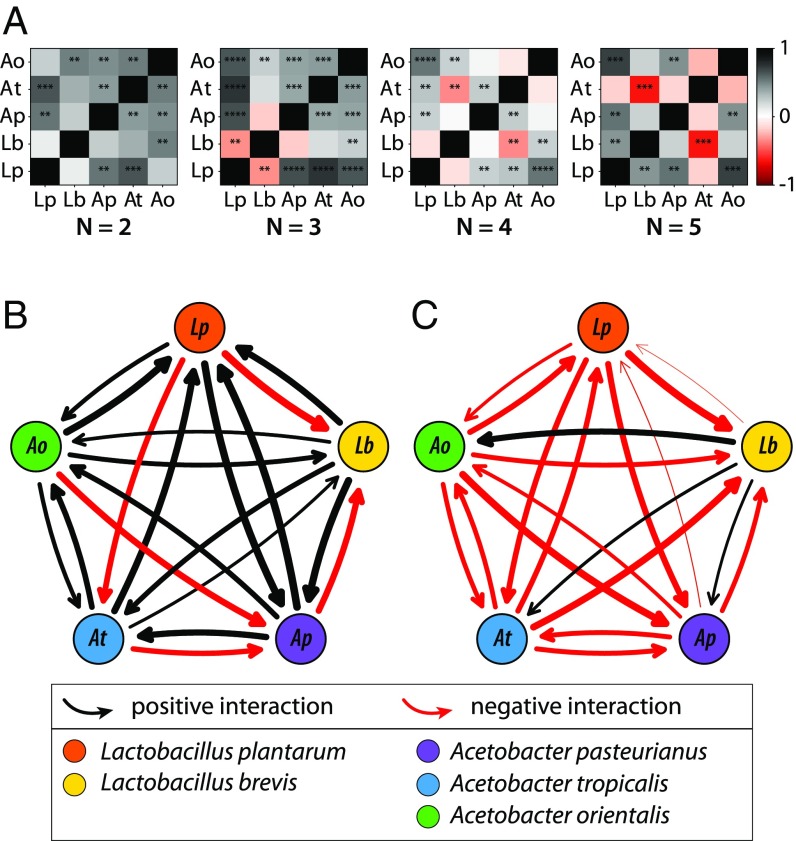
Gut bacteria can affect key aspects of host fitness, such as development, fecundity, and lifespan, while the host, in turn, shapes the gut microbiome. However, it is unclear to what extent individual species versus community interactions within the microbiome are linked to host fitness. Here, we combinatorially dissect the natural microbiome of Drosophila melanogaster and reveal that interactions between bacteria shape host fitness through life history tradeoffs. Empirically, we made germ-free flies colonized with each possible combination of the five core species of fly gut bacteria. We measured the resulting bacterial community abundances and fly fitness traits, including development, reproduction, and lifespan. The fly gut promoted bacterial diversity, which, in turn, accelerated development, reproduction, and aging: Flies that reproduced more died sooner. From these measurements, we calculated the impact of bacterial interactions on fly fitness by adapting the mathematics of genetic epistasis to the microbiome. Development and fecundity converged with higher diversity, suggesting minimal dependence on interactions. However, host lifespan and microbiome abundances were highly dependent on interactions between bacterial species. Higher-order interactions (involving three, four, and five species) occurred in 13–44% of possible cases depending on the trait, with the same interactions affecting multiple traits, a reflection of the life history tradeoff. Overall, we found these interactions were frequently context-dependent and often had the same magnitude as individual species themselves, indicating that the interactions can be as important as the individual species in gut microbiomes.
Overview
The claims and statistics of this paper haven’t been checked yet.
Free: it reads the open-access text and checks the first 5 claims that cite a source we can check. Create a free account to check every claim.
Integrity signals
Registry
Cites
Statistics
Figures
Verification
Claims the paper makes
The claims and statistics of this paper haven’t been checked yet.
Free: it reads the open-access text and checks the first 5 claims that cite a source we can check. Create a free account to check every claim.
Claims other papers make about this one
Each is checked against this paper’s own text: does it say what the citing paper says it does?
In the citing paper
“Recent animal studies have shown that the host fitness is regulated by functional interactions among species, not by a single or a limited group of taxa [139]”
From Gut Microbiota, Muscle Mass and Function in Aging: A Focus on Physical Frailty and Sarcopenia (2019) · cites this paper as [139]
Self-check
Percentages, sums and reported differences re-computed from the paper’s own numbers.
The self-check needs the paper’s full text.
Citations
Cites
The human microbiome: at the interface of health and disease
Cho, I., & Blaser, M. J. (2012) · Nature Reviews Genetics · doi:10.1038/nrg3182 · Cited by 3,449 · cited 1×
“These observations set up two major questions: What is the role of an individual bacterial species versus interactions between them in determining host lifespan, and how is the microbiome effect on lifespan related to overall host fitness? Identifying the host effects of specific bacteria has been difficult, in part,…”
BackgroundWill a Large Complex System be Stable?
MAY, R. M. (1972) · Nature · doi:10.1038/238413a0 · Cited by 2,869
Trade-Offs in Life-History Evolution
Stearns, S. C. (1989) · Functional Ecology · doi:10.2307/2389364 · Cited by 2,852 · cited 1×
“We therefore set up an experiment to measure how defined species compositions change each of the host fitness traits of lifespan, fecundity, and development time, which have been found to covary in life history tradeoffs (5, 6).”
MethodON THE USE OF MATRICES IN CERTAIN POPULATION MATHEMATICS
LESLIE, P. H. (1945) · Biometrika · doi:10.1093/biomet/33.3.183 · Cited by 2,671 · cited 1×
“To address this question, we combined our data for development, fecundity, and lifespan (SI Appendix, Table S1) in a Leslie matrix (26), a classic model of discrete population growth, to calculate organismal fitness under each bacterial association.”
MethodAcquisition and Allocation of Resources: Their Influence on Variation in Life History Tactics
van Noordwijk, A. J., & de Jong, G. (1986) · The American Naturalist · doi:10.1086/284547 · Cited by 2,383
The Long-Term Stability of the Human Gut Microbiota
Faith, J. J., Guruge, J. L., Charbonneau, M., Subramanian, S., Seedorf, H., Goodman, A. L., Clemente, J. C., Knight, R., Heath, A. C., Leibel, R. L., et al. (2013) · Science · doi:10.1126/science.1237439 · Cited by 2,058
Asymmetric Coevolutionary Networks Facilitate Biodiversity Maintenance
Bascompte, J., Jordano, P., & Olesen, J. M. (2006) · Science · doi:10.1126/science.1123412 · Cited by 1,283 · cited 1×
“(35), where asymmetry of interactions is indexed from 0 (perfectly symmetrical) to 2 (exactly opposite).”
BackgroundHost Biology in Light of the Microbiome: Ten Principles of Holobionts and Hologenomes
Bordenstein, S. R., & Theis, K. R. (2015) · PLOS Biology · doi:10.1371/journal.pbio.1002226 · Cited by 1,240 · cited 1×
“Finally, we introduce a mathematical framework to deconstruct microbiome/host complexity by making a conceptual analogy between the bacterial species interactions and genetic epistasis (21, 22).”
MethodMicrobiota-liberated host sugars facilitate post-antibiotic expansion of enteric pathogens
Ng, K. M., Ferreyra, J. A., Higginbottom, S. K., Lynch, J. B., Kashyap, P. C., Gopinath, S., Naidu, N., Choudhury, B., Weimer, B. C., Monack, D. M., et al. (2013) · Nature · doi:10.1038/nature12503 · Cited by 1,035
Innate Immune Homeostasis by the Homeobox Gene Caudal and Commensal-Gut Mutualism in Drosophila
Ryu, J.-H., Kim, S.-H., Lee, H.-Y., Bai, J. Y., Nam, Y.-D., Bae, J.-W., Lee, D. G., Shin, S. C., Ha, E.-M., & Lee, W.-J. (2008) · Science · doi:10.1126/science.1149357 · Cited by 829
Cited by
Items 401–500 of 621
Chronic ethanol ingestion impairs Drosophila melanogaster health in a microbiome-dependent mannerPreprint
Chandler, J., Innocent, L. V., Huang, I. L., Yang, J. L., Eisen, M. B., & Ludington, W. B. (2017) · bioRxiv (Cold Spring Harbor Laboratory) · doi:10.1101/217240 · Cited by 3
Self-citationFerguson, M., Petkau, K., Shin, M., Galenza, A., Fast, D., & Foley, E. (2019) · bioRxiv (Cold Spring Harbor Laboratory) · doi:10.1101/799981 · Cited by 3
“effects on host phenotypes (Gould et al., 2018), it will also be of interest to test effects of interactions among 350 Lactobacillus species on epithelial growth and tumorigenesis.”
BackgroundHenry, L. P., & Ayroles, J. F. (2020) · bioRxiv (Cold Spring Harbor Laboratory) · doi:10.1101/2020.03.19.999078 · Cited by 3
Kristensen, T. N., Schönherz, A. A., Rohde, P. D., Sørensen, J. G., & Loeschcke, V. (2021) · bioRxiv (Cold Spring Harbor Laboratory) · doi:10.1101/2021.09.09.459587 · Cited by 3
“Thus, interactions between the host genotype and the microbiota can have strong consequences for the host [21] but the impact of these interactions on evolutionary changes in natural populations is currently poorly understood [22,23].”
BackgroundMassey, C., Nosker, M., Gale, J., Scott, S., Walker, C. J., Cluff, A., Wilcox, S., Morrison, A., Morgan, S. J. G., Beltz, J. K., et al. (2024) · bioRxiv (Cold Spring Harbor Laboratory) · doi:10.1101/2024.05.02.591907 · Cited by 3
Acute targeted induction of gut-microbial metabolism affects host clock genes and nocturnal feedingPreprint
Greter, G., Moresi, C., Oswald, S., d’Oplinter, A. D. W., Künzli, D., Barazzone, E. C., Lan, J., Slack, E. M. C., & Arnoldini, M. (2024) · eLife · doi:10.7554/elife.100640.1 · Cited by 5
Microbiome evolution plays a secondary role in host rapid adaptationPreprint
Shahmohamadloo, R. S., Gabidulin, A. R., Andrews, E. R., & Rudman, S. M. (2025) · bioRxiv (Cold Spring Harbor Laboratory) · doi:10.1101/2025.06.27.661976 · Cited by 6
“D. melanogaster is well-suited for this work due to its short generation time, genetic diversity, and well-characterized microbiome with known effects on host fitness traits including development rate and stress tolerance (12, 45–48).”
Healthy gut microbiomes are host-controllable microbiomes
Bouchez, T., Liu, B., & Garza, D. R. (2025) · Frontiers in Microbiology · doi:10.3389/fmicb.2024.1497083 · Cited by 2
Association rule mining of the human gut microbiome
Zhang, Y., Ke, S., Wang, X., Sun, Y., Weiss, S. T., & Liu, Y. (2025) · Science China Life Sciences · doi:10.1007/s11427-024-2865-1 · Cited by 2
“Yet, there is mounting evidence that higher-order co-occurrence of microbial species may be as significant as pairwise interactions (Gould et al., 2018).”
Sun, H., Liu, X., Ahmad, M., Guo, X., Zhen, Y., Zhao, Y., Shen, P., Zhang, Y., & Dong, Z. (2025) · Environmental Microbiome · doi:10.1186/s40793-025-00740-3 · Cited by 3
Yuting, Z., Li, C., Huang, J., Yang, H., Luo, L., Honjung, L., & Yumei, C. (2025) · Animal Microbiome · doi:10.1186/s42523-025-00452-6 · Cited by 2
“The host and its gut microbiota form a close symbiotic relationship through long-term co-selection and co-evolution [49, 50].”
Cobamide-based interactions between soil bacteria can be predicted based on monoculture growth
Alvarez-Aponte, Z. I., Anagu, H. I., Mok, K. C., Nguyen, S. T., Trotter, V. V., & Taga, M. E. (2026) · Applied and Environmental Microbiology · doi:10.1128/aem.01300-26 · Cited by 2
The Siphamia-Photobacterium symbiosis: a binary vertebrate model for host-microbe interactions
Osland, H. K., & Gould, A. L. (2025) · Microbiology and Molecular Biology Reviews · doi:10.1128/mmbr.00132-25 · Cited by 3
Self-citationSeasonal Differences in Effects of Microbial Communities on Duckweed Traits
Kinerson, E., Trott, A., & O'Brien, A. (2025) · Ecology and Evolution · doi:10.1002/ece3.72211 · Cited by 2
Exploring Plant Disease Ecology through Meta-omics: Current Insights and Future Perspectives
Roy, S., Murmu, M., Chatterjee, S., Barman, M., Das, A., Kumar, S., & Gupta, S. (2025) · Springer eBooks · doi:10.1007/978-981-95-2294-1_6 · Cited by 2
You are what your fungus eats: diet shapes the microbial garden of a fungus-growing ant
Barcoto, M. O., de Sousa, R. L., Soares, J. M. B., Garcia, R. H. D. S., DeAzevedo, E. R., Mendes, L. W., Bueno, O. C., & Rodrigues, A. L. (2025) · npj Biofilms and Microbiomes · doi:10.1038/s41522-025-00876-7 · Cited by 2
“D imaging 188 – 194 , and chemical ecology 51,194 – 197 could unveil whether, when, and where these interactions occur, and how impactful these networks are for the microbial garden physiology 198,199 .”
Insect Gut Microbiota—Research Strategies and Perspectives
Li, X. B., Ye, Z., Wu, S., Lv, Y., Ren, Y., Luo, Q., & Hong, Y. (2026) · Insects · doi:10.3390/insects17040367 · Cited by 2
“Target microbes added to the growth environment of the larvae allow sterile larvae to come into contact with the bacterial community [61,84,89].”
The uropygial gland of the European hoopoe as a symbiotic organ
Martín‐Vivaldi, M., Martínez-García, Á., Peralta‐Sánchez, J. M., Schaub, M., Arlettaz, R., Martín-Platero, A. M., Martínez‐Renau, E., Barón, M. D., Ruiz‐Rodríguez, M., López-Hernández, E., et al. (2026) · Animal Microbiome · doi:10.1186/s42523-026-00543-y · Cited by 2
“Host traits that favor the acquisition of adequate or optimal symbionts for these functions would increase host fitness [28, 29] and, thus, evolve as adaptations in host populations [30–32].”
Heatwave winners and losers: cryptic coral holobionts differ in thermal tolerance
Meziere, Z., Byrne, I., Khalil, A., Popovic, I., Humanes, A., Guest, J. R., Chan, C. X., Riginos, C., & McGuigan, K. (2026) · Proceedings of the Royal Society B Biological Sciences · doi:10.1098/rspb.2026.0890 · Cited by 2
“Overall, these observations suggest that Symbiodiniaceae community composition may be a key contributor to response variation among S. pistillata holobionts, consistent with the broader role of microbiomes in host fitness (e.g. [77–79]).”
Microscale Carbon Cycling Between Bacteria and Algae Under the Sun
Mayali, X. (2021) · Advances in environmental microbiology · doi:10.1007/978-3-030-63512-1_13 · Cited by 2
Wei, D.-L., Miao, X., Tian, Y., Du, J., & Wang, M. (2022) · African Journal of Microbiology Research · doi:10.5897/ajmr2021.9582 · Cited by 2
Assis, B. A., Bell, T. H., Engler, H. I., & King, W. L. (2022) · Journal of Experimental Zoology Part A Ecological and Integrative Physiology · doi:10.1002/jez.2665 · Cited by 2
Choi, C. J., Jauzein, C., & Erdner, D. L. (2023) · Journal of Eukaryotic Microbiology · doi:10.1111/jeu.12966 · Cited by 2
“Given that the microbiome plays a critical role in host functioning, selection should favor those associations that increase host fitness (Gould et al., 2018).”
BackgroundRisely, A., Byrne, P. G., Hunter, D. A., Carranco, A. S., Hoye, B. J., & Silla, A. J. (2024) · Molecular Ecology · doi:10.1111/mec.17562 · Cited by 2
Tanfouri, N., Guerfali, M. M., Asimakis, E. D., Mokhtar, N. B., Apostolopoulou, G., Hamden, H., Charaabi, K., Fadhl, S., Stathopoulou, P. M., Cherif, A., et al. (2025) · Insect Science · doi:10.1111/1744-7917.70016 · Cited by 2
A test for microbiome-mediated rescue via host phenotypic plasticity in Daphnia
Shahmohamadloo, R. S., Gabidulin, A. R., Andrews, E. R., Fryxell, J. M., & Rudman, S. M. (2025) · Proceedings of the Royal Society B Biological Sciences · doi:10.1098/rspb.2025.0365 · Cited by 3
Hubert, J., Głowska, E., & Pekár, S. (2025) · Journal of Stored Products Research · doi:10.1016/j.jspr.2025.102663 · Cited by 2
Tritrichomonas spp. and Their Impact on Gut Immune Homeostasis
Cao, E. Y., & Mortha, A. (2020) · Springer eBooks · doi:10.1007/978-3-030-44826-4_10 · Cited by 2
Guilhot, R., Fellous, S., & Cohen, J. E. (2020) · PLoS ONE · doi:10.1371/journal.pone.0242692 · Cited by 2
“However, although interactions between microorganisms associated with Drosophila flies have been reported [4], the pervasiveness and nature of these relationships in the wild remains unclear [22, 23].”
BackgroundVega, N. M., & Ludington, W. B. (2021) · Current Opinion in Microbiology · doi:10.1016/j.mib.2021.10.006 · Cited by 2
Self-citationHolmes, I. A., & Gründler, M. C. (2022) · Molecular Ecology · doi:10.1111/mec.16733 · Cited by 2
Al-Dulaimy, E. A. M., & Jasim, M. A. (2022) · Journal of Pharmaceutical Negative Results · doi:10.47750/pnr.2022.13.s02.31 · Cited by 4
The partitioning of symbionts effects on host resource acquisition and developmental plasticityPreprint
Guilhot, R., Xuéreb, A., & Fellous, S. (2020) · bioRxiv (Cold Spring Harbor Laboratory) · doi:10.1101/2020.04.27.064667 · Cited by 2
“For example, microbial symbionts affect hosts reproductive strategy along the lifespan - fecundity allocation trade-off in invertebrates (Emelianoff et al. 2008; Gould et al. 2018; Walters et al. 2019) and plants (Gundel et al. 2013; Yule, Miller and Rudgers 2013; Chung, Miller and Rudgers 2015).”
BackgroundStrengthened mutualistic adaptation between teosinte and its rhizosphere biota in cold climatesPreprint
O'Brien, A., Sawers, R. J. H., Gasca‐Pineda, J., Baxter, I. R., Eguiarte, L. E., Ross‐Ibarra, J., & Strauss, S. Y. (2021) · bioRxiv (Cold Spring Harbor Laboratory) · doi:10.1101/2021.04.20.440703 · Cited by 2
“For example, microbiomes shape traits from obesity to life history in their animal hosts (Turnbaugh et al., 2008; Gould et al., 2018), and plant-microbiomes shape a comprehensive range of vegetative and floral traits in plants (Friesen et al., 2011; Rebolleda-Gómez et al., 2019).”
BackgroundPredicting and prioritizing community assembly: learning outcomes via experimentsPreprint
Blonder, B. W., Lim, M. H., & Godoy, Ó. (2022) · bioRxiv (Cold Spring Harbor Laboratory) · doi:10.1101/2022.07.07.499099 · Cited by 2
Deconstructing Taxa X Taxa X Environment Interactions in the Microbiota: A Theoretical ExaminationPreprint
Yitbarek, S., Guittar, J. L., Knutie, S. A., & Ogbunugafor, C. B. (2022) · SSRN Electronic Journal · doi:10.2139/ssrn.4105883 · Cited by 2
Chitosan diet alters the microbiome of adult house fliesPreprint
Schaal, H., Choudoir, M. J., Diwanji, V., Stoffolano, J. G., & DeAngelis, K. M. (2022) · bioRxiv (Cold Spring Harbor Laboratory) · doi:10.1101/2022.08.31.502951 · Cited by 2
Román, E. D., Nebhut, A. N., Fukami, T., & Gould, A. L. (2025) · bioRxiv (Cold Spring Harbor Laboratory) · doi:10.1101/2025.05.01.651688 · Cited by 3
Self-citationMale gut microbiome mediates post-mating sexual selection in DrosophilaPreprint
Maggu, K., Meena, A., Nardo, A. N. D., Sbilordo, S. H., Roy, J., & Lüpold, S. (2025) · bioRxiv (Cold Spring Harbor Laboratory) · doi:10.1101/2025.05.23.655737 · Cited by 2
“This bacterial density was comparable to prior reports for conventional flies (19, 65).”
InfluentialMicrobial Therapies in Reproductive Health
Singh, B., Mal, G., Kalra, R. S., & Marotta, F. (2024) · Springer eBooks · doi:10.1007/978-3-031-65459-6_7 · Cited by 1
Machine learning to predict gut microbiomes of agricultural pests
Jobayer, M., Taylor, A., Hasan, M. R., Ahmed, K. A., & Hossain, M. Z. (2025) · Neural Computing and Applications · doi:10.1007/s00521-025-10999-9 · Cited by 2
“Gould et al. (2018).”
Griffin, C. D., Schreiber, J., Bierwert, A., Kajihara, K. T., Weber, D. E., & Medeiros, M. C. I. (2025) · FEMS Microbiology Letters · doi:10.1093/femsle/fnaf084 · Cited by 1
Native and invasive raccoon populations host distinct microbiomes that may facilitate invasion
Kołodziejczyk, J., Hoffman, E. A., & Biedrzycka, A. (2025) · NeoBiota · doi:10.3897/neobiota.101.157515 · Cited by 1
“There is an established link between gut microbiome composition and host fitness (Gould et al. 2018).”
Redelinghuys, S., Emami‐Khoyi, A., Matcher, G. F., Teske, P. R., Heltai, M., Csányi, S., Toonen, R. J., & Porri, F. (2025) · Austral Ecology · doi:10.1111/aec.70118 · Cited by 1
Yang, J. W., & Denef, V. J. (2025) · mSystems · doi:10.1128/msystems.00803-25 · Cited by 1
Integrating behaviour and microbiomes into considerations of bee health
Nguyen, P. N., & Rehan, S. M. (2026) · Genome · doi:10.1139/gen-2025-0047 · Cited by 1
Marine Heatwaves, Ocean Warming and Acidification Reshape Reef Fish Gut Microbiomes
Mitchell, A., Hayes, C., Hudson, C. J., Connell, S. D., Harvey, B. P., Agostini, S., Jolly, J., Ravasi, T., Booth, D. J., & Nagelkerken, I. (2026) · Molecular Ecology · doi:10.1111/mec.70275 · Cited by 1
“Gut microbiome assemblages are shaped by host diet (Miyake et al. 2014), environmental conditions (Clever et al. 2022; Risely et al. 2023; Suzzi et al. 2023; Hayes et al. 2025) and species-specific host–microbiome interactions with the environment (Gould et al. 2018).”
López‐de‐la‐Cruz, J., Rivero, F., & Junior, C. R. T. (2026) · Mathematical Methods in the Applied Sciences · doi:10.1002/mma.70688 · Cited by 2
Lee, C. Z., Worsley, S. F., Terry, B., Komdeur, J., Hildebrand, F., Dugdale, H. L., & Richardson, D. S. (2026) · Molecular Ecology · doi:10.1111/mec.70304 · Cited by 1
Nutrient-rich environments drive microbiome restructuring and mucus shedding in a coastal cnidarian
Lachnit, T. (2026) · Frontiers in Microbiology · doi:10.3389/fmicb.2026.1792133 · Cited by 1
“These host-associated microbiomes contribute to nutrition, development, immunity, and protection against pathogens across a wide range of hosts and environments (Gould et al., 2018; Parfrey et al., 2018; Bernardo-Cravo et al., 2020).”
Sambamoorthy, G., Ansari, A. F., & Dixit, N. M. (2026) · Methods in molecular biology · doi:10.1007/978-1-0716-5080-6_8 · Cited by 1
Chapman, O. S., & McLean, B. S. (2026) · Integrative and Comparative Biology · doi:10.1093/icb/icag070 · Cited by 1
“It is well known that an individual’s gut microbiome is a major factor relating to the health and wellness of that organism ( Holmes et al. 2011 ; Tuddenham and Sears 2015 ; Gould et al. 2018 ), which warrants more research into how seasonal shifts in this trait could mediate stress response.”
Quartet: Disentangling positive and negative components of microbial interactions
Ansari, A. F., Sambamoorthy, G., Alexander, T. C., Reddy, Y. B. S., Raut, J. S., & Dixit, N. M. (2026) · PLoS Computational Biology · doi:10.1371/journal.pcbi.1014502 · Cited by 1
“Advancing the quartet to high-order interactions, often necessary to predict community behaviours [11,12,51,52], would be an important future goal.”
InfluentialYeasmin, M., & Peng, S. (2026) · Journal of Ocean University of China · doi:10.1007/s11802-026-6555-6 · Cited by 1
Milleville, R., Manière, G., Berthelot‐Grosjean, M., Lamotte, O., Grosjean, Y., Royet, J., & Kurz, C. L. (2026) · PLoS Biology · doi:10.1371/journal.pbio.3004042 · Cited by 1
“However, some microbes can also negatively impact an animal’s health and internal balance [5].”
Information content of high-order associations of the human gut microbiota network
Viles, W. D., Madan, J. C., Li, H., Karagas, M. R., & Hoen, A. G. (2021) · The Annals of Applied Statistics · doi:10.1214/21-aoas1449 · Cited by 1
“Such high-order associations have been shown to influence host fitness traits in the Drosophila melanogaster fruit fly, the microbiome of which consists of few combinations of microorganisms (Gould et al., 2018) that are feasibly enumerated.”
BackgroundDeveloping a Philosophical Foundation for the Study of the Microbial Side of Symbiosis
Stencel, A. (2023) · Diametros · doi:10.33392/diam.1783 · Cited by 1
Influence of Glyphosate Herbicide on the Functional State of the Poultry Intestine Microbiome
Laptev, G. Y., Филиппова, В., Il'ina, L. A., Yildirim, E. A., Turina, D., Павловна, Г. Е., Dubrovin, A. V., Меликиди, В., Андреевна, К. К., Александровна, К. И., et al. (2023) · Smart innovation, systems and technologies · doi:10.1007/978-981-99-4165-0_14 · Cited by 1
Dragičević, P., Rosado, D., Bielen, A., & Hudina, S. (2023) · Journal of Invertebrate Pathology · doi:10.1016/j.jip.2023.108039 · Cited by 1
Microbiomes in Animal Ecology: Advances, Assumptions, and Opportunities
Warne, R. W., & Kirschman, L. J. (2025) · Integrative and Comparative Biology · doi:10.1093/icb/icaf112 · Cited by 1
Observing weak adaptation of duckweeds to their local microbiome depends on local pondwater
Rose, A. G., & O'Brien, A. (2026) · American Journal of Botany · doi:10.1002/ajb2.70165 · Cited by 1
Heras, J., & Martin, C. H. (2021) · doi:10.22541/au.161169908.87361055/v1 · Cited by 1
Poudel, R., Jumpponen, A., Kennelly, M., Rivard, C. L., Gomez-Montano, L., & Garrett, K. A. (2019) · bioRxiv (Cold Spring Harbor Laboratory) · doi:10.1101/2019/874966 · Cited by 1
Fokt, H., Šakalytė, G., Unni, R., Abukhalaf, M., Cassidy, L., Μαρίνος, Γ., Godfroid, M., Kinfu, B. M., Schmitz, R. A., Kaleta, C., et al. (2023) · bioRxiv (Cold Spring Harbor Laboratory) · doi:10.1101/2023.03.05.530569 · Cited by 1
Author response: Competitive interactions between culturable bacteria are highly non-additive
Baichman‐Kass, A., Song, T., & Friedman, J. (2023) · eLife · doi:10.7554/elife.83398.sa2 · Cited by 1
van Leeuwen, P., Schulte‐Hostedde, A. I., Fournier‐Chambrillon, C., Aranda, M. C., Berthomieu, L., Fournier, P., & MICHAUX, J. R. (2024) · doi:10.22541/au.170667211.17228645/v1 · Cited by 1
Predictive modeling of microbial data with interaction effectsPreprint
Stadler, M., Olayo-Alarcón, R., Bien, J., & Müller, C. L. (2024) · bioRxiv (Cold Spring Harbor Laboratory) · doi:10.1101/2024.04.29.591596 · Cited by 3
“…the community-function landscape view from microbial ecology where presence-absence and absolute abundance data from designed experiments on small microbial communities are used to predict community functions, such as, e.g., butyrate production, [18, 15, 16, 25] or overall host fitness [26].”
Greter, G., Moresi, C., Oswald, S., d’Oplinter, A. D. W., Künzli, D., Barazzone, E. C., Lan, J., Slack, E. M. C., & Arnoldini, M. (2026) · eLife · doi:10.7554/elife.100640 · Cited by 1
eLife Assessment: Full factorial construction of synthetic microbial communities
Amir, A. (2024) · eLife · doi:10.7554/elife.101906.3.sa0 · Cited by 1
Experimental Evolution Reveals Limited Adaptation in Microbiota-less Drosophila melanogasterPreprint
Malwade, A., Koner, A., Vibishan, B., Gadkari, C., Saini, S., Khodake, V., & Dey, S. (2024) · bioRxiv (Cold Spring Harbor Laboratory) · doi:10.1101/2024.10.25.620247 · Cited by 1
Dumas, T., Pible, O., Grenga, L., Esposti, D. D., Delorme, N., Geffard, O., Chaumot, A., & Armengaud, J. (2024) · bioRxiv (Cold Spring Harbor Laboratory) · doi:10.1101/2024.11.06.622251 · Cited by 1
Effects of host DNA and k-mer size on metagenomic classification of historical samplesPreprint
Ng, S.-K., & Gutaker, R. M. (2025) · bioRxiv (Cold Spring Harbor Laboratory) · doi:10.1101/2025.04.05.647358 · Cited by 1
Gut microbe-derived lactic acid optimizes host energy metabolism during starvationPreprint
Millington, J. W., Lopez, J. A., Sajjadian, A. M., Scheffler, R. J., DeFelice, B. C., Ludington, W. B., Good, B. H., O’Brien, L. E., & Huang, K. C. (2025) · bioRxiv (Cold Spring Harbor Laboratory) · doi:10.1101/2025.05.27.656452 · Cited by 1
Self-citationZhang, N., Zhao, Y., Zhang, Z., Zhan, M., Zhao, X., Zhang, Y., Sun, J., Zhang, Y., Teng, L., & Liu, Z. (2025) · Scientific Data · doi:10.1038/s41597-025-05585-6 · Cited by 1
The Enterostat: a 3D-printed bioreactor for simulating gut microbiome dynamicsPreprint
Mueller, E. A., van der Elst, L. A., Gumennik, A., & Lennon, J. T. (2025) · bioRxiv (Cold Spring Harbor Laboratory) · doi:10.1101/2025.08.21.671663 · Cited by 1
“The mammalian gastrointestinal (GI) tract harbors trillions of microorganisms, including bacteria, archaea, microeukaryotes, and viruses that are essential for host fitness (Lozupone et al. 2012; Costea et al. 2017; Gould et al. 2018).”
Riedel, E. K., Lender, L., Kowallik, V., Pollierer, M. M., & Rohlfs, M. (2025) · bioRxiv (Cold Spring Harbor Laboratory) · doi:10.1101/2025.10.14.682149 · Cited by 1
Drosophila-Lactobacillus plantarum as a model of facultative nutritional mutualism
Grenier, T. (2021) · theses.fr (ABES) · doi:10.70675/f8169d85zba6cz4618za651z46b4396bf483 · Cited by 1
Wülbern, J., Hansen, L., Bannon, C. C., Liebeke, M., Zimmermann, J., Bohannan, B. J. M., & Johnke, J. (2026) · bioRxiv (Cold Spring Harbor Laboratory) · doi:10.64898/2026.06.25.734446 · Cited by 1
Akami, M., Ren, X., Wang, Y., Mansour, A., Cao, S., Qi, X., Ngakou, A., & Niu, C. (2019) · bioRxiv (Cold Spring Harbor Laboratory) · doi:10.1101/834119
“Introduction 56 Gut bacteria and fruit flies are thought to have a close evolutionary and biological 57 relationships with a wide degree of interdependence [1-3].”
BackgroundMartins Ferreira, S. C. (2020) · Refubium (Universitätsbibliothek der Freien Universität Berlin) · doi:10.17169/refubium-26567
Rattan, S. (2019) · Murdoch University Research Portal
Gichuhi, J. (2019) · Boloka Institutional Repository (North-west University)
Écologie des drosophiles et de leurs symbiotes microbiens en conditions naturelles
Guilhot, R. (2020) · theses.fr (ABES) · doi:10.70675/c72ae19fzeeb2z4ca5zbc44z0dd111043b7a
Karamchedu, M. V. (2021) · International Conference on Bioscience, Biochemistry and Bioinformatics (ICBBB) · doi:10.1145/3448340.3448343
“A few studies also model inter-microbial relationships in terms of network models, where an observed functional trait in the host such as a metabolite or biological function is measurably affected by an observed collection of microbes [33],[34],[35],[36].”
BackgroundBippert, C. (2020) · eScholarship@McGill (McGill) · doi:10.82308/53640
Lika, I. I. (2000) · Ubaya Repository (University of Surabaya)
Descifrando las funciones de la microbiota intestinal en la obesidad.
López‐Almela, I. (2021) · RiuNet (Universitat Politècnica de València) · doi:10.4995/thesis/10251/174897
van Leeuwen, P., Schulte‐Hostedde, A. I., Fournier‐Chambrillon, C., Aranda, C. M., Berthomieu, L., Fournier, P., & MICHAUX, J. R. (2021) · Research Square · doi:10.21203/rs.3.rs-932275/v1
“128 Both populations are currently in CBP’s.”
BackgroundInfluentialInsights into the microbial strain mediated impact on pest insect developmentPreprint
Gurung, K., Salles, J. F., & Wertheim, B. (2022) · bioRxiv (Cold Spring Harbor Laboratory) · doi:10.1101/2022.05.03.490458
Chevin, L. (2019) · Faculty Opinions – Post-Publication Peer Review of the Biomedical Literature · doi:10.3410/f.736618952.793565848
Metadata
- Authors
- Gould, A. L., Zhang, V., Lamberti, L., Jones, E. W., Obadia, B., Korasidis, N., Gavryushkin, A., Carlson, J. M., Beerenwinkel, N., & Ludington, W. B.
- Affiliations
- University of California, Berkeley (US)
- SIB Swiss Institute of Bioinformatics (CH)
- University of California, Santa Barbara (US)
- ETH Zurich (CH)
- Johns Hopkins University (US)
- Corresponding author
- Ludington, William B.
- ORCID
- Venue
- Proceedings of the National Academy of Sciences
- Publisher
- National Academy of Sciences
- Published
- 2018-12-03
- Volume
- 115
- Issue
- 51
- Pages
- E11951-E11960
- ISSN
- 0027-8424 (ISSN-L)
- 1091-6490
- PMC
- PMC6304949
- OpenAlex
- W2902868023
- Cited by
- 579
- References
- 42
- Citations by year
- 2026: 48 · 2025: 72 · 2024: 67 · 2023: 89 · 2022: 82 · 2021: 101 · 2020: 67 · 2019: 48 · 2018: 4
- FWCI
- 51.76
- Type
- journal article
- Language
- en
- Open access
- hybrid
- doi.org
- Licence
- Locations
- Proceedings of the National Academy of Sciences (publishedVersion, cc-by-nc-nd)
- Europe PMC (PubMed Central) (publishedVersion, cc-by-nc-nd)
- PubMed Central (publishedVersion, cc-by-nc-nd)
- PubMed (publishedVersion)
- Repository for Publications and Research Data (ETH Zurich) (submittedVersion, cc-by-nc-nd)
- ETH Zürich Research Collection
- Funders
- HHS | NIH | NIH Office of the Director (1DP5OD017851-01)
- National Science Foundation (1650114)
- Royal Society of New Zealand (RDF-17-UOO-007)
- David and Lucile Packard Foundation (0000)
- DOD | United States Army | RDECOM | Army Research Office (W911NF-09-0001)
- William K. Bowes, Jr. Foundation (0000)
- Topics
- Life Sciences › Agricultural and Biological Sciences › Insect Science › Insect symbiosis and bacterial influences
- Life Sciences › Biochemistry, Genetics and Molecular Biology › Molecular Biology › Gut microbiota and health
- Life Sciences › Biochemistry, Genetics and Molecular Biology › Genetics › Evolution and Genetic Dynamics
- Keywords
- gut microbiota, host fitness, Drosophila melanogaster, bacterial interactions, life-history trade-offs, bacterial diversity, lifespan, fecundity, development (biology), epistasis, higher-order interactions, microbiome assembly
- MeSH terms
- Gastrointestinal Microbiome, Host Microbial Interactions, Animals, Bacteria, Drosophila melanogaster, Epistasis, Genetic, Fertility, Germ-Free Life, Longevity, Phenotype, Reproduction, Gastrointestinal Tract, Biodiversity, Microbial Interactions, Microbiota
About these checks
Registry, retraction, Cites and statistics results are computed, not judged, with one exception: a printed reference that no index lists is read once by a model before it counts as a citation error. Claims are extracted by a model and kept only when their quote appears verbatim in the text; each cited source is then checked, with a model’s help, for whether it says what the claim relies on. Those verdicts can be wrong — read the claim’s quote and the cited source before relying on one.
Statistics and arithmetic are recomputed, not judged.
Confidence bands are shown only for fields calibrated on our annotated test set. None is calibrated yet, so no band is shown.
What counts as a claim ›How we measure confidence ›How we check this ›
Are you an author, or do you see a problem with this page? Request a review
Data sources
Bibliographic data: Semantic Scholar, OpenAlex, Crossref.
Contains information from the Semantic Scholar Academic Graph Datasets, made available under the ODC Attribution License (ODC-BY 1.0).
Semantic Scholar’s data is described in: Kinney, R., et al. (2023). The Semantic Scholar Open Data Platform. arXiv:2301.10140.
