

Microbiome interactions shape host fitness
Open accessThe DOI matches its Crossref record; 47 of the 47 references it cites were found in a registry or an index.
Abstract
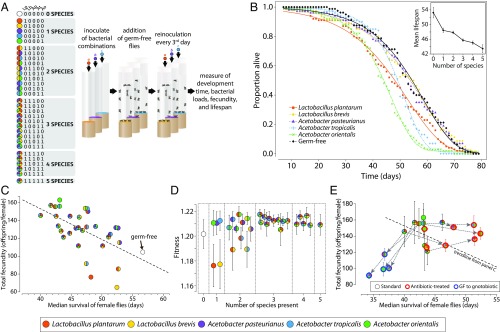
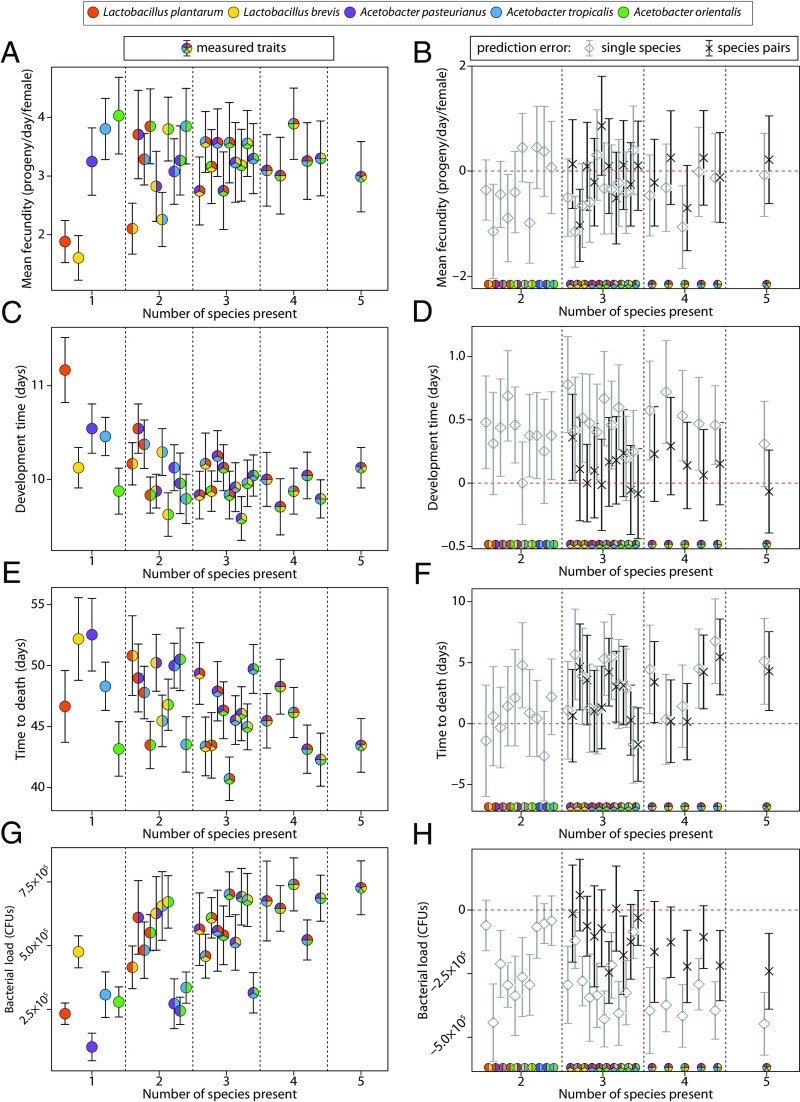
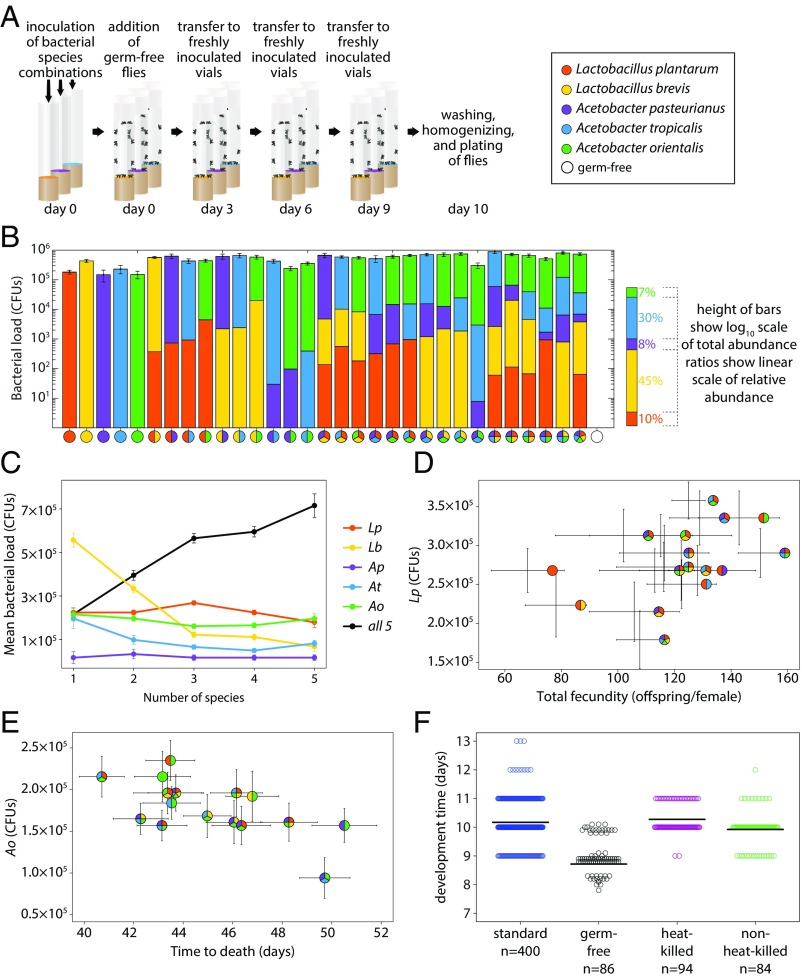
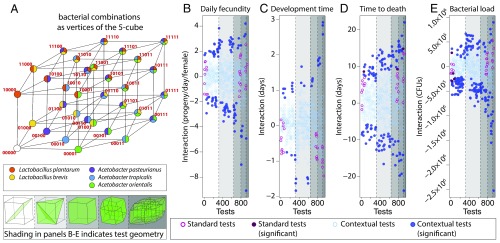
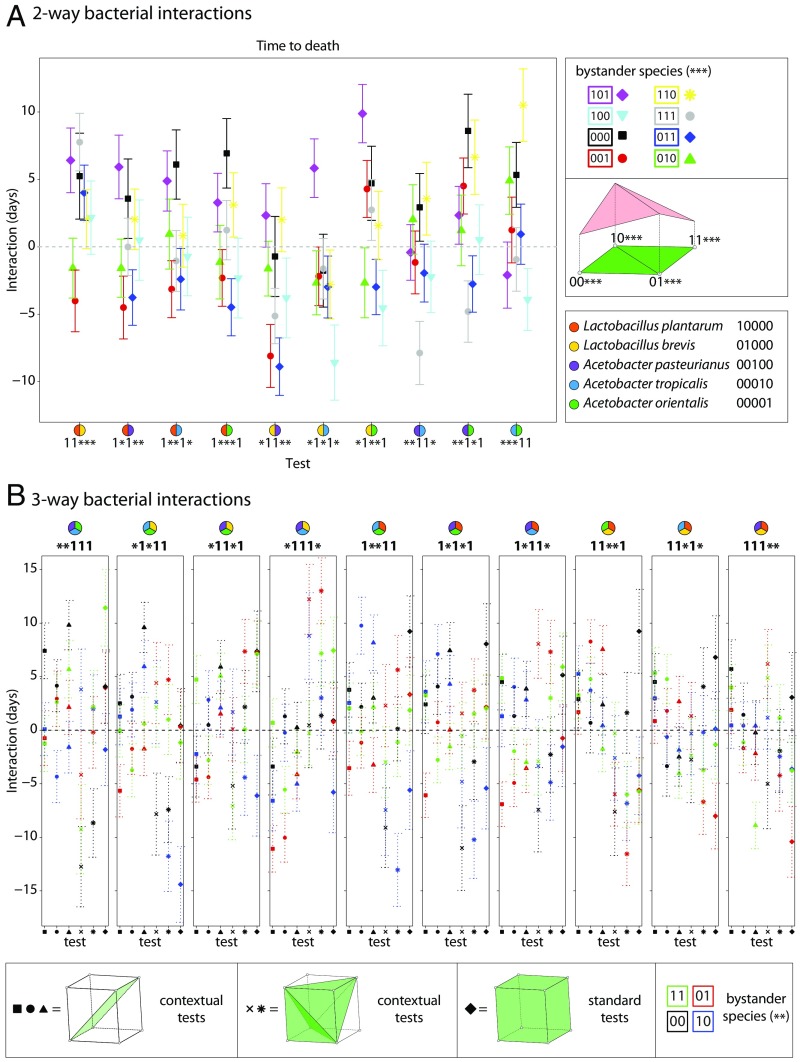
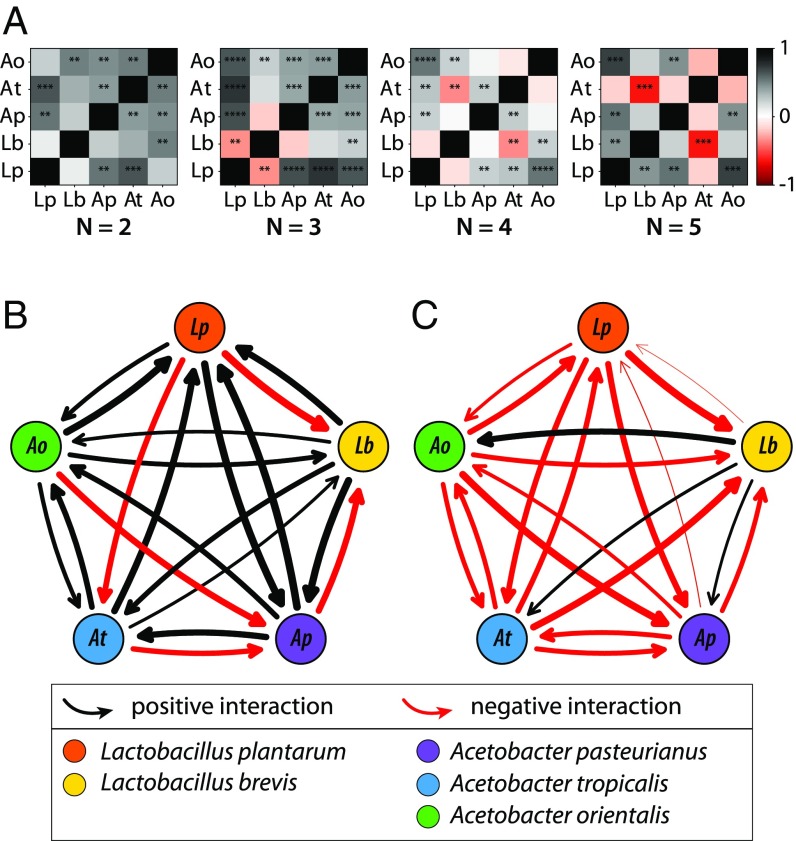
Gut bacteria can affect key aspects of host fitness, such as development, fecundity, and lifespan, while the host, in turn, shapes the gut microbiome. However, it is unclear to what extent individual species versus community interactions within the microbiome are linked to host fitness. Here, we combinatorially dissect the natural microbiome of Drosophila melanogaster and reveal that interactions between bacteria shape host fitness through life history tradeoffs. Empirically, we made germ-free flies colonized with each possible combination of the five core species of fly gut bacteria. We measured the resulting bacterial community abundances and fly fitness traits, including development, reproduction, and lifespan. The fly gut promoted bacterial diversity, which, in turn, accelerated development, reproduction, and aging: Flies that reproduced more died sooner. From these measurements, we calculated the impact of bacterial interactions on fly fitness by adapting the mathematics of genetic epistasis to the microbiome. Development and fecundity converged with higher diversity, suggesting minimal dependence on interactions. However, host lifespan and microbiome abundances were highly dependent on interactions between bacterial species. Higher-order interactions (involving three, four, and five species) occurred in 13–44% of possible cases depending on the trait, with the same interactions affecting multiple traits, a reflection of the life history tradeoff. Overall, we found these interactions were frequently context-dependent and often had the same magnitude as individual species themselves, indicating that the interactions can be as important as the individual species in gut microbiomes.
Overview
The claims and statistics of this paper haven’t been checked yet.
Free: it reads the open-access text and checks the first 5 claims that cite a source we can check. Create a free account to check every claim.
Integrity signals
Registry
Cites
Statistics
Figures
Verification
Claims the paper makes
The claims and statistics of this paper haven’t been checked yet.
Free: it reads the open-access text and checks the first 5 claims that cite a source we can check. Create a free account to check every claim.
Claims other papers make about this one
Each is checked against this paper’s own text: does it say what the citing paper says it does?
In the citing paper
“Recent animal studies have shown that the host fitness is regulated by functional interactions among species, not by a single or a limited group of taxa [139]”
From Gut Microbiota, Muscle Mass and Function in Aging: A Focus on Physical Frailty and Sarcopenia (2019) · cites this paper as [139]
Self-check
Percentages, sums and reported differences re-computed from the paper’s own numbers.
The self-check needs the paper’s full text.
Citations
Cites
The human microbiome: at the interface of health and disease
Cho, I., & Blaser, M. J. (2012) · Nature Reviews Genetics · doi:10.1038/nrg3182 · Cited by 3,449 · cited 1×
“These observations set up two major questions: What is the role of an individual bacterial species versus interactions between them in determining host lifespan, and how is the microbiome effect on lifespan related to overall host fitness? Identifying the host effects of specific bacteria has been difficult, in part,…”
BackgroundWill a Large Complex System be Stable?
MAY, R. M. (1972) · Nature · doi:10.1038/238413a0 · Cited by 2,869
Trade-Offs in Life-History Evolution
Stearns, S. C. (1989) · Functional Ecology · doi:10.2307/2389364 · Cited by 2,852 · cited 1×
“We therefore set up an experiment to measure how defined species compositions change each of the host fitness traits of lifespan, fecundity, and development time, which have been found to covary in life history tradeoffs (5, 6).”
MethodON THE USE OF MATRICES IN CERTAIN POPULATION MATHEMATICS
LESLIE, P. H. (1945) · Biometrika · doi:10.1093/biomet/33.3.183 · Cited by 2,671 · cited 1×
“To address this question, we combined our data for development, fecundity, and lifespan (SI Appendix, Table S1) in a Leslie matrix (26), a classic model of discrete population growth, to calculate organismal fitness under each bacterial association.”
MethodAcquisition and Allocation of Resources: Their Influence on Variation in Life History Tactics
van Noordwijk, A. J., & de Jong, G. (1986) · The American Naturalist · doi:10.1086/284547 · Cited by 2,383
The Long-Term Stability of the Human Gut Microbiota
Faith, J. J., Guruge, J. L., Charbonneau, M., Subramanian, S., Seedorf, H., Goodman, A. L., Clemente, J. C., Knight, R., Heath, A. C., Leibel, R. L., et al. (2013) · Science · doi:10.1126/science.1237439 · Cited by 2,058
Asymmetric Coevolutionary Networks Facilitate Biodiversity Maintenance
Bascompte, J., Jordano, P., & Olesen, J. M. (2006) · Science · doi:10.1126/science.1123412 · Cited by 1,283 · cited 1×
“(35), where asymmetry of interactions is indexed from 0 (perfectly symmetrical) to 2 (exactly opposite).”
BackgroundHost Biology in Light of the Microbiome: Ten Principles of Holobionts and Hologenomes
Bordenstein, S. R., & Theis, K. R. (2015) · PLOS Biology · doi:10.1371/journal.pbio.1002226 · Cited by 1,240 · cited 1×
“Finally, we introduce a mathematical framework to deconstruct microbiome/host complexity by making a conceptual analogy between the bacterial species interactions and genetic epistasis (21, 22).”
MethodMicrobiota-liberated host sugars facilitate post-antibiotic expansion of enteric pathogens
Ng, K. M., Ferreyra, J. A., Higginbottom, S. K., Lynch, J. B., Kashyap, P. C., Gopinath, S., Naidu, N., Choudhury, B., Weimer, B. C., Monack, D. M., et al. (2013) · Nature · doi:10.1038/nature12503 · Cited by 1,035
Innate Immune Homeostasis by the Homeobox Gene Caudal and Commensal-Gut Mutualism in Drosophila
Ryu, J.-H., Kim, S.-H., Lee, H.-Y., Bai, J. Y., Nam, Y.-D., Bae, J.-W., Lee, D. G., Shin, S. C., Ha, E.-M., & Lee, W.-J. (2008) · Science · doi:10.1126/science.1149357 · Cited by 829
Cited by
Items 301–400 of 621
Symbiosis in a Rapidly Changing World
Oliver, K. M., & Higashi, C. H. V. (2021) · Advances in environmental microbiology · doi:10.1007/978-3-030-63512-1_16 · Cited by 10
Erdei, A. L., Szelényi, M. O., Deutsch, F., Rikk, P., & Molnár, B. P. (2022) · Journal of Applied Entomology · doi:10.1111/jen.13006 · Cited by 9
“It was seen that some Acetobacter spp. increase the lifespan of D. melanogaster, but not the female fecundity (Gould et al., 2018), and environmental factors most likely influence which strains are the most beneficial (Matthews et al., 2021).”
BackgroundFecal Microbiota Monitoring in Elite Soccer Players Along the 2019–2020 Competitive Season
Viciani, E., Barone, M., Bongiovanni, T., Quercia, S., Gesu, R. D., Pasta, G., Manetti, P., Iaia, F. M., Trecroci, A., Rampelli, S., et al. (2022) · International Journal of Sports Medicine · doi:10.1055/a-1858-1810 · Cited by 10
“5c), since at lower alpha-diversity competition tends to become weaker [45].”
BackgroundGoswami, S., Das, S. B., Rath, P. C., Adak, T., Parameswaran, C., Jambhulkar, N. N., Govindharaj, G., Gadratagi, B. G., Patil, N. B., Mohapatra, S. D., et al. (2024) · Journal of Asia-Pacific Entomology · doi:10.1016/j.aspen.2024.102229 · Cited by 9
Microbiome Structure and Function: A New Framework for Interpreting Data
Greslehner, G. P. (2020) · BioEssays · doi:10.1002/bies.201900255 · Cited by 9
Drosophila Model for Gut-Mediated Horizontal Transfer of Narrow- and Broad-Host-Range Plasmids
Ott, L. C., Engelken, M., Scott, S. M., McNeill, E. M., & Mellata, M. (2021) · mSphere · doi:10.1128/msphere.00698-21 · Cited by 9
“Bacterial populations of the gut were inferred from whole-fly bacterial enumeration following ethanol surface sterilization (54).”
MethodMicrobial community dynamics revisited
Ji, B., Herrgård, M. J., & Nielsen, J. (2021) · Nature Computational Science · doi:10.1038/s43588-021-00144-6 · Cited by 10
Li, J., Zhang, Y., Sun, J., Thompson, F. L., & Zhang, Y. (2023) · Frontiers in Marine Science · doi:10.3389/fmars.2022.1128906 · Cited by 9
“Symbiotic relationships between microorganisms and their marine invertebrate hosts are continuously formed and co-evolved with a long-term history that impacts morphology, behavior, development, metabolism, and even evolution (McFall-Ngai et al., 2013; Gould et al., 2018).”
BackgroundMiller, C., Bates, S. T., Gielda, L. M., & Creighton, J. C. (2020) · Animal Behaviour · doi:10.1016/j.anbehav.2020.11.006 · Cited by 8
Nguyen, G. Q. H., Roblet, C., Lagacé, L., & Filteau, M. (2022) · Frontiers in Systems Biology · doi:10.3389/fsysb.2022.893007 · Cited by 8
“Microorganisms occur in communities and can influence each other’s activity directly using targeted mechanisms or indirectly by modify their environments (Tyc et al., 2014; Grandclement et al., 2016; Ratzke and Gore, 2018; Gu et al., 2020; Gupta et al., 2021).”
BackgroundSu, C., Xie, T., Jiang, L., Wang, Y., Wāng, Y., Nie, R., Zhao, Y., He, B., Ma, J., Yang, Q., et al. (2024) · Ecology and Evolution · doi:10.1002/ece3.11218 · Cited by 8
“…not only providing certain nutrients such as amino acids and vitamins required for growth and reproduction but also enhancing the host's resistance to external parasites, pathogens, and other un-favorable factors (Brown et al., 2020; Gould et al., 2018; Hosokawa & Fukatsu, 2020; Liu et al., 2021).”
Härer, A., Thompson, K. A., Schluter, D., & Rennison, D. J. (2024) · Molecular Ecology · doi:10.1111/mec.17571 · Cited by 8
Bathia, J., Miklós, M., Gyulai, I., Fraune, S., & Tökölyi, J. (2024) · Scientific Reports · doi:10.1038/s41598-024-82944-0 · Cited by 8
Liu, C., Wang, H., Wang, Z., Liang, L., Li, Y., Liu, D., & Lü, Q. (2025) · Scientific Reports · doi:10.1038/s41598-025-91621-9 · Cited by 8
“Additionally, interactions can regulate microbial community structures and multiple functionalities to affect host insects 42,43 .”
Juottonen, H., Moghadam, N. N., Murphy, L., Mappes, J., & Galarza, J. A. (2022) · Animal Microbiome · doi:10.1186/s42523-022-00210-y · Cited by 8
“In general, the microbiome can potentially influence the host’s life history and fitness [31, 58, 99].”
BackgroundZiab, M., Chaganti, S. R., & Heath, D. D. (2023) · Heredity · doi:10.1038/s41437-023-00620-x · Cited by 8
“2020), has emerged as a factor associated with host fitness (Rosshart et al. 2017; Suzuki 2017; Gould et al. 2018; Berg et al. 2020).”
BackgroundA computational framework for resolving the microbiome diversity conundrum
Daybog, I., & Kolodny, O. (2023) · Nature Communications · doi:10.1038/s41467-023-42768-4 · Cited by 9
“Such studies have been able to link the composition of an individual ’ s microbiome to numerous factors, ran-gingfromthehost ’ shealthandphysiology 11 – 13 ,throughitsbehavior 14,15 , to its aging dynamics 13,16 .”
Wheeler, T. B., Thompson, V., Conner, W. R., & Cooper, B. S. (2021) · Ecology and Evolution · doi:10.1002/ece3.7782 · Cited by 8
“Animals interact with microorganisms that influence their behavior, physiology, and fitness (Hurst and Jiggins, 2000; Brownlie et al., 2009; McFall-Ngai et al., 2013; Fredericksen et al., 2017; Gould et al., 2018; Hague, Caldwell and Cooper, 2020).”
BackgroundA toxic environment selects for specialist microbiome in poison frogsPreprint
Caty, S. N., Alvarez‐Buylla, A., Vasek, C., Tapia, E., Martin, N. A., McLaughlin, T. M., Weber, P. M., Mayali, X., Coloma, L. A., Morris, M. M., et al. (2024) · bioRxiv (Cold Spring Harbor Laboratory) · doi:10.1101/2024.01.10.574901 · Cited by 8
The gut microbiota of three avian species living in sympatry
Pereira, H., Chakarov, N., Caspers, B. A., Gilles, M., Jones, W. E., Mijoro, T. J., Zefania, S., Székely, T., Krüger, O., & Hoffman, J. I. (2024) · BMC Ecology and Evolution · doi:10.1186/s12862-024-02329-9 · Cited by 7
Gum Arabic modulates the microbiota-gut-brain axis and affects general fitness in zebrafish
Assaf, J. A., de Coriolis, J., Godden, A. M., Redhead, E., Bartram, J., Cohen‐Krais, J., Silova, K., Crighton, Z., Gall, G. L., Sami, S. A. K., et al. (2025) · Scientific Reports · doi:10.1038/s41598-025-17665-z · Cited by 9
Host evolution shapes gut microbiome composition in Astyanax mexicanus
Riddle, M. R., Nguyen, N. K., Nave, M., Peuß, R., Maldonado, E., Rohner, N., & Tabin, C. J. (2024) · Ecology and Evolution · doi:10.1002/ece3.11192 · Cited by 7
Forsythe, A. B., Otto, S. P., Nelson, W. A., & Day, T. (2024) · Journal of Evolutionary Biology · doi:10.1093/jeb/voae107 · Cited by 7
Li, J., Chen, L., Zhang, C., Han, C.-D., Feng, B., Ma, D., Zhou, G., & Zhang, J. (2025) · Plant and Soil · doi:10.1007/s11104-024-07170-z · Cited by 10
“Consequently, the predation effect of protists and the competitive pressure of beneficial bacteria might restrict the extensive proliferation of pathogenic bacteria (Liao et al. 2024), considerably increasing the relative abundance of beneficial bacteria (Gould et al. 2018).”
Ngando, F. J., Tang, H., Zhang, X., Zhang, X., Yang, F., Shang, Y., Cai, J., Guo, Y., Zhao, L., & Zhang, C. (2025) · Insects · doi:10.3390/insects16030283 · Cited by 7
Kamenova, S., Albon, S. D., Loe, L. E., Irvine, R. J., Langvatn, R., Gusarova, G., de Muinck, E. J., & Trosvik, P. (2025) · Ecology and Evolution · doi:10.1002/ece3.71731 · Cited by 7
“Finally, given the documented importance of the gut microbiome for both nutrient acquisition and host fitness (Suzuki 2017; Gould et al. 2018), we expect a significant correlation between diet and gut microbiome composition, as well as an independent positive gut microbiome-driven effect on…”
Efficient Analysis of Latent Spaces in Heterogeneous Networks
Tian, Y., Sun, J., & He, Y. (2026) · Journal of the American Statistical Association · doi:10.1080/01621459.2025.2604316 · Cited by 7
“…(Kivel¨a et al., 2014) open up new opportunities for understanding complex systems across diverse scientific endeavors (Salter-Townshend and McCormick, 2017), including social science (Lazega, 2001; Banerjee et al., 2013), microbiome (Gould et al., 2018), and neuroscience (Wen et al., 2022).”
Hernández, E. G., Berg, M. P., Oosten, A. R. V., Smit, C., & Salles, J. F. (2021) · Microbial Ecology · doi:10.1007/s00248-020-01656-w · Cited by 7
Shifts in gut microbiome across five decades of repeated guppy translocations in Trinidadian streams
Evans, S. E., Zandonà, E., Amaral, J. R., & Fitzpatrick, S. W. (2022) · Proceedings of the Royal Society B Biological Sciences · doi:10.1098/rspb.2021.1955 · Cited by 7
“the gut microbiome) is crucial to organism fitness as it regulates resource acquisition [1], life histories [2] and disease resistance [3].”
BackgroundA Functional Analysis of the Purine Salvage Pathway in Acetobacter fabarum
Newell, P. D., Preciado, L. M., & Murphy, C. G. (2022) · Journal of Bacteriology · doi:10.1128/jb.00041-22 · Cited by 7
Yang, Y., Xiaogai, L., Guo, J., Xu, H., Liu, Y., & Lü, Z. (2022) · Frontiers in Microbiology · doi:10.3389/fmicb.2022.1035644 · Cited by 7
“In the fruit fly (Drosophila melanogaster), microbiome interactions were reported to shape host fitness (Gould et al., 2018).”
BackgroundMicrobial communities are indicators of parasite infection status
Swanson, K., Blakeslee, A. M. H., Fowler, A. E., Roozbehi, S., & Field, E. K. (2023) · Environmental Microbiology · doi:10.1111/1462-2920.16533 · Cited by 7
Beribaka, M., Dimkić, I., Jelić, M., Stanković, S., Pržulj, N., Andjelković, M., & Stamenković‐Radak, M. (2020) · Archives of Biological Sciences · doi:10.2298/abs200911054b · Cited by 8
“Microbiota affect host fitness under changing environmental conditions [3,4].”
BackgroundWang, C., Li, J., Cheng, Y., Tang, H., Xiong, Y., Wu, Y., Wang, L., Liu, D., & Huang, J. (2022) · Molecular Genetics and Genomics · doi:10.1007/s00438-022-01875-5 · Cited by 7
“As the research on intestinal microflora has received increasing attentions, and the relevance of symbiotic microorganisms for host health and specific behaviors has also been widely reported, its unique role has gradually been recognized (Matthews and Jenks 2013; Gould et al. 2018; Schretter et al. 2018; Jia et al. 2…”
BackgroundPrakash, A., Agashe, D., & Khan, I. (2023) · Journal of Evolutionary Biology · doi:10.1111/jeb.14213 · Cited by 7
Volatile Interplay Between Microbes: Friends and Foes
Bruisson, S., Berg, G., Garbeva, P., & Weisskopf, L. (2020) · Springer eBooks · doi:10.1007/978-981-15-7293-7_9 · Cited by 9
Heras, J., & Martin, C. H. (2022) · PLoS ONE · doi:10.1371/journal.pone.0273177 · Cited by 7
Deconstructing taxa x taxa x environment interactions in the microbiota: A theoretical examination
Yitbarek, S., Guittar, J. L., Knutie, S. A., & Ogbunugafor, C. B. (2023) · iScience · doi:10.1016/j.isci.2023.107875 · Cited by 7
Predicting microbiome compositions from species assemblages through deep learningPreprint
Michel-Mata, S., Wang, X.-W., Liu, Y., & Angulo, M. T. (2021) · bioRxiv (Cold Spring Harbor Laboratory) · doi:10.1101/2021.06.17.448886 · Cited by 8
Härer, A., Kurstjens, E., & Rennison, D. J. (2025) · Animal Microbiome · doi:10.1186/s42523-025-00404-0 · Cited by 6
Alkaloids are associated with increased microbial diversity and metabolic function in poison frogs
Caty, S. N., Alvarez‐Buylla, A., Vasek, C., Tapia, E., Martin, N. A., McLaughlin, T. M., Golde, C. L., Weber, P. M., Mayali, X., Coloma, L. A., et al. (2024) · Current Biology · doi:10.1016/j.cub.2024.10.069 · Cited by 6
Ouwehand, J., Peijnenburg, W. J. G. M., & Vijver, M. G. (2024) · Chemosphere · doi:10.1016/j.chemosphere.2024.143905 · Cited by 6
Joint Microbial and Metabolomic Network Estimation with the Censored Gaussian Graphical Model
Ma, J. (2020) · Statistics in Biosciences · doi:10.1007/s12561-020-09294-z · Cited by 8
Cuellar‐Gempeler, C. (2021) · Advances in environmental microbiology · doi:10.1007/978-3-030-63512-1_17 · Cited by 6
Translational informatics for human microbiota: data resources, models and applications
Shen, K., Din, A. U., Sinha, B., Zhou, Y., Qian, F., & Shen, B. (2023) · Briefings in Bioinformatics · doi:10.1093/bib/bbad168 · Cited by 6
Wang, R., Li, Y., Zhang, Y., Wang, S., He, Z., Cao, D., Sun, Z., Wang, N., Zhang, Y., & Ma, B. (2024) · Biology · doi:10.3390/biology13121045 · Cited by 6
Mereological approach to higher-order structure in complex systems: From macro to micro with Möbius
Jansma, A. (2025) · Physical Review Research · doi:10.1103/physrevresearch.7.023016 · Cited by 14
Fuloria, S., Subramaniyan, V., Sekar, M., Wu, Y. S., Chakravarthi, S., Nordin, R. B., Sharma, P., Meenakshi, D. U., Mendiratta, A., & Fuloria, N. K. (2022) · Springer eBooks · doi:10.1007/978-981-16-8957-4_2 · Cited by 6
Ma, Y., Ma, Y., & Jiang, X. (2022) · Methods · doi:10.1016/j.ymeth.2022.05.005 · Cited by 6
Sexual transmission may drive pair similarity of the cloacal microbiome in a polyandrous species
Prüter, H., Gillingham, M. A. F., Krietsch, J., Kuhn, S., & Kempenaers, B. (2023) · Journal of Animal Ecology · doi:10.1111/1365-2656.13961 · Cited by 7
Species–area relationships in microbial-mediated mutualisms
Veresoglou, S. D., & Johnson, D. (2023) · Trends in Microbiology · doi:10.1016/j.tim.2023.05.008 · Cited by 6
Bo, T., & Kohl, K. D. (2021) · Animal Microbiome · doi:10.1186/s42523-021-00087-3 · Cited by 6
White, P. S., Broe, T. Y., Kuijpers, M. C. M., Dickey, J. R., & Jackrel, S. L. (2025) · The ISME Journal · doi:10.1093/ismejo/wraf083 · Cited by 5
Takada, Y., Ichinose, T., Fuse, N., Saito, K., Ikeda‐Ohtsubo, W., Tanimoto, H., & Hori, M. (2025) · Communications Biology · doi:10.1038/s42003-025-08348-6 · Cited by 6
Shared metabolism between a bacterial and fungal species that reside in the human gut
Gause, H., & Johnson, A. D. (2025) · Proceedings of the National Academy of Sciences · doi:10.1073/pnas.2504785122 · Cited by 5
Venegas, L., Ramayo‐Caldas, Y., Bohannan, B. J. M., Derôme, N., & Yañez, J. M. (2026) · Frontiers in Animal Science · doi:10.3389/fanim.2025.1678538 · Cited by 5
“…including aspects of host physiology (Crespo-Piazuelo et al., 2019), metabolism (Li et al., 2019; Dvergedal et al., 2020), homeostatic immunity (Ramayo-Caldas et al., 2021), and nutrition (Li and Guan, 2017), with the ultimate consequence of contributing to host fi tness (Gould et al., 2018).”
Feng, J., Zhu, W., Jiang, J., Zhao, C., Sun, Z., Jiang, W., Luo, Q., & Zhao, T. (2022) · Frontiers in Microbiology · doi:10.3389/fmicb.2022.1062604 · Cited by 5
“Therefore, it is urgent to evaluate the health of released CGS, and their microbiota was considered to be a good predictor because of its important functional contribution to host (Gould et al., 2018; Raymann and Moran, 2018).”
BackgroundOn the limits to invasion prediction using coexistence outcomes
Deng, J., Taylor, W., Levin, S. A., & Saavedra, S. (2023) · Journal of Theoretical Biology · doi:10.1016/j.jtbi.2023.111674 · Cited by 5
Predicting and Prioritising Community Assembly: Learning Outcomes via Experiments
Blonder, B. W., Lim, M. H., & Godoy, Ó. (2024) · Ecology Letters · doi:10.1111/ele.14535 · Cited by 5
Microbiome composition shapes temperature tolerance in a Hawaiian picture-winged Drosophila
Price, D. K., West, K., Cevallos-Zea, M., Cahan, S. H., Nunez, J. C. B., Longman, E. K., Yew, J. Y., & Medeiros, M. J. (2025) · Journal of Experimental Biology · doi:10.1242/jeb.250973 · Cited by 5
“…significantly influence host fitness traits, including thermal tolerance, reproductive investment and stress resilience, in a manner that contributes to local adaptation (Amend et al., 2022; Gould et al., 2018;McMullen et al., 2020;Medeiros et al., 2024; Téfit et al., 2023; Walters et al., 2020).”
Schönborn, J. W., Stewart, F., Maas-Enriquez, K., Akhtar, I., Droste, A., Waschina, S., & Beller, M. (2021) · iScience · doi:10.1016/j.isci.2021.103216 · Cited by 6
Gregory, C. L., Bradford, E. L., Fell, R. D., Haak, D. C., & Belden, L. K. (2025) · PLoS ONE · doi:10.1371/journal.pone.0317129 · Cited by 5
Microbiome transplants may not improve health and longevity in Drosophila melanogaster
Levine, B. H., & Hoffman, J. M. (2025) · Biology Open · doi:10.1242/bio.061745 · Cited by 5
Inoculation With Desulfovibrio sp. Does Not Enhance Chalk Formation in the Pacific Oyster
Banker, R., & Coil, D. A. (2020) · Frontiers in Marine Science · doi:10.3389/fmars.2020.00407 · Cited by 5
“Mounting evidence indicates that the relationship between metazoa and their resident microbial communities are central to host health and functioning (e.g., Bourne et al., 2016; Gould et al., 2018; Pierce and Ward, 2018; Vezzulli et al., 2018; van Oppen and Blackall, 2019).”
BackgroundA fast lasso-based method for inferring higher-order interactions
Elmes, K., Heywood, A., Huang, Z., & Gavryushkin, A. (2022) · PLoS Computational Biology · doi:10.1371/journal.pcbi.1010730 · Cited by 6
“Discovering these interactions is currently challenging at a practical scale [34, 24, 13, 15], however.”
BackgroundSelf-citationComposition of the bacterial community in the gastrointestinal tract of Kunming mice
Han, X., Shao, H., Wang, Y., Hu, A., Chen, R., & Chen, Q. (2019) · Electronic Journal of Biotechnology · doi:10.1016/j.ejbt.2019.11.003 · Cited by 6
“The bacteria community that colonizes the host intestine is closely associated with various physiological functions of the host, including digestion, nutrient metabolism and immunity, and may even affect the host's adaptation to the environment and evolution [1,3,4,5].”
BackgroundCoexistence holes fill a gap in community assembly theory
Letten, A. D. (2021) · Nature Ecology & Evolution · doi:10.1038/s41559-021-01461-9 · Cited by 5
Eble, H., Joswig, M., Lamberti, L., & Ludington, W. B. (2021) · bioRxiv (Cold Spring Harbor Laboratory) · doi:10.1101/2021.09.11.459926 · Cited by 5
“We measured fly lifespan, which we previously identified as a 131 reproducible phenotype that is changed by the microbiome (3).”
BackgroundMethodInfluentialSelf-citationMicrobial rescue effects: how microbiomes can save hosts from extinctionPreprint
Lennon, J. T., Mueller, E. A., Wisnoski, N. I., & Peralta, A. L. (2019) · OSF Preprints (OSF Preprints) · doi:10.31219/osf.io/snr49 · Cited by 5
“…in the context of island biogeography (Brown & Kodric-Brown, 1977), demographic rescue was subsequently integrated into metapopulation theory (Hanski, 1982) to emphasize that the movement of individuals from a source population could prevent local extinction in a sink population (Gotelli,…”
Full factorial construction of synthetic microbial communitiesPreprint
Díaz‐Colunga, J., Catalán, P., Román, M. S., Arrabal, A., & Sánchez, Á. (2024) · eLife · doi:10.7554/elife.101906.1 · Cited by 5
Sultanova, Z., Dönertaş, H. M., Hita, A., Aguilar, P., Dag, B., Lucas‐Lledó, J. I., Latorre, A., & Carazo, P. (2025) · Microbial Ecology · doi:10.1007/s00248-025-02640-y · Cited by 4
“Likewise, Gould et al. (2018) found that bacterial combinations that caused short lifespan in both sexes led to high fecundity, and combinations that caused long lifespan resulted in a low fecundity.”
InfluentialAadhil Basith, A., Sambamoorthy, G., Aditya, K., Ansari, A. F., Cheviti, B., Reddy, Y. B. S., Raut, J. S., & Dixit, N. M. (2026) · Ecological Modelling · doi:10.1016/j.ecolmodel.2026.111505 · Cited by 4
In Vivo Evaluation of a Polyethylene Glycol-Based Cryoprotectant during Cold Stress in a Rat Model
Zazharskyi, V. V., Zaslavskyi, O., Sosnitskyi, O. I., Bilan, M. V., Zazharska, N. M., & Biben, І. A. (2025) · World s Veterinary Journal · doi:10.54203/scil.2025.wvj11 · Cited by 5
“Experiments transplanting gut microbiota into axenic organisms have demonstrated that changes in microbiota composition can lead to phenotypic changes in hosts (Faith et al., 2014; Gould et al., 2018; Fontaine et al., 2018).”
Patton, S., Silva, D., Fuques, E., Klinges, J. G., Muller, E. M., & Thurber, R. L. V. (2025) · Environmental Microbiome · doi:10.1186/s40793-025-00709-2 · Cited by 4
Inagaki, T., Nozaki, T., & Matsuura, K. (2022) · Insectes Sociaux · doi:10.1007/s00040-022-00877-1 · Cited by 4
“Most animals and plants have symbiotic relationships with diverse microorganisms, which provide a wide range of benefits to their hosts, including increased fecundity and longevity (Salem et al. 2014; Gould et al. 2018).”
BackgroundGut Microbiota Affects Host Fitness of Fall Armyworm Feeding on Different Food Types
Ma, L., Wang, D., Ren, Q., Sun, J., Zhang, L., Cheng, Y., & Jiang, X. (2024) · Insects · doi:10.3390/insects15050304 · Cited by 5
“Although harmful gut bacteria could also adversely affect insects [59,60], the effect of Rahnella on insect fitness has not yet been reported.”
BackgroundHost genotype and infection status interact to shape microbiomes in Daphnia magna
Rajarajan, A., Decaestecker, E., Bulteel, L., Walser, J., Spaak, P., & Wolinska, J. (2024) · Parasitology · doi:10.1017/s0031182024000787 · Cited by 4
“Since host-associated bacterial communities substantially influence the fitness of a wide range of animal hosts (Suzuki, 2017; Gould et al ., 2018; Fontaine et al ., 2022), changes in bacterial community composition after initial parasite exposure may have downstream fitness effects on the host,…”
Tetracycline changes the microbial assembly of Hyphantria cunea and reduces its fitness
Li, T., Wang, C.-H., Wang, Z., Hao, B.-R., Xie, J., Li, H., Cai, D.-J., Ye, S.-C., & Zhao, L. (2025) · Environmental Entomology · doi:10.1093/ee/nvaf063 · Cited by 4
Prokaryotic Basis of Eukaryotic Eco-Evo Development
Berlanga, M., Viñas, M., & Guerrero, R. (2021) · Springer eBooks · doi:10.1007/978-3-030-77595-7_13 · Cited by 4
Call, T. B., Davis, E. K., Bean, J. D., Lemmon, S. G., & Chaston, J. M. (2022) · Applied and Environmental Microbiology · doi:10.1128/aem.00720-22 · Cited by 4
Dong, Y., Zhang, Z.-R., Mishra, S., Wong, A. C.-N., Huang, J., Wang, B., Peng, Y., & Gao, J. (2022) · Frontiers in Microbiology · doi:10.3389/fmicb.2022.1009919 · Cited by 5
Dissecting host‐microbiome interaction effects on phytoplankton microbiome composition and diversity
Yang, J. W., & Denef, V. J. (2024) · Environmental Microbiology · doi:10.1111/1462-2920.16585 · Cited by 4
Chalmers, T. J., & Wu, L. E. (2020) · BioEssays · doi:10.1002/bies.201900197 · Cited by 4
Bacteriome and Archaeome: The Core Family Under the Microbiomic Roof
Patrinos, G. P., Zerva, L., Arabatzis, M., Giavasis, I., & Kambouris, M. E. (2020) · Elsevier eBooks · doi:10.1016/b978-0-12-816664-2.00002-5 · Cited by 4
Mono-Association with Lactobacillus plantarum Disrupts Intestinal Homeostasis in adult DrosophilaPreprint
Fast, D., Duggal, A., & Foley, E. (2016) · bioRxiv (Cold Spring Harbor Laboratory) · doi:10.1101/049981 · Cited by 5
Karkuzhali, N., Edward, Y. S. J. T., Chitra, N., Senthilkumar, M., & Ramalingam, J. (2025) · Archives of Microbiology · doi:10.1007/s00203-025-04289-0 · Cited by 3
“Insect bacterial microbiota offers a wide range of benefits to their host, ranging from increased fecundity (Akami et al. 2019), oviposition (Gould et al. 2018) and longevity (Zientz et al. 2004) to shorter larval development (Gil and Latorre 2019).”
Zhang, L., Kang, L., Sun, K., Jin, L., & Wang, H. (2025) · Microorganisms · doi:10.3390/microorganisms13122840 · Cited by 3
“The gut microbiota, a complex and dynamic community of microorganisms residing in the host digestive tract, plays a crucial role in host health, fitness, and survival [1–3].”
Multilevel selection in multitype populations
de Azevedo-Lopes, A., & Traulsen, A. (2026) · PNAS Nexus · doi:10.1093/pnasnexus/pgag180 · Cited by 3
“At an even higher level, microbial communities can form complex associations with hosts, such as microbiomes, which in turn influences host fitness and health (9, 10).”
Assembly archetypes in ecological communities
Flores-Argüedas, H., Camarena, O. A., Saavedra, S., & Angulo, M. T. (2023) · Journal of The Royal Society Interface · doi:10.1098/rsif.2023.0349 · Cited by 4
“To investigate if assembly archetypes can also exist in experimental communities assembled across diverse environments, we revisit a community of commensal bacteria in Drosophila melanogaster gut studied by Gould et al. [25].”
BackgroundHematopoietic MyD88 orchestrates the control of gut colonization by segmented filamentous bacteria
Cherrier, M., Teo, T., Corrêa, R. O., Picard, M., Couesnon, A., Lebreton, C., Carbone, F., Masson, C., Schnupf, P., Cerf–Bensussan, N., et al. (2025) · Mucosal Immunology · doi:10.1016/j.mucimm.2025.03.002 · Cited by 3
Li, T., Wang, Z., Wang, C.-H., Hao, B.-R., Song, S.-Y., Dawa, Z., Lei, H., & Zhao, L. (2025) · Microorganisms · doi:10.3390/microorganisms13092078 · Cited by 3
“…effects on microbial functions, consistent with its narrower fitness impact (limited to fecundity), and its depletion of Actinomycetota (with limited functional redundancy in the TC group) may have targeted only specific reproductive symbionts without broadly disrupting metabolic pathways [11,39].”
Effect of the microbiome on pathogen susceptibility across four Drosophilidae species
Sun, H., Longdon, B., & Raymond, B. (2026) · Insect Science · doi:10.1111/1744-7917.70275 · Cited by 3
Browne, C. J., & Yahia, F. (2022) · Journal of Mathematical Biology · doi:10.1007/s00285-022-01843-y · Cited by 3
“Of note, the sign of this circuit does not have a two-locus interpretation, making them truly of higher-order (Gould et al. 2018).”
BackgroundMethodAlteration of microbiota and immune response of mice gavaged with Klebsiella oxytoca
Hua, M., Duan, A., Li, Q., Yue, J., Liu, X., Yuan, L., Liu, J., & Chen, C. (2022) · Microbes and Infection · doi:10.1016/j.micinf.2022.104977 · Cited by 3
Deciphering Interactions Within a 4-Strain Riverine Bacterial Community
Bonal, M., Goetghebuer, L., Joseph, C., Gonze, D., Faust, K., & George, I. (2023) · Current Microbiology · doi:10.1007/s00284-023-03342-9 · Cited by 3
Environmental bacteria increase population growth of hydra at low temperature
Miklós, M., Cseri, K., Laczkó, L., Kardos, G., Fraune, S., & Tökölyi, J. (2023) · Frontiers in Microbiology · doi:10.3389/fmicb.2023.1294771 · Cited by 3
“…Téfit et al., 2023), which in turn have been repeatedly shown to affect host health and Darwinian fitness (Shin et al., 2011; Fraune et al., 2015; Shreiner et al., 2015; Sison-Mangus et al., 2015; Knutie et al., 2017; Gould et al., 2018; Popkes and Valenzano, 2020; Weiland-Bräuer et al., 2020).”
BackgroundHung, Y.-T., Tuan, S., & Wong, A. C.-N. (2025) · mBio · doi:10.1128/mbio.02480-25 · Cited by 3
“…use of the lab-adapted Canton-S strain is advantageous for its genetic homogeneity and widespread use in previous fly microbiome, nutrition, and physiology studies (1, 16, 56), lab strains may not fully recapitulate the genetic diversity and environmental adaptations of wild Drosophila populations.”
Composition and Potential Functions of Bacterial Communities Associated With Aurelia Polyps
Li, Y., Hao, W., Peng, S., Sun, T., Zhao, J., & Dong, Z. (2022) · Frontiers in Marine Science · doi:10.3389/fmars.2022.864872 · Cited by 4
“Composition of Bacterial Communities Associated With Aurelia Polyps Bacterial communities associated with hosts are shaped by host selection and environmental conditions (Gould et al., 2018).”
BackgroundEmerging frontiers in animal behavior and parasitism: Integration across scales
Guindre‐Parker, S., Tung, J., & Strauss, A. T. (2022) · Oxford University Press eBooks · doi:10.1093/oso/9780192895561.003.0018 · Cited by 3
Both Genes and Microbiome Modulate the Effect of Selection for Longevity in Drosophila melanogaster
Yakovleva, E. Y., Merzlikin, D. S., Zavialov, A. E., Maslov, А. А., Mironova, E. A., & Markov, A. V. (2023) · Biology Bulletin Reviews · doi:10.1134/s2079086423030106 · Cited by 4
“It is known that females living on a microbiota-poor environment lay fewer eggs (Gould et al., 2018), so it may be particularly advantageous for males in the Mbd line to be more active in order to mate with more females and leave more offspring.”
BackgroundInfluential
Metadata
- Authors
- Gould, A. L., Zhang, V., Lamberti, L., Jones, E. W., Obadia, B., Korasidis, N., Gavryushkin, A., Carlson, J. M., Beerenwinkel, N., & Ludington, W. B.
- Affiliations
- University of California, Berkeley (US)
- SIB Swiss Institute of Bioinformatics (CH)
- University of California, Santa Barbara (US)
- ETH Zurich (CH)
- Johns Hopkins University (US)
- Corresponding author
- Ludington, William B.
- ORCID
- Venue
- Proceedings of the National Academy of Sciences
- Publisher
- National Academy of Sciences
- Published
- 2018-12-03
- Volume
- 115
- Issue
- 51
- Pages
- E11951-E11960
- ISSN
- 0027-8424 (ISSN-L)
- 1091-6490
- PMC
- PMC6304949
- OpenAlex
- W2902868023
- Cited by
- 579
- References
- 42
- Citations by year
- 2026: 48 · 2025: 72 · 2024: 67 · 2023: 89 · 2022: 82 · 2021: 101 · 2020: 67 · 2019: 48 · 2018: 4
- FWCI
- 51.76
- Type
- journal article
- Language
- en
- Open access
- hybrid
- doi.org
- Licence
- Locations
- Proceedings of the National Academy of Sciences (publishedVersion, cc-by-nc-nd)
- Europe PMC (PubMed Central) (publishedVersion, cc-by-nc-nd)
- PubMed Central (publishedVersion, cc-by-nc-nd)
- PubMed (publishedVersion)
- Repository for Publications and Research Data (ETH Zurich) (submittedVersion, cc-by-nc-nd)
- ETH Zürich Research Collection
- Funders
- HHS | NIH | NIH Office of the Director (1DP5OD017851-01)
- National Science Foundation (1650114)
- Royal Society of New Zealand (RDF-17-UOO-007)
- David and Lucile Packard Foundation (0000)
- DOD | United States Army | RDECOM | Army Research Office (W911NF-09-0001)
- William K. Bowes, Jr. Foundation (0000)
- Topics
- Life Sciences › Agricultural and Biological Sciences › Insect Science › Insect symbiosis and bacterial influences
- Life Sciences › Biochemistry, Genetics and Molecular Biology › Molecular Biology › Gut microbiota and health
- Life Sciences › Biochemistry, Genetics and Molecular Biology › Genetics › Evolution and Genetic Dynamics
- Keywords
- gut microbiota, host fitness, Drosophila melanogaster, bacterial interactions, life-history trade-offs, bacterial diversity, lifespan, fecundity, development (biology), epistasis, higher-order interactions, microbiome assembly
- MeSH terms
- Gastrointestinal Microbiome, Host Microbial Interactions, Animals, Bacteria, Drosophila melanogaster, Epistasis, Genetic, Fertility, Germ-Free Life, Longevity, Phenotype, Reproduction, Gastrointestinal Tract, Biodiversity, Microbial Interactions, Microbiota
About these checks
Registry, retraction, Cites and statistics results are computed, not judged, with one exception: a printed reference that no index lists is read once by a model before it counts as a citation error. Claims are extracted by a model and kept only when their quote appears verbatim in the text; each cited source is then checked, with a model’s help, for whether it says what the claim relies on. Those verdicts can be wrong — read the claim’s quote and the cited source before relying on one.
Statistics and arithmetic are recomputed, not judged.
Confidence bands are shown only for fields calibrated on our annotated test set. None is calibrated yet, so no band is shown.
What counts as a claim ›How we measure confidence ›How we check this ›
Are you an author, or do you see a problem with this page? Request a review
Data sources
Bibliographic data: Semantic Scholar, OpenAlex, Crossref.
Contains information from the Semantic Scholar Academic Graph Datasets, made available under the ODC Attribution License (ODC-BY 1.0).
Semantic Scholar’s data is described in: Kinney, R., et al. (2023). The Semantic Scholar Open Data Platform. arXiv:2301.10140.
