

Microbiome interactions shape host fitness
Open accessThe DOI matches its Crossref record; 47 of the 47 references it cites were found in a registry or an index.
Abstract
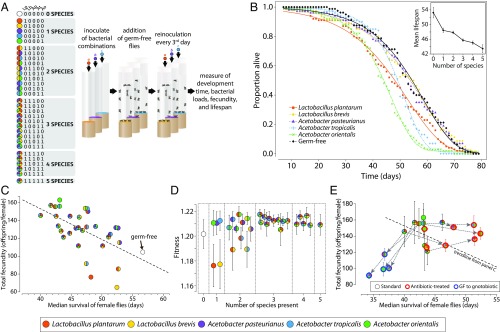
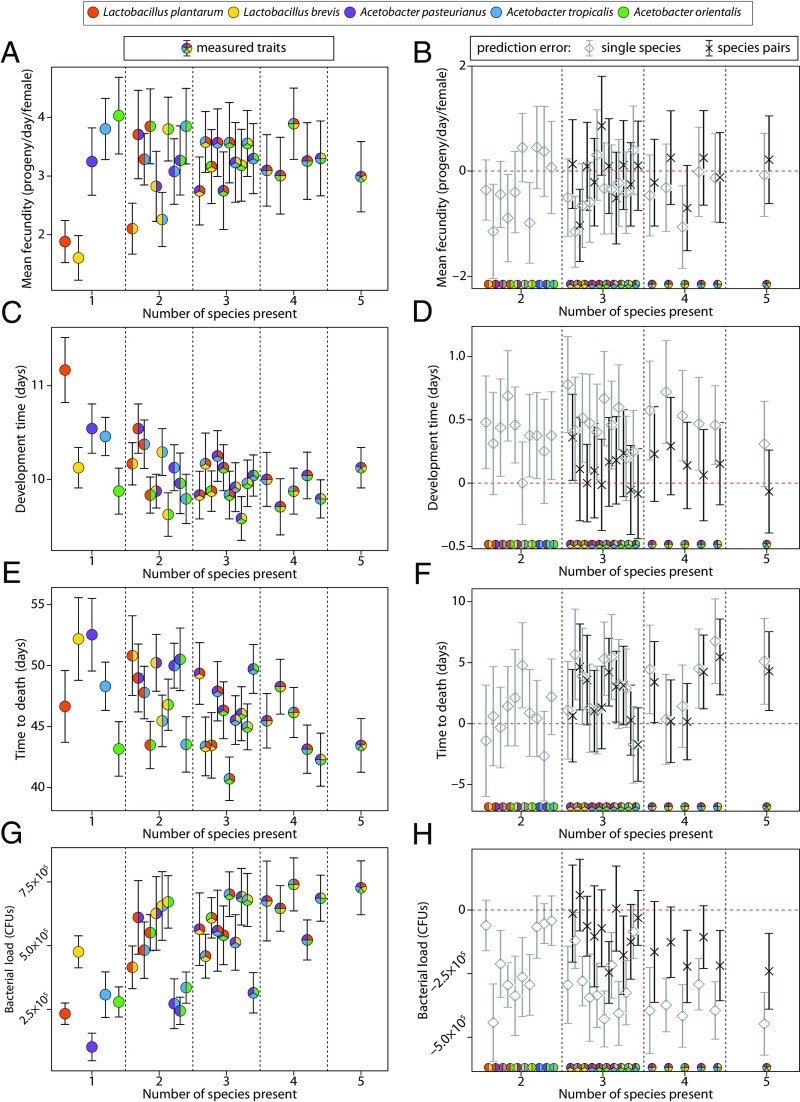
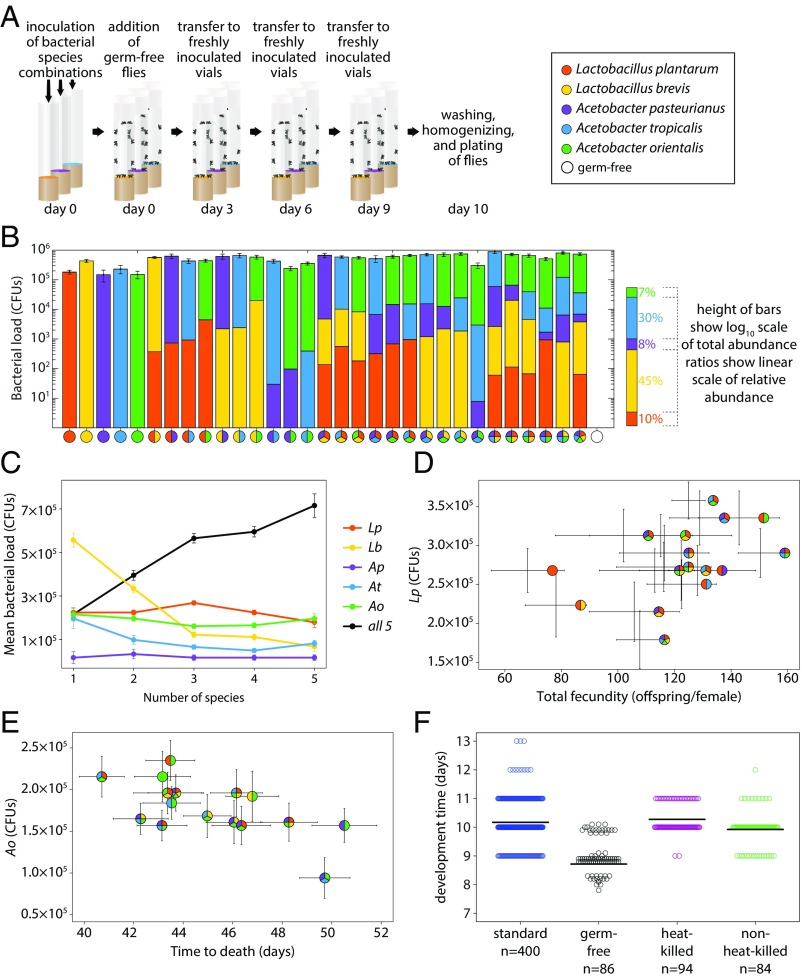
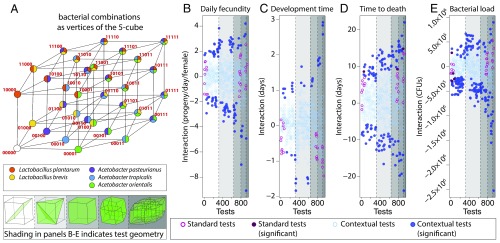
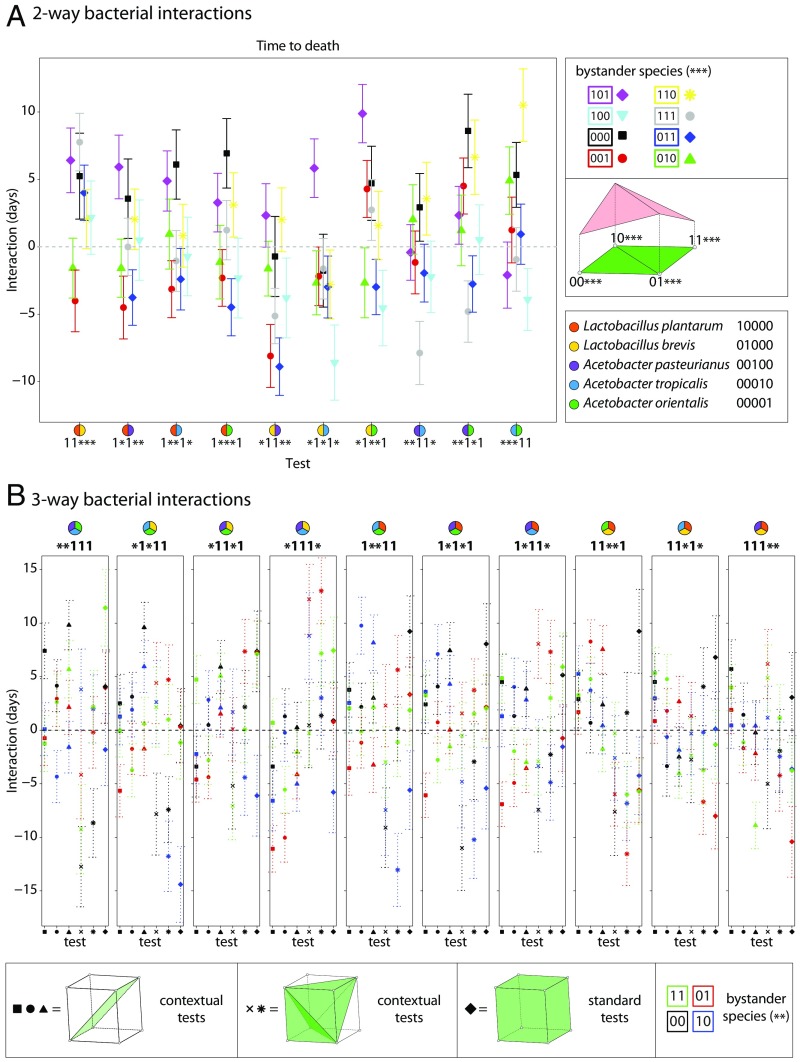
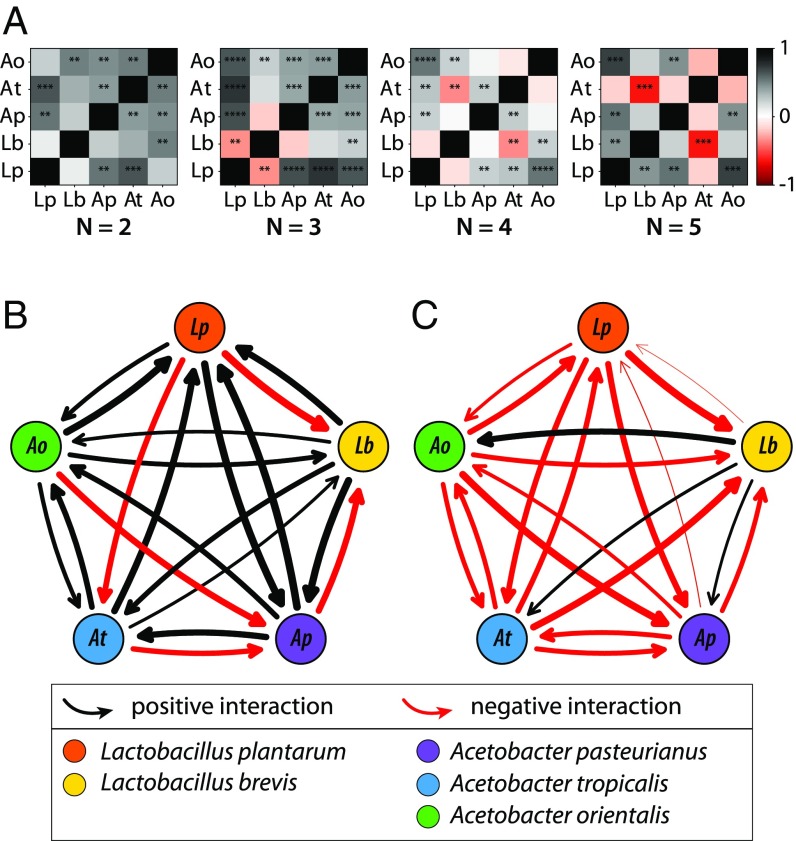
Gut bacteria can affect key aspects of host fitness, such as development, fecundity, and lifespan, while the host, in turn, shapes the gut microbiome. However, it is unclear to what extent individual species versus community interactions within the microbiome are linked to host fitness. Here, we combinatorially dissect the natural microbiome of Drosophila melanogaster and reveal that interactions between bacteria shape host fitness through life history tradeoffs. Empirically, we made germ-free flies colonized with each possible combination of the five core species of fly gut bacteria. We measured the resulting bacterial community abundances and fly fitness traits, including development, reproduction, and lifespan. The fly gut promoted bacterial diversity, which, in turn, accelerated development, reproduction, and aging: Flies that reproduced more died sooner. From these measurements, we calculated the impact of bacterial interactions on fly fitness by adapting the mathematics of genetic epistasis to the microbiome. Development and fecundity converged with higher diversity, suggesting minimal dependence on interactions. However, host lifespan and microbiome abundances were highly dependent on interactions between bacterial species. Higher-order interactions (involving three, four, and five species) occurred in 13–44% of possible cases depending on the trait, with the same interactions affecting multiple traits, a reflection of the life history tradeoff. Overall, we found these interactions were frequently context-dependent and often had the same magnitude as individual species themselves, indicating that the interactions can be as important as the individual species in gut microbiomes.
Overview
The claims and statistics of this paper haven’t been checked yet.
Free: it reads the open-access text and checks the first 5 claims that cite a source we can check. Create a free account to check every claim.
Integrity signals
Registry
Cites
Statistics
Figures
Verification
Claims the paper makes
The claims and statistics of this paper haven’t been checked yet.
Free: it reads the open-access text and checks the first 5 claims that cite a source we can check. Create a free account to check every claim.
Claims other papers make about this one
Each is checked against this paper’s own text: does it say what the citing paper says it does?
In the citing paper
“Recent animal studies have shown that the host fitness is regulated by functional interactions among species, not by a single or a limited group of taxa [139]”
From Gut Microbiota, Muscle Mass and Function in Aging: A Focus on Physical Frailty and Sarcopenia (2019) · cites this paper as [139]
Self-check
Percentages, sums and reported differences re-computed from the paper’s own numbers.
The self-check needs the paper’s full text.
Citations
Cites
The human microbiome: at the interface of health and disease
Cho, I., & Blaser, M. J. (2012) · Nature Reviews Genetics · doi:10.1038/nrg3182 · Cited by 3,449 · cited 1×
“These observations set up two major questions: What is the role of an individual bacterial species versus interactions between them in determining host lifespan, and how is the microbiome effect on lifespan related to overall host fitness? Identifying the host effects of specific bacteria has been difficult, in part,…”
BackgroundWill a Large Complex System be Stable?
MAY, R. M. (1972) · Nature · doi:10.1038/238413a0 · Cited by 2,869
Trade-Offs in Life-History Evolution
Stearns, S. C. (1989) · Functional Ecology · doi:10.2307/2389364 · Cited by 2,852 · cited 1×
“We therefore set up an experiment to measure how defined species compositions change each of the host fitness traits of lifespan, fecundity, and development time, which have been found to covary in life history tradeoffs (5, 6).”
MethodON THE USE OF MATRICES IN CERTAIN POPULATION MATHEMATICS
LESLIE, P. H. (1945) · Biometrika · doi:10.1093/biomet/33.3.183 · Cited by 2,671 · cited 1×
“To address this question, we combined our data for development, fecundity, and lifespan (SI Appendix, Table S1) in a Leslie matrix (26), a classic model of discrete population growth, to calculate organismal fitness under each bacterial association.”
MethodAcquisition and Allocation of Resources: Their Influence on Variation in Life History Tactics
van Noordwijk, A. J., & de Jong, G. (1986) · The American Naturalist · doi:10.1086/284547 · Cited by 2,383
The Long-Term Stability of the Human Gut Microbiota
Faith, J. J., Guruge, J. L., Charbonneau, M., Subramanian, S., Seedorf, H., Goodman, A. L., Clemente, J. C., Knight, R., Heath, A. C., Leibel, R. L., et al. (2013) · Science · doi:10.1126/science.1237439 · Cited by 2,058
Asymmetric Coevolutionary Networks Facilitate Biodiversity Maintenance
Bascompte, J., Jordano, P., & Olesen, J. M. (2006) · Science · doi:10.1126/science.1123412 · Cited by 1,283 · cited 1×
“(35), where asymmetry of interactions is indexed from 0 (perfectly symmetrical) to 2 (exactly opposite).”
BackgroundHost Biology in Light of the Microbiome: Ten Principles of Holobionts and Hologenomes
Bordenstein, S. R., & Theis, K. R. (2015) · PLOS Biology · doi:10.1371/journal.pbio.1002226 · Cited by 1,240 · cited 1×
“Finally, we introduce a mathematical framework to deconstruct microbiome/host complexity by making a conceptual analogy between the bacterial species interactions and genetic epistasis (21, 22).”
MethodMicrobiota-liberated host sugars facilitate post-antibiotic expansion of enteric pathogens
Ng, K. M., Ferreyra, J. A., Higginbottom, S. K., Lynch, J. B., Kashyap, P. C., Gopinath, S., Naidu, N., Choudhury, B., Weimer, B. C., Monack, D. M., et al. (2013) · Nature · doi:10.1038/nature12503 · Cited by 1,035
Innate Immune Homeostasis by the Homeobox Gene Caudal and Commensal-Gut Mutualism in Drosophila
Ryu, J.-H., Kim, S.-H., Lee, H.-Y., Bai, J. Y., Nam, Y.-D., Bae, J.-W., Lee, D. G., Shin, S. C., Ha, E.-M., & Lee, W.-J. (2008) · Science · doi:10.1126/science.1149357 · Cited by 829
Cited by
Items 101–200 of 621
MASI: microbiota—active substance interactions database
Zeng, X. L., Yang, X., Fan, J., Tan, Y. C., Ju, L., Shen, W. X., Wang, Y., Wang, X., Chen, W., Ju, D., et al. (2020) · Nucleic Acids Research · doi:10.1093/nar/gkaa924 · Cited by 54
“Microbiota plays vital roles in human health (1) and its malfunction and dysregulation may lead to health problems (37).”
BackgroundPredicting microbiome compositions from species assemblages through deep learning
Michel-Mata, S., Wang, X., Liu, Y., & Angulo, M. T. (2022) · iMeta · doi:10.1002/imt2.3 · Cited by 56
Baldo, L., Riera, J. L., Salzburger, W., & Barluenga, M. (2019) · Frontiers in Microbiology · doi:10.3389/fmicb.2019.02372 · Cited by 57
“Both freshwater and marine fishes have been found to host Vibrio species (Egerton et al., 2018) and V. cholerae (Halpern and Izhaki, 2017), while incidence of M. morganii has been previously reported in various fishes (Kim et al., 2000; Reshma et al., 2018), suggesting in both cases that the fish…”
BackgroundElevated temperature and toxic Microcystis reduce Daphnia fitness and modulate gut microbiota
Akbar, S., Huang, J., Zhou, Q., Gu, L., Sun, Y., Zhang, L., Lyu, K., & Yang, Z. (2020) · Environmental Pollution · doi:10.1016/j.envpol.2020.116409 · Cited by 53
Gut microbial factors predict disease severity in a mouse model of multiple sclerosis
Steimle, A., Neumann, M., Grant, E. T., Willième, S., Sciscio, A. D., Parrish, A., Ollert, M. W., Miyauchi, E., Soga, T., Fukuda, S., et al. (2024) · Nature Microbiology · doi:10.1038/s41564-024-01761-3 · Cited by 53
“A key study evaluating the effects of multiple defined microbiota compositions on fitness of Drosophila melanogaster already pointed out that microbial network interactions are more important than relative abundances of a given species alone 44 .”
BackgroundWhose trait is it anyways? Coevolution of joint phenotypes and genetic architecture in mutualisms
O'Brien, A., Jack, C. N., Friesen, M., & Frederickson, M. E. (2021) · Proceedings of the Royal Society B Biological Sciences · doi:10.1098/rspb.2020.2483 · Cited by 56
“This result could explain why microbiota affect such a wide variety of host traits, including traits unlikely to directly affect microbe fitness [6,7]; partner fitness feedbacks mean that any joint trait under selection in the host can evolve in microbes, even if the trait has little to do with the host–microbe intera…”
BackgroundThe Computational Diet: A Review of Computational Methods Across Diet, Microbiome, and Health
Eetemadi, A., Rai, N., Pereira, B. M. P., Kim, M., Schmitz, H. H., & Tagkopoulos, I. (2020) · Frontiers in Microbiology · doi:10.3389/fmicb.2020.00393 · Cited by 55
“Depending on the health claims, such products can fall under the categories of drugs or dietary supplements, which have different requirements for approval (Green et al., 2017).”
BackgroundShan, H., Xia, X., Feng, Y.-L., Wu, W., Li, H., Sun, Z., Li, J., & Chen, J.-P. (2024) · npj Biofilms and Microbiomes · doi:10.1038/s41522-024-00539-z · Cited by 50
Phylosymbiosis across Deeply Diverging Lineages of Omnivorous Cockroaches (Order Blattodea)
Tinker, K. A., & Ottesen, E. A. (2020) · Applied and Environmental Microbiology · doi:10.1128/aem.02513-19 · Cited by 49
Application of ecological and evolutionary theory to microbiome community dynamics across systems
McDonald, J. E., Marchesi, J. R., & Koskella, B. (2020) · Proceedings of the Royal Society B Biological Sciences · doi:10.1098/rspb.2020.2886 · Cited by 49
Sood, U., Gupta, V., Kumar, R., Lal, S., Fawcett, D., Rattan, S., Poinern, G. E. J., & Lal, R. (2019) · Indian Journal of Microbiology · doi:10.1007/s12088-019-00785-2 · Cited by 52
Bacterial Keystone Taxa Regulate Carbon Metabolism in the Earthworm Gut
Zhu, G., Schmidt, O., Luan, L., Xue, J., Fan, J., Geisen, S., Sun, B., & Jiang, Y. (2022) · Microbiology Spectrum · doi:10.1128/spectrum.01081-22 · Cited by 48
“Various animal model systems, such as mice (35), zebrafish (36, 37), bees (38), fruit flies (39, 40), and nematodes (41), are often used to identify the potential keystone taxa of intestinal microbiome (13, 42).”
BackgroundArtificially selecting bacterial communities using propagule strategies
Chang, C., Osborne, M. L., Bajić, D., & Sánchez, Á. (2020) · Evolution · doi:10.1111/evo.14092 · Cited by 50
“This challenge is important, as these pairwise and highorder interactions can limit our ability to predict the function of even mid-size consortia (10 taxa or more) (Guo and Boedicker 2016; Gould et al. 2018; Sanchez-Gorostiaga et al. 2019; Senay et al. 2019; Mickalide and Kuehn 2019; Sanchez 2019).”
BackgroundHigher-order microbiome interactions and how to find them
Ludington, W. B. (2022) · Trends in Microbiology · doi:10.1016/j.tim.2022.03.011 · Cited by 47
Self-citationDedrick, S., Warrier, V. U., Lemon, K. P., & Momeni, B. (2023) · mSystems · doi:10.1128/msystems.00757-22 · Cited by 56
Parasite-microbe-host interactions and cancer risk
Dheilly, N. M., Ewald, P. W., Brindley, P. J., Fichorova, R. N., & Thomas, F. (2019) · PLoS Pathogens · doi:10.1371/journal.ppat.1007912 · Cited by 47
Experimental Microbiomes: Models Not to Scale
Chevrette, M. G., Bratburd, J. R., Currie, C. R., & Stubbendieck, R. M. (2019) · mSystems · doi:10.1128/msystems.00175-19 · Cited by 46
“and fecundity, with some members influencing these traits only in the presence of certain other community members (4).”
BackgroundVarg, J. E., Kunce, W., Outomuro, D., Svanbäck, R., & Johansson, F. (2021) · Environmental Pollution · doi:10.1016/j.envpol.2021.117848 · Cited by 45
Li, T., Zhou, C., Wang, M., Zha, S.-S., Chen, J., Bing, X., Hoffmann, A. A., & Hong, X. (2022) · mSystems · doi:10.1128/msystems.01516-21 · Cited by 43
Axenic and gnotobiotic insect technologies in research on host–microbiota interactions
Wu, J., Wang, Q., Wang, D., Wong, A. C.-N., & Wang, G.-H. (2023) · Trends in Microbiology · doi:10.1016/j.tim.2023.02.007 · Cited by 45
Huang, Z., Wang, C., Feng, Q., Liou, R., Lin, Y., Qiao, J., Lu, Y., & Chang, Y. (2022) · Agronomy · doi:10.3390/agronomy12030543 · Cited by 42
“In this study, a model inspired by the “interaction equation” of [32] was designed to explore the growth-promoting effects of the three ST-PGPR agents under NaCl concentration of 0–300 mM.”
MethodMicrobiome-Aware Ecotoxicology of Organisms: Relevance, Pitfalls, and Challenges
Duperron, S., Halary, S., Gallet, A., & Marie, B. (2020) · Frontiers in Public Health · doi:10.3389/fpubh.2020.00407 · Cited by 44
Gillingham, M. A. F., Borghesi, F., Montero, B. K., Migani, F., Béchet, A., Rendón‐Martos, M., Amat, J. A., Dinelli, E., & Sommer, S. (2020) · The Science of The Total Environment · doi:10.1016/j.scitotenv.2020.143250 · Cited by 41
On the evolutionary origins of host–microbe associations
Sieber, M., Traulsen, A., Schulenburg, H., & Douglas, A. E. (2021) · Proceedings of the National Academy of Sciences · doi:10.1073/pnas.2016487118 · Cited by 40
“Indeed, there is evidence that specific members of the gut microbiota can promote both the developmental rate and fecundity of Drosophila and affect its locomotory activity (14, 18, 19), and that Drosophila can utilize microbial volatile cues in its feeding choices (20).”
Clausen, U., Vital, S.-T., Lambertus, P., Gehler, M., Scheve, S., Wöhlbrand, L., & Rabus, R. (2024) · Microbial Physiology · doi:10.1159/000536327 · Cited by 44
Why Evolve Reliance on the Microbiome for Timing of Ontogeny?
Metcalf, C. J. E., Henry, L. P., Rebolleda‐Gómez, M., & Koskella, B. (2019) · mBio · doi:10.1128/mbio.01496-19 · Cited by 40
Vibrio cholerae-Symbiont Interactions Inhibit Intestinal Repair in Drosophila
Fast, D., Petkau, K., Ferguson, M., Shin, M., Galenza, A., Kostiuk, B., Pukatzki, S. U., & Foley, E. (2020) · Cell Reports · doi:10.1016/j.celrep.2019.12.094 · Cited by 40
An efficient and scalable top-down method for predicting structures of microbial communities
Ansari, A. F., Reddy, Y. B. S., Raut, J. S., & Dixit, N. M. (2021) · Nature Computational Science · doi:10.1038/s43588-021-00131-x · Cited by 38
Gut microbiome effects on neuronal excitability & activity: Implications for epilepsy
Darch, H., & McCafferty, C. P. (2022) · Neurobiology of Disease · doi:10.1016/j.nbd.2022.105629 · Cited by 40
How gut microbiome interactions affect nutritional traits of Drosophila melanogaster
McMullen, J. G., Peters-Schulze, G., Cai, J., Patterson, A. D., & Douglas, A. E. (2020) · Journal of Experimental Biology · doi:10.1242/jeb.227843 · Cited by 40
Interkingdom Gut Microbiome and Resistome of the Cockroach Blattella germanica
Domínguez‐Santos, R., Pérez‐Cobas, A. E., Cuti, P., Pérez‐Brocal, V., García‐Ferris, C., Moyá, A., Latorre, A., & Gil, R. (2021) · mSystems · doi:10.1128/msystems.01213-20 · Cited by 39
“Many gut microbiomes have been characterized in different insect orders, such as termites (11, 12) and cockroaches (13–17) in Blattodea, crickets (18) and beetles (19–21) in Coleoptera, bees (22–25) in Hymenoptera, fruit fly (1, 26, 27) in Diptera, and several Lepidoptera (28, 29).”
BackgroundDemystifying individual heterogeneity
Forsythe, A. B., Day, T., & Nelson, W. A. (2021) · Ecology Letters · doi:10.1111/ele.13843 · Cited by 37
“Empirical research shows that there are countless processes underlying both fixed and dynamic condition (e.g. Bishop et al., 2019; Bowen et al., 2015; Gould et al., 2018; Paoli et al., 2020), although some of these processes contribute more often to one type of individual heterogeity than the other.”
BackgroundCouch, C. E., & Epps, C. W. (2022) · Journal of Heredity · doi:10.1093/jhered/esab078 · Cited by 39
Andrighetti, T., Bohár, B., Lemke, N., Sudhakar, P., & Korcsmáros, T. (2020) · Cells · doi:10.3390/cells9051278 · Cited by 37
“First, the high demand of time and cost of experimental studies makes it infeasible to test such a high number of potential microbiome–host interactions [19].”
BackgroundZhu, Y., Yang, R., Wang, X., Wen, T., Gong, M., Shen, Y., Xu, J., Zhao, D., & Du, Y. (2022) · iMeta · doi:10.1002/imt2.57 · Cited by 36
“These microbes are closely tied to the physiology, ecology, and evolution of their hosts [3, 4], frequently performing key services such as maintaining fitness [5], digestion [6], detoxification [7, 8], immunity [9, 10], compensating nutrients [11], and stress responses [12].”
BackgroundCompetitive interactions between culturable bacteria are highly non-additive
Baichman‐Kass, A., Song, T., & Friedman, J. (2023) · eLife · doi:10.7554/elife.83398 · Cited by 39
“Furthermore, we found similar trends in the larger communities of four species (three affecting species and one focal), both that effects combined in a nonadditive manner, being dominated by the strongest single- species effect, and that effects became stronger in larger communities, which is consistent with previous…”
Changes to the gut microbiota of a wild juvenile passerine in a multidimensional urban mosaic
Maracı, Ö., Corsini, M., Antonatou-Papaioannou, A., Jünemann, S., Sudyka, J., Lecce, I. D., Caspers, B. A., & Szulkin, M. (2022) · Scientific Reports · doi:10.1038/s41598-022-10734-7 · Cited by 37
Li, C., Chng, K. R., Kwah, J. S., Av‐Shalom, T. V., Tucker‐Kellogg, L., & Nagarajan, N. (2019) · Microbiome · doi:10.1186/s40168-019-0729-z · Cited by 36
Renahan, T., Lo, W., Werner, M. S., Rochat, J., Herrmann, M., & Sommer, R. J. (2021) · Environmental Microbiology · doi:10.1111/1462-2920.15438 · Cited by 37
“Life history strategies towards either longevity or reproduction can be influenced in Drosophila melanogaster by altering the microbiome composition (Clark et al., 2015; Gould et al., 2018).”
BackgroundCommon features of aging fail to occur in Drosophila raised without a bacterial microbiome
Shukla, A. K., Johnson, K. R., & Giniger, E. (2021) · iScience · doi:10.1016/j.isci.2021.102703 · Cited by 36
Host genomic influence on bacterial composition in the switchgrass rhizosphere
Sutherland, J., Bell, T. H., Trexler, R. V., Carlson, J. E., & Lasky, J. R. (2022) · Molecular Ecology · doi:10.1111/mec.16549 · Cited by 35
“Alternatively, host trait variation could have evolved as a direct response to beneficial interactions with microbes in the environment (Gould et al., 2018).”
BackgroundSelf-citationThe biogeography of host‐associated bacterial microbiomes: Revisiting classic biodiversity patterns
Härer, A., & Rennison, D. J. (2023) · Global Ecology and Biogeography · doi:10.1111/geb.13675 · Cited by 37
Cold exposure, gut microbiota and health implications: A narrative review
Zhou, E., Zhang, L., He, L., Xiao, Y., Zhang, K., & Luo, B. (2024) · The Science of The Total Environment · doi:10.1016/j.scitotenv.2024.170060 · Cited by 35
Could probiotics be the panacea alternative to the use of antimicrobials in livestock diets?
Cameron, A., & McAllister, T. A. (2019) · Beneficial Microbes · doi:10.3920/bm2019.0059 · Cited by 39
Circulating microbiome DNA: An emerging paradigm for cancer liquid biopsy
Chen, H., Ma, Y., Liu, Z., Li, J., Li, X., Yang, F., & Qiu, M. (2021) · Cancer Letters · doi:10.1016/j.canlet.2021.08.036 · Cited by 35
Shao, J., Liu, Y., Xie, J., Štefanič, P., Lv, Y., Fan, B., Mandić-Mulec, I., Zhang, R., Shen, Q., & Shen, Q. (2022) · Applied and Environmental Microbiology · doi:10.1128/aem.00240-22 · Cited by 34
“affect host fitness related to development, fecundity, and life span (4).”
BackgroundMicrobiome-derived acidity protects against microbial invasion in Drosophila
Barron, A. J., Agrawal, S., Lesperance, D., Doucette, J. D., Calle, S., & Broderick, N. A. (2024) · Cell Reports · doi:10.1016/j.celrep.2024.114087 · Cited by 35
“9–13 Previous studies in D. melanogaster have examined microbial invasion through the lenses of microbial pathogenesis, 14–18 microbiome assembly, 10,19 and probiotic colonization.”
BackgroundYan, W., 中国科学院深圳先进技术研究院深港脑科学创新研究院, 广. 深. 5., Li, Z.-J., Lin, Z.-Y., Ji, S., Tse, W. K. F., Meng, Z., Liu, C. X., Li, L., 中国科学院深圳先进技术研究院脑认知与脑疾病研究所中国科学院脑联结解析与调控重点实验室, 广. 深. 5., et al. (2024) · 动物学研究 · doi:10.24272/j.issn.2095-8137.2024.038 · Cited by 34
“Gould et al. (2018) reported that fly lifespan and fecundity are impacted by gut microbiome diversity.”
Unraveling the Molecular Mechanism of Immunosenescence in Drosophila
Min, K., & Tatar, M. (2018) · International Journal of Molecular Sciences · doi:10.3390/ijms19092472 · Cited by 33
The microbiota of Drosophila suzukii influences the larval development of Drosophila melanogaster
Solomon, G. M., Dodangoda, H., Mccarthy-Walker, T., Ntim-Gyakari, R., & Newell, P. D. (2019) · PeerJ · doi:10.7717/peerj.8097 · Cited by 33
Maracı, Ö., Antonatou-Papaioannou, A., Jünemann, S., Castillo-Gutiérrez, O., Busche, T., Kalinowski, J., & Caspers, B. A. (2021) · Frontiers in Microbiology · doi:10.3389/fmicb.2021.619141 · Cited by 35
Leveraging Experimental Strategies to Capture Different Dimensions of Microbial Interactions
Gupta, G., Ndiaye, A., & Filteau, M. (2021) · Frontiers in Microbiology · doi:10.3389/fmicb.2021.700752 · Cited by 33
“…phenotype to study, but rather activity (Pishchany et al., 2018), production (Islam et al., 2020; Senne de Oliveira Lino et al., 2021), behavior (e.g., coaggregation, virulence or biofilm formation; Diaz and Valm, 2020), morphology (Cheong et al., 2021), or benefit to the host (Gould et al., 2018).”
BackgroundInfluentialModels for Gut-Mediated Horizontal Gene Transfer by Bacterial Plasmid Conjugation
Ott, L. C., & Mellata, M. (2022) · Frontiers in Microbiology · doi:10.3389/fmicb.2022.891548 · Cited by 32
Effects of microbial evolution dominate those of experimental host-mediated indirect selection
Arora, J., Brisbin, M. M., & Mikheyev, A. S. (2020) · PeerJ · doi:10.7717/peerj.9350 · Cited by 35
Chen, J., Zhao, H., Wankhade, U. D., Chintapalli, S. V., Li, C., Gai, D., Shankar, K., Zhan, F., & Lazarenko, O. P. (2021) · Communications Biology · doi:10.1038/s42003-020-01564-2 · Cited by 32
Molecular trafficking between bacteria determines the shape of gut microbial community
Boopathi, S., Liu, D., & Jia, A. (2021) · Gut Microbes · doi:10.1080/19490976.2021.1959841 · Cited by 33
“Intrinsic interactions between bacteria precisely determine the composition of the community and increase the fitness of the host.(153) Human gut microbiome is strongly conserved across hosts, but the taxonomic composition is diversified in each individual,(154) thus confirming that the community function is not assoc…”
BackgroundThe gut-cardiovascular connection: new era for cardiovascular therapy
Cheng, C. K., & Huang, Y. (2021) · Medical Review · doi:10.1515/mr-2021-0002 · Cited by 34
“lifespan, metabolism, development and fecundity [4].”
Dundore-Arias, J. P., Smith, M. J., Millican, M. D., & Kinkel, L. L. (2023) · Annual Review of Phytopathology · doi:10.1146/annurev-phyto-021021-041457 · Cited by 38
Zhao, Z., Zhao, H., Wang, X., Zhang, L., Mou, C.-Y., Huang, Z., Ke, H., Duan, Y., Zhou, J. W., & Li, Q. (2024) · Scientific Reports · doi:10.1038/s41598-024-57731-6 · Cited by 31
“All animal handling procedures were approved by the Animal Care and Use Committee of the Fisheries Research Institute, Sichuan Academy of Agricultural Sciences (Chengdu, China), following the recommendations in the ARRIVE guidelines, under permit number 20210307001–5.”
BackgroundMethodStothart, M. R., & Newman, A. E. M. (2021) · Animal Microbiome · doi:10.1186/s42523-021-00105-4 · Cited by 33
Symbiosis: the other cells in development
Carrier, T. J., & Bosch, T. C. G. (2022) · Development · doi:10.1242/dev.200797 · Cited by 32
Why do hosts malfunction without microbes? Missing benefits versus evolutionary addiction
Hammer, T. J. (2023) · Trends in Microbiology · doi:10.1016/j.tim.2023.07.012 · Cited by 33
Sparsity of higher-order landscape interactions enables learning and prediction for microbiomes
Arya, S., George, A. B., & O’Dwyer, J. P. (2023) · Proceedings of the National Academy of Sciences · doi:10.1073/pnas.2307313120 · Cited by 32
Guivier, E., Pech, N., Chappaz, R., & Gilles, A. (2019) · Freshwater Biology · doi:10.1111/fwb.13437 · Cited by 31
“Indeed, many recent studies have shown that bacterial symbionts are critical biological components for host fitness traits, such as development and maturation of the immune system, or nutrient assimilation and energy metabolism (Fuhrman, 2009; Tremaroli & Bäckhed, 2012; Gould et al., 2018).”
BackgroundMayer, T., Mari, A., Almario, J., Roos, M. M., Abdullah, H. S. M., Dombrowski, N., Hacquard, S., Kemen, E. M., & Agler, M. T. (2021) · Molecular Ecology Resources · doi:10.1111/1755-0998.13408 · Cited by 29
Microbial education for marine invertebrate disease prevention in aquaculture
Dantan, L., Toulza, È., Petton, B., Montagnani, C., Dégremont, L., Morga, B., Fleury, Y., Mitta, G., Gueguen, Y., Vidal‐Dupiol, J., et al. (2024) · Reviews in Aquaculture · doi:10.1111/raq.12893 · Cited by 29
Díaz, S., Camargo, C., & Avila, F. W. (2021) · Parasites & Vectors · doi:10.1186/s13071-021-05093-7 · Cited by 30
Interactions between Culturable Bacteria Are Predicted by Individual Species’ Growth
Nestor, E., Toledano, G., & Friedman, J. (2023) · mSystems · doi:10.1128/msystems.00836-22 · Cited by 32
Delbare, S., Ahmed-Braimah, Y. H., Wolfner, M. F., & Clark, A. G. (2020) · Scientific Reports · doi:10.1038/s41598-020-75156-9 · Cited by 31
Liang, M., Feng, W., Chen, X., Tang, Y., Li, J., & Li, W. (2023) · Frontiers in Physiology · doi:10.3389/fphys.2023.1163055 · Cited by 27
“The destruction of gut microbiota by heat stress may ultimately affect the growth and reproductive characteristics of the host (Dubos and Schaedler, 1960; Gould et al., 2018; Moeller et al., 2019).”
BackgroundZhang, S., Shen, Y., Wang, S., Lin, Z., Su, R., Jin, F., & Zhang, Y. (2023) · Ecotoxicology and Environmental Safety · doi:10.1016/j.ecoenv.2023.115480 · Cited by 27
Cooper, R. O., Vavra, J. M., & Cressler, C. E. (2021) · mSystems · doi:10.1128/msystems.00916-20 · Cited by 28
“In these cases, it is important to also consider that interspecies microbiome interactions impact host fitness (19).”
Coexistence holes characterize the assembly and disassembly of multispecies systems
Angulo, M. T., Kelley, A., Montejano, L., Song, C., & Saavedra, S. (2021) · Nature Ecology & Evolution · doi:10.1038/s41559-021-01462-8 · Cited by 29
“[29] Gould, A.”
de León, A. V., Jahnes, B. C., Otero-Bravo, A., & Sabree, Z. L. (2021) · mSystems · doi:10.1128/msystems.00802-21 · Cited by 28
Bourne, M. E., Gloder, G., Weldegergis, B. T., Slingerland, M., Ceribelli, A., Crauwels, S., Lievens, B., Jacquemyn, H., Dicke, M., & Poelman, E. H. (2023) · PLoS Pathogens · doi:10.1371/journal.ppat.1011262 · Cited by 27
Diversity begets diversity under microbial niche constructionPreprint
Estrela, S., Díaz‐Colunga, J., Vila, J. C. C., Sánchez-Gorostiaga, A., & Sánchez, Á. (2022) · bioRxiv (Cold Spring Harbor Laboratory) · doi:10.1101/2022.02.13.480281 · Cited by 28
“Studies in laboratory fly populations reported that increasing microbiome diversity generally lowered the lifespan of these organisms [6], while similar manipulative studies in plant microbiomes found that increasing functional diversity protected the host against pathogens [7].”
BackgroundStothart, M. R., McLoughlin, P. D., Medill, S. A., Greuel, R. J., Wilson, A. J., & Poissant, J. (2024) · Nature Communications · doi:10.1038/s41467-024-49963-x · Cited by 28
Grieneisen, L., Muehlbauer, A. L., & Blekhman, R. (2020) · Philosophical Transactions of the Royal Society B Biological Sciences · doi:10.1098/rstb.2019.0598 · Cited by 29
Universal gut microbial relationships in the gut microbiome of wild baboons
Roche, K. E., Björk, J. R., Dasari, M. R., Grieneisen, L., Jansen, D., Gould, T. J., Gesquiere, L. R., Barreiro, L. B., Alberts, S. C., Blekhman, R., et al. (2023) · eLife · doi:10.7554/elife.83152 · Cited by 29
“…synthesis of physiologically important compounds, like short-chain fatty acids, neurotransmitters, and vitamins ( Faust and Raes, 2012 ; Foster and Bell, 2012 ; Dolinšek et al., 2016 ; Seth and Taga, 2014 ; Bäckhed et al., 2005 ; Gould et al., 2018 ; Pontrelli et al., 2022 ; Degnan et al., 2014 ).”
Jensen, N., Weiland‐Bräuer, N., Joel, S., Chibani, C. M., & Schmitz, R. A. (2023) · Microbiology Spectrum · doi:10.1128/spectrum.00262-23 · Cited by 26
“morphogenesis (10), reproduction (11-14), and environmental adaption (15-18).”
BackgroundCommunity interactions among microbes give rise to host-microbiome mutualisms in an aquatic plant
Laurich, J. R., Lash, E., O'Brien, A., Pogoutse, O., & Frederickson, M. E. (2024) · mBio · doi:10.1128/mbio.00972-24 · Cited by 25
“Few of the studies highlighted by Palmer and Foster (1) grew microbes in association with a host (but see references 5, 7) and even fewer simultaneously compared single and multiple strains of microbes in terms of their effects on both microbial and host growth.”
ResultMosquito Microbiome Diversity Varies Along a Landscape-Scale Moisture Gradient
Medeiros, M. C. I., Seabourn, P. S., Rollins, R. L., & Yoneishi, N. M. (2021) · Microbial Ecology · doi:10.1007/s00248-021-01865-x · Cited by 25
“Symbiotic or host-associated microbiomes represent communities of microorganisms that live on or within a host and can modulate the host’s behavior, metabolism, fecundity, developmental schedule, and immune system [1, 2].”
BackgroundThe importance of host physical niches for the stability of gut microbiome composition
Ludington, W. B. (2024) · Philosophical Transactions of the Royal Society B Biological Sciences · doi:10.1098/rstb.2023.0066 · Cited by 25
Self-citationBatstone, R. T., Burghardt, L. T., & Heath, K. D. (2022) · Proceedings of the Royal Society B Biological Sciences · doi:10.1098/rspb.2022.0477 · Cited by 28
Alteration of Lung and Gut Microbiota in IL-13-Transgenic Mice Simulating Chronic Asthma
Sohn, K., Baek, M.-G., Choi, S.-M., Bae, B., Kim, R. Y., Kim, Y. C., Kim, H. Y., Yi, H., & Kang, H. (2020) · Journal of Microbiology and Biotechnology · doi:10.4014/jmb.2009.09019 · Cited by 24
“A recent study suggested the microbiome interactions are as important as the individual species in shaping fitness traits by mapping gut bacteria against the fruit fly model [28].”
BackgroundMicrobiome mediation of animal life histories via metabolites and insulin‐like signalling
Warne, R. W., & Dallas, J. W. (2022) · Biological reviews/Biological reviews of the Cambridge Philosophical Society · doi:10.1111/brv.12833 · Cited by 28
Predicted Metabolic Function of the Gut Microbiota of Drosophila melanogaster
Ankrah, N. Y. D., Barker, B., Song, J. Y., Wu, C., McMullen, J. G., & Douglas, A. E. (2021) · mSystems · doi:10.1128/msystems.01369-20 · Cited by 34
“both field and lab Drosophila populations (34–37), and have been widely used to investigate the impact of gut microbes on host physiology (14, 30, 38, 39).”
BackgroundInsect Models in Nutrition Research
Tonk, M., Vilcinskas, A., & Wagner, A. E. (2022) · Biomolecules · doi:10.3390/biom12111668 · Cited by 26
Circadian rhythms of hosts and their gut microbiomes: Implications for animal physiology and ecology
Schmid, D. W., Capilla‐Lasheras, P., Dominoni, D. M., Müller‐Klein, N., Sommer, S., & Risely, A. (2023) · Functional Ecology · doi:10.1111/1365-2435.14255 · Cited by 24
Mason, C. J., Auth, J., & Geib, S. M. (2023) · Scientific Reports · doi:10.1038/s41598-023-40562-2 · Cited by 23
Robustness of microbiome function
Lee, K. K., Park, Y., & Kuehn, S. (2023) · Current Opinion in Systems Biology · doi:10.1016/j.coisb.2023.100479 · Cited by 24
Domin, H., Zimmermann, J., Taubenheim, J., Reyes, G. F., Saueressig, L., Prasse, D., Höppner, M. P., Schmitz, R. A., Hentschel, U., Kaleta, C., et al. (2023) · Microbiome · doi:10.1186/s40168-023-01701-z · Cited by 23
“These microbes can have a variety of effects and functions in metabolism [1], immunity [2], patho-gen resistance [3], development [4], and behavior of their macroscopic host [5].”
BackgroundHost-Microbe-Pathogen Interactions: A Review of Vibrio cholerae Pathogenesis in Drosophila
Davoodi, S., & Foley, E. (2020) · Frontiers in Immunology · doi:10.3389/fimmu.2019.03128 · Cited by 24
“When considering microbial control of host metabolism, it is important to note that higher-order interactions in a complex community of intestinal bacteria impact host health and fitness (43).”
BackgroundAdvancements in the Impact of Insect Gut Microbiota on Host Feeding Behaviors
Wang, Y., Wang, L., Li, D., Chen, Z., Luo, Y., Zhou, J., Luo, B., Yan, R., Liu, H., & Wang, L. (2024) · Genes · doi:10.3390/genes15101320 · Cited by 22
“The ecological diversity and niche differentiation of insects have largely shaped the composition and function of their gut microbiota, which in turn further enhances the adaptability of insects to specific niches and plays an indispensable role in the ecological network [2].”
BackgroundPoudel, R., Jumpponen, A., Kennelly, M., Rivard, C. L., Gomez-Montano, L., & Garrett, K. A. (2023) · Applied and Environmental Microbiology · doi:10.1128/aem.01843-22 · Cited by 22
“To minimize the bias resulting from unequal sequence counts per sample, samples were rarified to the lowest sequence count among the samples (6,698).”
BackgroundChaturvedi, A., Li, X., Dhandapani, V., Marshall, H., Kissane, S., Cambronero, M. C., Asole, G., Calvet, F., Ruiz‐Romero, M., Marangio, P., et al. (2023) · Nucleic Acids Research · doi:10.1093/nar/gkad685 · Cited by 24
“The gut microbiota community is intimately linked to the physiology and fitness of the host ( 145 ).”
BackgroundDing, M.-Q., Ding, J., Yang, S.-S., Ren, X.-R., Shi, S.-N., Zhang, L.-Y., Xing, D., Ren, N.-Q., & Wu, W. (2024) · The Science of The Total Environment · doi:10.1016/j.scitotenv.2024.176130 · Cited by 22
Rethinking embryology in vitro: A synergy between engineering, data science and theory
Gritti, N., Oriola, D., & Trivedi, V. (2020) · Developmental Biology · doi:10.1016/j.ydbio.2020.10.013 · Cited by 23
O’Brien, A. M., Laurich, J. R., & Frederickson, M. E. (2024) · Evolution · doi:10.1093/evolut/qpad183 · Cited by 21
Impact of gut microbial diversity on egg production performance in chickens
Wu, L., Zhang, T., Luo, Z., Xiao, H., Wang, D., Wu, C., Fang, X., Li, J., Zhou, J., Miao, J., et al. (2025) · Microbiology Spectrum · doi:10.1128/spectrum.01927-24 · Cited by 21
“The gut microbial community is composed of various types of microorganisms whose interactions significantly affect the host (41).”
Metadata
- Authors
- Gould, A. L., Zhang, V., Lamberti, L., Jones, E. W., Obadia, B., Korasidis, N., Gavryushkin, A., Carlson, J. M., Beerenwinkel, N., & Ludington, W. B.
- Affiliations
- University of California, Berkeley (US)
- SIB Swiss Institute of Bioinformatics (CH)
- University of California, Santa Barbara (US)
- ETH Zurich (CH)
- Johns Hopkins University (US)
- Corresponding author
- Ludington, William B.
- ORCID
- Venue
- Proceedings of the National Academy of Sciences
- Publisher
- National Academy of Sciences
- Published
- 2018-12-03
- Volume
- 115
- Issue
- 51
- Pages
- E11951-E11960
- ISSN
- 0027-8424 (ISSN-L)
- 1091-6490
- PMC
- PMC6304949
- OpenAlex
- W2902868023
- Cited by
- 579
- References
- 42
- Citations by year
- 2026: 48 · 2025: 72 · 2024: 67 · 2023: 89 · 2022: 82 · 2021: 101 · 2020: 67 · 2019: 48 · 2018: 4
- FWCI
- 51.76
- Type
- journal article
- Language
- en
- Open access
- hybrid
- doi.org
- Licence
- Locations
- Proceedings of the National Academy of Sciences (publishedVersion, cc-by-nc-nd)
- Europe PMC (PubMed Central) (publishedVersion, cc-by-nc-nd)
- PubMed Central (publishedVersion, cc-by-nc-nd)
- PubMed (publishedVersion)
- Repository for Publications and Research Data (ETH Zurich) (submittedVersion, cc-by-nc-nd)
- ETH Zürich Research Collection
- Funders
- HHS | NIH | NIH Office of the Director (1DP5OD017851-01)
- National Science Foundation (1650114)
- Royal Society of New Zealand (RDF-17-UOO-007)
- David and Lucile Packard Foundation (0000)
- DOD | United States Army | RDECOM | Army Research Office (W911NF-09-0001)
- William K. Bowes, Jr. Foundation (0000)
- Topics
- Life Sciences › Agricultural and Biological Sciences › Insect Science › Insect symbiosis and bacterial influences
- Life Sciences › Biochemistry, Genetics and Molecular Biology › Molecular Biology › Gut microbiota and health
- Life Sciences › Biochemistry, Genetics and Molecular Biology › Genetics › Evolution and Genetic Dynamics
- Keywords
- gut microbiota, host fitness, Drosophila melanogaster, bacterial interactions, life-history trade-offs, bacterial diversity, lifespan, fecundity, development (biology), epistasis, higher-order interactions, microbiome assembly
- MeSH terms
- Gastrointestinal Microbiome, Host Microbial Interactions, Animals, Bacteria, Drosophila melanogaster, Epistasis, Genetic, Fertility, Germ-Free Life, Longevity, Phenotype, Reproduction, Gastrointestinal Tract, Biodiversity, Microbial Interactions, Microbiota
About these checks
Registry, retraction, Cites and statistics results are computed, not judged, with one exception: a printed reference that no index lists is read once by a model before it counts as a citation error. Claims are extracted by a model and kept only when their quote appears verbatim in the text; each cited source is then checked, with a model’s help, for whether it says what the claim relies on. Those verdicts can be wrong — read the claim’s quote and the cited source before relying on one.
Statistics and arithmetic are recomputed, not judged.
Confidence bands are shown only for fields calibrated on our annotated test set. None is calibrated yet, so no band is shown.
What counts as a claim ›How we measure confidence ›How we check this ›
Are you an author, or do you see a problem with this page? Request a review
Data sources
Bibliographic data: Semantic Scholar, OpenAlex, Crossref.
Contains information from the Semantic Scholar Academic Graph Datasets, made available under the ODC Attribution License (ODC-BY 1.0).
Semantic Scholar’s data is described in: Kinney, R., et al. (2023). The Semantic Scholar Open Data Platform. arXiv:2301.10140.
