

Microbiome interactions shape host fitness
Open accessThe DOI matches its Crossref record; 47 of the 47 references it cites were found in a registry or an index.
Abstract
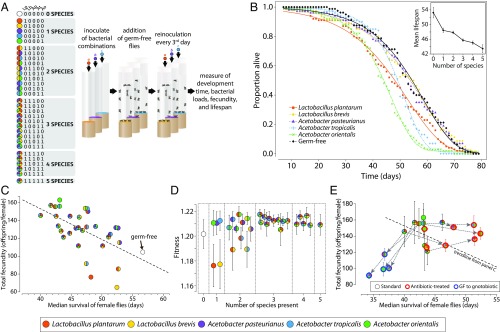
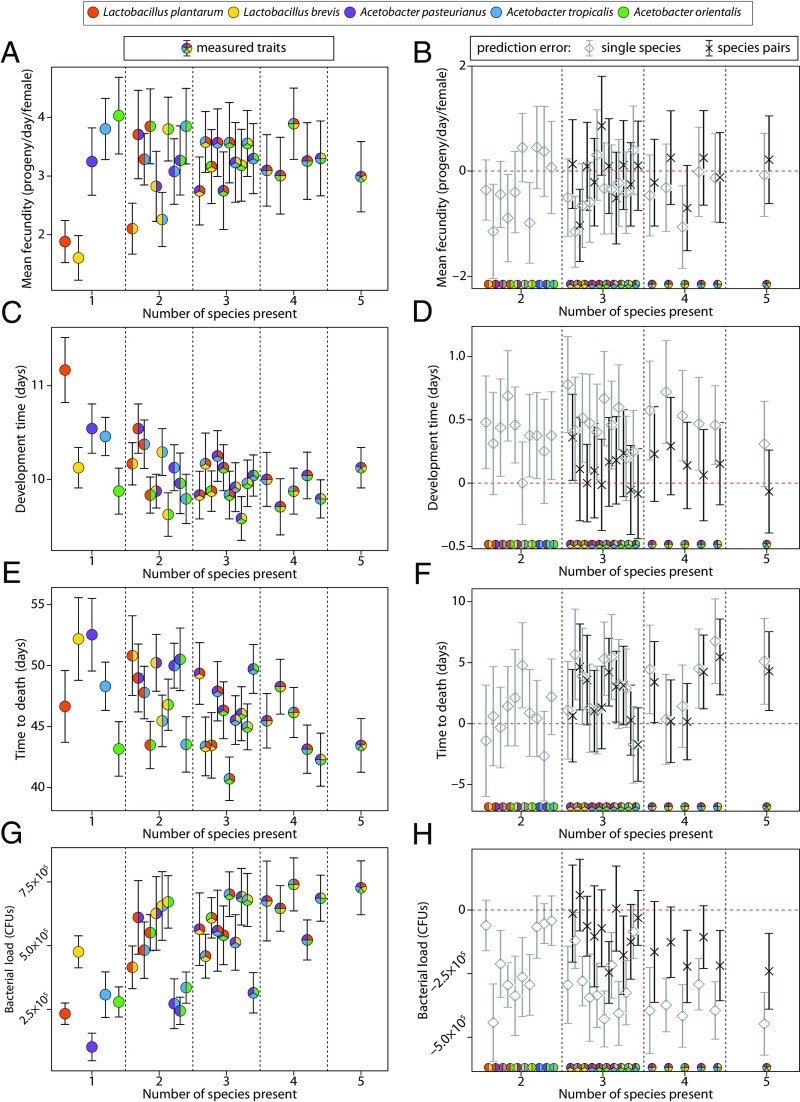
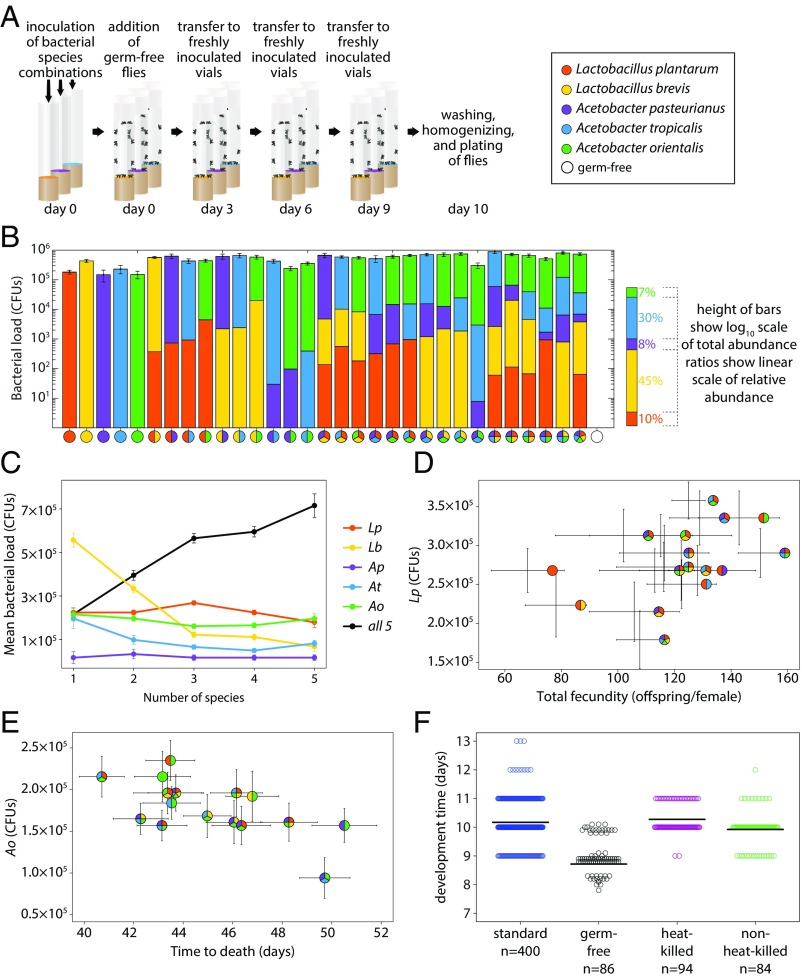
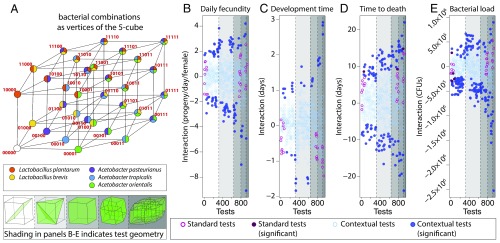
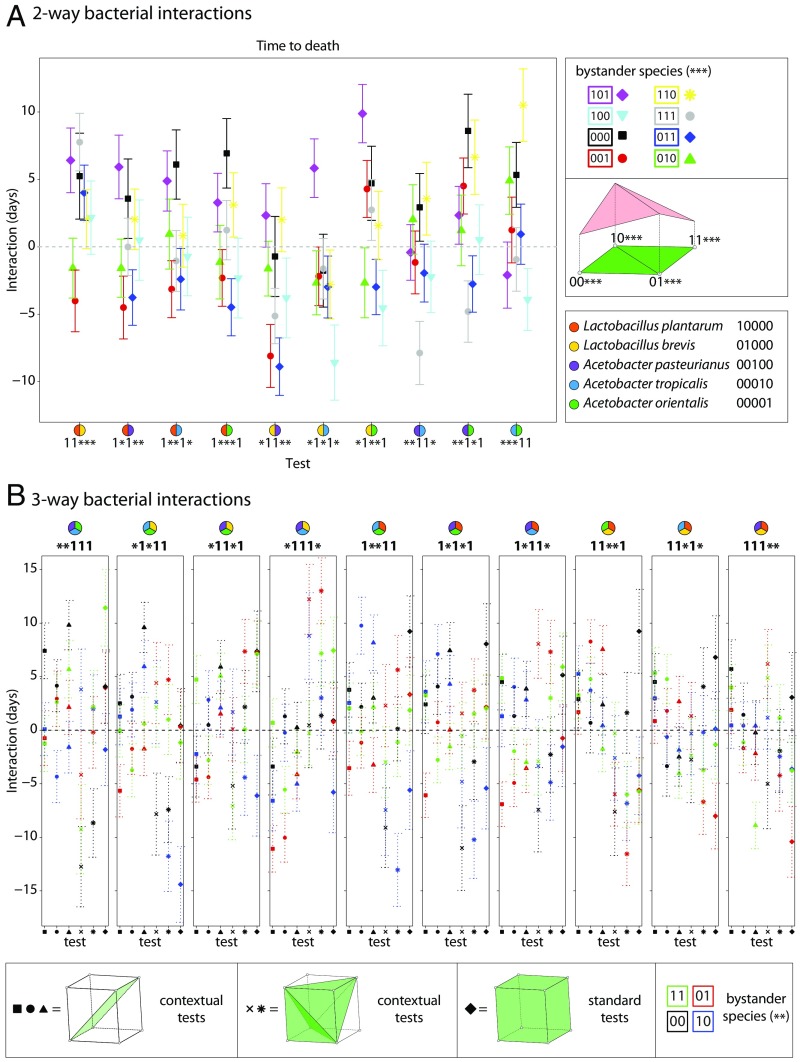
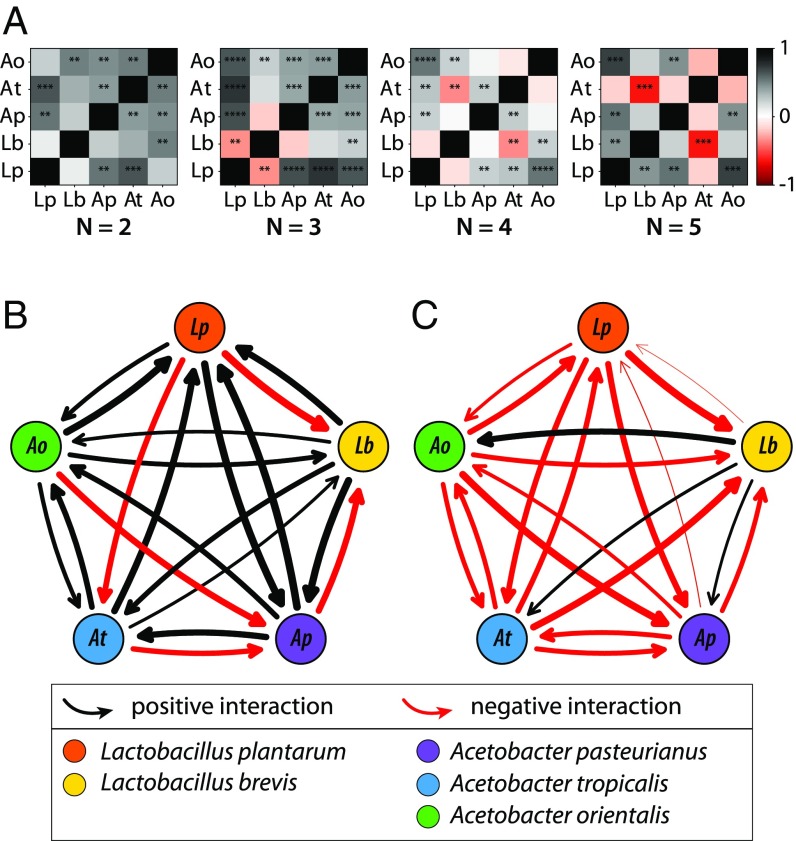
Gut bacteria can affect key aspects of host fitness, such as development, fecundity, and lifespan, while the host, in turn, shapes the gut microbiome. However, it is unclear to what extent individual species versus community interactions within the microbiome are linked to host fitness. Here, we combinatorially dissect the natural microbiome of Drosophila melanogaster and reveal that interactions between bacteria shape host fitness through life history tradeoffs. Empirically, we made germ-free flies colonized with each possible combination of the five core species of fly gut bacteria. We measured the resulting bacterial community abundances and fly fitness traits, including development, reproduction, and lifespan. The fly gut promoted bacterial diversity, which, in turn, accelerated development, reproduction, and aging: Flies that reproduced more died sooner. From these measurements, we calculated the impact of bacterial interactions on fly fitness by adapting the mathematics of genetic epistasis to the microbiome. Development and fecundity converged with higher diversity, suggesting minimal dependence on interactions. However, host lifespan and microbiome abundances were highly dependent on interactions between bacterial species. Higher-order interactions (involving three, four, and five species) occurred in 13–44% of possible cases depending on the trait, with the same interactions affecting multiple traits, a reflection of the life history tradeoff. Overall, we found these interactions were frequently context-dependent and often had the same magnitude as individual species themselves, indicating that the interactions can be as important as the individual species in gut microbiomes.
Overview
The claims and statistics of this paper haven’t been checked yet.
Free: it reads the open-access text and checks the first 5 claims that cite a source we can check. Create a free account to check every claim.
Integrity signals
Registry
Cites
Statistics
Figures
Verification
Claims the paper makes
The claims and statistics of this paper haven’t been checked yet.
Free: it reads the open-access text and checks the first 5 claims that cite a source we can check. Create a free account to check every claim.
Claims other papers make about this one
Each is checked against this paper’s own text: does it say what the citing paper says it does?
In the citing paper
“Recent animal studies have shown that the host fitness is regulated by functional interactions among species, not by a single or a limited group of taxa [139]”
From Gut Microbiota, Muscle Mass and Function in Aging: A Focus on Physical Frailty and Sarcopenia (2019) · cites this paper as [139]
Self-check
Percentages, sums and reported differences re-computed from the paper’s own numbers.
The self-check needs the paper’s full text.
Citations
Cites
The human microbiome: at the interface of health and disease
Cho, I., & Blaser, M. J. (2012) · Nature Reviews Genetics · doi:10.1038/nrg3182 · Cited by 3,449 · cited 1×
“These observations set up two major questions: What is the role of an individual bacterial species versus interactions between them in determining host lifespan, and how is the microbiome effect on lifespan related to overall host fitness? Identifying the host effects of specific bacteria has been difficult, in part,…”
BackgroundWill a Large Complex System be Stable?
MAY, R. M. (1972) · Nature · doi:10.1038/238413a0 · Cited by 2,869
Trade-Offs in Life-History Evolution
Stearns, S. C. (1989) · Functional Ecology · doi:10.2307/2389364 · Cited by 2,852 · cited 1×
“We therefore set up an experiment to measure how defined species compositions change each of the host fitness traits of lifespan, fecundity, and development time, which have been found to covary in life history tradeoffs (5, 6).”
MethodON THE USE OF MATRICES IN CERTAIN POPULATION MATHEMATICS
LESLIE, P. H. (1945) · Biometrika · doi:10.1093/biomet/33.3.183 · Cited by 2,671 · cited 1×
“To address this question, we combined our data for development, fecundity, and lifespan (SI Appendix, Table S1) in a Leslie matrix (26), a classic model of discrete population growth, to calculate organismal fitness under each bacterial association.”
MethodAcquisition and Allocation of Resources: Their Influence on Variation in Life History Tactics
van Noordwijk, A. J., & de Jong, G. (1986) · The American Naturalist · doi:10.1086/284547 · Cited by 2,383
The Long-Term Stability of the Human Gut Microbiota
Faith, J. J., Guruge, J. L., Charbonneau, M., Subramanian, S., Seedorf, H., Goodman, A. L., Clemente, J. C., Knight, R., Heath, A. C., Leibel, R. L., et al. (2013) · Science · doi:10.1126/science.1237439 · Cited by 2,058
Asymmetric Coevolutionary Networks Facilitate Biodiversity Maintenance
Bascompte, J., Jordano, P., & Olesen, J. M. (2006) · Science · doi:10.1126/science.1123412 · Cited by 1,283 · cited 1×
“(35), where asymmetry of interactions is indexed from 0 (perfectly symmetrical) to 2 (exactly opposite).”
BackgroundHost Biology in Light of the Microbiome: Ten Principles of Holobionts and Hologenomes
Bordenstein, S. R., & Theis, K. R. (2015) · PLOS Biology · doi:10.1371/journal.pbio.1002226 · Cited by 1,240 · cited 1×
“Finally, we introduce a mathematical framework to deconstruct microbiome/host complexity by making a conceptual analogy between the bacterial species interactions and genetic epistasis (21, 22).”
MethodMicrobiota-liberated host sugars facilitate post-antibiotic expansion of enteric pathogens
Ng, K. M., Ferreyra, J. A., Higginbottom, S. K., Lynch, J. B., Kashyap, P. C., Gopinath, S., Naidu, N., Choudhury, B., Weimer, B. C., Monack, D. M., et al. (2013) · Nature · doi:10.1038/nature12503 · Cited by 1,035
Innate Immune Homeostasis by the Homeobox Gene Caudal and Commensal-Gut Mutualism in Drosophila
Ryu, J.-H., Kim, S.-H., Lee, H.-Y., Bai, J. Y., Nam, Y.-D., Bae, J.-W., Lee, D. G., Shin, S. C., Ha, E.-M., & Lee, W.-J. (2008) · Science · doi:10.1126/science.1149357 · Cited by 829
Cited by
Microbiome definition re-visited: old concepts and new challenges
Berg, G., Rybakova, D., Fischer, D., Cernava, T., Vergès, M.-C. C., Charles, T., Chen, X., Cocolin, L., Eversole, K., Corral, G. H., et al. (2020) · Microbiome · doi:10.1186/s40168-020-00875-0 · Cited by 2,275
From hairballs to hypotheses–biological insights from microbial networks
Röttjers, L., & Faust, K. (2018) · FEMS Microbiology Reviews · doi:10.1093/femsre/fuy030 · Cited by 714
Microbiome diversity protects against pathogens by nutrient blocking
Spragge, F., Bakkeren, E., Jahn, M. T., B. N. Araujo, E., Pearson, C. F., Wang, X., Pankhurst, L., Cunrath, O., & Foster, K. R. (2023) · Science · doi:10.1126/science.adj3502 · Cited by 435
Gut Microbiota, Muscle Mass and Function in Aging: A Focus on Physical Frailty and Sarcopenia
Ticinesi, A., Nouvenne, A., Cerundolo, N., Catania, P., Prati, B., Tana, C., & Meschi, T. (2019) · Nutrients · doi:10.3390/nu11071633 · Cited by 418
Gut microbiota in ulcerative colitis: insights on pathogenesis and treatment
Guo, X. Y., Liu, X. J., & Hao, J. Y. (2020) · Journal of Digestive Diseases · doi:10.1111/1751-2980.12849 · Cited by 336
The microbiome extends host evolutionary potential
Henry, L. P., Bruijning, M., Forsberg, S. K. G., & Ayroles, J. F. (2021) · Nature Communications · doi:10.1038/s41467-021-25315-x · Cited by 329
Emerging strategies for precision microbiome management in diverse agroecosystems
French, E., Kaplan, I., Iyer-Pascuzzi, A., Nakatsu, C. H., & Enders, L. (2021) · Nature Plants · doi:10.1038/s41477-020-00830-9 · Cited by 305
The Effects of Temperature on Animal Gut Microbiomes
Sepulveda, J., & Moeller, A. H. (2020) · Frontiers in Microbiology · doi:10.3389/fmicb.2020.00384 · Cited by 300
Open challenges for microbial network construction and analysis
Faust, K. (2021) · The ISME Journal · doi:10.1038/s41396-021-01027-4 · Cited by 299
Bacterial species rarely work together
Palmer, J. D., & Foster, K. R. (2022) · Science · doi:10.1126/science.abn5093 · Cited by 294
The Structure of Ecological Networks Across Levels of Organization
Guimarães, P. R. (2020) · Annual Review of Ecology, Evolution, and Systematics · doi:10.1146/annurev-ecolsys-012220-120819 · Cited by 276
“Increasing evidence suggests that these microbiome networks may affect a number of features of their hosts and, consequently, host fitness (Gould et al. 2018, Layeghifard et al. 2019).”
BackgroundCo-evolution and Co-speciation of Host-Gut Bacteria Systems
Groussin, M., Mazel, F., & Alm, E. J. (2020) · Cell Host & Microbe · doi:10.1016/j.chom.2020.06.013 · Cited by 275
Morella, N. M., Weng, F. C.-H., Joubert, P. M., Metcalf, C. J. E., Lindow, S., & Koskella, B. (2020) · Proceedings of the National Academy of Sciences · doi:10.1073/pnas.1908600116 · Cited by 259
“Discussion The impact of a microbiome on host health and fitness depends not only on which microbial organisms are present in the community, but also on how they interact with one another within the microbiome (42).”
BackgroundSimple animal models for microbiome research
Douglas, A. E. (2019) · Nature Reviews Microbiology · doi:10.1038/s41579-019-0242-1 · Cited by 258
Spatial metabolomics of in situ host–microbe interactions at the micrometre scale
Geier, B., Sogin, E. M., Michellod, D., Janda, M., Kompauer, M., Spengler, B., Dubilier, N., & Liebeke, M. (2020) · Nature Microbiology · doi:10.1038/s41564-019-0664-6 · Cited by 234
Pais, I. S., Valente, R. S., Sporniak, M., & Teixeira, L. (2018) · PLOS Biology · doi:10.1371/journal.pbio.2005710 · Cited by 228
High-order interactions distort the functional landscape of microbial consortia
Sanchez-Gorostiaga, A., Bajić, D., Osborne, M. L., Poyatos, J. F., & Sanchez, A. (2019) · PLOS Biology · doi:10.1371/journal.pbio.3000550 · Cited by 196
“In spite of a growing appreciation of the role that HOIs may play in community assembly [28,35–40], we still know little about their quantitative contribution to specific processes and community-level functions [6,20].”
BackgroundResultInfluentialThe microbiome and mosquito vectorial capacity: rich potential for discovery and translation
Cansado-Utrilla, C., Zhao, S. Y., McCall, P. J., Coon, K. L., & Hughes, G. L. (2021) · Microbiome · doi:10.1186/s40168-021-01073-2 · Cited by 192
“and lifespan [141] and therefore the effectiveness of microbial control of mosquitoes [142].”
BackgroundMetabolic interaction models recapitulate leaf microbiota ecology
Schäfer, M., Pacheco, A. R., Künzler, R., Bortfeld-Miller, M., Field, C. M., Vayena, E., Hatzimanikatis, V., & Vorholt, J. A. (2023) · Science · doi:10.1126/science.adf5121 · Cited by 186
Mechanisms underlying gut microbiota–host interactions in insects
Schmidt, K., & Engel, P. (2021) · Journal of Experimental Biology · doi:10.1242/jeb.207696 · Cited by 175
“…(see Glossary) (Akami et al., 2019; Jose et al., 2019; Lee et al., 2017), fecundity (Pais et al., 2018) and longevity (Salem et al., 2014; Gould et al., 2018), to shorter larval development (Coon et al., 2014; Storelli et al., 2011; Shukla et al., 2018a,b; Vogel et al., 2017a; Shin et…”
BackgroundMicrobiome Multi-Omics Network Analysis: Statistical Considerations, Limitations, and Opportunities
Jiang, D., Armour, C. R., Hu, C., Mei, M., Tian, C., Sharpton, T. J., & Jiang, Y. (2019) · Frontiers in Genetics · doi:10.3389/fgene.2019.00995 · Cited by 170
“…Gade et al. (2011) combined two p-values for each pair of mRNA and miRNA expression values: (a) a p-value measuring the statistical correlation of the observed data and (b) a p-value obtained from an existing database of miRNA-target predictions (e.g., miRBase) (Griffiths-Jones et al., 2008).”
MethodHost-associated microbiomes drive structure and function of marine ecosystems
Wilkins, L. G. E., Leray, M., O’Dea, A., Yuen, B., Peixoto, R. S., Pereira, T. J., Bik, H. M., Coil, D. A., Duffy, J. E., Herre, E. A., et al. (2019) · PLoS Biology · doi:10.1371/journal.pbio.3000533 · Cited by 168
“Because microbial symbionts are integral parts of most living organisms [9,15], broadening our understanding of how microbial symbionts contribute to host performance and adaptability is essential.”
BackgroundPrevotella in Pigs: The Positive and Negative Associations with Production and Health
Amat, S., Lantz, H. L., Munyaka, P. M., & Willing, B. P. (2020) · Microorganisms · doi:10.3390/microorganisms8101584 · Cited by 166
Microbiome composition shapes rapid genomic adaptation of Drosophila melanogaster
Rudman, S. M., Greenblum, S. I., Hughes, R. C., Rajpurohit, S., Kiratli, O. L. Z., Lowder, D. B., Lemmon, S. G., Petrov, D. A., Chaston, J. M., & SCHMIDT, P. S. (2019) · Proceedings of the National Academy of Sciences · doi:10.1073/pnas.1907787116 · Cited by 169
“Bacteria play a crucial role in the physiology, ecology, and evolution of animals even if they are not transmitted or acquired across generations (22, 31–34), and the composition of affiliated microbial communities can impact host performance and relative fitness (35).”
BackgroundRodrigues, R. R., Gurung, M., Li, Z., García-Jaramillo, M., Greer, R., Gaulke, C., Bauchinger, F., You, H., Pederson, J. W., Vasquez-Perez, S., et al. (2021) · Nature Communications · doi:10.1038/s41467-020-20313-x · Cited by 160
Microbial coexistence through chemical-mediated interactions
Niehaus, L., Boland, I., Liu, M., Chen, K., Fu, D., Henckel, C., Chaung, K., Miranda, S. E., Dyckman, S., Crum, M., et al. (2019) · Nature Communications · doi:10.1038/s41467-019-10062-x · Cited by 164
Henriques, S. F., Dhakan, D. B., Serra, L., Francisco, A. P., Carvalho-Santos, Z., Baltazar, C., Elias, A. P., Anjos, M., Zhang, T., Maddocks, O. D. K., et al. (2020) · Nature Communications · doi:10.1038/s41467-020-18049-9 · Cited by 166
Microbiome evolution during host aging
Aleman, F., & Valenzano, D. R. (2019) · PLoS Pathogens · doi:10.1371/journal.ppat.1007727 · Cited by 152
Interspecies bacterial competition regulates community assembly in the C. elegans intestine
Ortiz, A., Vega, N. M., Ratzke, C., & Gore, J. (2021) · The ISME Journal · doi:10.1038/s41396-021-00910-4 · Cited by 129
The Symbiotic Spectrum: Where Do the Gregarines Fit?
Rueckert, S., Betts, E. L., & Tsaousis, A. D. (2019) · Trends in Parasitology · doi:10.1016/j.pt.2019.06.013 · Cited by 137
“Follow-up studies using host gut metagenomics and metatranscriptomics complemented with proteomics and metabolomics [3,60] to explore both the host specificity and the microbiome of invertebrates harbouring these gregarine species [61,62] would further elucidate the relationship and the roles of gregarines within thei…”
Drosophila as a model for the gut microbiome
Ludington, W. B., & Ja, W. W. (2020) · PLoS Pathogens · doi:10.1371/journal.ppat.1008398 · Cited by 141
“Combinatorial experimental designs have shown that higher-order interactions between 3, 4, and 5 species of the microbiome affect fly life history strategy [35, 36].”
BackgroundSelf-citationUsing ecological coexistence theory to understand antibiotic resistance and microbial competition
Letten, A. D., Hall, A. R., & Levine, J. M. (2021) · Nature Ecology & Evolution · doi:10.1038/s41559-020-01385-w · Cited by 140
Emmenegger, B., Massoni, J., Pestalozzi, C. M., Bortfeld‐Miller, M., Maier, B. A., & Vorholt, J. A. (2023) · Nature Communications · doi:10.1038/s41467-023-43793-z · Cited by 138
The potential role of the gut microbiota in shaping host energetics and metabolic rate
Lindsay, E. C., Metcalfe, N. B., & Llewellyn, M. S. (2020) · Journal of Animal Ecology · doi:10.1111/1365-2656.13327 · Cited by 129
“Germ-free flies had an increased lifespan, but a lower reproductive rate (Gould et al., 2018).”
BackgroundGalindo‐Castañeda, T., Lynch, J. P., Six, J., & Hartmann, M. (2022) · Frontiers in Plant Science · doi:10.3389/fpls.2022.827369 · Cited by 139
Microplastics as an aquatic pollutant affect gut microbiota within aquatic animals
Li, W., Chen, X., Li, M., Cai, Z., Gong, H., & Yan, M. (2021) · Journal of Hazardous Materials · doi:10.1016/j.jhazmat.2021.127094 · Cited by 128
The microbial exometabolome: ecological resource and architect of microbial communities
Douglas, A. E. (2020) · Philosophical Transactions of the Royal Society B Biological Sciences · doi:10.1098/rstb.2019.0250 · Cited by 131
“Furthermore, in some systems, the sign of interactions among community members can shift from generally positive (either facilitative or reciprocal) in binary co-culture towards competitive interactions as community complexity increases [70].”
BackgroundUnraveling host regulation of gut microbiota through the epigenome–microbiome axis
Pepke, M. L., Hansen, S. B., & Limborg, M. T. (2024) · Trends in Microbiology · doi:10.1016/j.tim.2024.05.006 · Cited by 122
Methods for the study of innate immunity in Drosophila melanogaster
Troha, K., & Buchon, N. (2019) · Wiley Interdisciplinary Reviews Developmental Biology · doi:10.1002/wdev.344 · Cited by 122
“Variations in the composition of environmental microbes can have significant effects on host physiology and immune responsiveness; thus, standardization of microbiota is recommended at the beginning of every project (Fast, Duggal, & Foley, 2018; Gould et al., 2018; Rosshart et al., 2017).”
BackgroundDisentangling host–microbiota complexity through hologenomics
Alberdi, A., Andersen, S. B., Limborg, M. T., Dunn, R. R., & Gilbert, M. T. P. (2021) · Nature Reviews Genetics · doi:10.1038/s41576-021-00421-0 · Cited by 120
Nutrient dominance governs the assembly of microbial communities in mixed nutrient environments
Estrela, S., Sánchez-Gorostiaga, A., Vila, J. C. C., & Sánchez, Á. (2021) · eLife · doi:10.7554/elife.65948 · Cited by 114
“Answering this question is central to solving many fundamental and applied problems, such as how multiple genes combine to give rise to complex traits [1,2], how multiple drugs affect the evolution of resistance in bacteria and cancer cells [3,4], how multiple environmental stressors affect bacterial physiology […”
BackgroundTop-down identification of keystone taxa in the microbiome
Amit, G., & Bashan, A. (2023) · Nature Communications · doi:10.1038/s41467-023-39459-5 · Cited by 116
Microbial community design: methods, applications, and opportunities
Eng, A., & Borenstein, E. (2019) · Current Opinion in Biotechnology · doi:10.1016/j.copbio.2019.03.002 · Cited by 113
The role of multilevel selection in host microbiome evolution
van Vliet, S., & Doebeli, M. (2019) · Proceedings of the National Academy of Sciences · doi:10.1073/pnas.1909790116 · Cited by 113
“As a result, the reproductive success of a host often depends on the composition of its microbiome (6).”
BackgroundThe microbiota influences the Drosophila melanogaster life history strategy
Walters, A. W., Hughes, R. C., Call, T. B., Walker, C. J., Wilcox, H., Petersen, S. C., Rudman, S. M., Newell, P. D., Douglas, A. E., SCHMIDT, P. S., et al. (2020) · Molecular Ecology · doi:10.1111/mec.15344 · Cited by 109
Engineering complex communities by directed evolution
Chang, C.-Y., Vila, J. C. C., Bender, M., Li, R., Mankowski, M. C., Bassette, M., Borden, J., Golfier, S., Sanchez, P. G. L., Waymack, R., et al. (2021) · Nature Ecology & Evolution · doi:10.1038/s41559-021-01457-5 · Cited by 103
Ruuskanen, S., Rainio, M. J., Gómez-Gallego, C., Selenius, O., Salminen, S., Collado, M. C., Saikkonen, K., Saloniemi, I., & Helander, M. L. (2020) · Environmental Pollution · doi:10.1016/j.envpol.2020.115108 · Cited by 111
“Concerning reproduction, work with invertebrate models has demonstrated that gut microbiome dysbiosis (especially the lack of symbionts) can negatively influence reproduction (Rosengaus et al., 2011; Sison-Magnus et al., 2013; Gould, 2018).”
BackgroundDirected Evolution of Microbial Communities
Sánchez, Á., Vila, J. C. C., Chang, C., Díaz‐Colunga, J., Estrela, S., & Rebolleda‐Gómez, M. (2021) · Annual Review of Biophysics · doi:10.1146/annurev-biophys-101220-072829 · Cited by 111
Demystifying the O-GlcNAc Code: A Systems View
Ma, J., Hou, C., & Wu, C. (2022) · Chemical Reviews · doi:10.1021/acs.chemrev.1c01006 · Cited by 102
Stochastic microbiome assembly depends on context
Jones, E. W., Carlson, J. M., Sivak, D. A., & Ludington, W. B. (2022) · Proceedings of the National Academy of Sciences · doi:10.1073/pnas.2115877119 · Cited by 98
Self-citationThe community-function landscape of microbial consortia
Sánchez, Á., Bajić, D., Díaz‐Colunga, J., Skwara, A., Vila, J. C. C., & Kuehn, S. (2023) · Cell Systems · doi:10.1016/j.cels.2022.12.011 · Cited by 97
Dodge, R., Jones, E. W., Zhu, H., Obadia, B., Martinez, D. J., Wang, C., Aranda-Díaz, A., Aumiller, K., Liu, Z., Voltolini, M., et al. (2023) · Nature Communications · doi:10.1038/s41467-023-36942-x · Cited by 91
Self-citationThe Interplay between Androgen and Gut Microbiota: Is There a Microbiota-Gut-Testis Axis
Li, X., Cheng, W., Shang, H., Wei, H., & Deng, C. (2021) · Reproductive Sciences · doi:10.1007/s43032-021-00624-0 · Cited by 95
Global epistasis on fitness landscapes
Díaz‐Colunga, J., Skwara, A., Gowda, K., Díaz‐Uriarte, R., Tikhonov, M., Bajić, D., & Sánchez, Á. (2023) · Philosophical Transactions of the Royal Society B Biological Sciences · doi:10.1098/rstb.2022.0053 · Cited by 93
Consuegra, J., Grenier, T., Akherraz, H., Rahioui, I., Gervais, H., Silva, P. D., & Leulier, F. (2020) · iScience · doi:10.1016/j.isci.2020.101232 · Cited by 96
“…the Acetobacter, Lactobacillus species and yeast were shown to influence additional adult traits such as olfaction and egg laying behavior (Fischer et al., 2017), food choice behavior (Leitão-Gonçalves et al., 2017), lifespan and fecundity (Gould et al., 2018) and immunity (Fast et al., 2020).”
BackgroundThe role of commensal microbes in the lifespan of Drosophila melanogaster
Lee, H., Lee, S., Lee, J.-H., Lee, W., & Min, K. (2019) · Aging · doi:10.18632/aging.102073 · Cited by 90
Commensal inter-bacterial interactions shaping the microbiota
Kern, L., Abdeen, S. K., Kolodziejczyk, A. A., & Elinav, E. (2021) · Current Opinion in Microbiology · doi:10.1016/j.mib.2021.07.011 · Cited by 89
Li, Y., Shao, L., Mou, Y., Zhang, Y., & Ping, Y. (2021) · Gut Microbes · doi:10.1080/19490976.2021.1957407 · Cited by 87
“However, not until recently have we been able to investigate their composition and function with the advances in DNA sequencing and metagenomic analysis techniques.(5) Moreover, brain-gut-axis (BGA), which studies the interactions between GM and CNS, has gained significant attention in recent years.”
BackgroundNatural selection for imprecise vertical transmission in host–microbiota systems
Bruijning, M., Henry, L. P., Forsberg, S. K. G., Metcalf, C. J. E., & Ayroles, J. F. (2021) · Nature Ecology & Evolution · doi:10.1038/s41559-021-01593-y · Cited by 89
Microbial rescue effects: How microbiomes can save hosts from extinction
Mueller, E. A., Wisnoski, N. I., Peralta, A. L., & Lennon, J. T. (2020) · Functional Ecology · doi:10.1111/1365-2435.13493 · Cited by 88
Bacterial associations in the healthy human gut microbiome across populations
Loftus, M. G., Hassouneh, S. A.-D., & Yooseph, S. (2021) · Scientific Reports · doi:10.1038/s41598-021-82449-0 · Cited by 85
Wang, Y., Eum, J. H., Harrison, R. E., Valzania, L., Yang, X., Johnson, J. A., Huck, D. T., Brown, M. R., & Strand, M. R. (2021) · Proceedings of the National Academy of Sciences · doi:10.1073/pnas.2101080118 · Cited by 86
Interspecies commensal interactions have nonlinear impacts on host immunity
Rice, T., Bielecka, A. A., Nguyen, M. T., Rosen, C. E., Song, D., Sonnert, N. D., Yang, Y., Cao, Y., Khetrapal, V., Catanzaro, J., et al. (2022) · Cell Host & Microbe · doi:10.1016/j.chom.2022.05.004 · Cited by 76
Bacterial interspecies interactions modulate pH-mediated antibiotic tolerance
Aranda-Díaz, A., Obadia, B., Dodge, R., Thomsen, T., Hallberg, Z. F., Güvener, Z. T., Ludington, W. B., & Huang, K. C. (2020) · eLife · doi:10.7554/elife.51493 · Cited by 78
“Strain, strain background (Acetobacter tropicalis) At (Gould et al., 2018) Acetobacter tropicalis lab fly (Oregon-R) isolate”
BackgroundMethodInfluentialSelf-citationBinetruy, F., Buysse, M., Lejarre, Q., Barosi, R., Villa, M., Rahola, N., Paupy, C., Ayala, D., & Duron, O. (2020) · Molecular Ecology · doi:10.1111/mec.15373 · Cited by 76
“…can determine pivotal phenotypic traits of their hosts, driving a variety of ecological and evolutionary processes including major nutritive, reproductive and immune functions (Gould et al., 2018; Groussin et al., 2017; Hanning & Diaz-Sanchez, 2015; Ley et al., 2008; Turner, James, & Poole, 2013).”
BackgroundHow commensal microbes shape the physiology of Drosophila melanogaster
Grenier, T., & Leulier, F. (2020) · Current Opinion in Insect Science · doi:10.1016/j.cois.2020.08.002 · Cited by 75
Deep learning approaches for natural product discovery from plant endophytic microbiomes
Aghdam, S. A., & Brown, A. M. V. (2021) · Environmental Microbiome · doi:10.1186/s40793-021-00375-0 · Cited by 75
Liu, J., Liu, L., Zhang, G., & Peng, X. (2021) · International Journal of Biological Macromolecules · doi:10.1016/j.ijbiomac.2021.08.139 · Cited by 71
Reviving a failed network through microscopic interventions
Sanhedrai, H., Gao, J., Bashan, A., Schwartz, M., Havlin, S., & Barzel, B. (2022) · Nature Physics · doi:10.1038/s41567-021-01474-y · Cited by 82
“6 and Supplementary Section 3.3), we consider the gut microbiome, a microbial community whose functional state has been shown to crucially impact human health 32,33 .”
BackgroundInfluentialFast, D., Duggal, A., & Foley, E. (2018) · mBio · doi:10.1128/mbio.01114-18 · Cited by 74
Bacterial community structure alterations within the colorectal cancer gut microbiome
Loftus, M. G., Hassouneh, S. A.-D., & Yooseph, S. (2021) · BMC Microbiology · doi:10.1186/s12866-021-02153-x · Cited by 81
The Axenic and Gnotobiotic Mosquito: Emerging Models for Microbiome Host Interactions
Steven, B. T., Hyde, J., LaReau, J. C., & Brackney, D. E. (2021) · Frontiers in Microbiology · doi:10.3389/fmicb.2021.714222 · Cited by 70
Network structure of resource use and niche overlap within the endophytic microbiome
Smith, M. J., Song, Z., Spawn, S., Hansen, Z. A., Johnson, M., May, G., Borer, E. T., Seabloom, E. W., & Kinkel, L. L. (2021) · The ISME Journal · doi:10.1038/s41396-021-01080-z · Cited by 70
Global epistasis and the emergence of function in microbial consortia
Díaz‐Colunga, J., Skwara, A., Vila, J. C. C., Bajić, D., & Sánchez, Á. (2024) · Cell · doi:10.1016/j.cell.2024.04.016 · Cited by 73
Lactobacilli biology, applications and host interactions
Mejía-Caballero, A., & Marco, M. L. (2025) · Nature Reviews Microbiology · doi:10.1038/s41579-025-01205-7 · Cited by 79
“Lactobacilli are similarly influenced by their microbial context, interacting positively or negatively with other microorganisms in fermented foods and host-associated sites (for example, the competitive dynamics between L. plantarum and L. brevis in the Drosophila gut) 141 .”
How sample heterogeneity can obscure the signal of microbial interactions
Armitage, D. W., & Jones, S. E. (2019) · The ISME Journal · doi:10.1038/s41396-019-0463-3 · Cited by 75
Rennison, D. J., Rudman, S. M., & Schluter, D. (2019) · Proceedings of the Royal Society B Biological Sciences · doi:10.1098/rspb.2019.1911 · Cited by 70
“Like other interspecific interactions, the composition of affiliated microbial communities can impact host performance and relative fitness [5,6].”
BackgroundAbrego, N., Roslin, T. V., Huotari, T., Tack, A. J. M., Lindahl, B. D., Tikhonov, G. N., Somervuo, P. J., Schmidt, N. M., & Ovaskainen, O. (2020) · Molecular Ecology · doi:10.1111/mec.15516 · Cited by 67
“…and microbes in the rhizosphere, direct and indirect interactions play important roles in determining the community composition and fitness of both plants and microbes (Artursson, Finlay, & Jansson, 2006; Frey-Klett, Garbaye, & Tarkka, 2007; Gould et al., 2018; Johansson, Paul, & Finlay, 2004).”
BackgroundPrinciples for Rigorous Design and Application of Synthetic Microbial Communities
Zhang, Y., Jing, M., Lyu, L., Nie, L., Xu, X., Sun, R., Xu, X., Chen, S., He, S., Zhang, Y., et al. (2025) · Advanced Science · doi:10.1002/advs.202514750 · Cited by 90
The role of insect gut microbiota in host fitness, detoxification and nutrient supplementation
Shamjana, U., Vasu, D. A., Hembrom, P. S., Nayak, K., & Grace, T. (2024) · Antonie van Leeuwenhoek · doi:10.1007/s10482-024-01970-0 · Cited by 67
“The association of the microbiome and the host is intricate, which reveals how resident microbes influence host metabolic phenotypes, physiology, fitness and facilitate and induce host altruistic behavior (Lewin-Epstein et al. 2017; Lewin-Epstein and Hadany 2020; Gould et al. 2018).”
Higher-Order Interactions Dampen Pairwise Competition in the Zebrafish Gut Microbiome
Sundarraman, D., Hay, E. A., Martins, D. M., Shields, D. S., Pettinari, N. L., & Parthasarathy, R. (2020) · mBio · doi:10.1128/mbio.01667-20 · Cited by 67
“In contrast, work using well-defined bacterial assemblies of up to five species in the fruit fly D. melanogaster found strong higher-order interactions governing microbe-dependent effects on host traits, such as life span (32).”
Ding, M.-Q., Yang, S.-S., Ding, J., Zhang, Z.-R., Zhao, Y., Dai, W., Sun, H.-J., Zhao, L., Xing, D., Ren, N., et al. (2023) · Environmental Science & Technology · doi:10.1021/acs.est.2c05009 · Cited by 64
Human milk oligosaccharide-sharing by a consortium of infant derived Bifidobacterium species
Walsh, C., Lane, J. A., van Sinderen, D., & Hickey, R. M. (2022) · Scientific Reports · doi:10.1038/s41598-022-07904-y · Cited by 64
Zhang, M., Chen, H., Liu, L., Xu, L., Wang, X., Chang, L., Chang, Q., Lu, G., Jiang, J., & Zhu, L. (2020) · Frontiers in Microbiology · doi:10.3389/fmicb.2020.00162 · Cited by 64
μBialSim: Constraint-Based Dynamic Simulation of Complex Microbiomes
Popp, D., & Centler, F. (2020) · Frontiers in Bioengineering and Biotechnology · doi:10.3389/fbioe.2020.00574 · Cited by 58
“Microbial communities are ubiquitous in nature, thriving in diverse habitats ranging from the deep subsurface (Dutta et al., 2018) over digestive tracts of higher animals (Gould et al., 2018) to the upper troposphere (Deleon-Rodriguez et al., 2013).”
BackgroundDiversity and Functions of Yeast Communities Associated with Insects
Malassigné, S., Minard, G., Vallon, L., Martin, E., Moro, C. V., & Luis, P. (2021) · Microorganisms · doi:10.3390/microorganisms9081552 · Cited by 61
“Insect bacterial microbiota offer a wide range of benefits to their host, ranging from increased fecundity [15], oviposition [16], and longevity [17] to shorter larval development [18].”
BackgroundHigher-order interactions shape microbial interactions as microbial community complexity increases
Morin, M., Morrison, A. J., Harms, M. J., & Dutton, R. J. (2022) · Scientific Reports · doi:10.1038/s41598-022-25303-1 · Cited by 66
Gut Bacteria in the Holometabola: A Review of Obligate and Facultative Symbionts
Kucuk, R. A. (2020) · Journal of Insect Science · doi:10.1093/jisesa/ieaa084 · Cited by 61
Resource competition can explain simplicity in microbial community assembly
Lee, H., Bloxham, B., & Gore, J. (2023) · Proceedings of the National Academy of Sciences · doi:10.1073/pnas.2212113120 · Cited by 59
Sex-Specific Linkages Between Taxonomic and Functional Profiles of Tick Gut Microbiomes
Obregón, D., Bard, É., Abrial, D., Estrada‐Peña, A., & Cabezas‐Cruz, A. (2019) · Frontiers in Cellular and Infection Microbiology · doi:10.3389/fcimb.2019.00298 · Cited by 62
Diet–Microbiota Interactions Alter Mosquito Development
Martinson, V. G., & Strand, M. R. (2021) · Frontiers in Microbiology · doi:10.3389/fmicb.2021.650743 · Cited by 58
“Increased diversity can create novel microbe–microbe interactions that change gene expression in the overall microbial community or in particular community members, which can result in emergent properties that change the overall metabolism or ecological interactions among microbial species (Ibberson et al., 2017; Kešn…”
BackgroundGuo, J., Chen, Y., Lu, P., Liu, M., Sun, P., & Zhang, Z. (2021) · Environmental Pollution · doi:10.1016/j.envpol.2021.117641 · Cited by 59
The ephemeral resource patch concept
Butterworth, N. J., Benbow, M. E., & Barton, P. S. (2022) · Biological reviews/Biological reviews of the Cambridge Philosophical Society · doi:10.1111/brv.12926 · Cited by 62
“Gould et al. (2018); van Vliet & Doebeli (2019) Kin selection Because of the highly competitive and ephemeral nature of ERPs, one evolutionary strategy is to optimise reproductive success by laying multiple offspring on the same resource.”
BackgroundRadiation as an immune modulator: mechanisms and implications for combination with immunotherapy
Darragh, L. B., & Karam, S. D. (2026) · Nature reviews. Cancer · doi:10.1038/s41568-025-00903-x · Cited by 60
The Native Microbiome is Crucial for Offspring Generation and Fitness of Aurelia aurita
Weiland‐Bräuer, N., Pinnow, N., Langfeldt, D., Roik, A., Güllert, S., Chibani, C. M., Reusch, T. B. H., & Schmitz, R. A. (2020) · mBio · doi:10.1128/mbio.02336-20 · Cited by 60
“The requirement of an associated microbiota for reproduction was recently also demonstrated for the fruit fly Drosophila (70).”
BackgroundThe Role of Microbiota in Drosophila melanogaster Aging
Arias-Rojas, A., & Iatsenko, I. (2022) · Frontiers in Aging · doi:10.3389/fragi.2022.909509 · Cited by 69
Immunometabolism: Insights from the Drosophila model
Galenza, A., & Foley, E. (2019) · Developmental & Comparative Immunology · doi:10.1016/j.dci.2019.01.011 · Cited by 58
Offspring Microbiomes Differ Across Breeding Sites in a Panmictic Species
Gillingham, M. A. F., Béchet, A., Cézilly, F., Wilhelm, K., Rendón‐Martos, M., Borghesi, F., Nissardi, S., Baccetti, N., Azafzaf, H., Menke, S., et al. (2019) · Frontiers in Microbiology · doi:10.3389/fmicb.2019.00035 · Cited by 55
“An enteric microbial community in homeostasis is thought to have important fitness benefits (Shin et al., 2011; Gould et al., 2018), since symbiotic gastrointestinal bacteria are known to play an important role in facilitating nutrient intake, gut development, immune system maturation and resistance against enteric pa…”
BackgroundPhysical Constraints on Epistasis
Husain, K. B., & Murugan, A. (2020) · Molecular Biology and Evolution · doi:10.1093/molbev/msaa124 · Cited by 64
Population bottlenecks constrain host microbiome diversity and genetic variation impeding fitness
Ørsted, M., Yashiro, E., Hoffmann, A. A., & Kristensen, T. N. (2022) · PLoS Genetics · doi:10.1371/journal.pgen.1010206 · Cited by 58
“These interactions between the host and its microbiota can in turn have a substantial impact on host fitness (Gould et al. 2018; Walters et al. 2019; West et al. 2019).”
Background
Metadata
- Authors
- Gould, A. L., Zhang, V., Lamberti, L., Jones, E. W., Obadia, B., Korasidis, N., Gavryushkin, A., Carlson, J. M., Beerenwinkel, N., & Ludington, W. B.
- Affiliations
- University of California, Berkeley (US)
- SIB Swiss Institute of Bioinformatics (CH)
- University of California, Santa Barbara (US)
- ETH Zurich (CH)
- Johns Hopkins University (US)
- Corresponding author
- Ludington, William B.
- ORCID
- Venue
- Proceedings of the National Academy of Sciences
- Publisher
- National Academy of Sciences
- Published
- 2018-12-03
- Volume
- 115
- Issue
- 51
- Pages
- E11951-E11960
- ISSN
- 0027-8424 (ISSN-L)
- 1091-6490
- PMC
- PMC6304949
- OpenAlex
- W2902868023
- Cited by
- 579
- References
- 42
- Citations by year
- 2026: 48 · 2025: 72 · 2024: 67 · 2023: 89 · 2022: 82 · 2021: 101 · 2020: 67 · 2019: 48 · 2018: 4
- FWCI
- 51.76
- Type
- journal article
- Language
- en
- Open access
- hybrid
- doi.org
- Licence
- Locations
- Proceedings of the National Academy of Sciences (publishedVersion, cc-by-nc-nd)
- Europe PMC (PubMed Central) (publishedVersion, cc-by-nc-nd)
- PubMed Central (publishedVersion, cc-by-nc-nd)
- PubMed (publishedVersion)
- Repository for Publications and Research Data (ETH Zurich) (submittedVersion, cc-by-nc-nd)
- ETH Zürich Research Collection
- Funders
- HHS | NIH | NIH Office of the Director (1DP5OD017851-01)
- National Science Foundation (1650114)
- Royal Society of New Zealand (RDF-17-UOO-007)
- David and Lucile Packard Foundation (0000)
- DOD | United States Army | RDECOM | Army Research Office (W911NF-09-0001)
- William K. Bowes, Jr. Foundation (0000)
- Topics
- Life Sciences › Agricultural and Biological Sciences › Insect Science › Insect symbiosis and bacterial influences
- Life Sciences › Biochemistry, Genetics and Molecular Biology › Molecular Biology › Gut microbiota and health
- Life Sciences › Biochemistry, Genetics and Molecular Biology › Genetics › Evolution and Genetic Dynamics
- Keywords
- gut microbiota, host fitness, Drosophila melanogaster, bacterial interactions, life-history trade-offs, bacterial diversity, lifespan, fecundity, development (biology), epistasis, higher-order interactions, microbiome assembly
- MeSH terms
- Gastrointestinal Microbiome, Host Microbial Interactions, Animals, Bacteria, Drosophila melanogaster, Epistasis, Genetic, Fertility, Germ-Free Life, Longevity, Phenotype, Reproduction, Gastrointestinal Tract, Biodiversity, Microbial Interactions, Microbiota
About these checks
Registry, retraction, Cites and statistics results are computed, not judged, with one exception: a printed reference that no index lists is read once by a model before it counts as a citation error. Claims are extracted by a model and kept only when their quote appears verbatim in the text; each cited source is then checked, with a model’s help, for whether it says what the claim relies on. Those verdicts can be wrong — read the claim’s quote and the cited source before relying on one.
Statistics and arithmetic are recomputed, not judged.
Confidence bands are shown only for fields calibrated on our annotated test set. None is calibrated yet, so no band is shown.
What counts as a claim ›How we measure confidence ›How we check this ›
Are you an author, or do you see a problem with this page? Request a review
Data sources
Bibliographic data: Semantic Scholar, OpenAlex, Crossref.
Contains information from the Semantic Scholar Academic Graph Datasets, made available under the ODC Attribution License (ODC-BY 1.0).
Semantic Scholar’s data is described in: Kinney, R., et al. (2023). The Semantic Scholar Open Data Platform. arXiv:2301.10140.
