

Microbiome interactions shape host fitness
Open accessThe DOI matches its Crossref record; 47 of the 47 references it cites were found in a registry or an index.
Abstract
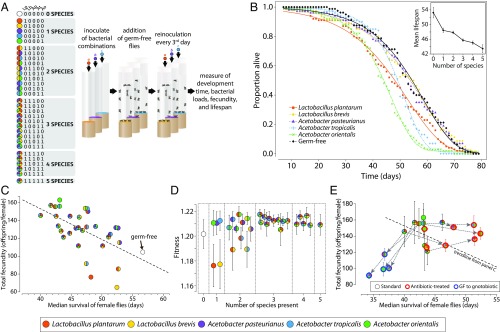
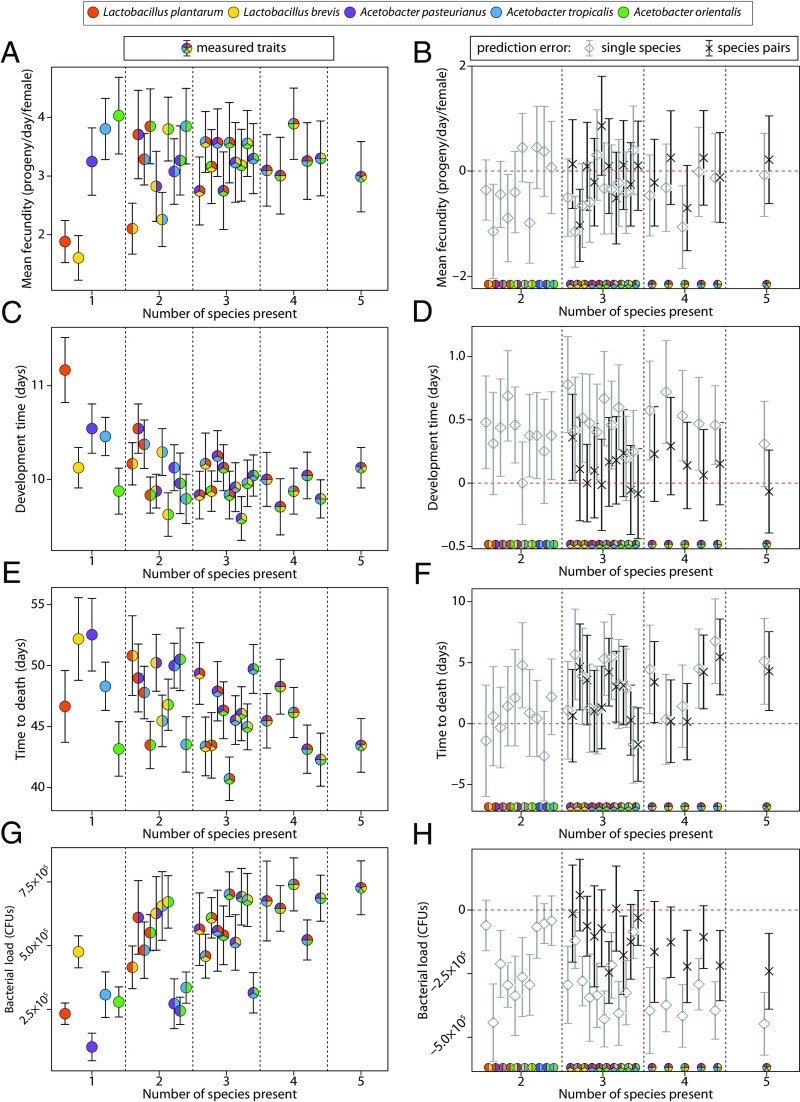
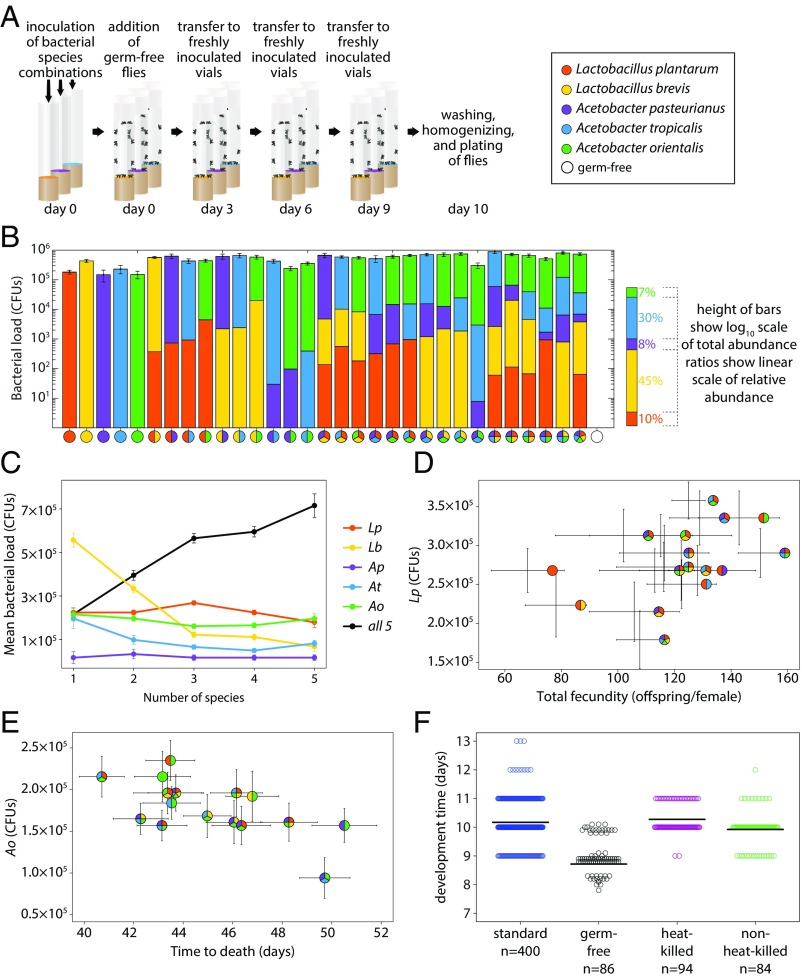
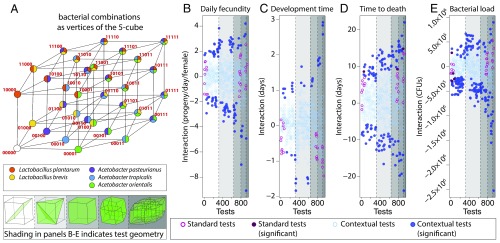
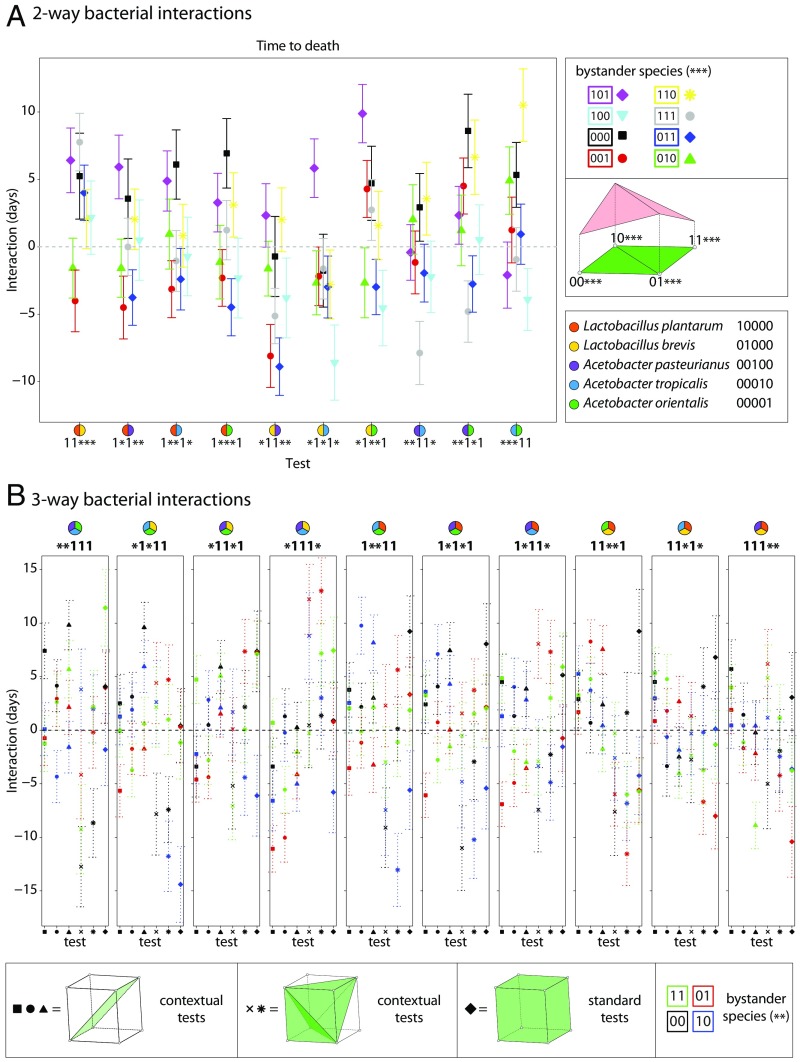
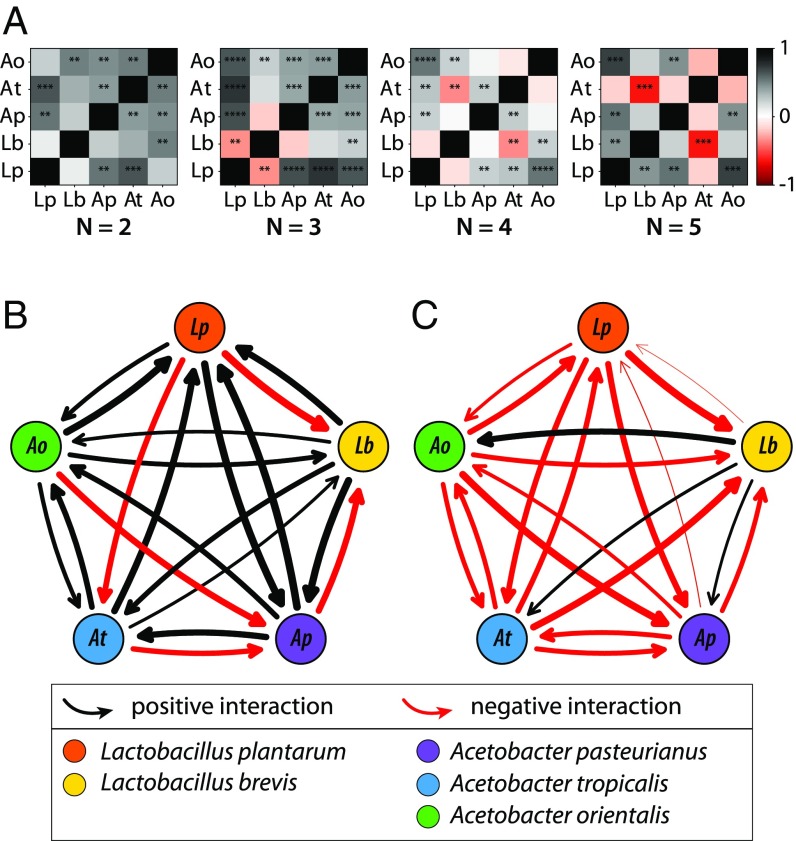
Gut bacteria can affect key aspects of host fitness, such as development, fecundity, and lifespan, while the host, in turn, shapes the gut microbiome. However, it is unclear to what extent individual species versus community interactions within the microbiome are linked to host fitness. Here, we combinatorially dissect the natural microbiome of Drosophila melanogaster and reveal that interactions between bacteria shape host fitness through life history tradeoffs. Empirically, we made germ-free flies colonized with each possible combination of the five core species of fly gut bacteria. We measured the resulting bacterial community abundances and fly fitness traits, including development, reproduction, and lifespan. The fly gut promoted bacterial diversity, which, in turn, accelerated development, reproduction, and aging: Flies that reproduced more died sooner. From these measurements, we calculated the impact of bacterial interactions on fly fitness by adapting the mathematics of genetic epistasis to the microbiome. Development and fecundity converged with higher diversity, suggesting minimal dependence on interactions. However, host lifespan and microbiome abundances were highly dependent on interactions between bacterial species. Higher-order interactions (involving three, four, and five species) occurred in 13–44% of possible cases depending on the trait, with the same interactions affecting multiple traits, a reflection of the life history tradeoff. Overall, we found these interactions were frequently context-dependent and often had the same magnitude as individual species themselves, indicating that the interactions can be as important as the individual species in gut microbiomes.
Overview
The claims and statistics of this paper haven’t been checked yet.
Free: it reads the open-access text and checks the first 5 claims that cite a source we can check. Create a free account to check every claim.
Integrity signals
Registry
Cites
Statistics
Figures
Verification
Claims the paper makes
The claims and statistics of this paper haven’t been checked yet.
Free: it reads the open-access text and checks the first 5 claims that cite a source we can check. Create a free account to check every claim.
Claims other papers make about this one
Each is checked against this paper’s own text: does it say what the citing paper says it does?
In the citing paper
“Recent animal studies have shown that the host fitness is regulated by functional interactions among species, not by a single or a limited group of taxa [139]”
From Gut Microbiota, Muscle Mass and Function in Aging: A Focus on Physical Frailty and Sarcopenia (2019) · cites this paper as [139]
Self-check
Percentages, sums and reported differences re-computed from the paper’s own numbers.
The self-check needs the paper’s full text.
Citations
Cites
The human microbiome: at the interface of health and disease
Cho, I., & Blaser, M. J. (2012) · Nature Reviews Genetics · doi:10.1038/nrg3182 · Cited by 3,449 · cited 1×
“These observations set up two major questions: What is the role of an individual bacterial species versus interactions between them in determining host lifespan, and how is the microbiome effect on lifespan related to overall host fitness? Identifying the host effects of specific bacteria has been difficult, in part,…”
BackgroundWill a Large Complex System be Stable?
MAY, R. M. (1972) · Nature · doi:10.1038/238413a0 · Cited by 2,869
Trade-Offs in Life-History Evolution
Stearns, S. C. (1989) · Functional Ecology · doi:10.2307/2389364 · Cited by 2,852 · cited 1×
“We therefore set up an experiment to measure how defined species compositions change each of the host fitness traits of lifespan, fecundity, and development time, which have been found to covary in life history tradeoffs (5, 6).”
MethodON THE USE OF MATRICES IN CERTAIN POPULATION MATHEMATICS
LESLIE, P. H. (1945) · Biometrika · doi:10.1093/biomet/33.3.183 · Cited by 2,671 · cited 1×
“To address this question, we combined our data for development, fecundity, and lifespan (SI Appendix, Table S1) in a Leslie matrix (26), a classic model of discrete population growth, to calculate organismal fitness under each bacterial association.”
MethodAcquisition and Allocation of Resources: Their Influence on Variation in Life History Tactics
van Noordwijk, A. J., & de Jong, G. (1986) · The American Naturalist · doi:10.1086/284547 · Cited by 2,383
The Long-Term Stability of the Human Gut Microbiota
Faith, J. J., Guruge, J. L., Charbonneau, M., Subramanian, S., Seedorf, H., Goodman, A. L., Clemente, J. C., Knight, R., Heath, A. C., Leibel, R. L., et al. (2013) · Science · doi:10.1126/science.1237439 · Cited by 2,058
Asymmetric Coevolutionary Networks Facilitate Biodiversity Maintenance
Bascompte, J., Jordano, P., & Olesen, J. M. (2006) · Science · doi:10.1126/science.1123412 · Cited by 1,283 · cited 1×
“(35), where asymmetry of interactions is indexed from 0 (perfectly symmetrical) to 2 (exactly opposite).”
BackgroundHost Biology in Light of the Microbiome: Ten Principles of Holobionts and Hologenomes
Bordenstein, S. R., & Theis, K. R. (2015) · PLOS Biology · doi:10.1371/journal.pbio.1002226 · Cited by 1,240 · cited 1×
“Finally, we introduce a mathematical framework to deconstruct microbiome/host complexity by making a conceptual analogy between the bacterial species interactions and genetic epistasis (21, 22).”
MethodMicrobiota-liberated host sugars facilitate post-antibiotic expansion of enteric pathogens
Ng, K. M., Ferreyra, J. A., Higginbottom, S. K., Lynch, J. B., Kashyap, P. C., Gopinath, S., Naidu, N., Choudhury, B., Weimer, B. C., Monack, D. M., et al. (2013) · Nature · doi:10.1038/nature12503 · Cited by 1,035
Innate Immune Homeostasis by the Homeobox Gene Caudal and Commensal-Gut Mutualism in Drosophila
Ryu, J.-H., Kim, S.-H., Lee, H.-Y., Bai, J. Y., Nam, Y.-D., Bae, J.-W., Lee, D. G., Shin, S. C., Ha, E.-M., & Lee, W.-J. (2008) · Science · doi:10.1126/science.1149357 · Cited by 829
Cited by
Items 501–600 of 621
Variations in marine microbiomes: from habitat to host
Ma, L. (2022) · Woods Hole Open Access Server (WHOAS) · doi:10.1575/1912/29313
Mikrobiom Przewodu Pokarmowego Człowieka – Wybrane Dane
Tokarz–Deptuła, B., Dudziak, P., Gurgacz, N., & Deptuła, W. (2022) · Postępy Mikrobiologii - Advancements of Microbiology · doi:10.2478/am-2022-023 · Cited by 1
The “brain-heart-gut” axis and novel mechanisms of future cardiovascular diseasePreprint
Hu, C. (2022) · Authorea · doi:10.22541/au.167103365.55933131/v1
Intestinal microbiota analyses of five economic fishery resources in the South China Sea
Tang, Y., Zhang, L., Liu, S., Zhou, J., Ren, Z., Qu, X., Li, Y., & Lou, F. (2023) · Comparative Biochemistry and Physiology Part D Genomics and Proteomics · doi:10.1016/j.cbd.2023.101085
Greter, G., Moresi, C., Oswald, S., d’Oplinter, A. D. W., Künzli, D., Barazzone, E. C., Lan, J., Slack, E. M. C., & Arnoldini, M. (2023) · bioRxiv (Cold Spring Harbor Laboratory) · doi:10.1101/2023.06.20.545777
Santiago, M. F. M., & Raulo, A. (2023) · eLife · doi:10.7554/elife.89468
El‐Shehawy, R. M., Luecke-Johansson, S., Brindefalk, B., Breitholtz, M., & Gorokhova, E. (2023) · Research Square · doi:10.21203/rs.3.rs-3248646/v1
Predicting and prioritizing coexistence: learning outcomes via experimentsPreprint
Blonder, B. W., Lim, M., & Godoy, Ó. (2024) · Authorea · doi:10.22541/au.171005255.53998183/v1
Réseaux de communication au sein de communautés microbiennes environnementales
Bernard, C. (2022) · theses.fr (ABES) · doi:10.70675/165de9b0z3cfbz416dz91a5zb86f8cdd5f70
Wang, Y., Baumdicker, F., Schweiger, P., Küenzel, S., & Staubach, F. (2021) · Figshare · doi:10.6084/m9.figshare.16682760
Wang, Y., Baumdicker, F., Schweiger, P., Küenzel, S., & Staubach, F. (2021) · Figshare · doi:10.6084/m9.figshare.16682769
Wang, Y., Baumdicker, F., Schweiger, P., Küenzel, S., & Staubach, F. (2021) · Figshare · doi:10.6084/m9.figshare.16682766
Wang, Y., Baumdicker, F., Schweiger, P., Küenzel, S., & Staubach, F. (2021) · Figshare · doi:10.6084/m9.figshare.16682772
Wang, Y., Baumdicker, F., Schweiger, P., Küenzel, S., & Staubach, F. (2021) · Figshare · doi:10.6084/m9.figshare.16682775
Wang, Y., Baumdicker, F., Schweiger, P., Küenzel, S., & Staubach, F. (2021) · Figshare · doi:10.6084/m9.figshare.16682754
Wang, Y., Baumdicker, F., Schweiger, P., Küenzel, S., & Staubach, F. (2021) · Figshare · doi:10.6084/m9.figshare.16682763
Minton, R. L., & Brak, H. H. (2024) · Journal of Molluscan Studies · doi:10.1093/mollus/eyae021
The Two Genomes of Gilthead Sea Bream (Sparus aurata): a Multi-Omics and Holobiont Approach
Naya-Català, F. (2024) · RiuNet (Universitat Politècnica de València) · doi:10.4995/thesis/10251/205692
Dissecting Impacts of Host-microbiome Interactions on Phytoplankton Microbiome Assembly
Yang, J. W. (2024) · Deep Blue (University of Michigan) · doi:10.7302/23898
Different species of yeast alter lifespan and fecundity of Drosophila melanogaster
Yakovleva, E. Y., Maximova, I. A., Merzlikin, D. S., Качалкин, А. В., & Markov, A. V. (2024) · Журнал общей биологии · doi:10.31857/s0044459624030013
Llanwarne, F., & Dobson, A. J. (2025) · Ecology and Evolution · doi:10.1002/ece3.70853
da Silva, H. (2024) · Digital Library of Theses and Dissertations (Universidade de São Paulo) · doi:10.11606/t.6.2024.tde-07022025-141606
Different Species of Yeast Alter the Lifespan and Fecundity of Drosophila melanogaster
Yakovleva, E. Y., Maximova, I. A., Merzlikin, D. S., Качалкин, А. В., & Markov, A. V. (2025) · Biology Bulletin Reviews · doi:10.1134/s207908642470021x
“As early as 1927, Steinfeld established that fruit flies whose digestive tract was devoid of microbiota lived longer than control flies (cited in: Gould et al., 2018).”
InfluentialSobih, S. E., Lewis, E. L., Kapheim, K. M., & French, S. S. (2025) · bioRxiv (Cold Spring Harbor Laboratory) · doi:10.1101/2025.11.19.689195
Diet-induced transgenerational effects on Drosophila dormancy are not mediated by the microbiome
Lyrakis, M., Dolezal, M., Nolte, V., & Schlötterer, C. (2025) · Journal of Experimental Biology · doi:10.1242/jeb.250069
Sato, M., & Miyazaki, R. (2026) · ISME Communications · doi:10.64898/2025.12.12.694077
Domin, H., Zimmermann, J., Taubenheim, J., Fuentes Reyes, G., Saueressig, L., Prasse, D., Höppner, M., Schmitz, R. A., Hentschel, U., Kaleta, C., et al. (2023) · Figshare · doi:10.6084/m9.figshare.24585942
Zhang, S., Li, B., Zeng, L., Yang, K., Jiang, J., 卢芳国, Li, L., & Li, W. (2024) · Figshare · doi:10.6084/m9.figshare.26706480
Henry, L. P., & Ayroles, J. F. (2021) · Figshare · doi:10.6084/m9.figshare.14396895
Henry, L. P., & Ayroles, J. F. (2021) · Figshare · doi:10.6084/m9.figshare.14396889
Henry, L. P., & Ayroles, J. F. (2021) · Figshare · doi:10.6084/m9.figshare.14396886
Zhang, S., Li, B., Zeng, L., Yang, K., Jiang, J., 卢芳国, Li, L., & Li, W. (2024) · Figshare · doi:10.6084/m9.figshare.26706465
Zhang, S., Li, B., Zeng, L., Yang, K., Jiang, J., Lu, F., Li, L., & Li, W. (2024) · Figshare · doi:10.6084/m9.figshare.26706468
Effect of among-microbe interactions on Drosophila melanogaster nutrition
McMullen, J. G. (2020) · eCommons (Cornell University) · doi:10.7298/2d6x-1d23 · Cited by 2
Henry, L. P., & Ayroles, J. F. (2021) · Figshare · doi:10.6084/m9.figshare.14396892
Guilhot, R., Rombaut, A., Xuéreb, A., Howell, K., & Fellous, S. (2021) · Figshare · doi:10.6084/m9.figshare.16727553
Henry, L. P., & Ayroles, J. F. (2021) · Figshare · doi:10.6084/m9.figshare.14396883
Loftus, M., Hassouneh, S. A.-D., & Yooseph, S. (2021) · Figshare · doi:10.6084/m9.figshare.14355517
Domin, H., Zimmermann, J., Taubenheim, J., Fuentes Reyes, G., Saueressig, L., Prasse, D., Höppner, M., Schmitz, R. A., Hentschel, U., Kaleta, C., et al. (2024) · Figshare · doi:10.6084/m9.figshare.24586141
Henry, L. P., & Ayroles, J. F. (2021) · Figshare · doi:10.6084/m9.figshare.14396898
Zhang, S., Li, B., Zeng, L., Yang, K., Jiang, J., Lu, F., Li, L., & Li, W. (2024) · Figshare · doi:10.6084/m9.figshare.26706474
Stothart, M. R., & Newman, A. E. M. (2021) · Figshare · doi:10.6084/m9.figshare.14913743
Wang, Y., Baumdicker, F., Schweiger, P., Küenzel, S., & Staubach, F. (2021) · Figshare · doi:10.6084/m9.figshare.16682757
Zhang, S., Li, B., Zeng, L., Yang, K., Jiang, J., 卢芳国, Li, L., & Li, W. (2024) · Figshare · doi:10.6084/m9.figshare.26706462
Zhang, S., Li, B., Zeng, L., Yang, K., Jiang, J., 卢芳国, Li, L., & Li, W. (2024) · Figshare · doi:10.6084/m9.figshare.26706477
Zhang, S., Li, B., Zeng, L., Yang, K., Jiang, J., 卢芳国, Li, L., & Li, W. (2024) · Figshare · doi:10.6084/m9.figshare.26706471
Griffin, C. (2024) · ScholarSpace (University of Hawaii at Manoa)
Onderzoek naar microbiële interactie netwerken van heterotrofe bacteriën in rivierwater
Bonal, M. (2023) · Lirias
Konicek, K. R. (2024) · ScholarSpace (University of Hawaii at Manoa)
Gause, H. E. (2024) · eScholarship (California Digital Library)
Study of microbial interaction networks among heterotrophic bacteria from river waters
Bonal, M. (2023) · Dépôt institutionnel de l'Université libre de Bruxelles (Université Libre de Bruxelles)
Foltz, A. E. (2024) · Lincoln (University of Nebraska)
Cheaib, B. A. (2020) · Corpus Université Laval (Université Laval)
Bacterial Association Networks from Healthy and Cancer-associated Gut Microbiomes
Loftus, M. (2021) · STARS (University of Central Florida)
Mosquito-associated bacterial communities source from diet and environmental substrates
Weber, D. E. (2023) · ScholarSpace (University of Hawaii at Manoa)
Cross, S. T., Stenglein, M. D., Wilusz, J., Foy, B. D., & Metcalf, J. L. (2020) · Digital Collections of Colorado (Colorado State University) · doi:10.25675/3.04747
Xie, F., & Huang, H.-H. (2025) · arXiv (Cornell University) · doi:10.48550/arxiv.2512.08146
Modeling assembly dynamics and stability of microbial communitiesPreprint
Eilersen, A., Sneppen, K., & Bonhoeffer, S. (2025) · bioRxiv (Cold Spring Harbor Laboratory) · doi:10.64898/2025.12.17.694811
“R Furthermore, some experimental evidence from the study of microbiomes specifically indicates that it is the presence or absence - rather than the abundance - of a given species within the microbiome which shapes host traits (20).”
Marginal link between sociality and gut microbiome in disparate mammalian hosts
Lebeuf‐Taylor, E., & Cottenie, K. (2026) · FEMS Microbes · doi:10.1093/femsmc/xtag004
“The gut microbiome—the community of microbes that inhabits animals’ gastrointestinal tract—can affect host fitness (Gould et al. 2018 , O’Brien et al. 2024 ) and is linked to host metabolism (Martin et al. 2019 ), immunity (Belkaid and Hand 2014 ), and the gut–brain axis (Carabotti et al. 2015 ,…”
Warren, P. K., Miller, G., Kandlikar, G. S., & Ng’oma, E. (2026) · BMC Ecology and Evolution · doi:10.1186/s12862-026-02493-0
“Microorganisms are deeply integrated into host biology across taxonomic and functional scales, playing critical roles in organismal performance and fitness (Ley et al. 2008; Muegge et al. 2011; Gould et al. 2018).”
Host traits and environmental factors shape infection heterogeneity in wild rat–protozoa networks
Markfeld, M., Talpaz, I., Biton, B., Randriamoria, T. M., Soarimalala, V., Goodman, S. M., Nunn, C. L., Titcomb, G., & Pilosof, S. (2026) · ISME Communications · doi:10.1093/ismeco/ycag026 · Cited by 1
“The host microbiome is also a key modulator, shaping susceptibility via its effects on immunity, metabolism, and overall health [38, 39].”
Environmental temperature is a strong driver of subspecies competition in the Drosophila microbiome
Gracia-Alvira, B., Migotti, S., Tian, X., Nolte, V., & Schlötterer, C. (2026) · eLife · doi:10.7554/elife.110808
Scheuerl, T., & Rivett, D. W. (2026) · Environmental Microbiology · doi:10.1111/1462-2920.70255
“On the other hand, there are several examples that mutualistic interactions facilitate co-evolutionary trajectories (Gould et al. 2018; Li et al. 2021), so the sign of interactions may have an important impact on evolutionary trajectories (Box 1).”
Khan, R. U., Zhang, B., Liu, H., Wu, W., Yang, J., Ma, Y.-C., Zou, C., & Jin, P. (2026) · Microorganisms · doi:10.3390/microorganisms14030551
“Understanding these interactions requires categorizing the microbiome into three classes of effects—microbe-to-host, host-to-microbe, and microbe-to-microbe—each with distinct evolutionary characteristics [2].”
Ali, W., Kim, M.-S., Jeong, H., Kim, D., Monchy, S., Li, L. L., Hilal, M. G., Naz, D., Benali, S., Thery, J., et al. (2026) · Marine Pollution Bulletin · doi:10.1016/j.marpolbul.2026.119561
StrataBionn: a neural network supervised classification method for microbial communitiesPreprint
Symons, A. E., Huynh, A. V., & Cornejo, O. E. (2026) · bioRxiv (Cold Spring Harbor Laboratory) · doi:10.64898/2026.03.31.715659
Les communautés microbiennes au sein des populations de tiques : origine, diversité et structure
Binetruy, F. (2019) · theses.fr (ABES) · doi:10.70675/bbc486a6z72faz4bfazb023zc92b9ecfbbe9
“Ainsi de récentes études ont montré l’impact de ces interactions sur le microbiome d’une part et sur l’hôte d’autre part (Bauer et al., 2018 ; Coyte et al., 2015 ; Coyte and Rakoff-Nahoum, 2019 ; Gould et al., 2018 ; Rakoff-Nahoum et al., 2016).”
BackgroundAruçi, E. (2023) · theses.fr (ABES) · doi:10.70675/87239574zb878z46fazb9c4z46257efd2a21 · Cited by 1
Agyapong, D., Chiquet, J., Marks, J. C., & Hocking, T. D. (2026) · arXiv (Cornell University) · doi:10.48550/arxiv.2604.03853
“Host fitness 2018 (Gould et al., 2018) is a five-species Drosophila gut system in which pair-vs-singleton colony counts were linked to host reproductive fitness.”
Šigutová, H., Geislerová, P., Šigut, M., & Pyszko, P. (2026) · Environmental Pollution · doi:10.1016/j.envpol.2026.128065
Impact des efflorescences de cyanobactéries sur le microbiome intestinal de poissons téléostéens
Gallet, A. (2021) · theses.fr (ABES) · doi:10.70675/2513de31z4297z4277z8bc3z38e8767d2005
Dantan, L. (2023) · theses.fr (ABES) · doi:10.70675/0a54b0e1ze078z47a3z948az4f0df95d7329 · Cited by 1
Paulino, S. (2024) · theses.fr (ABES) · doi:10.70675/214acb50ze604z4797z99fbzf444e0a44409
Savio, C. (2023) · theses.fr (ABES) · doi:10.70675/d9be4ec5zf08fz40e7zab42zb9088ed872f9 · Cited by 1
Mathematical modeling of biological systems in symbiotic interaction
Ondoua, D. (2023) · theses.fr (ABES) · doi:10.70675/b9501ea8z6ebcz4662zabe6z611b57f99d80 · Cited by 1
Exploring the impact of bacterial detection on Drosophila melanogaster feeding behavior
Montanari, M. (2023) · theses.fr (ABES) · doi:10.70675/6610bdebzd349z4317zbc41z656024221b01
Guo, X., Li, M., Ahmad, M., Liu, X., Zhang, S., Yu, Z., Zhao, Y., Sun, H., & Zhang, Y. (2026) · Marine Pollution Bulletin · doi:10.1016/j.marpolbul.2026.119760
Microbe-dependent inter-organ communication regulates germline stem cell proliferation in DrosophilaPreprint
Suyama, R., Zhao, M., Mori, H., Akiyoshi, H., Kawaguchi, S., Fatimah, R. M., Suzuki, Y., Arakawa, K., Yew, J. Y., & Kai, T. (2026) · bioRxiv (Cold Spring Harbor Laboratory) · doi:10.64898/2026.04.27.717131
Environmental temperature is a strong driver of subspecies competition in the Drosophila microbiomePreprint
Gracia-Alvira, B., Migotti, S., Tian, X., Nolte, V., & Schlötterer, C. (2026) · eLife · doi:10.7554/elife.110808.1
Gracia-Alvira, B., Migotti, S., Tian, X., Nolte, V., & Schlötterer, C. (2026) · eLife · doi:10.7554/elife.110808.2.sa0
Hou, P., Liu, L., Yang, D., & Zhang, C. (2026) · Insects · doi:10.3390/insects17050519
“Numerous studies have confirmed that integrating gut bacterial characterization with insect growth, development, and reproduction is a critical perspective for exploring host–bacteria interaction mechanisms and an indispensable component for developing innovative pest management strategies [20–23].”
Yan, G., Wang, S., Li, D., Liu, R., Zhang, Z., Zhang, Z., & Kan, Y. (2026) · Journal of Economic Entomology · doi:10.1093/jee/toag074
Uncovering Mechanistic Determinants of Host Phenotypes Using Microbial Systems Biology
Sumner, J. T., & Hartmann, E. M. (2026) · Integrative and Comparative Biology · doi:10.1093/icb/icag052
Molecular mechanisms of commensal resilience during intestinal inflammation
Arias-Rojas, A. (2024) · Refubium (Universitätsbibliothek der Freien Universität Berlin) · doi:10.17169/refubium-45968
Gentil, A., Martin, E., Vallon, L., Tsirikhova, I., Gervaix, J., Fildier, A., Wiest, L., Vulliet, E., Cantarel, A. A. M., Cazabet, R., et al. (2026) · bioRxiv (Cold Spring Harbor Laboratory) · doi:10.64898/2026.06.01.729185
Bharate, M., Hestetun, J. T., Steen, I. H., & Malaquias, M. A. E. (2026) · Scientific Reports · doi:10.1038/s41598-026-57881-9
Birch, S., Moran, Y., & Reitzel, A. M. (2026) · bioRxiv (Cold Spring Harbor Laboratory) · doi:10.64898/2026.07.23.740364
Bansal, N. (2026) · Lincoln (University of Nebraska)
The latent simplicity of microbial ecological interactionsPreprint
Camacho-Mateu, J., Quirós-Rodríguez, I., Burgio, G., Arrabal, A., Mendaña, A., Fernández-de-Bobadilla, M. D., Benitez‐Dominguez, B., & Sánchez, Á. (2026) · bioRxiv (Cold Spring Harbor Laboratory) · doi:10.64898/2026.07.30.741683
Everett, E., Gore, H., Kallepalli, S., Duffield, K. R., Flor-Weiler, L. B., Marino, J., & Ramirez, J. L. (2026) · Frontiers in Microbiology · doi:10.3389/fmicb.2026.1879658
“This experimental design follows the synthetic community (SynCom) approach, where a defined assemblage of field-derived bacteria is used to colonize germ-free or conventionally reared hosts under controlled conditions (Coon et al., 2014; Sommer et al., 2015; Gould et al., 2018).”
Tian, Y., Ding, M.-Q., Ding, J., Ren, X.-R., Fan, S.-Q., Liu, B.-F., Xing, D., Zhao, L., Zhang, Z.-R., Zhang, L.-Y., et al. (2026) · Microorganisms · doi:10.3390/microorganisms14081700
Indy reduction decreases aging-related dysbiosis in Drosophila
Lesperance, D., Padhi, S., Macro, J., Olson, S., Stanwood, E., Kannan, K., Graveley, B. R., Rogina, B., & Broderick, N. A. (2026) · Aging · doi:10.18632/aging.206408
“Based on their genomes, Acetobacter is predicted to produce succinate while Lactobacillus likely consumes both succinate and citrate [48, 49], meaning that cross-feeding between gut microbes likely contributes to metabolite flux, resulting in downstream effects on nutrient cycling [50, 51].”
Kambouris, M. E., Kritikou, S., Milioni, A., Ludovici, G. M., Karageorgou, K., & Velegraki, A. (2026) · bioRxiv (Cold Spring Harbor Laboratory) · doi:10.64898/2026.08.10.743807
“However, the microbial presence in biocompartments previously considered sterile 30 and the intrinsic associations of microbiota within appendage microbiomes 31–33 also carry a degree of uncertainty.”
Abraham, J. O., Leventis, R., Titcomb, G., Dobson, A. P., Moeller, A. H., & Graham, A. L. (2026) · Biology Letters · doi:10.1098/rsbl.2026.0248
“Negative associations might result from competition for host resources [30,31], immune trade-offs (e.g. Th1 versus Th2 immunity [33–35]) and direct nematode–bacteria interactions (e.g. predator–prey interactions), whereas positive associations, which were most common in our analyses, may reflect…”
Qixiu, C., Chen, H., Hu, S., Dai, Y., Cui, Y., Zhang, Y., Ping, M., Li, X., & Chen, J. (2026) · 3 Biotech · doi:10.1007/s13205-026-05024-2
“Plants are known to actively modulate their associated microbiomes to optimize fitness across different life stages (Gould et al. 2018).”
Feckler, A., Siebert, H. M., Anabelle, E., Cant, A., Esposti, D. D., Breiner, H., Stoeck, T., & Bundschuh, M. (2026) · Journal of Hazardous Materials · doi:10.1016/j.jhazmat.2026.143570
Reproductive Success Dependencies of Gut Microbiome: Insights from a Wild Population of Blue TitsPreprint
Cendrowska-Pek, M., Zagalska‐Neubauer, M., Janas, K., Barczyk, J., Arct, A., Cichoń, M., Gustafsson, L., & Drobniak, S. M. (2026) · Authorea · doi:10.22541/authorea.15008666/v1
Metadata
- Authors
- Gould, A. L., Zhang, V., Lamberti, L., Jones, E. W., Obadia, B., Korasidis, N., Gavryushkin, A., Carlson, J. M., Beerenwinkel, N., & Ludington, W. B.
- Affiliations
- University of California, Berkeley (US)
- SIB Swiss Institute of Bioinformatics (CH)
- University of California, Santa Barbara (US)
- ETH Zurich (CH)
- Johns Hopkins University (US)
- Corresponding author
- Ludington, William B.
- ORCID
- Venue
- Proceedings of the National Academy of Sciences
- Publisher
- National Academy of Sciences
- Published
- 2018-12-03
- Volume
- 115
- Issue
- 51
- Pages
- E11951-E11960
- ISSN
- 0027-8424 (ISSN-L)
- 1091-6490
- PMC
- PMC6304949
- OpenAlex
- W2902868023
- Cited by
- 579
- References
- 42
- Citations by year
- 2026: 48 · 2025: 72 · 2024: 67 · 2023: 89 · 2022: 82 · 2021: 101 · 2020: 67 · 2019: 48 · 2018: 4
- FWCI
- 51.76
- Type
- journal article
- Language
- en
- Open access
- hybrid
- doi.org
- Licence
- Locations
- Proceedings of the National Academy of Sciences (publishedVersion, cc-by-nc-nd)
- Europe PMC (PubMed Central) (publishedVersion, cc-by-nc-nd)
- PubMed Central (publishedVersion, cc-by-nc-nd)
- PubMed (publishedVersion)
- Repository for Publications and Research Data (ETH Zurich) (submittedVersion, cc-by-nc-nd)
- ETH Zürich Research Collection
- Funders
- HHS | NIH | NIH Office of the Director (1DP5OD017851-01)
- National Science Foundation (1650114)
- Royal Society of New Zealand (RDF-17-UOO-007)
- David and Lucile Packard Foundation (0000)
- DOD | United States Army | RDECOM | Army Research Office (W911NF-09-0001)
- William K. Bowes, Jr. Foundation (0000)
- Topics
- Life Sciences › Agricultural and Biological Sciences › Insect Science › Insect symbiosis and bacterial influences
- Life Sciences › Biochemistry, Genetics and Molecular Biology › Molecular Biology › Gut microbiota and health
- Life Sciences › Biochemistry, Genetics and Molecular Biology › Genetics › Evolution and Genetic Dynamics
- Keywords
- gut microbiota, host fitness, Drosophila melanogaster, bacterial interactions, life-history trade-offs, bacterial diversity, lifespan, fecundity, development (biology), epistasis, higher-order interactions, microbiome assembly
- MeSH terms
- Gastrointestinal Microbiome, Host Microbial Interactions, Animals, Bacteria, Drosophila melanogaster, Epistasis, Genetic, Fertility, Germ-Free Life, Longevity, Phenotype, Reproduction, Gastrointestinal Tract, Biodiversity, Microbial Interactions, Microbiota
About these checks
Registry, retraction, Cites and statistics results are computed, not judged, with one exception: a printed reference that no index lists is read once by a model before it counts as a citation error. Claims are extracted by a model and kept only when their quote appears verbatim in the text; each cited source is then checked, with a model’s help, for whether it says what the claim relies on. Those verdicts can be wrong — read the claim’s quote and the cited source before relying on one.
Statistics and arithmetic are recomputed, not judged.
Confidence bands are shown only for fields calibrated on our annotated test set. None is calibrated yet, so no band is shown.
What counts as a claim ›How we measure confidence ›How we check this ›
Are you an author, or do you see a problem with this page? Request a review
Data sources
Bibliographic data: Semantic Scholar, OpenAlex, Crossref.
Contains information from the Semantic Scholar Academic Graph Datasets, made available under the ODC Attribution License (ODC-BY 1.0).
Semantic Scholar’s data is described in: Kinney, R., et al. (2023). The Semantic Scholar Open Data Platform. arXiv:2301.10140.
