

Interpreting contemporary trends in atmospheric methane
Open accessThe DOI matches its Crossref record; 129 of the 129 references it cites were found in a registry or an index.
Abstract
Atmospheric methane plays a major role in controlling climate, yet contemporary methane trends (1982–2017) have defied explanation with numerous, often conflicting, hypotheses proposed in the literature. Specifically, atmospheric observations of methane from 1982 to 2017 have exhibited periods of both increasing concentrations (from 1982 to 2000 and from 2007 to 2017) and stabilization (from 2000 to 2007). Explanations for the increases and stabilization have invoked changes in tropical wetlands, livestock, fossil fuels, biomass burning, and the methane sink. Contradictions in these hypotheses arise because our current observational network cannot unambiguously link recent methane variations to specific sources. This raises some fundamental questions: ( i ) What do we know about sources, sinks, and underlying processes driving observed trends in atmospheric methane? ( ii ) How will global methane respond to changes in anthropogenic emissions? And ( iii ), What future observations could help resolve changes in the methane budget? To address these questions, we discuss potential drivers of atmospheric methane abundances over the last four decades in light of various observational constraints as well as process-based knowledge. While uncertainties in the methane budget exist, they should not detract from the potential of methane emissions mitigation strategies. We show that net-zero cost emission reductions can lead to a declining atmospheric burden, but can take three decades to stabilize. Moving forward, we make recommendations for observations to better constrain contemporary trends in atmospheric methane and to provide mitigation support.
Overview
The claims and statistics of this paper haven’t been checked yet.
Free: it reads the open-access text and checks the first 5 claims that cite a source we can check. Create a free account to check every claim.
Integrity signals
Registry
Cites
Statistics
Figures
Verification
Claims the paper makes
The claims and statistics of this paper haven’t been checked yet.
Free: it reads the open-access text and checks the first 5 claims that cite a source we can check. Create a free account to check every claim.
Claims other papers make about this one
Each is checked against this paper’s own text: does it say what the citing paper says it does?
In the citing paper
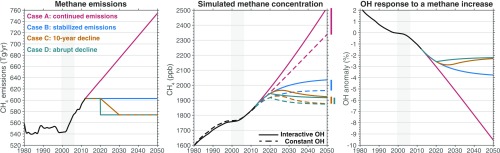
“If emissions of CH4 from anthropogenic and natural sources continue to rise as they have since 2007, this could decrease global mean OH by up to 10% by 2050 [147], increasing the atmospheric lifetime and concentrations of CH4 in a positive feedback.”
From Changes in tropospheric air quality related to the protection of stratospheric ozone in a changing climate (2023) · cites this paper as [147]
Self-check
Percentages, sums and reported differences re-computed from the paper’s own numbers.
The self-check needs the paper’s full text.
Citations
Cites
Thring, M. W. (1977) · Electronics and Power · doi:10.1049/ep.1977.0180 · Cited by 7,338
Carbon and hydrogen isotope systematics of bacterial formation and oxidation of methane
Whiticar, M. J. (1999) · Chemical Geology · doi:10.1016/s0009-2541(99)00092-3 · Cited by 3,146
(2010) · doi:10.5194/acp-10-11707-2010 · Cited by 2,859
Three decades of global methane sources and sinks
Kirschke, S., Bousquet, P., Ciais, P., Saunois, M., Canadell, J. G., Dlugokencky, E. J., Bergamaschi, P., Bergmann, D., Blake, D. R., Bruhwiler, L., et al. (2013) · Nature Geoscience · doi:10.1038/ngeo1955 · Cited by 2,247
Simultaneously Mitigating Near-Term Climate Change and Improving Human Health and Food Security
Shindell, D., Kuylenstierna, J. C. I., Vignati, E., van Dingenen, R., Amann, M., Klimont, Z., Anenberg, S. C., Muller, N., Janssens-Maenhout, G., Raes, F., et al. (2012) · Science · doi:10.1126/science.1210026 · Cited by 1,382
The Total Carbon Column Observing Network
Wunch, D., Toon, G. C., Blavier, J.-F. L., Washenfelder, R. A., Notholt, J., Connor, B. J., Griffith, D. W. T., Sherlock, V., & Wennberg, P. O. (2011) · Philosophical Transactions of the Royal Society A: Mathematical, Physical and Engineering Sciences · doi:10.1098/rsta.2010.0240 · Cited by 1,309
Assessment of methane emissions from the U.S. oil and gas supply chain
Alvarez, R. A., Zavala-Araiza, D., Lyon, D. R., Allen, D. T., Barkley, Z. R., Brandt, A. R., Davis, K. J., Herndon, S. C., Jacob, D. J., Karion, A., et al. (2018) · Science · doi:10.1126/science.aar7204 · Cited by 1,187
Self-citationThe global methane budget 2000–2012
Saunois, M., Bousquet, P., Poulter, B., Peregon, A., Ciais, P., Canadell, J. G., Dlugokencky, E. J., Etiope, G., Bastviken, D., Houweling, S., et al. (2016) · Earth System Science Data · doi:10.5194/essd-8-697-2016 · Cited by 1,060
Self-citationContribution of anthropogenic and natural sources to atmospheric methane variability
Bousquet, P., Ciais, P., Miller, J. B., Dlugokencky, E. J., Hauglustaine, D. A., Prigent, C., Van der Werf, G. R., Peylin, P., Brunke, E.-G., Carouge, C., et al. (2006) · Nature · doi:10.1038/nature05132 · Cited by 996
Three‐dimensional model synthesis of the global methane cycle
Fung, I., John, J., Lerner, J., Matthews, E., Prather, M., Steele, L. P., & Fraser, P. J. (1991) · Journal of Geophysical Research: Atmospheres · doi:10.1029/91jd01247 · Cited by 958
Research works printed but not linked: 1
- IPCC 2013 Climate change 2013: The physical science basis. Contribution of Working Group I to the Fifth Assessment Report of the Intergovernmental Panel on Climate Change, (IPCC, Cambridge Univ Press, New York), Technical Report
Cited by
The Global Methane Budget 2000–2017
Saunois, M., Stavert, A. R., Poulter, B., Bousquet, P., Canadell, J. G., Jackson, R. B., Raymond, P. A., Dlugokencky, E. J., Houweling, S., Patra, P. K., et al. (2019) · doi:10.5194/essd-2019-128 · Cited by 2,760
“The last budget presented in Saunois et al. (2016) has been followed by further syntheses analysing the trends and changes in the methane sources and sinks reported in the Global Methane Budget (Saunois et al., 2017), or extended with additional constraints (Turner et al., 2019).”
InfluentialThe Global Methane Budget 2000–2017
Saunois, M., Stavert, A. R., Poulter, B., Bousquet, P., Canadell, J. G., Jackson, R. B., Raymond, P. A., Dlugokencky, E. J., Houweling, S., Patra, P. K., et al. (2020) · Earth System Science Data · doi:10.5194/essd-12-1561-2020 · Cited by 2,711
Self-citationAtmospheric Chemistry and Physics
(2017) · doi:10.5194/acp-volume17-issue3-editorial · Cited by 2,667
Half of global methane emissions come from highly variable aquatic ecosystem sources
Rosentreter, J. A., Borges, A. V., Deemer, B. R., Holgerson, M. A., Liu, S., Song, C., Melack, J., Raymond, P. A., Duarte, C. M., Allen, G. H., et al. (2021) · Nature Geoscience · doi:10.1038/s41561-021-00715-2 · Cited by 1,061
The global methane budget 2000–2012
Saunois, M., Bousquet, P., Poulter, B., Peregon, A., Ciais, P., Canadell, J. G., Dlugokencky, E. J., Etiope, G., Bastviken, D., Houweling, S., et al. (2016) · Earth System Science Data · doi:10.5194/essd-8-697-2016 · Cited by 1,060
Self-citationCO2 emission sources, greenhouse gases, and the global warming effect
Yoro, K. O., & Daramola, M. O. (2020) · Advances in Carbon Capture · doi:10.1016/b978-0-12-819657-1.00001-3 · Cited by 953
Increasing anthropogenic methane emissions arise equally from agricultural and fossil fuel sources
Jackson, R. B., Saunois, M., Bousquet, P., Canadell, J. G., Poulter, B., Stavert, A. R., Bergamaschi, P., Niwa, Y., Segers, A., & Tsuruta, A. (2020) · Environmental Research Letters · doi:10.1088/1748-9326/ab9ed2 · Cited by 595
“While changes in the sink of methane from atmospheric or soil uptake remains possible (Turner et al 2019), atmospheric chemistry and land-surface models suggest the timescales for sink responses are too slow to explain most of the increased methane in the atmosphere in recent years.”
BackgroundGlobal Methane Budget 2000–2020
Saunois, M., Martinez, A., Poulter, B., Zhang, Z., Raymond, P. A., Regnier, P., Canadell, J. G., Jackson, R. B., Patra, P. K., Bousquet, P., et al. (2025) · Earth System Science Data · doi:10.5194/essd-17-1873-2025 · Cited by 427
Methane Mitigation: Methods to Reduce Emissions, on the Path to the Paris Agreement
Nisbet, E. G., Fisher, R. E., Lowry, D., France, J. L., Allen, G., Bakkaloglu, S., Broderick, T. J., Cain, M., Coleman, M., Fernandez, J., et al. (2020) · Reviews of Geophysics · doi:10.1029/2019rg000675 · Cited by 405
Lorente, A., Borsdorff, T., Butz, A., Hasekamp, O., aan de Brugh, J., Schneider, A., Wu, L., Hase, F., Kivi, R., Wunch, D., et al. (2021) · Atmospheric Measurement Techniques · doi:10.5194/amt-14-665-2021 · Cited by 387
Bais, A. F., Lucas, R. M., Bornman, J. F., Williamson, C. E., Sulzberger, B., Austin, A. T., Wilson, S. R., Andrady, A. L., Bernhard, G., McKenzie, R. L., et al. (2018) · Photochemical & Photobiological Sciences · doi:10.1039/c7pp90043k · Cited by 350
Beyond CO2 equivalence: The impacts of methane on climate, ecosystems, and health
Mar, K. A., Unger, C., Walderdorff, L., & Butler, T. (2022) · Environmental Science & Policy · doi:10.1016/j.envsci.2022.03.027 · Cited by 331
Wetland emission and atmospheric sink changes explain methane growth in 2020
Peng, S., Lin, X., Thompson, R. L., Xi, Y., Liu, G., Hauglustaine, D., Lan, X., Poulter, B., Ramonet, M., Saunois, M., et al. (2022) · Nature · doi:10.1038/s41586-022-05447-w · Cited by 306
A synthesis of methane emissions from shallow vegetated coastal ecosystems
Al‐Haj, A. N., & Fulweiler, R. W. (2020) · Global Change Biology · doi:10.1111/gcb.15046 · Cited by 289
A Review of Methane Gas Detection Sensors: Recent Developments and Future Perspectives
Aldhafeeri, T. R., Tran, M., Vrolyk, R., Pope, M. A., & Fowler, M. W. (2020) · Inventions · doi:10.3390/inventions5030028 · Cited by 282
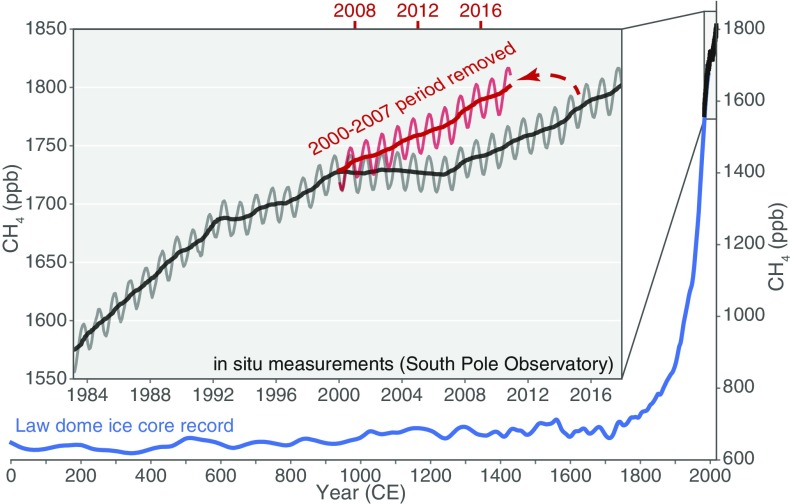
“With the onset of the industrial revolution, atmospheric methane concentration has increased dramatically from approximately 800 parts per billion (ppb) in the early 1900s to upwards of 1800 ppb in 2016 [2].”
BackgroundFLUXNET-CH4 Synthesis Activity: Objectives, Observations, and Future Directions
Knox, S. H., Jackson, R. B., Poulter, B., McNicol, G., Fluet-Chouinard, E., Zhang, Z., Hugelius, G., Bousquet, P., Canadell, J. G., Saunois, M., et al. (2019) · Bulletin of the American Meteorological Society · doi:10.1175/bams-d-18-0268.1 · Cited by 261
Zheng, B., Chevallier, F., Yin, Y., Ciais, P., Fortems-Cheiney, A., Deeter, M. N., Parker, R. J., Wang, Y., Worden, H. M., & Zhao, Y. (2019) · Earth System Science Data · doi:10.5194/essd-11-1411-2019 · Cited by 232
Rising methane: A new climate challenge
Fletcher, S. E. M., & Schaefer, H. (2019) · Science · doi:10.1126/science.aax1828 · Cited by 192
Reisinger, A. R., Clark, H., Cowie, A., Emmet‐Booth, J., Fischer, C. G., Herrero, M., Howden, M. S., & Leahy, S. C. (2021) · Philosophical Transactions of the Royal Society A Mathematical Physical and Engineering Sciences · doi:10.1098/rsta.2020.0452 · Cited by 185
Laughner, J. L., Neu, J. L., SCHIMEL, D. S., Wennberg, P. O., Barsanti, K. C., Bowman, K. W., Chatterjee, A., Croes, B. E., Fitzmaurice, H. L., Henze, D. K., et al. (2021) · Proceedings of the National Academy of Sciences · doi:10.1073/pnas.2109481118 · Cited by 174
“7D), they also have an outsized impact on atmospheric CH4 lifetime, as the largest share of CH4 oxidation occurs in the tropics (34).”
BackgroundMethodInfluentialSelf-citationZhao, Y., Saunois, M., Bousquet, P., Lin, X., Berchet, A., Hegglin, M. I., Canadell, J. G., Jackson, R. B., Hauglustaine, D. A., Szopa, S., et al. (2019) · Atmospheric Chemistry and Physics · doi:10.5194/acp-19-13701-2019 · Cited by 134
Wetland hydrological dynamics and methane emissions
Cui, S., Liu, P., Guo, H., Nielsen, C. K., Pullens, J. W. M., Chen, Q., Pugliese, L., & Wu, S. (2024) · Communications Earth & Environment · doi:10.1038/s43247-024-01635-w · Cited by 168
Zhang, G., Xiao, X., Dong, J., Xin, F., Zhang, Y., Qin, Y., Doughty, R., & Moore, B. (2020) · Nature Communications · doi:10.1038/s41467-019-14155-5 · Cited by 163
Daily Satellite Observations of Methane from Oil and Gas Production Regions in the United States
de Gouw, J. A., Veefkind, P. J., Roosenbrand, E., Dix, B. K., Lin, J. C., Landgraf, J., & Levelt, P. F. (2020) · Scientific Reports · doi:10.1038/s41598-020-57678-4 · Cited by 163
Foote, M. D., Dennison, P. E., Thorpe, A. K., Thompson, D. R., Jongaramrungruang, S., Frankenberg, C., & Joshi, S. C. (2020) · IEEE Transactions on Geoscience and Remote Sensing · doi:10.1109/tgrs.2020.2976888 · Cited by 162
“After a short stable period from 1999 to 2006, atmospheric methane concentration has continued to rise [5]–[7], fueling uncertainty about the partitioning between natural and anthropogenic sources in the global methane budget [1], [8], [9].”
BackgroundSelf-citationAdvancing Scientific Understanding of the Global Methane Budget in Support of the Paris Agreement
Ganesan, A. L., Schwietzke, S., Poulter, B., Arnold, T., Lan, X., Rigby, M., Vogel, F. R., van der Werf, G. R., Janssens‐Maenhout, G., Boesch, H., et al. (2019) · Global Biogeochemical Cycles · doi:10.1029/2018gb006065 · Cited by 161
Ramaswamy, V., Collins, W. D., Haywood, J., Lean, J. L., Mahowald, N. M., Myhre, G., Naïk, V., Shine, K. P., Soden, B. J., Stenchikov, G. L., et al. (2019) · Meteorological Monographs · doi:10.1175/amsmonographs-d-19-0001.1 · Cited by 163
Trends in global tropospheric hydroxyl radical and methane lifetime since 1850 from AerChemMIP
Stevenson, D. S., Zhao, A., Naik, V., O'Connor, F. M., Tilmes, S., Zeng, G., Murray, L. T., Collins, W. J., Griffiths, P. T., Shim, S., et al. (2020) · Atmospheric Chemistry and Physics · doi:10.5194/acp-20-12905-2020 · Cited by 159
Thorpe, A. K., Green, R. O., Thompson, D. R., Brodrick, P. G., Chapman, J. W., Elder, C. D., Irakulis‐Loitxate, I., Cusworth, D., Ayasse, A. K., Duren, R., et al. (2023) · Science Advances · doi:10.1126/sciadv.adh2391 · Cited by 158
“Large uncertainties remain regarding partitioning between these sources and the cause of recent changes in the atmospheric growth rate of methane ( 9 , 10 ).”
BackgroundSelf-citationLindstad, E., Eskeland, G. S., Rialland, A., & Valland, A. (2020) · Sustainability · doi:10.3390/su12218793 · Cited by 149
Feng, L., Palmer, P. I., Zhu, S., Parker, R. J., & Liu, Y. (2022) · Nature Communications · doi:10.1038/s41467-022-28989-z · Cited by 148
“Our a priori CO2 flux inventory includes (1) monthly biomass burning emission83; (2) monthly fossil fuel emissions84; (3) monthly climatological ocean fluxes85; and (4) 3-hourly terrestrial biosphere fluxes86.”
Lunt, M. F., Palmer, P. I., Feng, L., Taylor, C. M., Boesch, H., & Parker, R. J. (2019) · Atmospheric chemistry and physics · doi:10.5194/acp-19-14721-2019 · Cited by 145
“However, δ13CH4 source signatures for different microbial sources and their variation over time are not well characterized (Turner et al., 2019).”
Correcting model biases of CO in East Asia: impact on oxidant distributions during KORUS-AQ
Gaubert, B., Emmons, L. K., Raeder, K., Tilmes, S., Miyazaki, K., Arellano, A. F., Elguindi, N., Granier, C., Tang, W., Barré, J., et al. (2020) · Atmospheric chemistry and physics · doi:10.5194/acp-20-14617-2020 · Cited by 143
Boreal–Arctic wetland methane emissions modulated by warming and vegetation activity
Yuan, K., Li, F., McNicol, G., Chen, M., Hoyt, A. M., Knox, S., Riley, W. J., Jackson, R. B., & Zhu, Q. (2024) · Nature Climate Change · doi:10.1038/s41558-024-01933-3 · Cited by 137
“25), limiting reliable conclusions on natural and anthropogenic fluxes for the global CH 4 budget 6,24,25 .”
Architecture for microcomb-based GHz-mid-infrared dual-comb spectroscopy
Bao, C., Yuan, Z., Wu, L., Suh, M., Wang, H., Lin, Q., & Vahala, K. J. (2021) · Nature Communications · doi:10.1038/s41467-021-26958-6 · Cited by 129
Bernhard, G. H., Neale, R. E., Barnes, P. W., Neale, P. J., Zepp, R. G., Wilson, S. R., Andrady, A. L., Bais, A. F., McKenzie, R. L., Aucamp, P. J., et al. (2020) · Photochemical & Photobiological Sciences · doi:10.1039/d0pp90011g · Cited by 122
Butler, T. M., Lupaşcu, A., & Nalam, A. (2020) · Atmospheric chemistry and physics · doi:10.5194/acp-20-10707-2020 · Cited by 121
Maazallahi, H., Fernandez, J. M., Menoud, M., Zavala‐Araiza, D., Weller, Z. D., Schwietzke, S., von Fischer, J. C., van der Gon, H. D., & Röckmann, T. (2020) · Atmospheric chemistry and physics · doi:10.5194/acp-20-14717-2020 · Cited by 119
Recent Advances Toward Transparent Methane Emissions Monitoring: A Review
Erland, B. M., Thorpe, A. K., & Gamon, J. A. (2022) · Environmental Science & Technology · doi:10.1021/acs.est.2c02136 · Cited by 121
Skeie, R. B., Hodnebrog, Ø., & Myhre, G. (2023) · Communications Earth & Environment · doi:10.1038/s43247-023-00969-1 · Cited by 117
Verrucomicrobial methanotrophs: ecophysiology of metabolically versatile acidophiles
Schmitz, R. A., Peeters, S. H., Versantvoort, W., Picone, N., Pol, A., Jetten, M. S. M., & den Camp, H. J. M. O. (2021) · FEMS Microbiology Reviews · doi:10.1093/femsre/fuab007 · Cited by 118
“In addition, specialised high-affinity methanotrophs present in soil seem to oxidise methane from the atmosphere, although only present at a very low concentration (Holmes et al. 1999; Cai et al. 2016; Tveit et al. 2019).”
BackgroundA 130‐year global inventory of methane emissions from livestock: Trends, patterns, and drivers
Zhang, L., Tian, H., Shi, H., Pan, S., Chang, J., Dangal, S. R. S., Qin, X., Wang, S., Tubiello, F. N., Canadell, J. G., et al. (2022) · Global Change Biology · doi:10.1111/gcb.16280 · Cited by 112
“Additionally, historical CH4 emissions also have a legacy, although shorter than other long- lived greenhouse gases, on changes in the climate system (Bergamaschi et al., 2018; Turner et al., 2019).”
BackgroundMcNicol, G., Fluet‐Chouinard, E., Ouyang, Z., Knox, S., Zhang, Z., Aalto, T., Bansal, S., Chang, K., Chen, M., Delwiche, K., et al. (2023) · AGU Advances · doi:10.1029/2023av000956 · Cited by 112
“The short atmospheric lifetime of CH 4 also promises relatively fast climate change mitigation effects following CH 4 emissions reductions, rather than century-or-more timescales for CO 2 reductions (Abernethy et al., 2021; Turner et al., 2019).”
BackgroundInfluentialA New Divergence Method to Quantify Methane Emissions Using Observations of Sentinel‐5P TROPOMI
Liu, M., Ronald van der, A., van Weele, M., Eskes, H. J., Lu, X. H., Veefkind, P. J., de Laat, J., Kong, H., Wang, J., Sun, J., et al. (2021) · Geophysical Research Letters · doi:10.1029/2021gl094151 · Cited by 109
“In-situ measurements show a continuous increase of methane over the last decades (Dlugokencky et al., 2009; IPCC, 2013; Saunois et al., 2016; Turner et al., 2019), with stable concentrations from 2000 to 2006 (Dlugokencky et al.”
BackgroundGRiMeDB: the Global River Methane Database of concentrations and fluxes
Stanley, E. H., Loken, L. C., Casson, N. J., Oliver, S. K., Sponseller, R. A., Wallin, M. B., Zhang, L., & Rocher‐Ros, G. (2023) · Earth system science data · doi:10.5194/essd-15-2879-2023 · Cited by 102
“…but accelerating rate of increase over recent years (NOAA, 2022), the significant contributions of natural sources to the growing atmospheric pool (Turner et al., 2019), and improvements in gas measurement technologies have all contributed to a rapid increase in studies of CH4 dynamics in aquatic…”
BackgroundButler, T., Lupascu, A., & Nalam, A. (2020) · doi:10.5194/acp-2020-436 · Cited by 101
Methane emissions from oil and gas platforms in the North Sea
Riddick, S. N., Mauzerall, D. L., Celia, M. A., Harris, N., Allen, G., Pitt, J., Staunton-Sykes, J., Forster, G. L., Kang, M., Lowry, D. C., et al. (2019) · Atmospheric chemistry and physics · doi:10.5194/acp-19-9787-2019 · Cited by 99
Ma, S., Worden, J. R., Bloom, A. A., Zhang, Y., Poulter, B., Cusworth, D., Yin, Y., Pandey, S., Maasakkers, J. D., Lu, X. H., et al. (2021) · AGU Advances · doi:10.1029/2021av000408 · Cited by 96
Self-citationPaddy rice methane emissions across Monsoon Asia
Ouyang, Z., Jackson, R. B., McNicol, G., Fluet‐Chouinard, E., Runkle, B. R. K., Papale, D., Knox, S., Cooley, S., Delwiche, K., Feron, S. C., et al. (2022) · Remote Sensing of Environment · doi:10.1016/j.rse.2022.113335 · Cited by 94
“The renewed increase in atmospheric CH 4 concentration since 2007 has little consensus as to its cause (Allen, 2016; Nisbet et al., 2014, 2016; Schaefer et al., 2016; Schwietzke et al., 2017; Turner et al., 2019).”
BackgroundYin, Y., Chevallier, F., Ciais, P., Bousquet, P., Saunois, M., Zheng, B., Worden, J. R., Bloom, A. A., Parker, R. J., Jacob, D. J., et al. (2021) · Atmospheric chemistry and physics · doi:10.5194/acp-21-12631-2021 · Cited by 96
Self-citationWorden, J. R., Cusworth, D. H., Qu, Z., Yin, Y., Zhang, Y., Bloom, A. A., Ma, S., Byrne, B. K., Scarpelli, T., Maasakkers, J. D., et al. (2022) · Atmospheric Chemistry and Physics · doi:10.5194/acp-22-6811-2022 · Cited by 90
Andrade, L. D. S., Lima, H. H. L. B., da Silva, C. T. P., Amorim, W. L. D. N., Poço, J. G. R., López‐Castillo, A., Kirillova, M. V., Carvalho, W. A., Kirillov, A. M., & Mandelli, D. (2023) · Coordination Chemistry Reviews · doi:10.1016/j.ccr.2023.215042 · Cited by 87
The role of oxygen in stimulating methane production in wetlands
Wilmoth, J. L., Schaefer, J. K., Schlesinger, D. R., Roth, S. W., Hatcher, P. G., Shoemaker, J. K., & Zhang, X. (2021) · Global Change Biology · doi:10.1111/gcb.15831 · Cited by 86
Optical Methods of Methane Detection
Kwaśny, M., & Bombalska, A. (2023) · Sensors · doi:10.3390/s23052834 · Cited by 86
“The atmospheric methane concentration has increased dramatically from approximately 800 parts per billion (ppb) in the early 1900s to 1800 ppb in 2016 [3].”
BackgroundOn the Causes and Consequences of Recent Trends in Atmospheric Methane
Schaefer, H. (2019) · Current Climate Change Reports · doi:10.1007/s40641-019-00140-z · Cited by 86
Rain-fed pulses of methane from East Africa during 2018–2019 contributed to atmospheric growth rate
Lunt, M. F., Palmer, P. I., Lorente, A., Borsdorff, T., Landgraf, J., Parker, R. J., & Boesch, H. (2021) · Environmental Research Letters · doi:10.1088/1748-9326/abd8fa · Cited by 83
Jones, T., Franklin, J. E., Chen, J., Dietrich, F., Hajny, K. D., Paetzold, J. C., Wenzel, A., Gately, C. K., Gottlieb, E. W., Parker, H. A., et al. (2021) · Atmospheric chemistry and physics · doi:10.5194/acp-21-13131-2021 · Cited by 81
Scientists raise alarm over ‘dangerously fast’ growth in atmospheric methane
Tollefson, J. (2022) · Nature · doi:10.1038/d41586-022-00312-2 · Cited by 81
Fazi, S., Amalfitano, S., Venturi, S., Pacini, N., Vázquez, E., Olaka, L. A., Tassi, F., Crognale, S., Herzsprung, P., Lechtenfeld, O. J., et al. (2021) · Communications Biology · doi:10.1038/s42003-021-02365-x · Cited by 77
The calibration and deployment of a low-cost methane sensor
Riddick, S. N., Mauzerall, D. L., Celia, M. A., Allen, G., Pitt, J., Kang, M., & Riddick, J. C. (2020) · Atmospheric Environment · doi:10.1016/j.atmosenv.2020.117440 · Cited by 76
Anthropogenic emission is the main contributor to the rise of atmospheric methane during 1993–2017
Zhang, Z., Poulter, B., Knox, S., Stavert, A. R., McNicol, G., Fluet‐Chouinard, E., Feinberg, A. I., Zhao, Y., Bousquet, P., Canadell, J. G., et al. (2021) · National Science Review · doi:10.1093/nsr/nwab200 · Cited by 75
“These studies have arrived at divergent and even conflicting conclusions [17], citing increasing emissions (Continued from previous page)”
On the role of trend and variability in the hydroxyl radical (OH) in the global methane budget
Zhao, Y., Saunois, M., Bousquet, P., Lin, X., Berchet, A., Hegglin, M. I., Canadell, J. G., Jackson, R. B., Deushi, M., Jöckel, P., et al. (2020) · Atmospheric Chemistry and Physics · doi:10.5194/acp-20-13011-2020 · Cited by 69
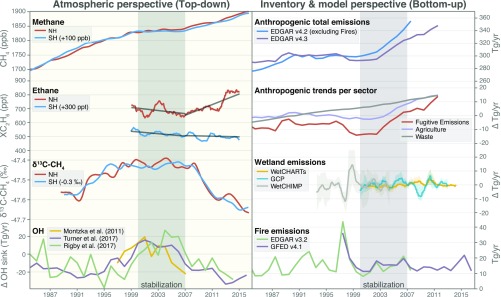
“…the present day, 4 stagnation in CH mixing ratios during 2000–2007 (Dlugokencky, closing gaps in the global CH budget on decadal timescales (e.g., Turner et al., 2019 One of the barriers to understanding atmospheric CH changes is the CH sink, which is mainly the chemical reaction with the…”
BackgroundOh, Y., Zhuang, Q., Welp, L. R., Liu, L., Lan, X., Basu, S., Dlugokencky, E. J., Bruhwiler, L., Miller, J. B., Michel, S., et al. (2022) · Communications Earth & Environment · doi:10.1038/s43247-022-00488-5 · Cited by 68
Zhao, Y., Saunois, M., Bousquet, P., Lin, X., Berchet, A., Hegglin, M. I., Canadell, J. G., Jackson, R. B., Dlugokencky, E. J., Langenfelds, R. L., et al. (2020) · Atmospheric Chemistry and Physics · doi:10.5194/acp-20-9525-2020 · Cited by 57
A machine learning examination of hydroxyl radical differences among model simulations for CCMI-1
Nicely, J. M., Duncan, B. N., Hanisco, T. F., Wolfe, G. M., Salawitch, R. J., Deushi, M., Haslerud, A. S., Jöckel, P., Josse, B., Kinnison, D. E., et al. (2020) · Atmospheric Chemistry and Physics · doi:10.5194/acp-20-1341-2020 · Cited by 52
Han, G., Pei, Z., Shi, T., Mao, H., Li, S., Mao, F., Ma, X., Zhang, X., & Gong, W. Y. (2024) · Geophysical Research Letters · doi:10.1029/2024gl109065 · Cited by 67
“The rapid increase in atmospheric methane concentrations in recent years is of concern (Lan et al., 2022), likely due to concurrent increases in emissions from fossil fuel extraction and microbial sources (Jackson et al., 2020; Peng et al., 2022; Thompson et al., 2018; Turner et al., 2019).”
BackgroundAkimoto, H., & Tanimoto, H. (2022) · Atmospheric Environment · doi:10.1016/j.atmosenv.2022.119033 · Cited by 67
Air pollution modulates trends and variability of the global methane budget
Zhao, Y., Zheng, B., Saunois, M., Ciais, P., Hegglin, M. I., Lu, S., Li, Y., & Bousquet, P. (2025) · Nature · doi:10.1038/s41586-025-09004-z · Cited by 67
“Besides the anthropogenic 4 and wetland emissions 5 , the reaction with OH is also a key factor that modulates trends and variations of the global CH 4 burden 6 .”
Methoxyl stable isotopic constraints on the origins and limits of coal-bed methane
Lloyd, M. K., Trembath‐Reichert, E., Dawson, K. S., Feakins, S. J., Mastalerz, M., Orphan, V. J., Sessions, A. L., & Eiler, J. M. (2021) · Science · doi:10.1126/science.abg0241 · Cited by 66
Madronich, S., Sulzberger, B., Longstreth, J. D., Schikowski, T., Andersen, M. P. S., Solomon, K. R., & Wilson, S. R. (2023) · Photochemical & Photobiological Sciences · doi:10.1007/s43630-023-00369-6 · Cited by 64
“If emissions of CH4 from anthropogenic and natural sources continue to rise as they have since 2007, this could decrease global mean OH by up to 10% by 2050 [147], increasing the atmospheric lifetime and concentrations of CH4 in a positive Fig.”
BackgroundMenoud, M., van der Veen, C., Scheeren, B., Chen, H., Szénási, B., Morales, R., Pison, I., Bousquet, P., Brunner, D., & Röckmann, T. (2020) · Tellus B · doi:10.1080/16000889.2020.1823733 · Cited by 63
“However, information on the emission rates and locations, and the temporal and spatial variability of the different methane sources still includes large uncertainties both at global (Kirschke et al., 2013; Worden et al., 2017; Pandey et al., 2019; Turner et al., 2019) and regional scales (e.”
BackgroundLi, Q., Peng, C. H., Zhang, J., Li, Y., & Song, X. (2021) · Scientific Reports · doi:10.1038/s41598-021-84422-3 · Cited by 62
Barker, P., Allen, G., Gallagher, M. W., Pitt, J., Fisher, R., Bannan, T. J., Nisbet, E. G., Bauguitte, S. J.-B., Pasternak, D., Cliff, S., et al. (2020) · Atmospheric chemistry and physics · doi:10.5194/acp-20-15443-2020 · Cited by 61
Baray, S., Jacob, D. J., Maasakkers, J. D., Sheng, J., Sulprizio, M. P., Jones, D. B. A., Bloom, A. A., & McLaren, R. (2021) · Atmospheric chemistry and physics · doi:10.5194/acp-21-18101-2021 · Cited by 61
Sheng, J., Tunnicliffe, R. L., Ganesan, A. L., Maasakkers, J. D., Shen, L., Prinn, R. G., Song, S., Zhang, Y., Scarpelli, T. R., Bloom, A. A., et al. (2021) · Environmental Research Letters · doi:10.1088/1748-9326/ac24d1 · Cited by 61
Methane (CH 4 ) sources in Krakow, Poland: insights from isotope analysis
Menoud, M., van der Veen, C., Nęcki, J., Bartyzel, J., Szénási, B., Stanisavljević, M., Pison, I., Bousquet, P., & Röckmann, T. (2021) · Atmospheric chemistry and physics · doi:10.5194/acp-21-13167-2021 · Cited by 60
Boy, M. H., Zhou, P., Kurtén, T., Chen, D., Xavier, C., Clusius, P. S., Roldin, P., Baykara, M., Pichelstorfer, L., Foreback, B., et al. (2022) · npj Climate and Atmospheric Science · doi:10.1038/s41612-022-00292-0 · Cited by 60
Sobanaa, M., Prathiviraj, R., Selvin, J., & Prathaban, M. (2023) · Environmental Science and Pollution Research · doi:10.1007/s11356-023-30601-w · Cited by 58
“Anthropogenic indulgence is the prime cause of climate change, converting wetlands into the civil area, population rise, deforestation, burning of fossil fuel, transportation, greenhouse gas emissions (GHGE), and mining (Turner et al. 2019; Kühmaier et al. 2022).”
Yu, X., Millet, D. B., Wells, K. C., Henze, D. K., Cao, H., Griffis, T. J., Kort, E. A., Plant, G., Deventer, M. J., Kolka, R. K., et al. (2021) · Atmospheric chemistry and physics · doi:10.5194/acp-21-951-2021 · Cited by 57
Self-citationZhang, Y., Kang, S., Wei, D., Luo, X., Wang, Z., & Gao, T. (2021) · Fundamental Research · doi:10.1016/j.fmre.2021.04.005 · Cited by 57
de Foy, B., Schauer, J. J., Lorente, A., & Borsdorff, T. (2023) · Environmental Research Letters · doi:10.1088/1748-9326/acc118 · Cited by 56
The Biogeochemical Methane Cycle
Whiticar, M. J. (2020) · Springer eBooks · doi:10.1007/978-3-319-90569-3_5 · Cited by 56
Pimlott, M. A., Pope, R. J., Kerridge, B. J., Latter, B. G., Knappett, D., Heard, D. E., Ventress, L. J., Siddans, R., Feng, W., & Chipperfield, M. P. (2022) · Atmospheric chemistry and physics · doi:10.5194/acp-22-10467-2022 · Cited by 56
Drinkwater, A., Palmer, P. I., Feng, L., Arnold, T., Lan, X., Michel, S., Parker, R. J., & Boesch, H. (2023) · Atmospheric chemistry and physics · doi:10.5194/acp-23-8429-2023 · Cited by 55
Kharitonov, S., Semenov, M. V., Сабреков, А. Ф., Kotsyurbenko, O. R., Zhelezova, A. D., & Schegolkova, N. (2021) · Environments · doi:10.3390/environments8020016 · Cited by 54
Paris, J.-D., Riandet, A., Bourtsoukidis, E., Delmotte, M., Berchet, A., Williams, J., Ernle, L., Tadić, I., Harder, H., & Lelieveld, J. (2021) · Atmospheric chemistry and physics · doi:10.5194/acp-21-12443-2021 · Cited by 54
Andersen, T., Zhao, Z., de Vries, M., Nęcki, J., Swolkień, J., Menoud, M., Röckmann, T., Roiger, A., Fix, A. R., Peters, W., et al. (2023) · Atmospheric chemistry and physics · doi:10.5194/acp-23-5191-2023 · Cited by 56
“However, the magnitudes of CH4 emissions are characterized with high uncertainties (Kirschke et al., 2013; Saunois et al., 2017; Turner et al., 2019), with uncertainties of fossil fuel production and use ranging from 20 % to 35 % (Saunois et al., 2020).”
BackgroundImproving Representation of Tropical Wetland Methane Emissions With CYGNSS Inundation Maps
Gerlein‐Safdi, C., Bloom, A. A., Plant, G., Kort, E. A., & Ruf, C. S. (2021) · Global Biogeochemical Cycles · doi:10.1029/2020gb006890 · Cited by 52
Self-citationThe Atmospheric Carbon and Transport (ACT)-America Mission
Davis, K. J., Browell, E. V., Feng, S., Lauvaux, T., Obland, M. D., Pal, S., Baier, B. C., Baker, D. F., Baker, I., Barkley, Z. R., et al. (2021) · Bulletin of the American Meteorological Society · doi:10.1175/bams-d-20-0300.1 · Cited by 52
“Fluctuations in the global rate of increase of atmospheric CH4 (Nisbet et al. 2014) remain unexplained (Turner et al. 2019).”
BackgroundQuantifying sources of Brazil's CH 4 emissions between 2010 and 2018 from satellite data
Tunnicliffe, R. L., Ganesan, A. L., Parker, R. J., Boesch, H., Gedney, N., Poulter, B., Zhang, Z., Lavrič, J. V., Walter, D., Rigby, M., et al. (2020) · Atmospheric chemistry and physics · doi:10.5194/acp-20-13041-2020 · Cited by 50
Effects of Chemical Feedbacks on Decadal Methane Emissions Estimates
Nguyen, N. H., Turner, A. J., Yin, Y., Prather, M. J., & Frankenberg, C. (2020) · Geophysical Research Letters · doi:10.1029/2019gl085706 · Cited by 47
“The cause of the onset and termination of this stabilization remains debated (see Turner et al., 2019, and references therein for a review of recent trends).”
BackgroundSelf-citationZhang, G., Liu, J., Li, J., Li, P., Wei, N., & Xu, B. (2021) · Fundamental Research · doi:10.1016/j.fmre.2021.03.007 · Cited by 49
Reuter, M., Buchwitz, M., Schneising, O., Noël, S., Bovensmann, H., Burrows, J. P., Boesch, H., Noia, A. D., Anand, J. S., Parker, R. J., et al. (2020) · Atmospheric measurement techniques · doi:10.5194/amt-13-789-2020 · Cited by 47
Practical constraints on atmospheric methane removal
Lackner, K. S. (2020) · Nature Sustainability · doi:10.1038/s41893-020-0496-7 · Cited by 46
Murguía‐Flores, F., Jaramillo, V. J., & Gallego-Sala, A. V. (2023) · Global Biogeochemical Cycles · doi:10.1029/2022gb007601 · Cited by 45
“In recent decades, a proportion of wetlands has been converted to support agroforestry, aquaculture, or cattle grazing all over the tropical regions (Goldberg et al., 2020; Turner et al., 2019).”
BackgroundDetection and long-term quantification of methane emissions from an active landfill
Kumar, P., Caldow, C. G. R., Broquet, G., Shah, A., Laurent, O., Yver-Kwok, C., Ars, S., Defratyka, S., Gichuki, S., Lienhardt, L., et al. (2024) · Atmospheric measurement techniques · doi:10.5194/amt-17-1229-2024 · Cited by 44
“…fractions in the atmosphere reaching up to 1911.88±0.59 parts per billion (ppb) for 2022, more than two-and-a-half times preindustrial levels (Lan et al., 2022; Nisbet et al., 2020), despite a temporary pause between 1998 and 2007 (Bousquet et al., 2006; Rigby et al., 2008; Turner et al., 2019).”
BackgroundInfluentialBakkaloglu, S., Lowry, D. C., Fisher, R., France, J. L., & Nisbet, E. G. (2021) · Waste Management · doi:10.1016/j.wasman.2021.07.012 · Cited by 43
Karacan, C. Ö., Field, R. A., Olczak, M., Kasprzak, M., Ruiz, F. A., & Schwietzke, S. (2024) · International Journal of Coal Geology · doi:10.1016/j.coal.2024.104623 · Cited by 42
Berchet, A., Pison, I., Crill, P., Thornton, B. F., Bousquet, P., Thonat, T., Hocking, T., Thanwerdas, J., Paris, J.-D., & Saunois, M. (2020) · Atmospheric chemistry and physics · doi:10.5194/acp-20-3987-2020 · Cited by 42
Hannun, R. A., Wolfe, G. M., Kawa, S. R., Hanisco, T. F., Newman, P. A., Alfieri, J. G., Barrick, J. D. W., Clark, K. L., DiGangi, J. P., Diskin, G. S., et al. (2020) · Environmental Research Letters · doi:10.1088/1748-9326/ab7391 · Cited by 42
“Published by IOPPublishing Ltd with large uncertainties (>20 Tg yr−1) in magnitudes and ecosystem-dependent responses to climate state (Turner et al 2019).”
Background
Metadata
- Authors
- Turner, A. J., Frankenberg, C., & Kort, E. A.
- Affiliations
- University of California, Berkeley (US)
- California Institute of Technology (US)
- University of Michigan (US)
- Corresponding author
- Turner, Alexander J.
- Frankenberg, Christian
- Kort, Eric A.
- Venue
- Proceedings of the National Academy of Sciences
- Publisher
- National Academy of Sciences
- Published
- 2019-02-07
- Volume
- 116
- Issue
- 8
- Pages
- 2805-2813
- ISSN
- 0027-8424 (ISSN-L)
- 1091-6490
- PMC
- PMC6386658
- OpenAlex
- W2915027405
- Cited by
- 426
- References
- 128
- Citations by year
- 2026: 48 · 2025: 44 · 2024: 70 · 2023: 80 · 2022: 61 · 2021: 62 · 2020: 40 · 2019: 18
- FWCI
- 23.26
- Type
- journal article
- Language
- en
- Open access
- hybrid
- doi.org
- Licence
- Locations
- Proceedings of the National Academy of Sciences (publishedVersion, cc-by-nc-nd)
- Europe PMC (PubMed Central) (publishedVersion, cc-by-nc-nd)
- PubMed Central (publishedVersion, cc-by-nc-nd)
- PubMed (publishedVersion)
- CaltechAUTHORS (California Institute of Technology) (submittedVersion, cc-by-nc-nd)
- NOAA Institutional Repository (submittedVersion)
- Funders
- Adolph C. and Mary Sprague Miller Institute for Basic Research in Science, University of California Berkeley
- Topics
- Physical Sciences › Environmental Science › Global and Planetary Change › Atmospheric and Environmental Gas Dynamics
- Physical Sciences › Earth and Planetary Sciences › Atmospheric Science › Atmospheric chemistry and aerosols
- Physical Sciences › Environmental Science › Environmental Chemistry › Methane Hydrates and Related Phenomena
- Keywords
- atmospheric methane, methane trends, methane budget, methane sources and sinks, tropical wetlands, livestock methane emissions, biomass burning, methane sinks, anthropogenic emissions, methane mitigation, climate change
About these checks
Registry, retraction, Cites and statistics results are computed, not judged, with one exception: a printed reference that no index lists is read once by a model before it counts as a citation error. Claims are extracted by a model and kept only when their quote appears verbatim in the text; each cited source is then checked, with a model’s help, for whether it says what the claim relies on. Those verdicts can be wrong — read the claim’s quote and the cited source before relying on one.
Statistics and arithmetic are recomputed, not judged.
Confidence bands are shown only for fields calibrated on our annotated test set. None is calibrated yet, so no band is shown.
What counts as a claim ›How we measure confidence ›How we check this ›
Are you an author, or do you see a problem with this page? Request a review
Data sources
Bibliographic data: Semantic Scholar, OpenAlex, Crossref.
Contains information from the Semantic Scholar Academic Graph Datasets, made available under the ODC Attribution License (ODC-BY 1.0).
Semantic Scholar’s data is described in: Kinney, R., et al. (2023). The Semantic Scholar Open Data Platform. arXiv:2301.10140.
