

The DOI matches its Crossref record; 17 of the 17 references it cites were found in a registry or an index.
Megalithic tombs in western and northern Neolithic Europe were linked to a kindred society
Abstract
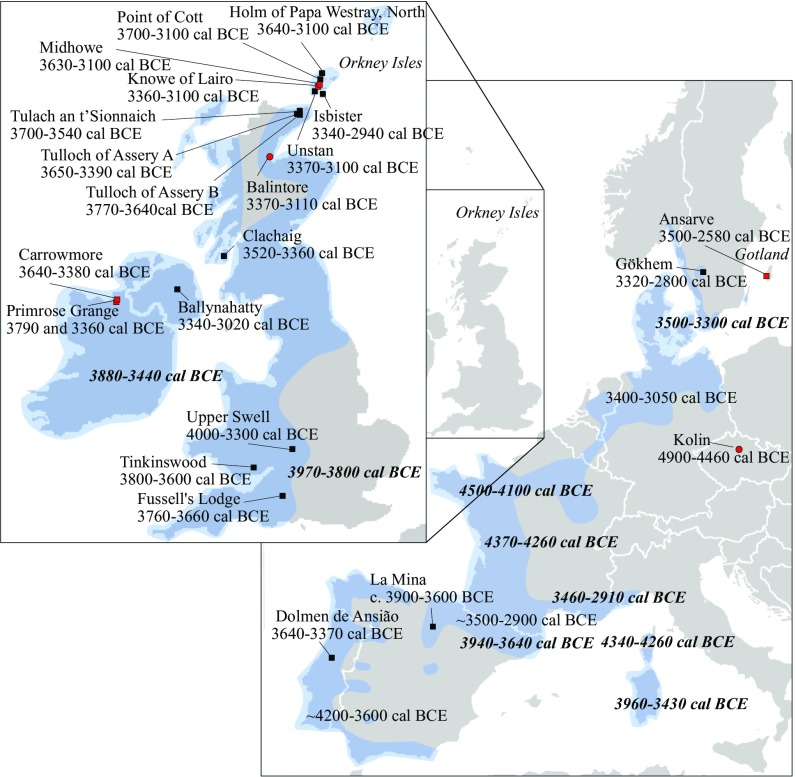
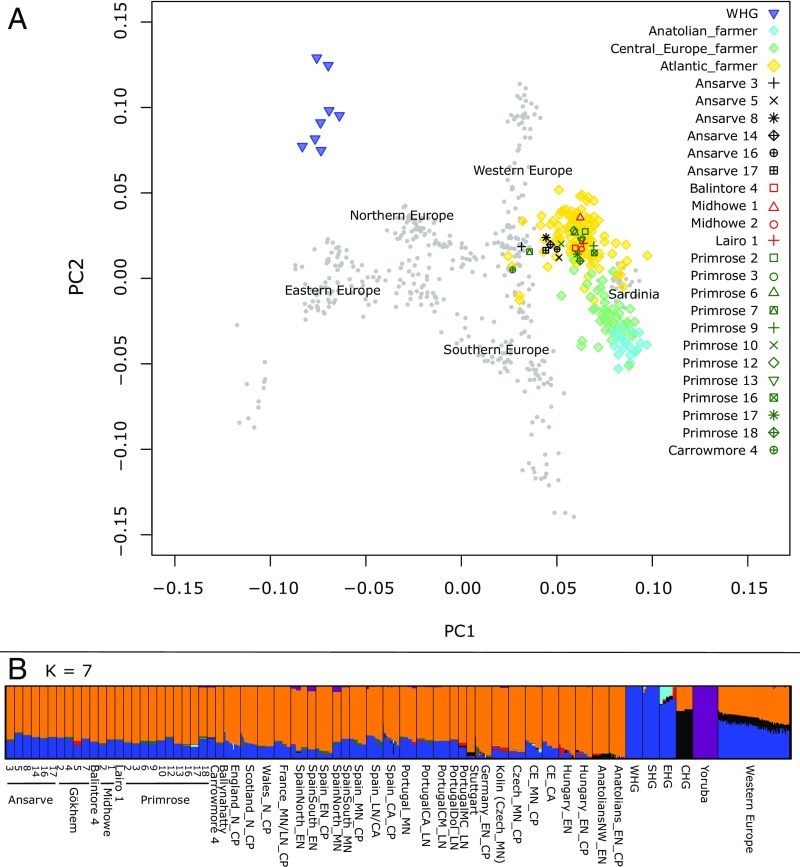
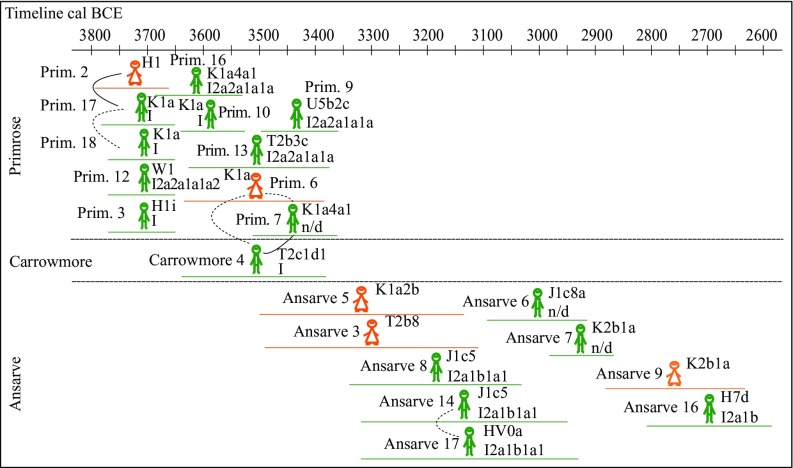
Paleogenomic and archaeological studies show that Neolithic lifeways spread from the Fertile Crescent into Europe around 9000 BCE, reaching northwestern Europe by 4000 BCE. Starting around 4500 BCE, a new phenomenon of constructing megalithic monuments, particularly for funerary practices, emerged along the Atlantic façade. While it has been suggested that the emergence of megaliths was associated with the territories of farming communities, the origin and social structure of the groups that erected them has remained largely unknown. We generated genome sequence data from human remains, corresponding to 24 individuals from five megalithic burial sites, encompassing the widespread tradition of megalithic construction in northern and western Europe, and analyzed our results in relation to the existing European paleogenomic data. The various individuals buried in megaliths show genetic affinities with local farming groups within their different chronological contexts. Individuals buried in megaliths display (past) admixture with local hunter-gatherers, similar to that seen in other Neolithic individuals in Europe. In relation to the tomb populations, we find significantly more males than females buried in the megaliths of the British Isles. The genetic data show close kin relationships among the individuals buried within the megaliths, and for the Irish megaliths, we found a kin relation between individuals buried in different megaliths. We also see paternal continuity through time, including the same Y-chromosome haplotypes reoccurring. These observations suggest that the investigated funerary monuments were associated with patrilineal kindred groups. Our genomic investigation provides insight into the people associated with this long-standing megalith funerary tradition, including their social dynamics.
Overview
The claims and statistics of this paper haven’t been checked yet.
Run the check — free, no account needed. It reads the open-access text and checks the sources it cites.
Integrity signals
Registry
Cites
Statistics
Figures
Verification
Claims the paper makes
The claims and statistics of this paper haven’t been checked yet.
Run the check — free, no account needed. It reads the open-access text and checks the sources it cites.
Claims other papers make about this one
Each is checked against this paper’s own text: does it say what the citing paper says it does?
In the citing paper
“Consistent with the hypothesis of a rapid spread of patrilocality after the Neolithic transition, ancient DNA studies show that male relatedness is often higher than female relatedness within archaeological sites from the Neolithic and the Bronze Age (mostly from Europe).”
From Patrilineal segmentary systems provide a peaceful explanation for the post-Neolithic Y-chromosome bottleneck (2024) · cites this paper as [68]
In the citing paper
“In addition, kinship analyses based on ancient DNA data from the Neolithic and Bronze Age (mostly Europe) showed low frequency of half-brothers and half-sisters67–71,73–77, with the exception of Hazleton North long cairn72.”
From Patrilineal segmentary systems provide a peaceful explanation for the post-Neolithic Y-chromosome bottleneck (2024) · cites this paper as [68]
In the citing paper
“In particular, males tend to share more often the same haplogroup of the Y chromosome, whereas there is a greater diversity of haplogroups for mtDNA67–77.”
From Patrilineal segmentary systems provide a peaceful explanation for the post-Neolithic Y-chromosome bottleneck (2024) · cites this paper as [68]
In the citing paper
“Furthermore, several sites showed evidence of mostly paternal transmission of goods and/or social status (for example refs. 68,69,72,73,75), suggesting patrilineal inheritance systems.”
From Patrilineal segmentary systems provide a peaceful explanation for the post-Neolithic Y-chromosome bottleneck (2024) · cites this paper as [68]
Self-check
Percentages, sums and reported differences re-computed from the paper’s own numbers.
The self-check needs the paper’s full text.
Citations
Cites
Population Structure and Eigenanalysis
Patterson, N., Price, A. L., & Reich, D. (2006) · PLoS Genetics · doi:10.1371/journal.pgen.0020190 · Cited by 5,280
ANGSD: Analysis of Next Generation Sequencing Data
Korneliussen, T. S., Albrechtsen, A., & Nielsen, R. (2014) · BMC Bioinformatics · doi:10.1186/s12859-014-0356-4 · Cited by 2,982
Ancient Admixture in Human History
Patterson, N., Moorjani, P., Luo, Y., Mallick, S., Rohland, N., Zhan, Y., Genschoreck, T., Webster, T., & Reich, D. (2012) · Genetics · doi:10.1534/genetics.112.145037 · Cited by 2,848
Massive migration from the steppe was a source for Indo-European languages in Europe
Haak, W., Lazaridis, I., Patterson, N., Rohland, N., Mallick, S., Llamas, B., Brandt, G., Nordenfelt, S., Harney, E., Stewardson, K., et al. (2015) · Nature · doi:10.1038/nature14317 · Cited by 1,940
Genome-wide patterns of selection in 230 ancient Eurasians
Mathieson, I., Lazaridis, I., Rohland, N., Mallick, S., Patterson, N., Roodenberg, S. A., Harney, E., Stewardson, K., Fernandes, D., Novak, M., et al. (2015) · Nature · doi:10.1038/nature16152 · Cited by 1,515
Dabney, J., Knapp, M., Glocke, I., Gansauge, M.-T., Weihmann, A., Nickel, B., Valdiosera, C., García, N., Pääbo, S., Arsuaga, J.-L., et al. (2013) · Proceedings of the National Academy of Sciences · doi:10.1073/pnas.1314445110 · Cited by 1,443
Ancient human genomes suggest three ancestral populations for present-day Europeans
Lazaridis, I., Patterson, N., Mittnik, A., Renaud, G., Mallick, S., Kirsanow, K., Sudmant, P. H., Schraiber, J. G., Castellano, S., Lipson, M., et al. (2014) · Nature · doi:10.1038/nature13673 · Cited by 1,357
Genomic insights into the origin of farming in the ancient Near East
Lazaridis, I., Nadel, D., Rollefson, G., Merrett, D. C., Rohland, N., Mallick, S., Fernandes, D., Novak, M., Gamarra, B., Sirak, K., et al. (2016) · Nature · doi:10.1038/nature19310 · Cited by 955 · cited 3×
“Individuals from the Scottish “short cist” burial Balintore (n = 1) and the Czech Republic Kolin Rondel site (n = 2) (46), associated with the Stroked Pottery culture, were also investigated.”
A Revised Timescale for Human Evolution Based on Ancient Mitochondrial Genomes
Fu, Q., Mittnik, A., Johnson, P. L. F., Bos, K., Lari, M., Bollongino, R., Sun, C., Giemsch, L., Schmitz, R., Burger, J., et al. (2013) · Current Biology · doi:10.1016/j.cub.2013.02.044 · Cited by 709
Genome flux and stasis in a five millennium transect of European prehistory
Gamba, C., Jones, E. R., Teasdale, M. D., McLaughlin, R. L., Gonzalez-Fortes, G., Mattiangeli, V., Domboróczki, L., Kővári, I., Pap, I., Anders, A., et al. (2014) · Nature Communications · doi:10.1038/ncomms6257 · Cited by 667
Early farmers from across Europe directly descended from Neolithic Aegeans
Hofmanová, Z., Kreutzer, S., Hellenthal, G., Sell, C., Diekmann, Y., Díez-del-Molino, D., van Dorp, L., López, S., Kousathanas, A., Link, V., et al. (2016) · Proceedings of the National Academy of Sciences · doi:10.1073/pnas.1523951113 · Cited by 488
A recent bottleneck of Y chromosome diversity coincides with a global change in culture
Karmin, M., Saag, L., Vicente, M., Sayres, M. A. W., Järve, M., Talas, U. G., Rootsi, S., Ilumäe, A.-M., Mägi, R., Mitt, M., et al. (2015) · Genome Research · doi:10.1101/gr.186684.114 · Cited by 485
Parallel palaeogenomic transects reveal complex genetic history of early European farmers
Lipson, M., Szécsényi-Nagy, A., Mallick, S., Pósa, A., Stégmár, B., Keerl, V., Rohland, N., Stewardson, K., Ferry, M., Michel, M., et al. (2017) · Nature · doi:10.1038/nature24476 · Cited by 389
mapDamage: testing for damage patterns in ancient DNA sequences
Ginolhac, A., Rasmussen, M., Gilbert, M. T. P., Willerslev, E., & Orlando, L. (2011) · Bioinformatics · doi:10.1093/bioinformatics/btr347 · Cited by 363
Estimating genetic kin relationships in prehistoric populations
Monroy Kuhn, J. M., Jakobsson, M., & Günther, T. (2018) · PLOS ONE · doi:10.1371/journal.pone.0195491 · Cited by 330
Self-citationAncient genomes link early farmers from Atapuerca in Spain to modern-day Basques
Günther, T., Valdiosera, C., Malmström, H., Ureña, I., Rodriguez-Varela, R., Sverrisdóttir, Ó. O., Daskalaki, E. A., Skoglund, P., Naidoo, T., Svensson, E. M., et al. (2015) · Proceedings of the National Academy of Sciences · doi:10.1073/pnas.1509851112 · Cited by 278
Self-citationZeng, T. C., Aw, A. J., & Feldman, M. W. (2018) · Nature Communications · doi:10.1038/s41467-018-04375-6 · Cited by 121
Research works printed but not linked: 55
- P Skoglund, , Origins and genetic legacy of Neolithic farmers and hunter-gatherers in Europe. Science 336, 466–469 (2012). · DOI · Paper page
- P Skoglund, , Genomic diversity and admixture differs for Stone-Age Scandinavian foragers and farmers. Science 344, 747–750 (2014). · DOI
- LM Cassidy, , Neolithic and Bronze Age migration to Ireland and establishment of the insular Atlantic genome. Proc Natl Acad Sci USA 113, 368–373 (2016). · DOI
- T Günther, M Jakobsson, Genes mirror migrations and cultures in prehistoric Europe: A population genomic perspective. Curr Opin Genet Dev 41, 115–123 (2016). · DOI
- A Omrak, , Genomic evidence establishes Anatolia as the source of the European Neolithic gene pool. Curr Biol 26, 270–275 (2016). · DOI
- GM Kılınç, , The demographic development of the first farmers in Anatolia. Curr Biol 26, 2659–2666 (2016). · DOI
- C Valdiosera, , Four millennia of Iberian biomolecular prehistory illustrate the impact of prehistoric migrations at the far end of Eurasia. Proc Natl Acad Sci USA 115, 3428–3433 (2018). · DOI
- I Olalde, , A common genetic origin for early farmers from Mediterranean cardial and central European LBK cultures. Mol Biol Evol 32, 3132–3142 (2015).
- R Bradley The Prehistory of Britain and Ireland (Cambridge Univ Press, Cambridge, UK, 2007). · DOI
- I Olalde, , The beaker phenomenon and the genomic transformation of northwest Europe. Nature 555, 190–196 (2018). · DOI · Paper page
- M Fraser People of the Dolmens and Stone Cists: An Archaeogenetic Investigation of Megalithic Graves from the Neolithic Period on Gotland. PhD dissertation (Uppsala University Uppsala Sweden). (2018).
- A Mittnik, , The genetic prehistory of the Baltic Sea region. Nat Commun 9, 442 (2018). · DOI
- R Joussaume Dolmens for the Dead: Megalith-Building Throughout the World (B.T. Batsford, London, 1988).
- AW Whittle Europe in the Neolithic : The Creation of New Worlds (Cambridge Univ Press, Cambridge, UK, 1996).
- JA Sheridan The chronology of Irish megalithic tombs. Stones and Bones: Formal Disposal of the Dead in Atlantic Europe During the Mesolithic-Neolithic Interface 6000–3000 BC . British Archaeological Reports International Series 1201 eds Burenhult G Westergaard S (Archaeopress Oxford UK) pp 69–73. (2003).
- JA Sheridan The Neolithization of Britain and Ireland: The “Big Picture.” Landscapes in Transition Levant Supplementary Series 8 eds Finlayson B Warren GM (Oxbow Oxford UK) pp 89–105. (2010).
- JA Sheridan, Interdigitating pasts: The Irish and Scottish Neolithics. The Neolithic of Europe. Papers in Honour of Alasdair Whittle, eds P Bickle, V Cummings, D Hofmann, J Pollard (Oxbow, Oxford, UK), pp. 298–313 (2017). · DOI
- C Scarre The Megalithic Monuments of Britain and Ireland (Thames and Hudson, New York, 2007).
- M Collard, K Edinborough, S Shennan, MG Thomas, Radiocarbon evidence indicates that migrants introduced farming to Britain. J Archaeol Sci 37, 866–870 (2010). · DOI
- T Darvill, Megalithic tombs, barrows, and enclosures in forth millennium BC Britain. Giants in the landscape: Monumentality and territories in the European Neolithic. Proceedings of the XVII UISPP World Congress (1-7 September, Burgos, Spain), eds V Ard, L Pillot (Archaeopress, Oxford, UK) Vol 3/Session A25d, 3–17 (2016).
- TR McLaughlin, , The changing face of Neolithic and Bronze Age Ireland: A big data approach to the settlement and burial records. J World Prehist 29, 117–153 (2016). · DOI
- B Schulz Paulsson Time and Stone: The Emergence and Development of Megaliths and Megalithic Societies in Europe (Archaeopress, Oxford, UK, 2017). · DOI
- V Cummings, M Midgley, C Scarre, Chambered tombs and passage graves of Western and Northern Europe. The Oxford Handbook of Neolithic Europe, eds C Fowler, J Harding, D Hofmann (Oxford Univ Press, Oxford, UK), pp. 813–838 (2015).
- MS Midgley The Megaliths of Northern Europe (Routledge, London, 2008). · DOI
- M Midgley, Monuments and monumentality: The cosmological model of the world of megaliths. Doc Praehist XXXVII, 55–64 (2010). · DOI
- MS Midgley, Megaliths in North-West Europe. The Oxford Handbook of the Archaeology of Death and Burial, eds L Nilsson-Stut, S Tarlow (Oxford Univ Press, Oxford, UK, 2013).
- A Fleming, Tombs for the living. Man (Lond) 8, 177 (1973).
- A Sherratt, The genesis of megaliths: Monumentality, ethnicity and social complexity in Neolithic North-West Europe. World Archaeol 22, 147–167 (1990). · DOI
- L Klassen Frühes Kupfer im Norden. Untersuchungen zu Chronologie, Herkunft und Bedeutung der Kupferfunde der Nordgruppe der Trichterbecherkultur (Jutland Archaeological Society, Højbjerg, Denmark) Vol 36 (2000).
- J Müller Megaliths and Funnel Beakers: Societies in Change 4100–2700 BC (Drieendertigste Kroon-Voordracht, Amsterdam, 2011).
- EJ Lee, , Collective burials among agro-pastoral societies in later Neolithic Germany: Perspectives from ancient DNA. J Archaeol Sci 51, 174–180 (2014). · DOI
- C Renfrew Before Civilisation: The Radiocarbon Revolution and Prehistoric Europe (Penguin, London, 1973).
- K-G Sjögren, Kinship, labor, and land in Neolithic southwest Sweden: Social aspects of megalithic graves. J Anthropol Archaeol 5, 229–265 (1986). · DOI
- M Furholt, J Müller, The earliest monuments in Europe: Architecture and social structures (5000–3000 cal BC). Early Monuments and Neolithic Societies from the Atlantic to the Baltic, eds M Furholt, F Lüth, J Müller (Frühe Monumentalität und soziale Differenzierung, Bonn, Germany), pp. 15–32 (2011).
- C Renfrew, Megaliths, territories and populations. Acculturation and Continuity in Atlantic Europe, ed SJ de Laet (De Tempel, Bruges, Belgium), pp. 198–220 (1976).
- C Renfrew The Megalithic Monuments of Western Europe (Thames and Hudson, London, 1981).
- H Malmström, , Ancient DNA reveals lack of continuity between Neolithic hunter-gatherers and contemporary Scandinavians. Curr Biol 19, 1758–1762 (2009). · DOI · Paper page
- M Fraser, , New insights on cultural dualism and population structure in the Middle Neolithic Funnel Beaker culture on the island of Gotland. J Archaeol Sci Reports 17, 325–334 (2018). · DOI
- R Martiniano, , The population genomics of archaeological transition in west Iberia: Investigation of ancient substructure using imputation and haplotype-based methods. PLoS Genet 13, e1006852 (2017). · DOI
- S Brace Population replacement in early Neolithic Britain. BioRxiv:10.1101/267443. Preprint posted February 18 2018. (2018). · DOI
- P Rowley-Conwy, Westward ho! Curr Anthropol 52, S431–S451 (2011). · DOI
- M Rivollat, , When the waves of European neolithization met: First paleogenetic evidence from early farmers in the southern Paris basin. PLoS One 10, e0125521 (2015). · DOI
- A Goldberg, T Günther, NA Rosenberg, M Jakobsson, Ancient X chromosomes reveal contrasting sex bias in Neolithic and Bronze Age Eurasian migrations. Proc Natl Acad Sci USA 114, 2657–2662 (2017). · DOI
- ER Jones, , The Neolithic transition in the Baltic was not driven by admixture with early European farmers. Curr Biol 27, 576–582 (2017). · DOI
- T Günther, , Population genomics of Mesolithic Scandinavia: Investigating early postglacial migration routes and high-latitude adaptation. PLoS Biol 16, e2003703 (2018). · DOI
- I Mathieson, , The genomic history of southeastern Europe. Nature 555, 197–203 (2018). · DOI
- DY Yang, B Eng, JS Waye, JC Dudar, SR Saunders, Technical note: Improved DNA extraction from ancient bones using silica-based spin columns. Am J Phys Anthropol 105, 539–543 (1998). · DOI
- M Kircher, Analysis of high-throughput ancient DNA sequencing data. Ancient DNA, Methods in Molecular Biology, eds B Shapiro, M Hofreiter (Humana Press, Totowa, NJ), pp. 197–228 (2012). · DOI · Paper page
- H Li, R Durbin, Fast and accurate short read alignment with Burrows-Wheeler transform. Bioinformatics 25, 1754–1760 (2009). · DOI · Paper page
- G Jun, , Detecting and estimating contamination of human DNA samples in sequencing and array-based genotype data. Am J Hum Genet 91, 839–848 (2012). · DOI · Paper page
- M van Oven, PhyloTree Build 17: Growing the human mitochondrial DNA tree. Forensic Sci International Genet Suppl Ser 5, e392–e394 (2015). · DOI
- H Weissensteiner, , HaploGrep 2: Mitochondrial haplogroup classification in the era of high-throughput sequencing. Nucleic Acids Res 44, W58–W63 (2016). · DOI
- C Wang, , Comparing spatial maps of human population-genetic variation using Procrustes analysis. Stat Appl Genet Mol Biol 9, 13 (2010). · DOI · Paper page
- DH Alexander, J Novembre, K Lange, Fast model-based estimation of ancestry in unrelated individuals. Genome Res 19, 1655–1664 (2009). · DOI · Paper page
- AA Behr, KZ Liu, G Liu-Fang, P Nakka, S Ramachandran, pong: Fast analysis and visualization of latent clusters in population genetic data. Bioinformatics 32, 2817–2823 (2016). · DOI
Cited by
Guyon, L., Guez, J., Toupance, B., Heyer, E., & Chaix, R. (2024) · Nature Communications · doi:10.1038/s41467-024-47618-5 · Cited by 28
Metadata
- Authors
- Sánchez-Quinto, F., Malmström, H., Fraser, M., Girdland-Flink, L., Svensson, E. M., Simões, L. G., George, R., Hollfelder, N., Burenhult, G., Noble, G., Britton, K., Talamo, S., Curtis, N., Brzobohata, H., Sumberova, R., Götherström, A., Storå, J., & Jakobsson, M.
- Venue
- Proceedings of the National Academy of Sciences
- Publisher
- National Academy of Sciences
- Published
- 2019-04-15
- Volume
- 116
- Issue
- 19
- Pages
- 9469-9474
- ISSN
- 0027-8424
- 1091-6490
- PMC
- PMC6511028
- Cited by
- 138
- References
- 17
- Language
- en
- Funders
- Riksbankens Jubileumsfond (M13-0904:1)
- Knut och Alice Wallenbergs Stiftelse (N/A)
- Berit Wallenberg foundation (N/A)
About these checks
Registry, retraction, Cites and statistics results are computed, not judged, with one exception: a printed reference that no index lists is read once by a model before it counts as a citation error. Claims are extracted by a model and kept only when their quote appears verbatim in the text; each cited source is then checked, with a model’s help, for whether it says what the claim relies on. Those verdicts can be wrong — read the claim’s quote and the cited source before relying on one.
Statistics and arithmetic are recomputed, not judged.
Confidence bands are shown only for fields calibrated on our annotated test set. None is calibrated yet, so no band is shown.
What counts as a claim ›How we measure confidence ›How we check this ›
Are you an author, or do you see a problem with this page? Request a review
